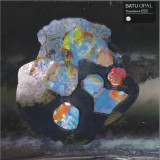
Building on the promise of nearly 10 years testing limits within club music, Batu presents his debut album Opal. Experimentation is a well-established facet of Omar McCutcheon's identity within the leftfield techno zeitgeist, but more than ever on Opal he seizes the opportunity to incorporate ideas beyond dancefloor impetus into his animated, forward-leaning sound.
Through the course of 11 tracks, rhythmic forms are mutated and manipulated, sonic matter bends across the frequency range and narrative structures coalesce and dissolve according to Batu's own internal logic. Unpredictability lies at the heart of all this music, bound together by a consistent modernist glint. It's a sound intrinsically connected to the superlative string of club 12"s, EPs and collaborations Batu has spun behind him thus far, even as it moves into unfamiliar terrain, guided by abstract inspiration from coastal landscapes and the mineral matter all life on Earth is built on.
Debut album from Batu on his own Timedance imprint following releases for Livity Sound, Hessle Audio or XL Recordings.
UK & Worldwide press campaign led by Dawn Creative. International press cover TBA and strong media (RA, Mixmag, DJ Mag, XLR8R) and radio coverage around the release (Jamz Supernova, KEXP, Dublab, Rinse France)
Extensive touring schedule for 2022 includes US, Mexico, UK, Europe, and features headline slots in multiple high profile festivals (Sonar, Dekmantel, Outlook, Dimensions, Waterworks and more)
quête:across the water
Adey Omotade, a sound artist and cultural cartographer rooted in Lagos and shaped by diasporic experiences in Paris, Johannesburg, Berlin and Ivory Coast, brings a rare sensibility to this work: walking between worlds, bringing with him the cadence of home and the dissonance of diaspora. In his hands, sound becomes ritual: a migration of soul, an assemblage of bells, melodies and chants woven from Ifa shrines, river banks and Yoruba festivals. Playing the dual role of griot and cartographer, Omotade, who works across acoustic ecology, experimental music and sound design, builds each track like a shrine: layered, intentional, alive with breath and blood, each track a libation, each break an invocation. Each track unfurls like aso-oke, the celebratory fabric of the Yoruba people: drums that speak in polyrhythms, synths bending like waves, incantations layered like memory, fading then returning, gently like the water at the banks of the Osun River.
The influence of experimental sound design is evident throughout, but ‘Ni'ran’ is no cold abstraction. It pulses with life, with the heartbeat of talking drums, the breath of ambient textures and the warmth of the voices of babalawos, priests of Ifa, invoking ire (blessings) on all. ‘Oori : Ogbe’ invokes the sacred Odu Ifá — a divination verse that speaks of beginnings, clarity and destiny. In ‘Ofo : 'Nkantation’, polyrhythms unfold like verses, each beat a coded message inviting listeners to reflect on destiny and alignment.The title track ‘Ęęro : Eeşu’ begins with the haunting voice of a priest reciting the Odu Ifá, a calling to give unto Eesu his due. Percussive patterns unfold like verses, each beat both a memory and a prayer.
- A1: Lady
- A2: Shakara (Oloje)
- B1: Gentleman
- B2: Water No Get Enemy
- C1: Zombie
- C2: Sorrow Tears And Blood
- D1: No Agreement
- D2: Roforofo Fight
- E1: Shuffering And Shmiling
- F1: Coffin For Head Of State
- F2: Itt
- G1: Army Arrangement
- H1: O.d.o.o
4LP vinyl boxset - pressed on opaque red, green, blue and yellow vinyl housed in printed inner sleeves with disco holes within a hardbound book jacket. The back cover is a Ludo board and the package contains Ludo game pieces, dice and instructions on how to play.
The Best of the Black President is the 13 track guide to Fela Kuti’s massive and manifold creative career. Fela was a musician, arranger, producer, political radical, outlaw and the originator of Afrobeat. This is the first time the complete compilation is available on vinyl. It is a 4 LP set, with updated cover art in a hardbound book jacket and printed inner sleeves. The individual LPs are pressed on red (sides A/B), green (sides C/D), blue (sides E/F) and yellow (sides G/H) vinyl. This edition features a Ludo game board as the back cover and comes with a perforated set of game pieces, dice, and instructions on how to play. Limited edition of 3000 for the world.
The release of this special edition coincides with the 12 episode podcast on the life and legacy of Fela, Fela Kuti: Fear No Man, produced by the Obamas and hosted by Jad Abumrad (Radiolab, Dolly Parton’s America). The series features dozens of interviews including Burna Boy, Paul McCartney, Questlove, Ayo Edebiri, David Byrne, Santigold, and President Obama himself. It was initially released on Audible on 9/15/25 and had a wide release across all podcast platforms on 10/15/25
Mona Steinwidder (Museum of No Art) and Mitko Mitkov have spent years exchanging sounds and words across Hamburg's creative landscape - Swimming Pool Reflections is where those exchanges accumulated in Steinwidder's studio beneath the slanted roof of a former barracks. Premiered in November 2024 for Gesa Troch's exhibition "you say water is sweet", the work intertwines Mitkov’s texts (originally composed as emails to members of a swimming club, as imaginary as they are real) with Steinwidder’s clarinet and synthesizer, full of dubby resonance.
Swimming Pool Reflections isn't about swimming. It's about standing at the edge and watching - the way light fractures through water, how shadows play across tile, everything that forms and dissolves in the viewer's eye. The libretto moves through straits where bodies of water collide, small lakes with white slides, pools suspended in generic landscapes generated from uploaded photographs. Binary gods and transparent shadows. Sediment and cosmic hands weaving existence on overdimensional looms.
Across two uninterrupted sides, words float like those oil spots Mitkov describes: "swallowing light, drifting between the waves, forming a strange pattern". The music holds space for these reflections without trying to contain them. Everything stays permeable. Everything keeps moving.
- E1: In Need
- E2: Riding My Bike Across The Lake In Wintertime
- E3: Sorry Jack
- E4: Step Man/Stat Man/Scat Man
- E5: Breate Yes. Breathe No
- F1: This Used To Not Be This Way, Or If So I Cannot Remember
- F2: Are We Sorry?
- F3: Reasonable Prices
- F4: Coffee Coin
- F5: We Did It
- F6: Clap
In 2023, k.d.b lived in a crumbling farmhouse on the edge of the River Maas. Each morning, he’d wake at 6:00 and walk along the river’s bank with his dogfriend Miemel, pausing at sunrise for a cup of coffee.
It’s 6:34, and a thick rug of mist rolls out across the river. It’s so dense that k.d.b can’t see the water beneath it. Then comes the sun: a single ray cutting through the mist like a tube of light, landing on Miemel’s face. In her mouth is a CD she’s picked up, and on the CD is the title Instrumental Romance.
'What is Instrumental Romance?' thinks k.d.b. 'Romantic instrumentals? Or a romance used instrumentally? As in, a romance used to get something—like love?'
Miemel drops the CD and turns her attention to a stray purple grape on the path. Grapes are poisonous to dogs, and as she bends toward it, k.d.b. shouts, “NO!” At that precise moment, a large fish rises from the mist. It launches into the air, mouth wide open, and hangs there above the clouds. His shout, having traveled across the river, bounces back towards k.d.b with a “NO,” and in perfect synchrony, it appears the fish is also shouting at Miemel. The timing is so perfect, they can’t be sure it isn’t.
The fish falls back down, entering its watery world with an eerie, splashless silence, leaving k.d.b and Miemel standing open-mouthed on the bank. Before they can register the perfection of this duet, another fish (or maybe the same one again) rises from the mist in the exact same spot and launches into the air. Without thinking, k.d.b shouts again. The word “ROMANCE” comes out. This time, however, he is slightly too late, and the word is too long, so “ROMANCE” lingers on after the fish has already fallen back down.
'What even is romance?' thinks k.d.b. 'The construction of mystery or excitement with dead red flowers and timing?'
A foghorn sounds behind him, and k.d.b turns 180 degrees to see a boat moving freight, right to left, along the River Maas. 'That’s strange', he thinks. 'If the river is there, then what’s that behind me, below the mist?'
Staring at the boat and its shipping containers as they float out of sight, k.d.b imagines a man. The man is standing at the bottom of a small valley, holding a fish. 'Who is this man, and what does he want?'
- Jacob Dwyer
- 1: Dølgsmål
- 2: Sommermørket
- 3: Cæsar
- 4: Trosten
- 5: Helgen
- 6: Astralreiser
- 7: Sjelefred
Something is brewing in the state of Norway! Kronstad 23 are the latest trailblazers from northern Scandinavia: a creative force exploring the boundaries of musical genres, including but not limited to: psych rock, jazz, post-rock & scandinavian folk music. The group of young players follows the footsteps of Motorpsycho, Elephant9 & El Paraiso’s own Lotus, Fra Det Onde & Kanaan, carving out their path through the musical landscape in seemingly effortless ways! One minute you’re floating on cosmic Pharoah Sanders waters, the next you’re ascending on electrified if-Tortoise-played-Allman Brothers-style jamming.
The band describes their approach as: “Sommermørket is an escape from inhumane technology and politics in search of something that feels authentic. The music breathes in the little that is left of old air and rises slowly into the hazy summer twilight like brittle thoughts that try to connect and fade away.”
Kronstad 23 was formed in Kronstad, Bergen, Norway in the Autumn of 2023. As old friends and musical collaborators, they rekindled a creative spark that had been dormant for over 10 years. Rarely rehearsed and often caught on first take, Sommermørket was recorded live on tape in the studio of Keyboardist Øyvind Vie Berg in Bergen, Norway. The record captures three sessions across one year, from spring and late summer in 2024 to winter of 2025.
It was 1985--or at least it felt like it. The chrome skyline of Neo-Milano shimmered in the dusk light, skyscrapers pulsating to the beat of neon advertisements, casting glowing reflections across the silver canals below. In this retro-futurist-old city in Italy called Milan, half modern Rotterdam the Netherlands caught between timezones of nostalgia and tomorrow, the nights were long, the music was loud, and everyone was searching for something real. Fred Ventura was wearing his black leather jacket and was singing loud in his favorite key. It was perfect for his voice! All I Want Is You! This mega future italo classic with a canadian Lime vibe will give you Italo goosbumbs. Italoconnection vs. Tyrell corporation and you know what this means! A super hit in the old Tyrell style, already played by Moustache label boss David Vunk at several festivals and underground club nights for some time.. expect the old analog feel basslines, Roland Jupiter 8 strings and lyndrum drums. It goes deep, it's pure Italo singalong.... be fast super limited copies to keep it real! It won't be better than this. Be fast, live is life, dont play this vinyl under water. Teardrops in your eyes. This text is not AI, its Vunky text. gone is gone. Moustache records 053!
- A1: Greenteeth
- A2: Fen Creatures
- A3: War Ditches
- B1: The Promise
- B2: Fable Of Beauty
- B3: Another Eden
- B4: Descent
Cambridge’s acclaimed psych-folk quintet Fuzzy Lights return with their fifth album ‘Fen Creatures’. Following on from 2021’s critically lauded ‘Burials’ the band have created their most conceptually focussed work to date – a mediation on environmental crises that uses the folklore and history of East Anglia as a lens to examine humanity’s fractured relationship with the natural world.
The album operates across multiple historical timelines, from Iron Age hill forts to medieval plague houses, from Byron's Romantic-era environmental warnings to the immediate threat of rising sea levels, creating a temporal tapestry that weaves ancient stories with contemporary concerns.
Musically, the quintet, Rachel Watkins (vocals/violin), Xavier Watkins (guitar/electronics), Chris Rogers (guitar), Daniel Carney (bass), and Mark Blay (drums), have pushed deeper into experimental drone territories while maintaining the crystalline folk sensibilities that have become their signature.
Lead track ‘Greenteeth transforms the traditional cautionary tale of Jenny Greenteeth, the water spirit who lures children to their deaths. "When I read this story to my daughter, she was instantly drawn into it," Watkins notes. "There's something timeless about these tales and the way they speak to fundamental fears and connections that span generations."
Elsewhere, 'War Ditches' imagines the Iron Age dead of a Cambridge hill fort keeping watch over the land, their vigil ending as modern people lose connection with the earth. 'The Promise' creates an imaginary encounter with the ghosts of Landbeach village across multiple eras, connecting the 1665 plague with our recent pandemic experience through shared narratives of community resilience and loss.
Critics praised ‘Burials’ as "way beyond folk and folk in essence all at once" (Backseat Mafia) and "folk-rock looking back squarely at the early 1970s" (Financial Times), and 'Fen Creatures' promises to cement Fuzzy Lights' reputation as one of Britain's most vital contemporary folk acts. The album positions them firmly within the lineage of artists like Fairport Convention, Trees, and Comus who understood that engaging with tradition isn't nostalgic escapism, but a way of accessing older wisdoms about how to live in the world.
‘Burials’ press:
“...the musical battle between the fuzzy and the light makes Fuzzy Lights special.” MOJO ★★★★
“...a simmering, sinister undercurrent which often explodes with apocalyptic fervour.” SHINDIG ★★★★
“...subverting genre expectations and folk melodies.” FINANCIAL TIMES ★★★★
“Way beyond folk and folk in essence all at once, it's a record that’ll bring you much reward.” BACKSEATMAFIA - 8.3/10
“a genuine delight....a stirring and unsettling listen, goosebumps adding to the pleasure of timeless music played well, with perfect precision. Don’t leave it another eight years, eh?” FOLK RADIO
“...re-inventing the folk-rock playbook and dragging it screaming through an array of influences...Fuzzy Lights’ most unique, reflective and ambitious record to date” FOR THE RABBITS
Léo Dupleix return to Black Truffle with Round Sky, following the enchanting Resonant Trees (BT119). The composer here performs on analogue synthesizer, harpsichord and spinet as one member of Asterales, a group that brings together four important figures in the international community of musicians working with just intonation: Dupleix, Jon Heilbron (double bass), Rebecca Lane (quarter-tone flute) and Frederik Rasten (guitars). The quartet perform three recent pieces by Dupleix, each of which is like a different view on the same landscape of unruffled calm, where the unique harmonic events made possible by just intonation flicker across melodies and harmonies like light on the surface of water.
The first side is dedicated to ‘Poème d’air’, composed while Dupleix was immersed in the music of 14thcentury ars nova composer-poet Guillaume de Machaut. A sustained study of the ‘sonic possibilities of low-pitched sounds in just intonation’, it begins with a long, rumbling pitch from Heilbron’s bass, soon joined by the organ-like tones of the composer on synthesizer. The piece is made up of cycling sequences of chords, each of which is repeated for several minutes before the music either freezes on a single harmony or silently pauses before the next episode begins. These structures are initially dominated by the bass and synthesizer, with Lane’s pure vibrato-less flute tone and Rasten picked harmonics adding flashes of colour. As the piece develops, flute and guitar become more prominent and the bass climbs to higher registers. The development culminates in a stunning episode around fifteen minutes in where the texture thins out, casting a spotlight on a melodic figure exploiting the uncanny sound of Lane’s quarter-tone flute.
On the second side we are treated to two briefer pieces, closer to the sound of Resonant Trees as they return harpsichord and spinet to the foreground. ‘Ghosts’ centres on a harpsichord melody that slowly expands as it repeats, growing from a haunting six-note cell to a flowing succession of notes whose shape become increasingly difficult to perceive. Alongside this melodic development, an increasingly lush accompaniment grows, with long tones from bass, flute, e-bowed guitar and synthesizer holding notes picked out the harpsichord melody in a swaying harmonic cloud. Dupleix notes that the concluding ‘Round Sky’ was written in the countryside in spring, a circumstance that seems far from irrelevant to the impression the piece makes when its euphonous spinet arpeggios emerge from a gentle synthesizer drone like a flower from a bud. Performed as a duo with Rasten, with both instrumentalists also singing, this title piece exemplifies what makes Dupleix’s music so unique: grounded in a rigorous application of just intonation principles yet as open as Harold Budd or Andrew Chalk to an uncomplicated, intuitive experience of beauty.
- Que Pasa
- Oye
- Groovy Samba
- Descarga China
- Bomba Chévere
- Para Pello
- The Jody Grind
- Como Fue
- Descarga China (Groove Version)
Manteca’s 2014 album, first time on vinyl. Manteca, the London Latin jazz/salsa funk combo, are back with a first-time vinyl release of their brilliant digital album “Oye” from 2014. “Oye” is a collection of heavy-duty Latin music that reaches well beyond the standard salsa or Cuban dance-band style, appealing to anyone and everyone, from mambo dancers to B-boys, jazz brothers to soul sisters! Led by Colombian singer Martha Acosta and bassist Javier Fioramonti, who have played with everyone from Roberto Pla and Candela, to Alex Wilson’s groups and Salsa Celtica, as well as backing Latin legends such as Joe Bataan, Jack Costanzo, Henry Fiol and Azuquita, this band really cooks! “Que Pasa” is smoking Latin funk, this will get your head nodding and foot tapping for sure.“Oye”, a lovely mid-tempo Afrobeat/Latin jazz fusion number with punching brass and super-funky kit playing. There are three cover versions on the album: Horace Silver’s “The Jody Grind”, a 1960s Blue Note Records soul jazz classic. Manteca does it justice, taking the original and turning it into a heavy Mongo Santamaria style funky Latin soul belter. Sergio Mendes’s “Groovy Samba” is also given the 1960s Mongo “Watermelon Man” style Latin soul jazz treatment. Very hip arrangement, and some fantastic brass soloing in there too. The last one is a brave choice. It’s the timeless bolero standard “Como Fue”, which the band plays beautifully. “Para Pello” (“For Pello”), a conga-style big percussive beat that evolved from Afro-Cuban street carnivals. Secondly, “Bomba Chevere”, a blend of Puerto Rican bomba and Colombian cumbia. The big Afro-Cuban track of the album is “Descarga China”, which has two different mixes. One is a descarga funk mix with some heavyweight kit playing and smoking trumpet soloing, while the other is a more straight-ahead Latin jam with Javier’s upright bass playing underpinning the whole number in a very Cachao way. Big shouts to the whole band, which features some of the best musicians from the London Latin music scene of the last three decades. These cats are as good as you’ll get in Latin music from anywhere across the world.This London Latin music gem has been crying out for a vinyl release for over a decade. At last, it's here. Slap it on the turntable, drop the needle on track one, turn the volume up, press play and be ready to dance. Standing still is NOT an option! DJ Lubi (One Jazz / Totally Wired Radio)
- 1: Jungle River Boat
- 2: Harbor Lights
- 3: Manila
- 4: Mama Iti E Papa E
- 5: Bamboo Lullaby
- 6: Ringo Oiwake
- 7: Moon Of Manakoora
- 8: Limehouse Blues
- 9: Beautiful Kahana
- 10: Caravan
- 11: Congo Train
- 12: Hello Young Lovers
Martin Denny returns with his loyal crew of multi-instrumentalists that had previously performed on
Forbidden Island, Primitiva, Hypnotique & Quiet Village: stand up bass player Harvey Ragsdale, vibe player Julius Wechter (also a member of the legendary recording unit The Wrecking Crew) and percussionist Augie Colon who was called the “Grandfather of Hawaii Percussion”. And of course, the famous cover girl on Martin Denny’s albums, Sandy Warner, otherwise known as “The Exotica Girl”, returns as well. Although Denny was recording his output at an astonishingly brisk rate, there’s something about Exotica Vol. III, which makes it one of his best and most sought-after with collectors and listeners. Of course, the brilliance of the lead-off track of Les Baxter’s “Jungle River Boat”, with its tight vibe-and-percussion workout intertwined with Colon’s iconic bird calls and other worldly sounds, only makes the sweet, lazy water sounds of the following track “Harbor Lights” all the more delightfully mysterious. So pour your drink of choice, dim the lights, open the windows, and let Exotica Vol. III roll across you.
“His last volume is a no-brainer. The material is simply too good to avoid.” – AMBIENT EXOTICA
2025 Repress
After 15 years of shaping Hungary's electronic music events scene, Technokunst proudly unveils its record label. The inaugural 12" kicks off a series of collaborative releases, featuring some of the collective's favourite Artists. Each release in the 'Split Series' will consist of both original tracks and reworks.
The first EP brings together Rrose and Luigi Tozzi for a dive into very deep waters across four cuts of mental Deep Techno. These are functional, floor-focused workouts - built for keeping the floor moving through all phases of the night.
Mastered by Giovanni Conti at Artefacts Mastering. Lacquer cut by Simon at The Exchange. Limited pressing on 180gr heavyweight white vinyl in full color sleeve. The artwork is based on a digitally scanned painting on canvas by Technokunst's own Dorka Berkes. The release is accompanied by a printed insert featuring the artwork and key pieces of information on both sides.
Early support from the likes of Adriana Lopez, Blazej Malinowski, Claudio PRC, Danieli, Deepbass, Kaspiann, Na Nich, Ness, Orbe, Reeko, Save Your Atoll, Vera Logdanidi and Volster.
After returning from Australia, Brian Baker has wasted no time in making an impact on the NZ scene with much heralded and reviewed singles and film clips, and in particular his solo show which has seen him perform at gigs and Festivals across the country. Now he"s joined two local Whanganui Musicians, Stu Duncan and pro drummer Brad MacMillan, both seasoned performers. The act is called BB and The Bullets and has a focus on the blues, doing tracks by Albert King, BB King, Muddy Waters plus some Stevie Ray Vaughan and other blues classics. They also feature some of Brian"s excellent releases and have a few of their own recorded. These tracks make up their debut LP which will soon be released on vinyl, CD and digital through Nixon Street Recordings, Whanganui"s own international record label. Yes, the guitaring that made Brian"s solo show stand out is heavily on display here, now backed by a tight, live rhythm section. Their shows have been very well received wherever they have performed, getting standing ovations at the recent Bay Of Islands Jazz and Blues Festival where they played six standout shows over three days ! They are drawing crowds wherever they appear, have been invited back to the Capital Blues Inc in Wellington after a knock em dead show there, and were a solid crowd pleaser at Snells Beach this summer for Auckland city council"s Music In Parks series. They are delighting audiences with rock solid, emotive performances of classic blues tracks underlined by undoubtedly one of the finest guitarists New Zealand has produced !
- A1: Cadux Plectere I
- A2: Lacinia Off Axis
- A3: Maris Stella Plectere Ii
- A4: Ere
- B1: Arborea Plectere Iii
- B2: Eve
- B3: Sidereus Plectere Iv
- B4: Lacinia In Axis
- C1: Veris Plectere V
- C2: Nova Pt I
- C3: Eve For String Orchestra
- C4: Nova Pt Ii
- D1: Matrix Plectere Vi
- D2: Maris Stella Plectere Vii
- D3: Lacinia Off Axis
- D4: Cycle Plectere Viii
Returning to Die Schachtel with his fourth full-length with the label, the Genoa born, Bologna based, guitarist and electroacoustic composer, Stefano Pilia, delivers “Lacinia”, a new, immersive cycle of compositions, delving deeper into the realm of metaphysical, spiritual, and divine meaning, weaving astounding arrangements of sonority from a palette of synths, strings, brass, organ, various electroacoustic instruments, and percussion. Resting at a refined intersection of the acoustic and electroacoustic, drone, and chamber music - overwhelmingly beautiful, delicate, and bold, - “Lacinia” stands as a high-water mark in Pilia’s already remarkable and forward-looking career.
Since its founding in Milan during the early years of the new millennium, Die Schachtel has occupied a singular place in the landscape of experimental music, issuing a carefully curated body of reissues and archival releases by historically significant figures and projects like Christina Kubisch, Luciano Cilio, Marino Zuccheri, Prima Materia, Claudio Rocchi, Lino Capra Vaccina, Gruppo di Improvvisazione Nuova Consonanza, Roland Kayn, and numerous others, balanced against bristling contemporary counterparts by the likes of Jim O'Rourke, Giovanni Di Domenico, Nicola Ratti, Luigi ArchettI, Valerio Tricoli, etc. Running like a spine through the label’s output is a deep dedication to the work of the Italian guitarist and electroacoustic composer Stefano Pilia. Now Die Schachtel returns with “Lacinia”, Pilia’s forth full-length with the label and their first release of 2024. Building on the ground of deeply personal engagement with metaphysical, spiritual, and divine meaning, explored within his previous LP with Die Schachtel, 2022’s “Spiralis Aurea”, “Lacinia” encounters the composer working in close calibration with various ensembles, including the Bologna based Ensemble Concordanze and Comunale di Bologna String Orchestra, weaving synths, strings, brass, organ, various electroacoustic instruments, and percussion into an astounding reconfiguration of immersive, contemporary minimalism that stands among Pilia’s most noteworthy releases to date. Issued by Die Schachtel in two special double vinyl editions and a CD edition, “Lacinia” features artwork by Bruno Stucchi/Dinamomilano, and is an absolute marvel that draws you in and doesn’t let go.
First emerging during the early 2000s, over the past two decades – via solo releases and numerous collations with artists like Oren Ambarchi, Valerio Tricoli, Alessandra Novaga, Z'EV, Andrea Belfi, David Grubbs, and numerous others - the Genoa born, Bologna based, guitarist and electroacoustic composer, Stefano Pilia has presented a singular voice within Italian experimental music, harnessing visceral energy and hands-on immediacy within delicately woven tapestries of sonority, each investigating the sculptural properties of sound and illuminating its relationship to space, memory, and the suspension of time. “Lacinia”, Pilia’s forth solo venture with Die Schachtel, encounters the composer reentering his longstanding practice of collaboration with various ensemble forms, including the Bologna based Ensemble Concordanze, for the albums central piece, “Lacinia Off Axis”, spinning stunning string confirmations by Pietro David Carami and Elena Maury on violin, Alessandro Savio on viola, and Mattia Cipolli on cello.
A new, important cycle of compositions by Pilia, “Lacinia” (meaning "lace" in Latin) builds upon the exploration of the metaphysical, spiritual, and divine dimensions through numbers, geometry, and the creation of tonal forms explored by 2022’s “Spiralis Aurea”, mirroring archetypal, immutable forms at the juncture of the abstract realm of mathematics and architectural structures in the physical world, expands the poetics and compositional ideas featured in its predecessor. Regraded by Pilia as both a series of individual compositions and a single work, “Lacinia” was conceived to “define a circular path (a sort of "rhizomatic lace") where the beginning and end touch, suggesting the concept of time not only as linear but also cyclical and ritualistic—an eternal return, a process of transformation where matter changes, its state changes, but without altering the invisible internal principle of mutation”, embarking upon a a series of “steps, degrees, and energetic quanta in a progression of archetypal whole numbers and transcendent creation.”
The resulting 16 tracks unfold as a series of complex sonic meditations. While deeply resonant with the minimalism of composers like Arvo Pärt, LaMonte Young, Pauline Oliveros, and Eliane Radigue, Pilia digs deep and moves far beyond the predictable tonal relationships and structures of that idiom, echoing the ancient liturgical and devotional music of composers like Gesualdo da Venosa, Monteverdi, and John Dowland, at a refined intersection of the acoustic and electroacoustic, drone, and chamber music.
Fascinatingly structured as a whole to include a number of motif returns, across which we encounter works like “Lacinia Off Axis” appearing in slightly different rendering, states, or evolutions three times, and compositions like “Eve” appearing twice in subtly different forms and arrangements - first for four oscillators, guitar and voice and then for string orchestra - as well “Maris Stella”, which similarly makes two appearances, first for horn trio, organ and percussion, and then for string orchestra, with “Lacinia” Pilia delves further into the world of chamber music than ever before, creating a deeply inward, mediative body of work the totality of which, guided by its rich string arrangements of arching, sorrowful tone, feels almost like a mass for some unproclaimed loss; simultaneously locked in the nuances of a moment, while managing to suspend time.
Perhaps most remarkable is Pilia's ability to create a remarkable sense of sonic cohesion while using such a varied number of ensembles and instrumentation. From the sprawling string arrangements delivered by Comunale di Bologna String Orchestra, under the direction of Paolo Mancini, and Ensemble Concordanze, and a flute trio (Cadux / Plectere) brilliantly played by Manuel Zurria, to pieces for sax, organ and percussion, violin duo and percussion, organ and percussion, Pilia manages to create a sense of singular, encompassing world that flows forward like a shifting stream.
Overwhelmingly beautiful, delicate, and bold, “Lacinia” is unquestionably a high-water mark in Stefano Pilia’s already remarkable, forward-looking career. Nothing short of a marvel of contemporary Minimalism that, through its shifting arrangements of harmonics, tonality, and texture draws flickering images of ancient forms of music into the present day, “Lacinia” is Issued by Die Schachtel in two special editions on double vinyl and a CD edition, featuring artwork by Bruno Stucchi/Dinamomilano. This is an immersive all-consuming listen that can’t be missed.
A hill repeating its own name.
Ben Beinn — mountain mountain — an imagined summit, recursive and unstable.
Poole’s new album Ben Beinn follows 2024’s In a River Shadow, and deepens his exploration of environment, voice, and abstraction. If the previous record moved with flowing water and submerged hymns, Ben Beinn climbs into elemental instability: passing storms, coded skies, and sodden ground.
Across ten tracks, Poole entangles the Celtic New Age sound world — traditional instrumentation (flute, low whistle, bagpipe, piano, strings) — with synthesis, environmental recordings, and abstracted voice. The sound palette is tactile — marked by microtonal harmony, swelling dissonance, and a breathy naïvety. Voices in Gaelic, Norwegian, and English surface and dissolve, stretched beyond recognition — more weather than word.
The album’s title refers to a tautological hill — Ben Beinn, or “mountain mountain” — a recursive site where motifs surface, fracture, and re-emerge. On 365 Days of Rain, rainfall data becomes a rhythmic lattice that slips from metrical order. 1000 opens the record in cinematic emergence: mountain icicles and frozen streams swell into strings and breathy melodic weight. Pulling from the connective folktales of hill and mountain trolls — “Dance for a thousand years,” Poole writes, “for jeg har sovet tidlig så lenge.”
Recorded in Scotland between 2024–2025, Ben Beinn draws from environmental recordings of frozen hill passes, storm drains, and peat bogs using contact mics and hydrophones. Rather than simply reflecting place, these recordings press against it — layering the sonic materiality of landscape with synthesis and song. An inflection point between fabrication — folk music as performed identity, a carrier of story — and its obfuscation through digital networks, where tradition is refracted into plural forms.
Musical reference points include the emotionally saturated textures of Inoyama Land, the folk-electronic hybrids of Eli Storbekken, the hyperrealist collage practices of Noah Creshevsky, and the disquieting sonic simulations of James Ferraro. While Ferraro captures the uncanny surfaces of networked life, Ben Beinn turns inward — toward a located listening, shaped by weather, memory, and terrain.
The second in a triptych that began with In a River Shadow, Ben Beinn continues Poole’s excavation of environmental and folk material through contemporary methods. If the first record submerged itself in flowing water and submerged hymns, this one is shaped by the slow pressures of land and sky — a music of erosion, recurrence, and elemental presence.
Across six tracks, a dream unfurls into sound – patterns emerging like scattered water droplets, a flowing dance of chance and texture. For Turmalin Dub, Tom of Terram (Hektisch Sprengen) teams up with Listensport. This EP flourishes in the fertile space between the organic and the synthetic, where textures breathe and rhythms pulse like living beings. It is shaped by five original creations and a ’90s-inspired French Dreamspell house remix by RAMZi, carrying the timeless spirit of the dancefloor. Turmalin Dub stands as a musical crystal, refracting light into deep colour and pulse; a fortress for the spirited and unconventional, an elegant tapestry of sound. The opening track weaves psychedelic hues with Balearic warmth, dubwise basslines, and whispers of slippery roots-reggae dub. Trance-inflected echoes flow together like water: from immersive ambient waves to intricate patterns and softly blurred dub techno. The release closes with Spirit, a track echoing the warmth and sway of trancehall, bridging introspective moments and the kinetic energy of a floor in motion.
- Hot Rotten Grass Smell
- Bull Believer
- Got Shocked
- Formula One
- Chosen To Deserve
- Bath County
- Quarry
- Turkey Vultures
- What's So Funny
- Tv In The Gas Pump
END[GER] Die Band Wednesday aus Asheville, North Carolina errichtet im Laufe der zehn Songs von "Rat Saw God" einen Schrein voller aufregender Details: Halb lustige, halb tragische Botschaften aus den Südstaaten, die sich klanglich irgendwo zwischen dem wimmernden Skuzz von Neunzigerjahre-Shoegaze und klassischem Country-Twang entfalten - mit verzerrter Pedal Steel und Frontfrau Karly Hartzman, die mit ihrer Stimme, den Lärm durchschneidet. Ein Song von Wednesday ist wie ein Quilt. Eine Kurzgeschichtensammlung, eine verschwommene Erinnerung, ein Flickenteppich aus Porträts des amerikanischen Südens, der disparate Momente einfängt und als Ganzes doch irgendwie einen Sinn ergibt. Karly Hartzman, die Songschreiberin, Sängerin, Gitarristin und Leiterin der Band, ist eine Geschichtensammlerin als auch eine Geschichtenerzählerin: Eine aufmerksame Beobachterin von Menschen und witzigen Bemerkungen. "Rat Saw God", das neue und beste Album des Quintetts aus Asheville, ist ekphrastisch, aber ebenso autobiografisch und vor allem sehr einfühlsam. Es wurde in den Monaten unmittelbar nach der Fertigstellung von dem zweiten Album der Band, "Twin Plagues", geschrieben und innerhalb einer Woche im Drop Of Sun Studio in Asheville aufgenommen. Die Songs auf "Rat Saw God" erzählen keine Epen, sondern das Alltägliche. Sie sind lebensnah, erzählen vom wahren Leben, sie sind verschwommen und chaotisch und seltsam zugleich - was Hartzmans eigenem Ethos entspricht: "Everyone's story is worthy. Literally every life story is worth writing down, because people are so fascinating." A Wednesday song is a quilt. A short story collection, a half-memory, a patchwork of portraits of the American south, disparate moments that somehow make sense as a whole. Karly Hartzman, the songwriter/ vocalist/guitarist at the helm of the project, is a story collector as much as she is a storyteller: a scholar of people and one-liners. Rat Saw God, the Asheville quintet's new and best record, is ekphrastic but autobiographical and above all, deeply empathetic. Across the album's ten tracks Hartzman, guitarist MJ Lenderman, bassist Margo Shultz, drummer Alan Miller, and lap/pedal steel player Xandy Chelmis build a shrine to minutiae. Half-funny, half-tragic dispatches from North Carolina unfurling somewhere between the wailing skuzz of Nineties shoegaze and classic country twang, that distorted lap steel and Hartzman's voice slicing through the din. Rat Saw God is an album about riding a bike down a suburban stretch in Greensboro while listening to My Bloody Valentine for the first time on an iPod Nano, past a creek that runs through the neighborhood riddled with broken glass bottles and condoms, a front yard filled with broken and rusted car parts, a lonely and dilapidated house reclaimed by kudzu. Four Lokos and rodeo clowns and a kid who burns down a corn field. Roadside monuments, church marquees, poppers and vodka in a plastic water bottle, the shit you get away with at Jewish summer camp, strange sentimental family heirlooms at the thrift stores. The way the South hums alive all night in the summers and into fall, the sound of high school football games, the halo effect from the lights polluting the darkness. It's not really bright enough to see in front of you, but in that stretch of inky void - somehow - you see everything. The songs on Rat Saw God don't recount epics, just the everyday. They're true, they're real life, blurry and chaotic and strange - which is in-line with Hartzman's own ethos: "Everyone's story is worthy," she says, plainly. "Literally every life story is worth writing down, because people are so fascinating." But the thing about Rat Saw God - and about any Wednesday song, really - is you don't necessarily even need all the references to get it, the weirdly specific elation of a song that really hits. Yeah, it's all in the details - how fucked up you got or get, how you break a heart, how you fall in love, how you make yourself and others feel seen - but it's mostly the way those tiny moments add up into a song or album or a person.
To celebrate our 10th release, we are proud to welcome Slippy G (@slippygmusic) to the RAW SOUL family.
The Cologne-based producer, DJ and freestyle rapper was inspired by the German beat scene, J Dilla and niche underground rap while growing up with hip-hop.
He also delved deeply into electronic music, discovering the shared DNA between beat-driven hip-hop and early house productions - from the raw energy to the production techniques of the legendary Akai MPC.
Over the years, Slippy G has built his own creative playground, crafting a sound that blends groove, warmth and raw authenticity with his own vocals.
RAWSOUL010 delivers six versatile tracks designed for the dance floor, smooth warm-ups and sunrise moments at festivals. Across the release, Slippy G showcases the vibrant soundscapes in his repertoire. If you're looking for grooves that get you in the pocket or house tracks that pay homage to the early '90s with a playful twist, RAW SOUL 010 has you covered.
With a fresh new look and a timeless, forward-thinking sound, this anniversary release marks a significant milestone for the label and the beginning of an exciting new chapter for Slippy G.
- The Voice Of Water
- Lake Of Sphinxes
With »Roto«, Derek Piotr revisits the aqueous terrain first explored in his 2016 album »Drono«, where the paradox of water’s stillness and perpetual motion was refracted into looping voices and glitching textures. Conceived as a »spiritual successor« and recorded in 2019, the album has lain dormant for six years before surfacing on Discreet Archive. That stretch of silence seems to have deepened its charge – the sound feels unearthed rather than made, like a whirlpool biding its time in obscurity until now.
Unlike »Drono«’s mosaic of shorter pieces, »Roto« unfurls as two expansive half-hour tracks, allowing Piotr to probe repetition with greater intensity. Vowels accumulate until they shimmer with alien sentience, drones grow dense and psychoacoustic, and the smallest digital artifacts flicker like neural sparks. The result is a work that denies familiarity; recurrence here only breeds strangeness, unspooling into a procession of hidden pulses and altered voices that resist prediction, drawing the listener deeper into a submerged, otherworldly space.
Derek Piotr is a folklorist, researcher and performer whose work focuses primarily on the human voice. His work covers practices including fieldwork, vocal performance, preservation and autoethnography; and is primarily concerned with tenderness, fragility, beauty and brutality. He has collaborated with artists including Scott Solter, Nathan Salsburg and Thomas Brinkmann across various disciplines.
He is lead archivist and creative director of the Fieldwork Archive.
- A1: Flowering On The Threshold
- A2: Water Under Birth
- A3: Dreamtime
- A4: Thinking Of You
- B1: Alive And Well
- B2: The Beautiful Side Of Loneliness
- B3: Time For A Change
- B4: Get Back Today
- C1: Time To Wake
- C2: Lust Wonderlust Wonder
- C3: Trying To Discover
- C4: The Light
- C5: Lost And Found In The Sun
- D1: Universe
- D2: Crystal Clear Eyes
- D3: Loves Return
- D4: You Have Always Known The Way
Emerging from the shadows of a small apartment in Chicago’s South Side Pilsen neighborhood in 1999, Winterlight was produced and mixed by Daniel Thompson over the course of three years, from 1999 to 2002. It’s an intimate and evocative album that captures a pivotal chapter in Thompson’s life and echoes the spirit of a formative era in the underground music scene.
Thompson’s journey began in the heat of Houston, Texas, where his love for sound quickly became an obsession. By the late ’90s, he was among the first DJs in Houston to champion the sound of Chicago house, often driving long distances from Texas to Chicago in search of records, inspiration, and connection. These trips—equal parts pilgrimage and education—eventually led him to relocate to Chicago, where his artistic vision would fully take shape. Winterlight is the direct result of that move. Crafted over several years, the album embodies a raw, hands-on approach to production, built from analog synths, outboard gear, and hours of meticulous layering. Thompson leaned on tools like the Kurzweil K2000, SE-1, Juno-106, and classic processors such as the DP4 and TC Electronic units, shaping each track with
care and intention.
Blending atmospheric textures with hypnotic rhythm and subtle experimental flourishes, Winterlight captures the sound of an artist deeply engaged with his tools and surroundings. His extensive vinyl collection—over 3,000 records—served as both palette and inspiration, with carefully chosen samples lending further depth and narrative to the music. Now set for release across all digital platforms and as a limited double 12" vinyl edition through Berlin’s Word & Sound, Winterlight invites listeners into a soundscape that is both immersive and personal. More than just an album, it is a sonic document of a moment in time—rich in tone, memory, and intent. For those willing to listen deeply, Winterlight offers a rare window into the underground spirit of the early 2000s and the inner world of a producer finding his voice.