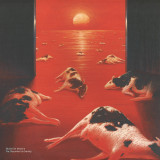
Revisiting a press release for the Nightingales' last album, Four Against Fate, we recalled hesitant anticipation for the forthcoming King Rocker, a film documentary of Robert Lloyd and Nightingales, made by Michael Cumming and Stewart Lee. After forty years of activity, Robert and the band had seen hyped recordings go lost, scant commercial success. Royalties? Ha. Yet response to King Rocker was immediately positive. Fab reviews galore, a long process regaining master rights which led to a series of expanded reissues with Fire. A tour postponed three times finally took place, to fully-packed houses. It was a very good year. The band felt a degree of anxiety prior to the sessions, which took place at Valencia's Elefante Studios. With bassist Andi Schmid isolated during Covid, the band had yet begun working out individual rough sketches, typically battered into songs over a period of months. They went into a new studio blind, with a new producer, Jorge Bernabe, without rehearsals . . . and produced a top-to-bottom masterpiece. Thirty seconds in, "Sunlit Uplands", is already a classic showcasing Fliss Kitson's increased songwriting power and the core dichotomy of the groups's best songs: perverse as fuck, catchy as fuck. I � CCTV is highlighted by a fab Jim Smith astral-garage guitar riff . . . and that's a one-two punch few albums ever equal, let alone carry over to the affectionate "Frances Sokolov", Robert's ode to mentor Vi Subversa, the playground riff that underlines "Spread Yourself Out" and then "Bloody Breath", the best encapsulation of all the band's genius in developing a kind of "pop" that no other combo has ever cracked. Other highlights include the lopsided mysterious beauty of "Magical Left Foot", the courtly raver of "I Need The Money At The Time" with a wonderful motorik groove driven by bassist Andi Schmid, and the album closer, "My Sweet Friend", a rockabilly lullaby which sounds like a magical outtake from Robert's one and only solo album It's a corker, it's a marvel, it's the best Nightingales record to date. Try and deny it. Tracks: 1 Sunlight Uplands (Turn That Frown Upside Down) 2 I � CCTV 3 Frances Sokolov 4 Spread Yourself Out 5 Bloody Breath 6 Mind Of Stone 7 I Needed The Money At The Time 8 The Very Nature 9 Magical Left Foot 10 Mark Meets No Mark 11 My Sweet Friend
Buscar:after sun
12 track vinyl LP and 18 track CD including bonus single and demo recordings. The Daggermen all went to Rede Secondary School in Medway, Kent. It was a school for those that failed their 11 plus, or who passed it but decided to go there anyway (as Jon pretends). Being in some of the same classes we became friends and found we liked the same music; The Who, The Small Faces, The Kinks, The Beatles and The Jimi Hendrix Experience. We started going to Carnaby Street, wearing Beatle boots and generally being a bit Moddy. Dave’s older brother, James Taylor, played organ in The Prisoners and we’d listen to cassette tapes of them along with other local band, The Milkshakes as we bounced on the trampoline during P.E. After watching both bands play live in local venues such as the M.I.C. club in Chatham we formed The Daggermen, working out who was going to play which instrument as we stood next to the now demolished school sports hall. No one can quite remember who thought of the name, The Daggermen (it was me) or how comes Jon was playing bass on a guitar in the band at the very start and then Terry took over when we started gigging (it was because he had a real bass guitar and a car). But the next thing was that we were supporting The Prisoners both in Medway and places such as the 100 Club in Oxford Street. Then, one sunny day at around the age of 17, I bumped into Billy Childish walking across a field. I formally introduced myself and told him that he should definitely come and see our band that night because we were “fucking brilliant”. He did turn up and bought us a tray of whiskies whilst we were on stage, a sure sign that he had liked it. This led to him and Russ Wilkins, bass player in The Milkshakes alongside Billy, asking us if we wanted to record an E.P. for Russ’s label, Empire Records. This was our first ever recording called Introducing The Daggermen which was made in a brick arch under Rochester bridge that we rented for £2 a week to rehearse in and lovingly referred to as ‘The Hole’. We got ourselves a “manager” (our mate, Vic Templar) and started playing up and down England, drinking as much as possible in the van on the way to each gig, often paralytic by the time we went on stage. Our musical style was a sort of mixture of punk and mod and we played covers such as ‘Heatwave’ (The Who’s version) and ‘Get Ready’ by the Temptations, along with Dave and Terry’s originals. Then came a change of line up when Jon resumed his position as bass player and Terry left for America. We started wearing military jackets thanks to Jimi Hendrix and made our first long player, Dagger In My Mind (I got the title off an episode of Star Trek, although I remembered it wrong and it should have been ‘Dagger Of The Mind’). The album was produced by James Taylor and Allan Crockford of The Prisoners at Woolly Studios on the Isle of Sheppey in 1986. This line-up played together for a couple of years up and down the country (also with a few gigs in France) before we called it a day and sailed off into the future in bands such as The James Taylor Quartet, The Kravin’ “A”s, The Solarflares and Billy Childish and The Buff Medways. As energetic youths we had a lot of fun and I am very proud to have been part of The Daggermen. We hope you enjoy these recordings, now all gathered together for the first time. Sincerely yours, Wolf Howard, Cafe Mozart, Chatham CD TRACKLISTING 1 – It’s You I See 2 – What Do I Do For You 3 – There’s No Escaping 4 – I’ve Been Hurt 5 – I Have Lost Heart 6 – You Were Meant To Be 7 – Every Moment 8 – Dagger In My Mind 9 – That Girl 10 – D’you Think Of Me 11 – I Feel The Regret 12 – I’ve Been Searching 13 – Now It’s You I Need 14 – Ivor 15 – One More Letter 16 – I Wish You Were Mine 17 – Bundle 18 – No Reason LP TRACKLISTING 1 – It’s You I See 2 – What Do I Do For You 3 – There’s No Escaping 4 – I’ve Been Hurt 5 – I Have Lost Heart 6 – You Were Meant To Be 7 – Every Moment 8 – Dagger In My Mind 9 – That Girl 10 – D’you Think Of Me 11 – I Feel The Regret 12 – I’ve Been Searching
One of the most distinctive recordings of the early 2000s, Jon Brion's one
and only solo album Meaningless is a master course in power popinspired art rock songwriting and production
Uniting psychedelic rock, classic songwriters, tape loop soundscapes, and
chiming folk jangle, the record offers a vivid backdrop for Brion's wry
observations on love, reality, and the elusive quality of meaning €"all that plus a
mind-bending Cheap Trick cover. More than two decades later, its emotional core
remains undiminished by year's spent in the major label wringer, both before and
after its creation. Like his work with artists including Aimee Mann, Fiona Apple,
and Elliott Smith, Brion's songs offer depth and resonance, and like his
soundtrack work on films like Magnolia, Punch Drunk Love, I Heart Huckabees,
and Eternal Sunshine of the Spotless Mind, its scope is widescreen. Remastered
and artist approved, Meaningless can finally be heard the way Brion intended.
Daniel Barenboim will turn 80 on November 15th. Warner Classics are celebrating the great musician, who has had tremendous success since the ‘60s both at the piano or conducting, with an album made in the mid-90s that is close to his heart and Argentinian origins, though aside of the classical repertoire. Tangos Among Friends - Mi Buenos Aires Querido (named after a tango by Carlos Gardel) proves again all the talent and swing Daniel Barenboim has, and has been a huge success since released by Teldec on CD in 1996.
“I spent the first nine years of my life in Argentina and only in Argentina. The rest of the world was far away. Everything Argentinian was close to my heart. The concepts of cosmopolitan existence or international thinking were not yet awakened. The air that I breathed was Buenos Aires, the language that I spoke was Spanish porteño and the rhythm to which I danced (figuratively speaking…) was the tango! My idol was Carlos Gardel. Nearly half a century later I came back not only to Argentina, not only to my childhood but especially to my Buenos Aires querido and many other wonderful melodies that make up this sentimental record.”
Daniel Barenboim – from album booklet
In an interview made in the 90s, Daniel Barenboim added: “In Argentina during the late 1940s there was no chasm between classical music and the tango, in the way there was a chasm between classical music and jazz. The tango is a basic part of Argentine popular culture; when you went to a restaurant or a party, that was the music you would hear. (…) Already as a child I was crazy about the tango. I still am.”
“The young Daniel found himself drawn to the bittersweet tales of passion, tragedy and nostalgia sung by Gardel, the tango singer and songwriter who exerted a major influence in popularizing the tango throughout the Western hemisphere and Europe. (…) Over the following decades Barenboim would regale friends at home or at parties with piano arrangements of tangos he heard in his youth. (…) Barenboim never thought of sharing his passion for tangos with the public until last year when he had returned to Buenos Aires for concerts with his Berlin Staatskapelle orchestra. At a reception he found himself talking tangos with a young Argentine. Learning of Barenboim’s interest in performing them, he offered to drum up a few local musicians with whom Barenboim could play tangos at home. That’s how he met Mederos and Console. “The first day we just played for fun,” Barenboim says. “Then we decided to make a recording. So we rehearsed for two days and made the record in one afternoon.” (…) Once he, Mederos and Console set out to record their tango program, Barenboim was surprised at how much of the characteristic tango rubato – a subtle alteration of rhythmic weight and accent – he still had at his fingertips, more than four decades after leaving Buenos Aires. That said, he insists on sharing credit for the success of the disc with his Argentine colleagues. “What they gave me was a pure sense of the tango, especially in the melodic freedom over a very strict rhythmic foundation. Performing tangos, you are constantly anticipating the downbeat or coming after it; this is part of the tradition. What I gave them was the necessity to rethink certain aspects – say, the volume and transparency of sound – so that playing tangos didn’t sound routine.”
– The Chicago Tribune, Oct. 1996
- 1: Long As I Got My Baby - Jackie Day
- 2: Down In The City - The Marvellos
- 3: I Got Love - The Other Brothers
- 4: I’ve Got To Win Your Love (For Me)
- The Simms Twins
- 5: My Love She’s Gone - The Intentions
- 6: This Couldn’t Be Me - The Sweethearts
- 7: The Sun Don’t Shine (Everyday) - The Saints
- 1: Tobacco Road North - Tommy Youngblood
- 2: Stand Up Straight And Tall - Jackie Shane
- 3: Walk The Chalk Line
- Aaron Collins & The Teen Queens
- 4: I’m Tired Aka Love Line - Billy Watkins
- 5: Tired Of Walkin’ - Little Joe Hinton
- 6: That’s It - Z.z. Hill
- 7: I Was Born To Love You - Johnny Copeland
• Celebrating 40 years since the game-changing “For Dancers Only” LP, KENT 001, “For Dancers Forty” revisits the Los Angeles labels that have given us so much.
• Like KENT 001, the collection represents the broad church of the Biharis’ recordings and features soul stompers, rhythm & blues busters, girly grooves and heavenly harmony.
• Most tracks are new to Kent LPs and there’s a brand new 1966 soul recording from 50s Modern R&B artists Aaron Collins & the Teen Queens. Long-time Kent favourites Jackie Day, Z.Z. Hill and Johnny Copeland are included with some of their underplayed tracks – for Copeland it’s the first vinyl outing for his dancer ‘I Was Born To Love You’. As ever on our rare soul scene, it’s the lesser-known artists who we revel in and there are stunning tracks from the Simms Twins, the Marvellos, the Intentions and the in-demand (due to the Kent 45 being deleted) ‘I Got Love’ by the Other Brothers.
• Tommy Youngblood’s LP track ‘Tobacco Road North’ has been a sleeper, eventually being picked up by hip hop samplers for its atmospheric musical qualities – and we at last give its proper accreditation after decades of misinformation. Little Joe Hinton’s ‘Tired Of Walkin’’ is now looked on as an R&B dance classic, despite its poor sales on release.
• The Sweethearts adorn our cover with a recently discovered colour photo from the archives of Modern’s head engineer Bill Lazerus. Apart from their bouncy ‘This Couldn’t Be Me’, they provided backing for many of the stable’s 60s recordings.
• You Have “Only”, “Also” and “Forever” – make space for “Forty”
The mysterious afro-soul of The Shaolin Afronauts first echoed across the dance floors of Australia in early 2008, captivating audiences with a highly evolved and unique approach to avant-garde soul music matched with an improvisational pedigree that immediately set them apart from their peers. In the almost fifteen years since the ensemble's debut they have released three albums on Freestyle Records and toured across Australia and around the world.
After an extended hiatus punctuated by rare live performances, The Shaolin Afronauts return with The Fundamental Nature of Being, an epic five album release that expands the sonic vision of the ensemble to towering new heights of burning afro-funk alongside esoteric and ethereal new sonic excursions. This expanded musical journey further explores the wide spectrum of the band's musical identity – with each of the five parts designed as both standalone records, while also offering a singular listening journey across the band's expansive musical world. This third part in the collection starts to explore influences from spiritual & free jazz sounds while still retaining the band's rich pan-african groove pallette.
It’s a beautiful phenomenon,” says Trampled by Turtles’ Dave Simonett, before adding with characteristic sincerity: “Everybody should see it." Simonett is talking about alpenglow, the natural event that washes mountains on the horizon in smoldering red and pink light, just before the sun sets or rises. It’s a harbinger of change––the space between new and old. It’s also the name of Trampled by Turtles’ new album, the band’s tenth. “My favorite part about making music is making records,” says Simonett. “I’m really excited about this one.” Produced by Wilco’s Jeff Tweedy, Alpenglow offers resounding proof that the beloved six-piece from Minnesota remain uncontested champs of understated virtuosity, literary songwriting, and a joyful hodgepodge of folk heart, rock-and-roll muscle, and string-band zen. Almost 20 years after first getting together, Trampled – that’s lead singer and songwriter Dave Simonett, bassist Tim Saxhaug, banjo player Dave Carroll, mandolinist Erik Berry, fiddle player Ryan Young, and cellist Eamonn McLain – also keep finding new ways to surprise us and one another. While many of the songs on Alpenglow grapple with change, none try to offer answers. Nothing’s neat and tidy. Instead, Trampled find endearing ways to sit in the tension, hope, and sense of loss that transitions and hard questions create. Then, just by expressing what’s there, the music offers comfort.
As three souls plunge down from the heavens, death and destruction can be felt hanging in the air like a foul stench. Red clouds swirl around a black sun that never sets and an erratic clock ticks off-tempo, moving faster and slower before rewinding and starting anew.
“Let me paint you a picture…” vocalist Mikey Arthur sings, welcoming listeners with a dramatic opening scene. It takes a skillful guide to navigate the darkest depths of hell. And, as The Gloom In The Corner depict in their second full-length album Trinity, death is merely the beginning of the series of chilling adventures
Purposefully aligning their song count with unlucky number thirteen – a reoccurring symbol in the ever-unfolding Gloom Cinematic Universe or GCU – it comes as little surprise to longtime fans that each of the Australian quartet’s enticing tracks intertwine to form an interlocking tale; this time centered around the appropriately labeled unholy trinity.
Comprised of previously deceased characters Rachel Barker, Ethan Hardy, and Clara Carne, the group’s bloody battle is woven throughout the album as the anti-heroes determinedly claw their way back to Earth from the Rabbit Hole dimension, slashing, shooting, and extinguishing anyone who dares to oppose their quest. Yet, for the Girl of Glass, Ronin, and Queen of Misanthropy, there is clearly more to the story than what can be contained within a single package.
Projecting a wide and complex web of lore, plot twists, and tongue and cheek humor, frontman Mikey Arthur, guitarist Matt Stevens, bassist Paul Musolino, and drummer Nic Haberle, have been producing highly detailed concept releases since their formation. And, consistently filling in more missing pieces of the puzzle with every body of work, the band equate each new record to a fresh season of The Umbrella Academy dropping on the streaming service of your choice. Because, just as a great TV series captivates viewers with its music and storytelling, the quartet’s work provides a complete experience designed to allow fans to check in with their favorite characters, all the while enjoying a cinematic new soundtrack.
For those just joining the GCU, as well as those looking for a quick refresh, 2016 debut album Fear Me introduced listeners to main protagonists Julian “Jay” Hardy, a Section 13 agent consumed by anger over his girlfriend Rachel’s death, and Jay’s gloom (later known as Sherlock Adaliah Bones), a demonic entity who at times takes over Jay’s body as a host vessel. 2017 EP Homecoming tells the tale of Jay’s brother Ethan, a war veteran suffering from PTSD, who upon discovering his brother’s struggle, kills himself as part of a Dante-style rescue mission to bring Rachel back to life. In 2019 EP Flesh and Bones, we’re introduced to Clara Carne, a past witness to one of Jay and Sherlock’s crimes, who instead of taking revenge, began a twisted love story with Sherlock, only to be murdered by his forced hand. And 2020’s Ultima Pluvia EP where we finally learn of Sherlock’s past as an ancient warlord under the tyrannical King Baphicho, and see Sherlock and Jay’s deaths ushered in by Section 13 opponent and New Order leader Elias DeGraver and his gloom Atticus Encey.
After 2016’s Fear Me, the band admit that their original intention was to jump straight into the events of Trinity before pivoting to create Homecoming, Flesh and Bones, and Ultima Pluvia. However, upon reflection, primary storywriter Mikey Arthur believes that pushing the timeline back actually provided greater opportunity for the group to properly flesh out the songs and plotlines for their sophomore studio record.
Indeed, while Trinity re-introduces the three central “heroes” of this new arc, it’s important to understand that while familiar, the characters are not carbon copies of who they were earlier in the story. And neither is the band who brought them to life.
Fully embracing the weird and whacky has never been a struggle for The Gloom In The Corner. Rather, it’s together with this attitude that the group come away with special moments such as the fascinating old and new dynamic between neighboring tracks “Red Clouds” – a song whose initial version predates the formation of The Gloom In The Corner as an official band – and “Gravity” in which a demo intended for future material was adjusted to fit the sonic drop.
Mirroring this evolution in the band’s musical approach, a sense of growth can also be seen projected in the characters and story that the quartet chronicle across the thirteen tracks.
Classifying their individual sound as an intricate form of “cinema or theater-core” due to the depth and breadth of their musical approach, features, samples, symphonic elements, and conceptual nature, The Gloom In The Corner continue to prove that they’re more than just a simple concept band.
In fact, similar to character theme music in movies and video games, the group seamlessly play off their diverse sonic story in a variety of ways. Continuing to breathe new life into older staples from their catalog, the quartet reworked their infamous “Oxymøron” breakdown from Fear Me into an impactful moment in Trinity’s “Nor Hell A Fury” and sprinkled audio easter eggs of this sort all throughout their new music for fans to discover.
Listeners are also brought further into the world of the GCU with the help of what The Gloom In The Corner call their “casting process.” Like picking actors for a musical, the band meticulously selected eleven different vocal features and several additional voice actors to bring the album and characters to life. Described as a 50/50 split between notable talents such as Ryo Kinoshita (Crystal Lake), Joe Badolato (Fit For An Autopsy), and Lauren Babic (Red Handed Denial), as well as talented friends and family like Elijah Witt (Cane Hill) and Mikey’s sister Amelia Duffield, each featured artist brought their own touch and realistic spark to the characters they portrayed.
For in the end, as much as Trinity and it’s cast live within the confines of their own supernatural worlds, themes such as falling out of love (Gatekeeper), battling depression (Obliteration Imminent), and standing behind women’s empowerment (Nor Hell A Fury), are ones that many can relate to or understand. And, while most individuals may avoid drowning their woes by way of transforming into full-on egotistical murderers like the Queen and King of Misanthropy and the gang, The Gloom In The Corner have illustrated that time and time again, life’s a little more fun when you can crack a smile. Taking a page from the trinity’s playbook: try to avoid the end of the world. But if you can’t…at least spend it with a killer soundtrack.
- A1: Enslaved - Eon
- A2: Mono - Er Eb Os
- A3: Ihsahn - Dark Awakening
- B1: Jo Quail - Prime
- B2: Bohren & Der Club Of Gore - Plateau
- C1: Hackedepicciotto - Trinity Past
- C2: Ulver - Godeater
- D1: Jonas Renkse - Er Eb Os
- D2: Zola Jesus - Prime
- D3: Spotlights - Of Eons
- E1: The Ocean - Primal (State Of Being) (State Of Being)
- E2: Crown - Element
- E3: Jaye Jayle - Er Eb Es
- F1: Godflesh - Ashen
- F2: Steve Von Till Aka Harvestman - Testament
- F3: Arabrot - The Last Days (See The Light) (See The Light)
The Others (Lustmord Deconstructed) is a celebration of the fearless attitude of being different and the expression of unique ideas which have never existed before. Over 13 years after the release of O T H E R , Pelagic Records has gathered 16 bands and solo artists to record their own unique takes on tracks from the Other-sessions. The result is an album that is more than a compilation, and more than the sum of its parts; covering a wide range of musical niches and directions, but sharing the same underlying mood and vibe defined by Lustmord's timeless soundscapes: from the ambient solo performances provided by IHSAHN, ENSLAVED or JONAS RENKSE to the subdued voice of ZOLA JESUS woven into Lustmord's sombre fabric to the industrial carnage that is GODFLESH's version of `Ashen'. LUSTMORD is the artistic moniker of Brian Williams. Born in North Wales, he started his musical career in 1980 and soon became a pioneer in the early industrial music scene in the UK. He was a former member of SPK during arguably their most crucial era, and went on to work with THROBBING GRISTLE members Chris & Cosey as well as appearing on early albums by CURRENT 93, NURSE WITH WOUND and others. After relocating to Los Angeles in 1993, Williams worked on dozens of motion picture soundtracks including The Crow, Underworld and Paul Schrader's First Reformed. Additionally he created several video game soundtracks, television scores and solo albums, as well as collaborating with artists as varied as THE MELVINS, CLOCK DVA, JARBOE, John Balance of COIL, Paul Haslinger (TANGERINE DREAM), PUSCIFER, Wes Borland and more, including Grammy Award-winners TOOL on their much acclaimed effort Fear Inoculum. To this day, Lustmord is actively recording and releasing music, his latest release being the collaborative album Alter with Karin Park of A°RABROT, and he is considered to be the founding father of the dark ambient music genre. The original O T H E R was released by independent record label Hydra Head Records, founded by ISIS frontman Aaron Turner and former home of bands such as CONVERGE, PELICAN, JESU, SUN O))) or BORIS. As one journalist put it at the time, O T H E R is a "grim example of a consummate artist who is working frmly within the parameters that he has laid out for himself over the years." This album shows Lustmord at his most characteristic, and the icy, ominous guitar playing of Jones, Turner and Ozborne resonates perfectly within the deep soundscapes that make up this frightening yet inspiring journey. What demonstrates the profound influence of Lustmord on this contemporary music underground showcased here is that artists from disparate ends of the sonic spectrum all feel inspired to explore the essence of his idiosyncratic sounds within their own realm: experimental electronica icons ULVER excel on a stunning, hazy rendition of `Godeater', while Japanese post-rock act MONO deliver a crushing version of `Er Eb Os', and THE OCEAN take us on a cathartically heavy mindtrip back to our `Primal State of Being'. In the end, each of these 16 artists delivers an interpretation that pays the deepest respect to this pivotal artist, while also standing out as a new track of its own.
Eight years after their first collaboration, ‘The Compass Joint’, slipped out as an ultra-limited white label, Charlie Soul Clap and Tom Trago have reunited to bring us a similarly warming, sun-splashed sequel, ‘The Compass Jawn’.
Like its predecessor – a now near-mythical 12-minute epic recorded late one night in Tom’s former squat-turned-studio close to legendary Amsterdam venue Trouw, and subsequently championed by DJ Harvey – ‘The Compass Jawn’ was inspired by the pair’s mutual love of both Caribbean keyboardist and FM synthesis enthusiast Wally Badarou, and the 1980s output of Chris Blackwell’s legendary Compass Point studio in Nassau, the Bahamas.
As sequels go, ‘The Compass Jawn’ is a bit of a belter. During the recording in 2019, Tom and Charlie sought to subtly evolve the original’s memorable lead line, reaching the for Yamaha DX7’s percussion patch – something utilized many times by Badarou during the 1980s.
The resultant ‘Studio Version’ is, if anything, even more emotive and uplifting than its predecessor. Underpinned by a shuffling rhythm pattern, the track ebbs and flows brilliantly, with jaunty synth stabs, undulating melodies and sparkling keyboard riffs ushering in held-note chords and a gorgeously rushing, ever-rising lead line. Throw in some starry pads and sunset-ready synth motifs, and you have another gorgeous, life-affirming treat.
‘The Compass Jawn’ comes backed with two top-notch alternative mixes. First up is an ambient ‘Dub’ mix from Trago that strips back the beats and instead focuses on the track’s many key melodic elements. Pushed forwards by drum machine handclaps, it’s a bubbly, sun-bright revision full to bursting with twinkling electronic motifs, jammed-out motifs, hands-aloft riffs and a bleeping take on the fluid and kaleidoscopic lead line.
Rounding off the package is the duo’s original demo mix – a raw, tough, and slightly more sub-heavy affair that’s notably more percussive and sweat-soaked whilst still sporting the key lead lines and FM synth sounds that make the studio version such a memorable and mood-enhancing affair.
The Discomfort Of Evening is the incredible and original soundtrack by prolific Belgian composer Michiel de Malsche to 2020 International Booker Prize winner The Discomfort of Evening by Marieke Lucas Rijneveld. Visceral and virtuosic, Rijneveld's novel follows Jas, a girl growing up in a devout Christian family that runs a Dutch dairy farm, whose brother dies in an accident after she wishes he would die instead of her rabbit. Lost in grief, her family falls apart as she becomes consumed by increasingly dangerous fantasies.
Michiel de Malsche has captured the atmosphere and spirit of Rijneveld's book perfectly, moving through moments of confrontation and introspection, sinking into spirals of despair, stasis and subtle hope and change. Brooding ambient basslines, driven by droning murmurs, are offset with melismatic electro-acoustic pieces that embody the novel's haunting and dissonant world, whilst also incorporating manipulated field recordings such as animal sounds and a church service, allowing for a full manifestation of Jas’s world in a completely new way.
De Malsche achieves this by rallying an unusual combination of acoustic instruments (16 in total) played by top-of-their-field musicians, creating a truly unique sound world and tonal palette, including an Ondes Martenot, a 7-stringed Chinese instrument called a guqin, a marimba, a string 6-tet, a toy piano and a bass flute.
De Malsche always confronts all emotional levels of his source material head-on, making his soundtrack into much more than just a fever dream. It is a precise description of, and accompaniment to, a devastatingly impactful book.
Michiel De Malsche is a Belgian composer, multi-instrumentalist and sound designer. He studied classical composition at the conservatories of Rotterdam and Ghent. His music has been performed all over the world and he has composed and produced dozens of soundtracks for contemporary dance, theatre, movies and documentaries.
Besides his work as a contemporary classical composer, he is active as a studio musician and producer in the world of electronic music.
The sun, kissing the forehead through half-closed blinds; the night, coming uninvited through a windowpane like a damp, sticky shroud. Light and darkness, solid foundations and elusive glimpses of parallel realities. Armies of digital insects - taken aback by warmth of one brave heart, 90s chillout rooms updated for todays vast and desolated space full of fragile souls desperate in their look for any kind of communion; “artificial intelligence” after three decades of wandering, trying to finally find a helping hand, solace and peace. Shimmer and shine. Welcome to “Pristine”, a new recording from the mind of Jacek Sienkiewicz.
For the past years Jacek has been escaping his image of relentless producer and performer of driving, multi-layered club music. His most recent works include deep ambient records, abstract electro-acoustic experiments, and super smart, stripped-down yet incredibly complex contemporary electronica. The last few records, mostly on his own label Recognition include albums with Max Loderbauer and Atom™, reinterpretations of works by Bogdan Mazurek of the legendary Polish Radio Experimental Studio, scores for radio plays and last year’s massively overlooked “Krasz”, music for theatrical performance of Ballard’s/Cronenberg’s “Crash”.
“Pristine”, a labour of love, is at times abstract and atonal, at times breathtakingly beautiful and tender.
8 tracks written and performed in Jacek’s unmistakable, singular style, and covering many grounds - abstract, electronic forms, neo-classical wonders, super tight compositions and freeform, jazz-like improvisations and stripped-down rhythms. Different moods, machine-translated and reverseengineered in a variety of recording locations, make up this exceptional record.
Shimmer and shine, immerse and enjoy.
Co-Financed By The Minister Of Culture And National Heritage of Poland.
The project has been implemented in co-production with Recognition Records and the National Centre for Culture of Poland
HIGHLIGHTS FINALLY, the highly sought-after and fun 'Drácula Yeyé' by Andrés Pajares is being officially reissued on a 7" vinyl single for the first time. The version recorded by the Spanish band Doctor Explosión in the 90s helped to popularize this song that has already achieved the status of garage-yeyé holy grail. On the B side the stunning garage-beat number 'Caperucita Yeyé' brings together some of the best artists of the Spanish-sung yeyé scene of the 60s: singers Marta Baizán, Miguel Ríos and the Venezuelan garage band Los Impala. Two highly sought-after garage-yeyé songs on a double-A-side single, essential for lovers of 60s sounds. DESCRIPTION Mainly known for his career as an actor, especially during the post-dictatorship years and through his "soft-erotic" comedy films, the popular Spanish comedian Andrés Pajares also recorded several records since the mid-1960s. Among them, "Dracula Yeyé" is THE song that has conquered selected dancefloors worldwide and has been on the wants lists of 60s sounds collectors and DJs for years. A rare artifact that was originally released in 1968 and whose original copies are very scarce and currently fetch exorbitant prices in the second-hand market. The later version recorded by the Spanish band Doctor Explosión in the '90s helped to make this record better known so that has already achieved the status of Spanish garage-yeyé holy grail. The single is completed with another fun and surprising yeyé song on the B side that could well be the main track of this release since it brings together some of the best artists of the Spanish-sung yeyé scene of the 60s: singers Marta Baizán, Miguel Ríos and the Venezuelan garage band Los Impala. All of them were the uncredited artists involved in this recording that was originally released as a children's record, with the musicalized narration of the classic tale "Little Red Riding Hood" that these musicians turned into a stunning garage-beat hit. Both songs are reissued here on a 7" single for the first time.
Isokratisses (Greek for "women who sing the "iso" or "drone") is a vocal ensemble comprised of eight women who carry the ancient tradition of polyphonic songs from Epirus: a region in northern Greece and southern Albania. Born and reared in the Greek speaking villages around Deropoli and Politsani in Albania, the women of Isokratisses have sung these songs since childhood. The group ranges in age from 19 to 56 with some sisters in the group as well as an aunt. They were nurtured by this archaic music, listening and singing it with their family and friends. The songs were passed down from generation to generation. The group started its artistic activity in 2015, after the singer Anna Katsi took the initiative to encourage the younger members to perform regularly. The communal nature of polyphonic singing is a way of revitalizing an art that has declined in recent years and to reassert the primacy of female voices in the southern Balkans. Singing these songs builds an invisible bridge that connects the present with the past, the memories of childhood travel with the immediacy of daily life. On Oct 14, 2022, Third Man Records will release a full album of these solo polyphonic songs, with Grammy-winning producer Christopher King. "It is social music, woven into the fabric of poor, marginalized, and disenfranchised communities. Many of the songs are variations of mirologia (songs of fate, songs of morning) that used to be sung throughout the southern Balkans but have largely disappeared on an informal cultural level except for Epirus. Structurally, the songs are pentatonic (five notes with no semitones) and are composed of three or four distinct melodic voices that weave together in an organic yet unexpected way. The remaining members of the group provide the iso or “drone” that is the low tonic note of the melody." - Chris King.
Available on limited edition translucent gold vinyl and very limited vinyl-style cd. "The Young Ones' Flaming Lips meet Jacques Brel in a pean to lost youth, 'Comme dans un Reve' Dream bossa chanson a la Gainsbourg/ Birkin. ‘Dreams’ is the second of the final trilogy of albums by critical darlings The Real Tuesday Weld following last year's acclaimed noir-themed ‘Blood'. This collection references late sixties songwriting a la Lee Hazlewood, Jimmy Webb and Burt Bacharach with nods to Flaming Lips and Tin Pan Alley, all mixed up with hazy lo-fi electronica, ghostly atmospherics and cinematic instrumentals. Guest vocalists A Girl Called Eddy, Sephine Llo and Oriana Curls provide a counterpoint to main man Stephen Coates' Gainsbourg-like crooning. Continuing the band's long preoccupation with dreams, the songs were written in the early morning or late evening on 'either side' of sleep: ‘I’d rise super early and go straight to it with the emotion of the night’s imaginings still heavy on me or work in that strange space-time just before sleep claims us”. The album is sequenced in an approximation of a life, from youth to age, with the band’s perennial focus on London, love, the English landscape and time passing. ‘Bone Dreams Blood’ in particular is a sonic memorial to friends loved and lost in the life of London. "beautiful...giddily recalls Gainsbourg, Pulp, Cole Porter, early Disney soundtracks and seedy postwar revue bars" SUNDAY TIMES // "Utterly unique, utterly delightful" THE TELEGRAPH // "These heart-pricking songs speak to us all" WORD // 'Utterly decadent and darkly humorous' TIME OUT LONDON // 'Superbly atmospheric' UNCUT // Track listing: 1 The Young Ones 2 Kinky Love 3 Bone Dreams Blood 4 I Awoke to Find I was Dreaming 5 Ever After 6 Lost Endeavour 7 Curtain Call 8 Comme Dans un Reve 9 Bodhisattva of the Gulag 10 Everything 11 Last Light
- A1: Rock This Mother
- A2: Talk To Me Girl
- A3: You Can Find Me
- A4: Check This Out
- A5: Jesus Going To Clean House
- A6: Hope You Understood
- A7: Is It What You Want
- A8: Love Is Everlasting
- A9: This Is Hip-Hop Art
- A10: Opposite Of Love
- A11: Do You Know What I Mean
- B1: Saving All My Love For You
- B2: Look Out Here I Come
- B3: Girl You Always Talking
- B4: Have A Great Day
- B5: Take My Hand
- B6: I Need Your Love
- B7: Your Town
- B8: Talk Around Town
- B9: Booty Head/Take A Little Walk
- B10: I Love My Mama
- B11: I Never Found Anyone Like You
Vinyl LP[23,49 €]
As the sun sets on a quaint East Nashville house, a young man bares a piece of his soul. Facing the camera, sporting a silky suit jacket/shirt/slacks/fingerless gloves ensemble that announces "singer" before he's even opened his mouth, Lee Tracy Johnson settles onto his stage, the front yard. He sways to the dirge-like drum machine pulse of a synth-soaked slow jam, extends his arms as if gaining his balance, and croons in affecting, fragile earnest, "I need your love… oh baby…"
Dogs in the yard next door begin barking. A mysterious cardboard robot figure, beamed in from galaxies unknown and affixed to a tree, is less vocal. Lee doesn't acknowledge either's presence. He's busy feeling it, arms and hands gesticulating. His voice rises in falsetto over the now-quiet dogs, over the ambient noise from the street that seeps into the handheld camcorder's microphone, over the recording of his own voice played back from a boombox off-camera. After six minutes the single, continuous shot ends. In this intimate creative universe there are no re-takes. There are many more music videos to shoot, and as Lee later puts it, "The first time you do it is actually the best. Because you can never get that again. You expressing yourself from within."
"I Need Your Love" dates from a lost heyday. From some time in the '80s or early '90s, when Lee Tracy (as he was known in performance) and his music partner/producer/manager Isaac Manning committed hours upon hours of their sonic and visual ideas to tape. Embracing drum machines and synthesizers – electronics that made their personal futurism palpable – they recorded exclusively at home, live in a room into a simple cassette deck. Soul, funk, electro and new wave informed their songs, yet Lee and Isaac eschewed the confinement of conventional categories and genres, preferring to let experimentation guide them.
"Anytime somebody put out a new record they had the same instruments or the same sound," explains Isaac. "So I basically wanted to find something that's really gonna stand out away from all of the rest of 'em." Their ethos meant that every idea they came up with was at least worth trying: echoed out half-rapped exhortations over frantic techno-style beats, gospel synth soul, modal electro-funk, oddball pop reinterpretations, emo AOR balladry, nods to Prince and the Fat Boys, or arrangements that might collapse mid-song into a mess of arcade game-ish blips before rallying to reach the finish line. All of it conjoined by consistent tape hiss, and most vitally, Lee's chameleonic voice, which managed to wildly shape shift and still evoke something sincere – whether toggling between falsetto and tenor exalting Jesus's return, or punctuating a melismatic romantic adlib with a succinct, "We all know how it feels to be alone."
"People think we went to a studio," says Isaac derisively. "We never went to no studio. We didn't have the money to go to no studio! We did this stuff at home. I shot videos in my front yard with whatever we could to get things together." Sometimes Isaac would just put on an instrumental record, be it "Planet Rock" or "Don't Cry For Me Argentina" (from Evita), press "record," and let Lee improvise over it, yielding peculiar love songs, would-be patriotic anthems, or Elvis Presley or Marilyn Monroe tributes. Technical limitations and a lack of professional polish never dissuaded them. They believed they were onto something.
"That struggle," Isaac says, "made that sound sound good to me."
In the parlance of modern music criticism Lee and Isaac's dizzying DIY efforts would inevitably be described as "outsider." But "outsider" carries the burden of untold additional layers of meaning if you're Black and from the South, creating on a budget, and trying to get someone, anyone within the country music capital of the world to take your vision seriously. "What category should we put it in?" Isaac asks rhetorically. "I don't know. All I know is feeling. I ain't gonna name it nothing. It's music. If it grabs your soul and touch your heart that's what it basically is supposed to do."
=
Born in 1963, the baby boy of nine siblings, Lee Tracy spent his earliest years living amidst the shotgun houses on Nashville's south side. "We was poor, man!" he says, recalling the outhouse his family used for a bathroom and the blocks of ice they kept in the kitchen to chill perishables. "But I actually don't think I really realized I was in poverty until I got grown and started thinking about it." Lee's mom worked at the Holiday Inn; his dad did whatever he had to do, from selling fruit from a horse drawn cart to bootlegging. "We didn't have much," Lee continues, "but my mother and my father got us the things we needed, the clothes on our back." By the end of the decade with the city's urban renewal programs razing entire neighborhoods to accommodate construction of the Interstate, the family moved to Edgehill Projects. Lee remembers music and art as a constant source of inspiration for he and his brothers and sisters – especially after seeing the Jackson 5 perform on Ed Sullivan. "As a small child I just knew that was what I wanted to do."
His older brother Don began musically mentoring him, introducing Lee to a variety of instruments and sounds. "He would never play one particular type of music, like R&B," says Lee. "I was surrounded by jazz, hard rock and roll, easy listening, gospel, reggae, country music; I mean I was a sponge absorbing all of that." Lee taught himself to play drums by beating on cardboard boxes, gaining a rep around the way for his timekeeping, and his singing voice. Emulating his favorites, Earth Wind & Fire and Cameo, he formed groups with other kids with era-evocative band names like Concept and TNT Connection, and emerged as the leader of disciplined rehearsals. "I made them practice," says Lee. "We practiced and practiced and practiced. Because I wanted that perfection." By high school the most accomplished of these bands would take top prize in a prominent local talent show. It was a big moment for Lee, and he felt ready to take things to the next level. But his band-mates had other ideas.
"I don't know what happened," he says, still miffed at the memory. "It must have blew they mind after we won and people started showing notice, because it's like everybody quit! I was like, where the hell did everybody go?" Lee had always made a point of interrogating prospective musicians about their intentions before joining his groups: were they really serious or just looking for a way to pick up girls? Now he understood even more the importance of finding a collaborator just as committed to the music as he was.
=
Isaac Manning had spent much of his life immersed in music and the arts – singing in the church choir with his family on Nashville's north side, writing, painting, dancing, and working various gigs within the entertainment industry. After serving in the armed forces, in the early '70s he ran The Teenage Place, a music and performance venue that catered to the local youth. But he was forced out of town when word of one of his recreational routines created a stir beyond the safe haven of his bohemian circles.
"I was growing marijuana," Isaac explains. "It wasn't no business, I was smoking it myself… I would put marijuana in scrambled eggs, cornbread and stuff." His weed use originated as a form of self-medication to combat severe tooth pain. But when he began sharing it with some of the other young people he hung out with, some of who just so happened to be the kids of Nashville politicians, the cops came calling. "When I got busted," he remembers, "they were talking about how they were gonna get rid of me because they didn't want me saying nothing about they children because of the politics and stuff. So I got my family, took two raggedy cars, and left Nashville and went to Vegas."
Out in the desert, Isaac happened to meet Chubby Checker of "The Twist" fame while the singer was gigging at The Flamingo. Impressed by Isaac's zeal, Checker invited him to go on the road with him as his tour manager/roadie/valet. The experience gave Isaac a window into a part of the entertainment world he'd never encountered – a glimpse of what a true pop act's audience looked like. "Chubby Checker, none of his shows were played for Black folks," he remembers. "All his gigs were done at high-class white people areas." Returning home after a few years with Chubby, Isaac was properly motivated to make it in Music City. He began writing songs and scouting around Nashville for local talent anywhere he could find it with an expressed goal: "Find someone who can deliver your songs the way you want 'em delivered and make people feel what you want them to feel."
One day while walking through Edgehill Projects Isaac heard someone playing the drums in a way that made him stop and take notice. "The music was so tight, just the drums made me feel like, oh I'm-a find this person," he recalls. "So I circled through the projects until I found who it was.
"That's how I met him – Lee Tracy. When I found him and he started singing and stuff, I said, ohhh, this is somebody different."
=
Theirs was a true complementary partnership: young Lee possessed the raw talent, the older Isaac the belief. "He's really the only one besides my brother and my family that really seen the potential in me," says Lee. "He made me see that I could do it."
Isaac long being a night owl, his house also made for a fertile collaborative environment – a space where there always seemed to be a new piece of his visual art on display: paintings, illustrations, and dolls and figures (including an enigmatic cardboard robot). Lee and Issac would hang out together and talk, listen to music, conjure ideas, and smoke the herb Isaac had resumed growing in his yard. "It got to where I could trust him, he could trust me," Isaac says of their bond. They also worked together for hours on drawings, spreading larges rolls of paper on the walls and sketching faces with abstract patterns and imagery: alien-like beings, tri-horned horse heads, inverted Janus-like characters where one visage blurred into the other.
Soon it became apparent that they didn't need other collaborators; self-sufficiency was the natural way forward. At Isaac's behest Lee, already fed up with dealing with band musicians, began playing around with a poly-sonic Yamaha keyboard at the local music store. "It had everything on it – trumpet, bass, drums, organ," remembers Lee. "And that's when I started recording my own stuff."
The technology afforded Lee the flexibility and independence he craved, setting him on a path other bedroom musicians and producers around the world were simultaneously following through the '80s into the early '90s. Saving up money from day jobs, he eventually supplemented the Yamaha Isaac had gotten him with Roland and Casio drum machines and a Moog. Lee was living in an apartment in Hillside at that point caring for his dad, who'd been partially paralyzed since early in life. In the evenings up in his second floor room, the music put him in a zone where he could tune out everything and lose himself in his ideas.
"Oh I loved it," he recalls. "I would really experiment with the instruments and use a lot of different sound effects. I was looking for something nobody else had. I wanted something totally different. And once I found the sound I was looking for, I would just smoke me a good joint and just let it go, hit the record button." More potent a creative stimulant than even Isaac's weed was the holistic flow and spontaneity of recording. Between sessions at Isaac's place and Lee's apartment, their volume of output quickly ballooned.
"We was always recording," says Lee. "That's why we have so much music. Even when I went to Isaac's and we start creating, I get home, my mind is racing, I gotta start creating, creating, creating. I remember there were times when I took a 90-minute tape from front to back and just filled it up."
"We never practiced," says Isaac. "See, that was just so odd about the whole thing. I could relate to him, and tell him about the songs I had ideas for and everything and stuff. And then he would bring it back or whatever, and we'd get together and put it down." Once the taskmaster hell bent on rehearsing, Lee had flipped a full 180. Perfection was no longer an aspiration, but the enemy of inspiration.
"I seen where practicing and practicing got me," says Lee. "A lot of musicians you get to playing and they gotta stop, they have to analyze the music. But while you analyzing you losing a lot of the greatness of what you creating. Stop analyzing what you play, just play! And it'll all take shape."
=
"I hope you understood the beginning of the record because this was invented from a dream I had today… (You tell me, I'll tell you, we'll figure it out together)" – Lee Tracy and Isaac Manning, "Hope You Understand"
Lee lets loose a maniacal cackle when he acknowledges that the material that he and Isaac recorded was by anyone's estimation pretty out there. It's the same laugh that commences "Hope You Understand" – a chaotic transmission that encapsulates the duality at the heart of their music: a stated desire to reach people and a compulsion to go as leftfield as they saw fit.
"We just did it," says Lee. "We cut the music on and cut loose. I don't sit around and write. I do it by listening, get a feeling, play the music, and the lyrics and stuff just come out of me."
The approach proved adaptable to interpreting other artists' material. While recording a cover of Whitney Houston's pop ballad "Saving All My Love For You," Lee played Whitney's version in his headphones as he laid down his own vocals – partially following the lyrics, partially using them as a departure point. The end result is barely recognizable compared with the original, Lee and Isaac having switched up the time signature and reinvented the melody along the way towards morphing a slick mainstream radio standard into something that sounds solely their own.
"I really used that song to get me started," says Lee. "Then I said, well I need something else, something is missing. Something just came over me. That's when I came up with 'Is It What You Want.'"
The song would become the centerpiece of Lee and Isaac's repertoire. Pushed along by a percolating metronomic Rhythm King style beat somewhere between a military march and a samba, "Is It What You Want" finds Lee pleading the sincerity of his commitment to a potential love interest embellished by vocal tics and hiccups subtlely reminiscent of his childhood hero MJ. Absent chord changes, only synth riffs gliding in and out like apparitions, the song achieves a lingering lo-fi power that leaves you feeling like it's still playing, somewhere, even after the fade out.
"I don't know, it's like a real spiritual song," Lee reflects. "But it's not just spiritual. To me the more I listen to it it's like about everything that you do in your everyday life, period. Is it what you want? Do you want a car or you don't want a car? Do you want Jesus or do you want the Devil? It's basically asking you the question. Can't nobody answer the question but you yourself."
In 1989 Lee won a lawsuit stemming from injuries sustained from a fight he'd gotten into. He took part of the settlement money and with Isaac pressed up "Saving All My Love For You" b/w "Is It What You Want" as a 45 single. Isaac christened the label One Chance Records. "Because that's all we wanted," he says with a laugh, "one chance."
Isaac sent the record out to radio stations and major labels, hoping for it to make enough noise to get picked up nationally. But the response he and Lee were hoping for never materialized. According to Isaac the closest the single got to getting played on the radio is when a disk jock from a local station made a highly unusual announcement on air: "The dude said on the radio, 107.5 – 'We are not gonna play 'Is It What You Want.' We cracked up! Wow, that's deep.
"It was a whole racist thing that was going on," he reflects. "So we just looked over and kept on going. That was it. That was about the way it goes… If you were Black and you were living in Nashville and stuff, that's the way you got treated." Isaac already knew as much from all the times he'd brought he and Lee's tapes (even their cache of country music tunes) over to Music Row to try to drum up interest to no avail.
"Isaac, he really worked his ass off," says Lee. "He probably been to every record place down on Music Row." Nashville's famed recording and music business corridor wasn't but a few blocks from where Lee grew up. Close enough, he remembers, for him to ride his bike along its back alleys and stumble upon the occasional random treasure, like a discarded box of harmonicas. Getting in through the front door, however, still felt a world away.
"I just don't think at the time our music fell into a category for them," he concedes. "It was before its time."
=
Lee stopped making music some time in the latter part of the '90s, around the time his mom passed away and life became increasingly tough to manage. "When my mother died I had a nervous breakdown," he says, "So I shut down for a long time. I was in such a sadness frame of mind. That's why nobody seen me. I had just disappeared off the map." He fell out of touch with Isaac, and in an indication of just how bad things had gotten for him, lost track of all the recordings they'd made together. Music became a distant memory.
Fortunately, Isaac kept the faith. In a self-published collection of his poetry – paeans to some of his favorite entertainment and public figures entitled Friends and Dick Clark – he'd written that he believed "music has a life of its own." But his prescience and presence of mind were truly manifested in the fact that he kept an archive of he and Lee's work. As perfectly imperfect as "Is It What You Want" now sounds in a post-Personal Space world, Lee and Isaac's lone official release was in fact just a taste. The bulk of the Is It What You Want album is culled from the pair's essentially unheard home recordings – complete songs, half-realized experiments, Isaac's blue monologues and pronouncements et al – compiled, mixed and programmed in the loose and impulsive creative spirit of their regular get-togethers from decades ago. The rest of us, it seems, may have finally caught up to them.
On the prospect of at long last reaching a wider audience, Isaac says simply, "I been trying for a long time, it feels good." Ever the survivor, he adds, "The only way I know how to make it to the top is to keep climbing. If one leg break on the ladder, hey, you gotta fix it and keep on going… That's where I be at. I'll kill death to make it out there."
For Lee it all feels akin to a personal resurrection: "It's like I was in a tomb and the tomb was opened and I'm back… Man, it feels so great. I feel like I'm gonna jump out of my skin." Success at this stage of his life, he realizes, probably means something different than what it did back when he was singing and dancing in Isaac's front yard. "What I really mean by 'making it,'" he explains isn't just the music being heard but, "the story being told."
Occasionally Lee will pull up "Is It What You Want" on YouTube on his phone, put on his headphones, and listen. He remembers the first time he heard his recorded voice. How surreal it was, how he thought to himself, "Is that really me?" What would he say to that younger version of himself now?
"I would probably tell myself, hang in there, don't give up. Keep striving for the goal. And everything will work out."
Despite what's printed on the record label, sometimes you do get more than one chance.

A deluxe, remastered, 20 year anniversary edition of the Heads’ third album proper, the under-rated gem in their canon that is “Under Sided”.
Originally released in 2002 on the Sweet Nothing label (SNLP/CD 11), Under Sided was recorded in 2001 at WhiteHouse Studios in Weston Super Mare, with Martin Nichols engineering. The band had previously recorded tracks for Mans Ruin 10” at these studios (also famous for Ripcord, Heresy, Slowdive, Hardskin, Decadence Within, Icehouse.. amongst many others!).
For the reissue, the original recordings were remastered for vinyl and CD by long time Heads Masterer (!) Shawn Joseph. The resultant 8 tracks, spread over 4 sides of vinyl are some of the best music the Heads have recorded, after a bit of a hiatus following their 2000 US tour / Peel session (included in the boxset / on the 2CD version here), the band regrouped and worked out the tracks for the album, relentless rehearsing for the recording. Very few shows happened in that 2001-2002 timeframe.. band members were busy, earning a living, getting on with life, but they still had some riffs/songs there.
Upon release in 2002 the album got great reviews in the press, from Kerrang and MOJO to the Sunday Times, all helping the Bristol fourpiece confirm their cult status, which has continued to current times..
The remastered album is being reissued as a 4LP + 2CD boxset. The extra 2LP features their Peel session from 2000, as well as a couple of compilation tracks (For Mad Men Only / Born To Go), and some unreleased demo versions, as well as 2 exclusive to this set CDS that feature nearly 150 minutes of Live recordings (mastered, but RAW!) from their gigs on the Thekla in Bristol and rehearsal room tapes in 2001 and 2002.
The boxset will also have a special slip-mat, stickers, and a 24 page booklet of photos /writings, including recollections by each band member, and others including Stewart Lee.
Under Sided is a pounding sike-nightmare that shows the Heads at the peak of their powers, there’s a flow throughout the album of melding psychedelic noise rock to unrelentin rhythms and creating a bad trip for all listening.. open battering-ram “Dissonaut” is a staple in their live shows to this day… even the gentle sooth of “Energy” is enveloped by a white noise fury.. the intensity of some of the tracks: the terror inducing “Bedminster” or “False Heavy” (a tour worn riffmonger from 2000) or the Magnet-esque “Heavy Sea”, showed the band as ferocious as any of the insurgent “stoner” genre of that time.
They were never going to make their living out of touring, record sales… as Hugo mentions in his notes for the booklet, “.. we had less boundaries and felt we could experiment more and not worry about commerciality…” but they were able to make this album.
A deluxe, remastered, 20 year anniversary edition of the Heads’ third album proper, the under-rated gem in their canon that is “Under Sided”.
Originally released in 2002 on the Sweet Nothing label (SNLP/CD 11), Under Sided was recorded in 2001 at WhiteHouse Studios in Weston Super Mare, with Martin Nichols engineering. The band had previously recorded tracks for Mans Ruin 10” at these studios (also famous for Ripcord, Heresy, Slowdive, Hardskin, Decadence Within, Icehouse.. amongst many others!).
For the reissue, the original recordings were remastered for vinyl and CD by long time Heads Masterer (!) Shawn Joseph. The resultant 8 tracks, spread over 4 sides of vinyl are some of the best music the Heads have recorded, after a bit of a hiatus following their 2000 US tour / Peel session (included in the boxset / on the 2CD version here), the band regrouped and worked out the tracks for the album, relentless rehearsing for the recording. Very few shows happened in that 2001-2002 timeframe.. band members were busy, earning a living, getting on with life, but they still had some riffs/songs there.
Upon release in 2002 the album got great reviews in the press, from Kerrang and MOJO to the Sunday Times, all helping the Bristol fourpiece confirm their cult status, which has continued to current times..
The remastered album is being reissued as a 4LP + 2CD boxset. The extra 2LP features their Peel session from 2000, as well as a couple of compilation tracks (For Mad Men Only / Born To Go), and some unreleased demo versions, as well as 2 exclusive to this set CDS that feature nearly 150 minutes of Live recordings (mastered, but RAW!) from their gigs on the Thekla in Bristol and rehearsal room tapes in 2001 and 2002.
The boxset will also have a special slip-mat, stickers, and a 24 page booklet of photos /writings, including recollections by each band member, and others including Stewart Lee.
Under Sided is a pounding sike-nightmare that shows the Heads at the peak of their powers, there’s a flow throughout the album of melding psychedelic noise rock to unrelentin rhythms and creating a bad trip for all listening.. open battering-ram “Dissonaut” is a staple in their live shows to this day… even the gentle sooth of “Energy” is enveloped by a white noise fury.. the intensity of some of the tracks: the terror inducing “Bedminster” or “False Heavy” (a tour worn riffmonger from 2000) or the Magnet-esque “Heavy Sea”, showed the band as ferocious as any of the insurgent “stoner” genre of that time.
They were never going to make their living out of touring, record sales… as Hugo mentions in his notes for the booklet, “.. we had less boundaries and felt we could experiment more and not worry about commerciality…” but they were able to make this album.
A deluxe, remastered, 20 year anniversary edition of the Heads’ third album proper, the under-rated gem in their canon that is “Under Sided”.
Originally released in 2002 on the Sweet Nothing label (SNLP/CD 11), Under Sided was recorded in 2001 at WhiteHouse Studios in Weston Super Mare, with Martin Nichols engineering. The band had previously recorded tracks for Mans Ruin 10” at these studios (also famous for Ripcord, Heresy, Slowdive, Hardskin, Decadence Within, Icehouse.. amongst many others!).
For the reissue, the original recordings were remastered for vinyl and CD by long time Heads Masterer (!) Shawn Joseph. The resultant 8 tracks, spread over 4 sides of vinyl are some of the best music the Heads have recorded, after a bit of a hiatus following their 2000 US tour / Peel session (included in the boxset / on the 2CD version here), the band regrouped and worked out the tracks for the album, relentless rehearsing for the recording. Very few shows happened in that 2001-2002 timeframe.. band members were busy, earning a living, getting on with life, but they still had some riffs/songs there.
Upon release in 2002 the album got great reviews in the press, from Kerrang and MOJO to the Sunday Times, all helping the Bristol fourpiece confirm their cult status, which has continued to current times..
The remastered album is being reissued as a 4LP + 2CD boxset. The extra 2LP features their Peel session from 2000, as well as a couple of compilation tracks (For Mad Men Only / Born To Go), and some unreleased demo versions, as well as 2 exclusive to this set CDS that feature nearly 150 minutes of Live recordings (mastered, but RAW!) from their gigs on the Thekla in Bristol and rehearsal room tapes in 2001 and 2002.
The boxset will also have a special slip-mat, stickers, and a 24 page booklet of photos /writings, including recollections by each band member, and others including Stewart Lee.
Under Sided is a pounding sike-nightmare that shows the Heads at the peak of their powers, there’s a flow throughout the album of melding psychedelic noise rock to unrelentin rhythms and creating a bad trip for all listening.. open battering-ram “Dissonaut” is a staple in their live shows to this day… even the gentle sooth of “Energy” is enveloped by a white noise fury.. the intensity of some of the tracks: the terror inducing “Bedminster” or “False Heavy” (a tour worn riffmonger from 2000) or the Magnet-esque “Heavy Sea”, showed the band as ferocious as any of the insurgent “stoner” genre of that time.
They were never going to make their living out of touring, record sales… as Hugo mentions in his notes for the booklet, “.. we had less boundaries and felt we could experiment more and not worry about commerciality…” but they were able to make this album.