
pre-order now28.04.2023
expected to be published on 28.04.2023
29,37 €
expected to be published on 28.04.2023

Since its beginnings, Hypnótica Colectiva has always shown a special interest in the music recorded and released in the city of Detroit.
A place with which we have both a blood and spiritual bond because of what occurred there socially and artistically during the 20th century.
This love led us to become ambassadors of what was happening there on a musical level, holding cultural events to screen documentaries translated into Spanish, as well as a number of themed sets at our events, dedicated motor city sections in our record shop or recently lectures on the history of the city and its music at the Museum of Illustration and Contemporary Art of Valencia (Muvim).
The time has now come to bring all this history, this musical influence, to the editorial section of our label HC records.
Detroit Legacy was born from the idea of capturing these influences on vinyl. Seeking artists from all over the world who share this passion that inspires them to create their music, what we can define as the universal Neo-Detroit.
For this first edition or first volume, the collective has enlisted in its ranks creators affiliated to the label who have shown us in their careers, this influence and this feeling.
Paul Cignol opens the record with Distance. From Dublin he offers us a track of warm sequences inspired by Deep Techno, with deep pads responding to organ keys and a subtle touch of 303.
Mallorcan LLuis Barcelo Sureda is responsible for the second track Funk Station. With a Techno Soul character that we might hear from Detroitish labels like Acacia or producers like Blake Baxter.
A real eminence in Techno is the Catalan Don Alex Martín, who already released in the mid-90s on Monssieur Garnier's label (France Communications). The Barcelona native brings his wealth of experience and wisdom through Megatech, which transports us to the spectrum of Derrick May’s Transmat who, in his day, was nicknamed "The Innovator". This track provides agile sequences of complex syncopated rhythms, combining with a dreamy Michigan style synth.
The anthem of the album comes from Ghent. The sublime Belgian creator, Mariska Neerman, once again makes our hairs stand on end and our hearts melt with a heavenly composition entitled Stellium.
No one interprets Neo-Detroit quite like Mariska, whom we baptise as a sovereign heiress of the genre in the world. If we have to think of an influence for this piece, we go straight to the genius of Detroit, the one and only Jeff Mills, in his most symphonic and harmonic facet of tracks released on his label Axis Records such as "The March", A Universal Voice That Speaks To All That Will Listen or A New Found Sense Of Being.
Some of these songs have been re-interpreted by world class philharmonic orchestras such as the Montpellier Philharmonic Orchestra at the 2005 Blue Potential (Pont Du Garde). Mariska's score in this song fuses organ keys with harmonic layers and violin - favourite instruments of the Detroitian extraterrestrial - with a harmonic result of strength and hope. An authentic anthem of classic emotional Techno.
Old School electro takes centre stage with the Master from Terrassa Ivan Arnau a.k.a. Dark Vektor. In the influence of Juan Atkins (the creator) as Cybotron or Model 500 and later creators who developed this sound like Aux 88. Metaverso Frik is a great recital of a urban poetry created and interpreted by Ivan, to completely devastating effect.
Croatian Bojan Jascur a.k.a. N-TER, closes the vinyl with We Will Emerge, in a exercise of vindication, a common weapon in the context of Detroit music. Raging, trippy electro in the purest style of Cosmic Force or Dynarec.
This first tribute to 8 Mile doesn't end with the vinyl, as 2 digital bonus tracks are included in the release.
We return to Barcelona with Pastin Futon in another sequence of consecutive oscillated rhythms oscillated much like Kevin Saunderson (The Elevator) in his day and the Techno Groove that we know today.
The most robotic touch of the release is the closer with this synthetic jigsaw puzzle of a track with echoes of the 1967 Detroit Riot, the Detroit Rebellion. Again produced by another Barcelona native, The Bandit (Dj Spy / Util Records). The sequences are very reminiscent of Arpanet and Drexciya.
The idea for the cover comes from Motor City itself by Jon Yowell, first cousin of HC records founder and head of HC records David Verdeguer.
Born, raised and a lifelong resident of Detroit, Jon is an enormously talented musician capable of writing lyrics, performing them on the mic and manipulating a number of stringed instruments as well as the drums, where he is a true master.
The cover is a tribute to the formative backgrounds of many of the city's musicians in every sonic trend. Wayne State University in the capital of Michigan.
Founded in 1868, it has offered didactic teaching to many of the city's musicians.
Not all of Detroit's creators went to university, and even less so when talking about Techno, many artists are self-taught or learned in a non-academic way, but it seems to us a good base to begin to highlight the origins of the city's music in a historic building, where those who have the opportunity to learn about music have been and continue to be educated.
The adapted designs are the work of our image manager Dani Requeni.
Mastering by Steve Voidloss at Black Monolith Studios in London (UK).
Order now and we will order the item for you at our supplier.

After the experience of Camizole, Dominique Grimaud began a new (and different) adventure in 1979 with Monique Alba. Alongside Gilbert Artman (Urban Sax), Guigou Chenevier (Etron Fou Leloublan), Jean-Pierre Grasset (Verto) and Cyril Lefebvre (Maajun), Vidéo-Aventures is composed of instrumentals capable of reconciliating Captain Beefheart, Henry Cow, Suicide and... John Barry. All with the backing of Rock In Opposition, which enabled this Musiques pour garçons et filles to become known worldwide.
“Let us enter your hearts”: is the request made by Vidéo-Aventures, and how can we refuse? Especially as Musiques pour garçons et filles, recorded by Dominique Grimaud and Monique Alba fifty years ago along with handpicked colleagues, is as fresh as ever.
1979: having improvised a huge amount (and how!) with Camizole, Grimaud tried his hand at composition and studio recording with Alba. Their first instrument was the AKS synthetiser, with which the duo recorded the instrumental tracks that were then offered to their comrades Guigou Chenevier (Etron Fou Leloublan), Gilbert Artman (Lard Free, Urban Sax), Jean-Pierre Grasset (Verto) and Cyril Lefebvre (Maajun).
At the end of the year, they all came into the studio for a week to record the eight tracks of this mini- album that Chris Cutler would issue a few months later on his label, Recommended. In France it was the beginning of the agitation around Rock In Opposition, to such a point that Musiques pour Garçons et Filles would rise to second place in the NME independent Charts. And this is hardly surprising...
For these instrumental miniatures (here with the bonus of rare archives, some of which are previously unpublished) are uncontrollable: electronics augmented by lap-steel guitar (“Tina”), cunning pop (“Zazou sur la piste”), mechanic sound (“Une vie modern”), street piano (« French Kiss »), disturbing atmospheres (“La ballade des cardiaques”) or something like a TV theme tune capable of adjusting all the colours (“Telstar”)... With such promising ingredients, why stop Vidéo-Aventures from entering?
expected to be published on 31.03.2023

All of us carry a piece of where we’re from with us, but these parcels of fallow land often in a uniquely mysterious way become the prey that nourishes our aspirations. Agnès Gayraud a refined thinker by day that transforms into la Féline at night left Tarbes many years ago in search of greener pastures. After making a name for herself with Adieu l’Enfance (2014), Triomphe (2017), and Vie Future (2019), the author and musician has evolved once again. Her latest release Tarbes reinvents the circle of life and challenges our preconceived notions. She welcomes us to her hometown with sweet and clear melodies over the backdrop of an electronic hum, reminiscent of Mark Twain classic Tom Sawyer. Tarbes is no more than a listen away. Physically prevented from returning to her hometown by the viral threat we all know all too well, Agnès found her way back with a small Electone home organ. The constraints of off-peak hours that called for some DIY savvy, slowly but surely, roused her spirit. With a drum machine, a bass and a guitar, she succeeded in making the young girl inside her smile again. With 13 songs and just as many adventures Tarbes is a concept album that tells the story of a young woman’s formative years, as spent in her hometown. The returning hymn doesn’t only imprint nostalgia, it paints the full emotional portrait of a town. Because for Agnès, Tarbes is not just her theater, but her whole world, showing how fiercely protective she is of her hometown in the song Solazur. Under a magnifying glass of emotion, and with the sentimental testimony that is La Panthère des Pyrénées, the artiste shows us the skeletons in our own closets. Tarbes, more than a brief stopover in a rail journey to the coast, broaches issues that touch on abandonment, desertification, aging and redevelopment that many French towns and cities face today. Alexandre Guirkinger’s photographs serve as album art that illustrates this strangely unique singularity. While fine-tuning this collection of stories, in an oh-so-intimate album where solitude rips away the mask of confidence, Agnès found solace in uniting with other spirits. For 3 songs Tarbes, Jeanne d’Albret and Fum, inspired by an Occitan poem of Louisa Paulin (1888-1944), she invited the young voices of Conservatoire Henri Duparc a building she knows intimately, despite never feeling allowed to enter as a child to breathe the energy of their adolescence into this record. She also collaborated with Lyon’s own François Virot to imbue his delicate rhythms into her work, as well as Belgian guitarist Mocke Depret. Lastly, La Féline entrusted the last production stages to her eternal partner in music, Xavier Thiry, with Stéphane “Alf” Briat on the mixing board. The final piece has a complex tranquility, surrounded by non-verbality, with Jeanne d’Albret, Louisa Paulin and the Pyrénées safeguarding Agnes’ secrets. With the calm reassurance of her metamorphoses, La Féline delivers a slice of silence to her town, serving as both her cradle and theater. Tarbes’ Théâtre des Nouveautés is where Agnès Gayraud, La Féline, has decided to present Tarbes to its residents on October 14, 2022. While “nouveautés” evokes newness, this theater is reminiscent of a future which is already outdated, where modernity is only vague and fictional, carrying reminders of French haute-kitsch accordionist Yvette Horner, whose parents were the caretakers of what was then called the Cani Eldorado a bastion of virtue through the 30s, with its lineup of Catholic films. However, by the 60s, it would have become a temple of pornographic cinema. Tarbes, “Les Nouveautés”, end card. In the mid 90s, then 16 years old, Agnès discovered the volatile dust and the ghosts of the past that were hidden in this apostate theater. This phantom bequeathed song the teenager with the gift of her undeniable talent at her first appearance on stage a high school performance of a guitar-laden ballad sung in Spanish, a language her Andalusian mother has infused her with. On October 14, 2022, Agnès returns to the stage, bass in hand and joined by François Virot (drums), Mocke Depret (guitar), Léa Moreau (keyboard) and the Conservatoire de Tarbes singers to perform the album in its entirety
expected to be published on 31.03.2023

This project tells an ambivalent story. Lightness on the one hand - a letting go around friendship and love, a rejuvenation in the line of his first EP - and more intense on the other around fatherhood at the end of adolescence which is told, sung like a precocious adult life. Married at 21, then a parent at 24, his twenties are normally synonymous with lightness, carefree living mixed with student life, but he has reversed the space-time curve of his adult life. He started out as a young father. Now he has just separated and is in some ways returning to that adolescence. He explains: "My daughter bridges the gap between all this, musically she inspires me too. She listens to LCD Soundsystem, but also Damso. She's an anchor for me that keeps me from growing old.
This album is a marker of all that. Each song is a step. An album he considers to be a gentle therapy. He started it while he was still in a relationship and finished it when the relationship ended. "It's like I could feel things happening while writing this album". This album and the whole process of creating it is therefore a sometimes dark and often bright path, which Clément likes to call "life".
expected to be published on 10.03.2023

Scottish composer and multi-instrumentalist Bill Wells and virtuoso tuba player Danielle Price once more team up for Karaoke Kalk under the name The Sensory Illusions. The two further explore the affinities between their idiosyncratic musical approaches across a variety of styles and genres while also expanding their sound palette. After its predecessor saw Wells working strictly with his electric guitar, on the »Sensory Illusions II« the piano enters the mix on two of the eleven pieces. Much like his brass-heavy collaboration album »Osaka Bridge« with Japanese collective Maher Shalal Hash Baz—made available again on vinyl by the German label Karaoke Kalk in February 2023—this album injects melancholic atmospheres with a sense of playfulness. Picking up on elements from jazz, pop, blues, and classic songwriting while acknowledging their debt to techniques from the worlds of avant-garde and improv music, The Sensory Illusions weave together disparate elements into a colourful, imaginative suite of songs.
Starting with the folky chords of opener »Four Chord Dream,« the track titles spell out Wells’ characteristic use of ideas that literally come to him in his sleep (the project was even named after a record he found while browsing a store in a dream). The National Jazz Trio Of Scotland leader then fleshes them out together with Price, who again serves as a one-woman rhythm section, as she does throughout most of the album. When Wells enters 1960s spy movie territory with a swirling rendition of John Barry’s »Theme from Vendetta« and picks up on those dynamics with a rolling riff in the next song, her versatile playing provides the backdrop for that. Once Wells sits down at the piano for the tender »Flotsam Bodes,« however, their roles are being reversed and Price—a seasoned and multifaceted musician who was one of only six applicants chosen to attend Chilly Gonzales' Gonzervatory in 2019 and who is currently working with acclaimed London-based trumpet player and composer Laura Jurd—takes the lead. »I’m the Urban Spaceman« makes it even more apparent how seamlessly these two experienced players leave each other space to showcase their respective talent and expand on their individual ideas: Marked by Wells’ soloing and exploring different sonic possibilities of the guitar, it also sees Price showcasing her reduced yet agile solos before they both return to the idea at the heart of the song.
It is precisely those ideas that guide the duo’s way through the individual pieces, but their sometimes widely different approaches yield very distinct results. While working with the piano once more on »Mr. Sophie« results in a fuller and more anthemic sound, they opt for a more restrained, melancholic one the album closer »Desk Aunt«. It is precisely these kinds of variations in mood and tone that underscore how these two musicians are perfectly attuned to each other. As the second duo record in their six years of working together, »The Sensory Illusions II« proves once more how much musical ground they are able to cover with their instruments and open minds alone.
expected to be published on 03.03.2023

Emotionally, crafted by Brainislave Zivkovic and Andre Tschaskowski in 1986 for Coloursound, is arguably the most beautiful library album ever produced. A start-to-finish masterpiece of powerfully melodic music for reflection and introspection. It is, indeed, deeply emotional.
Branislave Zivkovic handles the majority of Side A. Opener "Morning Light" evokes exactly that feeling, with a gorgeous and plaintive acoustic guitar solo combining with alto flute to stunning effect. Its immediate counterpoint, "Sundown", in no less arresting but brings with it an after-dark drama of almost Lynchian proportions, again drawing upon guitar and flute but with a slightly more melancholic, even sinister edge, also calling to mind Ry Cooder's score for Paris, Texas. It truly captivates when the strings arrive. Remarkable.
The reflective cello solo with swelling strings at the heart of "Pastoral Walk 1" ensure this track is aptly titled, with parts 2 and 3 adding more agitation - via keys and percussive elements - to great effect. "In The Garden 1" presents an elegiac cello solo whilst its second part elevates the romance. The four-part "Soft Thoughts" suite invites further introspection via reflective alto flute and guitar. Fans of The Durutti Column will need to seek this.
Andre Tschaskowski enters proceedings with three tracks at the end of the Side A. All of them aces in the pack. "Grief", whilst sorrowful, uplifts in its second half through beautiful keys. Equally hopeful are the two-part "Personal Mood" sketches, both dreamy exercises in optimistic ambience.
Tschaskowski controls the entirety of Side B. "Woodland Mood", with its pastoral flute and cor anglais and "Reminiscence", with its classical, emotional strings, both beguile. The piano and strings-heavy "Sentimental View" suite is one of the most beautiful, atmospheric things you will ever hear, particularly its second part. "Moonset 1" with it's wonderful Joe Pass-esque guitar is tense yet easy, the beauty elevated further with the introduction of strings and horns. The more restrained "Moonset 2" is pared back to its divine, sweeping essence and should surely have been sampled by now. To close out an album of almost impossible refinement, the brief 2-part "Emotional Tension" salvo brings both increased stress before resolving itself and the LP with a piano motif and atmosphere of serenity. Blessed relief.
As David Hollander, in Unusual Sounds: The Hidden History of Library Music, states, Coloursound was "founded in 1979 by composer, music lawyer, and vibraphonist Gunter Greffenius. A Munich-based library with a reputation for releasing innovative and ambitious music, it catered largely to the market for experimental sounds, its first release was 1980’s Biomechanoid, an abstract synthesizer excursion by Joel Vandroogenbroeck, of the pioneering kosmische band Brainticket. The record — complete with imposing, anonymous title and unearthly H.R. Giger cover art — set the tone for the label’s progressive leanings. The label’s catalogue stands as a tribute to the unfettered creative license that libraries were able to provide to forward-thinking musicians who, frustrated by the whims and constraints of the commercial scene, found complete freedom in the world of production music."
As with all our library music re-issues, the audio for Emotionally comes from the original analogue tapes and has been remastered for vinyl by Be With regular Simon Francis. Richard Robinson has brought the original Coloursound sleeve back to life in all its metallic silver glory.
expected to be published on 17.02.2023

Repress !
The long-awaited reissue of the best ever album of rare Eastern and psychedelic Jazz music by this famous Hungarian guitarist
Gabor Szabo, originally released in 1968. For the first time as extended edition with 2 bonus tracks: radio versions of Fire Dance
/ Ferris Wheel from the 1969 7” single 7”. Deluxe 8-sided Digipak CD and Gatefold Vinyl come with long, exclusively written
inner notes by the famous researcher and biographer Douglas Payne. Remastered by Martin Bowes at Cage Studios (UK).
Gabor Szabo was one of the most original guitarists to emerge in the 1960s, mixing his Hungarian folk music heritage with a deep
love of jazz and crafting a distinctive, largely self-taught sound. Born in Budapest, on March 8, 1936, Szabo was inspired by a Roy
Rogers cowboy movie to begin playing guitar when he was 14 and often played in dinner clubs and covert jam sessions while still
living in his hometown. He escaped from his country at age 20 on the eve of the Communist uprising and eventually made his way
to America, settling with his family in California.
He attended Berklee College (1958-1960) and in 1961 joined Chico Hamilton's innovative quintet featuring Charles Lloyd. Urged
by Hamilton, Szabo crafted a most distinctive sound; as agile on intricate, nearly-free runs as he was able to sound inspired during
melodic passages. Szabo left the Hamilton group in 1965 to leave his mark on the pop-jazz of the Gary McFarland quintet and the
energy music of Charles Lloyd's fiery and underrated quartet featuring Ron Carter and Tony Williams.
Szabo initiated a solo career in 1966, recording the exceptional album, Spellbinder, which yielded many inspired moments and
"Gypsy Queen," the song Santana turned into a huge hit in 1970. Szabo formed an innovative quintet (1967-1969) featuring the
brilliant, classically trained guitarist Jimmy Stewart and recorded many notable albums during the late '60s. The emergence of
rock music (especially George Harrison, Eric Clapton, and Jimi Hendrix) found Szabo experimenting with feedback and more
commercially oriented forms of jazz.
During the '70s, Szabo regularly performed along the West Coast, hypnotizing audiences with his enchanting, spellbinding style.
From 1970, he locked into a commercial groove, even though records like Mizrab occasionally revealed his seamless jazz, pop,
Gypsy, Indian, and Asian fusions. Szabo had revisited his homeland several times during the '70s, finding opportunities to perform
brilliantly with native talents. He was hospitalized during his final visit and died in 1982, just short of his 46th birthday.
Order now and we will order the item for you at our supplier.

Repress !
The long-awaited reissue of the best ever album of rare Eastern and psychedelic Jazz music by this famous Hungarian guitarist
Gabor Szabo, originally released in 1968. For the first time as extended edition with 2 bonus tracks: radio versions of Fire Dance
/ Ferris Wheel from the 1969 7” single 7”. Deluxe 8-sided Digipak CD and Gatefold Vinyl come with long, exclusively written
inner notes by the famous researcher and biographer Douglas Payne. Remastered by Martin Bowes at Cage Studios (UK).
Gabor Szabo was one of the most original guitarists to emerge in the 1960s, mixing his Hungarian folk music heritage with a deep
love of jazz and crafting a distinctive, largely self-taught sound. Born in Budapest, on March 8, 1936, Szabo was inspired by a Roy
Rogers cowboy movie to begin playing guitar when he was 14 and often played in dinner clubs and covert jam sessions while still
living in his hometown. He escaped from his country at age 20 on the eve of the Communist uprising and eventually made his way
to America, settling with his family in California.
He attended Berklee College (1958-1960) and in 1961 joined Chico Hamilton's innovative quintet featuring Charles Lloyd. Urged
by Hamilton, Szabo crafted a most distinctive sound; as agile on intricate, nearly-free runs as he was able to sound inspired during
melodic passages. Szabo left the Hamilton group in 1965 to leave his mark on the pop-jazz of the Gary McFarland quintet and the
energy music of Charles Lloyd's fiery and underrated quartet featuring Ron Carter and Tony Williams.
Szabo initiated a solo career in 1966, recording the exceptional album, Spellbinder, which yielded many inspired moments and
"Gypsy Queen," the song Santana turned into a huge hit in 1970. Szabo formed an innovative quintet (1967-1969) featuring the
brilliant, classically trained guitarist Jimmy Stewart and recorded many notable albums during the late '60s. The emergence of
rock music (especially George Harrison, Eric Clapton, and Jimi Hendrix) found Szabo experimenting with feedback and more
commercially oriented forms of jazz.
During the '70s, Szabo regularly performed along the West Coast, hypnotizing audiences with his enchanting, spellbinding style.
From 1970, he locked into a commercial groove, even though records like Mizrab occasionally revealed his seamless jazz, pop,
Gypsy, Indian, and Asian fusions. Szabo had revisited his homeland several times during the '70s, finding opportunities to perform
brilliantly with native talents. He was hospitalized during his final visit and died in 1982, just short of his 46th birthday.
Order now and we will order the item for you at our supplier.

Die Originalbesetzung von Black Ox Orkestar ist nach einer 15-jährigen Pause wieder zusammen. Die aus der fruchtbaren Montréaler Post-Punk-Agit-Prop-Szene der frühen 2000er Jahre hervorgegangene Band besteht aus Scott Gilmore, Jessica Moss und Thierry Amar von Thee Silver Mt. Zion (Amar komponiert und spielt auch weiterhin Bass für Godspeed You! Black Emperor) und Gabriel Levine von Sackville. Black Ox Orkestar haben Mitte der 2000er Jahre zwei gefeierte Alben mit aufgewühltem akustischem Avant-Folk veröffentlicht, auf denen sie osteuropäische und nordafrikanische Folklore durch die Linse einer düsteren, resonanten Indie-Rock-Sensibilität erforschten und Interpretationen von Instrumentalstücken aus verschiedenen jüdischen, rumänischen und arabischen Traditionen den Originalen gegenüberstellten. Auch dank Gilmores politisch aufgeladenem jiddischen Gesang sind diese frühen Alben für eine neue Generation von Musikern und Fans der jiddischen, Klezmer- und jüdischen Diaspora-Musik zu Meilensteinen geworden. Das von Greg Norman (Jason Molina, Nina Nastasia, Electrical Audio) hervorragend produzierte Album Everything Returns macht genau da weiter, wo die Band aufgehört hat: ein einschneidend atmosphärisches, melancholisches und doch entschlossenes Album einzigartiger moderner jüdischer Folkmusik, bei dem Klavier, Geige, Kontrabass, Klarinette und Cymbalom die Kerninstrumentierung bilden und die Gesangsstücke hauptsächlich auf Jiddisch gesungen werden. ENG Everything Returns reunites the original Black Ox Orkestar lineup following a 15-year hiatus. Arising from the fertile Montréal post-punk agit-prop scene of the early 2000s, the band comprises Scott Gilmore, Jessica Moss and Thierry Amar of Thee Silver Mt. Zion (Amar also continues to compose and play bass for Godspeed You! Black Emperor) and Gabriel Levine of Sackville. Black Ox made two acclaimed albums of roiling acoustic avant-folk in the mid-2000s, exploring Eastern European and North African folkways through the lens of a gritty, resonant indie rock sensibility, juxtaposing interpretations of instrumentals from various Jewish, Romani and Arabic traditions with originals led by Gilmore's politically-charged Yiddish vocals. These early albums have since become lodestars for many among a new generation of Yiddish, Klezmer and radical Jewish diasporic music practitioners and fans. First revealing its resurrection in February 2022 with a surprise flexi 7" single issued by left journal Jewish Currents as a gift to its thousands of subscribers, Black Ox has indeed fully and fruitfully reunited. Exquisitely recorded by Greg Norman (Jason Molina, Nina Nastasia, Electrical Audio), Everything Returns picks up right where the band left off: an incisively atmospheric, melancholic yet resolute album of uniquely modern Jewish folk music, with piano, violin, upright bass, clarinet and cymbalom making up the core instrumentation, and the vocal tunes sung primarily in Yiddish, alongside album centerpiece "Viderkol" and closer "Lamed-Vovnik" where English also features. This is not fusion music, but diaspora music: a cross-cultural call and response of musical lexicons, emerging from the history of Jewish persecution and displacement, the musicology of 19th century repertoire from Jewish shtetls , the improvisational traditions of nusakh in Jewish music and taqsim in Arabic music, and a wider polyglot dialogue of Jewish, Slavic, Arabic, and Central Asian musical traditions. Lyrically and stylistically, Everything Returns connects key current issues_from refugees forced to leave their homes, to the return of fascism and exclusionary nationalism_with the legacy of modernist Yiddish poetry and song. The new Black Ox Orkestar album is a sublime, poetic, politically-informed statement of re-energized diasporic musical intent, where Gilmore's voice and the band's simmering arrangements conjure an ardent, doleful balladry that echoes the sound and sensibility of artists like Tindersticks, The National, Nick Cave and Leonard Cohen. Everything Returns is a haunting, richly textured, darkly sparkling song cycle at once from a vanished world and very much of our time and place. Thanks for listening.
expected to be published on 02.12.2022

RIYL: A Hawk And A Hacksaw, Leonard Cohen, Daniel Kahn, Xylouris White, Arooj Aftab, Tindersticks, Nick Cave, Alasdair Roberts, Geoff Berner, The Klezmatics. Deluxe 180gLP with 350gsm Arktika jacket/inner + 36”x12” art/lyrics fold-out + DL. CD in gatefold jacket + art/lyrics fold-out. Recorded by Greg Norman (Jason Molina, Nina Nastasia, Electrical Audio). Everything Returns reunites the original Black Ox Orkestar lineup following a 15-year hiatus. Arising from the fertile Montréal post-punk agit-prop scene of the early 2000s, the band comprises Scott Gilmore, Jessica Moss and Thierry Amar of Thee Silver Mt. Zion (Amar also continues to compose and play bass for Godspeed You! Black Emperor) and Gabriel Levine of Sackville. Black Ox made two acclaimed albums of roiling acoustic avant-folk in the mid-2000s, exploring Eastern European and North African folkways through the lens of a gritty, resonant indie rock sensibility, juxtaposing interpretations of instrumentals from various Jewish, Romani and Arabic traditions with originals led by Gilmore’s politically-charged Yiddish vocals. These early albums have since become lodestars for many among a new generation of Yiddish, Klezmer and radical Jewish diasporic music practitioners and fans. First revealing its resurrection in February 2022 with a surprise flexi 7” single issued by left journal Jewish Currents as a gift to its thousands of subscribers, Black Ox has indeed fully and fruitfully reunited. Exquisitely recorded by Greg Norman (Jason Molina, Nina Nastasia, Electrical Audio), Everything Returns picks up right where the band left off: an incisively atmospheric, melancholic yet resolute album of uniquely modern Jewish folk music, with piano, violin, upright bass, clarinet and cymbalom making up the core instrumentation, and the vocal tunes sung primarily in Yiddish, alongside album centerpiece “Viderkol” and closer “Lamed-Vovnik” where English also features. This is not fusion music, but diaspora music: a cross-cultural call and response of musical lexicons, emerging from the history of Jewish persecution and displacement, the musicology of 19th century repertoire from Jewish shtetls, the improvisational traditions of nusakh in Jewish music and taqsim in Arabic music, and a wider polyglot dialogue of Jewish, Slavic, Arabic, and Central Asian musical traditions. Lyrically and stylistically, Everything Returns connects key current issues from refugees forced to leave their homes, to the return of fascism and exclusionary nationalism—with the legacy of modernist Yiddish poetry and song. The new Black Ox Orkestar album is a sublime, poetic, politically-informed statement of re-energized diasporic musical intent, where Gilmore’s voice and the band’s simmering arrangements conjure an ardent, doleful balladry that echoes the sound and sensibility of artists like Tindersticks, The National, Nick Cave and Leonard Cohen. Everything Returns is a haunting, richly textured, darkly sparkling song cycle at once from a vanished world and very much of our time and place. Tracklist: 1 Tish Nign 2 Perpetual Peace 3 Oysgeforn / Bessarabia Hora 4 Mizrakh Mi Ma’arav 5 Skotschne 6 Viderkol (Echo) 7 Epigenetik 8 Moldovan Zhok 9 Lamed-Vovnik
expected to be published on 02.12.2022

Bristolian power-improv duo Run Logan Run continue their link-up with Worm Discs and producer Riaan Vosloo on Nature Will Take Care Of You – a monumental slab of contemporary energy music that draws on the heavy soul of David Axelrod and the fiery commitment of Archie Shepp. Working with an expanded line-up that includes singer Annie Gardiner (daughter of the late guitarist Ricky Gardiner, who played and collaborated with Iggy Pop and David Bowie) plus a string quartet and a brass section, saxophonist Andrew Neil Hayes and drummer Matt Brown have once again steered Run Logan Run in a dramatic new direction. Churning, future-forwards and emotionally tuned in, Nature Will Take Care Of You reaches out towards propulsive rock and psychedelic soul, while keeping one foot in the radical jazz-not-jazz of Bristol’s ever fertile improv scene.
The core of Run Logan Run’s sound is the dynamic conjunction of Matt Brown’s agile and powerful drums with Andrew Hayes’ looping, pedal-treated sax motifs. No matter how the duo augment and enhance their music, the kernel of their art has always been the spiralling energies generated by this essential musical relationship. Explorations of repetition, dissolution and dervish-like disorientation remain a central part of their project, with Brown weaving a tight rhythmic armature for Hayes’ unshackled journeys into sound. But though they began within Bristol’s improvised music scene, their vision has been increasingly structured and expansive, and the arrival of producer and bassist Riaan Vosloo (Nostalgia 77) for 2021’s For a Brief Moment We Could Smell The Flowers allowed to them move outwards to explore pulsing, cinematic synth-scapes. Vosloo is behind the boards again on Nature Will Take Care of You – and the duo’s vision has broadened a step further.
expected to be published on 25.11.2022

This Boxset focuses on Waziri"s Illustrious Mid-Career Output - The Music he created during the years leading up to and after he performed his first Hajj (You Might Recognize some of the Hits from The Muslim Highlife) - And includes a copy of The Journey so far, a Limited-Edition Book written and designed by his children, To celebrate Waziri"s remarkable life And career.
expected to be published on 25.11.2022

In recent years ambient music has changed and encountering Jon Hassell's fourth world design has become easy. Most of the time there’s no feeling, no narrative, a nothingness of ideas through layers and layers of pastiche and boring bedroom music. This is not bashing. Just a reminder that sometimes the information trap delays an understanding of how good music really is.
“Cavalcante” is the new release by funcionário (born Pedro Tavares). You’ll find Jon Hassell in these eleven pieces. And yes, sometimes you’ll think about ambient music. Most of the time you’ll wonder about what is really happening. And why it's only now you’re hearing about this twenty-something musician from Setúbal, Portugal.
A little bit more than one minute into “En Garde!”, the opening track, one feels challenged by the idea that everything that was listened up to that moment was a false start. The piece abruptly stops, flips some digital sound, and restarts in a whole new direction. As this happens it becomes obvious we are in for a treat. Those two, three seconds create a sensation that everything happens in a moment that introduces you to funcionário's craft: delicate complex sounds infatuated with the idea of movement and the never-ending notion that there’s no dividers in the fourth world. Music can go beyond that.
As it moves forward – “Verde”, “Sierra” or “Publicidade Arco e Flecha” -, the album (his fourth) morphs around variations or perceptions of ambient / electronic / experimental music. And as the language evolves, it hints on how funcionário keeps stretching the boundaries of digital music as he wishes to advance to a more analog setup. In a way, he confronts foundational ideas while having breakthroughs and realizing he is at a top level. Justifiably ambitious, bright and discreetly edgy.
expected to be published on 11.11.2022

After releasing his self-titled debut album in 2017 (On Agitated AGIT044R), Dion Lunadon (The D4, ex-A Place To Bury Strangers) and In The Red Records is proud to release his sophomore album, Beyond Everything. Beyond Everything will be Lunadon’s first release on In The Red (an ideal match for his music), as well as his first full-length since departing A Place To Bury Strangers. Written, performed and recorded by himself, the songs tap into a raw, palpable energy that blur the line between the music and the person. Drums on the record were played by Blaze Bateh (Bambara) and Nick Ferrante (The Black Hollies). Lunadon says; “The record was written and recorded sporadically between 2017 and 2019. I probably wrote about one hundred songs during this period. The first album was pretty relentless which I liked, but I wanted to make something more dynamic for the second record. Something that could be more conducive to repeated listens. I’d get in my studio, come up with a song title, and start working on any ideas that I had. For example, with ‘Elastic Diagnostic,’ the idea was to create a hum that evokes the sound of life coursing through your body. Everything else kind of formed around that idea.” “An arresting, noise-infected dose of psych-garage.” on “It’s The Truth”—Brooklyn Vegan “An amped up garage psych ripper.” on “Living And Dying With You”—Brooklyn Vegan “A ferocious rocker.” on “Living And Dying With You”—Destroy Exist “A gritty and raw glam-like anthem centered around chugging power chords, Lunadon’s howled and desperate delivery, forceful and propulsive drumming paired with an explosive feedbackdriven coda, ‘It’s The Truth’ further cements the Kiwi-born, Brooklyn-based artist’s reputation for crafting anthems meant to be played as loud as humanly possible.” —Joy Of Violent Movement
expected to be published on 11.11.2022

Franz Nicolay is a musician and writer living in New York's Hudson Valley
- In addition to records under his own name, he was a member of
cabaret-punk orchestra World/Inferno Friendship Society, and the world's
best bar band the Hold Steady, Balkan-jazz quartet Guignol, co-founded
the composer-performer collective Anti-Social Music, was a touring
member of agit-punks Against Me!
He has recorded or performed (complete list here) with dozens of other acts. As
a solo act, he has appeared on the comedy/variety shows Late Night With Jimmy
Fallon, Hot Tub (hosted by Kurt Braunholer & Kristen Schaal), The Chris Gethard
Show, Tell Your Friends (hosted by Liam McEneaney), Radio Happy Hour, and The
Moon Show. As a member of The Hold Steady and Against Me!, he appeared on
Showtime's Billions, The Late Show with David Letterman, The Tonight Show with
Jay Leno, Later With Jools Holland, Late Night with Conan O'Brien, Jimmy Kimmel
Live, and The Late Late Show with Craig Ferguson. He has written scores or
directed music for several works of dance theater, including choreographers
Alison Chase (founding artistic director of Pilobolus and Momix), Ivy Baldwin,
Chelsea Bacon, and Diane Carroll, as well as for film and television. He was once
named #1 of Punk's 10 Best Accordion Players.
expected to be published on 11.11.2022

2 x black LP, im new Trifold-Cover + 32page Booklet;
OXYMORE' ist das 22. Studioalbum von Jean-Michel Jarre und eines seiner bislang ehrgeizigsten Projekte. Pierre Henry, ein Pionier der konkreten und elektronischen Musik, hatte Jean-Michel Jarre zu seinen Lebzeiten eine Reihe von Klängen vermacht, mit dem gegenseitigen Wunsch, eines Tages ein neues Werk zu schaffen. Oxymore, das einige dieser Klänge beinhaltet, ist in erster Linie eine Hommage an die Denkschule der französischen Musique concrète, ohne die die heutige weltweite elektronische Musik nicht so existieren würde, wie wir sie kennen. Das Album wurde in Mehrkanal und 3D-Raumklang konzipiert und bietet darüber hinaus eine Stereoversion sowie eine binaurale Version, die mit Standardkopfhörern zugänglich ist. Es ist das erste Projekt dieser Größenordnung, das so weit in der Audioinnovation geht. Im Rahmen dieser immersiven Kreation wird Jean-Michel Jarre auch 'OXYVILLE' auf den Markt bringen, eine Welt der virtuellen Realität, die die Veröffentlichung des Albums begleiten wird.'OXYMORE' est le 22ème album studio de Jean-Michel Jarre, l'un de ses projets les plus ambitieux à ce jour. Pionnier de la musique concrète et électronique, Pierre Henry avait légué de son vivant une série de sons à Jean-Michel Jarre, avec le souhait réciproque de créer un jour une oeuvre nouvelle. Oxymore, en intégrant certains de ces sons, est avant tout un hommage à l'école de pensée de la musique concrète française sans laquelle la musique électronique mondiale d'aujourd'hui n'existerait pas telle qu'on la connaît. Conçu en multicanal et son spatialisé 3D, l'album offre par ailleurs une version stéréo, ainsi qu'une version binaurale accessible avec des casques audio standards. Il s'agit du premier projet de cette ampleur à aller aussi loin dans l'innovation audio. Dans le cadre de cette création immersive, Jean-Michel Jarre lancera également 'OXYVILLE', un monde en réalité virtuelle qui accompagnera la sortie de l'album.
Order now and we will order the item for you at our supplier.

Diggin’ in the vast vaults of Victor Simonelli, a collection of classic Jazz-N-Groove remixes from the legendary Bassline Records label, fully remastered for the first time on one 12”.
Started back in 1993 by the man himself, the label features releases from the likes of Romanthony, Jocelyn Brown, DJ Duke and many more, also going on to spawn the Big Big Trax sublabel too.
For this 12 inch, a spotlight on Jazz-N-Groove, the legendary production team consisting of Marc Pomeroy, Brian Tappert & previously Roy Grant. Showcasing soulful house done properly, this EP takes in four of their sought-after ‘90s remixes of anthemic cuts from Northbound, Body Moods and Strive For Jive. For the house trivia heads out there, the pair also went on to launch Soulfuric Records and also digital download store, Traxsource.
Order now and we will order the item for you at our supplier.
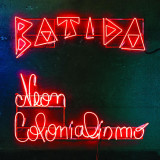
'Neon Colonialismo' is the new album -the first under his name since 2014- by musical agitator Batida, aka Pedro Coquenao, one of the main catalysts of the Afro-electronic scene. Carried by a subtle and refined electronic production, the eleven tracks (equally divided between songs and instrumentals), travel through the Portuguese-speaking world, from Portugal to Angola through Cape Verde and Brazil. They feature the presence of many distinguished guests: Mayra Andrade, Branko, DJ Satelite, Poté, Botto Trindade, Bonga, Ikonoklasta, Octa Push, Lia de Itamaracá, DJ Dolores, Joao Morgado, Pedro da Linha & Nástio Mosquito.
expected to be published on 14.10.2022

Mit seinem dritten Album als Peel Dream Magazine lockt Joseph Stevens in eine fabelhafte, zickzackförmige Welt, die er selbst entworfen hat. Auf Pad verzichtet er auf die unscharfe vorherige Glorie seiner Indie-Pop-Vergangenheit - hier zittert erst ein Vibraphon, stehen Streicher ebenfalls im Mittelpunkt. Der Vorhang hebt sich für einen opulentem Kammerpop und gibt den Blick frei auf Banjo. Glockenspiel. Farfisa. Und als er im Titeltrack des Albums ein Stöhnen ausstößt, wird klar, dass dies kein gewöhnlicher Auftritt ist. Pad ist ein konzeptionelles Werk über das Sich-Verlieren, wenn man nur noch sich selbst hat, und deutet auf eine aufregende neue Zukunft für Stevens' Pop-Song hin, indem es seine eigene Existenz neu interpretiert. Als Nachfolger des erfolgreichen Agitprop Alterna aus dem Jahr 2020 stellt Pad eine bedeutende soundtechnische Entwicklung für den 34-jährigen Songwriter dar, der im selben Jahr mitten in der Pandemie nach Los Angeles zog. Drumcomputer und Synthesizer aus den siebziger Jahren sind geblieben, aber er hat seine schnarrende Offset-Gitarre gegen eine Nylonsaite ausgetauscht und sich für einen sanften Barock-Pop-Sound entschieden, der von Bossa, Folk und seiner eigenen unheimlichen Mystik durchdrungen ist. Neben Vorbildern aus der Mitte des Jahrhunderts wie Burt Bacharach greift Stevens auf die kultisch geliebten Basteleien der Beach Boys aus den späten 1960er Jahren zurück und bietet eine surreale Melange aus alten Orgeln und gefundener Percussion sowie Harry Nilssons Songteppich The Point!von 1970. Pad klingt zwar wunderschön, hat aber auch eine gewisse Dunkelheit. Stevens spricht unsere generelle Ambivalenz gegenüber der Zukunft von allem, was wir kennen, an, teilweise beeinflusst durch seine Zeit in New York zu Beginn der Pandemie. In "Hiding Out" klagt er: Ich wandere an der Vernon Mall vorbei und hinauf zur Queensboro Bridge. Man gibt mir das Gefühl, zwei Fuß klein zu sein, aber das ist keine Art zu leben. Letzten Endes verfolgt Stevens einen Ansatz, bei dem der erste Gedanke der beste Gedanke ist, und lehnt sich an die fantastischen Elemente seiner eigenen Lebensgeschichte an. Pad ist ebenso archetypisch wie seltsam und verwischt genau die Grenzen, die es zu definieren versucht. Die Kunst ahmt das Leben nach, aber das Leben ahmt auch die Kunst nach - und die Ergebnisse können manchmal unvorhersehbar sein. Für Freunde von Sterolab, Beach Boys ca. Smile, High Llamas, Broadcast, The Lilys
expected to be published on 07.10.2022

A new EP by UK DJ / producer, Controlled Weirdness lands on Cultivated Electronics Ltd (CE's vinyl only sister label) in July. Heads will know Controlled Weirdness (real name Neil Keating) from his monthly radio show on Threads, his Presence Unknown label and Electric Sweat events. But he's actually been rocking the decks since the mid-'80s when as a youngster, Electro and early '80s pirate radio started his obsession with electronic music and he played his first gig at "The House of Dolls" in Farringdon where he soon became resident. After a stint in New York from 1989 he met Joel Bevacqua aka DJ Deadly Buda, who after returning to his hometown of Pittsburgh invited Neil to play at the first ever rave there in 1991, leading to a 6-month stint of events. Neil eventually returned to London in 1992 and started a radio show on pirate station Chillin FM alongside his sister, Stacey (later known as NoYeahNo). Many more events followed until in 1996 he formed Unearthly Records. Since then, he has played worldwide from plush clubs to dirty warehouses and has appeared on a variety of labels including Audio Illusion, Control Tower, Praxis, Zhark, Dirty Needles, Fdb and Still Raven. On 'In The Shadows' he delivers 4 earthy and raw Electro cuts with exciting electronics, tough beats and wonky acid.
Order now and we will order the item for you at our supplier.

It’s going off and The Chisel are back to cause a bit of bovver. Following a trio of explosive singles, the band finally bring us their debut full-length album, Retaliation, on the London-based punk institution La Vida Es Un Mus. Having formed in early 2020 and featuring a crew of members with long-term associations to the London punk scene, The Chisel quickly secured a reputation as one of the most exciting bands from a pool of contemporaries that includes Chubby & The Gang, Stingray and Big Cheese. Their sound is rooted firmly in Punk but with influences that run across the board to create a distinctive blend of Oi!, anarcho, UK-82 and hardcore. Retaliation is an unmistakably British record that draws a line from 1982 up to the present day, pushing its way into your collection and torching your stereo. Opening with the agitated force of ‘Unlawful Execution’, the tone is firmly set by a song that addresses the brutality of the Met Police (“Tell me what’s the difference between right or wrong / When a copper gets to blast a lad who did nothing wrong”). ‘Come See Me’ is a ferocious ode to camaraderie in the face of mouthy boneheads and bellends. ‘Shit Life Syndrome’ is a poisoned reference to the same cynical phrase used by physicians to describe the effects of people living under poverty and in the grips of substance abuse (“How can you expect people to act nicely, they’ve all been left on the edge of society”). It’s one of many songs influenced by singer Cal’s experiences of growing up in the working-class town of Blackpool. Cal states: “Blackpool as a town is often overlooked or even looked down upon, I wanted to write lyrics which gave the people of my town a voice”. With tunes like these The Chisel show that they’ll never pull any punches. However, beyond the fury and the swagger there’s another side that plays to an additional strength; the ability to write a memorable hook. Songs like ‘Retaliation’, ‘Tooth & Nail’ and ‘Not The Only One’ could be described as modern day anthems (the latter has become a fan favourite since the arrival of their first live shows) and cement their identity as a band not to be defined by their influences. Recorded by Jonah Falco at Total Refreshment Centre, London, March 2021.
Mixed by James Atkinson at the Stationhouse in Leeds. Mastered by Daniel Husayn at North London Bomb Factory. Cover painting by Tara Atefi.
expected to be published on 11.07.2022

"The letter X marks the spot, crosses over, literally with a cross. It’s the former, the ex-. The ex-lover known simply as “an ex”. Ex- is the latin prefix meaning “out”. Exterior, an exit. Extraordinary. Excellent. It’s exciting. Generation X. X-files. X is the unknown. X is Extreme“
Extreme is Molly Nilsson’s tenth studio album. Recorded in 2019 and throughout the 2020 global pandemic at home in Berlin, Extreme is a departure for Nilsson, an explosion of angry love. It’s an album of anthems for the jilted generation, soaked with joy and offering solace, bristling with distorted, Metal guitars and planet-sized choruses that bring light to the dark centre of the galaxy. It’s an album of the times, by the times and for the people. It’s a record about power. About how to fight it, how to take it and how to share it.
Absolute Power explodes with massive guitars, double kick beats and the instantly iconic line “It’s me versus the black hole at the centre of the galaxy.” Nilsson’s performance itself portrays absolute power in its confidence but the song is a call-to-arms, an entreaty to grasp the here and now, to take the power back. It’s Nilsson pacing the ring and we’re instantly in her corner. Earth Girls takes familiar Molly Nilsson themes - female empowerment and subverting the patriarchy - but casually throws in one of the choruses of her career. “Women have no place in this world” she sings, but it’s the world that isn’t good enough. Stadium-sized but still warmly hazy, Earth Girls has its fists in the air, glorifying in harmony, almost ecstatic in its feeling good. Nilsson’s Springsteen-level conviction and righteousness bleeds through the speaker cones, the cognitive dissonance between the song’s cadences and angry lyrics redolent of Bruce in his prime. Female empowerment isn’t always an angry energy on Extreme, however. On Fearless Like A Child, Nilsson’s anthem to the female body and women’s sovereignty of it, she croons over a mid-80s blue-eyed Soul groove. It sets a nocturnal scene as the narrator surveys her past and her surroundings. Before we’re fully submerged in a dreamlike, Steve McQueen-era Prefab Sprout poem to learning from your mistakes the song erupts into one of those lines only Molly Nilsson can get away with: “I love my womb, come inside I feel so alive” she fervently sings. Against the backdrop of ever-encroaching, conservative rulings on women’s reproductive rights in places like Texas, it’s simultaneously angry and full of love.
Every song on Extreme is a gleaming gem in a pouch of jewels. On Kids Today, Nilsson is the voice of wisdom, archly commenting on the eternal struggle between youth and authority. Wisdom infuses Sweet Smell Of Success with a transcendent love that forgives the narrator’s shortcomings and celebrates the moment, it’s a letter to the author from the author that asks “what is success” and concludes that this is it, this song, this moment. It’s a rare moment of simple reflection that is generous in its insight to Nilsson’s inner life. “Success” is a tool of power and we don’t need it… We need power tools and there are moments on Extreme where it feels like Nilsson is showing us how to find them. It's an open conversation through out Extreme. She’s a warm, comforting presence through out the album and specially on these songs of encouragement, songs perhaps sang to a younger Molly Nilsson or, really, to whomever needs to hear them. “They’ll praise your efforts, they’ll call you slurs a rebel, a master, an amateur / Merely with your own existence, you already offer your resistance.” On Avoid Heaven she’s even more direct, pleading with us to avoid concepts of purity and to embrace the glorious, ebullient, emotional mess we’re often in as a method of upending the power structures who need things to be perfect.
They Will Pay brings back the big, distorted power chords in the form of a agit-punk, pop slammer. Of course, when Molly Nilsson does punk pop we get the catchiest chorus this side of The Bangles or The Nerves. It’s rendered in an off the cuff, throwaway manner that is just perfect in its roughness. However, it’s on Pompeii that Nilsson delivers the album’s epic, emotional heartbreaker. Like 1995 on Nilsson’s album Zenith, or Days Of Dust on Twenty Twenty, the lyrics of Pompeii are heavy with a transcendent sadness, an aching poetry that cuts to the truth of the heart like the best Leonard Cohen lines, though here delivered with an uplifting, life-affirming love. It contains the most personal moments of Extreme, a song lit by the dying embers of romance. Yet it’s here where the alchemy at the base of all Nilsson’s best work is found. Turning small nuggets of personal truth into big, generous universal moments that invite everyone to cry, to love and to fight the power. In an album of jewels, it might be the shining star.
Molly Nilsson’s biggest, boldest and most vital album to date, Extreme is about power. Against the love of power and for the power of love.
Order now and we will order the item for you at our supplier.
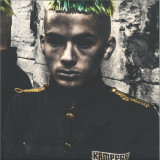
Poltergeist has that strange power of attraction that these personalities with their icy, mysterious aura hold. As soon as Ari Girard (aka Poltergeist) appears, something happens, he catches the light and strikes the spirits.
Kämpfer LP is a ghost story where Poltergeist invites Joy Division, New Order, Talking Heads, The Cure, Can, Kraftwerk, Nine Inch Nails or Jeff Mills for its first album. At the Poltergeist banquet, the crows of cold wave and the barbarians of krautrock, the metallers of indus rock and the freaks of techno meet.
The epicentre is Berlin, the Wall, Lou Reed's Gotham, the Bowie/Eno trilogy and the toxic nights of underground clubs...
Kämpfer LP, Poltergeist's first album, reveals its dark and disturbing universe. Marked by a heavy, deep and majestic atmosphere, this project evokes, without ever saying it openly, the climatic urgency, the ineluctable destiny, the human obsession to be first, to leave a trace of its passage and the nightmares which agitate the nocturnal spirits.
Between frenetic synths, bewitching waves and marked foot, this implacable album marks the beginning of the Poltergeist era.
Scratching synths, a dark and heavy universe: we can understand Vitalic's crush, who decided to sign the project at the first listening on his label Clivage Music.
Order now and we will order the item for you at our supplier.

After the 1974 release of The End…the magnetic and controversial Warhol muse went on a fruitful partnership with French director Philippe Garrel, for almost seven films. Back in New York in 1979 she started to perform again live, appearing firstly at the CBGB with John Cale and musical partner Lutz Ulbrich (former guitarist of Agitation Free and Ash Ra Tempel)… Back in France, she met young and talented Corsican bassist Philippe Quilichini who produced her comeback, Drama of Exile, in 1981. The album was released twice, in two different versions. Hereby we present the second, appearing in 1983, after a legal controversy was settled with Aura Records that released the first issue. While the first press was a 9-track offering, this second issue excludes “Purple Lips” but adds the tracks “Saeta” and “Vegas” released on a 7″ single in 1981. For this album, Nico recorded covers of the Velvet Underground’s “I’m Waiting for the Man” and David Bowie’s “Heroes”.
Order now and we will order the item for you at our supplier.

Joona Toivanen Trio makes their We Jazz Records debut with their new album "Both Only", out 25 Feb 2022. A landmark work for the long standing group, the album showcases a new sound for the band, trekking deep into new ideas for an acoustic jazz piano trio. Since their formation as teenagers in mid-1990's, the trio of pianist Joona Toivanen, bassist Tapani Toivanen and drummer Olavi Louhivuori (of Superposition, Ilmiliekki Quartet and Linda Fredriksson "Juniper") has developed their remarkably coherent band sound step by step, touring the world over. Nowadays, the trio is geographically split between Gothenburg, Sweden (Joona), Copenhagen, Denmark (Tapani), and Helsinki, Finland (Olavi), but the unit has never sounded so together as one, and as adventurous as on "Both Only".
"Both Only" by Joona Toivanen Trio is a cocoon, a welcoming shelter of sound that opens up naturally for the listener to inhabit. The album is moody and introspective, even dark at times, but by the time you get to the closing track, "This and This", you'll likely notice something hopeful brewing up. This is not music dealing with nostalgia or a world lost. Instead, it's a body of work with delicate dynamics, taking a minute just to listen and to look inwards to learn something, to move forward.
The first single "Enlightened" is perhaps the most traditional piece on the album, yet it flows like a vessel beyond genre, conveying a mood, a feeling and an idea. Listen to how the piano, bass and drums discuss, how the groove moves with the instruments having their clear roles but also supporting each other and documenting a musical aging process exactly as that of a quality bottle of red wine. As a song like "Direction" proves, the melody is there all the way, yet there is nothing obvious about how it's carried by the trio. Things remain surprising, fresh and moving at all times. "Except For" keeps its intensity, while nearly erupting into a full on 4-to-the-floor banger. Nearly! The key here is how the energy sustains itself, building the intensity within the music.
"Both Only" is a powerful statement from a band ready to renew itself time and again, and one willing to do it slowly, outside of the hype. This process makes the impact enduring, nuanced and lovely.
WJLP37 Joona Toivanen Trio "Both Only" is available on vinyl as a black vinyl edition and as a LP+7" bundle also including WJ0716 "Except For (7" Edit)" / "Keyboard Study No. 2".
“More excellent poetic soundscapes from We Jazz! Love the flow through the tracks here – textural pieces moving into more rhythmic jazz abstractions. Beautifully recorded too.”
Quinton Scott — Worldwide FM
“Following on from the excellent Linda Fredriksson album We Jazz extend the journey with this innovative Joona Toivanen Trio set.”
Paul Bradshaw — Straight No Chaser
“You’ll look in vain here for extravagant splashes of color or bright swathes of sound, but what you will discover are a finely-chiselled set of compositions that make the most of the trio’s limited palette: flint-sharp melodies hewn from the ice, crisp and crackling rhythms.”
Cal Gibson — Ban Ban Ton Ton
“Incredible album from Joona Toivanen Trio and a strong start to the new year from We Jazz.”
Kerem Gokmen — Dubmission
“Encapsulating a new movement in jazz.”
Jay Scarlett — Sounds Supreme
“Interesting listen on the shortest day of the year. They have a very definite and saturated style.”
John Chacona — All About Jazz
“Airplayed the track”
Tom Ravenscroft — BBC6 Music
“Jazz album of the year released already in February?”
Ralf Sandell — Hufvudstadsbladet
“★★★★★”
Iida Simes — Voima Magazine
Order now and we will order the item for you at our supplier.

Order now and we will order the item for you at our supplier.

Soul Music in Los Angeles was nearing its peak in 1966. The pre-eminent company was of course the giant Capitol Records and the uptempo songs that they released at the time still retain great power and attraction for many dancers today. But there were several small, private concerns making soul music, looking for that one big hit, and singers who were trying to find the break that would take their careers onto a new and higher plane. This album nods towards Capitol but concentrates on the varying styles of soul that the smaller, more agile labels released at the time. Many of these have been overlooked for far too long now, but here is the perfect opportunity to find out just how strong and varied the West Coast soul scene really was in the middle of the 1960s.
expected to be published on 30.05.2022

Joona Toivanen Trio makes their We Jazz Records debut with their new album "Both Only", out 25 Feb 2022. A landmark work for the long standing group, the album showcases a new sound for the band, trekking deep into new ideas for an acoustic jazz piano trio. Since their formation as teenagers in mid-1990's, the trio of pianist Joona Toivanen, bassist Tapani Toivanen and drummer Olavi Louhivuori (of Superposition, Ilmiliekki Quartet and Linda Fredriksson "Juniper") has developed their remarkably coherent band sound step by step, touring the world over. Nowadays, the trio is geographically split between Gothenburg, Sweden (Joona), Copenhagen, Denmark (Tapani), and Helsinki, Finland (Olavi), but the unit has never sounded so together as one, and as adventurous as on "Both Only".
"Both Only" by Joona Toivanen Trio is a cocoon, a welcoming shelter of sound that opens up naturally for the listener to inhabit. The album is moody and introspective, even dark at times, but by the time you get to the closing track, "This and This", you'll likely notice something hopeful brewing up. This is not music dealing with nostalgia or a world lost. Instead, it's a body of work with delicate dynamics, taking a minute just to listen and to look inwards to learn something, to move forward.
The first single "Enlightened" is perhaps the most traditional piece on the album, yet it flows like a vessel beyond genre, conveying a mood, a feeling and an idea. Listen to how the piano, bass and drums discuss, how the groove moves with the instruments having their clear roles but also supporting each other and documenting a musical aging process exactly as that of a quality bottle of red wine. As a song like "Direction" proves, the melody is there all the way, yet there is nothing obvious about how it's carried by the trio. Things remain surprising, fresh and moving at all times. "Except For" keeps its intensity, while nearly erupting into a full on 4-to-the-floor banger. Nearly! The key here is how the energy sustains itself, building the intensity within the music.
"Both Only" is a powerful statement from a band ready to renew itself time and again, and one willing to do it slowly, outside of the hype. This process makes the impact enduring, nuanced and lovely.
WJLP37 Joona Toivanen Trio "Both Only" is available on vinyl as a black vinyl edition and as a LP+7" bundle also including WJ0716 "Except For (7" Edit)" / "Keyboard Study No. 2".
“More excellent poetic soundscapes from We Jazz! Love the flow through the tracks here – textural pieces moving into more rhythmic jazz abstractions. Beautifully recorded too.”
Quinton Scott — Worldwide FM
“Following on from the excellent Linda Fredriksson album We Jazz extend the journey with this innovative Joona Toivanen Trio set.”
Paul Bradshaw — Straight No Chaser
“You’ll look in vain here for extravagant splashes of color or bright swathes of sound, but what you will discover are a finely-chiselled set of compositions that make the most of the trio’s limited palette: flint-sharp melodies hewn from the ice, crisp and crackling rhythms.”
Cal Gibson — Ban Ban Ton Ton
“Incredible album from Joona Toivanen Trio and a strong start to the new year from We Jazz.”
Kerem Gokmen — Dubmission
“Encapsulating a new movement in jazz.”
Jay Scarlett — Sounds Supreme
“Interesting listen on the shortest day of the year. They have a very definite and saturated style.”
John Chacona — All About Jazz
“Airplayed the track”
Tom Ravenscroft — BBC6 Music
“Jazz album of the year released already in February?”
Ralf Sandell — Hufvudstadsbladet
“★★★★★”
Iida Simes — Voima Magazine
Order now and we will order the item for you at our supplier.

The long-awaited reissue of this rare Eastern and psychedelic Jazz LP by the famous Hungarian guitarist, originally
released in 1968. For the first time and as extended Edition with four bonus tracks: radio version from 1968/69 7”
singles 7”. Deluxe 6-sided Digipak CD with 20 page booklet and Gatefold Vinyl comes with long, exclusively written
inner notes by the famous researcher and biographer Douglas Payne.
“The performances on this LP have a restrained, introspective quality. Szabo’s work is lyrical, rather economical, and
somewhat angular, and his tone is warm and glowing.” – Harvey Pekar, DownBeat
“Gabor Szabo is at the musical zenith of his career. This album could rank as his best to date.” - Billboard
“But for sheer lyrical beauty, few players are in Szabo’s class. His startling use of dissonance is a delight, too, and
time and again he will alter a final phrase just slightly, totally reorienting a familiar tune.” – Alan Heineman, DownBeat
“This is definitely one of my ‘go to’ Gabor albums.” Mike Stax, Ugly Things
"Gabor Szabo’s Bacchanal documents one of the earliest and finest examples of what was then known as “jazz rock.”
Years before this new jazz style evolved – or devolved, according to some – into “fusion,” jazz rock was mostly
fashioned by younger jazz players whose ears were open to the emerging sounds coming out of rock and roll,
especially those of the Beatles and, later, Jimi Hendrix. " - Douglas Payne
After recording four albums for Impulse in 1967, the distinctive guitarist Gabor Szabo cut three strongest records for
the Skye label in 1968-1969: "1969", "Dreams" and "Bacchanal" all of them became a legendary classic. This time
EBALUNGA!!! are rediscovers "Bacchanal". Szabo's regular group of the era is heard on record for the last time:
guitarist Jimmy Stewart, bassist Louis Kabok, drummer Jim Keltner and percussionist Hal Gordon. With the exception
of two Szabo originals, the material is comprised of current pop tunes including two songs by Donovan, "Love Is Blue,"
"The Look of Love" and "Theme from the Valley of the Dolls."
Gabor Szabo was one of the most original guitarists to emerge in the 1960s, mixing his Hungarian folk music heritage
with a deep love of jazz and creating a distinctive, largely self-taught sound.
Born in Budapest, on March 8, 1936, Szabo was inspired by a Roy Rogers cowboy movie to begin playing guitar when
he was 14 and often played in dinner clubs and covert jam sessions while still living in his hometown. He escaped
from his country at age 20 on the eve of the Communist uprising and eventually made his way to America, settling
with his family in California.
He attended Berklee College (1958-1960) and in 1961 joined Chico Hamilton's innovative quintet featuring Charles
Lloyd. Urged by Hamilton, Szabo crafted a most distinctive sound; as agile on intricate, nearly-free runs as he was
able to sound inspired during melodic passages. Szabo left the Hamilton group in 1965 to leave his mark on the popjazz of the Gary McFarland quintet and the energy music of Charles Lloyd's fiery and underrated quartet featuring Ron
Carter and Tony Williams.Szabo initiated a solo career in 1966, recording the exceptional album, Spellbinder, which yielded many inspired
moments and "Gypsy Queen," the song Santana turned into a huge hit in 1970. Szabo formed an innovative quintet
(1967-1969) featuring the brilliant, classically trained guitarist Jimmy Stewart and recorded many notable albums
during the late '60s. The emergence of rock music (especially George Harrison, Eric Clapton, and Jimi Hendrix) found
Szabo experimenting with feedback and more commercially oriented forms of jazz.
During the '70s, Szabo regularly performed along the West Coast, hypnotizing audiences with his enchanting,
spellbinding style. From 1970, he locked into a commercial groove, even though records like Mizrab occasionally
revealed his seamless jazz, pop, Gypsy, Indian, and Asian fusions. Szabo had revisited his homeland several times
during the '70s, finding opportunities to perform brilliantly with native talents. He was hospitalized during his final visit
and died in 1982, just short of his 46th birthday.
expected to be published on 30.04.2022

Produziert von Jorge Elbrecht (SKY FERREIRA, JAPANESE BREAKFAST, WILD NOTHING) ist "Giving The World Away" HATCHIEs bisher ausuferndstes Werk. Mit umfangreichem Input von ihrem langjährigen Kollaborateur Joe Agius, nimmt es die himmlischen, schimmernden Shoegaze- und Pop-Sensibilitäten ihrer früheren Veröffentlichungen auf, dreht aber den Lautstärke-Regler um das Zehnfache auf. Ursprünglich wollte Harriette Pilbeam mit diesen Songs eine energischere Richtung einschlagen - sie hatte die klare Vision einer HATCHIE-Show, die sich in eine Tanzparty verwandelt und mehr Bewegung und Lebendigkeit in ihre Live-Shows bringt. Aber dann, zwischen Covid und den Lockdowns in Australien, zog sich Pilbeam mehr in sich selbst zurück, und diese Selbstbeobachtung und Selbstfindung diente als wahre Inspiration für die Platte. In "Giving The World Away" kehrt sie immer wieder zu demselben Thema zurück - verinnerlichte Scham abzubauen und Dankbarkeit und Beständigkeit zu finden, und endlich in der Lage zu sein, sich selbst zu vertrauen. Harriette Pilbeam wuchs als Jüngste in ihrer Familie auf, ein selbst bezeichnetes "großes Baby", aber sie sagt, die letzten anderthalb Jahre hätten ihr den Raum gegeben, sich selbst besser zu verstehen. Nach Jahren der emotionalen Selbstverleugnung legt sie hier ihre Ängste offen. "Giving The World Away" ist ein Album über Selbstvertrauen, über Rückgewinnung, über die seltsame Zeit im jungen Erwachsenenalter, in der man endlich in der Lage ist, sich selbst klar zu sehen. "Giving The World Away" ist der bisher klarste Blick auf Pilbeam und ein Zeugnis der Kraft und des Mutes, die daraus entstehen, wenn man sich verletzlich zeigt und sein Herz aufs Spiel setzt.
expected to be published on 22.04.2022

Produziert von Jorge Elbrecht (SKY FERREIRA, JAPANESE BREAKFAST, WILD NOTHING) ist "Giving The World Away" HATCHIEs bisher ausuferndstes Werk. Mit umfangreichem Input von ihrem langjährigen Kollaborateur Joe Agius, nimmt es die himmlischen, schimmernden Shoegaze- und Pop-Sensibilitäten ihrer früheren Veröffentlichungen auf, dreht aber den Lautstärke-Regler um das Zehnfache auf. Ursprünglich wollte Harriette Pilbeam mit diesen Songs eine energischere Richtung einschlagen - sie hatte die klare Vision einer HATCHIE-Show, die sich in eine Tanzparty verwandelt und mehr Bewegung und Lebendigkeit in ihre Live-Shows bringt. Aber dann, zwischen Covid und den Lockdowns in Australien, zog sich Pilbeam mehr in sich selbst zurück, und diese Selbstbeobachtung und Selbstfindung diente als wahre Inspiration für die Platte. In "Giving The World Away" kehrt sie immer wieder zu demselben Thema zurück - verinnerlichte Scham abzubauen und Dankbarkeit und Beständigkeit zu finden, und endlich in der Lage zu sein, sich selbst zu vertrauen. Harriette Pilbeam wuchs als Jüngste in ihrer Familie auf, ein selbst bezeichnetes "großes Baby", aber sie sagt, die letzten anderthalb Jahre hätten ihr den Raum gegeben, sich selbst besser zu verstehen. Nach Jahren der emotionalen Selbstverleugnung legt sie hier ihre Ängste offen. "Giving The World Away" ist ein Album über Selbstvertrauen, über Rückgewinnung, über die seltsame Zeit im jungen Erwachsenenalter, in der man endlich in der Lage ist, sich selbst klar zu sehen. "Giving The World Away" ist der bisher klarste Blick auf Pilbeam und ein Zeugnis der Kraft und des Mutes, die daraus entstehen, wenn man sich verletzlich zeigt und sein Herz aufs Spiel setzt.
expected to be published on 22.04.2022

Produziert von Jorge Elbrecht (SKY FERREIRA, JAPANESE BREAKFAST, WILD NOTHING) ist "Giving The World Away" HATCHIEs bisher ausuferndstes Werk. Mit umfangreichem Input von ihrem langjährigen Kollaborateur Joe Agius, nimmt es die himmlischen, schimmernden Shoegaze- und Pop-Sensibilitäten ihrer früheren Veröffentlichungen auf, dreht aber den Lautstärke-Regler um das Zehnfache auf. Ursprünglich wollte Harriette Pilbeam mit diesen Songs eine energischere Richtung einschlagen - sie hatte die klare Vision einer HATCHIE-Show, die sich in eine Tanzparty verwandelt und mehr Bewegung und Lebendigkeit in ihre Live-Shows bringt. Aber dann, zwischen Covid und den Lockdowns in Australien, zog sich Pilbeam mehr in sich selbst zurück, und diese Selbstbeobachtung und Selbstfindung diente als wahre Inspiration für die Platte. In "Giving The World Away" kehrt sie immer wieder zu demselben Thema zurück - verinnerlichte Scham abzubauen und Dankbarkeit und Beständigkeit zu finden, und endlich in der Lage zu sein, sich selbst zu vertrauen. Harriette Pilbeam wuchs als Jüngste in ihrer Familie auf, ein selbst bezeichnetes "großes Baby", aber sie sagt, die letzten anderthalb Jahre hätten ihr den Raum gegeben, sich selbst besser zu verstehen. Nach Jahren der emotionalen Selbstverleugnung legt sie hier ihre Ängste offen. "Giving The World Away" ist ein Album über Selbstvertrauen, über Rückgewinnung, über die seltsame Zeit im jungen Erwachsenenalter, in der man endlich in der Lage ist, sich selbst klar zu sehen. "Giving The World Away" ist der bisher klarste Blick auf Pilbeam und ein Zeugnis der Kraft und des Mutes, die daraus entstehen, wenn man sich verletzlich zeigt und sein Herz aufs Spiel setzt.
expected to be published on 22.04.2022

Some sonic communities grow even in isolation, in the lonely obsessive moments in the studio as time melts away. Deep inside the Detroit Underground nests a Berlin underground, chasing those resonant shared sounds. DU Berlin draws together some of that love felt through music in the German capital. It’s not the wild city of reunification or *Berlin Calling* or tourist-style movies or the easyJet set. This is the side of the city that endlessly romances machines for the sheer joy of it, as The Allegorist titles her track, “until dawn.” And with some big names and emerging, ranging from mainstays to veteran agitators, the Berlin DU crew have telegraphed each other through productions and mutual inspiration. The results vibrate and rumble with sympathetic frequencies, but never limited to grayscale or dithered palettes.
DESIGN: Neubau Berlin.
Order now and we will order the item for you at our supplier.

Re-mastering by: Cicely Baston at Alchemy/Air Mastering
Recorded in 1986 in Paris and originally released only in France, Great Friends mines the John Coltrane spiritual legacy with fervent incantatory playing and an ecstatic charge. Not that alto saxophonist Fortune and tenor man Harper necessarily speak with Trane’s voice, but the intensity of their playing and their use of certain scales and modes produce a Tranelike atmosphere. Drummer Hart (who organized this band at the request of a Japanese promoter), bassist Workman and pianist Cowell form a hard-hitting team alongside the horns.
Things begin with “Cal Massey,” a tribute penned by Cowell. Harper sets the spiritual vibe in motion with a big-toned, take-no-prisoners solo. The Texas tenor man has the heaviest low-register sound in the business. On Workman’s “East Harlem Nostalgia,” he chomps into the low notes as a prelude to wailing runs into the upper register. Harper’s up tempo “Insight” is the album’s tour de force, with rippling solos and torrid exchanges between the saxophonists. Fortune’s searing tone is well suited to the exuberant joyride of this performance.
The rhythm section can be compared to the McCoy Tyner, Jimmy Garrison and Elvin Jones triumvirate that backed Trane. Equally heavyweight and agile, it is relentless in its conviction and spiritual attitude.
expected to be published on 18.02.2022

of time in the music world, he started to embrace his own limitations, subverting themes like “making it” and preinternet nostalgia with a Jim O’Rourkeinspired wink in his eye. While holed up in his Toronto basement, a lifelong obsession with outdated pop trickery and yesteryear’s preset sounds launched him into an alternate sonic universe—one where The Beach Boys’ late70s albums were big hits, and long-forgotten Italian soft rock is the style du jour. The resulting ten songs were given their final sheen by mastering impresario Dave Cooley (Tame Impala, Blood Orange, J Dilla). Born and raised in West Berlin sometime in the 80s, Carl has already had several musical incarnations. From a Berlin Art Prize nomination for his single-note vinyl record (“The whole concept makes me upset” — VICE), to glimpsing the album charts by cowriting an aging crooner’s magnum opus (“Glamorous” — NY Times), he has always been more interested in exploring different angles than building a career. Since a transcontinental move to Canada, his focus has shifted from the conceptual to the immediate music-making process,
expected to be published on 04.02.2022

4 Reworked & Reimagined tracks from Motherhood and a cover of Deftone’s “Teenager”. Clear w/ Blue Glitter Colored Cassette Shell, with full pull-out J-Card artwork. Recommended If You Like : Bjork’s Live Box, The Deftones Cate Le Bon. Montreal’s No Joy—since 2009, a noisy four-piece shoegaze band, from 2015 onward, the sonic experiments of founding member and principal vocalist Jasamine White-Gluz has rejected convention, opting to find cohesion in vast, bold, indiscernible structures. In the beginning, the group excavated melodious riffs from squalling guitars, now, White-Gluz approaches songwriting with abstract meticulousness, no longer tethered to her six-string instrument. In 2018, it was the modular electronica of No Joy / Sonic Boom, an EP collaboration with Spaceman 3’s Pete Kember. In 2020, her first full-length as a soloist and No Joy’s first album in five years, Motherhood, her guitar returned for a genre-agnostic, maximalist treatise on aging. Fertility, family, death, birth, her voice heard loud in the mix, White-Gluz became a commanding force among the many-splendored sounds of trip-hop, trance, nu-metal, dance rock, and, of course, shoegaze, delivered through banjo, vibraphone, scrap metal, slap bass, even kitchen appliances. Who knew chaos could have such lucidity? Now, White-Gluz’s ever-expansive evolution has brought forth Can My Daughter See Me From Heaven, an EP reanimation of five songs from Motherhood, transformed by new orchestral instrumentalists: an opera singer, a cellist, a harpist, French horn musician. These songs, recorded entirely remotely, are not a correction. They are a spring rebirth—an opportunity to grow those tracks, similar to the transformation they would’ve undergone live, on stage. “Songs take on a new life when I’m on tour. These songs didn’t get that chance. I still had more to say with them,” White-Gluz explains. “I probably never would’ve been like ‘let’s get a bunch of classically trained players together,’ if it wasn’t for covid-19 canceling tours. This EP was an opportunity to do something that wasn’t obvious. It’s a bedroom recording, but it doesn’t sound like we recorded this in our bedrooms. I wanted to do something that sounded bigger than Motherhood did, and Motherhood was recorded before covid.” Where many musicians used last year’s disaster to look inward, releasing solitary, insular albums, No Joy did the opposite: “It was more, ‘Let’s try everything!’ Give me something to look at!”
expected to be published on 12.11.2021

The edition that marks the start of the brand-new Comets Coming could not be more suitable: it is that Rodrigo Brandão, like his grandfather Herman Poole Blount, dust of stars that the world knows as Sun Ra, may have his feet on the Earth, but he has definitely a sidereal head.
Brandão arrived recently to Portugal, but already left a strong mark in the most adventurous Lisbon scene, having performed several concerts in which his language has been wrapped in the exploratory sounds of musicians such as Rodrigo Amado, João Valinho, and Hernâni Faustino. The agitator, poet and spoken word artist, brought a vast experience that over the years saw him collaborate with artists as distinct as the members of Metá Metá or Prince Paul (that one!) on BROOKZILL!.
This work, however, came in his luggage, across the ocean, on the rediscovery trip that brought him from Brazil to Lisbon. OUTROS ESPAÇO was recorded in São Paulo in late 2019 with a luxury crew: Tulipa Ruiz and Juçara Marçal added to the microphone, Thiago França played flute and alto & tenor saxophones, Guilherme Granado dealt with the synthesizers and effects, Marcos Gerez measured the overall pulse with his electric bass, Thomas Rohrer played soprano and 'rabeca' (fiddle), and Paulo Santos dealt with the percussion. In addition to the base band, OUTROS ESPAÇO also features some members of Sun Ra Arkestra's current incarnation. Respectively: Danny Thompson (RIP) on baritone and bongo, Elson Nascimento on 'surdo' (tom drum), Knoel Scott on tenor and soprano, with the giant Marshall Allen in a prominent role leading the collective towards the unknown, while playing the alto sax and synthesizer.
In OUTROS ESPAÇO, Brandão reaches for words from different origins, from contrasting times and cultures, all with magnetic resonance imaging: what is not from his furrow comes to him from Candomblé (“Quando Os Orixás Desfilam Sobre A Cracolândia”), from his readings of Sun Ra (“Eu Sou 1 Instrumento” is an adaptation of the poem I Am An Instrument), or from the school's playgrounds (“Jamais Nos Esqueceremos”). And in these words there are teeth and nails ingrained in injustice (“Quantos Coltrane...?, “Todo o Dia Tem +”) and kaleidoscopic delusions that result from the speed of light (“Sol da Meia Noite”).
The crew that travels through these OUTROS ESPAÇO (PT for "Other Spaces") has freedom as the main fuel, jazz as a measure of their reach, and all swings in the world as maps, so they can lose themselves at the end of the cosmos. There is urgency and reflection, craziness and precision, surprise and well-known ancestral raw material, that makes us vibrate inwardly with the same trembling as the comets that are coming.
The visionary and veteran Scotty Hard was responsible for making everything sound like the music of the spheres, dealing with the mixing from his INGUASONIC SOUND studio in Brooklyn, NY.
And lastly, in January, Rob Mazurek, another frequent ally of Brandão, another notorious space traveler, offered a poem that frames this project. Among other things, he writes:
Make this place sing
Make this place thunder
Make this place shake
It couldn't be in any other way.
expected to be published on 10.09.2021

Double vinyl on blue and orange transparent vinyl in gatefold sleeve with download code.
Former bIG*fLAME singer and bassist Alan Brown returns with his long term solo project The Great Leap Forward, releasing a powerful and trademark new album ‘Revolt Against An Age Of Plenty’.
Vigorous, scintillating and life-affirming, this 13-song album sees Brown reach a milestone birthday, as explored in 'Can You Kanreki?’ - the Japanese concept of second childhood and re-birth. Then there are the trademark political and social vignettes, such as the title song of the album 'Revolt Against An Age Of Plenty' – railing against mass consumerism and media control; the wistful 'dEBRA 2021' (a re-working of the bIG*fLAME classic 'Debra'); and the ascerbic 'It's A Wonderful Lie' – a scathing attack on the lack of openness, honesty and humility of our political leaders.
Brown featured on the legendary and influential C86 NME cassette as singer and bassist with Manchester agit-post-punk trio bIG*fLAME, and recorded nine John Peel sessions for BBC Radio One in the 1980’s with bIG*fLAME (4), The Great Leap Forward (2), A Witness (2) and Inca Babies (1).
Formed by Brown following the disbandment of bIG*fLAME in 1986, The Great Leap Forward is essentially a solo project in which Brown writes all songs and lyrics, and plays / programs all instruments on recordings.
The style and sound is more melodic and accessible than bIG*fLAME, but still with overtly political lyrics and a socialist / humanist ethos: incisive political and social commentary layered over sharp yet melodic guitar pop – and with a touch of electro and humour thrown in for good measure…
Stuart Maconie, writing for NME, summed up the band's sound: "First there's the jagged guitar melodics, sweet but never tacky. Then there's the ferocious rhythmic drive. But best of all there's the stylish and witty use of found voices...snatches and snippets of speech and propaganda that are integral to the songs."
Little wonder that as with McCarthy, The Great Leap Forward were loved by a young James Dean Bradfield.
Brown writes- “This album is the culmination of four year's writing, and it has a much more varied approach than previous releases. Whereas previously I've concentrated on a political approach, this album takes a wider view of the world. Of course I still provide the trademark political and social vignettes - how could I not - such as the title song of the album 'Revolt Against An Age Of Plenty' – named after a collection of works by the English writer Jack Common in which I rail against mass consumerism and media control; the wistful 'dEBRA 2021' (a re-working of the bIG*fLAME classic 'Debra'); and the ascerbic 'It's A Wonderful Lie' – with what I think is a scathing attack on the lack of openness, honesty and humility of our political leaders.
expected to be published on 30.07.2021

Phonophobia is a record that inspired thousands of dirty punks all over the world, and having the chance to re-release it is such a honour for us. I don't think we need to introduce this record and this band to any of the people who are reading these lines, but a few words are necessary to explain the value of this product. Phonophobia has originally been recorded and mixed at Southern Studios in London in August 1991. This version has been remixed and remastered by Dean Jones and Phil Vane with additional production at Springvale Studios in Ipswich in October 2009. The sonic assault is now more than ever ear damaging, so prepare your turntable and your eardrums for this final violent assault!
expected to be published on 16.07.2021