File Under: Jazz / Contemporary Jazz - For fans of Ryuichi Sakamoto, Boards of Canada, Linda May Han Oh, Supersilent, Nels Cline, Makaya McCraven, and Haruka Nakamura! Born in Pinsk, Belarus in 1984 and immigrating to Canada in 1992 with the collapse of the USSR; Alexei Orechin has been actively shaping musical environments with his current projects No Seas, a solo project for guitar and tape, and leading his own ensemble incorporating jazz, chamber, and experimental elements into his compositional work. A diverse talent that is reflected in the company he has shared the stage with: Nas, Akae Beka, Rana Mansour, Shad, Yaadcore, and Sina Bathaie. He has played in USA, Mexico, Europe, and Russia. Performances include the TD and Montreal Jazz Festivals, Caribana, Irie Music Festival, Tirgan Festival, and Pride Toronto. His music for film has been featured at TIFF, CFC, NFB and the Warsaw Jewish Film Festival. He has been featured on CBC, Noisey, Global News, The Star, Dub Rockers, Huffpost, Afropunk, and Relix magazine. 2020 saw the premier of '1992 Ambient', a 45-minute long composition that is a 'therapeutic experiment in slowly melting sound and colour; representing the acculturation and restructuring oneself through emigrating from Russia to Canada in 1992'. 2021 will also see the release of his debut full length album Mirages; an album that showcases his diverse and ever evolving style of composition, ranging from moments of melodic solitude to fractal experimentalism.
Buscar:ale x
The mystifying 9th album in the Field Works series, Cedars combines cosmic Americana with Western ambient and Middle Eastern influences. Delicate layers of pedal steel, banjo, oud, and hurdy-gurdy float atop looping guitar drones to create a soothing, atmospheric chamber where folk and electronic music coalesce. Set to Arabic and English poetry, the song cycle examines some of Earth's most iconic and ancient forests, revealing our complicated relationship with the natural world. For this special dual-language release, Field Works producer Stuart Hyatt has assembled a supergroup of musicians, poets, and artists. The album is narrated by Youmna Saba and H.C. McEntire. Instrumentalists include Marisa Anderson, Fadi Tabbal, Dena El Saffar, Danny Paul Grody, Bob Hoffnar, Tomás Lozano, Nathan Bowles, Alex Roldan, Youmna Saba, and Stuart Hyatt. Renowned illustrator María Medem brings poems by Todd Fleming Davis and Youmna Saba to life in the accompanying full-color Risograph comic book; and longtime Field Works collaborators PRINTtEXT design the packaging.
Testament is often credited as one of the most popular and influential bands of the thrash metal scene. Their debut album The Legacy immediately made an impact when it was first released in 1987. Music critic Alex Henderson of AllMusic gave it 4.5 out of 5 stars, praising the record for its “thrash circles” and for being “a relentlessly heavy and promising effort focusing on such subjects as the occult, witchcraft, nuclear war, and global destruction”. It made many year-end lists including those of renowned metal publishers Metal Injection. Loudwire lists the album among the ten best thrash records that weren’t released by The Big 4. The album spawned one single release, lead-off track “Over The Wall”, which the band still plays live during nearly every show they play and remains one of the most popular songs among fans.
This limited edition of only 1500 numbered copies release contains an insert and is pressed on silver coloured vinyl.
As Dense & Pika, Alex Jones and Chris Spero have garnered an enviable reputation for making devastating club ordnance that finds the sweet spot between dark, mysterious house and roaring, brawny techno. With over a decade of material under their belt, Jones and Spero are set to release their first studio length debut album, ‘Colour Burn’ via London major imprint BMG on 4th December, home to the likes of Leftfield, The Prodigy, Holy Ghost and Faithless.
‘Colour Burn’ is a 13-track composition crossing through downtempo house and electronica, built as a conceptual sonic representation of the pair’s live audio and visual set up. The album is a step away from harder and faster material and a move towards a more leftfield sonic trajectory, featuring a handful of impressive heavyweight features of Jones & Spero’s musical heroes who have informed the Dense & Pika output.
Released today, album moment ‘Honey’ features the master of sensual, slow-burn techno, Matthew Dear whose contribution to ‘Honey’ arrives in vocal form – a breathy, brooding ensemble of spoken word that glues perfectly with the duo’s trademark rough and textured sound palette. It helps turn what Alex calls “a headsy, dusty piece of housey tech” into something sensual and otherworldly.
Dark and smouldering, it seems to the suck the air out of the room like a tightly packed subterranean dancefloor deep in the throes of night. Glitched out percussion and fizzling hi-hats feel caustic against the track’s low-end frequencies. The thumping bassline and kick drum combination delivers punch and pressure to the mix in a true Dense & Pika format. Matthew’s sauntering vocal contribution guides the track into a deep and hypnotic groove well equipped for any late-night excursion. “The boys sent over a lengthy jam, but there was that simple loop that stood out and had me hooked. I put it on repeat and let the mind and pen wander. It’s a bit of cosmic abandonment, brazenly sung by a professional of the night.” Matthew Dear
Elsewhere on the LP, standout track ‘Hidden’ features the drums of Sepultura’s legendary metal icon Igor Cavalera resulting in a fabulous frenzy of percussion and driving rhythm. The equally momentous and unforgettable ‘Control’ features the heavily robotic vocoder of Leftfield’s Neil Barnes aiding and abetting in its quest to be a high-octane, twisted rave jam.
The impressive features on ‘Colour Burn’ are an insight into the hugely artistic and visionary A&R skills of Alex and Chris and the start of a new chapter for Dense & Pika kicking off with the long-awaited release of their first studio length album.
- A1: Theme Tune
- A2: Dig That Groove Baby
- A3: Dougy Giro
- A4: Spiders In The Dressing Room
- A5: Glenda And The Test Tube Baby
- A6: Up The Garden Path
- A7: Nellie The Elephant
- B1: Poor Davey
- B2: Stay Mellow
- B3: Queen Alexandra Road Is Where She Said She'd Be, But Was She There To Meet Me... No Chance
- B4: Worse Things Happen At Sea
- B5: Blue Suede Shoes
- B6: Firey Jack
- B7: Theme Tune
Hailing from Sunderland in England’s industrial northeast, the Toy Dolls infused their take
on punk with ample doses of working-class humour, the three-chord format a launching pad
for witty originals and clever cover tunes. 1983 debut Dig That Groove Baby captures the
group at their finest, their twisted rendition of kiddies tune “Nellie The Elephant” topping the
indie charts; the title track is an infectious singalong, while “Spiders In The Dressing Room”
and “Glenda And The Test Tube Baby” are more irreverent tongue in cheek, all delivered in
the peculiar androgynous accent of frontman Michael “Olga” Algar. Essential!
Arthur Alexander’s mid-60s releases for Monument and Sound Stage 7 under the supervision of Fred Foster in Nashville failed to register on the charts but are highly regarded, none more so than these sides cut on his first session for the company. The released tracks from the session, ‘(Baby) For You’ and ‘The Other Woman (In My Life)’, were more country-sounding.
These two wonderful soul songs remained in the vaults until an Ace CD in 2001 and have picked up admirers ever since. To own them on vinyl will be a vintage soul lover’s thrill.
Mats Gustafsson - Flute, baritone sax, live electronics, Johan Berthling - Electric bass, Andreas Werliin - Drums with Goran Kajfes - Quartertone trumpet, Mats Aleklint - Trombone, sousaphone, horn arrangements. Fire! tracking new paths and reaching new levels of excellence, still honoring their 12 year old vow of presenting a fresh approach to improvised music. Their debut album, You Liked Me Five Minutes Ago, was released in 2009 to wide international acclaim. "The basic strategy of pairing the expressive energy of free jazz with a sturdy sense of groove has yielded something potent and self-contained" (New York Times). Between this and Defeat there's been five albums, including collaborations with Jim O'Rourke (Unreleased?, 2011) and Oren Ambarchi (In The Mouth A Hand, 2012). No two Fire! records sound the same, but with Defeat they have taken their biggest leap so far, with Gustafsson giving the flute a prominent place in the sound image, a surprising and most successful move, his both expressive and ornamental approach given ample room to breathe, especially on the two long tracks bookending the album. In places more subdued than on previous efforts, but with the distinctive bass figures and hypnotic mood fully intact. There are some lively stretches with guests Goran Kajfes and Mats Aleklint, bringing to mind their big band offshoot Fire! Orchestra, albeit on a smaller scale. For over 20 years we have made a habit of releasing music that is beyond easy classification, in later years typified by Hedvig Mollestad, Elephant9 and Krokofant, but cemented by Fire! and their exploratory curiosity and deep love of music in general. We, and many others, have tried to compare the trio to other groups, but listening to Defeat we realize how futile this is. Given the above there's no doubt there are many influences at play, but the resulting brew is in a class by itself.
Latest volume of the first AA.VV. trilogy on R3volution Records. For this third volume, four great artists of the Techno scene are called to express themselves together with the owner of the label Michele Mausi: Joton, Keikari, Wrong Assessment (already appeared on the label) and Alexander Kowalski with the pseudonym of D_Func. together with Mario Berger.
Can you miss these bombs?
Conceived and produced by Luciano Cantone, co-founder of Schema Records, and written by Alex Puddu, The Afro Soul Prophecy is a musical project that stands out of time and trends and that finally releases a full-length after some 2017 singles/Ep's. "Heat in the City" is an almost completely instrumental black funk music-based album, that often indulges in afrobeat, latin, disco and urban blaxploitation music. The multi-ethnic nature of this project ensures a multi-faceted work, where the music language has been able to unite musicians from all over the world.
LTD edition... Crossbredd at Radio Bomb is an original adventure.
Producting Hardcore/jungle since 1994 Alex Aka Radio Bomb saw the "crossbreed" name taken by a more formated style, very drum & bass oriented while this original style was more jungle. Here comes a collection of 4 tunes exposing his point of view on this "name style".
So here come the original X Breed style !
It’s hard not to notice such an unforgettable sleeve, and if the music it protects is half as memorable as the artwork, you know you just have to hear it. We don’t think you’ll be disappointed because yes, this is the majestic 1971 album Un Muñeco De Madera, courtesy of the shadowy Sola, and it sounds exactly as you’d want it to. Originally released on RCA in Mexico, it’s kaleidoscopic Acapulcan-funk.
The album’s endless grooves are propelled by softly rocking, quasi-library funk breaks. Vocally, Sola is in step with the 60s French pop-chanteuse style, but of course her lyrics are delivered in sensuous Spanish. Her voice is beautiful. Pillowy soft and tender, it can suddenly explode in mystical anger. These are ten tracks of moody, mysterious vibes that stir the spirit and sooth the soul.
The LP was written, arranged and directed by prolific Spanish composer Manuel Alejandro, the man behind an incredible number of now classic Latin love songs from the 60s, 70s and 80s. As for Sola herself, next to nothing is known about the Mexican singer except the occasional whisper heard in only the darkest corners of the annals of music history. It’s said that upon growing disillusioned with the music industry she ended up in a convent of Carmelite Sisters. Fitting perhaps, given that Un Muñeco De Madera is a spiritual wonder of a record.
Much-loved single and title-track “Un Muñeco De Madera” opens the album. It introduces us to Sola’s sparkling Latin-funk, bursting with swaggering grooves sewn by tight drums, sweeping strings and lush keys. It’s followed by the serene but melancholic bossa groove of “Oye Mamá, Oye Papá” and the strings and guitar of “He Bajado Al Infierno” that hold up vocals reaching for an eternal truth. With full-on soundtracky feels, the rolling keys underpinning the Morricone-esque soundscape of “En Ellos Creo” will give you goosebumps. The gorgeous “Soy Rebelde” (“I’m Rebellious”), sets its gentle, piano-led delivery in delicate contrast to the lyrical sentiment.
Perhaps Sola’s most well-known track, the exotic bossa of “Tabu, Tabu”, is a formidable groove. Elegant bongos, prominent bass, delicate acoustics and a persistent flute blend with Sola’s unique voice; sinuous, sassy and forceful at the same time. The stunning “La Última Palabra”, while not literally the album’s last word, is nevertheless a stirring statement of strutting Latin soul, with more musical ideas packed into this one song than the entirety of most long-players.
If you hadn’t decided already, the final two tracks that are the funk-fuelled “Bada-Bada-Ba” and the horn-heavy percussive masterclass “Únete A Mi” will leave you in no doubt that this is one very special record.
Mastered with great respect by Simon Francis, cut by the master Pete Norman and with that sleeve lovingly restored by the Be With team, this re-issue ensures that Un Muñeco De Madera now sounds, looks and feels as beautiful as it deserves to.
: Un Muñeco De Madera (LP)
Three years in the making only to be held up nearly another whole year due to COVID, this dark brooding monster of an EP by Brussels based Strapontin, aka multi-disciplinary artist Patrick Belmont, is finally seeing the light of day.
Clocking in at over 35-minutes the record is almost album length and spans a multitude of depths and moods with elements of techno, new wave, rock 'n' roll, house and tribal…...all glued together with a sleazy atmosphere reminiscent of the electronic body music pioneered by Strapontin’s Belgian forefathers Front 242 and their German peers DAF.
Add to this a heads-down-no-nonsense darkroom beast of a remix by techno maestro Sascha Funke and the package is complete.
Strapontin provides us with some insight:
“It started with a desire to move away a bit from my 'dancefloor' side and go into more undefined fields, I wanted to work with blurry sensations that I can't understand. I like mixed feelings. Dramatex 300 is made of that ambivalent mood. The voice is saying 'I'm feeling empty' and 'I'm feeling healthy' at the same time. I like that paradox. Eunuque is a song but is also a character I will develop in a short movie (which will act as the 'music video' of the song). The Eunuque is a character full of anger yet he doesn't want to fight nor has he a target to aim at. A restrained aggressivity is boiling inside him/it that has no opportunity to escape from the body and gain release. The song is the fever he feels from these inner battles. I think Le Bain d'Huile and Anti-sceptical have the same slow and angry feeling. I'm proud of these tracks because they are a bit mysterious to me and it feels like they controlled me more than I controlled them.”
Getting plays from Monika Seta & Alexis Le-Tan
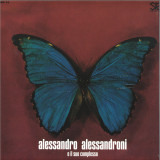
Sonor Music Editions presents the reissue of another holy grail by maestro Alessandro Alessandroni. The first legendary Farfalla release, "Alessandro Alessandroni E Il Suo Complesso" originally released in a few hundred copies on the cult Sermi imprint in February 1968. The seminal debut album realized by the legendary Italian maestro, featuring bewitching scat vocals by his wife Giulia De Mutiis (aka Kema), that truly started the Italian Library production golden era that would culminate in mid ‘1980s. A true landmark of the genre and an Italian discography jewel that spaces among the best Jazz, Bossa Nova and Lounge music; undoubtedly a desirable item of world’s record collecting field. Obsessive Jazz suites, enchanting scats over mind-blowing Bossa tunes, bouncy break-beats drums, groovy Pop and refined loungy atmospheres over some soft Psichedelia arrangements. An essential Italian Library masterpiece.
Skin is the debut album on Omena by Aleksandir.
Both musically and conceptually it's his most ambitious work to date, and maybe the first project that feels like a true piece of himself.
Half of the tracks are uplifting, while the other half dark, with a more serious tone than we’ve seen from Aleksandir before.
For the first time, the artist has included his own vocals on tracks, adding framework to the album.
Old, but still functioning computers are simply scrapped, made redundant and without remorse left to corrosion and an existence without a task and no perspective. That this doesn’t need to be so, and that even computers with limited storage capacity can still take on a function in society, is illustrated by Alexei Shulgin’s outdated 386, now serving as a musician. Performing Classic Rock's Biggest Smash Hits! The Clash! The Doors! The Sex Pistols! Hendrix! and more... gone digital, gone to 8-bit computerized chip-music with a singing computer, with all the charme available to a text-to- speech- programm.
Created by Russian artist Alexei Shulgin, 386 DX was “the world’s first cyberpunk band.” Known for its live performances on city streets and in nightclubs, the performer is a dingy, singing PC that runs Windows 3.1, equipped with a vintage sound card and loaded with MIDI files of drums, guitar, and synth and accompanying lyrics.
The ironic comment delivered by Shulgin and his singing computer is well within the context of the performances by the 386 DX rockband, with which he “toured” Europe in 1998 and performed on nearly 60 occasions. This one- man-one-computer-show was based on a similar idea as his current installation: Shulgin presented himself as a performer carrying a keyboard, and by simply hitting a key elicited the text-to-speech singing, accompanied by very simple music and a few Seventies-style visual effects.Alexei Shulgin simply is the King of Cyberpop.
Luigi Madonna returns for his first Drumcode EP in five years, teaming up with fellow Neapolitan and label favourite Robert Capuano.
We got our last taste of the creative synergy that marks Luigi Madonna and Robert Capuano’s friendship when the pair dropped ‘Limitless’ in 2017, a brilliant addition to A-Sides Vol.6. Prior to that Luigi hadn’t dropped a cut on DC since 2015’s hook-driven ‘Magic Land’, while Capuano stands as one of the label’s most infallible contributors, last year’s ‘The Walker’ EP was typically impressive.
Crafted between two studios in a pre-COVID-19 world, the three-track conceptual EP opens with ‘Mad World’, as masterfully layered industrial hits and rides depict it’s narrative, while a pulsating melodic lead ensures heavy impact. ‘System Alert’ is inspired by the destructive effects of climate change and the track’s composition mirrors this malaise, as a pitch-bending synth elicits rhythmic chaos alongside Luigi and Robert’s deft drum work. ‘Headquarter’ is steeped in drama and cinematic charm, backed by a distorted vocal sample, stormy oscillating synths and a sharp percussive backdrop.
Hunt & Gather’s debut vinyl release comes by way of Pezzner’s cryptic moniker “The Native Language”. Written as a quasi-homeless man living off the rich in the San Juan Islands who writes music once per year to suffice his own delusions.
Walking the streets in these damp, anxious days that all run together lately, I was approached by a man who would blend right into the neighborhood, layered in flannel and sweatshirts for sleeping.
Rough, but for his shoes. (Never cheap out on anything that separates you from the ground.) “Pezzner,” he called out, from a safe distance. “What did the mangrove say to the marauding hordes.” My soul left my body for a moment and my voice responded on its own. “Petrichor.”
He caught my eye, nodded, left a padded envelope on the ground and vanished. The envelope had passed through many hands, slipped into the bed of a ferry-bound truck, passed from one fellow traveler to another, stashed under the counters of anarchist bookstores, left tucked between books at Little Free Libraries. The greenish stains suggested that at one point it had been swum across a lake. Another DAT, contents encoded here unabridged, and a letter from someone who called himself The Sentinel.
The Vessel lived out his days on Shaw Island, under a canopy of trees that gets smaller and smaller every season. His condition the same, any electricity lit his brain on fire, could only bring himself to compose one day a year, only at night, out of sight. Until he met The Angel, an eccentric with means, who built for him a device.
A Faraday Cage to block all electromagnetic emissions. Burlap walls, for atmosphere. A system of pulleys and levers, wood and rope, all running into a box that sat outside. An entirely mechanical control surface. No electrons in here. The Vessel lit fires, watched the shadows dance, closed his eyes and disappeared into the motion for hours at a time. The Sentinel came every morning to change the tapes. The Angel watched and pondered, his plans unknown.
The box sat sealed, bare except for another set of ideograms, scratched in day by day over time. Inside, the usual bedroom-producer shit. Outside, the ideograms told a story, passed from the Vessel to the Sentinel and drawn by the Angel, of a man who became another creature. Alert to the lowest frequencies, feeling music deep in the soil below their feet. Music that brings messages, from distant friends, warning of new creatures and the danger they brought. Skin alive to the world, so sensitive it can detect the landing of a single fly. A mind capable of keeping a map of the world inside. A mind that can look in a mirror and see a soul it knows well. A mind that can grieve.
After processing its contents, I filled the envelope with granola bars and walked it down to the market. The clerk gave me a knowing look as I placed it on the counter behind a stack of pork rinds from the previous century. As I walked out, a young man carrying a plastic bag and wearing impeccable shoes walked in.
The 12" EP A Momentary Convergence of Differently Paced Trajectories is a heterogenous dj-oriented release, prelude and companion of Maurizio Ravalico's first solo percussion album Nobody's Husband, Nobody's Dad, released in November 2018 with the Funkiwala label. It comes in 180gms vinyl on a hand-numbered run of 300 individually screen-printed 320gsm brown card sleeves.
THE MUSIC
Side A opens with a full-size batucada version of Fear of Mapping, one of the tracks from No Fiction Now!, the 2013 debut album of Maurizio's trio Fiium Shaarrk.
It is followed by a personal take on one of Collocutor's second album tracks, Here to There to Everywhere, arranged here as a spacey 5/4 drum'n'bass epic.
Side B contains an old-school jungle remix of Just Bring Your Toys, one of the tracks from Maurizio's forthcoming album, by the Italian d'n'b veteran Enjoy (Omni Music, Bustle Beats). The EP closes with an edited version of the same track: a taste of the album.
Despite being both loosely presented as remixes, neither of the two arrangements on side A makes use of samples from the respective releases, and any material not progammed or played anew by Maurizio comes from either unreleased off-cuts or preliminary demos.
"One of the finest avant-garde percussionists in the world. Maurizio Ravalico is incredible to watch and hear. Catch him live somewhere soon!"- Jean-Claude Thompson, IfMusic uk
"Creative, deep and intriguing. Percussion avantgarde at its best." - Vince Vella, Dj, producer, Havana Cultura
Italian-born visionary cross-genres percussionist Maurizio Ravalico has been one notably eclectic presence in the London music scene since his arrival in the UK, in 1991.
Regularily seen on stage and on releases with the like of Jamiroquai and the James Taylor Quartet throughout the nineties, as well as with virtually every salsa and Cuban-oriented projects to originate from London in the same period, he has subsequently collaborated on many of the projects of the experimental music label Not applicable (Icarus, Isambard Khroustaliov, Alex Bonney, Tom Arthurs) since 2005, and is now an established name in both the London and Berlin improv and experimental scene, having played with John Edwards, Oren Marshall, Steve Beresford, Pat Thomas, Frank Paul Schubert and many others.
Maurizio Ravalico's peculiar approach to percussion is one of the distinctive traits of Tamar Osborn's modal jazz 5-piece band Collocutor (On the Corner records) and of the pan-European trio Fiium Shaarrk (on BBC3 Late Junction's 12 Best Albums of 2017). Maurizio Ravalico also collaborates with the string quartet Phaedra Ensemble, the composer Fred Thomas and the French contemporary dance company Silenda.