The Amity Affliction’s first album released on Roadrunner Records back in 2012, Chasing Ghosts delivered the band’s message of triumph over heartbreak with even more intense power.
They arrived onto the scene from Australia, bringing with them the full-on sing/scream assault of early Atreyu, the metallic adventurous bite of Poison the Well, the gang-vocal-chant inspiring stomp of Bring Me the Horizon and the skillfully melodic angst of Alexisonfire
The album was originally only released on CD and digitally in the UK, now appearing on Lemon Coloured vinyl for the first time.
Buscar:ale x
- A1: 30/70 & Alex Albrecht - Breaking Tense
- A2: Fantastic Man, Adam Halliwell & Edd Fis - Sirius Mystery
- A3: Loure & Zeitgeist Freedom Energy Exchange - Keep In Touch
- A4: Kris Baha & Morgan Wright - Need 2 Breed (Veneto Club Edit)
- B1: Rings Around Saturn, Sui Zhen - The Feelings Gone
- B2: Barney Mccall & Bell Towers - Make Ur Move
- B3: Big Yawn & Sleep D - Packet To Plate
- B4: In2Stellar & Mike Callander - Dreamworld Syncrasy
- B5: Michael Ozone & Toni Yotzi - Wobbly Gina
At Cloud’s Length is a collaborative compilation of musical works from artists on Melbourne/Naarm based collective WAT artists, using the vehicle of music as the driving force of connection.
While the opportunities to gather have been put on hold, this compilation is a collaborative release rising from a challenge set to the WAT artists roster to connect and create using isolation as a creative parameter from which to generate new music, resulting in surprising and powerful musical cross-pollination.
At Cloud’s Length - an ode to the use of cloud storage as the last front of musical collaboration during lockdown - reaches through the veil of isolation, passing overland, gathering energy and offering a release saturated with creativity and collaboration from afar.
This compilation is both a confluence of unique and diverse creative minds and a narrative of humanity's desire for deeper meaning and connection.
Music contributors:
30/70, Adam Halliwell (Mildlife), Alex Albrecht, Barney McCall, Bell Towers, Big Yawn,
Edd Fisher, Fantastic Man, IN2STELLAR, Kris Baha, Loure, Mike Callander, Morgan Wright, Michael Ozone, Rings Around Saturn, Sleep D, Sui Zhen, Toni Yotzi, ZFEX
“The album title ADELA comes from a song by Rodrigo which constitutes the emotional culmination of our duo’s programme. What counts is not the name, but the person we love and long for. Everyone certainly has such a person, and so we hope that each listener will find something close to his or her heart on our album.
The piano and classical guitar virtually never collaborate in music. However, after our first joint performance with Łukasz Kuropaczewski, we immediately realised that we could create intriguing music worlds together. We followed the same line of thinking in our choice of programme, which derives from both the piano and guitar repertoires, though the spirit of the South that informs most of that music is more typically associated with the guitar tradition. In my arrangements of classical works, I strove to represent the sonic qualities of both instruments, their unique expression, and cultural associations. I reworked Domenico Scarlatti’s famous “Sonata in D Minor (Toccata)” K. 141 so as to bring out its Spanish roots. Titled “Domingo” on our album, it features distinctive flamenco qualities and an improvised layer. The “Aranjuez Concerto BWV 1056” is, as its very name suggests, a fusion of the world’s most famous piece for guitar and orchestra, Joaquin Rodrigo’s “Concierto de Aranjuez”, with Johann Sebastian Bach’s “Keyboard Concerto in F Minor” BWV 1056. Themes from the second, slow movements of both concertos interlink here as in the film cross-cutting technique, and we swap roles, Łukasz leading the Bach theme while I take up Rodrigo’s.
Three of the works on this album have been enriched by the angelic voice of Jakub Józef Orliński. In these three, Egberto Gismonti’s guitar composition “Água e Vinho”, my own “Quarantine Song”, and even the famous “Adela” by Joaquin Rodrigo, the voice has been treated more as an instrument than a lyrical subject. “Quarantine Song” was composed during the COVID-19 quarantine in 2020 specially for Jakub Józef Orliński as its performer. “Pedro” was inspired by the films of Pedro Almodóvar.
[c] A3. Água e Vinho [feat. Jakub Józef Orliński] - Egberto Gismonti
[f] B2. Quarantine Song [feat. Jakub Józef Orliński] - Aleksander Dębicz
[h] B4. Adela [feat. Jakub Józef Orliński] - Joaquín Rodrigo
It's tempting to think that you have all the answers, screaming your gospel every day with certainty and anger. Life isn't quite like that though, and the debut album from London four-piece TV Priest instead embraces the beautiful and terrifying unknowns that exist personally, politically, and culturally. Posing as many questions as it answers, Uppers is a thunderous opening statement that continues the UK's recent resurgence of grubby, furious post-punk music. It says something very different though - something completely its own. Four childhood friends who made music together as teenagers before drifting apart and then, somewhat inevitably, back together late in 2019, TV Priest was borne out of a need to create together once again, and brings with it a wealth of experience and exhaustion picked up in the band's years of pursuing 'real life' and 'real jobs', something those teenagers never had. Last November, the band - vocalist Charlie Drinkwater, guitarist Alex Sprogis, bass and keys player Nic Smith and drummer Ed Kelland - played their first show, to a smattering of friends in what they describe as an "industrial freezer" in the warehouse district of Hackney Wick. "It was like the pub in Peep Show with a washing machine just in the middle_" Charlie laughs, remembering how they dodged Star Wars memorabilia and deep fat fryers while making their first statement as a band. Unsurprisingly, there isn't a precedent for launching a band during a global pandemic, but among the general sense of anxiety and unease pervading everything at the moment, TV Priest's entrance in April with the release of debut single "House Of York" - a searing examination of the Monarchy set over wiry post-punk and fronted by a Mark E. Smith-like mouthpiece - served as a breath of fresh air among the chaos, its anger and confusion making some kind of twisted sense to the nation's fried brains. It's the same continued global sense of anxiety that will greet the release of Uppers, and it's an album that has a lot to say right now. Taking musical cues from post-punk stalwarts The Fall and Protomartyr as well as the mechanical, pulsating grooves of krautrock, it's a record that moves with an untamed energy. Over the top of this rumbling musical machine is vocalist Charlie, a cuttingly funny, angry, confused, real frontman. Uppers sees TV Priest explicitly and outwardly trying to avoid narrowmindedness. Uppers sees TV Priest taking musical and personal risks, reaching outside of themselves and trying to make sense of this increasingly messy world. It's a band and a record that couldn't arrive at a more perfect time.
-LTD. LOSER EDITION-
This LIMITED LOSER INDIES edition is on GREY MARBLED Vinyl! It's tempting to think that you have all the answers, screaming your gospel every day with certainty and anger. Life isn't quite like that though, and the debut album from London four-piece TV Priest instead embraces the beautiful and terrifying unknowns that exist personally, politically, and culturally. Posing as many questions as it answers, Uppers is a thunderous opening statement that continues the UK's recent resurgence of grubby, furious post-punk music. It says something very different though - something completely its own. Four childhood friends who made music together as teenagers before drifting apart and then, somewhat inevitably, back together late in 2019, TV Priest was borne out of a need to create together once again, and brings with it a wealth of experience and exhaustion picked up in the band's years of pursuing 'real life' and 'real jobs', something those teenagers never had. Last November, the band - vocalist Charlie Drinkwater, guitarist Alex Sprogis, bass and keys player Nic Smith and drummer Ed Kelland - played their first show, to a smattering of friends in what they describe as an "industrial freezer" in the warehouse district of Hackney Wick. "It was like the pub in Peep Show with a washing machine just in the middle_" Charlie laughs, remembering how they dodged Star Wars memorabilia and deep fat fryers while making their first statement as a band. Unsurprisingly, there isn't a precedent for launching a band during a global pandemic, but among the general sense of anxiety and unease pervading everything at the moment, TV Priest's entrance in April with the release of debut single "House Of York" - a searing examination of the Monarchy set over wiry post-punk and fronted by a Mark E. Smith-like mouthpiece - served as a breath of fresh air among the chaos, its anger and confusion making some kind of twisted sense to the nation's fried brains. It's the same continued global sense of anxiety that will greet the release of Uppers, and it's an album that has a lot to say right now. Taking musical cues from post-punk stalwarts The Fall and Protomartyr as well as the mechanical, pulsating grooves of krautrock, it's a record that moves with an untamed energy. Over the top of this rumbling musical machine is vocalist Charlie, a cuttingly funny, angry, confused, real frontman. Uppers sees TV Priest explicitly and outwardly trying to avoid narrowmindedness. Uppers sees TV Priest taking musical and personal risks, reaching outside of themselves and trying to make sense of this increasingly messy world. It's a band and a record that couldn't arrive at a more perfect time.
- A1: Alexander’s Ragtime Band
- A2: Permanently Lonely
- A3: What’ll I Do
- A4: Summer Of Roses / December Day
- A5: Nuages
- B1: Mona Lisa
- B2: I Don’t Know Where I Am Today
- B3: Amnesia
- B4: Who’ll Buy My Memories
- B5: The Anniversary Song
- C1: Laws Of Nature
- C2: Walkin’
- C3: Always
- C4: I Let My Mind Wander
- D1: Is The Better Part Over
- D2: My Own Peculiar Way
- D3: Sad Songs And Waltzes
- D4: Ou-Es Tu, Mon Amour / I Never Ca Red For You
Talk about a talented family: Willie Nelson and his Sister Bobbie Nelson each achieved massive success in country music. Even in their late 80’s, the Nelsons continue to make music and their influence can be heard through many artists in the genre. December Day, Willie’s Stash Vol. 1 is a collaboration album between the two, and upon release in
2014 it was met with positive reviews from music critics. The album spawned three singles: “Who’ll Buy My Memories”, “Laws of Nature” and “Summer of Roses / December Day”. The liner notes were written by Willie’s frequent collaborator Mickey Raphael. This record comes as a limited edition on snowy white vinyl.
From co-founder of the Lumineers, Jeremiah Fraites, Piano Piano is a collection of songs that’s been in the works for the better part of a decade, featuring gorgeous, intimate piano-centric instrumental songs capturing Fraites’ reflective moments from his Denver home. Piano Piano is an achingly gorgeous set of songs, emotionally direct yet profoundly revealing. Fraites’ songwriting reaches into deeply personal spaces with moving grace and stark elegance, retaining the folk-inspired melodicism so familiar from his work in The Lumineers, transported into a more classically sophisticated setting. In addition to piano, Fraites plays nearly every instrument on the album, including guitar, drums, synths, and programming. It was co-produced and engineered by David Baron (Jade Bird, Vance Joy, Shawn Mendes) and features other collaborators such as The Lumineers’ violinist Lauren Jacobson, cellists Rubin Kodheli and Alex Waterman, and Macedonia’s 40-piece FAME’S Orchestra.
'Rodriguez', the enigmatic subject of the 2012 Academy Award®-winning documentary, Searching for Sugar Man, released two albums with Sussex Records, 1970’s Cold Fact and 1971’s Coming from Reality. Out of print on vinyl for several years, both albums are newly remastered by Alex Abrash at 'AA Mastering set for release on August 30 release by Sussex/UMC on CD and 180-gram black vinyl.
'Cold Fact' is the debut album from singer-songwriter Rodriguez.
It was released in the United States on the Sussex label in March 1970. In 1971 the album was released in South Africa by A&M Records.
In 1976, several thousand copies of Cold Fact were found in a New York warehouse and sold out in Australia in a few weeks. It went to Nr. 23 on the Australian album charts in 1978, staying on the charts for 55 weeks. Coming from Reality is the second and (to date) final studio album from singer and songwriter Rodriguez, originally released by Sussex Records in 1971.
The CD for Coming from Reality features three additional bonus tracks, originally recorded in 1972-’73 for a third album that was never completed. The tracks were co-produced by Dennis Coffey and Mike Theodore, who also co-produced Cold Fact.
The tracks were first issued in 2009 on the Light in the Attic CD release, and they were also featured on the Searching for Sugar Man soundtrack.
one of englands rarest privately pressed progressive lps, isolation is barely known and generally misunderstood. its a concept lp tackling the sense of loneliness and loss after the breakup of a relationship, and was performed with an accompanying experimental film which has miraculously survived. the film is 18 minutes long in glorious black and white, the use of shadow is very akin to the work of Alexandr Hackenschmied and Maya Derren, and follows a beautiful young woman from a London Railway Station on a train journey to a country field. The lp has fantastic compositions of melodic progressive rock with a repeated Theme and returns to the lines "And now theres nothing" throughout.
What hides in the fog that keeps people apart, and what does it take to cut through it? These questions hang heavily over
Sarah Beth Tomberlin's music, whose hushed and intimate tones orbit answers as much as they savor the unanswerable.
To be in relation to another human being is to engage with a deep mystery: We are all fundamentally alone, siloed into
confusing bodies, and yet occasionally we ¬nd someone who lets us feel as if we weren't. Tomberlin, the Louisville native
who recently relocated to Los Angeles, delights in articulating and amplifying that mystery, picking out its details and
marveling at its scale. In singing her aloneness she soothes it, and extends a hand to others reckoning with their own
solitude--a paradox that warms her spectral songs.
Tomberlin's new Projections EP continues the arc of her critically acclaimed 2018 debut At Weddings, weaving new collaborators and new techniques into her signature dusky milieu. Since the LP's release, Tomberlin has toured with Pedro the
Lion, Andy Shauf, American Football, and Alex G, played a Tiny Desk concert for NPR, and given a riveting performance on
Jimmy Kimmel Live! The ¬ve-song EP, capped with a cover of Casiotone for the Painfully Alone's stunning "Natural Light,"
re ects this period of intensive growth and self-discovery. "I wrote these songs while getting to know myself outside of
people's perceived notions of who I was," says Tomberlin. "I just started being like, What am I interested in? What do I want
out of relationships and friendships? What am I looking for that I don't have in myself already?"
Today Margot share new single Walk With Me via Full Time Hobby. The Peckham band ended 2019 supporting Swimming Tapes on their U.K. as well as releasing their debut EP earlier this year. New single Walk With Me is a song about empathy, depression and the power of talking. All channelled by frontman Alex Hannaway's pastel vocal hues and searingly honest delivery. Walk With Me works as a conversation between someone experiencing a depressive episode and another trying to understand. "It’s about listening, friendship, understanding, I’ve had experiences where friends, family members have been patient, they’ve been persistent and caring, and it’s this that has really helped me in my life" explains Hannaway. In addition to the official video, the band have also shared a 'Karaoke Video' for the single. "We've been using home karaoke sessions to blow off steam during the lockdown period. Often feeling confined, bored, angry, frustrated; the elation and release of belting out familiar songs in our living room felt cathartic. So it felt perfect for the video, capturing not only the isolation of lockdown but also the communal, spirited moments too" explain Margot. Margot comprises of five friends who moved from the suburbs of south London to Peckham after finishing University. In two separate bands at the time, drunken nights out discussing the merits of a merger evolved into the first few rehearsals. It went well - Margot formed in 2018 and released a steady stream of singles across the year. The band employ a DIY ethic, self-producing their recordings in their home studio. After ending 2019 supporting Swimming Tapes on their UK tour, the band released their debut EP in February 2020 and are set to support Dana Gavanski on her upcoming tour in March 2021. Margot's nuanced blend of dream-pop, neo-psychedelia and jangle-guitar create a propulsive, cruising feel reminiscent of Real Estate or War on Drugs. Expect to hear more from them in 2020.
Under the impression of the racially motivated murders on 19 February 2020 in Hanau, her hometown, the visual artist and musician Michaela Meise recorded the piece "Cemalim" by the Turk Erkin Koray in German translation. The production of the song was supported by the Städtische Galerie Nordhorn and the NS-Dokumentationszentrum München, both of which have included the work in their exhibition programmes this year.
Erkin Koray is a representative of the psychedelic Anadolu-Rock and published "Cemalim" as an arrangement in 1973. The original composer, Rafik Başaran, came from the Cappadocian town of Ürgüp, which is also mentioned in the song. "Cemalim" means, translated into German, "My darling Cemal", and is a lament for the dead. Meise wrote the German text based on the translation by Fatih Alasalvaroglu, who also comes from Hanau.
Besides the mourning of nine young people, solidarity with the relatives and friends of the murder victims is urgently needed. They have organised themselves in the "Initiative 19 February Hanau" - on their website you can find information about what support they would like to receive.
Most of the concert programme of the last two years included anti-fascist songs and was a reaction to the increasing right-wing populism. Folk songs, hits and chansons of the 1960s, published in July 2018 on the album "Ich bin Griechin" (Martin Hossbach), dealt with the experience of the Second World War, told of the longing to leave home or the experiences of a seasonal worker. The songs were composed by the anti-fascist Mikis Theodorakis, the musician Barbara, who survived the Shoah with her family in the underground, and George Moustaki and Alexandra, who crossed both national borders.
Unter dem Eindruck der rassistisch motivierten Morde am 19. Februar 2020 in Hanau, ihrer Heimatstadt, hat die bildende Künstlerin und Musikerin Michaela Meise das Stück »Cemalim« des Türken Erkin Koray in deutscher Übersetzung eingespielt. Die Produktion des Liedes wurde von der Städtischen Galerie Nordhorn und dem NS-Dokumentationszentrum München unterstützt, die beide das Werk in ihre diesjährigen Ausstellungsprogramme aufgenommen haben.
Erkin Koray ist ein Vertreter des psychedelischen Anadolu-Rock und veröffentlichte »Cemalim« im Jahr 1973 als Bearbeitung. Der ursprüngliche Komponist, Rafik Başaran, stammte aus der kappadokischen Stadt Ürgüp, von der auch im Lied die Rede ist. »Cemalim« bedeutet, ins Deutsche übersetzt, »Mein Liebling Cemal«, und ist eine Totenklage. Meise schrieb den deutschen Text auf Grundlage der Übersetzung von Fatih Alasalvaroglu, der ebenfalls aus Hanau kommt.
Neben der Trauer um neun junge Menschen ist Solidarität mit den Angehörigen und Freunden der Mordopfer dringend notwendig. Sie haben sich in der »Initiative 19. Februar Hanau« organisiert – auf ihrer Website finden sich Informationen, welche Unterstützung sie sich wünschen.
Meises Konzertprogramm der letzten zwei Jahre umfasste anti-faschistische Lieder und reagierte somit auf den zunehmenden Rechtspopulismus. Volkslieder, Schlager und Chansons der 1960er Jahre, erschienen im Juli 2018 auf dem Album »Ich bin Griechin« (Martin Hossbach), verarbeiteten die Erfahrung des Zweiten Weltkrieges, erzählten von der Sehnsucht, die Heimat zu verlassen oder den Erfahrungen eines Saisonarbeiters. Die Lieder stammten vom Antifaschisten Mikis Theodorakis, der Musikerin Barbara, welche die Shoah mit ihrer Familie im Untergrund überlebte, sowie von George Moustaki und Alexandra, die beide nationale Grenzen überschritten.
Downloads
NEP was a loose multimedia collective formed in 1982 Zagreb, ex-Yugoslavia. The founder Dejan Krsic collaborated with various artists in a quest of re-thinking the stale concepts of art history, position of the author and the barriers between pop and elitist high culture. Heavily influenced by Walter Benjamin and Andy Warhol in theory and Brian Eno and Kraftwerk in music, Krsic created NEP as an umbrella term (meaning Nova Evropa or New Europe) of diverse rule-breaking activities, covering graphic design, music, photography, video, news-media and theoretical work. Musically NEP focused on experiments in ambient and tape-music, self-released and hard to find compilation tapes like "The Cassette Played Poptones" (1988). Deeply immersed in pop-culture, politics and art theory Krsic's search for perfect pop music with cutting critical edge peaked in 1989, the year 'Decadance' track was conceived in studio. Fox & His Friends published the single in 2017 with Snuffo Remix on B-side. It received rave reviews in music press like MixMag and DJ Mag and it is still played on dance-floors around the world. But the story around the NEP is musically (as well as artistically) much wider: for the first time Fox & His Friends team compiles best cuts from unreleased and rare NEP tapes, covering the period from 1985 to 1989 on POP NOT POP abum. Dejan Krsic is now famous graphic designer and art historian in Croatia. Other collaborators include Laibach and Borghesia photographer Jane Stravs, artist and TV director Gordana Brzovic, Jovan Culibrk, now Bishop at The Serbian Orthodox Church and Anja Rupel, singer of cult Yugoslavian synth-pop group Videosex as well as the other members of Videosex, Iztok Turk and Janez Krizaj who produced some of the tracks. Other collaborators were talented producers Robert Logozar and Davor Daga Devcic, singers Linda Cooper, Natalija, Alexx Kovacs... The list of collaborations is long. Some of the memorable moments on POP NOT POP album are early demo version of Decadance 'How Do I Dance To This Music?' with blue movies samples and drum machine experiments like early Cabaret Voltaire, then Krsic's reinterpretation of legendary Kraftwerk's Trans Europe Express anthem as 'Transcendance', or 'Radical Chic', where Dejan himself and Anja Rupel from Videosex make lovely couple of dandy-esque fashionistas, singing chart-friendly radio synthpop tune that contrasts the A-side (The 'NOT POP' side) - full of experiments, dark wave and industrial nods to Test Department and Cabs. B-side is 'THE POP' side that will surprise most of the NEP followers from their early experimental cassette days. Sunny, danceable, joyfull pop that reveals the many faces of NEP. As Kraftwerk today is more of a concept than a band, NEP does the same by re-writing its products (musical, graphical, theoretical, activist) and constantly puts them in permanent state of change or re-mix. In the future, only NEP logo will be enough to consider something an art piece, and NEP will be everybody who wants to, as their Art Manifest claims. Until that day comes, 'POP NOT POP' is a document of how the vivid and creative were art-scenes in socialist Yugoslavia. Some of the graphic work, cut-ups from theory and Manifesto are also included on this LP, designed by Dejan Krsic aka NEP himself. This release is made from the original master tapes and published for the first time on vinyl.
Blues singer and harmonica player Brian Knight (1939-2001) is counted as one of the initial members of The Rolling Stones. Co-founder of Brian Jones first band together with Ian Stewart and Dick Taylor (later Pretty Things) among others. Musical disagreement with Jones, who fancied Bo Diddley and Chuck Berry while Knight was a Muddy Waters follower, led to his departure from the group - later to be replaced by Jagger and Richards. He formed his own "Blues By Six" band, frequently with Charlie Watts on drums, and spent the following years touring and playing London clubs. In the seventies he continued with Bradford-Knight Blues Band. Always a high profile act on the English blues circuit Knight has performed with many known artists through the decades, as Rick Wakeman, Peter Green, Paul Jones, Zoot Money, Ronnie Lane, Charie Watts, Chris Farlowe...and many more. After two successful decades of touring and performing he finally got to record his debut in 1981on the independent label PVK Records. The album is a mix of standard blues and rock numbers as traditional "white blues", sometimes reminding of early British R&B from Cyril Davies or Alexis Korner. It features Dick Heckstall-Smith (Colosseum) on sax, Peter Green on guitar and Stones own Charlie Watts on drums
Tibor Szemző returns with a new album, based on the music for his film about historic figure Alexander Csoma.
Tibor Szemző is a Hungarian composer, performer, media artist. Recently his album Snapshots From The Island (1987) gained renewed interest. Over the years Tibor Szemzo continued composing classical / electronic works. His pieces often include spoken texts, film and other media. He creates installations and composes music for his own and others’ films.
Csoma, his new album, is based on the music for this film about Alexander Csoma. Alexander set up to research the origin of the Hungarians 200 years ago. During his student years, before he enrolled in college, he and two fellow students vowed to go to Central Asia to discover the origins of their nation. In the first thirty-five years of his life, he spent his humble pilgrimage in Asia traveling and studying with Buddhist priests in Tibet in isolation, and devoted the remaining eleven years of his life to publishing some of the material he had collected in India.
Now on the 200th anniversary, Szemző’s Cinematic Opera wishes to pay tribute to Alexandar Csoma. Over the course of two vinyl sides classical and acoustic instruments are mixed with angelic voices, spoken word in German, Hungarian & English. Sounding like vintage Tibor Szemzo compositions, vividly performed by the Gordian Knot Company and the Voces Aequales Ensemble.
- A1: Samba Negra - Eberebijara
- A2: King Somalie - Monkey 'S Dance
- A3: El Grupo Folclórico - Tamba
- A4: Los Viajeros Siderales - El Campanero
- A5: Rio Latino - Ayu
- B1: Aníbal Velásquez - La Mazamorra Del Diablo
- B2: La Francachela - Mosquita Muerta
- B3: El Grupo Folclórico - Juipiti
- B4: King Somalie - Le Mongui
- C1: El Grupo Folclórico - El Tornillito
- C2: Samba Negra - Long Life Africa
- C3: La Banda Africana - Te Clavo La... Mano
- C4: Myrian Makenwa - El Platano
- D1: El Grupo Folclórico - Tucutru
- D2: Grupo Bola Roja - Caracol
- D3: El Grupo D'abelard - Otro Perro Con Ese Hueso
- D4: Conjunto Barbacoa - Wabali
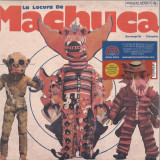
La Locura de Machuca is the story of one man’s bizarre odyssey into Colombia’s coastal music underground, and the wild, hypnotic sounds he helped bring up to the surface.
One night in 1975, a successful tax lawyer named Rafael Machuca had his mind blown in Barranquilla’s ‘Plaza de los Musicos’. Overnight he went from a high ranking position in the Columbian revenue authority to visionary production guru of the newly formed record label that bore his name, Discos Machuca, and for the next six years he devoted his life to releasing some of the strangest, most experimental Afro Psychedelia Cumbias ever produced. La Locura de Machuca is the story of one man’s bizarre odyssey into Colombia’s coastal music underground, and the wild, hypnotic sounds he helped bring up to the surface.
The Colombian music industry was thriving in the mid-seventies, but while homegrown bolero and vallenato tunes were doing well on the charts, it was imported African records that were setting crowds on fire at the picos – the sound-systems that fuelled neighbourhood parties – and wherever those records were played there were always a handful of groups who were inspired to plug traditional Cumbia directly into the electric currents coming from across the Atlantic.
It was these obscure bands, who fused Colombian and African rhythms with the swirling organs and psychedelic guitars of underground rock, that fired Machuca’s imagination. While the label made its money releasing popular hits by legends such as Alejandro Durán and Aníbal Velásquez, that money was poured back into a unique run of experimental releases by fringe artists such as La Banda Africana, King Somalie, Conjunto Barbacoa, and Abelardo Carbono, one of the godfathers of Champeta Criolla.
When Machuca couldn’t find groups to realise his particular vision, he simply created them himself. Drawing on a fearsome roster of musicians associated with the label, he assembled bands that lasted only as long as it took to record an album ,and unleashed the results – complete with arrestingly unusual album covers – under a series of different names such as Samba Negra or El Grupo Folclórico. This unorthodox approach led his longtime recording engineer, Eduardo Dávila, to describes Machuca’s productions as the “B-Movies of Colombian music.”
The story of Doctor Machuca and his eccentric exploits tells of one of Colombia’s most atypical and peculiar record companies; a defining pillar of Afro-Caribbean psychedelia. His productions have come to represent the roots of Champeta and set the pedigree standards for Afro and Costeño avant-garde. The seventeen tracks on La Locura de Machuca, harvested from the darkest, strangest corners of the Discos Machuca catalogue, sound like little else recorded before or since.
6/12[15,92 €]
Fifth part of Machine Funk project. Machine Funk is a twelve vinyl records project created by Cygnus and Alek Stark, the mind behind Fundamental Records, 808 Box, Electric Eclectics and now Electro Records. Machine Funk is based on the classic cyber-punk comic book created by Barry Windsor Smith. Essential electro music full of vocoders and analog machinery, produced by Cygnus!
Picture Vinyl
Sixth part of Machine Funk project. Machine Funk is a twelve vinyl records project created by Cygnus and Alek Stark, the mind behind Fundamental Records, 808 Box, Electric Eclectics and now Electro Records. Machine Funk is based on the classic cyber-punk comic book created by Barry Windsor Smith. Essential electro music full of vocoders and analog machinery, produced by Cygnus!