Heavy-weight club tracks! Activity FM launches with a bang. The first V/A EP sets a bold tone: four heavyweight cuts built for serious floors. DJ Hell leads with Scale, a pounding darkside anthem. Truncate follows with Where Do We Go - a peak-time acid weapon. Detroits DJ T-1000 delivers No Victims Only Volunteers, a fierce dose of machine funk mastery. Closing it out, UK legend Mark Broom unearths Nineties - an unreleased time capsule from 92-93, straight from the DAT vaults.
Artwork by Activity Vision.
Full support from Ben Sims, DJ Bone, Detroit In Effect, The Advent, Marcel Dettmann, Jerome Hill, Alienata, Slam, Sol Ortega, Om Unit.
Suche:alien t
Filippo Diana's “The Haunted Palace” is the second album of unreleased tracks published by Musica Per Immagini, or a sort of soundtrack for an imaginary horror film set in a bloody past, ispired by the book “The Case of Charles Dexter Ward” by Howard Phillips Lovecraft. The artist formerly known as Joe Drive used analog and digital synthesizers, as well as microphones and computers, to describe in notes the ancestral practices of resurrection of the dead accomplished by a shy and unsuspected character, who slowly transforms into an alien, inspiring both fright and terror.
- Fine + 2 Pts
- Let's Play Clowns
- Dog Park
- I'm Totally Not Down With Rob's Alien
- Hey! Is That A Ninja Up There?
- Pony Up!
- Houston, We Have Uh-Oh
"Pop" is a tag that's been assigned to Minus The Bear throughout their career. It's been used to set a distinction between the unique brand of complex indie rock they introduced on their first EP and the more angular and aggravated sounds of their previous bands Botch, Kill Sadie, and Sharks Keep Moving. It's also a tag that was thrown around frequently in the wake of their streamlined fourth album, OMNI. And it's a descriptor that immediately comes to mind within the first few seconds of their classic second formal EP, They Make Beer Commercials Like This. Now celebrating its 10-year anniversary and first time in print since 2011, Beer Commercials is the evolutionary step between Minus The Bear's first two landmark albums, Highly Refined Pirates and Menos El Oso. Opening track "Fine + 2 Points" remains one of the band's strongest opening tracks in their discography,charging out of the gates with a syncopated stomp that comes across as a more agitated take on Kylie Minogue's "Can't Get You Outta My Head". If Minus The Bear were looking to make pop music without any of its major-scale bubblegum trappings, they nailed it here. The band follows it with "Let's Play Clowns" and "Dog Park" - nods to Highly Refined Pirates' formula of frenetic clean guitar work, bombastic choruses, and Jake Snider's lyrics of detached romantic nostalgia. These tracks may represent Minus The Bear's original trademark version of pop, but on songs like "I'm Totally Not Down With Rob's Alien" the band eschews it's restless energy for atmosphere and dynamics, creating a sound that's inspired more than a handful of contemporary melodic post-rock bands. By the time the band belts out "Pony Up!" the listener has watched the three-year sonic transition between Minus The Bear's first two full-lengths transpire within under half-an-hour, with the their earlier math rock predilections yielding to the tightly wound club-banging pedalboard trickery that defined their sophomore album. Even if Beer Commercials doesn't fit within your definition of pop music, the unorthodox energetic charm of this relatively low-profile release serves as an exciting reminder of why Minus The Bear became one of the most important and influential indie rock bands of the new century.
2025 Repress
Die „Girls Gang Remixes“ 12“ wartet mit Clubversionen und Remixen von befreundeten Künstlern wie dem legendären DJ Hell, dem Dark-Disco-Allstar Damon Jee, dem italienischen Produzenten Phunkadelica und dem französischen Sänger und Filmkomponisten The Populists (alias Yan Wagner) auf. Ausserdem enthält sie noch Clubversionen von den beiden Singles „Promise Me feat. Curses“ und „Schall & Rauch“ und eine griechische Version von dem Sommerhit „Halkidiki“.
DJ Hell ist der Pate des Electroclash und Gründer des einflussreichen Labels International Gigolo Records. Helmut Geier steht seit vielen Jahrzehnten hinter den Decks und spielt entweder in den größten Clubs der Welt, auf riesigen Musikfestivals oder bei Laufstegshows für die angesagtesten Modemarken, neben der Produktion von Musik, der Schauspielerei in Filmen und dem Designen von Kleidung. Sein Extended Mix von FOMO (Fear Of Missing Out) ist eine krachende, genreübergreifende Reise durch Zeit und Raum. Eine neue Baseline, treibende Hihats, Live-Atmosphäre und ein druckvoller Kick heben den Track auf ein neues Level und machen ihn zu einer Waffe auf der Tanzfläche. Der aus Südfrankreich stammende Damon Jee ist eine Pionierfigur in der Dark-Disco-Szene. Mit über zwei Jahrzehnten Erfahrung in der elektronischen Musik hat der Dust & Blood-Labelbesitzer einen ganz eigenen Sound entwickelt. Er verwandelt „Girls Gang“ in eine Clubbombe, indem er seine charakteristische Big-Room-Energie einfließen lässt, einen epischen Break hinzufügt und die Vocals in eine andere Welt verzerrt. The Populists ist das cluborientierte DJ-Projekt des französischen Sänger-Produzenten, Gesaffelstein-Kollaborateurs und Filmkomponisten Yan Wagner. Seit 2014 veröffentlichte er EPs und Tracks auf Tastemaker-Labels wie Lumière Noire, Zone, Detriti, Ritmo Fatale & XXX. Auf seinem Remix von 'Disco Goth' kombiniert er entspannte Italo-Disco-Grooves mit New Beat Drums und verleiht dem Original ein ganz anderes Feeling.
Girls Gang wurde überragend aufgenommen und unter anderem Magazinen wie Rolling Stone, Mixmag, Musikexpress, Kulturnews, Visions, TAZ, Penthouse, Brigitte sowie Sonic Seducer (Album des Monats) und Orkus abgefeiert. Radiostationen wie KEXP, BBC Radio 1, Sunshine Live (Album der Woche), Radio Eins, Flux FM, WDR 1Live und Deutschlandfunk berichteten über das Album, das mittlerweile auf über 20.000 weltweite Radioeinsätze und mehr als 1 Million Streams kommt. Auch führende Online-Plattformen wie Spiegel Online, Plattentests (Album der Woche), Laut.de (Song der Woche) und Tonspion (#6 Album des Monats) lobten die Veröffentlichung in höchsten Tönen.
Format: Schwarzes Vinyl (140 g) mit alternativen & Clubversionen sowie Remixen von Damon Jee, DJ Hell, Phunkadelica & The Populists.
15 Years Of Dame-Music Vol. 3 marks the final chapter in a celebratory trilogy from the label, closing out a decade and a half of fearless sonic exploration.
True to form, Vol. 3 delivers a curated cross-section of techno, electro, and acidic dancefloor pressure, each track a statement, each artist a pillar of the underground.
From outer space techno to basement electro, this record is a testament to the label’s enduring influence and unrelenting spirit, with six standout cuts from across the techno and electro spectrum which inc. artists such as Dr Smoke (aka Oscar Mulero), DJ MELL G, Millimetric, Alienata, Delectro and label head Bloody Mary.
A genre-defying Afrofuturist manifesto from Uganda. Producer,
dancer and choreographer Faizal Mostrixx"s singular vision of
East African electronic music is a lush sonic tapestry of
polyrhythms, modern dancefloor styles, amapiano, Nile basin
ceremonial chants and Pan-African field recordings. A stalwart
of the explosive Kampala electronic music scene Mostrixx has
collaborated with the Nyege Nyege collective appearing at both
the African and European editions of their festival. Mutations is
Faizal"s second full length album, following close on the heels of
his acclaimed digital EP Transitions (May 2022 / Glitterbeat). In
their review of Transitions, The WIRE noted: "If today"s currents
in East African electronic music have a more mainstream
destiny, this might be how it starts."
- A1: Retrospect - This World Is Not My Home
- A2: Hidden Fire Improvisation
- B1: Hidden Fire Blues
- B2: Hidden Fire Blues
- C1: My Brothers The Wind And Son #9
- C2: My Brothers The Wind And Son #9
- D1: Hidden Fire I
- D2: Hidden Fire Ii
Strut Records proudly presents the official reissue of Hidden Fire Volumes 1 & 2, the final album released by Sun Ra on his El Saturn label in 1988.
Captured live over three nights at the Knitting Factory in New York City, these performances mark the closing chapter of a 33-year odyssey of radical, independent music-making. Originally issued in tiny quantities with minimal packaging and cryptic artwork—often featuring hand-written labels or Ra’s own handmade designs—Hidden Fire was among the most elusive entries in Sun Ra’s vast discography.
Musically, these recordings stand apart from Ra’s other '80s compositions. Here, Hidden Fire plunges into darker, more dissonant territory. Ra performs exclusively on the Yamaha DX7 synthesiser, pushing its digital sound palette into alien dimensions. The Arkestra lineup is uniquely configured, featuring a rare and heavy string section with three violins, including the legendary Billy Bang, and the singular space vocalist Art Jenkins, whose eerie textures and vocalisations had not been heard so prominently since the early 1960s Choreographers Workshop sessions. The music is raw, unsettled, and often overwhelming.
“Retrospect / This World Is Not My Home” opens with a palindromic riff that evokes Ellington before unraveling into a stark sermon from Ra, warning of death’s dominion over Earth-bound minds. “Hidden Fire Improvisation” is a furious explosion of tone science, with Marshall Allen, Billy Bang, and John Gilmore delivering fire-breathing solos over relentless drumming and Ra’s cascading synth clusters. “Hidden Fire Blues” offers a warped, electrified version of Ra’s familiar blues feature, led by Bruce Edwards on guitar and Rollo Radford on electric bass, transformed through the haze of DX7 textures. “My Brothers The Wind And Sun #9” evokes the experimental weight of The Heliocentric Worlds with its crashing percussion, pulsing synth-vocal duets, and string- driven chaos that seems to spiral into oblivion.
Even the quieter moments—such as “Hidden Fire II,” a duet between Ra and Art Jenkins—feel thick with unease and shadowy beauty. These performances represent a Sun Ra less concerned with cosmic joy or outer-space swing, and more focused on conjuring portals to the unknown.
Remastered from original sources and presented with archival photos, new liner notes by Paul Griffiths, and restored artwork inspired by the original Saturn editions, this reissue offers a definitive window into the last creative surge of one of music’s most visionary figures across two Vinyl LP’s.
- The Voice Of Water
- Lake Of Sphinxes
With »Roto«, Derek Piotr revisits the aqueous terrain first explored in his 2016 album »Drono«, where the paradox of water’s stillness and perpetual motion was refracted into looping voices and glitching textures. Conceived as a »spiritual successor« and recorded in 2019, the album has lain dormant for six years before surfacing on Discreet Archive. That stretch of silence seems to have deepened its charge – the sound feels unearthed rather than made, like a whirlpool biding its time in obscurity until now.
Unlike »Drono«’s mosaic of shorter pieces, »Roto« unfurls as two expansive half-hour tracks, allowing Piotr to probe repetition with greater intensity. Vowels accumulate until they shimmer with alien sentience, drones grow dense and psychoacoustic, and the smallest digital artifacts flicker like neural sparks. The result is a work that denies familiarity; recurrence here only breeds strangeness, unspooling into a procession of hidden pulses and altered voices that resist prediction, drawing the listener deeper into a submerged, otherworldly space.
Derek Piotr is a folklorist, researcher and performer whose work focuses primarily on the human voice. His work covers practices including fieldwork, vocal performance, preservation and autoethnography; and is primarily concerned with tenderness, fragility, beauty and brutality. He has collaborated with artists including Scott Solter, Nathan Salsburg and Thomas Brinkmann across various disciplines.
He is lead archivist and creative director of the Fieldwork Archive.
It is an honor for us to present our 5th release.
An eclectic journey that starts from the distant 1991 until the present days.
A special and colorful voyage with artists we endlessly respect and admire.
We are delighted to welcome these masterminds (or maybe Aliens) to the HBEM family.
Let the music tell its HISTORY!
BARRO #12 – Nebula Circuit (with remixes by Orlok 101 & Abraxas)
Limited to 200 units. Exclusive distribution: Melting Pot Records
The label BARRO returns with its twelfth release, reaffirming its commitment to vinyl culture and uncompromising club music.
This time, the spotlight is on Nebula Circuit, delivering a series of tracks that navigate between EBM, techno, and electroclash, all sharply designed for the dancefloor.
BARRO #12 vinyl release features four tracks:
• Three original productions by Nebula Circuit, where electronic darkness merges with tense rhythms and incisive basslines.
• A remix by Orlok 101, pushing the material into an even more abrasive, machine-driven territory that strengthens the label’s underground identity.
A Statement of Intent:
With this release, BARRO consolidates its place within the darker, more combative spectrum of electronic music. BARRO #12 is crafted for DJs, collectors, and all underground devotees — a punk-spirited record with a clear mission: the dancefloor.
BARRO #12 – available soon on vinyl and digital.
The above references have already been supported by artists such as Dave Clarke, Phase Fatale, The Hacker, Lokier, NX1, Unhuman, Alienata, Reka, and many more.
Introducing the Evil B-Side Twins — A New Era from Yazzus & DJ TOOL
Two of the most unpredictable forces in the underground are colliding at full velocity: YAZZUS and DJ TOOL are proud to launch Evil Twin Rekords — a label and collaborative project born from the wildest corners of their shared sonic imaginations.
Under the moniker The Evil B-Side Twins, the duo are setting out to warp time and space through a blazing fusion of trance, gnarly breaks, and techno rhythms. Their sound? Think hyper-speed rave transmissions beamed in from another galaxy — distorted basslines, and acidic euphoria intersecting 90’s psychedelic textures as they soundtrack a playful, alien-friendly universe. It’s high-energy, no-rules, evil as hell club music with a space-age edge. And their debut EP Relentless Spirit delivers just that.
Four rave-ready ‘in your face’ anthems, breaking the boundaries of modern electronic music. A collision of catchy grooves, iconic motifs from the old school trance world and mental melodies that you won’t forget easily.
Evil Twin Rekords isn’t just a label. It’s a wormhole into a sound that’s too futuristic, too feral, and too fun to fit into anyone’s algorithm. Expect inter-dimensional anthems, and records that feel like they’ve been smuggled from the B-side of a black hole.
This is rave culture turned inside out — full-throttle, unapologetically weird, and always one step ahead. From the UK to Scandinavia let the band expand your horizon and welcome you to the Evil Era. Listen without prejudice.
The artwork is a specially commissioned portrait of the twins, hand painted by friend and collaborator Ryo Koike, known for his eerie, whimsical fantastical style. Throughout his visual ident, he provides an imaginative window into the twins’ cosmos and beyond.
In the smoggy orange light of a new millennium, the young Deb Demure would take the bus, once a week, from his home in crumbling Hollywood to his grandmother's apartment, nestled in the pastel pristineness of Beverly Hills. During these visits, Deb couldn't help but notice the disconnect between the glow of his grandmother's temple, and the downtrodden, alienated figures that populated the seats of the mass transit that took him there. Week after week, he would observe these characters: fading B-movie starlets, leisure-suited alcoholics and forgotten civil servants. But one fateful commute home, as the twilight waned to the purple Los Angeles night, he realized these figures were not as lost as they appeared - there was a nobility in their failure, reflective of the dignity of the city's vanishing golden era. They were survivors, in need of a voice: a spokesperson for every color of hope and hopelessness, transcendent of gender and time; Drab Majesty became Deb's musical podium for this undertaking. Raised in a music-centric household, Deb would find the time to teach himself to play his father's right-handed guitar upside down and left-handed; an unorthodox fashion from where his earliest understanding of chords and harmony were conceived. Exploring the bins of discarded vinyl in his neighborhood thrift stores, his toolkit expanded with the subterranean sonic gems of the recent past. Influences range from the virtuosic arpeggiated guitar work of Felt's Maurice Deebank and the grittier pop progressions of Red Lorry Yellow Lorry's Chris Reed as well as Steve Severin from Siouxsie and The Banshees. He also studied the harmonic oscillations and utilization of the occult power of vibratory frequency present in New Age sounds of Greek artist, IASOS. In terms of orchestration, he consciously culls from the seaside maximalism of Martin Dupont and mechanized grooves of early Depeche Mode. Like a dualistic pendulum, his vocals swing from a preistly baritone to a choir boy's falsetto reflecting the sepulchral ambiance of church visits with his grandmother. Currently the drummer for Los Angeles lo-fi rock ensemble Marriages and having honed an unorthodox home recording style, Deb sources his sounds from a repository of "mid-fi" synthesizers and other lesser-quality instruments. Following the release of his debut cassette EP, "Unarian Dances", he also shared a split 12" with synth pop forefathers, Eleven Pond. During the Spring of 2015, Drab Majesty signed with Dais Records and released his first single, Unknown to the I, as a introduction for his first initial foray into the album format, romantically titled Careless. Written over the course of 2 years, "Careless" is a compendium of songs that have outlasted a malicious burglary of his studio, his struggles with substance addiction, and most recently, the death of his beloved grandmother.
2019 Repress !
Featuring Sim Simmer on the A Side in a cheesy electek track - "Get a little fizzee"/ On the B "The vinyl tune" - a message of hope for all you vinyl headz out there and "sounds of the intergalactic undeground" a space bass number which actually includes samples from real live aliens!!!!
Editions Mego presents Bosko, landing exactly 30 years after the initial General Magic flights into the fantastic; the legendary first Mego release, a collaboration with Pita whereby all sounds were harnessed from the buzzing, drinking, humming sounds of fridges MEGO 001 General Magic & Pita and a 12” with Elin called Die Mondlandung (The Moon Landing) MEGO 002 which embarked on a minimal techno template so austere and strange it was one of the historic progenitors of austere and wonky rhythms alongside Sakho and other European explorers.
The initial return of the playful and mystical Austrian outfit General Magic came with the 20th year anniversary vinyl reissue of their classic debut Frantz eMEGO 010. A record so audacious and playful it still baffles as much as it entertains. At some point whilst working on this reissue GM’s Ramon Bauer and Andi Pieper were spurred on to rummage around with ideas and tools once more and after more than two decades of inactivity sonic sorcery was conjured once again. Live shows in honour of Peter Rehberg were performed in Vienna and London. Softbop, a limited risograph collaboration with Tina Frank came with the first new recordings as a digital download came out discreetly online. The first full length album following Rechenkönig in 2000 MEGO 032 “Nein Aber Ja” released in 2023 on Finlay Shakespeare’s GOTO Records on CD and cassette. An ongoing series of mix tapes online further highlights their interests encapsulating a new found angle on electronic mayhem. All of these elements retain the wildly eclectic and ecstatic glow that only they can harness and hand out to an unprepared world.
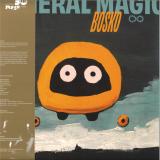
Now, we have General Magic’s second official full length comeback recording, Bosko. The new album is initially notable prior to the needle hitting the wax or the cursor identifying a track due to the artwork. Made by long term collaborator Tina Frank, this is Frank’s first analogue artwork, with a painting of a happy/nervous machine thing hovering in a landscape of no discernible identity. It’s quasi science fiction hovering amongst the potential for fun. Suited to the music? Natürlich.
Bosko sees Bauer and Pieper update and reframe their original investigations with a fresh supply of head scratching, heart racing tunes that hit the inexplicable with a wild mesh of drums, pianos, synthetic voices and all manner of immaterial sonic play. Startling sonics shock the ears on Club Duchamp which sounds like a conversation between synthetic adult ants in an environment still in development. Elfer features vocals supplied by a female-ish voice who, whilst grappling melody, has trouble executing a firm identity. Noorenhalt catapults along a mainframe of syncopation so unwieldy it feels like the voice, which is utterly alien, provides the only comfort. Seite 5 inhabits a fuzzy zone where a synthetic Horn of Jericho type ambience competes with rhythms never quite sure of who they are. Rise of the Ombré raises the spectral dread. Is this Science Fact? Absolutely nothing within Bosko is predictable.
The amount of change in the miasma of existence and the things we touch in order to make things has shifted so exponentially we are at the point where minds are starting to glaze over. All of this makes the return of the always original, always surprising, always fresh and exciting General Magic totally in tune with the artificial intelligent apocalyptic age we currently inhabit. The tools may have changed but the wonderfully warped gaze of Bosko offers a fresh new vision of perplexing funk and robotic punk.
Rivet’s new album for Editions Mego is an uplifting and joyous affair coming in the wake of tragedy and disenchantment. It is yet another rebirth from an artist willing to take a step back and reprise the current situation he is in. Mika Hallbäck has a long credible history in the Swedish underground. First recognised for his industrial techno works under the Grovskopa moniker he worked privately on more experimental works that eventually came out as On Feather and Wire, an album released on Editions Mego in 2020. After much acclaim for this bold new direction that blended electronic abstraction, pop and industrial forms into a heavy synthetic trip two tragedies struck. One was the passing of label boss Peter Rehberg and then the passing of his dog Lilo, who was as close as a companion one could have. These events led to the release of the more unsettling follow up L+P-2 (Lilo and Pita minus two) on Midnight Shift Records in 2023. Peck Glamour sees Rivet return to the reawakened Editions Mego with an album of optimism inspired by reconciliation with loss and further explorations of new mental/sonic realms.
Hallbäck defines his approach as not being married to any particular machine, instrument, process or genre. However he holds a particular affinity to sampling, of which, he says, provides the dirt and grit amongst what would otherwise be pristine, generic machine music. The contemporary crate digging method of scouring obscure download music bogs for unique sounds was his preferred research practice.
Peck Glamour is an album full of tracks brimming with the excitement of exploration. It's the results of a mind informed by punk, industrial, techno, dancefloor, disappointment, trauma and rebirth. Here the synthetic and authentic is viewed simply as the same means of human rationale and expression.
The opening, ‘Catch Up to Light’, sets the scene with ecstatic and odd fluorescent vocals sliding amongst crystalline likembe whilst synths swirl amongst the external festivities. ‘Orbiting Empty Cocoon’ is somewhat a homage to the alien sound worlds of The Orb, one which takes the listener deeper into a mind melting array of teased potential as visual elements are executed in a mask of audio wizardry and euphoric staccato rhythms, the later being a nod to Singeli music. ‘Patitur Butcher’ is more dance frontal utilising the Ghatam drum and a YouTube rip of a Chinese language lesson. ‘Plastic Bag Putain’ was made during the beginning of Russia's invasion of Ukraine and should be clear of its intent. ‘All that Heaven Allows’ is a marimba cover of an imaginary Love Parade anthem. 'Kyrie Geire’ potentially briefly fills the void left by the demise of Coil. The entire trip of Peck Glamour is sewn up with ‘We left before we came’ whereby extraneous recordings of double bass player Gregory Vartian-Foss (tuning/strumming/moving the bass) are superimposed with local field recordings to create a gorgeous bed of sounds acting as an exciting exit music to this sharp collection of cinematic ear excursions.
In the smoggy orange light of a new millennium, the young Deb Demure would take the bus, once a week, from his home in crumbling Hollywood to his grandmother's apartment, nestled in the pastel pristineness of Beverly Hills. During these visits, Deb couldn't help but notice the disconnect between the glow of his grandmother's temple, and the downtrodden, alienated figures that populated the seats of the mass transit that took him there. Week after week, he would observe these characters: fading B-movie starlets, leisure-suited alcoholics and forgotten civil servants. But one fateful commute home, as the twilight waned to the purple Los Angeles night, he realized these figures were not as lost as they appeared - there was a nobility in their failure, reflective of the dignity of the city's vanishing golden era. They were survivors, in need of a voice: a spokesperson for every color of hope and hopelessness, transcendent of gender and time; Drab Majesty became Deb's musical podium for this undertaking. Raised in a music-centric household, Deb would find the time to teach himself to play his father's right-handed guitar upside down and left-handed; an unorthodox fashion from where his earliest understanding of chords and harmony were conceived. Exploring the bins of discarded vinyl in his neighborhood thrift stores, his toolkit expanded with the subterranean sonic gems of the recent past. Influences range from the virtuosic arpeggiated guitar work of Felt's Maurice Deebank and the grittier pop progressions of Red Lorry Yellow Lorry's Chris Reed as well as Steve Severin from Siouxsie and The Banshees. He also studied the harmonic oscillations and utilization of the occult power of vibratory frequency present in New Age sounds of Greek artist, IASOS. In terms of orchestration, he consciously culls from the seaside maximalism of Martin Dupont and mechanized grooves of early Depeche Mode. Like a dualistic pendulum, his vocals swing from a preistly baritone to a choir boy's falsetto reflecting the sepulchral ambiance of church visits with his grandmother. Currently the drummer for Los Angeles lo-fi rock ensemble Marriages and having honed an unorthodox home recording style, Deb sources his sounds from a repository of "mid-fi" synthesizers and other lesser-quality instruments. Following the release of his debut cassette EP, "Unarian Dances", he also shared a split 12" with synth pop forefathers, Eleven Pond. During the Spring of 2015, Drab Majesty signed with Dais Records and released his first single, Unknown to the I, as a introduction for his first initial foray into the album format, romantically titled Careless. Written over the course of 2 years, "Careless" is a compendium of songs that have outlasted a malicious burglary of his studio, his struggles with substance addiction, and most recently, the death of his beloved grandmother.