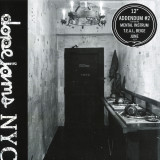
While continuing in the spirit of Dope Jams NYC Volume 1: 2005-2012, which compiled some of the shop’s most cherished tracks from its seven-year run in Brooklyn, here 10 years later we present the collection’s second addendum EP. It moves partially beyond the title’s timeframe – pulling together a couple of the store’s more recent favorites since its 2013 reopening upstate, along with two older gems from its Myrtle Ave days.
Kicking things off is a full-sided pressing of aptly titled techno stormer “Direct Contact.” Bursting forth with a no nonsense, party rockin’ swagger, Greek producer June’s blistering monster of a tune swiftly unleashes an arsenal of arpeggiated synths, jackin’ percussion and out-of-nowhere flourishes with the single-minded purpose of movin’ the crowd. Gracing the B-side are a trio of selections that occupy far moodier terrains. “Imprints,” the lead-off track from T.E.A.L.’s debut LP Cuttings, is a fine example of Dope Jams’ long-held but largely overlooked penchant for dark and dynamic ambient musics. Heavily textured with ripping distortion and space-enhancing tape delay, the piece offers up a brief yet haunting dispatch from a doomed and desolate mind-state. In a more upbeat vein, “Music on My Mind” looks back almost 25 years to the creative apex of Garden State garage royalty Smack. Operating under their Mental Instrum alias, the low-profile production unit crafts an elegant blend of feather-light chords and bumpin’ kicks to firmly underscore guest collaborator Storm’s sincere vocals. Fittingly capping the record is “Blast Knuckles,” the first completed – and hitherto unreleased – track by Dope Jams friends Beige. Rawly produced yet intricately layered, it sketches a fleeting picture of the unique style of lo-fi deep techno the duo developed over the course of their woefully brief partnership.
Suche:am unit
In the vibrant streets of Tembisa, South Africa, amidst the sprawling urbanity connecting Johannesburg and Pretoria, the story of Moskito began. Formed in 2001 by Mahlubi "Shadow" Radebe and the late Zwelakhe "Malemon" Mtshali, the group first emerged as a powerhouse of pantsula dancers. However, their undeniable passion for music soon led them down a new path_ one that would cement their place in kwaito history. Spending countless hours on the street corners of their township, where they were born and raised, Shadow and Malemon danced and sang with an infectious energy that attracted crowds. It wasn't long before the duo decided to channel their talents into a kwaito group, and after adding friends Patrick Lwane and Menzi Dlodlo, Moskito was born. (Pantsula dancing emerged in the 1950s among Black South Africans in townships and continually evolved until it became intertwined with kwaito music culture. The stylized, rapid foot movements and characteristic low-dancing became associated with kwaito as it took over South African urban culture into the early 2000s.) With limited resources, the group displayed immense creativity, recording demos using two cassette decks and instrumental tracks from other artists. They would rap and sing over an instrumental playing on one deck while the second deck records their performance. Their determination paid off when they submitted their demo to Tammy Music Publishers, who were captivated by Moskito's style. "Kwaito was the thing `in' at the time. If you did music you did kwaito. We wanted to fit in and actually it was easy," says Radebe. "We didn't have engineers in the group, so the first time in a real studio was with Percy and Thami to record Idolar." That same year, the group released their debut album, Idolar, under Tammy Music. The album was an undeniable success reaching gold status selling over 25,000 units and earning them a devoted fan base across South Africa and neighboring countries like Botswana, Swaziland, Namibia and Zimbabwe. Moskito collaborated with industry legends such as Chilly Mthiya Tshabalala, who was known for his work with Thiza and Spoke "H." They drew inspiration from Thami Mdluli a.k.a Professor Rhythm, who had dominated the disco scene back in the 80s and 90s. Mdluli helped with musical arrangements and executive produced the album and signed on producer-engineer Percy Mudau, while Shadow and Malemon took pride in composing most of their songs. Like many of the rising kwaito artists of the time, they didn't have music production or engineering backgrounds so they required support from engineers together their ideas down on tape. They were inspired from South African kwaito icons like Trompies, Mdu, Mandoza, and Arthur Mafokate, alongside international heavyweights like Snoop Doggy Dogg, Dr. Dre, 2Pac, and R. Kelly, Moskito created a sound that was uniquely theirs_a perfect blend of local flavor and global influence.
- A1: The Ladder
- A2: Impossible (Ft. Alison Goldfrapp)
- A3: This Time, This Place (Ft. Beki Mari)
- B1: The Girl And The Robot (Ft. Robyn)
- B2: Here She Comes Again (Ft. Jamie Irrepressible)
- B3: Monument (Ft. Robyn)
- C1: Oh, Lover (Ft. Susanne Sundfør)
- C2: Unity (Ft. Karen Harding)
- C3: You Don't Have A Clue (Ft. Anneli Drecker)
- D1: The "R
- D2: Breathe (Ft. Astrid S)
- D3: Running To The Sea (Ft. Susanne Sundfør)
- D4: What Else Is There? (Ft. Fever Ray)
- 14: Never Ever (Ft. Susanne Sundfør)
- 15: Sordid Affair (Ft. Man Without Country)
- 16: I Had This Thing (Ft. Jamie Irrepressible)
- 17: Feel It (Ft. Maurissa Rose)
- 18: Do It Again (Ft. Robyn)
- 19: Like An Old Dog (Ft. Pixx)
Svein Berge and Torbjorn Brundtland have carved out a singular space for themselves in electronic music and here the Norwegian pair offer us a live album, a document of their 2023 tour. It's a sprawling affair, clocking in at over two hours and featuring a diverse cast of vocalists. The tracklist reads like a who's who of leftfield pop, - - Alison Goldfrapp, Robyn, Susanne Sundfor and Fever Ray among them - each voice adding a different shade to Royksopp's already nuanced sound. 'What Else Is There?', a reworking of the Royksopp classic featuring Fever Ray, is an early highlight, a brooding, intense rendition that transforms the original into a pulsating dancefloor beast. Elsewhere we get the Robyn collaboration 'Do It Again' and 'Running To The Sea' featuring Susanne Sundfor, and even die-hard fans will find something to discover here, with subtle tweaks and re-imaginings offering a fresh perspective on familiar material. A fitting tribute to Royksopp's enduring appeal and their ability to continually evolve and innovate.
[a] A1 | The Ladder [True Electric]
[b] A2 | Impossible (ft. Alison Goldfrapp) [True Electric]
[c] A3 | This Time, This Place (ft. Beki Mari) [True Electric]
[d] B1 | The Girl And The Robot (ft. Robyn) [True Electric]
[e] B2 | Here She Comes Again (ft. Jamie Irrepressible) [True Electric]
[f] B3 | Monument (ft. Robyn) [True Electric]
[g] C1 | Oh, Lover (ft. Susanne Sundfør) [True Electric]
[h] C2 | Unity (ft. Karen Harding) [True Electric]
[i] C3 | You Don't Have A Clue (ft. Anneli Drecker) [True Electric]
[j] D1 | The "R" [True Electric]
[k] D2 | Breathe (ft. Astrid S) [True Electric]
[l] D3 | Running To The Sea (ft. Susanne Sundfør) [True Electric]
[m] D4 | What Else Is There? (ft. Fever Ray) [True Electric]
[n] 14 | Never Ever (ft. Susanne Sundfør) [True Electric]
[o] 15 | Sordid Affair (ft. Man Without Country) [True Electric]
[p] 16 | I Had This Thing (ft. Jamie Irrepressible) [True Electric]
[q] 17 | Feel It (ft. Maurissa Rose) [True Electric]
[r] 18 | Do It Again (ft. Robyn) [True Electric]
[s] 19 | Like An Old Dog (ft. Pixx) [True Electric]
- Sola
- Aria
- Sfondo E Oltre
- Mondo Nostro
Rama Parwata and Adam Halliwell unite together with their love of the freer sides of jazz and improvised music, alla Peter Brötzmann and Ganelin Trio to the more funk laden music of Bitches Brew and Herbie Hancock"s Mwandishi. It"s when musicians find a synergy together, be it through sound conversations, be it through mouth conversation s, or be it through the love of what other musicians have said before them, then they can go forth and collaborate freely. As is the case for this duo. Rama and Adam play from different worlds but find a synergy amongst the humanity of sound.
Sonic Interventions is a diaspora-futuristic band of interdisciplinary artists from five continents. Emerged in 2020 from the transcultural Berlin Jazz scene, the group unites diverse languages, instruments, rhythms and dance for collective meditation and healing, improvisation and groove.
Since then, the band has established itself as one of Berlin's most acclaimed underground Jazz collectives. Known for inclusive live spectacles, in which moments of meditation and trance rise into heavy grooves, traditional rhythms of the African and Latin American continents coalesce with urban styles such as Hip Hop, Trap and House. The band combines poetry and dance inspired by the cosmos, ancient alchemy and world mythologies.
Infinity Division is the alias of electronic producer Ash Luk. Best known for his innovative blend of euphoric melodies, scattered breakbeats and gabber infused rhythmic chaos drawn from his relentless live performances, Ash’s newest offering, debut album SATISFACTION (which also marks the launch of his label, SOFTCORE UNLTD.), explores his relationship with all things anthemic.
Featuring artwork from Spyros Rennt, the thirteen track album traverses a diverse array of sonic landscapes. Spanning doomy post-rave and trance-driven metal to breakbeat-infused industrial pop, the album is united by a genre-defying exploration of the elusive essence of anthemic sound.
Venturing beyond the safety of machines, Ash steps to the forefront with his vocals on Seven Demons and Like Heaven, while From Evil, Weather Prophets, and Satisfaction feature vocal contributions from Zastar of Violent Magic Orchestra, Coy Mistress, and Nova Bruise, enriching the album’s diverse soundscapes.
In addition to his work with Infinity Division, Ash is one half of the doom electronic live duo S.A.T.I.N. alongside Ireen Amnes and is possibly best known for his work in Minimal Violence, a project known for their raw, hardware, punk influenced live performances. Releasing on well known labels such as Tresor and Technicolour / Ninja Tune. Their work was characterized by a DIY ethos and an emphasis on analog equipment, allowing for a direct and visceral approach to production. Now, with Infinity Division, Ash continues to build on a body of work that explores the space between genres, combining an attention to detail through carefully constructed sound design with the spontaneity and raw energy of his live performances. SATISFACTION sets the stage for the next phase of Infinity Division, showcasing a collection of tracks that draw from the essence of the past while reaching out toward a mirage of the future.
- Gone Sovereign
- Absolute Zero
- A Rumor Of Skin
- The Travelers, Pt.1
- Tired
- RU486:
- My Name Is Allen
- Taciturn
- Influence Of A Drowsy God
- The Travelers, Pt.2
- Last Of The Real
House of Gold & Bones – Part 1 is the fourth studio album by American rock band Stone Sour. It is the first Stone Sour album without bass player Shawn Economaki, who left the band in 2012, his studio replacement was Rachel Bolan from Skid Row. Musically, Corey Taylor also described the album's sound as "Pink Floyd's The Wall meets Alice in Chains' Dirt". House of Gold & Bones – Part 1 was released on October 22, 2012 and debuted at number 7 on the Billboard 200 music album charts. The album has sold just under 130.000 copies in the United States alone and got raving reviews all over the globe. The album hasn't been available on vinyl for over 10 years and is now available as a limited edition of 1500 individually numbered copies on gold coloured vinyl and includes a 4 page booklet.
Rocket Recordings’ new Black Hole Series is a place where the unorthodox, otherworldly and esoteric can flourish, and there could be no more fitting first release for it than the most powerful metaphysical travelogue yet from Moundabout. Journeying still further into and beyond the landscapes from which this duo have unearthed inspiration, ‘Goat Skull Table’ is a transmission to give flight to spectral visions and include trance-states in abundance.The vibrations and manifestations of the duo of Paddy Shine(GNOD) and Phil Langero (Los Langeros, Damp Howl, Bisect) has always resonated within a very specific sense of place, transcending linear narratives and astral planes in a quest to unite timeless spirits with inner space. This third release for Rocket Recordings sees them colluding with
the landscape of their surroundings, transcending linear narratives and astral planes in a quest to unite timeless spirits with inner space.The title track marks a focal point here; a Shamanic rite on which Langero’s charismatically charged mantras collude with an audial landscape somewhere on the map between the abstract spell-casting of Nurse With Wound and the druidic gnosticism of Julian Cope. This is Moundabout at their darkest and most ritualistic. Elsewhere, the hypnotic repetition of the twin ten-minute extrapolations ‘Blood On My Blanket’ and ‘Wagon’, and the potent incantatory chants of ‘Am I Not’ and ‘Brave New World’ glow with a rugged and
charged dynamism redolent of the Swedish Psychedelia of Träd, Gräs & Stenar, uniting a minimal aesthetic with maximal impact.
Dauntless, feverish, and reaching new heights of primal intensity ’Goat Skull Table’ is a formidable field guide to the earthen and other
Dateline: April 10, 1970. Setting: The storied Fillmore West in San Francisco, CA. Context: Miles Davis, three days removed from his first session for Jack Johnson and, with newly recruited soprano saxophonist Steve Grossman in tow, opening shows for countercultural heroes the Grateful Dead on the latter’s home turf. Result: The initial rumblings of a thrilling era in which Davis and his cohorts would again upend jazz and popular conceptions of the genre with music steeped in groove, improvisation, and hang-on-for-your-life adventurousness. All captured on Black Beauty: Miles Davis at Fillmore West.
Mastered at MoFi’s California studio, pressed at Fidelity Record Pressing in California, and housed in a Stoughton gatefold jacket, Mobile Fidelity's numbered-edition 180g 33RPM 2LP set helps bring what went down that spring evening in Bill Graham’s venue to your listening room with exceptional clarity, balance, and presence. Originally only released in Japan in 1973 and unavailable in the United States until the late ‘90s on compact disc, this marks the first time Black Beauty has been issued on domestic vinyl. The wait is worth it.
Benefitting from quiet surfaces and excellent definition, these LPs present the band’s livewire energy and torrential storm of notes with captivating dynamics, pacing, and fullness. At its core, this audiophile reissue takes you into the walls of sound erected by a band learning on-the-fly the sheer power, will, and breadth of the electric jazz Davis was orchestrating and realizing, on the spot, would reach rock audiences that until that point had only a faint awareness of his mad-scientist experimentation. The sense of release and reach conveyed by these carefully restored records make it clear the veteran bandleader was in the process of a permanent shift that he’d chase for the next five years.
Given Davis was only a few months away from releasing the pioneering double album Bitches Brew, it shouldn’t come as a surprise that much of the fare here adheres to similar explorative approaches. Turbulent rhythms, provocative trumpet passages, and rich, saturated tonal colors that seemingly splash against a blank canvas take precedence over any traditional attempts at organization and melody. Davis and Co. intentionally play everything on a line with the bandleader signaling changes with his horn via coded phrases. The group speaks a common language — with each member having gone to achieve iconic status for their career contributions and technical prowess.
In the company of Grossman, Chick Corea (piano), Dave Holland (bass), Jack DeJohnette (drums), and Airto Moreira (percussion), Davis constructs themes around “Directions,” “Miles Runs the Voodoo Down,” “It’s About That Time,” the title track to Bitches Brew, and more from his then most-recent studio works and the in-progress Jack Johnson. His farewell to the popular standards that for nearly two decades remained a part of his repertoire arrive via a brief dalliance with “I Fall in Love Too Easily,” a shortened albeit aggressive “Masqualero,” and the “Theme” finale of “Spanish Key.” Initially, Black Beauty lacked specific track listings due to Davis’ increasing frustration with listeners over-analyzing his music.
In retrospect, it’s difficult to blame anyone for wanting to view what’s on display here with the aural equivalent of a magnifying glass. Leaning in rock directions, yet maintaining an ear for spaciousness and solos, Black Beauty survives as a snapshot of a thrilling moment amid a transitory period in which evolution came fast and furious. Just two months later, Davis would add another instrumentalist to the lineup in the form of organist Keith Jarrett, and the perpetually restless visionary would blast off to a more atmospheric and arguably more chaotic universe.
Consider, then, this live document a bridge to that galaxy and a breathtaking example of the possibilities of jazz itself.
For their second album 'The Foel Tower', Quade holed up in an old stone barn in the cradle of a Welsh mountain valley.
The valley was a stark and windswept backdrop with little daylight, as the band would huddle around crackling fires each evening. “There was very much a feeling of being on the complete fringes of society,” the band says. “The last vestiges of settlement before the unrelenting barren moors that loomed over us.”
It was an environment that would shape the band – a Bristol four piece made up of Barney Matthews, Leo Fini, Matt Griffiths and Tom Connolly – and the record they have made. It’s an album that is as dreamy as it is melancholic, and as quiet and tender as it is forceful and potent – gliding across genres like winds blowing over those wide-spanning Welsh hills – to arrive at something the band half-jokingly, yet somewhat accurately, describe as “doomer sad boy, ambient-dub, folk, experimental post-rock.”
Quade is a band but it’s also a very close-knit group that have been friends since childhood who use this musical vehicle for interpersonal explorations and connections. “We’ve individually experienced a lot of difficulty over the last several years and Quade has represented a space to shelter from these,” the band says. “This means we often communicate extensively with each other about the issues affecting us individually and collectively. These conversations and concerns are central to The Foel Tower.”
In many ways, the making of this record – or any Quade record – goes way deeper than the simple writing, construction and recording of music. It is a profoundly deep and meaningful experience. “A key theme of the album relates to why we connect with specific places in the way that we do,” the group says. “We often remove ourselves to isolated valleys, sheltered from some of the painful personal struggles that we have experienced as a band. These become spaces in which we collectively purge ourselves of some of these difficulties hoping to make Quade a physical and emotional place of solace. This album celebrates these places that we’ve been able to retreat to and recuperate.”
It is a deep, dense record that is stuffed with musical, cinematic and literary influences – from Ursula La Guin and Cormac MacCarthy through to RS Thomas and Yeats – but despite the heavy, introspective and anxious nature of some of the material, it is also a record that is remarkably deft, agile and considered.
Made with producer Jack Ogborne and mixer Larry ‘Bruce’ McCarthy, there is a pleasing duality to the final sound of the record. One that feels fragile and intimate but also powerful and forceful, as introspective as it is expansive, and a record that is as detailed and textured as it is wide open and spacious.
The album title also pays homage to the place that shaped it so greatly. Within this remote Welsh valley stands the Foel Tower, a stone structure filled with valves and cylinders that can raise and lower the level of the reservoir to draw off water. Which it can then send as far as 70 miles to Birmingham. However, in the late 1800s this land was occupied by local farmers and families in the hundreds until the British Government acquired the land, cleared the valleys, and promptly displaced them in order to begin serving the vastly expanding industrial English city. The band dug into the history and politics of this and wove it into the themes they were already thinking about, using what the Foel Tower stands for as something of a contemporary metaphor. “This tension was something that we wanted to explore without the haughty judgement of our more metropolitan lifestyles,” they say. “And to explore how this specifically relates to ourselves: how can we envisage a genuinely ecological future for ourselves – one that is accessible, affordable and in harmony with endangered rural practices.”
What makes The Foel Tower such an incredible record is that it feels born of a time, place and situation that only existed in that very moment. It’s a snapshot of those 10 days spent in rural Wales and all the feelings and anxieties the band were experiencing at that specific time, magically caught on tape. “The album very much feels tied to this valley for us and the conversations and experiences we shared there,” they say. “It brings up a great deal of poignancy for us, an emblem of some fleeting respite from the strains we all have to experience. But there’s also deep sadness knowing how transient these moments are – in fact, there’s just a great deal of sadness in this album. But it’s also a record that while personal, resigned, and emotionally burdened, is ultimately hopeful.”
- A1: Ile De Gorée
- A2: Il Veut Marcher Avec Toi
- A3: Y Vou Balé Va
- B1: Séhé Voulé
- B2: Fortifie-Toi
- B3: Il Veut Marcher Avec Toi (Remix)
- B4: Loué
Vinyl[22,27 €]
Jess Sah Bi is well-known as half of the legendary duo Jess Sah Bi & Peter One who brought homegrown Country-Americana to the West African masses with their smash debut Our Garden Needs Its Flowers in the mid-1980s. Touring stadiums and reaching listeners worldwide, their music has racked up millions of spins on YouTube and remains imprinted in the hearts of Ivorians of a certain age. ATFA reissued their album in 2018, garnering critical acclaim from publications including Pitchfork and Rolling Stone and reaching a new generation of listeners outside Ivory Coast (Cote d'Ivoire). Sometime in the early 90s, Die Sahbi - or Jesse, as he known to friends-became gravely ill with an unknown ailment and almost died. He visited various doctors and all kinds of religious healers and nothing helped. One day he went down to an Evangelical Christian revival in his neighborhood. They prayed over him and he was delivered. He says, "Their prayers helped chase out whatever demons and unhealthy spirits were inside me. After that my illness went away. When I went to the United States a few months later on an exchange program I wanted to make music to thank God because I was saved." He recorded an album of music praising God in order to honor a promise he made to himself at the depths of his desperation in the hospital. The album Jesus-Christ Ne Deçoit Pas Jesus Christ Does Not Let Us Down came out in 1991 and sold around 3000 cassettes in Ivory Coast. The master tape was lost along the way so the recording has never been on digital platforms until now. Jesse didn't have much time to record while visiting South Carolina, hence the relatively short album, 6 songs including two reprises for filler. A local pastor connected him with a studio and some American musicians (Robert Fortner and Gary Davis) to help. They added acoustic guitar, percussion and keyboard accompaniment to Jesse's soaring French and Gouro vocals, harmonica and finger-picked acoustic. The resulting recording is deeply soothing and contemplative music that perfectly compliments the songs already embraced by millions. But he had to find the rest of the studio expenses-$600 total-which he secured drawing cartoons for UNICEF. Jesse is Ivory Coast's first political cartoonist, a vocation for which he was widely celebrated at the time. It also made him a few enemies which lead to him leaving the country permanently a few years later. Jesus-Christ Ne Deçoit Pas is Jess Sah Bi's first and only gospel album. Fortunately, fans responded with enthusiasm: widespread radio airplay and concerts followed, along with a growing solo profile in the country. The first big gospel artists in Ivory Coast were the duo Mathieu et Constance, who emerged in 1989. There was a bigger gospel music movement in English-speaking counties like Ghana and Nigeria (Christians make up roughly 40% of the population in Ivory Coast, slightly less than Muslims). Jesse didn't have any intention of working in Christian music but he realized, "You don't make music to make money-you want to send a message." In the years since Jesus-Christ's release, gospel music in Ivory Coast has grown to become a key part of music culture in the country. Spiritual music appears in community actives across the public and private spectrum from religious gatherings and parties to television broadcasts and music festivals. And, as it has evolved and indigenized locally, gospel music has picked up elements of traditional Ivorian music, reggae and soul. The album ultimately precipitated the demise of the duo, who were soon separated geographically as Peter One relocated to Nashville. He went on to become a nurse and release a successful solo album on Verve following the ATFA collaboration. Nowadays Jesse lives in the Bay Area and continues to record and perform music wherever and whenever he has the chance. He is publishing a new book of humorous cartoons in 2025 and his most recent album Never Give Up came out in 2020
No less deep, in fact debatably deeper still, Ghost Dubs aka Michael Fiedler returns after the runaway success of his highly acclaimed 'Damaged' 2LP (1500 units sold and 'Dub/Reggae album of the year' for 2024 in The Wire Magazine), with 'Extended Damaged Versions'. Six dubbed out reworks of tracks from last year's album, deconstructed by the man himself, again for The Bug's PRESSURE label. Kicking off with the irresistible seismic grind of 'Dub Regulator', a dancefloor driven beast that miraculously eclipses the original mix, the opening cut increases in weight and intensity seductively, upping the fx drenched madness with its incessant droid hypnotics. The album's mutant dub techno relentlessly probes, stretches and disfigures all of the previous originals, version by version, on this fascinating follow up release to 'Damaged'.
As Fiedler surgically splices and dices his own original source material into successively more warped variants, gleefully atomizing the originals into molten space echo fragments. 'Thin Dub' is a masterclass in simultaneous saturation and evaporation, wilfully liquified in the heart of the echo chamber. Anyone already smitten by 'Damaged' (ie Pole, JK Flesh, Echospace, Valentina Magaletti etc have all graciously, recently acknowledged its greatness), will definitely find further reverb drenched nourishment on 'Chemical Version', which releases a whirlpool of heavily sedated delay trails, and ends up sounding like a wall of sound mirage, vaguely resembling prime Porter Ricks at their sub aquatic peak. Finally, the ambient pulsations of 'Lobotomy Version' sets the album adrift in deepest space, as this superbly crafted collection reflects Michael Fiedler doing what he does best, getting lost in his own mixing desk sorcery, whilst reflecting the captivating morphology of his live shows, where he magically revamps his heavyweight tracks into pure voodoo, casting spells effortlessly....Not an attempt to just milk 'Damaged', 'EDV' is itself a standalone triumph, an invaluable transformation of the original album's material into an epic, fresh, dub odyssey.
- A.i.m
- Po$T American
- My Spirit Animal Ate Your Spirit Animal
- Pit Song
- The Caucasity
- Mythical Cowboys
- Dead Pioneers
- White Wine
- Juicy Fruit (Ode To Chief Bromden)
- Stfu
- Bloodletting Carnival
- Love Language
- Fire And Ash
- Working Class Warfar
- Untitled Spoken Word No. 2
TRANSPARENT YELLOW VINYL[23,11 €]
Crystal clear vinyl. 'PO$T AMERICAN' is the second full-length album by Dead Pioneers. Written in February and recorded in July, it preempts the 2024 American election but wraps up the fears and frustrations as eloquently and, crucially, humorously as the band's 2023 self-titled debut. "Currently, we are amidst the gross existence of capitalism, colonialism, white supremacy and the many oppressive forces that have come to inform everything around us" says vocalist and songwriter Gregg Deal. "The title PO$T AMERICAN informs a collective disenfranchisement and disillusionment to the so-called American dream, while moving forward with hope of a desired designation of unity outside those that would use us for their own capitalistic power grab." The aural palate is broadly the same, but it feels expanded, stronger somehow: drawing on the confrontational writing of Rage Against The Machine, the unapologetic voice of Chuck D and Public Enemy, the storytelling of Johnny Cash, the evolution of IDLES, and punk stalwarts including Black Flag, Rollins Band and Dead Kennedys. Overall the resulting feeling across the new album is one of cautious optimism: "Although we didn't expect the political relevance to become more relevant, we have no illusions to the American dream, or to where we seem to be going. But we have hope that we can get to a better place for people to have what they need." It is an album that speaks to and for this precise time and place; that perhaps could not exist at any other time. It is an album for now.
- A.i.m
- Po$T American
- My Spirit Animal Ate Your Spirit
- Animal
- Pit Song
- The Caucasity
- Mythical Cowboys
- Dead Pioneers
- White Wine
- Juicy Fruit (Ode To Chief Bromden)
- Stfu
- Bloodletting Carnival
- Love Language
- Fire And Ash
- Working Class Warfare
- Untitled Spoken Word No. 2
Crystal clear vinyl. 'PO$T AMERICAN' is the second full-length album by Dead Pioneers. Written in February and recorded in July, it preempts the 2024 American election but wraps up the fears and frustrations as eloquently and, crucially, humorously as the band's 2023 self-titled debut. "Currently, we are amidst the gross existence of capitalism, colonialism, white supremacy and the many oppressive forces that have come to inform everything around us" says vocalist and songwriter Gregg Deal. "The title PO$T AMERICAN informs a collective disenfranchisement and disillusionment to the so-called American dream, while moving forward with hope of a desired designation of unity outside those that would use us for their own capitalistic power grab." The aural palate is broadly the same, but it feels expanded, stronger somehow: drawing on the confrontational writing of Rage Against The Machine, the unapologetic voice of Chuck D and Public Enemy, the storytelling of Johnny Cash, the evolution of IDLES, and punk stalwarts including Black Flag, Rollins Band and Dead Kennedys. Overall the resulting feeling across the new album is one of cautious optimism: "Although we didn't expect the political relevance to become more relevant, we have no illusions to the American dream, or to where we seem to be going. But we have hope that we can get to a better place for people to have what they need." It is an album that speaks to and for this precise time and place; that perhaps could not exist at any other time. It is an album for now.
- 1: #4
- 2: #7
- 3: #
- 4: #
- 5: #2
- 6: #10
- 7: #11
- 8: #
- 9: #
The work of each of these powerfully creative & exceptionally perceptive individuals - poet and scholar Fred Moten and jazz bassist Brandon Lopez - concerns itself with how one might navigate the ascending reign of longinstitutionalised madness while simultaneously keeping humanity and sanity intact The synergistic mesh of these two voices in Duo is here presented on record for the frst time, following two acclaimed works on the Reading Group label in trio with Gerald Cleaver. Inimitable poet, cultural theorist, author, 2020 MacArthur Fellow, Fred Moten creates new conceptual spaces that accommodate emergent forms of Black cultural production, aesthetics, and social life. Moten is a professor of performance studies and comparative literature at New York University concerned with social movement, aesthetic experiment, and Black study. He is also a United States Artists Rockefeller Fellow and was elected to the American Academy of Arts and Sciences. Puerto Rican- American bassist Brandon Lopez is the son of a gravedigger who himself put time in doing the same, developing muscles that serve him well in his thorough command of the upright bass. On moving to NYC, Lopez made himself indispensable within numerous realms of creative music. As the Cleveland Review of Books noted, "This is virtuosity as vocabulary, a total command of texture, subtlety, and a depth that can be reached into."
On their previous work in trio with Gerald Cleaver:
"Best Jazz Albums of 2022: Moten is after nothing less than a full interrogation of the ways Black systems of knowledge have been strip-mined and cast aside, and yet have regrown." - New York Times
"8.0 - A conceptually rich, politically weighty album that asks timeless questions without over-explaining...breathlessly complex" - Pitchfork
Fred Moten: texts, voice
Brandon Lopez: bass
Songs about the unity of Sudan, peace between Muslims and Christians and the fate of war orphans, backed by grooves equally taking influence from Arabic sounds, American funk as well as neighboring Ethiopia.
Kamal Keila was among the first artist we met in Sudan during our two trips to Khartoum and Omdurman last year. He is one of the key figures of the Sudanese jazz scene that was a vital part of the musical culture in Sudan from the mid 1960s until the islamist revolution in the late 1980s. When we meet Kamal he luckily presented us with two mold covered studio reels.
Each tape included five tracks. One with English lyrics and another with Arabic ones. Musically you can hear the influence of neighboring Ethiopia much more than on other Sudanese recordings of the time, as well as references to Fela and American funk and soul. His lyrics, at least when he sings in English which gave him more freedom from censorship, are very political. A brave statement in the political climate of Sudan of the last decades, preaching for the unity of Sudan, peace between Muslims and Christians and singing the blues about the fate of war orphans called "Shmasha".
A note inside one of the boxes specified the track titles, durations and the fact that the sessions were recorded on the 12th of august 1992. Both sessions stand as a hearable testament how Kamal Keila stuck to a sound aesthetic from decades ago, while incorporating current events into his lyrics.
Kamal Keila's album is the first in a series of releases covering the Sudanese jazz scene on Habibi Funk. Be on the lookout for albums by The Scorpions and Sharhabeel coming soon.
2LP + Download Code + 8 Page Booklet
Guilherme Granado makes his first solo appearance on the Keroxen label under the guise of his Goat Unity project, the result of a plethora of collaborations with musician friends and foes.
A São Paulo native, Guilherme has been quietly building a reputation for being the go-to guy for loop based beats and groovy basslines. He has played and recorded with Mauricio Takara in Hurtmold (4 albums) and he’s also part of São Paulo Underground (also with Takara and Rob Mazurek). He also performs, produces, and records under the name Bodes & Elefantes and has toured extensively through South America, US and Europe with São Paulo Underground, Prefuse 73 et al. With Ghost Parades Guilherme goes deep into his beat based deviations whilst somehow managing to connect the dots between the Wu-Tang Clan and the Sun Ra Arkestra, adding an healthy dose of tropicalismo for good measure.
Guilherme’s Ghost Parades does an impeccable job at showcasing the multi instrumentalist composition skills filled with dubby rhythms, addictive bass lines along with celestial and hazy chants. Its a smooth journey to take here, avoiding all the obvious pit holes of the genre and keeping the listener guessing where we’re going at every turn. A spacious, open ended listening experience where loops effortlessly intertwine with live jam instrumentation.
Organic, natural beats for atypical people.
- A1: A I.m
- A2: Po$T American
- A3: My Spirit Animal Ate Your Spirit Animal
- A4: Pit Song
- A5: The Caucasity
- A6: Mythical Cowboys
- A7: Dead Pioneers
- A8: White Wine
- B1: Juicy Fruit (Ode To Chief Bromden)
- B2: Stfu
- B3: Bloodletting Carnival
- B4: Love Language
- B5: Fire And Ash
- B6: Working Class Warfar
- B7: Untitled Spoken Word No 2
CRYSTAL CLEAR VINYL[26,01 €]
Transparent yellow vinyl, limited to 300 copies. GSA exclusive Indie variant. 'PO$T AMERICAN' is the second full-length album by Dead Pioneers. Written in February and recorded in July, it preempts the 2024 American election but wraps up the fears and frustrations as eloquently and, crucially, humorously as the band's 2023 self-titled debut. "Currently, we are amidst the gross existence of capitalism, colonialism, white supremacy and the many oppressive forces that have come to inform everything around us" says vocalist and songwriter Gregg Deal. "The title PO$T AMERICAN informs a collective disenfranchisement and disillusionment to the so-called American dream, while moving forward with hope of a desired designation of unity outside those that would use us for their own capitalistic power grab." The aural palate is broadly the same, but it feels expanded, stronger somehow: drawing on the confrontational writing of Rage Against The Machine, the unapologetic voice of Chuck D and Public Enemy, the storytelling of Johnny Cash, the evolution of IDLES, and punk stalwarts including Black Flag, Rollins Band and Dead Kennedys. Overall the resulting feeling across the new album is one of cautious optimism: "Although we didn't expect the political relevance to become more relevant, we have no illusions to the American dream, or to where we seem to be going. But we have hope that we can get to a better place for people to have what they need." It is an album that speaks to and for this precise time and place; that perhaps could not exist at any other time. It is an album for now.
The album’s title, New World, Lonely Ride, gestures toward its meditative orientation. The duo offers a series of reflections on the zeitgeist of our present moment, the spirit of our age: the isolation and loneliness that continues to echo in the wake of the pandemic; the fractures that mar our political discourse; the uncertainty that has stamped itself on the future of democracy. The vast geography of America and the absence of a common ground, a shared political vision, have contributed to the affective landscape of contemporary American life—of what it feels like to live in the United States today.
Using instrumental voices and textures drawn from the traditional American forms of folk, country, bluegrass and blues, and informed with a modern sense of ambience and space, the sound is both contemporary and deeply rooted. With New World, Lonely Ride, Grigoni and Pan American join countless American artists who have drawn upon this landscape—physical and affective— giving it a voice and shape, listening to its character. And in starting there, with listening, offer a response for the future.
A veteran of the UK reggae scene, Peter Spence meets young and ambitious Portuguese singer Fidel of Real Rockers posse, both providing their very own unique style with sharp lyrics and flow on the brand new 'Suburban' riddim.
"Outlaw" encourages to seek for righteousness and keep on pursuing what's yours, and Peter Spence here makes his best with vocals and lyrics.
Fidel's "More Love" is a message of peace, unity and cooperation - the simple things that we always need to remember about.
This EP is the first one to feature Seafront Crew on production duties.