Cerca:amba

Generi
Tutto
ZOH AMBA - SUN

ZOH AMBA

SUN

12inchSTSLP445
SMALLTOWN SUPERSOUND
22.08.2025
  • Fruit Gathering
  • Interbeing
  • Ma
  • Forevermore
  • Seaside
  • Champa Flower
  • At Noon
  • Like The Sun
  • In Heart

"Sun" ist das erste Album der aus Tennessee stammenden Baritonsaxophonistin Zoh Amba für das in Oslo ansässige Label Smalltown Supersound - und ihr zweites Album nach "Oh Sun", das 2022 auf dem Label Tzadik erschienen ist. Auf "Sun" stellt Amba eine neu zusammengestellte Gruppe mit einer Reihe von Kompositionen vor, die die Grenze zwischen Performance und Prozess verwischen - wobei sich sowohl die Musik als auch der Akt ihrer Aufnahme in Echtzeit entfalten, teilweise geleitet von improvisatorischen Aufnahmetechniken. Als Bandleaderin bewegt sich Amba an den Rändern eines improvisatorischen Deltas, in dem spiritueller Jazz und Free Folk nicht als getrennte Genres auftreten, sondern als Nebenflüsse derselben Strömung, die beide aus einem gemeinsamen Glauben an die Musik als heilige Kraft entspringen. Die Entscheidung, "Sun" auf Smalltown Supersound zu veröffentlichen, entstand aus einer gemeinsamen Verbindung zum verstorbenen deutschen Saxophonisten Peter Brötzmann, der sowohl ein spiritueller Mentor für Amba war als auch mehrere Platten auf dem Label veröffentlicht hat. Und während das Album in amerikanischen Folk-Traditionen verwurzelt ist, ist es Brötzmanns furchtloser Geist - selbst ein immenser historischer Katalysator für den europäischen Free Jazz -, der wie ein roter Faden durch die musikalische Zusammenarbeit des Ensembles und seine experimentellen Aufnahmetechniken verläuft. Für Amba war es jedoch wichtig, dass das Ensemble - bestehend aus Caroline Morton (Bass), Lex Korton (Piano) und Miguel Marcel Russel (Percussion) - vor den Aufnahmen eine tiefere musikalische Verbindung aufbauen konnte: ,Wir haben tagelang einfach nur zusammen gespielt, und ich habe versucht, mir mental Notizen zu machen, was in dieser Band ganz natürlich vorhanden war - bevor ich Anweisungen gab oder Noten austeilte. Ich wollte sehen, wo wir alle in diesem Moment in unserem Leben standen. Von dort aus begann ich, mit ihnen den Prozess zu gestalten. So entstanden die Struktur der Band und der Ansatz für das Album."

pre-ordina ora22.08.2025

dovrebbe essere pubblicato su 22.08.2025

22,27
Y-Bayani & The Band of Enlightenment Reason and Love - Asembi Ara Amba

With his third single release, Y-Bayani (pronounced like Why-Bayani) shows clearly that he is the most intriguing roots-reggae sensation coming out of Ghana. He is backed again by the lushly grooving Band of Enlightenment, Reason and Love.

Asembi Ara Amba, sung in Fanti language, is an old Fanti story about having bad luck if you see a vulture up in the sky. As Y-Bayani sees one suddenly and for no reason he gets in trouble with the police. Being hold back in the police station he finally takes his chance to escape into freedom while the police men taking a nap.

On We Are The Band of Enlightenment, Reason And Love the group presents their personal anthem. The song is a cinematic journey starting with a mighty horn theme, followed up by a mantric chant and enters finally into a wall of sound in double time. It's a small symphony for sure.

non in magazzino

Ordina ora e ordineremo l'articolo per te presso il nostro fornitore.

9,66

Last In: 2 years ago
Various - Bitteschön, Philophon!

"Bitteschön, Philophon!" presents a "best of" selection taken from the so far fifteen 7" releases by the Berlin-based label Philophon. Greats as Jimi Tenor, Alemayehu Eshete and Hailu Mergia as well as new discoveries such as Guy One, Alogte Oho and Y-Bayani echo on "Bitteschön" the wide spectrum of the Philophon catalogue.

Philophon puts its emphasis on authentic local styles - from heavy grooving Ethio-Jazz coming out of Addis Abeba to cheerful Frafra-Gospel, as it is celebrated in Bolgatanga/Northern Ghana. Most recordings took place where the music is located - and that's the recipe for Philophon's productions: go to the source and dive into the real.

non in magazzino

Ordina ora e ordineremo l'articolo per te presso il nostro fornitore.

15,55

Last In: 18 months ago
Loya - Corail

Loya

Corail

12inchMWB008
Mawimvi
11.12.2018

Loya is a new project by French producer Sébastien Lejeune, which allows him to research his
own cultural heritage, as a native of La Réunion.
For the past five years, Loya has been exploring the musical environment of the sister islands of the
Mascarenes (Indian Ocean), breaking down the boundaries between electronic music and
traditional music in a globalized world. Growing up in the great melting pot of La Reunion, Loya was
exposed to a number of cultures and rhythms that fueled his curiosity.
Settling in metropolitan France in the mid-90s, Loya's first encounter with electronic music
happened upon discovering acts such as Autechre, Plaid and Boards of Canada. Soon, Loya was
drawing from Intelligent Dance Music and bleep techno to build complex rhythm arrangements and
ethereal melodies. Throughout this research, Loya gradually managed to tame the erratic nature of
his machines to summon states of trance that reminded him of the music he grew up listening to as
native of the Mascarene.
From this route through the meanders of contemporary electronic music, Loya developed a
trademark sound based on triple time beats, pointillist sound design and a taste for experimentation.
Such distinctive features can already be heard on his first self-produced album Eruption, released
in 2014 and the EP Indian Ocean, released in 2016 on Mawimbi Records, although Corail is his
most accomplished work and a testament of his clear talent.
Exploring the blue depths of the Indian Ocean with the fluency of a native, the ten compositions of
Corail unfold like an archipelago. Showcasing the talents of traditional musicians such as Mauritius
ravanne icon Menwar and Madagascan accordion master Régis Gizavo, Corail finds a fine balance
between the soft, velvety ripples of modular synthesizers and the rawness of frantic percussion
motifs and local field recordings.

non in magazzino

Ordina ora e ordineremo l'articolo per te presso il nostro fornitore.

13,07

Last In: 7 years ago
Kilchhofer - Dersu

Kilchhofer

Dersu

12inchMARIONETTE04
Marionette
09.08.2017

REPRESSED !
Marionette wanders through the polyrhythms and shifting harmonics of Benjamin Kilchhofer's 'Dersu'. This is an expedition into modular synthesis and physical modelling, where patches become complex instruments, and the instruments become music. Kilchhofer composes the 4th Marionette instalment, enveloped in a film of spring reverb and tube distortion.

non in magazzino

Ordina ora e ordineremo l'articolo per te presso il nostro fornitore.

10,88

Last In: 8 years ago
Various - Basement Versionz 2

DJ Support: Phil Mison (Cantoma/Ambala), Charlie Bones (Do!You!!!), Frank Booker, Trujillo, Alice Palace, CIAN, DJ Aficionado, No Plastic, Jad & The, Leon D, Moe, Sadeedo, Longboss (Strangelove), Tom Kutsche, Marian Tone, Andy Pye (Balearic Social), Soft Rocks, Wrekin Havoc, Alfresco Disco, Manuel Darquart, Tom Bolas, Danny Russell, Craig Christon (Passport to/Beyond Paradise)
Many Hands - Basement Versionz #2, continuing from #1 with further excursions into Basement Balearica. From Bunker to Beach: Wiggy Dread Italo, Rebel Disco Reggae, Thai Boogie Funk and freshly creased 80s Steppers to help clever selectors get out of, or into trouble.

spedizoni da17.04.2026

L'articolo è già in viaggio verso di noi e dovrebbe essere spedito da 17.04.2026.

14,24
Oren Ambarchi - Hubris (10th Anniversary Remaster) (LP)

Newly remastered version of Oren Ambarchi’s long out-of-print classic Hubris originally released on Editions Mego in 2016. Expertly remastered by audio wizard Joe Talia who worked with the original mixes, highlighting the myriad details of the audio with forensic precision, previously unheard up until now.

From the 2016 press release:
Hubris continues the exploration of relentless, driving rhythms heard on Ambarchi’s Sagittarian Domain (2012) and Quixotism (2014). Where those records looked to Krautrock and techno for their starting points, the sidelong opening track here begins from the perhaps unlikely inspirations of disco and new wave, drawing particularly from Ambarchi’s love of Wang Chung’s soundtrack to William Friedkin’s To Live and Die in L.A. Leaving behind the song-forms of these reference points, Ambarchi weaves a sustained and pulsating web of layered palm-muted guitars from which individual voices rise up and recede, eventually setting the stage for some lush guitar synth from Jim O’Rourke. Arnold Dreyblatt collaborator Konrad Sprenger contributes overtone-rich motorized guitar, pushing the piece into a satisfying intersection of shimmering minimalism and rhythmic drive that smoothly builds up until the entrance of Mark Fell’s electronic percussion in its final section.
After a short second part, in which Ambarchi, O’Rourke and crys cole pay tribute to the skewed harmonic sense of Albert Marcoeur with a track built from layered guitar figures and abstracted speech, the long final piece pushes the concept of the first side into darker and denser areas. Joined by electronics from Ricardo Villalobos and the twin drums of Will Guthrie and Joe Talia, the layered guitars of the first piece are transformed into a raw and tumbling fusion-funk groove that calls to mind early Weather Report or even the first Golden Palominos LP. As this stellar rhythm section rides a single repeated chord change into oblivion, a series of spectacular events emerge in the foreground: first, aleatoric synthesizer burbles from Keith Fullerton Whitman, then slashing skronk guitar from Arto Lindsay, until finally Ambarchi’s own fuzzed-out harmonics take center stage as the piece builds to an ecstatic frenzy. Few artists could hope to include such an incredible variety of collaborators on one record and still hope for it to have a unique identity, but Ambarchi manages to do just that, crafting three pieces that emerge directly out of his previous work while also pushing ahead into new dimensions.
Players: Oren Ambarchi, crys cole, Mark Fell, Will Guthrie,
Arto Lindsay, Jim O’Rourke, Konrad Sprenger, Joe Talia, Ricardo Villalobos, Keith Fullerton Whitman.

In Stock

Disponibile in Stock e pronto per la spedizione

22,27
CRYS COLE & OREN AMBARCHI / IELASI, GIUSEPPE - SPARKLING OR SILENT / UNFAMILIAR MUSIC (PARIS)
  • 1: Crys Cole & Oren Ambarchi 'Sparkling Or Silent
  • 2: Giuseppe Ielasi 'Unfamiliar Music (Paris)

Entstanden aus einem Live-Auftritt, offenbart ,unfamiliar music (paris)" das Wesen der Obsessionen und des Klanguniversums von Giuseppe Ielasi - einem Musiker, dessen Zurückhaltung nur von seinem Talent und seiner grenzenlosen Hingabe an das musikalische Schaffen seit fast 30 Jahren übertroffen wird. unfamiliar music (paris) ist ein bemerkenswerter Ausdruck von Ielasis Herangehensweise, einer Herangehensweise, in der Feinfühligkeit, manchmal Nostalgie und Emotionen es verstehen, mit Zurückhaltung ein Klanguniversum zu durchdringen, das um Polyphonie und Reminiszenz herum aufgebaut ist, um Texturen und Motive, die sich mit Anmut und Inspiration verflechten, verbinden und gegenseitig antreiben. ,Sparkling or Silent" des Duos Crys Cole und Oren Ambarchi ist ein eigenständiger Moment in ihren jeweiligen künstlerischen Ansätzen, ein Schritt zur Seite, der einen Fixpunkt um eine elektroakustische Methode markiert, die zwar in beiden Werken stets latent vorhanden war, sich hier jedoch als zentrale Kompositionsmodalität durchsetzt. Der elektroakustische Ansatz wird hier jedoch nicht aus formalen Gründen herangezogen, geschweige denn als ästhetische Leitlinie. Im Gegenteil, er wird als Kompositionswerkzeug betrachtet, offen für alle klanglichen Möglichkeiten, ein Werkzeug, das es dem Künstler ermöglicht, innerhalb des Klangs selbst einen verwobenen Raum zu entwerfen, in dem Erinnerungen, Eindrücke und Empfindungen eine Erzählung am Rande der Vorstellungskraft und der gemeinsam erlebten Momente weben - eine Erzählung, in die eine komplexe und sensible Klangschicht eingebettet ist, die die Grenzen zwischen künstlerischem Projekt, intimer Reise und geteilten Träumen verschwimmen lässt.

pre-ordina ora15.05.2026

dovrebbe essere pubblicato su 15.05.2026

22,65
Dr K. Gyasi & His Noble Kings - Sikyi Highlife LP
  • A1: Yede Aba
  • A2: Mene Menua Mienu
  • A3: Sabarima
  • A4: Ebia Nie
  • A5: Amintiminim
  • A6: Siakwaa
  • A7: Nana Agyei
  • B1: Efie Ne Fie
  • B2: Nyankonton Nko Nyaa
  • B3: Kwankwaasem Nti
  • B4: Egya Ananse Yi Wonan Baako
  • B5: Kwaadede Meyare Merewu
  • B6: Eda A Mewu

Strut proudly presents the first-ever reissue of a landmark 1974 Ghanaian highlife classic Sikyi Highlife by Dr K. Gyasi & His Noble Kings, originally released on Essiebons.

A defining recording of the era, Sikyi Highlife bridges tradition and innovation at a pivotal moment in Ghanaian music. Deeply rooted in the classic 1950s–’60s highlife sound, K. Gyasi drew inspiration from the ancient sikyi drum-dance of the Akan people of southern Ghana, shaping the album’s rhythms around its distinctive pulse.

The vocal arrangements echo the traditional Akan modal style, grounding the music firmly in Ghana’s cultural heritage. Yet Sikyi Highlife is equally forward-thinking. As electric guitars became standard in highlife during the 1960s, the 1970s ushered in further experimentation. The Noble Kings broke new ground as the first highlife guitar band to incorporate keyboards and a full horn section into their sound, expanding the genre’s sonic possibilities while retaining its rootsy spirit.

Gyasi’s approach was part of a broader indigenisation movement among Ghana’s electric highlife bands in the post-independence era. Inspired by the nation’s ‘African Personality’ ethos and reinforced by Afrocentric messages arriving from American soul and funk, artists began reclaiming traditional forms within modern arrangements. Contemporaries included Koo Nimo, who revived the older palmwine style, and drummer Nii Ashitey, whose Wulomei band pioneered a folklorised Ga highlife sound from 1973.

Like many musicians of his generation, Gyasi was a passionate supporter of Ghana’s independence movement. In 1963, he travelled as a musical ambassador alongside Ghana’s first president, Kwame Nkrumah, performing across North Africa and the USSR and carrying Ghanaian culture onto the world stage.

The Noble Kings’ mid-’70s line-up featured some of the country’s finest musicians, including guitarist Eric Agyeman (who led the band at the time), Thomas Frimpong on drums and vocals, Ernest Honny on organ, and bassist Ralph Karikari - who was renowned for his innovative technique of translating the rhythms and tonal language of the traditional talking drum onto electric bass.

Upon its original release, Sikyi Highlife became one of the biggest-selling albums of the 1970s for Essiebons, earning Gyasi the affectionate honorary title of “Dr” from his devoted fans. Today, the album remains an evergreen classic, still cherished across Ghana and beyond.

pre-ordina ora15.05.2026

dovrebbe essere pubblicato su 15.05.2026

22,27
Hans Reichel - Dalbergia retusa LP 2x12" + DL

Black Truffle is thrilled to announce Dalbergia Retusa, an extensive double LP selection of the solo guitar music of Hans Reichel, compiled by Oren Ambarchi. Last heard on Black Truffle as one quarter of the joyously anarchic Bergisch-Brandenburgisches Quartett, Hans Reichel (1949-2011) is one of the great figures of experimental guitar music. Though perhaps lesser known than peers like Derek Bailey, Fred Frith and Keith Rowe, Reichel’s rethinking of the instrument was in some ways the most radical of all. Early on, he dispensed with existing guitars to build a series of his own that explored the use of additional strings and fretboards, moveable pickups, extra bridges, special capos, and other innovations documented in the extensive booklet accompanying this release.

Reichel was a long-term resident of Wuppertal, the small Western Germany city that became an unlikely centre of European free jazz in the late 1960s, also home to Peter Brötzmann and Peter Kowald. His solo debut Wichlinghauser Blues was an early entry into the FMP discography and began a relationship with the label that stretched into the 1990s; all the solo performances heard here were first released on FMP. As Reichel says in the charming archival interview with Markus Müller included here, he was ‘always a cuckoo’s egg at FMP’, a label that began as an outlet for roaring European free jazz. What strikes the listener right from the opening selection on Dalbergia Retusa—‘Return of the Knödler show’, from 1987’s The Dawn of Dachsman—is the extraordinary beauty of Reichel’s music, at once alien in the shimmering sonorities and unconventional pitch relationships made possible by his invented instruments, and deeply lyrical, even romantic in its harmonic content. Growing up in West Germany in the 1960s, Reichel’s formative influences were mainly British and American rock bands, a background that shines through in many of the pieces included here: ‘An old friend passes by’ is haunted by the ghost of Hendrix’s rhythm guitar, and the wild closer ‘Heimkehr der Holzböcke’, taken from a rare 1975 7” and the only piece to use overdubbing, layers errant hammer-on and slide tones over a Canned Heat boogie chug.

Reichel was an important source for the development of Oren Ambarchi’s own extended approach to the electric guitar. Appropriately enough, his selection opens with the very first piece by Reichel he ever heard, on a flexidisc included with a 1989 issue of Guitar Player magazine. Though Reichel collaborated with others extensively in many settings and also performed on violin and his other major contribution to instrument invention, the daxophone, his music for solo guitar remains at the core of his oeuvre. Focusing exclusively on solo pieces recorded between 1973 and 1988, the 23 pieces on Dalbergia Retusa showcase the range and consistency of Reichel’s work, allowing the listener to see how his performances developed hand-in-hand with his instrumental inventions. On a piece from his very first LP, played on an 11-string instrument (partly strung with piano strings and using a schnapps glass a slide), we hear his intensive exploration of fret-hammering to create zither-like, chiming tone, which Reichel would hone further in later years with a double fretboard guitar specifically designed to be hammered rather than fretted and picked. On a piece from 1979’s Death of the Rare Bird Ymir, Reichel uses two steel-string acoustic guitars at once, with beautiful results: ‘some even say too beautiful’, he jokes in the interview included here. Many of the pieces from the 1980s make use of varieties of the ‘pick behind the bridge guitar’, instruments of uncanny harmonic richness primarily designed to be played on the ‘wrong’ side of the bridge. At times the unexpected behaviour of attacks, resonance, and decay can almost seem electronic, conjuring up the technology-assisted work of Henry Kaiser or even Fennesz, but realised solely through Reichel’s unorthodox techniques on his invented instruments. Extensively illustrated with photos and Reichel’s own plans and drawings of his instruments, Dalbergia Retusa is an essential introduction to the unique world of Hans Reichel. Rarely has music been at once so strange and so beautiful.

In Stock

Disponibile in Stock e pronto per la spedizione

35,50
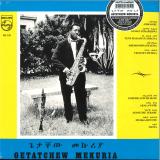
GETATCHEW MEKURYA - ETHIOPIAN URBAN MODERN MUSIC VOL.5 LP

2024 repress.

Getatchew Mekurya is probably the most revered veteran of Ethiopian saxophone.A real giant, both physically and musically. Not only is he at the very top level of Ethiopian saxophonists, but he is the 'inventor' of an extremely distinctive musical 'style.'

In Stock

Disponibile in Stock e pronto per la spedizione

18,70
Betonkust - Tropicana Tracks Two

On the 2024 Altered Circuits release Tropicana Tracks Rotterdam-based artist Betonkust paid tribute to the former subtropical pool (now a circular entrepreneurship hub) Tropicana of his hometown. ALT025 is the follow-up: the fallen-from-grace swimming paradise again fuels a club-oriented selection, inspired by, in the artist's words, "the electronic music from 1988 up until now", more specifically "the Benelux-sound". Tropicana Tracks Two kicks off in full gear with the zero swing drums and lately bass rhythms of Don't Think I'll Be Here Too Long setting the stage for intense synth stabs. Its counterpart comes by way of Realxing, which nonetheless uses similar patches. If the A1 is the thrill of the slides, this one feels like blissfully floating in the geothermally heated waters afterwards. Will Support on the reverse side takes on Detroit techno. Minimal in its composition, it is carried by tough, loopy minor fifth synth sections and prominently mixed rides. TV For Lonely People features more big bass catchiness and melancholic, silky melodies, glued together by vintage flanger treatment and chlorine-damp reverb. The production revels in what feels like the quintessential Betonkust sound. Innershades then joins for the encore, and, characteristically, the mood turns a bit darker. Letting Go Of The Dream is an emotional New Beat update, fully equipped with thudding drum works, haunting lo-fi vocals and pivotal 303 programming - a fitting reaffirmation of the long-standing ties between two of Low Countries Electronics's finest ambassadors.

pre-ordina ora25.05.2026

dovrebbe essere pubblicato su 25.05.2026

16,77
Naajet - The Night Starts Now EP

A rising artist of the French electronic scene, Naajet asserts her identity with The Night Starts Now, a four-track EP that celebrates the freedom and intensity of the night. Co-founder of the Bande de Filles collective and known for her explosive universe blending House, Hardgroove and Breaks, as well as for the unique energy inherited from her dance background, Naajet delivers here a sonic manifesto conceived as an ode to club culture and to the present moment.

“I imagined this EP as an anthem to the world of the night. The night offers us unparalleled freedom, an outlet that allows us to be ourselves, to create, to love. The Night Starts Now captures this celebration of the present moment and this declaration of independence.” Naajet Opening the EP, “Ready To Shine” unfolds radiant House nourished by Pop and 90’s sounds. With a clear and ascending rhythm, the track combines euphoria and introspection. “I composed this track as a joyful and introspective journey that prepares us to embrace the night. For me, it is a call to accept our wounds, to transform them into light and strength, so that we may shine brighter when we enter the club,” explains Naajet. Between ethereal vocal lines and shimmering pads, the track acts as a ritual of entering the night, inviting us to turn wounds into strength and to shine on the dancefloor. The second track of the EP, “Sugar”, embodies the effervescence of the club. Carried by a hypnotic voice and an effervescent rhythm, the track celebrates the communion of bodies and the liberating energy of dance. “It is an ode to dance and to bodies coming together. This track speaks of those moments when, on the dancefloor, boundaries fall: we sweat together, we free ourselves together, and energy flows from one body to another,” says Naajet. A true concentrate of intensity, “Sugar” captures the moment when sweat, rhythm and abandon merge into a collective movement towards freedom.

With “I Can Be Anything”, Naajet changes register and flirts with deeper, even techno textures. Built on a throbbing pulse and sharp synths, this track is meant as a manifesto of identity. “I really wanted to propose a track that claims our right to free and plural expression and sexuality. I Can Be Anything is about our multiple identities, our ability to reinvent ourselves and to refuse any form of formatting,” she says. Between club intensity and political resonance, “I Can Be Anything” questions our multiple facets and embodies the assertion of an elusive and free self. Closing the EP on an euphoric note, “May It Never End” stands out with its broken rhythms and powerful synths. The track conveys the transcendent energy of the end of the night, when dawn arrives but we refuse to leave the collective trance. “I wanted to put into music this feeling of infinite energy, when time is suspended and the party seems to never have to stop. It is this euphoric vertigo that connects us all in the same breath, this utopia of a night that would never end,” says Naajet. A true apotheosis, this track embodies the utopia of an eternal night.

DJ, producer and co-founder of the Bande de Filles collective, Naajet has established herself with a singular universe where House, Hardgroove and Breaks blend, nourished by her background as a dancer and an instinctive sense of groove. For the past three years, she has performed on French and European stages – from Berlin to Amsterdam, via Geneva and Oslo – and has made her mark in clubs such as Rex Club, Le Sucre and Badaboum, as well as festivals like Nuits Sonores and Kolorz. On the production side, she has released several acclaimed EPs on renowned labels such as Shall Not Fade and Monki & Friends. In 2025, she takes a new step with the launch of her label SWEAT Records and a residency at Le Sacré in Paris, affirming her role as an ambassador of a free and intense club culture. She also collaborates with the waacking company MADOKI, for which she composes and mixes projects at the crossroads of dance and music. With The Night Starts Now, Naajet confirms her status as an essential artist of the new electronic generation1

In Stock

Disponibile in Stock e pronto per la spedizione

15,92
NALBANDIAN THE ETHIOPIAN & EITHER/ORCHESTRA - NALBANDIAN THE ETHIOPIAN (ETHIOPIQUES)

The Éthiopiques series returns! Essential archive recordings from an extremely fruitful period in Ethiopian music.

Before “Swinging Addis” took over the world, there was Moussié Nerses Nalbandian — the Armenian-born composer who shaped modern Ethiopian music. Mentor, arranger, and pioneer, he laid the foundations of Ethio-jazz.

This Éthiopiques volume revives his forgotten legacy, recorded live by Either/ Orchestra First issue ever with new exclusive photos and in depth liner 8-page insert.

“Ethiopian jazzmen are the best musicians that we have seen so far in Africa.
They really are promising handlers of jazz instruments.”

Wilbur De Paris
(1959, after a concert in Addis Ababa)

አዲስ፡ዘመን። *Addis zèmèn* **A new era.**
The time is the mid-1950s and early 1960s, just before "Swinging Addis" bloomed – or rather boomed – onto the scene. Brass instruments are still dominant, but the advent of the electric guitar, and the very first electronic organs, are just around the corner. Rock’n'Roll, R’n’B, Soul and the Twist have not yet barged their way in. Addis Ababa is steeped in the big band atmosphere of the post-war era, with Glenn Miller's *In the* *Mood* as its world-wide theme song, neck and neck with the Latin craze that was in vogue at the same period. Life has become enjoyable once again, with the return of peace after the terrible Italian Fascist invasion of Ethiopia (1935-1941). The redeployment of modern music is part and parcel of the postwar reconstruction. *Addis zèmèn* – a new era – is the watchword of the postwar period, just as it was all across war-torn Europe.
The generation who were the young parents of baby boomers** were the first to enjoy this musical renaissance, before the baby boomers themselves took over and forever super-charged the soundtrack of the final days of imperial reign. Music is Ethiopia's most popular art form, and very often serves as the best barometer for the upsurge of energy that is critical for reconstruction. Whether it be jazz in Saint-Germain-des-Prés or the *zazous* who revolutionised both jazz and French *chanson* after the *Libération*, be it Madrid's post-Franco Movida, or Dada, the Surrealists and *les années folles* that followed World War I, the periods just after mourning and hardship always give rise to brighter and more tuneful tomorrows. Addis Ababa, as the country's capital, and the epicentre of change, was no exception to this vital rule.

**Two generations of Nalbandian musicians**
Nersès Nalbandian belonged to a family of Armenian exiles, who had moved to Ethiopia in the mid-1920s. The uncle Kevork arrived along with the fabled "*Arba Lidjotch*", the** "*40 Kids*", young Armenian orphans and musicians that the Ras Tafari had recruited when he visited Jerusalem in 1924, intending to turn their brass band into the official imperial band. If Kevork Nalbandian was the one who first opened the way of modernism, pushing innovation so far as to invent musical theatre, it was his nephew Nersès who would go on to become, from the 1940s and until his death in 1977, a pivotal figure of modern Ethiopian music and of the heights it. Going all the way back to the 1950s. Nothing less. And it is Nersès who is largely to thank for the brassy colours that so greatly contributed to the international renown of Ethiopian groove. While the younger generations today venture timidly into the genealogy of their country's modern music, often losing their way amidst a distinctly xenophobic historiographical complacency, many survivors of the imperial period are still around to bear witness and pay tribute to the essential role that "Moussié Nersès" played in the rise of Abyssinia's musical modernity.
Given the year of his birth (15 March 1915), no one knows for sure if Nersès Nalbandian was born in Aintab, today Gaziantep (Turkiye/former Ottoman Empire) or on the other side of the border in Alep, Syria... What is certain is that his family, like the entire Armenian community, was amongst the victims of the genocide perpetrated by the Turks. Alep, the place of safety – today in ruins.
Before Nersès then, there was uncle Kevork (1887-1963). For a quarter of a century, he was a whirlwind of activity in music teaching and theatrical innovation. *Guèbrè Mariam le Gondaré* (የጎንደሬ ገብረ ማርያም አጥቶ ማግኘት, 1926 EC=1934) is his most famous creation. This play included "ten Ethiopian songs" — a totally innovative approach. According to his autobiographical notes, preserved by the Nalbandian family, Kevork indicates that he composed some 50 such pieces over the course of his career. This shows just how much he understood, very early on, the critical importance of song as Ethiopia's crowning artistic form. Indeed, for Ethiopian listeners, the most important thing is the lyrics, with all their multifarious mischief, far more than a strong melody, sophisticated arrangements or even an exceptional voice. (This is also why Ethiopians by and large, and beginning with the artists and producers themselves, believed for a long time — and wrongly — that their music could not possibly be exported, and could never win over audiences abroad, who did not speak the country's languages).

Last but not least, one of Kevork's major contributions remains composing Ethiopia's first national anthem – with lyrics by Yoftahé Negussié.
Nersès Nalbandian moved to Ethiopia at the end of the 1930s, at the behest of his ground-breaking uncle. Proficient in many instruments (pretty much everything but the drums), conductor, choir director, composer, arranger, adapter, creator, piano tuner, purveyor of rented pianos,... he was above all an energetic and influential teacher. From 1946 onwards, thanks to Kevork's connexion, Nersès was appointed musical director of the Addis Ababa Municipality Band. In just a few years, Nersès transformed it into the first truly modern ensemble, thanks to the quality of his teaching, his choice of repertoire, and the sophistication of his arrangements. It was this group that would go on to become the orchestra of the Haile Selassie Theatre shortly after its inauguration in 1955, which was a major celebration of the Emperor's jubilee, marking the 25th anniversary of his on-again-off-again reign.

At some point or other in his long career, Nersès Nalbandian had a hand in the creation of just about every institutional band (Municipality Band, Police Orchestra, Imperial Bodyguard Band, Army Band, Yared Music School…), but it was with the Haile Selassie Theatre – today the National Theatre – that his abilities were most on display, up until his death in 1977. To this must be added the development of choral singing in Ethiopia, hitherto unknown, and a sort of secret garden dedicated to the memory of Armenian sacred music, and brought together in two thick, unpublished volumes. Shortly before his death (November 13, 1977), he was appointed to lead the impressive Ethiopian delegation at Festac in Lagos, Nigeria (January-February 1977).

His status as a stateless foreigner regularly excluded him from the most senior positions, in spite of the respect he commanded (and commands to this day) from the musicians of his era. Naturally gifted and largely self-taught, Nerses was tirelessly curious about new musical developments, drawing inspiration from the very first imported records, and especially from listening intensely to the musical programmes broadcast over short-wave radio – BBC *First*. A prolific composer and arranger, he was constantly mindful of formalising and integrating Ethiopian parameters (specific “musical modes”, pentatonic scale, and the dominance of ternary rhythms) into his “modernisation” of the musical culture, rather than trying to over-westernise it. It even seems very probable that *Moussié* Nerses made a decisive contribution to the development of tighter music-teaching methods, in order to revitalise musical education during this period of prodigious cultural ferment. Flying in the face of all the historiographical and musicological evidence, it is taken as sacrosanct dogma that the four musical modes or chords officially recognised today, the *qǝñǝt* or *qiñit* (ቅኝት), are every bit as millennial as Ethiopia itself. It would appear however that some streamlining of these chords actually took place in around 1960. It was only from this time onward that music teaching was structured around these four fundamental musical modes and chords: *Ambassel*, *Bati*, *Tezeta* and *Antchi Hoyé*. A historical and musical “details” that is, apparently, difficult to swallow, especially if that should honour a *foreigner*. Modern Ethiopian music has Nersès to thank for many of its standards and, to this day, it is not unusual for the National Radio to broadcast thunderous oldies that bear unmistakable traces of his outrageously groovy touch.

In Stock

Disponibile in Stock e pronto per la spedizione

22,06
Various - 10 ans Révolus EP1

Various

10 ans Révolus EP1

12inchAR17EP1
Astropolis Records
18.12.2025

Astropolis Records, the label born from the legendary Brest festival, marks a decade of electronic devotion with a sprawling, heartfelt anniversary compilation — slightly belated, but executed with undeniable flair.
It also comes in two EPs, showcasing the many facets of the Astropolis universe: in-house artists, long-time festival collaborators, and fresh talent from France’s ever-bubbling scene. Eighteen artists guide us through a sonic journey where rave heritage, electronic dreamscapes, and collective fervor intertwine — true to the spirit of a festival that has never recognized borders


The first EP bathes in warm tones across electronica, house, g-tech, old-school rave, and melodic techno.
It opens with grace and magic via Rone, whose electronic touch conjures the intimate and the infinite. Between electronica and downtempo, The Dolphin Ambassador delivers luminous melancholy, offering a gentle calm before the storm.


The unlikely pairing of Mézigue and Swooh catapults house into a g-tech vortex with the unrestrained Broken Roll To Venice, a compact fusion of groove, hybrid sounds, and playful inventiveness.
Belaria & Madben continue this alchemical thread on Into The Void, an incendiary anthem where 90s rave, EBM, and modern intensity collide in hypnotic trance.


For old-school dancefloor loyalists, KiNK finally resurrects a cult live set staple: Give Me, a bona fide banger merging breakbeat and vintage house, engineered for late-night sweat sessions.
Oniris & Benjamin Rippert revisit the melodic techno roots of the label on Sonate, demonstrating a masterful command of harmony.


This anniversary compilation underscores the label’s openness to new generations and recent sonic hybrids, while paying homage to the techno scene that shaped its early days. Much like the festival itself, it embodies the same sincerity and collective energy: a small manifesto connecting generations, aesthetics, and territories — celebrating roots without nostalgia, and the future without bowing to trends.

In Stock

Disponibile in Stock e pronto per la spedizione

14,08
ELKIN & NELSON - DÂM-FUNK & LORENZO SORIA RETOUCH

Dâm-Funk & Lorenzo Soria RETOUCH Elkin & Nelson's Balearic Classic "Vámonos". A Cross-Continental Tribute form the West Coast Funk to Andalusian Rhythms.
Hand stamped 10"

Two generations, two continents, and one timeless Balearic groove — “Vámonos”, the 1970s classic from Colombian-Spanish duo Elkin & Nelson, gets a retouch by the hands of Dâm-Funk and Lorenzo Soria. Infusing the track with new sonic energy while paying homage to its iconic roots, this version of “Vámonos” travels from the beaches of Ibiza to the sun-drenched streets of Los Angeles and Seville.

Together Dâm-Funk — a pioneer of modern-funk and longtime ambassador of the West Coast boogie-funk sound. Known for seminal albums like “Toeachizown” and “Invite the Light” on Stones Throw Records, as well as collaborations with Snoop Dogg, Ariel Pink and Christine and the Queens, Dâm-Funk brings his signature analog synths and laid-back groove to the mix. His unmistakable style draws deeply from Prince, Slave, and the golden era of 1980s funk.

Lorenzo Soria represents a new generation of global-minded producers reshaping the electronic landscape from Southern Spain. A native of Seville, Soria’s collaborations with, Califato ¾, draws from reggaeton, EBM, punk, and traditional Andalusian folklore, Lorenzo’s rhythmic palette is both eclectic and rooted. His contribution to “Vámonos” brings percussive depth and vibrant energy that pulse with Mediterranean warmth.

Together, Dâm-Funk and Lorenzo Soria have created a two versions of “Vámonos” that is both respectful — with lush keys, hypnotic percussion, and genre-defying flair, this collaboration reinvents a Balearic gem for a new generation of listeners and dancers.

In Stock

Disponibile in Stock e pronto per la spedizione

15,34
Various - GHOSTED III

Various

GHOSTED III

12inchDC955
DRAG CITY
29.10.2025

Ambarchi, Berthling and Werliin are back, a little looser and wilder than before. Their ability to lock in and focus on the smallest of details is enhanced here by a sense of increased immediacy. Great news for fans of stimulating variations of tone and mood within a potentially infinite universe of rhythm and sound! The more you listen to Ghosted III, the better your hearing becomes. Or maybe it"s just that you hear more every time you play it.

In Stock

Disponibile in Stock e pronto per la spedizione

26,68
João do Pife - Garoto Do Pife / Homenagem a Ludugero (7")

Presenting a joyous double dose of Brazilian pífano magic by João do Pife, taken from his iconic Folclore Alagoano LP and pressed for the first time on 7” vinyl. The infectious, uplifting energy of the instrumental track 'Garoto Do Pife' has been a dancefloor weapon for revered selectors such as Gilles Peterson, Cliffy and the Mr Bongo DJs, and we are proud to be reissuing it for the first time.

The pífano, pifaro or pife, which creates the distinctive melodies in these tracks, is a simple seven-hole woodwind instrument from the Northeast region of Brazil. Often made out of bamboo or taquara wood, they are rich in folkloric music tradition and paired with percussion instruments to form the Bandas de Pífanos groups, which originated from the Northeastern states of the country. "Pifeiros” such as João do Pife, Edmilson do Pífano, and Carlos Malta brought the pífano into a wider public eye through their albums and vinyl recordings.

A part of pífano maestro João do Pife’s rich legacy, these two mesmerizing and timeless tracks originate from his sought-after 1975 LP Folclore Alagoano, released on the Tropicana label. Born João Alfredo Marques dos Santos in 1943, in Riacho das Almas, João do Pife became an ambassador of Northern Brazilian culture and folklore through his music, which placed the pífano centre stage.

For this 7" issue, we have curated two of our favourite tracks from the album, 'Garoto Do Pife' and 'Homenagem a Ludugero', that exude a driving and joyous dancefloor energy. With lively accordion and organ accompaniments that weave around João do Pife's sublime pífano playing, they channel a folk spirit that will resonate deep within your soul.

As inspiration for the picture sleeve, we have adapted the original cover photo art for this 7 inch issue. João do Pife’s music, which is housed within, will sweep you away to Northeastern Brazil in an instant.

In Stock

Disponibile in Stock e pronto per la spedizione

16,39
Mark Du Mosch - Sterling Melody LP 2x12"

Peek of Normal is the new label from disco veteran Stevie Kotey, whose productions have graced the Bear Funk, Ambassador's Reception, Strut, Electric Minds and many more labels in the past. Pretty much its first move was to ink a deal with Dutch master Mark du Mosch, who'd been friends with Kotey since the latter moved to Rotterdam in 2005 and discovered his neighbour had similar tastes in disco. This new label's inaugural release, Sterling Melody, is quite the labour of love, and with eight tracks spread across a double vinyl pack collection lean more towards the coldwave, electro and synthpop of the early 80s rather than 70s disco. There are echoes of some pretty classic sounds here, from the Vince Clarke-esque throb of '77777st' and 'A5G Neowise' - not unlike the soundtrack work of mid period Tangerine Dream - to the slower motioning Italo-tinged shininess of 'Soluzio'. Our favourite is the title track itself, perky and full of sparkle, like the incidental music for a lost series about a mullet-clad, white linen suited detective who doesn't play by the rules, only much, much better. Definitely worth a Peek.

In Stock

Disponibile in Stock e pronto per la spedizione

26,68
Articoli per pagina:
N/ABPM
Vinyl