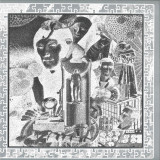
Build An Ark is well known as one of the greatest spiritual jazz bandsAin the 2000's led by producer Carlos NiNo and vocalist Dwight Trible.AThis EP includes remarkable 2 cover tracks from their first album"Peace With Every Step(2004)" of the astonishing project where he invited top jazz musicians, Phil Ranelin who led the Tribe label in the 70's and Nate Morgan from the Nimbus label led by Horace Tapscott, etc.AA-side is a cover of Pharoah Sanders' masterpiece "You've Gotta Have Freedom", one of the representative songs of spiritual jazz.AAnother side Includes a cover of "Vibes From The Tribe" which is Phil Ranelin's heavy breakbeats left on Tribe in 1975!
quête:an
- Crimson Sin (1985 Demo)
- My Bone (Live At Full Moon Saloon)
- Veil Of Death (1985 Demo)
- You Do Not Scare Me (1985 Demo)
- Division (1986 Live At Full Moon Saloon)
- Right To The Point (1986 Live At Full Moon Saloon)
- She's Fun (1985 Rehearsal, The Sleepers Cover)
- Slow Death (1985 Rehearsal)
- Vampires (1986 Rehearsal)
- Which Guy (1985 Rehearsal)
- My Bone_Veil Of Death (1985 Live At Club Vis A Vis)
Altar De Fey originated in San Francisco in the early 1980’s as part of the emerging musical form that would come to be
known as Deathrock. Out of the Zeitgeist flash of 70’s Punk Rock the new sound took the darkest elements of the counter
culture into ever deeper, gloomier and more mature territory.
Performing at legendary San Francisco venues Mabuhay Gardens, Graffiti, The Nightbreak and the rest billed with
Christian Death, 45 Grave, and all the fellow architects of West Coast Post Punk.
The original incarnation passed through a rotating cast of characters centered strongly by the vision and experimental
guitar of founding member Kent Cates. Eschewing the conventional chord progression/solo form entirely Cates’s guitar spins
strands of melody and rhythm, tone and texture in a style that to this day is all his own. The mood was perfected with the
innovative tribal drumming of Aleph Kali and Butch Mason’s haunted confrontational vocals.
Though the band had a strong base of support, no original recordings were ever released and the young members
carried on into new musical endeavors. By 1988 ADF disbanded.
Years upon years passed yet the name was never completely forgotten. As Goth Punk culture persisted, grew and
developed over time the band began to take on a kind of legendary hue among fans in the know; The lost mysterious
phenomenon of Altar De Fey. -There was a kind of poetry to it. Finally in 2011, when asked if they would play a reunion for a
festival in San Francisco Kent and Aleph surprised everyone by answering yes.
Reforming originally as a 2 piece with a drum machine Kent on guitar and Aleph on vocals to an enthusiastic reception,
the duo enjoyed it so much they decided to continue the momentum and quickly added Skot Brown on bass, Aleph switched
over to live drums, and Jake Hout was added on vocals. The new line up debuted in April of 2012 and has continued
regularly performing songs from the original 80’s catalogue and steadily adding new material ever since.
A new generation of underground Deathrock music is growing across the world, in closer, more direct communication
than ever before, and interest in the band has quickly escalated.
This unique compilation brings you 11 original ADF songs recorded between 1984-1986 (demos, rehearsal records, live
records). If you are into classic Christian Death, 45 Grave, Kommunity FK, Burning Image etc. grab this gem now before it’s
too late!
“Nothing ever really disappears,” Cassandra Jenkins says. “It just changes shape.” Over the past few years, she’s seen relationships altered, travelled three continents, wandered through museums and parks, and recorded free-associative guided tours of her New York haunts. Her observations capture the humanity and nature around her, as well as thought patterns, memories, and attempts to be present while dealing with pain and loss. With a singular voice, Jenkins siphons these ideas into the ambient folk of her new album.
An Overview on Phenomenal Nature honors flux, detail, and moments of intimacy. Jenkins arrived at engineer Josh Kaufman’s studio with ideas rather than full songs — nevertheless, they finished the album in a week. Jenkins’ voice floats amid sensuous chamber pop arrangements and raw-edged drums, ferrying us through impressionistic portraits of friends and strangers. Her lyrics unfold magical worlds, introducing you to a cast of characters like a local fisherman, a psychic at a birthday party, and driving instructor of a spiritual bent.
Jenkins’ last record, 2017’s Play Till You Win, confirmed the veteran artist’s talent. Evident of Jenkins’ experience growing up in a family band in New York City, the album showcased her meticulous songwriting and musicianship, earning her comparisons to George Harrison and Emmylou Harris. Jenkins has since played in the bands of Eleanor Friedberger, Craig Finn, and Lola Kirke, and rehearsed to tour with Purple Mountains last August before the tour’s cancellation. Her new record departs from her previous work in its openness and flexibility, following her peripatetic lifestyle. “The goal is to be more fluid, to be more like the clouds shifting constantly,” she says. The approach allowed Jenkins to express herself like she never has.
On album opener “Michaelangelo,” before the heavy drum beat and fuzz guitars enter, Jenkins sings quietly “I’m a three-legged dog, working with what I’ve got / and part of me will always be looking for what I lost // there’s a fly around my head, waiting for the day I drop dead.” Phenomenal Nature thrives in this dichotomy between ornate sonics and verbal frankness, a calming guided tour to the edge. Later, on “Crosshairs,” amid lush strings, she sings conversationally: “Empty space is my escape / it runs through me like a river / while time spits in my face.”
“Hard Drive,” the third track and album centerpiece, opens with a voice memo Jenkins recorded at The Met Breuer: a guard muses about Mrinalini Mukherjee’s hybrid textile and sculpture works, which were then on display in a retrospective titled Phenomenal Nature. “When we lose our connection to nature, we lose our spirit, our humanity,” she explains. Stuart Bogie's saxophone & Josh Kaufman's glittering guitar make way for Jenkins' spoken word which constellates scenes from her life, gradually building and blossoming as she recreates a meditation guided by a friend who incants, “One, two, three.”
Sounds of footsteps and bird calls run through the album’s glittering conclusion, “The Ramble.” Meditative and bright, it recalls how Jenkins felt while writing and recording her new material: “Everything else is falling apart, so let’s just enjoy this time,” she said. If Phenomenal Nature has a unifying theme, it’s the power of presence, the joy of walking in a world in constant flux and opening oneself to change.
Arnau Obiols und KAYYAK haben sich erst letztes Jahr über ihre Freundinnen kennengelernt, die zufälligerweise Schwestern sind. Wie man sich vorstellen kann, dauerte es nicht lange, bis sich die beiden Schwäger zum ersten Mal im Studio trafen – begleitet vom Schweizer Bassist Jules Martinet, mit Vocals des südafrikanischen Sängers B’utiza und des mosambikanischen Sängers Tcheco (Teil der legendären Band Ghorwane, Real World Records).
Die Energie wurde während der Produktion der Songs zum Leben erweckt und resultierte in zwei großartige Originale. Folkloristische Tradition in moderner Komposition, akustischen Drums, Percussion mit Acid-Elementen, Echo-Feedback und psychedelischen Klängen, alles durchdrungen mit funky Basslines.
Zusätzlich gewannen sie Kalabrese und MLiR, auf der B-Seite ihre Remix-Künste beizutragen. Beides Künstler, die Arnau und Kay besonders am Herzen liegen.
Most of the songs were recorded in my flat on cassette or digital four track recorders, although a couple were done in my much-lamented studio above a morgue in The Anatomy Rooms.
Hot on the heels of solo concerts to commemorate the 20th birthday of her debut album Mud Stories, An Pierle returns with a brand new Quartet album that proves that looking back was no retro exercise. Together with life/musical partner Koen Gisen and jazz youngsters Hendrik Lasure & Casper Van De Velde (schntzl, warm bad, Bombataz,...) she now presents Wiga Waga, an adventurous new album that juggles playfulness and experimentalism.
The songs sound familiar and bear the Pierle mark, even though they uncover hereto unexplored territory. Inspired by a newly-found enthusiasm and inquisitive spirit, the musicians came up with a batch of songs that revisit familiar themes and atmospheres, but dress them up with an invigorating eclecticism. Working as a real 'band', the quartet sets out for a new, collective identity. It is not jazz in the classic sense, but it contains the imagination, freedom and constant renewal of the genre, and it works like a charm.
In a world of announcements of announcements, Gatecreeper are firing no warning shots before dropping their new release. “I think the social media environment has just fried our attention spans,” vocalist Chase Mason says. “Trying to hold someone’s attention for two or three months with a typical album roll-out doesn’t seem feasible with everything else currently going on in the world.” That’s not the only reason An Unexpected Reality comes with no pre-release hype whatsoever. “It’s meant to be listened to as a whole, so we didn’t wanna break it up or release a couple songs ahead of time as ‘singles’ or whatever,” Mason clarifies. “We also didn’t wanna treat it like it’s our next full-length. Because it’s not.” Written, recorded and now released during the Covid-19 pandemic, An Unexpected Reality is Gatecreeper like you’ve never heard them before. Exploring both ends of the tempo spectrum, the release offers two opposing sides of the band’s musical personality. Side one consists of seven short, sharp shocks that have a total running time of less than seven minutes. Inspired by grind, punk and hardcore, tracks like “Starved,” “Rusted Gold” and “Amputation” are some of the fastest offerings the Arizona death metal squad has ever recorded. Side two is the exact opposite.
OOOOOHHHHH yeah!!! Nearly 2 years without new and fresh stuff on S3A Records???? We had to come back to the kitchen right ??!! So, let’s do it!!! Here we have a new cook in the family : OUVRIJSTER!! He is a great artist from Amsterdam, with a brilliant taste!! Mix a little bit of Moodyman with a large dose of Alfabet (Tom Trago + Awanto 3), add a little Max Graef spiced hihats, and you have the recipe for this “Staying Sane EP” !A 6 tracks EP from samplebased house to hiphop.
Für "No Eye Has An Equal", einer "Reflektion darüber, wie Vielfalt einen Sinn für Unendlichkeit kreieren kann", gräbt der italienische Komponist Giulio Aldinucci tief in sein umfangreiches Archiv electroakustischer Kompositionen und präsentiert vier radikale Rekonzeptualisationen seines eigenen Materials. Jede ist für sich ein Blick in tiefe, persönliche Atmosphären, die Aldinucci seit über einer Dekade mit seinen Kompositionen kreiert und perfektioniert. Empfohlen für Fans von Steve Reich, Kara Lis Coverdale, William Basinski, Tim Hecker und Deepchord.
Alien Recordings was born in the late 80's by Andy Panayi and
Alec Stone, out of a love of music and DJing. They also ran a
night around London called Alienation, playing a mix of house,
electro, breakbeat and techno. They're back as (An) Alien with
new material for your listening pleasure; alongside music by
legend Terry Francis as well as Panayi and Stone themselves
(A²), the likes of Stopouts (Rob Collman + Navigator) were
staples of the imprint and they front up for "Tales From The
Archives Part 2.2". There's the brooding Drexciyan electro funk
of "Kill All Humans" originally from 1998, a remastered version
of "Sandstorm" from their release on Robin Ball's
Groovepressure imprint in 1999 and on the B side is the
underwater cybernetic epic "Freaks" by A².
- A1: Diego Carpitella & Alan Lomax - E Ballamu Tutti Ddhoi Ti Paru
- A2: Diego Carpitella & Ernesto De Martino - Pizzica Tarantata N 014
- A3: Diego Carpitella & Ernesto De Martino - Pizzica Tarantata N 015
- A4: Diego Carpitella & Ernesto De Martino - Pizzica Tarantata N 026
- A5: Diego Carpitella & Ernesto De Martino - Pizzica Tarantata N 030
- A6: Diego Carpitella - Santu Paolu Meu De Galatina
- B1: Bjorn Torske & Trym Søvdsnes - Pizzica Tarantata N 026 (Rework)
- B2: Uffe - Pizzica Tarantata N 015 (Rework)
- C1: Lns - Pizzica Tarantata N 014 (Rework)
- C2: Bottin - Santu Paolu Meu De Galatina (Rework)
- D1: Don't Dj - Pizzica Tarantata N 014 (Rework)
- D2: Kmru - Pizzica Tarantata N 030 (Rework)
After their first issue focus on Benga, a Kenyan musical movement, FLEE is proud to present its new project: «Tarantismo: Odyssey of an Italian Ritual», available on 2LP Gatefold and as a bundle with 2LP Gatefold and a 168 pages Book.
Please note that the book only is not available
Dedicated to Tarentism, this project tells the story of a centuries-old choreo-musical ritual from Southern Italy, mobilizing frenetic rhythms and maniac dances, to exorcise women of a mysterious evil caused by the bite of a spider. Trans-disciplinary, this effort of documentation and artistic re-interpretation of one Europe’s most mysterious trance phenomenon is comprised of a double LP vinyl compilation including original recordings from Italian Maestro's Carpitella, Lomax and De Martino with reinterpretations from Don't DJ, Bottin, LNS, Bjorn Torske & Trym Søvdsnes, KMRU, Uffe and a hardcover Italian/English book.
- Nothing Is Safe
- He Dead (Feat. Ed Balloon)
- La Mala Ordina (With The Rita) (Feat. Elcamino & Benny The Butcher)
- Club Down (With Sarah Bernat)
- Run For Your Life (Feat. La Chat)
- The Show
- All In Your Head (Feat. Counterfeit Madison & Robyn Hood)
- Blood Of The Fang
- Story 7
- Attunement (With Pedestrian Deposit)
- Piano Burning
There Existed An Addiction To Blood" ist das insgesamt vierte Album von Clipping und ihr drittes für Sub Pop. Es ist der Nachfolger des von Kritikern und Publikum gleichermaßen gefeiertes Album ,Splendor And Misery" aus dem Jahr 2016. ,There Existed An Addiction To Blood" enthält die Singles ,Nothing Is Safe", ,Blood Of The Fang" und ,La Mala Ordina" (Feat. Benny The Butcher, Elcamino, The Rita), die von Clipping produziert, von Steve Kaplan gemischt und von Dave Cooley bei Elysium Masters in Los Angeles gemastert wurden. Das Album enthält auch Gastbeiträge von Ed Balloon, La Chat, Counterfeit Madison und Pedestrian Deposit. ,There Existed An Addiction To Blood" ist Clippings Interpretation eines neuen Rap-Splitter-Genres unter Zuhilfenahme ihrer einzigartigen Lupe. Clipping wenden sich auf dem neuen Werk intensiv dem Horrorcore zu, eines bewusst absurden und kreativ bedeutsamen Subgenres, das Mitte der 90er Jahre blühte. Einige der bemerkenswertesten Pioniere hießen Brotha Lynch Hung und Gravediggaz, aber es umfasst auch bahnbrechende Werke der Geto Boys, Bone Thugs-N-Harmony und die nahezu vollständigen Veröffentlichungen des klassischen ,Memphis cassette tape rap". Der wahrscheinlich subversivste und experimentellste Rap hat sich oft als ,Alternative" zu konventionellen Sounds präsentiert, aber Clipping verzerren das Ganze respektvoll in neue Konstellationen. ,There Existed An Addiction To Blood" absorbiert die hyper-gewaltigen Horror-Symboliken der Murder Dog-Ära, stellt sie aber in einem neuen Licht dar: immer noch dunkel getönt und düster, aber in einem seltsameren und lebendigeren Farbton. Wenn der traditionelle Horrorcore mit ,Blacula", dem populären Blaxploitationsfilm-Klassiker aus den frühen 70er Jahren, verwandt war, so ist das neue Output von Clipping analog zu ,Ganja & Hess", dem blutrünstigen Kultklassiker von 1973, der als unbesungenes Wahrzeichen des schwarzen Independent-Kinos gilt, dessen Score von Sam Waymon, Clipping als Inspiration zum Titel des Albums diente und auch Samples auf dem Track ,Blood Of The Fang" lieferte.ENG The science-fiction visionary Octavia Butler once declared that "there is nothing new under the sun, but there are new suns." The aphorism could apply to any art form where the basic contours are fixed, but the appetite for innovation remains infinite. Enter Clipping, flash fiction genre masters in a hip-hop world firmly rooted in memoir. If first person confessionals historically reign, the mid-city Los Angeles trio of rapper Daveed Diggs and producers William Hutson and Jonathan Snipes have spent the last half-decade terraforming their own patch of soil, replete with conceptual labyrinths and industrial chaos. They have conjured a mutant emanation of the future, built at odd angles atop the hallowed foundation of the past. Their third album for Sub Pop, There Existed an Addiction to Blood, finds them interpreting another rap splinter sect through their singular lens. This is Clipping's transmutation of horrorcore, a purposefully absurdist sub-genre that flourished in the mid-90s. If some of its most notable pioneers included Brotha Lynch Hung and Gravediggaz, it also encompasses seminal works from the Geto Boys, Bone Thugs-N-Harmony, and the near-entirety of classic Memphis cassette tape rap. The most subversive and experimental rap has often presented itself as an "alternative" to conventional sounds, but Clipping respectfully warp them into new constellations. There Existed an Addiction to Blood absorbs the hyper-violent horror tropes of the Murder Dog era, but re-imagines them in a new light: still darkly-tinted and somber, but in a weirder and more vivid hue. The album contains interludes with hissing recordings of demonic invasions, and guest appearances from Griselda Gang's Benny the Butcher and Hypnotize Minds horror queen La Chat. Other tracks feature contributions from noise music legends The Rita and Pedestrian Deposit. It all ends with "Piano Burning," a performance of a piece written by the avant-garde composer Annea Lockwood. Yes, it is the sound of a piano burning. There Existed an Addiction to Blood fits neatly into the broader scope of the band's career, which has seen them expand from insular experimentalists into globally recognized artists. Since the release of their first album in 2013, Diggs has won a Tony and a Grammy (both for his acting/rapping work as Thomas Jefferson and Marquis de Lafayette in Hamilton), as well as co-written and starred in 2018's critically hailed Blindspotting, while Snipes and Hutson have scored numerous films and television shows. Clipping's last album, the 2016 afro-futurist dystopian space opus Splendor & Misery was recently named one of Pitchfork's Best Industrial Albums of All-Time. Commissioned for an episode of This American Life, their 2017 single "The Deep" became the inspiration for a novel of the same name, written by Rivers Solomon and published by Saga Press. But their latest masterwork embodies what the band had been building towards - a work that finds them without peer. This is experimental hip-hop built to bang in a post-apocalyptic club bursting with radiation. It's horrorcore that soaks up past blood and replants it into a different organism, undead but dangerously alive. It is a new sun, blindingly bright and built to burn your retinas.
"Crosstalk" is a collaborative effort between Theomatic's artists - a sort of a peer reinterpretation of each other's works. First on the A-side is Acos Coolkas' "Skyline", from their first-ever single on Theomatic, released in 2005, receiving a sonic facelift from An-2. This is followed by An-2's remix of D-Pulse's first track from their latest full-length album, "Gratitude", which first appeared as a mystery track on An-2's 2018 SoundCloud mix, now seeing the light of the day by popular demand, and is not to be missed. On the flipside D-Pulse deliver a two-part remix of An-2's "The Gift" - previously only available digitally. These two stunning pieces, filled with ethereal soundscapes, will delight any discerning Balearic-sound connoisseur. Rounding things off is Acos Coolkas' remix of An-2's seminal
180g Limited
Life is but an Empty Dream is the seventh full length from long-form ambient composer OKADA.
By pressing play, Gregory Pappas, the man behind the moniker, requires your full attention. Waves of crashing sound swirl around viscus beats and cavernous staccato piano. Sound becomes broken to be reconstructed many times over. This is not the lovesick nor heartbroken OKADA we've witnessed before. This is a cathartic, disillusioned, OKADA, out the other side, worse for wear but building anew.
The proximal six-minute opening to the album expounds destruction and disintegration, chaos and rebirth. The eye of this storm then disseminates wide allowing a female vocal breath to imply "again." Have these destructive waves ultimately lead to pleasure? Or moments of rage that have eventually lead to acceptance? It is evident that there is a need, a yearning, an ache, that percolates to the surface on Life is but an Empty Dream. This, mind you, has all happened in the first ten minutes of the album.
Pappas, as with all OKADA albums, has put every fiber of his being into the creative process. Such focus and shroud that hangs over the album lead us to assume Pappas' is in an antithetical state than the one apparent on 2016's ode to the blossom- ing relationship Love Telepathic.
Life is but an Empty Dream features four long from tracks that effortlessly progress through extended vignettes encompassing ambient, post-industrial, chillwave and even IDM. Life is but an Empty Dream also has the distinction of being the first OKADA album to be pressed to vinyl and will be available on May 24th
- A1: Sea (3:02)
- A2: Island (2:46)
- A3: Tree (3:21)
- A4: The Archway (3:10)
- A5: Waiting (3:24)
- B1: Seed Change (3:49)
- B2: Moments (3:14)
- B3: Adjustment (3:14)
- B4: On Rope (3:06)
- B5: A Different Tree (2:56)
FLOAT proudly welcomes their second artist into the fold. UK electronic artistand Szun Waves band member Luke Abbott, presents a special 10-track album tocelebrate Piano Day 2019 - an international event series initiated by NilsFrahm which acts as a platform for piano-related projects. 'Music From The Edge Of An Island' sees Abbott divert from his typicallyexperimental electronic style to explore a more compositional approach centredaround VST instruments. Rather than the usual themes of synthesis andimprovisation, the album is lead by piano motifs, structured around emotivemelodies and sparkling arrangements. The record began as a part of asoundtrack commission by producer / actor Jessica Hynes for her film 'TheFight' and ultimately became a fully-realised album. The film script had acoastal setting that created the record's thematic idea: "I had this ideaabout being on the edge of England, almost ready to fall off a cliff into thesea but keeping your balance on the edge." The idea of writing for the piano had been ruminating for some months asAbbott found himself spending an increasing amount of time playing on theinstrument. Without a piano of his own though, he found a strangely enchantingway to fulfil his creative impulse. "I used to have an upright piano, but I'dgiven it away when I last moved house, so I ended up using a piano VST in thecomputer, which I actually really enjoyed. Writing the music became a bit of aweird fantasy process, I was in an odd headspace for a few days." The writing process was remarkably quick, resulting in simple yet inspiredpieces that subtly blur the lines between MIDI computer music and liveperformance. 'Music From The Edge Of An Island' can be seen as a collection ofgentle reveries that sway between the twilight hours, marked by moments ofsoft, contemplative ballads and more active and expansive motions. Openingtrack 'Sea' begins with a mysterious piano waltz before unnerving synth dronestake over. 'Island continues with piano triplet figures plus addedorchestration of cello strokes and airy glass pads, before heading into themelancholic 'Tree', bringing in more strings and added pathos heard in therestless piano motif. Quieter passages are contrasted with the Gamelan-esque'Moments' and the uplifting 'On Rope', whilst more lyrical moments on thealbum can be found in tracks such as 'Adjustment' and closing track 'ADifferent Tree'.