Since the release of the highly acclaimed album Mamari (2021), the Muito Kaballa project has continued to develop.
The new album Little Child (2022) starts with a cracker called Inside Outside. The song addresses the hypocrisy and double standards of the European Union when it comes to refugee policy. The group works together with the renowned German/Nigerian musician Ade Bantu and the Angolan guitarist Juresse Amie Tieti Ndombasi and picks up their listeners where they were parked with Mamari. Fat grooves with clearly recognizable Afrobeat influences.
However, the musical journey leads step by step away from the usual sounds of the band. Already the second track Dansez! Dansez! shows that. The sound leads to Angola, Congo and a bit of Mali. The band stacks so many rhythms on top of each other that the word poly appears in a whole new light. It becomes clear that the nine deal intensively with the music that is the source of their inspiration. The gifted guitarist Juresse Amie Tieti Ndombasi puts the icing on the cake with his sound.
Let's continue with No = No. Here at last it becomes clear: Muito Kaballa has escaped from his drawer and is now in free flight, somewhere between jazz, fusion, afrobeat and whatever. But who cares? The sound is convincing, the feet shake to the beat and cannot be calmed down even with great effort and the message "Don't protect your daughter, educate your son" can't be said often enough.
The next song, Memories, reveals completely different sides of the band. While the sound is suddenly much more relaxed and, let's call it jazzy, the lyrics also become much more intimate and poetic. "Keep in mind, it makes you blind, starring in the sun". We don't find out what memories Niklas Mündemann, composer of the song, has in mind here but that shouldn't bother us. We just put on our sunglasses and let ourselves be carried away by the almost epic track, which with its ten minutes of playing time leaves nothing to be desired in terms of diversity. Sophisticated listeners will wonder if Niklas Mündemann listened to a bit of Kamasi Washington while composing. Maybe even a lot? Be that as it may - a special treat in the piece: the trombonist Saskia-Marleen Dahms, who makes a guest appearance on this song, rounds off the sound of the brass section again.
Last but not least, we come to the namesake of the album: the song Little Child builds on the mood of the previous track and rounds off the musical odyssey with a good portion of goosebumps. But the song doesn't just leave its mark on the surface, no, it also gets under your skin. While the melody has considerable catchy tune potential, it is above all the lyrics and the message that grab you here. Niklas Mündemann wrote the song during a phase of mental depression. Above all, psychotherapy helped him to think more positively again and to comfort his own inner child. We've all heard about that child in us. But when was the last time we hugged it? The song Little Child is the perfect accompaniment for this, because when you hear it, you immediately feel hugged, pressed and safe. Another highlight are the incredibly beautiful solos, played by Benjamin Schneider on guitar and Saskia-Marleen Dahms on trombone.
That's the end of the album and, to be perfectly honest, you don't feel left out in the rain, but you do feel left out in a (warm) shower. Time flies when you hear Muito Kaballa's new album and in the end you want more. 4 remixes for the dancefloor are delivered by French producer Kuna Maze, Polish/Angolan duo Lua Preta, French producer La Dame and Brazilian producer Badsista, tipping the remix balance into more female input.
Search:ang
12" + 7" !
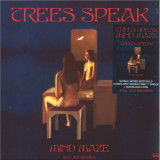
Mind Maze is, amazingly, Trees Speak’s fifth album to be released on Soul Jazz Records in the space of little over two years– an output matched only by the intensity of their music created during this short time.
The first pressing only of the album comes with a bonus seven-inch single containing two tracks that are not available on vinyl anywhere else.
As with all their previous releases, ‘Mind Maze’ is a mind-boggling tightrope walk across an array of musical influences that seamlessly create the unique present-day world of Trees Speak.
The band’s sound is characterized by a combination of German krautrock motoric-beat rhythms, angular New York post-punk attitude, 60s spy soundtracks, psych, rock, jazz, and 70s synthesizers and vocoders. There is also a cosmic spatial awareness to their sound; both personal inner space and galactic outer space, as well as a wilful pushing of sonic boundaries.
Trees Speak are a musical duo based in Tucson, Arizona, composed of Daniel Martin Diaz and Damian Diaz. Their music is heavily influenced by the cosmic magic of the natural desert landscapes of Arizona, creating a unique and captivating sound that is both experimental and innovative.
Here you will find the myriad sounds of 1970s German electronic music (everything from Can to Cluster, Popul Vuh to Tangerine Dream); 1980s New York post-punk and synthcore (from No Wave to Suicide); John Barry’s 1960s movies, John Carpenter’s 1970s horror. You will also hear the influences of French and Italian progressive rock (Magma, Goblin) as well as cosmic, new age and experimental space soundscapes …. an almost endless list of diverse influences that ebb and flow like an ocean of sound, in the process creating a truly unique soundscape that Trees Speak have made wholly their own.
The name Trees Speak reflects their interest in the concept of using future technologies to store information and data in trees and plants, with the idea that trees communicate collectively. This interest in nature and technology, combined with their passion for experimentation, has led Trees Speak to create a truly one-of-a-kind listening experience that is both unique and engaging.
If you ever wanted to hear Can, Neu!, Destroy All Monsters, Pere Ubu, electric eels, John Cage, Liquid Liquid, Tangerine Dream, Suicide, Laurie Spiegel, Art Ensemble of Chicago, John Barry, Mother Mallard’s Portable Masterpiece Company, Sun Ra, Stockhausen, John Carpenter, Electro-Acoustic and Musique Concrete and Mars in one band - then this is it! Trees Speak are a band that defies categorization and offer an eclectic listening experience, both exciting and memorable.
The two bonus tracks (‘Seraphim’ and ‘Orpheus’) included with the album give us a further window into the complex mind maze of the group - two stunning acoustic tracks that explore a distinct early 70s sound of Yes, Argent and other progressive rock accolytes.
- A1: Dreams (Feat Xênia França&Zé Leônidas)
- A2: Kismeti (Feat Matthias Schriefl)
- A3: Asase (Feat Eric Owusu)
- A4: Sábado (Feat Zé Leônidas)
- A5: Carrossel (Feat Zé Leônidas)
- B1: Caio & Eric (Feat Eduardo Camargo)
- B2: Ndiyakhangela (Feat Bongani Givethanks &Amp; Mpho Nkuzo)
- B3: Agôra (Feat Matthias Schriefl)
- B4: Oblique Sunshine (Feat Rebekka Ziegler)
Global pointing Brazilian jazz trio releases their new album Agôra, that sparkles with electric funk and Herbie-esque eclecticism. It features a myriad of guest vocalists and musicians including Brazilians Xênia França and Zé Leônidas, Jembaa Groove's Ghanaian singer Eric Owusu and South African artists Bongani Givethanks & Mpho Nkuzo
Re-wiring the concept of 'fusion' for 2023, Agôra is Brazilian trio Caixa Cubo's resurgent new record with the title referring to 'now', based upon the intuitive and fluid nature of the trio's method, and this inspired recording. With shoots to black music culture, from Brazil to Brooklyn, Ghana and South Africa, Agôra is the group's ninth album yet is their first where they've invited guests, mainly singers, onto each track and follows their last, Angela from 2020, released on Heavenly Records, which won a BBC 6 Music Album of the Year (Huey Morgan's selection) granting them much deserved international recognition.
The core musical elements of Caixa Cubo are Henrique Gomide (keys), João Fideles (drums) and Noa Stroeter (bass), all from São Paulo, Brazil and where they met as teenagers and would continue their friendship and musical bond at the Royal Conservatory in The Hague, Netherlands. Now all in their mid thirties, João and Noa live back in the city where it all started but Henrique has settled in Cologne, Germany where the recording of Agôra took place, over the course of 3 days, at the home cum studio of Chris 'Dusty' Doepke, their friend and owner of the label they signed to, Jazz & Milk.
In line with all their creations where flow and energy provide the magic, allowing what the moment provides, the album shines not only for its virtuosity but for its minimalism, the depth of space, and for the first time, the ability to figure in and outside of the jazz fold, as the trio decided, for the first time, to bring in singers and add a new aesthetic to their sound.
"Agôra is a wake-up call to reality, a reminder that the infinite possibilities of technological progress should not disconnect us from the earth, from eye-to-eye relationships, and from moments lived in person" the band are keen to point out. "And that we must not be consumed by greed, for all we truly possess.... is the NOW."
Turning hope and metaphor into music, the debut single Sábado, an electrified future- jazz-fizz reflects perfectly the spontaneity that permeated the entire recording of the album. "When we got to the studio, we had no idea what we were going to record. We started playing a groove, kind of inspired by Gilberto Gil's 80s albums, and our drummer João started singing this funny song 'Sábado Barrigudão' (Big Belly Saturday) alongside the bass groove and that was that". Inspired by their city of birth, São Paulo, it features long time collaborator and vocalist Zé Leônidas, with cuicas, tamborim, agogo and shakers providing the most obvious Brazilian affect from the album.
Dreams is the band's first foray into R'n'B melding the group's simple and sporadic instrumentation of drums, keys and bass into a Jill Scott inspired song that could have been born in Brooklyn yet sung by Brazilian singer and Grammy nominated Xênia França and Zé Leônidas in both English and Portuguese. Xênia recently performed online for hip-to-it website Colors and it's her latest collaboration with Caixa Cubo, having first met in 2009 for a series of live performances.
South African artists Bongani Givethanks & Mpho Nkuzo come to the record with a wholly different approach on Ndiyakhangela, providing spoken word and vocal refrains on top of an Afro-Brazilian percussion jam with a delivery and verse in Xhosa, Zula and Ndebele. Asase is the album opener and features vocals of Eric Owusu who is part of highlife pioneer Pat Thomas's live band and most recently, co-leader of Jembaa Groove, an Afro-soul band from Berlin. It's a synth wig out with djembe grooves and offers a brand new take on Afro-soul-jazz.
Other contributions come from Cologne based jazz singer Rebekka Ziegler (Oblique Sunshine), São Paulo based guitarist Eduardo Camargo (Caio & Eric) and trumpet player Matthias Schriefl on Kismeti, a gorgeous and rolling number that ebbs and flows, exemplifying the group's effortless ability to craft a sound energised by a belief in one-self and the idea of having faith without the need to look at each other for verification.
As drummer and percussionist João Fideles perfectly surmised upon arriving for the recording session, "What drums do you have? Whatever you have, I'll use it". Agôra is testament to nearly 20 years of camaraderie, friendship and most importantly, trust.
Angelo is an LP, named after a car, featuring nine songs Brijean have crafted and carried with them through a period of profound change, loss, and relocation. It finds percussionist/singer Brijean Murphy and multi-instrumentalist/producer Doug Stuart processing the impossible the only way they know how: through rhythm and movement. The months surrounding the acclaimed release of Feelings, their full-length Ghostly International debut in 2021 which celebrated tender self-reflection and new possibilities, rang bittersweet with the absence of touring and the sudden passing of Murphy’s father and both of Stuart’s parents. In a haze of heartache, the duo left the
Bay Area to be near family, resetting in four cities in under two years. Their to-go rig became their traveling studio and these tracks, along with Angelo, became their few constants. Whereas Feelings formed over collaborative jams with friends, Angelo’s sessions presented Murphy and Stuart a chance to record at their most intimate, “to get us out of our grief and into our bodies,” says Murphy. They explored new moods and styles, reaching for effervescent dance tempos and technicolor backdrops, vibrant hues in contrast to their more somber human experiences. Angelo beams with positivity and creative renewal — a resourceful, collective answer to “what happens now?”
Angelo the car is a 1981 Toyota Celica they got off Craigslist during their first stint in Los Angeles, where Murphy and Stuart have since settled. “Such a bro-y, ‘80s dude car, it’s been super fun to drive around in a new town,” Murphy says. “He’s older than us, he’s a classic, he’s got a story.” It is a spiritual vehicle with a cinematic appeal, first dropping them off in an alleyway for the scene-setting intro, “Which Way To The Club.” The question is quickly resolved by “Take A Trip” as a cruising bassline mingles with crowd sounds, hand-claps, cuíca hiccups, whip-cracks, even a horse neigh. Brijean have found some club on this cross-dimensional trip — the kind of
imagined space or chamber within one’s self capable of “shifting a fraction of who you are,” says Murphy. They wrote the track with the simple intention to be “as free as we could be,” adds Stuart, likening the flip on the B section to a realm unlocked: ”What if the world changed completely? You open the door to a new room.”
Next is “Shy Guy,” a motivational anthem for the wallflowers among us. Murphy sets up the daydream: “We are in junior high, we’re on the dance floor, what’s going down, who is dancing, who is not, how are we gonna make them dance?” The narrator, the MC, hypes up the room as conga-driven rhythms bounce between languid synth and guitar lines. “Show me how to move...I feel something...I know you feel it too,” Murphy sings sweetly, calling back to the opening lines of Feelings, and this time the audience chants it back. It is easy to picture Brijean performing this one — something they only got to do a handful of times until more recently, opening shows for Khruangbin and Washed Out, an experience they found informative. Murphy explains, “It was inspiring to be out there and let loose more. To see how people can expand their expression on stage gave me more liberty with how I viewed my musicianship. My role for so long was to be a backup percussionist, so why would I ever leave the drums, you know? But then after playing all these runs, you see these artists and realize you can, you have permission.”
“Angelo” and “Ooo La La” deliver the danciest stretch in Brijean’s catalog to date. The title track adopts a deep house pulse replete with strings, hi-hats, and kicks. The latter opts for a funkier groove that foregoes verses in favor of warbled hums and extended breakdowns. What follows is perhaps the duo’s dreamiest run, a comedown initiated with the honey-hued interlude “Colors” drifting into “Where Do We Go?”, a tropicália reverie where Murphy contemplates the passage of time and space.
It all culminates in “Caldwell’s Way,” a fond farewell to their Bay Area community — “a part of my life that I knew couldn’t come back,” says Murphy. Above shimmering organ sounds, lush strings, and the birdcall of their former neighborhood, she wistfully articulates the uncertainty of moving on by remembering the characters dear to them. There’s the wisdom of their neighbor, Santos, who refused payment when helping them move out: “I’d rather have 100 friends than 100 dollars.” And the song’s namesake, Benjamin Caldwell Brown, a friend and club night cohort for many years. “I’m only miles away, maybe I’m just feeling lonely,” the line resigns to warm nostalgia, and “Nostalgia” runs the closing credits to this healing and transportive collection.
Free-roaming French techno talent Angioma lands on Lady Tazz's Mind Medizin with a new single that comes remixed by the legendary Kaiser, Fixon and Toru Ikemoto.
Angioma does it all from peak time and hypnotic techno to jacking house, all with his own signature exotic twist. He is currently Berlin-based and has released on Made of Concrete, but also co-runs with BLANKA the Room Trax label and Room Lab, contemporary local art and networking space. With increasingly high-profile sets in clubs like Egg London and Anomalie Berlin, Angioma is an ever more crucial part of the modern techno landscape.
The brilliant 'Unusual Suspect' is darkly seductive with its high-pressure techno rhythms and silky synth lines. Pulsing keys bring late-night hypnosis, and the icy hi-hats draw you in further to this shadowy and tunnelling groove. It's a warm, Mills-inspired sound that is stylish and dynamic.
The A Side also features a heart stopping Detroit infused remix courtesy of Mexican based Fixon (part of the Illegal Alien crew). On the flip and Gianluca Caiati aka Kaiser has been tearing up the techno scene for 15 years. His superb remix pairs things back but the pummeling, rubbery drums remain the focal point as whip-snapping snares lash about up top, incendiary hi-hat pressure grows, and the sleek synths intensify the trip. Finally, Japanese Techno hero Toru Ikemeto delivers an off-kilter slice of driving take on the original.
On April 7th electronic luminary Nathan Fake presents the new longplayer ‘Crystal Vision’ on his own Cambria Instruments imprint, which features collaborations with Clark and Wizard Apprentice.
This is music for music’s sake – recorded without angles, agendas and themes – so Fake was free to simply continue honing his craft and express himself non-literally. Aptly titled, there’s a clarity of execution and ambition, and a peak effectiveness to the record that just sounds right.
Continuing to set a personal bar higher and topping his own best, the mark of master craftsperson is everywhere, but that doesn’t mean it’s polished; There’s plenty of rawness evident, with spiky sonics keeping ears on high alert – full of endorphin-flooded rave energy.
Following a short, scene-setting ‘Arrival’ – a simple major chord arpeggio played on a Jupiter 6 which sounds like curtains opening at dawn, things begin apace with ‘The Grass’, which hurtles like a precision-tuned bullet train through Arctic tundra. The undulating effect of compression is emphasised by the classic techno trope where 2 rhythms jar yet interlock, creating an exquisitely disorientating strobe-like flutter. On the track’s guest, Fake comments, “I fell in love with Wizard Apprentice's ‘I Am Invisible’ and felt our musical styles were similar. Their vocals are smooth and clear and sharp at the same time. They’re like a calm within the storm.”
Inspired by Italo disco but sounding wholly alien and futuristic, ‘Vimana’’s fizzing buzzsaw arpeggiated bassline, popping snares and bright whirling melody are equally an electro trance melange, with an effervescent major chord Arp that kicks in midway.
Reminiscent of what used to be called ‘funky techno’ but with sparklier sounds, ‘Boss Core’ blinds like sunshine bouncing off ice. Using his trusty Boss DR550 drum machine, and inspired by Autechre's ‘Vose In’, the track peaks by reaching that melancholic/euphoric axis for which he is loved.
With chugging slow breakbeats not a million miles from Board Of Canada or trip hop, ‘Crystal Vision’ rolls along, with the melody opening up, revealing more hidden notes as it progresses, building into a fractal, kaleidoscopic mosaic.
An emotional outpouring with serotonin surging through the circuitry, classic breakbeats and layers of lazers, ‘Bibled’ has all the hallmarks of a classic. This is a bonafide festival-set closing, hugging-your-mates, moment – or, with its guitar solo, “a power ballad” – as Nathan calls it.
A minimalistic moment of calm midway through the album, ‘CMD’’s gently comforting dreamscape is conjured with FM stacked and detuned sine waves which are left to breathe, whilst the chunky Chicagoan house jack of ‘Hawk’ brings to mind classic Relief records, but even more detuned and wibbly, and laden with synths.
As the title suggests, ‘Amen 96’ is in Fake’s own words, “me having a go at jungle. I grew up listening to it, and I remember as a teenager it sounded like the most intense and otherworldly music ever. It still does. This track is an experiment to see how my melodic style works against amen breaks”. Closer to the braindance end of the spectrum than ‘proper’ jungle (and all the more interesting for it), Fake channels the spirit of Squarepusher but makes it his own, brimming with melodious twinkle.
A collaboration with Nathan’s close friend and genuine musical hero Clark. ‘Outsider’ finds this dream team alchemising pure gold that’s bigger than the sum of their parts. Skittering, intense, far-reaching end epic, the pair close proceedings on a grandly dramatic note. In 2020 Nathan released the album ‘Blizzards’, which was described by The Quietus as “his best work”, and “his best LP yet” yet by Resident Advisor. The equally well received ‘Blizzards Remixes’ EP which featured Afrodeutsche and Irene Dresel followed in 2021, as did a nationwide UK tour.
An in-demand remixer, Fake has added his magic to tracks by Radiohead, Clark, Perc, Jon Hopkins, GoGo Penguin, Dominik Eulberg, Christian Löffler and Damian Lazarus, working for labels including Ninja Tune, Domino, Warp, Blue Note and Kompakt.
Seit gut 30 Jahren zählt Adriana Calcanhotto nun schon zu den größten und einflussreichsten Stimmen jener weiblichen Singer/Songwriter-Generation aus Brasilien, deren Vertreterinnen gleichermaßen als Komponistinnen, Instrumentalistinnen und Dichterinnen erfolgreich sind.
Vor drei Jahren hatten die pandemiebedingten Lockdown-Maßnahmen im Land sie dazu gezwungen, das 2020 veröffentlichte Album "Só" ("einsam/allein") unter ungewöhnlichen Bedingungen aufzunehmen: als virtuelle Zusammenarbeit mit anderen Musiker:innen, die (genau
wie sie selbst) in den eigenen vier Wänden festsaßen.
Kein Wunder, dass das Resultat vor allem jene Einsamkeit zum Ausdruck brachte, unter der in jenen Tagen die meisten Menschen leiden mussten.
Nun jedoch meldet sich die zweifache Latin-Grammy-Gewinnerin
(2006 & 2010) mit einem ganz anders klingenden und sehr viel extrovertierteren Longplayer zurück: "Errante" - was im Deutschen so viel wie "umherziehend" bedeutet.
Tatsächlich bewegt sich Adriana Calcanhotto auf ihrem 13. Studioalbum sehr frei und legt große Distanzen zwischen ganz unterschiedlichen Stilen und Genres zurück (alles von Bossa Nova, Samba-Canção, Xote, Maxixe und Samba-de-Roda bis hin zu Rock/Pop und Funk Carioca (Favela Funk)), wobei auch die Themenpalette ähnlich groß angelegt ist, wenn es etwa um die Liebe und deren Ende geht, ums Flirten, um Verluste, um Trauer und Selbstreflexion.
2023 Repress.
In honor of the January full moon, 2016.
Supported by Alan Backdrop, Claudio PRC, Ness, Svreca, Antonio de Angelis, Arnaud le Texier, Exium, Kwartz, Takaaki Itoh, The Noisemaker, Unam Zetineb, Vilix, Oscar Mulero, Eric Cloutier, Conrad van Orton, Acronym, Felix Lorusso, Jose Pouj, Nihad Tule, Nobody Home, Brando Lupi, Brendon Moeller (Echologist), Francois X, Gianluca Meloni, Artefakt, Iori, Rasmus Hedlund, Reggy van Oers, Retina.IT, Stefan Vincent, Antonio Ruscito, Sam Kdc and more.
Orange Vinyl
»Love As Projection« is the new album by Frankie Rose, her fifth studio LP and second for Night School following the reissue of her interpretation of The Cure’s »Seventeen Seconds«. Frankie Rose has forged an enviable musical legacy, from playing with bands like Crystal Stilts and The Vivian Girls but on »Love As Projection« she takes a bold step into electronic pop production. A sumptuous recorded statement, it dances in ecstasy and broods on the tumult of the western world’s decay in equal proportion. At the heart of the album is glowing, confident songwriting, resplendent in hooks and choruses but still touched with an optimism undimmed.
After spending nearly two decades establishing herself across New York and Los Angeles independent music circles, Rose re-emerges after six years with a fresh form, aesthetic, and ethos. Celebrated over the years for her expansive approach to songwriting, lush atmospherics, and transcendent vocal melodies and harmonies, »Love As Projection« is a reintroduction of her established style through the lens of contemporary electronic pop. Recorded with producer Brandt Gassman and mixed with long-term collaborator Jorge Elbrecht this is the album Frankie Rose has been building up to her entire career.
More than a rebirth, a refinement, a resurgence, »Love As Projection« boasts a widescreen scope: a long- form project heavily considered for half of a decade, culminating in the most personal and accessible collection of art-pop that Frankie has ever written. When Rose aims for the pop jugular as in first lead track »Anything«, the result is unstoppable. A majestic pop song built for radio, it erupts into an irresistible chorus that marries classic epic 80s American pop with the cult effervescence of Strawberry Switchblade »It’s like a prom scene in a John Hughes movie. It’s a hopeful song about abandoning fear even if the world is quite literally on fire.. In the end, at least we have each other,« says Rose. »Sixteen Ways« further boasts a propulsive, massive chorus, though tempered by a cynicism built in global post-truth, global malaise. »It’s about getting your hopes up, but simultaneously making lists in your head about how it will never work out in your favour.«
The big anthems don’t let up there. On »DOA« some massive, rolling drums lathered in big mid-80s gated reverb dovetail with a syncopated baseline for the ages as Rose’s vocal sails effortlessly above. The effect isn’t unlike ethereal vocalists Clannad circa Howard’s Way or Enya jamming with Simple Minds in their stadium-conquering heyday. Rose tempers the adrenalin with heart-tugging bittersweet tones and there are plenty of them. »Sleeping Night And Day« takes its time with an off-the-cuff chorus, swirling around in harmony and chorus-bass. »Saltwater Girl« picks up the balladeering baton with another nod to album track-mode Switchblade, deep space opening up in the mid-tempo drum track and soupy, digital atmospherics. Album closer »Song For A Horse«, reimagines modern Pop production a-la-PC Music but shorn of the meta-atmosphere. Pianos, swelling synths, minor keys cut through with major. These moments, also seen in Feel Light offer ballast to the soaring pop choruses. Moments like these are big oceans of emotion to fall into before being led out by Rose into a bright new day.
»Love As Projection« is released in the USA by Slumberland.
Die renommierte Singer-/ Songwriterin Katie Melua die Details zu ihrem kommenden neunten Studioalbum „Love & Money“ bekanntgegeben - ein atemberaubendes und höchst persönliches, insgesamt zehn Tracks umfassendes Werk, das einen tiefen Einblick gewährt, was innerhalb der letzten zwei Jahre in Katies Leben geschehen ist. Mit 56 Platinauszeichnungen in ihrer nunmehr zwei Dekaden andauernden Karriere ist Katie Melua zu einer der meistverkauften Künstlerinnen Großbritanniens avanciert, nachdem sie mit ihrem Debütalbum „Call Off The Search“ die Charts stürmte und anschließend nicht weniger als acht aufeinanderfolgende Top-10-Alben in Großbritannien veröffentlichte - zuletzt geschehen im Jahr 2020 mit dem „Album No. 8“.
Die Neuigkeit über die Veröffentlichung von „Love & Money“ am 24. März 2023 via BMG folgt auf die erst kürzlich erfolgte Bekanntgabe von Katies bevorstehender UK- und Europa-Tournee im April und Mai diesen Jahres, die mit einer Show in der legendären Royal Albert Hall in London am 16. Mai ein absolutes Highlight beinhaltet.
Produziert von Leo Abrahams (Ghostpoet, Brian Eno, Regina Spektor), wurde „Love & Money“ im Sommer 2022 in Peter Gabriels Real World Studios aufgenommen, während Katie mit ihrem mittlerweile neugeborenen Sohn schwanger war. Das Album ist eine exquisite Sammlung von Songs, die wesentlich von Dankbarkeit und einer Positivität geprägt sind, die sich mit einer neuen Liebe einstellt. Darüber hinaus geht es auch um Selbstakzeptanz angesichts von einschneidenden Veränderungen und wohl auch um den Versuch ist, „die Überzeugung loszulassen, dass Glück weniger schwer ist als das Gegenteil".
Katie Melua stammt ursprünglich aus Tiflis, Georgien, und hat es in jeder Hinsicht weit gebracht. Durch moderne Klassiker wie „The Closest Thing To Crazy" und „Nine Million Bicycles" unsterblich geworden, war ihr letzter Longplayer - das 2020 erschienene „Album No. 8“ - der bisher von der Kritik am meisten gelobte. Es zeigte eindrucksvoll, wie sie als Lyrikerin gereift ist, in dem sie sich sanft gegen den romantischen Idealismus in herkömmlichen Popsongs auflehnte und stattdessen nach etwas suchte, das sich näher an ihrer eigenen Erfahrung anfühlte. Doch ganz gleich, wann es das letzte Mal war, dass man mit ihr in Berührung gekommen ist, es gibt vermutlich keinen besseren Zeitpunkt, die Entwicklung von Katie Melua als Singer- / Songwriterin genauer unter die Lupe zu nehmen als jetzt mit der Veröffentlichung ihres neues, mittlerweile neunten Album „Love & Money“. Das Album wird sowohl digital als auch auf Vinyl und als Standard- oder auch Deluxe-CD erhältlich sein. Die Deluxe-CD enthält vier Bonustracks, darunter ein atemberaubendes Duett mit dem deutschen Künstler Philipp Poisel.
There’s more than a hint of ambition on the double LP sophomore effort from Sam Austin Rabede, the producer known as DJ Black Low. Pretoria, South Africa-born and based, the young man makes amapiano with new ways of expressing this local turned-global style of dance music.
In DJ Black Low’s musical imagination, the songs manage to smoothly vacillate between dreamy and firmly-grounded. Adorned with vocalists across most of the twelve tracks, there’s a new dimension to Black Low’s now-signature approach to abstract, angular deconstruction of the rhythmic developments in his songs.
The album references influences and ambitions in its song titles and lyrics while the music itself is anthemic in its sonic and structural aspirations. On many of the songs a slow-burning tension transforms into something unexpected until you’re somewhere else as the track concludes. There is an emotional and compositional maturity that builds on his earlier work. Vocals and lyrics are in focus.
Production collaborators among Black Low’s Gauteng Province circle add to the constantly churning array of ideas that populate this consistently surprising release. Despite being a relative newcomer, DJ Black Low is onto something here.
Zurich’s Elvis Cassetta delivers a dazzling four-track debut EP to his brand-new WhyNot imprint. Complete with a refined deep house sound, this is an expertly crafted body of silky smooth grooves to get floors shaking.
'Down With Us' instantly displays Cassetta’s effortless ability to create a hot house swing using just a handful of elements – subtle groove, skittish percussion and a sultry vocal sample. The whole track is thrown out wide in the breakdown, but then as the bassline is brought back in, Cassetta draws it all back in close for an intimate dancefloor moment. Definitely one of those hands-in-the-air peak-time scenes.
Dreamy synth pads steadily build under a thunderous kick drum pattern on the EP’s second track, 'Focals Finest', which takes the tempo up a notch for a real sweat inducer.
Finally, it’s all about a raw bassline on the metallic and techy 'Jupiter Groove'. Contorted slices of spoken word dip in and out throughout to create another level of leftfield, danceable percussion. While the low end is the main focus on the original, in Silat Beksi’s remix, we hear a brighter take on the deep groove. There’s a swirling sample, more prominent key stabs, eerie vocals and a teasing smattering of melody. Percussive elements are thrown from all angles, and they pulsate up into the rafters of the lofty house track, leading you further into a state of hypnosis.
Overall, these are house tracks made right – a classy release fit for warming in crowds in style.
The next transmission from planet BRUK comes courtesy of Lårry, an enigmatic artist ploughing an individualist furrow through various fields of electronic expression, one hand tweaking the tiller and the other casually dismissing the rules of rave. You might have caught their sharply-pointed sound on Super Hexagon or Awkwardly Social, or perhaps stumbled across their fabled 2021 live performance from Fitzroy in Berlin, or even unconsciously swayed to something spun in a set any time over the past five years. Lårry's discography is modest but mighty, and How Was That For You builds into that idea with four
precise tools for forward-leaning soundsystem communion. From the fractalised barbs of electronica stepper 'In Water' to patiently dread-eyed wobbler 'Angela's Knife', 'Uniform Uninform's icy incisions to the snaking spiral staircase of 'Yargachin', this is brain fodder first and foremost, with bassweight impact threaded through as an added bonus. Keeping fine company amongst the other oddities inhabiting the Bruk mandate, Lårry continues to keep us on our toes, literally and figuratively.
- A1: April 14Th 2020
- A2: Kyle (I Found You)
- A3: Dermot (See Yourself In My Eyes)
- A4: Yasminah (See Your Face Again)
- A5: Hackney (Interlude)
- A6: Julia (Deep Diving)
- A7: Adam (Interlude)
- A8: Me (Heavy)
- A9: Big Hen (Steal My Joy)
- B1: Marnie (Wish I Had U)
- B2: Sabrina (I Am A Party)
- B3: Lydia (Please Make It Better)
- B4: Carlos (Make It Thru)
- B5: Angie (Interlude)
- B6: Angie (I've Been Lost)
- B7: December 17Th 2020
- B8: Marea (We've Lost Dancing)
- A1: Die Bühne Ist Angerichtet
- A2: Mein Ding
- A3: Er Wollte Nach London
- A4: Gegen Die Strömung
- B1: No Future
- B2: Leider Nur Ein Vakuum
- B3: Good Life City
- B4: Ich Lieb Dich Überhaupt Nicht Mehr
- C1: Wozu Sind Kriege Da
- C2: Ein Herz Kann Man Nicht Reparieren
- C3: Das Leben
- C4: 0-Rhesus-Negativ
- D1: Was Hat Die Zeit Mit Uns Gemacht
- D2: Reeperbahn 2011 (What It's Like)
- D3: Jonny Controlletti
- D4: Honky Tonky Show
- E1: Bis Ans Ende Der Welt
- E2: Cello
- E3: Unterm Säufermond
- E4: Horizont
- F1: Candy Jane
- F2: Alles Klar Auf Der Andrea Doria
- F3: Goodbye Sailor
- F4: Ich Schwöre
black repress !
Everyone's favourite Italian duo Micky More & Andy Tee joined in full force with house music icons Cevin Fisher and Roland Clark. The Logo side sees ‘All About The Culture’ feat. Cevin Fisher, a track doused in live bass, fiery grooving Rhodes chords and spoken word lines that shines a light on the freedom of expression and liberation found through the culture of house music. Already tested on the dancefloors of New York, London And Ibiza this track is ready to become a future classic!
Flip it to find ‘The Rhythm’ feat. Roland Clark; a groove heavy concoction of live instruments from strings and guitar, to keys and bass that come together tp create a warm, uplifting, funk-disco-house heater topped off with those spine tingling spoken word vocals. A timeless original production.
Repressed on Black Vinyl.
DJ Support:
The Shapeshifters, Hector Romero, Terry Hunter, Seamus Haji, Quentin Harris, CJ Mackintosh, Quibiko, Northy Cotto, Double Dee, Roog, Dr. Packer, Angelo Ferreri, Kenny Carpenter, Benji Candelario, Dj Disciple, Dj Pope, Luis Radio, Richard Earnshaw, Lenny Fontana, Dj Pippi, Marco Fullone
London's Lilas Records has been going from strength to strength following the recent sell out of Swoy’s Essence EP. This time they welcome German based Daniel Broeseck to Lilas who showcases two sides to his personality with a pair of straight up dance floor killers sitting comfortably alongside two hypnotic breakbeat groovers. The release has seen early support from the likes of Nu Zau, Cristi Cons, Miroloja and Techu to name just a few.