Features
NEW in the MK2 version:
Newly developed top panel and reinforced housing construction
Reworked metallic buttons with improved feel & tactile response
Precision Pitch with selectable ranges of +/-8 %
Superior finish in deep black metallic
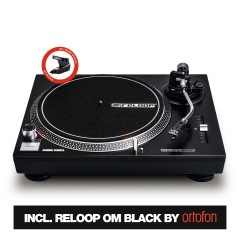
Quartz-driven DJ turntable with direct drive
Perfect for beginners
USB audio output for digitizing your records easily
Precise motor control with 2 speeds selectable (33 1/3 & 45 rpm)
Precision-engineered, die-cast aluminium platter with stable rotation
Statically balanced s-shaped tone arm with hydraulic lift and anti-skating - mechanism
Universal connection for pick-up systems (SME)
Extendible needle illumination
Built-in phono pre-amplifier (no grounding necessary)
Switchable phono and line level output
Shock-absorbing feet for vibration isolation
Sturdy, heavy construction with optimized damping features
Prepared for dust cover (available as optional accessory)
Incl. platter, OM Black pick-up system (by Ortofon), headshell, slipmat, counterweight, power cord, operating instruction manual
Technical Data
Turntable:
Type: direct drive turntable
Drive: quartz-driven direct drive
Motor: 8-pol., 2-phase, brushless DC motor
Turntable speeds: 2 speeds, manual (33 1/3, 45 RPM)
Starting torque: > 1kg/cm
Brake time: 50 dB (DIN-B)
Brake system: electronic brake
Platter:
Material: aluminium die-cast
Diameter: 332 mm
Tone arm:
Type: universal, statically balanced, s-shaped
Effective length: 230.5 mm
Overhang: 16 mm
Tracking angle error: < 3°
Applicable pick-up weight: 3.5 – 8.5 g (incl. headshell 13 – 18 g)
Anti-skating range: 0 - 7 g
Connections:
1x PHONO/LINE out (gold-plated)
General:
Power supply: AC 115/230 V, 60/50 Hz (US/EU)
Power consumption: 13 W
Dimensions: 450 (w) x 352 (d) x 144 (h) mm
Weight: appr. 6.76 kg
Поиск:anti system
Все
Far Out Radio Systems, the musical project by Thomas Neyens, is set to make waves with the release of his anticipated second album, "Mariana No Death." This transformative musical journey invites listeners to explore the depths of the Mariana Trench, where the protagonist seeks solace amidst the chaotic realities of our world. Drawing inspiration from the roots of early techno and lo-fi electronica, Thomas Neyens showcases a unique sound palette, embracing a DIY and raw production style. "Mariana No Death" is a testament to pure machine music that delivers a powerful message of honesty and a hopeful outlook for brighter days ahead.
Mint Condition - A record label focused on excavating the outer fringes of classic House and Techno. Unreleased mixes, classics, overlooked gems and never heard before material, mined from the last 30+ years of contemporary dance music are the order of the day. From Chicago, Detroit and New York to Manchester, London and beyond. Mint Condition have got their digging hats on to bring you exclusive heat and those rarer than rare jams that have been in your wants list for years. Dig in......
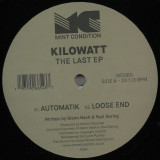
MC065 presents a highly anticipated reissue of Kilowatt's 'The Last EP' – a coveted 4-track compilation featuring a blend of technoid electro-funk and Detroit-inspired house grooves. Originally unleashed on Rob Gretton's legendary Manchester label 'Rob's Records', this EP seamlessly meshes with contemporary sounds and promises an immersive experience on a powerful sound system. Catering to aficionados of the more intricate and funk-infused facets of electronic music, Kilowatt unleashed this underground gem in 1995, earning it a well-deserved cult status among dedicated music explorers and DJs alike. Secure your copy of this exceptionally rare piece of UK musical brilliance now, courtesy of your friends at MC.
All tracks have been lovingly remastered by London's Curve Pusher from the original sources especially for Mint Condition. 100% legit, licensed and released. Dug, remastered, repackaged and brought to you by the caring folks at your favourite reissue label - Mint Condition.
Hospital Records proudly present the debut solo album from drum & bass icon Grafix. ‘Half Life’ is an introspective glimpse into the influences and sonic development of the Bristol-based producer, who over the years has established himself as a pinnacle of the dance music world. Grafix’s first ever studio longplayer as a solo artist consists of 14 hotly-anticipated pulse pounding anthems, featuring killer collaborations from the likes of Metrik, Lauren L’aimant, Reiki Ruawai and Chrissie Huntley in his hit singles ‘Somewhere’, ‘Feel Alive’ and ‘Skyline’.
High-octane dancefloor energiser ‘Skyline’ sees drum & bass titans Grafix and Metrik collide for a third time on this futuristic drum & bass cut infused with pure uplifting soundscapes. Enter a world of powerhouse synthesis, relentless basslines and Metrik’s very own vocal performance. This is just the follow up you needed from the mammoth success with the duo’s previous collaborations ‘Overdrive’ and ‘Parallel’.
Grafix draws upon his love for rave culture on the acid heavy ‘Blast Out’ - a no-holds-barred drum & bass system shocker. Skittery vocal chops, shredding bass hits and minimal-funk drums show the side of Grafix well known for tearing up the dance - never afraid to drop a wild card.
From the hypnotic and distorted energies on the likes of ‘CTRL’ and album title track ‘Half Life’, to the forward-facing vibes on LP numbers such as ‘Accelerate’ and ‘The Chance’, the versatile flavours supplied by Grafix throughout are a testament to his years of experience in the studio.
Other album highlights include two tracks with the immensely talented Lauren L’aimant who boasts previous releases on staple dance imprints including Anjunadeep, Colorize and Protocol Recordings. ‘Watch The Sky’ is an anthemic stepper home to Lauren’s spine-tingling vocals and Grafix’s catchy synth hooks. ‘Feel Alive’ captures the pair’s undeniable ability to strike up a euphorically cutting-edge dance music banger.
The ‘Half Life’ LP also features the previously released tracks ‘Radiance’ as well as radio hit ‘Somewhere’ featuring New Zealand’s very own Reiki Ruawai. Both tracks of which are no stranger to worldwide drum & bass listeners.
Grafix’s debut album marks a signature milestone within his musical journey as a solo artist and his achievements so far only scratch the surface. The first single ‘Somewhere (feat. Reiki Ruawai)’ to drop from his album racked up global airwave support with an impressive number of plays from radio tastemakers including Danny Howard, René LaVice, Mollie Collins, the George FM crew in New Zealand and of course, Fred V. With regular support from big hitters including Sub Focus, Wilkinson, Friction, Camo & Krooked and more, Grafix’s music continues to talk for itself when racking up countless DJ spins as well as consistent landings across pinnacle industry platforms such as UKF. Keep an eye out for Grafix at Snowbombing, Hospitality On The Beach Albania and more throughout 2022!
This music was composed for SKALAR, an audio-visual kinetic art installation by light artist Christopher Bauder & Kangding Ray SKALAR is a large-scale art installation that explores the complex impact of light and sound on human perception. Created by light artist Christopher Bauder and musician Kangding Ray, this monumental artwork is a reflection on the fundamental nature and essence of human emotions. By combining a vast array of kinetic mirrors and perfectly synchronized moving lights with a sophisticated multi-channel sound system, SKALAR offers an audio-visual narration of radiant light vector drawings and multi-dimensional sound in enormous pitch-dark spaces. SKALAR is an intense journey through the cycle of basic human emotions. Everchanging tonalities trigger the full spectrum of emotional experiences using light, sound, and motion. The feelings of awe, surprise, exhilaration, and anticipation of having one’s senses overwhelmed are created, explored, and repeated in cycles throughout the piece, providing a collective, yet highly individual emotional experience. Light and darkness as endless cycles of day and night define our perception of time and influence our emotions. SKALAR is a central piece within light artist Christopher Bauder’s body of work, reflecting his deep fascination with light. In this gigantic installation, light is treated as a solid material that can be dimensionally sculpted and shaped, evoking abstract emotional associations. Intertwined with the tireless exploration of textures, rhythm, and sound design by musician and composer Kangding Ray, the silence of darkness is filled with iridescent forms of spatial light and sound. The original composition is spatialised in 360° over a 12 channels sound system, this stereo version has been mixed and mastered to convey a similar sense of space. As of the release of this record, SKALAR has been presented in Berlin (Kraftwerk) in 2018, in Mexico City (Frontón) in 2019 & in Amsterdam (Gashouder) in 2020. Fore more information about the piece and its concept, please visit skalar.art
Discovered, curated and managed by Exos, Planet X is the latest discovery in our solar system. Little is known about this mystical planet other than that it radiates sound waves on the rougher side of the galactic spectrum. This first release comes from Exos himself where he fuses together old and new material with remixes from his astro pals, Ben Sims and Antigone. The release takes off with an old 90’s Exos track which is then warped and mixed by Ben Sims in his signature hardgroove style. Next in orbit is Bingo, a brand new track for interstellar clubbing that sounds like a country theme where Exos sampled a live guitar from his father’s rock band. The outcome is a dark and raw mixture of a 909 beat with a dark space cowboy riff from the blackest hole of our galaxy. The Antigone remix takes us near the event horizon where there is absolute chaos between dimensions.
The second release from Planet X will launch off next autumn with fellow space cadet Lafontaine on a 4 track storming missile and signs off with a nuclear remix by the one and only Matrixxman.
Start the countdown for our journey to the center of the galactic dancefloor!
Jel Ford returns to Drumcode after his highly anticipated remix of Alan Fitzpatrick's For An Endless Night.
Ford laces his three electrifying, new original tracks with a high energy that are guaranteed to get any dance floor rocking.
Heavily featuring on Adam Beyer's Drumcode radio both Red Mist and Overcast have gained heavy support from DJ's and fans alike. Ode To Basement' is an end of night smasher that will make everyone melt into the ground as it is caressed out of the sound system.
UILTY RAZORS, BONA FIDE PUNKS.
Writings on the topic that go off in all directions, mind-numbing lectures given by academics, and testimonies, most of them heavily doctored, from those who “lived through that era”: so many people today fantasize about the early days of punk in our country… This blessed moment when no one had yet thought of flaunting a ridiculous green mohawk, taking Sid Vicious as a hero, or – even worse – making the so-called alternative scene both festive and boorish. There was no such thing in 1976 or 1977, when it wasn’t easy to get hold of the first 45s by the Pistols or the Clash. Few people were aware of what was happening on the fringes of the fringes at the time. Malcolm McLaren was virtually unknown, and having short hair made you seem strange. Who knew then that rock music, which had taken a very bad turn since the early 1970s, would once again become an essential element of liberation? That, thanks to short and fast songs, it would once again rediscover that primitive, social side that was so hated by older generations? Who knew that, besides a few loners who read the music press (it was even better if they read it in English) and frequented the right record stores? Many of these formed bands, because it was impossible to do otherwise. We quickly went from listening to the Velvet Underground to trying to play the Stooges’ intros. It’s a somewhat collective story, even though there weren’t many people to start it.
The Guilty Razors were among those who took part in this initial upheaval in Paris. They were far from being the worst. They had something special and even released a single that was well above the national average. They also had enough songs to fill an album, the one you’re holding. In everyone’s opinion, they were definitely not among the punk impostors that followed in their wake. They were, at least, genuine and credible.
Guilty Razors, Parisian punk band (1975-1978). To understand something about their somewhat linear but very energetic sound, we might need to talk about the context in which it was born and, more broadly, recall the boredom (a theme that would become capital in punk songs) coupled with the desire to blow everything off, which were the basis for the formation of bands playing a rejuvenated rock music ; about the passion for a few records by the Kinks or the early Who, by the Stooges, by the Velvet mostly, which set you apart from the crowd.
And of course, we should remember this new wave, which was promoted by a few articles in the specialized press and some cutting-edge record stores, coming from New York or London, whose small but powerful influence could be felt in Paris and in a handful of isolated places in the provinces, lulled to sleep by so many appalling things, from Tangerine Dream to President Giscard d’Estaing...
In 1975-76, French music was, as almost always, in a sorry state ; it was still dominated by Johnny Hallyday and Sylvie Vartan. Local rock music was also rather bleak, apart from Bijou and Little Bob who tried to revive this small scene with poorly sound-engineered gigs played to almost no one.
In the working class suburbs at the time, it was mainly hard rock music played to 11 that helped people forget about their gruelling shifts at the factory. Here and there, on the outskirts of major cities, you still could find a few rockers with sideburns wearing black armbands since the death of Gene Vincent, but it wasn’t a proper mass movement, just a source of real danger to anyone they came across who wasn't like them. In August 1976, a festival unlike any other took place in Mont-de-Marsan – the First European Punk Festival as the poster said – with almost as many people on stage as in the audience. Yet, on that day, a quasi historical event happened, when, under the blazing afternoon sun, a band of unknowns called The Damned made an unprecedented noise in the arena, reminiscent of the chaotic Stooges in their early adolescence. They were the first genuine punk band to perform in our country: from then on, anything was possible, almost anything seemed permissible.
It makes sense that the four+1 members of Guilty Razors, who initially amplified acoustic guitars with crappy tape recorder microphones, would adopt punk music (pronounced paink in French) naturally and instinctively, since it combines liberating noise with speed of execution and – crucially – a very healthy sense of rebellion (the protesters of May 1968 proclaimed, and it was even a slogan, that they weren’t against old people, but against what had made them grow old. In the mid-1970s, it seemed normal and obvious that old people should now ALSO be targeted!!!).
At the time, the desire to fight back, and break down authority and apathy, was either red or black, often taking the form of leafleting, tumultuous general assemblies in the schoolyard, and massive or shabby demonstrations, most of the time overflowing with an exciting vitality that sometimes turned into fights with the riot police. Indeed, soon after the end of the Vietnam War and following Pinochet’s coup in Chile, all over France, Trotskyist and anarcho-libertarian fervour was firmly entrenched among parts of the educated youth population, who were equally rebellious and troublemakers whenever they had the chance. It should also be noted that when the single "Anarchy in the UK" was first heard, even though not many of us had access to it, both the title and its explosive sound immediately resonated with some of those troublemakers crying out for ANARCHY!!! Meanwhile, the left-wing majority still equated punks with reckless young neo-Nazis. Of course, the widely circulated photos in the mainstream press of Siouxsie Sioux with her swastikas didn’t necessarily help to win over the theorists of the Great Revolution. It took Joe Strummer to introduce The Clash as an anti-racist, anti-fascist and anti-ignorance band for the rejection of old-school revolutionaries to fade a little.
The Lycée Jean-Baptiste Say at Porte d’Auteuil, despite being located in the very posh and very exclusive 16th arrondissement of Paris, didn’t escape these "committed" upheavals, which doubled as the perfect outlet for the less timid members of this generation.
“Back then, politics were fun,” says Tristam Nada, who studied there and went on to become Guilty Razors’ frontman. “Jean-Baptiste was the leftist high-school in the neighbourhood. When the far right guys from the GUD came down there, the Communist League guys from elsewhere helped us fight them off.”
Anything that could challenge authority was fair game and of course, strikes for just about any reason would lead to increasingly frequent truancy (with a definitive farewell to education that would soon follow). Tristam Nada spent his 10th and 11th unfinished grades with José Perez, who had come from Spain, where his father, a janitor, had been sentenced to death by Franco. “José steered my tastes towards solid acts such as The Who. Like most teenagers, I had previously absorbed just about everything that came my way, from Yes to Led Zeppelin to Genesis. I was exploring… And then one day, he told me that he and his brother Carlos wanted to start a rock band.” The Perez brothers already played guitar. “Of course, they were Spanish!”, jokes their singer. “Then, somewhat reluctantly, José took up the bass and we were soon joined by Jano – who called himself Jano Homicid – who took up the rhythm guitar.” Several drummers would later join this core of not easily intimidated young guys who didn’t let adversity get the better of them.
The first rehearsals of the newly named Guilty Razors took place in the bedroom of a Perez aunt. There, the three rookies tried to cover a few standards, songs that often were an integral part of their lives. During a first, short gig, in front of a bewildered audience of tough old-school rockers, they launched into a clunky version of the Velvet Underground's “Heroin”. Challenge or recklessness? A bit of both, probably… And then, step by step, their limited repertoire expanded as they decided to write their own songs, sung in a not always very accurate or academic English, but who cared about proper grammar or the right vocabulary, since what truly mattered was to make the words sound as good as possible while playing very, very fast music? And spitting out those words in a language that left no doubt as to what it conveyed mattered as well.
Trying their hand a the kind of rock music disliked by most of the neighbourhood, making noise, being fiercely provocative: they still belonged to a tiny clique who, at this very moment, had chosen to impose this difference. And there were very few places in France or elsewhere, where one could witness the first stirrings of something that wasn’t a trend yet, let alone a movement.
In the provinces, in late 1976 or early 1977, there couldn’t be more than thirty record stores that were a bit more discerning than average, where you could hear this new kind of short-haired rock music called “punk”. The old clientele, who previously had no problem coming in to buy the latest McCartney or Aerosmith LP, now felt a little less comfortable there…
In Paris, these enlightened places were quite rare and often located nex to what would become the Forum des Halles, a big shopping mall. Between three aging sex workers, a couple of second-hand clothes shops, sellers of hippie paraphernalia and small fashion designers, the good word was loudly spread in two pioneering places – propagators of what was still only a new underground movement. Historically, the first one was the Open Market, a kind of poorly, but tastefully stocked cave. Speakers blasted out the sound of sixties garage bands from the Nuggets compilation (a crucial reference for José Perez) or the badly dressed English kids of Eddie and the Hot Rods. This black-painted den was opened a few years earlier by Marc Zermati, a character who wasn’t always in a sunny disposition, but always quite radical in his (good) choices and his opinions. He founded the independent label Skydog and was one of the promoters of the Mont-de-Marsan punk festivals. Not far from there was Harry Cover, another store more in tune with the new New York scene, which was amply covered in the house fanzine, Rock News (even though it was in it that the photos of the Sex Pistols were first published in France).
It was a favorite hang-out of the Perez brothers and Tristam Nada, as the latter explained. “It’s at Harry Cover’s that we first heard the Pistols and Clash’s 45s, and after that, we decided to start writing our first songs. If they could do it, so could we!”
The sonic shocks that were “Anarchy in the UK”, “White Riot” or the Buzzcocks’s EP, “Spiral Scratch” – which Guilty Razors' sound is reminiscent of – were soon to be amplified by an unparalleled visual shock. In April 1977, right after the release of their first LP, The Clash performed at the Palais des Glaces in Paris, during a punk night organised by Marc Zermati. For many who were there, it was the gig of a lifetime…
Of course, Guilty Razors and Tristam were in the audience: “That concert was fabulous… We Parisian punks were almost all dressed in black and white, with white shirts, skinny leather ties, bikers jackets or light jackets, etc. The Clash, on the other hand, wore colourful clothes. Well, the next day, at the Gibus, you’d spot everyone who had been at this concert, but they weren’t wearing anything black, they were all wearing colours.”
It makes sense to mention the Gibus club, as Guilty Razors often played there (sometimes in front of a hostile audience). It was also the only place in Paris that regularly scheduled new Parisian or Anglo-Saxon acts, such as Generation X, Siouxsie and the Banshees, the Slits, and Johnny Thunders who would become a kind of messed-up mascot for the venue. A little later, in 1978, the Rose Bonbon – formerly the Nashville – also attracted nightly owls in search of electric thrills… In 1977, the iconic but not necessarily excellent Asphalt Jungle often played at the Gibus, sometimes sharing the bill with Metal Urbain, the only band whose aura would later transcend the French borders (“I saw them as the French Sex Pistols,” said Geoff Travis, head of their British label Rough Trade). Already established in this small scene, Metal Urbain helped the young and restless Guilty Razors who had just arrived. Guitarist for Metal Urbain Hermann Schwartz remembers it: “They were younger than us, we were a bit like their mentors even if it’s too strong a word… At least they were credible. We thought they were good, and they had good songs which reminded of the Buzzcocks that I liked a lot. But at some point, they started hanging out with the Hells Angels. That’s when we stopped following them.”
The break-up was mutual, since, Guilty Razors, for their part, were shocked when they saw a fringe element of the audience at Metal Urbain concerts who repeatedly shouted “Sieg Heil” and gave Nazi salutes. These provocations, even still minor (the bulk of the skinhead crowd would later make their presence felt during concerts), weren’t really to the liking of the Perez brothers, whose anti-fascist convictions were firmly rooted. Some things are non-negotiable.
A few months earlier (in July 1978), Guilty Razors had nevertheless opened very successfully for Metal Urbain at the Bus Palladium, a more traditonally old-school rock night-club. But, as was sometimes the case back then, the night turned into a mass brawl when suburban rockers came to “beat up punks”.
Back then, Parisian nights weren’t always sweet and serene.
So, after opening as best as they could for The Jam (their sound having been ruined by the PA system), our local heroes were – once again – met outside by a horde of greasers out to get them. “Thankfully,” says Tristam, “we were with our roadies, motorless bikers who acted as a protective barrier. We were chased in the neighbouring streets and the whole thing ended in front of a bar, with the owner coming out with a rifle…”
Although Tristam and the Perez brothers narrowly escaped various, potentially bloody, incidents, they weren’t completely innocent of wrongdoing either. They still find amusing their mugging of two strangers in the street for example (“We were broke and we simply wanted to buy tickets for the Heartbreakers concert that night,” says Tristam). It so happened that their victims were two key figures in the rock business at the time: radio presenter Alain Manneval and music publisher Philippe Constantin. They filed a complaint and sought monetary compensation, but somehow the band’s manager, the skilful but very controversial Alexis, managed to get the complaint withdrawn and Guilty Razors ended up signing with Constantin with a substantial advance.
They also signed with Polydor and the label released in 1978 their only three-track 45, featuring “I Don't Wanna be A Rich”, “Hurts and Noises” and “Provocate” (songs that exuded perpetual rebellion and an unquenchable desire for “class” confrontation). It was a very good record, but due to a lack of promotion (radio stations didn’t play French artists singing in English), it didn’t sell very well. Only 800 copies were allegedly sold and the rest of the stock was pulped… Initially, the three tracks were to be included on a LP that never came to be, since they were dropped by Polydor (“Let’s say we sometimes caused a ruckus in their offices!” laughs Tristam.) In order to perfect the long-awaited LP, the band recorded demos of other tracks. There was a cover of Pink Floyd's “Lucifer Sam” from the Syd Barrett era – proof of an enduring love for the sixties’ greats –, “Wake Up” a hangover tale and “Bad Heart” about the Baader-Meinhof gang, whose actions had a profound impact on the era and on a generation seeking extreme dissent... On the album you’re now discovering, you can also hear five previously unreleased tracks recorded a bit later during an extended and freezing stay in Madrid, in a makeshift studio with the invaluable help of a drummer also acting as sound engineer. He was both an enthusiastic old hippie and a proper whizz at sound engineering. Here too, certain influences from the fifties and sixties (Link Wray, the Troggs) are more than obvious in the band’s music.
Shortly after a final stormy and rather barbaric (on the audience’s side) “Punk night” at the Olympia in June 1978, Tristam left the band ; his bandmates continued without him for a short while.
But like most pioneering punk bands of the era, Guilty Razors eventually split up for good after three years (besides once in Spain, they’d only played in Paris). The reason for ceasing business activities were more or less the same for everyone: there were no venues outside one’s small circuit to play this kind of rock music, which was still frightening, unknown, or of little interest to most people. The chances of recording an LP were virtually null, since major labels were only signing unoriginal but reassuring sub-Téléphone clones, and the smaller ones were only interested in progressive rock or French chanson for youth clubs. And what about self-production? No one in our small safety-pinned world had thought about it yet. There wasn’t enough money to embark on that sort of venture anyway.
So yes, the early days of punk in France were truly No Future!
Meticulously assembled from a good 15 years' worth of source material, Cong Burn boss John Howes' second Paperclip Minimiser transmission proliferates its predecessor's network of turn-of-the-millennium aesthetics and concepts, bringing us closer to the lost future promised by the mid-digital age. If the debut album rooted itself in 2006, using an era-specific rig to activate its vintage Winamp-ready sound, 'II' pushes the clock forward just a little, recycling an unreleased album that Howes engineered in various locations across the north of England, starting way back in 2011. Working quickly and methodically with his homebrewed "DIY DAW" system, Howes improvised live using the record's bank of sounds, transforming the skittering bio-electronic rhythms, bitcrushed modem whines and inclement Lancs soundscapes into a suite of sleek, bass heavy steppers.
Howes has refined his setup and process over the years to function as an antithesis of contemporary production logic, a system that he can use easily to retreat from the excessive layering, overdubbing and editing that plagues modern electronic music. With only limited separate channels in each track, 'II' sounds both archaic and strangely novel. Showing respect to the early days of techno, when stone-cold classics were jammed out live using just a drum machine, a sampler and a couple of synths, Howes simultaneously acknowledges the promise of the transition to a digital future, as nascent algorithmic technology began to rehydrate stale rhythmic and melodic patterns. Fabricating its wrinkled cyberpunk landscape from shovelware blips and whines, spacious environmental echoes and lustrous, plasticky FM hits, 'II' is dense but never congested. It's a reminder that bass music thrives when it's given the room it needs to breathe.
Two years after their debut on Berlin-based Mannequin Records, Parisian duo Leroy Se Meurt returns with their second full-length album, Hier Pour Toujours. Far from any sense of nostalgia, this record offers no illusion of hope—history repeats itself, the future looks bleak, and their brand of electronic punk is the perfect soundtrack to it all.Drum machines dictate the pace while synths saturate the space, looping sequences grind relentlessly, and vocals lead this machine orchestra straight into the heart of the chaos. Drawing from their roots, Leroy Se Meurt pushes their fierce electronics further than ever—experimenting with bold slogans, spoken passages, and powerful sing-along choruses.The album opens with Pas Ma Croix, a commanding anthem built for the stage. It flows into Du Plafond à La Terre, driven by a monstrous electro beat and bassline, flirting with emotional vulnerability in its chorus before exploding into a synth solo. Alevlere Karşı once again taps into the duo’s EBM-meets-Turkish vocals signature style, hitting the mark with dancefloor precision.The title track, Hier Pour Toujours, closes side A with a more intimate, drumless moment—solemn but no less intense.That brief calm is shattered by Déviance, marking the return of guitars and an eruptive chorus brimming with raw energy. From there, the album launches into the furious Révolte Ardente, with its syncopated rhythm and vocals drenched in distortion, and continues with Pro Déclin, a stripped-down rhythmic skeleton carrying anti-growth mantras straight to the point. In a world clouded by confusion, the most direct messages often land the hardest.For a change of scenery, Fütürsüz dives into John Carpenter-esque territory—no drums, eerie night-streaked synths, and, for the first time in the band’s history, nearly clean vocals.Closing the record, Encore crawls at a BPM so slow it’s nearly in reverse. But what it lacks in speed, it makes up for in weight—a crushing incantation capable of toppling sound systems.With Hier Pour Toujours, Leroy Se Meurt isn’t offering optimism, but rather persistence. Nothing is settled yet—and perhaps, just perhaps—there’s still light at the end of the tunnel.
Limited to 250 copies !
The Deadheads had never had much luck with spaceships. Their first mission had ended in a catastrophic engine failure, leaving them adrift in deep space for weeks. This time, their craft was hardly more reassuring. A hodgepodge of outdated technology and shoddy repairs made it more of a floating death trap than a reliable cruiser. As they began their descent toward the strange planet, the hull creaked and rattled, sending a wave of dread through the crew.
"Hold on," Matt's voice crackled over the intercom, without much conviction, as if he himself doubted they would make it out alive. Outside, a thick, grayish atmosphere swirled ominously, while the planet's gravity became far stronger than anticipated.
“Fuck, we’re gonna burn at the entrance!” M yelled, his hands flailing on the console as sparks flew from the control panel. The ship’s sensors were completely jammed, and the navigation system flickered intermittently, like a dying light. Below, the planet’s surface was a tangle of lava rivers and jagged rock formations, the kind of place no sane person would ever land. But the Deadheads had never pretended to be. They lived in a state of constant emergency.
As the descent intensified, the alarms blared. On the bridge, the screens lit up with red warnings and flashing messages: "SYSTEM ERROR," "UNSTABLE TRAJECTORY," "SUIVITY SYSTEM COMPROMISED." The lines of code scrolled by too quickly to be read, while a mechanical voice repeated relentlessly: "Imminent impact. Structural integrity at twenty percent."
The once pristine shell of the vessel began to disintegrate, with shards of metal breaking away and disappearing into the atmosphere.
With a final, piercing screech, the ship crashed onto the planet's surface, sending up a cloud of dust and debris. The crew was violently thrown from their seats, stunned but barely alive. They struggled to their feet amidst the wreckage, the ship reduced to a charred shell around them.
"Well," M said, wiping the dirt off his suit with a grimace, "at least the air is breathable." Matt scanned the hostile expanse stretching before them and smiled slightly. "Perfect. Let's hope we have better luck with the planet than with our ships."
With that, the Deadheads gathered their equipment and headed into the unknown, while the remains of their ship slowly sank into the unstable soil of the planet.
Splattered LTD EDITION
Trackwahser side bring a crazy romance, mystic call for a tribal dancefloor banger ! Legend !
Second tune, in collab with Boubou, member of Antinorm-17 Sound System back in the years... The oldschool Acid excitation supported by a thick Hard Techno kick. Put some electricity in the air, be Deter-Mina !
With Roland K side you will get 2 Hardtek missiles !
The first track delivers a high-energy, fast-paced, and punchy vibe, perfect for rocking the dancefloor.
The second, a collab with Darth Leng, takes the energy even further with an explosive mix of styles and unrelenting power.
Tracks designed to get parties rocking and boost good vibes to the max!
Trackwahser side bring a crazy romance, mystic call for a tribal dancefloor banger ! Legend !
Second tune, in collab with Boubou, member of Antinorm-17 Sound System back in the years... The oldschool Acid excitation supported by a thick Hard Techno kick. Put some electricity in the air, be Deter-Mina !
With Roland K side you will get 2 Hardtek missiles !
The first track delivers a high-energy, fast-paced, and punchy vibe, perfect for rocking the dancefloor.
The second, a collab with Darth Leng, takes the energy even further with an explosive mix of styles and unrelenting power.
Tracks designed to get parties rocking and boost good vibes to the max!
Fobos Hailey is the sound of a new era. Reminiscent of the anti-authoritarian, boundless soundscapes of the early '90s, his music carries an infectious, ethereal flair of self-determination. Bulletproof oozes liquid confidence and swagger — it's the kind of sound that lights a fire in your belly. Throw it on your sound system, and you'll be dodging bullshit like Neo dodges bullets in The Matrix. Fobos Hailey elegantly showcases the breadth of his production — from heavy-hitting bangers to self-reflective, contemplative jams. Get ready to be dosed with some of the freshest sounds of 2025. This masterful LP reimagines the rave sound we love from the past and pushes it into a future-facing, modern form.
- A1: Rlgn & Sasha Kustov - Pillars
- A2: Iskrit - Moskva
- A3: Turbosh - French Trax 7000
- A4: Magnum Opus - Li (Prod By Nacaratt)
- B1: Лучший Друг - God Of Sexual Desire
- B2: Dj Yesyes - Run
- B3: Boris Redwall - Project 2000
- C1: Lipelis - Double Mcgem Deluxe
- C2: Maksimovna - Dobryi Trek
- C3: Kito Jempere - Karagod
- D1: Dominique Mara - Pepupape
- D2: Qarti - Pure
- D3: Mo?Se? - Alaska
Part 2[18,95 €]
As a label, we are specialists in musical diversity. With our newest installment of the annual System 108 compilation we present you two parts of hand picked creative output by our friends, residents and dearest guests. Curated by the artist Ira Bespalova, the concept of both parts is simple and deep: the good, the calm, the kind is part 1 and all anti-heroes, filthy electro-armored jams is part 2. All together - another twist of the planet, another beat of our big heart, that became shelter and home home for a whole new tribe. It pumps, it creates, unites and warms up, kicks it real hard, no matter how tough it is. Part 1 is densely populated by our new kids on the block! Isktrit, TURBOSH, BORIS REDWALL, DJ Yesyes, Dominique Mara have been releasing singles, EP's and album during 2023 and became an integral part of the collective. Here you will also find good old friends Maksimovna, Lipelis, Kito Jempere. Very special Siberian inspired trippy workout by RLGN and Sasha Kustov, Luchshiy Drug. And a super special guest appearance starring Magnus Opus and mo?se?. The running order is curated as a narrative, as an album that takes you on a journey. But separately, it all works as singles, DJ tracks and tools. Welcome to Nine Years Of Love!
- End Result
- I Ain't Thick, It's Just A Trick
- Systematic Death
- The Gasman Cometh
- Banned From The Roxy
- Where Next Colombus?
- Do They Owe Us A Living?
- Securicor
- Demo(N)Crats
- Big A, Little A
- Punk Is Dead
- Walls (Fun In The Oven)
Blang Records are thrilled to announce another two vinyl album re-releases from Jeffrey Lewis's back catalogue: The debut classic The Last Time I Did Acid I Went Insane (originally Rough Trade 2001) and The critically acclaimed 4th album 12 Crass Songs (originally Rough Trade 2007). 12 Crass Songs (VV004LP): Astonishingly transformed covers of songs originally written by the band Crass in 1978-1984, this 2007 LP is the most rare and sought-after vinyl in Jeffrey's catalogue and is also now completely out of stock. "Weird? Very_ _ but it's also downright inspiring" (4 of 5 stars) - Rolling Stone. "The record presents Crass's lyrics calmly, often demonstrating how sane and practical they are; it proves once again, and kind of thrillingly this time, that no music is immune to interpretation" - The New York Times. "Folk maverick raids anarchist commune and finds catchy tunes_ Works wonderfully" - Spin "Jeffrey Lewis' talents appear without end_ (on 12 Crass Songs he) magically makes the anarcho-rockers' anti-establishment savagery his own, by wrapping their barbed sentiments in his trademark mottled tea-towel warmth" - NME. "12 Crass Songs succeeds utterly_ eerily beautiful and strangely affecting" - Plan B Magazine "He's taken hold of any number of my old stormy favourites and breathed fresh life and fire into them. . . Man, I'm in awe of Jeffrey right now. Who'd have thought he could have done that?" - Everett True/ Village Voice "Quite brilliant" - (4 of 5 stars) MOJO. "It's no mean feat to transform such abrasive harangues into lush, tuneful folk_ without defusing their righteous anger_ but Crass's intelligent and indignant screeds could not hope for a more sympathetic translator." (4 of 5 stars) - THE GUARDIAN. Blang Records and Jeffrey Lewis have history: before Blang was a label, it started life as a live night at the 12 Bar Club in Denmark Street, hosting many a set of the NY Antifolk artists over on UK shores, including Jeffrey Lewis. Now 20+ years since Jeffrey first played Blang. Native New Yorker Jeffrey Lewis is a comic book writer/artist and a musician. A cult hero birthed from the now infamous antifolk movement that sprung up on Manhattan's Lower East Side in the 90s, Jeffrey has released dozens of albums showcasing his unique blend of bleakly witty observations, scratchy, lo-fi punk and croaky folk/anti-folk, all firmly rooted in a strong DIY sensibility. Jeffrey and his band have toured the world multiple times over, released albums on Rough Trade, Moshi Moshi and Don GIovanni Records, and have been featured by NPR, The History Channel, The NY Times and more.
- Combination #1 ( • | 6 | 4 | 3 | 2 | 6 )
- Combination #2 ( 4 | 2 | 1 | 4 | • | 1 )
- Combination #3 ( 7 | 7 | 2 | 1 | 6 | 1 )
- Combination #4 ( 7 & 3 | 3 | 7 | 6 & 2 | 1 | 2 & 6 )
- Combination #5 ( • | 6 | 6 | 3 | 4 | 7 )
- Combination #6 ( 5 | 3 & 7 | • | 5 | 3 | 3 )
- Combination #7 ( • | 6 | • | 2 | 4 | 5 )
- Combination #8 ( 1 | 5 | 3 | • | 7 | • )
- Combination #9 ( 6 | 7 & 4 | 6 | 2 | 5 | 4 & 7 )
- Combination #10 ( 2 | 1 & 3 | 4 & 5 | 7 | 4 | 4 )
frozen reeds presents Mark Fell’s ‘Psychic Resynthesis’, an instrumental work performed by Explore Ensemble. This double LP is the label’s 8th release, arriving 13 years after its foundation.
Fell is a multidisciplinary artist, composer, and theorist based in Rotherham, UK. Renowned for his rigorous and conceptual approach to electronic music and sound art, his work explores the limits of structure, rhythm, and perception through a blend of computational systems, philosophical inquiry, and cultural critique.
Over the last decade, Fell’s practice has visibly shifted from a world of technical intricacy and myopic microdetail to one of collaboration and community. He has purposefully sought out diverse musical partners from a wide variety of traditions and disciplines and found equally diverse ways to work and create together – not to integrate their playing into a musical fusion, but rather to discover how such combinations of approaches and experience can stimulate unique and heretofore unheard results.
The music here emerges from a commission for contemporary chamber group Explore Ensemble, situating Fell’s work in a new context entirely. Having been a notable critic of classical music’s slavish adherence to traditional musical notation, “the score”, and its associated issues of control and hierarchy, one might expect a provocative or abrasive approach. Instead, a work of deep, tonal introspection unfolds - an elegant structure navigating the artist’s antipathy for linear or timeline-based musical approaches.
In Fell’s selection of timbres and events, the dynamic of composer and performer is interrupted by his twin adoption of system and flexibility. Mathematical determination and sonic fixation vie for dominance. The conflict governing combinations. Upsetting preconceived strategies.
Published in an edition of 777 double LPs, with included digital download, the result, ‘Psychic Resynthesis’, represents both a prismatic object for repeated examination and an abstruse table of musical correspondences.
Originally conceived as a compilation of outtakes and live recordings from The Shadow Ring's 1995 stateside tour, Wax-Work Echoes takes its name from the first line of "Put the Music in Its Coffin," the title track of the group's breakthrough release. Lambkin abandons the bitsand- bobs approach, advancing the Shadow Ring concept with entirely original material that builds on the unit's self-mythologizing lyrics, celebrates the clicking of horse hooves, ponders on the sociability of rats and mice, and warns of the dangers of poultry. The first Shadow Ring album to officially include Tim Goss in the main lineup, Wax- Work Echoes reveals the group in its final and lasting form, awash in the outer bounds of atmospheric exploration, with Lambkin's familiar wry and morbid lyricism and the stripped-down angularity of amateurishly detuned guitars fully intact. While Klaus Canterbury and Tony Clark seem all but forgotten, and the shrugged off S. Fritz is listed on the liner notes as performing only "when required," Lambkin did solicit contributions from outside the inner circle. A bit of "Mambo Twist," lifted from a tape of unreleased Vitamin B12 material sent to Lambkin by Alasdair Willis, found its way into "V.E.R.M.I.N.," while an extended epistle contribution from Richard Youngs (and, technically, Brian Lavelle) would be employed in the second half of "Catching Sight/Of Passing Things." Released on CD in 1996 for Bruce Russell's newly minted Corpus Hermeticum, Wax-Work Echoes was recorded concurrently with intense rehearsal periods, in anticipation of the forthcoming "Rose Watson Tour," and was supported by a celebratory fanzine media blitz. The album seemingly absorbs the frenetic excess of the band's transatlantic travels; Wax-Work Echoes channels the trio's wilder instincts into an unresolved catharsis, not yet free of frustration or restlessness. Out of print for almost three decades and available here for the first time ever on long-playing disc, Wax-Work Echoes is a classic from the outer eddies of The Shadow Ring's sound, a must-have for any aficionado's collection: "A window slides, glass slips from frame / And canvas carcass breathes again." Throughout their legendary, decade-long run, the Shadow Ring were an enigmatic force on the international musical sub-underground. Before their disbandment in 2002, this shambolic rock outfit, formed by a group of rowdy teenagers in southeast England, left behind a mighty run of eight LPs, a handful of 7"s, and a spate of raucous live shows and cryptic zine appearances on both sides of the Atlantic, all which have bolstered their enduring word-of-mouth mystique. Beginning in 2023 with the first-ever vinyl pressing of the self-released pre-Shadow Ring tape The Cat & Bells Club (1992), Blank Forms Editions has been conducting a systematic retrospective of the storied group. Wax-Work Echoes and Hold Onto I.D. are the latest releases in a multiyear reissue effort that includes several LPs, a comprehensive CD box set, and a nearly five-hundred-page book.
Scowl is a band that sounds exactly like their name implies. Venomous, fierce, antagonistic. A sneer not to be crossed. Over the last five years, the Santa Cruz, California, band has firmly planted their flag in the hardcore scene with their vicious sound and ripping live show, sharing stages around the world with Circle Jerks, Touché Amoré, and Limp Bizkit, and filling slots at prominent festivals like Coachella, Sick New World, and Reading and Leeds. But with their new album, Are We All Angels (Dead Oceans), Scowl is aiming to funnel all that aggression through a more expansive version of themselves.Much of Are We All Angels grapples with Scowl's newfound place in the hardcore scene, a community which has both embraced the band and made them something of a lightning rod over the past few years. Standout single "Not Hell, Not Heaven" outright rejects the narratives cast onto them by outsiders. "It's about feeling victimized and being a victim, but not wanting to identify with being a victim," explains vocalist Kat Moss. "It's trying to find grace in the fact that I have my power. I live in my reality. You have to deal with whatever you're dealing with, and it ain't working for me." The band breaks from a sense of disassociation to seek deeper connections on "Fantasy." "It's incredibly challenging to try to balance my love for the scene while also feeling, in some spaces, extremely alienated and hated," Moss says. "`Fantasy' is about feeling like I don't know how to connect with these people anymore, because I have shelled myself away so hard." The album ends in a philosophical place on the closing, titular track, "Are We All Angels," asking questions like, "Is this all there is?" and ultimately putting it on the listener to decide. "It's about the personal struggle between good and evil. It doesn't matter how `good' or `bad' you are, there are systems that will try to rewrite your narrative no matter what you actually do," explains Moss, noting that punctuation on "Are We All Angels" has been deliberately omitted in an attempt to leave the statement open-ended. Are We All Angels is the highly anticipated follow-up to Scowl's debut, 2021's How Flowers Grow, a 16-minute primal scream over punishing riffs. But amidst the pounding chaos, it was the record's sonic outlier, a cleaner interlude called "Seeds to Sow," that, true to its name, planted the seed for what was to come for the band. "It kind of laid out this destiny for us, and I feel like now we're fulfilling that," says drummer Cole Gilbert. The band continued to expand their sound on 2023's widely acclaimed Psychic Dance Routine EP, incorporating more pop hooks and favoring gentler singing over heavy screaming, paving the way for what would come next.Scowl's growth got a huge boost from producer Will Yip (Turnstile, Title Fight, Code Orange, Balance and Composure), who broadened the band's scope. "Will would say, `Everything you have here is correct, but it's in the wrong place,'" says Gilbert. Moss adds: "Will really helped restructure a lot of the material. Some songs he tore apart to make more space for the really good hooks and choruses." But even through this more eclectic approach, Scowl loses none of their edge, and still manages to convey the anger and frustration that lies underneath. They are deeply committed to carrying the ethos of punk and its sense of community. "Hardcore and punk have sculpted how we operate, what we want to do as a band, and how we participate," says guitarist Malachi Greene. "At our core, we are a punk and a hardcore band, regardless of how the song shifts and changes."