Placid aka Paul Wise is the operator in chief at ‘We’re Going Deep’ – an online community and record label born out of a lifelong love affair with the many shades of electronic rhythm, and an obsession for collecting records since 1988. With a mission to share and release new music via his We’re Going Deep and We’re Going Back imprints, you’ll find only the best in underground Acid, Electro, IDM, Techno and House for the dance floor and your listening pleasure.
Up next in the label series, We’re Going Deep is excited to welcome 4 tracks of fresh material from pivotal electronic music maker Gerard Hanson, under his much prized E.R.P. alias. Renown for keeping his profile below the radar and letting the machines do all the talking for him. Hanson’s work as a producer has been much coveted since his debut back in the mid 90s as Convextion. Hailing from Dallas, Texas, he has become something of a hero in the underground Electro community. His work as E.R.P. has left a huge impression on labels such as Frustrated Funk, Bleep43 and Semantica over the years. Renown for his distinctive shimmering machine funk aesthetic, he ably summons the outer reaches of deep space listening thanks to his innate mastery of brooding, sci-fi soundscapes that few can equal.
Following releases for Apnea and Synchrophone, Hanson lifts off with a heartfelt tribute to our recently departed friend James Baker on ‘One4ReKab’. Ascending with the pulse of a steady kick drum, precision snares take hold as whispered vocals seep in and out of consciousness. Underpinned by trademark angular bass tones, soaring strings inject a deep sense of foreboding as all the parts fuse with a fierce glow. Stepping things a notch back as the sonic trajectory levels out, ‘Onward’ takes a more contemplative stance in a fusion of hypnotic drum programming that leads the fray whilst subtle arpeggios flow, all whilst wistful melodies wind you in.
Over on the flipside, Hanson revisits his 2008 composition “Multipole Vector” to launch yet another interstellar cruise by mission in the shape of “Multipole Vector II”. Leading with the simplest of bass progressions and metronomic beat programming, twinkling synth elements reach across the void as chords sweep to and fro to powerful effect. Ending out on the uplifting yet almost IDM inflected tones of “Self Unemployed”, this low tempo air rounds the EP off on an equally captivating note filled with playful charm, that makes this collection of music all the more pleasing.
Suche:ar at
- A1: Pt 1
- B1: Pt 2
Atef Swaitat (yarghul) and Abu Ali (lead vocals) are popular Bedouin wedding musicians continuing a long family tradition in Jenin and the north of historic Palestine. The album is comprised of immersive field recordings from weddings across the Galilee in the 1970s.
Copyright of Majazz Project / Palestinian Sound Archive
Created by Mo’min Swaitat
***
Over several years, Mo’min Swaitat has amassed an archive of rare tapes and vinyl from Palestine and beyond, spanning field recordings of weddings to revolutionary tracks and synth-heavy 80s funk. Many of these were acquired from a former record label in Jenin in the north of the West Bank. The Majazz Project is a research project borne out of the archive, focused around sampling, remixing and reissuing vintage Palestinian cassettes. It is a collaboration between Arab and non-Arab DJs, producers and artists interested in shedding new light on the richness and diversity of Palestinian musical heritage.
A mutant beat manifesto from Miami luminaries Jonathan Trujillo (Jonny from Space) and Pablo Arrangoiz (El Gusano, DJ Fitness, Baüzer Vep), Crespi Drum Syndicate’s Colada Talk follows the duo’s debut on Sonido Isla with a freshly freaked collection of percussive oddities. Rooted in foundational clave rhythms and avant-garde experimentation, Crespi Drum Syndicate emerges from the amphibious underbelly of Miami’s Latin-infused club scene with their singular electro-acoustic vision.
Extensive live recording sessions, free improvisation, and a ritualistic studio practice
— countless hours spent twisting and rearranging sounds from found objects and Buchla modular systems — coalesce into new rhythmic forms. Atonal saxophone, bass clarinet, and slide whistle further expand upon Trujillo and Arrangoiz’s ever-evolving sonic palette, while NYC’s AceMo lends a hand on the heavily syncopated “Siu,” and closer “Boubow” might be the duo’s most hook-driven production to date with its mangled pop vocal and lewd drum-line bounce.
Landing somewhere between Steve Reich’s polyrhythmic “Six Marimbas,” Moebius & Plank’s industrial Krautrock sessions, and Ricardo Villalobos’ hypnotic techno minimalism, Colada Talk delivers on a world of subtropical rhythmic futurism and experimental body music that’s as heady as it is culo-shaking.
French modular tribalist Sindh launches the Komudo Origins Series on his own label with a fierce first chapter built for deep physical immersion. Still rooted in rythmic ritualism, these four tracks push further into shadowy, shape-shifting techno. 'Sauros' is the beatless opener, all hovering, menacing atmospheres and sonically refracted voices. 'Arbhar' glides along with a sleek, understated techno framework that feels like it's made of pure air. 'Mystic Sun' begins to edge towards the pumping, firing echoes and low level spoken words across a progressive-style builder, before 'Denali' closes things off via thumping, late-night techno charge. Subtle darkness, alien textures and body-focused grooves define this potent new series.
Cataleya Music follow up their debut from Vick Lavender with Let Me Show You from Zephan aka Cool Affair. The Johannesburg based producer has been making music since 2006. The Prince of Broken Beats has a Jazz background, evident in his music released as Cool Affair and Zephan. Let Me Show You has a magical melody, icy chords and textured percussion. Cool Affair's vocals add an extra dimension. Alongside the original, we get a 'Galactic Soul Remix' from the legendary DJ Spinna. The Brooklyn born producer needs little introduction, at home with Hip Hop, House and everything in between. On this remix, Spinna opts for swaying synths and flips the keys. This remix complements Zephan's original perfectly. After only two releases, Sweden's Cataleya Music show they are an imprint to watch.
- 2: Against Death
- Smashed
- Can't Touch
- Sit
- Lucky
- Safe
- Son Of
- Destiny
- Billions
- Death Of Music
- No Mail
- I.d.o.l
- Yo
- Bawk
- Crack
- Headless
- In So Many
- Ajukaja Me
“Certain albums hit like howling bullets at pivotal moments, tearing open the face of music to reveal hidden sonic muscles and fusing them back into something both strangely familiar and yet entirely unrecognisable. We believe this is one of those records.”
The double album Death of Music delivers 18 crooked vocal pops, some ruthless, others unexpectedly disarming. In some songs, Ajukaja & Mart Avi function like a two-headed saurus swinging its spiky tail to shady pop-house smackers. In others, Ajukaja's serene organ licks descend into subterranean caverns, allowing Avi to float to the surface on their wavelengths and turn his voice into billions of extinct moths, enslaved by the moonlight’s pull. There are songs that face destruction and those that seek to prevent it.
One kykeon rap goes, “If you die before you die, then when you die, you don't die!”. Ajukaja & Mart Avi have embraced this notion to create new music that allows them to thrive in the algorithmic wasteland. 13 years in the making, these 66 minutes are packed with lifetimes of truths you didn’t know you needed to know. They are Ajukaja & Mart Avi – two against death.
Produced by Ajukaja
Words by Mart Avi, Music by Raul Saaremets
Guitar and Bass by Sten Sheripov (Can’t Touch The Earth, Safe)
Sax by Steve Vanoni (I.D.O.L.)
Recorded between 2011—2024
Mastered by The Bastard
Cover Photo by fs
Sleeve by Marke, Mart Avi
Pressed in Tartu, Estonia
- Side A. Gypsy Song
- Side B. Never Land
After traveling through Mexico, Miami, the Bahamas, and New Orleans, Nishioka recorded his fourth album South American Journey in Los Angeles,
released in 1979. From this album, two of his most celebrated tracks—“GYPSY SONG”, a fan favorite with numerous cover versions, and “NEVER LAND”,
featuring the distinctive sound of steel pans and a Japanese reggae vibe are now being pressed on 7-inch vinyl for the first time in a limited edition!
The recording features members of the So What Review band, including Junshi Yamagishi (guitar) and Osamu Ishida (guitar), along with renowned steel pan
player Robert Greenidge, known for collaborations with Van Dyke Parks and Taj Mahal.
(FLATT THE LAIDBACK)
Kyozo Nishioka Profile
(Born May 7, 1948 – Died April 3, 1999)
Singer songwriter from the Shima Peninsula in Mie Prefecture, affectionately nicknamed “Zo-san”.
After enrolling at Kinki University and moving to Osaka, Nishioka became a regular at the folk cafe Dylan in Namba, opened in August 1969 by Masaji Otsuka
and Yoko Ishimura. Dylan was a gathering spot for folk music enthusiasts from all over Japan.
Nishioka formed the folk group The Dylan with Masaji Otsuka and You Nagai, performing at folk camps and the Nakatsugawa Folk Jamboree. In 1971, Nishioka
left the group, and Otsuka and Nagai continued as The Dylan II. Nishioka wrote and composed the song “Puka Puka” under the pen name Zokyozo, which became
one of his signature works. The song was first released in July 1971 as the B-side of The Dylan II’s single “Otoko rashii tte Wakarukai” on URC Records.
Nishioka began his solo career, releasing his debut album “Dylan nite” in July 1972, produced by Kinji Yoshino on Bellwood Records, which included his own
version of “Puka Puka”. In September 1973, he appeared at the farewell concert of Happy End titled CITY – LAST TIME AROUND at Bunkyo Public Hall in Tokyo.
His 1974 album “Machiyuki Murayuki” was produced by Haruomi Hosono, and his 1975 album “Rokka My Baby” featured support from Shigeru Suzuki’s band
HUCKLE BACK. Nishioka recorded three albums under Hosono’s production, deepening their friendship.
Together with his wife and lyricist KURO, Nishioka wrote songs for artists such as Eikichi Yazawa. The couple traveled the world, recording overseas albums such
as “Nanbei Ryoko” (1977), “Yoh-Sollo” (1979), and “New York to Jamaica” (1981), incorporating reggae, calypso, and other global sounds. In the 1980s, he released
works under the duo name KYOZO & BUN with Yoshifumi Okajima, and in the 1990s returned to solo projects with albums like “START” (1993) and “Farewell
Song” (1997).
After KURO’s passing in 1997, Nishioka continued his musical activities until his own death in 1999 at the age of 50. His music transcended the boundaries of folk,
blending jazz and tropical elements to create a unique world view, leaving an indelible mark on Japanese music history.
- 1: Tinkerbell
- 2: Lights On, Nobody Home
- 3: Coping
- 4: Astro Boy/Ochanomizu
- 5: Duuude
- 6: Friends Of Fire
- 7: A Chance Of A Lifetime
- 8: Turn Of Luck
Turquoise/Black Smoke Vinyl[24,33 €]
KALEIDOBOLT’s fifth album is pungent to the ears – KARAKUCHI out in March Karakuchi is one record you can judge by its cover. The first time Kaleidobolt’s faces have adorned an LP, they have been fused into a torpedoing biomechanical vehicle. Echoing The Birthday Party’s Junkyard or Motörhead’s Orgasmatron (…on acid?!), the illustration epitomises perfectly Kaleidobolt’s agenda of “hyperkinetic rock”. Their feverish, psych-prog sound is full of motion. It jerks around at different speeds, threatening to spin out of control and crash into flames at any given moment. What’s more, it isn’t taken too seriously. This is heavy and intricate music, yes. But as bassist and co-singer Marco Menestrina puts it, the Kaleidobolt attitude is “an ugly smirk more than an angry face with a fist.” On their fifth album since forming in 2014, the Helsinki-based outfit lean into their strengths as a formidable power trio. With their previous two records, 2019’s Bitter and 2022’s This One Simple Trick, they had thrown everything at their disposal into the recording with no expense spared on overdubs, effects and kitchen sinks. Produced again by Niko Lehdontie (Oranssi Pazuzu), Karakuchi comes from tightly rehearsed, live-in-the-studio takes. Kaleidobolt realise that greater sparsity can be a strength, and they’ve allowed their instruments extra space to breathe. It makes for their earthiest, purest and perhaps most authentic record to date. Karakuchi’s exuberant style emerges from the individual members’ contrasting listening habits. These span classic prog, Japanese city pop, noise rock, post-hardcore and historical podcasts. One record they can all agree is a masterpiece, the centre of the Venn diagram where all three members meet, is King Crimson’s Red. As for their new album’s title, that’s as suitable as the cover art. “Karakuchi” is the slogan of the Japanese beer brand Asahi Super Dry. Translated literally, this means “pungent to the mouth”. As drinkers of that product, Kaleidobolt acknowledge its parallels to their songs. “It’s very intense, right at the front, like at the first bite,” explains Menestrina. “And then it leaves your mouth feeling refreshed. The flavour doesn’t linger in your mouth, basically. It has a quick, hard finish. With a bit of a stretch, we thought that that could also be said of our music.” Karakuchi is Kaleidobolt at their hardest, fastest, tightest and super-driest. Pungent to the ears. -JR Moores, November 2025
- 1: Tinkerbell
- 2: Lights On, Nobody Home
- 3: Coping
- 4: Astro Boy/Ochanomizu
- 5: Duuude
- 6: Friends Of Fire
- 7: A Chance Of A Lifetime
- 8: Turn Of Luck
Black Vinyl[23,49 €]
KALEIDOBOLT’s fifth album is pungent to the ears – KARAKUCHI out in March Karakuchi is one record you can judge by its cover. The first time Kaleidobolt’s faces have adorned an LP, they have been fused into a torpedoing biomechanical vehicle. Echoing The Birthday Party’s Junkyard or Motörhead’s Orgasmatron (…on acid?!), the illustration epitomises perfectly Kaleidobolt’s agenda of “hyperkinetic rock”. Their feverish, psych-prog sound is full of motion. It jerks around at different speeds, threatening to spin out of control and crash into flames at any given moment. What’s more, it isn’t taken too seriously. This is heavy and intricate music, yes. But as bassist and co-singer Marco Menestrina puts it, the Kaleidobolt attitude is “an ugly smirk more than an angry face with a fist.” On their fifth album since forming in 2014, the Helsinki-based outfit lean into their strengths as a formidable power trio. With their previous two records, 2019’s Bitter and 2022’s This One Simple Trick, they had thrown everything at their disposal into the recording with no expense spared on overdubs, effects and kitchen sinks. Produced again by Niko Lehdontie (Oranssi Pazuzu), Karakuchi comes from tightly rehearsed, live-in-the-studio takes. Kaleidobolt realise that greater sparsity can be a strength, and they’ve allowed their instruments extra space to breathe. It makes for their earthiest, purest and perhaps most authentic record to date. Karakuchi’s exuberant style emerges from the individual members’ contrasting listening habits. These span classic prog, Japanese city pop, noise rock, post-hardcore and historical podcasts. One record they can all agree is a masterpiece, the centre of the Venn diagram where all three members meet, is King Crimson’s Red. As for their new album’s title, that’s as suitable as the cover art. “Karakuchi” is the slogan of the Japanese beer brand Asahi Super Dry. Translated literally, this means “pungent to the mouth”. As drinkers of that product, Kaleidobolt acknowledge its parallels to their songs. “It’s very intense, right at the front, like at the first bite,” explains Menestrina. “And then it leaves your mouth feeling refreshed. The flavour doesn’t linger in your mouth, basically. It has a quick, hard finish. With a bit of a stretch, we thought that that could also be said of our music.” Karakuchi is Kaleidobolt at their hardest, fastest, tightest and super-driest. Pungent to the ears. -JR Moores, November 2025
- 1: Private Symphony (Feat. Stuart Murdoch)
- 2: The Cold Collar (Feat. Gruff Rhys)
- 3: Love Is A Life That Lasts Forever (Feat. Molly Linen)
- 4: First Moonbeams Of Adulthood
- 5: Road To The Amber Room
- 6: Hachi No Su (Feat. Saya From Tenniscoats)
- 7: In Portmanteau (Feat. Field Music)
- 8: Irreparable Parables
- 9: Spectators In The Absence Of God (Feat. Kathryn Joseph)
- 10: Soul Enters The Ocean Sun Climbs Out The Sea
White Vinyl[26,26 €]
Very limited numbers, orders will need to be confirmed.
For his new album, Irreparable Parables, Andrew Wasylyk felt a strong desire to write a set of songs featuring an element hitherto rare in his work: the human voice. Equally strong was the conviction that he did not want to sing them himself.
The Scottish multi-instrumentalist and composer set about assembling a group of guest singers, sending out the songs to wherever they were in the world. The vocals were recorded remotely and then, like migrating birds, winged their way back to Scotland. The result is an album of great beauty which, perhaps preeminently in Wasylyk’s work, expresses the vulnerability and resilience of the human spirit.
Six singers appear on the record, represented by six songbirds illustrated on the sleeve by Clay Pipe Music’s Frances Castle. The cuckoo is a nod to Belle and Sebastian’s 2004 single ‘I’m A Cuckoo’, that band’s Stuart Murdoch being the first voice you hear on the new album. When the vocal for ‘Private Symphony #2’ arrived, says Wasylyk, “it was everything that I was looking for and more. But this is Stuart Murdoch. Of course he’s going to make something incredibly beautiful and thoughtful.”
The song lyrics were, for the most part, written by the singers. The music is Wasylyk’s creation. He navigates a sound world that lies somewhere beyond the borders of classical and jazz, ambient and abstract. It is difficult to describe, but easy to understand, which is to say to feel. That is the way Wasylyk’s work is experienced: as a feeling. It takes you back to childhood, perhaps, to feelings of comfort and safety, or to memories of walks at sunrise and sunset, or to the way a shadow falls on a particular field in a particular place at a particular time in your life. This is consoling music. That is why, though pretty, it is not merely pretty. These are songs to shore up the soul.
Wasylyk writes in a room, in his native Dundee, full of “half broken” instruments. He picks these up, plays a little, seeking an idea, a feeling, a door that lies ajar. The musical palette of Irreparable Parables includes brass and woodwind, a six-piece string section, guitar, bass, drums, vibraphone, Mellotron, Fender Rhodes, tape loops, synthesisers and percussion. The strings were arranged by the cellist Pete Harvey, a long-term collaborator.
Among the other guest vocalists are Gruff Rhys of the Super Furry Animals, Saya Ueno from Japan’s Tenniscoats and Peter Brewis from Field Music. Wasylyk himself takes the lead vocal on the title track, though a throat infection and touch of pitch-shifting have altered his singing in a way that even he, having fallen out of love with his own voice, finds acceptable.
The heart of the record can, arguably, be found in two tracks, ‘Love Is A Life That Lasts Forever’ and ‘Spectators In The Absence of God’, sung respectively by Molly Linen and Kathryn Joseph. The former, bright with trumpets, was inspired by the writing of Derek Jarman. “I was feeling deeply upset about the world and wanted to try and write some- thing that was obviously hopeful,” Wasylyk says.
‘Spectators …’ offers an emotional counterpoint. It is an “apocalyptic hymn” that seems to grapple with watching human suffering from afar, too distant to be at physical risk, but experiencing the psychological wounding, and feelings of helplessness, even complicity, that come with constant awareness of other people’s pain. “Kathryn’s a pal, I love her dearly, and she’s a brilliant artist who really feels what she writes,” Wasylyk says. “The cracked tenderness of her voice is spellbinding.”
The album closes with an instrumental piece, ‘Soul Enters The Ocean Sun Climbs Out Of The Sea’, all piano and strings, that offers a sense of resolution and ascension. A good moment, too, for Wasylyk to reflect upon the artistic companionship that he enjoyed while making this record – the songbirds that answered his call: “These humans are incredible at what they do. I’m deeply grateful and feel so lucky. It blows my mind.”
- Phonè
- Turenas
- Stria
- Sabelithe
Dr. John Chowning (b. 1934) is a pioneering computer musician, composer and professor who, in 1967, discovered the FM synthesis algorithm. This breakthrough in electronic music allowed for simple, yet rich timbres described as sounding "real." With this discovery, Chowning composed singular, dramatic electronic music and changed the timbre of music forever.
Chowning utilized the potential of computers to synthesize sounds according to programmed instructions. The composer's use of his own FM algorithms, digital synthesis with computers and the new compositional concepts offered by a programmable musical structure combine to create some of the most original and unique electronic music ever created.
The compositions on this LP were realized between 1966 and 1981 and the music on this LP, with the exception of Stria, was originally released on CD in Germany (Wergo, 1988). The version of Stria included here contains a section not included on the Wergo CD. Thus, this version of Stria is complete. This is the first time these purely digital recordings have been released on an analog medium. The original dynamics of these groundbreaking compositions have been preserved on this LP. As a result, listeners are advised to increase volume with caution.
In 1975, John Chowning founded the CCRMA - Center For Computer Research In Music and Acoustics at Stanford University. Through Stanford, Chowning licensed his groundbreaking algorithms to Yamaha resulting in numerous new instruments including the iconic DX series of keyboards. In 1972, his composition Tureens which is included on this LP, was the first to create the illusion of continuous 360-degree space using four speakers.
Technical Notes:
All pieces on this LP are originally quadrophonic. The illusion of moving sound sources is thus projected from the surrounding environment given by four loud-speakers on the stereo-basis.
STRIA was composed using Chowning’s own program to compile the musical structure into note-lists and MUSIC 10 (by D. Poole/Tovar) to generate the sounds in software-synthesis. The original quadrophonic version utilized 12 bits, two different sampling rates being used to accommodate the enormous amount of data on the magnetic disc-packs available at that time. The original sound-data was processed by sampling-rate conversion and digital mixes to achieve the stereo version presented on this LP.
SABELITH and TURENAS were synthesized originally using Smiths’ SCORE and MUSIC 10. However, their format was changed from direct sound-samples to a command stream for a special purpose computer, the System Concepts Digital Synthesizer, designed by Peter Samson, one of the first large-scale digital synthesizers for real-time sound processing - one was designed for CCRMA in the late seventies. For this recording the sounds were recorded directly from the synthesizer computing the samples in real-time.
PHONÈ was realized with the System Concepts Digital Synthesizer using again Chowning’s own program to create the note list.
The master tape of this LP was made directly from the computer system at CCRMA which generated and stored the sound data in digital format. No analog recording was involved at any stage of the production and editing process.
POWERWOLF strenghten their exceptional position at the forefront of heavy metal with Wildlive (Live at Olympiahalle), out February 27, 2026, via Napalm Records. Recorded
during the breathtaking sold out show of their Wolfsnächte Tour 2024 in Munich, this is not just a live album – it is a grandiose cinematic experience. Wildlive documents POWERWOLF’s unrelenting rise to the top, showcasing a performance that goes far beyond a metal concert. A cult-like celebration of art, with each song visually reimagined with a changing digital stage set, timed effects, and theatrical elements, Wildlive proves that what POWERWOLF create is beyond music – it is religion.
Here we have two luminaries of contemporary music, vocalist Audrey Chen and iconoclast guitar player Tashi Dorji, who both have proven themselves as key representatives of idiosyncratic music for the past 20 plus years.
Audrey, born into a family of material scientists, doctors and engineers, channeled those family genes through un-processed hyperextended voice, consequently transmutating her family's DNA into her very own sonic language of equal precision, discipline and creative power as her kins' professions.
Tashi, on the other hand, carries the mountains in his spirit: born in Bhutan, Southeast Asia, now residing in Ashville, North Carolina, close to the Appalachians. That earthly power is unmistakably present in his energetic guitar playing, which also incorporates folkloric elements of both his native country, and his homeland since 2000.
Those two strong musical personalities met on stage in the late summer of 2023 at Morphine Raum, Berlin. The fact that it took place in one of the birthplaces of techno music, seems to have pushed their performance towards an industrial, repetitive aesthetic of, at times, almost dancelike quality. However, as the track titles suggest, that classic forward pulsating rhythm, associated with electronic dance music, is bent at their heart's content, as are its appertaining clean melodies gnashed to smithereens.
- 1: This Chain
- 2: T.m.t
- 3: White Lies (Feat. Gut Instinct)
- 4: Predetermined Hate
- 5: Prey Strikes Back
- 6: Truth Revealed
- 7: Self Evident Truth
Tape[14,50 €]
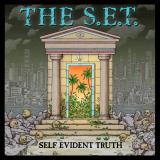
Out of Baltimore, Maryland comes The S.E.T. who are crafting 100% unapologetic hardcore music. Formed between bassist Che (founder of Flatspot Records), guitarist Brady (formerly of Turnstile), and drummer Ryan (formerly of End It), the band started through jam sessions in early 2024. Before they knew it, they had instrumentals for seven songs written and were ready to put lyrics to the tracks, and the search for a vocalist began. Che spotted Tim hopping on stage and grabbing the microphone at Disturbin’ The Peace Festival, invited him to try out for vocalist, and The S.E.T. was then complete.
The S.E.T. will release their debut Self Evident Truth EP, on February 27th through Flatspot Records. It’s 15 minutes of fury and groove, taking cues from Baltimore acts such as Gut Instinct (whose Sebastian Gorgone features on “White Lies”) and Stout and the crossover sounds of New York like Leeway and Judge. Recorded and mixed by Justin Day at New Noise Recording and mastered by Brad Boatright at Audiosiege, the tracks roar with thick bass lines, fast-paced drums, and rage fueled vocals. Lyrics come from a place of candor, expressing the basis of equal rights and defying the propaganda the current administration is spewing.
As The S.E.T. comes into fruition, the band wants to exist as a place to put words to action and come together as a community through both their music and live shows
Out of Baltimore, Maryland comes The S.E.T. who are crafting 100% unapologetic hardcore music. Formed between bassist Che (founder of Flatspot Records), guitarist Brady (formerly of Turnstile), and drummer Ryan (formerly of End It), the band started through jam sessions in early 2024. Before they knew it, they had instrumentals for seven songs written and were ready to put lyrics to the tracks, and the search for a vocalist began. Che spotted Tim hopping on stage and grabbing the microphone at Disturbin’ The Peace Festival, invited him to try out for vocalist, and The S.E.T. was then complete.
The S.E.T. will release their debut Self Evident Truth EP, on February 27th through Flatspot Records. It’s 15 minutes of fury and groove, taking cues from Baltimore acts such as Gut Instinct (whose Sebastian Gorgone features on “White Lies”) and Stout and the crossover sounds of New York like Leeway and Judge. Recorded and mixed by Justin Day at New Noise Recording and mastered by Brad Boatright at Audiosiege, the tracks roar with thick bass lines, fast-paced drums, and rage fueled vocals. Lyrics come from a place of candor, expressing the basis of equal rights and defying the propaganda the current administration is spewing.
As The S.E.T. comes into fruition, the band wants to exist as a place to put words to action and come together as a community through both their music and live shows
- A1: Devil In My Closet
- A2: Angel Of Sorrow
- A3: Wild Streak
- A4: Couldn't Do Nothin
- A5: Tiny Coffin
- B1: World Of Trouble
- B2: Voodoo Edge
- B3: Person To Person
- B4: Take Me Down
- B5: One Believer
One Believer, the Elektra debut by the late bluesman John Campbell, was outside of virtually every trend on major labels and in pop at the time. Other than Chris Whitley's Living with the Law, it was the only roots record issued on a major label in 1991.
A deeply atmospheric record full of subtle shimmering organs and warm guitar textures that accent the dreamy spooky side of the blues more than the crunchy stomp and roll that Campbell was known for in the clubs and displayed on his follow-up Howlin' Mercy. Tracks like "Angel of Sorrow," "World of Trouble," and "Wild Streak" offer shimmering ambient textures from which the blues emanate from the ether. Campbell was living and working in New York and his music was certainly influenced by that late-night environment. These are beautiful songs, tempered in shadow and restraint while baring their teeth at all the right moments. On "Couldn't Do Nothin'," "Devil In My Closet," and "Person to Person the roadhouse magic comes out. The album's last two tracks "Take Me Down" and the title track are menacing in their conviction and creepy swampy in execution.
One Believer is available as a limited edition of 750 individually numbered copies on blue vinyl and contains an insert.
- A1: I Just Can't Help Believin
- A2: Twenty Days And Twenty Nights
- A3: How The Web Was Woven
- A4: Patch It Up
- A5: Mary In The Morning
- B1: You Don't Have To Say You Love Me
- B2: You've Lost That Loving Feeling
- B3: I've Lost You
- B4: Just Pretend
- B5: Stranger In The Crowd
- C1: The Next Step Is Love
- C2: Bridge Over Troubled Water
- C3: I've Lost You (Single Version)
- C4: The Next Step Is Love (Single Version)
- C5: You Don't Have To Say You Love Me (Single Version)
- C6: Patch It Up (Single Version)
- D1: How The Web Was Woven (Take 1)
- D2: I've Lost You (Take 1)
- D3: You Don't Have To Say You Love Me (Take 2)
- D4: Patch It Up (Take 1)
- D5: Bridge Over Troubled Water (Take 1)
- E1: That's All Right
- E2: I Got A Woman
- E3: Hound Dog
- F1: I've Lost You
- F2: I Just Can't Help Believin
- F3: Patch It Up
- F4: Twenty Days And Twenty Nights
- F5: You've Lost That Lovin' Feelin
- F6: Polk Salad Annie
- F7: Introductions
- F8: Blue Suede Shoes
- F9: You Don't Have To Say You Love Me
- F10: Bridge Over Troubled Water
- F11: Suspicious Minds
- F12: Can't Help Falling In Love
- E4: Heartbreak Hotel
- E5: Love Me Tender
After being out of print for a good number of years, we are making 15 titles out of our Elvis Presley back catalogue available again between August 2025 and February 2026. Each title will see two different editions: one on regular-coloured vinyl and one very limited on mix-coloured, marbled vinyl, both housed in deluxe sleeves with a linen look and feel.
That’s The Way It Is is Elvis’ 12th studio album, consisting of eight studio tracks recorded at the RCA studios in Nashville and four songs performed live at The International Hotel in Las Vegas. It accompanied the theatrical release of the eponymous documentary film, although it is not generally considered a soundtrack album.
Added to this definitive 4LP legacy edition are four single sides from the period and a selection of fly-on-the-wall outtakes from the June Nashville sessions that produced the majority of tracks for the LP. Disc 3 and 4 feature the first complete release of a concert from Elvis’ 1970 "Summer Season” recorded on August 12. The 20-page booklet features an insightful essay, photos and memorabilia.
That’s The Way It Is (Legacy Edition) is available as a limited edition of 500 individually numbered copies on yellow and black marble vinyl.
In the pantheon of classic free jazz, Noah Howard's The Black Ark looms large. Recorded at Bell Sound Studios in New York City in 1969 – just prior to the alto saxophonist's relocation to Europe – the album was eventually released in 1972.
The Black Ark exhibits not only the power and imagination of Howard's playing, but also his breadth as a composer and bandleader. Listeners expecting unrelenting blasts of "energy music" might be surprised to find a cohesion atypical of free jazz; amidst the wild, impassioned solos, Howard weaves in Latin rhythms and fat-bottomed grooves.
The first side, consisting of "Domiabra" and “Ole Negro,” sets the album's tone. Both tracks sound as if they could have appeared on some of Blue Note's proto-spiritual jazz, groove-heavy releases – evoking the likes of Lou Donaldson or Horace Silver – before ceding the floor to the horn players' anarchic firepower.
As John Corbett writes in the liner notes, "Two players stand out. Bassist Norris Jones – who would soon consolidate his name into a one-word reversed amalgamation/permutation of the two, Sirone – is given ample room, largely unaccompanied; his corporal approach foreshadows later work with the Revolutionary Ensemble. But the secret weapon on The Black Ark is Arthur Doyle. Straight from basement rehearsal sessions with Milford Graves, whose ensemble he had joined and who remained a favorite of the drummer for decades, Doyle is a human flamethrower."
Trumpeter Earl Cross' guttural, vocal effects complement Doyle's take-no-prisoners approach, while the estimable combination of Muhammad Ali (Rashied's brother) on drums and Juma Sultan on congas adds an ever-shifting propulsion. The septet is rounded out by the enigmatic pianist Leslie Waldron, who anchors the group with imaginative accompaniment and occasional boppish flourishes.
Every bit worthy of its reputation as an "out-jazz" holy grail, The Black Ark only sounds better with age. It remains the ideal record to convert the remaining free-jazz skeptics.
2026 Repress
Alleviated Records is proud to present the first of hopefully a succession of releases sharing selections from our own Archive of recordings that either have never been issued or that have never been issued on the Alleviated imprint. After many years of being ''on-the-shelf'' we are extremely pleased to share these with the public. First up, we have a selection that was being considered for the ''Another Side'' (Fingers, Inc.) album that features Ron Wilson free-styling vocals to a deep-house vibe. To this day, we are not quite sure why this selection was not included on the project but are pleased to finally share it. Next up we have ''Electronic Debris'' delivering a ''mellow-deep'' vibe. Then we have ''Saspence'' with, as the title implies, a ''mysterious-deep-minimal house'' feel. Concluding the EP is ''Nyte Light'' delivering a ''deep-ambient-acid'' flavor. We sincerely hope that you enjoy these selections at the club and at home for a long time to come. Musically Yours...
- Ntr1
- Ntr2
- Drg5
- Drn9
- Drg10
- SL12:
- Drg14
- Drg15
- Prn2#16
- Otr
- Prn2_9Ofm15Tb
- Prn2_9Ofm15Ta
- Prn2_M15T
- Prn2_M15T_Selforg_Tapecut
NYZ (David Burraston) presents this collection of generative music pieces carefully extracted from a PreenFM2 gifted to him by Aphex Twin. PRN2_M15t is being released at the same time as an LP titled Stria from Dr. John Chowning who invented the original FM synthesis algorithms which were sold to Yamaha and used in the creation of the DX series of keyboards. An interview with Chowning, conducted by David Burraston, will be published at the same time.
David Burraston is an award winning artist/scientist working in the areas of technology and electronic music, operating Noyzelab as an independent art/science music studio since 1981. Numerous research publications include a 2006 PhD thesis Generative Music & Cellular Automata, which developed and applied fundamental new concepts from generative music practice to a key problem in complex systems theory.
His experimental arts practice encompasses field recording, landscape-scale sound art, chaos/complexity, practice-based research, sound synthesis and electronic music. He performs, lectures, conducts workshops and creates art installations in Regional NSW and around the world. David also designs and builds sound synthesizers based on his theories of chaos/complexity science. He was recently interviewed by Bandcamp Daily and The Wire Magazine.
David has worked with many diverse collaborators such as Aphex Twin, Chris Watson, Doug Quin, Russell Haswell, Robin Fox, Oren Ambarchi, Sarah Last, Cat Hope, Garry Bradbury, William Barton, Alan Lamb, MIT Media Lab and the Australian Broadcasting Corporation. In 2014 he independently published the legendary "SYROBONKERS!", the most technical and in-depth interview ever given by Aphex Twin.