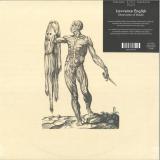
Announcing Perseverance Flow, the latest album from acclaimed Chicago-based ensemble Natural Information Society (NIS), release date 2024-10-24. After a trilogy of double LPs by expanded manifestations of the band that began in 2018 with Mandatory Reality & continued through Since Time Is Gravity (a Pitchfork Best Jazz & Experimental Album of the Year selection & Mojo’s #1 Underground Album of 2023), NIS returns to its core formation of Lisa Alvarado on harmonium, Mikel Patrick Avery on drums, Jason Stein on bass clarinet, & composer/multi-instrumentalist Joshua Abrams on guimbri for one continuous 37 minute composition across a single LP. As the rocket boosters on spaceship earth sputter closer to burnout, lower your stylus into a soundfield that grows stronger the deeper you travel into it; a dose of the medicine many of us look to music to deliver awaits you inside.
One of the deep contemplations of this natural information (thanks Bill Callahan) is the wide range of source materials Abrams draws from over the band’s more than 15 year history: Ideas from minimalism, modal jazz & traditional musics are regularly reimagined in these compositions. The 2021 double LP descension (Out of Our Constrictions), with guest soloist Evan Parker, reflected aspects of Abrams’ love of party music, Chicago house, & John Coltrane. *But even veteran travelers with the NIS best brace themselves for the Perseverance Flow.
Speaking to the history & the inspirations behind the album, Abrams offers: “We played the piece for a year in concert before the recording. At Electrical (Audio Studios, Chicago) we went in at 11 & were done in time to pick our kids up from school.” Abrams continues: "In a reference world, I imagine Perseverance Flow like a live extended realization of a Jaylib lost instrumental as remixed by Kevin Shields. Or vice versa. I also think it has sympathies to some of the more rhythmically intricate dance musics out of Chicago & Lisbon.”
The core NIS ensemble heard on Perseverance Flow always address Abrams’ writing with the discipline of orchestra musicians & the creativity of improvisers. But this time around, instead of inviting living legend status musicians Evan or William Parker or Ari Brown as honored guests to solo freely over the composed materials, Abrams’ invited guest collaborator was the medium of the recording studio itself. Situated at the board with engineer Greg Norman, Abrams pushed post production techniques found only sporadically on earlier NIS records deep into the heart of the music, distorting & reshaping instruments to subtly &, at times, aggressively mutate timbre & texture, color & time.
Refracting the band’s signature mesmerizing chains of overlapping rhythmic patterns through the sonic funhouse of dub makes Perseverance Flow the most formally experimental NIS album to date. Now a soundworld fully unique to itself is listening to itself, consoling & humoring itself, & consoling & humoring you. A destruction myth & a creation myth of a soundworld together at once —”energetically nutritious” (October 2025 Issue 500 The Wire) supernatural information society.
“Perseverance Flow is skipping rope in slo-mo. A dance of co-operation to rally guts & humors & keep marching through pouring tears” (Abrams).
Поиск:ar at
Все
Alpenglühen starts 2026 with two close friends working together in the 11th one
Atàvic is the collaborative project between Estrato Aurora and Absis, merging two distinct yet complementary approaches to electronic music. The project is rooted in texture, atmosphere, and subtle narrative, allowing sound to evolve organically and without excess.
They together bring a refined sense of space and detail, working with ambient layers, restrained rhythms, and melodic fragments that unfold slowly. Here is a 4 track release with a more tactile and material approach, focusing on timbre, resonance, and sonic density, blurring the line between abstraction and structure.
The alignment between Atàvic and the label lies in a shared appreciation for subtlety, patience, and sonic storytelling, where each release is conceived as a complete and meaningful statement.
With this reference, Atàvic contributes a work that resonates with alpenglühen’s aesthetic ethos while reinforcing the collaborative project’s own identity: music that invites close listening and reveals its nuances slowly.
If you’re looking for a peak-time, dancefloor-driven banger to keep you moving until sunrise, this is not that record.
But if you’re after a mind-blowing experience that challenges and expands your listening (and dancings), this one’s for you. Don’t overthink it.
Multidisciplinary Brussels-based artist Sagat steps up with a new mini album on the Basic Moves side label, Gems Under The Horizon, featuring a remix by Slovenian ambient bird e/tape. A few years ago, Wiet Lengeler, aka Sagat was invited by Basic Moves to create a live visual show using an analogue video synth setup to accompany a 5-hour dj set by e/tape at Face B in Brussels. From that moment on, the synchronicity between the two artists was clear - and this EP is the result.
Besides his visual work, Wiet Lengeler is also known for his contemporary techno music, primarily released on Brussels’ cult label Vlek Recordings. For this mini-album, Gems Under The Horizon 003, he presents four grainy ambient and textured electro-acoustic explorations. The tracks unfold organically — like ivy — gradually revealing layers of sound and hidden textures beneath babbling streams of electronics. e/tape’s remix feels like a natural continuation of Sagat’s sonic universe, together forming a mesmerising whole that explores the fringes of ambient music. In addition to the release, a limited run of the release + 30 x 3 riso printed posters from the visual show at Face B, made by Sagat and hand numbered are made available.
Mastering and lacquer cut was done by Frederic Alstadt at Angstrom Mastering. Artwork & inserts are designed by renowned Ghent-based visual artist Dieter Durinck.
Sit back and enjoy the wonderful aural world of Sagat and e/tape.
Sincerely,
The Basic Moves team.
A chopped-and-screwed love letter to the sounds of rebajada – half-speed cumbia, pioneered by Sonido Dueñez in the 1990s, and born from an overheated turntable motor that didn’t make the crowd stop dancing. With Debit’s treatment, rebajada becomes an ethereal, at times intense ambient tapestry that’s also a history lesson.
Spend any amount of time pacing the streets of Monterrey, the bustling city in the north of Mexico where Delia Beatriz, aka Debit, grew up, and you’ll be sure to catch traces of cumbia echoing from Bluetooth speakers, DIY soundsystems, or car stereos. An Afro-Latin dance form and »practica cultural« originating in Colombia in the early 19th century, cumbia evolved rapidly in the early 1900s, as a localised sound played on drums and flutes quickly modernised to integrate European instrumentation like the accordion. When it reached Mexico in the 1940s, the sound shifted again, fusing with mariachi styles and integrating further vallenato folk elements. Eventually, cumbia spread across the entirety of Latin America, splintering into a spectrum of different musical styles such as chicha in Peru, and cumbia villera in Argentina. And over in Monterrey, cumbia inadvertently found its own idiosyncratic groove.
From the 1950s to the 1970s, waves of immigrants from across Mexico and Latin America headed to Monterrey to find work, making a home in Colonia Independencia. Colombian cumbia records, shipped in from Mexico City, Houston, and Miami, became the soundtrack of the neighbourhood, relaying familiar stories to a rural working class adjusting to their new industrial reality. The sound struck a chord with locals, and huge street parties hosted by ramshackle soundsystems known as sonideros unified the diverse community. So when cumbia rebajada materialised serendipitously in the 1990s, it emphasised and highlighted the memory distortions at the heart of the immigrant experience. Local record collector, selector, and sonidero Gabriel Dueñez had been playing cumbia for hours one night when disaster struck: his turntable’s motor overheated and slowed down, turning the music into a warped groan, with half-speed voices echoing over wobbly accordion drones and splashy drums. But the crowd kept dancing, and Sonido Dueñez realised he’d struck gold – cumbia rebajada was born.
Over the next few years, he dubbed a popular series of mixtapes, hawking them at the flea market on the dried-up Santa Catarina riverbed beneath El Puente del Papa, the bridge that links downtown Monterrey with Independencia. These woozy archives became the stuff of legend, poetically but subconsciously shadowing DJ Screw’s series of epochal cassettes that appeared over the border in Houston. Beatriz uses Sonido Dueñez’s first two tapes as the starting point for »Desaceleradas«, entering into a dialogue with time, culture, and geography as she recalls the sonic ecosystem that surrounded her decades ago, long before she emigrated to the USA. If 2022’s acclaimed »The Long Count« was an attempt to recover concealed pre-Columbian history in the face of colonisation, »Desaceleradas« jumps forward, figuring out how memory and shared celebration can resist a more contemporary form of cultural erasure. As AI systems scrape, blend, and decontextualise culture around us, leaving vapid slop, »Desaceleradas« proposes a slower, more careful, and ultimately more human kind of engagement. It’s an archive with a pulse.
Do you remember the last time you were breathing consciously? Either way, you are likely doing it now. On his new album Observation of Breath« for the Swiss-based Hallow Ground label, Lawrence English worked exclusively with an organ for four compositions that are exercises in »maximal minimalism,« as their creator himself notes in a nod to Charlemagne Palestine, who coined this term. While it seems somewhat fitting that those four pieces based on a steady flow of air were conceived and recorded in a situation of accelerated standstill caused by a respiratory disease, the Room40 founder is not so much concerned with capturing the zeitgeist than rather incorporating the spirit of time itself. »It is a record about presence and patience,« he explains. Exploring the unique sonic affordances of a singular instrument, »Observation of Breath« is not only devoted to the durability of sound but also to its density. That it marks his debut on Hallow Ground after having shaped its sound by mastering most of the label’s releases in recent years is just as fitting then as its release following albums by Kali Malone and FUJI|||||||||||TA, whose innovative work with organ instruments have facilitated a rediscovery of their possibilities.English’s compositions however are neither directly indebted nor responding to these musicians. His exploration of the organ’s many facets started a decade ago when the composer was given access to an instrument built in 1889 that is presently housed at The Old Museum in Brisbane. After it had already played a crucial role on his seminal albums »Wilderness Of Mirrors« and »Cruel Optimism,« last year’s self-released »Lassitude« was the first record that English entirely composed and recorded with that instrument. »During the soft lockdowns, I spent many days playing to an empty concert hall, recording the pieces that became ›Lassitude‹ and then, this album,« says English in regards to an unfortunate situation that fortunately provided him with time and space—two major themes but also key qualities of the four new compositions. In this sense, he goes on, »Observation of Breath« resolves a number of the questions originally raised by »Lassitude.
The Danish label arbitrary presents Framework / Zwischen Remixes – a remix by German artistJan Jelinek and one by musician & label founder Mads Emil Nielsen originally made for a digital compilation, now published on 7" vinyl (arbitrary22).
For the CRXSSINGS release, Jan Jelinek remixed Nielsen’s Framework 10, a track from the Framework Book/CD (arbitrary01) based on sequences/recordings of sine waves and noise.
Side B: a rework by Mads Emil Nielsen of Jelinek’s voice collage and electronic sounds, from Zwischen – Marcel Duchamp, would you like or expect people to spin the wheel on your kinetic object Roue de Bicyclette?
Framework 10 (Remix) written & produced by Jan Jelinek, Berlin, 2019.
Zwischen/Marcel Duchamp (Remix) written & produced by Mads Emil Nielsen, Copenhagen, 2019.
Graphic design + score (cover, back: Framework 10) by Mads Emil Nielsen.
Mastered and cut by Kassian Troyer at D&M, Berlin.
Childhood Intelligence Nineteen by Dan Piu “The Mystic Mind” 2x12 LP
As the vortex of time evolves, Swiss Underground Legacy “Dan Piu” returns to his home planet “Childhood intelligence”. A rare specimen and artifact known for his timeless & intelligent soul-infused music, arises with his 3rd solo album on Childhood. “The Mystic Mind” 2x12 Lp as the trilogy, the sequel of “Tru Time And Ages” and “Inside Universe”.
This Full-Length player is a voyage through yet another unexplored realm of Dan's creativity, where listeners are invited to explore a vast network of emotions. As the album organically unfolds, tales of spooky synth worlds emerge, where hypnotic atmospheres collide with analog technoid elements, guided by classic JUNO chord progressions. Witness the alchemy of vintage ARP, Jupiter, Mono/Poly, and 80s Yamaha sounds as they morph into an elusive journey of electronic mysticism crafted by the otherworldly mind, the “Mystic Mind” of Dan Piu.
For a few years, Slovakian born & Czech-based artist pantata (Stefan Barcak) has been making music for himself, while running a record store slash coffee bar (called 25,2 rpm) in Prague. Over the course of a month in 2024 pantata made many songs with different analog machines and selected the favourite tracks out of this. His music is very laidback -almost empty- analog music that reminds of K. Leimer and Tara Cross mixed with Czech & Slovakian childhood memories and love and honesty of nowadays memories. "I was born on March 3, 1998, in a small town in eastern Slovakia. In the distance, you could see the Slovak mountains. That image of big mountains on the horizon still inspires my work today. In my early years, before my family and I moved to Prague, I was quite an outsider, I liked drawing and painting and I never stopped. Nowadays, I have a nice setup at home. A few synths: Sequential Circuits Six-Trak, Pro-One, Yamaha DX7, Roland Juno, JP-8000, S-1 (a small SH-101 clone), and classic Roland drum machines like the 909 and 707. I also use a few effect pedals, an old mixer, and a Tascam Portastudio where I record everything to tape. When I make a track, I usually need to finish it in one day. I start playing my instruments, and whatever feeling I have that day needs to be recorded. If I leave a song for tomorrow, I might lose the feeling and feel something completely different, so I prefer to start a new track instead."
- A1: Uncanny Unit - El Futuro Está En Vuestras Manos
- A2: Allumynd - Mind Limits Broken
- A3: Fabio Vinuesa - Corrupted Data
- B1: Robot City - Intercom 82 (Bastardo)
- B2: Synth Alien - Electric Abyss
- B3: Vema-Diodes - Train Light
- C1: Univac - Helicon
- C2: Telephasycx! - Chaos Theory
- C3: Ørbitā Secundariā - Submodulo Ba73
- D1: Nightcrawler & Dark Vektor - Oscuridad-Sintetica
- D2: Shhgrr & Igal - Decadence
- D3: Estado De Bienestar Feat. Chayell Zen / Peter Bonne - Guardianes Del Tiempo (Danos Mucho Beis Mix)
El Elektro Compilado Padrísimo Vol. 1 is a double 12” compilation curated by Spanish artist Elektro’s Grandfather, Dark Vektor featuring his personal selection from today’s scene. A fearless snapshot of the Spaniard national electro scene. Established figures stand shoulder to shoulder with new blood, generating a current where tradition and innovation collide in sparks. Every track is a charged fragment of a collective identity, soldered into one unstoppable groove. A declaration that the Spanish electro underground is alive, mutating, and absolutely padrísimo. Presented in ONE-OFF truly limited edition of 300 copies lacquered pressed on 180 gr. high quality solid BLACK vinyl. All tracks have been specially remastered for vinyl by Daniel Hallhuber at Young and Cold Studios (Germany).
La Matta Records proudly presents the first official 7-inch, Tutto Ben, a rare “Italo-Brazilian” mini EP by iconic singer, guitarist, and composer Jorge Ben Jor. This edition includes Ana Maria (Remastered), originally recorded at the Teatro Sistina in Rome in 1978, while Falcão and Lorella were first released in 1983 on the CGD (Maracanà) label, part of Warner Music Italy, celebrating AS Roma’s league title. This 7-inch captures a pivotal moment in Jorge’s career, singing in Italian with Banda do Zé Pretinho in Rome. Acclaimed for his radiant spirit and admired by the genius art director Franco Fontana — who invited him to Rome several times — this fully remastered gem is now available for collectors and enthusiasts on vinyl.
On »Empty Room,« David Granström works with slow transformations, cyclical and isometric patterns as well as just intonation as a way to create harmonic stability, allowing his long-form pieces to develop their own unique temporal and spatial qualities. A prolific figure in Stockholm’s experimental drone scene and a collaborator of Hallow Ground label mates Maria W Horn and Mats Erlandsson, the Swedish composer navigates through moments of quietude and crushing volume on these five tracks. Sonically and atmospherically, the pieces on »Empty Room« simultaneously call to mind Fennesz’s most meditative work or the physical experience of seeing Sunn O))) live, blending guitar recordings and synthesised sounds with forceful effects similar to those of Mario Díaz de Leon’s Oneirogen project while still being as moving and delicate as Alessandro Cortini’s solo work. The album is marked by melodies and harmonies that are the product of a peculiar working process that turned the composer into an intent listener collaborating with, rather than simply using technology.
Having been invited by the self-organising artist group The Non Existent Center for a residency to Ställbergs Gruva, a defunct iron ore mine in Sweden’s Bergslagen region, Granström took his guitar as a starting point for his compositional work that heavily relies on real-time sound synthesis. »I seldomly use the instrument as a sound source in the final compositions and rather transcribe and orchestrate the harmonic structures using sound synthesis,« he explains. »On this album however, I chose to include the actual recordings of the guitar in order to extend the spectra between non-referential synthetic sounds and embodied referential sounds.« Working with precise tunings in order to blend the timbre of the synthesis with the harmonic structures of the composition, he created composite sound objects in which the harmonic elements blend into each other.
Through the re-amplification of synthetic musical materials from the inside of the abandoned mine, his original compositions were enriched with site-specific sound qualities before he further refined them in a singular working process. Granström works with algorithmic and generative processes, using the SuperCollider programming environment and thus blurring the lines between generative and creative forms of composition. »One of the things that I like about this way of working is that it creates a distance between myself as a composer and myself as a listener of the music that is produced entirely by the system,« he says. Granström’s technologically aided eschewing of the conventions of composing doesn’t make the end result any less personal, however. By listening again and again to the newly generated output, Granström simply took on a different role in the process of finalising the music, with the technology and the sounds becoming his co-authors.
By creating systems that generate music, he gains a new perspective on (musical) time, says Granström. »There doesn't have to be a fixed length to the music at all,« he explains. »And by writing music with this in mind, my focus tends to shift towards writing cyclical structures that gradually change and transform over time.« Simple parts, in other words, that emerge as the five complex wholes that form »Empty Room,« a record that itself seems to take on different forms with every new listen.
The new 012 series opens with “Waveform Studies”, a project that brings together fresh talents on the platform, merging their visions of bleep and hypnotic techno through an interplay of deep and raw frequencies. To launch the EP, label head Claudio PRC sets the tone with “Pulse”, a deep and immersive techno journey, followed by the haunting and mesmerizing soundscapes of “Vacuum” by French DJ and producer Eman. Next, Italian artist Riccardo De Polo contributes “Aseptic”, a raw, hypnotic, and minimalistic techno banger, which seamlessly leads into the spacey and dreamy textures of “Voluta” by Venezuelan-born, Berlin-based DJ and producer Isabel Soto. Finally, emerging artist Leo Cologna closes the release with “Sinus”, a digital bonus that fully embodies the spirit of this compilation. The graphic design and visual aesthetics is curated by the Berlin artist Medas, adopting the light drawing technique, reflecting the rigor and abstraction of the sound and emphasizing the essence of the musical content.
All tracks are written and produced by the respective artists. Artwork by Medas. Mastered at Incidence Studio.
Recollection V-VI marks the third in a planned series of 7” releases, each built from Glonti’s expanding archive of Soviet-era recordings. The artwork by Dmytro Nikolaienko (Day Night) once again reflects the utilitarian aesthetic of Soviet-era record design.
In 2018, Glonti started collecting LPs of Soviet-era Georgian composers at Tbilisi’s “Dry Bridge” flea market.The records mostly consisted of classical and chamber music released on Melodiya, the singular, state owned record label of the USSR. It was through this process that the idea of Recollection was born, as Glonti aimed to create an album that would utilize samples from his growing collection.
A reflection on how we hold each other and how we let go, ‘Secular Music Vol 1’ is the first instalment in a triptych of albums by multi-limbed live dance music outfit Girls Of The Internet. Continuing their ongoing policy of “therapy through music”, the album touches all points on the shifting landscape of human connection: belief, doubt, loss, forgiveness. Emphasising human elements of songwriting, performance and production within the lineage of house, disco and electronic music; this first record furthers the band’s flair for manifesting the creative and communal spirit that birthed the scene. Joining the dots that have not been joined for a long time, the collective takes on people of all sexualities, gender expressions and body types. House music was created as an inclusive artform and Girls of the Internet are here to assert we are all invited. The group is completed with a rotating assembly of talented collaborators, including the live band with Nandi and Wynter on vocals and Tommy Peach on bass and trumpet. ‘Secular Music Vol 1’ also features guest appearances from Dani Siciliano, Sió, Pinty, i am an island, and James Alexander Bright - also a regular member of the live band. Girls Of The Internet’s 2024 album ‘When I Was Lost, I Found Myself’ was the follow-up to the acclaimed ‘Girls FM’, one of BBC 6 Music’s Albums of the Year in 2019. Firmly on the radar of key DJs Gilles Peterson, Tom Ravenscroft, Trevor Nelson, Pete Tong, and Lauren Laverne for some time, the band’s songs have more recently found fans in BBC Radio 1’s Sian Eleri and BBC 6 Music’s Nick Grimshaw as well as around the rest of the planet on tastemaker stations Byte FM, FIP, NTS, KALW, KCRW, KEXP and Soho Radio. Girls Of The Internet have performed on home turf at Glastonbury, The Warehouse Project’s Homobloc, Drumsheds, Printworks, Latitude, Lost Village festival, and a residency this summer at London’s Colour Factory. With Ibiza shows at Pikes and Glitterbox at #1 Club in the World Hï; this July saw Tom take on their first US dates with DJ sets in New York, LA and San Francisco. The live band are currently in the middle of an extended live tour that runs through to December. ‘Secular Music Vol 1’ is set for release on 14th November 2025 on Girls Of The Internet's own recently launched House Of the Internet label.
- Kollaps
- Grovt Skadeverk
- Riv Skorpen Av Såret
- Skreddersm
- Parasitt
- Traumemarsj
- Rottebitt
- Til Ettertids Plage
- Klarhet Og Dybde
- Rennestein
- Svikter Din Neste
- Naglet Til Livet
- Klangbunn Fra Helvete
NEW VERSION ON WHITE VINYL! After turning heads with the relentless 2024 EP Råtner på rot, Jordsjuk are back with their full-length debut: Naglet til livet (translates to 'Nailed to life'). Across twelve tracks and 36 minutes, the band delivers a visceral strike of raw, uncompromising metal - free of gloss, gimmicks and nonsense. Naglet til livet is a kaleidoscope of destruction, decay, and ugliness, the band states. From the thrash-fueled chaos of "Grovt skadeverk" and the suffocating aggression of "Parasitt", to the punk-driven decay of "Rennestein" and the gloomy introspectiveness of "Svikter den neste", this is the sound of filth, concrete, ruin, and rage. Twelve tracks of in-your-face, riff-driven and organic metal. Jordsjuk consists of Renton (drums), Mannevond (vocals), Sagstad (guitars), and Larsen (bass) - seasoned musicians from the Norwegian underground. Their sound sits somewhere between black, death, thrash, punk, and rock, forging a sonic identity as raw as it is deliberate. The lyrics, written in Norwegian, dive into personal collapse, trauma, and apocalyptic despair, delivered with uncompromising honesty. Drums were recorded at PhatCat Studios (Rygge, Norway), with the rest captured at various locations in Oslo. Mixing was handled by Kurt Ballou (Converge) at God City Studios (Salem, MA), while Brad Boatright took care of mastering at Audiosiege Studio (Portland, OR). The result is exactly what it needs to be: dirty, sharp, and heavy. Jordsjuk is necro music for necro times, says the band, and after hearing Naglet til livet, it's hard to disagree. The band were booked to by:Larm festival and Midgardsblot in 2025, and it's on stage that their sonic violence truly takes over. For those who've seen them live, expectations are high. For everyone else - prepare to be run over.
- A1: ) Think Fast, Make Conversation
- A2: ) Here Come The Rugby Boys
- A3: ) Limpet
- A4: ) Drinking On A Weeknight
- A5: ) Back On The Meds
- A6: ) The Day We Missed The Train
- B1: ) Oh Veronica, How Right You Are
- B2: ) Romantic Visions (Prepare For Disappointment)
- B3: ) Strictly Presbyterian
- B4: ) Everybody’s Moving To Australia
- B5: ) Say You’ll Never Leave Me
The Just Joans' new album Romantic Visions of Scotland finds the Glasgow band in characteristically melancholic form, pairing shambling indie pop with sharp observations on romantic pratfalls and everyday dis-appointments, all delivered with sardonic Scottish wit, fronted by siblings David and Katie Pope, whose wry lyrics and heartfelt vocals remain at the heart of the band’s distinctive sound.
Originally inspired by a grandiose exhibition title spotted on Glasgow buses in 2019 for a show at the Nation-al Museum of Scotland called Wild and Majestic: Romantic Visions of Scotland, the new album arrives six years later as a collection of semi-autobiographical snapshots from the Central Belt of Scotland. Whilst some of the details have been exaggerated for comic (or tragic) effect, the songs are based on personal experience of mundane failings, bitter regrets and missed opportunities that make up an unremarkable life.
Recurring themes of nostalgia for a bygone era and the fear of being left behind by lovers, friends and peers run throughout the album. Musically and lyrically, the band channels Village Green-era Kinks, with nods to The Television Personalities, The Smiths and Dolly Mixture.
In the past they have always recorded by themselves in a variety of bedrooms, living rooms – and the occasional toilet. For the first time they have abandoned their DIY recording practices to create what songwriter David Pope calls, “a corporate behemoth in an actual studio.” The album was recorded at Chem19 in Blan-tyre with Paul Savage, who is best known as a founding member of local legends The Delgados. He has also produced and recorded the likes of Teenage Fanclub, Arab Strap and Camera Obscura, and has captured a slightly more muscular version of the band while retaining their ramshackle charm.
The album artwork by vocalist and painter Katie Pope depicts Motherwell Train Station – an ordinary, boring place that speaks to the subject matter of the songs, but with a hint of potential escape. As David Pope ex-plains, “For me, the painting reminds me of the ending of Billy Liar in which Billy tries and fails to leave his hometown for the bright lights of London. Half the band also live in Motherwell, so it seemed appropriate.”
Funded by Creative Scotland, the recording allowed the band to bring in bass and cello arrangements, adding depth and a sheen of musical proficiency to their signature sound.
About The Just Joans - The Just Joans were formed in Glasgow in 2005 by songwriter David Pope. Early demos were collected together and released as a loose concept album, Last Tango in Motherwell, in 2006. Chris Elkin joined on guitar and was followed shortly after by David’s younger sister, Katie, on vocals and Fraser Ford on bass. Over the years they have released EPs and albums on WeePOP! and Fika Records and have gained a cult following as Scottish pop miserabilists.
The current line-up consists of Katie Pope (vocals), David Pope (vocals, guitar), Chris Elkin (lead guitar), Fraser Ford (bass), Arion Xenos (keyboards) and Jason Sweeney (drums).
Press Quotes:
“They fit snugly into the scratchy, low budget Scottish indie tradition of The Delgados and Arab Strap… There’s mischief in this miserabilism.” - Mojo 4*s
“Glasgow’s The Just Joans have documented the romantic pratfalls of a generation of indie kids with sardonic wit and a shambling musical style where Stephin Merrit lies down with The Vaselines.” - Uncut
“Funny and sad, it’s the kind of song that made Red House Painters, The Magnetic Fields and The Wedding Present’s early albums so easy to embrace; an unpretentious sharing of relatable gloom.” - Record Collector
- A1: Beautiful Baby
- A2: Better Change Your Mind
- B1: Atomic Bomb
- B2: Shame
- B3: I Need You All Life
red vinyl[30,46 €]
- 1: Dream Legend
- 2: Strawberry White Paper" Again
- 3: Tears Are Not Just Decoration
- 4: Two People Who Can't Go Home
- 5: Atonement
- 6: Jam
- 7: Melody
- 8: Look Up At The Stars At Night
- 9: An Afternoon Gazing At The Sea
- 10: Story
January 21, 2026 marks the 40th anniversary of Hideaki Tokunaga's major label debut.
A long-awaited new album will be released on this memorable day! Titled "COVERS," it marks the launch of a new series of cover albums that truly showcase Tokunaga's talent.
This is his first studio recording since moving to Nippon Columbia, and his first cover album in 11 years since his smash-hit series "VOCALIST 6." With "VOCALIST," Tokunaga
built his own brand on the concept of faithfully covering classic songs by female artists. "COVERS" features a wide selection of works by both male and female artists,
reinterpreting classics that he "want to sing now" with his own powerful arrangements and vocals. It's been exactly 40 years since the release of his debut song, "Rainy Blue."
Look forward to the new sound that has been created as a result of this journey.
For over six decades, Charlemagne Palestine (b. 1947, New York) has been a pioneering composer, performer, and multimedia artist, celebrated for his ecstatic sonic explorations and ritualistic, metaphysical performances. Emerging from the cross-disciplinary New York art scene of the 1960s and ’70s, he helped shape a heretical edge of minimalism alongside figures like Conrad, Riley, Niblock, and Glass. Trained as a Jewish cantor and later as the carillonneur at St. Thomas Church, Palestine cultivated a deep fascination with resonance and overtone—an obsession that evolved through his use of percussion, early synthesizers, and monumental piano works, influencing artists from John Cale to Nick Cave.
Animated by a spirit of ecstatic play and what he calls his »meschugge« (Yiddish for »crazy«) sensibility, Palestine’s universe blends the sacred and the absurd, filled with soft toys, ritual gestures, and immersive sound environments. Rejecting the »minimalist« label in favor of a maximalist, »spontanimalist« approach, he creates long-form, resonant performances that transform spaces into vibrating, living organisms—opening portals into the nature of time, sound, and devotion.
In the same vein, the aptly titled live record »The Organ is the World’s Greatest Synthesizer« – performed during the Sonic Acts Festival at Amsterdam’s Oude Kerk in 2025, and taking its title and cover art from a drawing realized by Palestine himself during the concert – adds to his opaque yet vibrant personal mythology and intimate transcendence, marking a return to the Staalplaat catalog after »Fffroggssichorddd« (2020) and »Music for Big Ears« (2001).
Beginning with a resonating bell and his falsetto overtone singing, then surrendering to the endless, wild soundscapes of tone-feeling and beat frequencies generated by the church’s organ, across 40+ minutes, single sound sources evolve into clusters, entangle fully with one another, and establish their own spatial existence and aural architectures. We witness the traces of something that can be described as a perpetual performance, a test for the ever-changing interaction between artist, instrument, space and, ultimately, us.
Since Palestine has always defined his execution as a form of anti-composition - of simply »being in the music« as if inhabiting a space - the true power of »The Organ is the World’s Greatest Synthesizer« lies in encapsulating a moment of Palestine’s practice in its most authentic, live dimension. Sound becomes at once subtle substance and strange telluric force, animating physical forms from some unknown channel beyond and within, accessible only through our sensorium. The point in this liminal temple of tone, timbre and frequency is not to learn anything but to simply enter. Palestine earns once again his self-given title of contemporary shaman by keeping this sonic portal open, allowing us to witness and make it last.
»I have always felt and heard and mixed the sounds in my world as liquids not as solids. Sonic liquids are material that is endlessly transformable. But I’m not crazy about people who go around defining stuff.«
For years, Jackson C. Frank was as ghostly a legend as they come. Even the relatively few record collectors who revered his work were usually only aware of the lone album that he released in his lifetime. For all most listeners knew, Frank put out a celebrated LP and vanished, despite that record having been produced by Paul Simon.
1975 Mekeel Sessions features six tracks recorded in the mid-'70s at a studio in Lake Hill, New York about five miles from Woodstock where Frank was living at the time. Only discovered in the mid-'90s, these recordings still hum with the same mysterious warmth that defined Jackson at his peak. His guitar work, alternating between strummed and fingerpicking, is consistently adept. His stark and somber voice more weathered than the lighter tone heard on his 1965 debut.
The Mekeel tapes were intended for Frank's sophomore album (titled Marlene), but alas it never came to be. What one hears is not a singer-songwriter fading out of view; it is a singular artist who never stopped trying to build his own world, even when no one was watching. For fans of everyone who Jackson influenced: from Nick Drake, Sandy Denny, Bert Jansch and John Martyn to more contemporary acts like Elliott Smith and Iron And Wine who surely used Frank's sparse approach as a template.