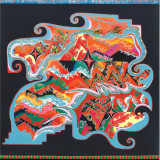
"Applying elements of minimalism or electronic music to their compositions, Carcascara's second studio album is deeply rooted in folk, blues or jazz. Borrowing from American primitivism, this acoustic guitar trio based half way between London and Zumaia, stretch the boundaries of tradition with a fluid and developed command of the string instrument.
Coming out 14 years after their self-titled debut, highly recommended for fans of Robbie Basho, Steve Reich or John Fahey."
Cerca:ari
From Elvis in Memphis retains the distinction of being the most cohesive, passionate, mature, and emotionally invested record Elvis Presley ever made. Named one of the 500 Greatest Albums of All Time by Rolling Stone, the white-soul landmark features backing by "The "Memphis Boys" and teems with rhythm-heavy country, gospel, R&B, and blues. Lauded for its natural, open sonics, the 1969 set now comes across with remarkable clarity, presence, and warmth courtesy of a premium restoration befitting a king.
Mastered from the original master tapes, pressed on MoFi SuperVinyl at RTI, and strictly limited to 10,000 numbered copies, Mobile Fidelity's UltraDisc One-Step 180g 45RPM 2LP box set of From Elvis in Memphis unearths the ravishing inner detail, sticky rhythms, and brilliant arrangements of Chips Moman's inspired production. In short, this unparalleled reissue unlocks the spirit and gestalt of the recording and takes you inside American Sound Studio. It also brings you up close and personal with Presley's singing – widely considered by many to represent the finest of his career – located dead-centre amidst the instrumental hurricane. Equally impressive are the contributions of the aforementioned Boys, and how their Southern-brewed playing – a balance of leisure with swiftness, grandiosity with concision, freedom with control – dovetails with Presley's vernacular.
The lavish packaging and gorgeous presentation of the UD1S From Elvis in Memphis pressing befit its extremely select status. Housed in a deluxe box, it features special foil-stamped jackets and faithful-to-the-original graphics that illuminate the splendor of the recording. No expense has been spared. Aurally and visually, this UD1S reissue exists as a curatorial artifact meant to be preserved, pored over, touched, and examined. It is made for discerning listeners that prize sound quality and production, and who desire to fully immerse themselves in the art – and everything involved with the album, from the images to the finishes.
Sharing much in common with the full, rich, orchestrated Stax Records sound, From Elvis in Memphis oozes with choice nuances and distinctive flourishes that on this ultra-hi-fi edition not only arise with previously unheard transparency and sharpness, but complement and serve the whole. Take the specific tonalities and blending of violas, cellos, and horns that communicate mood and serve as counterpoints. Or lively performances of the backing quintet, and how the piano and Hammond organ trace the lines of the melodies and Presley's lead. Listen to the uplifting support provided by the cadre of backing vocalists (more than a dozen credited), unrivalled in Presley's canon and a precursor to the approach he'd soon adopt in Las Vegas.
Of course, From Elvis in Memphis precedes the icon's transition into his glitzy jumpsuit phase – and follows his merciful move away from the hoary soundtrack work that consumed nearly a decade of his creative life and prompted a rebirth that began in 1968. As the bridge between eras, the record seizes on Presley's rejuvenated attitude and commitment to quality, facets that drip from the fervency with which he delivers every word. For the same reasons, and for the fact it traces back to Presley's original roots and hip-shaking guise, the album further remains a cornerstone of American music history.
Writing about the work's 40th anniversary for Rolling Stone, James Hunter correctly observed: "From Elvis in Memphis represented the full-on immersion in the Memphis idea of Elvis Presley, the American singer second only to Frank Sinatra for the ability to conjure a particular sonic universe with his merest vocal utterance. And from the album's first song, in which a bluesy Elvis espies a woman 'Wearin' That Loved On Look,' to its last, in which a more straight-up-pop Elvis regrets the injustices of life 'In the Ghetto,' his fully engaged, newly energized voice finds its most logical album setting in years."
Incredibly, Presley and company completed more than two dozen cuts for From Elvis in Memphis. One, "Suspicious Minds," turned into the vocalist's final chart-topping single and lingers as one of his most beloved rock n' roll numbers. Even though it never formally appeared on the record, the non-album song is included here as a bonus track and attains newfound depth, energy, and swagger. Coupled with the other dozen tracks – including the sultry "Power of My Love," balladic take of Dallas Frazier's "True Love Travels on a Gravel Road," and driving cover of Hank Snow's I'm Moving On" – it makes for the finest Elvis listening experience available.
'Stronger Than Fiction EP' is a result of investigating sounds and information while channeling techno in an oldschool manner. Arising from sheer call and response strength and folded into a no-nonsense, momentum-feeling arrangement approach rather than considered thought. Designed to push things off the rail a bit long after sunset and far from dawn.
Als Sänger mit einem außergewöhnlichen Stimmumfang (von Bassbariton bis Countertenor), der sich auf der Bühne mit einer New-Wave-Band oder bei einer Purcell-Arie wohlfühlt, mit dem Aussehen eines körperlosen Außerirdischen, der die Massen faszinierte, als Europäer, der aber in New York lebte, war Klaus Nomi ein komplexer und talentierter Künstler. 1979 hatte David Bowie, der damals gerade in seiner Berliner Zeit war, wie üblich vor fast allen anderen das aufkommende Phänomen wahrgenommen. Platin- und Goldplatten, ekstatische Konzertsäle, eine faszinierte Modewelt: Klaus erlebte zwischen '79 und '82 einen meteoritenhaften Aufstieg. Anlässlich des 40. Todestages von Klaus Nomi veröffentlicht Sony Music / Legacy seine gesamte offizielle Diskografie neu: Seine beiden Studioalben "Klaus Nomi" und "Simple Man" als Digipack-CD // Sein Album "In Concert" von 1986 zum ersten Mal als Digipack-CD // Sein Album "Encore" von 1986 zum ersten Mal als Digipack-CD. // Seine Kompilation "Encore: Nomi's Best" zum ersten Mal als CD Digipack und wieder auf Vinyl // zudem eine wunderschöne, limitierte 4LP Deluxe Box inkl. exklusive «In Concert-LP»
Physically tethered to this reality, yet creatively unmoored from any earthly restraints, Holy rawn freely slip in and out of metal, shoegaze, electronic, alternative, and rock as if inhabiting multiple states of sonic existence al at once. Blazing new trails both seen and unseen as well as heard and unheard (but always felt), the Arizona quartet continue to cover uncharted territory on their second full-length offering, Dimensional Bleed.
- Inanimate
- Earth-Grazer
- Gravity
- Antares
- Ouroboros
- Black Lights
- Voyager
- Muchos Touche
- Echoes
- 5: 12 Am
- The Lichtenberg Figure
- Souvenirs
- Twenty Years
- Heartfelt
- Inanimate (Instrumental)
- Earth-Grazer (Instrumental)
- Gravity (Instrumental)
- Antares (Instrumental)
- Ouroboros (Instrumental)
- Black Lights (Instrumental)
- Voyager (Instrumental)
- Muchos Touche (Instrumental)
- Echoes (Instrumental)
- 5: 12 Am (Instrumental)
- The Lightenberg Figure (Instrumental)
- Souvenirs (Instrumental)
- L'appel Du Vide
- Monochrome
- Under Different Welkins
- Les Nuits Noires
- Grey Souls
- A Bitter End
- Stranger Self
- The Light, The Fire
- Joie De Vivre
- Lead The Light
- A Travers Le Miroir
- Heal The Wound
- L'appel Du Vide (Instrumental)
- Monochrome (Instrumental)
- Under Different Welkins
- Les Nuits Noires (Instrumental)
- Grey Souls (Instrumental)
- A Bitter End (Instrumental)
- Stranger Self (Instrumental)
- The Light, The Fire (Instrumental)
- Joie De Vivre (Instrumental)
- Lead The Light (Instrumental)
- A Travers Le Miroir (Instrumental)
- Heal The Wound (Instrumental)
- Somebody Else
- Deep Blue
- Lilly
- Modern Slave
- C'est La Vie
- Head Rush
- Kings Of Ignorance
- Rain
- Human Condition
- Somebody Else (Instrumental)
- Deep Blue (Instrumental)
- Lilly (Instrumental)
- Modern Slave (Instrumental)
- C'est La Vie (Instrumental)
- Head Rush (Instrumental)
- Kings Of Ignorance (Instrumental)
- Rain (Instrumental)
- Human Condition (Instrumental)
The next chapter of the Natural Information Society is here. Since Time Is Gravity, credited to Natural Information Society Community Ensemble with Ari Brown, presents a newly expanded manifestation of acclaimed composer & multi-instrumentalist Joshua Abrams nearly 15 year, 7 albums &-counting flagship ensemble. Joining the core NIS of Abrams (guimbri & bass), Lisa Alvarado (harmonium) Mikel Patrick Avery (drums) & Jason Stein (bass clarinet) are Hamid Drake (percussion), Josh Berman & Ben Lamar Gay (cornets), Nick Mazzarella & Mai Sugimoto (alto saxophones & flute), Kara Bershad (harp) & Chicago living legend of the tenor saxophone Ari Brown. Recorded live to tape at Electrical Audio & The Graham Foundation, cover painting Vibratory Cartography: Nepantla, by Lisa Alvarado. 2xLP on Eremite USA, 2xLP & CD on Aguirre/Eremite Europe. Out 14-04.
Since first developing Natural Information Society in 2010, Joshua Abrams has been gradually expanding the group’s conceptual underpinnings, its musical references & the sheer number of the group’s members. Its music is, in a sense, an expansive form of minimalism, based in repeated & overlaid rhythmic patterns, ostinatos & modality. Its roots, its scale & its meaning become clearer in time. If time is gravity, it also allows us to carry more. Having begun as fundamentally a rhythm section with Abrams’ guimbri at its core, the version here can stretch to a tentet, including six horns.
Abrams has been expanding his minimalism gradually, but he has long understood a key to minimalism’s potential: the breadth of its roots in the late 1950s & early 1960s, ranging from the dissatisfaction of young European-stream composers with the limitations of serialism to the simultaneous dissatisfaction of jazz musicians with the dense harmonic vocabulary of bop & hard bop. The former began exploring rhythmic complexity & narrow tonal palates in place of harmonic abstraction (Steve Reich’s Drumming, Philip Glass’ Music with Changing Parts; perhaps above all Terry Riley’s In C & his late ‘60s all-night organ & loop concerts); the later reduced dense chord changes to scales (signally with Miles Davis' Kind of Blue, but rapidly expanding with John Coltrane’s vast project). In the 1950s the LP record opened the world with documentation of Asian & African musics, key influences on both minimalists & jazz musicians. If John Coltrane’s soprano saxophone suggested the keening shehnai of Bismillah Khan, the instrument was rapidly taken up by two key minimalists, LaMonte Young & Riley, similarly appreciative of its flexible intonation, the same thing that kept it out of big bands.
If the guimbri, the North African hide-covered lute that Abrams plays with NIS, involves a rich tradition of hypnotic healing music associated with the Gnawa people, Abrams’ music also touches on other musics as well — other depths, memories & healings, different drones, rhythms & modes. As the group expands on Since Time Is Gravity, he has made certain jazz traditions in the same stream more explicit as well. If there is a mystical & elastic quality involved in the experience of time, both in direction & duration, you will catch it here. The parts for the choir of winds expand on the roles of Abrams’ guimbri, Mikel Patrick Avery & Hamid Drake’s percussion & Lisa Alvarado’s harmonium: at times, the winds are almost looping in the tentet version, each hitting a repeating note in turn, at once drone & distinct inflection on temporal sequence. The brilliance of the work resides in Abrams’ compositions, the NIS’ intuitive execution & in Ari Brown’s singular embodiment of the great tenor saxophone tradition, including the oracular genius of Eddie “Lockjaw” Davis, & Yusef Lateef. The three pieces by the expanded NIS featuring Brown —the opening “Moontide Chorus” & “Is” & the ultimate “Gravity”— have an immediate impact, & togther might be considered a kind of concerto for tenor saxophone. Here Brown presses almost indistinguishably from composed melody to improvised speech, getting so close to language that he might have a text. Everything here is a sign. Note the tap of the Rhythm Ace that links “Moontide Chorus” to “Is”, the attentive heart always present, even when signed by a machine. There’s a link here to the methodologies & meanings of dub music & the linear & vertical collage of beats, textures & tongues: treated with reverence, a sample of a beat-box can be as soulful, as hypnotic, as a mbira or a tamboura. If those pieces with Brown are heard as a suspended concerto, the three embrace & enfold the other works, like the sepals of a flower. That placement will also touch on the mysteries of our perception of time.
Particularly in “Is”, but elsewhere as well, a phenomenon of transcendence arises in which time appears to be tripartite, at once moving backwards & forwards & standing still. This is an act of technical brilliance certainly, but also an illumination of music’s ability to represent temporal consciousness through polymetrics. This particular listener has only heard it before in a few places, including the horn shouts & bowed basses of Coltrane’s Africa, in moments of Charles Mingus’ The Black Saint & the Sinner Lady, in certain pieces where tapes were literally running backwards, & earlier still in Dizzy Gillespie’s Cubana Be, Cubana Bop, in which the composer George Russell & conguero Chano Pozo found a music that spoke at once in the voices of Stravinsky’s Rite of Spring & the vestigial rites, rhythms & songs of the Yoruba language & Santeria religion of inland Cuba.
In Joshua Abrams’ compositions & the realization of them by the NIS, in the time of one’s close listening & memory thereof, distinctions between the “natural” & the “social”, the “quotidian” & the “transcendent” are erased, suspended or perhaps irrelevant. Consider two of the ensemble pieces, one named for nature, the other social science. In “Murmuration” the repeated wind figures of flute & alto saxophone combine with the interlocking patterns of harp, guimbri & frame drum (tar) to create a perfect moving stillness, not an imitation but a witness to the miracle of the starlings’ astonishing collective art, a surfeit of beauty that might be the ultimate defense tactic.
“Stigmergy” takes its name & concept from the Occupy movement’s Heather Marsh, who proposes a social system based on a cooperative rather than competitive models, one in which ideas are freely contributed & developed as ideas rather than an individual’s property. In its form, Abrams’ “Stigmergy” is the closes thing to traditional jazz, a series of accompanied solos by each of the wind players. However, the composed accompaniment is a radically collectivist notion: a repeated rhythmic figure, call it ostinato or riff, in which the different winds each play only a note or two of the figure, a concept both more collectivist & individualistic in its conception than any typical unison figure. It suggests another of the underlying recognitions that propel the Natural Information Society, the group as social organism, the teleology of hypnotic anarchy, all parts in place, functioning systematically, evolving & expressing itself, its nature & society, as a transformative organism.
George Lewis has described music as “a space for reflection on the human condition”. This suggests that, rather than a “distraction”, at least some music might serve as a distraction from distraction. It’s a focus, a clarity, a awareness, an external invitation to interiority, as if music itself is a model for form & contemplation, an organism contemplating for us or as us. If that is a possibility, & I am sure I have heard such musics, than this music is among them. How many of our rhythms, melodies & harmonies (cultural, historical, biological, psychic) might such music carry, translate & transform in the particulate ecstasy of our own murmuration? (Stuart Broomer, April 2022)
Tapestry is a work born from collaboration, homage and the best sound.
“La Collaboración” is created when Arturo Bambini, a producer, jazz bassist and full-time musician, meets a young Lynx 196.9 on the other side of the world, a poet and rapper from Philadelphia who captivates him with his rhymes. And its deep and melancholic tone.
From this understanding arises this work, “El Homenaje” by Lynx to Carole King's Tapestry album, whose sound accompanied him throughout his childhood.
“Tapestry” lives up to its name and like a good “Tapiz” it was built with scraps in the form of collaborations such as Dirty Winters, Simón Taibi or the masterful Kool Keith (AKA Dr. Octagon / Dr. Dooom!)
All this sewn with the mastery of Arturo Bambini, the Italian musician based in Barcelona, who with his red tracksuit and rat head wraps us through hip hop and jazz with an urban cadence taken from the very heart of the "best sound".
Als Sänger mit einem außergewöhnlichen Stimmumfang (von Bassbariton bis Countertenor), der sich auf der Bühne mit einer New-Wave-Band oder bei einer Purcell-Arie wohlfühlt, mit dem Aussehen eines körperlosen Außerirdischen, der die Massen faszinierte, als Europäer, der aber in New York lebte, war Klaus Nomi ein komplexer und talentierter Künstler. 1979 hatte David Bowie, der damals gerade in seiner Berliner Zeit war, wie üblich vor fast allen anderen das aufkommende Phänomen wahrgenommen. Platin- und Goldplatten, ekstatische Konzertsäle, eine faszinierte Modewelt: Klaus erlebte zwischen '79 und '82 einen meteoritenhaften Aufstieg. Anlässlich des 40. Todestages von Klaus Nomi veröffentlicht Sony Music / Legacy seine gesamte offizielle Diskografie neu.
Death Is Not The End's 333 sub-label drops a much needed reissue of Rupie Dan's My Black Race 12" from 1982. A huge Shaka selection featuring one of the heaviest dubs available from this era of UK roots production. Originally written and produced by Rupie for his Flag Records label, with engineering from Tony Addis (later of Addis Posse and the Warriors Dance label).
"The lyrical idea for My Black Race came about during the 1980/81 social/racial revolution that took place in several cities all over England, including London, Liverpool, Birmingham, Leeds etc. I was living in Bradford, West Yorkshire at the time and was a DJ/Sound System operator on Jah Scorcher International Sound. I also co-hosted a Reggae show on an independent radio station Called Pennine Radio 235. In my regular job I was a youth and community leader with the Bradford education council. I was fully connected and in touch the community.
Seeing how the media used the events of the social uprising as a weapon to further discriminate against the African & Caribbean community committed me to say and do something to elevate the minds of especially young people who were already demoralised by the rhetoric that brought about the so called "riots" of the time. It was during this time that the lyrical foundation of "My Black Race" was laid. The rhythm came later after hearing Barry Brown's "No Wicked Shall Enter the Kingdom of Zion". In the summer of 1982 I entered into the Addis Ababa recording studio on Harrow Road, Paddington and recorded the song having moved to London the previous year. Musicians featured included Victor Cross on bass and Mark Wright on drums (both from the Ariwa band), Rizzo on guitar, Tan Tan and Bami on Horns (all 3 from Aswad band), Bubblers on Piano/Organ (Undivided Roots/Ruff Cutt Band). Lead vocals were provided by myself, with backing vocals Jenifah Gad and Niomi who was working with David Bowie at the time. The engineers were Bubblers and Tony Addis (later of Addis Posse & the Warriors Dance label).
Jah Shaka was in the studio during the entire recording session. I was aquatinted with him as I was previously involved in a 3 way soundclash with Shaka, Quaker City and my sound at the time Jah Scorcher. Some years later I was in Terry's Dub studio in North Acton cutting some dubs when King Jammys and Bunny Lee walked in and heard the song. Bunny was responsible for the production of Barry Brown's "No Wicked Shall Enter the Kingdom of Zion". Thankfully they were both impressed by the track which delighted me as a young up-and-coming artist/producer. The rest is history as we know it. Jah Shaka was mystically constant hence his attachment and love for the song. Jah bless and guide him."
Tineke Postma, a highly acclaimed bandleader, composer, and saxophonist, is set to release her eagerly awaited 8th album "Aria" in May 2023 via Edition Records. Aria reflects Tineke's personal musical journey since the release of her "Freya" album in February 2020. The album features new compositions, including pieces inspired by the Bimhuis Composition Assignment 2021 she worked on during the COVID-19 pandemic. The title "Aria" represents Tineke's passion for incorporating breath and space in her music, which is more important than ever in today's world. It also signifies melody, a musical form central to opera, a genre Tineke holds dear and is influenced by, particularly the singing of Maria Callas.
Pointillist club rhythms and dense, porous dub clouds encircle the Wrecked Lightship as Laurie Osborne and Adam Winchester set sail for phantom islands once more. The nocturnal boatswains chart a course guided by pronounced percussive impulses, using physicality to navigate the looming atmospheric pressure that has become their signature style.
Opening tracks ‘Arial’ and ‘Third Law’ speak to the roots of Osborne and Winchester’s respective work as Appleblim and Wedge, dealing in dancefloor abstractions where techno, electro and dubstep once stood, but there’s much more at play than simple genre tags could ever express. ‘Third Law’s electro-static interference calls back to Winchester’s work in Dot Product, while the twitchy urgency and gnarly bass echoes Osborne’s ALSO project with Second Storey.
Wrecked Lightship is an anchorless concern, free to drift into experimental waters if the currents surge that way, and so ‘Kill Mirror’ and ‘Hydrotower’ head away from forthright structures to play around with sound design and full-frequency manipulation. It’s too kinetic and jagged to be considered ambient, even if it willfully shirks the dancefloor. But for every starboard swerve there’s a prevailing wind, and the likes of finely-tuned club weapon ‘Take It Back’ whip ahead with laser-eyed focus.
Nailing their split interests between immediacy and the avant-garde to the mast, Wrecked Lightship deepen the reach of their project on their second album. Whatever shape a specific track might take, Oceans & Seas serves as a paean to the art of sonic manipulation and spatial processing.
Written and produced by Adam Winchester and Laurence Osborne
Artwork by Chloe Grove
Layout by Takashi Makabe
Text by Oliver Warwick
Mastered and cut by Simon at The Exchange
The album showcased Cornfield's knack for crafting deeply personal songs with an observational tone and witty lyric delivery. She took these heartbreakingly relatable songs on the road, playing numerous shows & festivals across North America and Europe, including opening for Pedro The Lion, Stars, Sarah Harmer and others.
On Cornfield's new album, Could Have Done Anything, she teamed up with producer and Bonny Light Horseman member, Josh Kaufman in Upstate New York, first at the stained- glass- tinted Dreamland Recording Studios, then at the nearby Isokon Studio, run by engineer D. James Goodwin (Kevin Morby, Whitney) and his assistant, Gillian Pelkonen. Kaufman and Cornfield played every instrument themselves, channeling the energy of her favorite classic records,
from Elliott Smith's Figure 8 and Jeff Buckley's Grace to Neil Young's Harvest -- albums where the listener is simply carried by the songs, and their musicians' beautiful playing. Standouts like "You And Me" highlight intimacy and absence, while "Gentle Like The Drugs" captures memories from Cornfield's spring 2022 tour with Pedro the Lion - her first time seeing sunsets in Arizona.