The story of the invention of the term, 'deepfunk' is probably only known among fans and practitioners of this niche-genre. In short, it all started in the 1990s when DJs like Keb Darge, Mark 'Snowboy' Cotgrove and others began spinning obscure and feral Funk 45 RPM singles from local American bands, ostensibly generating another sub-category branch off of the mighty Northern Soul tree. The dance-club phenomenon inevitably spilled over to contemporary groups on the funk scene which immediately tried to record their music the way their idols did. The 'rare groove' and 'acid jazz' movements had run their course and there was a concerted effort to reinstate primitive idiomatic styles and techniques into the music, most notably by 90s funk collective The Poets of Rhythm. As more years passed by the number of bands steadily increased (although in tiny numbers, compared to the mainstream market). Almost every country had a representative with the majority of them coming from the United Kingdom. The deepfunk sound was still a niche, however a very few bands made it onto the mainstream charts, most notably Sharon Jones & the Dap Kings.
At the height of the retro-soul movement a questionable development took place. As more bands arrived on the scene, the production became more and more polished and pop-ish. Some of that squeaky-clean tidiness began to creep into the recordings, encouraged in part by the signature sounds of the digital recording technology available at that time. Some bands even tried to jump onto the possibility of promoting their music as 'deepfunk' although they were actually playing slick, funky pop music. This way some people who thought they were listening to raw, energetic funk actually felt quite ambushed when hit with real deepfunk. In fact, a certain percentage of funk music produced within the past 20 years does not deserve to be described as 'deepfunk' at all. Fortunately there were (and are) some pleasant exceptions which did not just imitate but actually rendered amazing funk music just like some of the finest funk combos of the 1960s and 70s.
One of those creative minds is without a doubt Joel Ricci aka Lucky Brown. Originally from Seattle, Washington, USA, he has enriched the deepfunk community since the mid-2000s with his stellar abilities. He is not only an amazing musician playing multiple instruments, but also a brilliant composer, arranger, and producer too. But for us here at Tramp he is much more, a close friend and remarkable human being. Whenever we were struggling, whether with the label or in private life, Joel and his musical work helped us to overcome everything and to keep going our path.
So here we are in 2023. The songs you are listening to right now are the complete Space Dream collection, split into two parts, representing the two living-room recording sessions from which his 2011 Tramp Records debut was compiled. Each fully remastered album contains unreleased material and comes with brand new, beautifully reimagined artwork by Ricci himself, housed in an authentic 1960s tip-on cover. A first class product from a first class musician for the discerning funk enthusiast.
quête:art jones
The story of the invention of the term, 'deepfunk' is probably only known among fans and practitioners of this niche-genre. In short, it all started in the 1990s when DJs like Keb Darge, Mark 'Snowboy' Cotgrove and others began spinning obscure and feral Funk 45 RPM singles from local American bands, ostensibly generating another sub-category branch off of the mighty Northern Soul tree. The dance-club phenomenon inevitably spilled over to contemporary groups on the funk scene which immediately tried to record their music the way their idols did. The 'rare groove' and 'acid jazz' movements had run their course and there was a concerted effort to reinstate primitive idiomatic styles and techniques into the music, most notably by 90s funk collective The Poets of Rhythm. As more years passed by the number of bands steadily increased (although in tiny numbers, compared to the mainstream market). Almost every country had a representative with the majority of them coming from the United Kingdom. The deepfunk sound was still a niche, however a very few bands made it onto the mainstream charts, most notably Sharon Jones & the Dap Kings.
At the height of the retro-soul movement a questionable development took place. As more bands arrived on the scene, the production became more and more polished and pop-ish. Some of that squeaky-clean tidiness began to creep into the recordings, encouraged in part by the signature sounds of the digital recording technology available at that time. Some bands even tried to jump onto the possibility of promoting their music as 'deepfunk' although they were actually playing slick, funky pop music. This way some people who thought they were listening to raw, energetic funk actually felt quite ambushed when hit with real deepfunk. In fact, a certain percentage of funk music produced within the past 20 years does not deserve to be described as 'deepfunk' at all. Fortunately there were (and are) some pleasant exceptions which did not just imitate but actually rendered amazing funk music just like some of the finest funk combos of the 1960s and 70s.
One of those creative minds is without a doubt Joel Ricci aka Lucky Brown. Originally from Seattle, Washington, USA, he has enriched the deepfunk community since the mid-2000s with his stellar abilities. He is not only an amazing musician playing multiple instruments, but also a brilliant composer, arranger, and producer too. But for us here at Tramp he is much more, a close friend and remarkable human being. Whenever we were struggling, whether with the label or in private life, Joel and his musical work helped us to overcome everything and to keep going our path.
So here we are in 2023. The songs you are listening to right now are the complete Space Dream collection, split into two parts, representing the two living-room recording sessions from which his 2011 Tramp Records debut was compiled. Each fully remastered album contains unreleased material and comes with brand new, beautifully reimagined artwork by Ricci himself, housed in an authentic 1960s tip-on cover. A first class product from a first class musician for the discerning funk enthusiast.

Rare Montreux festival sessions from 1982.
Live Album by Detroit/Tribe Jazz Icon Reggie Fields.
Featuring an All-Star Line-up.
First ever vinyl reissue.
180g BLACK vinyl limited to 500 copies (w/obi strip) . Non-Returnable.
The Real ShooBeeDoo (AKA Reggie Fields) has always been a consistent name on the Detroit jazz scene … Fields who played with Pharoah Sanders while he was living in Motor City, worked with Sun Ra in the late 1970s and early 80s and who was also a close associate of the Afro-centric TRIBE label and artist collective, leaving his marks on a few essential TRIBE sessions such as Phil Ranelin’s “The Time Is Now!” as well as Ranelin & Wendell Harrison’s masterpiece “A Message From The Tribe”. It was Wendell Harrison who gave Fields the chance to record his landmark solo album (Reminiscing from 1981) to be released on his Wenha imprint. Reggie chose to record under his moniker “The Real ShooBeeDoo” because he built a rock-solid reputation as an internationally acclaimed performer under that name.
In 1982 he embarked on a European tour and performed at various clubs in countries such as Germany, Holland, Belgium, Italy, Switzerland, Luxemburg, France and Norway. This ecstatic touring vibe can later be heard on his fantastic ‘‘Live at Montreux Jazz Festival, 1982” album (simply called ‘Good To Go’).
“Good To Go” which we are proudly presenting you today features 10 tracks consisting of smooth Jazz-rumbas, French avant-garde jazz vocalizations, bass lines that can blow through walls as if they were made from paper, foot stomping rhythmic beats, lyrics that are pure poetry and ecstatic beats that took the crowd on a musical trip that ended in them raving for more. Playing before a large and enthusiastic crowd, Reggie’s spiritual cosmic free-flowing rhythms took the audience by storm…and the stakes were high because the bill was pretty impressive, he shared the stage with some of the biggest names in the genre (the festival bill also included Miles Davis, Dizzy Gillespie and Sonny Rollins).
Also…a quick closer look at the cast of all-star players featured on the album is most likely to be enough to get an impression that this is a very special record. Detroit preferred pianist Earl Van Riper brings his rich musical experience to the table that he perfected during his collaborations with Marcus Belgrave, Eddy ‘Cleanhead’ Vinson, Dinah Washington, Wes Montgomery and countless others. On the tenor saxophone we have Robert Barnes known for his work with Donald Bird…and last but not least we have Tani Tabbal on drums who is famous for his performances and recordings with Roscoe Mitchell and Sun Ra!
All of the above makes this rare album a total must-have that just begs for a prominent place in your record collection.
Tracklist:
Jumping With The Bellboy , Dark Eyes , Qu'est Ceque C’est , Do You Call that Friendship , Oo Shoobee Doo , Crazy She Calls Me , Have You Met Miss Jones , Ye Brac Hareesee , Hit That Jive Jack , Too Late Now
- A1: Warm Winter
- A2: Speshal (Feat. Stove God Cooks)
- A3: Two 23’S (Feat. Conway The Machine)
- A4: Loverboy Interlude
- A5: Back To Shore (Feat. Wiz Khalifa & Elcamino)
- B1: Target Practice (Feat. Jim Jones)
- B2: Band Of Brothers (Feat. Benny The Butcher & Ransom)
- B3: Sal’s Pizza
- B4: Mint Green (Feat. Curren$Y)
- B5: Sharlene
Although Beyond Belief was completed in only a handful of all-night sessions, 38 Spesh and Harry Fraud took their time crafting this high level Hip-Hop music. Harry didn’t simply send Spesh a folder of beats to rap to, Spesh made the trip to Harry’s lab, and all the beats and lyrics were created on the spot. Fans and critics agree that this 10-track offer- ing is some of the strongest work in both artists’ catalogues. The LP boasts monster tracks like “Speshal,” “Band of Brothers,” and “Warm Winter.” Guests on the album include Benny The Butcher, Conway The Machine, Stove God Cooks, Ransom, Wiz Khalifa, Curren$y, Jim Jones, and ElCamino.
Hot Creations welcomes Viot and Vitor Vinter as they make their label debut with ‘FMF’, featuring a remix from Bruno Furlan.
Brazilian-born pairing Viot and Vitor Vinter have both emerged as rising names to watch in the scene, capturing the attention of industry heavyweights like Joseph Capriati, Michael Bibi, Marco Carola and many more. Previously collaborating on SOSA’s imprint COCO, they now bring their latest offering ‘FMF’ to Jamie Jones and Lee Foss’ esteemed label Hot Creations, marking another milestone in their careers - accompanied by fellow Brazillian talent Bruno Furlan who returns to the label on remix duties.
With both artists favouring a freaky atmosphere, ‘FMF’ unveils deep, sultry vocals nestled over the top of an alluring acid bassline that drives the track forward. Bruno Furlan’s twist to the track injects a surge of high-octane energy with tumbling percussion and shadowy stabs, guaranteed to whip the crowd into a frenzy.
Life On Mars is the 1976 debut album by the American R&B/jazz fusion singer, arranger, musician, composer and conductor Dexter Wansel. The album is considered to be a "space-funk" classic, inspired by David Bowie's "Life On Mars?". Wansel composed his own sci-fi sounds with swirling, ring-like oscillators, cosmic sub tones, and metallic, otherworldly leads using his signature ARP 2600 synthesizer. Wansel's pioneering synth sound was shared on numerous records with artists like MFSB, Billy Paul, Evelyn "Champagne" King, Teddy Pendergrass, and The Jones Girls. The album inspired other artists and Wansel's "Theme From The Planets" drum beat intro is hailed as being one of the first foundation beats of hip-hop. His sampled music has been used by Kanye West, Lil Wayne, Drake, Rick Ross, J. Cole, Wiz Khalifa, and Ice Cube amongst others.
Life On Mars is available as a limited edition of 1500 individually numbered copies on translucent blue coloured vinyl.
Miles Davis created just one studio album with his original sextet: Milestones. And he made every moment count. Pairing with Cannonball Adderley, John Coltrane, Red Garland, Paul Chambers, and Philly Joe Jones, Davis not only laid the groundwork for the modalism that immediately followed but tailored a genuine modern-jazz masterwork laden with performances among the most explosive of his distinguished career. Sandwiched between the more famous 'Round About Midnight and the epochal Kind of Blue, Milestones remains a seminal work of art.
Sourced from the original master tapes and pressed on dead-quiet SuperVinyl, Mobile Fidelity's numbered-edition 180g LP grants each musician their own space amid broad soundstages. Afforded the benefits of a nearly non-existent noise floor and supreme groove definition, this vinyl reissue doubles as a time machine back to the February-March 1958 recording sessions.
Colors, shapes, and dimensions appear in the manner that resembles what you'd glean from behind a studio control room's window. Davis' burnished trumpet is rendered in three-dimensional perspective and seemingly coaxes the band to play with unburdened zest. Coltrane's trademark saxophone teems with lifelike tonality and images with specificity; his solos work in tandem with and against the driving rhythms. Garland's swaggering piano lines? Visualize the keys as he hits full stride, the chords and fills slithering around skeletal frameworks.
Inducted into the Grammy Hall of Fame and selected as a "Core Collection" record by the Penguin Guide to Jazz, Milestones is as famous for its title track – widely considered ground zero for modalism and bolstered by Jones' hallmark "Philly Lick" rim shot – as the players that produced it. The launching pad for many of Davis' improvisational flights, the album teases the explorations Coltrane would soon chase. Davis' own solo work broaches territories that far exceed what he had done in his bop-rooted past. Every song is a highlight.
Take the bravado "Dr. Jackle," featuring a hot-foot pace and bebop strains, or "Sid's Ahead," which continues the album's blues theme while juggling edgy harmonics and inside-out structures. On "Billy Boy," distinguished with an arco bass solo from Chambers, Garland gets a turn in the spotlight and channels the openness practised by one of his heroes, Ahmad Jamal. Even more instructive is the band's reading of Dizzy Gillespie's "Two Bass Hit." Three years removed from the version Davis and company recorded for the trumpeter's Columbia debut, this interpretation demonstrates the extent to which the group had jelled in a relatively short amount of time.
Then there's "Straight, No Chaser," the definitive rendition of Thelonious Monk's signature piece. Coltrane's marbled playing pulls at the tune's borders, Adderley takes liberty with solos, and Davis dances around his mates, at one point quoting "When the Saints Go Marching In" while demonstrating his knowledge of tradition and casting an eye towards the future.
About that future. Garland already had one foot out the door during the Milestones sessions to the extent Davis spells him on "Sid's Ahead." Jones would stick around for a bit longer but soon plot his exit. History proves Davis navigated the changes with visionary aplomb. Yet the chemistry, excitement, and beauty the sextet achieves on Milestones cannot be overstated. This reissue helps put the album in proper perspective – and presents the music the fidelity it deserves.
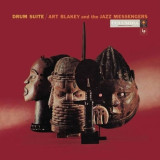
One of the inventors of the modern bebop style of drumming, Blakey is known as a powerful musician and a vital groover; his brand of bluesy, funky hard bop was and continues to be profoundly influential on mainstream jazz.
For more than 30 years his band, Art Blakey & The Jazz Messengers included many young musicians who went on to become prominent names in jazz. Recorded in 1956, Art Blakey's Drum Suite is a wonderful hybrid of African, Latin, and hard bop rhythms that prefigures the concept of Afro-beat by at least a decade. The sheer energy, not to mention its very special and fresh-sounding intimacy, make it especially astounding.
Even more amazing is that the three parts of the suite -- Blakey's "The Sacrifice," Ray Bryant's "Cubano Chant," and Oscar Pettiford's "Oscalypso" -- were recorded straight through live, and were only intended to be a pre-take run-through. As is obvious here, Blakey and company nailed the whole thing right out of the box.
Groundbreaking for its time, and still sounding vital, powerful, and visionary, the Drum Suite album is somewhat of a lost masterpiece that deserves a fresh audience.
"Art Blakey's first release for Columbia Records is essentially two records. Side one is a percussion ensemble playing what would, ten years later, be called Afro-Cuban drumming. Side two is the mid-fifties version of the Jazz Messengers featuring Jackie McLean on saxophone. Side one features Blakey, Jo Jones and Charles Wright on drums, Candido and Sabu on bongos, and Oscar Pettiford and bass and cello. The group plays three compositions, one by Blakey, one by Pettiford and one by Ray Bryant, fusing African, Cuban, and calypso percussion into a well-integrated suite.
"The group recorded a run through and it was so perfectly executed that they used the practice run for the release, unedited except to add some Swahili chants by the percussionists during a few passages. One cannot help but think of Olantunji's Drums of Passion, another Afro drumming landmark, here. Blakey's drum suite was recorded at Columbia's 30th Street studios in New York in 1957 and is in mono. The almost stereoscopic image is truly remarkable. Mastered by Kevin Gray and pressed at RTI, Drum Suite is a valuable record of one of the most important figures in jazz history. Recording: 9/10. Music 9/10." - Dennis Davis, Hifi+
"...The three-part suite was laid down in one take with no arrangements, and begins with a few tympani thwacks followed by an African chant. Soon the ensemble kicks in and the group takes off an a sweaty Afro-Cuban-bop journey that will leave you breathless, as the thing crackles with terrific energy. Side Two is more conventional hard bop, but given this group's mastery of if not invention of the style, these tracks are extremely satisfying. Kevin Gray's remastering is detailed and immediate, with plenty of bit and air, if not the widest dynamic range. For anyone interested in percussion of this genre, this is not to be missed." - Wayne Garcia, The Absolute Sound
Julian Cannonball Adderley's only Blue Note album, Somethin' Else, would likely forever be famous in music lore if just for the presence of Miles Davis. The iconic composer/trumpeter steps into the role of sideman on the 1958 set, one of just a handful of times he'd make such a move after the calendar passed the mid-1950s. Yet evaluating Somethin' Else strictly on Davis' involvement misses the big picture. Plain and simple, Adderley's jubilant work remains a jazz landmark due to the chemistry of its Hall of Fame personnel, enthusiasm of its participants, and sophistication of its arrangements – not to mention the reference-grade production and inclusion of the definitive renditions of two all-time jazz standards.
Limited to 6,000 numbered copies, pressed on dead-quiet MoFi SuperVinyl at RTI, and mastered from the original master tapes, Mobile Fidelity's ultra-hi-fi UltraDisc One-Step 180g 45RPM 2LP collector's edition pays tribute to the record's merit and includes the bonus track "Allison's Uncle." Offering reference-calibre sonics, this spectacular collector's version provides a clear, transparent, ultra-dynamic, and up-close view of a cornerstone effort that witnesses Adderley and Davis sharing horn duty alone for the only time in their fabled careers – an arrangement that occurred as a result of Adderley having joined Davis' majestic sextet a year prior.
The premium packaging and beautiful presentation of the UD1S Somethin' Else pressing befit its extremely select status. Housed in a deluxe slipcase, it features special foil-stamped jackets and faithful-to-the-original graphics that illuminate the splendour of the recording. No expense has been spared. Aurally and visually, this UD1S reissue exists as a curatorial artefact meant to be preserved, touched, and examined. It is made for discerning listeners that prize sound quality and production, and who desire to fully immerse themselves in the art – and everything involved with the album, from the iconic photos to the gorgeous finishes.
The vibrant potency reveals itself openly on an analogue set that provides full-range reproduction of an ensemble that also includes pianist Hank Jones, bassist Sam Jones, and drummer Art Blakey. Each and every snare hit, downbeat, and cymbal splash registered by the latter take on realistic proportions, blooming and decaying as they would right in front of you on a stage. Jones' foundational bass lines register with uncommon depth and palpability, the litheness of the strings and fullness of the instrument epitomizing the definition of rhythm. Stellar, too, are the surefooted 88s. Sublime in scale, tonality, and attack, with the delineation such you can practically separate the white and black keys in your mind. As for that liquid interplay between Adderley and Davis? Breathtakingly lifelike in timbre, naturalism, purity, and presence. This collector's version takes you there – there being Rudy Van Gelder's legendary New Jersey studio in March 1958 to witness it all unfold, again and again.
For reasons that extend far beyond the outstanding playing and flawless repertoire, Somethin' Else is without question a record you'll always want to watch and hear come together. As veteran critic Bob Blumenthal observed writing about the album four decades after its release, "The instant rapport achieved by the quintet is thus the product of much shared and common history, though the tensile strength that they create throughout created a totally unique feeling that can be attributed to the sensitive musicianship of all concerned, including the supposedly hard bopping leader and drummer." Such inimitable feeling, or emotion, courses throughout every passage, and no where more obviously than on "Autumn Leaves" and "Love for Sale."
Without question, the discreet interpretations of the Johnny Mercer and Cole Porter songs, respectively, found on Somethin' Else have long been considered part of jazz's alluring mystique. Adderley and Davis bring contrasting approaches to the table yet sound of a singular mind on "Autumn Leaves," with the latter's muted trumpet and the headliner's lush alto saxophone dovetailing into a performance that endures as a blueprint for expression, counterpoint, sophistication, fluidity, and linearity. Blues, melody, and romance pour from their horns. Their bandmates, picking up on the intimate vibe and calm mood here – as well as on the spry, head-over-heels spirit of "Love for Sale" – join in on the conversation with sharp economy and float-on-air roundedness.
Not to undersell the other three numbers, all deserving five-star status. Twelve measures in length, the title track offers a slow burn in swing. Written by Adderley's brother, Nat, the 12-bar "One for Daddy-O" transmits funk flavors. The closing "Dancing in the Dark" pops with lushness and temptation, its stream of bold colours and understated textures calling for a moonlight twirl, or at least fantasies suggestive of a memorable night. Somethin' else, indeed.
When he first came on the scene, Phil Woods was often referred to as
"The New Bird," in a nod to the legendary Charlie Parker - A testament to
his genius on the saxophone to be sure
But while obviously indebted to Parker - as all modern jazz saxophonists of a
certain era were - there is no question that Phil Woods was an original. After
earning a degree in music from Juilliard in the early 1950's, Woods found himself
in the orbit of the great Quincy Jones. At Jones' invitation Woods joined Dizzy
Gillespie's infamous Jazz Ambassadors - a tour sponsored by the US State
Department as part of a global cultural diplomacy initiative - and subsequently
became a member of Jones' own touring band. This recording, his 9th album as a
band leader, consists entirely of Woods' five- part Rights of Swing Suite. An
ambitious large-scale composition based solidly on jazz traditions. A culmination
of the influences the then 30 year artist had absorbed. Arguably considered one
of Woods finest recordings, the record features a stellar section made up of
Wood's fellow Quincy Jones band members. (It should be noted that these same
musicians, for the most part, are also the section on Benny Bailey's Candid
Records recording, Big Brass, recorded a a few months prior in November of
1960). Recorded at the Nola Penthouse Studios in New Your City on two dates in
January and February of 1961, and conducted by Quincy Jones. The LP includes
extraordinary liner notes by Candid A&R man and producer Nat Hentoff, and indepth commentary from Woods himself, giving a context and insight that adds to
the experience of hearing these extraordinary performances
WHITE VINYL[49,16 €]
It would be difficult to overstate the importance of the Jones brothers Thad, Hank and Elvin on the world of jazz. Between the three of them, their performances can be heard on literally thousands of recordings, including some of the most legendary sessions ever recorded with some of the greatest artists. Post-War Detroit was really taking notes on the new sounds of jazz coming into favor and the group of former Detroiters included on this album include some of its most virtuosic students. Thad Jones, (although he was technically from nearby Pontiac, MI) on trumpet, Kenny Burrell on guitar, Tommy Flanagan on piano and Billy Mitchell on saxophone. Jones’ first for Blue Note from 1956 stands as a fantastic sounding announcement that the Detroiters had landed in New York and were about to take off. Including legendary players Shadow Wilson on Drums and Oscar Pettiford on Bass; Detroit - New York Junction, a long sought after rarity and a true testament to the importance of Detroit on the evolution of jazz music through Blue Note Records. Recorded at Audio Video Studios - New York, NY 1956 by Alfred Lion and Rudy Van Gelder
Black Vinyl[49,16 €]
It would be difficult to overstate the importance of the Jones brothers Thad, Hank and Elvin on the world of jazz. Between the three of them, their performances can be heard on literally thousands of recordings, including some of the most legendary sessions ever recorded with some of the greatest artists. Post-War Detroit was really taking notes on the new sounds of jazz coming into favor and the group of former Detroiters included on this album include some of its most virtuosic students. Thad Jones, (although he was technically from nearby Pontiac, MI) on trumpet, Kenny Burrell on guitar, Tommy Flanagan on piano and Billy Mitchell on saxophone. Jones’ first for Blue Note from 1956 stands as a fantastic sounding announcement that the Detroiters had landed in New York and were about to take off. Including legendary players Shadow Wilson on Drums and Oscar Pettiford on Bass; Detroit - New York Junction, a long sought after rarity and a true testament to the importance of Detroit on the evolution of jazz music through Blue Note Records. Recorded at Audio Video Studios - New York, NY 1956 by Alfred Lion and Rudy Van Gelder
- A1: New Day
- A2: Palosanto
- A3: Don't Be Afraid
- A4: Mission (Feat Kid Abstrakt)
- A5: Train 2 Moabit (Feat Figub Brazlevic)
- A6: Insomnia
- A7: Pills (Feat Phoniks)
- A8: If I Had A Diary (Feat Keepvibesnear)
- B1: Blunotte (Feat Flofilz)
- B2: Luna Piena
- B3: Mandala (Feat Pachakuti)
- B4: Getting By (Feat Ryshon Jones)
- B5: Meditation
- B6: Healing
- B7: U Do
- B8: Things Are Going To Be Alright
“Insomnia” is the third solo album from Italian jazz beat maestro Koralle for Melting Pot Music. Without exaggeration, it can be described as the most mature and advanced piece of work by the beatmaker and producer from Bologna. On “Insomnia” Koralle invites some of his favourite artists and musical peers to collaborate and exchange sounds, ideas, beats, melodies and lyrics. The guest list includes fellow producers & musicians FloFilz, Pachakuti, Figub Brazlevic, Kuranes, Phoniks and Brous One as well as rappers and singers Kid Abstrakt, KeepVibeNear, Ryshon Jones.
All tracks produced and mixed by Koralle. Recorded at Godblesscomputers Studio, Bologna (Italy). Mastered by Roe Beardie. Artwork by Giulia Dall'Ara. Layout by Chicken George.
- A1: The Battle Dub Feat Emilie Chick (Straight Dub Mix)
- A2: Galactic Beats Dub (Straight Mix)
- A3: Lava Dub Feat Ua (Straight Dub Vocal Mix)
- A4: Mirror Dub Feat Josué Thomas (Straight Mix)
- A5: Outer Space Dub Feat Dj Krush (Straight Dub Mix)
- B1: I'm Thinking, I'm Spacing Dub Feat Afrika Bambaataa (Straight Dub Mix)
- B2: Sumimasen Suite Dub Feat Emily Capell, Rebel Dread (Straight Dub Mix)
- B3: We Need Power Dub Feat Josh Milan (Straight Dub Mix)
- B4: Hear?There? Beyond Dub Feat Kan Takagi, Reck (Straight Dub Mix)
Yasushi Ide, the Japanese Street Music Icon Unleashed "Cosmic Suite 2" in a Revolutionary Blend of Genres.
Yasushi Ide, the revered figure in Japanese street music, has recently unveiled his latest musical opus titled "Cosmic Suite 2," a rebel music masterpiece that pushes the boundaries of musical genres.
This groundbreaking album features collaborations with esteemed pioneers including Afrika Bambaataa, Don Letts, Josh Millan, Jeff Mills, DJ Krush, Tony Allen, and more. By transcending the limitations of time, genre, and even mortality, Ide has crafted a truly unique and eclectic street music experience unlike anything seen before.
Notably, Ide enlisted the expertise of Grammy-winning sound engineer Steven Stanley to embark on the reconstruction of "Cosmic Suite 2" using his renowned dub mix techniques. The outcome of this collaboration is the birth of "Dr. Steven Stanley Meets Yasushi Ide - Cosmic Disco Dub," a mesmerizing rendition that showcases the genius of both artists.
Hailing from Jamaica, Steven Stanley is a highly regarded sound engineer and producer whose illustrious career spans several decades, primarily in the realms of reggae, dub, and rock music. Having worked with acclaimed acts such as Talking Heads, Black Uhuru, and Tom Tom Club, Stanley has solidified his status as a living legend within the industry. His contributions to Tom Tom Club's "Genius of Love" and his Grammy-winning work on Black Uhuru's "Anthem" further exemplify his unparalleled expertise. Additionally, Stanley has collaborated with notable artists including Grace Jones and B-52's.
In "Dr. Steven Stanley Meets Yasushi Ide - Cosmic Disco Dub," Stanley expertly integrates elements from the original "Cosmic Suite 2" tracks, employing his unique dubbing techniques to enhance the sonic experience. Through the addition of his signature dubby reverb and other distinctive sound manipulations, Stanley elevates the album to an entirely new dimension.
"The Battle" Transformed into an Enchanting Disco Dub Experience, Infused with Stanley's Horn Section Effects for a smoky ambience.
In the mesmerizing track "Galactic Beats," the legendary Afrobeat pioneer Tony Allen's powerful drums take center stage. Skillfully applying his dub effects, Stanley adds vibrant layers and new dimensions to the composition, further enhancing its sonic palette.
Another standout is the dub version of "LAVA," featuring acclaimed Japanese singer UA. The track, which was already a fan favorite in its original form, undergoes a remarkable transformation in this dub rendition, further accentuating its appeal.
"Outer Space" Transcends Time and Genre with a Dream Collaboration Between the Late Legendary Reggae Drummer Style Scott and Japan's Turntablist Extraordinaire, DJ Krush. While the original track exudes a stoic and deep cosmic dub essence, Stanley ingeniously reimagines it as a nostalgic old-school dancehall masterpiece.
"Sumimasen" is a track that exemplifies Stanley's mastery, where the unique Japanese word "Sumimasen" (meaning "I'm sorry") is transformed into a psychedelic and deeply immersive dub journey. The track features captivating echoes on the vocals and twisted synth elements, transporting listeners to a cosmic realm of sonic exploration.
Furthermore, it is crucial to highlight "Hear, There, and Beyond," a collaboration between Yasushi Ide, Kan Takagi, the pioneering figure of Japanese hip-hop, and RECK, the bassist from the legendary punk rock band FRICTION. This reconstructed version takes the original track to unprecedented heights. With a remarkable shift to tribal drums in the midst of the song, the energy intensifies, resulting in a wild and exhilarating musical experience.
The reconstruction of this album evokes memories of Mad Professor's "No Protection," a renowned dub reconstruction of Massive Attack's work that remains an enduring masterpiece in the genre. With its exceptional craftsmanship and artistic vision, "Dr. Steven Stanley Meets Yasushi Ide - Cosmic Disco Dub" has the potential to be regarded as another timeless dub reconstruction masterpiece, solidifying its place in music history.
'In The Moment That You're Born' features 10 never released songs, and all the lyrics were solely written by the late Shawn Smith, exception made for Stars N’ You, (originally written by Andy Wood of Mother Love Bone and Malfunkshun for the Deep Six Compilation). Barrett Jones plays piano on "Meadow in Autumn", while Hans Teuber plays horns and keys on various other tracks. The album was self-produced by Brad, and recorded and mixed by Floyd Reitsma at Studio Litho in Seattle (except for "In The Moment That You're Born," which was mixed by Josh Evans). The artwork was cured and crafted by Regan Hagar with the addition of pictures taken by Lance Mercer. Brad is: Keith Lowe: Bass, Piano, Keys Shawn Smith: Vocials, Guitars, Keys Stone Gossard: Guitars, Keys Regan Hagar: Drums, Keys
- A1: James Brown - Hundred Mile High City (Ocean Colour Scene)
- A2: Skanga - It's A Deal, It's A Steal (Tom, Nick & Ed)
- A3: Junior Murvin - The Boss
- A4: Lewis Taylor/Carleen Anderson - Truly, Madly, Deeply
- A5: Dusty Springfield - "Hortif**Kinculturist" (Winston)
- A6: John Murphy/David Hughes - Police & Thieves
- B1: Robbie Williams - 18 With A Bullet
- B2: E Z Rollers - Spooky
- B3: The Stooges - The Game
- B4: The Castaways - "Muppets" (Harry, Berry & Gary)
- B5: Stretch - Man Machine
- B6: Evil Superstars - Walk This Land
- C1: John Murphy & David Hughes - "Blaspheming Barry" (Barry)
- C2: John Murphy & David Hughes - I Wanna Be Your Dog
- C3: John Murphy & David Hughes - It's Kosher (Tom & Nick)
- C4: James Brown - Liar Liar
- C5: The Stone Roses - "I've Been Shot" (Plank & Dog)
- C6: Pete Wingfield - Why Did You Do It
- C7: Guns 4 Show Knives 4 A Pro" (Ed & Soap)
- C8: Oh Girl
- C9: If The Milk Turns Sour (With Rory)
- C10: Zorba The Greek
- D1: I'll Kill Ya (With Rory)
- D2: The Payback
- D3: Fools Gold
- D4: It's Been Emotional (Big Chris)
- D5: 18 With A Bullet
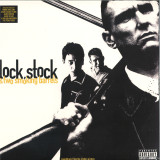
Originally released on Island Records in September 1998, the soundtrack to the box-office smash film, written and directed by Guy Ritchie, quickly became a must-own album, and is frequently cited as one of the best movie soundtracks of all time.
Lock, Stock and Two Smoking Barrels redefined the British gangster film and established Guy Ritchie as one of the greatest directing and writing talents of his generation. Using a frenetic mixture of filmic styles, humour, violence, breakdown of the fourth wall, narration, and vast amounts of swearing, it is hard to imagine a time when this film and its influence was not around. It made a star of the-then unknown Jason Statham, and, amazingly, hard man footballer Vinnie Jones, who as Big Chris, had several scene-stealing moments. Taking his cue from Quentin Tarantino, who had been meticulously curating his film soundtracks since the early 90s, Ritchie made the music to his film tell its own story, complete with memorable snatches of dialogue between many of the tracks.
It offers a beautifully eclectic selection of songs from the preceding three decades, plus then-current artists providing some of their best material, such as Hundred Mile High City by Ocean Colour Scene or E-Z Rollers' drum'n'bass masterpiece Walk This Land. Of the heritage tracks, Dusty Springfield sings her sultry take on Spooky; James Brown appears twice with The Boss and The Payback; The Stooges with I Wanna Be Your Dog, and two versions of Pete Wingfield's masterful one-hit-wonder 18 With A Bullet; in its 1975 original and a contemporary cover by Lewis Taylor and Carleen Anderson. And this is only half of it.
- A1: Leonard Nimoy – Music To Watch Space Girls By
- A2: Martin Denny – The Enchanted Isle
- A3: Yma Sumac – Gopher
- A4: The Bongolian – B-Boy Toga Party
- A5: Los Bitchos – The Link Is About To Die
- A6: Herb Alpert & The Tijuana Brass – The Lonely Bull (El Solo Toro)
- A7: Michael Giacchino & Nouvelle Modernica Orchestra – Sidereal Day: 3 (Instrumental)
- B1: Mel Tormé – Sunshine Superman
- B2: Sergio Mendes & Brasil ’66 – Mais Que Nada
- B3: Lalo Schifrin – Lalo's Bossa Nova
- B4: Quincy Jones – Black Orpheus (Manha De Carnaval)
- B5: Les Baxter & 101 Strings Orchestra – Tropicando
- B6: Pizzicato Five - They All Laughed
- B7: Alain Goraguer – Les Hommes
- B8: Hugo Montenegro & His Orchestra – The Good, The Bad And The Ugly
- C1: Mort Garson & The Lords Of Percussion – Geisha Girl
- C2: Arthur Lyman – Quiet Village
- C3: Les Baxter – Voodoo Dreams / Voodoo
- C4: Cal Tjader – The Lady Is A Tramp **
- C5: Martin Denny – The Enchanted Sea
- C6: Ixtahuele – Mareld 2021
- C7: Keith Mansfield – Morning Broadway
- D1: Mel Tormé – Comin' Home Baby
- D2: Dave Pike – Sweet Tater Pie
- D3: Jack Trombey – Underlay No.3
- D4: Don Sebesky – Guru-Vin **
- D5: Keith Mansfield – Beat Me Till I'm Blue
- D6: Brian Bennett & Keith Mansfield – Mermaid **
- D7: Sheila – Bang Bang
coloured 2x12"[35,08 €]
Jamie Jones and Lee Foss’ Hot Creations welcomes a loaded new EP as Andre Salmon, Michael Joseph and Lexlay collaborate across four tracks for their ‘Momii’ EP.
Home to stand-out collaborations such as Todd Terry and Riva Starr’s recent ‘This Is The Sound’ through to classics such as Jamie Jones and The Martinez Brothers’ ‘Bappi’, Hot Creations has always been a platform and label pairing unique and exciting artist combinations with impressive results.
Closing July, the label now invites a stacked selection of artists for a big collaborative release as label signee Andre Salmon returns for his second release on the imprint and combines with Orlando’s Michael Joseph and Barcelona’s Lexlay, also featuring Figio, Francis Davila and Cami Jones.
The three main featured artists take the helm on the title track ‘Momii’ for a skippy and slick lead effort, while Salmon and Joseph link with Milan’s Figio’s for the snaking, percussion-driven ‘Aquarium’. Next, the three lead names unite once more and combine rumbling low-ends and lively hats on the bubbling ‘Left Hand’, before Salmon and Joseph once again link with fresh talent as Francis Davila joins the party, working warping synths and rolling drums around the alluring vocals of Cami Jones.
Long time Leng recording artists 40 Thieves are back with one of their most notable singles to date – a surprise collaboration with two NYC disco originals, storied vocalist Cinnamon Jones and multiinstrumentalist/producer Gary Davis.
San Francisco outfit 40 Thieves has been serving up cosmic, dubbed-out and otherworldly contemporary disco treats since the mid 2000s, and have been part of the Leng family since 2011. The crew, headed up by Layne Fox, Jay Williams and Corey Black, have released countless killer cuts on the label, as well as an expansive
debut album, 2014’s The Sky Is Yours.
They’ve worked with other artists before, but nobody at the same legendary level as Cinnamon Jones and Gary
Davis. The latter cut his teeth as a musician working with iconic disco producers Patrick Adams and Peter Brown at their P&P Records stable, before becoming a producer and artist in his own right writing and arranging the disco classic ‘Got To Get Your Love’ performed by Clyde Alexander & Sanction.
Jones, meanwhile, has enjoyed a hugely successful career both in her native New York (as Joyce Jones, an original member of First Choice) and on the West Coast, where she not only became an in-demand performer, but also snagged a role in the Supremes biopic Dream Girls.
‘The Gift’ is one of Jones’ most cherished solo songs – a joyful celebration of a new day dawning that has long been popular in her live sets. With input and instrumentation from Davis and a fantastic delivery of her own lyrics by Jones, 40 Thieves has successfully re-framed the track as a sunrise-ready future Bay Area free party
favourite; a dubbed-out, suitably cosmic creation that’s presented in three potent versions.
Leading the charge, and stretched across side A of the vinyl version is the band’s ’Disco Mix’ which boasts a fully realised instrumental arrangement and extensive use of passages from Jones’ vocals. Not all the lyrics are present as the Bay Area band has chosen to focus on selected lines that most neatly fit their musical vision and
celebrate the joys of dancing at sunrise. There are more spaced-out keyboard solos, sharper guitars (smothered in effects in true 40 Thieves fashion) and sound design that’s as immersive as it is heady and intoxicated.
On the flip is the ‘Disco Dub’. A bona-fide dub disco chugger rich in relentless synth-bass, addictive guitar licks, echo-laden vocal snippets, sparkling nu-disco electronics, tactile, deep house style electric piano stabs and cosmic effects aplenty, it’s a track tailor-made for slowly shuffling while the sun peeps over the horizon.
To complete an inspired package, 40 Thieves have also included a killer DJ tool: a ‘Beats’ take that wraps energy packed percussion hits, trippy electronic noises, trailing dub delays and sparse melodies around a metronomic drum machine beat. It’s a wavy, groovy and pleasingly mind-altering way to conclude one of 40 Thieves’ most magical EPs to date.
Grammy-winning producer, composer, guitarist and songwriter Blake Mills returns with his first solo record since 2020’s Mutable Set, co-produced by Blake and experimental artist Chris Weisman.
Blake Mills has released four acclaimed solo albums and produced, played and recorded with artists such as Fiona Apple, Alabama Shakes, Phoebe Bridgers, Perfume Genius, Moses Sumney, Bob Dylan, Laura Marling, Cass McCombs, Weyes Blood and Randy Newman, among others. His album Mutable Set, released in in 2020, was praised by Pitchfork as “a hushed collection that floats through the subconscious like a tender dream” and earned their Best New
Music title. Most recently, Mills worked as the Executive Music Producer and chief songwriter on Amazon Prime’s limited series Daisy Jones and the Six.