Search:as i may

Styles
All
BROR GUNNAR JANSSON & THE ESCAPISM - - PEOPLE!
  • A Refugee
  • Refuge
  • Blood
  • Occupied
  • At The Diner 2
  • At The Penitentiary
  • A Beggar
  • People!
  • A Generic Breakup Ballad

180g, turquoise vinyl. Perhaps the hardest thing about Soul music is convincing. If the place and the experiences don't somehow shine through and meet us, we risk missing out on what's on offer completely. "But first_ are you experienced?" as Jimi Hendrix asked. That's precisely why Soul music is difficult in Sweden. There are few who can portray their experiences in music in a way as convincing as in the Black US Soul tradition. This however seems almost provocatively easy for Bror Gunnar Jansson to do. On the album People, it's as if he pours both lyrics and melodies that have grown slowly in life and that come naturally if you grow up on the right soil. And on almost every song, it only takes a few bars for Bror Gunnar Jansson & The Escapism to show who their musical relatives are. Although Gunnar seems to move freely in musical landscapes ruled by the greats of seventies soul from Al Green, Curtis Mayfield and Aretha Franklin, as well as in some of the fringes of blues and jazz territory, both he and drummer and producer Christopher Cantillo explain that the album has took a long time brewing. And that what may appear obvious and simple has sprung out of a friendship that spans more than half of their lives.

pre-order now12.09.2025

expected to be published on 12.09.2025

23,11
MATT WATTS - HOW DIFFERENT IT WAS WHEN YOU WERE THERE LP
  • A1: Time Turns As An Engine
  • A2: Joanne
  • A3: Your Love Is Not Your Own
  • A4: How Many Years
  • A5: Just One Man To Be Turned Loose
  • A6: If We’ll Ever Be Here Again
  • B1: Things Have Surely Changed
  • B2: Days Have Come And Gone
  • B3: Endless Twisted Root
  • B4: Many An Friend Too Kind
  • B5: Known Thieves

Matt Watts (1987–2024) was born in Philadelphia, in the USA. He recorded his first songs along the banks of the Missouri River in Montana when he was 15, touring the north-western states extensively as a young troubadour. He arrived in Belgium at the tender age of 19 and grew into a full-fledged singer-songwriter that combines a profound respect for the folk tradition with contemporary influences.

His solo album, Songs from a Window, was released in 2014 by Starman Records and received glowing praise in the press.

Matt Watts played dozens upon dozens of shows in the Benelux, often together with Stef Kamil Carlens and Nicolas Rombouts. While his predecessor Songs from a Window was a true solo album, How Different It Was When You Were There includes personal stories by Watts that have been subtly seasoned with wonderful musicians such as Nathalie Delcroix, Bjorn Eriksson, Geert Hellings (Stanton, Guido Belcanto), Maarten Moesen (Guido Belcanto), and bassist and this album’s producer, Nicolas Rombouts (formerly with Dez Mona, Stef Kamil Carlens, The Colorist, Guido Belcanto, and many others).

One of the highlights of this album, which truly showcases Matt Watts’ awakening, is “Many a Friend Too Kind”: a fabulous duet with Stef Kamil Carlens. Watts also performed in Zita Swoon Group’s production, The Ballad of Erol Klof. Sadly, Matt Watts passed away in June 2024.

MORE QUOTES

“Watts, who washed up in Belgium, sings his personal, poetic lyrics in a high, whispering voice that immediately brings Nick Drake to mind.” 4/5 **** (De Standaard)

‘This is an album full of sincere sentiment and stimulating, evocative stories in fine songs that have been beautifully coloured by Watts and his band, and on which he brings the narrative aspect to the fore more than ever.’ (daMusic)

‘Sensitive songwriter, exceptional storyteller... Introverted, dark, more country, less Nick Drake.’ (OOR)

‘This is real, raw, authentic. Well done, Matt, very well done.’ (Keys And Chords)

‘And no matter how young Matt Watts may be, the singer/musician writes timeless songs reminiscent of those by David Blue and John Martyn...’ (Rootstime)

‘Matt knows how to strike that chord in the same way as Cohen, which immediately moves you. From the beginning to the end of this record.’ (Gigview)

‘A singer-songwriter who believes in simplicity (not a note too many), but grabs you by the scruff of the neck from the start and confronts you with the painful beauty of romance.’ (Luminous Dash)

‘Let's be honest here: Belgium has simply become too small for an album like “How Different It Was When You Were There”. Song material of this calibre deserves a much, much wider audience!’ 4.5***** (ctrl.alt.country)

pre-order now12.09.2025

expected to be published on 12.09.2025

23,95
Thomas Dolby - The Golden Age of Wireless
  • Flying North
  • Commercial Breakup
  • Weightless
  • Europa And The Pirate Twins
  • Windpower
  • The Wreck Of The Fairchild
  • Airwaves
  • Radio Silence
  • Cloudburst At Shingle Street

"The Golden Age of Wireless is the debut album by English musician Thomas Dolby. The album was originally released in May 1982. Several tracks have a submerged, barely audible layer of almost random sound that serves as a constant (and disturbing) subtext, occasionally erupting into a song. This sonic underworld is all part of Dolby's mechanical wizardry. Rolling Stone magazine awarded The Golden Age of Wireless four stars out of five, calling it ""one of the most impressive debuts"" of 1982. They compared the album's melodicism to the works of Paul McCartney and concluded that ""unlike many synthesizer bands from England, Dolby eschews morbid, droogy drones."" Musician magazine said the album was ""the best damned record to come out of Europe's current fascination with synth-pop. Period."" Theye added, ""Dolby is purely amazing. And best of all, he writes songs.""

The Golden Age Of Wireless is available as a limited edition of 1000 individually numbered copies on silver coloured vinyl and includes an insert. "

pre-order now12.09.2025

expected to be published on 12.09.2025

31,51
NORIO MAEDA - Shadow Of The Highway - Original Soundtrack
  • A1: Highway No Kage ~ Daiichi No Giwaku
  • A2: Matteita Onna ~ Daiichi No Wana
  • A3: Highway No Kage ~ Main Theme
  • A4: Nazo No Onna ~ Wana!?
  • A5: Matteita Onna ~ Main Theme
  • A6: Highway No Kage ~ Wana E No Chosen
  • B1: Sachiusu No Onna ~ Namiko No Tsuioku
  • B2: Nazo No Onna ~ Main Theme
  • B3: Highway No Kage ~ Teki Wo Motomete
  • B4: Sachiusu No Onna ~ Main Theme
  • B5: Matteita Onna ~ Variations
  • B6: Highway No Kage ~ Kanashii Ketsumatsu

Composed, Arranged, and Conducted by: Norio Maeda

Has there ever been a soundtrack so thrilling and beautiful? This is the pinnacle of cine-jazz, crafted by the master Norio Maeda.

Released in 1971, Shadow Of The Highway is a suspense-action film produced and starring Jiro Tamiya, and directed by Jun Fukuda.
True to its tagline—“A sports car tearing vertically through Japan, from Kagoshima to Hokkaido”—the film features a Mitsubishi Galant GTO racing
across the country. Often compared to the American New Cinema classic Vanishing Point, it stands as a Japanese road movie gem.

The music was composed by the legendary Norio Maeda. His piano corners with elegance, the vibraphone dashes forward with flair, the bass charges
ahead with power, and the drums shift gears with precision. Motion and stillness, obsession and desire, joy and sorrow—thrilling performances and
beautiful melodies elevate the film to new heights.

As a soundtrack, it is exceptional. But even more, it represents an extraordinary level of quality for Japanese jazz in 1971. The performances are so
remarkable that it’s unfortunate the exact personnel remain unidentified. However, it has long been rumored that the musicians may have been associated
with Takeshi Inomata’s Sound Limited—or possibly The Third.

Text by Yusuke Ogawa (UNIVERSOUNDS / DEEP JAZZ REALITY)

pre-order now12.09.2025

expected to be published on 12.09.2025

43,07
Various - Dolores: Salsa & Guaracha From 70's French West Indies

In Guadeloupe, many people think that jazz and ka music are like a ring and a finger. To some extent, the same could be said about so called Latin music and the music played in the French West Indies.

Both aesthetics were born in the Caribbean and bear so many connections that they can easily be considered cousins. In constant dialogue, there are lots of examples of their fruitful alliance and have been for a while. The English country dance that used to be practiced in European lounges came to be called kadrille in Martinique and contradanza in Cuba. They both featured additional percussion instruments inherited from the transatlantic deportation. Drawing from shared feelings about the same traumatized identity – later to be creolized – it would be hard not to assume that they were meant to inspire each other. The golden age of the orchestras that graced the Pigalle nights during the interwar period further proves the point. As soon as the 1930s, Havana-born Don Barreto naturally mixed danzón and biguine music in a combo based at Melody's Bar. In the following decade, Félix Valvert, a conductor who was born and raised in Basse-Terre in Guadelupe, also worked wonders in Montparnasse with La Coupole, which was an orchestra made up of eclectic musicians. Afro- Caribbean performers of various origins were often hired on rhythm and brass sections in jazz bands, which used to enliven the typical French balls of the capital. In the 1930s and onwards, Rico’s Creole Band was one of them.


Martinican violinist-clarinettist Ernest Léardée, who would become the king of biguine music as well as the main figure of French Uncle Ben's TV commercials (a dark stigma of post-colonial stereotypes), had musicians from the whole Caribbean sphere play at his Bal Blomet – and they all enchanted "ces Zazous-là" (according the words of Léardée's biguine-calypso piece). In les Antilles (French for French West Indies), music history started to speed up in the 1950s, when trade expanded and radio stations grew bigger. The Guadelupean and Martiniquais youth tuned in their old galena radio sets to South American and Caribbean music. As for the women traders, les pacotilleuses, they bought and sold goods across different islands (the "passing of items through various hands" was thought to be most pleasurable) and brought back countless sounds in their luggage. Such was the case of Madame Balthazar, who once returned from Puerto Rico with the first 45rpm and 33rpm to ever enter Martinique.

Out of this adventure was created the famous Martinican label La Maison des Merengues, a music business she opened and undertook with her husband and which proved to be a major landmark. At the end of the 1950s, in Puerto Rico, Marius Cultier competed in the Piano International Contest playing a version of Monk's Round 'Midnight. He won the first prize and this distinction foreshadowed everything that was to come. Cultier, the heretic Monk of jazz, was quickly praised for writing superb melodies, always tinged with a twist that conferred a unique sound to his music. It didn't take long for the gifted self-taught musician to get to play with Los Cubanos, making a name for himself thanks to his impressive maestria on merengues.

The rest is history. Besides, in the late 1950s, Frantz Charles-Denis, born into the upper middle class in Saint-Pierre and better known by his first name Francisco, went back home after working at La Cabane Cubaine – a club located rue Fontaine where he had caught the Latin fever. Francisco's music was therefore heavily marked by his Cuban cousins' influence, which gave the combos he led a specific style and also led to renewal. Things were swinging hard in La Savane, located in the main square in Fort-de-France. He set up the Shango club close by and tested out the biguine lélé there, a new music formula spiced up with Latin rhythms. Soon afterwards, fate had him fly to Puerto Rico and Venezuela.

As for percussionist Henri Guédon (percussions were only a part of his many talents), he was born in Fort-de-France in May 22nd 1944, the day marking the celebration of the abolition of slavery. As an old man, he could remember that in " his father's Teppaz, a lot of hectic 6/8 music was constantly playing...". In the opening lines of his Lettre à Dizzy, a small illustrated collection of writings published by Del Arco, he highlighted the huge impact that cubop had on him as a teenage boy, around 1960. He eventually turned out to be the lider maximo in La Contesta, a big band steeped in Latin jazz. He was also the one who originated the word zouk to describe music which brought the sound of the New York barrio to Paris. It was the culmination of a journey that started in Sainte-Marie: "a mythical place for bélé, the equivalent of Cuban guaguancó". In the early 1960s, the tertiary economy developed to the detriment of agriculture. Yet rural life was where roots music emerged in Martinique and in Guadeloupe.

Record companies played a major part in the process of Latin versions sweeping across the islands – before reaching everywhere else. Producer Célini, boss of the great Aux Ondes label, and Marcel Mavounzy, both the head of Émeraude records - a firm which was founded in 1953 - as well as the brother of famous saxophonist Robert Mavounzy, were big names to bear in mind. Although there were many of them - all of whom are featured on this record - Henri Debs was definitely the major figure in the recording adventure. He proved to be so influential that he even got compared to Berry Gordy. In the mid 1950s, when he acquired his first Teppaz, he worked on his first compositions: a bolero and a chachacha. Then, he became the one man who made people discover Caribbean music, from calypso to merengue. He was among the first ones to rush out to San Juan, Puerto Rico, to buy records and distribute them through a store run by one of his brothers in Fort-de-France. He had members of the Fania All Star come and perform there, which he was madly proud about. He was also the first one to pay attention to Haitian music, such as compas direct and various other rhythms which would soon flood the market. As a result, many of the combos hitting his legendary studio would end up boosted by widespread "Afro-Latin" rhythms. However, he never denied his identity: gwo ka drums were given a major role, although they were instruments which had long been banned from the "official" music spheres. The present selection bears witness to such a creative swarming. Here are fourteen tracks of untimely yet unprecedented cross-fertilization: all types of music rooted in the Creole archipelago have found their way, whatsoever, to the tracklisting. Whether originating from the city or being more rural, they all go back to what Edouard Glissant, in an interview about the place of West Indian music in the Afro-American scope, called "the trace of singing, the one which got erased by slavery." "It is so in jazz, but also in reggae, calypso, biguine, salsa... This trace also manifests through the drums, whether Guadelupean, Dominican, Jamaican or Cuban... None of them being quite the same. They all point to the idea of a trace, seeking it out and connecting to each other through it. This is the hallmark of the African diaspora: its ability to create something new, in relation to itself, out of a trace. It may be the memory of a rhythm, the crafting of a drum, a means of expression which doesn't resort to an old language but to the modalities of it." The opening track features one of the emblematic orchestras of this aesthetic identity, criscrossing many music types from the archipelago. The 1974 Ray Barretto guajira – Ray Barretto was a major New York drummer influenced by Charlie Parker and Chano Pozzo – is magnificently performed by Malavoi, a legendary Fayolais group (i.e from Fort-de-France). Additionally, the compilation ends on a piece by Los Martiniqueños de Francisco. It symbolically closes the circle as it is a genuine potomitan of Martinique culture which also functions as a tireless campaigner for Afro-Caribbean music. Practicing the danmyé rounds (a kind of capoeiria) to the rhythm of the bèlè drum, it delivers a terrific Caterete, a kind of champeta of Afro- Colombian obedience which was originally composed by Colombian Fabián Ramón Veloz Fernández for the group Wgenda Kenya. The icing on the cake is Brazilian Marku Ribas, who found refuge in Martinique in the early 1970s, bringing his singing to the last trance-inducing track. These two "versions" convey the whole tone of a selection composed of rarities and classics of the tropicalized genre, swarming with tonic accents and convoluted rhythms. It is the sort of cocktail that the West Indians never failed to spice up with their own ingredients. For instance, the Los Caraïbes cover of Dónde, a famous Cuban theme composed by producer Ernesto Duarte Brito, has a typical violin and features renowned Martinique singer Joby Valente and his piquant voice.


The track used to be – or so we think – their only existing 45rpm. The meaningful Amor en chachachá by L'Ensemble Tropicana, a band which included Haitian musicians among whom was composer and leader Michel Desgrotte, also recalls how Latin music was pervasive in the tropics in the mid-1960s. They were the ones keeping people dancing at Le Cocoteraie in Guadelupe and La Bananeraie in Martinique. Around the same time, another "foreign" band, Congolese Freddy Mars N'Kounkou's Ryco Jazz, achieved some success on both islands by covering Latin jazz classics – such as their adaptation of Wachi Wara, a "soul sauce" by Dizzy Gillespie and Chano Pozo whose interweaving of strings and percussions can have anyone hit the dancefloor. How can you resist Dap Pinian indeed, a powerful guaguancó by Eugene Balthazar, performed by the Tropicana Orchestra and published by the Martinique-founded La Maison des Merengues? It also acts as a symbol of the maelstrom at work. Going by the name Paco et L'orchestre Cachunga, Roger Jaffory used to play guaguancó too: his Fania-inspired Oye mi consejo is one example of his style. Baila!!!!! Dancing was also one of the Kings' focus points. Oriza is a Puerto Rican bomba and a "classic" originally composed by Nuevayorquino trumpeter Ernie Agosto, which reserves major space for brasses, giving it a special sheen.

Emerging from the New York barrios crucible was also La Perfecta, a Martinique group originating from Trinidad, whose name directly references the totemic Eddie Palmieri figure as well as his own band, also called La Perfecta. Here they borrow Toumbadora from Colombian producer and composer Efraín Lancheros and interpret it by emphasizing percussions, which set fire to the track even more than the wind instruments. The same goes for Martinique's Super Jaguars, who use Tatalibaba – a composition by Cuban guitarist Florencio "Picolo" Santana which was made famous by Celia Cruz & La Sonora Matencera – as a pretext for sending their cadences into a frenzy. In a more typically salsa vein, the Super Combo, a famous Guadelupean orchestra from Pointe-Noire that was formed around the Desplan family and had Roger Plonquitte and Elie Bianay on board, adapt Serana, a theme by Roberto Angleró Pepín, a Puerto Rican composer, singer and musician also known for his song Soy Boricua. Here again, their vision comes close to surpassing the original. In the 1970s, L'Ensemble Abricot provided a handful of tracks of different syles, hence reaching the pinnacle of the art of achieving variety and giving pleasure. They played boleros, biguines, compas direct, guaguancó and even a good old boogaloo - the type they wanted to keep close to their hearts for ever, "pour toujours", as they sang along together in one of their songs. Léon Bertide's Martinican ensemble excelled at the boogaloo which had been composed by Puerto Rican saxophonist Hector Santos for the legendary El Gran Combo.


Three years later, in 1972, Henri Guédon, with the help of Paul Rosine on the vibraphone, tackled the Bilongo made famous by Eddie Palmieri. Such a classic!!!!! And so were the Aiglons, the band from Guadelupe: choosing to execute Pensando en tí, a composition by Dominican Aniceto Batista, on a cooler tempo than the original, they noticeably used a wonderfully (un)tuned keyboard in place of the accordion. On the high-value collectible single – the first one released by Les Aiglons under the Duli Disc label – there is a sticker classifying the track under the generic name "Afro". Now that is what we call a symbol. Jacques Denis

out of Stock

Order now and we will order the item for you at our supplier.

21,43

Last In: 57 days ago
BARONS OF SOUL - Time or Tide / I Loved and I Lost
  • A1: Time Or Tide
  • B1: I Loved And I Lost

Occasionally, one experiences serendipitous events in life. On the 13th of July this year, I received a message from Tim Trapnell, who had discovered an unknown 60’s track on YouTube and expressed his admiration for its exceptional quality. Intrigued by the message, I clicked on the link and was immediately captivated by the musical composition. Within minutes, I embarked on a quest to uncover more information about the band and the particular track. On the 16th of July, only three days after, I’ve received a message from Jim Bojorquez (aka JC), the lead vocalist of the Baron of Soul, “Hello Yann, I was delighted to hear that you have discovered and enjoyed my original composition, ‘Time or vs Tide.’ It was written by myself and Clark Baldwin. that the recording was performed live and this song was never released in any format back in the day. I have reached out to Jim Bojorquez the next day and we spent a considerable amount of time conversing via video chat about his illustrious 60-year music career as an artist in San Jose, California.

I proposed to Jim that I could release two songs from The Barons of Soul through Epsilon Record Co. I re-mastered both songs and made a deal with Jimmie that same day. So today, I am so pleased to present these two previously unissued tracks. "Time or Tide" is a powerful uptempo piece featuring an exceptional brass section and a Hammond B3. The vocals are exceptionally punchy and catchy, ensuring an unforgettable listening experience. "I Loved and I Lost” is a remarkable take of the Impressions classic written by Curtis Mayfield’s If you are an enthusiast of 60s uptempo music like Tim and myself, then this new and exceptional 45 is an absolute must-listen and must have!

pre-order now10.09.2025

expected to be published on 10.09.2025

19,96
PICKLE DARLING - BATTLEBOTS
  • Obsolete
  • Violence Voyager
  • Earthshaped
  • Congratulations Champion
  • Human Bean Instruction Manual
  • Steps
  • Massive Everything
  • Infinite Trolley

Pickle Darling has always existed just outside of the periphery. In a heightened time of fast music, algorithmic consumption and rapid virality, Lukas Mayo (they/them) has remained focused on the album. Their discography is a reflection of their creative evolution, and they deliberately look for ways to push sonic boundaries from release to release. Since debuting with Bigness in 2019 followed by Cosmonaut in 2021, Mayo has curated a catalog that is deeply personal and strangely tactile, where tiny, unexpected details_an off-kilter loop, a whispered aside, the warmth of an old Casio_become as crucial as melody itself. Their 2023 LP Laundromat was a precise and polished expansion of that world, a record that felt like it had been carefully placed behind glass. Their forthcoming fourth album, Battlebots, by contrast, is unruly and full of static: a collection of songs that feel like they could only ever exist on scratched CD-Rs passed between friends. Self-recorded in their home studio in Christchurch, New Zealand, it finds Mayo taking a scalpel to their own songwriting. Songs were stretched, chopped, reversed. Some ideas started as "unlistenable garbage" before morphing into something unexpectedly beautiful. If a song felt too straightforward, Mayo had to mess it up. That friction of old and new, organic and digital, melody and noise is what drives Battlebots. Drawing inspiration from a strange, scattered lineage: Four Tet's Rounds, The Books, Neneh Cherry's Broken Politics, The Wrens' Three types of reading ambiguity, but also the emotional directness of 2000s pop like Madonna's Ray of Light and Robyn's Body Talk, the result is an album that feels like a glitch in the system, pushing against past constraints while embracing the weird, beautiful mess of making something new.

pre-order now05.09.2025

expected to be published on 05.09.2025

22,27
Various - Friday Night In San Fransisco LP
  • A1: Mediterranean Sundance / Rio Ancho
  • A2: Short Tales Of The Black Forest
  • B1: Frevo Rasgado
  • B2: Fantasia Suite
  • B3: Guardian Angel

Friday Night in San Francisco is a live album by Al Di Meola, John McLaughlin, and Paco de Lucía.

It was recorded live at the Warfield Theatre in San Francisco,

on December 5 in 1980. The album is considered an iconic recording and was described by jazz author Walter Kolosky as
"a musical event that could be compared to the Benny Goodman Band's performance at Carnegie Hall in 1938...
it may be considered the most influential of all live acoustic guitar albums."

Al Di Meola is an acclaimed Italian American jazz fusion and Latin jazz guitarist, composer, and record producer.
He experienced a celebrated career that has spanned four decades and earned him critical accolades,
three gold albums and more than six million record sales worldwide.
Di Meola has amassed over 20 albums as a leader while collaborating on a dozen or so others.


John McLaughlin, also known as Mahavishnu, is an English guitarist, bandleader, and composer.
He is a pioneer of jazz fusion, combining elements of jazz with rock, world music,
Indian classical music, Western classical music, flamenco, and blues. He received multiple "Guitarist of the Year"
and "Best Jazz Guitarist" Awards from magazines such as Downbeat and Guitar Player and was ranked 49th in Rolling Stone
magazine's list of "100 Greatest Guitarists of All Time". Jeff Beck called him "the best guitarist alive".

Paco de Lucía was a Spanish virtuoso flamenco guitarist, composer, and record producer.
He was one of the first flamenco guitarists to branch into classical and jazz. De Lucía was noted for his fast and fluent fingerstyle runs
and gained popularity outside Spain after collaborating with McLaughlin and Di Meola. Richard Chapman and
Eric Clapton described de Lucía as a "titanic figure in the world of flamenco guitar."


Friday Night in San Francisco is available as a limited edition of 1000 individually numbered copies on purple coloured vinyl and includes an insert.

pre-order now05.09.2025

expected to be published on 05.09.2025

31,30
Shooting Daggers - Love & Rage LP

Shooting Daggers

Love & Rage LP

12inchNHSLP044C
New Heavy Sounds
05.09.2025
  • Dare
  • Not My Rival
  • Smug
  • Wipe Out
  • A Guilty Conscience Needs An Accuser
  • Tunnel Vision
  • Bad Seeds
  • Love & Rage
  • Caves/Outro
also available

Black Vinyl[25,17 €]


Love & Rage, the brilliant 2024 debut album from London Queercore trio Shooting Daggers turned many heads with its jaw dropping depth and melody as well as blinding energy, feminist fury and angst. It has to be said that the band are not just bashing it out here. The playing is knockout and the vocals in particular are a standout. Singer Sal proving that she can do hard and fast and cool and melodic with equal aplomb. Add in some really inventive vocal arrangements and harmonies, and you have a band that is pushing that hardcore envelope big time. 2nd edition in Pink vinyl, full colour single outer sleeve, with a full colour printed inner sleeve, with an exclusive A4 poster included as well as a full download code. `Shooting Daggers may well have already made 2024's finest punk album'- Metal Hammer 'a ferocious brand of self-styled queercore punk rock that takes no prisoners' - Kerrang. 'a truly empowering album' - Noizze.

pre-order now05.09.2025

expected to be published on 05.09.2025

23,32
VR SEX - ROUGH DIMENSION

Vr Sex

ROUGH DIMENSION

12inchDAISLP4160
Dais Records
05.09.2025
  • Victim Or Vixen
  • Glutton For Love
  • Cyber Crimes
  • Live (In A Dream)
  • The Walk Of Shame
  • Crisis Stage
  • Taste Of Hate
  • Snake Water
  • End Vision

The latest by Andrew Clinco's acid punk alias VR SEX takes its title from an architectural phrase but more importantly refers to the warped, wicked underworld the songs both chronicle and condemn. Donning the moniker Noel Skum - an acerbic anagram of Elon Musk - Clinco vents his scorn for and fascination with the seedy, surreal margins of low-life Los Angeles, doomed to dead ends of vanity, lust, and technology. Although initially launched as an outlet for "heavier sounds" beyond Clinco's duties in new wave fantasists Drab Majesty, the project has ripened into a compelling exercise in world building, weaving themes of gritty city neofuturist sleaze within a framework of driving, distorted guitars and cathode-blasted synths. Echoes of Chrome, Wire, Minimal Man, and Sisters Of Mercy ripple through the collection but ultimately Rough Dimension charts its own twisted vision of "our unforgiving reality." Written and demoed across two weeks alone in a Marseille flat using his prized 1980's Gibson "Invader" and a laptop, Clinco then took the tracks to Strange Weather studios in Brooklyn to record with Ben Greenberg (Uniform, The Men) who helmed 2019's debut, Human Traffic Jam. The results are notably ripping, refined, and riveting. Riffs in alternate tunings chug and churn over mid-tempo drums punctuated by spikes of sci-fi electronics while the vocals swagger and spit venom ("where we walk is also where we shit / but if we bark at our reflections are we hypocrites? / impulses bleed right into our seed / where hate culminates the apple rotted on the tree"). It's a bristling mix of the melodic and the macabre, absurdist observations of fast living and desperate measures, the clock of youth ticking towards midnight as dreams unravel in Babylon. VR SEX's specialty is making these cautionary tales of psychic decay and tainted love a thrill rather than a drag. There's a sunglasses at night glamor to Clinco's choruses and solos, a wit to his black leather judgements ("what is the answer / to cancerous people / walking in my line of sight?"). The music's milieu tends towards parasites and predators but its mood skews refreshingly accelerated and amused, cruising the strip with a cigarette, watching goths and limousines crawl in gridlock beneath digital billboards. The Rough Dimension may be a cesspool, but it's home.

pre-order now05.09.2025

expected to be published on 05.09.2025

23,49
Gwen Mccrae - All This Love I'm Giving

Yet another solid Soul/Funk nugget lifted from the vaults of Miami's CAT Records (Another T.K. Disco subsidiary).

Often sampled, re-edited & re-jigged but never bettered! Gwen McCrae's all time classic "All This Love I'm Giving" finally see's a timely repress, just as God intended, on a dinked 45 with all original artwork intact! That's right, you may recognize this number from Cassius' 1999 hit "Feelin' For You" but this track has long been a staple of rare groove dances & sophisticated soul parties with discerning DJ's & selectors clamoring for the original 45 at any cost.

Backed here with it's original b-side slow jam "Maybe I'll Find Somebody New" this rare 45 has been re-mastered, re-pressed & brought back for 2015's dance-floors in conjunction & with the permission of T.K. Disco / Henry Stone Music, Miami USA.

out of Stock

Order now and we will order the item for you at our supplier.

10,88

Last In: 6 days ago
I H8 CAMERA - LIVE AT L’ARCHIDUC – BRUSSELS MAY 2023 LP 2x12"

I H8 Camera is the improvisation collective of ‘Master of Ceremonies’ Rudy Trouvé who, for more than 15 years now, has been leading an ever-changing line-up of absolute top-notch musicians through an insane adventure across rock, jazz, folk, krautrock, no wave, post-punk...boundless improvisation starting from a few brief pointers...innovative, contrary, abrasive and often very brilliant.

This double album was recorded during a 5 day residency at the famous club L’Archiduc in Brussels with a killer line up of Rudy Trouvé (Guitar, vocals) Stef Kamil Carlens (Bass, vocals), the late and dearly missed Matt Watts (Vocals), Teun Verbruggen (Drums), Teuk Henri (Guitar) and Jef Mercelis (Korg MS 10). Guest appearances by a.o. Roland Van Campenhout (Guitar) and Catherine Graindorge (Violin).
An intense and adventurous album, super hot CBGB’s vibes in Brussels!

pre-order now05.09.2025

expected to be published on 05.09.2025

29,37
2Cellos - Score (2x12")

2Cellos

Score (2x12")

2x12inchMOVCL031C
Music On Vinyl
05.09.2025
  • 1: Medley ("Game Of Thrones")
  • 2: May It Be ("The Lord Of The Rings")
  • 3: For The Love Of A Princess ("Braveheart")
  • 4: Love Story ("Love Story ")
  • 5: Cinema Paradiso ("Cinema Paradiso")
  • 6: Moon River ("Breakfast At Tiffany's")
  • 7: Love Theme ("The Godfather")
  • 8: My Heart Will Go On ("Titanic")
  • 9: Theme ("Rain Man")
  • 10: Cavatina ("The Deer Hunter")
  • 11: Malena ("Malena")
  • 12: Main Theme ("Schindler's List")
  • 13: Titles ("Chariots Of Fire")
  • 14: Now We Are Free ("Gladiator")

Includes insert Featuring covers of iconic cinematic scores Performed with the London Symphony Orchestra Limited edition of 1000 numbered copies on purple coloured vinyl 2CELLOS explore the magic of cinema and television in their new album Score, r eimagining the most beloved film and TV melodies with their distinctive sound.

2CELLOS have forged a signature style that breaks down the boundaries between genres of music, from classical and film music to pop and rock. Score is available as a limited edition of 1000 numbered copies on purple coloured vinyl and includes an insert.

pre-order now05.09.2025

expected to be published on 05.09.2025

43,28
GASTR DEL SOL - CROOKT, CRACKT, OR FLY
  • Wedding In The Park
  • Work From Smoke
  • Parenthetically
  • Every Five Miles
  • Thos. Dudly Ah! Old Must Dye
  • Is That A Rifle When It Rains?
  • The C In Cake
  • The Wrong Soundings

Gastr del Sol"s second album returns at last to the vinyl format - its first physical manifestation in well over a decade. Once again, a drop of the needle may ignite any number of queries, summed simply in one: What IS this music? Such is the potent energy of Crookt, Crackt, or Fly, retaining its otherworldly qualities some 32 years and countless musical movements since. Crookt, Crackt, or Fly expands upon The Serpentine Similar"s minimalist stance in unexpected ways, imposing further austerity in the soundscape but for an unpredictable expansive quantity periodically overflowing, waves of blood sluicing through the elevator doors. This is partially due to a change within the group dynamic: the departure of bassist Ken "Bundy" Brown and the arrival of a new partner for guitarist and singer David Grubbs - guitarist and sound fuckerer Jim O"Rourke. O"Rourke"s initial work with Gastr involved editing and recomposing recordings of the Grubbs-Brown-&-sometimes-John-McEntire lineup, producing an utterly outré collage of cut-ups and other types of tape processing. This became the "20 Songs Less" single, after which he was invited to play with the group. It was a time of flux; Brown recalls playing a Gastr show at the Metro around this time featuring himself, John McEntire, Grubbs and O"Rourke - and one of the pieces played was a Tortoise song! Throughout these shifts, Gastr del Sol"s music was never less than fully considered and composed, even in moments redolent with the suggestion of the random and the non-sequitur. Grubbs and O"Rourke made no attempt to replicate Serpentine"s arrangement of thick, scaly drones and hypnotic song-visions in their own partnership, finding Crookt, Crackt,"s sound instead in spiny, gamelan-like interactions between their (mostly acoustic) guitars, played precisely in and out of formation with bright, fleet-fingered abandon. O"Rourke"s fondness for field recordings and his capacity for tape manipulation intersected with Grubbs" sensibilities, edifying his evolving song style: written with increased sharpness and sly surreal humor, sung closer to silence. Halfway into "Work from Smoke", the sudden collapse of the sound-walls around us signals Crookt, Crackt"s major departure. From the thicket of guitars, a swell of drones and free-jazz squeals, made up of bass clarinet, vibraphone and organ, pulls the listener into an entirely other acoustic space. "Every Five Miles" derails in similarly tactile fashion: a guitar duet boils up thunderously, then fragments and spirals apart. As a free electric guitar part crops up, improbably holding the center, the acoustic space around it continues to disintegrate in ambient stereo. A wedding of folk music idioms to classical, improvised and modern compositional modes (including Gastr"s own formative post-punk mode), Crookt, Crackt, or Fly is a song-based reality steadily giving way to its alternative alchemies playing out within.

pre-order now05.09.2025

expected to be published on 05.09.2025

31,72
YOUNG GUV - GUV III & IV LP 2x12"
  • Couldn't Leave U If I Tried
  • It's Only Dancin
  • Lo Lo Lonely
  • Only Wanna See U Tonight
  • Good Time
  • Take Up All My Time
  • But I Ain't Got U
  • Same Old Fool
  • She Don't Cry For Anyone
  • Scam Likely
  • April Of My Life
  • Too Far Gone
  • Change Your Mind
  • Sign From God
  • Overcome
  • Love Me Don't Leave Me
  • Cry 2 Sleep
  • Cold In The Summer
  • Maybe I Should Luv Somebody Else
  • Helium
  • Nervous Around U
  • Nowhere At All
  • Wind In My Blood

In the spring of 2020, Ben Cook _ a.k.a. Young Governor, Young Guv, or just Guv _ was holed up in the New Mexico high desert, his U.S. tour having been abruptly covid-cancelled during a southwest swing. He and his bandmates were living moment to moment in something called an Earthship, a solar-rigged adobe structure sustainably constructed with, among other things, recycled bottles and tires. And out there in the serene vastness, as a short ride-it-out stint turned into a nine-month sojourn, Ben was writing music, slowly, little by little, mostly at night while the others slept. By the New Year, almost in spite of himself, he had created a new album, two new albums actually, and through the ordeal he was forever changed. In a place he never expected to be, under circumstances no one could have predicted, and in the face of physical isolation, emotional desolation, and existential dread, Ben created GUV III & IV, a collection of songs dedicated and testifying to the eternal healing power of love _ how to find it in the world, in others, and most importantly, in himself.

pre-order now05.09.2025

expected to be published on 05.09.2025

33,57
SOAK - Grim Town

SOAK

Grim Town

12inchRTLP0039LP
Rough Trade
05.09.2025
  • A1: All Aboard
  • A2: Get Set Go Kid
  • A3: Everybody Loves You
  • A4: Knock Me Off My Feet
  • B1: Maybe
  • B2: Fall Asleep / Backseat
  • B3: Crying Your Eyes Out
  • C1: I Was Blue Technicolour Too
  • C2: Deja Vu
  • C3: Scrapyard
  • C4: Valentine, Shmalentine
  • D1: Ybftbyt
  • D2: Life Trainee
  • D3: Missed Calls
  • D4: Nothing Looks The Same
pre-order now05.09.2025

expected to be published on 05.09.2025

32,56
Haswell & Hecker - UPIC Diffusion Session #23

Russell Haswell and Florian Hecker have both a long history with Mego/Editions Mego. Individual releases have peppered the Mego catalogue since Haswell’s Live Salvage 1997->2000 cd release (MEGO 012) in 2001 and the debut Hecker release IT ISO161975 (MEGO 014) in 1998.

The individual exploration of sonic phenomena by these two practitioners has resulted in both being highly regarded for their uncompromising approach to sound as matter. Russell Haswell and Florian Hecker came together as a collaborative duo with the now-legendary record Blackest Ever Black, somewhat inexplicably, on the classical imprint of Warner Brothers.

In 2025, Hecker and Haswell return with a new album featuring the two-channel edit produced initially for their UPIC DIFFUSION SESSION #23, performed as a live diffusion across 8-channels at the X100 Festival, Berlin, 2023, celebrating the 100th anniversary of Xenakis' birth.

This record furthers the duo's exploration of Xenakis's UPIC system as the sole instrument. The UPIC is a computer music system that generates sound from visual input. The original intention of the system developed by Xenakis was to make a utopian tool for producing new sounds accessible to all, independent of formal training. One can locate footage of Xenakis and a group of children making drawings for the system in the 70's.

The duo set off experimenting with a diverse array of hand-drawn images to feed the UPIC system including news photographs of disasters and atrocities, "food porn" through to depictions of the natural world and microscopic images of molecular structures (including 'the blackest ever black'). The resulting eccentric audio from these images is claimed by the artists to heighten synaesthesia and is as mysterious as it is baffling.

Throughout UPIC DIFFUSION SESSION #23 frequency clusters move and morph in the most unusual manner, shifting and stretching into shapes that hint at some kind of magical process. What starts out deceptively simple soon unravels into a large array of sonic mayhem. Symbolic jet planes are shredded by a swarm of insects, a metal bowl howls into the void, a tiny tin toy crawls into a thicket with the resolute aura of a black hole. A burning geyser of laser forms liquid shrapnel. This is sound as an alchemical process, a constant chimerical flow into the netherworld and is the net result of the decades long radical investigations by the two artists involved. UPIC DIFFUSION SESSION #23 is a direct, rich and rewarding listen for those willing to invest time into the outer limits.

out of Stock

Order now and we will order the item for you at our supplier.

24,58

Last In: 8 months ago
General Magic - Bosko LP

General Magic

Bosko LP

12inchEMEGO314V
Editions Mego
04.09.2025

Editions Mego presents Bosko, landing exactly 30 years after the initial General Magic flights into the fantastic; the legendary first Mego release, a collaboration with Pita whereby all sounds were harnessed from the buzzing, drinking, humming sounds of fridges MEGO 001 General Magic & Pita and a 12” with Elin called Die Mondlandung (The Moon Landing) MEGO 002 which embarked on a minimal techno template so austere and strange it was one of the historic progenitors of austere and wonky rhythms alongside Sakho and other European explorers.

The initial return of the playful and mystical Austrian outfit General Magic came with the 20th year anniversary vinyl reissue of their classic debut Frantz eMEGO 010. A record so audacious and playful it still baffles as much as it entertains. At some point whilst working on this reissue GM’s Ramon Bauer and Andi Pieper were spurred on to rummage around with ideas and tools once more and after more than two decades of inactivity sonic sorcery was conjured once again. Live shows in honour of Peter Rehberg were performed in Vienna and London. Softbop, a limited risograph collaboration with Tina Frank came with the first new recordings as a digital download came out discreetly online. The first full length album following Rechenkönig in 2000 MEGO 032 “Nein Aber Ja” released in 2023 on Finlay Shakespeare’s GOTO Records on CD and cassette. An ongoing series of mix tapes online further highlights their interests encapsulating a new found angle on electronic mayhem. All of these elements retain the wildly eclectic and ecstatic glow that only they can harness and hand out to an unprepared world.

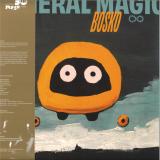
Now, we have General Magic’s second official full length comeback recording, Bosko. The new album is initially notable prior to the needle hitting the wax or the cursor identifying a track due to the artwork. Made by long term collaborator Tina Frank, this is Frank’s first analogue artwork, with a painting of a happy/nervous machine thing hovering in a landscape of no discernible identity. It’s quasi science fiction hovering amongst the potential for fun. Suited to the music? Natürlich.

Bosko sees Bauer and Pieper update and reframe their original investigations with a fresh supply of head scratching, heart racing tunes that hit the inexplicable with a wild mesh of drums, pianos, synthetic voices and all manner of immaterial sonic play. Startling sonics shock the ears on Club Duchamp which sounds like a conversation between synthetic adult ants in an environment still in development. Elfer features vocals supplied by a female-ish voice who, whilst grappling melody, has trouble executing a firm identity. Noorenhalt catapults along a mainframe of syncopation so unwieldy it feels like the voice, which is utterly alien, provides the only comfort. Seite 5 inhabits a fuzzy zone where a synthetic Horn of Jericho type ambience competes with rhythms never quite sure of who they are. Rise of the Ombré raises the spectral dread. Is this Science Fact? Absolutely nothing within Bosko is predictable.

The amount of change in the miasma of existence and the things we touch in order to make things has shifted so exponentially we are at the point where minds are starting to glaze over. All of this makes the return of the always original, always surprising, always fresh and exciting General Magic totally in tune with the artificial intelligent apocalyptic age we currently inhabit. The tools may have changed but the wonderfully warped gaze of Bosko offers a fresh new vision of perplexing funk and robotic punk.

out of Stock

Order now and we will order the item for you at our supplier.

24,58

Last In: 8 months ago
World Brain - Open Source

Lucas Chantre, aka WORLD BRAIN, last graced us with a solo release half a decade ago, with 2019’s Peer 2 Peer. As its name suggests, that album explored the promise and perils of universal connectivity via quirked-up songwriting and instrumental psychedelia. His new release, Open Source, deepens this internal and external journey. Bursting beyond the four walls of ‘bedroom pop’ and reflecting a move from Berlin to Paris—where much of the album was recorded—and on to Brussels, the album has a jazzy, cinematic scope (as on the Brubeck-inspired march “Fromage collatéral,”) enveloping the listener in a cosmic-pastoral audiosphere.

There are still many tones that evoke the software sounds of decades past (the exemplar here is “cAPTCHA,” whose virtual marimba and vocalese suggest a breathless, Exotica-inspired introduction .mov for the information superhighway) but the palette has become richer and more organic, lead by the woodwinds which play a major role throughout, with flute provided by labelmate Martha Rose. (On the aforementioned “cAPTCHA” one also hears the world-class whistling talents of the incomparable Molly Lewis.)

Yet the single most noticeable new element may be the use of Chantre’s native French, sung by his sister on “Ville fleurie” and the gorgeous, fluttering “Minute papillion” (the title an idiomatic injunction to slow down!) Chantre initially wrote these lyrics in English, but felt something wasn’t quite right, only realizing what was off when he heard them sung in another language. That spirit of discovery – of finding a new spark in returning home – suffuses Open Source. It invites us to play, beckons us to relax, reminds us to find serenity amidst the churn of the present: minute papillon, dans le tourbillon.

out of Stock

Order now and we will order the item for you at our supplier.

19,54

Last In: 8 months ago
Cameron Winter - Heavy Metal (LP)

'Heavy Metal' ist das Debüt-Soloalbum von Geese-Frontmann Cameron Winter. Es ist eine unerwartete klangliche Kehrtwende von Geeses unverkennbar Jam-ähnlichem Indie-Twang undverzichtet größtenteils auf Stadiongitarren zugunsten eines sanfteren Anschlags, der seinen mystischen, fantasievollen lyrischen Stil voll zur Geltung bringt. Gelegentlich verwirrend, doch unendlich bereichernd, enthüllt 'Heavy Metal' Winter als Chamäleon-artigen Meister seines Fachs, einen wandlungsfähigen Singer-Songwriter im Stil von Größen wie Dylan, Cohen und Nilsson.

out of Stock

Order now and we will order the item for you at our supplier.

23,49

Last In: 15 days ago
Items per Page:
N/ABPM
Vinyl