iven Jones’ rather slack approach to track titles (both being consistent with and sometimes even just supplying them), it’s a bit of a relief to realize that two tracks with the same name are indeed related. In the case of “Arab Jerusalem”, which makes up nearly half of the newly-released Lalique Gadaffi Handgrenade, that kinship is immediately apparent even though both tracks are clearly their own experiences.
Released as the first track on the Minaret-Spearker picture disc 7” in 1996, “Arab Jeruzalem” (spelling also sometimes being fairly slack) is 5:42 of effectively shifting dark ambience, wordless female vocals drifting over the hand percussion, chimes, and static of the track, with eventual conversational loops discussing... something underneath. The end of that version is especially striking for the way the woman’s wordless singing starts being sampled in such a way that it overlays the whole track (and, slightly, itself). The almost 24-minute “Arab Jerusalem” here might be called the Deer Hunter version of the same story, building with great patience and many more abstract detours towards what now seems like simultaneously an excerpt and, now, a climax. As with many of Jones’ more ambient tracks, the great length just lets it cast its spell more thoroughly and entrancingly.
The other three tracks, meanwhile, suggest some of Jones’ other work but never evoke them as directly as “Arab Jerusalem”. “Jordan River” is nearly as long (a second shy of 20 minutes) but strips out the vocal elements in its predecessor, focusing instead on a more active percussive workout (analogue and digital both) and a river of hiss running down the center of the track. The title track of Lalique Gadaffi Handgrenade might bring to mind the title of “Lalique Gadaffi Jar” from Libya Tour Guide (last reissued by Staalplaat in 2015), but if they’re sonically related Jones must have practically melted the other track to get this one. And the closing “Desert Gulag” (like the title track, a much more manageable length than the first two epic tracks here) bears a slight resemblance to “Negev Gulag” from 1996’s Fatah Guerrilla, here what was a piercing, repetitive drone is softened and looped over more of Jones’ percussion. The result is a well-rounded release that shows off many aspects of Jones’ sound as Muslimgauze, while existing (like many of these DAT tapes do) in conversation with much of his previously released work.
Поиск:aspect
Все
Ism opens audaciously with the spiritual mic-check “You Are Free To Choose,” a track that features bassist Junius Paul alongside Vincent Davis (drums), Justin Dillard (piano), and Corey Wilkes (horns). This is by no accident. In many ways, “You Are Free To Choose” captures the spirit of Junius Paul’s artistic roots. Corey, Justin, and Vincent were among the multigenerational cadre of Chicago musicians present when Junius chose to follow his own path of creative discovery at the storied Velvet Lounge on the South Side of the city in 2002.
Though he began learning his craft playing in church, Junius’s creative voice really developed during jam sessions at clubs like The Velvet alongside members of the AACM. It was iron sharpening iron, the most natural form of knowledge transfer. He explained The Velvet’s vibe in 2018: “It’s like in Africa.... If you had this society of diviners or medicine people, or you know, sages… The Velvet stuff is not secret; but there are certain aspects of it… if you weren’t there, you weren’t there.” The Velvet Lounge closed in 2010. But, of course, the spirit of the Velvet Lounge is not dead. “Tune No. 6,” recorded live at the Co-Prosperity Sphere in Chicago, is a sweet interlude here to remind us that jazz is alive, bristling with what’s yet to come.
As Junius pushes forward as a creative musician, he is careful to carry with him the spirit and the knowledge he’s gathered from those who have come before him. He is very literally a bridge between generations of the Chicago vanguard, currently playing in a handful of combos with Makaya McCraven (who produced several of the tracks on Ism) as well as a few of Roscoe Mitchell’s working groups – most notably the Art Ensemble of Chicago – in addition to fronting his own band.
Redsonja Records brings to light reference number 16, held back until now, as to date 18 of our catalog has already been released. Visionary 01 is an EP by VVAA released on vinyl and digital format which showcase new a graphic identity of Redsonja Records: the warrior. In addition, RS16 also includes a future reference: Visionary 02. The four producers that participate coincide in several aspects related to the concept we believe in as a label. They all possess a kind of "divine touch" when producing their tracks, you can tell they all work from their soul. Jose Rico presents a track title ‘Discotime’, deep rhythmic cadences in the purest Detroit style; clean, bright, and delightfully mischievous sounding. Analogies intentionally created, synths that cross each other with elegance and leave space for all the necessaries. The result is an essential track in any relevant music collection. It takes us to other worlds that are more relaxed, more divinized, more colorful, more leisurely ...
Reissue of this 1976 LP from Zambia. Deep minimal African music, lovely compositions over scarce drum machines and (fuzzy) guitars.. Beautiful music with a deeper message in the lyrics which is explained better in the long review below. Some words from the label. There is music that falls right into place, a perfectly articulated expression of a few distinct influences. Then, there is another kind of median music, something more mysterious, the result of time, place, technology, and alchemy. Zambian writer and musician Smokey Haangala’s Aunka Ma Kwacha (The Money is Gone) released in 1976 is an example of this more mystical metallurgy, falling somewhere between psychedelic Zamrock, US folk, Kalindula, and Sundown Beat (music played after dark) from Tongaland. The unique mix of languages on the album (Bemba, Tonga, Lozi, and English) also suggest this complex cultural crossroads. Underlying the whole album is the insistent beat of a simple drum machine, which was totally unheard of in Zambia at the time, and parallels pioneering experiments by Francis Bebey, Sly Stone, and Shuggie Otis, utilizing a technology which would later come to define dance music. Then there’s the album’s original artwork by Peter Kependa, done in style similar to the infamous Jamaican dancehall illustrator Wilfred Limonious, interpreting the album’s title and primary theme; the burden of financial inequality.
In this sense the album is political, but the theme is extrapolated and explored through its impact on personal life; love, marriage, social status, and diet. The album is full of cautionary tales, folklore and references to magic, aspects of Zambian culture simultaneously mystifying and alluring to outsiders, part of what attracted Western readers to Nigerian writer Amos Tutuola’s hallucinatory Yoruba folktales. After becoming a household name in Zambia for his music, writing, and television appearances, Smokey Haangala died at the age of 38, the very week his book The Black Eye was published, abruptly ending his brilliant and ascending career. We are lucky to have his inimitable work to remember him by, Aunka Ma Kwacha resting comfortably in the pantheon of re-visionary works by Rodriguez, Kissoon Ramasar, TJ Hustler, and William Onyeabor.
Edition of 100 copies only.
Side A: 'Vodou'. Head priest: Gran Sèvitè Jean-Daniel Lafontant. Vodou priests: Oungan Eddy Saint-Jean and Anperè Jean Céus. Vodou priestesses: Manbo Françoise Célestin, Manbo Christine Lamour, Manbo Marie-Marthe Similien and Manbo Jacqueline Thélus. Other participants: Ounsi and members of Sosyete Na-Ri-VéH. Percussionists: Ountògi and the drummers of The Sacred Temple Na-Ri-VéH 777. Side B: 'Rara'. All-female rara band: Forever Rara Fanm of Belair.
Grand Rue recordings made by AMé in front of the Atis Rezistans, Port-au-Prince on 21 December 2015, 4:54pm to 5:18pm. Vodou ceremony and all-female rara band recorded by AMé at Temple Na-Ri-VéH 777 in Port-au-Prince, 16 December 2015, 9pm to 1am. Edited by Philip Marshall with AMé in Cologne, 16 May 2016. Mastered by Zachary James Watkins at Stank House, 3 August 2016. Artwork by Stefan Fähler. AD&D by Don Wyrm.
With thanks to: Ghetto Biennale, Leah Gordon, Atis Rezistans, Gabriel Toso, the priests and priestesses, the members of the all-female rara band, the percussionists, Clocktower Radio and all the Haitian People.
An introduction to Vodou music and Rara, by Gabriel Toso:
"Tanbou prete pa janm fè bon dans" ("A borrowed drum never makes good dancing")
"Music is to Vodou what water is to our bodies or fire to our hearts: all embracing, all inflaming. The spirits of Vodou are called upon and energised by the inexhaustible rhythms of Africa. Brought by the slaves to the New World, and merged with indigenous and European traditions, their magical power is the soundtrack of Vodou itself, its life-force.
Dancing, singing, praying are all fundamental aspects of Vodou; but above all it is the drumming that plays a major role during the ceremonies, an invitation to the lwas (gods) to join and partake in the rituals. Like the heartbeat of an infant in its mother's womb or the vibrations of our planet, the percussions of the tanbou (drum) are at once instrument and creator. Different batteries of drums correspond to different rites, countless rhythms to a multitude of nations of laws. The drum is not only a musical instrument but a sacred object, an expression of the divine. Its sound guides the initiates to their appointment with the spirit world.
Rara festivals are yearly celebrations that begin following Carnival during the Catholic Lent season, when the activity of the Vodou temples is at its quietest. During those six weeks Rara bands parade for miles playing music, dancing, and performing rituals for Afro-Haitian laws, while wearing specific costumes and using a variety of musical instruments. Probably originated in Haiti during the colonial period, Rara bands and their vast repertoire of songs are both politically and socially engaging while keeping an amusing, irreverent, and at times risqué personality. Traditionally connected with a Vodou temple, Rara bands leave the ceremonial spaces to interact in the public sphere through parading, thus reminding both participants and spectators of the physical presence of the lwas." – Gabriel Toso, London, 3 November.
Blaue Blume are a Danish alternative art pop band with a deep connection to the romanticism of the early 80s UK scene. Referencing artists such as Talk Talk, The Smiths and Cocteau Twins, it's clear their influences are with the more sensitive, magical aspects of music - and the eternal questions of love, life and death. Following two singles (Lovable and Vanilla) the album Bell of Wool is finally with us. It’s suitably enchanting from start to finish. Two themes dominate Blaue Blume’s new album Bell Of Wool, darkness and adventure. With the record mostly made before singer Jonas Smith slipped into a depressive episode, the album’s lyrics and moods draw pictures of the darkness, anxiety and tension that would mark Smith’s depression. Sonically, the album sounds a distance away from anything they’ve done before. Indie and electro pop and rock are out, and instead the album is crafted from soft, glowing synthscapes, dawns and skies transformed into sounds. Even on hints of their older work, like on the acoustics of “Rain Rain”, the synthwork comes into the picture and swells the song into something bigger and more majestic. Opener “Swimmer” introduces the listener to the softness and subtlety of the new sound, whereas songs like “Morgensol” and “Bombard” show it at its biggest and more grand.
The third Sunday Breakfast Records release sees a debut from a SB resident. Barcelona based and Bern native James Mc Hale, arrives with two original tracks for his "Insomnia EP", which is accompanied by a stellar remix from scene regular Ion Ludwig.
"Aspect" is the first song from James, a light flowing minimal groover, held together by a subtle melody that teeters on the edge playfully, the second song titled "Somnia" keeps the easy, subtle vibes coming although it adds a moodier theme with an occasional punch tech lead that cuts through it for those after hour sessions.
On the flip side we then have the Ion Ludwig remix of "Aspect", the energy is amped up on this version, going for more intensity yet still keeping the subtle details to the original. This is the business side, direct and straight for those peak set moments.
- A1: Coloratura Soprano Singer
- A2: Man Wiithout Larynx
- A3: Buccal Speech
- A4: Parabuccal Speech
- A5: Singing Voice
- A6: Glossopharngeal Speech
- A7: Frogsound
- A8: Esophageal Voice
- B1: Injection--Basic Sound Two Times
- B2: Basic Sound Of The Esophageal Voice
- B3: Basic Sound Of The Esophageal Voice, An Octave Lower
- B4: Esophageal Voice By Telephone
- B5: Singing Voice With Larynxphone
- B6: Pipa Di Tichioni
- B7: Western Electric
The larynx or voice box is a small organ located towards the top of the neck in humans and some other animals. Constructed largely of cartilage, it houses the vocal folds that allow for the manipulation of pitch and volume, which are essential for the phonation of spoken speech. It is also involved in bringing air to the lungs when we breathe and it protects the windpipe when we swallow. However, those unfortunate to experience the potentially fatal malignant tumours of laryngeal cancer will have their larynx removed, resulting in a traumatic loss of speech; thankfully, as this rare record issued by Smithsonian Folkways in 1964 demonstrates, removal of the larynx does not necessarily spell the end of speech for such blighted individuals. Instead, through developments in artificial voice creation, patients could learn to employ modes of vocal communication again. The album was recorded by physician Harm A. Drost at the Phonetic Laboratory of the Ear, Nose and Throat Dept of the University Hospital, Leiden, in the Netherlands, working under the direction of Professor H. A. E. van Dishoeck. As the advances were fairly new and surprisingly varied, Drost felt a phonograph album demonstrating the techniques would be useful for those in the field. The album thus features a narrator explaining aspects of several different techniques, followed by examples of patients employing them. Buccal speech (limited to certain consonants), parabuccal speech (collecting air in a space between the upper jaw and the cheek), glosso-pharyngeal speech (a method deemed obsolete where air is forced between the tongue and the palate), esophageal voice (made by reconditioning one’s esophagus via swallowing, suction or injection), various injection techniques and devices such as the larynxophone, pipa di tichioni and “western electric” are all explored here, along with other aspects of the larynx and its absence. Speech After The Removal Of The Larynx is definitely one of the strangest albums ever given a commercial release!
With its fourth catalogue number, Steinlach returns to the vinyl format with a remix EP. On board are international friends of the label, who layed hands on Wice's originals with outstanding re- interpretations. While the A-side contains two groovy and club-oriented remixes of "Just kiddin", the trippy flipside focuses on the second outcome of the label and refers to the two pieces "Absent" and "Hertz".
The record opens with a fast-paced and jacking "Just Kiddin" version by Deep'a and Biri. The two guys from Tel Aviv re-interprate the clubby aspect of the piece, furnish it with a portion of percussions and accompany it with a volatile beat. Discharging the track with a big bang, they're leaving the listener with no chance but to move energetically to the groove patterns while cherishing the original lead melody.
Just like Deep'a and Biri, Jon Hester bets on the energy and the recognition value of the original synth line. As typical for Jon, he gives a more Chicago-style housey and bouncy touch to the composition. The lead is getting chopped, re-interpreted and re-arranged into a new groove and melody pattern, sure to inspire the floor to shake and to catapult everyone around into a frisky dancing mood. Suddenly, the well-known arpeggio of the original comes in and makes for the climax of this brilliant remix.
With side B, the club aspect of the record might not be left behind, but moved into more stripped and trippy terrains. The B1 track is fashioned as a ruthless "Absent" version, unmistakably having Refracted's writing all over it. The smallest variations of the synth line, drones, and pads, without resorting to typical drum rack aspects, find their way deep inside the listener's head, and draw them into their subtle rhythm. The unapologetic roughness of the interpretation is striking and makes it a brilliant peaktime weapon.
Rounding up the whole EP, the last remix of the record is a wonderful re-interpretation by the talented Australian that is Mosam Howieson. He ministered to Wice's personal favourite piece and crafted a loving and deep version of "Hertz", which translates the magic of the original into own words and emotions, adds a subtle groove to it, then invites to listen more carefully. One quickly dives into a hopeful world in which a certain magic seems to be present, and where everything seems to be alright. Be it as a perfect last piece after a long fulfilling evening, or as the outstanding means to make the sun rise in the morning-Mosam's interpretation sure hits the spot.
Special thanks go out to our close friends Simon Sandleitner who is always in charge of the great artworks and Roger Reuter (Roger23) for having always an open ear, his helpful advises and his thought-out criticism.
Time is Local is a project by Danish collective We like We and sound artist Jacob Kirkegaard built around a 12-hour live sound installation and performance at Thorvaldsen Museum in Copenhagen.
The piece was initiated and performed by the artists during the G((o))ng Tomorrow Festival in 2017. As they slowly wandered the halls and rooms of the museum for a whole day, they performed extended sound compositions for a visiting audience at each of the 12 chambers for a longer session - a haunting experience as the outside world disappeared and the focus was on quiet sonic moments unfolding in midst of the grand, reverberous space. For this album they have collected 12 fragments revolving around the chambers in the museum. Each chamber is being represented by its own handful of tones, instruments and voice. The statues within, depicted by neo-classicist sculptor Bertel Thorvaldsen get their own soundtrack of quiet emanating gusts. Barely heard frequencies reflect through the walls. The marble carved busts of Greek gods that line the museum hallways gaze eternally with a blank stare as decades pass and new audience arrives.
Although We like We should need no introduction to followers of the Sonic Pieces label, the Danish all female sound quartet consists of Katrine Grarup Elbo (violin), Josefine Opsahl (cello), Sara Nigard Rosendal (percussion) and Katinka Fogh Vindelev (voice). Together they have forged a dynamic and intuitional sound beyond genres through the last decade. Only two years ago they released the nordic neo-classical opus Next to the entire All. This time they emerge in collaboration with sound artist Jacob Kirkegaard. Jacob’s works are sonic reflections on complex aspects of the human civilisation, treating themes such as radioactivity, melting ice, border walls and tones emitted by the ears. Through the last decades he has released records and sound documents through labels such as Touch, Important Records and more. As a document of their 12h performance, Time is Local is a beautiful sonic evocation that shines as a bright line of sun through the cracks of a tomb.
Following his debut on Phantasy earlier in 2019, Joshua James returns to the label with ‘Journeys In Love’, complimented by a propulsive remix from Joe Goddard. Flipping the ruthless sleaze and hi-NRG of ‘Coarse’ on its head, the XOYO and Rinse FM resident presents a release that soundtracks the deeper, more vulnerable and always joyous aspects of London’s queer nightlife culture. ‘Journeys In Love’ lands with immediate effect, building steadily and confidently around a trippy sample and the hugely pleasurable push-and-pull of James’ synths. Breathing deeply and suspended in red-light, James’ new production tastefully recalls the late-hour, sensual attitude classic NYC deep house, while transmissions of a bottom-heavy bass weight anchor the track in the capital’s defiant after-hours scene. As a digital exclusive, the Super Drama remix utilises skittering percussion and cymbal rushes to drive things forward, dissolving with a playful acid coda.
Needing little introduction, Hot Chip and Two Bears co-founder Joe Goddard delivers a soaring and complementary reinterpretation of ‘Journeys In Love’, one built on halcyon, analogue sounds and further bathed in ecstasy and melancholy.
Swedish composer and multimedia artist Marcus Fjellström's debut Miasmah release follows two critically acclaimed full length albums on Lampse (2006's 'Gebrauchsmusik' and 2005's 'Exercises In Estrangement'). In addition Marcus has had several commissioned works requested, leading to him working with, among others, the Swedish Royal Ballet, the Scottish Chamber Orchestra, numerous ensembles, soloists and filmmakers including 'Salad Fingers' creator David Firth. Currently based in Berlin, Fjellström's compositions often combine aspects of modern classical composition and arrangement and more avant forms of music, be that acoustic or electronic.
'Schattenspieler' (which translates as 'Shadowplayer') takes the form of eleven compositions which explore ambience and melody, texture and silence. Haunting synth and orchestral instrument-based audio constructions, flowing from one moment to the next - the fleeting ghosts of Fjellström's melodies rise, only to be buried under a claustrophobic clutter of percussion and creaking background noise. These pieces do indeed feel like you're listening to something more implied than obviously stated, as if Fjellström wants only to expose us to the shadow of the music - the implication being perhaps a more terrifying experience than to be confronted outright…listen to 'Schattenspieler' and you may find your mind starts to play tricks on you…
The undeniably Angelo Badalamenti-esque descending synth strings of opening track 'The Disjointed', lay the foundations for Fjellström's 'Schattenspieler' album; music resting somewhere between the unsettling horror soundtracks of Jerry Goldsmith, the elevating melodies of Cliff Martinez, and the subtle audio constructions of Miasmah label mates Kreng and Jacaszek. Marcus' wide ranging abilities in composition and his willingness to let go of accepted form and function makes 'Schattenspieler' a perfect choice of release for the Miasmah label. The suspense laden 'Antichrist Architechture Management', with its harrowing and tense undertones, weaving synth lines and a wash of static hiss and flicker, is a particular standout track. Despite it's a strangely oppressive sound, shafts of light grace 'Schattenspieler'; pieces such as 'Untitled 090616' find gorgeous melodies are boxed in by unsettling arrangements and sparse background ambience. There is a coldness to many of these compositions - not without emotion, but somehow remorseless. 'Schattenspieler' is, for the main part, a defiantly bleak journey.
Vinyl edition ltd. to 300 copies, purple vinyl, incl. 8-page 12" booklet with drawings by Marcus Fjellström.
With the release of their first two albums and live shows supporting Snarky Puppy, Roy Ayers, Marcus Miller, Larry Mizell & the Blackbyrds, Butcher Brown, Yellowjackets and more, Resolution 88 have already established themselves as one of the UK's leading exponents of funk jazz. Their music is synonymous with the silky, buttery sound of the Fender Rhodes. They're also a bona fide band, a refreshing change in a musical world increasingly occupied by online collaborations and viral videos. They're best mates who love to hang out, play together and make their own music - that sincerity is evident in their songs and their chemistry on stage.
'Revolutions' represents a lot of firsts - the first time Resolution 88 have recorded to multi-track tape, the first time that they've included a real string and brass section, the first time they've included special guests on record and the first time they've pressed an album on vinyl. Imagine a combination of an undiscovered Herbie Hancock album from the mid' 70's, rare-groove samples from the golden era of hip hop (ATCQ, Pharcyde etc) and the new London sound of bands like Yussef Kamaal.
Every track on'Revolutions'represents an aspect of music on vinyl. On'Pitching Up'you hear the DJ pitch the record up from 33rpm to 45rpm.'Out Of Sync'simulates a clumsy attempt at beat-matching. The hypnotic, circling sax line that opens the title track'Revolutions'(echoed by the strings at the end) evokes the mesmerizing sensation of watching the record label artwork whirling as it spins on the platter.'Runout Groove'fades in and out; the drum beat mimics the distinctive, perpetual rhythm tapped out by the stylus as it reaches the runout groove. On the second side,'Sample Hunter'unexpectedly deviates from the main section into Rhodes-drenched interludes; the type of moment that producers searched high and low for back when hip hop was great.Marcus Tenney's (Butcher Brown) lyrics on 'Dig Deep'are all about the thrill of digging for records and'Matrix'is inspired by the hidden messages sometimes left in the matrix markings on record pressings. On'Tracking Force', you can hear the beat twist and morph as the stylus skates over the record. Finally,'Warped Memories'closes out the album with a wistful, melancholy melody. Sit back with a glass of Japanese whisky and a Cuban cigar (or whatever your chosen poison is), stick the album on and enjoy it from start to finish - although if you're listening to it on vinyl, you'll need to get up to turn it over to the B-side ;)
PAREDO presents new and exclusive works by three female japanese music producers: KOPY, TENTENKO and MIKI YUI who are based in Osaka, Tokyo and Düsseldorf respectively and a radical reinterpretation using elements of the featured works by Lena Willikens, the PAREDO MEGA MIX. All four contributions showcase their highly individual approaches to contemporary electronic dance music. Paredo is directly informed by multi-directional encounters of four musicians and their close observations of musical production and reception in practice.
In 2017 Lena Willikens and TAL founder Stefan Schneider have both, though independently from one another, been invited to Japan under the auspices of the Goethe Institut. While Schneider researched electronic noise music cultures in Osaka, LENA WILLIKENS and her artist partner SARAH SZCZESNY developed aspects of audio mix and filmed footage for their collaborational art project PHANTOM KINO BALLETT while in residency at Villa Kamogawa in Kyoto.
"While in Kyoto, we often went to Osaka or Tokyo to explore the diversity of the music subcultures there. It was fascinating to witness how Japanese underground cultures adopt influences from abroad and turn them into something original and very much their own. We also saw live performances by KOPY and TENTENKO whom we quickly befriended."
KOPY is a consistant part of the vital electronic music scene from Osaka. Besides a few performances at Düsseldorfs famous SALON DES AMATEURS, she has also been invited by LENA WILLIKENS to her showcase at the MEAKUSMA FESTIVAL in 2018.
TENTENKO begun to enter into the japanese music scene with a steady flow of experimental cdr productions as well as collaborations with members of the legendary japanese noise band Hijokaidan.
MIKI YUI originally from Tokyo has lived in Düsseldorf for more than two decades now. Besides albums of her solo work for LINE (US), or more recently, for Cusp Editions (UK) she also collaborates with Carl Stone in the duo REALISTIC MONK (on the Meakusma label) and was a member of Klaus Dingers last band JAPANDORF (Grönland Records).
LENA WILLIKENS who has a background in fine art, first honed her unique approach during a long residency at Düsseldorf’s Salon des Amateurs. Outside of the club, the Cómeme label was home to her first EP, 2015's Phantom Delia. In 2017 she has released a remix of Kenyan singer OGOYA NENGO for the ON MANDE EP, TAL02.
- 1: Umbral
- 2: Lumina
- 3: Io
- 4: Emesis
- 5: Puerta De Sal
- 6: Tejidos
- 7: Ultimo Aliento
- 8: Uno
- 9: Religar
- 10: Lucero
- 11: Astro
Mateo Kingman conceives of his second album Astro as a cure for the healthy. It’s a journey across the constellation of the snake, a journey at once earthly and cosmic. The poetic text expressed with a multiplicity of vocal timbres drives the musical journey, starting with the decision to face up to our demons, passing through a deep sense of vertigo and sacred healings, to return us to ourselves, reconciled and grateful.
Musically, Astro expresses an intense investigation, tying together different threads: contemporary urban song (trap, hip hop, and elements of electronic music), traditional Latin American melodies influenced by shamanic icaro chants, and the emphasis on synthesizers, resulting in a new, hypnotic kind of sound.
In a world in which we increasingly need more stimuli and approval from the outside, Astro invites us to take a look inside and explore all the aspects of the self, from the darkest to the lightest. On this record, Mateo Kingman shows a strong point of view as the author, although he moves away from the sounds and themes with which he made his name, daring to mix current trends, urban rhythms and vocal experiments, forming a constellation through which we can all travel, showing a clear personal and musical evolution.
If you've yet to succumb to the charms of Children of Zeus - and there can't be many out there who haven't - then this "odds and ends" LP offers a neat introduction. Five of the seven tracks have been plucked from the Manchester crew's previous full-length excursions, while the other two - seductively soulful two-step garage reworks of "Vibrations" and "Slow Down" by fellow Manchester resident Zed Bias - have previously been almost impossible to get hold of. Setting aside the club-ready remixes, what "Excess Baggage" proves is that Children of Zeus are one of British music's most essential outfits right now, delivering sensual and life-affirming cuts that brilliantly blend the best aspects of hip-hop, R&B and modern soul.
The second chapter in the Family Matters serie marks the 10th release on the Belgian record label 9300 Records. Via electro, through house and breakbeat, all the way to New Beat, established members offer you their view on the different aspects in the spectrum of electronical music. It's a nostalgic reference to the past, through the eyes of the present. Alessandro Parisi makes his first contribution to the label with an ominous New Beat influenced track, while Betonkust joins him on the dark B-side with his well known non compromising electro. A-side consists of dance-floor approved electro/house tracks of both Intimacy & Innershades and a sober, yet sophisticated anthem by the hand of Robert D.
BNJMN's penchant for ambient music is showcased here across 8 tracks for his Tiercel imprint. The collection, made across multiple sessions over a 3 year period, documents various aspects of the sonic world BNJMN inhabits. The ongoing project demonstrates the lighter and darker, yet always emotional side of the Berlin resident. Limited edition cassette and digital release. Mastered by Inland. Artwork by Youvalle Levy
Arts Gallery is back with all his charm and class, this time at the controls "Lucid Void", a mysterious duo coming from the beautiful land of Georgia. Their connection goes beyond a human link, the balance of two souls is expressed very clearly in this record, showing their mental attitude to draw music geometrically. This music take the listener into another level of space, a wider and limitless place in the mind of the creator. Something that is very rare to experience and yet expressed in such a simple way by this project. Comes in a hand-stamped cardboard sleeve.
L’Illustration Musicale, Sonimage, Técipress-In Editions (Timing), Musax, Freesound,
Montparnasse 2000 in France but also De Wolfe and Chappell in England, every of these
sound illustration labels have in common to bring out as a legendary spectre the name of Jacky
Giordano and his aliases. Widespread practice in the library music world, Joachim Sherylee,
chosen for the In Motion album, is one of his plentiful aliases (with José Pharos, Jacky
Nodaro, Gruppo Sounds, Rubba...) used by the french composer, that we regain as well for
Black Devil with Bernard Fèvre or even for the Shifters with Yan Tregger.
For his enthronement on the mythical English label De Wolfe, it's under the obscure name of
the Rubba collective that Jacky Giordano aka Joachim Sherylee sneaked in the londonian De
Wolfe studios with the companionship of British colleagues such as John Hyde (aka John
Saunders, James Harrington, Astral sounds or even Wozo) and his wife Monice Hyde (aka
Monica Beale), Alan Howe (aka John Collins), Robert Poole and Tim Broughton.
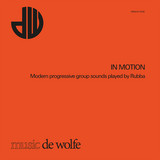
Published in 1980, the In Motion: Modern Progressive Group Sounds Played By Rubba LP
and its minimalistic and utilitarian red record cover which contains 13 tracks, mainly composed
by Joachim "Giordano" Sherylee and was never reissued since then. This record became cult
over time; it will have taken that the Hip-Hop world seizes it in order to dig out from the
disregarded and underestimated musical gems graveyard. First of all with beatmaker Madlib
and Freddie Gibbs in 2011 with the track “Thuggin'”, in which he sampled the track “Way Star”,
also used more recently by Mil and the rapper Westside Gunn on his track “Brains Flew” by
(1964 Version).
Nearly 40 years after, the Farfalla Records label, after publishing Timing Archives, presents
another aspect more progressive and psychedelic of the multi-faceted composer Jacky
Giordano by fully reissuing at last this coveted, mysterious and mesmerizing "Rubba". Very
desired by crate-diggers, In Motion appears in the want-list of plenty enthusiasts in this
enigmatic world of the library music. (Erwann Pacaud)