Rock & Roll, indeed. Ruth Brown’s sizzling full-length debut — also known by its eponymous title — symbolizes what was exciting, fresh, invigorating, and raw about the burgeoning style in its halcyon days. Originally released in 1957, and reissued here in audiophile quality for the first time in partnership with Atlantic Records’ 75th anniversary, the set remains a testament to one of the most pioneering and talented vocalists to ever command a stage.
Mastered on Mobile Fidelity Sound Lab's renowned mastering system in California, pressed at RTI, housed in a Stoughton jacket, and strictly limited to 2,000 numbered copies, Mobile Fidelity’s 180g mono LP of Rock & Roll plays with an immediacy, vibrancy, and fullness that showcase the reach, power, and emotionalism of Brown’s voice. The sound of her support musicians — brassy horns, swinging rhythm combos, echoing backing vocalists, rollicking pianists, jaunty guitarists — is made clear and vivid, helping the upbeat fare to jump, juke, and jive with newfound energy and exuberance. In a related manner, Brown’s slower, more understated material crackles with an intimacy and passion that let you know you're in the presence of a woman who has lived what she sings. The longtime Rock and Roll Hall of Fame member deserves nothing less.
In an era dominated by big-throated vocalists, few — if any — came grander than Brown. The singer, whose repeat million-selling ‘50s success with Atlantic Records led many to call the then-indie label “The House That Ruth Built,” charted two dozen R&B hits in the span of a decade for the fledgling imprint. Rightly coined “Miss Rhythm,” the extroverted Brown put Atlantic on the national map, became the best-selling female musician of the ‘50s, and established a precedent that would ultimately lead to Grammy and Tony Awards. Her early works have lost none of their fire or flair.
Akin to many full-length LPs of its era, Rock & Roll doubles as a collection. Its 14 tracks comprise some of the more famous sides Brown recorded for Atlantic, beginning in 1949 with the all-time-great rendition of the ballad “So Long,” and continuing through 1956. After the song caught the public’s ear, the Virginia native briefly became known for her smoldering style with lovelorn material and torch songs, approaching them (see “Oh What a Dream,” “Old Man River”) with a combination of pained sadness and hardened resilience that had no contemporary equal. Encouraged to pursue the style by Atlantic Records co-founder Ahmt Ertegun, her R&B-driven material soon made her a constant chart presence.
Demonstrating what fellow legend Bonnie Raitt deemed “sex with class and dignity,” Brown merges blues and jazz, swing and gospel in electrifying fashion. She dares you not to move, dance, and get on your feet. A majority of Rock & Roll explodes with uptempo runs and jaunty readings of hot-blooded R&B numbers. Sweaty and sultry, bawdy and bold, Brown eclipses the anthemic blare of the saxophones and joyful clatter of the 88s, singing with a slight catch in her voice and hurricane-gale force that threatens to blow the roof off whatever room her voice occupies.
Evidence abounds. Listen to her prod the band and encourage the band members to blow a fuse on a sizzling “Hello Little Boy,” complete with cries and wails; stretch her phrasing to the heavens on the swaying “Wild Wild Young Men,” laden with romp-and-stomp beats; plead and persuade on the snaking “5-10-15 Hours,” which flips the script on the age’s notions of dominance; use her raspy tones, high notes, and breath control to mesmerizing effect on the smash “Mama He Treats Your Daughter Mean,” recorded with a group led by Ray Charles; survey the scene and take charge on the steaming “As Long as I’m Moving”; and tap a classy albeit flirtatious vein on “Lucky Lips,” which dented the pop charts as her first crossover hit.
Throughout Rock & Roll, Brown knows the lyrical connotations and spirited architecture of the songs inside-out. Her assertive voice — never harsh, strident, or false — is the epitome of the passionate desires and sonic strains that turned into nascent rock ’n’ roll. Brown played a pivotal role in helping the style develop, the record a timeless reminder of a lasting legacy that will never be forgotten.
Search:at jazz
Real groups like Empirical are a rarity in contemporary jazz, where musicians so often come together for single projects then disperse again once they are done: groups that endure for fifteen years, without slackening in their quest for the new and the fresh, are all but unheard of. Having started their journey in 2007, Empirical now makes a triumphant return, re-taking their rightful place at the centre of the UK scene with "Wonder is the Beginning". Their first full-length album since 2016, is a mature musical statement that shows the band"s fire is still undimmed and their commitment to maintaining the legacy while forging their own unique path is as strong as ever.
HAZE is honoured to present you a new EP by Bruno Pronsato. The tracks are full of acid arps, atonal and jazzy textures, vocal chops, swingy percussions resulting in precise and groovy masterpiece. Bruno showcases his passion, excellence and addiction, delivering pulsating still pure minimal 4-tracker. Must have!
- A1: Lady Bird
- A2: Tune Up
- A3: Pent Up House
- A4: Indian Summer
- B1: Cheryl Blues
- B2: Line For Lyons
- B3: Look For The Silver Lining
- B4: My Old Flame
Recorded in October 1959, with heroin a caustic presence, In Milan is the first of the albums Chet Baker cut in Europe, revisiting West Coast cool jazz nuggets with drummer Gene Victory and a set of local players, including bassist Franco Serri and pianist Renato Sellani, bolstered by saxophonists Glauco Masetti and Gianno Basso on select tracks. Bop favourites such as Charlie Parker & Miles Davis’ ‘Cheryl’ and Davis’ ‘Tune Up’ are handled with care, and there’s a fine take of ‘Line For Lyons,’ which Baker first recorded as a member of Gerry Mulligan’s Quartet, with a great solo by Serri. It’s Baker at his best – thoroughly excellent!
After their highly praised debut record "I" - called "a sparkling electro-jazz and cinematographic hybridization game" and "refreshingly futuristic big band music" - the french quintet returns with the new full length called "II". Notilus is back, more raw and free than ever, taking a journey through both evening shadows and luminous mornings, through long expanses of suspended time as well as hypnotic swathes of dancing vibes. It crosses vast tundras, ascends snowy mountain ranges, reaches swampy troubled waters bathed in eerie light, at the crossroad between Jazz, Techno, Ambient music and self-reflexion.
The Notilus Orchestration:
Philippe Rieger : machines
Mathieu Goust : drums & percussions
Guillaume Nuss : trombone & effets
Christophe Rieger : saxophone & effets
Paul Barbieri : cornet, synthétiseurs
Repress!
London based DJ and producer Dan Shake is set to announce details of his new EP ‘Mosquito’, due for release on 13th March 2020 via his Shake Records imprint.
Dan’s latest outing offers three driving, thoughtful Detroit house influenced club tracks: from the synth-heavy adrenaline rush of title track Mosquito, to the jacking, motoric resolve of The Deep
End, and Hide Seek’s kinetic, sample-driven house groove.
Since debuting on Moodymann’s Mahogani Music in 2014 with 3AM Jazz Club / Thinkin About U, Dan made it into a springboard for his ambitions to work crowds the world over. His love of groove – ranging from sparky acid to Brazilian samba, itchy funk to heavyweight house – fuels his drive to make those around him dance as keenly as he does. At a party, Dan Shake isn’t just loaded with peak time weapons: he is one.
This will be the seventh release on Dan’s Shake imprint, following a string of dance floor-igniting releases, the most recent of which continues to scorch the airwaves from Radio 1 to NTS, garnering DJ support from the likes of Annie Mac, Gilles Peterson, Honey Dijon and The Black Madonna, and a searing set of disco-house releases last year on his own Shake imprint and Denis Sulta’s Sulta Selects.
Dan’s infectious charm and expert ear has resulted in a truly international list of shows in locations as far flung from home as Beirut to Buenos Aires, plus armfuls of Balearic visits, including closing the main stage at Dimensions Festival and playing b2b shows with Jeremy Underground, Marcellus Pittman & DJ Boring to name a few. With a never-ending tour schedule ahead, including his debut U.S. and Australia tour, stops at Nuits Sonores, Love International, Printworks, Kingdom Festival, Fly, Boardmasters, Dimensions, Pikes Ibiza and more new music planned for 2020, Dan Shake is set to have an exceptional year.
The fresh-faced folk pop band Stornoway seem promising: They play with guileless vigor, have a light-stepping chemistry as a unit, harmonize well. Their lead singer Brian Briggs has a lovely, pure high tenor, the kind of voice that effortlessly conveys simple longing. And yet, on their second album, Tales from Terra Firma, they continue to be almost crushingly dull, making well-appointed and cheerfully empty music that successfully communicates next to nothing.
Their Achilles Heel is a simple and unfortunate one, the same on Tales as it was on 2010's Beachcombers Windowsill. Stornoway are clearly in love with Celtic and British folk, and yet they can't write a memorable melody to save their lives. Try to sing along to the verse melody of "Zorbing", their most well-known tune, and pay attention to what your face muscles are doing; most likely furrowing with the effort of recall. Each of Tales' painstakingly arranged nine songs sinks underneath the weight of this insurmountable problem, which is a shame.
If you're making folk-pop, an inability to write a catchy melody is a difficult deficiency to overcome. Stornoway try valiantly with their complex arrangements, which quickly grow exhausting. “You Take Me as I Am” is cluttered with horn charts and pointlessly banging piano. “(A Belated) Invite to Eternity” builds to a full Explosions in the Sky crescendo, with glimmering tremolo guitar and a “Tonight, Tonight”-style sweeping string section, but having built zero momentum and generated zero heat until that point, their planned fireworks display fizzles.
“Farewell Appalachia” follows the same pattern, with celesta, finger-picked acoustic and electric guitar all tracing an emptily pretty circle with nothing in the center. The melody of "The Great Procrastinator" is almost cleanly written enough to be memorable-- and then the ersatz Dixieland jazz interlude crashes in. Stornoway are deft players, and the transitions are tightly managed, but this is praise on the same order as praising the brushwork in a hotel-room painting.
Briggs’ lyrics are filled with uncomplicated images of the good old British countryside, but his lyrics trample over all these dew-covered fields with wordy, awkward phrasing: "And in the gathering dew, I was lucid as a floodlight,” goes a line from “(A Belated) Invitation to Eternity”. “There's a hunger in the air/ A lemon swollen in the trees" he bleats on “Knock Me on the Head”. On “The Great Procrastinator”, he sings that he is “a scientist with far too many metaphors and far too little data to conclude in time.” They don’t read particularly well, and they don’t sound much more natural when sung.
Tales From Terra Firma is a peculiar record-- carefree music that feels leaden; tuneful-sounding songs that offer no tunes to hold onto. They seem an odd fit for 4AD, a label mostly home to singular voices. They may be a mercenary signing, an attempt to ride the coattails of Mumford and Sons' success. But Mumford and Sons, as head-smack simple and pandering as they are, have a pretty crucial ingredient in their arsenal: they write anthems. In that regard, they have Stornoway pretty thoroughly beat.
Tucked away in a corner of northwestern Europe and so small you could drive through it in minutes without noticing you were ever there, Luxembourg is often overlooked. This is also true for Luxembourg’s music scene, and even more so in the early 1980s. Aside from a string of victories at the annual Eurovision song contest or the mighty Radio Luxembourg that had for decades been blasting jazz, rock and other modern music into stolid Western European ears, very little else seemed to be going on. But even in a country of barely 350,000 people, musical adventurers had picked up on the spaced-out jazz-funk of bands like Return to Forever, Herbie Hancock’s Mwandishi, Weather Report, George Duke, and the electric Miles Davis. Under the leadership of trumpet player Gast Waltzing, a handful of them put together a band called “Atmosphere” and used the sound of their inspirations as a launchpad for their own musical exploration.
What you hold in your hands is a “best of” the Atmosphere band, which released two albums and a 7” single between 1981 and 1986. Privately pressed and long out of print, with original copies very hard to come by even in their country of origin, these records have for years been unheard by anyone outside hardcore collector circles. With no master tapes available, it was a real labor of love to track down the best quality vinyl copies and to reissue a selection of our favorite tracks in professionally remastered form.
Editions de Lux is a new label dedicated to unearthing and releasing records we love and believe deserve more attention, with a focus on Luxembourg and the surrounding countries. We are just the latest in a long line of immigrants who have come to work in Luxembourg and who are trying to find our own path into the heart of this mysterious little country that has much more to it than dark forests, medieval castles, rusting steel mills, and shadowy banks.
The funky, atmospheric, evocative and sometimes downright weird output of companies such as DeWolfe, Cavendish, Burton and the ubiquitous KPM have always been a guiding inspiration for ATA Records, as evidenced in the spooky soundtrack works of The Sorcerers, the big band brass of The Yorkshire Film & Television Orchestra and even in the soul-jazz of The Lewis Express ('Theme From The Watcher).
Everything released on ATA is written and guided by the label heads Neil Innes and Pete Williams, who frequently dip their toes in the Library pond while working on other projects. These occasional one-off tracks have accumulated over the past few years and have now found a home on the first volume of an ongoing series : The Library Archive
Ranging from heavy big band brass (Whack, Slap & Blow, Kaye Okay) to evocative thriller soundtrack (Midnight Heist, Wiretap, The Needlenose) via introspective ethereal soundscapes (Nuclear Wind, Siren's Sea) these 11 tracks faithfully recreate the feel of the Library music catalogues of the 60s and 70s.
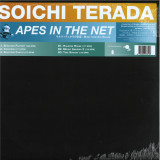
6-track EP compilation with Terada's work for the Ape Escape games, tip!
Outside of the international house underground, where his early ‘90s works for the Far East Recording label he co-founded with Shinichiro Yokota are rightly celebrated as bona-fide classics, Soichi Terada is best-known for his work composing music for video games. Yet until now, few of his productions for video games have been released outside of Japan, especially on vinyl.
Apes In The Net, a six-track EP featuring music composed for the popular PlayStation 1 series Ape Escape, sets the record straight. It not only showcases Terada’s quality as a composer and producer, but also his versatility. Like much of Terada’s work on the Ape Escape series, the tracks featured don’t explore deep, New York and New Jersey influenced house sounds, but rather his lesser-celebrated love of jungle and drum & bass – a sound he fully explored on 1996 album Sumo Jungle.
“The producer of the Ape Escape games heard that and got in touch,” Soichi remembers. “They asked me to make the soundtrack, and then work on the music for the sequels after that. I used to love making music with AKAI hardware samplers, synthesisers, and computers, so I played and recorded the tracks using almost the same methods as I did when I made house music. Using breakbeats and audio samples with a sampler was the most useful way to make the soundtracks.”
The six tracks on show, which were originally recorded in the ‘90s but reconstructed and remastered for Japan-only CD and digital releases over a decade ago, mix elements of Terada’s familiar deep house style – think warming chords and pads, memorable melodies, and emotive musical motifs – with blistering D&B breakbeats, 16-bit synth sounds, electronic bleeps and undeniably weighty basslines. They’ve stood the test of time and arguably sound just as fresh now as they did at the turn of the millennium.
For proof, check the soaring, spellbinding ‘Spectors Castle’, where uplifting lead lines and sumptuous chords dance atop punchy beats and growling bass, the jazzy and saucer-eyed rush of ‘Mount Amazing’ (all twinkling piano motifs, alien synth sounds, squelchy bass and skittish drums) and the intergalactic, liquid D&B excellence of ‘Time Station’, whose whistling melodies and stargazing chords are undeniably alluring.
There are plenty of other delights to be found across the EP, too, from the bustling, race-to-the-finish breathlessness of D&B/bleep techno fusion workout ‘Spectors Factory In’, and the rumbling sub-bass, creepy pads and suspenseful melodies of ‘Haunted House’, to the bombastic, all-out-assault on the senses that is ‘Coaster’, the set’s most “purist” jungle workout – albeit one that also doffs a cap to the pulsating world of big room techno.
Apes In The Net, then, celebrates Soichi Terada’s mastery as a video games composer and early Japanese junglist. Props are well and truly overdue.
Donny Benét is an adult Entertainer, Hit-Maker, Attentive Lover- and one of Australia’s most acclaimed- and experienced Jazz-Musicians. He has toured Europe- and the UK five times through 2017/2018, playing Festivals & Headline-Shows in 14 different Countries- and will be returning in 2020! The Don’s gigs are rammed with 20-somethings partying like a scene out of Miami Vice.
Recorded in the infamous Donnyland-Studios using the finest Japanese, American & Italian synthesizers, The Don speaks to the heart, promising love as soft as Italian leather. Donny’s immaculate Armani grooves hint at the dancefloor and the bedroom The Don is transportive. ‘Night In Rome’ opens the shutters of your hotel room onto a view of The Colosseum, ‘Reach The Top’ thrusts you on a frenzied race to success through the streets of NYC.
‘Working Out’ urges you to break a sweat wherever you may be. ‘Konichiwa,’ is a song assmooth as the silken tofu from whence the song’s spirit is inspired, and ‘Santorini,’ an ode to love worth fighting for along the crystal-waters of the Aegean Sea.
New album “Mr Experience” due for Release on 22nd May, 2020
Brooklyn-based artist Jonah Parzen-Johnson returns with the new album You're Never Really Alone, out on We Jazz Records, March 8. If you look at the label on the LP containing eight intimate compositions for baritone sax & flute, you will find the words, “we made this together”. At first thought, this simple phrase may seem out of place on a solo record, but just like the compositions on this album, it was carefully crafted to cut to the core of what this music is all about.
In Jonah’s words: “It’s pretty hard to end up at a solo saxophone concert by accident. Odds are pretty good, if you are there, it is because you light up when you experience something new, something experimental. That shared desire connects us, and suddenly, for a night, we are a community. For me, being connected to those spontaneous communities is the best part of being an experimental artist. Everything I make is in service to the cultivation of that community, our community. Without it my music doesn’t exist and because of that I can joyfully say to each person, at every concert, that we made this together.
”You’re Never Really Alone arrives in stark contrast to Parzen-Johnson’s 2020 We Jazz Records solo debut, Imagine Giving Up. Where Imagine Giving Up was celebrated for Parzen-Johnson’s ability to assemble deeply evocative electr acoustic sound worlds, “filling the landscape in one element at a time until a picture emerges that could almost be a full band,” (Wire Magazine, March 2020) You’re Never Really Alone shows us that Jonah can look you in the eye and say “my voice alone is enough”.
Across eight tracks, Parzen-Johnson, a Chicago native, explores the technical limits of his baritone saxophone and flute without ever making the listener feel like he has something to prove. You will find circular breathing, multiphonics, and explosive levels of sound, but more importantly, you will enjoy every moment of musical storytelling and compositional skill. This album is made for repeat listening.
The opening track, “When I Feel Like Myself” is a meditative invocation of self realization. Parzen-Johnson summons three and four note harmonies from his saxophone with deep control, as he gently explores how tension can become its own release. An unadorned melodic thread gently weaves each musical expression to the last, guiding us deeper into an album that simultaneously celebrates the power of one, and the yearning for exploration that unites us all.
"The recordings that make up Afro Blue Impressions were acquired by jazz impresario/auteur Norman Granz during the tours he produced for many jazz artists during the 1960s, though they weren't issued until 1973. Recorded at shows in Berlin and Stockholm, the John Coltrane Quartet -- with pianist McCoy Tyner, bassist Jimmy Garrison, and drummer Elvin Jones -- is in tremendous form here, using a familiar repertoire in order to expand upon the group's own building blocks in creating the new post-harmonic system that the saxophonist was developing. Reissued on vinyl by Craft Recordings, released as part of the Craft Jazz Essentials series. "
When accidents happen, they are normally over in seconds, sometimes minutes; this one has been going on for 20 years. It is two decades since the members of Emile Parisien’s quartet played a jam session together. At the end, they looked at each other in disbelief. They had not just been hit by a collective musical thunderbolt, they also knew they had just brought...well...something...into being. The common ground between them was jazz, but each had all kinds of seeds to sow in it, from classical music and contemporary sounds to rock, electronica and chanson. Saxofonist Emile Parisien, Pianist Julien Touéry, Bassist Ivan Gélugne and drummer Julien Loutelier rip up labels, break down barriers, upset codes, and yet they know exactly where they are headed. There is a shared obsession with narrative. “The central axis of the quartet has always been storytelling,” Parisien emphasizes.
“Let Them Cook” is like a breath of fresh air, and with a band sound now firmly and unmistakably of 2024 rather than 2004. There was a particular turning point: at a concert in Sweden near the end of their “Double Screening” album tour, they had taken a chance and tried out a move from an entirely acoustic sound to incorporate some electronics.It worked, so they stayed with it: they found that these electronic punctuations never polluted the band’s DNA, but rather stimulated it. The electronic apparatus was clearly additive to the stories of these compositions, the way it all fitted together was astounding.
Which brings us back to the ever-present question: how do you get away from the classic jazz quartet of sax, piano, bass and drums? “We’re always trying to find the answer! There’s no point in redoing what the John Coltrane and Wayne Shorter groups did, because in many ways you’ll never reach their level.” “There’s a certain road in life most people walk on,” Wayne Shorter once said, “because it’s familiar, and they can jostle to get in front. I prefer to take a different road that’s less crowded, with many forks, where you get a wider view of life. I call it ‘the road less travelled’. That’s where I want to be.” In the year which marks its 20th anniversary, Emile Parisien’s quartet has never been more in tune with the thinking of one of its main influences.
slide 7 to 10 of 8
Les Égarés
Les Égarés
Brothers Dana and Alden McWayne, along with a troupe of multi-instrumental artists, come together to create jazzy melodies with indie sounds inspired by their unconventional upbringing in Eugene, Oregon. Dana (saxophone) is an organic farm inspector while Alden (drums) is a recent grad of Berklee College of Music. Their debut full-length album, Quiet Music for Young People, is a lush album that melds vintage sounds with the aesthetic and experience of existing in Gen Z and the digital age. Quiet Music For Young People also reminisces of the brother's childhood, summer days spent working at an apple orchard and jamming at jazz clubs on rainy Oregon nights. The experimental smooth jazz-infused album closer "Dragonfly" has been gaining traction on streaming due to trends across Instagram and TikTok.
Jeb Loy Nichols describes 'parish bar' as "some covers, some jazz, some country, some soul... what it sounds like at my house". if so, nichols's house sounds like the place to be, never more so than when he's spinning 'countrymusicdisco45', the infectious lead-off track. over what sounds like a swamp-funk version of the 'superstition' riff, nichols explains how he was getting down at a club when a country record came on and killed the mood, everywhere except in his head, and how he tried to convert the throng to 'the new country style' by demonstrating a ridiculous dance - "roll like the wind and scoot like a rooster / skip around the room like you usta". fun, funky. elsewhere, his familiar crossover style is in full effect, with dancehall twitches enlivening the country standard 'i'm blue i'm lonesome too' and the country-funk groove 'whole thing going on'; the classic 'just a country boy' whispered over an itchy drum shuffle in his baritone murmur; 'foggy road ride' sounding like 'family affair' -era family stone; 'neath the cold ground' and 'so sad' navigating the area between dub, blues, country and funk, and nichols's own booze warning, 'satan's helper', done lambchop style. his best collection since 'lover's knot'.
DELUXE CLEAR VINYL EDITION
Marking 40 years of The Jesus And Mary Chain, "Glasgow Eyes" was recorded at Mogwai"s Castle of Doom studio in Glasgow, where Jim and William continued the creative process that resulted in their previous album, 2017"s "Damage and Joy", becoming their highest charting album in over twenty years. What emerged is a record that finds one of the UK"s most influential groups embracing a productive second chapter, their maelstrom of melody, feedback and controlled chaos now informed more audibly by their love for Suicide and Kraftwerk and a fresh appreciation of the less disciplined attitudes found in jazz. "Glasgow Eyes" not only extends The Jesus and Mary Chain"s story, but feels simultaneously like a return to roots. From the incendiary "Psychocandy" debut and its classic "Just Like Honey" onwards, the Reid brothers steadily became the misfits who made good without compromise.
RED VINYL EDITION
Marking 40 years of The Jesus And Mary Chain, "Glasgow Eyes" was recorded at Mogwai"s Castle of Doom studio in Glasgow, where Jim and William continued the creative process that resulted in their previous album, 2017"s "Damage and Joy", becoming their highest charting album in over twenty years. What emerged is a record that finds one of the UK"s most influential groups embracing a productive second chapter, their maelstrom of melody, feedback and controlled chaos now informed more audibly by their love for Suicide and Kraftwerk and a fresh appreciation of the less disciplined attitudes found in jazz. "Glasgow Eyes" not only extends The Jesus and Mary Chain"s story, but feels simultaneously like a return to roots. From the incendiary "Psychocandy" debut and its classic "Just Like Honey" onwards, the Reid brothers steadily became the misfits who made good without compromise.
Post-Punk (Originally Called New Musick) Is A Broad Musical Genre That Emerged In 1977 In The Wake Of Punk Rock. Post-Punk Musicians Moved Away From Punk's Traditional Elements And Raw Simplicity, Adopting Instead A Broader, More Experimental Approach That Included A Variety Of Avant-Garde Sensibilities And Non-Rock Influences. Inspired By Punk's Energy And DIY Ethos, But Determined To Break With Rock Clichés, Artists Experimented With Styles Such As Funk, Electronic Music, Jazz And Dance Music; Dub And Disco Production Techniques; And Ideas From Art And Politics, Including Critical Theory, Modernist Art, Film And Literature.
These Communities Have Produced Independent Record Labels, Visual Art, Multimedia Performances And Fanzines. These Three Compilations Are By No Means 'Best Of' Or Collections Of Chart Hits. They Are Compilations That Endeavour (And We Think They Do Well) To Take A Wide-Ranging Look At The UK And American Post-Punk Scene In The Years From 1978 To 1984, But Here Almost Everything Stops In 1981, Giving Space To Bands And Artists That Almost Always Didn't Make It Beyond The 45 Rpm Mark. A Representation Of The True 'Outside Of Everything' Of The Era.
Das erste Album mit Gesang der geliebten äthiopischen Nonne, Komponistin und Pianistin Emahoy Tsege Mariam Gebru enthält tiefgründige und bewegende Kassettenaufnahmen, die inmitten politischer Umwälzungen und Unruhen entstanden sind. Es sind Lieder über Weisheit, Verlust, Trauer und Exil, die direkt in eine Boombox gesungen und von Emahoys unverwechselbarem Klavier begleitet werden. Obwohl sie die Lieder noch im Haus ihrer Familie in Addis Abeba schrieb und aufnahm, singt Emahoy über den Schmerz, weit weg von zu Hause zu sein, über die Revolution von 1974 und den Roten Terror in Äthiopien und über eine Vorahnung ihres zukünftigen Exils in Jerusalem. Im 21. Jahrhundert ist Emahoy weltweit für ihren ganz eigenen melodischen und rhythmischen Stil bekannt geworden. Häufig als "jazzy" oder "honky tonk" fehlinterpretiert, entspringt Emahoys Musik in Wirklichkeit einer tiefen Auseinandersetzung mit der westlichen klassischen Tradition, gemischt mit ihrem Hintergrund in traditioneller und orthodoxer äthiopischer Musik. Diese Lieder, die zwischen 1977 und 1985 aufgenommen wurden, unterscheiden sich von allem, was die Künstlerin bisher veröffentlicht hat. Die Geräusche der Vögel vor dem Fenster, das Knarren der Klavierbank und das Klopfen von Emahoys Finger auf der Aufnahmetaste vermitteln das Gefühl, bei der Künstlerin zu sein, während sie aufnimmt. Emahoys Texte, die sie auf Amharisch singt, sind poetisch und schwer von der Last des Exils. "Als ich hinausschaute / hinter die Wolken / konnte ich den Himmel meines Landes nicht sehen / bin ich wirklich so weit gegangen?", fragt sie in "Is It Sunny or Cloudy in the Land You Live?" Ihr Gesang ist zart und innig und zeichnet die melodischen Konturen ihres Klaviers nach.