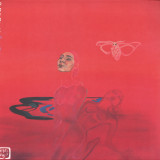
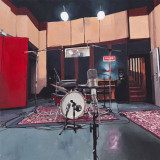
João Almeida (trumpet) and Pedro Melo Alves (drums), two of the most creative and prolific Portuguese jazz musicians of their generation, are MOORIS. Recorded in May 2021, right after the second lockdown in Portugal, “I” shows them freely exploring their instruments of choice but also finding and creating sound with “objects”, as they describe.
Both musicians leave behind familiar ground and use their instruments to create sounds that appear ceremonial or even manifest themselves as rituals. “+” sets the tone, dark, sparse and haunting, and the next four tracks (all on the "positive" side, with “+” added to each title) make use of the freedom proposed by this experiment with the uncanny. The “objects” start appearing, creating movement, confusion and dancing around different genres, from dark metal to industrial.
Flashes of jazz can be heard throughout, particularly on the B side (the "negative" side), with all tracks following the same conceptual logic as the A Side (“-”, “- -”, etc.). The atmosphere is clearer here. João’s trumpet ascends to a new level and creates new concepts in the fourth world realm. In a matter of seconds, it shifts naturally to somewhere else, the dense/dark atmosphere experienced on the A side becomes a distant memory and we are now flowing with the sounds, not trapped in them. A beautiful release after a tense/intense beginning.
After spending the last year constantly listening to “I”, MOORIS' debut still sounds brutal and unforgiving. A rare breed.
quête:at jazz
Repress!
Little Dragon return with a spectacular second album offering in August, a pulsating electro pop epic that Prince would be proud of (only fronted by a beautiful Swedish lady with a sultry voice). A bold and surprising side/two step onwards from their self titled debut, released two years ago to great acclaim especially among specialist circles. Machine Dreams, with its nagging hooks and gloriously infectious tunes, should finally see the band break out into the mainstream.
Recorded in their home city of Gothenburg, Machine Dreams is a gigantic leap on from previous material but still maintains a distinct sound that can only be Little Dragon. Be it Yukimi s warmly inviting vocals, Erik s dextrous drumming, the vast array of synths and bleeps created by Hakan or Frederik s bubbling bass lines, together they don t sound like anything else around right now. The move towards a more electronic sound was a conscious one, as Yukimi explains; The title Machine Dreams seems obvious. These days, humans seem more and more like machines, and as technology evolves, machines feel more human and it becomes fuzzy and beautiful and science fiction-ish. We feel dependent on our machines to create and live, and their sounds reflect us .
Album opener A New breaks us in gently with a single whirring note on the synthesiser, an almost alien sound that gradually morphs into a slow, thumping bassline. Yukimi s vocals flow alongside Hakan s assortment of sound effects interspersed with militaristic drums breaks. A magical opener that sets the scene and seems to sink into itself, taking us with it, until the pace is swiftly ratcheted skywards with Looking Glass , the massive snare, crisp driving beat and experimental synths revealing the band s current penchant for the 80 s. This influence continues apace into stand out track My Step . Utilising a solid drumbeat that nestles next to jagged and playful synthlines, the track breaks down into motorik propulsion with a scuzzy techno bassline that Yukimi works with ease.
Upcoming single Feather finds Yukimi s voice at its most detached and blaze, seemingly nonchalant yet magnificently seductive. Backed by Hakan s keyboard atmospherics, the song creates a soundscape reminiscent of Tears For Fears more reflective moods. Gradually layering more vocals, synths, echoes and reverb, it builds to a quietly psychedelic, dreamy cosmic swirl. Runabout brings forth a mini Airto style percussive breakdown at the tail end of yet another Little Dragon pop gem. Swimming bursts forth into vision with stabbing keys and reflective bass alongside yet another wonderful vocal performance from Yukimi who sings of young love and now so many years have past, my memories as clear as glass . The song is over as quickly as it started, flowing into the next miniature masterpiece in the form of Blinking Pigs
The album closes with the stunning track Fortune , which has already caught the attention of none other than DJ Shadow. It s no wonder really, as the textured melodies blend with the drifting percussion, creating a blissful sonic mood. With a smattering of drums and bass and the magic of Yukimi s voice and Hakan s electronic dynamics floating on top, it s the perfect track to end this fascinating journey through Little Dragon s brave new world.
With disparate influences from Depeche Mode to Prince, LCD Soundsystem to James Holden, Dancehall to R&B, Jazz and Soul, Little Dragon take their place among artists who straddle many genres, yet somehow create their own and in doing so create sounds that make time stop (Yukimi). Futuristic yet somehow retro, Machine Dreams sees Little Dragon achieve something timeless; that elusive pop classic.
ME LOST ME led by Newcastle-based artist Jayne Dent announces a new album RPG via Upset The Rhythm on 7th July, and is touring across the UK including support dates with Pigs x7. RPG (recorded in Blank Studios with Sam Grant of Pigs x7) is ME LOST ME’s fourth outing as a collective, having transitioned from an ambitious solo project in 2017, Jayne now regularly collaborating with acclaimed North-East jazz musicians Faye MacCalman and John Pope.
ME LOST ME delights in experimenting with songwriting and storytelling, creating a beguiling mix of soaring vocals and atmospheric electronics that playfully weave together disparate genres, drawing influence from folk, art pop, noise, ambient and improvised music. Hauntological in part, RPG is concerned with tales and with time - are we running out of it? Does insomnia cause a time loop? Do the pressures of masculinity prevent progress? Jayne Dent asks these questions and more on RPG, her homage to worldbuilding and the story as an artform, calling back to those oral traditions around a campfire, as well as modern day video games - bringing folk music into the present day as she does so.
ME LOST ME presents sound reaching in opposite directions, straddling time towards the archaic and timeless traditions of folktales, and towards the possible and potential futures of pastoral Britain and the world at large. Part speculation, part reminiscence, what results on the new album RPG is music that sounds ultimately displaced and yet omnipresent, adjacent to a hapless Vonnegut hero whose life is scattered throughout time and history, but full of wonder and curiosity rather than fear.
On track “The Oldest Trees Hold The Earth”, we see time stretched out between the branches of impossibly old beings in the woods. This track was co-written in Aarhus, Denmark with fellow Newcastle folk musician (with Danish heritage) Ditte Elly. The pair wordlessly passed a sheet of paper between each other to write the lyrics, inspired by Højbjerg and Mosegård, the woods they were sitting in. “How long should I wait/Before the moss grows?/On my skin, on my outstretched arms,” the lyrics are sung in a round, the close harmonies delicate and detailed.
A central thesis of this album is the joy of creation, something which is paid homage to in the album’s final track, “Science And Art” (Not because we need it to last/just because we needed to make it - so we invented the words/this language). It is also reflected in the definition that Jayne gives for “folk” itself. She comments, “To me, folk is quite an expansive idea. I think of it as creative work that's often made ad-hoc, with things that are at hand and more often than not it's born of a DIY ethos. It is songs and stories of the people, as in the traditional sense, but also creative coding, game design etc. Whatever outlet someone has for their creative expression could be described as folk. It's the things we make because humans need to make things, and the stories we tell about ourselves and the world around us.”
Crucially, on latest album RPG, Dent expands her songwriting and looks towards the unreal locations of worldbuilding in video games for inspiration. She comments, “I think the main similarity is the importance of a song's setting/environment to inform its narrative and textures, I'm often most inspired when out walking in the natural landscape, in cities and travelling to places I've never been before - the environment I'm in really impacts the work I make. While writing this album, however, I found myself inspired by imaginary landscapes, those in video games, paintings, etc. I was writing stories into these unreal locations instead. Even the songs inspired by real places, like The Oldest Trees Hold the Earth, have a very surreal quality to them in the songs, like they're being warped and turned into something not of this world. I think that's the main difference for me in terms of the thematic content and inspiration behind this album - I've been getting more and more interested in balancing surreal and fantastical environmental elements with ordinary and everyday settings.”
RPG upends the concept of the eternal return - we may be in the midst of inevitable repetition, but we tell stories whilst awaiting the passage of time.
"Being familiar with, and a fan of Jayne's earlier work, it was great to get the opportunity to work with her on the production of her new record. I had in mind a sense of what the record might be, but what came of the sessions, led by the vision Jayne had for the record, totally exceeded my expectations. As far as albums go, it has a breadth of writing and a sonic depth that made it a truly brilliant record. Having Jayne join us on a leg of the Pigs x7 tour in April is going to be ace. The creative nature, the sincerity and bold strokes of ME LOST ME put it in that space outside of any genre pigeonholes, and between our two sets I imagine the audience is going to have a proper sonic bath..."
Sam Grant, Pigs Pigs Pigs Pigs Pigs Pigs Pigs, 2023
“The music of Me Lost Me is beguiling, idiosyncratic and cinematic - or should that be video-game-omatic? This suite of songscapes often hits the sweet spot between ancient and modern with its masterful blend of stark folk, neon electronic burbling and unusual arrangements. Jayne's singing is refreshingly straightforward and nuanced - it's exquisite! - and perfectly punctures the nebulae of synths and brass which billow around the old wooden frames of the songs. Whilst listening I had images in my mind of what Northumberland might look like through the eyes of Simon Stalenhag - foggy moors, a robot looking across the sea to Lindisfarne, twinkling lights on metal towers.... that sort of thing. It's a really great album.”
Richard Dawson, 2023
Emm Gryner is an award winning singer, songwriter, actor and best-selling author. Emm sang and played keyboards in David Bowie's band, and appears on numerous recordings, including his landmark 1999 SNL appearance, Bowie at The Beeb and Toy. Bowie's acclaimed Glastonbury 2000 documents her performance in front of more than 100,000 fans at Worthy Farm. With Trapper she shared arena stages with Def Leppard, and she also helped bring the first music video recorded in outer space to the world.
Detroit radio formed the soundtrack of Emm's life and career and her brand new record is a celebration of that music. From Motown,jazz and pop, to Steely Dan, Fleetwood Mac and the Doobies, Business & Pleasure is infused with the sunshine soul and stellar playing of the late 70s and early 80s. These songs, produced by Fred Mollin, written with poet Michael Holmes, and recorded with drummer Shannon Forrest (Toto), keyboardist Pat Coil (Michael McDonald), bassist Larry Paxton (Alison Krauss), and guitarists Tom Bukovac (Taylor Swift) and Pat Buchanan (Hall & Oates, Dolly Parton), embody a take on yacht rock that sails deep into the 2020s and introduce the world to a bold new character: a powerful woman whose passion, presence, conviction, humor and grace serves to unite the world in
music, joy and love, once again.
‘Life & Love’ is the third album from Skinshape (with ‘Filoxiny’ being his fourth). Written, Recorded and Produced by Will Dorey at the Arch Studio, London, and in his bedroom. Great melting pot of styles and tunes, D.I.Y. Funk Soul Jazz. Recommended if you're into Khruangbin. Skinshape is the project of British musician William Dorey. The sound has roots in many genres but in particular 1960s-0s Funk, Soul, Reggae, Psychedelic Rock, Afrobeat and Folk. Skinshape grew out of a love for old music and the way it sounded. Initially Dorey experimented with samples (especially drum breaks) to create instrumental Hip-Hop/Trip-Hop tracks but then later started to play around with tape machines as a means to create his own 'samples'. This process gave birth to Skinshape with all elements being recorded by Dorey since the first self-titled album released in 2014. Aside from the Skinshape project Dorey was bassist for the band Palace from 2014-2017 and runs a reggae label called Horus Records based in North London.
Retro house sounds from Italy on this release... tunes that still go down well with some of the big name festival dj's during their summer tour! A track that remained unpublished for 33 years until Devil Dee decided to make it public and bring his own voice to the spotlight joined by jazz-blues singer Joan Faulkner (former supporting voice of Boney M and Milli Vanilli, also known by her stage name 'Dee-Vah'). Devil Dee is Davide Mancori - a cinematograph with a flattering career as a club-dj from 80s-90s onwards - who lovingly produced this release which differs from most of the releases on Best Record by its housey vibe. 'And The Beat Goes On' was written in Germany in 1989 by Leonie Gane and Ryan Paris laying the crucial foundations for an evolutionary step of the italian disco music. A step forward for the 'Italo' movement considered obsolete and defunct. In fact, the track is also referring to the latest Italo-Disco which entirely covered the scene of the 1980s with furious activity, If the meeting between Devil Dee and the famous interpreter of 'Dolce Vita' - Mister Ryan Paris - creates the alchemy, the explosive mix is completed with the precious work of Marco Magrini. The arrangement by Pierluigi Cerin and the executive work of Claudio Casalini close the magic circle. Five friends and a great singer from Indiana to fill the dance floors all over Europe, while the images of the provocative and surreal video-clip capture the audience by splitting in two. There are those who do not want to see certain issues publicized and those who appreciate their cheekiness, such as Best Record which by publishing the vinyl printed at 180 grams celebrates the 40 years of activity.
Como Asesinar a Felipes (CAF) from Santiago, Chile, displays their rhythmic existential poetry over a grounding produced by organic instruments. On the same platform elements of jazz, hip-hop, rock, classical and electronic music meet, creating a mix that has stood out for its originality, atmosphere and a lot of energy during its live performances interpreted through a signature that is uniquely their own: saturated, technicolor hues of sound painted on a dark psychedelic canvas. In 2008 their self-titled debut record was released which gained remarkable attention throughout Latin America and especially their home country Chile. Now, 15 years later, it was time for a fresh sound and a remaster. Soon after the digital release of the remastered album, the record will be released on vinyl for the first time ever!
Baiana (pronounced By-Anna) is the alias of powerhouse Liverpool-born Brazilian jazz artist, Laura Doyle Following on from performances at Love Supreme, the Manchester Jazz festival, world famous jazz clubs The 606 and Pizza Express as well as an unprecedented 12 weeks on the A- list of the Jazz FM playlist, with her breakthrough single "Saudade Samba" Baiana's highly anticipated self- titled debut album is finally here. Produced by the legendary UK Latin percussionist, Snowboy, 'Baiana' features 11 finely crafted songs covering a huge range of Brazilian styles from fiery Sambas to Bossa Nova, Jazz Fusion to Baiao and everything in-between. Singing in both Portuguese and English, Laura evokes a vocal style reminiscent of the great romantic torch singers of the 40's and 50's such as Julie London and Peggy Lee and yet one can clearly also feel the passionate expression of Portuguese Fado and the Brazilian greats such as Elza Soares, Gal Costa and Elis Regina as she sings of love-lost and broken hearts. An unexpected candidate for Brazilian jazz with her Scouse accent and fiery red hair denoting her Irish roots, Laura became enraptured by Brazilian music after living in Rio de Janeiro where she was seconded as "first lady" with the Italian diplomatic service.
Repress!
Released on Riverside records in 1962, "Letter from Home" was the debut album of Jazz vocalist Eddie Jefferson. Often credited as the founder of vocalese, Jefferson wrote memorable lyrics to classic jazz standards including "Parker's Mood.", "Lady Be Good," "So What," "Freedom Jazz Dance,"... Eddie Jefferson is backed here by a bunch of Jazz heavyweights, all at the top of their game. Among them: tenor sax masters Johnny Griffin and James Moody, trumpeter Clark Terry, pianists, Winton Kelly, and Joe Zawinul, bassist Sam Jones, and two hyper swinging drummers, Louis Hayes and Osie Johnson. This is an often underrated vocal Jazz album, a hidden gem ready to be unearthed. Don't miss it !!!
Repress!
Here's a true West Coast soul-jazz gem originally released on pacific jazz in 1961. Les McCann's warm and emotional singing shines over some gorgeous big band arrangements signed by the great conductor and bandleader Gerald Wilson. McCann's usual trio with Herbie Lewis on bass and Ron Jefferson on drums is augmented by a phenomenal bunch of West Coast top musicians including clarinetist Buddy Collette, tenor sax lions Charles Lloyd, Teddy Edward, and Harold Land, and two absolute guest stars: tenor sax giant Ben Webster and organ stylist Richard "groove" Holmes, what else?
Soul-jazz and blues at their best. Allmusic Guide
The Syphons are the house band at Suit Yourself Music, a collective of exceptional musicians. This is their first release and features Darrell Smith. In 2024 there will be a series of releases with The Syphons featuring other artists and vocalists in the genres of Soul, Northern Soul, Acid Jazz, Mod Jazz, Rhythm & Blues.
All these releases will be new compositions taking inspiration from the original artists in these genres, but ‘Respecting The Architect’ by taking influence to pen new music rather than cover versions.
First time on vinyl!
Newly remastered. LP housed in a gatefold jacket.
Featuring Herbie Hancock, Martha Reeves, Alphonse Mouzon, Chuck Rainey, Patryce “Choc’let” Banks, Carlos Morales, and members of The Pointer Sisters.
In the 1970s, Betty Davis defied genre and gender by pushing her voice to extremes and embracing the erotic. She articulated a kind of pre-punk, funk-blues fusion that had yet to be normalized in mainstream music – a style that few musicians have come close to replicating. As one of the first Black women to write, arrange, and produce her own albums, Betty was a visionary who disregarded industry boundaries and constraints. Raw, unapologetic and in full control, Betty paved the way for generations of future artists who said “funk you” to the music industry and social norms.
In 1979, when Davis entered an L.A. studio to record her fifth and final album, she was reeling from a series of setbacks. Three years earlier, after recording her fourth album, Is It Love Or Desire, Davis was dropped from her label and the LP was subsequently shelved. In 1978, her beloved band Funk House went their separate ways. Looking for a fresh start, Davis relocated to Hollywood to focus on songwriting. Before long, British manager Simon Lait (Toni Basil), offered to fund her next project.
With renewed vigor, Davis reunited with former Funk House guitarist Carlos Morales and brought together industry veterans like fusion drummer Alphonse Mouzon and session bassist Chuck Rainey. Old friends Anita and Bonnie Pointer (The Pointer Sisters) and Patryce “Choc’let” Banks joined Davis on vocals, as did Motown legend Martha Reeves. The resulting album, Crashin’ From Passion, was her most musically diverse, blending elements of reggae and calypso (“I’ve Danced Before”), jazz (“Hangin’ Out in Hollywood,” “Tell Me a Few Things”), dark synth-pop (“She’s a Woman”), and even disco (“All I Do Is Think of You”). Equally exploratory are Davis’ vocals, as she trades in her signature sass and snarls for more nuanced stylings.
Among the album’s few funk tracks is “Quintessence of Hip,” in which Davis hails musicians like Bob Dylan, Billie Holiday, Stevie Wonder, and John Coltrane, while deftly integrating elements of their work. The song also offers a moment of stark vulnerability, as she sings, “Isn’t rich? Isn’t it queer? Losing my timing so late in my career.” It would prove to be a prophetic line in the months to follow.
The mixing process was mired by artistic differences and then cut short, amid the death of Davis’ beloved father. Bereft and exasperated, Davis returned home for the funeral, setting into motion her retirement from the music industry. Crashin’ From Passion, meanwhile, would be shelved for 15 years and licensed for a CD-only release, without Davis’ consent, in the ‘90s. This 2023 edition of the album, made with Davis’ full approval and cooperation, marks its first official release and first time ever on vinyl. The package was designed by GRAMMY®-winning artist, Masaki Koike, while the album cover features an incredible shot of Betty captured in London in the mid-1970s by renowned photographer Kate Simon.
Crashin’ From Passion was remastered by Dave Cooley at Elysian Masters and pressed on vinyl at Record Technology, Inc. (RTI). The accompanying booklet includes a treasure trove of rare photos from the era, plus lyrics, and new liner notes by writer, ethnomusicologist, and Betty’s close friend, Danielle Maggio, who integrates interviews that she conducted with Davis, marking her last ever interviews.
Clear Vinyl - Repress!
Trumpeter Don Cherry, an Ornette Coleman soulmate and a world musician decades ago, became one of jazz's many early losses 10 years back. But saxophonist Pharoah Sanders, who joins him on this fizzing 1966 set, has since ascended to cult status, and he is still around to admire . In the 1960s, he knew no melodic fear at all, in which respect he was aptly partnered with Cherry. This is a quartet set, strongly influenced by the melodic approach of Coleman, but with a fierce abstraction of tone quite different from Coleman's playful lyricism.
Moreover, the rhythm team of Ed Blackwell on drums and Henry Grimes on bass provides a scintillating underpinning for the music that is worth listening to all on its own. Sanders' mix of Coltrane's yearning long notes, Ayler's ghostly, fluttering wail, Coleman's fast, bumpy phrasing and his own manic bagpipe screams certainly separates the faint-hearted from the stayers on the opening Awake Nu. But the conversation between Sanders and Cherry is light, lyrical and engaging on The Thing, and the saxophonist even gets into a stubborn, Sonny Rollins-like repeating Latin vamp on There Is the Bomb. An unflinchingly quirky classic. (THE GUARDIAN)
The Galaxy Sound Co's latest 7" kicks off with a remastered edit of 'Passion Play' by The Sugarhill Gang. It's a tune that was originally on their self-titled 1980 album and comes with background vocals from the superb funk and soul band Positive Force. Somehow the tune didn't make the charts at the time though it has been heavily referenced and sampled since, including by the likes of Kerri Chandler. The B-side is 'Who Is She (And What Is She to You)', a soul-jazz cover of a Bill Withers classic taken from Madelaine's only album, Who Is She, in 1978. It has a serious Chicago pedigree and great arrangements from Johnny Pate.
The Brazilian Singer Ed Mottais one of the greats in Jazz / Funk, not onlyin the South American Music-Scene, but world-wide.He has been one of the leading artists at the forefront in Brazil with a hugefollowing in his Home-Country and around the world With his new album "Behind The Tea Chronicles" he embarks on a new musical journey, crossing genres from Jazz to Funk, over to Soul. Having worked with many renowned musicians over the course of his career (Greg Phillinganes, Chucho Valdez, Roy Ayers and many more) he established his own style of creating music with a message. On this latest album Ed Motta is singing in English, telling stories that resonatewhich a broad audience. Recording the rhythm in Brazil, backing vocals in LA -featuring the legendary Paulette McWilliams and Phillip Ingram - strings in Prague and horns in Detroit, he worked with the best musicians he could find to find an astonishing sound, that will be recognised by the audiophile audience as top of the class. Being recorded with the highest standard, Ed Motta made sure to raise the bar once more.
- A1: 助手席のSituation (Situation In The Passenger Seat)
- A2: Passing Scene
- A3: Miss Shooting
- A4: 灰色のひととき (A Gray Moment)
- A5: さらっとゆるして〜コーヒー通の恋人 (Forgiveness Without Reservation ~ Lover A6 And Coffee Connoisseur)
- B1: Wardrobeの中の夢 (A Dream In The Wardrobe)
- B2: 秋日和 (Clear Autumn Day)
- B3: 夜の海風 (Evening Sea Breeze)
- B4: Spouse-同行者- (Traveling Companion)
- B5: One By One
Satoshi Suzuki (鈴木慧) described his musical practice perfectly on the OBI strip of his 1987 privately pressed LP - Tokyo Contemporary! consisting of 40% Jazz, 30% Soul, 20% Brazil, and 10% Kayokyoku - a musical mixture not too far off from what is now referred to as City Pop.
However, this archival compilation of Satoshi Suzuki's works presents a perspective of the City Pop sound not from affluent 1980s Japanese bubble economy-era studios and highly paid studio musicians, but from a one-person band making the most of the instruments in their home studio, inspired by musical traditions from around the world.
With notes of city pop, AOR, jazz, soul, bossa, and kayōkyoku - Satoshi Suzuki's intimately recorded pop songs are charming and full of wit, with a seasonal and poetic approach to these musical forms using only a drum machine and an array of digital synthesizers. Sounding a little like Pacific Breeze played on a Casio keyboard and drum machine, Uku Kuut soundtracking a SEGA video game, or the wonderful lo-fi works of Suzuki’s lo-fi homemade pop & jazz contemporaries Ronald Langestraat, Lewis, and Joe Tossini — though most of all, SUZUKI's works show a new and singular perspective of the bubble-era city pop of the Showa period.
Distant Travel Companion (遠い旅の同行者) introduces Suzuki's musical works to a wide audience for the first time, featuring remastered songs originally released over three privately pressed LPs from the 1980s, as well as a previously unheard CD from 1993. The original works were released in an impossibly limited edition of 100 copies each - printed and assembled on printing equipment at Suzuki’s company office and scarcely distributed, recording these songs at his home studio in his free time. The compilation's design and accompanying OBI and liner notes are a direct homage to the original releases.
Satoshi SUZUKI is a Japanese keyboardist, singer, songwriter, and music arranger. He is also an author of literature and winner of the "Shin-nihon-bungaku" (New Japanese Literature) Award. He was born in 1958 in Tokyo, Japan.
Repress!
In the last few years we’ve seen French DJ and producer Laroye delivering the goods time after time on respected labels such as Atjazz Recordings, Compost, Makin Moves and Foliage. His latest LP just released on Local Talk has been getting big support picking up plays on Radio 1, 6Music, Worldwide FM as well as spins from Natasha Diggs, Gilles Peterson, Craig Charles, Louie Vega, Honey Dijon to name a few. Freerange is proud to welcome him back for the follow up to 2020’s release Be The Change, presenting you with a killer 4 track EP entitled Uku Dance.
Leading the charge, Laroye is joined by influential Detroit artist, DJ, producer and vocalist Javonntte who has written and recorded a brilliant vocal for a track entitled First Sight. Laroye’s fat beats, jazzy chords and soulful touch make the perfect production for Javonntte’s vocals.
Up next we have the Percussive Dub mix of Uku Dance in which Laroye strips things back to the bare bones making for a serious percussion tool work out to spice up your sets.
On Uku Dance a bass-heavy groove is punctuated with vocal chops and deep Rhodes part which adds a moody, late night touch. Just the kind of soulful, dubby, afro track that will get the house dancers throwing down like their lives depended on it!
Closing out the release you’ll find an instrumental version of First Sight.
‘Demos/sketches/interludes from the hinterland between records. Drum machines and single take vocal sketches tied together with downtime synth experiments and recordings of local disappearing areas.’ True as it is, Jabu’s strap-line is a somewhat understated take on what also proved to be a transformative experience for them. The follow-up record to their 2020 sophomore LP ‘Sweet Company’ (and the ensuing ‘Versions’), ‘Boiling Wells’ weaves a smudged, group -mind spell. Originally released earlier this year without fanfare as a digital-only release, it now receives the proper release attention it deserves, issued in a neatly packaged vinyl edition of 300 copies. Dreamlike, woozy, raw and in dub, the album documents a blossoming process, and encapsulates a fragment in time - holed up in the country, soaking up the atmosphere in collective isolation, creatively embracing the limitations of a small recording set-up, and finding a new way to work as a band. “My mum had gone away so we’d decided to take the mixing desk and a couple of drum machines out to her house and set it up in the front room. We did it a couple of times to get the bulk of the tunes on 'Boiling Wells' done, one in summer and one boozy one around Christmas. I think we all immediately enjoyed working that way, sat around all together, more of an immediate thing. Jas started to play a lot more guitar, her and Al would write lyrics on the fly or be programming a drum beat in or something. We were all switching around and getting ideas down really quickly, not worrying too much if they were good or not. The music was limited by the stuff we had there, I didn’t bring a big desk so we only had six channels or so, and everything was basically just recorded in as a stereo take so we were more or less stuck with it after we’d laid it down - which was nice too. I don’t think we would’ve changed them anyway; it was the sound of the room and of us doing it together in the moment that was really important.” There has always been a collaborative heart to Jabu, though its nature has shifted and morphed over time. In their earliest incarnation, in after-school jams, Alex Rendall would rap over Amos Childs’ beats, but by the time they began releasing music in 2012, Al had found his singing voice – a sweet, soulful counterpoint to Amos’ increasingly dub-wise, experimental backing. Both are founder members of Bristol’s Young Echo, a collective of friends and musicians first operating loosely together on radio shows, artistic collaborations and events, and later on, running a record label. As expansive as their original remit was, Young Echo has steadily evolved since featuring in The Wire’s 2013 cover feature on Bristol’s new school of post-dubstep bass music. Of late, Seb (aka Vessel) has been working with violinist Rakhi Singh on string arrangements for Jabu, and the upcoming residency at Bermondsey’s MOT will showcase relative newcomers Birthmark and Intel Mercenary alongside the regular crew. Jabu’s debut album proper, ‘Sleep Heavy’, arrived in 2017 courtesy of Blackest Ever Black. A sublime, focused meditation on grief and loss written largely by Amos and Al, it marked the debut of Jasmine Butt (aka Guest), adding a further layer of vocal texture to their palette. ‘Sweet Company’, their first album written as a trio (released via their own do you have peace? label), drifted into lighter, more ethereal introspection. Featuring guest appearances by Sunun and Daniela Dyson, remixes by Equiknoxx’s Time Cow and Young Echo ‘s Ossia teased out the inherent pop and dub sensibilities respectively. Recent times have also seen remixes by kindred spirits Seekers International and Jay Glass Dubs, and a collaboration with the renowned T.S. Eliot Prize-winning dub Poet and musician Roger Robinson on a pair of plaintive, aching 7” singles. Jabu’s broad raft of inspirations can be experienced first -hand on their monthly NTS Radio show ‘Music 4 Lovers’, co -hosted by long-time friend and soul afficionado Andy Payback. A celebration of the endless tapestry of interrelated musical connections, it runs parallel to Jabu’s own reinterpretation of their influences. For ‘Boiling Wells’, Amos remembers a diet of “A.R. Kane, Cocteau Twins, DJ Screw, Southern/Memphis rap mixtapes, early 90’s jungle, Karen Dalton, Sybille Baier, Vashti Bunyan, Svitlana Nianio, a lot of soul, Armand Hammer & Alchemist, Grouper, Bobby Caldwell. Jazz was a constant, Japanese, Polish, Latin, American…”. And from those diverse strands, something new and singular has formed, to line up alongside them. ‘Boiling Wells (Demos ‘19-’22)’ is released by UK newcomer Six of Swords in a limited vinyl edition of 300 copies, pressed on black vinyl housed in full colour 270 gsm matt varnish sleeve and black paper inner, with full download coupon
André Roligheten is known for his strong presence in a number of collaborations with everything from Gard Nilssen's Acoustic Unity, Team Hegdal, Friends & Neighbors, Trondheim Jazz Orchestra, Susanne Sundfør, to his own release "Roligheten - Homegrown" from 2017.With his new adventurous ensemble, he is now releasing brand new music on the album "Marbles" (Odin, 03.11.23). The album contains a collection of compositions that facilitate bold interaction. The compositions are conceived as parallel universes with their own, improvised musical forms. Imagine that Sonny Rollins and Egberto Gismonti met on the beach at a yoga retreat in Hawaii and decided to make an album together! Roligheten brings out a highly personal expression in his warm tenor saxophone together with a star team of Scandinavian musicians. Each and every one of them adds a unique depth and substance to the musical universe; Strøm's rigorous double bass, Ståhl's bold vibraphone, Nilssen's elastic drums and Lindström's gripping pedal steel. This merges into a unique sound that carries Roligheten's compositions on a golden stool. The gallery of people in this ensemble has prestigious names, and they have worked with artists and bands such as Tonbruket, Bushman's Revenge, Ane Brun, Paal Nilssen-Love, Bobo Stenson, Supersonic Orchestra and Georg Riedel.
Million Seller is the new electro-acoustic album and project led by Matt Calvert, one of the founding members of the underground alt-rock sensation Three Trapped Tigers The inspiration for the project originated as Matt revisited his collection of early 70s releases by Herbie Hancock's Mwandishi group - some of the pianist's most overlooked and least understood albums. "The concept of Million Seller was to create a contemporary sound with similar elements to the Mwandishi band, putting the electronics and percussion at the forefront, merging organic and synthetic." Mwandishi (originally a sextet, later a septet with added electronics) had three horn players: Million Seller has none, instead using three synth players: Calvert himself is joined by Stale Storlokken of free- form experimental legends Supersilent, and by the unclassifiable improvisor Matthew Bourne. The line-up is completed by drummer Dave Smith, who brings his comprehensive knowledge of the Gambian tradition of Sabar drumming alongside his extensive jazz background, and a trio of guest musicians: Mamadou Saar on sabar and djembe drums, Kadialy Koudate on kora, and Sam Wilson on contemporary percussion. The results are a striking fusion of ancient and modern sounds, of heavy yet playful synth interactions topped by driving acoustic percussion, of wild improvisation mixed with moments of ambient beauty, all creating a sonic identity that's every bit as unique, wide-ranging and unforgettable as its inspiration.
"Following the superb initial two volumes, Emerald City Nights: Live at the Penthouse Vol.3, captures spectacular 1966-68 performances by the master pianist’s trio at the Penthouse in Seattle. Also available as a 2-CD set and download.
Package includes reflections by Ahmad Jamal himself, interviews with fellow pianists Les McCann, Emmet Cohen, Monty Alexander, and Joe Alterman, and essays by producer Zev Feldman and journalist Eugene Holley, Jr., among others. The extensive booklet features rare photos by Don Bronstein, Chuck Stewart, and more.
Producer and music sleuth Zev Feldman’s label, Jazz Detective, a division of the newly created Deep Digs Music Group, releases the third and final volume of the Ahmad Jamal sets: Emerald City Nights: Live at the Penthouse (1966-68), featuring previously unreleased performances by master pianist Ahmad Jamal.
The 2-LP set will be issued on 180-gram vinyl transferred from the original tapes and mastered by the legendary Bernie Grundman. The music will also be available as a 2-CD set and download. The package has been produced by Feldman and supervised by Ahmad Jamal himself shortly before his passing away in April of 2023."
EIVIND LØNNING, ESPEN REINERTSEN, ROMKE KLEEFSTRA & JAN KLEEFSTRA
For IT DEEL II the Kleefstra Bros have collaborated with the Norwegian duo Espen Reinersen and Einvind Lønning (who also collaborate as duo Streifenjunko). Ten years ago the Kleefstra Bros saw Streifenjunko perform at WORM, Rotterdam (NL), and this always stuck in memory. This is why now for IT DEEL II they got together.
The music by Reinersen and Lønning, with the use of wind instruments and electronics, is experimental, but open. It finds a way between improv, jazz and soundart. And like Jacaszek (IT DEEL I) they work with field-recordings in their electro-acoustic music. Like the Kleefstra Bros, Reinersen and Lønning are intrigued by forests, and for IT DEEL II they brought field-recordings made in the forests surrounding Oslo (NO). During the recording sessions as a quartet, they created a dialogue between the forest sounds from Oslo and the Frysian forests, and their instrumental improvisations.
.
The result you find on this new LP IT DEEL II is one of contemplation about how we treat our environment, our nature, and more specific our (local) forests.
The Roger Webb Sound's Moonshade is one of the coolest records ever. Originally appearing via the legendary De Wolfe library in 1971, it's a sumptuous jazz-soul-funk instrumental set. Full of melodic, melancholic yet sun-drenched songs, rich with colour and contrast, it was composed by self-taught jazz pianist Roger Webb and features vocal performances by Barbara Moore. That's right; *the* powerhouse library music duo! It makes Moonshade the perfect precursor and accompaniment to Barbara Moore's eternal classic Vocal Shades And Tones. It will come as no surprise that original copies, if you can ever find them, will set you back north of 200 notes.
Moonshade is a phenomenal showcase of Brit maestro Webb's own roots in jazz. Those roots are served up here with a plethora of fast-stepping rhythms that truly give flight to the vocals of Barbara Moore, as they soar in wonderful ways. Moore sings wordlessly throughout, allowing her voice to act like another instrument in concert with the horns and keyboards elevating the fine arrangements. This is a deeply beautiful record.
The album opens with the ornate Baroque pop splendour of the sun-dappled melancholia of "Sunshine". Strings, piano and wordless female vocals combine to create this brief beauty of unimaginable grace. The cool "Gentle Eyes" features haunting and beautiful vocals, smooth jazz piano and horns and a general easy vibe without being easy listening, if you know what we mean. You do. Just listen. The pounding "Heavy Lace" is one for the beat-heads, funky open drums (!) with muted organ, bassy piano chords and ace horns. Sampled by Quakers for their great debut album on Stones Throw. The nostalgic "Yesterday" is wistful and beautifully melodic instrumental soul music with gorgeous acoustic guitar and flutes. It's followed by the light, lilting "Petal Soft" which features more Baroque styles, overflowing with flutes and harps. The bright, bouncing "Coaster" is an easy-going piano-led, guitar-driven swinger whilst "Grey Sigh" is another classic. A real highlight, with more fantastic propulsive drums and percussion and plaintive wordless vocals courtesy of Barbara. Speaking of which, the soft, sweet Rhodes jazz of the lilting "Sweet Thing" is another staggering showcase of the brilliance of Barbara. Just astounding.
Head straight past the honky-tonk-by-numbers piano jaunt "Cough Drop" and luxuriate in the soft, delicate beauty of the album's melodic, cyclical title track, "Moon Shade". Fragile flutes and acoustic guitar float across judicious bass notes before giving way to slightly ominous piano and, again, those beguiling wordless vocals. And then round again to the flute refrain of the intro. This time with the vocals to see us out. Majestic drama jazz at its finest. The cello-and-flute adorned "Sapphire" is a fluid orchestral beauty whilst "Interweave" rides with more urgency in its string and bass stabs. When the warm keys enter, it's a bonafide mellifluous wonder. The softer "Musette" begins in beautifully gentle fashion before pivoting for a driving yet elegant piano middle section. It reverts back to the mellow intro, for its outro. Understood? The melodic organ and prominent rhythm section running through "Reminiscence" makes for a delightfully understated folk-funk instrumental whilst the cool, rolling piano feels of "7.30 For 8.00" seem to perfectly suit the phrase "dinner jazz". It's no bad thing, c'mon. This classy, memorable set is rounded out by the half-minute mince of the Barbara-blessed "Sparky". It's just over too soon!
The audio for Moonshade has been brilliantly remastered by Be With regular Simon Francis, ensuring this release sounds better than ever. Cicely Balston's expert skills have made sure nothing is lost in the cut whilst the records have been pressed to the highest possible standard at Record Industry in Holland. The original, iconic sleeve has been restored here at Be With HQ as the finishing touch to this long overdue re-issue.
"PRODUCER ZEV FELDMAN’S NEW IMPRINT, JAZZ DETECTIVE, LAUNCHES NEVER BEFORE RELEASED CAL TJADER LIVE SETS RECORDED IN THE 1960s AT THE PENTHOUSE JAZZ CLUB IN SEATTLE.
THIS IS THE FIRST OFFICIAL RELEASE OF PREVIOUSLY UNISSUED LIVE CAL TJADER MUSIC IN NEARLY 20 YEARS!
Transferred from the original tapes by Bernie Grundman, Cal Tjader: Catch The Groove – Live at the Penthouse 1963-1967 is presented as a 180-gram vinyl limited edition 3-LP SET and will also be available as a Deluxe 2-CD set and as a digital download.
Package includes reflections by producer Zev Feldman and jazz writer Greg Casseus, as well as interviews with Poncho Sánchez, Eddie Palmieri, Joe Locke, Gary Burton, Carl Burnett, and Brent Fischer, and a statement by Tjader’s son and daughter Rob and Liz Tjader. The extensive booklet contains previously unpublished photos by Ray Avery and Fred Seligo.
All of the performances heard on this set are previously unreleased. Legendary vibraphone player Tjader is heard with a variety of quintets, backed by pianists Clare Fischer, Lonnie Hewitt and Al Zulaica, bassists Fred Schreiber, Terry Hilliard, Monk Montgomery and Stan Gilbert, drummers Johnny Rae and Carl Burnett, and percussionists Bill Fitch and Armando Peraza.
Taking its name from Feldman’s handle “the Jazz Detective” and reflecting his determined work unearthing hitherto unheard, award-winning treasures, the Jazz Detective label is an imprint of Deep Digs Music Group, a partnership with Spain’s Elemental Music, with which Feldman has enjoyed a long professional relationship."
- A 1: Cycle Five - Kurt Rosenwinkel, Aaron Parks, Greg Hutchinson, Eric Revis
- A2: The Past Intact - Kurt Rosenwinkel, Aaron Parks, Greg Hutchinson, Eric Revis A3. Music - Kurt Rosenwinkel, Aaron Parks, Greg Hutchinson, Eric Revis
- B1: Our Secret World - Kurt Rosenwinkel, Aaron Parks, Greg Hutchinson, Eric Revis
- B2: Solé - Kurt Rosenwinkel, Aaron Parks, Greg Hutchinson, Eric Revis
- B3: Undercover - Kurt Rosenwinkel, Aaron Parks, Greg Hutchinson, Eric Revis
Legendary guitarist and composer Kurt Rosenwinkel’s latest quartet with visionary jazz musicians Aaron Parks (Piano & Fender Rhodes), Eric Revis (Acoustic Bass) and Greg Hutchinson (Drums).
The group’s exhilarating recording Undercover: Live At The Village Vanguard is a selection of seven of Rosenwinkel’s original compositions, captured over three nights of their weeklong run at the historic Village Vanguard, the legendary New York jazz club that has been host to the defining artists in jazz.
- Blackisgod,A Ghetto-Sci-Fi Tribute(_G)
- Smd
- Fk
- We Need Mo Color
- Black!
- Adam X Jalen, Eye Luv U
- Amerikkka, Try No Pork
- Run Pig Run
- Deadmeat
- Myhearthurt
- Chris Dorner
- Nation Tyme
- Homicide/Genocide/Ill Die
- Bebe's Kids, Apollo
- Dirt
- Faceless Wings,Black!
- Blackest Love, Like Paint On Tha Wall
- Steal From The Enemy
- On Fire, Pray!
- Black Be Tha God, Negro
- Blackisinfinite Black Alive! Spirit Shop (Understanding)
- Negro Friday
- Blackz
- Heavy
- Breathe.birth
- G Tribute Live Rehearsal /All My Nxggas Gone Prosper Rehearsal Live
- Fkoffme
- 2: Dirt
- Cointail
- Fkthapolice
- Wakeupnprosper
- Numbers On Yo Head Ft Billy Woods
- Tha Embrace Narrated By Akeema Zane
- Wblbdlnitm : Pray Rehearsal
- Nation Tyme Rehearsal Live
- Nation Tyme Psa
- Wrkouts2Jazzselfdefensealso
- Blackbethagod!!!!!!!(Culture,Freedom.cipher), Psa 4 Tha Folks
- Blackspace
- Stratosphere Status
On his album NEGRO DELUXE Siifu trades in soulful rap for punk, fueled by the Black experience in America followed by spiritual jazz and poetry. A beautiful chaotic collage of sounds that reflect the black man’s thoughts on the day-to-day. It doesn’t take long to reach the heart of NEGRO, Pink Siifu’s new album. It’s an aggressive collection of hardcore punk and free jazz, with bold lyrics that encourage shooting back at trigger-happy law enforcement. This album profoundly communicated the anger of an African-American community beset by police violence a month before the murder of George Floyd lit the streets on fire. In April 2021, he revisited the project with NEGRO DELUXE, which doubled the length of the original.
Pink Siifu tells Bomb Magazine “after we were done mastering and mixing, Zeroh was like, “Yo, NEGRO is like fire, and NEGRO DELUXE is like smoke….So I would characterize NEGRO DELUXE as, like, after you’re angry, after you’ve punched a wall, after you beat somebody up, whatever, how do I channel that into something else? How do I just let it go? I feel like NEGRO DELUXE is that, for real, in a nutshell. It’s like the chaos calmed down after all the fire’s gone and the smoke is in the air.”
It isn’t anything like ensley, Siifu’s breakthrough 2018 LP. Where that record used mid-tempo soul and hip-hop to score his upbringing, NEGRO is a riotous mix calling for Black revolution. It’s also the most fearless project in his growing discography. NEGRO harkens back to 1992, to Ice-T’s thrash metal band Body Count, song “Cop Killer”.
This album is meant to remind us of Rodney King, Racist Cops, The Black Panther Party, and Christopher Dorner, the ex-L.A. police officer who, in 2013, went on a violent shooting spree against his former colleagues and their family members due to seeing his own policeman violate the people there supposed to be protecting. “It’s about America, It’s about the trauma that comes from the flag. It’s about understanding that it’s okay to be angry.”
In the album, originally titled ‘To Be Angry’, Siifu started crafting NEGRO after listening to old Afrocentric jazz and watching clips of novelist and poet Amiri Baraka and civil rights activist Stokely Carmichael, reading Sun Ra’s sci-fi poetry book, The Planet Is Doomed, and started studying Bad Brains, June Tyson, Death, Ras G, and many others.
- Ramybė
- Autoportretas
Santaka is truly the sound of a culture. The name means “confluence” in Lithuanian, and the project has been exactly that from the moment DJ/producer Manfredas and drummer/producer Marijus Aleksa resolved to work together in the early days of 2020.
Not only does it bring together the talents that Manfredas and Marijus have individually honed over their own illustrious international careers in the club underground and young jazz worlds – but their recordings have drawn on talents from across styles and generations within Lithuania, creating a fusion of experimental sounds that represents the living nation. The highest common factors of post rock, jazz, dancefloor and abstract electronics, classical and more all flow together. Now, they are deepening this further, by reworking recordings by composer Rytis Mažulis and the avant-garde choir Melos Collective.
Over two tracks, they create haunting but hopeful, weird but truly wonderful atmospheres that look back to the deep history of their home nation’s music and culture but also forward to sonic science fictions of their own. In “Autoportretas”, disembodied voices emerge from the air around Marijus’s percussion subtly at first but becoming more and more corporeal as the ritual takes shape.
The eight-minute “Ramybė” is less linear, more dreamlike, with orchestral drones, free jazz fluttering and retro electronics joining the voices and drums. But for all their eeriness and oddness, both are built on the pleasure principle too: this exploratory music joining past and future is thrilling and sustaining in the moment.
Tenor saxophonist Ben Webster (born Kansas City, 1909) needs little introduction, Webster is regarded as one of the three foremost swing era tenor saxophonists - the two others being Coleman Hawkins and Lester Young. His ballad playing and sound inspired such later fellow saxophonists as Archie Shepp, Sonny Rollins and John Coltrane. Webster became famous for his unique sound, quick tempos, his solos that contained great virile rhythmic momentum, a rasping timbre and an almost brutal aggressiveness filled with growl, while his ballad playing was breathy, tender and sensual. The list of his collaborations is long, Ben Webster worked, recorded and played with legends from the likes of Art Tatum, Count Basie, Cab Calloway, Roy Eldridge and Dexter Gordon_but a dream came true when he was offered a permanent job in Duke Ellington's orchestra where his personal style matured. Webster stayed with Ellington until 1943, after which he formed his own groups and played with other small ensembles. From 1952 on he spent his time between Los Angeles and New York playing, freelancing and recording with a variety of soloists, among them high-profile singers like Billie Holiday, Ella Fitzgerald, Carmen McRae and Frank Sinatra. Despite excellent reviews of his albums, it was difficult for Webster to find steady work in the US during the early 1960's, and when in 1964 he got offered to play for a month in London he accepted and sailed to England. Webster never returned to the United States. In Europe he found plenty of work, playing residences in Scandinavia, settled in Amsterdam (1966-69) and then in Copenhagen (where he even has a street named after him). He toured frequently, playing in clubs and at big festivals with local bands or with visiting American musicians. Ben Webster suffered a stroke in Amsterdam in September 1973 following a performance in Leiden and died on September 20. Even when his health started to decline during his last years, his playing never did. To the last day Webster played with passion and intensity, delivering weight on every note. Webster is the subject of two renowned documentaries and two extensive biographies have been published about his legacy. Responsible for a plethora of excellent recordings he remains THE best-selling tenor saxophonist in jazz. Ben Webster was one of those unique jazz musicians whose presence came through on every recording (He recorded for prestigious labels including Verve, Impulse!, Prestige, Reprise, Blue Note_and countless others. On the album we are proudly presenting you today (Wayfaring Stranger recorded in 1970 by the NPS Radio network in The Netherlands) you will find mind-blowing high-quality Dutch sessions that were left dormant on a shelf and weren't commercially released for over 30 years! On 'Wayfaring Stranger' the listener is treated to no less than nine sublime tracks that document Webster's trademark relaxed-swinging but imaginative playing style that never gets boring. The album features an all-star line-up from the likes of Rob Langereis (Toots Thielemans), John Engels (Chet Baker, Dizzy Gillespie) and Cees Slinger (Dexter Gordon, Slide Hampton). Expect a 61-year-old Ben Webster in excellent form giving a warm, dusky, gritty yet funky performance where he delivers everything from up-tempo material, 12-bar blues jams to soulful expressive ballads. Webster's quartet is in constant musical dialog with each other, creating a unique back and forth between musicians at the top of their game. Tidal Waves Music now proudly presents the FIRST EVER vinyl release of this fantastic album (originally released as a limited Compact Disc edition back in 2000). This unique record comes as a deluxe 180g DOUBLE vinyl edition (strictly limited to 1000 copies) with obi strip.
Finnish drummer/Producer Teppo "Teddy Rok" Mäkynen returns with his alias The Stance Brothers. Lauded by the likes of Kenny Dope and Gilles Peterson, Mäkynen"s studio creation has been visible on the 7" format during the recent years. Now, Mäkynen is back with a full LP, the project"s first in more than 10 years. Duktus is a treasure-trove for everyone into crunchy jazz funk à la Bob James & CTI, but this is no retro exercise.
It has become clear that Matthew Shipp is the most interesting and important jazz pianist of his generation, the most continually evolving and pushing forward. (We could also say “best,” even have been known to declare that, but it’s such a loaded term.) Now that he’s in his sixties and something of an elder statesman of the art form, he’s overdue for a retrospective look at his catalog, and to help make that happen, ESP-Disk’ will be reissuing some of his great early work that’s gone out of print:
• The 1990 trio recording Circular Temple (originally self-released on Quinton, then reissued in 1994 by Henry Rollins on his Infinite Zero label) will come out this September;
• His 1994 duo album with William Parker, Zo (originally on Rise, reissued in '97 on Rollins’s 2.13.61 label), will reappear in Spring 2024.
These will both be reissued not only on CD, the format on which they first appeared, but on vinyl as well, since many jazz fans prefer that medium. Additionally, his solo piano album Zero, released by ESP-Disk’ in 2018, will be put out on vinyl for the first time, also in 2024.
Circular Temple has marked many firsts for Matthew Shipp: his first CD release, first piano trio album, first of many times on record with Parker and Dickey, first album to be reissued, and on ESP-Disk’s reissue of it, first CD-only album to finally appear on vinyl and first album to be released by three different labels. And, more trivially, the first Shipp album that current ESP head/reissue producer Steve Holtje acquired, back when the only choices were that and a 1988 LP-only duo by Shipp and saxophonist Rob Brown on the Cadence label.
Vecchio's Afro-Rock is one big horn-heavy, bass-blasting, Latin groove funk-rock party. Only now, you're all invited because this, ladies and gentleman, is officially...a grail no more. With copies currently starting at 400 Euros for an original, this beautifully presented reissue, part of Be With's fresh campaign with Music De Wolfe, is well overdue. A magnificent and somewhat obscure library set that's just a total, cohesive joy from start to finish, this here is the soundtrack to all your smokin' summer BBQs and communal cookouts.
Afro-Rock is the debut album by Argentine keyboardist Luis Vecchio. Recorded for the sound library label De Wolfe, the album is frequently mentioned in hushed reverence among the beat digger DJ collecting crowd. It features fiery brass charts, funky bass lines, fluttering flute, choppy organ and additional hand tribal percussion. The band let loose too and jam hard; yet there's a certain thread of solidity that runs throughout, the tracks just belong together, not disparate sound and rhythm experiments like some library records; this is just straight up, no messin', consistent funk-rock FIRE! Hips will sway, heads will nod to the steady vibes. It's insanely good.
The humid, building funk of the appropriately titled "Megaton" is a dramatic explosion of swirling, dazzling organ lines, ferocious beats and heavy horns throughout. It just don't stop. The tempo slows slightly for the deep and deeply addictive "Renegade". It's all heavy jazz horn refrains, always triumphant, coupled with devastating percussive breakdowns and killer guitar riffing. It's an insistent organ-led juggernaut. The frenetic "Facade", up next, is no less driving, horns high up in the mix over rattling percussion and brilliant organs lines. Just sensational. The bright "Chabati" is another glorious extension of the optimistic Vecchio sound, the organs wilder than ever before. The moody "Green Hell" is a real highlight and closes out the A-Side with some outrageously funky refrains - be it horns, organ or guitars - and is complimented by gorgeous flute work that galvanises the piece, elevating it to downright heavenly status.
Knowing full well that he's on to a surefire thing, Vecchio opens the flipside in much the same vein. Indeed, "Boss" is yet another uptempo highlight, a sensual orgy of proud horns, hand percussion and melodic flute playing over driving organ and guitars. It's followed by "Nsambei", which is rightly adored for its briefly open drum break, fantastically propulsive percussion breakdowns throughout and the jazzy, loose organ and guitar shreds. The bright "Waboco" ups the tempo and the pressure, hanging on one hell of a guitar hook and infectious horn refrain. Perhaps foreseeing how this album would come to be viewed, the aptly-titled "Cult" is possibly the finest song on the record. Which is saying something, because this record is insanely good. Riding a steady, confident organ groove straight out the gate, the kinda melancholic flute line over the top serves as a beautiful counterpoint which the horns often come in and imitate/riff off. Goddamn this is so so good, it needs to be played everywhere. The overwhelmingly mighty 7-minute jam "Ngoma-ku" rounds out this quite staggering record brilliantly in its heavy, mid-tempo blues with countless extended solos.
The audio for Afro Rock has been meticulously remastered by Be With regular Simon Francis, ensuring this release sounds better than ever. Cicely Balston's expert skills have made sure nothing is lost in the cut whilst the records have been pressed to the highest possible standard at Record Industry in Holland. The original, iconic sleeve has been restored here at Be With HQ as the finishing touch to this long overdue re-issue.
Experimental rock quintet from Los Angeles for fans of Unwound, Duster, Slint, and Lowercase. Mixed and engineered by Tim Green at Louder Studios (Unwound, Melvins, Jawbreaker). Live appearances with Flenser labelmates, Have a Nice Life, Chat Pile, Midwife, and tour dates planned throughout 2023. Since its formation in 2018 by like-minded Calarts students Alex Kent (guitar, vocals), April Gerloff (bass), and Sylvie Simmons (guitar), as well as the recent addition of Clint Dodson (percussionist), Los Angeles-based quartet Sprain has honed its signature flavor of experimentalism to a razor-fine point. Gradually moving from twisting conventions in its early works of minimalist slowcore to now transcending the confines of genre altogether, Sprain's evolution over the past several years has encouraged the band to embrace a sound true to its muse. With its latest record, The Lamb As Effigy or Three Hundred And Fifty XOXOXOS For A Spark Union With My Darling Divine, the band has translated this intent into an ambitious work that pairs its resplendent scale with uncompromising honesty towards the band's artistic and conceptual essences. The most extraordinary of art isn't created without its fair share of trials, of which Sprain faced numerous during the recording process of The Lamb As Effigy, with the sum and circumstances of them nearly sealing the album's fate in limbo. With obstacles including session reschedulings as a result of a line-up change and a major studio electrical failure at the last possible moment, a mixing process that demanded the organization of several years of material across four separate studios, and the recording of the actual songs pushing the members of Sprain to their own physical limits, there were several times where the band considered scrapping the whole thing altogether. But Sprain persevered, applying the knowledge and willpower derived from those struggles to get The Lamb As Effigy across the finish line. Clocking in at nearly two hours, The Lamb As Effigy resembles an aural parallel to the human experience itself, with all the glorious beauty, crushing brutality, and unexplainable chaos that comes with it intact. Explosions of earth-sundering guitars, angelic keys, swirling strings, and bursts of improvised electronic noise coalesce to weave a visceral yet unique sonic tapestry bearing hints of no-wave, sound collage, 20th-century avant-garde, and free jazz. Spanning bellowing howls, emphatic spoken word, and nuanced croons, Alex Kent's dynamic vocal delivery adds texture to these eight meditations on otherwise immaterial topics and the meaning or the lack thereof they embody.
Atack’s founder member and lead guitarist Keith Atack has a long pedigree in the rock music scene. He grew up during the sixties and was influenced from an early age by bands like The Beatles, Rolling Stones, Yardbirds and then on to Jimmy Page and Ritchie Blackmore. He has also toured with many pop acts like Bonnie Tyler, Rick Astley and many others. He has a rock / funk / soul style as well as a jazz and blues influence. He is joined by band members that also have strong roots in the rock scene such as Bob Richards on drums who has rubbed shoulders with members of bands like Iron Maiden, Survivor, Asia and Shy. Bassist Chris Childs is well respected and is the bass player with UK stalwarts “Thunder/ Lonerider/Tyketto”, he is an ideal addition to the line-up along with seasoned vocalist Lee Small (Shy/Phenomena/Lionheart and many more). Finishing off the quintet is Nick Foley whose keyboard prowess is ever present throughout the album. The sound of the Hammond for which he is known gives the whole album a feel of Deep Purple and Rainbow with a true classic British Rock sound. “Nine Lives” is an exciting addition to the escape music roster and available in limited edition vinyl and CD formats, something very much to look forward to.
Black Vinyl[34,41 €]
After almost 25 years a new studio album of the German prog rock legend in original lineup! Agitation Free was one of the leading representatives of German experimental rock
music in the early 1970s. The Berlin band developed long, for that time unusual, free
instrumental improvisations from the end of 1967. They achieved cult status as early as
1972 with an independent mixture of improvised rock paired with electro, ethno, jazz and
trance elements.
Extensive live activities gave the band a steadily increasing level of recognition throughout
Europe. For example, the group performed in the cultural program of the Olympic Games
in Munich in the summer of 1972, toured France for two months in early 1973, performed
at the "German Rock Super Concert" in Frankfurt in May, produced the second album "2nd"
and then went on tour through France and major German cities. In 1974, the band began
to show signs of fatigue, which led to their temporary breakup at the end of the year after
a farewell concert.
Although a number of albums (with recordings from 1972 to 1974) were released after the
group's breakup and the studio album "River of Return" was released in 1999, it took
almost 35 years for the original band to reunite for concerts. In February 2007, Agitation
Free, with the original lineup from 1974, gave a series of concerts at Tokyo's "Shibuya
O'West."
In retrospect, it became clear that the experimental circle Agitation Free was one of the
important bands of the "Berlin School" and furthermore a career springboard for several
German musicians. Christopher Franke, for example, helped the band Tangerine Dream
achieve worldwide recognition. Michael Hoenig worked with Klaus Schulze and Tangerine
Dream before he became known as a film composer in Hollywood after a solo album
(among other things, the film music for the blockbuster "9 1/2 Weeks" with Kim Basinger
and Mickey Rourke). Axel Genrich moved to Guru Guru, Burghard Rausch became a
founding member of Bel Ami. Gustl Lütjens, toured with Shirley Bassey and Nena and later
found a large audience with his new age band Living Mirrors, especially in the USA. Lutz
"Lüül" Ulbrich joined Ashra, worked with ex-Velvet Underground singer Nico, produced
solo records in addition to theater music, and has enjoyed success with the 17 Hippies since
the late 1990s.
In the line-up Michael Hoenig (keyb, syn, el. perc), Burghard Rausch (dr, el. per), Lutz GrafUlbrich ((git, acc. git, bj), Gustl Lütjens (git acc. git, vocals) and Daniel Cordes (b, syn) the
new studio album "Momentum" was recorded.
Color Vinyl[36,93 €]
After almost 25 years a new studio album of the German prog rock legend in original lineup! Agitation Free was one of the leading representatives of German experimental rock
music in the early 1970s. The Berlin band developed long, for that time unusual, free
instrumental improvisations from the end of 1967. They achieved cult status as early as
1972 with an independent mixture of improvised rock paired with electro, ethno, jazz and
trance elements.
Extensive live activities gave the band a steadily increasing level of recognition throughout
Europe. For example, the group performed in the cultural program of the Olympic Games
in Munich in the summer of 1972, toured France for two months in early 1973, performed
at the "German Rock Super Concert" in Frankfurt in May, produced the second album "2nd"
and then went on tour through France and major German cities. In 1974, the band began
to show signs of fatigue, which led to their temporary breakup at the end of the year after
a farewell concert.
Although a number of albums (with recordings from 1972 to 1974) were released after the
group's breakup and the studio album "River of Return" was released in 1999, it took
almost 35 years for the original band to reunite for concerts. In February 2007, Agitation
Free, with the original lineup from 1974, gave a series of concerts at Tokyo's "Shibuya
O'West."
In retrospect, it became clear that the experimental circle Agitation Free was one of the
important bands of the "Berlin School" and furthermore a career springboard for several
German musicians. Christopher Franke, for example, helped the band Tangerine Dream
achieve worldwide recognition. Michael Hoenig worked with Klaus Schulze and Tangerine
Dream before he became known as a film composer in Hollywood after a solo album
(among other things, the film music for the blockbuster "9 1/2 Weeks" with Kim Basinger
and Mickey Rourke). Axel Genrich moved to Guru Guru, Burghard Rausch became a
founding member of Bel Ami. Gustl Lütjens, toured with Shirley Bassey and Nena and later
found a large audience with his new age band Living Mirrors, especially in the USA. Lutz
"Lüül" Ulbrich joined Ashra, worked with ex-Velvet Underground singer Nico, produced
solo records in addition to theater music, and has enjoyed success with the 17 Hippies since
the late 1990s.
In the line-up Michael Hoenig (keyb, syn, el. perc), Burghard Rausch (dr, el. per), Lutz GrafUlbrich ((git, acc. git, bj), Gustl Lütjens (git acc. git, vocals) and Daniel Cordes (b, syn) the
new studio album "Momentum" was recorded.
Vocal Shades And Tones is a miraculous leftfield library classic from the genius mind of celebrated UK composer/singer/vocal arranger Barbara Moore. It's a heavenly groove-based blend of jazz, Latin, soft-psych, folk-funk and gospel soul. Recorded for the legendary Music De Wolfe in 1972, it's an audacious start-to-finish listen, as dizzying as it is dazzling. It's a perfect snapshot of a musical era, supported by Moore's glorious vocal arrangements. Widely regarded among collectors, DJs, and lounge/easy-listening acolytes as an absolute essential it is viewed as the holy grail by many production music heads, rarely appearing for sale and disappearing in a flash when it does. Indeed, originals now go for over £300 and it's easy to see why. Just one of the reasons why this fresh Be With reissue, part of a wider De Wolfe reissue campaign, is so utterly crucial.
Racing out the gate, the driving "Hot Heels" is a bright, sophisticated scat groove which sounds Brazilian, richly produced as if coming by the hand of Arthur Verocai. Yes, *that* good. It's followed by "It's Gospel" which is, er, a wonderfully slow and deeply soulful gospel treasure. The appropriately monikered "Steam Heat" is a darker, breathy gem, one for salacious crates and one of the record's most infamous tracks. "Fly Away" is pastoral West Coast soft rock, very much in conversation with John Cameron and Keith Mansfield's epochal KPM recording, Voices In Harmony. "His Name Was" is a stop-you-dead-in-your-tracks Beach Boys accapella church-organ stunner, whilst "Swing Over" is another carefree, richly produced sun-dappled smasher. The gentle Bossa and sunshine soul of the aptly-titled "Touch Of Warmth" closes out a virtually perfect A-Side.
The B-Side opens with the easy grace and dramatic build of "Voice Force Nine". The jaunty "Very Fine Fellow" may be the only track to slightly grate so we advise heading to the slower, moody "Shades-Tones", eminently more compelling with sparkling, hypnotic piano throughout, underpinning the gorgeous wordless vocals. Just beautiful. It was sampled by Redman for his Method Man-featuring "Do What Ya Feel" on the great Muddy Waters. We're back in Brazilian territory with the cool, uptempo "I'm Feather" before swooning to the warm, relaxed "Drifting", another total highlight which was famously sampled by Koushik on his legendary remix of Madvillain's "America's Most Blunted (Doom's Verse)". The penultimate track, "Take Off" is a bright, organ lounge groove before this remarkable set is rounded out by the beaty "Fly Paradise". It's so so good, it sounds like Rotary Connection fronted by The Mamas & the Papas. As noted in a recent Guardian article on Moore's life, "there is a plushness and electricity in the tight vocal harmonies that spring out, sung with the precision of cathedral choristers decades before Auto-Tune." Amen.
In the 1960s, Barbara Moore was a member of Top of the Pops’ resident vocal-harmony group, The Ladybirds and sang backing vocals for Dusty Springfield’s TV show. Her own outfit, the Barbara Moore Singers, were regulars on TOTP, singing with Jimi Hendrix when he performed "Hey Joe" live in Lime Grove Studios. An important detail for Moore was the shepherd’s pie she bought Hendrix when she found him alone, looking emaciated, near the BBC canteen. By 1970, she was working as a session singer for De Wolfe and, by 1972, was composing her own tracks for De Wolfe and working within their tight creative strictures. Each short track had to evoke an obvious mood and theme, with no significant key or tempo changes. Her response, this very album, managed to stay between the lines while cohering as an overarching artistic masterpiece.
The audio for Vocal Shades And Tones has been carefully remastered by Be With regular Simon Francis, ensuring this release sounds better than ever. Cicely Balston's expert skills have made sure nothing is lost in the cut whilst the records have been pressed to the highest possible standard at Record Industry in Holland. The original, iconic sleeve has been restored here at Be With HQ as the finishing touch to this long overdue re-issue.
Having gathered up praise from Mary Anne Hobbs, Cerys Matthews, Jamie Cullum, Gilles Peterson, Huey Morgan, The Guardian, Jazzwise and more, for his lauded ‘Crisis & Opportunity’, drummer and composer Myele Manzanza returns with the fourth instalment of his series, titled ‘Meditations’.
On ‘Meditations’, we see Myele revert to a purely acoustic line-up, channeling a focused and razor-sharp return to his Jazz roots. Showcasing an incredible level of musicianship between three musicians at the top of their game - including Matthew Sheens (Ross McHenry, John Patitucci) on piano and Matt Penman (Joshua Redman, SFJAZZ Collective) on double bass - the trio exchange motifs over the length of 7 tracks.
Opening proceedings with frenetic rhythmic improvisation, complimented by melancholic and cinematic layers of sound, ‘Crayford’s Room’ is a tribute to Myele’s musical mentor back in New Zealand. Remembering his time as a student in Wellington, Myele shows his deep connection to his origins, manifesting itself as lament on ‘Winter’ and ‘Homesick’. Introducing hypnotic, contemplative melodies take centre stage on ‘Something Old Something New’ (the first single to be released from the project)’ It maintains a sense of tension and intrigue throughout, and intensity rises to a crescendo sending sonic particles sprawling into space.
Intuitive, darker and deeply contemplative, Myele shares his innermost thoughts on ‘Crisis and Opportunities Vol.4 - Meditations’. He divulges:
‘The personal angst and existential frustration I was going through across 2020 - 2022 I believe is well reflected here. The album is deeply informed by the musicianship and sound of my trio, Matthew Sheens on piano and Matt Penman on double bass. Knowing that musicians of their calibre were going to be involved gave me licence to go further in my writing, deploying odd time signatures, sharing the melody roles across the piano and the bass, and delving deeper into the nuances of what the acoustic piano / bass / drums trio can do. The compositions present a challenge even to the best musicians, and I knew that it was essential to have a team on this level to really move the music beyond an academic exercise and draw out the emotion and colour from the material.’
mule musiq welcomes british producer jimmy wallace, presenting his debut album “red, yellow, black” - a nine track strong record that partly leaves the dancefloor behind.
since childhood, music has been a strong influence on the 33-year-old artist. his mother, a music teacher, exposed him to classical sounds from an early age.
but it was hearing the electronic tones of the french touch movement, which really ignited his mu-sical journey. a year later he started to dj, acting out his love for four-to-the-floor grooves in local clubs. today you'll find him on the bill with artists like ruf dug, mr scruff, or bradley zero, heating up the dance floors.
as a producer he has already released a handful of stunning eps, including one for sweden’s finest house label studio barnhus, and one for london’s revered rhythm section international imprint.
both feature house tunes with an edge, house tunes with a love for the roots of the genre along-side more reflective, ambient moments. he also runs the label tartan records, where he publishes dancefloor focused white labels.
his music has been championed by titans of the scene such as palms trax, ryan elliott, dj tennis, gilles peterson, dixon, and hunee. axel boman even coined his debut ep as “one of the very best demo emails ever received at label studio barhnus hq”.
an advance praise, that wallace now acknowledges with an album full of deeply crafted music. some tracks lean towards the dancefloor, like the swung sounds of “bubbles”, the hypnotic mael-strom of “good morning”, or the epic, jazzy moments of “labyrinth”.
the theme of nature is evident throughout, with field recordings and environmental sounds he rec-orded on the road, being fused with his own musical ideas.
tracks like “waterfall” and “tokyo street”, draw influence on time spent in asia, whereas "dhq", "by the river", and "by the lake" are inspired by his childhood and hometown in the shropshire country-side. “i’ve been writing ambient and more nature focused material for a few years now without really having a plan for it.
finally, this year after writing the tune “labyrinth” i felt i had a body of work which was both diverse and cohesive enough to bring together on a record. so, the album represents moments of time i have spent in various outdoor spaces around the world, using sound to try and turn these experi-ences into musical format.” wallace discloses.
the result is a mesmerizing long player featuring an evocative, emotional story arc that avoids ste-reotypes and straight party orientated narration. “having written plenty of club music for the past few years, i wanted to show a different side to my sound.
something more intimate, private, experimental which can be listened to away from the party.” he reveals on the meditative, blissful “red, yellow, black” - an album, which has the power to transport listeners to places and spaces new – for inspiration, relaxation, and dancefloor moments off the beaten path
Reissue der Debüt-LP 'Forgettable' (2014) des US-Emo-Quartetts Sorority Noise, das sich aus Mitgliedern der Screamo-Band Old Gray, Prawn und Two Humans zusammensetzte. Transparent-Purple Vinyl.
C"mon Tigre, the innovative music collective known for their genre-blending compositions, releases their highly anticipated fourth album Habitat. Drawing inspiration from the concept of an ecosystem where various forms of life, both animal and vegetal, thrive and coexist, the album takes listeners on a sonic journey through the intricate and ever-evolving nature"s theater. C"mon Tigre"s ability to blend inï¬éuences from distant corners of the world enriches their music and visual imagery. The album is deeply inï¬éuenced by rhythms coming from Brazilian tradition, the backbone is rooted in samba, forro, through instruments and tempos that come from this cultural magnificence. However, it retains the African jazz, electronic, and mixed inï¬éuences that have characterized the project thus far. Connecting the dots, the result is a richly layered and genre-defying soundscape. The record boasts a stellar lineup of collaborations. Among these are Seun Kuti, heir to the legacy of the legendary Fela Kuti, whose afrobeat roots infuse the album with a potent and infectious energy. The record also features Xenia Franca, a dynamic Brazilian artist hailing from Sao Paulo, Arto Lindsay, recognized as a pivotal figure in the world of experimental music, Giovanni Truppi and the Californian collective Drumetrics which featured on C"mon tigre"s records since their debut in 2014.
Studio Barnhus proudly presents Joshua Idehen, announcing "Stretch for the Stars" – a new EP from
the Stockholm-based British-Nigerian spoken word artist and musician. Joshua's explosive creativity
and soulful voice have made him a fixture on the UK jazz scene, his exuberant live performances
lighting up clubs and festival stages across the world, including recent Studio Barnhus parties and
Boiler Room streams.
Together with producer and instrumentalist Ludvig Parment, Joshua fuses poetry with modern club
sounds in a natural, free-flowing way, resulting in some of the most poignant new music heard at
Studio Barnhus label headquarters in recent times. The new EP was co-produced by label mainstay
Matt Karmil and designed by Laurenz Brunner. Vinyl and digital release date November 24.
A quietly funky collection that repays repeated play by creating a mesmeric, almost
hypnotic, cocoon to lose yourself in" Echoes
Examining our relationship with the cosmos as well as more intimate liaisons closer
to home; new transatlantic future soul duo Cosmic Link are set to release their
eponymous debut album on 24th November.
The duo consists of Florida based Jay Myztroh and Bristol based producer Ben
Dubuisson, best known for the Hundred Strong project. Citing influences of Erykah
Badu, Prince, Alice Coltrane, Stevie Wonder and Esperanza Spalding; the album
crosses cosmic soul/RnB, low-end weighted hip hop, and conscious jazz. While the
musical vibrations lay down a groove on a sensory level, the lyrics prompt deeper
subconscious thought.
Under a “Cosmic” header, side one of the album starts with ‘Let It Go’, a song about
releasing the things that no longer serve you in your life, before exploring
meditation (‘Quiet Time’), karma, and responsibility in the way you live your life
(‘Metaphysical’).
Side two of the album is grouped with the theme “Link” and as narrative, explores
the evolution of a relationship: ‘Cellphone’ expresses the desire to be close to
someone, ‘Shoot’ is the introduction to the courting stage, and ‘Show U Love’ is a
request to take a step into a committed relationship.
“All of these songs are personal,” says Jay. “They explore either my experiences or are
written to me as understandings to help me navigate this plane of existence. The
personal nature of the music is what makes it universal to all humans”.
The overall theme of the album is summed up in the lyrics of the closing title track,
“Our motion is perpetual/together we move/at the speed of life/ intertwined by our
timelines/which coincide”.
Jay explains, “There is no separating the all from the source. With all living things
being products of the Cosmos, we are forever linked to it. We all share a source, atimeline, a planet, air, a sun etc. We are linked by simply being and doing the things
beings do”.
Introduced by mutual artist friends, the catalyst for their collaboration was the 2017
album 'Black Diamonds' by Jay's previous project Stono Echo, produced by the late,
great Paten Locke. Over the course of a few years they began remotely exchanging
music and lyrics, building a catalogue of finished tracks. During this time, Myztroh
was also completing his Masters degree in choral conducting that focused on
discovering and promoting compositions from the African Diaspora. Run by Ben
Dubuisson, High Noon Music has been based in Bristol since the early 2000s,
releasing records by artists including Ben’s own Hundred Strong, plus Boca 45,
Joseph Malik, Kali Phoenix, One Cut, Mr Fantastic, and Numskullz.
Caz Plak İstanbul proudly presents...
ONE OF JAZZ'S ALL-TIME GREATS PLAYING TURKISH RHYTHMS!
Don Cherry delves into Turkish rhythms, accompanied by his long-time Don Cherry Trio members: Turkish drummer Okay Temiz and South African bassist Johnny Dyani.
The vinyl LP is manufactured in Istanbul under the guidance of Mr. Okay Temiz, the only living member of this iteration of the Don Cherry Trio. The LP has been remastered from original material housed in BYG Records' vaults by Okay Temiz & Mert Ucer and licensed from BYG Records, France.
This LP features the recording by the Don Cherry Trio in Paris 1971 for the Sound and Vision program at the legendary ORTF studios in Paris 1971. Serving as the second chapter of our 'Turkish Jazz Trilogy', it follows Okay Temiz's magnum opus, 'Okay Temiz's Oriental Wind at Montreux Jazz Festival 1982' LP. We present one of the paramount Jazz figures of all time interpreting Turkish rhythms in Don Cherry Trio - The ORTF Recordings Paris 1971 LP
This release also stands as one of the most important recordings prior to Don Cherry's legendary "Organic Music Society" album in 1973, in which Okay Temiz also plays drums.
"Don Cherry Trio as an 'Applied Universe of Thought.'
In the spring of 1971, while we were playing as the Don Cherry Trio in Paris, Don (Cherry) seamlessly flowed from the trumpet to the piano, with improvisation as the lighthouse of the melody. This approach opened up a realm of boundless freedom for Johnny and me. It is to be observed as a melody within a melody. From the Organic Music Society album we recorded a year after this concert, up until the ECM album we recorded before Don's final departure from this planet, this principle has been the gravitational force of the Don Cherry universe.
That, indeed, is the true legacy of the Don Cherry Trio."
Excerpt from the liner notes by Okay Temiz and Haluk Damar
Two leading lights of UK house join forces for a special collaboration which delivers every bit as much as you would expect from anything with the Jimpster & Crackazat stamp on. Having been introduced to Crackazat’s vocal and lyric writing on his acclaimed Evergreen LP from last year Jimpster was keen to team up to bring some of that flavour to his own sound. Born out of a desire to stretch outside of their comfort zones, and with a mutual respect for each others productions, the Natural Child EP brings us two original vocal tracks and two dub versions covering a spectrum of moods from classic soulful to deep, atmospheric, contemporary house.
Opening track Natural Child leads the charge with Crackazat’s trademark jazz-influenced piano part, swirling moog lines and vocal being complimented with Jimpster’s punchy drums and warm, rounded bassline. The result is a spacious and deceptively simple track which will wrap you up in its warm confines.
Next up we have a completely different take on Natural Child which ups the BPM and adds a more live, percussive and rolling vibe which will no doubt get the house dancers throwing down.
My Harmony comes next with its slick and soulful sound which draws inspiration from golden era NYC sounds of Blaze and Louie Vega while Nick Cohen’s live bass brings a bounce to the chunky, shuffling house beats.
Closing out the EP we have a dub version of My Harmony which loops up the Rhodes part, strips back the groove and adds layers of FX and arpeggiating synths resulting in a heads-down deep and soulful track to warm up the dance floor.
Soundscape Versions presents the 4th release on sub-label Analog Versions and welcomes Laslo, DJ and Producer from Hungary. On this record he explores the lower tempo territories in a minimalistic way, fusing jazz influences with dub music and downtempo. The release was influenced by early electronic music released on the infamous hungarian label, UGAR and early nu-jazz records. Musically the main goal was to have a human, imperfect feel to the drums. As usual, everything was recorded live on the mixing desk. Instead of sequencing most of the synth parts were played live and additional guitar atmospheres were dubbed over some sections.
Search Party is the debut album from pianist, Rupert Cox. Rupert has made a little following for himself already being a respected player for Myele Manzanza, China Moses, Chris Hyson and many more.
His debut album swings between laidback contemporary jazz and swirling electronics. There are mellow and moving moments alongside joyful, uplifting melodies and dancing rhythms.
The record has already won support from people like Deb Grant on BBC Radio 6 Music and is slowly developing an ardent following.
DJ Support:
Deb Grant (BBC Radio 6 Music) and Tony Minvielle (Jazz FM)
Jacob Collier: “Having known Rupert for more than a decade, I can honestly say that this kaleidoscopic beauty of an album does effervescent justice to his magnificent musicianship. It’s a journey for the soul! I can’t wait for the whole world to hear it.”
Brad Mehldau: “Music is all about storytelling for me at its base and it’s got that going on all the tracks… It really holds together as a singular voice.” “It feels like I’ve heard it before, like it has a familiarity, but it doesn’t sound like something or someone else.”
Saxophonist Alex Hitchcock continues his mission to seek out new sounds and textures at the forefront of contemporary jazz, and to act as a catalyst to bring together some of the finest musical talents drawn to the fervid internationalism of the contemporary London scene His response to the current challenging climate for artistic endeavour is to go big and go bold: Dream Band: Live in London is a truly groundbreaking project presenting three different 'dream bands' of his favourite musicians, captured live over three nights at London's legendary Vortex club performing music specially composed for each ensemble. The extraordinary line- ups he assembled are testament to the respect he has earned among his peers as a composer, player and bandleader with a uniquely inspiring vision. The band for the first night features the frontline of Mark Kavuma's trumpet and Liselotte Ostblom's vocals blending together over the trio of Rob Luft, Rio Kai, and Jamie Murray: the second features James Copus on trumpet with longtime musical partners Kit Downes on piano and Lewis Wright on vibes, and Conor Chaplin and Marc Michel supplying bass and drums, and the third sets Downes' piano alongside the guitar of Ant Law and Alexandra Ridout's trumpet, with the international all-star rhythm section team of Orlando le Fleming and James Maddren. Part of the album's delight lies in the unexpected combinations of these acclaimed players, and the new levels of creativity that they bring forth; the constant presence of Hitchcock's unmistakeable voice on tenor sax and the strength and consistency of his writing gives the project a compelling unity. Each of the three bands brings their own unique blend of voices to Hitchcock's compositions, taking them in directions unforeseen even by their composer.
Limited edition high-definition premium vinyl for super fidelity, 180g audiophile pressing - the complete LP + 2 bonus tracks Coltrane's sessions for Atlantic in late October 1960 were prolific, yielding the material for 'My Favorite Things', 'Coltrane Plays the Blues', and 'Coltrane's Sound'. 'My Favorite Things' was destined to be the most remembered and influential of these, and while Coltrane Plays the Blues is not as renowned or daring in material, it is still a powerful session. As for the phrase "plays the blues" in the title, it's not so much an indicator that the tunes are conventional blues, but more indicative of a bluesy sensibility.
Limited edition 180g audiophile pressing, high-definition premium vinyl for super fidelity - the complete LP + 2 bonus tracks 'Monk's Dream' was the first album Thelonious Monk released on Columbia Records after his less than amicable departure from Riverside Records. Even though Monk had already recorded all the tracks on the album before (apart from Bright Mississippi), in a variety of settings, the powerful cohesion of the quartet this Columbia session produced a first-rate work worthy of the praises it received when released, and which it still receives today. It was Monk's best-selling album ever. "This important album, Monk's first after a long absence from the recording studio, is a stunning reaffirmation of his power as a performer and composer. It is a brilliant and absorbing program of five Monk originals and three standards (and they might just as well be originals, so startling is their transformation at his hands). This is a beautiful album in every respect, completely stimulating in each second of its more than 47 minutes" - ***** Pete Welding, DownBeat
After a string of two dozen brilliant albums beginning in the 1950’s, clarinetist, saxophonist, flutist,
composer and arranger Jimmy Giuffre stopped recording. For nearly ten years he focused solely on
live performance. This album, Music for People, Birds, Butterflies and Mosquitoes, marked his return
to the studio after his self imposed hiatus. Known for developing forms of jazz which allowed for free
interplay between the musicians, Giuffre began his career as an arranger for Woody Herman’s big
band in the late 1940s. Playing primarily saxophone, he became a central figure in the West Coast
cool jazz scene of the 1950’s, with the Lighthouse All Stars in Hermosa Beach, CA. In the late 50’s, he
began working within different configurations of the trio format, on what he called “blues-based folk
jazz.” A prime example being his piece "The Train and the River" famously featured in 1958 Newport
Jazz Festival concert film, Jazz On A Summer’s Day. The trio here is completed by drums and bass
with Giuffre trading seamlessly between tenor saxophone, clarinet, flute and bass flute. The twelve
original compositions are very much in Giuffre’s signature style. The melody explorations have an
eastern vibe, and are played in hushed tones with an almost chamber music like quality. From 1973,
originally on the Choice label, this album has been remastered and is being presented here as the
artist intended, with its original title, track order and album artwork, for the first time since its original
release. Remastered by Alex McCollough at True East Mastering. Vinyl cut by Jeff Powell at Take Out
Vinyl.
NEA Jazz Master, Toots Thielemans, is widely considered to be the preeminent jazz harmonica
player. It is safe to say that before him, the harmonica in jazz was simply not done, and Thielemans
can be credited with legitimizing the instrument in the genre. Born in Brussels, Belgium in 1922.
Theileman’s excelled on accordion as a small child, before picking up the guitar as a teenager after
hearing Django Reinhart. Along the way, he taught himself to play harmonica as a hobby. In 1948,
during a visit to the US, he sat in on guitar with a jazz group at small club in New York and was
“discovered.” Engagements soon followed with the likes of Benny Goodman, Charlie Parker, Miles
Davis, Oscar Peterson, Dizzy Gillespie, Quincy Jones and more. As the story goes, in response to a
musicians’ union restriction, Thielemans was forbidden to play guitar at a gig. So, he pulled out his
harmonica. The rest, as they say, is history. He went on to have a long and prolific career on the
instrument, as both a band leader and session musician. With his unique sound, he became a go-to
for film scores in the 1970s (The Pawn Broker, Midnight Cowboy). Perhaps most notably, Thielemans
is unconsciously known to generations for having played the melody on Sesame Street’s famous
closing theme. Organized as a purely jazz session, the date here prominently features a young Joanne
Brackeen on piano. It is perhaps Brackeen’s presence that makes this set so interesting. As an
avant-garde player she provides the vehicle for Thielemas to explore more advanced ideas. The
album covers a wide range of material, including two originals by Brackeen, alongside standards by
Coltrane, Ellington, Mercer and Mancini.
- A1: Theme~Mustache
- A2: Tak's Tune
- A3: Joint
- B1: Monster
- B2: Lullaby For Yuh
- B3: Scotland Scene
- B4: Theme
Clear Vinyl[38,24 €]
The drums of fire scorch the age. With his young and talented Sound Limited, Takeshi Inomata heralds the arrival of the golden age of jazz rock in high spirits. Drummer Takeshi Inomata, who led the Japanese jazz scene with his precise stick work and musicality with an eye on the times, formed Sound Limited at the end of the 1960s, influenced by the brass rock music that was flourishing at the time. He said, “I wanted to fuse jazz and rock and bring together young musicians to play music with vitality. I want this group to be a group with a large scale that is not confined to the small frame of modern jazz,” he said, launching a new axis. Their first album, “The Sound of Sound Limited” (1970), became their masterpiece. It is a masterpiece that is full of energy and enthusiasm throughout the album, starting with “Theme~Mustache,” which has become one of the most beloved and iconic songs of the band.
Drums, Music Director – Takeshi Inomata
Electric Bass – Jun Suzuki
Electric Guitar – Ryo Kawasaki, Shigenori Kamiya
Flute – Toshiaki Yokota
Mixed By – Eiji Uemura
Organ – Yusuke Hoguchi
Tenor Saxophone – Takao Uematsu
Trombone – Shigemichi Domoto, Takashi Imai
Trumpet – Shunzo Ohno, Takashi Kumagai
Neon Violet[21,43 €]
DOOM JAZZ II: Deception continues the epic story of the DOOM JAZZ saga, with Jamie Saft and Bobby Previtetrading the slow, sensual lines of DOOM JAZZ I for a more active, muscular sound Side One, "The New Friend" and "Everyone is Aware" uses a vintage Yamaha organ to create an atmosphere of mystery and space. Side Two, "Deception"moves into different territory, Saft's distorted Hammond Organ sailing over Previte's active, commanding tom toms in a blues based jam of wild ferocity and intense foreboding. The plot thickens
Violet and Blue LP[21,43 €]
DOOM JAZZ II: Deception continues the epic story of the DOOM JAZZ saga, with Jamie Saft and Bobby Previtetrading the slow, sensual lines of DOOM JAZZ I for a more active, muscular sound Side One, "The New Friend" and "Everyone is Aware" uses a vintage Yamaha organ to create an atmosphere of mystery and space. Side Two, "Deception"moves into different territory, Saft's distorted Hammond Organ sailing over Previte's active, commanding tom toms in a blues based jam of wild ferocity and intense foreboding. The plot thickens
Faitiche releases the album Improvisations And Edits, Tokyo 26.09.2001 on vinyl for the first time. For the original 2002 CD on Soup-Disk and Sub Rosa (Audiosphere), Jan Jelinek and the Japanese trio Computer Soup (Satoru Hori – trumpet, Osamu Okubo - toys & electronics, Kei Ikeda - toys & electronics) presented eight tracks all recorded one afternoon in the trio’s living room in Tokyo. They are excerpts from a joint group improvisation that subsequently underwent rudimentary editing, on which Jelinek and Computer Soup worked separately.
Jelinek met the three musicians at his first concert in Japan in 2001, at Tokyo’s Yellow club, where Computer Soup performed as the support act. Delighted by their free improvisation on pocket-sized electronic toys, trumpet and oscillators, he arranged to meet Hori, Okubo and Ikeda a few days later for a session at their apartment. The resulting three-hour recording, made on their living room floor, formed the basis for Improvisations and Edits. A few days later, Jelinek returned to Berlin. Over the following months, they separately chose passages from the recording that were then edited and assembled into an album.
Formed in Tokyo in 1996 as a quintet (including Shusaku Hariya and Daisuke Oishi), Computer Soup began by performing with acoustic instruments on the streets of Shibuya. Ikeda und Okubo soon switched instruments, and from then on the group’s minimalistic but densely woven sound was defined by electronic toys, oscillators and Satoru Hori’s trumpet. Their first album was released in 1997 on the Japanese label Soup Disk. Eight further releases followed.
From the reviews of Improvisations and Edits, Tokyo 26.09.2001 in 2003:
"The mind-blowing first track Straight Life is perhaps the best example of what the album has to offer. Jelinek's trademark smears and washes occupy the midrange, like ghosted images of Joe Zawinul's electric piano floating quietly in the wind. DSP jazz modes are set against a walking bassline (possibly computer generated) and a gently tooted trumpet complete with Harmon mute, a dead ringer for Miles Davis' Prestige-era ballads. The effect is something like a three-dimensional film, with different realities on each layer; images of what jazz was manage to interact with a real-time demonstration of all it could be."
pitchfork, 2003
"Improvisations and Edits is a warm and mellow Ambient release with beautiful glitch fragments, static noise bursts and real trumpet intersections. However, there are times where it is the exact opposite, mainly effect-laden, overdriven and bouncy with a lack of melodies and focus, so be aware of these specific tracks."
ambientexotica, 2003
"Often deliciously dreamy and hazy, Improvisations and Edits is like listening to an exceptional instrumental jazz performance while half-conscious or under some sort of chemical influence. Computerised blips and bleeps, loops and treatments and murky sonic skips curl up around desolate horn notes and scattered instrumental noises that culminate in elegant music."
exclaim.ca, 2003
As the title suggests, the recording Tenorlee finds Lee Konitz, the great American saxophonist,
playing exclusively on tenor. It was a spontaneous decision, and a tribute to his dear friend,
Lighthouse All-Star saxophonist Richie Kamuca, who had passed away just days before Konitz
entered the studio for these sessions. Konitz classically trained on the clarinet, but switched to jazz
saxophone after being enamored by Lester Young. By 1945 the 18 year old Konitz was performing
professionally. He made a staggering 150 albums as a band leader over the course of his long and
storied career. He played and recorded with everyone from Dave Brubeck, Charles Mingus, Ornette
Colman, Elvin Jones, and Gerry Mulligan, to Elvis Costello, Brad Mehldau and Charlie Haden.
Between 1948 and 1950, he was a member of Miles Davis’ group, and participated in the recordings
that would eventually be collected and released as Birth of The Cool. With a trio featuring Lighthouse
All-Star alum Jimmy Rowles on piano and Michael Moore on bass, Kontiz called out old and familiar
songs. The intention was to “let the tunes happen” as only finely tuned jazz musicians of certain
experience can. Of note is “Lady Be Good” which finds Konitz and Rowles quoting Lester Young’s
solo from the 1936 recording with Count Basie. From 1978, originally on the Choice label, this album
has been remastered and is presented here as the artist intended, with its original title, track order and
album artwork, for the first time since its original release. Remastered by Alex McCollough at True
East Mastering. Vinyl cut by Jeff Powell at Take Out Vinyl.
- A1: Isolation I
- B1: Isolation Ii
Music from the movie “Abbreviated Serial Killer”. In this soundtrack Masahiko Togashi and Motoki Takagi challenged “the limit of improvisational performance”.
The film was directed by Masao Adachi. This is a so-called “landscape film” about Norio Nagayama, a serial killer. Masahiko Togashi, who was asked to compose the music, recorded three songs as a duo with Motoki Takagi. Togashi said, “I thought it was strange to compose the human heart,” and the recording was done with “total improvisation.”
Recorded in December 1969. This year is the beginning of the Japanese free jazz trend.This album is an important work that Togashi, who was the central figure of the scene, and Takagi, who also had a strong presence at the core, said, “I challenged the limits of improvisation.” The soundtrack is one of the best free jazz albums in Japan.
Orange Vinyl[13,40 €]
Berlin party series and label AWAY Music continues its limited vinyl series called "Reissued", dedicated to re-releasing iconic cuts from the vast collaborative catalog of Move D & Pete Namlook. The third installment "Reissued 3", which follows the series' first two EPs from previous years, features again some exceptional pieces that were previously only available on CD. Move D and Pete Namlook are electronic visionaries whose 26-album relationship explored and intertwined psychedelic synthscapes, deep house and techno, future jazz, and downtempo on Namlook's cult imprint Fax Records. Their innovative and influential works keep inspiring electronic music producers today, showcasing their willingness to collaborate and push the boundaries of electronic music. First up on the A side, “Der Strahlender Verlierer”, from the 2006 Album “Let the Circle Not Be Broken”, begins atmospherically before pushing subtly into open filter and undulating synth territory. Introspective and accepting, the piece gradually lets the sum of its parts coalesce into a peaceful whole with sustained chords and the flicker of played steel strings.
“Hardwired Tangent” from the 2001 Album “Wired” rounds out the first side with edgier and more ominous tones. Brooding and bubbling its way through artificial textures absorbed by carefully weighted rhythmic tension. Shuffling jazz electronics. The moody low-mid hum providing buoyancy throughout. Also from the 2001 album, the B side’s “Hardwired Hypotenuse + Asymptote” is a synthetic journey. Textural, pseudo-organic, pulsating with urgency. The motoric percussion imparting structure to the sonic alchemy. Tactile yet integrated components offer the listener (or dancer) multiple entry points into the music. This is both artful and kaleidoscopic — a treatise on contemplative and psychoactive house music.
"Reissued 3" is a true testament to the innovative spirit and pioneering work of Move D and Pete Namlook. With these tracks now available on vinyl for the first time, AWAY's limited series is a must-have for old and new fans alike.
Black Vinyl[12,14 €]
Berlin party series and label AWAY Music continues its limited vinyl series called "Reissued", dedicated to re-releasing iconic cuts from the vast collaborative catalog of Move D & Pete Namlook. The third installment "Reissued 3", which follows the series' first two EPs from previous years, features again some exceptional pieces that were previously only available on CD. Move D and Pete Namlook are electronic visionaries whose 26-album relationship explored and intertwined psychedelic synthscapes, deep house and techno, future jazz, and downtempo on Namlook's cult imprint Fax Records. Their innovative and influential works keep inspiring electronic music producers today, showcasing their willingness to collaborate and push the boundaries of electronic music. First up on the A side, “Der Strahlender Verlierer”, from the 2006 Album “Let the Circle Not Be Broken”, begins atmospherically before pushing subtly into open filter and undulating synth territory. Introspective and accepting, the piece gradually lets the sum of its parts coalesce into a peaceful whole with sustained chords and the flicker of played steel strings.
“Hardwired Tangent” from the 2001 Album “Wired” rounds out the first side with edgier and more ominous tones. Brooding and bubbling its way through artificial textures absorbed by carefully weighted rhythmic tension. Shuffling jazz electronics. The moody low-mid hum providing buoyancy throughout. Also from the 2001 album, the B side’s “Hardwired Hypotenuse + Asymptote” is a synthetic journey. Textural, pseudo-organic, pulsating with urgency. The motoric percussion imparting structure to the sonic alchemy. Tactile yet integrated components offer the listener (or dancer) multiple entry points into the music. This is both artful and kaleidoscopic — a treatise on contemplative and psychoactive house music.
"Reissued 3" is a true testament to the innovative spirit and pioneering work of Move D and Pete Namlook. With these tracks now available on vinyl for the first time, AWAY's limited series is a must-have for old and new fans alike.
KOU is the new project by Apolline Schöser (half of Nina Harker) & Thomas Coquelet.
Apolline & Thomas have been performing since 2022 under the KOU guise with 24 electronic harmoniums. Producing dense layers of tones & overtones. On their debut album KOU steers in another direction. The harmonium appears occasionally, but more prominent are delicate guitar pluckings, distant vocal effects, synths, flutes, piano strokes, a touch of musical magic and Apolline’s jazz not jazz vocals.
As soon as the needle drops it’s clear we are jump-cutting straight to the other side of the mirror. Cats purr, a woman sings as if asleep, drum machines stutter and warp and Alvin Lucier is not 'sitting in a room that is not different to the one you are not in now’. If you’re already confused, join the club. But, it’s the good kind of confused, a bewildering experience akin to the first time hearing the Faust Tapes or watching Inland Empire. Wait though, as pigeons coo and the tape machine clunk-clicks a gorgeous weirdo version of Roger's and Hart’s Blue Moon emerges to let you know this isn’t just dada splurge, there’s a genius pop sensibility at work here too. Side two takes us further into the murk with mournful detuned brass, stoned Joan La Barbara-esque vocalese and a droning Farfisa hymn, before ending with another too-tempting snatch of DIY pop. Some of the references are recognisable. All kinds of 70s/80s European art prog - think early Battiato, Pierot Lunaire’s Gudrun, Lucia Bosè and Gregorio Paniagua's Io Pomodoro etc etc. There’s a strong whiff of 90s us goof-off surrealism too- Bongwater, Siltbreeze, Royal Trux’s Twin infinitives, the damaged folkier side of Alastair Galbraith, Half-Japanese, early Beck even all feel relevant.
Like an oddball group of friends you might meet by chance and end up weirding-out with for days, the minds behind this deliciously odd music allow you to stay for a while in their strange subcultural world. You might not want to live here forever but a short trip, while it lasts, rewires your brain for the better.
- A1: Star (Ricardo Villalobos Master)
- A2: Custard Last Stand / Amo1 Ambient Version (Ricardo Villalobos Master)
- B1: Make My Love Grow (Ricardo Villalobos Mix Down)
- B2: Black Apple Pink Apple (Ricardo Villalobos Remix)
- C1: Make My Love Grow (Ricardo Villalobos Make My Love Groove Remix)
- C2: Softlanding (Ricardo Villalobos Remix)
- D1: Dealer (Ricardo Villalobos Remix)
tom Ravenscroft at 6music amongst others. And now, in true AMO1 creative fashion they are presenting an off-shoot release of that album, one completely reimagined by the man, the myth: Ricardo Villalobos.
Much has been written and talked about when it comes to producer/DJ Ricardo Villalobos over the years.
The mercurial Chilean-German artist has consistently redefined the boundaries of techno and electronica over the past 30-years as a producer, whilst also traversing the world and expanding minds as a DJ who can equally delight as he does challenge.Like a great jazz drummer (he was a percussionist before discovering mixing records), Villalobos has not so much as broken “the rules” of structure as just created his own unique approach. One that is often surprising, ever open-minded, and clearly lead by whatever happens to be inspiring him at any given moment. Watching him work or hearing him play music always feels live and free. He’s an artist. And that is exactly how this (perhaps unlikely) collaborative album has come to light – but then this is Ricardo, so maybe we should all know by now that anything is possible.
Villalobos explains, “In my scientific search for some electroacoustic musical landscapes, the offer of remixing ‘Black Apple Pink Apple’ was just perfect for me… In general, the song writing is so very good and particular, with all the instruments played into a sequencer, so it was very inspiring to strip down these pop songs into my dubby extensions, taking only the drums, bass, and vocals of the song.” Expanding further, “After delivering the first remix, Mo and myself came up with the idea of reimagining the whole album in a new way, mixed simple with other ears and my inspirations, with a new and different point of view of what instruments are important to hold the song to bare itself.”
It says a lot, and somehow captures the essence of Ricardo’s approach to music (and life), that one remix soon evolved into a whole plethora of reimagined works, driven by a creative slipstream and a clear connection to the songs created by A Mountain of One.
Mo Morris provides more insight into his own connection with Villalobos, “I lived in Berlin back in 2002-04 and used to religiously go to dance to Rici at the after (after) hours parties: little, tiny events. And he just used to blow my mind, I hadn’t heard anything like it before (or since). Ultra-modern and forward thinking.”
Mo continues, “A good friend connected to Ibiza happenings introduced me to Ricardo as it transpired that he was a fan of our early material, so I sent him some demo’s when we were in the studio creating ‘Stars Planets Dust Me’ and he loved ‘Black Apple Pink Apple’. The relationship and collaboration grew from there really, and I hope that this release is still at the start of what we can all create together.”
Focussing in on the album at hand – ‘Ricardo Villalobos reimagines: Stars Planets Dust Me’ – we are treated to a concept listen that guides us from dreamy daytime Balearic pop – staying very true to the original songs – all the way through to completely original deep dubby techno excursions. And to Villalobos fans, it will perhaps surprise (and hopefully delight) how light a touch he has provided to the opening tracks, focussing more on enhancing the sonics, and allowing the originals to shine brighter through remastering and mixing down. It’s in these moments that we see Ricardo as a pure music fan, needing not overly change or alter what’s already been created, but simply doing what he can to maximise what’s already there.
What will certainly delight Ricardo fans are the four full ‘klub’ remixes provided of ‘Black Apple Pink Apple’, ‘Make My Love Grow’, ‘Softlanding’ and ‘Dealer’ that each boldly explore the outer regions of the dancefloor in a way that only Villalobos can.
Mo rounds off, “From an electronic and sonics standpoint he’s kind of out there on his own. It’s such a unique sound. Weatherall also had this, and Harvey has that unique flavour, and also people like Nils Frahm and Max Richter have this gift. It’s not an easy thing to produce. Ricardo has his own personal cosmic trademark.”
Indeed he does. Take a trip with him around the stars and planets and see for yourself.
Stacey Kent is a classic jazz singer with a legion of fans, international honors and awards, sales in the
millions, and chart-topping albums spanning a 25 year career. As the title suggests, 1998’s Let
Yourself Go: Celebrating Fred Astaire, is a tribute to one of Kent’s heroes. The album features songs
from The Great American Songbook made famous by Astaire on film. Like Astaire, Kent seamlessly
and easily takes the audience along with her, creating an elegant intimacy in her performances.
Thanks to the tight arrangements, effortlessly executed by Kent's skilled section, the recording exudes
a remarkable sense of musical cohesion and sophistication. Kent's interpretation of the songs is
marked by her understanding of the lyrics, conveying their emotional depth and subtle nuances.
Produced by Kent’s long time companion and collaborator Jim Tomlinson and recorded at Curtis
Schwartz Studios, England, the album has been remastered and is available on vinyl for the first time
in over a decade as a 2xLP set. Remastered by Alex McCollough at True East Mastering. Vinyl cut by
Jeff Powell at Take Out Vinyl
Named for the Grateful Dead song that concludes this inspired double
album, Uncle John's Band features masterful guitarist John Scofield at
his most freewheeling
Wide ranging repertoire finds his trio with Vicente Archer and Bill Stewart tackling
material from Dylan's "Mr Tambourine Man" to Neil Young's "Old Man", from
Leonard Bernstein's "Somewhere" to the Miles Davis Birth of the Cool classic
"Budo". And jazz standards including "Stairway to the Stars" and "Ray's Idea" rub
shoulders with seven Scofield originals that are variously swing, funk and folkinflected. The red thread through the programme is the trio's tremendous
improvisational verve.
"I feel like we can go anywhere," says John Scofield of the group's multidirectional versatility.
Uncle John's Band was recorded at Clubhouse Studio in Rhinebeck, New York, in
August 2022.
Frozen reeds presents the only recorded duo playing of two legendary musical figures. Derek Bailey and Paul Motian – two longstanding pioneers of distinct strains of improvised music – came together for a brief period of collaboration in the early 1990s. Tapes of their two known live performances (one at Groningen’s JazzMarathon festival in the Netherlands, the other a year later at New Music Cafe, NYC) were recently unearthed in the Incus archives, and their contents will surprise and delight fans of both supremely idiosyncratic musicians.
The Groningen concert (1990) is released on vinyl, while the New York date (1991) is included with the digital download, free of charge for all purchasers. A conversation between Bill Frisell and Henry Kaiser on Bailey, Motian, their intertwined backgrounds, and the significance of these recordings is included as sleeve-note insert.
“This is one of those moments that we’re always hoping for, and it's so rare. And it's so hard to talk about, because it's so beautiful. It's like you're seeing some new species of plant that you never knew existed or something.” – Bill Frisell
Each player bringing decades of crucial experience to their encounters – with histories taking in vast swathes of the development of jazz and free improvisation – these fleeting shared moments provide some of the most riveting playing in the career of either.
There is precious little recorded evidence of Motian as a free improviser, but his mastery is beyond any doubt in these recordings. From knife-edge precision to textural haze, Motian’s palette is astounding, but perhaps even more impressive is his confidence in the non-idiomatic conversation itself. Pushing far beyond the established vocabulary of free percussion, his playing allows a measured degree of repetition to take form, giving rise to almost song-like structures. The covert influence of the drummer’s work on the post-rock genre (just taking its first nascent steps in the early 1990s) is made overt here.
In turn, Bailey allows some of his most unashamedly melodic passages to unfold without a mote of his trademark contrariness or antagonism. Patterns that would be acerbically disrupted elsewhere are allowed to settle, with variations of note and timbre introduced more gradually than is typical of his playing. When forceful changes in dynamics or tone do arrive, they do so in such close tandem with Motian’s rhythmic and textural transitions as to beggar belief. The guitarist’s duos with percussionists (Jamie Muir, Han Bennink, John Stevens…) arguably provide some of the highlights of his discography. ‘Duo in Concert’ represents a strong addition to the list.
An elegant sense of construction pervades the sets, as the duo ably fulfil the promise of free improvisation: carving out hugely compelling, expertly balanced, and thrillingly paced music as if from thin air.
Fresques sur les parois secrètes du crâne is the second album by french duo Cheval de frise, one of the most paradoxical bands rock has ever produced. This striking, enigmatic, baroque masterpiece, was recorded at Black Box studio in 2002, and released in CD format on RuminanCe (Paris), in 2003. The album is now being reissued by New York label Computer Students™, and pressed to vinyl and cassette tape for the first time, with the original track list remastered by Carl Saff. Evoking the cubist digressions of expert jazz, as well as the paroxysms of flamenco with a nylon guitar flexing its muscles on the anvils of the darkest metal, Cheval de Frise creates a frightened rock'n'roll, highly aesthetic yet half ugly, with a transfigured ugliness. Transfigured by what? The question remains unanswered. As does almost every other question that repeated listening to Fresques sur les parois secrètes du crâne raises
Orbiting Human Circus' new album is called Quartet Plus Two. What is Orbiting Human Circus? It is the continuing evolution of Julian Koster (Neutral Milk Hotel, The Music Tapes), whose music and storytelling under this moniker have encompassed immersive theater and a Night Vale Presents podcast, as well as more traditional albums. Central to the album are the "two" referenced in the title: North and Romika, the singing saws, whom Koster doesn't "play" so much as encourage. "I think saws sing like angels," says Koster. "I always have. Since I was a little boy. When you encourage them to sing, they do so earnestly and beautifully. It's an honest and real sound." The origins of Quartet Plus Two are as magical and seemingly unlikely as everything else in Koster's career. While walking through New York's Central Park, he stumbled upon Gauvain Gamon and Kolja Gjoni_a standup bass player and drummer, respectively_playing Gershwin and Mingus, and a musical partnership was born. Pianist Benji Miller rounds out the titular quartet, with Koster's longtime collaborators Robbie Cucchiaro (horns) and Thomas Hughes (orchestral arranging and chimes) of The Music Tapes also contributing to the record. The music they make together is at once familiar and unrecognizable, as Koster and Orbiting Human Circus interpret jazz compositions by Irving Berlin, Duke Jordan, George and Ira Gershwin, and others, alongside Koster's three originals. The use of the term "composition" is intentional and speaks to Koster's relationship with the music of Quartet Plus Two in far more evocative terms than "cover" or "standard." "To me it was always magical that there were these people called `composers' who created symphonies and popular songs for other people to breathe into life and existence all over the world and throughout time," he explains. "They traveled into our homes as sheet music, endless recorded interpretations, or were passed from hand to hand, village to village, like folk tales, changed by every hand that touched them. That music was something that came to life in our own living rooms and lives, songs that our grandmothers might have sung in a choir that we might sing just as earnestly. I just think it's nice, and I would love to share that feeling in any way we can."
Wayne Shorter stepped out as a Blue Note artist on his masterful 1964 label debut Night Dreamer, a sublime set that signalled the arrival of one of the most important saxophonists and composers in jazz history. Timeless Shorter compositions are given transcendent performances by a quintet with Lee Morgan, McCoy Tyner, Reggie Workman, and Elvin Jones. This Blue Note Classic Vinyl Edition is stereo, all-analog, mastered by Kevin Gray from the original master tapes, and pressed on 180g vinyl at Optimal.
Bill Evans and Jim Hall had first recorded together in July of 1959, during the making of John Lewis’ LP Odds Against Tomorrow, and the two musicians also participated on Gunther Schuller’s Jazz Abstractions (recorded in December of 1960). However, those were big band albums and had no space at all for any real interaction between the pianist and guitarist. Undercurrent, presenting them as a duet, was their third studio encounter and one of their most rewarding collaborations. 180-GRAM BLUE COLORED VINYL - THE COMPLETE ALBUM + 2 BONUS TRACKS
Istanbul born performing artist, producer, composer and instrument builder Berke Can Ozcan, in collaboration with critically acclaimed Norwegian trumpet mastermind Arve Henriksen and Brooklyn-based baritone saxophonist Jonah Parzen-Johnson, takes you on a captivating journey through the depths of nature on the Lycian Way, immersing the listener in a mesmerizing soundscape that echoes the wonder and mystery of the trail leading to the ancient Lycia As Ozcan ventures deeper into uncharted territory, he stumbles upon a sight that would spark an artistic flame - the Twin Rocks. This collaboration weaves together a tapestry of sonic explorations that capture the essence of Ozcan's journey. The ambient-jazz album's delicate balance between organic sounds and electronic manipulation creates a dreamlike atmosphere that transports the listener to the rugged terrain of the Lycian Way. Mastered by three time Grammy winner Dave Darlington, each track on this ethereal album mirrors a different aspect of the journey to the Twin Rocks, meticulously composed by Ozcan, Parzen-Johnson and Henriksen with each section of the trail in mind. The album is infused with melodic bird songs and sound walk memories that add depth and texture to the ethereal soundscape. Ozcan's array of self- crafted instruments made out of bamboos, soda bottle caps, straws, house keys, terracotta flower pots alongside with his long time companions like his steel drums, chimes, gongs, and vibraphone, serve as the medium through which he expressed the reflections of his encounters in his own world of rhythm and melody
Since their formation in 1977 Mark Perry’s group Alternative TV have moved far away from their more direct punk rock beginnings into all manner of other areas of music that have sometimes themselves drawn from improvisation, free jazz, industrial and electronic music. On Direct Action, Alternative TV’s first studio album since Opposing Forces in 2015, we are presented with six instrumental tracks which steadily rip apart all expectations as they shed all allusions to rock music in favour of the kinda sonic mutilations that once helped 1979’s classic (and Nurse With Wound list endorsed) Vibing Up the Senile Man (Part One) stumble into weird and wonderful shapes. Direct Action marries guttural electronics to sounds most artists would consign to the bin and through Perry’s long perfected mastery of pulling together disparate strands to create something entirely alchemical and invigorating delivers a unique stamp to the ATV story. With the help of longtime collaborator Dave Morgan alongside the input of Gareth Matthews, Ruth Tidmarsh and Cos Chapman, abstract patterns of dishevelled sound rub alongside occasional percussion, disembodied plasma guitar strums and even what seems like an oboe groaning in a murky corner. Similar to its distant cousin of Vibing…, everything adds up to a whole that’s demanding yet completely rewarding as every listen prises open the dark scab of contemporary malaise to reveal something fresh. The front cover’s homage to an incredible album by a pioneering electronic group we are not going to name should in itself point to the unpredictable nature of the music here. If you are savvy enough to get that reference, then you’re on the right path to understanding where Direct Action resides. Easy listening this ain’t. Limited to 600
Coral Red Vinyl. Frank Zappa was instrumental in getting former Mothers Of Invention member Lowell George and his new band, Little Feat, featuring Roy Estrada, RIchie Hayward and Billy Payne, a contract with Warner Bros. Records. The eponymous first album delivered to Warner Bros. was recorded mostly in August and September 1970, and was released in January 1971. Despite good reviews of their sophomore effort, lack of commercial success led to the band splitting up, with Estrada leaving to join Captain Beefheart's Magic Band. In 1972 Little Feat reformed, with bassist Kenny Gradney replacing Estrada. The band also added a second guitarist in Paul Barrere, who had known George since they attended Hollywood High School in California, and percussionist Sam Clayton (brother of session singer Merry Clayton and the brother-in-law of the jazz saxophonist Curtis Amy) and as a result the band was expanded from a quartet to a sextet. This new lineup radically altered the band's sound, leaning toward New Orleans funk. The group went on to record 'Dixie Chicken' (1973) - one of the band's most popular albums, which incorporated New Orleans musical influences and styles - as well as 'Feats Don't Fail Me Now' (1974), which was a studio-recorded attempt to capture some of the energy of their live shows. This recording was made in between the 'Dixie Chicken' and 'Feats Don't Fail Me Now' albums. Recorded live in Denver on July 20, 1973 at Ebbet's Field.
"Musik für animierten Tonspurfilm", the twelfth album by Die Anarchistische Abendunterhaltung (or DAAU, as they are commonly known), is the soundtrack to a series of short, abstract animation films by Rudy Trouvé, who also acted as a creative director during the recording process.
The music originates from acoustic improvisation sessions by accordionist Roel Van Camp, clarinetist Han Stubbe, double bass player Hannes D'Hoine and percussionist Jeroen Stevens. These took place according to conceptual guidelines set by Trouvé. Sometimes the starting point was a play on words or a random chord sequence, sometimes a specific atmosphere, but the playing field was always kept deliberately limited. Hence, the musicians were forced to build a musical structure with minimal means. The result was cut on cassette, after which the Antwerp enfant terrible - Rudy Trouvé-, known from his work with dEUS, Kiss My Jazz, Gore Slut and I H8 Camera among others, happily hit the tracks with a virtual sledge hammer. DAAU's pieces were cut up, sampled, drastically restructured and pasted together again, a method that had been applies earlier on the retrospective album 'Hineininterpretierung' (2017). On top of that audio collage, the musicians added new electronic layers, using a digital accordion, synths, digital bass and marimba. DAAU says: 'On the soundtrack, like on the older record, we were looking for a symbiosis between an acoustic and electronic sound. And there too we messed around with dub and Krautrock references'.
180-gram 45 RPM double LP
Mastered by Ryan K. Smith at Sterling Sound from the original analogue master tape
Pressed at Quality Record Pressings and RTI
Gatefold old-style "tip-on" jacket by Stoughton Printing
In The Right Place is the sixth, and biggest-selling album of the late iconic music legend, six-time Grammy-winner, and Rock And Roll Hall of Fame inductee, Dr. John. Dr. John, the stage name of Malcolm John Rebennack, Jr., was one of the most original, distinctive and influential voices to ever come out of New Orleans. His career spanned six decades as a songwriter, composer, producer and performer. His unique blend of music carried his hometown of New Orleans at its heart.
His colorful musical career began in the 1950s when he wrote and played guitar on some of the greatest records to come out of the Crescent City, including recordings by Professor Longhair, Art Neville, Joe Tex, Frankie Ford and Allen Toussaint. Dr. John headed west in the 1960s, where he continued to be in demand as a session musician, playing keyboards on records by Sonny and Cher, Van Morrison, Aretha Franklin and The Rolling Stones' Exile On Main St. During that time he launched his solo career, developing the charismatic persona of Dr. John The Nite Tripper. A legend was born with his breakthrough 1968 album Gris-Gris, which introduced to the world his unique blend of voodoo mysticism, funk, rhythm & blues, psychedelic rock and Creole roots.
1973's In The Right Place contained the chart hits "Right Place Wrong Time" and "Such A Night." In addition to his six Grammy wins (1989, 1992, 1996, 2000, 2008 and 2013), he has received six other Grammy nominations over the years. In 2007 he was nominated for "Sippiana Hericane," his Hurricane Katrina benefit disc.
AllMusic says that with In The Right Place, Dr. John struck mainstream paydirt, especially with his hit single "Right Place Wrong Time" bounding up the charts and initiating listeners into New Orleans-style rock (the song hit No. 9 in 1973 on the Billboard Hot 100 songs chart).
Also including Allen Toussaint's "Life," and a funky little number entitled "Traveling Mood," which shows off the good doctor's fine piano styling, and with able help from the Meters as backup group, In the Right Place is still a fine collection to own.
With mastering by Sterling Sound's Ryan K. Smith direct from the original tape, and two sides of premium 180-gram vinyl (pressed by the best — Quality Record Pressings and RTI), our 45 RPM edition of In The Right Place emphasizes Dr. John's gravelly bayou drawl and sonically creates the hoodoo-infused stage persona he brought to his performances.
After Hurricane Katrina Dr. John immediately stepped up to the plate with generous relief fund-raising concerts and recordings. In 2007 he was inducted into the Louisiana Music Hall of Fame and Blues Hall of Fame. In 2008 he released City That Care Forgot, winning him a Grammy for Best Contemporary Blues Album.
His numerous other awards included the Louie Award from the Louis Armstrong House Museum and the Jazz Foundation of America's Hank Jones Award, presented in October 2016 at "A Great Night in Harlem" which pleged $1 million to help musicians recovering from the 2016 Louisiana flood.
We are so pleased to bring you this deluxe 180-gram 45 RPM 2LP Analogue Productions (Atlantic Series) reissue of the timeless Dr. John classic In The Right Place. Cue it up and prepare to be transported.
- A1: Willie Williams & The Sound Dimension – Jah Righteous Plan
- A2: Al Campbell – Take A Ride
- A3: Cedric 'Im' Brooks – Satta
- A4: Ken Boothe & Joe Higgs – A Message Of Old
- A5: Jackie Bernard – Jah Jah Way
- B1: Devon Russell – Jah Hold The Key
- B2: Zoot Sims – Small Garden
- B3: The Saints – Sleeping Trees
- B4: Larry Marshall – Run Babylon
- B5: 5. Vin Gorden – Babylon Rock
- C1: The Gladiators – Talawah
- C2: Prince Francis – African Skank
- C3: Cedric 'Im' Brooks – Full Time
- C4: Prince Lincoln – True Experience
- C5: Joseph Hill – Behold The Land
- D1: Winston Matthews – Sun Is Shining
- D2: Karl Bryan – Lk Strut
- D3: Count Ossie & The Zion All Stars – Holy Mount Zion
- D4: Tommy Mccook & The Discosonics – Tenor On The Call
New one-off press limited edition transparent green double vinyl edition of Soul
Jazz Records long unavailable Studio One Roots 2, featuring classic tracks recorded
at Studio One.
Studio Roots Vol. 2 delves deep into the vaults of the legendary Jamaican Reggae
label and features rare and classic roots as well as an unprecedented seven
unreleased tracks that up till now had never seen the light of day.
Roots and rastafarian music was being recorded at Studio One by Clement "Sir
Coxsone" Dodd from the early 1960s onwards to the 1990s and this album reflects
the depth and diversity of roots music at the label.
From the slow-ska of Dudley Sibbley, to the deep instrumental jazz cuts of Cedric Im
Brooks over classic roots rhythms such as "Satta Massagana" to Winston Mathews
stunning eerie version of Bob Marley and the Wailers "Sun Is Shining". The Zion All
Stars features the Burro rastafarian drumming of Count Ossie and the Mystic
Revelation of Rastafari.
This album features many of the classic Studio One artists – Willie Williams, Tommy
McCook, Cedric Brooks, The Gladiators, Vin Gordon – as well as many less wellknown artists – all who produced classic roots music under the guidance of producer
Clement "Sir Coxsone" Dodd and recorded at the legendary Studio One Records.
- A1: The Skatalites - Coconut Rock
- A2: Cedric "Im" Brooks & Sound Dimension - Mun-Dun-Go
- A3: Tommy Mccook & Richard Ace & Disco Height - Shockers Rock
- B1: The Soul Vendors - Ringo Rock
- B2: Jackie Mittoo & Ernest Ranglin - Jericho Skank
- B3: The New Establishment - The People Skanking
- B4: Karl Bryan & The Afrokats - Money Generator
- C1: Lester Sterling - Afrikaan Beat
- C2: Sound Dimension - Heavy Rock
- C3: Sugar Belly - In Cold Blood
- D1: Don Drummond - & The Skatalites Heavenless
- D2: The Soul Brothers - Bugaloo
- D3: Vin Gordon - Red Blood
- E1: Pablove Black - Push Pull
- E2: Jackie Mittoo & Brentford Rockers - Sidewalk Doctor
- E3: Liberation Group - Namibia
- F1: Brentford Road All Stars - Last Call
- F2: Soul Defenders - Still Calling
- F3: Karl Bryan & Count Ossie - Black Up
REPRESSED 2x12" now with bonus download code! Heavy, heavy tunes! Studio One instrumentals are the foundation of Reggae. These rhythm tracks became the basis for all Dancehall as countless artists and producers re-versioned these classic Studio One instrumentals.
REVIEWS: "Sheer volume of output from Studio One is astonishing, combined with the fact that the quality of the recordings never seem to diminish. These instrumentals touch on ska, rocksteady, dub, and begin to hint at the reggae sound of the late '70s. Each instrumental is perfect and has the feel that it could hardly be improved upon. Soul Jazz has once again put together a wonderfully rounded collection of music from Studio One" - All Music.
"I think if a nuclear family could have a soundtrack, ours would be the Soul Jazz comp Studio One: Scorcher. I wouldn't say it's the best record ever made, but if I heard it every single day for the rest of my life, I'd be 100% cool with it." DJ. & "Compilation of essential & rare Studio One instrumentals" - Hard Wax.
"Studio One Scorcher is the latest of these, collecting instrumental tracks spanning the years from the late 60's rocksteady vogue through the onset of dancehall and digital rhythms in the early 80's featuring The Skatalites, trombonist Don Drummond, Pablove Black and others." - Billboard.
New one-off press limited edition silver coloured double vinyl edition of Soul Jazz Records long unavailable 'Jamaica Soul Shake' collection of tracks from The Sound Dimension, probably the funkiest reggae groups to ever to exist on the planet! Features classic tracks recorded at Studio One.
This is the first ever collection of the music of The Sound Dimension - a mixture of classic tracks alongside super-rare singles only ever released in Jamaica. Alongside The Skatalites, The Sound Dimension were perhaps the most important group in the history of reggae music. That they remain relatively unknown is explained by the fact that they mostly functioned as the in-house studio group at Studio One Records performing anonymously behind the stars of the day - the reggae equivalent of Motown’s Funk Brothers.
Ausbalancierte und dynamische Neupressung des 2018er Debütalbums der Melbourner Jazz-Band Midlife, das bei den Worldwide FM Awards als bestes Album des Jahres nominiert war und Trendsetter wie DJ Harvey, Gilles Peterson, Artwork und Bradley Zero begeistert hat. Mit seiner sensationellen, Genre sprengenden Kombination aus progressiven 70er Sounds mit elektronischem Krautrock, unterlegt mit einer Mischung aus rhythmischem Funk, House und Dream-Pop, ist die LP jetzt schon ein Klassiker der Psychedelic-Jazz-Fusion, der eine süchtig machende Atmosphäre schafft, die live mit wilden Improvisationen unterstützt wird.
When Black Pumas made their self-titled debut in 2019, the Austin-bred duo set off a reaction almost as combustible and rapturous as their music itself. Along with earning a career total of seven Grammy Award nominations (including Album Of The Year) and winning praise from leading outlets like Pitchfork and Rolling Stone, singer/songwriter Eric Burton and guitarist/producer Adrian Quesada achieved massive success as a live act, touring large theatres all over Europe and North and South America and delivering a transcendent show Burton aptly refers to as “electric church.” As they set to work on their highly awaited sophomore album, the band broadened their palette to include a dazzling expanse of musical forms: heavenly hybrids of soul and symphonic pop, mind-bending excursions into jazz-funk and psychedelia, starry-eyed love songs that feel dropped down from the cosmos. Wilder and weirder and more extravagantly composed than its predecessor, Chronicles of a Diamond arrives as the fullest expression yet of Black Pumas’ frenetic creativity and limitless vision.
‘Double Pink’ is the debut album by And Is Phi (Andrea Isabelle Phillips), a multidisciplinary artist from Norway and the Philippines now based in South East London. ‘Double Pink’ is a nuanced world that draws on colours and texture; with influences of Joni Mitchell and Frank Zappa, 90's R&B and Madlib’s ‘Shades Of Blue’ blending languidly to produce a base for uncovering layers of self, a deep release, and fragile new form.
Written by Andrea and co-produced with Fiona Roberts and Lorenz Okello over a nine month period; ‘Double Pink’ thematically explores the many movements of internal change, speaking from a deep inner voice inside the body. The title track is an invitation to be as unapologetically hungry as you please after a long absence of life giving passion and trust in oneself. ‘White Noise’ is a recovery song playing in your soul the first time you made it back out to the dance floor after a heart break so massive it laid rest to the person you used to be. Songs like ‘Working’ and ‘Staaar’ come from a candid and contemplative aspect. Stages of grief and resilience and wonder and wisdom are all touched upon.
“The album explores metamorphosis, liminal spaces, and the multiple faces of love”, says Andrea. “I mention love as a key ingredient, because anyone who has had to push and pull and hold and yield themselves through great loss and transformation knows it ain’t gonna happen without love. Tough times ask for double love, a stronger heart, something like a double pink”.
Andrea’s story dots between periods spent living in Norway, the Philippines and England - experiencing joy and beauty battling corruption and violence in Manila, DJing in Oslo, losing her sizable record collection in a warehouse fire before making friends and family in the jazz scene in London. Every story needs a scene, a landscape, an environment; all things Andrea visualises when writing songs.
“At my heart I am emotional and imaginative, searching for freedom for my spirit. What grounds it all is coming from a family of storytellers. My father played drums and percussion, he was a great dancer and a true collector and connoisseur of music from everywhere. My wise mother instilled in me a sense of faith and grace”.
Andrea is far from new to the scene, having performed with Steamdown, Emma Jean Thackray, Hector Plimmer, Scrimshire, William Florelle and many more as a valuable and inspiring creative force within the South London music scene. Andrea also created the album’s artwork and music videos: musicality and painting evolved from her initial creative languages of drawing and dance. All aspects are dialects of her common language: singing what can’t be painted and painting what can’t be sung.
Legendary UK dance act return with their first new album in over a decade
House music would sound very different without the work of X-Press 2. For the last three decades, they have been serving up a broad spectrum of music ranging from catchy, to anthemic, to moody and atmospheric.
Having won an Ivor Novello award for their hit ‘Lazy’ (feat. David Byrne), and even had their music synced by fashion house Givenchy, they have always showed evolution, shown in their 4 previous studio albums having set the tone with singles ‘You Know (Everybody)’ and ‘Muse’, anticipation is growing for this special double LP
The album is the proverbial musical journey, made to be listened to from beginning to end, then flipped over for another spin.
SONLIFE is an 8 track LP that spans genres from Downtempo to Jazz, and is an amalgamation of live instrumentation, field recordings and samples. A lot of the tracks on the album started out as very simple ideas; repetitive, single, distorted loops - “very odd and rough ideas conjured up in the middle of the night in my early twenties”. He originally imagined the project being an experimental solo project in 2015, trying out new sounds and genres. The tracks were back under wraps for a few years when he took a break from making music, and when he returned, they were all reimagined with a brand new life.
The album has heavy influences from the likes of Massive Attack, “Black Sands”-era Bonobo, Portico Quartet and the more dance orientated musicians such as Overmono and Mount Kimbie.
Lovers Grain and The Quiet feat James Mollison
Piecebypiece features Plumm
George Coleman (born March 8, 1935) is an American jazz saxophonist best known for his work with Miles Davis and Herbie Hancock in the 1960s. Coleman was born in Memphis, Tennessee and learned to play the alto saxophone in his teens. After his work with Ray Charles, George started working with B.B. King in 1953 and switched to playing the tenor saxophone.
George Coleman was a member of legendary outfits such as Max Roach’s quintet, The Slide Hampton Octet, Miles Davis’ Quintet and The Chet Baker Quintet. The list of his collaborations is impressive to say the least, Mr. Coleman recorded and performed with greats such as Freddie Hubbard, Herbie Hancock, Charles Mingus, Ahmad Jamal, Idris Muhammad, Pharoah Sanders, Ornette Coleman, Melvin Sparks, ArtBlakey…and many others.
Coleman was named an NEA Jazz Master, was added to the Memphis Music Hall of Fame in 2015, and received a brass note on the Beale Street Brass Notes Walk of Fame. George Coleman’s performances were included on classic recordings released by prominent labels from the likes of Blue Note, Atlantic, Prestige, Strata-East, Muse, Verve and Impulse!
On the album we are proudly presenting you today: Amsterdam After Dark (Recorded in 1978 at the famous NY Sound Ideas Studio and released on Timeless Records in 1979) the listener is treated to six majestic tracks of the highest caliber and features a remarkable outing of advanced musicianship by jazz-giants in their prime, delivering an inspirational gem of an album.
The all-star line-up includes Sam Jones (Dizzy Gillespie, Duke Ellington, Ben Webster) on bass, Billy Higgins (Donald Byrd, Thelonious Monk, John Coltrane) on drums and Hilton Ruiz (Roy Brooks, Rashaan Roland Kirk, Sonny Rollins) on piano. Most players featured here were also part of the legendary ‘Eastern Rebellion’ collective responsible for releasing multiple ground-breaking albums over several decades.
Amsterdam After Dark shows off George Coleman’s mastery of the sax, his brilliant vintage techniques and deep soulful tones. Coleman plays from the heart and is on top of his game. Expect both original compositions as well as standards, beautiful ballads with elegant (yet fierce) solos alternating between the instruments, growling blues-oriented themes…this is a contemporary sounding Hard Bop & Post-bop crossover album and a must have for any self-respecting jazz fan or collector!
Five groups, one mythical studio - documenting the emergence of a generation!
The initial postulate was simple: five groups, one emblematic studio and 24 hours for each to imagine and record two unreleased tracks with one objective - the will to document a French jazz scene in the midst of renewal.
In these last few years, several innovative currents have shaken up the world of jazz and attracted new fans. They have bubbled up from Los Angeles, impregnated with hip-hop culture (Kamasi Washington, Terrace Martin, Thundercat), or from London, tinged with African rhythms (Nubya Garcia, Kokoroko, Ezra Collective). Meanwhile, in France, a new scene is emerging, carrying with it more of a dancefloor-oriented sound influenced by electronic music - an obvious kinship with the French Touch explosion of the late 90s.
Historically, every movement has been assimilated to a certain neighbourhood, to specific clubs where late at night, young guns stayed up to imagine the jazz of tomorrow - the Cotton Club for the jazz of the 20s, Minton’s Playhouse in Harlem for Be-Bop, the Black Hawk in San Francisco for West Coast jazz, Birdland in New York for Hard-Bop or a lot more recently, the Total Refreshment Centre which has been the playing field for the new London scene.
In Paris too, this new sound is associated with actual venues, places which have allowed these groups to form, create a repertoire and forge an aesthetic - Le Baiser Salé for Monsieur Mâlâ, La Gare/Le Gore for Photon, La Pêche in Montreuil for Ishkero, La Petite Halle for Underground Canopy and also le Duc des Lombards and le 38 Riv’ for Alex Monfort; it’s in a live context that this music will always continue to evolve.
Keeping this “live” spirit, with all its spontaneity, was actually the guiding line for the elaboration of this Studio Pigalle compilation. Each take was recorded in the most organic way possible, bringing all the musicians together in the same room to limit post-production alterations before the final cut was assembled, in just one day, by studio in-house sound engineer, Felix Rémy.
A feeling of urgency permeates a record guided by an artistic production taking care to crystalise the essence of this artistically free-range generation whose childhoods were rocked just as much by Bill Evans and Roy Hargrove as by J Dilla and Jeff Mills. One of the two tracks recorded is geared towards the dancefloor, and the other, more cosmic/ambient gives freer rein to individual interpretation.
There were therefore many possible ways of interpreting these guidelines for the five formations which number among the most distinctive on the current French musical landscape, and the occasion, for some, to rummage through their archives! With Transe (Mbappé) and Da Verdere (Vella), Monsieur
Mâlâ present us with two unreleased tracks issued from the very first rehearsals of the quintet reworked especially for this compilation. “Seen the aesthetic range of this group, it all worked out very naturally in the studio”, recounts keyboardist Nicholas Vella “Recording like they did in the sixties with all the channels live and working with small imperfections was a very interesting task, even when it came to the mix, we had to make do with the takes we had... “
“Our group is very recent, and with this session, in just two tracks, we had the opportunity to present the entirety of our musical universe,” says Photons pianist Gauthier Toux. “All too often, we assimilate this fusion between jazz and dance music to computers and post-production modifications. For “Dessine”, we kept the first take, and we must have recorded just three or four for the other track with more of a techno bent. In one day, we understood that we could play our entire repertoire live, from A to Z”.
“When the Komos label offered me this project, it immediately spoke to me”, remembers Alex Monfort “Straight away, I thought of “Since I Met You”, a track with a nine/four time signature which really is reminiscent of a new- soul groove, but with this extra cosmic vibe! I wrote the words to the chorus and Nina Tonji placed her voice on the track, adding her own verses. For “Tonight”, the up-tempo track, I wanted to head off in more of a hybrid direction inspired by Kaytranada or the Black Radio series by Robert Glasper. A cross-over between jazz and hip-hop which really does represent my world, and I also tried to place vocals centre stage (Emcee Agora)”.
“We truly resonated with the way Antoine Rajon imagined this compilation and the recording session”, confide Warren Dongué and Jérémy Tallon from Underground Canopy. “When arriving in this studio we felt as if we had gone backtothe70s! Inkeepingwiththespiritofthisera,heknewhowtoletus keep our spontaneity, without recording in too many takes, and that’s how we like to work”.
“We managed to adhere to the themes of the compilation without changing our instrumentation, we wanted to remain faithful to the sound of Ishkero on these new compositions and take them somewhere else” – says drummer TaoEhrlich -“Withoutaddinganyelectronics.Thesessionwassupervisedin a truly subtle and benevolent manner. From a human perspective, it was also a wonderful experience”.
Whether turned towards hip-hop, ethnic or electronic music, the artists featured on this Studio Pigalle compilation represent the eclecticism of a new generation in the process of writing the first chapters of its history. Open to experimentation, these artists continue to hold high an immutable love for improvisation and creation in the moment... another definition of the word Jazz!
Berlin-based Swedish bassist and producer Petter Eldh returns with a new Koma Saxo album Post Koma, out on We Jazz Records, 10 November. The title Post Koma aptly describes the vibe of this one: The Koma Saxo sound continues its evolution, morphing into a holistic vision of jazz now and soon, where live instrumentation and repurposed sampling lose their boundaries.
Over the course of its three iterations (self-titled debut in 2019, LIVE in 2020, Koma West in 2022) Koma Saxo has sounded at times "liquid" and postproduced, at times raw and direct, at times acoustic and at other times oddly electronic (even while still being made with acoustic instruments). Post Koma is a culmination of this sonic study by Eldh, resulting in a music vision that never second-guesses throwing tasty hooks and everlasting melodies out the window after a mere bite of them. But fear not: there are even more new ideas just around the corner.
Eldh's compositions and ideas merge together in a way that just flows. There are quality musicians in the mix, including Koma Saxo live band members Sofia Jernberg, Jonas Kullhammar, Otis Sandsjö, Mikko Innanen, Maciej Obara and Christian Lillinger, but that's like saying that a cake includes flour and sugar. This music is not about playing, it's essentially about how the music is and how it takes its shape, so you quickly lose track of who did what, and that's all in the benefit of encountering this music as an entity that is constantly challenging itself while moving forward. The musicians are valued contributors, and an integral part of what's here, but this is far from traditional jazz playing where a band sits in a room playing takes after takes of compositions on sheet.
That being said, this is jazz to the fullest. That is, music that understands its past but always moves forward, and is never afraid of taking risks. Petter Eldh uses jazz as a starting point, not the end goal. This gives his music edge and mobility beyond what can be contained on one album. In a way, an album, then, becomes a snapshot of a creative process in constant flux and evolution.
Opening track "Koma" is literally drum & bass. It only consists of those two elements, yet what comes out of it is an open invite, a way of clearing your palette. It would be useless to describe individual tracks beyond that, but there's a strong sense of deliverance to the set. It feels like an ending, and also like a new beginning.
Berlin-based Swedish bassist and producer Petter Eldh returns with a new Koma Saxo album Post Koma, out on We Jazz Records, 10 November. The title Post Koma aptly describes the vibe of this one: The Koma Saxo sound continues its evolution, morphing into a holistic vision of jazz now and soon, where live instrumentation and repurposed sampling lose their boundaries.
Over the course of its three iterations (self-titled debut in 2019, LIVE in 2020, Koma West in 2022) Koma Saxo has sounded at times "liquid" and postproduced, at times raw and direct, at times acoustic and at other times oddly electronic (even while still being made with acoustic instruments). Post Koma is a culmination of this sonic study by Eldh, resulting in a music vision that never second-guesses throwing tasty hooks and everlasting melodies out the window after a mere bite of them. But fear not: there are even more new ideas just around the corner.
Eldh's compositions and ideas merge together in a way that just flows. There are quality musicians in the mix, including Koma Saxo live band members Sofia Jernberg, Jonas Kullhammar, Otis Sandsjö, Mikko Innanen, Maciej Obara and Christian Lillinger, but that's like saying that a cake includes flour and sugar. This music is not about playing, it's essentially about how the music is and how it takes its shape, so you quickly lose track of who did what, and that's all in the benefit of encountering this music as an entity that is constantly challenging itself while moving forward. The musicians are valued contributors, and an integral part of what's here, but this is far from traditional jazz playing where a band sits in a room playing takes after takes of compositions on sheet.
That being said, this is jazz to the fullest. That is, music that understands its past but always moves forward, and is never afraid of taking risks. Petter Eldh uses jazz as a starting point, not the end goal. This gives his music edge and mobility beyond what can be contained on one album. In a way, an album, then, becomes a snapshot of a creative process in constant flux and evolution.
Opening track "Koma" is literally drum & bass. It only consists of those two elements, yet what comes out of it is an open invite, a way of clearing your palette. It would be useless to describe individual tracks beyond that, but there's a strong sense of deliverance to the set. It feels like an ending, and also like a new beginning.
Beloved Polish downtempo / nu jazz masters Skalpel present an exquisite collection of the older Skalpel’s classics and some exclusive material performed live by a masterful 17-piece Big Band. Skalpel’s “Big Band Live” brings mellow, smoky vibes, hypnotic grooves and vibrant, occasionally blissful mood. Polish jazz at its best!
Skalpel is a nu-jazz classic. On their debut and sophomore albums “Skalpel” and “Konfusion” (Ninja Tune) they were able to resurrect the dusty spirit of the 60s & 70s jazz and reimagine it for the 21st century audiophiles. They created emotionally charged music, sophisticated in its structure. After ten years Skalpel returned in 2014 with “Transit” an album that segued from sample-based music into compositions created on virtual instruments. Their critically acclaimed 2020 album “Highlight” together with the follow-up: „Escape Remixes EP” (which included a remix by rising modern classical star Hania Rani and globally respected house duo Catz‘ N Dogz ) had almost 6 million streams on Spotify alone. Their last studio album „Origins” was an inspiring contemporary vision adapting various currents of electronica and dance music of the millennium era. The latest release earned them a „Polish Grammy” - Fryderyk Award.
The journey continues as Marcin Cichy and Igor Pudło present Skalpel Big Band. Patryk Pilasiewicz, composer and musician from Poznań, who is the originator of the idea, dissected and revised Skalpel’s music for a seventeen-person Big Band. The idea was to weave new, acoustic interpretation of Skalpel’s compositions with their original electronic sound.
The late percussionist Milford Graves was one of the most unique artists the world has ever seen. Born in Jamaica, Queens in 1941, he began his career in the early '60s as a part of New York's vibrant Latin jazz scene. His focus quickly turned inward, shifting towards a practice that explored the very nature of self. From his work in the New York Art Quartet and collaborations with Albert Ayler, Sonny Sharrock and more to his important contributions during NYC's loft era – he is, simply put, free jazz royalty.
In April 1966, the duo of Graves and pianist Don Pullen played at Yale University. As John Corbett writes in the liner notes, "This performance was something of a turning point for Graves. Until then he had been working in other people's bands or collective ensembles. He was phenomenally busy. In 1965 alone, he recorded with NYAQ (two LPs), Giuseppi Logan Quartet, Paul Bley Quintet and Lowell Davidson Trio, and he made his first recording released under his own name, Percussion Ensemble. Every one of these is important in its own way, but none of them quite anticipate how radical was the music that he and Pullen would unleash that evening in New Haven."
Originally released on the artists' own Self-Reliance Program label, this legendary one-night performance would be split into two volumes: In Concert At Yale University and Nommo. While rooted in African rhythms, Graves' music has its own sense of time. As the drummer stated in a 1966 DownBeat interview, "Time was always there, and the time I see is not the same as what man says time is. It works by impulsion."
The late percussionist Milford Graves was one of the most unique artists the world has ever seen. Born in Jamaica, Queens in 1941, he began his career in the early '60s as a part of New York's vibrant Latin jazz scene. His focus quickly turned inward, shifting towards a practice that explored the very nature of self. From his work in the New York Art Quartet and collaborations with Albert Ayler, Sonny Sharrock and more to his important contributions during NYC's loft era – he is, simply put, free jazz royalty.
In April 1966, the duo of Graves and pianist Don Pullen played at Yale University. As John Corbett writes in the liner notes, "This performance was something of a turning point for Graves. Until then he had been working in other people's bands or collective ensembles. He was phenomenally busy. In 1965 alone, he recorded with NYAQ (two LPs), Giuseppi Logan Quartet, Paul Bley Quintet and Lowell Davidson Trio, and he made his first recording released under his own name, Percussion Ensemble. Every one of these is important in its own way, but none of them quite anticipate how radical was the music that he and Pullen would unleash that evening in New Haven."
Originally released on the artists' own Self-Reliance Program label, this legendary one-night performance would be split into two volumes: In Concert At Yale University and Nommo. While rooted in African rhythms, Graves' music has its own sense of time. As the drummer stated in a 1966 DownBeat interview, "Time was always there, and the time I see is not the same as what man says time is. It works by impulsion."
We at BDQ are delighted to release Brian Auger, Julie Driscoll & The Trinity's long lost, swinging Hammond Organ version of the jazz dance classic ‘Jeannine’. Released for the very first time on a 45, ‘Jeannine’ had lain forgotten about for 55 years, and was only discovered whilst Brian and his son were looking for previously unreleased material to include on the recent ‘Auger Incorporated' compilation (Soul Bank Music) Julie Driscoll’s unmistakable voice paired with Auger’s fiery playing makes for a fresh take on this evergreen classic.
On the B side, for the first time on a UK release we have the hip swinging, big band 'mod jazz' dancer 'In & Out'. Taken from The Trinity's 1967 album 'Open' and is built around guitarist Gary Boyles' Wes Montgomery inspired playing. 'In & Out' was only released on a 45 in the US by ATCO Records, making this it's only ever single release outside of the United States - this special BDQ 45 single is a strictly limited edition release and will not be repressed.
Brian himself has been very supportive, making it very clear that this 45 was a priority project for him, and we are very lucky to collaborate on our second project with this legendary artist. Many will be aware that Brian and BDQ first collaborated on the single ‘Truth In My Tears’ which featured his trademark Hammond Organ sound alongside the sultry voice of Lydia Sharpe to great effect. We extend our gratitude to Brian and Karma Auger, Brians' manager Greg Boraman, and all at Soul Bank Music/K7 Music.
- A1: Kiseki
- A2: Persinette
- A3: Narva
- A4: Eudaimonia
- A5: Porpita
- A6: Nazo No Tenkai (Ernok)
- A7: Mångata
- B1: Ano Yo
- B2: Zarra
- B3: Kairos (Amor Fati)
- C1: Magnolia (Aisling)
- C2: Cho Oyu
- C3: Matumaini
- C4: Zoticus
- C5: Légäsi
- D1: Votivus
- D2: Querencia
- D3: Kundinyota
- D4: Dragons Of Eden
- D5: Eunoia
- D6: Znaniya (Falkor)
- D7: Tzedakah
- D8: Apocrypha
- E1: Asherah
- E4: Qumran
- E5: Makaria
- E6: Kupaianaha
- E7: Taijasa
- F1: Vesta
- F2: Ziggurat
- F3: Ziya
- F4: Scar
- F5: Let The Light Shine In
- F6: Komorebi
- F7: Daydream
- G1: Dream Dance
- G2: Apotheosis
- G3: Magnolia (Astronomia Nova)
- G4: Moksha
- H1: Datsuzoku
- H2: Hypatia
- H3: Kuleana
- H4: Aldous
- H5: Jijivisha
- H6: Paititi
- H7: Airavata
- H8: Znaniya (Ahura Mazda)
- H9: Nag Hammadi
- H10: Halcyon
- H11: Sweet Invitation
- E2: Plotinus
- E3: Kairos (Kefi)
Miguel Atwood-Ferguson lebt in seiner Heimatstadt Los Angeles und ist einer der herausragenden Musiker, Orchestratoren, Arrangeure und Komponisten unserer Zeit. „Les Jardins Mystiques Vol.1“ ist sein lang erwartetes Debütalbum. Es präsentiert uns eine leidenschaftliche Liebeserklärung und ein Reich der schönen Möglichkeiten.
Es gibt eine Fülle von Möglichkeiten, sich Miguel Atwood-Fergusons Musik zu nähern - und es gibt keine Grenzen, wohin sie jemanden führen könnte. Als Komponist, Arrangeur, Multiinstrumentalist und Produzent hat er an mehr als 600 Alben und Soundtracks für genreübergreifende Künstler:innen gearbeitet, darunter Flying Lotus, Thundercat, Anderson .Paak, Mary J. Blige oder Seu Jorge. Seine Klangpalette umfasst Jazz, Klassik, Hiphop, Electronica, Avantgarde, Pop und vieles mehr. Zu seinen gefeierten Live- und Aufnahmeprojekten gehören die innovative orchestrale Neuinterpretation des Repertoires von J Dilla, „Suite For Ma Dukes“ (2009), seine produktiven Werke mit seinem langjährigen Freund und Kollaborateur Carlos Niño, darunter das improvisierte Album, „Chicago Waves“ (2020), auf International Anthem, und seine Gruppen wie das Quartetto Fantastico und das Miguel Atwood-Ferguson Ensemble. „Les Jardins Mystiques“ ist ein Projekt, das Miguel Atwood-Fergusons musikalisches Universum offenlegt und mit anderen teilt. Es hat sich über ein Dutzend Jahre hinweg entwickelt, wurde größtenteils von ihm selbst finanziert und zeigt seine ausgesprochen elegante Musikalität (u. a. auf Geige, Bratsche, Cello und Keyboards) sowie seine freigeistigen Dialoge mit mehr als 50 Instrumentalist:innen. ‚Volume 1‘ ist hierbei bloß der erste Teil eines geplanten Triptychons, das insgesamt ganze zehneinhalb Stunden origineller und erfrischend ausladender Musik umfassen wird. Atwood-Ferguson verband sich mit seinen Gastmusiker:innen auf vielfältige Weise: durch gesellige Studiodialoge, durch Fernkommunikation während der Pandemie und durch die Energie von Live-Auftritten in seiner Heimatstadt, darunter im Del Monte Speakeasy (das herrlich belebende, von einem Klavier begleitete „Dream Dance“) und im Bluewhale (u. a. „Ano Yo“ mit dem temperamentvollen Alt-Saxophon von Devin Daniels und den kosmischen Harmonien von „Cho Oyu“). Bennie Maupin, der legendäre US-Multi-Blasinstrumentalist, zu dessen Repertoire auch Miles Davis' Fusion-Opus „Bitches Brew“ gehört, spielt Bassklarinette auf der hinreißenden Eröffnungsnummer „Kiseki“. Im Laufe seiner illustren Karriere hat Miguel Atwood-Ferguson mit Künstler:innen wie Rihanna, Ray Charles, Lana Del Rey, Lady Gaga, Anderson .Paak, Dr. Dre, Kamasi Washington, Mary J. Blige, will.i. am, Big Boi, Arthur Verocai, Bonobo, Lianne La Havas, Kaytranada, Moses Sumney, Seu Jorge, Common, The Roots, The Cinematic Orchestra, Jamael Dean, Shafiq Husayn, Adrian Younge & Ali Shaheed Muhammad, Carlos Niño, Bilal und viele mehr zusammengearbeitet.
Color Vinyl[20,97 €]
In the decade or so that hard-working New York quartet Sunwatchers have operated, the group has steadily & subtly refined their sound - a brain-blasting mixture of jazz, psychedelia, krautrock, punk, noise, & Saharan blues - into something that is avant-leaning enough to appeal to the discerning jazz & experimental music fan & weird & wooly enough to get the true heads' toes tapping. "Music Is Victory Over Time" is the band's 5th album, and fourth for Chicago-based Trouble In Mind Records, seeing the long-running lineup of Peter Kerlin (bass guitar), Jim McHugh (guitars), Jason Robira (drums), and Jeff Tobias (alto saxophone and keyboards) in prime form. Album opener "World People" is a classic Sunwatchers number whose title expresses their Anarcho-Internationalist ideology (and the atypically multi-culti make up of their crowds), with an underlying melodic resonance to New Orleans funeral marches à la Albert Ayler _ a triumphant call to arms to all peoples. Live fave "Too Gary"'s gang vocal shout punctuates a motorik rager named for a phrase often uttered by a badass eight year old skateboarder McHugh knew with a speech impediment (it means "that's too scary"). "T.A.S.C." (or "Theme For Anarchist Sports Center") is inspired by Sonny Sharrock's maligned 80's output & sounds exactly like a wrathful, mutant version of a prime-time athletic show theme, replete with the requisite "sitcom ending." The sun- scorched "Foams" - a longform piece intended to depict natural stuff like tides, nightfall, and time slowly passing, ancient, peaceful and slightly gross all at once - practically jumps out of the speakers, its palpable intensity crackling in your eardrums. The title of "Tumulus" might reference an ancient burial mound, but the music itself might be the group's most high-tech song to date, complimented by an arpeggiating sequencer, three different forms of tape delay and an electric saxophone; ecstatic, fiery & deeply spiritual. "There Goes Ol' Ooze" is a smoky creeper that lets Tobias & Kerlin take a walk for a while, with respectful nods to the Stones and Steve Reich. "Song For The Gone" closes out the album, showcasing a sincerely tender moment for the gang, as an expression of love and resolve for dear friends who had recently, tragically died. Its cascading, bluesy melody attuning itself to our own collective unconscious grief. Having the distinct pleasure of being the first band to record in John Dwyer 's new LA-based recording studio Discount Mirrors, "Music Is Victory Over Time" boasts a beefed up sound. The band worked closely with in-house engineer Eric Bauer - facilitator, troubleshooter, sonic obsessive, a legendary freak and a DIY lifer. The band also had full access to the studio's epic armory of gear: amps, axes (it's Dwyer's Eddie Harris model electric sax), synths, a bass guitar once belonging to Klaus Flouride of the Dead Kennedys. Crucial for the sounds and the vibe. The album art was created by Josh MacPhee, the activist artist, author, archivist and founding member of both the radical artist collective Just Seeds and Interference Archive, a public collection of materials from social movements based in Brooklyn. MacPhee's participation in the project works as a statement of Sunwatchers' progressive utopian intentionality, and organically underscores their involvement in revolutionary projects within and without of their hometown. Listening to "Music Is Victory Over Time", Sunwatcher's rebellious spirit & unbridled enthusiasm remain fully intact, but the secret sauce is their infectious irreverence in the face of the horrors of this world. Much of our best cultural commentary is Trojan-horsed to the general public via humor & satire & the band has a knack for lacing the ridiculous with the radical. It's good to have them back. "Music Is Victory Over Time" is released worldwide digitally via most DSPs, on CD, black vinyl & a limited "Sunflare" blue/red splatter vinyl while supplies last.
Black Vinyl[20,97 €]
In the decade or so that hard-working New York quartet Sunwatchers have operated, the group has steadily & subtly refined their sound - a brain-blasting mixture of jazz, psychedelia, krautrock, punk, noise, & Saharan blues - into something that is avant-leaning enough to appeal to the discerning jazz & experimental music fan & weird & wooly enough to get the true heads' toes tapping. "Music Is Victory Over Time" is the band's 5th album, and fourth for Chicago-based Trouble In Mind Records, seeing the long-running lineup of Peter Kerlin (bass guitar), Jim McHugh (guitars), Jason Robira (drums), and Jeff Tobias (alto saxophone and keyboards) in prime form. Album opener "World People" is a classic Sunwatchers number whose title expresses their Anarcho-Internationalist ideology (and the atypically multi-culti make up of their crowds), with an underlying melodic resonance to New Orleans funeral marches à la Albert Ayler _ a triumphant call to arms to all peoples. Live fave "Too Gary"'s gang vocal shout punctuates a motorik rager named for a phrase often uttered by a badass eight year old skateboarder McHugh knew with a speech impediment (it means "that's too scary"). "T.A.S.C." (or "Theme For Anarchist Sports Center") is inspired by Sonny Sharrock's maligned 80's output & sounds exactly like a wrathful, mutant version of a prime-time athletic show theme, replete with the requisite "sitcom ending." The sun- scorched "Foams" - a longform piece intended to depict natural stuff like tides, nightfall, and time slowly passing, ancient, peaceful and slightly gross all at once - practically jumps out of the speakers, its palpable intensity crackling in your eardrums. The title of "Tumulus" might reference an ancient burial mound, but the music itself might be the group's most high-tech song to date, complimented by an arpeggiating sequencer, three different forms of tape delay and an electric saxophone; ecstatic, fiery & deeply spiritual. "There Goes Ol' Ooze" is a smoky creeper that lets Tobias & Kerlin take a walk for a while, with respectful nods to the Stones and Steve Reich. "Song For The Gone" closes out the album, showcasing a sincerely tender moment for the gang, as an expression of love and resolve for dear friends who had recently, tragically died. Its cascading, bluesy melody attuning itself to our own collective unconscious grief. Having the distinct pleasure of being the first band to record in John Dwyer 's new LA-based recording studio Discount Mirrors, "Music Is Victory Over Time" boasts a beefed up sound. The band worked closely with in-house engineer Eric Bauer - facilitator, troubleshooter, sonic obsessive, a legendary freak and a DIY lifer. The band also had full access to the studio's epic armory of gear: amps, axes (it's Dwyer's Eddie Harris model electric sax), synths, a bass guitar once belonging to Klaus Flouride of the Dead Kennedys. Crucial for the sounds and the vibe. The album art was created by Josh MacPhee, the activist artist, author, archivist and founding member of both the radical artist collective Just Seeds and Interference Archive, a public collection of materials from social movements based in Brooklyn. MacPhee's participation in the project works as a statement of Sunwatchers' progressive utopian intentionality, and organically underscores their involvement in revolutionary projects within and without of their hometown. Listening to "Music Is Victory Over Time", Sunwatcher's rebellious spirit & unbridled enthusiasm remain fully intact, but the secret sauce is their infectious irreverence in the face of the horrors of this world. Much of our best cultural commentary is Trojan-horsed to the general public via humor & satire & the band has a knack for lacing the ridiculous with the radical. It's good to have them back. "Music Is Victory Over Time" is released worldwide digitally via most DSPs, on CD, black vinyl & a limited "Sunflare" blue/red splatter vinyl while supplies last.
The funky, atmospheric, evocative and sometimes downright weird output of companies such as DeWolfe, Cavendish, Burton and the ubiquitous KPM have always been a guiding inspiration for ATA Records, as evidenced in the spooky soundtrack vision of The Sorcerers, the big band brass of The Yorkshire Film & Television Orchestra and even in the soul-jazz of The Lewis Express & Outer Worlds Jazz Ensemble. It only seemed natural for the team at ATA Records to scratch their own Library itch and so "The Library Archive Vol. 1" was born in 2019. Recorded over a series of sessions in the Aladdin's Cave of vintage recording equipment that is ATA studios, it featured many of the ATA stable of performers. Released in 2021, "The Library Archive Vol. 2" still had the golden age of European Library music squarely in it's sights, but this time the focus was drawn more to the off-kilter soul organ sound of Italian quartet I Marc 4. These two volumes garnered praise from Library aficionado Shawn Lee ("Holy...
Hailing from Cape Town, tenor saxophonist Winston Mankunku Ngozi (1943-2009) is a venerated
figure in the pantheon of South African jazz. Inspired by Coltrane while rooted in indigenous folklore,
he released the classic album Yakhal’ Inkomo at the outset of his career with the Mankunku Quartet in
1969. Backed by the Cliffs, Alex Express documents Mankunku’s return to the studio in 1975 with a
handful of new and original compositions and his inimitable tone on full display. Shaking off the burden
of Yakhal’ Inkomo, which was heralded as an earnest manifesto for modern South African jazz, the
album is a carefree affair that leans into township grooves with joyful exuberance. In addition to a
collaborative project with Mike Makhalemele entitled The Bull and the Lion, Alex Express is the first of
just two rare snapshots of Mankunku in the 1970s. Disillusioned by the recording industry, it would
take until his resurgence in the 1990s for Mankunku to flesh out his recorded legacy.
Perth-born, Naarm-based duo Special Feelings, aka Naomi Robinson and Poli-Pearl, are stepping up on Bradley Zero’s Rhythm Section label with their first long player – released on November 10, 2023. Across its 9-tracks, Special Feelings combines the electrically improvisational feel of live performances, with snappy broken beat-esque percussions and house-inspired looping synth hooks. Tapping into the infectious collaborative spirit of Naarm’s jazz community, Special Feelings are joined by a crew of the city’s rising artists.
Early iterations of Special Feelings’ music drew on psychedelic sun-dappled rock, with Naomi playing guitar and singing alongside Poli-Pearl on the drums. Over the years, this has shapeshifted into Naomi on bass and rhythms, with Poli-Pearl helming synths and keys – rooted in the sounds of Perth’s and London’s jazz of the moment, intertwined with Brainfeeder-nodding electronica. Today, Special Feelings’ influences span from the deep grooves of Moodymann to the freewheeling horns of Emma Jean Thackray to the stepping drums of Kaidi Thatham, and beyond.
Both Naomi and Poli-Pearl are self-taught multi- instrumentalists and producers; Naomi got her start playing in high school dream pop bands, before moving to Naarm to immerse herself in its musical communities, and study classical guitar at the University of Melbourne.
LP - 180 Gram Grey Marble Vinyl / Handnumbered Edition limited to 300 Units Prodigious multi-instrumentalist Nate Wood joins the indefatigably creative partnership forged in New York City by Gilad Hekselman and Will Vinson. Urban Myth is a powerful, diverse but unified set of recordings that combines elements of jazz with pop accessibility and the directness and honesty of folk and delivers a new surprise at every turn. The Jazz Mann gave Trio Grande four stars and wrote about them "The sound of three huge individual talents coming together to create something that is even greater than the sum of its parts."
- 1: The Lineman - Prelude And Development
- 2: He Saw An Opportunity - Counterpoint In C Minor
- 3: Vice - Main Title Piano Suite
- 4: Master Of The Butterfly Knife
- 5: Flipping Cards
- 6: B-Flat Prelude
- 7: The Lineman In E-Flat Minor
- 8: Taking Over The Damn Place
- 9: Scalia
- 10: 0James Earl Carter Jr
- 11: The Wyoming Campaign
- 12: The Other Half Fears Us
- 13: Dick's Heart Is Healthier Than Ever
- 14: He Wants To Impress His Father
- 15: My Friend, My Running Mate
- 16: The Washington Game Board
- 17: The Many Offices Of The Vp
- 18: The War In Afghanistan / His Magnum Opus
- 19: The Iraq War Symphony
- 20: Major Combat Operations Have Ended
- 21: At Death's Door
- 22: Conclusion - The Transplant
- 23: Vice - Main Title Orchestra Suite
- 24: Imperium
- 25: G Minor Prelude
- 26: Parade Music
The soundtrack features orchestral, big band, rock, and hip-hop compositions, the score was recorded at Abbey Road and Air Studios and evokes both the intensity and the sardonic humor found within the main themes of the film. Speaking of the music, Nicholas Britell says, “When I first began working with Adam McKay on the score for VICE, Adam’s initial instinct was that the score should have a symphonic scope to match the size of the story we were telling. Over the course of more than one year of composing, I wrote a score which utilizes a full symphony orchestra, while also exploring the sounds of big band jazz, rock, and hip-hop. There is a subtle – and at times not-so-subtle – dissonance in the music which weaves in and out of the themes, harmonies, and textures. This idea of dissonance became a central element within the nature of the score.”
Released in 1996, A Dave Brubeck Christmas is a solo piano album by the renowned American jazz pianist and composer. Featuring Brubeck originals: “To Us Is Given” and “Run, Run, Run to Bethlehem,” the album also includes versions of the holiday favorites “Santa Claus Is Coming to Town,” “Winter Wonderland,” “Away in a Manger,” “Joy to the World,” “The Christmas Song,” “Jingle Bells” and more. This new 2-LP edition is released on 180-gram vinyl with lacquers cut at 45RPM by Ryan Smith at Sterling Sound.
12" / Vinyl made with 100% CO2 Reduced / 100% recycable / ISCC PLUS-certified "BioVinyl"
Two accomplished house mainstays come together on Get Physical Music as James Curd joins forces with the legendary Osunlade for superb new single 'Chocolate Puddin'' while FNX Omar and Kai Alcé step up with their own remixes.
Curd came up as a DJ in Chicago and has gone on to become a mainstay of the scene. He is also credited with inventing G-Swing, a house sound infused with swing. He has run various labels over the years while releasing on some of the world's finest imprints and serving up his magical sets everywhere from fabric in London to The Avalon in Los Angeles and The Arches in Glasgow. American Osunlade meanwhile has deep spiritual roots in Yoruba traditions that are also reflected in the name of his record label. He makes music with a rare spirituality as proven once again here.
The superb 'Chocolate Puddin'' is silky smooth deep and Afro-tinged house with gorgeous percussive melodies and soft shakers. It's full of soul and warmth with meaningful leads that bring plenty of uplifting emotions next to a bluesy vocal.
Atlanta's house mainstay and a long-time underground favourite Kai Alcé then remixes. His version is more pacey but no less deep - the jazzy chords are seductively draped over the cuddly deep drums and the vocal has a more soulful edge. Osunlade also offers his own Yoruba Soul mix which is a hi-tek sound with futuristic synth chords and uplifting house drums. Last to remix is Moroccan mainstay and label regular FNX Omar. He flips the track into something that is richly layered with percussion and nimble bass, organic hand claps and hypnotic drum lines that all sink you in deep.
This package is as delicious as its name suggests.
By the early '70s, Milford Graves had more or less stopped gigging. Having learned his lesson the hard way in multiple-night runs like a legendary Slugs' residency with Albert Ayler, he knew that the level of energy that he put out during a performance would be difficult to sustain over the long haul. A concert was a kind of absolute ritual for him, after which he would be totally spent, emotionally and physically. Graves rarely left anything on the table. Any musical performance was an opportunity to present an amalgamated version of all the things he had learned. He was an innovator and a teacher at his core, and the concert venue was one of his first classroom settings.
In March 1976, Verna Gillis invited Graves to perform on WBAI's Free Music Store radio show. For the date, he chose to present a trio lineup which he had been occasionally playing – featuring two saxophonists who were dedicated to the drummer's vision. Hugh Glover is almost exclusively known for his work with Graves, while Arthur Doyle would gain exposure later for an obscure record that he made two years later, Alabama Feeling, which would become a highly collectable item among free jazz enthusiasts.
Originally released in 1977, Bäbi remains one of Graves' most seminal recordings. The music played by the trio was ecstatic. Extreme energy music, buoyant and joyful. It relied on Graves' new way of approaching the drum kit, in which he had opened up the bottoms of his skin-slackened toms and eliminated the snare. Graves' art was always unblemished by commercial interests, and this album is its finest mission statement.
Diese nie zuvor gehörte Aufnahme des legendären Tenorsaxophonisten "Little Giant" Johnny Griffin, der im Ronnie Scott's Jazz Club spielte und von Mitgliedern der Ronnie's House Band (Stan Tracey, Malcolm Cecil und Jackie Dougan) unterstützt wurde, erscheint auf AAA Vinyl. Das Album wurde bei Gearbox Records mit einer rein analogen Signalkette gemastert und direkt von den Originalbändern geschnitten, die 1964 im Club von Les Tomkins aufgenommen wurden. Die Hülle enthält Fotografien des geschätzten Val Wilmer und Linernotes von Richard Williams.
- Shipwrecked (Featuring The Mind)
- Thc
- The Waters
- Healer (Featuring Jean Deaux)
- Comfortable” (Featuring Noname Gypsy)
- Vibe
- Jazz
- Black Sheep
- Drink More (Featuring Ebony)
- Canada Dry
- Who Else
- Dehydration
- 514:
- Martyrs
- Jerome (Featuring Joey Bada$$) + Features Appearances From Fellow Rising Stars Joey Bada$$ And Noname Gypsy, Plus Production From Statik Selektah, Kirk Knight, J.u.s.t.i.c.e. League, Dj Dahi, And Many More. Xxl Called The Project An “Indisputable Success”, Declaring Jenkins “A Formidable Opponent To Some Of Hip-Hop’s Most Highly Regarded Mcs”
Repress! With all due respect to New York, Los Angeles, Atlanta, and Miami, the epicenter of the rap universe in 2016 just may be Chicago. With young stars ranging from Chief Keef to Chance The Rapper to Lil Bibby to Vic Mensa, the Windy City continues to push the boundaries of hip-hop music and culture.
The latest artist to emerge from this hotbed of talent is Mick Jenkins, a gifted lyricist who has built a strong buzz online with a series of acclaimed mixtapes. Now, one of those collections will be available in physical format for the first time ever, with a limited-edition vinyl pressing of “The Waters” set to hit stores soon. Originally released online in late 2014, “The Water
Mick Jenkins, lyrical hip-hop mastermind and Chicago's Finest, returns with the album "The Patience." He chose to title it "The Patience" because it was that patience that he needed to get to the point in his career where he is now.
Waiting to get free from a label that didn't share his vision was very frustrating, especially since he had to consciously hold back his musical gems in order to release them in collaboration with a partner and team that believed in his art and supported him in his vision for his music.
During this time, Mick worked on his upcoming amazing body of work that has evolved into something very special. Mick at times compares himself to a star chef, brewing up lyrics, seasoning each line to perfection. The album is bursting with offbeat rhymes, sophisticated grooves and complex metaphors. On 'The Patience', the artist shows in an impressive way that he is one of the best in his genre.
Features on the album include JID, Freddie Gibbs, Benny The Butcher and Vic Mensa, who are no less eloquent as rappers and round out the record excellently. Also the production, peppered with live instruments and many jazz influences, makes the hip-hop hearts beat faster.
Blackfoxy is a jazz-funk group originating from Villeneuve La Garenne in the Parisian region. The group was formed in 2011 at the initiative of Kalid Bazi and Klaus Blasquiz (the singer of the legendary group Magma with Christian Vander, Jannick Top, etc.). They are notably known for the hits "Talk About Peace" (featuring Nina Attal, MB14, and Princess Erika), dedicated to the victims of the Bataclan attacks in 2015, as well as their performance on France 4 with 50 drummers on the Michael Jackson song "Don"t Stop" & "Til You Get Enough" One of their most notable features is their ability to innovate by skillfully and uniquely incorporating elements from "Blaxploitation" film music and African, Cuban, and Caribbean musical traditions into their funk, characterized by a high-quality brass section and arrangements borrowed from both 70s and 80s Funk. Blackfoxy"s music also stands out due to the complementarity of its two singers, Klaus Blasquiz (baritone and tenor, he sings over 5 octaves!) and Sista Wyndyz. Lastly, since the attacks of 2015, Blackfoxy has been involved in the movement (sponsored, among others, by Manu Katché) to promote the values of peace through music in popular neighborhoods and rural areas in France and elsewhere.
- A1: Fizzy Blood (Live In London)
- A2: The Fuck Of It All (Live In London)
- A3: Blood, Bunny, Larkhall (Live In London)
- A4: “It’s Nice To Be Back In Islington”
- A5: One Of My Eyes Is A Clock
- A6: Shower Of Scorn (Live In London)
- A7: “It’s Going Good/Top Shelf”
- A8: Song For Saturday (Live In London)
- B1: “We Got So Much To Pack In”
- B2: It’s Hard To Be A Gentleman (Live In London)
- B3: I Ain’t Your Boy (Live In London)
- B4: “I Like These Bits Where We Can Get Personal”
- B5: Nobody Loves You (Live In London)
Jamie Lenman made his name as the singer, guitarist and songwriter in alt rock outfit Reuben, who toured and released relentlessly during the 2000s as part of the so-called “British post-hardcore renaissance” along with bands like Hundred Reasons, Biffy Clyro and Frank Turner’s Million Dead.
After the band’s dissolution in 2008, Lenman took a long break from music only to return in 2013 with the colossal double album ‘Muscle Memory’, combining elements of jazz, folk and thrash. Over the next ten years he continued to tour with various backing bands and released a string of records via indie label Big Scary Monsters, including the acclaimed ‘Devolver’ in 2017 and career highlight ‘The Atheist’ in 2022.
He continues to balance his musical efforts with his work as a journalist and illustrator for publications such as The Guardian, Rocksound and Doctor Who Magazine. He lives in Surrey, UK.
Guitar legend John Scofield fuses with trip-hop jazz trio Medeski, Martin & Wood on this influential and much-loved album, originally released on New Year’s Day in 1998. The quartet gets funky on “Chank” and the organ-drenched “Hottentot” and nods to Scofield’s fusion roots on album highlight “Jeep on 35”. This Verve By Request title is pressed on 180-gram vinyl at Third Man in Detroit.
The sound that swallows jazz rock, mode jazz, and free jazz is serious and profound.
A magnificent concept album that will remain in the history of Japanese jazz with the theme of global anti-war and peace
Hiromasa Suzuki, a rare pianist/composer/arranger who showed his skills in the groups of Terumasa Hino and Akira Ishikawa. Collaborating with Big Soul Media, led by Jiro Inagaki, one of the best jazz rock groups of our time, this work is unusual for a Japanese jazz work, and the concept is based on the theme of “global anti-war and peace.”
The sound that swallows jazz rock, mode jazz, and free jazz is serious and solid, but at the same time, it is full of overwhelming dynamism.
Suzuki’s ability to manage a big band and create a masterpiece sound is also splendid, and Big Soul Media, which listened to Suzuki’s intentions and responded to his request, is also splendid.
Both Suzuki and Inagaki’s activities in the jazz-rock era are at their peak, and this work is also important in that it captures the overlap.
text by Yusuke Ogawa (universounds/Deep Jazz Reality)
Composition/Arrangement/Conductor: Hiromasa Suzuki
Performed by Jiro Inagaki and Big Soul Media
Jiro Inagaki (S.Sax, T.Sax)
Shigeo Suzuki (A.Sax)
Tadayuki Harada (B.Sax)
Takehisa Suzuki (Trumpet)
Tetsuo Fushimi (Trumpet)
Takeshi Nomura (Trumpet)
Shigemichi Domoto (Trombone)
Tadataka Nakazawa (Trombone)
Kazuo Usui (Trombone)
Tsunehide Matsuki (Guitar)
Masaru Imada (Piano, Organ)
Hiromasa Suzuki (Piano, Organ)
Yasuo Arakawa (Bass) / Gen Ishimatsu (Drums)
Spirit of Sundaze Ensemble (SOSE) is the latest evolution from London based DJ / producer, label and party series Secretsundaze. Sitting at the intersection of live music and electronic music innovation, leading contemporary musicians reimagine, record and perform a selection of tracks which have been foundational across Secretsundaze’s 20+ year history, embracing a myriad of influences from Balearic to synth pop to Brit funk.
EP 1 opens with their first single, a re-imagination of Photek’s seminal ‘Mine to Give’. Featuring Wayne Snow on vocals and garnering wide support from the likes of BBC 6 Music heads Gilles Peterson and Nabihah Iqbal, through to NTS and Worldwide FM tastemakers including Zakia, Moxie and Colleen ‘Cosmo’ Murphy, the tempo is slowed and explored in a more synthy 80s production style.
Next is their take on Joyce Sims’ (RIP) ‘Come into My Life’, moving the original Mantronix production into a more contemporary UK / Street Soul / Balearic territory.
The B-side sees them take on beloved Phil Asher (RIP) production, Nathan Haines’ stunning ‘Earth is the Place’, a classic Secretsundaze record if ever there was one. Featuring the vocals of Cherise, the SOSE version is a dance floor ready update which will appeal to all lovers of proper deep, soulful-leaning house music, one for the heads.
Closing the record is a flip of Wbeeza’s ‘Coast Spotting’. Featuring synths from the excellent Hinako Omori, this one goes in with an extended late night transcendental electronic / jazz rework with the original’s looped lead line modulating throughout the piece.
Leading musicians feature on the record including Myele Manzanza (Theo Parrish, Sound Signature), Lewis Moody (Zeitgeist Freedom Energy Exchange), Nikos Ziarkas (Theon Cross, Chelsea Carmichael), Oli Savill (Basement Jaxx), and Johnny Brierley (Fofoulah).
Following their debut sold out show at Southbank’s Centre Queen Elizabeth Hall, the Ensemble next take to the London stage at the iconic EartH Theatre, Dalston on September 21st for an EP launch party as well as a headline open-air concert at Las Dalias, Ibiza as part of Beat Hotel on September 30th.
All in all, an impressive debut showcasing the breadth and scope of this exciting new live project from Secretsundaze founder James Priestley, one to watch.
- A1: Güelcome 00 18
- A2: Ultra-Funk 03 38
- A3: Mi Linda 03 46
- A4: Sexy 03 24
- A5: Las Lycras Del Avila 03 01
- A6: Groupie 04 40
- B1: Otra Vez 06 20
- B2: Cachete A Cachete 04 47
- B3: Baiada De Chusy 03 52
- B4: Asomacho 01 16
- C1: Ponerte En Cuarto 04 32
- C2: Mango Cool 02 54
- C3: Nerio Compra Una Contestadora 00 24
- C4: Quiero Desintegrar A Tu Novio 03 26
- C5: El Disco Anal 06 14
- C6: No Me Pagan 03 20
- D1: Cha-Chaborro 02 44
- D2: Aldemaro En Su Camaro 03 31
- D3: The New Sound Of The Venezuelan Gozadera 12 10
Orange colored vinyl[36,09 €]
Anniversary Edition 2xLP in 25th-Anniversary-Pot-At-The-End-Of-The-Rainbow Gold, in a gatefold jacket.
When Los Amigos Invisibles first released "The New Sound" - exactly a quarter of a century ago!) - it was the ultimate party album. Time has passed, but the party has kept on- and this party music, full of non- stop funked out grooves - traveling through house, funk, acid jazz, and bossa nova, to name a few musical avenues - is a journey deep into the pants of rhythm. (We won"t even mention the old sound of the Venezuelan Gozadera).
Assegai is an instrumental rock outfit consisting of saxophone, bass, guitar, and drums. Each member of the group brings a variety of musical influences to the eclectic entanglement that is Assegai’s distinct sound. No matter where you place yourself musically you will always find something to grab your attention in their odd type of instrumental rock. The album Water Worlds and Dry Spells is the product of a mutual pile of ideas; written sketches, memorized conversations, and cell phone recordings which were all collected in a joint cloud folder, and eventually laid the foundation of the compositions. Continuing from their 2020 album Kraal and their 2022 album 53, this release is a further development of the unity that the band have found themselves in, where jazz phrases fuse with krautrock repetition, traditional folk themes, and polyrhythmic structures. The compositions on Water Worlds and Dry Spells showcase the intensity that the band has cultivated during the last couple of years of live performances. On Water World and Dry Spells Assegai acts as the perfect live band for a future abandoned water world
- A1: Unseen Small Steps
- A2: Light Years
- A3: Noon At The Moon
- A4: The Other Side Of The Moon
- B1: Tsukiyo
- B2: Between Worlds
- B3: Authentic Love Song
- B4: Oasis
- C1: Light Years (Daydream Dub)
- C2: Noon At The Moon (Daydream Dub)
- C3: The Other Side Of The Moon (Daydream Dub)
- D1: Tsukiyo (Daydream Dub)
- D2: Authentic Love Song (Daydream Dub)
- D3: Oasis (Daydream Dub)
Following on from the warm reception to Hell Yeah and Music Conception reissuing Calm's cult Before album, the labels have come together once more to offer up a reissue of the Japanese master's highly sought-after long player Moonage Electric Ensemble. The hard-to-find original has been given an all-new mixdown from original stem files and then re-mastered by Calm himself, and the double LP will also come with a bonus 12" featuring his very own Daydream Dubs plus an obi-strip and original artwork by FJD.
The blissful yet soul-stirring Moonage Electric Ensemble, which landed first in 1999, was Kiyotaka Fukagawa's stunning sophomore album and the one that kept the bar high following his debut Shadow of the Earth. It investigated all new worlds of future jazz, ambient and downtempo and has since become a cult classic that often fetches three figures on secondhand markets. He has released over 18 albums since including Before which was reissued in 2022, though Moonage Electric Ensemble remains a favourite with those who enjoy the most accomplished and innovative sounds from the first wave of chillout.
This escapist charmer opens with the suspensory synths and piano keys of 'Unseen Small Steps' featuring spoken words from Dan Gamble, then 'Light Year' has gently tumbling rhythms and shimming synth moving about the soothing mix. 'Noon At The Moon' brings gorgeously fizzing future jazz drums and mellifluous piano playing full of subtle joy, and 'The Other Side Of The Moon' then layers up melancholic chords and chunkier rhythms that are detailed with gorgeous persuasive details and mystic flutes. 'Tsukiyo' is a new age charmer with paddy hand drums and romantic interplay between sax and trumpet, 'Between Worlds' is an ambient interlude with distant winds blowing and intimate whispers from Gamble before closer 'Authentic Love Song' rides on dusty trip hop breaks as lazy piano chords melt the heart and Gamble serves up another aloof monologue.
This is another welcome reissue of a sublime album that is not only one of Calm's finest but also a true gem in the wider world of downtempo music.
2024 Restock
Yaşar Akpençe was born in 1966 in Istanbul (Türquiye) and can be consider as one of the best world darbouka player.
He began his career in music at the age of 9 by playing Congo and carried on with the darbuka at 13 and made his musical dream come true by working with famous musicians. Akpençe has performed as a guest musician on numerous albums as well as being the founder of the percussion collective known as « Harem Group ».
Yasar has performed with almost every major artist in Turkey, spanning many genres including pop, traditional. gypsy, jazz, arabesque and contemporary.
The track « Desert Wind » was released in 2004 on his cd album « Passion Percussion » and we ‘re very proud to reissue it for the first time on vinyl. This track is a dance floor classic ! A perfect tool for DJ’s all over the world
Balmat co-founders Philip Sherburne and Albert Salinas have been fans of Shy Layers’ lilting, Balearic pop for years, so when Shy Layers’ JD Walsh asked us to listen to a set of demos he was working up with fellow Atlanta multi-instrumentalist Jeff Crompton, we jumped at the chance. And once we heard their work in progress, the decision was almost immediate: We have to release this.
Together, Walsh and Crompton are Anagrams, and their debut album together, Blue Voices, might initially seem like a departure from Balmat’s habitually electronic terrain. It’s not ambient music, but it’s also not not ambient music, at least to listeners in the right frame of mind. The two musicians, who met when Walsh moved from Brooklyn to Atlanta in 2016 and began collaborating a few years later, see the music in similarly ambiguous terms. “I like it because it’s not jazz,” jokes Crompton, a veteran and credentialed jazz player. “And JD likes it because it’s jazz.”
Crompton is a musician (and former high-school band teacher) with deep roots in Georgia’s improvised and experimental music scenes; his credits include shows with Eugene Chadbourne, a guest appearance with Godspeed You! Black Emperor, and a collaboration with Duet for Theremin and Lap Steel’s 12-hour drone performance at Knoxville’s Big Ears. On Blue Voices he plays alto and tenor saxophone, clarinet, electric piano, and organ. Walsh has been releasing music as Shy Layers since 2015, when he started self-releasing on Bandcamp; the following year, Germany’s Growing Bin packaged his first two EPs as a self-titled album, and in 2018, Tim Sweeney’s Beats in Space label put out Shy Layers’ sophomore album, Midnight Marker. Where those records channeled Walsh’s playful harmonic instincts into wistful songwriting with tropical overtones, on Blue Voices he lets his experimental tendencies take the lead. Playing acoustic and electric guitars, electric lap steel, bass, Moog Matriarch, modular synth, and programmed drums, he concentrates his energies on richly textural layers and abstract assemblages of tone color.
Across the album’s 11 tracks, there are faint echoes of familiar touchstones: the atmospheric twang of Daniel Lanois’ pedal steel on Apollo: Atmospheres and Soundtracks; the mercurial modal runs of Ethio- jazz; the late-summer calm of Fuubutsushi; the versatility of players and composers like Patrick Shiroishi and Sam Gendel, who are asking similar questions about where jazz ends and some other, nameless territory begins. Mostly, though, what Blue Voices captures is the quixotic sound of two restless musical imaginations making it up as they go along, two voices discovering a shared language in a hitherto unexplored shade of blue.
'Tema di Susie' is one of the main themes from the soundtrack composed by Alessandro Alessandroni for the 1976 Italian noir Sangue di sbirro, known in English as Blood and Bullets, as well as Knell, Bloody Avenger (the Susie in the original title refers to the female love interest of the film's hero, who is on a mission to seek revenge for the gangland murder of his policeman father).
At once sweet and sentimental, haunting and melancholic, 'Tema di Susie' stands out from the other tracks in the film, which are more action oriented. Like the rest of the score, however, it exemplifies the way in which, during the '70s, Italian film composers created their own version of the sound of American blaxploitation cinema, with its groovy blend of funk, jazz, and soul. It is no coincidence that the film's director, B-movie specialist Alfonso Brescia, specifically requested music in the style of Shaft, the iconic film that defined that sound in 1971.
Though seemingly simple, 'Tema di Susie' is a perfect example of Alessandroni's style – in particular his unique ability to effortlessly blend groove and melody, funk and feeling, into one musical piece. So, we invited different artists with different backgrounds, influences and approaches to bring their individual take on this elegant and now timeless tune.
Neapolitan duo Fratelli Malibu have taken Alessandroni's melodic theme and woven it into a mesmerizing tapestry of rhythmic beats, world percussion and ethereal atmospheres. Drawing inspiration from funk/Afrobeat, synth-pop and Italo-disco, they've conjured a psychedelic-tinged, afro-cosmic groove that's bound to transport you to another dimension.
As the music unfolds, you'll feel like you've stepped into a vibrant, fantasy world. The breaks, outro, and intro are woven with a psychedelic thread that leaves you yearning to return once the final note fades away. And that's not all – they've injected an irresistible pop sensibility into the track with the use of drum machines and synths. The result? A rework that not only amplifies the dreaminess of the original but also seamlessly marries the past with the future.
We love the track so much that we decided to double the fun with a vocal retouch version, courtesy of the Italian funk/soul collective Banda Maje. Their vocalists, Chiara Della Monica and Cristina Cafiero, elegantly infuse cinematic and Balearic vibes into the mix, paying a wonderful homage to Fratelli Malibu's exquisite arrangement.
It's been a little over ten years since Hailu Mergia reemerged on the international music scene. Following the first in a series of his classic recordings reissued in collaboration with Awesome Tapes From Africa, Mergia assembled a band and began performing live again after many years driving a cab in Washington, DC. His first show back appeared on the front page of the New York Times along with a stellar review and he took off from there performing his flavor of Ethiopian jazz all over the world in the years since, including Radio City Music Hall and Montreal Jazz Festival. Finally, we have a recorded document of the keyboard player's powerful DC-based trio _ which practices each weekend in his basement _ featuring Kenneth Joseph on drums and Alemseged Kebede on bass. Beautifully captured at one of their fiery live shows at the venerable Brooklyn non-profit cultural center Pioneer Works on July 1, 2016, the concert was recorded by PW staff and mixed by Ted Young with mastering by ATFA's expert audio extraction collaborator Jessica Thompson. The performance clarifies what many people across the globe already know: in his fifth decade of music-making Hailu Mergia continues to push the boundaries of his remarkable abilities. Mergia and his veteran band energetically and playfully unpeel layer after layer of harmonic and rhythmic interest out of a spectrum of Ethiopian repertoire. Modern jazz demands constant reinvention and improvisation, night after night creating new works out of known modes and classic standards. This band is unstoppable when it comes to turning age-old melodies (like "Tizita" or "Anchihoye Lene") upside down and inside out until they emerge as molten new works, often spontaneously. Mergia's original compositions (like "Yegle Nesh") shine brighter than ever here as well. Moving from keyboard to organ to accordion to melodica, he deftly switches instruments _ often during the same song. Mergia at 77 years old seems to be working harder than musicians half his age. "Pioneer Works Swing (Live)" brings into focus the kind of onstage group improvisation and deadly solo passages that reach for places Mergia and the band have never gone, on festival and club stages across four continents. Now that Mergia has released two new recordings along with four classic reissues, he is eager to let everyone hear what he's been doing on the road since he re-took the global stage for his victory laps. So much more than an old act from yesteryear, Mergia balances his legendary Ethiopian recordings with good old fashioned sweat-soaked live concert triumphs such as the one we have here.
It’s been a little over ten years since Hailu Mergia re- emerged on the international music scene. Following the first in a series of his classic recordings reissued in collaboration with Awesome Tapes From Africa, Mergia assembled a band and began performing live again after many years driving a cab in Washington, DC. His first show back appeared on the front page of the
New York Times along with a stellar review and he took off from there performing his flavor of Ethiopian jazz all over the world in the years since, including Radio City Music Hall and Montreal Jazz Festival.
Finally, we have a recorded document of the keyboard player’s powerful DC-based trio—which practices each weekend in his basement—featuring Kenneth Joseph on drums and Alemseged Kebede on bass. Beautifully captured at one of their fiery live shows at the venerable Brooklyn non-profit cultural center Pioneer Works on July 1, 2016, the concert was recorded by PW staff and mixed by Ted Young with mastering by ATFA’s expert audio extraction collaborator Jessica Thompson. The performance clarifies what many people across the globe already know: in his fifth decade of music-making Hailu Mergia continues to push the boundaries of his remarkable abilities.
Mergia and his veteran band energetically and playfully unpeel layer after layer of harmonic and rhythmic interest out of a spectrum of Ethiopian repertoire. Modern jazz demands constant reinvention and improvisation, night after night creating new works out of known modes and classic standards. This band is unstoppable when it comes to turning age-old melodies (like “Tizita” or “Anchihoye Lene”) upside down and inside out until they emerge as molten new works, often spontaneously. Mergia’s original compositions (like “Yegle Nesh”) shine brighter than ever here as well. Moving from keyboard to organ to accordion to melodica, he deftly switches instruments—often during the same song. Mergia at 77 years old seems to be working harder than musicians half his age.
Pioneer Works Swing (Live) brings into focus the kind of onstage group improvisation and deadly solo passages that reach for places Mergia and the band have never gone, on festival and club stages across four continents.
Now that Mergia has released two new recordings along with four classic reissues, he is eager to let everyone hear what he’s been doing on the road since he re-took the global stage for his victory laps. So much more than an old act from yesteryear, Mergia balances his legendary Ethiopian recordings with good old fashioned sweat-soaked live concert triumphs such as the one we have here.
Bringing together Johannesburg’s two saxophone titans for a supergroup recording project was a
visionary move by Jo’Burg Records in 1976. Following the success of Makhalemele’s debut The
Peacemaker and Mankunku’s long-awaited sophomore release Alex Express, which both appeared in
1975, the bar had been set very high. Enamoured by their jazz contemporaries, the session was
concocted by members of an exciting new South African rock group called Rabbit, who formed a
backing group consisting of guitarist Trevor Rabin, bassist Ronnie Robot and drummer Neil Cloud
alongside jazz pianist Tete Mbambisa. Recorded at the state-of-the-art Satbel Music Recording
Studios, the inspired performances of this diverse cast of young South African artists at the height of
their powers was captured with exquisite fidelity. Packaged as The Bull and the Lion, the album title
references Mankunku’s signature composition “Yakhal’ Inkomo” (which means “the bellow of the
bull”) and Makhalemele’s stage name “Ratau” (meaning "lion"). The pairing of Mankunku and
Makhalemele stands with Moeketsi/Matshikisa and Pillay/Coetzee as one of the epic collaborations of
South African jazz in the 1970s.
Sean La’Brooy is an Australian producer and composer currently based in New York, who’s work traverses ambient, jazz and house music. He is the co-founder of Australian ambient label Analogue Attic Recordings. With this release, La’Brooy has hooked up with the Scissor and Thread label to put out Merchant - five dreamy and versatile tracks featuring his distinct style of harmonically complex pads mixed with jazz-influenced instrumental melodies and solos. Snow Storm starts the journey, coupling field recordings with snippets of gentle jazz lines and wandering percussion. Cargo is the most dancefloor-oriented of the release, and locks into a driving groove early on, featuring various synth and piano fragments to add and flow through the track. Pilot is a track that also finds an off-kilter groove, embellished with dubbed-out percussion by fellow Australian Joseph Batrouney and samples. Storage too features a guest—New York based drummer Leo Yucht—who delivers a rolling breakbeat which is intertwined with live percussion, airy pads and snippets of piano to build a rich atmosphere. The closing piece is Helipad, a dubby bassline providing the anchor for an intricate rhythm of bongos and synth to support a light-as-a-feather melody.
Swiss vocal acrobat Andreas Schaerer and Finnish
guitarist Kalle Kalima have some things in common. As
artists, each is essentially in a category completely of his
own. Both are musicians who can always conjure
something special from their chosen instruments. Both are
known on the international jazz scene for the completely
distinctive and original ways their music constantly crosses
genres.
Both have played together for several years in the quartet,
A Novel Of Anomaly. And now they have recorded a first
album together in which the focus is on the two of them.
However, for this ‘evolution’ (as the album title has it), they
have also involved - and drawn inspiration from - a
musician whom they both admire, Tim Lefebvre. The
American bassist has worked with many pop and jazz
stars, notably Sting, Elvis Costello, David Bowie, Mark
Guiliana, Wayne Krantz... Lefebvre’s involvement in the
Michael Wollny Trio’s breakthrough was, incidentally,
anything but tangential. In other words, his playing is at
home in practically every context.
Listeners familiar with Schaerer’s and Kalima’s previous
work may find ‘Evolution’ somewhat surprising. “An album
is such a different platform from playing live on stage,”
explains Schaerer. “Over the course of our many
recordings, we have become increasingly aware quite how
differently one has to play.” That awareness has also
resulted in a particularly careful focus on the postproduction phase of ‘Evolution’.
With ‘Evolution’, Schaerer, Kalima and Lefebvre have redrawn the roadmap for the production of a jazz album.
New avenues are constantly opening up in these complex
but also catchy songs which are just made for repeated
listening... and, of course, listening to the album is also a
reminder that it will all sound completely different again
when heard live.
Green Vinyl[62,98 €]
The funk fans have been waiting for this one. Finally available on vinyl, Grant Green’s near perfect slice of jazz funk and soul, Live at Club Mozambique, remastered and rendered back in the Motor City. Grant Green’s band had been playing a series of live dates at Detroit’s Club Mozambique, (before it became a fabled Male dance club) when this session was recorded live on two cold January nights in 1971. Powerhouse drummer Idris Muhammad and soulful tenor star Houston Person were brought in to supplement Green’s current band featuring Ronnie Foster on organ and Clarence Thomas on Soprano and Tenor Sax and Blue Note producer Francis Wolff recorded. This treasure was never released, though, and (conjectures aside) remained in the Blue Notes vaults for 35 years before a 2006 CD release. Sounding incredibly fresh and live, you’d be hard-pressed to find a more real stamping of Grant Green at the top of his game. The lp blends extremely hypnotic and wild funk such as their opening cover of a local funk hit “Jan Jan” by the Fabulous Counts next to laidback renditions of early 70’s soul favorites “Walk on By”, “Patches” and “One More Chance” by the Jackson 5. It perfectly captures the magic of hearing a legendary band effortlessly doing their thing in a small club while the audience unwinds after a long work day. Green pulls it all together with his melodic genius and perfect delivery. Great artists make it seem so easy. No pretensions here, just a great band burning up the stage with unmistakable chemistry on what might be the ultimate jazz funk time capsule. Maybe you can’t go back in time, but if you close your eyes and light a cigarette, you might be convinced you’re sitting in a wood-paneled club on Detroit’s Westside enjoying Grant Green and his band tear it up. Grant Green - Guitar Ronnie Foster - Organ Idris Muhammad - Drums Clarence Thomas - Soprano Sax, Tenor Sax Houston Person - Tenor Sax Recorded live at Club Mozambique - Detroit, MI 1971 by Francis Wolff
Black Vinyl[57,77 €]
The funk fans have been waiting for this one. Finally available on vinyl, Grant Green’s near perfect slice of jazz funk and soul, Live at Club Mozambique, remastered and rendered back in the Motor City. Grant Green’s band had been playing a series of live dates at Detroit’s Club Mozambique, (before it became a fabled Male dance club) when this session was recorded live on two cold January nights in 1971. Powerhouse drummer Idris Muhammad and soulful tenor star Houston Person were brought in to supplement Green’s current band featuring Ronnie Foster on organ and Clarence Thomas on Soprano and Tenor Sax and Blue Note producer Francis Wolff recorded. This treasure was never released, though, and (conjectures aside) remained in the Blue Notes vaults for 35 years before a 2006 CD release. Sounding incredibly fresh and live, you’d be hard-pressed to find a more real stamping of Grant Green at the top of his game. The lp blends extremely hypnotic and wild funk such as their opening cover of a local funk hit “Jan Jan” by the Fabulous Counts next to laidback renditions of early 70’s soul favorites “Walk on By”, “Patches” and “One More Chance” by the Jackson 5. It perfectly captures the magic of hearing a legendary band effortlessly doing their thing in a small club while the audience unwinds after a long work day. Green pulls it all together with his melodic genius and perfect delivery. Great artists make it seem so easy. No pretensions here, just a great band burning up the stage with unmistakable chemistry on what might be the ultimate jazz funk time capsule. Maybe you can’t go back in time, but if you close your eyes and light a cigarette, you might be convinced you’re sitting in a wood-paneled club on Detroit’s Westside enjoying Grant Green and his band tear it up. Grant Green - Guitar Ronnie Foster - Organ Idris Muhammad - Drums Clarence Thomas - Soprano Sax, Tenor Sax Houston Person - Tenor Sax Recorded live at Club Mozambique - Detroit, MI 1971 by Francis Wolff
The last twelve months have been a whirlwind for Henry Counsell and Louis Curran, the men who make up Joy (Anonymous). Having established themselves during the Covid-19 era by playing impromptu meet-ups on London’s South Bank, they have graduated to bigger venues, travelled to far-flung locales and recorded their second album, Cult Classics, while maintaining the spontaneous energy and irrepressible joy that made their name. Their music revels in the euphoria of being alive and all the feelings, good or bad, that come with it. It invites us into a community, draws us close and promises the night of our lives.
Recorded over the course of a year, the blueprint for Cult Classics was laid down over a two-week span at Imogen Heap’s Round House in east London. Joy (Anonymous) invited friends old and new to visit - they’d record live instruments in jam sessions upstairs and then retreat to a second room to flip and loop and generally mess with the sounds, moulding them into sizzling dance tracks. “Loads of people were coming up to me like ‘I thought this was going to be a dance record?’” Louis says, remembering the quietly beautiful music they’d be recording. “I’d be like, don’t worry about that, just keep playing.” He’d send it back to people later and they’d be floored - “That was my bit and you’ve made it... jungle!”
It was an organic and creatively fulfilling approach, one that didn’t allow any of the music to get stale or stagnate. As they built the tracks from the sounds they’d collected, Joy (Anonymous) would weave the new songs into their famously improvised live sets, testing them, refining them, taking note of the audiences’ reactions. In a year punctuated by a lot of travel, they’d also incorporate the voices of people they met along the way - “Beazley’s Poem”, which opens the record, features the words of a man who was working security at a Fred Again show at New York’s Terminal Five. “He was basically doing the opposite of his job and being a hype man, climbing on the fence and ramping up the crowd - we ended up hanging out with him - like, who’s this legend?” Louis explains. “He just speaks really amazingly about his life, all these amazing thoughts and opinions - he started jumping on the mic when we were playing, preaching these amazing messages to the crowd, like that we all need to be nicer to each other. The first time we played the record in its entirety, he introduced us and that’s the recording we’ve used.”
Joy (Anonymous) remain dedicated to the spirit of spontaneity. They shut a street down with a surprise waterside party in New York. On a trip to Copenhagen they played an impromptu set in a cafe, which turned into a house party and a night-long good time. In Lithuania, they ended up playing in a decommissioned prison. It’s harder, perhaps, to keep that spirit alive now that they are operating more within the confines of the music industry but they will keep lugging their kit to wherever the party calls for as long as they can. “I think if we lose that, we’ve kind of lost what makes us us,” Henry says.
Bursting with multi-genre reference points and disparate influences, Cult Classics is very much a dance album. The samples we made ourselves or we took from music that is quite different to dance music, but we definitely wanted to shout out a lot of the dance influences that we love,” Henry says. They listened to a lot of Daft Punk and Basement Jaxx as well as The Prodigy (“more rage stuff”), taking songwriting tips from their dance forebears, but also recording bits that felt more like jazz and motown (see: A Place I Belong and the lovely album closer, You’re In Or You’re Out). Emir Taha’s gentle classical guitar runs like a thread throughout Cult Classics, washing into the undertones of the record, tying it all together.
The album follows the beat of a night out, from frenetic, sweaty movement to the gentler winding down as the dawn breaks. At times it is euphoric, celebratory and pure, whirling fun, at others it seeks the joy in the darker emotions that life throws our way. 404 is designed to encapsulate everything about the Joy (Anonymous) journey so far. Skittering beats and ghostly vocals give way to vibrating house chords: sirens blare as we approach a dubstep drop. It’s dramatic and wild, ratcheting up, seeming to settle then hitting you with an intense and frantic breakdown before the ghostly vocal returns to lull us back into the world. It has the feel of a hungry cat playing with a mouse, toying with it before letting it get away.
What sounds like someone playing the spoons on playful, housey How We End Up Here is actually Louis’ restless habit of clicking his rings on everything, one of a myriad of calling cards and easter eggs that day one fans will recognise. They rework Miley Cyrus and Swae Lee’s Party Up The Street into a French-electro-inspired future classic, adding a note of melancholy to a tune that you can imagine hearing blaring from every car on a summer drive. The lyrics on Cult Classic are generally reassuring, inspirational, originally drawn from Henry in stream-of-consciousness freestyles. You’re fine the way you are, they seem to say - the repeated “No need to try” of A Place I Belong, the assurance that “It’s in me all the time” on In Me All The Time. Even the summery but regretful Did You Wrong hints at the growth that is possible from less than ideal behaviour. For Joy (Anonymous), joy isn’t about just being “happy” all the time - it’s about relishing every element of your being.
The name ‘Joy (Anonymous)’ is taken from the work Henry did with Alcoholics Anonymous groups: it is a way to build a community around sharing joy. Their impromptu live sets are known as ‘meetings’; they encourage fans to share moments of joy to their website. They care deeply about the scene they’ve come up in and are determined not to leave it behind. Every show is another chance to reach out and connect with people who love to come together and revel in music as loud as it can go.
Support slots for Fred Again and The Streets, wild B2Bs with Fred and Skrillex, and a set at Four Tet’s Finsbury Park all-dayer this summer have given the duo the opportunity to live out childhood dreams and introduced their infectious live shows to new audiences at huge venues.
With an album as assured and joyful as Cult Classics on the horizon (and a killer collab with The Blessed Madonna coming up), they’re only going to reach higher heights. But the essence of Joy (Anonymous) remains on the South Bank. Between shows at Ally Pally in September, they dragged their camping chairs and gear back down to the banks of the Thames: and it just felt right.
180gram vinyl album in cork covered deluxe box with hand-signed art print by Manfred Bockelmann, LP size booklet and digital download code. The album ‘Duo’ by Joachim Kühn and Michael Wollny marks the start of a collaboration between two extraordinary partners: the label ACT and Château Palmer, one of the most important Grand Cru wineries in Bordeaux. And it unites the worlds of music, wine and modern art in a unique way. This first, exclusive release brings together two icons of European jazz piano who are also close friends and mutual sources of inspiration. Two ever-alert and enormously creative minds, which possess the virtue of being able to listen, and also the confidence to do the right thing at the right moment. A magical encounter of two jazz piano greats
- A1: Euphoria 1 49
- A2: Soft Hallucinations 2 00
- A3: Sky Move 2 40
- A4: Destroyed Dreams 2 06
- A5: Horror Trip 1 39
- A6: Floating Illusions 2 23
- A7: Lost Chance 1 46
- A8: The Morning After 3 15
- A9: Random Thoughts 1 12
- B1: Heroin 2 44
- B2: Night Trip 2 54
- B3: Day Trip 1 21
- B4: Dealer's Corner 3 23
- B5: Sad And Hopeless 1 53
- B6: Riding Pegasus 3 32
- B7: Hopeless Chaos 2 15
- B8: Goin' Mad 2 06
Sven Torstenson's notorious Drugs is a loopdigga's fever dream, bursting with breaks for days and featuring possibly the most iconic cover of all library music's cult classics. First released in 1980, it's now a hyper-rare and seriously sought-after electronic album full of experimental soundscapes and samples just waiting to be flipped. It's both terrifying and terrifyingly good. So much so, it's been brilliantly sampled by Kendrick Lamar and Chance The Rapper.
The sleeve describes Drugs as containing "the newest dimensions of electronic sounds. Dramatic underscores for all problems of today's life and society, at the border between reality and delusion." That's pretty spot-on. The fast moving "Euphoria" is an incredible, unignorable opener. It's loaded with disorientating effects and really needs to be heard to be believed. It's followed by the gorgeous "Soft Hallucinations", containing quiet, meditative and beautiful sounds - as the title suggests. One listen and you'll want to live in the warm embrace of this beatless, harmonic gem. Sinister squelchy synth stabs don't distract from the sheer beauty of the track's main (gentle) thrust. They only serve to elevate its trippy magic.
Next up, "Sky Move"'s agitated and repetitive rhythm makes it an intense listen but with a broad melody that will appeal to many. "Destroyed Dreams" utilises a muffled church organ and it sounds heavenly to begin with but it gradually invites increasingly distorted elements. Yes, you've had trips like this, we're pretty certain. Mental! Talking of bad trips, never have they sounded so good as "Horror Trip"; this fractured drama-synth just needs some some dusty beats to hold it up - get involved.
"Floating Illusions" almost sounds like a beatless Spiritualized bomb from the early-mid 90s; melodic, synthy, church organ-drenched. The mournful, dramatic "Lost Chance" pulses along on a bed of acidy synths whilst "The Morning After" is the sonic equivalent of the extreme fear and doom experienced in the aftermath of the previous night's carnage. Whilst somewhat uncomfortable listening, again, it's pretty compelling thanks to the myriad effects being expertly utilised. Fascinating. The sprawling, fragmented "Random Thoughts" is described as containing "confused melody phrases" - yeah, pretty much sums this one up.
The B-Side is ushered in by "Heroin" and it's as sketchy as you might think, all mysterious minor chords with a dominating - but not overbearing - bass refrain. Next up, the dream-like synthy fanfare of "Night Trip" climaxes after a few minutes of dramatic, ecclesiastical sounds whilst "Day Trip" layers its melody over a repetitive rhythmic base.
Next up, one of the *REAL* highlights makes itself known. Absolutely not to be missed, "Dealer's Corner" is all shifting tenors from quiet to hectic and back around again. The hectic parts are like a totally synthed-out-the-eyeballs jazz-funk collective wigging out with the latest electronic toys from 1980. This one totally SMOKES.
The dramatic "Sad And Hopeless" is appositely replete with dissonant, minor church-organ chords whilst "Riding Pegasus" uses a creepy ostinato bass melody to create irrational bleepy menace that's ripe for sampling. The penultimate track, "Hopeless Chaos" is another disorientating trip, a bleepy confection of sounds and phrases whilst closer "Goin' Mad" is all electronic percussion with an unpleasant rhthymic feel and irritating melody. Music to annoy your partner with!
Established in Munich in 1965 by Gerard and Rotheide Narholz, Sonoton introduced library music to Germany. Initially intended to cater to the country's new TV market, the library also provided an avenue for Gerhard Narholz's astonishing musical prolificacy, and soon became a haven for a wide range of European composers and musicians. In 1969, Sonoton struck a deal with the British label Berry Music for international publishing rights, exposing its catalog to a worldwide audience; when Berry was bought out by EMI in 1973, Sonoton transitioned into a full-fledged international label, with successes in the library and commercial fields and many innovations to its credit. Now a worldwide operation with hundreds of producers and composers under its employ, Sonoton nonetheless remains an independently run business still helmed by its founders - a remarkable achievement in an era when nearly every other major library has been absorbed by a multinational conglomerate.
The audio for Drugs has been remastered by Be With regular Simon Francis, ensuring this release sounds better than ever. Cicely Balston's expert skills have made sure nothing is lost in the cut whilst the original, iconic sleeve has been restored here at Be With HQ as the finishing touch to this long overdue re-issue.
GREEN AND WHITE MARBLE VINYL.
The Beths occupy a warm, energetic sonic space between joyful hooks, sun-soaked harmonies, and acerbic lyrics. Their debut album Future Me Hates Me, forthcoming on Carpark Records, delivers an astonishment of roadtrip-ready pleasures, each song hitting your ears with an exhilarating endorphin rush like the first time you heard Slanted and Enchanted or 'Cannonball.'
Front and center on these ten infectious tracks is lead singer and primary songwriter Elizabeth Stokes. Stokes has previously worked in other genres within Auckland's rich and varied music scene, recently playing in a folk outfit, but it was in exploring the angst-ridden sounds of her youth that she found her place. 'Fronting this kind of band was a new experience for me,' says Stokes. 'I never thought I had the right voice for it.'
From the irresistible title track to future singles 'Happy Unhappy' and 'You Wouldn't Like Me,' Stokes commands a vocal range that spans from the brash confidence of Joan Jett to the disarming vulnerability of Jenny Lewis. Further honeying Future Me Hates Me's dark lyrics that explore complex topics like being newly alone and the self-defeating anticipation of impending regret, ecstatic vocal harmonies bubble up like in the greatest pop and R+B of the '60s, while inverting the trope of the 'sad dude singer accompanied by a homogenous girl-sound.'
All four members of The Beths studied jazz at university, resulting in a toolkit of deft instrumental chops and tricked-out arrangements that operate on a level rarely found in guitar-pop. Beths guitarist and studio guru Jonathan Pearce (whose other acts as producer include recent Captured Tracks signing Wax Chattels) brings it all home with an approach that's equal parts seasoned perfectionist and D.I.Y.
'There's a lot of sad sincerity in the lyrics,' she continues, 'that relies on the music having a light heart and sense of humor to keep it from being too earnest.' Channeling their stew of personal-canon heroes while drawing inspiration from contemporaries like Alvvays and Courtney Barnett, The Beths serve up deeply emotional lyrics packaged within heavenly sounds that delight in probing the limits of the pop form. 'That's another New Zealand thing,' Stokes concludes with a laugh. 'We're putting our hearts on our sleeves—and then apologizing for it.'
Der finnische Jazztrompeter Verneri Pohjola bereitet sich darauf vor, im November 2023
sein mit Spannung erwartetes Album "Monkey Mind" zu veröffentlichen. Für dieses Projekt
hat er mit den renommierten Musikern Jasper Hoiby, Kit Downes und Olavi Louhivuori
zusammengearbeitet. Pohjola ist bekannt für seinen innovativen Stil und sein
dynamisches Spiel, bei dem er mühelos traditionelle und moderne Elemente zu einem
fesselnden und einzigartigen Sound verschmilzt.
Es wird erwartet, dass das kommende Album Verneri Pohjolas Position als führender
Künstler in der europäischen Jazzszene weiter festigen wird. Seine früheren Alben und
seine elektrisierenden Live-Auftritte haben breite Anerkennung gefunden und ihn als einen
der talentiertesten Jazzmusiker seiner Generation etabliert. Monkey Mind" wird mit
Spannung erwartet und verspricht eine wichtige Ergänzung des Katalogs dieses
europäischen Jazzvirtuosen zu werden.
Hailing from Alexandra and nicknamed "Ratau" (meaning "lion"), saxophonist Mike Makhalemele (1938-2000) was a force of nature with a robust yet soulful tone and seemingly endless breath. He embraced the pop music scene as an enthusiastic collaborator and staked his territory at the intersection of township grooves with modern currents in soul, funk and disco. As a solo artist, he delivered a formidable run of albums in the 1970s that that made him the most prolific recording artist in South African jazz during this era. First issued in 1975 by the maverick independent label Jo’Burg Records, his debut The Peacemaker was a tour de force that introduced Makhalemele’s heavyweight sax prowess (deftly accompanied by Jabu Nkosi on keys and Sipho Gumede on bass) while showcasing his innovative approach as a composer and arranger. To mark the arrival of a new
saxophone colossus, the album’s profile portrait cover boldly evoked the iconic Yakhal’ Inkomo by the Mankunku Quartet from 1969. Mike Makhalemele and Winston Mankunku Ngozi would go on to share
the spotlight on a collaborative release entitled The Bull and the Lion in 1976
- A1: Call Off The Search
- A2: Crawling Up A Hill
- A3: The Closest Thing To Crazy
- A4: My Aphrodisiac Is You
- A5: Learnin' The Blues
- A6: Blame It On The Moon
- B1: Belfast (Penguins And Cats)
- B2: I Think It's Going To Rain Today
- B3: Mockingbird Song
- B4: Tiger In The Night
- B5: Faraway Voice
- B6: Lilac Wine
- C1: Call Off The Search (Demo)
- C2: Tiger In The Night (Demo)
- C3: Faraway Voice (Demo)
- C4: I Think It's Going To Rain Today(Demo)
- C5: My Aphrodisiac Is You (Demo)
- C6: September Song (Demo)
- C7: It Seemed Like A Good Idea At The Time (Demo)
- D1: Downstairs To The Sun
- D2: Shirt Of A Ghost
- D3: Deep Purple
- D4: Turn To Tell
- D5: Jack's Room
- D6: Anniversary Song (Live)
1LP[24,75 €]
Katie Meluas Debütalbum "Call Off The Search" machte sie sofort zu einem außergewöhnlichen neuen Talent. Das Album, welches dieses Jahr sein 20-jähriges Jubiläum feiert, zeigt ihren einzigartigen Gesangsstil, der Jazz-, Blues- und Folk-Einflüsse mit zeitgenössischer Pop-Sensibilität vermischt. Das Album wurde von Mike Batt mitgeschrieben und produziert, der eine zentrale Rolle bei der Entwicklung des prächtigen und anspruchsvollen Klangs des Albums spielte. Das zentrale Thema von "Call Off The Search" ist die Liebe und die Selbstfindung, ausgedrückt durch eine Sammlung von gefühlvollen und introspektiven Songs, darunter die Leadsingle "The Closest Thing to Crazy", die mit ihrer gefühlvollen Performance und der fesselnden Melodie das Publikum weltweit sofort in ihren Bann zog. Von Kritikern und Zuhörern wurde das Album für seinen reifen und gefühlvollen Sound gelobt, vor allem wenn man bedenkt, dass Katie Melua zum Zeitpunkt der Veröffentlichung erst 19 Jahre alt war. Call Off The Search" fand bei einem breiten Publikum Anklang, wurde ein kommerzieller Erfolg und zu einem der meistverkauften Alben des Jahres 2003.
Diese Neuauflage zum 20-jährigen Jubiläum wurde in den Metropolis Studios in London neu gemastert und enthält B-Seiten sowie sieben bisher unveröffentlichte und unverfälschte Demos, die Katie und Mike Batt 2002 aufgenommen haben. Die von Pete Paphides verfassten Liner Notes enthalten Beiträge aus einem neuen Interview mit Katie.
Foundation Music is proud to present ‘The Flowers EP’ by Foremost Poets aka Johnny Dangerous. Back in the news after being featured on the Grammy winning Alien Superstar from Beyonce’s latest album - but for those that know - he has never gone away as he is always on someone’s dance floor.
Foremost Poets productions and his vocals are simply devastating and label head, Ross Allen, has been a fan since he first heard the Nu Groove classic ‘Reason’s to Be Dismal’ on the reworked Richard Long Edition. It was a record that blew him away then and now, recently played by Pete Tong on Radio One, with Sven Vath including it on his anniversary compilation too. Ross signed this record when he hooked up with Johnny in New York 3 years, but wanted to wait until the time was right. That time is now.
‘Flowers In the Attic’ is no normal dance record, clocking in at thirteen minutes. It’s an epic Johnny D production, falling into that place where funk and house come together in the most magical, danceable way. It’s long but enticing, taking you through different phases and surprises you as it sucks you in, twists you up, and pulls you out.
‘Escape From Dubai’ is almost trance like but with that New York lean that keeps it very much on the right side of the Foundation Music fence. Full of funk, it has a deepness that builds and swells into an epic journey that takes you to another dimension.
The broken beat of ‘Don’t Shut Your Eyes’ closes out and is another piece of New York/ New Jersey up-tempo funk, syncopated and grooving with a repetitive hook, that goes deep via its Hammond organ solo and jazzy vocal.
During the peak of Australia's post-punk scene, Melbourne's The Wreckery captivated with their darkly atmospheric rock, combining swamp blues, noir-jazz, and deadpan rock. Fast forward 35 years, and "Fake is Forever" resurrects The Wreckery's signature sound, featuring Charles Todd's baritone sax, Hugo Race's poignant lyrics, and Clayton-Jones' angular guitars. With Nick Barker and Frank Trobbiani providing a solid rhythm, this iconic band delivers an album that ranges from sarcastic and provocative tracks like "Smack Me Down" to romantic melodrama in "The Devil in You," all with a quieter yet equally menacing and intoxicating presence compared to their '80s brashness.
Off World presents the final album in its trilogy of surreal and spacious leftfield electronics. "A stellar project headed by Sandro Perri, one of the most singular producers in contemporary music" (Boomkat), this third volume is another distinctive collection of tracks constructed from semi-improvised ensemble recordings made over the past decade with a varied cast of coconspirators. Drew Brown, Matthew Cooper, Susumu Mukai and Andrew Zukerman join Perri again on a variety of synths and machines, along with violinist Jesse Zubot (Tanya Tagaq, Fond Of Tigers). Perri also continues to add organ and piano to the mix, while Volume 3 notably features first-time Off World contributors Nicole Rampersaud on trumpet and Martin Arnold on guitar, both mainstays of Toronto's vibrant improv and out-music scenes. The Quietus calls Off World "genuinely explorative_the musical equivalent of a Dali-esque landscape" which through all sorts of genre-defying twists and turns, at times evokes "offkilter, late Miles Davis ambience". Off World 3 doubles down on that jazz-adjacent trope in certain respects, while holding fast to Pitchfork's dictum that Perri "cultivates his own genreless brand of futurism." Marked by longer tracks than previous collections, three of the album's five songs clock in around the 10-minute mark, where overtly improvised instrumental playing wends its way across alternately bubbling and woozy electronic beds. "Impulse Controller" is a languidly skewed rhumba where ambling melodic undercurrents and dubby electronic pointillism provide a dulcet promenade for Rampersaud's Miles-esque trumpet excursions. "Ludic Loop" see-saws along in a slow synthy two-step, punctuated by Perri's restrained piano chords and Arnold's fried electric guitar. "Empasse" is perhaps most reminiscent of earlier Off World collections, though again slowed and stretched, with oozing synth bass ostinatos counterposed by ambient layers of viola and violin filigree from Zubot. These three centerpiece longform tracks each highlight one of the album's instrumental improvisers, and taken together, make for the most scintillating sedate and ruminant album in the trilogy. Off World 3 sounds as sui generis as ever, but in wrapping up the series, Perri sprinkles the project's emblematic alien surrealism with decidedly anthropic elements and temporalities. This final volume in the trilogy could also be seen as a re-statement of Perri's politico-aesthetic mission, as aptly celebrated by Pitchfork and its glowing 8.0+ reviews of Perri's 2018/2019 solo albums In Another Life and Soft Landing (released between Off World 2 and the present volume): a uniquely purposeful, subtly detailed cannon of songs "busy, vibrant, and bursting with life, but that aren't ever in a rush to get anywhere."
Philly's first supergroup returns with a new LP They released four albums. Their joint debut LP with The Krown Rulers from Camden, New Jersey included production by the Ultramagnetic MCs' Kool Keith and Ced Gee, with a style that was bass-heavy with the Roland TR-808 drum machine and E-mu SP-12 sampler, raw "street" lyrics and aggressive scratch DJing. They performed with Public Enemy, Run-D.M.C., Biz Markie, Big Daddy Kane, Rob Base and DJ E-Z Rock, LL Cool J, and many others. They toured the US as the support act for 2Live Crew, and were fan favorites on the groundbreaking Street Beat radio program on Power 99, hosted by Lady B. They were racially mixed and ethnically diverse, and were regular performers at the After Midnight club in North Philly, once the largest Hip-Hop club in America. Their contemporaries included DJ Jazzy Jeff & The Fresh Prince, DJ Cash Money and Marvelous, Cool C, Schoolly D, MC Breeze, and Three Times Dope. Brand new tracks and new version of classic My Part Of Town.
Neo Noir Swing! The modern Les Paul from the Dark Side! PO and his band catapult you right into a ball room filled with misfits and goons and smack you with 12 songs including the terrific cover version of Niagara's 80's disco hit L'amour a la plage Pierre Omer was born in London of an Indian father and a Swiss mother. He is a founder member of the legendary Swiss funeral Rock'n'Roll band The Dead Brothers (guitars and accordion). In 2009 he started several solo projects along with Robert Butler (the Shit, the Miracle Workers), Roland Bucher and Christian Aregger (Blind Butcher) in 2013 the Swing Revue was born, along with: Pierre Omer: vocals, guitar Julien Israelian: drums, Géraldine Schenkel: Fender Rhodes, Christoph Gantert: vocals, trumpet, and the one and only Lalla Morte: Sings Fakir and Dances. They played many shows and festivals such as: Binic Folk Blues Festival, Montreux Jazz Festival, Buskers Bern, Festival Les Athénéennes, Pod'Ring Biel, Vinelz, Le Cirque Electric Paris etc. This new album is recorded by the band itself in true DIY-style - Pierre already produced some Voodoo Rhythm Records (mama rosin) in the past - and was mixed in Berlin's Big Snuff Studio with Nene Baratto (movie star junkies, black lips, Heat, Jimi Tenor, King khan, Black Mass Rising. The whole album Stands out with Pierre's amazing song writing skills, the lazy laid back dark vocal and his irritating guitar playing, along with Christop Gantert's devil possessed trumpet playing. The Music of the swing era of the 30's and 40's, combined with a garage spirit and an eye for everything else make for a special album. Classic black vinyl with dlc and printed inlay, CD as gatefold wallet with 12page booklet.
NORTHSIDE RECORDS join forces once again with MANDARIN DREAMS to present the debut of a new soulful star in the local night sky.
Introducing “Lord Knows,” a vibrant 7-piece outfit based in Naarm (Melbourne).
Their sound is a fusion of jazz, soul, R&B, showcasing an unfiltered energy that thrives in the flow state of improvised jams. Drawing inspiration from icons like D’Angelo, J Dilla, and Madlib, they’ve formed a sound that is steeped in nostalgia from the early 2000s neo soul era.
Led by singer Brandon DeLord, Lord Knows will bring a smile to your dial.
Their debut release features six soulful songs and artwork courtesy of legendary Naarm artist A.KID
The LORD KNOWS EP will be available on wax from April 20th, 2024, RECORD STORE DAY, with a performance closing out the day at NORTHSIDE RECORDS.
Enjoy a taste of the record with a download or stream of the lead single 'LOSING SLEEP' here.
Spread it like butter!
For the record stores, you can purchase wholesale copies for
We will make sure your order is fulfilled leading up to RSD. Get back to us on this email to put your order in. (Shipping available now for overseas)
There’s a connection between the musical history of the Mediterranean that can’t be explained through academia alone. It’s an expression of simultaneous grief and celebration that trespasses cultures and generations; and demands to be felt, or even better, danced, to be understood. The same spirit weaves Rebetiko from the ashes of the Ottoman empire to the heavy Hafla soundtracks on the Koliphone label in ‘70s Jaffa, or rebellious Turkish psychedelic music to the first generation of surf guitarist migrants in America. It's an infectious feeling that travelled and evolved wherever it was called, and that passion is embodied in “Back to the Taverna”, the new album by Berlin based bouzouki quintet, Cherry Bandora.
On the milestone of their third release, original members Liad Vanounou (Bouzouki) and Lorena Atrakci (Vocals) have bolstered their sound with longtime friends and collaborators Moshe ‘Moosh’ Lahav on Keyboards and flute, Tamir ‘Hassan’ Chen on Bass and Nimrod Lieberman on Drums to create an album celebrating the ecstasy of being able to drink and perform together again, freed from the anathema of the last years. The band has evolved considerably since their beginnings ten years ago as an Agean-influenced part of the local Balkan Swing scene; the most significant addition being the deployment of “The Hardest Working Man in Tropical Music” Alex Figueira as musical director for this album. His scorched fingerprints are unmissable throughout the extended psychedelic breakdowns and percussive overdubs that make “Back to the Taverna” such a dynamic offering.
Cherry Bandora have always been a very personal band; collecting songs from nearby cultures and history and blending them into their own experience by developing new arrangements or lyrics, just as musicians from those times would have. Lorena delights in expressing herself away from her mother tongue or providing modern lyrics for an updated feeling, as she does to the beloved Turkish standard, “Rampi Rampi”. In this interpretation she uses her native Hebrew in a saucy lockdown-delivery-guy romance... This track also features Baris Öner from local Turkish rock band Kara Delik on his signature flanging Saz.
Singing in Greek, English, Turkish and Hebrew was also a natural choice on the album, representing the “multikulti” area of Berlin that the band lives and records in. These languages would all be heard on the street as they walked to record in the analog Studio Wong in Kreuzberg.
“As descendants of Mizrahi Jews (Jewish migrants from non-European countries), growing up listening both to Beatles and Umm Kulthum, playing in jazz music departments in high school, and now living in Kruezkölln, we basically pay tribute and revive this shared heritage in the context of the global music scene of today” says Lorena.
The opening track, The Sound Of Baglama, is an interpretation of the anthemic Tsitsanis homage to the tavernas and sweethearts of Thessaloniki. It lays the ground for what to expect from Cherry Bandora’s exceptional live performances, featuring effortless switch-ups between surf rock choruses and laid-back verses dipping into Persian disco funk. This song will be accompanied by a tour-collage “found footage” style film clip in production at this
time.
Cherry Bandoras show their dedication to the bit with a rousing English version of the canonical rembetiko tune Dimitroula Mou. This amour song, popular with generations of female singers, is accompanied by real studio plate smashing, a ritual which sealed their final session for the album. 2 bonus tracks are included on the digital release, both a little more raw from the band’s home studio: the reeling dervish Rubi Rubi (which will be released as a second single with a video clip) and the emotionally dense and hypnotic slow burner Esý.
The album will be released digitally and on vinyl as a collaboration between Rebel Up Records (Belgium) and Rumi Sounds (Berlin) on Friday 3 november 2023 and is a prime example of what a raunchy, open minded and tireless bouzouki band can do as they hit their prime.
An extensive highlighted review will appear in Songlines magazine #135 December issue and the track ‘Benimde Canim Var’ will be featured on their free compilation. Also radioplay on Radio Campus France playlist (allover) during November and December.
Folk Magic Band represents one of the most interesting and original, yet lesser-known experiences of the italian jazz scene of the 1970s. In the legendary alternative environment of the Folk Studio in Rome, an open 18-members lineup is inspired by the free jazz of its time, a music that encompasses the whole world and its polychromy of sound. The echo seems to resonate the pan-ethnic motifs of Don Cherry and his Organic Music Society, but also the spiritual jazz of Pharoas Sanders and the orchestrations of the Sun Ra Arkestra. The textures chase a chinese melody, ignite with african scents and south american jungles, flow into fusion violin drifts a la Archie Shepp's Attic Blues or Mingus-like orchestral sections. The fascination of this collective affair still strikes for its playful and ironic nature, still impressing for its strength and willingness to open and influence new directions.
The 45rpm double disc Audiophile Analog Collection features a variety of recordings from the world of movies, blues, percussion ensembles, world music and jazz. This is part of a special series of compilations of analog audiophile recordings at their best, with emphasis on execution and great sound.
The 2xHD Fusion Mastering System is an innovation in audio restoration for a virtual audio reality. In the constant evolution of its proprietary mastering process, 2xHD has progressed to a new phase called 2xHD Fusion, integrating the finest state-of-the-art analogue Nagra-T tape recorder modified with high-end tube playback technology, wired with OCC silver cable for better transparency and 3D imaging. 2xHD Vinyl are sourced from first generation analogue recordings without any digital corruption. The cutting is done at Bernie Grundman Mastering Lab on tube cutting equipment.
Chyskyyrai, whose real name is Valentina Romanova, comes from Yakutia (Republic of Sakha), the northernmost republic of Siberia.
She sings in a variety of traditional vocal techniques, drawing on folk songs, animal imitation but most of all on the ancient mythological epic Olonkho, which has a multitude of archaic delivery styles. Olonkho performance is a traveling one-man theatre and a solo improvisation. Traditionally, the Olonkho storytellers, olonkhosuts, travelled from community to community, tribe to tribe, and performed the same function as a shaman. Mostly they were regarded as spiritual guides, teachers and keepers of cultural values. Their performances could last for several days, and were not just entertainment but also the way of teaching that people are not separate from nature and attuned them to it.
The songs presented on this LP capture a period of her life when she met with Tim Hodgkinson (Henry Cow) and Ken Hyder (Talisker) who had been performing together since 1978, and are well-known for their explorations in the field of shamanic cultures and free jazz. Their collaboration with the “Soviet Jazz Federation” goes back many years until finally in 1990, the duo went on an extensive tour in Siberia as “The Shams” during which they also visited Yakutia. Since then they have made numerous trips to Tuva, Altai and Buryatia playing with the local musicians and studying shamanism.
Recorded in Ken Hyder’s basement, early May 2005. Sleeve artwork by Sophie Lécuyer.
Formed in 1999 by bassist Jim Barr and drummer Clive Deamer, best known as the rhythm section of seminal act Portishead, award-winning Bristolian jazz-rock disruptors Get The Blessing present their seventh studio album 'Pallet' Like most artists around the world, the pandemic forced the ensemble to rethink their creative processes. Born from a series of improvisations between Barr, Pete Judge on trumpet and Jake McMurchie on saxophone, the trio built up a rough portfolio of recordings which they then sent to Deamer, who added his drum parts at home in Oxfordshire. The result is nine minimalist compositions driven by groove, texture, electronics, and spontaneity. Built around the hypnotic loops that have become synonymous with their sound, 'Pallet' is an exploration of the nexus of improvisation and modern production. Grounded by thick, punchy bass lines and playful drum grooves, the record creates deep sonic spaces through the use of dizzying delays, squelching filtered loops and trails. The album's title owes much to the obtuse punning jazz musicians have enjoyed since the '50s; the song titles conjure up an imaginary colour chart with which the listener can fill in the paint-by-numbers image of a wooden pallet on the cover art
Dagerlöff & Galner is a French duo that seeks to create its own vision of modern music, including elements of futuristic synths, Japanese video games, progressive jazz or epic and textured soundtracks. Their sound has a progressive touch that can recall the works of Aphex Twin or Oneohtrix Point Never. To be given the opportunity to set this masterpiece to music, the first cinematic venture into the occult, was a real treat for them. Presented in the style of a lecture, Häxan: Witchcraft Through The Ages is a Swedish silent documentary - horror film directed by Benjamin Christensen which was originally released in 1922 (in Sweden) and deals with witchcraft from antiquity to the film's contemporary period. The movie was released in the US in 1968. Witchcraft is carefully portrayed through illustrations from medieval books and audio-visual reconstructions. From the witches' sabbath to the interrogations of the Inquisition, the classical images come to life in disturbing spectral visions using all the special effects available at the time: overprints, models, jump cuts, stop motion, make-up and prosthetics. The film's soundtrack is divided in three parts, including the one by Dagerlöff & Galner. The duo enhances the heretical character of the work through dark pieces with constant intensity. This work of digital synthesis (choirs, orchestra, organ, analog modulars and tapes) allowed them to draw lines between tradition and modernity, like a film whose purpose remains as strong and relevant almost a century later. The film was re-released in a restored Blu-ray version by Potemkine in 2021, in a limited edition of 1666copies(sold out).
Jake Muir's latest set of soft-focus, sensual electro-concrète, dissolves X-rated gay sleaze flick soundtracks into a shimmering suite of subdued orchestral flourishes and surreal cosmic psychedelia.
Back in 2020, Muir put together a 90-minute mix for Honey Soundsystem, blending tracks from Kelman Duran, DJ Olive, Daniel Lanois and Terre Thaemlitz with obliquely camp dialog samples from vintage gay porn. The idea was to represent queer sexuality in a looser, more experimental manner, grazing the super-sensory pleasure of the bathhouse experience and the illicit joy of cruising without getting too self-serious while doing it. The mix was so popular that Muir followed it up with a weightless sequel two years later, and began developing the concept into a proper album, using more samples of music and dialogue, eventually performing the piece at the esteemed GRM as part of their FOCUS #4 concerts alongside work by Eliane Radigue, Folke Rabe and Chris Watson.
Bathhouse Blues is split into two side-long pieces that wash and ripple with nervous tension and discreet salaciousness. Opening with a familiar theatre sting, there are echoes here of kosmische and experimental electronics on 'Cruisin’ 87', fashioned into puddles of syrupy, back-room ambience. Occasionally we hear lascivious words thru the fog, men mumbling to each other before sex. "That's beautiful," a voice mutters over a dusky cricket chirp on 'Pipe Dream'. "It is," another replies.
Muir's sonic treatment is suitably explicit, like a 1950s Hollywood jump-cut to a train going into a tunnel; he takes the whole-body, mutual release of queer sex and interprets it with heady gestures, peppering jazzy rhythmic frostings into basins of skewered drone and gurgling synths. His sound is coloured by the pleasure of physical touch, a mussy flux of high frequency scrapes and caresses juxtaposed with woozy, dubbed-out fondles and thrusts. Who said the GRM was buttoned up?
Echolocation is the astonishing debut album from Mendoza Hoff Revels,
an electric & formidable new unit led by Ava Mendoza (electric guitar,
compositions) &Devin Hoff (electric bass, compositions) and featuring
James Brandon Lewis(tenor sax) & Ches Smith (drums)
A super-group of our time, all profound creative artists in their own right, rocking
mightily together, in their prime. 21st Century progressive rock played by punk
rockers with serious improv skills & jazz feel. And non-stop wicked catchy tunes,
riffs & grooves.
Strong sonic references are The Stooges' Funhouse, rendered by a band readily
adept at rapidly swinging rhythmic & harmonic shifts, (plus tenor sax on every
track!) and also Minutemen, both their whole body of music & their fundamental
egalitarian punk ethos.
Bread & Souls is an ensemble of musicians, singers, DJs, producers and, most of all, long term friends: a globally-spread family re-gathered by Franco Fusari – entrepreneur, music lover and dreamer.
“Find the Beauty” on 7″ is the project preview (which precedes the release of the whole project late 2023), featuring Detroit-based Paul Randolph on vocals, the amazing Tommaso Cappellato on drums, Marcus Machado on guitar and Taku Hirano on percussion, all directed by eclectic project leader and producer Mark de Clive-Lowe, a pianist and true electronic-jazz pioneer.
The complete Bread & Souls project will be released as 4×12” EPs, with original music produced by Mark de Clive-Lowe and featuring Tommaso Cappellato, Bembé Segué, Vanessa Freeman, Paul Randolph, Rich Medina, and many more; remixes from: Mr. Scruff with Kaidi Tatham, Domu, Volcov, LTJ Xperience, Alex Attias and G&D.
Svart Records proudly presents Pekka Pohjola's "Heavy Jazz - Live in Helsinki" for the first time on vinyl! Legendary Finnish composer and bassist Pekka Pohjola, known from his work in Wigwam, Made In Sweden, touring with Mike Oldfield and having a successful solo career, caught live at Tavastia Club, Helsinki, Finland on April 18th 1995. Joining Pohjola (bass) on stage are Seppo Kantonen (keyboards), Markku Kanerva (guitars) and Anssi Nykänen (drums). During his long career that took him from riding the Finnish prog rock wave to the heavy jazz rock heights of the 1990s, Pekka Pohjola tried his hand in many things. Heavy Jazz has previously only been released on CD in 1995 and 2011 by Pohjola Records and will now finally be available on wax as well. Heavy Jazz is presented on a 2LP edition of classic black vinyl. Limited to 500 copies.
"These sides from 1970s band Smith & Gordera are prototypical for the ""Sounds Like Santana"" genre coined at the Friends of Sound record store in Austin, TX years ago. Heavy Latin Rock fusion on these tracks with just a pinch of Jazz thrown in for good measure.
""Evil Deeds"" starts right into it the moment the needle hits the groove on your turntable - heavy organ, percussion, shakers, and guitar all greet your ears. Moving into the track you get the typical shredding guitar solo, organ solo, and a sax solo, for good measure.
""Time and Space"" starts with a nod to the classic Dave Brubeck ""Take Five"" and continues on an adventure into a more psychedelic groove and more of a Rock vibe. Time changes and tempo shifts and big solos round out the side."
"These sides from 1970s band Smith & Gordera are prototypical for the ""Sounds Like Santana"" genre coined at the Friends of Sound record store in Austin, TX years ago. Heavy Latin Rock fusion on these tracks with just a pinch of Jazz thrown in for good measure.
""Evil Deeds"" starts right into it the moment the needle hits the groove on your turntable - heavy organ, percussion, shakers, and guitar all greet your ears. Moving into the track you get the typical shredding guitar solo, organ solo, and a sax solo, for good measure.
""Time and Space"" starts with a nod to the classic Dave Brubeck ""Take Five"" and continues on an adventure into a more psychedelic groove and more of a Rock vibe. Time changes and tempo shifts and big solos round out the side."
- 01: Subterraean Futari Botchi - Nanako Sato
- 02: Silhouette - You & The Explosion Band
- 03: I Wish You Love - Hatsumi Shibata
- 04: Kirameku Inner Space - Yuji Ohno & Galaxy
- 05: Speak Low - Ann Young & Yuji Ohno Trio
- 06: Lilac-Gai No Aki - Ken Tanaki
- 07: I Want To Be Happy - Mieko Hirota
- 08: The Soaring Seagull - Electric Keyboard Orchestra
- 09: Mouchido Kikasete - Hatusmi Shibata
Wewantsounds is delighted to announce the release of "TOUCH," a selection of sought-after tracks produced by Yuji Ohno, one of the most revered producers and arrangers on the Nippon music scene. His blend of Jazz, Space Funk and Disco have long been highly sought-after by DJs around the world and we've been given unique access to the Nippon Columbia vaults and to Mr. Ohno himself to come with a versatile selection from his 70s body of work, all bearing his uniquely recognisable sound. The set includes works with singers Nanako Sato, Hatsumi Shibata and Ken Tanaka alongside tracks from his cult anime soundtracks for "Lupin III" and "Captain Future." Approved by Yuji Ohno himself, "Touch" was remastered in Tokyo by Nippon Columbia and features liner notes by Nick Luscombe in conversation with the maestro and artwork by Optigram's Manuel Sepulveda.
Born in Atami in 1941, Yuji Ohno started learning the piano at a young age and formed his own band during his teenage years, getting into Jazz in the process. After high school, he entered the prestigious Keio University in Tokyo and played in the revered university big band alongside two other pianists, Masahiko Sato and Hirosama Suzuki, who would have an illustrious career in their own right. After University, Ohno became a professional musician and started playing with the new wave of Japanese Jazz musicians forming his own trio and recording with the likes of Hideo Shiraki, Terumasa Hino and Masahiko Togashi from 1967 onwards.
At the turn of the 60s, Ohno started to veer away from the Jazz scene as he realised, as told to Nick Luscombe that "the jazz music being played by the Japanese at the time was only chasing the cutting edge, and was ignoring the roots and origins of jazz." Ohno therefore shifted his efforts to film and TV and also to producing artists for various Japanese labels, becoming one of the most in-demand composers, arrangers and producers in Japan. This is when Ohno developed his unique sound across a wide variety of styles. More than anything else, he got renowned for his anime soundtracks, particularly with the Lupin III series - represented here by the superbly funky "Silhouette" - which made his fame in Japan
Whether it's jazz, funk, disco or Pop, the "Ohno Sound" is unmissable both in terms of melodies and arrangements, on a par with those of such legends as Quincy Jones and Michel Legrand. Ohno's melodies are sophisticated yet accessible and there's a great sense of space in his productions especially when it comes to slow-burning grooves as heard on "Kirameku Inner Space" from the cult anime soundtrack "Captain Future" or "The Soaring Seagull" from the sought-after 1975 album "Electro Keyboard Orchestra." This album was recorded with seven fellow musicians including Kentaro Haneda and Ohno's old friend, Masahiko Sato and using twenty Korg synths to create a unique blend of futuristic jazz funk. "The Soaring Seagull" could be the perfect embodiment of Ohno's signature sound when it comes to instrumentals. The producer was however equally at ease with producing lush disco extravaganzas such as "Subterranean Futari Botchi" by Nanako Sato or "I Wish You Love" by Hatsumi Shibata, a revamp of Charles Trenet classic, both colourful and glitzy.
Ohno's versatility is on display here with a couple of jazz vocal tracks, "Speak Low" by Ann Young accompanied by the Yuji Ohno Trio and Mieko Hirota's fast and furious "I Want to Be Happy" while he also excelled at crafting gorgeous mellow songs such as Ken Tanaka's "Lilac-gai No Aki" and Hatsumi Shibata's "Mouichido Kikasete" closing the selection on a perfect note. "Touch" is just a tiny selection from Yuji Ohno's immense body of work and it will hopefully open the ears of Japanese music lovers to one of the most important musician, producer and arrangers of his generation.
- A1: Turn Ix 03:47
- A2: Super Freeloader 03:41
- A3: Turn X 07:57
- A4: Turn Xi 03:10 Site
- B1: Turn Xii 03:25
- B2: Zeit Ohne Harmonie Iii 05:45
- B3: Turn Xiii 01:57
- B4: Turn Xiv 02:12
- B5: Festival Mood Iii 00:56
- C1: Turn Xv 02:14
- C2: Turn Xvi 06:00
- C3: Turn Xvii 02:34
- C4: Turn Xviii 04:32
- D1: Turn Xix 04:41
- D2: Turn Xx 06:08
- D3: Turn Xxi 01:38
- D4: Festival Mood Iv 01:47
With the label MPS, post-war musical history was written in Germany: noble music productions with many international greats come from the Black Forest and are timelessly legendary. In this tradition, HGBSBlue releases selected projects on high-quality vinyl.
The DLW trio has been working together for twelve years now and is now setting the tone in the modern European music scene, as the trio has long since left the boundaries of jazz behind. DLW, that is the sound-painting vibraphonist Christopher Dell, the virtuoso Danish bassist Jonas Westergaard and the German star drummer Christian Lillinger.
Time and again, the three jazz musicians from Berlin play together with artists from classical or avant-garde music. "Supermodern"
is the project that brings the three DLW musicians together with US pianist Bob Degen. This music is also unikal. It is a reverence
to the legendary Modern Jazz Quartet (MJQ), which in the 1950s was the link between chamber jazz and European classical music.
With "Supermodern," this reference to the MJQ is illuminated from the perspective of European avant-garde music, rather than
its African-American roots, which nevertheless resonate respectfully throughout.
DLW has "developed a concept based on repetition and difference. The starting point for a piece is always a single bar, which is
rhythmically interlaced and repeated trance-like until the smallest irregularities occur, which are written down and creatively
processed further. From this "superimposed combinatorics" (Christopher Dell) a perpetuum-mobile-like sound movement
develops, which is further radicalized on record by sound alienations and cut-up techniques." Thus respectfully wrote the Neue
Züricher Zeitung in August 2023.
Word has long since spread outside the German jazz scene that the DLW projects are always musically new. This is also the case
with the double LP "Supermodern 2", with recordings made in 2021 in analog at the MPS studio in the Black Forest. Together
with US pianist Bob Degen, who has been one of the creative voices of the German jazz scene for about 50 years, they play highenergy music, with sparkling virtuosity and close communication. A musical treat, further enriched by the immensely present
analog sound of this recording.
New Jersey, Brick City hip-hop legend Beneficence and UK based producer duo Jazz Spastiks unearth a timeless treasure with the release of their collaboration album "Summer Night Sessions". With a completely jazzy street feel and slick written, soothing, intellectual lyrics the Ill Adrenaline co-founder releases his 8th full length album. Over 25 years of successfully releasing independent music, Beneficence set the bar high by using lo-fi, jazzy boom-bap sounds masterfully. Following his most successful "Stellar Mind" (2021) release accompanied with a memoir ("Concrete Soul - The Memoir & Making of Ill Adrenaline Records") of his life and music journey, the close Artifacts affiliate delivers a personal collage of authentic hip-hop music with a brilliant Jazz Spastiks backdrop. Well selected guest appearances in these "Summer Night Sessions" include Skyzoo, Saukrates, Doodlebug (of Digable Planets), Awon, El Da Sensei (of The Artifacts), J-Live, Rakaa Iriscience (of Dilated Peoples), Kid Abstrakt, Shabaam Sahdeeq, and grammy nominated R&B singer Anthony David on a CD/digital only bonus track. On the first single "Do This, Do That" feat. Awon, Beneficence flows smoothly over simple but captivating horns reminiscing about his come up on the music scene. "At the time I was seated behind Diddy and Biggie, '95 Source Awards keys to the city". "Mic Epps" displays lyricism in its finest form when Beneficence playfully pans between a reference to comedian Mike Epps and microphone episodes. "Civilize 'em with a mic check, I get funny on 'em, Mike Epps, you coming ugly imma swipe left, what we giving you is priceless, the nicest!". The musical marriage between the beautiful sounds of Jazz Spastiks and the sharp pen of Beneficence is tactfully done with rich and hypnotic bangers for hip-hop lovers with an ear for certified dopeness
Chicago-based producer/multi-instrumentalist Ben Billington makes music under the name Quicksails.
A pillar of the Chicago experimental scene and its branches across the midwest and national DIY circuits, Billington has enriched his communities through overlapping roles as a musician and curator /
promoter of freak sounds for more than two decades. In addition to his work as a solo artist, he has performed with bands such as ONO, ADT, Circuit Des Yeux, Tiger Hatchery, and Ryley Walker’s
band. Billington’s solo recordings as Quicksails encompass everything from free jazz-inspired electro-acoustic production to rhythmic synth-pulse tapestries to music focused on what could be
considered one primary instrument among the many he works with: the drum kit and auxiliary percussion. Surface, his fifth release to appear on Hausu Mountain, combines all of these idioms into
one diverse program while also expanding his palette to rope in his more recent experiments with touch-sensitive custom synthesizers and modular systems. Surface shimmers with a sense of tonal
sophistication and emotional resonance that sets a high-water mark for the Quicksails project.
The album’s mind-bending juxtapositions of electronic and acoustic sound sources of contrasting fidelities charge each composition with energies at once alien and familiar — rooted in free improvisation and
jazz traditions while streaking off into realms of lush synth arrangement, and textural abstraction.
Within Quicksails’s dense fields of sound, one voice stands out with particularly bold contrast: the saxophone of modern experimental stalwart Patrick Shiroishi (Fuubutsushi, The Armed, a multitude of
improvised collaborations on labels like Astral Spirits and Touch Records), who guests on three of the album’s ten tracks. Shiroishi’s sax performances alternately burst out in squalling atonal spirals and
glow with neo-noir melodicism as if glimpsed in the smoke under a streetlamp on a darkened city corner.
Musical innovators, Red Snapper, have announced that they will release a new album on Lo Recordings on the 20th of October 2023.
‘Live at The Moth Club’, the follow up to 2022’s acclaimed ‘Everybody Is Somebody’ long player, features nine tracks from a vast and impressive back catalogue on Warp Records and Lo Recordings and captures perfectly the energy of their celebrated sold out London show from May 2022 in Hackney.
With an incredible and genre bursting career that spans nearly thirty years, the new album demonstrates the band’s ability to constantly rework classic and new tracks, keeping them impassioned, experimental and relevant. The collection includes a version of ‘Suckerpunch’ which originally appeared on their 1998 album ‘Making Bones’ and will now be released as a single on the 15th of September 2023.
Notorious for casting convention aside, and remaining one of the UK’s most forward thinking and rule breaking live bands, Red Snapper embrace a unique blend of live, euphoric Afro-Jazz, Future Funk, Dub, Dark Hip-Hop and fragile soundscapes.
Formed in 1994, the original line up of Rich Thair (drums), Ali Friend (double bass) and David Ayers (guitar) released three EPs on Rich Thair and Dean Thatcher’s label Flaw Recordings. The first EP ‘Snapper’ featured Beth Orton on vocals.
Over the initial years the band released the sonically pioneering albums; ‘Reeled and Skinned’, ‘Prince Blimey’, ‘Making Bones’ and ‘Our Aim Is To Satisfy Red Snapper’ (Warp records), touring globally and supporting the likes of Massive Attack, Bjork, The Prodigy, De La Soul and The Fugees. They also acquired a reputation for innovative and expansive remixing – reworking tunes by Trouble Funk, David Holmes, Sabres of Paradise, Garbage, Lamb, S-Express and Edwyn Collins amongst others.
Since then the band have released the eponymous ‘Red Snapper’ and ‘A Pale Blue Dot’ on Lo Recordings followed by ‘Key’ on V2 Records which featured the track ‘Spikey’ which was on the soundtrack for El Camino, the Netflix Breaking Bad film directed by Vince Gilligan in 2019.
In 2013 Red Snapper composed a new soundtrack to the 1970’s Senegalese, psychedelic road movie Touki Bouki which had been restored by Martin Scorsese. The band toured Europe performing the soundtrack live to the film, culminating in the celebrated sell-out show at The Queen Elizabeth Hall on London’s Southbank. In 2014 the album ‘Hyena’ was released on Lo Recordings featuring all the music from their original film score.
- A1: Darling Dears “I Don’t Think I’ll Ever Love Another”
- A2: Eddie Finley & The Cincinnati Show Band “Treat Me Right Or Leave Me Alone”
- A3: Thomas East “Slippin’ Around”
- A4: Hot Chocolate “We Had True Love”
- B1: The Equatics “Merry Go Around”
- B2: Black Conspirators “Love”
- B3: Jazzie Cazzie And The Eight Sounds “Young Girl”
- B4: Rhythm Machine “Whatcha Gonna Do?”
- B5: Ed. Nelson “I’ll Give You A Ring (When I Come, If I Come)”
- B6: Darling Dears “And I Love You”
- C1: Symphonic Four “Who Do You Think You’re Fooling (Part I)”
- C2: Lee Bonds “I’ll Find A True Love”
- C3: Black Exotics “What Am I Waiting For”
- C4: Black Velvet “Is It Me You Really Love”
- C5: The Conspiracy “I Believe (Our Love Has Gone Away)”
- D1: Little Janice “Since You’ve Been Gone”
- D2: Primitive “You Are Everything To Me”
- D3: Eunice Collins “At The Hotel”
- D4: Hunts Determination Band “Are We Through”
- D5: Disciples Of Soul “Together”
- D6: Symphonic Four “Who Do You Think You’re Fooling (Part Ii)”
Repress! We at Now-Again unearthed so much information about the bands that recorded the definitive disco and modern soul contained in our recently launched Soul Cal anthology that we decided we had no choice but to release an album and a book at the same time. Well, following that line, the music contained on Loving On The Flip Side music is too damn good to be anonymously relaunched, decades after musical visionaries blended the best of heavy funk and sweet soul into a unified whole. And simply telling the stories of these vocalists and bands without allowing their lovelorn pleas to be heard again wasn’t an option. Thus, Loving On The Flip Side again offers the enthused a chance to listen to, read about and reflect on another great burst of black American creativity: the creation of the sublime
genre we like to call “sweet funk.”
It seems laughable to skip past Thomas East’s “Slipping Around” 7” for the cheesy funk of ‘Just A Trip,” or to listen obsessively to Lou Ragland’s instrumental funk on the Hot Chocolate LP and ignore his indolent-yet-stirring “We Had True Love.” Yet we did just that, until we first heard the Darling Dears and Funky Heavy’s beautiful
two-sider nearly ten years back. This was the record that set Loving On The Flip Side in motion, as the Darling Dears and Funky Heavy’s two songs precipitated the sweet funk genre: the dichotomy of Funky Heavy’s skull snapping rhythm section and the teenage Dears’ angelic harmonies didn’t sound like anything we’d heard before. That discovery set off a decade long search for the band and culminated in their discovery, the documenting of their stories, the emergence of their master tapes and the inclusion of their songs on Loving On The Flip Side.
The excitement we felt while listening to the Darling Dears and Funky Heavy’s masterworks forced us back into the field, in search of other sweet funk swooners and beat-heavy ballads to round out this anthology. The opportunity to present anew such wondrous soul music made the exhaustive process that produced Loving On The
Flip Side worthwhile, and allowed us to collect one-offs that escaped prior investigations into the deep funk and sweet soul genres.
Having performed in- demand Christmas shows at Jazz at Lincoln Center and around the world, Sands offers such classics as "Let It Snow, Let it Snow, Let It Snow," "Do You Hear What I Hear," "Sleigh Ride," Have Yourself a Merry Little Christmas," "Silent Night," "Jingle Bells," and "God Rest Ye Merry Gentlemen" as well as a few surprises.
Joining the NAACP Image Award nominee is vibraphonist Stefon Harris, saxophonist Jimmy Greene, guitarists Max Light and Marvin Sewell, bassist Yasushi Nakamura, percussionist Keita Ogawa and drummer Ryan Sands.
Video Age make breezy and timeless songs that are so ineable, they can only be the result of a decades-long friendship and songwriting partnership. Across four albums, Ross Farbe and Ray Micarelli have gleefully worn their influences on their sleeve, writing inviting tunes that reference sounds ranging from disco to pop and indie rock. On their latest LP, Away From The Castle, the New Orleans duo have strayed from nostalgia and instead have honed their own unique musicality, making songs that sound like themselves with a taste of inspiration from classic singer-songwriters of the 60s and 70s. The album is a testament to the possibilities that come from getting out of your comfort zone, the freedom of writing vulnerably and unselfconsciously, and the joys of getting to work with your closest companions. After releasing and eventually touring their critically-acclaimed third album Pleasure Line in 2020, Farbe and Micarelli sought inspiration for their next project through collaboration. They worked with Drugdealer on his album Hiding In Plain Sight, Micarelli gigged throughout New Orleans' jazz and blues scenes, and Farbe recorded local artists at his home studio, most recently producing Esther Rose's new album Safe to Run. Feeling refreshed, they rented a cabin in Eunice, Louisiana with touring members Nick Corson and Duncan Troast, where they spent eight days in August 2022 jamming, cooking and writing together. Through this process, Video Age have made their best collection of tracks to date by perfectly alchemizing their influences and experiences into a record still tinged with nostalgia, but moving towards a more succinct and authentic voice. Away From The Castle is a document of a band having fun and rediscovering their love for making music together, but it's also their most honest and personal work yet-Video Age distilled to its purest form.