Repress.
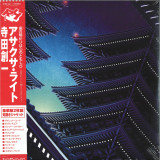
Back in 2015, Japanese DIY house pioneer Soichi Terada stepped back into the limelight courtesy of Rush Hour's 'Sounds From The Far East', a Hunee curated retrospective of material first released on his own Far East Recording label in the 1990s and early 2000s. Buoyed by the positive response and renewed interest in his work, Terada went back into studio to record his first new album of house music for over 25 years, Asakusa Light.
Developed over 18 months, Terada tried to recreate the mental and physical processes that led to the creation of his acclaimed earlier work. Those familiar with Terada’s celebrated, dancefloor-focused sound of the 1990s – a vibrant, atmospheric, and emotive take on deep house powered by the twin attractions of groove and melody – will find much to enjoy on Asakusa Light.
“I tried to recall my feelings 30 years ago, but when I tried it, I found it super difficult,” he explains. “I didn’t even know what I thought about myself five years ago, and the mental metabolic cycle seems to be faster than I thought. I tried different methods, including digging up my old MIDI data and composing by remembering old experiences. With the help of Rush Hour, I found some of the light from my heart that I had 30 years ago. I nicknamed the light I found in my heart, ‘Asakusa Light’.”
Produced using the very same synthesizers and drum machines that powered his 1990s work, the album is a joyous, colourful and life-affirming collection of timeless house music that not only recalls Terada’s own impeccable back catalogue, but also that of similarly celebrated contemporaries such as the Burrell Brothers or Ben Cenac (Dream 2 Science, Sha-Lor).
Terada, who has spent much of the last two decades writing video game music, has always had a gift for combining warm, undulating synthesizer basslines and perfectly programmed machine drums with stirring chords, smile-inducing melodies and mellow musical flourishes. It’s this immersive, sun-kissed and tuneful trademark style that takes centre stage on Asakusa Light, an album for the ages.
The set begins with the alien-sounding chords, soft-touch percussion and dawn-friendly warmth of ‘Silent Chord’ and ends on a high via the bouncing string stabs, starlight chords and thickset grooves of ‘Blinker’; in between, you’ll find a deluge of effortlessly feelgood music that’s the aural equivalent of a dopamine rush at sunrise.
There are subtle variations aplenty throughout the album – see the 8-bit lead lines and pulsing electronic textures of ‘Takusambient’, the vintage Tony Humphries flex of ‘Diving Into Minds’ and the effortlessly funky ‘Marimbau’ – but it’s the uniquely atmospheric, vivid and tactile nature of Terada’s loved-up sound that resonates. After well over 30 years in house music, the light in his heart is shining brighter than ever.
Buscar:att
Another vinyl and another electric debut as we introduce France's Casual Treatment to EarToGround. New to the label but an extremely well versed, well known prolific producer and DJ to our scene.
This powerful Extended Player effortfully delivers four bright cuts of razor sharp Techno. The two originals from Casual express a somewhat soulful experience of his production range with the use of immersive chords and shimmering female vocals backed by obsessive grooves and perfectly executed percussion.
To fully augment the experience exponentially two Portuguese leading lights of the movement deliver their own input to the release via two separate remixes. Vil enterers in with his unique rolling attitude to bring you a true peak time performance and completing the release Cravo lets rip with an intense, sharp, fast paced rework with his dark undertones.
A true essential 12".
Vinyl Crazy Records presents its new vinyl reference…!!!
Mastering and lacquer cutting by Lawrie Dunster at Curve Pusher.
Carved out from between the cracks of life over a 2 year period, Low Flung presents his eighth full length album ‘The Wheel’. Together, the 11 tracks provide a space to process and sit with difficult change. This takes the form of microscopic minimalist landscapes. Presented in both audio and physical form as micro grooves on a 12” vinyl.
At times the sound wanders and walks, other times it remains still, clear and precise. The omni-present artifacts found in ‘The Wheel’ are left to breathe a different life during each listen. Drones act like familiar trails losing their path as space transforms like a breeze over a table of sand. Hyper focused spores evolve around blurred waves of time. Electronic tones are captured flowing to the rhythm of a decaying natural world.
‘The Wheel’ is a patchwork of sonic experiments made using modular synthesis, fixed architecture synthesis, Buchla Music Easel (replica), outboard effects, cassette manipulation techniques, samplers and field recordings taken along the texturally rich and historically questionable eastern coastline of Australia.
The tracks have been composed with a materiality that embraces the acoustics of different listening environments. Much like mood, this means each listening experience is unique due to the natural acoustics of your listening space. The sounds on this album embrace this phenomena, creating a rich, visceral listening experience that slowly scratches away at discrete moments of time
Rather than attempting to traverse new sonic fields of experimentation in ‘The Wheel’, the album touches on the various spaces Danny has explored over the past ten years as an Audio Visual artist. Although technically eighth, it would be more fitting to say this album draws a clear line from ‘Blow Waves (2018)’ to ‘Outside The Circle (2020)’ to become the third and final chapter in the expanded non linear, unintentional landscape series. Serendipitous that each was conceived over 2 year periods of time.
While the key focus is sitting with difficult change, this album is also a celebration of any moment you might find yourself in. Good, bad, easy or hard, this album is an attempt to help with feeling content wherever you are along your path. With each cycle a new context.
Kharkiv born artists Komponente & Kurilo have been an integral part of the local scene in the past years both as DJs, Live-Act and Producers.
Now further apart since the beginning of the war they are still united in music and we are happy to finally share this EP with which was originally conceived when both artists were still Kharkiv based during the pandemic.
Kurilo has since made the journey to the New York via Berlin in recent months. While Komponente took refuge in Kyiv for some time after having sat out most of the fighting in and around Kharkiv while lending a helping hand to families and elders who couldn't manage or didn't have the means to leave the city when russia attacked.
At this point we are just happy and thankful to have both of them still with us and to be able to finally get this EP out which by now seems to have travelled from a past life to us in the here and now.
Pandemics or War this is Electronic Music charged with pure emotions produced during one crisis, released during the next and we will still dance to it during whatever comes next!
microCastle’s third offering of 2023 welcomes Ditian back to the label for his first artist EP. Splitting time between Buenos Aires, Berlin and Barcelona, the Argentinean artist has carved out a unique place in the electronic underground over the last half decade. With an immediately recognizable sonic signature, Ditian channels languages of varied musical landscapes, churning them into his own complex rollercoaster of intricate electronica. A sound that is equally at home on rebellious dance floors around the world or in the sweet spot of a late-night leftfield listening session. A short but meticulous discography reflects Ditian's choosy nature; with Exit Strategy, Innervisions and TAU serving as the primary landing spots for his musical output. Having remixed Ivory’s ‘Arpstairs’ for his microCastle debut last summer, a project which was followed by a contribution to Dixon and Ame’s Secret Weapons 15 collection to begin the year, Ditian now returns to the label with a four-track showcase entitled ‘Serpenta’.
The crushing title track crashes in and sets any preconceived ideas of Ditian’s music alight, forecasting jet force propulsions and wild signal bending synths. As somewhat of a departure from his previous experiments, Ditian’s clustered pungi mutations provide an enduring main theme, while a wonderfully warped break is sure to cast a paranoid spell over the dancefloor.
‘Venena’ follows in fine style and further hammers down Ditian’s elusive vision. Dizzying, rapid-fire sequences of rhythm, granular textures and heavily manipulated synths travel to the very edges, while maelstroms of drums and contorted basslines highlight a high-octane second act.
‘Inertia’ lands at the collection’s midway point and does so in remarkably twisted fashion, stepping decisively on the gas and steering into shadowy transgressions. Never one to shy away from darkness or pushing boundaries, Ditian’s metallic storyboarding rises and falls across act one, consciously withholding energy, as grooves pulse and effects orbit, creating tension that eventually gets resolved as clusters burst open and oscillate in kaleidoscopic fashion.
Ditian’s creative attitude reveals itself further on collection closer ‘Influenza’. Presenting some of his most club-adjacent rhythms yet, it’s a clever coax of billowing tones and scrappy melodica which get wrapped up in a concordant fog, eventually getting washed away; because after all, the oceanic drones are all the better when they’re magnified to full size.
Cover art: Mauricio Seidel
Evelyn spreads her wings and prepares to fly. This is her first offering for the ESP Institute. On side A, 'Tremors' slams together a plethora of seemingly disparate rhythms, organic percussion, field samples, hypnotic chants and a relentless low end punch, that when in full-swing, works some seriously deep sorcery. Contrasting her pounding kick and rolling sub combo are a softer grouping of melodies, soft mallets and muted tones that lay subtly beneath the aggression, skillfully playing with a sense of spatial depth and room size. Its the kind of track that draws you in with meditative bars, concentric cycles that sit ever so slightly off-axis, inducing the mind and body to obsess and regulating its timing, and then drops you into a very intentionally arranged soundstage giving expansive space to explore. On the flip, 'Pregunta' continues this approach of natural versus industrial instrumentation. The consistent machine kick has a powerful but playful tone, the negative space between each stroke evoking a mighty gesture as its note bends in the decay. Set in 3/4, a community of live percussion successively adds and subtracts, each player’s imperfect attack accumulating into a mechanically smeared and addictive loop that toys with peaks a handful of times yet restrains any unnecessary climax for the betterment of a driving groove. Near the end, as the kick and various players mute and the base of the track is given a moment to breathe, its apparent just how layered the production was in the moments prior, as we’re suddenly at home, smitten with the wobbly and lopsided innocence of the foundational percussion. These two songs will push you headfirst into the light.
As it celebrates its 50th anniversary, Bill Withers' Still Bill remains true to its title – and stands as the greatest male-fronted soul album not made by a singer named Marvin, Al, Sam, James, or Ray. Though the saying "keeping it real" did not exist in popular parlance when Withers released his sophomore effort on Sussex Records, no words better capture the music's approach, mindset, and value. Every facet of Still Bill radiates honesty, truth, and emotion.
These characteristics – along with Withers' strong singing, hybrid arrangements, and deceptively simple songwriting – have allowed the album to endure to the point where it sounds as fresh today as in 1972.
After rising into the Top 5 of the Billboard Album charts and attaining gold status within a year of release, Still Bill has long been evaluated not by sales – but according to its merit, spirit, and agelessness. Included by The Guardian on its "1,000 Albums to Hear Before You Die" list (2007) as well as in Tom Moon's 1,000 Recordings to Hear Before You Die book (2008), its contemporary standing as one of history's most venerated soul efforts eclipses the positive reception it enjoyed in the early ‘70s.
Still Bill walks the same hallowed ground as What's Going On, Call Me, Night Beat, and Genius + Soul = Jazz. Like those landmarks, Still Bill plays with a mix of consistency, effortlessness, and complexity that rewards repeat listening and transcends categorization.
In combining four of the era's predominant styles – Philly soul, sweaty funk, Southern-reared blues, acoustic-based folk – and melding them with standout production borrowed from both minimalist affairs and sophisticated singer-songwriter albums, Still Bill occupies a distinct universe.
Its rhythmic fare is equally laidback and invigorating; relaxing and rollicking; eloquent and muscular; soft and tough. Withers' calm, self-assured voice hovers above it all, doubling as a warm blanket that adds comfort and grace to lyrics steeped in maturity, perspective, and compassion.
Withers' balanced outlook on human desires, needs, and situations stem from his own existence as a former blue-collar employee who believed his time as a musician would soon end. That grounding forever separates Withers from other contemporary soul greats – and stamps Still Bill with a conversational nature and egoless approachability.
"I mean look, I'm really a factory worker," said Withers in 1972. "That's a real job." There's that word again: real. The songs on Still Bill are tethered to modesty and actuality, wedded to a belief in simplicity, and connected to universal truths that link us all – independent of our economic or social standing. No track better exemplifies those principles than "Lean on Me," a feel-good paean to brotherhood and community that hit No. 1 on the pop and R&B charts en route to becoming a mainstream staple.
Withers approaches the plainspoken insight on "Lonely Town, Lonely Street" and heartbreaking vulnerability of "I Don't Want You on My Mind" with similar sincerity and straightforwardness. His proclivity for authenticity extends to the record's other big hit: the sexual, funk-laden "Use Me," which reached No. 2 and reflects the singer's everyman persona. It's an identity couched in keeping it real, the very inclination that ultimately led Withers to retire in the mid-'80s rather than bend to industry pressures or risk credibility.
That commitment to truthfulness and realism helps make Still Bill feel as unaffected as the air we breathe. Looking back on "Lean on Me" years later, Withers said it seemed like "something that was there before I got here" – the kind of song that could be 100 or 10 years old, or one we encounter anew 10 years into the future. The same can be said for every note on Still Bill.
Two mavericks, out on the weekend, trying to make it pay...
"Maverick was the word that came to mind when I listened to this music. A slightly wayward independence of spirit and outlook. The word originally referred to an unbranded male calf that had become separated from the herd (because Texan rancher Sam Maverick was so negligent in his branding - ‘if it ain’t branded, it’s a Maverick’). But Sam’s grandson Maury Maverick gave it a different twist in his short but stormy Congressional career as the only liberal member of the Southern Democratic caucus. Maury was so out of step with his own folks that he not only voted in 1937 to make lynching a federal crime, he even addressed the House to condemn the practice as barbaric. His attempt to ban racist mob murder sadly failed, but it’s that refusal to march in step which distinguishes the two ‘mavericks’ who made this record.
Who would attempt to combine cunning ethnological forgery, Scottish folk songs, claw-hammer guitar, untutored horn-tootling, elastically relaxed drumming and garage electronic fuckery? Only Greg and Stefan, high on sea, sunshine and mis-judged micro-dosing – that’s who. ‘Don’t drown’ was offered as practical advice during the self-described ‘Yellow Submarine’ phase of making this record. And while they managed to avoid literally doing so (phew), they sound here like they got pretty ‘deep in’ to an Octopus’s sound world all their own. This surprisingly clear analogue recording has just enough Bikini Bottom grit to ensure traction. The tunes are inviting, and the sonic disruptions are too good-natured and goofy to upset even the most delicate digestion.
The sessions have had a couple of years to marinate, courtesy of some pandemic, and are here offered in that most Archducal of vinyl formats, the double ten inch. What are you waiting for, a side of Crabby Patties? Get your water-wings and dive in (unless you’re tripping)!" - Bruce Russell (The Dead C)
Pumice is the long-running, endlessly inventive project of New Zealand native Stefan Neville (1974), whose shambolic music is equally reminiscent of Kiwi pop groups such as The Clean and Tall Dwarfs as well as the country's experimental noise-rock bands like the Dead C. Largely recorded solo by himself on junky equipment, his songs typically feature blown-out guitars, wheezing chord organs, and vocals disguised by tape hiss and static.
Greg Malcolm (1965) is a guitarist from New Zealand who has played everywhere on the globe and with all most everyone, including Rosy Parlane, Toshimaru Nakamura, Tetuzi Akiyama and Bruce Russell, as well as solo releases on his own label, Corpus Hermeticum, Kraak and Celebrate Psi Phenomenon.
Berlin based OKMACH3 presents a divers and club-oriented sound. The focus is on releases blending genre conventions and challenging listeners while keeping in mind that the night belongs to lovers and dancers alike. Our ¦rst release is also the solo debut of fnctrl and encapsulates the spirit of OKMACH3 perfectly. His sound merges Electro influences with a bass-driven four to the floor production and grooves ranging into Trance. It’s an atmospherically dense and dark Sci-Fi trip attended by an AI contemplating the nature of human interaction.
Recorded Things is thrilled to present "Season Two Remixes" by Oliver Rosemann & Alexander Kowalski. This highly anticipated release features fresh interpretations of their original tracks, and is available digitally and on vinyl.
Following the success of last year's vinyl release of "Season Two," this new offering breathes new life into the already captivating compositions. The duo's collaborative efforts have attracted a stellar lineup of talented artists who have put their unique spin on the tracks. "Stinger," "Most Monkeys Live In Trees," and "Lucid Mind" have been remixed by the exceptional talents of Roll Dann, Ritzi Lee, Vil & Cravo, and Mario Berger.
This release is a testament to the versatility and artistry of Oliver Rosemann & Alexander Kowalski, as well as the immense talent of the remixing artists. "Season Two Remixes" is a must-have for electronic music enthusiasts and collectors alike. Whether you prefer the digital format or the warmth of vinyl, this release is sure to leave a lasting impression.
- A1: Door Opens
- A2: Millionaire
- A3: No Witch At All
- A4: Taken Alive
- B1: The Soul That I Had
- B2: Entrance To Hell
- B3: The Orchestrator
- B4: Hell Demonic Possession
- C1: Sinister Minister
- C2: Jay Time
- C3: Time Gambler
- C4: Fortunes Told
- C5: Jam (The Rock)
- D1: Monster In Paradise
- D2: Mr. Longevity
- D3: Door Slams
- D4: Jam (The Taker)
Top notch hard-rock / proto metal by post-Atomic Rooster and pre-Hard Stuff band BULLET, featuring the explosive guitar & vocals of JOHN DU CANN (The Attack, Andromeda, Atomic Rooster) plus bass player John Gustafson (Quatermass, Roxy Music, Ian Gillan Band) and PAUL HAMMOND (Atomic Rooster) on drums.
Their legendary studio recordings from 1970-71, now for the first time on vinyl.
*Gatefold sleeve with detailed liner notes and photos.
RIYL: HARD STUFF, CAPTAIN BEYOND, URIAH HEEP, DUST…
“…gritty sounding, blues based power trio built around John Du Cann’s unlimited arsenal of crunchy guitar riffs and scorching solos…”
Ryan Sparks (Sea Of Tranquility)
Original release date: September 20, 1979
Along with the 3rd album, another excellent Sanullim album with the highest proportion of Kim Chang-hoon's songs. Based on a more stable and elegant performance than ever before, it is a work that attempted various experiments never before.
The guitar sound using rough fuzz tone and flanger effect, the strong rhythm and groove of the prominent bass line and dynamic drum, the keyboard expressing the rich string effect, and the stronger 'Korean' color are properly harmonized to each song. It conveys a kaleidoscopic, dramatic and refined fascination.
Mysterious and dreamy classic song Let’s Go To The Vineyard with a strong scent of progressive rock, and the Sanullim’s sounding hard rock A Portrait Of A Lady Shaman, the first song written by Kim Chang-wan, Why Are You Leaving Me? It contains songs that deliver new inspiration the more you listen to it.
12" + 7" !
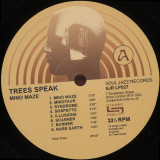
Mind Maze is, amazingly, Trees Speak’s fifth album to be released on Soul Jazz Records in the space of little over two years– an output matched only by the intensity of their music created during this short time.
The first pressing only of the album comes with a bonus seven-inch single containing two tracks that are not available on vinyl anywhere else.
As with all their previous releases, ‘Mind Maze’ is a mind-boggling tightrope walk across an array of musical influences that seamlessly create the unique present-day world of Trees Speak.
The band’s sound is characterized by a combination of German krautrock motoric-beat rhythms, angular New York post-punk attitude, 60s spy soundtracks, psych, rock, jazz, and 70s synthesizers and vocoders. There is also a cosmic spatial awareness to their sound; both personal inner space and galactic outer space, as well as a wilful pushing of sonic boundaries.
Trees Speak are a musical duo based in Tucson, Arizona, composed of Daniel Martin Diaz and Damian Diaz. Their music is heavily influenced by the cosmic magic of the natural desert landscapes of Arizona, creating a unique and captivating sound that is both experimental and innovative.
Here you will find the myriad sounds of 1970s German electronic music (everything from Can to Cluster, Popul Vuh to Tangerine Dream); 1980s New York post-punk and synthcore (from No Wave to Suicide); John Barry’s 1960s movies, John Carpenter’s 1970s horror. You will also hear the influences of French and Italian progressive rock (Magma, Goblin) as well as cosmic, new age and experimental space soundscapes …. an almost endless list of diverse influences that ebb and flow like an ocean of sound, in the process creating a truly unique soundscape that Trees Speak have made wholly their own.
The name Trees Speak reflects their interest in the concept of using future technologies to store information and data in trees and plants, with the idea that trees communicate collectively. This interest in nature and technology, combined with their passion for experimentation, has led Trees Speak to create a truly one-of-a-kind listening experience that is both unique and engaging.
If you ever wanted to hear Can, Neu!, Destroy All Monsters, Pere Ubu, electric eels, John Cage, Liquid Liquid, Tangerine Dream, Suicide, Laurie Spiegel, Art Ensemble of Chicago, John Barry, Mother Mallard’s Portable Masterpiece Company, Sun Ra, Stockhausen, John Carpenter, Electro-Acoustic and Musique Concrete and Mars in one band - then this is it! Trees Speak are a band that defies categorization and offer an eclectic listening experience, both exciting and memorable.
The two bonus tracks (‘Seraphim’ and ‘Orpheus’) included with the album give us a further window into the complex mind maze of the group - two stunning acoustic tracks that explore a distinct early 70s sound of Yes, Argent and other progressive rock accolytes.
Amy Douglas should need no introduction, having supplied song-writing and vocal duties for Horse Meat Disco, Róisín Murphy, Luke Solomon, Soul Clap, and worked with Joe Goddard on their Hard Feelings project,
Here she teams up with Craig Bratley, who dusts off the analogue synths to produce something which clearly wears its influence on its sleeve, taking in elements of Balearic, Street Soul and early Sheffield Bleep.
On the Ashigaru Dub, Craig explores these influences further, the result reminiscent of Mad Professors take on Massive Attack.
Montreal duo Bas Relief present a collection of rough-cut IDM and pitch-corrected emo on Insulary, a five-song EP out June 2023 on Brooklyn imprint Quiet Time. Written and compiled long distance from threads of bass music-inspired alt pop and guitar recorded in isolation, Insulary is the duo’s first substantial release since 2018. Granulated microglitches fill out the digital drum arrangements, calling on influences Baths and Loraine James, overlaid with warm piano progressions, melancholic guitar loops, and collaged vocal production.
These self-reckoning, forlorn vocals form a patchwork narrative, hazed like a shapeshifted memory, long reconfigured with each conjuring, coherence inconsistent but still there. Recurring dreams find home among recursive passages, self-referencing lyrically and with samples churned through plugins, recorded on loop until you fall upon the most satisfying aha! moment and lock it to the grid. At certain moments all the pieces combine to reminisce in sentimental shards of Porter Robinson or The Postal Service, while never straying from Bas Relief’s own vernacular.
Visiting the past in person simply by walking the routes you took in a life long past, that reenactment of memory, that attempt to capture that which you can’t – it might even be a future – is a central bolt of Insulary’s lyrical content. It’s sentimental, it longs for some past which might not even have existed, and it’s hopeful too, never capitulating to traditional structures in its embrace of unusual stylistic combinations. Insulary – brim-packed with fragments of drum and bass, uptempo electronica, and emo – is but a preview of Bas Relief’s exciting near future
Eternally Frozen consists of a series of canon based compositions for brass ensemble, percussion and synthesizer by Andrea Belfi. The canon is an ancient compositional technique in which an initial melody is imitated at a specified time interval by one or more parts, creating illusionary never-ending musical journeys.
The work is inspired by the evocative image of the Deprong Mori, a mythological bat with the alleged ability to fly through solid matter by bending atoms by its natural skill of audio echolocation. The myth suggests that one of these bats had been “eternally frozen” in a wall of solid lead in 1952 by the researcher of the Rockefeller University, Donald R. Griffith. This story is exhibited in a display at the Museum of Jurassic Technology in Los Angeles, an institution renowned for both speculative, fantastical reinforcement of mythology and playful and beguiling distortions of mysterious could-be truths.
Both the canon and the “frozen” Deprong Mori are man-made illusory simulations of eternity. Their attempt is to create mirages, where the insinuation of facts is more meaningful than the reality.
After many years of sonic explorations with percussion, drums, and electronics, Belfi is here projecting himself as a composer through the direction of an astonishing brass ensemble in the realization of these canonic works. There are evident echoes of the works of Arthur Russell, Miles Davis, Moondog, William Basinski, and the Italian soundtrack tradition of Ennio Morricone and Egisto Macchi.
We’re starved for two-sided 12”s in the world of ambient music, but Chris Madak aka. Bee Mask has refreshingly graced us with one this week.
It should be said that there’s Skee Mask and then there’s Bee Mask; the latter is far more unsung, undeservingly so. Madak’s music is abstract and cerebral enough to have lent him credo enough to have released on the likes of Weird Forest, Spectrum Spools and Room40.
But this latest reissue, ‘Versailles Is Not Too Large Or Infinity Too Long’, hears him plunge the aethereal heights for the US label Unifactor. Originally released on cassette on Chondritic Sound in 2008, these pieces deserve the renewed attention and the fresh laying to wax, since they’re not “regular ole” ambient cuts in the slightest.
Unafraid of indulging the high end freqs, Bee Mask fleshes out a mood of uncertain, urgent bliss - sizzling, crunching and soaring the drone, as if its maker were a modern Icarus flying too close to the sun.
- A1: Ciência
- A2: Iix 03
- A3: Qliq 07
- A4: Untitled 01
- A5: #04
- A6: Butô 05
- A7: Nandemo 12
- A8: Sem Título I
- A9: Spam 08
- A10: Qliq 02
- A11: Lctrnc 08
- A12: Sem Título
- B1: Excerto Da Trilha Sonora Do Vídeo "The Kids
- B2: Sjc 01
- B3: Spam 05
- B4: Croquis 2 06
- B5: Nandemo 05
- B6: Mimevoc 05
- B7: #03
- B8: Lctrnc 06
- B9: Spam 12
- C1: Mbiẽta 02
- C2: Ar 02
- C3: Mbiẽta 01
- C6: #1
- C7: Sjc 06
- C8: Cnandemo 08
- C9: Qliq 08
- C10: Mbiẽta 05
- D1: Sem Título
- D2: Cerâmica 03
- D3: Cerâmica 06
- D4: Cerâmica 08
- D5: Spam 10
- D6: Sjc 04
- D7: Qliq 05
- D8: #06
- D9: Qliq 09
- D10: Sim
- C4: Ar 05
- C5: Untitled 02
Tracks are mixed together.
"In this album, Akira Umeda mixes 42 recordings, dated between 1988 and 2018, which, in a sense, reflect the incredible range of his creative work: from songs, to ambient music; from field recordings to prank calls. The cassette tapes, whose contents make up this double-LP, had been stored in Umeda’s house in São José dos Campos, in São Paulo, Brazil.
Restless, and easily bored, Akira moved seamlessly from one activity to another – he was a little bit of everything (and nothing at all). Such people usually go unnoticed and unrecognized, something which Umeda found perfectly acceptable. Nevertheless, unlike most people, he had no right to see himself in this light – in the light of ephemerality and anonymity –, for in everything he tried his hand at, he inevitably left an impressive and distinctive mark.
The term cruising refers to the practice of seeking and obtaining instant, no-strings-attached sexual gratification with strangers. Akira Umeda was well-acquainted with this term, but his practice of it was not restricted to the aforementioned context. Rather it extended into all spheres of his life and work. A historian by training, he later became a ceramicist, a photographer, a visual artist, a draftsman, a graphic designer, a DJ, a musician, an audio technician, a writer, a researcher... He made forays into a myriad of artistic and academic fields – with a single intention: to achieve a specific objective and promptly exit stage left, as it were."
Groundbreaking release from the early 80's produced with rather primitive synthesizers with as result "A Dog in the Night" a track with a thick sound, unusual for its time. Credited as "the sound of the future" in those days and sounding reevant today. The piece produced by Stefano Zito and arranged by Stefano Galante is after 40 years among the favorites of collectors and followers of Italo-Disco, being noted among the songs to be re-edited by Danilo Braca, the New York based Italian Dj known for his creativity! He manages to create wonderful reconstructions, often considered "works of art". Such as the version he remixed and revisited, with the strings played and recorded by Layer Bows, but above all with the additional lyrics written and performed by the superlative SuperJaimie (aka Charlotte Balibar); with her voice she gives a completely different air to this Italo-Disco jewel, now worthy of being brought to the attention of the new generations. Such a gem, made available again on high quality vinyl!