This is a charity recording of Mark Knopfler's instrumental "Going Home (Theme From Local Hero)", produced in aid of Teenage Cancer Trust and Teen Cancer America. The recording features today's biggest and best-known guitarists, accompanied by an all-star band. Artists: Joan Armatrading, Jeff Beck, Richard Bennett, Joe Bonamassa, Joe Brown, James Burton, Jonathan Cain, Paul Carrack, Eric Clapton, Ry Cooder, Jim Cox, Steve Cropper, Danny Cummings, Duane Eddy, Sam Fender, Guy Fletcher, Peter Frampton, Audley Freed, Vince Gill, David Gilmour, Buddy Guy, Tony Iommi, John Jorgenson, Mark Knopfler, Joan Jett, Albert Lee, Greg Leisz, Hank Marvin, Brian May, Robbie McIntosh, John McLaughlin, Orianthi, Nile Rodgers, Mike Rutherford, Joe Satriani, John Sebastian, Connor Selby, Slash, Bruce Springsteen, Ringo Starr and Zak Starkey, Sting, Susan Tedeschi and Derek Trucks, Ian Thomas, Pete Townshend, Keith Urban, Steve Vai, Waddy Wachtel, Joe Louis Walker, Joe Walsh, Ronnie Wood, Glenn Worf and Zucchero.
Buscar:aud
The music Charles Mingus and his group recorded during his landmark 1960 sessions for Candid Records produced three of the most revered jazz albums of the era. INCARNATIONS is a new masterpiece thoughtfully assembled from rare and unreleased material from those sessions that stands proudly in the Mingus canon of masterworks. All but one of the tracks here are from the November 11th, 1960 sessions Mingus and producer Nate Hentoff put together. The date was split into two halves: one a pure Mingus-led date, featuring a six-piece band that expanded into an octet for two additional tunes, and another, a partial reunion of a collective that had assembled in opposition against George Wein’s Newport Jazz Festival that past July. (That collective, calling themselves The Jazz Artist Guild, would release the album Newport Rebels, on Candid in 1961.) Of special note here is the one track recorded during the Mingus October 20th 1960 sessions. It is a previously unreleased track titled “All The Things You Are (All.)” Found on a tape that contained material from both of these fall 1960 dates, the piece has its roots in an Art Tatum rendition of “All the Things You Are,” which Mingus had recorded before in various settings. Featuring Booker Ervin, Eric Dolphy, Charles McPherson, Ted Curson Lonnie Hillyer, Roy Eldridge, Jimmy Knepper, Britt Woodman, Tommy Flanagan, Paul Bley, Dannie Richmond and Jo Jones. With audio restored and remastered by Bernie Grundman, and liner notes by Pitchfork and New York Times contributor Hank Shteamer, this album is a must have for any Mingus fan.
- Mar Vista - Visions Part 1 Her Eyes Are Closed
- Kennlisch - Kennlisch
- Crystal Eyes - Crystalzed
- Warlus - Girl Like You
- Gerard Alfonsi - Fana Stickle
- Geoffroy - Viking
- Amphyrite - Symphonie Pour 3 Oeufs Brouilles
- Eole - Friendship
- Capucine - Les Elephants
- Rictus - Flashes
- Inscir Transit Express
- Polaris - Polaris
- Joel Boutolleau - Force
- Spotch Forcey - Frustre
- Demon Wizard - Black Witch
- Temple Sun - Voyage Sans Retour
- Chantal Weber - Ballade Aux Chataignes Tombees
- Jean-Claude Zemour - X Kmh
- Rhodes Co - Baoum
- Guidon Edmond Et Clafoutis - Stormy Sunday
"For a long time, I'd come across these discs without really understanding what connected them, apart from a button and that famous logo designed by René Dessirier. Then, with a little more digging, I discovered the "self-production" link. For choirs, schools, folk singers, young pop groups, popular homes and even great composers who engraved unique copies of certain recording sessions...
The French equivalent of the English "Derby Service", the Kiosque d'Orphée, formerly at 7 Rue Grégoire de Tours in the 6th arrondissement, was taken over by Georges Batard in 1967 and moved to 20 Rue des Tournelles in the 4th arrondissement of Paris. The adventure lasted until 1991. Georges Batard was a sound engineer who used a Neumann tube engraver to engrave acetates from the tapes he received, before printing the precious vinyls in the press factories of the day, where he was able to produce very small runs of between 50 and 500 copies.
Of course, there were other structures for releasing his records, such as Voxigrave or, later, FLVM, but none of them had so many records in their catalog. Le Kiosque d'Orphée was neither a label nor a publisher, but a structure that allowed you to press your own vinyl, at a time when it was quite an adventure to get your first 45 rpm or 33 rpm album released!
Georges Batard was described as passionate and conscientious. His son, bassist Didier Batard, wrote of him:
"Georges was passionate about recording and reproducing the stereo sound of his great passion, music. He paid close attention to distortion rates, signal-to-noise ratios, response curves, rise times and other damping factors in audio equipment. He was looking for the exact reproduction of concert hall sound in his living room (with the same sound level, if possible...). In the late '50s/early '60s, he found other sound enthusiasts in AFDERS (Association Française pour le Développement de l'Enregistrement et de la Reproduction Sonores). He became its honorary president. Every Saturday afternoon, its members met to test au- dio equipment. Their opinions were published in the monthly Revue du Son.
All you had to do was send in your tapes and choose the number of record copies you'd like to take home with you, so you could finally share your creations and, in a way, exist. You could opt for a generic sleeve, available in several colors, directly customizable with your name and credits, or you could design your dream sleeve yourself in your living room or at a printer's.
This "Do It Yourself" temple gave birth to some superb pouches. Stencilled, hand-written, illustrated with paintings, drawings, illustrations by friends or girlfriends of the time, photo prints hastily stuck in the middle of a blank, white sleeve, on which the traces of time would leave their imprints, so that collectors and the curious would come and buy them decades later, with the promise of a musical discovery, unfortunately not always fulfilled...
What most of these records have in common is the youth of their songwriters, whether or not they've had a career. Stories of buddies, of getting by and dreams of glory made up this catalog. Most of them were amateur productions, both in terms of the level of the musicians and the quality of the recordings, made on a two-track or, the ultimate luxury, a 4-track in a teenager's bedroom or parents' living room.
It was the beginning of the home studio, thanks to the advent of the Revox portable tape recorder. A bit of a shaky DIY system, but, in return, the luxury of setting no limits: one-sided tracks, no outside censorship, no artistic director, no manager, no Barclay or EMI/Pathé Marconi logos...
When you finally had your own record, you could give it away or sell it to friends, family or after concerts. You could also drop it off at the nearest record shop, with undisguised pride.
It was also a calling card that could be sent to radio stations or music labels, in the hope of launching a career...
Many of the protagonists in this story tried to sign with labels, but in those days, bridges were not so easy to build between one's hometown, or even one's village, and the major or more specialized label that might have released these records. At the time, the advertisements published in the press by the Kiosque d'Orphée opened up the field of possibilities for provincial composers. It was now possible to make their own record, without having to go through the process of signing with a label.
Some of the composers who have gone on to make a career have used this channel to release their first record or parallel projects (Claude Engel, Dominique A, Andy Emler, Michel Deneuve, Claude Mairet, Mick Piellard, Tristan Mu- rail...) and sometimes even single or very limited pressings of work or promotional copies (Bernard Parmegiani, Jef Gilson...).
This album is the conclusion of a long investigation, begun six years ago. It took a long time to find the records, scattered all over the place, in the homes of collectors and sometimes the musicians themselves, and then to listen to them, sometimes painstakingly, to unearth these moments of grace.
From this work, 23 tracks remain, but there are dozens of others that could have been included, so we had to choose, and the choice had to be as universal as possible. This selection is obviously not objective, but I hope you'll like it.
Today's music is raw, touching and powerful. "
Jean-Baptiste Guillot - Born Bad Records
Introducing, the experimental violinist and performer Vanessa Bedoret.
The London-based French musician today announces that she’ll be joining, Scenic Route, a label renowned for selecting and nourishing rising stars for the release of her debut album, Eyes, due out on 8th of March 2024. Launching with a taste of what’s to come, today she also shares single “1/2”, a textural track that tells of the dichotomy between those who are selfless and those who are self-centred, and their need to merge as one. This duality is reflected in the industrial metallic echoes under Vanessa’s soaring vocals and the piercing strings of her chosen instrument, the violin.
Treating songwriting as an instinctive process, Bedoret transforms her deeply personal experiences into pure emotion. Not following any set narrative, Eyes takes the listener on a journey via their own experiences, prompting introspection through Bedoret’s hypnotic melodies.
Through the album, she awakens the audience's imagination, to open up their emotional response. On “Ballad”, a vague, loving lyrical letter to someone close, Bedoret’s heartbreakingly soft lament is barely audible over the dramatic atonal strings. She flips her narrative again in the titular track, “Eyes”, so the listener empathises through her isolated violin, and takes on her anguish, not needing to understand the full story.
Bedoret began her classical training at age 6 and on completion at 18 she embraced the thrill of playing guitar in punk bands, and like many at the turn of adulthood, was quickly captured by the allure of the dancefloor. Her far-reaching taste doesn’t stop there, she also counts black metal to opera and from eurodance to IDM as inspiration. Her deep understanding of musical form elevates her experimentation to a truly unique sonic experience, one that never strays too far from her original love of classical music.
With only a string of releases under her belt via independent labels like Laura Lies In and Archaic Vaults, her refined skillset has meant she’s been in high demand for both solo shows and collaborations. These accolades include playing violin with New York avant garde collective Standing On The Corner at The Serpentine, as well as a part of Kahil El’Zabar conducts MOKI at the ICA, and Linder: Another Music in a Different Arcadia at the Design Museum alongside artist Linder Sterling, Naima Cherry, Maxwell Sterling, Kenichi Iwasa & Ella Frears.
For her solo performances, she’s shared stages with Standing on the Corner, Ekaterina Bazhenova-Yamasaki, Philomème Pirecki, John T. Gast and Nexcyia to name a few. She’s also performed as a duo alongside musician Severin Black in support of their collaborative EP release, First Passage / Excommunicated.
Through the lens of a life lived to it’s fullest and one that does not shy from experiencing the rawest of emotions, it’s clear that Bedoret has a nack for translating personal observations into cinematic crescendoes. The field recordings throughout only heighten this feeling adding both a grounding and other worldy sensibility. Lyrically, she allows you to peek into her private world and for a fleeting moment letting you lock eyes with hers, asking what do you see?
This debut is a glowing experimental work that purrs with a distinctive narrative. Vanessa Bedoret is a promising new act, ready to take 2024 by storm.
"My favorite singer in the place was Karen Dalton. She had a voice like Billie Holiday's and played the guitar like Jimmy Reed." - Bob Dylan // Karen Daltons Capitol-Debüt aus dem Jahr 1969 ist endlich wieder erhältlich! Light in the Attic freut sich, eine brandneue Ausgabe dieser herzzerreißenden und bluesigen Einführung in die berauschende Welt von Dalton und ihrem tiefen Brunnen voller musikalischer Geheimnisse zu präsentieren. Weltmüde und vom Blues erfüllt, war Daltons unübertroffene interpretatorische Tiefe und emotionale Bandbreite wie keine andere. "It's So Hard To Tell Who's Going To Love You The Best" wurde 1969 für Capitol aufgenommen und reihte sich ein bei klassischen amerikanischen Songwritern wie Lead Belly, Fred Neil und Tim Hardin. Diese Neuveröffentlichung ist die endgültige, rein analoge Version von Daltons umwerfendem Debüt, mit neu gemastertem Audiomaterial von den Original-Capitol-Mastern, dem Original-Artwork von 1969 in einem erweiterten Klappcover, ungesehenen Fotos des Albumfotografen Joel Brodsky und einem Essay, in dem Karens Freunde und musikalische Mitstreiter zu Wort kommen, vom Albumproduzenten und Bassisten Harvey Brooks bis zum Musiker Peter Stampfel von den Holy Modal Rounders. - Features new all-analog mastering by Kevin Gray at Cohearent Audio, direct from the original analog tapes - Pressed at RTI - Includes liner notes by Brian Barr - Featuring unseen photos by legendary photographer Joel Brodsky - LP housed in an expanded gatefold jacket
Most audiophiles know Alan Parsons Project's I Robot by heart. Engineered by Parsons after he performed the same duties on Pink Floyd's Dark Side of the Moon, the 1977 record reigns as a disc whose taut bass, crisp highs, clean production, and seemingly limitless dynamic range are matched only by the sensational prog-rock fare helmed by the keyboardist and his creative partner, Eric Woolfson. Not surprisingly, it's been issued myriad times. Can it be improved? Relish Mobile Fidelity's stupendous UltraDisc One-Step 180g 33RPM box set and the question becomes moot.
Mastered from the original master tapes and pressed at RTI on MoFi SuperVinyl, I Robot comes to life with reference-setting realism on this numbered, limited-edition reissue. Boasting immaculate highs and lows, generous spaciousness, and see-through transparency that takes you into the studio with Parsons and Woolfson at Abbey Road, this definitive edition is designed to demonstrate the full-range capabilities of the world's best stereo systems while offering listeners the convenience of having all the music on one LP.
Featuring a nearly inaudible noise floor, this transcendent UD1S edition functions as a repeat invitation to savor reference-grade soundstages, immersive smoothness, sought-after instrumental separation, three-dimensional imaging, and consummate tonal balances. Able to be played back at high volumes without compromise or fatigue, it is a demonstration record for the ages – the likes of which are no longer being made. This is the very reason you own and invest in high-end audio gear.
The special characteristics of this UD1S version extend to the premium packaging. Housed in an elegant slipcase, the reissue features special foil-stamped jackets and faithful-to-the-original graphics. Aurally and visually, it is made for discerning listeners who prize sound quality and production, and who desire to fully immerse themselves in everything about this conceptual landmark. The Alan Parsons Project's most famous record deserves nothing less.
Inspired by and loosely based around the Isaac Asimov stories of the same name, I Robot delves into themes of artificial intelligence and technological dominance that make the record extremely relevant in the 21st century. Indeed, Parsons and Woolfson's pinnacle creation dovetailed with the ascendency of Star Wars, which itself is experiencing a rebirth in an age of self-driving cars, smart devices, and mindless automation. Lyrically, songs such as "The Voice" call into question human behavior – and their relationship to increasing robotic supremacy – in everyday life. Parsons and Woolfson reflect the associated paranoia, dichotomy, and transformation via shifting sci-fi arrangements steeped in drama and moodiness.
The absorbing tunes on I Robot also continue to fascinate due to their perfectionism and innovation. Borrowing from Pink Floyd's strategies, Parsons and Woolfson utilize a looped sequence on the title track to create new downbeats. "Some Other Time" employs two different lead vocalists and yet gives the illusion that only one is involved. Captivating strings, a piccolo trumpet, and bona fide pipe organ grace "Don't Let It Show." The origins of "Nucleus" stem from a unique analog keyboard concoction dubbed "the Projectron," devised by Parsons and electronic engineer Keith Johnson. Andrew Powell's orchestral and choral arrangements top it all off, with "Total Eclipse" arriving as a frightening track that presages the climactic "Genesis Ch. 1 V. 32."
Does man or machine win in the end? Decide as you get lost in Mobile Fidelity's UltraDisc 180g 33RPM LP pressing. Secure your numbered copy today!
More About Mobile Fidelity UltraDisc One-Step and Why It Is Superior
Mobile Fidelity Sound Lab's UltraDisc One-Step (UD1S) technique bypasses generational losses inherent to the traditional three-step plating process by removing two steps: the production of father and mother plates, which are created to yield numerous stampers from each lacquer that is cut. For UD1S plating, stampers (also called "converts") are made directly from the lacquers. Since each lacquer yields only one stamper, multiple lacquers need to be cut. Mobile Fidelity's UD1S process produces a final LP with the lowest-possible noise floor. The removal of two steps of the plating process also reveals musical details and dynamics that would otherwise be lost due to the standard multi-step process. With UD1S, every aspect of vinyl production is optimized to produce the best-sounding vinyl album available today.
MoFi SuperVinyl
Developed by NEOTECH and RTI, MoFi SuperVinyl is the most exacting-to-specification vinyl compound ever devised. Analogue lovers have never seen (or heard) anything like it. Extraordinarily expensive and extremely painstaking to produce, the special proprietary compound addresses two specific areas of improvement: noise floor reduction and enhanced groove definition. The vinyl composition features a new carbonless dye (hold the disc up to the light and see) and produces the world's quietest surfaces. This high-definition formula also allows for the creation of cleaner grooves that are indistinguishable from the original lacquer. MoFi SuperVinyl provides the closest approximation of what the label's engineers hear in the mastering lab.
For a few years Leo Robinson was the sort of hidden secret you sometimes come across in local music scenes. First in Manchester and now in Glasgow, he’d pop up regularly on DIY bills or as local support to a touring act, quietly blowing them off stage with his rich baritone vocal and homespun lo-fi tales of folklore and animism. With The Temple – his debut on PRAH Recordings – he looks set to cross over from being a cult concern.
“There's a spectrum within the album between fully mythologising or symbolising my lived experience, and just stating it in very matter of fact terms - that push and pull between the need to abstract and the need to break through the abstraction and have an honest moment with oneself” he explains. “This is one of the themes of the album as well as part of the process. The aim was to take all these anecdotal or symbolic elements and merge them into one narrative and one world, in a way that you can find your way through the record as if it were a landscape or language with its own logic.”
The record takes on a pastoral, slightly baroque nature that Robinson partly attributes to a friend screening a lot of ‘70s BBC material in his book shop that they used to hang out at. There are also elements of jazz, flickering to life in “The Spring”’s piano-led finale and coda.
Thematically, Robinson likens it to a Jungian ‘Hero's Journey’, his voice possessing a character who goes through several defined stages of consciousness. From conception and the beginning of an earthly life, the first half of the album recognises the development of the protagonist’s narrative and identity, before “The Pink Light”’s freeform departure from the hitherto more song-based suite devastatingly shatters this. The second half of the album then sees the protagonist witness “the uncontainable” water; learning that true divinity lies not in the individual self or lofty notions of gods and temples, but in the unremarkable nettles, insects and dogs on the roadside riverbank - referenced on tracks “The Cormorant” and “The Spring”.
Although now residing north of the border, The Temple was written while Robinson was finding his feet in Manchester, having moved there to go to art school as a teenager (as a visual artist, he has exhibited at the Tiwani Contemporary in London and Cardiff’s Chapter Arts Centre). As a result, many of the tracks bear out the shadows of his experiences in the northern city – at their most visible and explicit on the beautifully fragile storytelling of “The Pavement”. Written the day after the Manchester Arena Bombings, it recalls Robinson waking up to go to work on a hot summer’s day to discover that his street had been blocked off for terrorism investigations; it then progresses through the rest of his day, amidst the grimly surreal aftermath of the previous night.
Having written the chords, melodies and lyrics to the album, Robinson fleshed out the tunes by scoring out parts for the additional instrumentation, but it was only when a friend sent a demo to PRAH that he was able to fund its full recording. Guitars, vocals, piano and French Horn (the latter recorded by Lauren Reeve-Rawlings) were put down at Green Door Studios in Glasgow. Microphones were placed around the room and the sound of the musicians stepping on creaky floorboards and opening creaky doors were left audible to further the record’s live feel. The harpsichord heard on “The Serpent”, meanwhile, came from University of Glasgow lecturer David McGuinness. Strings were then recorded at PRAH Studios by Francesca Ter-Berg and Raven Bush, the Social Singing Choir adding their choral vocals to “Temple II”.
The result is an album that feels both luscious and yet intimately raw; as grand as Richard Dawson at his most panoramic but containing the rough edges and skeletal looseness of a Calvin Johnson work. At times Robinson lyrically moves towards the surreal, but ultimately this is a record grounded in reality; a true showcase of Robinson’s skill as a lyricist and songwriter.
With his first record project, Tiziano Codoro, at his debut as a leader and composer, presents himself decisively not granted. “Impermanenze” transcends borders and undertakes a mesmerizing sonic journey. This electronic-jazz live pushes the boundaries of musical innovation by immersing audiences in the rich tapestry of hypnotic melodies, sophisticated improvisations and pulsating rhythms. The musicians involved seamlessly blend elements of acoustic jazz with mesmerizing electronic textures, creating a harmonious fusion of tradition and experimentation. Impermanenze encapsulates the spirit of Northern European jazz by channeling its characteristic introspection, artistic freedom and sonic beauty.
d B1.
Cory Weeds and Champion Fulton travelled to OCL Studios in Calgary to record a new live, duo album in
front of a rapt audience.Their special bond was evident as Fulton delivered sophisticated, swinging turns
across a set of beautiful tunes, in conversation with Weeds at his expressive best.This eight track LP
edition is pressed on classic black 180g vinyl and limited to 300 copies worldwide.
His unorthodox approach adds a touch of playfulness to the Mozart & Gershwin pieces performed while upholding Corea's obvious reverence for their music. His joyous fusion sets the tone for the musicians and the audience, creating a truly captivating and boundary- pushing experience. The recording captures the essence of Corea's musical vision, his appreciation for classical traditions, and his undeniable genius as a performer and improviser.
It stands as a testament to his lasting influence and his eternal quest to push the boundaries of music. Through his work as a composer and a performer, he sought to bridge the gap between genres, embracing the universality and enduring power of classical music.
Corea realized this ambition fully during this live performance as was eager to release the recording as an album that would inspire jazz and classical music lovers equally.
James Hudson is a captivating and charming performer who has a natural affinity with an audience. His outstanding voice can communicate the nuances of a melody and lyric with great interpretive prowess which undoubtedly sets him apart as a jazz singer at the top of his game.
James Hudson's upcoming second album 'Moonray' is a bold and ambitious project that features a unique ensemble including horns, vibraphone and strings to create a rare and accomplished sound. This follows his debut album 'Tomorrow', which attracted international media coverage and exceptional reviews from many top jazz publications (BBC Music Magazine, London Jazz News, Jazzwise, JazzViews), plus air-time across national radio stations where it was named 'Album of the Week' by Jazz FM.
Having recently sold out his first show at the world- renowned Ronnie Scott's, James is in demand at many of the UK's most respected jazz clubs. Regularly performing to sell- out crowds at Pizza Express Jazz Club Soho, Crazy Coqs, Piano Smithfield, Peggy's Skylight, and Hull Truck Theatre, he has appeared at the EFG London Jazz Festival, Leeds Jazz Festival, and Wigan International Jazz Festival. James is sought after by some of the top big bands and orchestras in the industry whom he has guested with all over the world.
James has taken great inspiration from the likes of Mel Torme, Frank Sinatra, Nat King Cole, and Sarah Vaughan which when combined with his passion for jazz standards has inspired him to establish his own voice and unique style, which is captured in his music and live performances.
During the late 1970s, after No Wave pioneer Lydia Lunch met saxophonist James Chance, she began setting her angry and disjointed poetry to anti-music, founding her ground-breaking band Teenage Jesus and The Jerks with Lunch’s shouted lyrics matched by her non-conventional use of electric guitar. The group’s self-titled debut EP is a fast and furious affair, produced by Robert Quine of the Voidoids/Lou Reed, with future Nick Cave drummer Jim Sclavunos on bass and Bradley Field on minimalist percussion; steeped in aggression and audacity, it’s an awesome disc that rebuffs punk’s easy cliches and refuses to be categorized. This reissue also includes the ‘Pre’ EP and the tracks from the legendary No New York compilation.
HJirok is a mythical figure, conceived as a fictional character by Iranian-born Kurdish singer and artist Hani Mojahedy. Together with versatile music producer And Toma of Mouse On Mars, she combined a variety of sounds collected during their joint travels to Iraqi Kurdistan and elsewhere with heavily processed recordings of Sufi drum rhythms and setar melodies. The result is a driving, dubbed-out, and deeply intricate soundscape that perfectly sets the stage for Mojahedy's extended, unconventional vocal techniques and polyglot lyrics. Both informed by tradition and rigorously forward-looking, »Hjirok« (with a lowercase J) is at once a profoundly personal album and a universal utopian promise. As a ghost from the past, HJirok draws on Mojtahedy's memories to mould a new future out of them.
The foundation for »Hjirok« was laid in the city of Erbil in the Kurdish part of Iraq. During one of their stays in the region, Mojahedy and Toma recorded the three percussionists Hadi Alizadeh, Jawad Salkhordeh and Serdar Saydan as well as setar player Ali Choolaei from Motahedy's backing band while they were playingthe rhythms and notes that she had grown up with in the house of her grandfather in the Iranian city of Sanandaj. Her memories of that place revolve around hypnotic Sufi music, dervishes in deep trance, and ecstatic singing. Much like this music seemed to open a portal to other dimensions, the inhabitants of the house lived in a sort of alternative reality: It provided them with a hideaway from political circumstances. Following the Iranian revolution in 1979, a Kurdish rebellion ensued but was met with the utmost brutality by the new regime, which resulted in the death of thousands.
It is no coincidence that the music on »Hirok« would draw on rhythmic patterns that were passed on from one generation to the next for hundreds of years. »The project is rooted in the figures of the Sufi dervishes and thus a culture that precedes today's political, social, cultural, and religious systems,« explains Mohtahedy. »The Sufi sound travelled around the entire world. I like to think of it as a dialogue between peoples-one based on the rhythms of the drums and the sound of their voices.« Toma adds that by electronically transforming the recordings and enriching them with field recordings from both rural and urban spaces, they were able to use the stories told by the drums and the setar to create an entirely new narrative.
The story told by these eight pieces is hence a deeply personal, but also inherently political one. Moitahedy herself left Iran in 2004 and relocated to Berlin in 2010. Having continued to use her art as a platform to tirelessly advocate for the rights of the Kurdish people and women under oppressive regimes, she has not been allowed to return to her country of origin ever since. »Hani is singing for equality and there are people who are afraid of that-her femininity, her strength.« Toma says. Much like earlier Hirok sound installations addressed human-made climate change and other systemic ills, also »Hjirok« can hardly be disconnected from far-reaching struggles for liberation and equality.
This is also true on a thematic and even linguistic level. »The lyrics are about a promise,« Mojahedy says, citing Kurdish writer Ebdulla Pesêw as an inspiration. »At their core, these are about that day on which violence and fear become a thing of the past; what they tell you is ot not give up, to keep hoping,« she adds. The promise embedded in them is an emancipatory one. These contents are mirrored on a linguistic level: The lyrics were written in both Kurdish and Farsi, blurring the lines between the two languages and thus, Kurdish and Persian cultures.
Mojahedy, or rather HJirok, conveys these philosophical themes with elegance. Herversatile vocal performance is only loosely basedo n established styles. »Of course everything started with traditional rhythms, but we kept pushing things further and further, so Idid the same with my voice,« Mojahedy explains. »There were no boundaries.« The same can be said of the field recordings that she and Toma used. Whether it's conversations between members of the Pesmerge, the Kurdish armed forces, having a chat in meadow full of bunnies or the humming and buzzing of metropolises like Tehran: »Hirok« paints a sonic picture that is quite literally autopian one; that of a non-place in which different soundscapes, cultures and ways of life coexist peacefully.
What the album conjures up from Mojahedy's memory is not only a very specific place during a unique time in history as experienced by a single person. It is also ametaphorical home open to anyone who wishes to enter - promise of a better, more egalitarian future for everyone. Hence, HJirok will bring it on tour, presenting the material as an audio-visual live show that makes use of the photo and video material that Mojahedy and Toma have collected during their travels through Kurdistan.ja
»Sound of Matter« is the debut album by Romanian sound artist and composer Simina Oprescu. The two pieces draw on research conducted with 15 historical church bells at the Märkisches Museum and the Stadtmuseum Berlin. After the artist had presented the results of her studies of the connection between matter and harmony in the form of a multi-channel installation, she has translated the underlying approach of this site-specific work into an album that unfolds slowly, consistently setting in motion subtle tonal changes that continuously change the mood of the two pieces. »Sound of Matter« is both minimalist and maximalist, creating an infinitely rich and multi-layered dronescape that modestly invites its audience to get lost in the sonic experience.
Oprescu has been fascinated by church bells since her childhood spent in Transilvania since the instruments were shrouded in mystery, as she explains in an in-depth essay that accompanies the album. Having received a Bachelor’s degree at UNArte in Bucharest and after studying at the Royal Conservatory of Mons in Belgium, Oprescu enrolled at Berlin’s Universität der Künste for an M.A. in Sound Studies and Sonic Arts. She started working with the archive of the Märkisches Museum, which included 15 historical church bells that were built between the 15th and the early 19th century.
Since every bell sounds different according to its shape, material, and density, Oprescu abstracted these qualities in the formula f = K1t/d^2√E/s(1-m^2). This enabled her to recreate the harmonic tone of the individual bells with Max/MSP. She then composed a piece with semi-overlayed tones, i.e. overlapping frequencies. Naturally, this resulted in a beating effect that provided the music with a sense of urgency, though the five second-long natural reverb of the Märkisches Museum’s Große Halle turned it into a »warm blanket of sound,« as the artist herself puts it. This is perfectly recreated on »Sound of Matter« due to the music being presented in mono, bringing out the intrinsic movement of the beatings with more nuance than a stereo version would.
»Sound of Matter« feels warm and welcoming even when different frequencies seem to create friction between each other or when the subtle beating effects turn into throbbing rhythms, like at the end of the record. It manages to explore both Oprescu’s personal fascination with church bells and psychological and psychoacoustic questions relating to them as well as philosophical issues connected with them. This music is profoundly physical, but also intellectually stimulating—perfectly at home in the catalog of the Swiss Hallow Ground label between records by Kali Malone, Lawrence English, or Siavash Amini.
The booklet features an in-depth essay on church bells by Simina Oprescu.
2024 Repress
Berg Jaar is doing the first collaborative release between his own Room imprint and Planet Rhythm. PRRUKVSROOM001 is a highly adventurous and drum oriented record that touches multiple moods and sub genres. From the soothing pads of Masam to the exotic taints of Ao, this record will strike a chord with lovers of audacious textures and sound design.
Wewantsounds continue its extensive Meiko Kaji reissue program in partnership with Teichiku Records and Meiko Kaji herself, with the release of "Gincho Wataridori," her debut album from 1972. This is the first time the album is reissued since release and it comes with its original Japanese artwork and newly remastered audio. Famous for her 70s exploitation movies ("Lady Snowblood", the "Female Prisoner Scorpion" and "Stray Cat Rock" series) and revered by Quentin Tarantino, Meiko Kaji also released a string of great albums on Teichiku mixing Japanese Pop and cinematic grooves. This reissue comes with deluxe Gatefold sleeve LP, OBI strip and a 2-p insert featuring new liner notes by Hashim Kotaro Bharoocha.
For the 15th anniversary of this timeless classic, !K7 Records are re-issuing Tosca’s seminal album ‘No Hassle’ in an audiophile 3LP format.
Multi-instrumentalists Richard Dorfmeister and Rupert Huber have been friends since their Vienna schooldays. Richard later became half of the globally acclaimed DJ-producer duo Kruder and Dorfmeister, while Rupert worked in piano composition and sound-art installation. ‘No Hassle’ is Tosca’s fifth studio album.
A luxurious tapestry of analogue and digital sounds, submerged samples and live instruments, it evolves and expands into an hour-long ambient symphony. The title reflects not only the duo’s laidback approach to making music but their whole philosophy of life.
‘No Hassle’ is all about contemplation and concentration. While recent Tosca releases like J.A.C. (2005) and the remix collection Souvenirs (2006) were a move towards classic song structures and club-friendly grooves, their latest is a much more introspective journey into inner space.
Jacob Lusk, Ryan Hope & Ari Balouzian; an acclaimed gospel singer and choir director, an established film director and a classically trained musician and soundtrack artist. This is the trio that fate brought together and now make up Gabriels.
Their debut EP ‘Love & Hate In A Different Time’ comprises five songs that sound instantly of another era without faltering into throwback territory. True masters of story-telling, their timeless take on vintage soul, new R&B and just a hint of ultra-contemporary altpop have seen them become firm favourites of Gilles Peterson, Off White’s Virgil Abloh, Benji B, Annie Mac, Elton John... the list goes on.
The lead track and new single, ‘Love & Hate In A Different Time’, showcases their sound perfectly. A soul-stirring song with elements of funk and that joyous gospel influence too. Jacob has one of those terrifically cavernous deliveries and understands the power of when to adopt restraint and when to let rip. It’s raw, show-stopping and combines to form a magical few minutes of cinematic sound, unlike anything else out there today.
In the song’s long-form video, directed by band member and British born musician Ryan Hope (himself a celebrated music video director), we’re taken through a history of the dancefloor in archive footage, culminating in Jacob singing Billie Holliday’s Strange Fruit to a rapt audience during a Black Lives Matter protest in LA last year. It’s an engrossing, moving watch and an evocative listen.
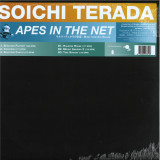
6-track EP compilation with Terada's work for the Ape Escape games, tip!
Outside of the international house underground, where his early ‘90s works for the Far East Recording label he co-founded with Shinichiro Yokota are rightly celebrated as bona-fide classics, Soichi Terada is best-known for his work composing music for video games. Yet until now, few of his productions for video games have been released outside of Japan, especially on vinyl.
Apes In The Net, a six-track EP featuring music composed for the popular PlayStation 1 series Ape Escape, sets the record straight. It not only showcases Terada’s quality as a composer and producer, but also his versatility. Like much of Terada’s work on the Ape Escape series, the tracks featured don’t explore deep, New York and New Jersey influenced house sounds, but rather his lesser-celebrated love of jungle and drum & bass – a sound he fully explored on 1996 album Sumo Jungle.
“The producer of the Ape Escape games heard that and got in touch,” Soichi remembers. “They asked me to make the soundtrack, and then work on the music for the sequels after that. I used to love making music with AKAI hardware samplers, synthesisers, and computers, so I played and recorded the tracks using almost the same methods as I did when I made house music. Using breakbeats and audio samples with a sampler was the most useful way to make the soundtracks.”
The six tracks on show, which were originally recorded in the ‘90s but reconstructed and remastered for Japan-only CD and digital releases over a decade ago, mix elements of Terada’s familiar deep house style – think warming chords and pads, memorable melodies, and emotive musical motifs – with blistering D&B breakbeats, 16-bit synth sounds, electronic bleeps and undeniably weighty basslines. They’ve stood the test of time and arguably sound just as fresh now as they did at the turn of the millennium.
For proof, check the soaring, spellbinding ‘Spectors Castle’, where uplifting lead lines and sumptuous chords dance atop punchy beats and growling bass, the jazzy and saucer-eyed rush of ‘Mount Amazing’ (all twinkling piano motifs, alien synth sounds, squelchy bass and skittish drums) and the intergalactic, liquid D&B excellence of ‘Time Station’, whose whistling melodies and stargazing chords are undeniably alluring.
There are plenty of other delights to be found across the EP, too, from the bustling, race-to-the-finish breathlessness of D&B/bleep techno fusion workout ‘Spectors Factory In’, and the rumbling sub-bass, creepy pads and suspenseful melodies of ‘Haunted House’, to the bombastic, all-out-assault on the senses that is ‘Coaster’, the set’s most “purist” jungle workout – albeit one that also doffs a cap to the pulsating world of big room techno.
Apes In The Net, then, celebrates Soichi Terada’s mastery as a video games composer and early Japanese junglist. Props are well and truly overdue.
X CLUB. is the production duo of Ben Clarke and Jesse Morath. Founded in Brisbane/Meanjin Australia’s warehouse scene and exported to London and beyond, their music is inspired by early 90s techno all the way through to future-facing drum’n’bass, with X CLUB. carving out a space entirely of their own thanks to their authentic and eclectic take on dance music with serious consideration for underlying groove.
With releases on labels such as Steel City Dance Discs, SPANDAU20/CROWDS, 99CTS Records and Stay On Sight, X CLUB. have seen their records reach global audiences with frequent touring across the UK, Europe, North America, Asia and Australia.
Wrestling With New Technique by X CLUB. is the second release on their own label HIDE THE JUNK, a powerful four track offering that follows on from it's HTJ001 predecessor which set out to explore the groovier, percussive and fun side of techno. These tracks have met dance floors the world over, summer into winter, making for big stage moments and more intimate club connections. It's the follow up EP that fans and DJ's alike have come to know and expect in X CLUB. and the start of what will be an exciting 2024.