Search:b devotion

Styles
All
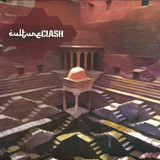
Cultureclash - Cultureclash

Lost Futures is a new label that explores experimental and often radical approaches to dance music from the past. In a musical landscape that increasingly claims to seek and reward new forms and ideas, Lost Futures delves into the recent past to revisit forward-thinking, optimistic projects that, owing to the social, musical or outright political climate, perhaps struggled to find an audience. Allowing only time to re-contextualise these leftfield, sometimes misunderstood and ultimately human bodies of work, Lost Futures taps into the inherent idealism of rave.

LF001 trips back until the early nineties to revisit the alternative scene emerging from the Dutch city of Utrecht. Here, three young men - DJ Zero One (Sander Friedeman), TJ Tape TV (Arno Peeters) and DJ White Delight (Richard van der Giessen) - joined forces to form 'The Awax Foundation'. Inspired by the transcendent and revolutionary electronic music arriving on their shores imported from Chicago and Detroit, combining their knowledge, gear and ever-expanding vinyl collection allowed additional freedom in paying sincere tribute to these intoxicating sounds, while also developing their tastes in a more personal, eclectic direction.

The musical flavours of Awax initially leaned toward acid house and the roots of techno. However, with three different mindsets in the mix, their tastes were rarely fixed. One thing each shared in common was a devotion to collecting rare sounds, specifically more adventurous and international samples than those emanating from the increasingly-hard, masculine dance music emerging from the Netherlands during the period. Inspired by the cross-over global sound of bands like Suns of Arqa, or 'World Music', as it was perhaps patronisingly termed at the time, the trio became interested in the idea of making techno with 'ethnic instruments'.

Of course, this being 1992, none of The Awax Foundation had access to such instruments, instead, they had a vast, collective library of samples from all over the world. There were no collaborations and no clear plan. Instead, they set to work using a Yamaha TX16W sampler, the legendary Atari 1040ST computer, a cheap mixing desk and a couple of low-end synths and FX machines. When Richard mentioned the project to his friend, Akin Fernandez, the London DJ and owner of cult label Irdial Discs, Fernandez was intrigued enough to invite the trio to record a one-hour show for his 'Monster Music Radio' series on London's then-burgeoning Kiss FM.

Forced to come up with a name, 'CultureClash' seemed like the obvious choice, even if the members of Awax were only creatively sparring among themselves. Along with the term 'ethno-techno', slightly dubious to a hopefully more conscious Western audience in 2017, these were the only guiding principles to the quietly ambitious project that soon combined cutting-edge machine rhythms with samples sourced from everywhere from Bolivia to Togo, and inspired by everything from Ravi Shankar's epic soundtrack to the Oscar-winning movie Ghandi, to the technical limits of their own setup requiring a dazzling degree of cut-and-paste work. Some tracks even emerged out of academic studies within the ethnomusicology department at The University of Amsterdam.

The show aired on October 2nd, 1992, recorded in one blistering take and without any rehearsals, traversing a huge variety of tempos and styles. If the performance wasn't seamless, it was undeniably thrilling, fresh and ambitious. As such, several labels, including Fernandez's aforementioned Irdial Discs expressed an interesting in commercially releasing CultureClash, while another imprint proposed a series of twelve-inches and an album. But the sheer complexity of the project meant that it never saw the light of day, while the trio embarked on different journeys ahead, both creative and personal.

Twenty five years later, and the original CultureClash lineup and founding members of The Awax Foundation provide the sound of the first release from Lost Futures. An otherworldly, ambitious and optimistic compilation, accompanied by extensive sleeve notes from the trio, CultureClash is a timeless ode to experimentation in dance music's ever-overlapping culture.

out of Stock

Order now and we will order the item for you at our supplier.
22,65 €
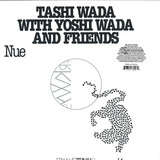
Tashi Wada With Yoshi Wada & Friends - FRKWYS Vol. 14 - Nue

Composer Tashi Wada has performed for years with his father Yoshi Wada—artist, composer, and early member of the Fluxus movement. However, they have rarely appeared together in studio settings. Nue, the fourteenth entry in RVNG Intl.'s intergenerational FRKWYS series, finally brings Tashi and Yoshi, along with an eclectic group of close friends and extended family, together on tape.

Nue draws on aspects of Tashi's background for his widest vision to date—among them the minimalist bagpipe music of Yoshi, who co-composed three of the tracks, the psychoacoustic and perceptual explorations of his mentor, composer James Tenney, and reimagined forms of ancient and devotional music. The album, however, is not a tribute to the past or a recapitulation of familiar sounds. Instead, Nue is an intertwining of people and ideas as a means of growing, of looking inward to move outward, and of looking back to move forward.

To achieve this growth, Tashi assembled a core group of fellow travelers, including Yoshi, composer Julia Holter, producer Cole MGN, and percussionist Corey Fogel, to give life to this multifaceted suite. As an experience, Nue subtly navigates the interactions, intimacy and spaciousness of this group.

The album's title itself is a nod to Tashi's abiding interest in duality and the unknown: nue is a mythological Japanese chimera with the face of a monkey, the legs of a tiger, and a snake for a tail, a composite form, at once disturbing and otherworldly. But, as the composer points out, nue is also French for naked—stripped of complexity, bare and exposed, but also raw and essential.

From the doubling of tones—and the world of harmonic nuances such an action produces—to the rich interplay between individual musicians, all baring their own personalities and experiences through shared performance, Tashi's compositions allow space for these elements to join and grow. The multipartite creature that is an ensemble melds in the simplicity and purity of the music itself.

As explained by Tashi, each part was written with an individual in mind, not simply an instrument. And each individual performer makes their mark, from Holter's vocal performances on the cresting, oceanic 'Mutable Signs' and 'Ondine' with guest vocalists Simone Forti, Jessika Kenney and Laura Steenberge, to Fogel's resonant, precise percussion on 'Bottom of the Sky.' Producer Cole MGN, who has worked extensively with artists like Beck and Ariel Pink, helped to create a world of sound with minimal yet multi-dimensional materials. Like many of its influences, Nue uses deceivingly simple means to create complex, coherent worlds and narratives.

Tashi notes the influence of legendary Brazilian writer Clarice Lispector, whose work looked inward, investigating memory and emotion and dream, to understand the often overwhelming world outside the self. Like Lispector's classic novel Near to the Wild Heart, Nue cleaves these archetypal dualities—world/self, old/new, complex/simple—to create a work that allows them to coalesce into something singular.

As Tashi states in his liner notes: 'My desire was to create something both old and new sounding—ancient and futuristic—and ultimately something of its own world and other. Nue is a vision, an endless night of dreams, and a personal history of sorts, full of joys and demons.'

out of Stock

Order now and we will order the item for you at our supplier.

27,27 €
Alice Coltrane - Lord Of Lords

Originally released in 1972, Lord Of Lords was Alice Coltrane's final album for Impulse! and the last installment in her awe-inspiring trilogy that also included Universal Consciousness and World Galaxy. While all three records featured strings alongside a jazz ensemble, Lords Of Lords stood apart from its predecessors due to the sheer size of the orchestra (12 violins, 6 violas and 7 cellos, arranged and conducted by Coltrane herself) and its refined, blissful performances - shining a vital light on the devotional path that she would follow for the rest of her career.

On the first two pieces, "Andromeda's Suffering" and "Sri Rama Ohnedaruth" (titled after the spiritual name for her late husband), Alice's dazzling piano and harp blend perfectly with the blanket of strings, while the haunting rhythm section of Charlie Haden and Ben Riley and a magnificent, droning electric organ emerge immaculately on the title track and closer "Going Home." Coltrane's musical vision is bold in its imagination and cosmic in scope, yet remains intensely personal and immediate. Lord Of Lords points inward as much as to the beyond, recalling her classical roots and recasting Eastern modes to radically invert the American avant-garde and spiritual jazz traditions.

This first-time vinyl reissue has been carefully remastered from the original master tapes.

out of Stock

Order now and we will order the item for you at our supplier.

20,55 €
Midori Takada & Lafawndah - Le Renard Bleu

It is said that every generation casts its mind back to a previous era in times of crisis; the resources that will allow us to decode the questions of our moment may lie in the myths of another era.

Le Renard Bleu, the new musical and cinematic collaboration between Lafawndah and composer Midori Takada, and filmmakers Partel Oliva, takes a cross- generational echo as ground zero for recovering a crucial myth for uncertain times: the blue fox.

As transmitted by Takada, the fox appears in both ancient Senegalese and Japanese folktales as the trickster archetype; belonging both to the heavens and to the earth, the fox is the agent of chaotic good, shaking the world up when its energy has become stagnant. Above all else, the fox is famous for its cunning nature.

Renard Bleu marks the first new music released by Takada in nearly twenty years; it would be difficult to overstate the importance of her return to the public eye. Her first solo record, 1983's Through the Looking Glass, has been rediscovered and heralded as a lost classic; the influence of her percussion trio, the Mkwaju Ensemble, continues to permeate and inspire a new generation entranced by its lucid beauty, playfulness, and sensual patience. Takada has performed in numerous film score orchestras, including the ensemble for Akira Kurasawa's Dreams, coincidentally a key influence on Renard Bleu.

In the ensuing years, Takada has worked closely with theater group the Suzuki Company of Toga on productions of Electra and King Lear, an experience, she says, that allowed her to pursue 'a unity of music, body and space.' Recent live solo performances have evinced the depths of her exploration of all three.

Equally, it is Lafawndah's freedom of tone, decentralized maps of ancient and modern music cultures, and alloying of devotional intensity with modern songcraft casts her as a distinct relative of Midori Takada's.

Over the course of two EPs, self- directed music videos, and countless live performances, Lafawndah has drawn out an uncompromising exploration of how theater, situational intervention, and choreography can amplify the affective palate of forward pop music. One can trace the influence of artists such as Meredith Monk, Carlos Sara, and Andy Kaufman as much as musical antecedents AR Rahmann, Missy Elliott, or Geinoh Yamashirogumi.

It is in a mutual commitment to this unity that Lafawndah, Takada and Partel Oliva find fertile aesthetic common ground.

The music of Renard Bleu originated in Takada's preoccupation with the legend of the fox; after constructing a vivid instrumental composition dramatizing the spirit animal's journeys through waterphone, bells, marimba and various forms of drums, Lafawndah responded - in her inimitable mix of fairytale and undertow-- with melodies and lyrics capturing a dialogue between her and the fox himself. Eventually, the duo met in Tokyo for a week of communing with the material at Avaco Creative Studios, where new elements were composed on site.

Created in partnership with KENZO and premiered today via their channels, it was Partel Oliva who imagined a contemporary cinematic frame for the myth of the fox to re- appear, creating a hybrid of choreography and narrative around Takada and Lafawndah's performance of their joint composition (also titled Le Renard Bleu.) Returning to film in Japan for the third time, Partel Oliva's moving image work (Club Ark Eternal, The Pike and the Shield) has set the standard for and revolutionized the fashion art film. Their deployment of original music, dance, and a highly stylized mis en scene coalesces here in the casting of Los Angeles krump artist Qwenga as the eponymous fox, stalking the halls of the ancient Noh theater in which Takada and Lafawnda's performance takes place.

Why call up the myth of the fox now In Le Renard Bleu, Lafawndah and Takada's collapsing of distance between generations, styles, and milieus intimates that the relationship to time must be shaken. The future lies in fragments in the past; to remember is to recover it; the fox rises to thicken the plot.

out of Stock

Order now and we will order the item for you at our supplier.

14,24 €
Ustad Zia Mohiuddin Dagar - Ragas Abhogi & Vardhani (Rudra Veena // Seattle // 9 March 1986)

Raga Abhogi
1) Alap
2) Jod
3) Jhala

Raga Vardhani
4) Alap
5) Jod
6) Jhala

Zia Mohiuddin Dagar : rudra veena
Annie Penta : tanpura

Concert recorded at the home of Shantha and Niranjan B. Benegal, Seattle, Washington 9 March 1986.
Recorded by Niranjan Benegal. Files obtained from Jeff Lewis.
Mastered & Cut by Rashad Becker at Dubplates & Mastering 1117 & 0318.

Liner notes by Renaud Brizard, edited by Stephen O'Malley & Ian Christe.
Front and back cover photos by unknown.
Interior photography by Niranjan B. Benegal, Dan Neuman & unknown, Seattle 1978-1980. .

Around ten years ago, deep into a cozy and hazy night following a concert with my sound brothers Daniel O'Sullivan and Kristoffer Rygg in London (as Æthenor), they graciously introduced me to a recording of rudra veena (a kind of noble deeper bass relative to the sitar, in a way) as performed by dhrupad master Zia Mohiuddin Dagar.

Dhrupad, for those who do not know, is a branch of Hindustani classical music said to "show the raga in its clearest and purest form". It's pacing concentrates heavily on the slow, contemplative alap section and works with specific microtonal gestures and deep characteristics of resonance ... in short I was hooked on this new (to me) and ancient form of music from the first listen, and feel that a more or less continual listening & reviewing of Zia Mohiuddin Dagar's recordings in the years that followed have influenced my own approach to music quite heavily (if, albeit, indirectly).

In early 2015 I was able to make contact with Zia Mohiuddin Dagar's son Bahauddin and some of his American students/disciples, primarily Jeff Lewis. Over time we developed a friendly and educational exchange, access a massive archive of recordings and developed these two paired titles for my label. It's been a long path to arrive at actually releasing them but also probably in many ways one of the most significant releases I've worked on. And I'm proud to be able to reveal these to date unreleased archival recordings of one of the masters of dhrupad, Z. M. Dagar, to the public for the first time.

Zia Mohiuddin Dagar was the nineteenth generation in a family tradition known as Dagar gharana, a rich lineage which continued and performed the musical form of dhrupad (Bahauddin Dagar continues the lineage as a master rudra veena dhrupad player of note today). Initially, dhrupad was a rigorous, austere, devotional genre that was sung in Hindu temples. But between the 16th and the 18th centuries, it became the preeminent genre in royal courts in North and Central India, and the Dagar gharana developed and continued publicly following the eventual loss of court patronage for dhrupad in the 19th century. The French ethnomusicologist Renaud Brizard covers the story of Zia Mohiuddin Dagar's life and teaching (a long story also in Seattle, my hometown!), the Dagar family and gharana, the rudra veena and more topics in an extensive set of liner notes in this release.

Ragas Abhogi & Vardhani were recorded in a private house concert in Seattle at the home of the Benegals in March 1986 (the week before the accompanying release SOMA029 Raga Yaman was recorded). The Benegals were friends (& Shantha Benegal was also a student) of Dagarsahib who sometimes hosted Hindustani music concerts in their home. It's a rare glimpse of a more intimate, personal and perhaps different kind of performance considering the form of dhrupad.

-Stephen O'Malley, March 2018, Paris, France

Stephen O'Malley would like to especially thank Bahauddin Dagar, Jeff Lewis & Jody Stecher for their enthusiasm, cooperation, patience, insight & advice toward developing these editions. Thank you also to Laurel Sercombe & John Vallier from the University of Washington Ethnomusicology Archives, Shantha Benegal, Philippe Bruguière, Dan Neuman, Ira Landgarten, Renaud Brizard, Ian Christe, Peter Rehberg, Rashad Becker, Daniel O'Sullivan & Kristoffer Rygg, all for their direct or indirect cooperation, assistance & patience.

out of Stock

Order now and we will order the item for you at our supplier.

26,43 €
Ustad Zia Mohiuddin Dagar - Raga Yaman (Rudra Veena // Seattle // 15 March 1986)
 
1

Raga Yaman
1) Alap
2) Jod
3) Jhala
4) Gat (Composition in Chautal)

Zia Mohiuddin Dagar : rudra veena
Manik Munde : pakhawaj
Gayathri Rajapur & Annie Penta : tanpuras

Recorded by unknown at the University of Washington, HUB Auditorium, Seattle, Washington 15 March 1986 , concert co-sponsored by the UW Ethnomusicology Division and Ragamala.
Original digitally processed audio recording made with Panasonic PV-9000 VCR, Sony PCM-F1, PZM mics. Mastered & Cut by Rashad Becker at Dubplates & Mastering 1117 & 0318.

Liner notes by Renaud Brizard, Stephen O'Malley & Ian Christe.
Front and back cover photos by Niranjan B. Benegal, Seattle Center Folklife Festival 1979. Elizabeth Reeke & Annie Penta on tanpuras.
Inner gatefold photography by Niranjan B. Benegal & Ira Landgarten.

Around ten years ago, deep into a cozy and hazy night following a concert with my sound brothers Daniel O'Sullivan and Kristoffer Rygg in London (as Æthenor), they graciously introduced me to a recording of rudra veena (a kind of noble deeper bass relative to the sitar, in a way) as performed by dhrupad master Zia Mohiuddin Dagar.

Dhrupad, for those who do not know, is a branch of Hindustani classical music said to "show the raga in its clearest and purest form". It's pacing concentrates heavily on the slow, contemplative alap section and works with specific microtonal gestures and deep characteristics of resonance ... in short I was hooked on this new (to me) and ancient form of music from the first listen, and feel that a more or less continual listening & reviewing of Zia Mohiuddin Dagar's recordings in the years that followed have influenced my own approach to music quite heavily (if, albeit, indirectly).

In early 2015 I was able to make contact with Zia Mohiuddin Dagar's son Bahauddin and some of his American students/disciples, primarily Jeff Lewis. Over time we developed a friendly and educational exchange, access a massive archive of recordings and developed these two paired titles for my label. It's been a long path to arrive at actually releasing them but also probably in many ways one of the most significant releases I've worked on. And I'm proud to be able to reveal these to date unreleased archival recordings of one of the masters of dhrupad, Z. M. Dagar, to the public for the first time.

Zia Mohiuddin Dagar was the nineteenth generation in a family tradition known as Dagar gharana, a rich lineage which continued and performed the musical form of dhrupad (Bahauddin Dagar continues the lineage as a master rudra veena dhrupad player of note today). Initially, dhrupad was a rigorous, austere, devotional genre that was sung in Hindu temples. But between the 16th and the 18th centuries, it became the preeminent genre in royal courts in North and Central India, and the Dagar gharana developed and continued publicly following the eventual loss of court patronage for dhrupad in the 19th century. The French ethnomusicologist Renaud Brizard covers the story of Zia Mohiuddin Dagar's life and teaching (a long story also in Seattle, my hometown!), the Dagar family and gharana, the rudra veena and more topics in an extensive set of liner notes in this release.

Raga Yaman was recorded at a public concert in Seattle at the HUB Ballroom at the University of Washington in March 1986 (the week after the accompanying release SOMA028 Ragas Abhogi & Vardhani was recorded) at the end of his last tour of the United States. Yaman was a special raga for Zia Mohiuddin Dagar, one of his signature raags. For centuries, Yaman has been considered as one of the most fundamental ragas in Hindustani music and is one of the first ragas which is taught to students. A deep knowledge of Yaman gives a key for understanding many other ragas. It's filled with tranquility, contemplation, pathos and spiritual yearning. .

-Stephen O'Malley, March 2018, Paris, France

out of Stock

Order now and we will order the item for you at our supplier.

26,43 €
DEUTER - PRINCESS OF DAWN / SOUNDTRACK
  • A1: Princess Of Dawn
  • A2: Winter Sun
  • A3: Triad
  • A4: Tom Bombadills Dance
  • A5: Pearls
  • A6: Arabia
  • A7: Cray-fish
  • A8: Deep Sea
  • A9: Starlight
  • B1: Phoenix
  • B2: Hoodle-doodle
  • B3: Gotic Velvet
  • B4: Green Cherub
  • B5: Desert-rock
  • B6: Synthi-effect
  • B7: Flea-dance
  • B8: Flea-dance Ii
  • B9: Laser
  • B10: Up And Down
  • B11: Desert-rock Ii
  • B12: Kolibri
  • B13: Elefantentempel
  • B14: Reed
  • B15: Singing Bell
  • B16: Evening
  • B17: Together

New Lp-edition of a private press library recordings of the early '70s.
Together with Florian Fricke and Peter Michael Hamel, Deuter is certainly the main responsible of a fruitful encounter between European sensibility and Eastern aesthetics in the German music of the 1970s. Soundtrack was originally produced by Kuckuck in 1973 not for an official and public release, but as a library' to be used for films, TV and radio. As a library it respects the canonical and typological structure of the genre with 26 short sonic fragments, sequences imagined and conceived like fulminating illuminations. There's still a solid electronic vocation that, however, has put aside the most disruptive effluvia of D (1971) of pure kraut' ancestry. In fact, the album is more like an ideal passing bridge between some ritual instances of the previous Aum (1972) and the following successful phase of Deuter during the period when he stays in the Bhagwan Shree Rajneesh's ashram in Poona realizing, in parallel to a renewed inner life, masterpieces like Celebration, Haleakala, Ecstasy and Silence is the Answer. Musically speaking, Soundtrack presents itself as a heterogeneous work with nocturnal, cinematic, galactic and atmospheric-environmental implications. Electronics remains the predominant factor but can vary from mantra drones of more ceremonial and meditative space-relax' tones of some tracks (Triad, Deep Sea, Gothic Velvet or Evening) to the most amused formulations of pulsating analog synths that in the hands of Deuter become toy-equipement' to modulate and explore (Desert Rock, Synth Effect, Flea Dance or Laser). There is no lack of acoustic moments more ethnically inspired with Arabian and Indian (Reed, Arabia) or devotionally solar themes (Tom Bombaddils Dance), so evoking an air of diffuse peace then completely conquered in the beloved India.

pre-order now31.05.2018

expected to be published on 31.05.2018

16,60 €
Willie Graff & Darren Eboli - The Tribeca Tapes

Quality is the key word from Copenhagen based Music For Dreams and here is another home run. Willie Graff splits his year between DJ residencies in New York and Ibiza. In this new outing with studio partner Darren Eboli, the influence is, as the title suggests, clearly NY-based. Over only four tracks, the pair manage to craft a stunningly comprehensive exploration of the essential elements of dance music.

Opening track "Love Flight" staggers into a lush string-driven groove that recalls the glory of Metro Area meets Wally Badarou vibes. Minimal yet playful, it lounges somewhere in the depths of the house tradition, calling on familiar sounds while throwing in odd details along the way (harmonicas). It takes both skill, devotion and a sense of humor to pull this track off, making for a strong opening. "Moon Tan" lingers on a metallic hook that drags you into a plethora of percussion followed by a rubbery soft baseline. Dubby key work would suggest this was a new wave band jamming at Compass Point, while the icy chill of the xylophone transports you into 80s italo territory.

"Second Sun" pulls out the bag of boogie tricks, relying on a firm but humble baseline and smattering drum machine claps. Nile Rodgers-style guitar licks guide us onwards into a well-orchestrated jam that builds up and breaks down with perfect timing while dreamy chords reach for the sky. "First Light" keeps the groove tight while dipping over towards more Balearic temperatures. Steeped in a watery atmosphere and gentle organic percussion, it focuses in on a trance-inducing arpeggio that lulls you in to the swaying Badarou-style synth swirls that intercept it.

out of Stock

Order now and we will order the item for you at our supplier.

10,88 €
79rs Gang - Fire On The Bayou

The amazing Romeo and Jermaine - Big Chiefs from different ends of the city -came together to celebrate their shared devotion to the deep roots of NO's 'Indian' culture. Vocals and percussion only but these guys deliver a fearsome wallop. Ooooh na na.

out of Stock

Order now and we will order the item for you at our supplier.

14,33 €
Happy Meals - Full Ashram Devotional Ceremony Volumes Iv-vi

Optimo Music präsentiert eine neues Sublabel, das auf den Namen So Low hört. Das erste Release kommt vom Glasgow's Happy Meal, ein Duo bestehend aus Suzanne Rodden und Lewis Cook, die auf So Low ihr zweites Album vorlegen. Full Ashram Devotional Ceremony Volumes IV - VI ist mit seinen Kraut-Electronic-Noise-Ambient-Wave Einflüßen gleichermaßen verstörend und einnehmend und garantiert ein spannendes Hörerlebnis.

out of Stock

Order now and we will order the item for you at our supplier.

15,34 €
Rumbleton - A New Day

Touching down for the inaugural release on the newly formed label, North of 7 Sounds, is the mighty Rumbleton - a true heavyweight with over 2 decades immersed in sound system culture, running the Stand Firm Hi-Fi label and releasing music on Scientific Wax, Rupture LDN, Outsider, and Samurai Music to name but a few. A true master of his sound, we are extremely proud to have Rumbleton set the bar for future North of 7 excursions. A New Day' takes you on a journey filled with haunting pads, razor-sharp drum kit clashes, and infinite amounts of low-end. Bottomless swathes of atmospherics respire in and out of the mix, culminating in a breathtaking breakdown - crafted with utmost devotion to the Godfather of Soul himself. A truly honourable homage to jungle's roots in sample culture and breakbeat science.Conscience' on the flipside is weightiness refracted in minimalism. Rumbleton fully submerges your mental space in a cavernous, dubwise fog, while militant, scorched-earth drums power the tune forward. A warm, subterranean bassline churns endlessly beneath, all the elements occasionally exhaling and collapsing under their own weight, only to regenerate once again...

out of Stock

Order now and we will order the item for you at our supplier.

11,72 €
Monsieur Georget - Le Village Flottant

Zeal....Enthusiastic devotion to a cause, ideal, or goal. In our case devotion to deep, dubby, warm mirco grooves.

The label's first release comes from 'Monsieur Georget' which is an alternative alias for well-known French producer Chris Carrier, who many will recognise from his own label Adult Only Records, along with releases on other labels including Robsoul, One Records, OFF Recordings and Silver Network.

The release also features a remix from stellar German artist DeWalta, who along with a number of seminal releases on Meander, is a regular collaborator with Mike Shannon and boasts releases on other labels including Vakant, Haunt and Visionquest.

Track one titled Le Village Flottant' is the first of the three originals on the release. Setting the tone of what's to come, it has stripped back drums with delicate sprinkles of delay that are brought to life with a wonky lead synth and poignant piano stabs. The track fuses intricacy with dancefloor focused energy.

Second track called Mecrant Des Oceans' has gliding synths that line the back of the mix whilst the morphing tones and subtle squelch of an acid line provides the momentum. Murky and mysterious, there's a metallic ring to the percussion and it's a fine example of how less can often be so much more.

Third on the release is the DeWalta remix of Le Village Flottant' and keeping the originals ride, he adds his own dub Techno influence. With new synth parts he cuts the already stripped drums to a bare minimum, which gives his added synths plenty of room to breathe and creates a captivating ambience.

Finishing the EP is the third original track titled Picnic Dans Le Metro' and like the rest of this release, it twists and turns with rippling textures and deep atmospherics. Each drum hit is crafted with expert precision and every textured synth sound merges to create the perfect groove and mood.

out of Stock

Order now and we will order the item for you at our supplier.

8,36 €
Faugust - Devotions (1984 - 2006)

Faugust

Devotions (1984 - 2006)

10inchMIRA009
MIRA
02.07.2014

Following the latest Avian release as Sigha, James Shaw now unveils his Faugust project with a 10" title on the Avian sub-label - Mira. Emotive and highly personal, Devotions (1984 - 2006) shows a side of Shaw's sound that has been largely buried since 2004, combining his experience as a guitarist with many of the sonic approaches that characterise his best known music today. Over the course of four tracks it layers pulsating bass and synth lines with melodic flourishes and a pop sensibility not seen in his other work. As per previous Mira releases, the artwork is done by Juan Mendez aka Silent Servant.

out of Stock

Order now and we will order the item for you at our supplier.

4,16 €
Items per Page:

Language