ORKA is a duo comprising Francine Perry from London and Jens L. Thomsen from the Faroe Islands. They crossed paths in the vibrant club scene of London, an immersive world that had a profound impact on their creative journey. ORKA's music draws inspiration from the Hardcore Continuum and UK sound system culture, blending it with elements of minimal techno, progressive electro, and ambient music, resulting in a diverse range of stylistic influences. Now ORKA emerges with their long-awaited new album. Once again, they greet us with their distinct blend of earthy tones and a bold, adventurous spirit, taking us to a realm bursting with neon-lit hues, pulsating club beats, and an abundance of sensory stimulation. Aptly named "All At Once," the album title provides a clue to the auditory and sensory experience that awaits the listener in this immersive record. ORKA has continuously evolved as a project over many years and iterations, embracing fluidity and a relentless quest for fresh sonic amalgamations. Their journey has been marked by a gradual refinement, stripping away layers to reach the core essentials. This transformative process has unfolded over the years, reaching from their site-specific, cowshed sampling and band-based expedition in "Livandi oyða" (2007) to the bold, innovative exploration of minimalist techno in "Vað" (2016). However, their latest release, "All At Once," signifies yet another remarkable leap forward in their artistic evolution. The seeds of this artistic progression were already planted in previous releases like the <13 EP (2017) and the hard-hitting techno single "Juno" (2018). However, it is with the arrival of the album "All At Once" that ORKA's vision fully blossoms, unveiling a vivid and expansive sonic landscape. This latest offering presents a glorious and vibrant tapestry, showcasing a maximalist approach to techno that pulsates with energy coupled with their signature meticulous attention to sound design, reflecting a deep awareness and intentionality in their creative process. If this album was to be thought of as a place, it would be a shimmering, futuristic, buzzing kind of city with vibrating night-time drizzle from above and endless glowing lights in the distance. Several of the tracks are built around cut-up vocal samples that are divided from their semiotic meanings and reconfigured as loops, and thus mined for their timbral and percussive qualities. Recurring collaborators South London duo LV (Hyperdub, Keysound, Brownswood) are featured on a handful of these tracks, mixing in their complex cocktail of grime and bliss. The result is a sort of queer erotic dance-floor mysticism, and the closest to a full-blown dance record that ORKA have ever made. There must be a club in that shimmering futurist city of the night.. and it is a collective, inclusive and alluring place. There is no need to fear any dancefloor exhaustion by listening to this album though, as there are also moments of floating cyber beauty and pure enveloping warmth to be found among its tracks. As always, following the artistic journey of ORKA is a joyous experience, filled with unexpected twists and turns that keep us captivated.
Buscar:b key
Stevie Ray Vaughan's third studio album Soul To Soul was released in 1985, just two years after his massive debut Texas Flood. Moving more into a soulful R&B-tinged blues sound, Stevie included two new band members on keyboard and saxophone for Soul To Soul. The band know their way around a number of cover versions of songs penned by Hank Ballard, Doyle Bramhall, and Willie Dixon, bringing a variety of influences into SRV's brand of modern blues. His own compositions such as “Say What”, “Ain't Gone 'N' Give Up On Love” and “Life Without You” reveal an artist that is ever passionate in delivering real blues, and growing in his songwriting at the same time.
Soul To Soul is available as a limited edition of 1500 individually numbered copies on blue marbled vinyl.
Stevie Ray Vaughan's third studio album Soul To Soul was released in 1985, just two years after his massive debut Texas Flood. Moving more into a soulful R&B-tinged blues sound, Stevie included two new band members on keyboard and saxophone for Soul To Soul. The band know their way around a number of cover versions of songs penned by Hank Ballard, Doyle Bramhall, and Willie Dixon, bringing a variety of influences into SRV's brand of modern blues. His own compositions such as “Say What”, “Ain't Gone 'N' Give Up On Love” and “Life Without You” reveal an artist that is ever passionate in delivering real blues, and growing in his songwriting at the same time.
"If you can imagine a love child between MAC DEMARCO and SPAR-KLEHORSE, then this would be what you're left with." - SO YOUNG MAGA-ZINE
Raised in North Queensland, Australia, Jarrod Mahon is not one to shy away from bold new endeavors. Once parting ways with his previous record label in 2019, Mahon chose to go fully independent, relocating to Berlin in 2019 (where he still resides), despite having no contacts at all in the country. What’s more, having recorded/performed under the pseudonym Emerson Snowe for over a decade - during which time he home-recorded five albums and 13 EP’s, toured with the likes of King Krule or Ariel Pink, played showcases SXSW and the Great Escape, the works - Mahon took that brave, most uncommercial decision to release under his own name and start almost totally anew.
“There was never really a concept to that name Emerson Snowe other than having some kind of separation from who I was as a person,” Mahon explains, “using a moniker gave me that confidence to push myself further mentally and to give myself some kind of a freedom”. And through the process of creating what would become his debut album, Mahon saw that he had outgrown the need for this protective persona. ‘Everything Has A Life’ was meant to be the debut Snowe album”, he admits, “but after I finished mixing it with Syd Kemp, co-producer I realized that I had actually grown a lot and was much more comfort-able with who I am and what my personal beliefs are.”
The choice of ‘Everything Has A Life’ as the album title, pulled from beauteous opening track ‘All I Know’, neatly summarizes this new outlook: moving on from ‘self-pity’ of the past-self by becoming present for the loved ones around you, improving understanding of one’s own self, via the wider world at large.
That track marks the first written during a lockdown stint in LA where Mahon wrote and recorded every day for 2 months, produced nigh on 250 demos and birthed the bulk of the record. It also brought Mahon back to his all-time favorite, Sufjan Stevens’ Ilinois and its blend of widescreen orchestral landscapes and more candid, naked acoustic-leaning variations - an important influence for the album's stylistic contrasts. Another key inspiration for the record too brought Mahon back to his roots - those full-bloom strains of his Mum’s Beloved Neil Diamond, an annual Christmas irritant to Mahon as a child, yet an artist he’s come to respect in adulthood. “Whatever the reason, with age I came to love the big show band sounds,” he says, “the idea of a performer on stage with a mas-sive orchestra with strings was amazing to me.”
With the help of producer Syd Kemp (Ulrika Spacek, Vanishing Twin), such grand designs could be met. - “When we first met, he asked me if I would like real strings on it. I said of course.” Enter Magda Mclean on violin (Caroline/the Umlauts), and Gamaliel Rendle Traynor on Cello (Sweat, Fat White Family), whose strings helped lift the record to romantic new heights.
He continues: “I said to Syd that the only thing I wanted to achieve with this rec-ord was that I wanted it to make me cry at one point. And we got there eventual-ly.” The final culmination of all these strands, ’Everything Has A Life’ is indeed a treasure trove of emotive riches. Locking into that bittersweet, quintessentially ‘pop’ combination of triumphant rhythms and confessional, stream-of-consciousness lyrics plucked straight from the heart, Mahon faces up to years of substance abuse with a series of gorgeous, blushing melodies: “I was using, I was drinking, I was lying to my friends, I was messing up again, I was hiding from myself”, he joyously chants on ‘The Growing’.
A banquet fit for an indie king, Everything Has A Life is loaded with psych-pop lusciousness (‘All I Know’) and anthemic glam fuzz (‘Death Of The Ladies Man’, ‘Deadstar’, or ‘Sonny is my Best Friend’); recalling that foundational Sufjan Ste-vens influence too with shambling flecks of country (‘Charly (Romantic Heart)’). There’s also those lo-fi crepitations of ‘My Man’ and ‘I can’t’ harking back home-recorded demos that lie at the core of Mahon’s creative process.
In the swirl of underground music emerging from Dunedin, New Zealand in the 1980s, Peter Gutteridge stands as one of the era’s most intense and shadowy figures. Despite being a founding member of The Clean and The Chills, Gutteridge would eschew indie-rock fame for the hypnotic and driving sounds of his later bands such as Snapper.
Fittingly, it is Pure—Gutteridge’s lone solo album of intimate home recordings—that serves as the most revealing and celebrated release of his career. As Peter Jefferies writes in the liner notes, “That’s what’s so good about Pure. Not only the songs, but the name, the name for the recording. It is as pure as you can get. That’s the real deal, when it goes from nothing to something and he catches it on his machine.”
Originally released on cassette in 1989 on Xpressway, Pure documents Gutteridge’s stunning use of 4-track as instrument. Featuring lo-fi pop gems and interstitial sketches, the LP combines densely layered keyboards and guitars, distorted drum machines and possessed-sounding vocals to create a truly singular work of undistilled artistic vision.
While Gutteridge denied that he was the architect of the “Dunedin Sound,” Pure sits comfortably next to the most revered Flying Nun releases of its time. Shifting exquisitely from churning rattle to an airy ease without losing momentum, these twenty-one songs hold a lasting place in the canon of DIY music. Recommended for fans of Syd Barrett, Jim Shepard and early Fad Gadget. Includes drawing chosen by Peter’s family.
Japan has produced some exceptionally talented jazz drummers and among them is Tatsuya Nakamura, who joins the BBE Music J Jazz Masterclass Series with his album ‘Locus’ from 1984, a session covering several bases, from heavy percussive samba to meditative avant-ambient. This is the album’s first ever reissue, although a track from ‘Locus’, ‘¼ Samba’, was included on J Jazz vol. 3. Nakamura began his drumming career as a teenager, inspired after seeing the documentary film “Jazz on A Summer’s Day” and listening to his idols Art Blakey and Miles Davis. By his early twenties, Nakamura was working with such luminaries as free jazz guitarist Masayuki Takayanagi, pianist Masaru Imada and band leader & composer Mitsuaki Kanno. In the mid-70s, like several other Japanese jazz players, Nakamura decided to make the move to New York where he studied drumming with Roy Haynes, and performed with members of the AACM and players from the loft and free jazz scenes including Richard Davis, George Adams, John Hicks, and Pharaoh Sanders. Returning to Japan, Nakamura continued playing as leader of his Japanese band The Jazz Fellows and in 1979, he went into the studio as leader for the classic “Where Is The Quarter” session featuring Masaru Imada, Hideto Kanai and Kenji Mori. This session includes the original percussion heavy version of ‘¼ Samba’ and was followed by a period back in NYC during which he recorded the funky/free session ‘Rip Off’ in 1980. 1984 saw Nakamura working as leader of a heavy-duty fusion septet and in February of that year he led them in a performance at Audio Technica Hall. The album ‘Locus’ on Sea Horse Records is the label’s one and only release. On ‘Locus’, Nakamura is joined by a stellar line-up. On trumpet is Shinobu Fujimoto and he’s joined by seasoned bass player Hideto Kanai (1931 -2011) who began playing in the mid-1950s, appearing on King Recs All-Star Jazz Series before going on to be a regular fixture on the legendary Three Blind Mice (TBM) label, backing many of its leading artists. He even released his own album on TBM, ‘Ode to Birds’ in 1975. On guitar is Kazumasa Akiyama. Born in Tokyo in 1955, he taught himself guitar at 10 years old and was influenced initially by The Beatles and Ray Charles, and later Jimi Hendrix, Cream, Chicago Blues, and jazz. When he was a student, he got a chance to appear on Sadao Watanabe's radio program ‘My Dear Life’, which led him to join the Isao Suzuki Group and Mikio Masuda Group. Akiyama released his first leader album ‘Dig My Style’ in 1978 and is still an active musician. On keys is the incredible Jun Fukamachi (1946-2010). Born in Harajuku, Tokyo, Fukamachi started playing the piano at the age of three, showing an extraordinary talent, recognised as a child prodigy. He became a professional musician while still in school and released his first album ‘Portrait of a Young Man’ on Polydor in 1971.
Woods are in bloom again, inviting you to disappear into a new spectrum of colors and sounds and dreams on Perennial. Formed in Brooklyn in 2004, Woods have matured into a true independent institution, above and below the root, reliably emerging every few years with new music that grows towards the latest sky. Operating the Woodsist label since 2006 and curating the beloved homespun Woodsist Festival for the musical universe they’ve built, Perennial is the sound of a band on the edge of their 20th anniversary and still finding bold new ways to sound like (and challenge) themselves. Perennial grew from a bed of guitar/keyboard/drum loops by Woods head-in-chief Jeremy Earl, a form of winter night meditation that evolved into an unexplored mode of collaborative songwriting. With Earl’s starting points, he and bandmates Jarvis Taveniere and John Andrews convened, first at Earl’s house in New York, then at Panoramic House studio in Stinson Beach, California, site of sessions for 2020’s Strange To Explain. With a view of the sparkling Pacific and tape rolling, they began to build, jamming over the loops, switching instruments, and developing a few dozen building blocks. The album’s resulting 11 songs, 4 of them instrumental, are in the classic Woods mode--shimmering, familiar, fractionally unsettling--but with the half-invisible infinity boxes of Earl’s loops burbling beneath each like a mysterious underground source. From source to seed to bloom, each loop unfolds into something unpredictable, from the jeweled pop of the aching “Little Black Flowers” to the ecstatic starlit freak-beat of “Another Side.” They are blossomings both far-out and comforting, like the Mellotronic cloud-hopping of “Between the Past,” or sometimes just plain comforting, like the widescreen snowglobe fantasia of the instrumental “White Winter Melody,” touched by Connor Gallaher’s pedal steel. Woods have long used the studio as a place of songwriting, naming 2007’s At Rear House after their shared dwelling and recording space. But Perennial also carries with it an even longer view of Woods. Emerging from the process alongside the music was Earl’s reflection that “perennial plants and flowers are nature’s loops,” an idea rolling under the album’s lyrics like the loops themselves. It certainly applies to the band, too, who have quietly tended to a long, committed project of being a band in the weird-ass 21st century, both individually and communally. Though separated by coasts, the communal sprit carries through Earl, Taveniere, and Andrews’ collaboration, a living embodiment of the freedoms rediscovered every time a new collectively created piece of music emerges. For nearly two decades, Woods have survived subgenres, anchored in the fertile soil below hashtags like lo-fi and freak-folk and psychedelic and indie, and built a shared history that’s something to marvel at. As the flagship band for Woodsist, they’ve accumulated a striking extended family of collaborators (and Woods alum) that have made the label one of the most dependable imprints in the kaleidoscopic low-key underground. It’s a glow that’s transferred whole to the blissed-out Woodsist Fests held in Accord, New York in recent years, which have folded in a wide range of diverse sounds, from the the jazz cosmoverse of the Sun Ra Arkestra and adventurous legends Yo La Tengo, to a hard-to-even-count family tree of contemporaries, like Kevin Morby (who served a few tours of duty as Woods bassist) and Kurt Vile (who released his 2009 debut on Woodsist), a living community in sound. Perennial carries all of this, shaped by decades, but made in the moment, and here right now. The smell of the flowers doesn’t remain, but sometimes the flowers do. Jesse Jarnow Recorded and mixed by Jarvis Taveniere at Panoramic House in Stinson Beach, CA with additional recording at The Ship in Los Angeles, CA and Cottekill Bird Sanctuary in Stone Ridge, NY. Produced by Jarvis Taveniere and Jeremy Earl. Mastered by Timothy Stollenwerk at Stereophonic Mastering in Portland, OR. Jeremy Earl - vocals, guitars, drums, percussion, sk-5, mellotron, vibraphone, autoharp, loops Jarvis Taveniere - guitar, bass, upright bass, hammond, vocals John Andrews - piano, organs, mellotron, drums, vocals Connor Gallaher - Pedal Steel Kyle Forester - sax, wurlitzer
'‘Begin Again’ is the first single to be taken from The Mysterines’ forthcoming LP, and sees the four piece build on their signature introspective lyricism, stripping instrumentation back for an incredibly powerful set up and delivery. It’s the sound of a band truly refining and maturing their craft, and speaking further about the single Lia Metcalfe says: “Written during a full moon in a barn in the West Country, ‘Begin Again’ felt like finding a key to the spirit realm the evening it arrived. It felt like I was embarking on a surreal journey of self dissolution; think of the first verse as a set of instructions, and see how far reality stretches.”
Riding high on the success of their critically acclaimed, UK Top 10 debut album ‘Reeling’ released March 2022, The Mysterines have been achieving remarkable success since the release, including two tours of the UK, two of North America and one in the EU, and now a tour with their personal heroes Arctic Monkeys across UK stadiums this summer.
It's not because one might have worked with people like Jimi Hendrix, John McLaughlin and Rod Stewart throughout their career that Italo-Disco wouldn't get the best of your work. A great example of the Italian phenomenon's infectiously widespread grip is British rock keyboardist Brian Auger's path, when he found himself in a Milanese recording studio during the mid 80's and recorded his last known release in that decade. Powerfully fusing decades of rock and jazz education with the synthetic hysteria of the time (and culture), the result is a classic downtempo number that has found its way into some of our favorite DJ sets for a while now. Vocal and instrumental are featured on the A-side and in addition the B-side offers a new remix where things take somewhat of a catastrophic turn into what sounds like Brian getting on the wrong train to a K-hole, probably not for most dance floors. Meticulously remastered at manmade mastering in Berlin.
It’s been nearly eight years since the last Mondo Drag album came out. In that time, the Bay Area psych-prog band toured the US and Europe, performed at major festivals and—once again—reformed their rhythm section. But in the context of the band’s nearly two-decade existence, this period may have been the most fraught. Vocalist and keyboardist John Gamiño lost friends and family members. Meanwhile, humanity suffered the throes of a global pandemic. “It was a dark chapter,” he recalls. “I was going through a lot of stuff personally—there’s been a lot of death, loss of family members, and grief. Plus, the band was inactive. It felt like time was slipping away from me. I felt like I was wasting my opportunities. I felt like I wasn’t participating in my story as much as I could have.” This feeling of time slipping away is the prevailing theme on Mondo Drag’s new album, Through the Hourglass. “For me, Through the Hourglass really encompasses the quarantine/pandemic years,” Gamiño says. “But in a way that includes a couple of years before that for us, because the band was stagnant during that time. Living with that was really impactful on our daily lives. So, the album is reflective. It’s looking at time—past, present, future.” Luckily, Mondo Drag emerged from this dour period reborn. Freshly energized by bassist Conor Riley (formerly of San Diego psych squad Astra, currently of Birth), who joined in 2018, and drummer Jimmy Perez, who joined in 2022, Gamiño and guitarists Jake Sheley and Nolan Girard have triumphed over the seemingly inexorable pull of time’s passage. “Astra was the one contemporary band that we felt was on the same tip as us,” Gamiño says. “We saw the similarities and felt the same vibe. Conor moved to San Francisco in 2018 and heard we were looking for a bassist, so we got in touch. For us, it was like, ‘The synth player from Astra wants to play bass for us?’ We couldn’t think of anybody more perfect.” Perez, meanwhile, brings deep psych-prog knowledge and impeccable skill. “He’s an amazing drummer, and he allowed us to do what we’ve been trying to do,” Gamiño says. “Before he came along, it was like, ‘Where are the drummers who like psych and prog and can play dynamically?’ We ended up trying out metal drummers, but they couldn’t swing. Jimmy was the final piece of the puzzle.” The result is a dazzling and often plaintive rumination on the hours, days, and years—not to mention experiences—that comprise a lifetime. Two-part opener “Burning Daylight” smolders with melancholy, offering a whirl of multi-colored and hallucinatory imagery. “It’s about the California wildfires and a feeling of helplessness,” Gamiño explains. “There’s a juxtaposition between the dark lyricism and upbeat music which is meant to imply a sort of delusional state—and choosing our own delusion to overcome the crushing despair of reality.” Eleven-minute centerpiece “Passages” is a sprawling prog-rock adventure, festooned with lofty guitar melodies, sweeping organ flourishes and a delicately finger-picked outro. But the heaviest song, thematically speaking, might be the mournful and hypnotic “Death in Spring,” which borrows its title from the like-named Catalan novel. “In the novel, people are placed inside opened trees and their mouths filled with cement before they die to prevent their souls from escaping,” Gamiño explains. “The song is about three people I knew who lost their lives to gun violence, addiction, and mental health. It’s my way of cementing their souls in song form.” Mondo Drag fans might be surprised by this blend of hard reality with literary surrealism, but it’s a perfect example of how the last several years have impacted Mondo Drag—and Gamiño in particular. “On all of our previous albums, the lyrical content is more psychedelic and out there,” he acknowledges. “This is the most personal stuff I’ve ever done, so I’m definitely feeling vulnerable on this one.” The title Through the Hourglass comes from the opening of the long-running soap opera Days of Our Lives. It’s less inspired by a predilection for daytime TV than Gamiño’s connection with his late mother, who passed during the time since the last album. “I used to watch Days of Our Lives with her everyday growing up,” he explains. “The song is kind of a reinterpretation of the theme song, although it’s different enough that probably no one will catch it. Now that I’m getting older, I like to put these little Easter eggs in the songs for myself and for archival purposes—for memories.” Through the Hourglass was tracked at El Studio in San Francisco, with an additional ten days of recording at the band’s rehearsal space, which doubles as a hybrid analog-digital recording studio. The album was engineered and mixed by Phil Becker, drummer of space-punk mainstays Pins Of Light. “We’re still here,” Gamiño says. “We’ve been in the studio working on our craft and honing our skills. Now we’re re-emerging for the next stage of our life cycle.”
Piotr Kurek’s new album “Smartwoods” is a sprawling root system of tiny melodic phrases that loop and curl around subtly evolving instrumental thickets. The Warsaw-based producer and composer takes his cues from early music, baroque music and experimental jazz, entangling his influences with filigree traces of contemporary computer music and fueling it with sonic vapors from the near future.
Made up of seven distinct segments, the album blurs its acoustic and electronic elements into an illusory hedge of abstract sound. Harp, saxophone, clarinet, double bass, voices and guitar twist into computerized processes and synthesizer chirps, creating an uncanny dreamworld where the real isn’t always what it seems. Each player is entwined with the other to create a living, breathing whole.
Like Kurek’s painterly 2021 album “World Speaks”, “Smartwoods” is also inspired by visual art - particularly the whimsical work of Algerian-French graphic designer Jean Sariano. The album cover features artwork by Polish painter Tomasz Kowalski, whose shapeshifting creatures and miniature stories aptly reflect the music’s wild fantasy. The first manifestation of “Smartwoods” – a live show at Unsound in Kraków in 2022 – featured animations by Italian artist Francesco Marrello, who put together a visual treatment for the single “Harps”.
Music composed, arranged and produced by Piotr Kurek
Anna Pašic - harp
Tomasz Duda - clarinets, saxophone, flute
Wojtek Traczyk - double bass, electric bass
Piotr Kurek - keyboards, MIDI wind controller, electric guitar
Recorded in June and November 2022 by Piotr Kurek, Piotr Zabrodzki (Studio Pasterka) and Tomasz Duda
Alex Silvi also known as Alien Signal is an Italian composer who profoundly tasted the creation and evolution of electronic dance music. He grew his music interest during the late 80s in Belgium under the strong ascendancy of key venues such as La Rocca, Boccaccio, and Fuse. Consequently moving to Rome in the early 90s where the techno scene was flourishing. In 1992 released on Upland Recordings, managed by S.Paganelli author of Defcon 5 And Altitude, the album "Alien Signal" - "The Search Begins" including the track called "Atomic", which very soon became one of the anthems for the Roman techno hood of that time. Superluminal Recordings is honored to guide you through trance-progressive themes of evangelical nostalgia. "Circularity" induces inner meditation due to melancholic strings and slow-descending ethereal scenarios, fresh-tasting melodies blended into soft-decaying instrumental charm. All compositions have been re-collected from an early 90s Alien Signal archive.
Brussels-based power trio Don Kapot are set to release their rousing new album 'I Love Tempo' on the 15th of September via W.E.R.F. Records - NEWS distribution.
A lifeboat of free jazz, afrobeat and krautpunk sailed by Giotis Damianidis (bass), Viktor Perdieus (baritone saxophone) and Jakob Warmenbol (drums), the album follows the release of their critically acclaimed 2022 album 'Un Peu Live' recorded with Dutch multi-instrumentalist, vocalist and composer Fulco Ottervanger, and described by Bandcamp Daily as a 'very fun mix of modern jazz and krautrock.'
Don Kapot strike hard with their fourth album, mixed and co-produced by Greg Saunier (Deerhoof). Using a wide range of instruments, they evolve their sound into a solid complex rhythmic wave, shaken by demented samples and punk attitude.
From the vibrant, pounding rhythms of opening track 'Me Pig' to the off-kilter, whimsical beats of 'Macarona' and 'Terryble,' Don Kapot integrate new instruments and sounds into their repertoire, including keyboards and sampling. The groove remains a central element to the sound as the trio deliver a palpable blend of high tension and joyous energy where genres are demolished.
Elsewhere, the funk-heavy 'Bernadette' allows the magical, freestyle sax work of Perdieus take centre stage while 'Don Be No' is an urgent, flippant blast of vigour and zest before the album title track 'I Love Tempo' is an exhilarating and hypnotic journey that combines the freedom and verve of free jazz with the trance-like zeal of artists such as Tony Allen, Fela Kuti and Kologbo
Releasing their self-titled debut album in 2018 via Mr. Nakayasi Records, in 2021 they signed to Flemish record label W.E.R.F. Records and have released three albums under the label and have performed sold-out shows across Belgium and the Netherlands.
The players in Don Kapot also extend their musical adventures to other projects. Damianidis leads Punk Kong and has performed with Akira Sakata, Sakis Papadimitriou, Oghene Kologbo, Tony Allen, Baba Ani, Balasz Pandi and Gonzalo Almeida among others. Warmenbol was a member of The Unrevealed Society, Robbing Millions and M(h)ysteria. He also performs with Ruth Tafebe & the Afrosoul Messengers (with Giotis), Under The Reefs Orchestra and Monolithe Noir. Perdieus performs in Punk Kong and with Pompelmoes and The Milk Factory and took part in Ifa y Xango, Laia Arkestra, Bolhaerd, Nest and VVolk. He has also recorded and played with Andrew Cyrille (Bambi Pang Pang).
Spittle Records presents a reissue of Chinese Restaurant by Italian new wave duo Chrisma, originally released in 1977. The album was recorded between London and Milano during the second half of 1977, and the results were something like post-punk. More in the direction of bands such as Ultravox, The Stranglers, and Suicide than the Sex Pistols and the Ramones, due to the use of electronic keyboards, obsessive rhythms, tense harmonies, and scratching vocals emerging from generally dark sound textures. Chinese Restaurant was definitely ahead of its time, especially in terms of Italian rock.
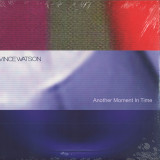
We’ve waited over 20 years and finally Vince Watson is releasing the follow up to his seminal ‘Moments In Time’ album released on Ibadan and Alola, entitled ‘Another Moment In Time’. Over the twenty years since the release of ‘Moments In Time’, Vince has put out more than ten LPs of various flavours. Here he returns to the vibe and feel of those early works. ‘Another Moment in Time’ wastes no time in exploring those rich, melancholic tones with his stunning piano chords and an essence of nostalgia that is both thought provoking and deeply satisfying. This album takes Vince Watson ever further into his original sound but with a pristine quality and finesse that his early work was yet to benefit from.
There are many highlights, from the opener with its rich acid deepness and subtle keys, to the energetic and deeply fulfilling ‘Flashback’ that gives a nod to Funk d’Void’s Diablo or KiNK. ‘Peace Of Mind’ features the incredible talents of the hallowed Underground Resistance ‘Timeline’ keyboard master Jon Dixon as co-writer, this combination of both musicians is an ear to behold; the piano and Rhodes playing is straight up high-tech jazz. ‘Lost In the Deep’ takes its cues from Detroit but hits different with twisting chords and grooves. ‘Whispers’ delivers the most melancholic deepness on the LP, whereas ‘Sunshine’ is pure out and out happiness with its twisting chords and a firm foundation in Detroit. Written on the first sunny day after the winter, you can hear the breath of relief within the track.
‘Rendezvous Finale’ is the 3rd and final version of a cut that’s had a long and satisfying journey. Originally released on Carl Craig’s Planet E in 2006, it was then formatted into Afro House for Osunlade’s Yoruba Records in 2018, and in ‘22 this new version was debuted for Carl Cox’s Birthday at DC10 in Ibiza for Vince’s live set. The reaction sealed the deal! ‘Forever’ and ‘Make A Wish’ are straight up club cuts that featured on a single also in ‘22. The album closes out with the peacefully beautiful ‘Sleep’ that rounds things off to sonic perfection.
20 years is a long time to wait, and it would do ‘Another Moment in Time’ no justice to simply say it was worth the wait. This feels like the next evolution in Vince Watson. The finesse, the musicality, musicianship, and the production levels are of the highest level. ‘Peace of Mind’ and ‘Flashback’ may well be two of the biggest tracks that Watson has released to date.
g D1 Rendezvous Finale
- 1: Trouble With The Green
- 2: Bag In The Wind
- 3: Anwen
- 4: Dig The Mountain!
- 5: It’s Not Up To You
- 6: The Fisherman
- 7: Sea Legs
- 8: The Navigator
- 9: The Manatee
- 10: Kicking The Stone
- 11: Excelsior
During their original run, Stornoway achieved immense critical acclaim, fan adoration and two Top 20 albums, one of which (their debut ‘Beachcomber’s Windowsill’) was certified Silver. But in 2016 they announced that they were ending on a high (2015’s ‘Bonxie’ being “their best album yet” according to The Guardian) with the following year’s farewell tour, although their rapturously received WOMAD set (“a magnificent farewell”, The Spectator) was delayed until 2022. They still earned new fans, however, when their version of ‘The Only Way Is Up’ exceeded 2 million streams after being used in an advert and in various TV shows.
Vocalist/guitarist Brian Briggs stopped songwriting altogether and instead pursued a new career passion managing a wetland for water voles and lapwings. Nonetheless, Brian and bandmates Jon Ouin (keyboard) and Oli Steadman (bass) stayed in torch, and step-by-step they reconnected with the love of creating music that had first inspired them to start a band.
- Word Games (Live)
- Love The One You’re With (Live)
- Sugar Babe (Live)
- Do For The Other (Live)
- Jesus Gave Love Away For Free (Live)
- 49: Bye-Byes/For What It’s Worth (Live)
- You Don’t Have To Cry (Live)
- The Lee Shore (Live)
- Cherokee (Live)
- Black Queen (Live)
- Know You’ve Got To Run (Live)
- Band Introduction (Live)
- Ecology Song (Live)
- Bluebird Revisited (Live)
- Lean On Me (Live)
Founding member of Buffalo Springfield and folk-rock supergroup Crosby, Stills, Nash & Young, Stills' first solo album, Stephen Stills, earned a gold record, is the only album to feature both Jimi Hendrix and Eric Clapton, and climbed to #3 on the album charts. Stephen Stills’ single "Love the One You're With" became his biggest solo hit, peaking at number 14 on the Billboard Hot 100 and is the first track on this collection. 14 tracks from Stephen Still’s First US Tour, previously unissued and recorded Live at The Berkeley Community Theater in 1971, featuring David Crosby on two songs. In 1971 Stephen Stills embarked on a US tour, opening each show with an intimate acoustic first set, and closing each night with a riveting electric set featuring the Memphis Horns. These historic, previously unreleased recordings took place over two nights at the Berkeley Community Theater, with David Crosby joining him on vocals and guitar for "You Don’t Have To Cry" and "The Lee Shore." These recordings find Stills at peak performance in both vocal delivery and musicianship, effortlessly incorporating alternate instrumentation on his instantly recognizable tracks, including a seamless medley of “49 Bye Byes" and "For What It’s Worth” unexpectedly played on piano. Hand-picked by Stills from his personal archives, this album captures timeless and era defining performances. Fans who were lucky enough to catch his historic debut trek, dubbed “The Memphis Horns Tour,” were treated to the balladeer, the raving troubadour, the acoustic bluesman, the soul driver, and by far the most passionate music maker. Backed by a loyal cast of friends, including his usual steady rhythm section—drummer Dallas Taylor and bassist Calvin “Fuzzy” Samuels—along with keyboardist Paul Harris, guitarist Steve Fromholz, and percussionist Joe Lala, these Northern California shows were one of the most unique and intimate stops on the tour This album, rather than being an artifact from a bygone era, sparkles and stimulates. It cajoles you into thinking, feeling and—most importantly—moving. Stephen Stills Live At Berkeley 1971 is a cornucopia of priceless sound—and all of it bears the distinct and loving fingerprint of Stephen Stills.
Building off of the themes of identity, storytelling and experimentation on her critically acclaimed debut album, Khonnar (2018), Deena Abdelwahed’s upcoming album Jbal Rrsas is the next chapter of a reimagining of what club music could be. The album spans seven tracks of bass, techno, and experimental music, with Abdelwahed consulting with masterminds like Tunisian composer and multi-instrumentalist Khalil Hentati, aka Khalil Epi, and Iraqi-British multi-instrumentalist, composer, and researcher Khyam Allami, as well as Egyptian mastering engineer Heba Kadry, to help realise her vision.
Jbal Rrsas starts with the seductively apocalyptic opener, The Key to the Exit, a deconstructed sha’bi production. With tracks like Six as Oil and the delightfully intense Violence for Free, Abdelwahed leads users to a desert rave, where industrial rhythms are left unbridled. Abdelwahed’s vocals on Complain and Pre-Island are powerful and exposed, confidently placed on dizzying avant-garde productions. The Wire previously said “Khonnar is an assured debut that sits on the edge of a whole swathe of possibilities, not only sonic but also geographical, social and political.” With Jbal Rrsas finds Abdelwahed deftly navigating through those possibilities, frequently pushing against genres, labels, and social identifiers, while elevating club music to otherworldly heights.
EXPANSION continues its series of 10' CLASSICS back to back with the coolest CONTEMPORARY takes of one awesome track. First off is the 70s masterpiece by master of the keyboards EDDIE RUSS, and a definitive jazz funk classic, never before released as a single, and originally from the rare 1976 LP 'See The Light', issued on CD by Soul Brother in 2008.
The newer version is by the UK's jazz funk and soul icons INCOGNITO. It's an especially recorded version that does not feature on any of their albums and has been extremely rare until this release on vinyl. Incognito have just celebrated 35 years in the business and are masters of the jazz funk vibe and this version keeps faithful to the original while being also the fresh and vibrant sound we love from the group.
Watch out for more releases in the 'back to back' 10' series which so far has featured classics are makes by Johnny Hammond and Norman Connors