Following up on their debut LP Kick Drunk Love for Marcel Vogel’s Intimate Friends imprint a few years back, we are proud to present the next installment in the sporadic KAMM legacy: Cookie Policies.
Far more sonically rich and musically adventurous than its predecessor, Cookie Policies sees the band make bold strides into new territories where classically hardwired categories such as jazz, indie rock, and electronica melt into one another with immaculate, timeless ease.
The band members’ positions are more clear cut as well this round, with Marc David Barrite (aka Dave Aju, who also did one of his coveted mix engineering jobs on the LP) on prominent lead vocals in many of the pieces, Alland Byallo on trumpet, Kenneth Scott on synth bass, and Marc Smith adding guitar sections while the others shared the arranging and programming duties. This makes for a deeper continuation of the otherworldly combination of their known individual production styles, as well as a musical whole truly greater than the sum of its parts.
The set starts off with “Bird Call”, whose opening ode to Morricone ok corral-meets-samurai showdown riffs flow into a loose and drifting psychedelic boom bap blip, building until a glorious change-up of key and energy brings the track to its peak and deconstructed back down. “Rachel, the Largest Bullfrog” then takes things in a sweeter, slightly more traditionally-structured direction where dusty indie-folk ballad vibes intersect with an array of twisted cosmic tones, bits of computer keyboard percussion, and deep rolling sub bass. “Buckle Down” then moves things back away from acoustic restraints into a beautiful synth-laden musing on potential regret, with an ultra-potent horn section from Byallo vs a nasty stacked Roland SH-101 finish.
“CCBPGC” cools things off for a few minutes with an ambient field recording slice-and-dice motif, which slowly but surely evolves into a slinking jazz noir groove from another dimension. The more traditional song structures return on the lovely “La Luna”, where Barrite’s pen and soulful voice take to nautical longing themes over apropos waves of sonic textures. The ebb and flow of the verse/chorus sections eventually rise and give way to an absolutely gorgeous denouement. “Shleem” then takes us into pure unadulterated soaring sci-fi soundtrack ambient blast-off bliss, while the epic closing track “The Soft Glow of Electric Sex” gives a hearty nod to early masters of sprawling psychedelic jam sessions, from Pink Floyd and Can to In A Silent Way-era Miles and Liquid Liquid, while bringing it clearly into futurist millennia. The gradual evolution of the piece into its grand finale is the stuff we true music-lovers live and die for. We hope you enjoy the ride as much as we do.
quête:b key
One year after the landing of his long-awaited eponymous debut album, French producer Zimmer is back with a massive remix package to make the pleasure last, and he’s certainly put on a great spread for the occasion.
Up on duty for this second round of synth-splattered, stargazing goodies, we find none other than Herr Gerd Janson in the saddle for a pair of ‘short' and ‘extended’ dance versions, expert vibist Lauer, Mexican outfit Zombies In Miami, US-based producer Amtrac, with French clique homeboys Kendal and You Man completing the set.
All synths blazing, Gerd Janson gets the ball rolling with a pair of prismatic reworks of ‘Rey’, tailored to take the dancers on a wildly fun and light-hearted space jaunt. No need for an intro, the ’short edit’ goes straight for the audio G-spot and takes no byway to get its point across - pure mellifluous, horizon-widening dancefloor carefreeness on the menu.
Don’t get too easily distracted by its title, the ‘extended version’ is no basement creeper but rather an enhanced summer-flavoured earworm that lays further emphasis on the drums and bass for optimal peak time functionality.
French duo You Man pick up the torch with an equally sturdy and emotional reshape of ‘Wildflowers (ft. Panama)’, nicely contrasting Panama’s suave vocals with thoroughly funk-oozing bass arpeggios that’ll melt any sweatbox down to the ground.
In comes Lauer’s reinterpretation of ‘Mouvement’ - a dynamic late-afternoon weapon meshing the hectic bounce of cascading synths and incendiary bass, hazed-out poolside vibes and pop-indebted melodic motifs. The result is a fast-paced heater primed for extended use from sunset to sunrise with vibrant variations in shades throughout.
A true solar-powered, mystique-imbued affair, Zombies In Miami’s take on ‘Mayans’ propels us in a fascinating continuum of pulsating rhythms, hyper-modern textures and smouldering ritualistic vibrations.
Adding his spin to ’Techno Disco’, rising talent Kendal shoots his shots with deadeye accuracy, luring you into a junglistic intro to better surprise you with his usual tsunami- like deluge of serpentine keyboard chords and epic buildups.
Topping off this variegated sonic journey, Amtrac takes us on a soul-healing trip with his revisit of ‘Make It Happen’ - laying down a particularly tasty downtempo pop jam for you to chill and dream yourself to sleep with, fully enlarged with his trademark streamlined, balmy signature.
Traditionally the liner notes of an album take on a kind of third-party address, where a writer is delivering their thoughts about how an album makes them feel without breaching that space where they are representing themselves or the moment in time directly to the reader. The goal is typically a kind of timelessness, but as we live in unprecedented times, unconventional methods take on new life, and hopefully importance. In the spirit of that idea... man, is this the kind of album we all need right now. So many of us feel like we're constantly walking a tightrope, are feeling like we can't unwind, are in genuine need of a few moments of respite. Every so often an album emerges from an artist that most likely did not realize when they were composing how timely the results would be, and Lofi Dimensions is exactly that kind of record. It doesn't really matter why it's coming when it is, what's important is that it's here, offering peace to the perturbed and inspiration for the downcast. The American Dollar have long been one of those artists operating in a kind of middle ground, a band with a long history of creating moving instrumental rock that has somehow avoided ever becoming synonymous with modern American post-rock acts. They retain a sort of autonomy in a valued position just outside the boundaries of classification. Blending electronic textures with moving guitar and keyboard melodies, their music has always traveled somewhere in the spaces between trip-hop, electronic, post-rock and ambient, and this inability to be defined is ultimately what sets them apart from the trappings of genre, allowing them to be whatever they want The American Dollar to be in a given moment, always on their terms.
JON SPENCER, THE BLUES EXPLOSION MAN who put the BELLBOTTOMS on BABY DRIVER! The Top Cat who spread the
Secret Sauce in BOSS HOG! The Rockabilly Right-Hook from Heavyweight Outlaws HEAVY TRASH! The Swank-Fucking Master of PUSSY GALORE!
Jon Spencer is back! Often imitated, never duplicated, the original NYC underground-rock legend returns from the wilderness with twelve red-hot hits, each more powerful than the last!
This is Garage Punk for Now People! A wizard’s brew of rhythm & blues and subversive dance grooves, weaponized with sci-fi skronk and industrial attitude, calibrated for the Revolution, a Molotov cocktail of sound guaranteed to destroy any post-modern hangover!
Pulsing with energy, clanging with excitement, and dripping with radioactive soul and raw emotion, Jon Spencer opens up his heart like never before, exploring man’s modern condition with caustic guitars and outerworld crooning, asking and answering the musical question, “Is it possible to torch the cut-throat world of fake news and pre-fab, plastic-coated teen rebellion with the power of rock’n’roll?”
THE ANSWER IS YES! SPENCER SINGS THE HITS!
This is the truth serum America has been craving, the beginning of a rock’n’roll rebellion that takes no prisoners and puts the squares on ice!
Recorded and mixed with Bill Skibbe at the Key Club in Benton Harbor, MI. Featuring the talents of Sam Coomes (Quasi, Heatmeiser) and M. Sord (M. Sord). On tour in the Europe in Autumn 2018!
- A1: Return Of The Ghetto Fly Feat Neco Redd
- A2: Superficial
- A3: Slippin' On Ya Pimpin' Feat Dames Brown
- B1: I Got It Feat Alena
- B2: Soul Fly (Part 1) Feat Alena
- B3: Soul Fly (Part 2) Feat Dames Brown
- C1: 1960 What Ft London House Cats Choir
- C2: Steppin' Feat Dames Brown
- C3: Your Love Is All I Need
- D1: Funk Is Here To Stay
- D2: Send A Message
- D3: Superficial (Live Version)
1 x Yellow 1 x Blue[25,17 €]
South Street delve into the The Sound Of Detroit from one of its unsung heroes, reissuing Amp Fiddler's 'Motor City Booty' LP on suitably swanky purple and pink vinyl respectively. Coming straight off the D Funk assembly line, it's a full on dance floor affair from Motown to P-Funk, Techno and Neo Soul.
This 12 track album produced by Amp Fiddler & Yam Who? includes the massive 'Soul Fly' sounding like a Mark Ronson production had he been hanging out with George Clinton's Parlet followed by the bonafide P-Funk anthem 'Steppin' both featuring the stunning vocals by the Dames Brown girls.
Amp Fiddler is credited for taking both a young J Dilla and also Q-Tip under his wing teaching them his Akai MPC techniques, setting the path for some of Hip Hop's finest recordings which have defined the shape of things to come.
His musical collaborations & current duties include: Moodymann's musical maestro, keyboard wizard for Theo Parrish's live band, a longstanding Funkadelic member, co-writer for Sly & Robbie, Prince, Maxwell, Jamiroquai & Seal to name a few.
Nas has had a career of generally consistent excellence, punctuated with a few lulls. He’s an incredibly skilled rapper sometimes accused of having a tin ear when it comes to choosing beats – especially on albums (and the entirety of ‘Illmatic’ aside, obviously).
‘Made You Look’ was a shot in the arm for Nas at a time when he’d shed some of his core, street fanbase. After the unfocussed ‘Nastradamus’ and ‘I Am…’ albums he’d had a return to some kind of form with ‘Stillmatic’, but many felt he came off second best in the ensuing battle with Jay-Z.
This single, a club and street classic almost from the moment it dropped, is exactly what he needed to reconnect with his fans and to show he could still throw down. Lyrically, it’s hardcore bragging 101, delivered with panache and numerous quotables that themselves would go on to be sampled.
Key to it all, however, is that beat. Salaam Remi was no stranger to resurrections, having almost single-handedly turned The Fugees from forgettable also-rans to major-players. The beat here is deceptively simple, one of hundreds of records to chop up Incredible Bongo Band’s ‘Apache’ but doing so in a way that felt instantly fresh. Nearly 20 years later it still has the power to get a stationary crowd moving, an empty dancefloor to fill, a still head to nod.
This original version has never been on 7” before. It’s presented with full artwork.
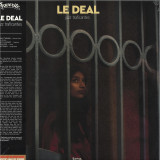
Favorite Recordings presents Jazz Traficantes by LE DEAL, a new musical adventure from the finest French jazzmen with Florian Pellissier (Piano & Fender Rhodes - Camaraõ Orkestra, Cotonete,
Aldorande, Setenta), Yoann Loustalot (Flugelhorn – Bruit Chic, Old & New Songs, Aerophone, Lucky Dog), Théo Girard (Upright Bass – Pensée Rotatives, Discobole) and Malick Koly (Drums - The Wallace
Roney Quintet). Needless to say, they’re used to play all over the globe and quite often to New York. During one of these
trips to the Big Apple, they discovered that the legendary Van Gelder studio (where most of Blue Note, Verve and CTI albums were recorded) was still active and opened so they decided to book a few days session.
Here is the story told by Florian Pellissier: “The tracks had been written the night before. We were going to run through them and then record. A simple plan. Van Gelder had passed a while back, but he left the keys and secret codes with his faithful assistant Maureen before heading off to create the right sound up in heaven. Nothing had changed in the atmosphere or configuration, not even the way the mics were placed. The studio and its wooden beams still exuded New York’s sixties jazz, dimly lit streets and clubs where anything might happen past midnight. Maureen knew just how to capture the ambiance of the sessions and bottle the energy without spilling a drop, taking infinite care to collect each cymbal tone, drum roll and trumpet phrase, without losing a single vibrating bass string or the slightest keyboard pause.”
Indeed, the four contrabandists succeeded to deliver an outstanding album, filled with themes that’ll get stuck in your head, just like in the 19 minutes long performance “Mexican Junkanoo Suite” and its three
parts. But more than just beautiful melodies, LE DEAL truly managed to bring a sense of drama to their compositions, going into the deepest emotions through gutted arrangements, improvising with great attention to the articulation of their ideas. From the beginning to the end, musicians and engineers did their best to emulate the proper vintage sound. Jazz Traficantes could prove once and for all that
French Jazz can indeed cross the borders. The album will be available as Tip-On Deluxe Vinyl LP but also on CD & Digital with a bonus track, “Noche en la Carcel”
Sasanami" is the result of a dialog between the Japanese photographer Yamamoto Masao and the Japanese musician Uchida Akira (with
Miu Sakamoto at the voice) initiated by IIKKI, between October 2019 and August 2020.
After to have worked as a saxophonist for several years, Akira Uchida, in 2007 learned piano tuning under Mr. Satoshi Yoshida. Planning and holding "Sound workshop" which is to introduce how to interact with various sounds from the viewpoint of sound turning. In 2015 while he was learning from Mr. Masahiro Adachi, Akira Uchida started to create a Clavichord (keyboard instrument), invented in the 14th century.
"Making instruments, tuning sounds, being a musician, this flow is essential for me to see the world".
Yamamoto Masao was born in Aichi Prefecture, Japan in 1957. He started to photograph when he was 16 years old. He also studied painting but later chose gelatin silver print as his media. His first gallery show in the U.S. was in 1994 in San Francisco. In 1996 he had a solo exhibition at Yancey Richardson Gallery in New York. His works have been shown in Europe since 2006. Besides Japan, U.S.A., and Europe, his museum and gallery exhibitions were held in Moscow and Sao Paulo. Media coverage includes NY Times and other major art magazines. Yamamoto lives in Yatsugatake Nanroku,Yamanashi Prefecture where he enjoys creating his work while being close to nature.
GES: Anthology of American Pop Music
Six great pop standards remembered: five pop songs are dissected by sampler, stretched, compressed, and re-collaged. In this way, their identity is lost. What remains is a vague concreteness: flashes of déjà vu and remote echoes that evoke the original.
GES (Gesellschaft zur Emanzipation des Samples)
-
Active members: Helmut Schmidt, Jan Jelinek
Founded: 2009
Headquarters: Federal Court of Justice, Karlsruhe, Germany
-
GES Glossary
Acoustic Surveillance Series
A 7-inch vinyl record series curated by GES focussing on historical methods of acoustic surveillance. Each record introduces a surveillance system from the past. Starting with Uguisubari in 2017, the series will continue with the release of Orecchio di Dionisio in 2021. GES is open to further suggestions on this subject.
Bundesgerichtshof (German Federal Court of Justice), Karlsruhe
“The use of audio samples as artistic practice may justify the infringement of copyright and intellectual property rights.” (ruling of the German Federal Court of Justice pertaining to Metall auf Metall II, 2016). The court is also the official headquarters of GES.
Circulations
What happens to copyright claims when music from a passing car is captured in a street recording? Is it legal to use this recording freely or is it necessary to obtain licensing rights? Circulations re-enacts this recording situation: audio players are placed in public spaces, where they reproduce the desired sample material. The acoustically choreographed space is then recorded, creating a field recording in which everyday noises circulate together with seemingly incidental music.
Emancipation of Sampling
Fuelled by its criminalization, the act of sampling existing recordings forfeited some of its artistic prestige (see Sampling). GES wishes to rehabilitate and re-emancipate the practice of sampling as a form of art in its own right. Strategy: 1. Name samples and sources explicitly. 2. Choose samples that are as popular and as recognizable as possible (Beatles, Carpenters, etc.). 3. The editing and manipulation of the sample must not compromise its recognizability (negotiable). 4. Use as many samples as possible. 5. Always name more sample sources than were actually used in the composition.
Field Recording
A compositional practice widely used in sound art and ethnomusicology that involves the recording of natural acoustical phenomena. Two additional requirements are usually imposed: The recording process should take place outside a studio environment, i.e. outdoors. And the person recording does not generate any of the acoustic material him/herself. GES expands this definition by introducing the concept of choreographed public space (see Circulations).
Gambling
An acoustic event favoured by GES, already used in numerous sound collages (must take place in public). The most popular option is thimblerig, a cup and ball gambling game commonly played in the street. Compositional instruction by GES: Place an audio playback device in the proximity of a thimblerigger. Play works for orchestra (by Debussy or Mahler). Move slowly towards the gamblers with a microphone.
Helmut Schmidt
Multiple identity and fictional character devised by GES. Figures variously within the semiotic system of GES as member, guest artist or public representative. Following the historical example of Subcommandante Marcos (EZLN).
Kraftwerk
The German band founded by electropop musicians Florian Schneider-Esleben and Ralf Hütter (a.k.a. Die Prozessoren) is the natural enemy of GES. Protected by computer-generated avatars, Kraftwerk operates a quote-hostile cultural hegemony. Their strategy: Install a special brand in the collective consciousness by means of a sophisticated system of quotations and references that may in turn not be quoted by anyone else. Other bands with such delusions of omnipotence: U2, Metallica.
Marcel Duchamp
As the inventor of the readymade, Duchamp may be viewed as a precursor to the art of sampling. However, the artist is appreciated above all for his sonorous qualities, as his vocal silence has often been sampled and processed. It was the inspiration for Jelinek's radio play Zwischen.
Orecchio di Dionisio
This 65-meter-deep limestone cave in the Sicilian town of Syracuse, carved out of a hillside in ancient times, has exceptional acoustics: A person standing at the cave entrance can hear every word whispered deep down inside it. The painter Michelangelo da Caravaggio gave it its name (The Ear of Dionysius) in 1608. The cave indeed resembles an ear and – according to Caravaggio – had a specific function: The tyrant Dionysius I imprisoned his political prisoners in the cave in order to spy on them. Orecchio di Dionisio will be featured in the Acoustic Surveillance Series in the near future.
Sampling
Compositional practice whereby recorded music is fragmented, turned into sound collages and transferred into different contexts of meaning. Since the advent of affordable sampling technology in the 1990s, the music industry has been trying to criminalize and/or promote the practice. Both strategies are driven by the same principle: Profit.
Uguisubari
Sound-making floorboards in Japanese temple and castle complexes, featured in the Acoustic Surveillance Series in 2017. In the Edo period, the “nightingale floor” (literal translation of uguisubari) was a popular acoustic warning system. The principle was straightforward: When someone stepped onto the boards, nails would rub against metal clamps beneath the floor, creating a tell-tale squeaky sound that was said to resemble the chirping of the Japanese nightingale.
Wind
A generator of acoustic events and an amplifier/transmitter of existing sounds. A meteorological form of energy appreciated by the GES on account of its unpredictability. A series about wind as an acoustic phenomenon is planned. Working title: Hotel Corridors.
Zwischen (Between)
Radio play by GES member Jan Jelinek based on recordings of various public interview situations. From the speech of the interviewees (all of them eloquent personalities) the pauses between coherent utterances were extracted and assembled. What we hear is an archaic body language: modes of breathing, word particles and onomatopoeic turmoil. A key question for GES: Which comes first, personal rights or artistic freedom? For Zwischen, Jelinek used only recordings by public figures that were already available to the public.
Originally released 30 years ago in October 1990, and named after a traditional Norwegian fairy-tale, East of The Sun West of The Moon, co-produced by Ian Stanley (Tears for Fears), marked a departure from previous albums released by the Norwegian new-wave band. Acoustic guitars were added into the mix, and the piano replaced the keyboard/ synthesiser of previous albums. This album also features the first non-Morten lead vocals, by Magne on ‘’The Way We Talk.’’
Der Wunsch nach Veränderung regt sich aus dem Inneren. Entweder man hört ihm zu - oder nicht. Aluna hat sich entschieden, zuzuhören. Nach dem vielfachen Lob der Kritiker als eine Hälfte des MultiplatinDuos AlunaGeorge etablierte die Grammy-ausgezeichnete Sängerin, Songwriterin und Produzentin auf ihrem Solo-Debütalbum ”Renaissance” ihren unbestreitbar charakteristischen und unberechenbaren Sound. ”Ich bin eine schwarze Frau, aber ich bin auch eine multikulturelle Frau, und ich habe an vielen verschiedenen
Orten gelebt und Erfahrungen gesammelt, und so dachte ich mir, das ist es, was ich mitbringen werde”, so Aluna. ”Renaissance” stellt den Höhepunkt ihrer Reise als ”schwarzes Mädchen aus einem damals ganz weißen, britischen Vorort” dar, zum Beginn einer regelwidrigen Revolution bei der sich festgefahrene Grenzen zwischen Kultur, Rasse, Geschlecht und Genre auflösen. Aluna war an jedem Aspekt des Albumprozesses beteiligt - vom Verfassen der Texte über Gesang, Schlagzeug- , Keyboard- und Gitarrenspiel bis hin zur Koproduktion von ”Renaissance” zusammen mit Singer/Songwriter Lido. Zusätzlich enthält das Album Feature-Beiträge von Princess Nokia, Jada Kingdom, SG Lewis, KAYTRANADA, Scott Storch, GRADES, Mr. Carmack und Rema. Mit über 2 Milliarden generierten Streams weltweit gehört Aluna zu den erfolgreichsten Künstlerinnen des
Dance & Electronic Genres. Zudem arbeitete sie kürzlich mit Größen wie DJ Snake, Disclosure, Flume, Jungle, Popcaan, oder Cautious Clay zusammen.
Tape / Cassette
As one half of Phantom Horse, his long-serving electronic duo with Ulf Schütte, Niklas Dommaschk co-produces beautifully muted, Kraut-inspired jams that seem to soundtrack fictitious TV ads for wondrous imaginary household appliances, e.g. a calmly efficient, if slightly unsettling kitchen robot with an integrated lava lamp feature.
In contrast, Shapes cuts tracks down to size – nothing here is longer than five-and-a-half minutes. Also, Dommaschk has turned up the treble, the prominence of the higher frequency spectrum adding bite and menace to these deceptively simple synth polyrhythms.
Whereas opening track “Benzin” (German for “Petrol”) manages to conjure the paradoxical image of something or someone meandering with urgency, “Einzeller” (German for “single-celled organism”) channels a John-Carpenter-style pulse, complete with horror sound effects. “Interference” is a truly effective representation of the term, with piercing, but quiet tinnitus frequencies set above a beat as sparse as it is crunchy. “Two Stones”, by contrast, offers a kind of robotic wistfulness whereas closing piece “Energies of the mind” fizzes out like a jumble of toy keyboards attempting to score a science programme - and failing, but instead revealing some much grander emotional truth.
This is the sound of breaking some kind of inner lockdown, of turning inwards and then projecting parts of murky inner shadows outward, as well-defined and sometimes lurid shapes, individually clear, but still in the process of becoming organized into a complete whole. The unfinished is what excites us the most. May the shapes never find their slot in the jigsaw puzzle.
All songs by Niklas Dommaschk
Recorded between 2017 and 2020 in Berlin and Nijmegen
Mastering by Edgar Medina
Artwork by Daniel Castrejón
Moods & Grooves proudly introduces another new face, this time from the Detroit scene. DJ Eternal Student (aka Marvin Prather) steps up to the plate with his melodic track Hear Me Though and a deep groove entitled Transpose Deep.
Hear Me Though combines a funktastic bass line with some heavy breathing drums, strumming synths, xylophone like keys, and a sexy vox to create a wonderful head bobbing groove all on its own. Hot remixes of Here Me Though come courtesy of Domenique Xander (Berlin) and Deepset. Domenique puts a nice wash over it with panned and echo'd claps, drums, and very dreamy pads to create a stellar remix. Deepset ( a partnership between Brian Neal and Avalon Kalin) provide an up-tempo deep groove with a banging kick and swinging vocal chops to accompany the original vox of the track. A new bass line and funky congas produce a warm and lush version of the original. The synergy these producers had is incredible, all vibing from Marvin’s original version.
Transpose Deep is a climber. It starts off very unassuming with a solid 4 on the floor kick that morphs into solid synthy pads, and a funky bass line before it breaks into a full sprint of these elements, a bass that growls at you, and hats that swing hard.
Two hot property New Zealanders under the guise Manuel Darquart take the WOLF reigns for their debut on the label. Drawing influence from classic Italian house labels such as Irma, Antima and Palmares (alongside having that South Pacific sea breeze ingrained in their souls), the duo let loose on a three track EP that could have easily been plucked straight out of a ‘90s Key Tronics Ensemble stash. WOLF mainstay Medlar completes the package with a percussive workout remix of ‘Parkour!’, dubbed, rerubbed and full of that timbale goodness.
With a string of releases on the likes of Coastal Haze, Childsplay and Infinite Pleasure, Manuel Darquart transport you to a distant island life where corona’s claws have yet to cause chaos. Opener ‘Keep It DXy’, sees sweeping pads caress the shores as bumping basslines mix with punchy stabs and dreamy toplines.
From the beach to the jungle, ‘Miranda’ is a stomp through the undergrowth, the tropical landscape calling out at every turn, as synth melodies dance around steamy bass arps and streams of percussive hits.
Flip it to the B for ‘Parkour’, a proto-house gem that captures that ‘80s feel with gated snares, thumping kicks and synths galore, before Medlar closes out the EP with a ripping whirlwind of percussion for his remix of ‘Parkour’.
One of the most quietly influential underground artists of recent times, Yamaneko returns with Spirals Heaven Wide, his fourth full-length album. Since breaking through in 2014 with his cult debut album Pixel Wave Embrace, Yamaneko has been one of the key artists re-contextualising ambient music for a new generation, crafting fragile compositions that draw as much from the angular shapes of grime, techno and keygen music as they do the soothing soundscapes of new age cassettes, ambient records and video game soundtracks. Written during Yamaneko’s last winter in London before relocating to Tokyo, Spirals Heaven Wide is his longest and largest-sounding release to date, combining some of his most evocative long-form pieces with the kind of haunting miniatures that made his early music so distinctive. The majority of the tracks were written after Yamaneko's first run of audio-visual shows at the end of 2018, and so are rooted in the same kind of live workflow and production methods that he explored with those sets. As with last year’s Afterglow EP, Spirals Heaven Wide is underpinned by a underlying influence of euphoric dance music, with distant trance and hardcore signifiers - both key influences on Yamaneko from an early age - visible through the album’s thick blankets of wind and fog. These influences come fully to the forefront on ‘This Spring of Love' and 'Fall Control’, two of the most outright spine-tingling tracks Yamaneko has released to date. Elsewhere, the album explores his love of emo music’s bittersweet melancholy, a fascination with constellations and the cosmos and an increasing love of writing extended, long-form compositions: a side of Yamaneko first explored on 2017’s Spa Commissions collection and continued on his contribution to respected ambient series Longform Editions.
- A1: Das Goldene Zeitalter - Don't Give Up Your Smile Today
- A2: Nu Art Quartet - Black Bandit
- A3: John Tinsey - Freedom Excelsior (Part 2)
- A4: Obie Jessie Quartet - Black King
- A5: Walt Bolen - Peace Chant
- B1: Genghis Kyle - Bakit Ba
- B2: Luna Brothers Trio - Mozambique
- B3: Hozan Yamamoto - Spotlight On Sapporo
- B4: The Milestones - Funk
From 1963 to 2014: "Peace Chant - raw deep and spiritual jazz" exhibits 51 years of music. A well matched anthology with sounds to dive into, hard rhythms to dance to and vocals to meditate on.
The Tramp Records crew has compiled 9 tracks in nice order and dramaturgy. Some tunes you might have never heard before unless you own one of the rare original vintage vinyl records. Peace Chant is released on two separate LPs with own catalogue numbers and on one CD. Some songs I can't get out of my mind:
The previously unreleased "Don't Give Up Your Smile Today" is opening the compilation. It's from Das Goldene Zeitalter, a band that didn't survive - but whose members had a huge influence on German jazz, soul, afrobeat and funk within the last years merging into groups like The Poets of Rhythm, The Whitefiled Bros., and The Malcouns. Boris Geiger aka. Bo Baral sings a Pharoah Sanders like tune, his voice deeply resonating, the rhythm section heavily grooving.
After the first three woolly recorded tracks Walt Bolen's "Peace Chant" with its dry and funky sounds with flute, two guitars and percussion is quite a pleasure to listen to. Organ and voice are Bolen's who used to play the keys in San Fernando Valley church when he was a child. "Peace Chant" was recorded for his own Ar-Que label in 1972 and is one of the few cuts with him as a leader. He has played sessions and clubs for years and today he is sitting at the church organ again.
This publication's oldest recording dates back to 1963: "Mozambique" by Luna Brothers Trio, a Caribbean and hypnotic instrumental. For my jazz trained ears it is rather unusual that the güiro (the gherkin played with a stick) is being played throughout the entire song. Heavily laid back cowbell, concas and timbales and the slightly detuned piano are wonderful! "Mozambique" sounds like from another star but its origin is Los Angeles, where the brothers Fred and Ricardo Luna had their night club band. You could imagine a bast skirt strip and at the same time the great Raumpatrouille (Space Patrol) landing on German B&W TV screens in 1966.
Hozan Yamamoto recorded crime jazz with the Japanese bamboo flute shakuhachi. He belonged to Tony Scotts "Music for Zen Meditation" in 1964, played with Ravi Shankar, avant-garde jazz bassist Gary Peacock and appeared at Donaueschingen Festival for contemporary music. Tokio university's open minded lecturer recorded the funky and modal "Spotlight on Sapporo" in 1972.
Counterchange presents 'Eigenlicht' by Portuguese-German multi-instrumentalist, producer and award-winning film composer John Gürtler.
Gently teetering between krautrock-influenced synth mantras and saxophone improvisations, down-tempo electronica, sound design experiments and moments of rich ambience, 'Eigenlicht' is a diverse album of electro-acoustic music. The 11 tracks were recorded between two studios and on location at Berlin's infamous Teufelsberg, the abandoned Cold War era US spy-radio and radar outpost named 'Field Station Berlin', surrounded by forest to the west of the city.
A document of Gürtler's development, many of the pieces here were first laid down in his bunker-like former basement studios at Drontheimer Straße in north Berlin, before he eventually elevated above ground - both physically and musically - building his current Paradox Paradise studio and becoming an established film music composer. In 2019 John won the European Film Academy Award for Best Score, for his soundtrack for Nora Fingscheidt's debut feature 'Systemsprenger' (System Crasher).
In recent years John collaborated on a number of projects with acclaimed German producer and composer Phillip Sollmann aka Efdemin, performing live and releasing the 'Gegen Die Zeit' EP on Sky Walking, a subsidiary of Dial records where he also remixed Efdemin's 'Parallaxis' under the moniker The Borderland State.
In part an ode to the Macbeth Systems M5 modular synthesizer, with its three oscillators, much of the album features the towering instrument, whose uniquely rich tone and rumbling, pure bass end characterises tracks like 'Eigenlicht', 'M5', 'Synthetics' and 'Five Voice'.
"The M5's built in spring reverb and huge sliders and faders - as opposed to all the tiny knobs on Eurorack synths - make it as playable as any acoustic instrument."
John's primary background is in acoustic music, coming from woodwind and keyboard instruments, improvisation and composition. The leap into working with computers and electronic instruments found him exploring ways to make synths and samplers sound as organic as possible.
- A1: Cosmic Protrusion
- A2: Energy Wind
- A3: Path To The Fortress
- A4: Indian Milk
- B1: 5Am-Prn-Ksv
- B2: Translucent Formlessness
- B3: Primitive Nightmare
- B4: Duga-3
- C1: Stolen Paintings
- C2: Beat Instrumental
- C3: Jobim’s Cigar
- C4: Sphinx
- C5: Ancient Flight Text
- D1: Ascending Spirals
- D2: Alpine Bossa
- D3: Bronze Frog
- D4: Penta
„Gianmarco Liguori has created his own fascinating niche in music which exists at a place where jazz, soundtracks and improvised art music intersect … mesmerising, sometimes eerily ambient … grounded in electronica soundtracks, experimental Miles Davis of the Seventies, slightly funky Eighties jazz-rock with a nod to minimalism and impressionism … Albums by Liguori offer the indefinable and stand at some distance from just about everything else going on in New Zealand music.”
Graham Reid, NZ Herald
Duga-3, composed and produced by New Zealand-based multi-instrumentalist Gianmarco Liguori, was originally released in 2011 in an edition of 200 copies. The album quickly sold out, with original copies sought after by collectors and fans of Murray McNabb and Kim
Paterson (who appear on the LP), both pioneers of jazz rock in New
Zealand in the early 1970s.
Co-producer Murray McNabb (1947-2013), keyboardist with legendary NZ jazz rock group, Dr Tree in the
1970s, recorded his album Song For The Dreamweaver with ECM artists
Ron McLure and Adam Nussbaum in New York (1990), and had performed with the
likes of Don Cherry, Ed Blackwell, Charlie Haden, Joe Henderson and Sam Rivers. He
was also a top-tier composer/arranger for film, television and radio.
A vital voice in the modern discourse on depression, body positivity, and the LGBTQ community, her trailblazing influence has arguably never been more apparent and some of the key writers of the moment have teamed up to work with her. Alongside Rae Morris and Fryars, who co-penned the first single WHO I AM, co-writers include Jonny Lattimer (Ellie Goulding, James Bay, Rag ‘n’ Bone Man), Future Cut (Little Mix, Shakira, Lily Allen), Tom Neville (Dua Lipa, Kesha, Calvin Harris) and Shura. Among the tracks she releases here are the slinky, tropical-tinged Overload, a warning to a people getting on your nerves, and Escape, a broken beats-driven track about escaping everyday life. The summery Self Love owes a debt to Donna Summer, while Melanie’s love of Billie Eilish influenced the moody, intimate Nowhere to Run. Melanie and Billie’s admiration for one another was plain to see at this year’s BRIT Awards, where Melanie presented Billie with the Best International Female Solo Artist award after a long embrace. Who I Am and second single Blame It On Me have both set up the self-titled album and despite releasing during a global lockdown, she has performed to great acclaim on TV and online across the world on flagship shows such as The One Show in the UK, no less than 4 million plus German TV shows and James Corden’s Late Late show in the US where her performance is now the benchmark. With growing streaming support and A list radio support on both tracks in the UK, Australia, Latin America, SE Asia and Germany so far, it’s a global new chapter for Girl Power.
For Dekmantel Festival 2019, The Netherlands Institute for Sound and Vision’s RE:VIVE initiative and Dekmantel teamed up for the third time to invite four artists to bring fresh music to a curation of Dutch archival films. As debuted live in Amsterdam’s Eye Filmmuseum, 2019 featured new scores from Safe Trip eclectic left-of-centre DJ / producer, Max Abysmal, 80s pastiche, keyboard wizard duo, Lamellen, Italian contemporary composer and saxophonist, Laura Agnusdei and heavy-hitter, Identified Patient. 2019’s films were as diverse as the invited artists. Three of the films come Academy Award winning Dutch producer, Nico Crama whose collection is held by The Netherlands Institute for Sound and Vision while Comeback (Poppenfilm) was made by amateur Dutch filmmaker, Otto Laan.
Comes with liner notes inlay and pressed on 180 grams vinyl.