Japanese folk-rock legend Morio Agata stunned fans with this way-outta-left-field dispatch - a synthesizer-laden, new-wave/post-punk classic. Originally released by Osaka’s Vanity Records in 1980 and back on vinyl for the first time in nearly 40 years, this fully authorized reissue has been remastered from the original analog tapes. In tip-on sleeve, with double-sided insert.
50 years ago, Hokkaido-born singer-songwriter Morio Agata released his debut single, Sekishoku Ereji (Red Elegy), an emotive, shuffling piano ballad that (shockingly) sold half a million copies in Japan. While he would never have another Top-40 hit, Agata would spend the next half century issuing a series of idiosyncratic, experimental pop albums. Today, he’s a beloved cult figure, still actively touring and recording in his seventies.
In his first decade as a recording artist, Agata released a stream of classics right out of the gate — Otome No Roman (1972) melded American-styled folk rock with traditional Japanese melodies, Zipangu Boy (1976) was a sprawling, Haruomi Hosono-produced psychedelic opus, and Kimi No Koto Suki Nan Da (1977) saw Agata tackle slick, lightly funky AOR. While this sort of stylistic schizophrenia might sink your average artist, Agata’s singular voice and magnetic charisma elevates everything he touches, and subsumes it all into Morio Agata World — a joyous, playful and frequently unhinged world.
Arguably the biggest left-turn of Agata’s early career, however, came in 1979, when legendary experimental label Vanity Records’ Yuzuru Agi paired Agata with major players from his label’s roster and the Osaka punk scene for an impromptu recording session. An impressive list of musicians took part (SAB, Yukio Fujimoto (Normal Brain), Masahiro Kitada (INU), Taiqui (Ultra Bide), Jun Shinoda (SS), Chie Mukai (Che-Shizu), and others) and even though they all came from different wings of the underground music scene, together they built an arresting, minimalistic bedrock of synthesized and acoustic sounds for Agata to work his magic over. The recording sesssions were tense and it took a while for the collective to find their footing. But the hard work paid off — Norimono Zukan is a masterpiece of ramshackle new wave and droning dirges, topped off with Agata’s unmistakeable croon, at times delicate, other times twisted. It’s a relatively short album, but a deep one, and Mesh-Key is honored to introduce it to a new generation of music fans.
Buscar:b key
* Classic roots reggae vocal track from the late Devon Russell.
* The original version was recorded by Coxsone Dodd for his Studio One label.
* This updated digital version was produced by Zion Train and released in 1992.
* A long-time sound system favourite with a dub version from Zion Train on the flipside.
Die beliebte Band Bright Eyes mit der dritten Welle von Veröffentlichungen im Rahmen ihres laufenden Companions-Reihe. Das Projekt sieht vor, dass die Band ihren gesamten Katalog neu auflegt, wobei jedes Originalalbum von Neueinspielungen begleitet wird. Diese Companion EP enthält dazu Gastauftritte von Johanna and Klara Söderberg (aka First Aid Kit) und Alynda Segarra (Hurray For The Riff Raff) sowie eine Coverversionen "When You Were Mine" von Prince. Eines der Dinge, die Conor Oberst auffielen, als er und seine Band durch mehr als zwanzig Jahre Musik gingen, war, dass er vielleicht tatsächlich die ganze Zeit über denselben Song geschrieben hat. Natürlich nicht klanglich, aber konzeptionell. Diese letzte Welle enthält mit Noise Floor frühe Bright Eyes-Songs, die so roh sind, dass Oberst sie damals nicht direkt veröffentlicht hat, sowie mit Cassadaga und The People's Key die ausgefeiltesten und anspruchsvollsten Alben der Band. Als Bright Eyes mit Cassadega auf Tournee gingen, spielten sie 7 ausverkaufte Abende in der Town Hall in New York. Was gibt es Erwachseneres als einen Rockstar? Und doch ... "Thematisch unterscheiden sich diese frühen Songs gar nicht so sehr von denen, die ich jetzt mache", sagt Oberst und schüttelt den Kopf. "Es hat etwas Bestätigendes und Entmutigendes an sich. Man fragt sich: Habe ich mich wirklich verändert oder bin ich gewachsen? Aber vielleicht liegt es auch nur daran, dass ich von Anfang an wusste, worüber ich schreiben wollte. Es war eine interessante Reise, all diese alten Songs wieder aufzugreifen und neu zu interpretieren."
the remix release of japanese jazz fusion masterpiece of eiki nonaka which was released in the last summer.
uk balearic master “faze action” chosen one of the best track “flanged vortex” from the album(this track is licensed for great compilation “heisei no to” on music from memory). the result is timeless summer feel balearic slow house.
our new favorite artist in milano “simone du kunovich” chosen very emotional tune which is remind us pat metheny. his remix is stripped down no beats emotional house music. it will be your all time favorite closing track!
Not every two-year period measures out the same, noted Brendan Benson, the 51-year old Grammy-nominated singer-songwriter and co-founder of The Raconteurs. Benson had just finished his well-received seventh album, "Dear Life" in 2019 when his world came to a stop. "I was rehearsing for South-By-Southwest and gearing up for a tour and had a band ready and then, of course, the world shut down," he said in a recent interview. The lockdown then began to reroute lives, societies and ambitions worldwide. "Everything changed," Benson said. "I went to work on some songs so I"d have new material when things opened up." Over months with minimal interactions, those songs coalesced and took on lives of their own, he said. Two years of semi-isolation, of fading relationships, of the natural inward turn that comes with less human contact unexpectedly pushed Benson"s song-writing into new places. Instead of being an afterthought, Benson"s solitude evolved into, "Low Key" the eighth album by the idiosyncratic songwriter who has enjoyed both world-wide popularity with the Raconteurs and a devoted cult following for his numerous solo projects. Low Key, the Nashville-based artist said, was his chance to explore how lives and relationships changed during the lengthy isolation from the normal interactions of everyday life.
Twisted and irreverent, The Rabbits combined ear-splitting guitar shrapnel with one of punk’s greatest-ever snot-nosed vocalists. With hints of PIL or Chrome, but beamed in from a parallel dimension and filtered through the warped lens of visionary loner Syoichi Miyazawa. First-ever vinyl release, fully remastered from the band’s original early ’80s cassette releases, and housed in a sturdy tip-on sleeve. Includes a double-sided, printed insert. Edition of 500
Singer-songwriter Syoichi Miyazawa’s tale is a confounding one.
He grew up in a small town in Yamagata Prefecture (in northern Japan), loved Dylan and The Beatles, and had very little exposure to, or interest in, underground music. And yet, shortly after 24-year-old Miyazawa arrived in Tokyo in 1978, he began performing solo shows at tiny clubs in the city, singing and playing guitar. His performances quicky devolved from brisk acoustic jaunts to lengthy, heavy dirges sung in a snot-nosed wail over a blown-out electric guitar detuned to produce a kind of sonic sludge.
At one of his earliest gigs, a mutual friend introduced him to Endo Michiro, who would soon become the legendary front man of Japanese punk icons The Stalin. It turned out Miyazawa and Endo had attended Yamagata University at the same time just a few years earlier, but hadn’t known each other at school. In Tokyo, they became fast friends, moved into the same apartment building, and for years were inseparable. Endo played guitar and drums on Miyazawa’s debut release, the “Christ Was Born in a Stable” flexi disc. But while Endo was social and outgoing, Miyazawa preferred to be alone, avoiding concerts unless he was performing.
Despite these antisocial tendencies, Miyazawa came to despise playing solo. In 1982, an eccentric high school student named Chika introduced herself at one of Miyazawa’s gigs, and Miyazawa asked if she’d play bass. She agreed and drafted two of her friends to play second guitar and drums. The Rabbits were born.
Miyazawa wrote the tunes, and had a clear vision for the group, but struggled to get the sound he wanted from the other members. His second guitarist was more of a fusion player, and Miyazawa took great pains to get him to tone down the shredding. The group quickly went through multiple line-up changes. Frustrated with the sound of their first proper recording (self-released as the “X1(x)” cassette), Miyazawa spent a full year mixing their second cassette, “Winter Songs,” on his own.
The hard work paid off — the sound of “Winter Songs” is striking, and unlike anything the band’s peers produced. There’s liberal use of delay on the vocals, giving the music a psychedelic feel, but the guitars are caustic, cutting through the mix like metal shrapnel. The rhythm section seems on the verge of teetering out of control throughout, an overdriven and pummeling current below abrasive slabs of guitar and vocals. Even at their most aggressive, though, The Rabbits had strong pop sensibilities, complete with cooing backing vocals and the occasional harmonica solo. Miyazawa delivers his borderline nonsensical lyrics with equal amounts of menace and gaiety, consistently riding that fine line as only a natural oddball can. At times, the band sounds like a distant cousin of PiL, Chrome or The Homosexuals, but beamed in from a parallel dimension and filtered through Miyazawa’s warped lens.
Although The Rabbits briskly sold all 500 copies of the "Winter Songs" tape, live audiences at the time seemed dumbfounded by the group, and would stare at them in silence. After two years together, The Rabbits called it quits in 1984.
When asked if any of the many legendary groups (Les Rallizes Desnudes, G.I.S.M., etc.) he shared stages with left an impression, Miyazawa recently revealed that he always left the venue as soon as he finished performing, so he never caught any of the other bands…
All of which is to say —
The Rabbits are one of the great punk bands of the early ’80s, but their leader had no interest in the punk scene and always thought he was making “normal” music. They rubbed shoulders with a slew of notable groups of the era, and their singer was best friends with arguably the most famous Japanese punk of all time, but Miyazawa shunned fraternization and purposefully distanced himself from his peers.
Could this be why so few underground music fans are familiar with the group, even in Japan? Why they seem to have been written out of the official history of Japanese punk? One can never know for sure, but Mesh-Key hopes to remedy this travesty by offering this compilation, the first-ever official LP by The Rabbits, to a new generation of punk and psychedelic music connoisseurs.
credits
Once again Studio Mule dives deep into the music history of Japan, unearthing the multi-colored album “A-Key” by Eiki Nonaka, released as CD only on the short living japanese label Sun & Moon Records in 1995. An album, that uniquely unifies global ethnic music styles, the playfulness of Jazz, innovative electronic soundscapes, and the winding per-sonality of spiritual music.
It’s the only solo album of a musician, that is triggering the advanced electrified japanese music culture since the early 1980ees. Eiki Nonaka was part of electronic New Age quartet interiors, releasing the two minimalistic, synth-pop leaning albums “Interior” and “design” in 1982 and 1987. likewise, he was a member of Haruomi Hosono’s band friends of earth, playing, voicing, and tuning the drum machine, guitar, synthesizers, and mi-crophone on their second landmark experimental Pop Electronic album “Sex, Energy and Star”, released Hosono’s outstanding non-standard label in 1986.
His one and only solo album “A-Key” features the essence of all his musical journeys until 1995, bringing, as he puts it on his blog: viewz.jp, “all my musical career up to that point designed in sounds that were ringing in my head at that time. It's extremely introspective, but the various mental landscapes of that time are still vibrating fresh and acoustically new.”
Double gatefold album including Slift’s first 2 albums on Black vinyl!
Space Is The Key:
Recorded and mixed by Lo Spider at Swampland, Toulouse.
Art by Pierre Ferrero.
Jean F./ guitar, vox
Rémi F./ bassVI, vox
Canek F./ drum
Originally out on Howlin Banana Records and Exag Records / June 2017.
La Planete Inexploree:
Originally out September 2018 via Howlin Banana Rds / Stolen Body Rds / Exag' Rds/ Six Tonnes de Chairs Rds and Rockerill Rds.
Tape edition on Ya Ya Yeah.
SLIFT //
Jean Fossat - Guitar, Synth, Vox
Rémi Fossat - Bass, Vox
Canek Flores - Drums, Percussions and Farfisa
Additionnal musicians //
Ornella Mesple Somps - Vox
Lucie Lelaurain - Flûte
Yann Favier - Congas and Percussions
Lo Spider - RE 201 and Percussions
Recorded and mixed by Lo Spider at Swampland, Toulouse.
Mastered by Jim Diamond
Turbo Recordings presents its grandest achievement yet, a reimagining of Plastikman's 1998 magnum opus "Consumed", Transformed as a new collaborative composition between original artist Richie Hawtin and musical genius Chilly Gonzales. This is an album three decades in the making, brought into the world by Executive Producer Tiga. A masterpiece of restraint, depth, and music as architectural vision, "Consumed" was profoundly influential, defining the soon-to-emerge minimal movement. Shortly after its 20th anniversary, Chilly Gonzales was inspired to compose accompanying piano pieces (counterparts) for each of the tracks and shared them with Tiga, who became the conduit between both artists and led the project to fruition on his label. Hawtin mixed the new combined work, allowing each artist their own space within the project,more of a sonic conversation between them than a conventional collaboration. Consumed in Key will be available as a deluxe triple vinyl LP. The artwork is a reinterpretation of the original album's, flipped to black and white and with the cutout size transposed to the dimensions of a piano key, the die-cut in the white outersleeve revealing a shiny black foil stamp on the black innersleeves.
Black Key return from a four year hiatus in style - with 4 sublime tracks from Australian ultra deep house don Planisphere - aka David Swatten. Following an incredibly well received LP on reissue label For Those That Knoe, Swatten returns with more expansive, smokey and utterly consuming deep house cuts, stamped with his unique sound but offering a different flavour from his Definitive Transmission LP. One which immediately stands out from the crowd. Being only his third release in 20 years, there's an understandable sense of anticipation around Swatten's output. This release undoubtedly puts Black Key firmly back on the map, picking up their deserved reputation for releasing only the very best deep house, aimed well and truly at the heads.
Black Key return from a four year hiatus in style, with 4 sublime tracks from Australian ultra deep house don, Planisphere, aka David Swatten. Following an incredibly well received LP on reissue label, For Those That Knoe, Swatten returns here with more expansive, smokey and utterly consuming deep house cuts, stamped with his unique sound but offering a different flavour from his Definitive Transmission LP � one which immediately stands out from the crowd. Being only his third release in 20 years, there's an understandable sense of anticipation around Swatten's output. This release undoubtedly puts Black Key firmly back on the map, picking up their deserved reputation for releasing only the very best deep house, aimed well and truly at the heads.
- A1: Key Glock - Penguins
- A2: Young Dolph - What U See Is What U Get
- A3: Key Glock - Aspen
- A4: Key Glock - In Glock We Trust
- A5: Young Dolph - Cheat Code
- B1: Key Glock - Coordinate
- B2: Key Glock - I'm The Type
- B3: Young Dolph - Case Closed
- B4: I Can Sho U
- B5: Rain Rain
- C1: Somethin' Else
- C2: Yeeh Yeeh
- C3: Buddy Love
- C4: Nintendo
- C5: Sleep With The Roaches
- D1: Move Around
- D2: Hashtag
- D3: Pot Of Gold
- D4: A Goat & A Dolphin
- D5: Dummest & The Dummest
The Memphis rap duo returns with Dum and Dummer 2, the monumental follow up to their highly acclaimed album, Dum and Dummer, which charted #8 on the US Billboard 200. With more of a lighthearted approach than the more serious back-and-forth on the first project, Young Dolph & Key Glock hit their stride as a duo and show the world what Memphis has to offer. With hit songs like “Aspen,” “I’m The Type,” & “Penguins,” the album boasts an impressive 20 song tracklist and feels as effortless as an old friendship.
- A1: Waterlogged
- A2: Guv'nor
- A3: Banished
- A4: Bite The Thong Feat. Damon Albarn
- B1: Rhymin Slang
- B2: Dawg Friendly
- B3: Borin Convo
- B4: Snatch That Dough
- C1: Gmo Feat. Beth Gibbons
- C2: Bout The Shoes Feat. Boston Fielder
- C3: Winter Blues
- D1: Still Kaps Feat. Khujo Goodie
- D2: Retarded Fren
- D3: Viberian Sun Part Ii
- D4: Wash Your Hands
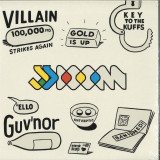
On paper, a full collaborative album from Doom and space age production from Jneiro Jarel
can't fail. In practice it's even better. Doom is in the form of his life here. JJ produced all the
tracks, Doom provided the bulk of the vocals and compiled the cut and paste skits. Doom
recorded the album while 'banished' from the States and back living in london. He references
British culture throughout the album, name dropping British institutions, and possibly being
the first emcee to reference My Big Fat Gypsy Wedding. Jneiro recording the beats in the dirty
south, got into a UK state mind, and turned in heavy hip hop production that leans towards
grime, dubstep and British techno. The album will appeal to fans of classic Doom material.
JJ's tough, far out hip hop production will appeal to fans of Dilla, Flying Lotus and el-p. It also
features guest appearances from Beth Gibbons, Damon Albarn and Khujo (goodie mob).
Album artwork is by graffiti artist Steve Powers aka Espo.
- A1: Total Unity - I'm Takin' A Stroll With The One I Adore
- A2: Laurene Lavallis - Key To Our Love
- A3: Precisions - Take A Good Look
- A4: Mike Adame & Barrio - Chicanita
- A5: The Nu Rons - I'm A Loner
- B1: Living Funk - Fools Love
- B2: Charisma - Don't Act Suprised
- B3: Taste Of Love - Love Meditation
- B4: Elvans Road Ltd - Can I
- B5: Steve Parks - Still Thinking Of You
*Repress*
Low Key Source drops a limited edition AA side 7 inch vinyl release featuring tracks by Tall Black Guy x Allysha Joy and Children Of Zeus x Black Milk.
Tall Black Guy’s production for “Sip Of You” has it’s feet firmly planted in the golden era but all the while still managing to sound futuristic and of the moment. Allysha Joy laces the jazz influenced production effortlessly with her own signature soulful vocals, pulling the listener gently in.
On "Won’t End Well" Manchester's Children Of Zeus depicts a neighbourhood entranced by drugs and how good kids seduced by this way of life learn how to become a part of the cycle despite the advice of their parents knowing it won’t end well. Black Milk’s hard kick and crisp snare mimic the darkness surrounding this type of environment in a predatory and cunning manor.
Debut release for the brand new mediterranean label ‘R&C Records’ based on just “benessere” (well-being).
It opens with ‘Eram’ a nice italo-balearic flavoured fusion between Carella’s sounds & sea winds, ruffled by drums of “Soul”.
On the flip-side ‘Key Mon’ is a splash of psycho roller drums on Peter’s magical voice. Shock !!