AI-36 comes from Ear to Ear - the debut collaboration between label regular Samuel van Dijk (Multicast Dynamics) and Ukrainian artist Yevgen Chebotarenko. Taken from a series of live recording sessions, the album explores in four parts a markedly darker realm of soundscape music. A cornucopia of abstract morphing scenes and heady synesthesia, the album brims with rich sonic detail and evocative gestures. Deftly blending organic sound textures with an experimental austerity, ‘Live Recordings’ displays potent and accomplished storytelling.
The album opens to a grey overcast vista, a natural landscape that slowly melts into a descending chasmic dysphoria. The mood transitions to a drone-based piece on the B-side, characterised by a more psychologically suspenseful framework and exotic blend of sound design. The atmosphere lightens, yet equally pensive as side C takes on a more elemental form, invoking water and its array of microbial and metabolic ecosystems. Brief cathartic moments in the final section pave the way for deeper wayfaring on the D-side. Stray signals and unknowable artefacts skitter across a vast subaqueous domain, a fathomless womb of potentialities that ebbs into eternity.
Поиск:b live
Все
Recommended for everyone who is into uncompromising dance music devoid of emotional signifiers and willing to catch a brief glimpse into the chaotic dimensions of a cold urban environment. credits releases September 1, 2023 Recorded and mixed by Low Order Mastered by Daniele Antezza at Dadub Mastering Artwork by Misha Brin Layout by Anna Haleta
This live album — released on vinyl for the first time — is made up of three European dates in 2001, and introduced Shorter’s ‘Footprint Quartet’: pianist Danilo Perez, bassist John Patitucci and drummer Brian Blade.
All are in top form, especially on challenging reimaginations of the title track and ‘Masquelero’, both from his time with the 1960’s Miles Davis Quintet.
Janaka Stucky is a poet, performer, and author of two poetry collections published by Third Man Books & Records. Janaka’s poems are at once incantatory, mystic, and epigrammatic.
His esoteric & occult influences, combined with a mesmeric approach to performance, create an almost ecstatic presence on stage. Of his live shows, VICE writes, “Janaka Stucky performs poetry readings like he's part fire-and-brimstone preacher, part doom-metal frontman … For him, lighting incense, dropping acid, and creating some of the most ecstatic lines of verse you’ve ever read is just another day at the office.”
Praised by Jimmy Page as “riveting,” Janaka Stucky’s book length poem, Ascend Ascend, published by Jack White’s Third Man Books in 2019, gets a mesmerizing treatment on this album by the same name, accompanied by experimental cellist Lori Goldston. Goldston, known for her work with a number of acts—including Nirvana, Cat Power, and Earth—provides otherworldly layers of distortion and natural reverb over Stucky’s dirge-like vocal performance.
Recorded at the All Pilgrims Church in Seattle while Stucky was on a 7-city tour produced by Atlas Obscura in 2019, the performance is served well by the room’s ambiance and was recorded, mixed, and mastered by Mell Dettmer—who has engineered albums for acts such as Earth, Sunn O))), Master Musicians of Bukkake, and Wolves in the Throne Room.
Any moment can crash your emotional state of mind. You are looking for help. You can’t find it with-inside of you. A Diamond shines twice a day. The night can be day and vice versa. We love you, no doubt. Our friends love you too. Do you love yourself? A Zebra is not a unicorn but is still unique. Who are you to tell us We can’t do it? EUPHORIC SPIRITS EUPHORIC SPIRITS Women are strong and full of love and positive energy. This life is a gift and you should genuinely use it. Read a book. Internet TV connects your brain to something not valid; remember that. We still love you. You are beautiful. Come with us to hidden spheres and find your inner voice. Shock, Projection, Ideals, Sorrow, Disaster, Fundamental, Weak, Strong, More, Less.
We love you. Follow us to the planet of our inner fears, and we do magic. It will become another planet. Together forever. We love you.
The very first initial Minimum Success Records release features the legacy of some finest mix of breakbeat, gabber & hardcore influenced tracks with some ghetto touch produced in the studio sessions between 1993-1997 by the duo Amalgam 5 at West 20 Studio in Turku, Finland. Well after a decade being buried in the deepest master tapes archives these tracks are finally seeing a daylight and becoming available on a beautifully designed vinyl release by Bank™.
The Tears of Joy label boss returns with an encompassing tribute to the power of the dancefloor. As a member of Pacific Horizons and under a host of other aliases, the Los Angeles-based producer has explored the breadth of dance music - from Mancuso-inspired loft house to bassbin rumblers that nod to his familial relationship with the U.K. - but his most personal statements have been reserved for the Live For Each Moon moniker.
As a result of this, and also by nature of its journey/trip sequencing, 'A Vision of Dance' reaches for a comprehensive sound, honed over decades of observation and participation. The producer's varied interests shine through, and they are pushed beyond genre experiment into new, hybridized shapes - sinewy, searching, warehouse techno shares space with crunchy, heaving breakbeat cut-ups and churning, slow motion chugs. While the overall pace leans toward the trancelike whirlwind, a few atmospheric, introspective interludes are cut in as kind of existential breathers - nods to LFEM's back catalog of haunted ambience as much as ravers' respites.
We are both very pleased to introduce Johannes Brecht to the Siamese family! A highly talented, trained and decorated musician is a fair description of Johannes and we’re proud to call him a friend and sometimes even a mentor.
This record has been in the works for a long time and since all of us wanted to have this EP out on vinyl too it took some time to get everything in place. As expected the three originals show a wide array of Johannes Brecht's world of electronic music. It's about creating something with love and passion rather than staying on safe ground
Following the arrival of their debut album ‘Alterazione’, LF58 (F.Scorcucchi and G.Tillieci) are back on Astral Industries with a special trove of outer-space explorations. Recorded one evening back in April 2019 as a live performance at Rome’s Brancaleone, the eponymously titled album offers a sprawling journey across the pan-dimensional ether. Spread across six sides of vinyl, the performance includes fully improvised material as well as choice selections from Simone Giudice, Jonas Kopp, Nuel, Birds of Prey, Rapoon, Steve Roach and Adham Shaikh. There is no doubt that the unique energy and circumstances of the evening contribute to a certain atmosphere present in the music.
With seemingly no beginning nor end, the session emerges in suspension; an electric ocean of infinite deepness. Gleaming across the patter of galaxies on a wide black backdrop, its myriad vistas are projected like transitioning scenes of an unending story. The gentle tide brings with it specks of cosmic debris and mysterious signals. Soon, quiet drones are overtaken by ripples of solar flare and percussive clamours. Forms melt like liquid, a ball of amorphous plasma pulsating with ecstatic radiance. Prying open universe within universe, ‘Live at Brancaleone’ has a vastness that cannot really be contained.
DC Salas’s second EP indeed is a tale of beautiful feelings: After his last year’s debut EP on Live At Robert Johnson called The Complicated Art of Dreaming, this fresh four tracker is a proof to his creative continuity.
A1 Did They Listen rhythmic structure banks on a pounding and effective combination of bassdrum, conga and cowbell, joined by a mildly distorted bass line figure, which embeds itself in a panoramic soundscape. A2 Beautiful Feelings introduces a remarkable striking sawtooth sequence, with repeated filtered and resonating variations, alternating throughout the track. On the flipside, B1 Within employs yet another bubbly bassline, keeping the soundscape wide-open to retain enough sonic space for that eerie, yet highly energetic Cosmic Disco touch. B2 Liquid Perception signature is a liquid acid bassline introduced in the second part of the track, perfectly befitting its track title. All tracks of this monolithic EP, thanks to its consistent approach to sound design, could easily be mixed subsequently with each others.
DC Salas is thirtysomething year old Diego Cortez Salas, a skilled talent with peruvian origins hailing from Brussels. A regular DJ at C12 and Kiosk Radio both in Brussels, Diego also co-runs Biologic Records with his mate Abstraxion since 2014.
Informed by a highly influential early 1980s electronic music classic, the title track literally mind-sets the theme of Llewellyn’s latest release, kicking off with a euphoric vibe and drums shimmering with digital artifacts. At times almost dreamy cinematic pads, upfront with energetic Moroder-esque propelling bass lines, are the sound signatures of Llewellyn’s journey through a warm and synthesizer laden EP, reviving the sound aesthetics of both the post-discoid VHS and today’s club era with a contemporary touch. Finishing off with a laid-back facet, this four track EP contains enough warmth and drive to get you safely through the cold months, into a warm and promising future.
Llewellyn is one of Martin Enke’s producer’s monikers, who is closely associated with the Riotvan crew and also known as Lake People. Past releases can be found on labels like Riotvan, Uncanny Valley, Permanent Vacation, Mule Musiq and others.
Transversales Disques proudly presents Pharoah Sanders - Live in Paris (1975). A never-before released ORTF recording performed live at studio 104, Maison de la Radio, Paris. First official release with the full permission and cooperation of the National Audiovisual Institute. Deluxe edition, Classic Tip-On Gatefold jacket, including exclusive liner notes and pictures. Mastered from the original master tapes.
It was in 1973, on the 14 of October, late in the afternoon; on a pretty Sunday under the Big Top in the heart of the “Parc de la Pépinière”, in Nancy; it was the “premiere”, the world
first hearing, and it has so far remained the only one commissioned by composer and trumpet player lvan Jullien, for the first international Nancy Jazz Pulsations festival. In order to complete this work of composition and orchestration, Ivan asked the great Eddie Louiss on organ, and chose to do without a double bassist who would have been drowned in a telluric outburst, for the best drummers in Europe and beyond had accepted out of sympathy to offer their contribution to such a festival. The only melodist with Louiss was the English John Surman (born in 1944) here on soprano saxophone, discharging torrents of incandescent lava.
Conversing with drums, cymbals, xylophones, kettledrums, vibraphones, tumbas, djembes and all other percussive things that you’ll like to imagine – a bunch of talents such as those
of the French André Ceccarelli, Daniel Humair or Bernard Lubat, the New Yorker Stu Martin, who reminds of Paul Motian in his “breaks”, South African Louis Mo-Holo, young Lamont Hampton, the great trombonist “Slide” Hampton’s son and the Malagasy Franck
Raholison, the Senegalese Lamine Konte. And we will scrupulously refrain from omitting the four musketeers, here representing
percussion in classical music, namely the Percussion Quartet of Paris under the leadership of Mr. Lucien Lemaire.
After a year in studio together PST and DJFB are ready with another live studio excursion from the PSTStudion! They continue to explore the live possibilities in the studio. With more additional gear and upgraded old-school synch and programming methods! This time a more up tempo affair. Trippin’ into a dance floor oriented territory, with 808 grooves, the usual heavy dubbed out effects, subtle melody hooks and some psyched out live acid flow. Three track 12″ tripper with a deep touch and groove.
First time reissue of JP free jazz rarity, pre-Seikatsu Kōjyō Iinkai group.
The single album self-released by the quartet Shūdan Sokai in 1977 is one of the most vital documents of mid-seventies Japanese free jazz, documenting Tokyo’s free scene at the precise moment when it began to shift to a handful of tiny venues on the western fringes of the city. In Free Jazz in Japan, Teruto Soejima identifies the extant venue Aketa no Mise in Nishi-Ogikubo as the pioneer of this decamping from the centre: a cramped basement beneath a rice shop, seating just 20 people. Musician-run, operated on a shoestring, these spaces offered a vital site for community, creativity, and a small measure of financial independence — “even though it was in a basement, in spirit it was a loft.”
Among the most active of the new venues was Alone in Hachiōji, nearly an hour from Shinjuku, in a district shaped by universities, lower rents, and a thriving counterculture. Originally opened in 1973 as a jazu kissa, Alone was unusually spacious and equipped with a stage, grand piano, and drum kit. Around 1974, Junji Mori and Yasuhiro Sakakibara began working there, booking free jazz players on weekends and establishing the venue as a crucial hub. Mori recalls early appearances by figures including Kazutoki Umezu, Toshinori Kondo, and others who would define the scene.
In early 1976, Umezu and pianist Yoriyuki Harada — recently returned from New York’s loft jazz environment, where they had played with musicians such as David Murray and William Parker — formed Shūdan Sokai with Mori and drummer Takashi Kikuchi. The name, meaning “mass evacuation,” pointed to their self-chosen exile in Hachiōji. With Alone as their home base, the quartet developed a music characterized by an infectious sense of enjoyment and a willingness to integrate free jazz with elements of song structure. Harada switched between piano and bass; the group experimented with rap-like vocal pieces, jabbering nursery rhymes over bass rhythms.
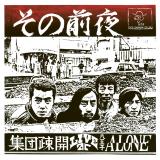
They returned to Alone on December 24 to record Sono zen’ya (Eve), releasing it on their own Des Chonboo Records, partially funded by advertisements from local businesses printed on the rear cover. The closing “Ballad for Seshiru,” dedicated to Harada’s newborn son, unfolds over a delicate piano melody that moves into emphatic chords as intertwining alto lines rise and spiral.
Alone closed in September 1977, and Shūdan Sokai soon dissolved, later morphing into the expanded Seikatsu Kōjyō Iinkai Orchestra. What remains is a recording rooted in a specific place and moment: a fiercely independent scene sustained by small rooms, close listening, and collective commitment.