Close is the debut album from American Dreams Records founder & ONO member Jordan Reyes.
The album is comprised of six songs composed on modular synthesizer working in a rhythmic ambient, electronic realm - songs like ‘Quicksand’ are glacial and melodic while others like ‘Lost Machine’ skew to the kinetic.
On this album, Reyes mused on idea of sobriety, endurance, and being in a state of trance - wading deep in the patch cords of the eurorack synthesizer allowed him to reach a state of non-attachment, similar to running or biking a long distance. This kind of tunnel vision allowed him to perceive himself fading from the day-to-day and exist wholly inside the machine, becoming a more cybernetic organism.
Suche:b vision
- A1: Bad Bitch From Tokyo (Intro)
- A2: Aim For The Moon Feat Quavo
- A3: For The Night Feat Lil Baby & Dababy
- A4: 44 Bulldog
- B1: Gangstas
- B2: Yea Yea
- B3: Creature Feat Swae Lee
- B4: Snitching Feat Quavo & Future
- B5: Make It Rain Feat Rowdy Rebel
- C1: The Woo Feat 50 Cent & Roddy Ricch
- C2: West Coast Shit Feat Tyga & Quavo
- C3: Enjoy Yourself Feat Karol G
- C4: Mood Swings Feat Lil Tjay
- C5: Something Special
- D1: What You Know Bout Love
- D2: Diana Feat King Combs
- D3: Got It On Me
- D4: Tunnel Vision (Outro)
- D5: Dior
Am 15.01.2021 erscheint das posthume Debütalbum „Shoot For The Stars, Aim For The Moon“ des New Yorker Rappers Pop Smoke erstmals auf Vinyl. Das Album debütierte auf #1 der US Albumcharts und schaffte es auch in Deutschland auf #9 der Charts. Über 20 Wochen nach Release befindet sich das Album immernoch in den Top 5 der US-Albumcharts. Unter anderem sind 50 Cent, DaBaby, Lil Baby, Roddy Ricch, Future, Quavo und Swae Lee auf dem Album vertreten
On their Night Dreamer debut, Sarathy Korwar and his allstar “UPAJ Collective” gain brand new ground in their mission to rebalance spiritual jazz with authentic Indian classical music. “UPAJ” means “to improvise” inHindi, and recording direct-to-disc at Artone Studios with almost no preconceived directions, they truly capture the “spirit of spontaneous improvisation”, as Sarathy puts it, like never before.
Sarathy Korwar 2020
"Recording in one take, direct-to-disc is a unique scenario to be in. I feel very blessed to be presented this opportunity. I decided very early on that in order to make the best use of this scenario, the music had to be completely improvised and spontaneous. That is the only true way to record within the limitations of one take. No regrets, no mistakes, no fear and no judgement. These were the ideals. In a way, this was about creating a utopian vision of a world I would like to live in. A microcosm of the ideals that I would like to live by, in the recording studio. The vision of going into the studio with this in mind, was more important than the resulting music we created. Process over product.
Before the session we did some collective breathing exercises that I have learnt from my mother (who is a pranayama practitioner/teacher) and Wim Hof. I believe this helps centre the focus of the group and balances the mind, making it most receptive to new sounds and inspiration.
The song So said Said is a tribute to Edward Said. Intimate Enemy, a tip of the hat to the book of the same name by Ashis Nandy (Intimate Enemy: Loss and recovery of self under colonialism). A cover of Flight IC408 by State Of Bengal is on Side B, as I am a massive fan of the band. Elephant Hangover is the imagery that the tune conjures for me personally on listening to it. A beautiful remix by the brilliant Osunlade of So said Said is on side D.
Thank you to the gifted musicians - Al, Tamar, Achuthan and Giuliano for trusting and letting go. I am lucky to spend time with you."
Herman Saiz debuts on Aprapta Music with his latest creation, Time To Choose LP - 12 Original Tracks spread across 2x12inch.
The NZ based producer's latest project, born out of the volatility of 2020, merges various styles of electronic music, to offer a thought-provoking album, challenging the heavy main stream programming of this generation.
Each tracks aim to dissolve the illusionary forces holding us to meaningless narratives and diluted culture.
From downtempo, hip hop, minimal, house and experimental electronica, the album is an invitation to choose your own preferred timelines, switching off auto pilot, and harnessing the power of being present in the now.
Through interweaving deep truths with electronic pulses, this is a clear offering to choose sovereignty and an awakened future.
Veyl presents 'Nuit' - a split-EP between two excellent projects we're enraptured to share with you. Both hailing from France, Blind Delon (Toulouse) and Contre Soirée (Paris) share a similar vision, bringing music from before any of their birth dates into the world of today.
Dedicating their sound to cold bass lines and synthesizers, the 80s, french post-punk and black romanticism, both acts spent their nights observing, describing, thinking, crying, each in their own way.
Building a bridge between the melancholy and urgency defining that era, ’Nuit' is the fruit of this labour.
‘Giants of All Sizes’ was recorded at Hamburg’s Clouds Hill Studio, The Dairy in Brixton, 604 Studios in Vancouver and Blueprint Studios in Salford with additional recording taking place at various band member’s home studios spread across Manchester. As with their previous four studio albums, ‘Giants’ was produced and mixed by Craig Potter. Guests across the album include Jesca Hoop, The Plumedores and South London newcomer Chilli Chilton.
Given such bleak, if ultimately redeemed, subject matter, it is also, perversely, the most relaxed record which elbow have made in some time. On ‘Giants of All Sizes’, each band member extended their usual process of working on demos alone and followed their vision to its conclusion rather than, as Craig Potter puts it, ‘taking the edges off things to find compromise’. In tandem with this, they returned to playing live in the studio, encouraged to experiment with the banks of analogue equipment at Clouds Hill in Northern Germany, giving songs a looser, more live feel. The result is the most starkly dynamic record from the band in recent times, “Sonically unabashed”, as Guy would have it. Whilst album closer ‘Weightless’ has the gossamer melodies and communal harmonies for which the band have latterly been known, this album echoes earlier elbow work at times whilst also breaking new ground.
‘White Noise White Heat’ is motorik, metal machine soul driven by a vocal that is rage incarnate, ‘Doldrums’ mixes John Carpenter with The Plastic Ono Band to brilliantly disturbing effect and ‘On Deronda Road’ hitches stark bass beats and glitches to an ad-hoc choir. ‘Empires’ delivers dark resignation via an insidious melody and ‘Seven Veils’ continues the subversion by inverting the perception of elbow as a band for lovers into a band for haters, a double-barrelled fuck-you song par excellence. ‘The Delayed 3:15’ marries mariarchi guitars to jazz dynamics, Morricone via Buddy Rich, and ‘My Trouble’ is a clockwork, analogue shuffle housing a delicate melody that builds over the course of the song into a fragile monolith to the power of love.
Lead track, ‘Dexter & Sinister’, released on 10” ahead of the album, encapsulates the whole. A seven-minute musical journey that blends deep bass grooves, sudden keyboard stabs, dislocated piano and guitar runs and soul stylings then abruptly shifts gear, parts the storm clouds and takes wing, flying towards the heat of the sun. It is the soundtrack for these ‘hope free, faith free, charity free days’, a denial of the divine and a reconciliation, two songs in one song, two emotions for one emotion, human, fragile and brilliant like the album which it opens.
Trace the arc of Clap Your Hands Say Yeah's evolution and it shows an accomplished musician and composer sounding ever more confident, constantly refining and broadening his sound and indulging an ever wider set of influences. Few have been as consistently brilliant, eclectic, and intimate; fewer still have done so while being defiantly, 100% independent, refusing to sign deals that compromise artistic vision. New Fragility is a continuation of this, yet it also stands apart as one his strongest collection of songs yet. Personal yet universal, New Fragility confronts numerous modern ills. 'Where They Perform Miracles', a song concerning spirituality and alternative methods of healing, harks back to Ounsworth's time as an anthropology student doing fieldwork in Mexico, while 'Dee, Forgiven' is an intimate look at what harm anxiety, and the over-prescription of certain medication, has on the vitality of youth. The song contains one of Ounsworth's strongest vocals yet - a quivering beacon that shifts from a wail to a low grumble in the blink of an eye, a remarkable expressive instrument that sits perfectly amid the understanded orchestration. For 15 years, it's been one of music's most distinctive voices, and it's never sounded as rich or poised.
LTD. BONE OPAQUE VINYL
Trace the arc of Clap Your Hands Say Yeah's evolution and it shows an accomplished musician and composer sounding ever more confident, constantly refining and broadening his sound and indulging an ever wider set of influences. Few have been as consistently brilliant, eclectic, and intimate; fewer still have done so while being defiantly, 100% independent, refusing to sign deals that compromise artistic vision. New Fragility is a continuation of this, yet it also stands apart as one his strongest collection of songs yet. Personal yet universal, New Fragility confronts numerous modern ills. 'Where They Perform Miracles', a song concerning spirituality and alternative methods of healing, harks back to Ounsworth's time as an anthropology student doing fieldwork in Mexico, while 'Dee, Forgiven' is an intimate look at what harm anxiety, and the over-prescription of certain medication, has on the vitality of youth. The song contains one of Ounsworth's strongest vocals yet - a quivering beacon that shifts from a wail to a low grumble in the blink of an eye, a remarkable expressive instrument that sits perfectly amid the understanded orchestration. For 15 years, it's been one of music's most distinctive voices, and it's never sounded as rich or poised.
Goat Girl’s new album ‘On All Fours’ was produced by Dan Carey (Kae Tempest, Black Midi, Franz Ferdinand) in South London in early 2020. This new record sees the band veer away from the confrontational lyricism of their debut and indicates Goat Girl’s maturing perspectives in discussing the world’s injustices and social prejudices, using the music to explore global, humanitarian, environmental and mindful wellbeing.
Throughout ‘On All Fours’, Goat Girl’s frequent use of sci-fi synthesisers, off-beat chord progressions, analogue drum machines, diverse vocal styles and distinct, gritty guitars fuses a musical language that expresses both former characteristics and newer developments of the band’s sound and vision.
To step out from trival sounds.
Jo IND strikes here again !
A side brinsg a quiet sweet tune, strings is the thema... With a veryu nice Josh Winks acid style for the start, meeting the cello effect... Sweet musical crazyness... with tonality variations and harmony richness... Acid as a musical instrument.
take your time and enter the universe of these 2 superb tunes : we splitted the listening of B side in two so you can hear this superb intro... Defenitly feeling the space in full with a 1m30 intro... before kicking in a mystical way...
The label visual of B side is an fatastic vision of someone falling ? flying ? in front of a soundwall ???
totally in the state of mind of this crazey tune...
In a time where everyone from Whitney Houston to Frank Zappa have been re-created in hologram form, where Grimes recently suggested in an interview that “we were at the end of human art”; there could scarcely be a better time for genre-shifting Leeds-based six-piece Team Picture to bring forth the thrillingly expansive synth-pop opus of their debut album The Menace of Mechanical Music.
Inspired by an early 20th century essay under the same name by American marching band leader John Philip Sousa, Team Picture take a look at the automation of creativity on this, their first record with a fully settled line up. Themes centre around the value of creative identity in an automated age, the increasingly disposable nature of art and where that leaves its creators. At twelve songs split into a three-part suite; The Menace of Mechanical Music is emphatically maximalist.
Tracks like the breathy, twinkling Flowerpots, Electric Beds and Handsome Machines’ Icarus-like striving for the sun are an antidote to a music world awash with digital production manipulation and songs written to algorithm. In debating the loosening of the human grip on creativity, Team Picture have poured every last drop of emotion into the recording process.
The group’s now trademark three-way vocal delivery and blurring of textures takes on new structure and purpose. They’ve always had a self-awareness to themselves, too. Initially grouped in with the guitar psych crowd, thanks to their fledgling repeato-rock, they were quick to disassociate themselves from that on 2018's mini-album Recital. With The Menace of Mechanical Music, they expand their sound further still, pirouetting from the likes of Sleeptype Auction – which glimmers like a late 80’s 4AD artefact – through various FX-laden dreamscapes, to the squelchy post-punk of closer Quit Reading. Yet the group were as much influenced by the work of the Early Netherlandish painter Hieronymus Bosch, and his triptych The Garden of Earthly Delights, as they were music touchstones ranging from Kate Bush, Cass McCombs and The Cure.
It’s Sousa words that resonate most deeply within the record however: “The fears of Sousa echo the fears of today's musician,” says Lewis of the late band leader’s 1907 text. “The re-appropriation of funds and support that the artist needs to survive, the gradual erosion of musicianship and self-improvement, that art will become disposable, and that our cultural identity will disappear.”
Recorded with producer Matt Peel (W.H Lung, Eagulls), half the group were unemployed during the session and a daily routine would see them undertake universal credit meetings and job interviews in the morning, before heading to the studio to work into the night. “It was an anxious process but an enjoyable one” says the band’s guitarist Josh Lewis. Indeed, beyond the increasingly golden gated idea of ‘making it’ as an artist, this new album is simply about surviving as one.
Sousa’s vision of a society that had deferred to automation, where babies were rocked to sleep by wheels and pulleys, and people no longer played piano with their own hands. Well over 100 years later and on the precipice of a technological shift never seen before, The Menace of Mechanical Music is the most human response that Team Picture could have given.
A folk/bluegrass troubadour from Vermont who delves into shape-note traditions and Appalachian ballads and makes it all beguilingly his own. His guitar lines have the fancy fingerwork of a crack banjo player and his banjo lines have the tugging suspensions of a jazzer.’ – Guardian
‘Amidon is a rare Americana artist whose … signature banjo-strewn style … and disparate mix of influences play into a sound that is at once archaically rootsy and savvily refined.’ – Wall Street Journal
Sam Amidon considers his new self-titled album the fullest realization to date of his artistic vision. It comprises his radical reworkings of nine mostly traditional folk songs, performed with his band of longtime friends and collaborators. Amidon produced the record, applying the sonic universe of his 2017 The Following Mountain to these beloved tunes, many of which he first learned as a child. ‘Pretty Polly,’ for example, was one of the first traditional tunes he learned to play, and ‘Time Has Made A Change’ is a song that his parents – singers who were on the 1977 Nonesuch recording Rivers of Delight with the Word of Mouth Chorus – sang around the house when he was young. Amidon will perform two concerts at Kings Place in London on October 3. A limited number of tickets will be available in the venue, as well as tickets to stream the event from home. Further details are available here.
Amidon and his frequent band of multi-instrumentalist Shahzad Ismaily and drummer Chris Vatalaro were joined in the studio by Belgian guitarist Bert Cools (who played on his last EP), as well as Amidon’s wife, Beth Orton, who adds vocals on three songs. Acoustic bassist Ruth Goller and saxophonist and labelmate Sam Gendel also play on the album, which was mixed by Leo Abrahams. Sam Amidon was mostly recorded live in the studio. Amidon arranged the songs, which are traditional tunes, with the exception of Taj Mahal’s ‘Light Rain Blues’, Harkins Frye’s ‘Time Has Made A Change’, and ‘Hallelujah’, which is an 1835 William Walker shape-note tune using earlier words by Charles Wesley, found in the Sacred Harp collection of early American folk-hymns.
Sam Amidon is Amidon’s fifth recording on Nonesuch and follows the 2019 EP Fatal Flower Garden (A Tribute to Harry Smith). Additional recordings include his 2017 album The Following Mountain and Kronos Quartet’s Folk Songs the same year, on which he was a featured singer along with Rhiannon Giddens, Natalie Merchant, and Olivia Chaney; Lily-O in 2014; and his label debut, Bright Sunny South, in 2013.
- A1: Samba Negra - Eberebijara
- A2: King Somalie - Monkey 'S Dance
- A3: El Grupo Folclórico - Tamba
- A4: Los Viajeros Siderales - El Campanero
- A5: Rio Latino - Ayu
- B1: Aníbal Velásquez - La Mazamorra Del Diablo
- B2: La Francachela - Mosquita Muerta
- B3: El Grupo Folclórico - Juipiti
- B4: King Somalie - Le Mongui
- C1: El Grupo Folclórico - El Tornillito
- C2: Samba Negra - Long Life Africa
- C3: La Banda Africana - Te Clavo La... Mano
- C4: Myrian Makenwa - El Platano
- D1: El Grupo Folclórico - Tucutru
- D2: Grupo Bola Roja - Caracol
- D3: El Grupo D'abelard - Otro Perro Con Ese Hueso
- D4: Conjunto Barbacoa - Wabali
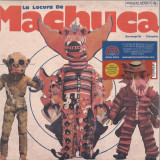
La Locura de Machuca is the story of one man’s bizarre odyssey into Colombia’s coastal music underground, and the wild, hypnotic sounds he helped bring up to the surface.
One night in 1975, a successful tax lawyer named Rafael Machuca had his mind blown in Barranquilla’s ‘Plaza de los Musicos’. Overnight he went from a high ranking position in the Columbian revenue authority to visionary production guru of the newly formed record label that bore his name, Discos Machuca, and for the next six years he devoted his life to releasing some of the strangest, most experimental Afro Psychedelia Cumbias ever produced. La Locura de Machuca is the story of one man’s bizarre odyssey into Colombia’s coastal music underground, and the wild, hypnotic sounds he helped bring up to the surface.
The Colombian music industry was thriving in the mid-seventies, but while homegrown bolero and vallenato tunes were doing well on the charts, it was imported African records that were setting crowds on fire at the picos – the sound-systems that fuelled neighbourhood parties – and wherever those records were played there were always a handful of groups who were inspired to plug traditional Cumbia directly into the electric currents coming from across the Atlantic.
It was these obscure bands, who fused Colombian and African rhythms with the swirling organs and psychedelic guitars of underground rock, that fired Machuca’s imagination. While the label made its money releasing popular hits by legends such as Alejandro Durán and Aníbal Velásquez, that money was poured back into a unique run of experimental releases by fringe artists such as La Banda Africana, King Somalie, Conjunto Barbacoa, and Abelardo Carbono, one of the godfathers of Champeta Criolla.
When Machuca couldn’t find groups to realise his particular vision, he simply created them himself. Drawing on a fearsome roster of musicians associated with the label, he assembled bands that lasted only as long as it took to record an album ,and unleashed the results – complete with arrestingly unusual album covers – under a series of different names such as Samba Negra or El Grupo Folclórico. This unorthodox approach led his longtime recording engineer, Eduardo Dávila, to describes Machuca’s productions as the “B-Movies of Colombian music.”
The story of Doctor Machuca and his eccentric exploits tells of one of Colombia’s most atypical and peculiar record companies; a defining pillar of Afro-Caribbean psychedelia. His productions have come to represent the roots of Champeta and set the pedigree standards for Afro and Costeño avant-garde. The seventeen tracks on La Locura de Machuca, harvested from the darkest, strangest corners of the Discos Machuca catalogue, sound like little else recorded before or since.
- A1: Aqua Bassino - A Mellow Key
- A2: Elegia - Way Form One So Hard *
- A3: Thomas Ferriere - If You Can’t *
- B1: A Reminiscent Drive - Fly Over Bombay *
- B2: Juantrip’ - Switch Out The Sun
- B3: Jori Hulkkonen - Lo-Fiction (Alternative Version)
- B4: Aqua Bassino - Rue De Paris
- C1: Rodriguez Jr - Siempré Siempré *
- C2: Frederic Galliano - Bko-Dkr *
- C3: Scan X - Turmoil
- C4: Maxence Cyrin - Acid Eiffel *
- D1: Gong Gong – Atone *
- D2: Laurent Garnier - Greed (Avril Remix)
- D3: A Reminiscent Drive - Two Sides To Every Story
To finish to celebrate the 25th anniversary of the legendary label F Communication:
For the first time available on vinyl a compilation of the famous Megasoft Office series. Included many unreleased tracks.
The Megasoft Office series started 10 years ago. Since this time, visions and emotions inspired by music became a more popular feeling. Most of the tracks on this album are unreleased music which has been specially created by F Com artists to feed your creativity.
More releases from these artists are available all year long through albums or singles on the label.
(*) first time on vinyl
Modern House Quintet present their debut album, an LP featuring their vision of what electronic music has to offer. This record sees the duo explore the various sounds and influences that make them what they are. Presented in two separate LPs, this first is a vibrant mix of inspirations, ideas and sounds. From deeper soulful music, to more upfront and synthetic and all the way through to pieces that incorporate instruments you might not always hear in this kind of music.
Jorge Caiado’s new “Cycles” EP, offers 3 strong versions of title theme plus a remix by Detroit legend
Mike Huckaby. A house/techno manifesto that takes his artistic vision one step further, placing him as
a cutting edge producer internationally supported by the likes of Move D and others.
From Lisbon via Detroit, “Cycles” will make any worldwide dancefloor take a peak. So grab it, play it
and check the results. Limited repress.
“The greatest thing about being a musician is experiencing it with other people,” says Ed Riman, the Brighton-based Eurasian singer, songwriter and sound-scapist who records as Hilang Child. “Whether that’s playing with others, creating together, sharing a vision, whatever, I just think in all aspects it’s a totally elevated experience when you’re not alone.” Proof rings out with force and feeling on Hilang Child’s superlative second album, ‘Every Mover’, released on Bella Union.
In 2018, Riman delivered a serene, textured debut album in ‘Years’, rich in sound and feeling. Lauren Laverne, Q, MOJO and others lavished praise but the “isolating process” of making the album left Riman hungry to find alternative ways of working. Meanwhile, the “lonely, pressured” aftermath of ‘Years’ found Riman grappling with “rough selfesteem and anxiety issues,” amplified in part by social media’s “fulfilment narratives.” Duly, he set out to navigate and overcome these mindsets, drawing deeply on his own insecurities and those he recognised in others.
These themes converge emphatically on ‘Every Mover’, an album steeped in everyday emotional states and crafted for cathartic, communal performance. Drawing on a rich spread of collaborators, sounds and themes, Riman uses his frustrations as the impetus to transform the brimming promise of ‘Years’ into upfront and expansive new shapes. “I wanted it to sound a bit gutsier than the first album,” he says, succinctly, “heavier and closer to the kind of stuff that hits me when I go to shows or blast music in the car. I started out in music as a drummer playing for pop or beat-driven artists and grew up listening to louder stuff, but a lot of the music I’ve made as Hilang Child has been more ethereal. I wanted to bring it back to a place that feels more ‘me’ and make more of a thing of having big hypnotic drums, aggressive bass, ripping distorted instruments and a general energy to it.”
‘Good To Be Young’ serves swift notice of this leap, its banked synths and twinkling sound clusters leading to an assertion of fresh force when the main beat lands and a congregation of friends - AK Patterson, Paul Thomas Saunders, Dog in the Snow, Ellen Murphy, members of Penelope Isles - unite for the gang-vocal refrains. “It’s all iridescent colour I’m on,” Riman exults, a claim lived up to on the full-flush folktronica of ‘Shenley’.
A reflection on spiralling insecurity, ‘Seen The Boreal’ ups the ante again with its monkish chorales, looping samples, spectral woodwinds (from multi-instrumentalist John ‘Rittipo’ Moore, of Public Service Broadcasting and Bastille previous) and ecstatic chorus, Riman transforming a meditation on hindsight’s limiting effects into a spur to look forwards. And surge forwards he does with the glittering synths, spacey guitars and Krautrock propulsion of ‘King Quail’, developed in jam sessions with dream-pop wonder Zoe Mead (Wyldest) in her basement studio.
Brought to a sublime close with ‘Steppe’, the resulting album projects its own epiphanic force. Thankfully, most of the main parts were recorded pre-lockdown between East London, Gateshead, Brighton, Wandsworth and elsewhere, before mixing proceeded remotely. Meanwhile, alongside indie-pop trio OUTLYA’s Will Bloomfield (percussion/coproduction on ‘Play ’Til Evening’), visual design collective Tough Honey (accompanying videos) and other collaborators, Riman’s bond with co-producer JMAC (Troye Sivan, Haux, Lucy Rose) proved crucial. “It felt freeing to work collaboratively and have that push-andpull of ideas,” says Riman. “Even the moments where we didn’t see eye-to-eye made it feel like I wasn’t alone, with someone else working just as passionately on the project.”
LP pressed on red transparent vinyl.
This album could easily have turned top-heavy. After all, here’s a record which, in just under 40 minutes, covers anything from Arabic scales to Japanese sounds, from free jazz references to concepts by Finnish pianist Kari Ikonen’s favourite painter Vasiliy Kandinsky.
To realise his vision, Ikonen even personally developed a device allowing him to play micro-intervals on his piano. And yet, things turned out differently: If anything, the results sound dream-like and mesmerising rather than stodgy and severe.
The album’s genesis may serve to explain this paradox. In August of 2019, Ikonen suddenly found himself with a month of free time. Without thinking twice and as if in a premonition of the Covid-lock-down, he recorded ‘Impressions, Improvisations and Compositions’ at his own home. His only companion was his beloved Steinway, captured by a personal selection of high-end microphones. Just a few days after the final session, the pieces landed on the desk of ECM- and Blue-Note-engineer Johannes Lundberg who mixed the album at his Gothenburg Epideminstudios. Clearly then, the music is spontaneous. But it’s also refined and deep. The influence of Kandinsky inspired
Ikonen to write some of his most complex and monumental pieces.
- A1: (I Can't Get No) Satisfaction
- A2: Let's Spend The Night Together
- A3: Flip The Switch
- A4: Gimme Shelter
- B1: Anybody Seen My Baby?
- B2: Paint It Black
- B3: Saint Of Me
- B4: Out Of Control
- C1: Memory Motel
- C2: Miss You
- D1: Thief In The Night
- D2: Wanna Hold You
- D3: It's Only Rock'n' Roll (But I Like It)
- D4: You Got Me Rocking
- E1: Like A Rolling Stone
- E2: Sympathy For The Devil
- E3: Tumbling Dice
- E4: Honky Tonk Woman
- F1: Start Me Up
- F2: Jumpin' Jack Flash
- F3: You Can't Always Get What You Want
- F4: Brown Sugar
Bridges To Bremen is a full-length show performed by the Stones on the fifth and final leg of the Bridges To Babylon Tour. Filmed at the German city’s Weserstadion on September 2, 1998, the band had by then completed four legs in the stadiums and arenas of North America (twice), Asia and South America before finally landing in Europe early that summer. This concert film has been meticulously restored from the original masters, and the audio remixed and remastered from the live multitrack recordings. Four tracks from their Soldier Field performances in Chicago are included as bonus features. Eagle Vision’s SD Blu-ray range presents upscaled standard definition original material with uncompressed stereo and DTS-HD Master Audio surround sound for the best possible quality. Formats include a 3 x 180gm black vinyl release. DVD details Region: 0, Picture Format: NTSC, DVD Aspect Ratio: 4:3FF, DVD Audio: Dolby Digital Stereo, Dolby Digital 5.1 Surround Sound, DTS 5.1 Surround Sound, DVD Format: DVD-9. Blu Ray: Region: ABC (all) Picture Format: NTSC, BD Aspect Ratio: 16:9 (4:3PB, BD Audio: LPCM Stereo, DTS-HD 5.1 Master Audio, BD Format: BD-50
restock
Following up on a strong launch with Braintalk, Human Sense Technology returns for their 2nd entry; this time from the man of many styles, Eastern Zurich's very own Dan Piu, with Modern Utopia Thought EP. Dedicated to his youth and influenced by future visions of creation, the atmosphere and arrangement on this EP permeates into the imagination with colors of suspense, harmony, and spherical textures showcasing the finer lines of deep frequency. Courageous indeed as this EP embraces the mysterious in an eccentric bliss that charms the listening experience in a way that grooves the body as much as it moves the mind. Welcome to Modern Utopia EP, where there are no constraints on creation or time.