FELT welcomes back Civilistjävel! with »Följd«, the follow-up to last year’s »Brödföda«. 7 tracks further chronicling his melancholic murk, ever drifting towards that faint dub glow. Features a collaboration with Thomas Bush Jolly Discs.
Uncanny are the nocturnal sounds that ebb patiently from Tomas Bodén and his machines. His music continues to uncover equal parts beauty and dread from isolation, a purposeful slow pace guiding those gentle noises through the arctic air surrounding its author. No matter the weather, these expressions as Civilistjävel! continue to find a loving home on Fergus Jones’s FELT imprint.
On »Följd«, he naturally develops on the inclinations found on »Brödföda«. »XIII«’s unsettling warble melts into the dusky spurts of »XIV«. Further on, the dew-glowed ambience of »XV« precedes »XVI«’s dub trudge which casts a hypnotic grey shadow. »XVII«’s wind-swept acid redux then quietly transitions into the stunning introspective drone of »XVIII« before closer »XIX« comes into view, its positive dawn enacted through Thomas Bush’s croons lilting amongst organs, guitars and tempered sound design.
Civilistjävel! continues to emote a great deal with very little, a reliable abstract practitioner that posits »Följd« as an arresting audio tale within his celebrated oeuvre.
Поиск:back on track
Все
We're told that inspiration for this bumper new double album of super fresh techno from the young New Palm label came in 2023 when the artists met up on the LA River armed with "a couple of generators, a Klipsch system, turntables, and a modular rig, for a day into night of music centred around various forms of dub." The results are superb, with Charles Edward opening up with the sparse, laid-back dub of 'Bogus August', Lena Deen keeping it deft with the ambient soundscapes of 'Either Ore' and Berndt's 'Solstice' exploring widescreen minimalism dub, with plenty more to love in between.
Jesse Hackett returns with another unclassifiable co-mingling of genres, this time made in collaboration with Durban-based gqom trio Phelimuncasi. The group met up in Nyege Nyege's Kampala studio last year, spending three days engineering a sequence of tracks that turned the acts' respective sounds inside out, stretching urgent vocals over mutating backdrops of time stretched electronic drums, saturated noise and unstable synths.We last heard from Hackett on last year's chilling 'Shadow Swamps', a chilly, surrealist blast of disembodied folk and vintage electronics that added a cinematic twist to industrial music. Phelimuncasi meanwhile followed their acclaimed debut with the enormous 'Ama Gogela', asserting their dominance with tight, dancefloor-fwd, hook-led jams produced by some of the scene's most important beatmakers. In collaboration, both Metal Preyers and Phelimuncasi materialized a few worlds outside their comfort zones, with the Durban trio's words frothing from Hackett's marshy productions like echoes from another universe.Opening track 'Gidigidi ka Makhelwane' erupts in a fizz of beatbox percussion that loops noisily alongside Makan Nana, Khera and Malathon's stirring vocals, delivered in their local isiZulu tongue. Hackett's process is relatively restrained, offering Phelimuncasi the space to work their rousing magic unimpeded and adding punctuation where necessary. But when he takes more of a destructive role, it's just as impressive: on 'Gqom slowgen Chant', he corrupts his rhythm into a ritualistic pulse, letting the trio's words melt into metallic clicks and nauseous atmospheres.Elsewhere on 'Mgiligi wableka', Phelimuncasi's words create a rousing rhythm against a low-n-slow gqom thud from Hackett, and on 'Coffin Roller' he brings to mind '80s video nasty soundtracks, toying with analog synth sequences against Makan Nana, Khera and Malathon's distant chants. 'Like A Corpse' might be the album's most hollowed-out banger, turning the beat into a chopped 'n screwed drag that scrapes clamorously against Phelimuncasi's gurgling raps. Needless to say, there's nothing else like this.Jesse Hackett returns with another unclassifiable co-mingling of genres, this time made in collaboration with Durban-based gqom trio Phelimuncasi. The group met up in Nyege Nyege's Kampala studio last year, spending three days engineering a sequence of tracks that turned the acts' respective sounds inside out, stretching urgent vocals over mutating backdrops of time stretched electronic drums, saturated noise and unstable synths.We last heard from Hackett on last year's chilling 'Shadow Swamps', a chilly, surrealist blast of disembodied folk and vintage electronics that added a cinematic twist to industrial music. Phelimuncasi meanwhile followed their acclaimed debut with the enormous 'Ama Gogela', asserting their dominance with tight, dancefloor-fwd, hook-led jams produced by some of the scene's most important beatmakers. In collaboration, both Metal Preyers and Phelimuncasi materialized a few worlds outside their comfort zones, with the Durban trio's words frothing from Hackett's marshy productions like echoes from another universe.Opening track 'Gidigidi ka Makhelwane' erupts in a fizz of beatbox percussion that loops noisily alongside Makan Nana, Khera and Malathon's stirring vocals, delivered in their local isiZulu tongue. Hackett's process is relatively restrained, offering Phelimuncasi the space to work their rousing magic unimpeded and adding punctuation where necessary. But when he takes more of a destructive role, it's just as impressive: on 'Gqom slowgen Chant', he corrupts his rhythm into a ritualistic pulse, letting the trio's words melt into metallic clicks and nauseous atmospheres.Elsewhere on 'Mgiligi wableka', Phelimuncasi's words create a rousing rhythm against a low-n-slow gqom thud from Hackett, and on 'Coffin Roller' he brings to mind '80s video nasty soundtracks, toying with analog synth sequences against Makan Nana, Khera and Malathon's distant chants. 'Like A Corpse' might be the album's most hollowed-out banger, turning the beat into a chopped 'n screwed drag that scrapes clamorously against Phelimuncasi's gurgling raps. Needless to say, there's nothing else like this.
- A1: B-Rock & Mono Junk - My Mind Is Going
- A2: Orchestra Guacamole & Mika Vainio - Theme For The Lost Diamonds
- A3: Mr Velcro Fastener& Mesak - Robotic Appliances (Original Demo)
- B1: Jori Hulkkonen - Whispers (Extended Dance Version)
- B2: Markus & Kristian - Hän Malli On
- B3: Spektor - Rubic`s Cube
- C1: Imatran Voima - It`s Time To Testify
- C2: Decepticons - We Are The Decepticons
- C3: Dr Robotnik - Own Commands
- D1: Feng Shui - Hao Hao (I`m Back)
- D2: Brothomstates - Naeae Eletrok
- D3: Tero - Music
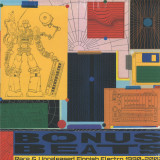
Cold Blow proudly presents Bonus Beats: Rare & Unreleased Finnish Electro 1990–2002, a landmark compilation capturing Finland's underground electro scene from the late 1990s and early 2000s. This double-LP features 9 rare and 3 previously unreleased tracks from pioneering Finnish artists, showcasing a distinctly Nordic approach to the genre. With contributions from notable names such as Jori Hulkkonen, Mr. Velcro Fastener, Mono Junk, and the late Mika Vainio, this release highlights the experimental and DIY ethos that defined Finland's electronic music scene during this period.
Carefully curated by Erkko Lehtinen, a key figure in Finland's electro scene as a DJ and promoter, the compilation explores a broad sonic palette, spanning early techno influences, robotic allure, and dark, bass-heavy tracks. Standout contributions include Decepticons and Dr. Robotnik's unreleased dark electro cuts, with the latter veering into minimal wave territory. Feng Shui feat. Monsieur delivers a striking collaboration that fuses a trance-like lead with raw, industrial beats, uniting members of Huoratron, Nu Science, Polytron, and Op:l Bastards. Keeping alive the legacy of Perttu Häkkinen (aka Randy Barracuda), this release wouldn't be complete without Imatran Voima's bass-driven anthem from their debut EP. Also featured are Spektor's retro synth experiments, Tero's Commodore 64-based creations, Brothomstates' (later a Warp signee) futuristic soundscapes, and a rare cover of Kraftwerk's The Model by the anonymous duo Markus & Kristian. Erkko's extensive liner notes provide additional insight into this culturally and musically significant era. Available in double-LP, this collection is a must-have for electronic music aficionados and vinyl collectors.
j 10: Feng Shui - Hao Hao (I`m Back) feat. Monsieur
King Street Sounds is on a mission to reintroduce timeless house classics to the dancefloor with another iconic release. Their aim, to educate a new generation about the sounds of the old school while also offering fresh remixes for everyone to enjoy.Kerri Chandler's 'Bar A Thym' is back on 12-inch vinyl, featuring the full original 7:24 mix. This track builds, keeping listeners at the brink of euphoria and inviting them to dance. It’s THE perfect groove.The original track is accompanied by a new version via South African producer Themba who adds his signature afro sound to the mix, infusing the song with swing, extra percussion, and heightened anticipation around the various drops.Then the classic Foremost Poet's version, which was a great alternative to the timeless bomb. If you’re a house head, you need this in your life.
- A1: S.i.v.a 01 31
- A2: Galassia M81 04 35
- A3: L'abeille Pourpre 04 31 Video
- A4: Miami 2064 06 09
- A5: L'uomo E La Natura (Part 1) Una Melodia, I Miei Ricordi 04 16
- B1: Dernier Stop Avant Neptune 06 55
- B2: Mer Méditerranée 03 51
- B3: The End Of Capitalism 03 49
- B4: La Terre C'est L'espace 04 29
- B5: L'uomo E La Natura (Part 2) Sogni E Realta 03 25
Emmanuel Mario returns to Karaoke Kalk with his third album under his Astrobal moniker for the Berlin-based imprint. »L’uomo e la natura« (»Man and Nature«) sees the prolific drummer and producer, who has worked with artists such as Laetitia Sadier and label mate Pink Shabab, take a different musical route than before. The French electronic music composer pays homage to the spirit of library music while also making concessions to different strains of pop and even classical music. With only two of the ten songs putting words to the music, »L’uomo e la natura« is a masterful exercise in the evocation of atmospheres: expressing much while saying very little outright—show, don’t tell.
The album was born out of a desire to push the envelope. »I wanted to make music that was both pop and ambitious in its chord progressions as well as surprising in its construction,« explains the Paris-based artist. Taking inspiration from library music artists such as Alessandro Alessandroni or Bruno Nicolai as well as the more cosmic strains of electronic instrumental music, he strove »to create a soundtrack that would immediately bring to mind outer space.« The first of the three singles released ahead of the full album, »L’abeille pourpre,« captures this spirit with funky rhythms and an overjoyed interplay of different melodies, all tied together by wordless yet terminally catchy vocals.
The second single, »Miami 2064,« traverses through many different moods in its six-minute run-time: Starting off as neo-noir synth-wave piece, it then proceeds to pay its dues to the masters of the cosmic music tradition such as Tangerine Dream or, of course, Jean-Michel Jarre before slowly descending back to Earth with guitars and dreamy synthetic vocals, playfully punctuated by a plethora of wistful melodies. It is the perfect encapsulation of the open-ended approach Mario follows throughout the entire album, taking full creative licence in regards to songwriting and arrangements. »I wanted to surprise myself,« he shrugs. He succeeded.
»L’uomo e la natura« rewards multiple listens not only emotionally, but also intellectually. »I also wanted to talk about politics and ecology, because it’s impossible not to,« Mario notes. Some of the track titles express this more openly than others and the two title tracks sung by Mario and Nina Savary use French and Italian lyrics, respectively. However, as a whole the album leaves things open to interpretation. Does »The End of Capitalism« sound elegiac or triumphant? And what do you actually make of this musical vision of the Floridian metropolis, whose mere existence is threatened by climate change already today, four decades from now? Mario doesn’t necessarily answer these questions—he doesn’t tell, he shows.
- Monda
- Vänern
- Volda
- Laisan
- Rocks
- Rose
- Årdal
- Lofoten Sunset
- Haugesund Night Sky
- Anna
180g double vinyl, coke bottle green. One of Sweden's currently most celebrated musicians, Daniel Ögren, releases his album "Pine" on February 12th. Thanks to his solid musical background, he has established himself as one of the country's most influential and versatile creators, both as an artist, multi-instrumentalist and producer for some of Sweden's biggest names. He is one of the members of the two-time Swedish Grammy-award-winning band Dina Ögon, who have made a significant mark in the past few years. Recently, Ögren also released the four-track EP "Daniel Ögren med vänner tolkar Allan Edwall" consisting of interpretations of cultural icon Allan Edwall's musical treasure. Additionally, Ögren produced Broder John's new album "Följ inte mig". Beyond his fundamental role in Dina Ögon, Daniel has also collaborated musically with well-known artists such as Sven Wunder, Eva Dahlgren, Amason, Daniel Johnston, Anna von Hausswolff, Fatouma Diawara, The Greys and Anna Järvinen. As a member of Dina Ögon, Daniel has shaped one of the most celebrated and innovative bands in modern Swedish music.
The influence of the UK’s Steel City on electronic music is well documented and undisputed and continues to push the envelope with key figures such as Winston Hazel (Forgemasters, The Step), DJ Parrot/Crooked Man, Richard Benson (RAC, SWAG, Altern 8), Chris Duckenfield (RAC, Popular Peoples Front, SWAG, All Ears Distribution), a thriving underground club scene and the likes of Synaptic Voyager reinforcing the city’s rich musical legacy.
Matt White and Paul Baines have been making off-kilter, emotive, late night electronic jams since meeting in the early 90’s and while life took them on different paths for a while, they have recently blown the thick layer of dust from their synths and drum machines and got busy in the studio to create some amazing new music which draws influence from that classic UK techno sound which played such an important part in the development of dance music culture around the world. With recent releases on Frame Of Mind, Acquit and Telomere Plastic the duo are clearly on a roll, wearing the heritage of their city on their sleeve and delivering what can only be described as heartfelt, authentic machine music made with love and soul.
From the opening beats of lead track Dawn Till Dusk we are drawn in to another place which feels comfortably familiar yet organic, fluid and loose in a way that tugs on the heartstrings. A million miles from cookie-cutter tech house, this is two guys in a bedroom studio, digging deep on hardware machines to create a sound to get completely lost in. Lonely Promontory takes things deeper still with immersive pads, taught electro beats and blissed-out melodic lines which give just hint of optimism and recall those beloved sounds of B12, Redcell and Likemind.
Flipping over we have Stellar Engine which goes a littler heavier on the beats and bass whilst still retaining a floating quality, once again highlighting the hardware jam workflow that Synaptic Voyager utilise in their studio. Once Exposed takes us back to those heady days of the early 90’s when techno, house and ambient electronics combined to create a heady blend of deep atmospherics and driving beats which could work on both dance floors and car stereos alike. Rounding off the EP we have Cognitive Network which goes for a straighter four on the floor techno groove and a killer bassline to lose yourself in. These recordings were delivered to the label in unedited long form (some tracks totalling 15 minutes or more in length!) which Jimpster lovingly edited into the versions which you hear on this release.
2024 was a big year for Regulate Recordings and their sister club night “Shake Your Rump”. DJ Deviant’s “The Rhythm” & “Make Em Bounce” burned up dance floors in spring, “Summer Jam” saw Atomphunk & Deviant team up with Seattle MCs Mugs and Pockets to devastating effect. “Summer Jam” lit up the second half of the year with support from the Allergies, Boca45 and 6 Music and was included in Craig Charles’s “Funkiest Tracks of 2024”.
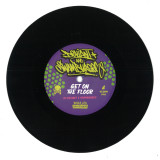
Regulate move into the new year by setting off two certified bangers. Master of the decks DJ Deviant is back on production duties; lead track “Get On The Floor” sees him once again collaborating with Swamburger (Mugs and Pockets) for a full force party starter. The production pulls influences from the earliest days when hip hop and disco were joined at the hip, with nods to The Sugar Hill Gang and The Furious Five, as well as the Golden Age and artists like Chubb Rock and Big Daddy Kane. Swamburger’s machine gun delivery and Deviant’s sharp cuts pull the track right into 2025 for maximum impact.
Flip side “Where’s The Party Clap” is a big trunk of cut and paste funk with a popping bass line, horns, claps, cuts and a groove that just doesn’t quit.
- A1: Progetto Tribale - The Sweep
- A2: Onirico - Echo Giomini
- A3: Open Spaces - Artist In Wonderland
- B1: Alex Neri – The Wizard (Hot Funky Version)
- B2: M C.j. Feat. Sima - To Yourself Be Free - Instrumental Mix Energy Prod
- B3: Mato Grosso - Titanic Expande
- C1: Dreamatic - I Can Feel It (Part 1)
- C2: Carol Bailey - Understand Me Free Your Mind (Dream Piano Remix)
- C3: The True Underground Sound Of Rome - Secret Doctrine
- D1: Don Carlos - Boy
- D2: Lazy Bird – Jazzy Doll (Odyssey Dub)
Vol 2[28,99 €]
Volume 1 of this expertly curated project of 90s Italian House - put together by Don Carlos.
If Paradise was half as nice… by Fabio De Luca.
Googling “paradise house”, the first results to pop up are an endless list of European b&b’s with whitewashed lime façades, all of them promising “…an unmatched travel experience a few steps from the sea”. Next, a little further down, are the institutional websites of a few select semi-luxury retirement homes (no photos shown, but lots of stock images of smiling nurses with reassuring looks). To find the “paradise house” we’re after, we have to scroll even further down. Much further down.
It feels like yesterday, and at the same time it seems like a million years ago. The Eighties had just ended, and it was still unclear what to expect from the Nineties. Mobile phones that were not the size of a briefcase and did not cost as much as a car? A frightening economic crisis? The guitar-rock revival?! Certainly, the best place to observe that moment of transition was the dancefloor. Truly epochal transformations were happening there. From America, within a short distance one from the other, two revolutionary new musical styles had arrived: the first one sounded a bit like an “on a budget” version of the best Seventies disco-music – Philly sound made with a set of piano-bar keyboards! – the other was even more sparse, futuristic and extraterrestrial. It was a music with a quite distinct “physical” component, which at the same time, to be fully grasped, seemed to call for the knotty theories of certain French post-modern philosophers: Gilles Deleuze, Félix Guattari, Paul Virilio... Both those genres – we would learn shortly after – were born in the black communities of Chicago and Detroit, although listening to those vinyl 12” (often wrapped in generic white covers, and with little indication in the label) you could not easily guess whether behind them there was a black boy from somewhere in the Usa, or a girl from Berlin, or a pale kid from a Cornish coastal town.
Quickly, similar sounds began to show up from all corners of Europe. A thousand variations of the same intuition: leaner, less lean, happier, slightly less intoxicated, more broken, slower, faster, much faster... Boom! From the dancefloors – the London ones at least, whose chronicles we eagerly read every month in the pages of The Face and i-D – came tales of a new generation of clubbers who had completely stopped “dressing up” to go dancing; of hot tempered hooligans bursting into tears and hugging everyone under the strobe lights as the notes of Strings of Life rose up through the fumes of dry ice (certain “smiling” pills were also involved, sure). At this point, however, we must move on to Switzerland.
In Switzerland, in the quiet and diligent town of Lugano, between the 1980s and 1990s there was a club called “Morandi”. Its hot night was on Wednesdays, when the audience also came from Milan, Como, Varese and Zurich. Legend goes that, one night, none less than Prince and Sheila E were spotted hiding among the sofas, on a day-off of the Italian dates of the Nude Tour… The Wednesday resident and superstar was an Italian dj with an exotic name: Don Carlos. The soundtrack he devised was a mixture of Chicago, Detroit, the most progressive R&B and certain forgotten classics of old disco music: practically, what the Paradise Garage in New York might have sounded like had it not closed in 1987. In between, Don Carlos also managed to squeeze in some tracks he had worked on in his studio on Lago Maggiore. One in particular: a track that was rather slow compared to the BPM in fashion at the time, but which was a perfect bridge between house and R&B. The title was Alone: Don Carlos would explain years later that it had to be intended both in the English meaning of “by itself” and like the Italian word meaning “halo”. That wasn’t the only double entendre about the song, anyway. Its own very deep nature was, indeed, double. On the one hand, Alone was built around an angelic keyboard pattern and a romantic piano riff that took you straight to heaven; on the other, it showcased enough electronic squelches (plus a sax part that sounded like it had been dissolved by acid rain) to pigeonhole the tune into the “junk modernity” section, aka the hallmark of all the most innovative sounds of the time: music that sounded like it was hand-crafted from the scraps of glittering overground pop.
No one knows who was the first to call it “paradise house”, nor when it happened. Alternative definitions on the same topic one happened to hear included “ambient house”, “dream house”, “Mediterranean progressive”… but of course none were as good (and alluring) as “paradise house”. What is certain is that such inclination for sounds that were in equal measure angelic and neurotic, romantic and unaffective, quickly became the trademark of the second generation of Italian house. Music that seemed shyly equidistant from all the rhythmic and electronic revolutions that had happened up to that moment (“Music perfectly adept at going nowhere slowly” as noted by English journalist Craig McLean in a legendary field report for Blah Blah Blah magazine). Music that to a inattentive ear might have sounded as anonymous as a snapshot of a random group of passers-by at 10AM in the centre of any major city, but perfectly described the (slow) awakening in the real world after the universal love binge of the so-called Second Summer of Love.
For a brief but unforgettable season, in Italy “paradise house” was the official soundtrack of interminable weekends spent inside the car, darting from one club to another, cutting the peninsula from North to centre, from East to West coast in pursuit of the latest after-hours disco, trading kilometres per hour with beats per minute: practically, a new New Year’s Eve every Friday and Saturday night. This too was no small transformation, as well as a shock for an adult Italy that was encountering for the first time – thanks to its sons and daughters – the wild side of industrial modernity. The clubbers of the so-called “fuoriorario” scene were the balls gone mad in the pinball machine most feared by newspapers, magazines and TV pundits. What they did each and every weekend, apart from going crazy to the sound of the current white labels, was linking distant geographical points and non-places (thank you Marc Augé!) – old dance halls, farmhouses and business centres – transformed for one night into house music heaven. As Marco D’Eramo wrote in his 1995 essay on Chicago, Il maiale e il grattacielo: “Four-wheeled capitalism distorts our age-old image of the city, it allows the suburbs to be connected to each other, whereas before they were connected only by the centre (…) It makes possible a metropolitan area without a metropolis, without a city centre, without downtown. The periphery is no longer a periphery of any centre, but is self-centred”.
“Paradise house” perfectly understood all of this and turned it into a sort of cyber-blues that didn’t even need words, and unexpectedly brought back a drop of melancholic (post?)-humanity within a world that by then – as we would wholly realise in the decades to come – was fully inhuman and heartless. A world where we were all alone, and surrounded by a sinister yellowish halo, like a neon at the end of its life cycle. But, for one night at least, happy.
Back in stock due to popular demand, the 23rd release in our signature Brazil 45’s series served up a double header of classics from Sonia Santos and João Donato.
First up, 'Poema Ritmico Do Malandro (Balanço Do Crioulo)' is a beautiful track from the instantly recognisable Sonia Santos. A song that drifts from classic to psychedelic samba, laden with strings, horns and crowd noise. First released on 7” by Copacabana in 1971, but never on an album, originals fetch up to £100 per copy. A different version of this song also appears on the truly excellent Zito Righi Alucinolandia LP.
On the B side, 'Cala Boca Menino' is taken from João Donato’s much sought after and requested Quem É Quem LP. Quirky percussion, bubbling keys, horns and a hypnotic vocal. Donato is a hugely prolific force in Brazilian music and worked with the likes of including Tom Jobim, Astrud Gilberto, Cal Tjader, Dom Um Romao and Gilberto Gil amongst others. ‘Cala Boca Menino’ was released on a 7” in 1973 in Brazil, but is very difficult to find at a reasonable price and in good condition these days.
- A1: Dadge Von O Von Non "83
- A2: Azo Nkplon Doun Nde
- A3: Mo Ngbadun Re
- A4: Fini Les Paves
- B1: Feso Jaiye
- B2: Adigbedoto
- B3: Tu Es Tout Seul
- B4: Yiri Yiri Boum
- C1: Agbadja Moderne No2
- C2: Manzanillo
- C3: L'indomptable Gnonnas
- C4: Bailando Mi Solo
- D1: Gbeto Enon Mon
- D2: El Cochechivo
- D3: Ati Mawuin Dagamasi
- D4: Avivogbe
Analog Africa is back with a dedicated project celebrating Gnonnas Pedro, the king of Modern Agbadja, and they press it up on a marvellous double album that includes an eight-page booklet with a ton of extra info. Although four tracks of his have previously appeared on the 2009 Legends of Benin compilation, this bumper pack features 16 of Pedro's best works, all of which captivated Africa at the time. His vibrant blend of Agbadja, Cuban fon, jerk, highlife and more unique styles, all of which come with vocals sung in Fon, Mina, Yoruba, French, English and Spanish, add up to one hell of a rich sound. This is a great testament to the artist's extraordinary legacy.
Veyl is pleased to welcome Harlem back to the label with a new 8 track LP titled Cage. The Stockholm-based duo of Martin Thomasson and Johan Skugge last appeared on the imprint with 2021’s, Bait, and the project now returns diving deeper in to their infectious cocktail of menacing electronics.
Bringing with them a vast body of work, ranging from dub to minimal techno, with Harlem the pair fuse electro, no wave, post-punk, disco, proto-body, dub, hip-hop, and grime, creating a unique sound that cannot be categorized. Cage opens with “Shut Your Body”, a muscular piece which drills into the surface, setting the stage for what’s to come. Next up is “Fantasy Scan” a dance floor ready jam that picks up the pace and lures us into the pleasure dome. “Blow by Blow” brings a nihilistic energy to a fictional scenario that takes its cues from the past while remaining firmly in the now.
“Kiss The Steel” continues on the slow burning path, dropping us into a dream like state, blurring the lines of reality and plunging us into a surrealist nightmare or reverie? “Dummy Up” comes roaring back, injecting a dose of electro and body that sounds like a soundtrack to your favorite cult gathering. With “Sleuth”, we hear the repetitive grind of a man at work, searching for the unknown, unlocking new mysteries along the way. As we head toward the finale, “Contact High” brings back a seductive dance, ready to movie bodies and stir emotions. Closing things out is “Wiggle Walker”, returning us to a drifter’s journey, a wanderer’s melody that carries us to the end, or is it just the beginning?
Retrofuturism, outer space and limitless exploration are the central themes of Cesar Quinn's second album, "HELO".They incorporate influences from contemporary hip-hop experimentalists like The Alchemist and Armand Hammer, while also revisiting the space jazz of Sun Ra and the ambient probings of Terry Riley.
"HELO" was self-produced by Frederik Daelemans, with co-production contributions from Aram Santy and Youniss. LA-based mixing and mastering engineer Zeroh (associated with Injury Reserve, Liv.e, Pink Siifu) added his hip-hop flair, enhancing the band's sound into a cohesive, sample-inspired experience.
Features play a significant role in "HELO". The first vocal feature is Antwerp artist Youniss on "SMOKE," followed by New York vocalist Semiratruth, who energises "QUASAR." The collaboration with Belgian jazz saxophonist Mattias De Craene, long discussed but never realised on the debut album, finally materialises on "MARS," where he explores a range of saxophones, creating a rich tapestry of sound. The standout feature is undoubtedly Detroit rapper Zelooperz, whose verse and chorus on the title track "HELO" fulfilled a long-held aspiration for the band, given their admiration for his work with The Alchemist and Earl Sweatshirt. Finally, Zeroh lent his deep vocals to the ambient track "BOOTES," further uniting the album.
We are extremely proud to present the OFFICIAL vinyl release of "Subways Of Your Mind" by FEX, a track that captivated music enthusiasts worldwide as the "Most Mysterious Song on the Internet", or short TMS. After years of speculation, the song's origins have been confirmed, and now, for the first time ever, it will be available on a 7" single.
If you don't know what this is about - than look up on Wikipedia.
The release features the original demo version of the song recorded in 1983, faithfully restored and remastered. The single is backed with "Heart In Danger", an equally stunning track from the band, also taken from their original demo cassette. Ture Rückwardt, songwriter and singer of FEX, even considers this as his most favourite.
Don't miss this chance to own a piece of music history!
In the mid 90s, deep within London’s underground scene, Matt Hodgson (7th Voyage) and Laurant Webb (Housey Doingz) created an acid record that slowly became a cult favourite, highly sought after by DJs and vinyl collectors. A seamless fusion of raw acid techno energy and house infused groove.
These standout tracks are driven by sharp, meticulously programmed
drums and massive 303 basslines. Each track unfolds as a raw, evolving journey, balancing tension and release with hypnotic precision. It’s the raw signature sound of the time, still as exciting today
Recorded at Swag Studios Croydon in 1996 and initially released on
Surreal, this record quickly became a treasured rarity. Now, it’s back with a notable reissue as part of the Pariter collection.
Blending influences from classical, film and electronic music, Angus MacRae's extensive musical output encompasses solo albums, concert performances, and award-winning scores for theatre, film, ballet, television and contemporary dance. His has scored internationally touring dance productions, Olivier Award winning shows heard across London's West End and on Broadway, and acclaimed films screened at international festivals. Drawing on themes of memory and imagination, his immersive solo work transcends its classical roots to create transportive, elegiac compositions of unflinching emotional honesty. Spanning three albums and a number of EPs, his work has reached a global audience.
Vivarium, his third full length studio album, is an otherworldly journey through the lost worlds of childhood imagination. A blend of intimate piano, soaring strings, ethereal voices and haunting electronic textures, Vivarium evokes what the artist describes as "a series of bell jars to be traveled between." Reflecting on the album's genesis, MacRae shares: "I spent years trying to capture the emotional resonance of my childhood imagination. As a child, the world felt as magical, mysterious, and boundless as my dreams. In time, fragments of music emerged that seemed to recapture that feeling—a glimmer in the dark, an echo of the magic, fear, and mystery of those early memories. Through Vivarium, I hope to offer a portal back into those worlds."
This exclusive double vinyl release also includes Bell Jar, an evocative bonus track on Side D, featuring a collaboration with acclaimed New York clarinetist Michael Winograd. In this new composition, MacRae reimagines themes from the album, weaving in Winograd's improvised melodies to create a fresh, expressive piece that brings a touch of Klezmer soul to Vivarium's ethereal soundscape.
Stuck on common ground is the debut album of the Italian Power Trio hijss. With a mixture of heavy blues influenced riffs and synthesized Krautrock parts hijss tries to create a high dynamic range that will keep your attention at all time. On top of gritty basslines and ferocious drums lie cosmic guitars, tantalizing vocals and arpeggiated electronic drones. All three band members come from a vast musical background. Their common denominator is with out a doubt a punkish attitude. The album was produced by Toni Quiroga and hijss, drums were recorded at Nologo Recording Studio, Laives by "holy barbarian" Fabio Sforza. Engineered, mixed and mastered at accept productions by Toni Quiroga, album cover by Luca Guarino.
Imaginary friends Akka & BeepBeep share the third release on their label: Floral Ancestors by Raduns. The 12” offers blooming ambient rooted in dub, lush drone and hand-picked cosmic that’s all grown deep in Detroit.
Spacious sonic arrangements vividly swell yet keep grounded within a sculptural rhythmic core. Raduns sows synth basslines and wispy pads next to harmonious guitars and muted field recordings. Grooving propulsion drives throughout. Rhythms appear, in negative space, like outlines between leaves. Recorded with machines direct to SD card, the compositions represent ephemeral blessings of experience. As if strolling into a verdant conservatory, the layered and diverse sensations blend into one cohesive revelatory experience.
On their first record, Raduns draws an ancestral line in Detroit as inspiration. A time when you could ride a streetcar from Dexter-Linwood to Belle Isle. A time before freeway expansion demolished vibrant Black neighborhoods. A time before the rebellion, motown and white flight. A time when Raduns’ great-grandparents were florists in the city, serving the community in times of celebration and times of grief. This melancholic circle shapes the project in which Raduns summons these Floral Ancestors, stretching upward from the darkness of the earth into the light of the world back down once more.
AKKA’s Side: “Grass Boulevard” exhales a luscious soundscape that develops through wave-crashing synths and circulated guitars to a transplanted acid lead. “Spread” lays out a decoration of blended sample and hold synth with kosmische styled guitar licks. Tracked as a single take in a Detroit community studio, the tune intuitively reseeds the symbiotic sprout between krautrock and Detroit techno.
BEEP’s Side: “Metrograde Bouquet” submerges you into the bulb of a handcrafted vase. Dub techno roots grow out into murky water with energy that is subtle yet profound. “Oldest of Arrangements” textures breaths of misty air cascading ventilating in on itself. The track’s time seems to stretch and disappear within a dark and deep undercurrent. A harmonic and reverberant resonance closes the record in a flowering of beauty and peace.
“You’re a flower child. Put this music out.” - Someone Important in Detroit
- Home Is Where You Hang Yourself
- Snakecharmer
- Through The Eyes Of A Child
- A Matter Of Trust
- The Doctor And The Dj
- Sleeping Pills
- Famous To Me
- Can You Blame Me?
- Sugar Water
- Homecoming
- Her Space Holiday-Misery Loves Company (Space Is Easy Mix)
- Aspera Ad Astra-Godspeed (Freedom Fighters Mix)
- Bright Eyes-Contrast And Compare (Making Words Work Mix)
- Novasonic Down Hyperspace-Sounds Just Like An Ocean (Ocean Floored Mix)
- Re Wired
- Micromars-Smile Decoy (To Mars And Back Mix)
- Mahogany-Singing Arc Lamp (Natural Satellites Mix)
- Duster-And Things Are Mostly Ghosts (Version Overdose Mix)
- Her Space Holiday-Famous To Me (Hurtful Kid Mix)
- Tapping
Color Vinyl[32,35 €]
Available on Bedroom Isolation Frosted Silver Still Void Crystal Clear vinyl for indies only. Genre: Indie Rock / Electronic. Following his post-hardcore heroics with Indian Summer and Calm, Marc Bianchi unplugged his distortion pedal and switched on the four track. From his boyhood San Mateo, California bedroom, Her Space Holiday explores the bewilderment of young adulthood through a dreamy prozac lens. This expanded 25th anniversary edition of Home Is Where You Hang Yourself includes an extra LP of remixed songs from Duster, Bright Eyes, Micromars, and Mahogany, an elegant tip-on jacket, lyrics, and 20 milligrams of millennial malaise. Ask your doctor if Her Space Holiday is right for you