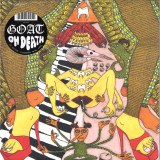
Formidable psychic warriors, channelers of the mystic and proponents of a spiritual quest that transcends this realm, Goat remain a band shrouded in mystery. Travelling from their inscrutable origins in the Swedish village of Korpilombo across the stages and festivals of the world in the last decade, this band has created their incendiary music entirely according to their own co-ordinates. With all this in mind, the casual observer might have guessed from its title that ‘Requiem’, their beatific and melancholic album of 2016, was to be their last. Yet the ancestral spirits summoned by their art are always restless. Thus the eternal cycles of rebirth have triumphantly produced ‘Oh Death’ - a ceremonial conflagration as powerful as any this band has made. Invigorated by forces we can only guess at the origins of, ‘Oh Death’ is a party to which all are welcome. Blithely waving away easy classification, these heat-hazed serenades are just as comfortable in the headspace of vicious ‘70s funk as they are in zesty ZE records post-punk. Folk-haunted incantations and free jazz skronk here find common ground, buoyed by relentless forward motion and raucous energy. Yet all of the above is locked into a delirious gnostic groove that threatens to throw the whole shebang spiralling into orbit. ‘Oh Death’ is driven by a supernatural charge that unifies, invigorates and transcends borders, whether geographical, musical, or between this world and the next. In the hands of these sages and soothsayers, this is just the beginning.
Buscar:beat inc
San Diego born and raised DJ/Producer, Dillon Marinez, today releases his latest EP ‘Wormhole’, out now on Dirtybird.
Curated by Claude VonStroke, the compelling two-track project presents a dynamic soundscape showcasing the sonic duality of one of Dirtybird’s newest rising stars. The chaotic, high-energy sound of its titular track ‘Wormhole’ is instantly mesmerizing, while its companion ‘Facelift’ is a deep, rolling burner.
Regarding the EP, Dillon Marinez said, “My first Dirtybird Campout inspired both tracks. Claude’s set especially was full of some thick stabby bass which was right up my alley. This sound gave me an idea for each lead and the rest flowed naturally.”
Continuing to grow as a consistent member of the Dirtybird flock, Marinez’s latest EP, ‘Wormhole’ marks his fifth release on the esteemed label following last year’s ‘No Pressure’ EP and earlier singles like ‘Dance For Me.’
Taking inspiration from funk, hip hop, and reggae, Marinez credits his father and brother for exposing him as a kid to the multi-genre sounds that shape his music style today. A bassist since childhood, it was only natural for Dillon to be drawn to the ebbs and flows of house music. Learning Ableton in college, Marinez was able to incorporate a blend of rhythmic elements to create his unique bass lines and incredibly catchy beats known to captivate crowds.
Releasing music on Dirtybird marks a full circle moment for Dillon, as he has previously named Dirtybird’s artists Justin Martin and Shiba San as major sources of inspiration for his music.
Marinez invites fans to join him on his rhythmic journey and stream ‘Wormhole’ today.
The essential series from the ’80s has been rebuilt, remastered, and carefully portioned onto a five disc set of 7-inch singles, including all the classic vocal bits that became iconic samples, and more than a few new additions to bring things up to date.
Where would dance music be without Acapellas Anonymous? Although many records claim to have changed the game, the arrival of the Acapellas Anonymous series in the mid/late ’80s actually did just that. A hugely popular, multi-volume set of vocal tracks sourced from a wide variety of dance classics, AA was used extensively at the dawn of sampled music to provide hooks for numerous hits. “I’ve Got the Power,” “Ride On Time,” multiple Clivillés and Cole tracks, Pal Joey’s “Party Time,” ’90s Italo house and rave cuts, and untold others all found their choruses among the many acapellas collected on the series. As Ultimate Breaks & Beats was for funk and hip-hop sampling, so was AA for dance music, both for producers and as a must-have for the creative DJ. Sure, before these records came along, DJs had their own choice vocal bits that they used in sets or layered into edits. But suddenly, much like Ultimate Breaks, these carefully guarded secret sources were available easily, and in convenient form, for the first time. And the response, from DJs and a new generation of producers, was immediate.
That part of the story is widely known, and indeed, was widely experienced by anyone paying attention to music of the time. But the questions linger: who was it that found these acapellas, many of them only existing on promo singles, or as tiny fragments buried on obscure B-sides? Who edited and put them together? By now, you may have guessed that once again we owe an enormous debt to the maestro of edits and our hometown hero, Danny Krivit. And it’s to him we must tip our collective caps for this latest release, a carefully revised, fully remastered, and immaculately executed update to the series — this time on 7-inch.
All of the classics are here, rinsed but still powerful: “Let No Man Put Asunder,” “Weekend,” “Don’t Make Me Wait,” “You Don’t Know,” and dozens more. New additions make a few clever appearances as well, with Roland Clark’s “I Get Deep” (used for Fatboy Slim’s “Star 69”), and Rickie Lee Jones’s stoned rambling known as “Little Fluffy Clouds” showing up for the first time. This is no nostalgia trip — Acapellas Anonymous was recently tapped for a Cardi B megahit, and naturally you’ll find that source, Frank-Ski’s “Whores In This House,” included. All in all, an astounding 80 high-quality acapellas and vocal hooks are spread across the five 7-inch, 33RPM singles, which have each been sequenced thematically with attention paid to timings and tempos to provide maximum utility for the working DJ. And if the past is any indicator, we will likely see a new crop of tracks spring up as these find their way into the production toolkits of the world’s track-makers.
Wau Wau Collectif's second album, Mariage, is instilled with a newfound sense of purpose. Expanding upon the inspirational themes of their acclaimed 2021 debut, Yaral Sa Doom (Educate The Young), this long distance collaboration from musicians in Senegal and Sweden's Karl Jonas Winqvist is an even more stylistically expansive affair. Joyful children's songs collide with fuzzy guitar solos and thumping hip-hop beats. Shimmering synths lift off from the plunky percussion of the balafon and versatile sounds of the 22-string kora. Familiar voices from the first album return with more explicitly political lyrics, while the music feels both rhythmically dense and sonically weightless, flowing from one spellbinding moment to the next. For Mariage, band members from each country were inspired to include a wider array of instrumental flourishes unique to their cross-continental collaboration. "Yay Balma" revolves around the cycling riffs of Jango Diabaté's xalam guitar, as this song's fuzzy tones and soaring sax solos open side two with a bang. "Pitchi Goubidi" provides a stark contrast, with the kora played like a harp and Gilbert Badji's gravelly lyrics about "the bird of the night" disappearing into dubbed-out chamber pop. Winqvist's omnichord hovers back into focus on "Yonou Natangue," a free-floating jam that maintains the messages of Wau Wau Collectif's debut, promoting youth education to address the social issues facing contemporary Senegal: "Peace is the better wealth / The way to wander."
Following the release of Barbie Bertisch’s debut album Prelude in June 2022, Love Injection is thrilled to announce Prelude Remixes via Love Injection Records, which features six artists new to the label, kicking off with a two-track 12” single followed by a full digital release. Love Injection is the label and fanzine Bertisch runs with her partner, Paul Raffaele. The duo are romantic about remixes as an artform and always intended to have reinterpretations be the next phase after Prelude. Often reduced to ways to extend a hype cycle, or disjointed add-ons, Love injection’s remixes exist in dialogue with the artist’s songs.
The 12 inch single will inaugurate the project, with Montreal’s Gene Tellem on the A side, and Panorama Bar residents Lakuti and Tama Sumo on the flipside. On the “GT Remix”, Bertisch gushes that “Gene is very good at creating and sculpting atmospherics in her productions. She really grabbed the song and took it to a different place.” Tellem's version of “After The Storm” is faster, elastic and pulsing with an almost primordial intensity.
Creative and life partners Lakuti and Tama Sumo take on “Fertile Garden (Emerge)”. Lakuti, originally from South Africa, got her start DJing in the Johannesburg house scene of the ‘90s. She is now based in Berlin and often DJs with Tama Sumo, who grew up in Bavaria and moved to Berlin in 199x and has been a staple in the scene there since. The duo, both residents of Berlin's Panorama Bar, turn “Fertile Garden” into an ecstatic, unrelenting beat-down, best fit for peak time.
Deca’s streak of entrancing releases continues with Smoking Gun, an album that deftly blends psychedelic, raw production with sharp insights and clever lyricism. But it’s also much more than that. Smoking Gun is a sonic representation of an artist grappling with living in America, a country with a network of broken systems that leaves Deca questioning when and if it may turn around. To say this all makes for a compelling listen would be a vast understatement, because the New York City-based rapper/producer knows the key to presenting this material. He does it in a way that’s both refreshing and new, but never isolating or simply too oddball. There’s a left-field quality to his work, but Deca knows exactly what he’s doing. To prove that point, he enlisted fellow outside-the-box thinkers like Blu and Homeboy Sandman to appear on some of the album’s standout cuts. “Shelter,” which features Blu, is a jazzy, dusty piece of thoughtful hip-hop with crazy flows and lyrics to match. It’s so good you’ll wish these two would record an entire project together, and the same goes for Boy Sand’s appearance on “Dawn Wind.” Backed by Deca’s own low-key funky production, both he and Homeboy Sandman go verse for verse, each offering their own take on how to liberate yourself from the machine that aims to surveil and control both our outer world and inner peace. Other tracks embody a similar energy, including the justifiably cynical “St. America (feat. DJ Stan Solo)” and stunning “Tuning.” The latter track may just be the most impressive piece on Smoking Gun, thanks in part to the mind-melting beat-switch. It’s a thrilling musical journey that furthers Deca’s narrative about mankind’s ethical plight, and the problems we collectively face. TRACKLIST: 1. Smoking Gun (Intro) 2. St. America (feat. DJ Stan Solo) 3. Tuning 4. Blight 5. Flight Path (feat. Ichiban, DJ AWHAT!) 6. Hive of Industry 7. Crab Apples 8. Shelter (feat. Blu) 9. Tunnel Under 10. Dawn Wind (feat. Homeboy Sandman) 11. War Heads 12. The Eagle's Descent
Italian The Villains Inc. moves up a gear with its fourth release to date and already the second in less than a year!
Conscious “Time To Go Back EP” introduces the exclusive collaboration between label owner Gab.Gato (Dominance Electricity, Drivecom, SolarOne) and his partner in crime Jack Bags (La Sabbia) from Milan.
Together, they drop an untouchable dancefloor oriented five tracker based upon a terrific concept.
Coming from the year 2106 with a preventive message to save Earth from manhandled destruction, scientist Dr Boomer understands how much it’s too late to prevent the planet from Armageddon.
A side opens with insane “Man Of The Future”: a pure analogical time machine merging whispers a la Egyptian Lover to heading vocoder sequences over a sharp 808 programming.
Luminous and hypnotizing at the same, this oldschool anthem is instantly followed by enthusiastic “No Permission”.
A groovy bassline melt with acidic loops turns the song into a masterpiece enhanced by funny vocal scanding “You Have No Permission To Get Into My Head”.
Top notch! With its fierce rhythm and relentless beats, title track “Time To Go Back” coming next signs an ode to the glorious days of West Coast electro sound.
Vintage sonorities fuse into cutting-edge drums while a funky atmosphere will propel you through time and space. Ace!
The flipside goes deeper into the realm serving up what appears as the climax of the EP. Combining gloomy strings to progressive swirls and ethereal chords, well named “Darkness” delivers a scary yet prophetic message from the future that will spread guilty feelings to any listener: “There Will Be No Light, No Hope…”. You have been warned! Last cut “The Bad Place” concludes the 12” on a soulful note regarding the state of our world controlled by government and technology.
Completed by a fantastic comic style artwork, awaken and despair “Time To Go Back EP” offers an outstanding retrofuturist release from which no one will come out unscathed.
One of the best outings in The Villains Inc. so far, rush on it!
*Ltd Coloured Vinyl on Transparent Blue Vinyl* London-based musician and producer Ryan Lee West, aka Rival Consoles, creates driving, experimental electronic music that makes synthesisers sound human. His consistent desire to create a more organic, living sound, sees him forming pieces that capture a sense of songwriting behind the machines.
‘Now Is’ marks a new chapter in an ongoing quest for refinement and evolution. More playful and melodic, the album draws from much experimentation in minimalist songwriting and seamlessly blends synthesisers and acoustic instruments. “There are some pieces that are influenced quite strongly by the isolation and anxiety of these times. There are also pieces which are more optimistic and vibrant, which I think is a consistent attitude of my records, as I want art to express many aspects of life.”
From the elevating arrangements of ‘Beginnings’ and motorik beats of ‘World Turns’, to the isolation of ‘Frontiers’, influenced by the barren landscapes of Iceland, Rival Consoles’ eighth studio album subtly morphs and evolves. “The title of the record ‘Now Is’ interests me because it is the beginning of a statement, but it is incomplete. I like art that is open and suggestive of ideas even if they are inspired by very specific things. With my previous record ‘Overflow’ being very dark, heavy and almost dystopian, I wanted to escape into a different world with this music and ended up creating a record which is a lot more colourful and euphoric.”
For the sonic ‘Vision of Self’, West looked to create the kind of movement and colour a string section in an orchestra would construct, but with synthesisers. “I think there’s a lot of synergy between the two worlds. I wanted to create a hypnotic journey, where the synths and sounds weave in and out of each other, so you get lost in the music and don’t know where one sound starts or another ends.” This “journey” West refers to is symbiotic of the way he has approached music throughout a progressive career – an ongoing project that is never static and always moving forward.
A sense of euphoria is reached with the pulsating title track which bursts into colour like the appearance of the summer sun, while ‘Echoes’ is a vivid exploration of rhythm and sound for summer nights. The track starts with a dense collage of modular synths, fragmented metallic tones, broken sounding drums and a downcast melodic synth line. “This is a piece where the main melody has been in my head for a long time and was just waiting to come out. I kind of think of it as the sonic equivalent to an impressionist painting in that I wanted to explore the sensation of lots of small layers of different colours and textures that are constantly moving around each other.”
Rival Consoles is set to appear at festivals across Europe this summer, with headline shows expected to follow in the autumn.
Twisted and irreverent, The Rabbits combined ear-splitting guitar shrapnel with one of punk’s greatest-ever snot-nosed vocalists. With hints of PIL or Chrome, but beamed in from a parallel dimension and filtered through the warped lens of visionary loner Syoichi Miyazawa. First-ever vinyl release, fully remastered from the band’s original early ’80s cassette releases, and housed in a sturdy tip-on sleeve. Includes a double-sided, printed insert. Edition of 500
Singer-songwriter Syoichi Miyazawa’s tale is a confounding one.
He grew up in a small town in Yamagata Prefecture (in northern Japan), loved Dylan and The Beatles, and had very little exposure to, or interest in, underground music. And yet, shortly after 24-year-old Miyazawa arrived in Tokyo in 1978, he began performing solo shows at tiny clubs in the city, singing and playing guitar. His performances quicky devolved from brisk acoustic jaunts to lengthy, heavy dirges sung in a snot-nosed wail over a blown-out electric guitar detuned to produce a kind of sonic sludge.
At one of his earliest gigs, a mutual friend introduced him to Endo Michiro, who would soon become the legendary front man of Japanese punk icons The Stalin. It turned out Miyazawa and Endo had attended Yamagata University at the same time just a few years earlier, but hadn’t known each other at school. In Tokyo, they became fast friends, moved into the same apartment building, and for years were inseparable. Endo played guitar and drums on Miyazawa’s debut release, the “Christ Was Born in a Stable” flexi disc. But while Endo was social and outgoing, Miyazawa preferred to be alone, avoiding concerts unless he was performing.
Despite these antisocial tendencies, Miyazawa came to despise playing solo. In 1982, an eccentric high school student named Chika introduced herself at one of Miyazawa’s gigs, and Miyazawa asked if she’d play bass. She agreed and drafted two of her friends to play second guitar and drums. The Rabbits were born.
Miyazawa wrote the tunes, and had a clear vision for the group, but struggled to get the sound he wanted from the other members. His second guitarist was more of a fusion player, and Miyazawa took great pains to get him to tone down the shredding. The group quickly went through multiple line-up changes. Frustrated with the sound of their first proper recording (self-released as the “X1(x)” cassette), Miyazawa spent a full year mixing their second cassette, “Winter Songs,” on his own.
The hard work paid off — the sound of “Winter Songs” is striking, and unlike anything the band’s peers produced. There’s liberal use of delay on the vocals, giving the music a psychedelic feel, but the guitars are caustic, cutting through the mix like metal shrapnel. The rhythm section seems on the verge of teetering out of control throughout, an overdriven and pummeling current below abrasive slabs of guitar and vocals. Even at their most aggressive, though, The Rabbits had strong pop sensibilities, complete with cooing backing vocals and the occasional harmonica solo. Miyazawa delivers his borderline nonsensical lyrics with equal amounts of menace and gaiety, consistently riding that fine line as only a natural oddball can. At times, the band sounds like a distant cousin of PiL, Chrome or The Homosexuals, but beamed in from a parallel dimension and filtered through Miyazawa’s warped lens.
Although The Rabbits briskly sold all 500 copies of the "Winter Songs" tape, live audiences at the time seemed dumbfounded by the group, and would stare at them in silence. After two years together, The Rabbits called it quits in 1984.
When asked if any of the many legendary groups (Les Rallizes Desnudes, G.I.S.M., etc.) he shared stages with left an impression, Miyazawa recently revealed that he always left the venue as soon as he finished performing, so he never caught any of the other bands…
All of which is to say —
The Rabbits are one of the great punk bands of the early ’80s, but their leader had no interest in the punk scene and always thought he was making “normal” music. They rubbed shoulders with a slew of notable groups of the era, and their singer was best friends with arguably the most famous Japanese punk of all time, but Miyazawa shunned fraternization and purposefully distanced himself from his peers.
Could this be why so few underground music fans are familiar with the group, even in Japan? Why they seem to have been written out of the official history of Japanese punk? One can never know for sure, but Mesh-Key hopes to remedy this travesty by offering this compilation, the first-ever official LP by The Rabbits, to a new generation of punk and psychedelic music connoisseurs.
credits
new pressing on red & black swirl vinyl. RIYL: New Order, Drab Majesty, The KVB, Black Marble, The Soft Moon. Layering synths, guitars, electronic percussion and live drums, Houses of Heaven fuses early industrial and techno rhythms with the melodicism of shoegaze and a heavy dose of dub-influenced effects on their first full-length album titled 'Silent Places.' Written against the backdrop of the Northern California wildfires, ever-growing tent cities and the continued rise of empty luxury housing in the Bay Area, the album explores the intimate experiences that transpire within the chaotic confines of modern living. Opener "Sleep" basks in the tension surrounding the album's inception with blown-out kick drums, claustrophobic verses, and deteriorating vocal effects. Sharp arpeggiated synths and woozy strings neutralize the track's subterranean anxiety with texture and sensuality. Produced by Matia Simovich (Inhalt) and with engineering credits that include Monte Vallier (Weekend) and John McEntire (Tortoise), it's a potent introduction to the muscular sound design underpinning the album. Booming taiko drums sound the beginning of "Dissolve the Floor," the album's most club-ready track. A pulsing arpeggio gives the song its industrial heartbeat while disintegrating tape delay throws menace into the hazy atmosphere. The undulating techno beat breaks and repairs itself with seductive and satisfying timing. "In Soft Confusion" doesn't stray from the album's obsidian narrative as it envisions and ponders the aftermath of human extinction. Sonically speaking, though, it's the album's most uptempo offering with Tecon's supremely infectious chorus vocal hook and Beck's dizzying guitar riffs. The intricate electronic drum programming is elevated by Ott's live drumming, which lends a refreshingly human touch to the potentially icy, and often mechanical, sonic territory of synthdriven music. Adding density to the album's shadowy allure are the unusual sounds and vintage outboard effects that Tecon and Simovich impressively maneuver into the album's tonal palette. Great care has been taken to finesse familiar pop structures with an inventive edge. It's this mindfulness of past and present that is sure to secure Silent Places as a standout album in the new decade. Also Available From Houses Of Heaven: Remnant 12" EP
Jozef Van Wissem- Lute, Electronics, Beats, Electric Guitar, Found Bird Sounds. In 2013 van Wissem won the Cannes Soundtrack Award at the Cannes Film Festival for Jim Jarmusch’s “Only Lovers Left Alive “. In December 2017 Jozef van Wissem was invited to perform the madrigal depicted in Caravaggio’s painting The Lute Player (1596) at the Hermitage museum of Saint Petersburg. In 2022 three of his works were used for in the soundtrack and trailer of Irma Vep (HBO). His completely unique musical world can be easily verified by his collaborations, especially that these relationships are also strengthening his own musical character. He worked together with Zola Jesus, Tilda Swinton, Jarboe as well as with his long-time collaborative partner, also his friend, Jim Jarmusch. “La Cinémathèque Française in Paris commissioned me to write and perform the score at the presentation of the restored version of Nosferatu. I was a bit overwhelmed by its success. It was sold out. I wasn’t going to repeat it. But people kept asking. In the beginning the soundtrack was more improvised and reactive to the images but after a few times the audience kind of showed me the way. To start with a few notes and building the score slowly to a dense slow metal ending. I found an old 7-inch single with recordings of extinct birds on a market, I electronically processed and added them to the score . “ Manipulating the sounds of electric guitar in alternate tuning he manages to create the feeling of fear, equal to the experience of the victims of Count Orlok. “To me Nosferatu personifies this Death Bird of the Plague. The Black Death depicted in the film offers a timeless parallel with contemporary society. The vampire Count Orlok infests the city with rats and people are infected with the plague. They must quarantaine. This provokes hysteria. Much like nowadays”. With a melodic almost medieval magic and mystery Jozef van Wissem has reignited the light through the filters of dark energy post punk and even black metal into a wondrous new melodramatic cinematic space…- John Robb (Louder Than War) Beginning with a solo played on the lute, his performance will incorporate electric guitar and distorted recordings of extinct birds, graduating from subtlety to gothic horror. – New York Times Delightfully macabre, intense and electrifying – MXDWN
- 1: Hello From The Spirit World (Instrumental)
- 2: The Gates (Instrumental)
- 3: Button Masher (Instrumental)
- 4: Dog At The Door (Instrumental)
- 5: Gauze (Instrumental)
- 6: Pizza Alley (Instrumental)
- 7: Crystal Sword (Instrumental)
- 8: Boot Soup (Instrumental)
- 9: Coveralls (Instrumental)
- 10: Jumping Coffin (Instrumental)
- 11: Holy Waterfall (Instrumental)
- 12: Flies (Instrumental)
- 13: Salt (Instrumental)
- 14: Sleeper Car (Instrumental)
- 15 1: To 10 (Instrumental)
- 16: Attaboy (Instrumental)
- 17: Kodokushi (Instrumental)
- 18: Fixed And Dilated (Instrumental)
- 19: Side Quest (Instrumental)
- 20: Marble Cake (Instrumental)
- 21: The Four Winds (Instrumental)
Following the success of Aesop Rock's most recent solo album, Spirit World Field Guide, he returns to deliver the instrumental version of those interdimensional adventures. Aesop has long been celebrated for his talents as a lyricist, but he has continually grown and evolved as a producer as well. While the original Spirit World Field Guide was packed with insightful chapters of firsthand know-how into the terrain, wildlife, and social customs of our parallel universe, the Spirit World Field Guide Instrumentals not only set the tone but also provide the roadmap for you to take your own journey. Welcome to the Spirit World. Explore with intention. "He's never before been such a commanding presence behind the boards. The beats here are the best of his career, full of torque and life." - Pitchfork "The strongest collection of beats he's ever produced." - Passion of the Weiss Official instrumentals from Aesop Rock's critically acclaimed album, Spirit World Field Guide, available for the first time. Album produced entirely by Aesop Rock, except for "Sleeper Car" produced by Hanni El Khatib. Additional album instrumentation provided by Grimace Federation and Hanni El Khatib Vinyl packaging includes 12" matte gatefold jacket, printed record sleeves, and one each of transparent cloudy effect green/blue double-vinyl, plus free digital download card. Album artwork illustrated by renowned artist Justin "Coro" Kaufman
Saft's X series signs up accomplished French house artist Pablo Valentino for a new EP that features Patchworks and includes a remix from Seb Wildblood. Valentino hails from East France but his work has made a global impact. He runs FACES Records and is A&R for the cult MCDE Recordings. Next to that he DJs around Europe and has produced both solo and as part of collectives such as Creative Swing Alliance and Hipster Wonkaz for labels like MCDE, Eureka and Room With A View.
Atmospheric opener "Look Deeper" is a rough and steamy deep house cut for cosy basements. The drums are raw and alive, the lead synth is haunting, and the keys bring a jazz feel while vocal coos add some serious soul. French jazz, soul and deep house artist Patchworks guests on "X Rousse", a freewheeling jam with loose-limbed drums and funky chords. It channels the spirit of Moodymann and is sure to bring heat to any party. The final original is "Bagaco"; a bubbly and percussive number underpinned by warm bass stabs. The dynamic groove never rests and raw claps amp up the energy throughout.
Seb Wildblood is a driving force in the South London scene thanks to running Church, All My Thoughts and Coastal Haze. From house to downtempo, leftfield to techno, he has a broad stylistic range that always looks forwards. His remix is a celebratory broken beat workout. It's all about big stabs, soulful smeared chords and cutting loose on the dance floor without a care in the world. Once again, The Saft X
- A1: Ataxia - Detroit Gospel
- A2: Ataxia & Andres - Pine Island
- A3: Ataxia - Language
- B1: Ataxia & Dj Minx – Maxia
- B2: Ataxia - Spit In Your Percolator
- B3: Ataxia - 98 Degrees
- C1: Ataxia - Number Streets
- C2: Ataxia - The Formulator
- C3: Ataxia - The Pusher
- D1: Ataxia & Mister Joshooa - Feels Like
- D2: Ataxia – Wm
- D3: Ataxia - Dance The Bridge
Having torn up raves for well over a decade, the Detroit duo Rickers and Ted Krisko AKA Ataxia present their debut longplayer ‘Out Of Step’. Featuring guest spots from close peers DJ Minx, Andrés and Mr Joshooa, they twist house, techno, electro, breakbeat and rave into revitalized new shapes; embellished with a touch of soul, funk and hip hop. With backgrounds in hardcore and punk, Ataxia’s debut is suffused with that energy, attitude, and approach; this is raw, lean and unashamedly no-nonsense dance floor tackle that goes straight for the jugular. Heavily analogue, the album experiments with tape saturation, which harks back to the duo’s formative years in bands, recording demos to cassettes. These straight-up, in-the-red tracks give preference to overdriven drum machines, rather than generic polished sheen, but conversely, it’s all deceptively well-crafted too; ‘Out Of Step’ is a standout record that’s big in character, bringing to mind the renegade spirit of Underground Resistance, and the bombastic brilliance of The Prodigy and Chemical Brothers.
Defiantly optimistic despite the state of the world, a “life is good” vocal sample meets minor chords sliding over 808 hats on the exemplary house/techno pumper ‘Detroit Gospel’, before a lighter moment on the album, but no less impactful with its hefty low-end thump, is ‘Pine Island’ featuring Motor City hero Andrés. Together they cook up a Motown-inspired house cut awash with horn swells and backup singers, bouncing to wide swung funk bass, in classic 313 style. ‘Language’ turns the club on its head – busting out one of the most distinct basslines in recent times, and bristling with buzzy, undulating chords, whilst ‘Maxia’ features influential Detroit royalty DJ Minx. Inspired by her classic ‘A Walk In The Park’, with a fat distorted kick and stealthy bass groove, this is low-slung, stripped-back, heads-down coolness. The high-tech funk of ‘Spit In Your Percolator’, is laser-guided in its efficiency, with a strobe-like, increasingly intensifying energy, peppered with clever, tripped up vocal chops. With the next cut, conveyor belt noises and fast churning low-end gives way to a dubbed-out breakdown, on the deep breakbeat roller ‘98 Degrees’. Charged with a blistering, rave intensity, ‘Number Streets’, is a futuristic distorted techno workout that booms through the subs, whilst ‘The Formulator’ mixes filtered snippets, abstract synth noises and melodic bleeps with a bassline echoing Paperclip People’s ‘The Floor’. Closer to the UK definition of hardcore, combining 4/4 and breakbeat, ‘The Pusher’ evokes the spirit of late 80s orbital raves, adding a natty keys solo, and deadly bass used sparingly, for even deadlier effect. ‘Feels Like’ sees Rickers and Ted team up their studiomate and fellow TV Lounge resident and club booker, Mister Joshooa. Inspired by Photek but also almost UKG in style, this breakbeat session is stamped with MJ’s signature chopped vocals and intricate rhythmic interplay. The bubbling, wobbly loose swing of ‘WM’ is constructed around a classic chopped-up MTV cribs sample, with a filtered vocal creating a far out psychedelic effect – all of which is propelled apace by a huge bruising LFO. The LP concludes in fine style with ‘Dance The Bridge’, where bouncy beats and wigged-out keys meet bright, gently uplifting synth chords that bring a clear-skied mood; ending the record as it began, on an optimistic note.
‘Out Of Step’ marks another chapter in the ongoing relationship between Life and Death co-founder DJ Tennis and Ataxia. Their connection goes back to the earliest days of the label, where they played gigs together on some of Tennis’ initial visits to Detroit. It’s a friendship that’s blossomed organically over the last decade through their shared love of punk and hardcore, and led to the fruition of one of Ataxia’s most compelling projects to date. Labels to release Ataxia’s output include legendary Detroit techno imprints Planet E and KMS, plus the seminal American house label Nervous Records. Their catalogue also includes music for Visionquest, Leftroom, 20/20 Vision and Seth Troxler’s Play It Say It.
After his latest ‘Youth EP’ that experimented with spacious vocal chops and whimsical soundscapes, Nocow returns with a relentless flurry of blows on the heavily computerized ‘Magnit EP’ released on npm. Featuring gloriously broken melodies and hard-hitting rhythm, Nocow explores the darker, more formulaic side to his sound. Brooding acid-infused synths shimmer across the four tracks, morphing between moods as the EP progresses. ‘Magnit S’ kicks off the EP with scattered bass hits, driving dark techno arpeggios, and a hint of footwork-esque percussion. The intense atmosphere is a relatively new direction for Nocow, straying from his more meticulous, introverted beats prior. ‘Kali’ incorporates warbled synth with a more subdued rhythm, playing with a modular sound and distant echoes of robotic vocals. This fragmented track is more akin to his 2018 sound of the Voda/Vozduh/Zemlya trilogy as the kinetics of sound play a strongly defined role in the overall sonics. ‘Sputnik’ commences with a blistering arpeggio of bit-crushed synth and chimes. The rocket-propelled pacing creates a frantic, yet ultimately controlled piece, worthy of a place in a club 300 years from now. Yet, after the frenzy comes the calm. The closing track ‘Extasy’ grinds the EP to a kaleidoscopic halt. Vocoder passages drift across the dense soundscape as Nocow transports you to an other-world, filled with spacey percussion. This closer is a well-deserved return to solid ground, following the perpetual trio of dark, yet utterly compelling techno pieces. Once again, Nocow exhibits his multi-faceted approach to electronic music that truly sets him apart.
Wütrio is the first in a series of re-issue albums curated by legendary German DJ, producer and rare vinyl collector Rainer Trueby. 'Wütrio' is the critically-acclaimed album first released in 1987 on the Bremen based label, Thein Records . A label started by Friedrich Thein whose musical pedigree includes links to the world class and world famous Thein Brass instrument makers and retailers. 'Wütrio', the band, originally formed in the Bavarian city of Würzburg and went through line-up changes before recording this album with founding members Robert Schulte Hemming and Rudi Engel complemented by Wolfgang Pusching, Martin Kübert, Peter Wirth and the amazing vocal talents of Beate Kynast. The album is a work of art; Jazz it certainly is, but it is so much more than this one genre as it moves like a cabaret aboard the Trans-Europe Express travelling across genres and changing tracks as it picks up Samba, Jazz-Rock, Fusion, Electro-Funk and the New York Avant-Garde on its journey. From his time as one half of production duo 'A Forest Mighty Black', Rainer Trueby has been at the forefront of cutting edge Black music as creator, disseminator and curator. Previous releases through BBE include the must have 2020 compilation 'Soulgliding' and co-productions with DJ Kon on the 'Kon and the Gang' album from 2016. It is worth noting that it is Rainer himself who gave the name 'Soulgliding' to a genre of certain paced and soulful groove of music that now bears that name. His selection of the 'Wütrio' album to kick off a highly collectable series of re-issues is an inspired choice.
Robert Groslot's Concerto for Bass Guitar and Orchestra represents the
next step in the evolution of the bass guitar
Groslot's composition pushes the instrument to its technical limits, while creating
a unique symbiosis between the soloist and the orchestra. Although he may not
be the first composer to write for the bass guitar in a symphonic setting, Groslot
brings a level of artistry and sophistication to the composition that will continue
and accelerate the legitimation of the bass guitar within contemporary classical
music. "The idea of a concerto for bass guitar is something that I have been
dreaming of for decades. Since its invention, the bass guitar has firmly
established itself as an essential and integral part of practically every genre of
music. The bass guitar, as we now know it, was invented and produced by Leo
Fender starting in 1951. The more portable bass guitar, in comparison to the large
and unwieldy double bass, was capable of playing at higher volumes via
amplification and satisfied the new sonic demands created by the widespread
use of electrification in popular music. By increasing the overall scale of the
electric guitar and only using the lowest four strings (E, A, D, G), Fender gave birth
to a new instrument. Traditional double bassists could quickly adapt, with the
added benefit of more accurate intonation due to the frets. Hence the original
name: The Precision Bass. At the same time, guitarists could also become bass
players when called upon. As a result, many of the early bass guitarists began
their musical life as guitar players, with the most well-known example being Paul
McCartney of The Beatles.
The fact that the bass guitar had no direct lineage like the evolution of the piano
or violin over time, led to a variety of disparate playing styles without any
fundamental methodology. Unlike the more traditional instruments, the bass
guitar does not sit upon a foundation of centuries of proven methods and
established schools of playing. The evolution of the bass guitar has been a
patchwork of trial and error by active musicians. This has led to a plethora of
personal approaches and hybrid-styles, effectively leading to the rapid evolution
of bass guitar technique. Given its relatively young history, it is remarkable how
the bass guitar has grown from being an instrument taken up out of necessity, or
as an afterthought, to being as respected and vital to modern music as any of the
older, more established instruments." - Thomas Fiorini
Ever since he remixed Abimaro & The Free’s ‘Mark’ back in 2014, NuNorthern Soul boss Phil Cooper has kept in touch with Daniel Stenger, the producer and self-taught multi-instrumentalist behind the Flashbaxx project. Cooper was always convinced that Sanger would be capable of crafting a very special release for the label but was willing to give him time to come up with something special.
With Take Care My Friend, a mini-album inspired by the German producer’s deeply rooted love of jazz-funk, Stenger has repaid the faith shown in him. He’s deliv-ered a collection of quality cuts marked out by audible warmth, effortless musicality and memorable, sun-soaked songs.
As he makes clear in the liner notes included with the vinyl version of the mini album, the project began with the recording of luscious, Rhodes-laden opener ‘Al-right’. After staying up all night recording the track, Stenger not only decided to continue recording with the same relatively limited set of instruments (think bass and electric guitars, drums, piano, electric piano, organ, hand percussion and a handful of synthesizers), but also stick to a hybrid sound that added a subtle Lat-in shuffle to his Balearic-minded take on jazz, funk and soul fusion.
We’re biased of course, but there’s no denying that Stenger’s creative choices have resulted in a superb set of tracks. While the restricted kit list provided focus during the music-making process, there’s still plenty of musical variety across the six tracks that make up the set.
For proof, compare and contrast the jazzy, loose-limbed headiness of ‘It Just Happens’, where simmer-ing synth-strings, twinkling melodic motifs and glis-tening guitar licks rise above smooth jazz-funk bass and a gentle broken beat rhythm, and the slow-motion soul brilliance of ‘Strangers’, where Kathryn Kempf’s evocative and poignant lead vocals rise above a sump-tuous downtempo groove and heart-aching piano lines.
This subtly varied but musically coherent vibe contin-ues across the mini album. Stenger indulges in a bit of New York daydreaming on ‘Brooklyn Love Boat’, a wonderfully musically detailed chunk of 1970s style jazz-funk heat that offers knowing nods to Roy Ayers, Herbie Hancock and the jazz-fusion stylings of Azymuth, before opting for a deeper, slower and even more seductive sound on the Hammond-sporting bliss of ‘Take Care My Friend’.
Closing cut ‘City Lights’, a gorgeous, soft-focus affair smothered in echoing Rhodes riffs and immersive chords, has the feel of an underground classic in wait-ing: a stirring, string-drenched future sing-along whose emotion-packed lyrics are delivered brilliantly by Glasgow-born singer/songwriter Chris Pookah.
Despite the song’s subject matter – the painful final breakdown of a relationship – there’s something strangely uplifting about the combination of Pookah’s pitch-perfect vocal delivery and the absorbing warmth of Stenger’s comforting and sonically detailed music. It provides a fittingly impressive finish to a mightily immersive mini album.
The Jak has returned with 2 new Dirty bLends in extremely limited quantity.
Introducing nU cOhort to the label:
The Falcon(a silent assassin)
this new artist alias to the label has contributed to the further effort
of maintaining the sound from the early inception of chicago tracks like the days of old that still lives and breathes in us today that honors and treasures enriched essential dance music history.
DirtyBlends Edition 7 both sides IZ straight HEAT!
The Jak kicks the A-Side into madness with a Jakbeat blueprint of energetic electronics and various bass lines on this obscure creation honoring Ron Hardy, Frankie Knuckles and Farley that resonates a confrontational question repeatedly saying “Who said i can’t beat U for the title track ‘An Offbeat Formation of Control’
The Falcon Flys fiLthY iLL on the B-Side wit a whiPLash idea influenced from Chicago’s south-side of rhythm styles Paul Johnson and Chip E!!! made 2 Jak 4 Crazies that is truly Definitive Jakbeat.
- A1: Fantastic
- A2: Keep It On (This Beat)
- A3: I Don't Know
- A4: How We Bullshit
- A5: Fat Cat Song
- A6: The Look Of Love
- B1: Estimate
- B2: Hoc N Pucky
- B3: Beej N Dem
- B4: Pregnant (T3)
- B5: Forth & Back (Rock Music)
- B6: Fantastic 2
- B7: Fantastic 3
- C1: Keep It On
- C2: 5 Ela Remix
- C3: Give This Nigga
- C4: Players
- C5: Look Of Love (Remix)
- C6: Pregrent (Baatin)
- D1: Things U Do (Remix)
- D2: Fat Cat (Remix)
- D3: Fantastic 4
- D4: What's Love Gotta Do With It (Look Of Love Remix)
- D5: 2 You 4 You
Available again. Note price increase. The contributions of the late Detroit producer James DeWitt Yancey –better known to the world as J Dilla to the world of hip-hop can't be overstated, and nowhere is his legacy more apparent than his work as a member of Slum Village. A founding member of the trio, (Alongside rappers T3 and Baatin) Dilla provided the group's distinctly esoteric, free-wheeling sound, built around winding basslines, quirky drumbeats, subtle low-end frequencies, and classic jazz & soul samples. Against the backdrop of Dilla's rich production, T3 and Baatin's free-flowing style of rhyming would also earn wide critical praise, leading to comparisons as the successors to A Tribe Called Quest. (A label they themselves have rejected.) It's on Slum Village's 1997 studio debut, Fan-Tas-Tic Vol. 1, that all these elements come together in the most proficient manner. An instant hit among Detroit's underground hip-hop scene, the album seemed to combine all the best elements of the reigning alternative and gangsta styles of hip-hop into one cohesive style that was a hit among critics. Fan-Tas-Tic's influence extended far beyond Detroit, as its sound heavily influenced the sounds of D'Angelo, Erykah Badu, and The Roots just to name a few. (Roots drummer ?uestlove has even declared that: "Hands down this album birthed the neo-soul movement.") Ne'Astra Media Group now presents the album reissued on vinyl, for the first time in several years. Every wobbling bass note of J Dilla's production has been preserved and every freestyle line of T3 and Baatin has been re-created, to maintain the legacy of a late-90s rap classic, and the legend of one of hip-hop's greatest beatsmiths.



