Nonesuch Records releases an album of songs written and performed by Caroline Shaw and Sō Percussion, Let the Soil Play Its Simple Part. The musicians, who have known each other since their student days, were presented with three days of gratis studio time and decided to experiment with ideas they had begun putting to tape during the sessions for their January 2021 Nonesuch release Narrow Sea. With Shaw on vocals and Sō – Eric Cha-Beach, Josh Quillen, Adam Sliwinski, and Jason Treuting – filling out this new band, they developed songs in the studio, with lyrics inspired by their own wide-ranging interests: James Joyce, the Sacred Harp hymn book, a poem by Anne Carson, the Bible’s Book of Ruth, the American roots tune ‘I’ll Fly Away’, and the pop perfection of ABBA, among others. The album is co-produced by Shaw, Sō Percussion, and the Grammy Award–winning engineer Jonathan Low (The National, Taylor Swift).
Shaw, who won a Pulitzer Prize for her vocal composition Partita for 8 Voices, written for and performed with Roomful of Teeth, makes her solo vocal debut with Let the Soil Play Its Simple Part. The album’s first track, ‘To the Sky’, from the Sacred Harp, takes its lyrics from Anne Steele. “I love the songs about death, and going home, and looking toward a time that is better or brighter, which, if there’s one thing to think about in the world, maybe that’s the thing,” Shaw says. “This one I love in particular. There’s a line, ‘Frail solace of an hour / So soon our transient comforts fly / And pleasure blooms to die.’ It’s meditation on the ephemeral, and I love it.”
“I hadn’t written very many songs, but I have certainly loved many in my life. I’ve been thinking of making a solo album for seven or eight years, but it takes having the right friends and community in the room,” Shaw says. “The prompt for all of us was: What would we make in the room together with no one person in charge, like a band writes in the studio?”
Cha-Beach recalls of the early test run during the Narrow Sea session: “It had that capturing-lightning-in-a bottle feeling.” When the opportunity to have three days in their friends’ studio, Guilford Sound, came up, the five musicians decamped for Vermont with engineer/co-producer Jonathan Low. “Jon is an amazing editor,” Cha-Beach says. “He is so helpful in thinking about: ‘We have these ideas: how do we shrink those and make them come across on an album?’”
One such idea was for Shaw to do a duet with each member of Sō. She sings with Josh Quillen on steel drums on the title track, which she wrote in under an hour in a “free-writing zone, very inspired by James Joyce, taking on that brain space,” she says. Lyrically, the song is “related to some math bits that I love, but also memory, and love songs of somebody who’s gone or passed away, or that you’re no longer with: what is the sound of that kind of devastation or confusion or love?” They recorded the song only twice, and the first take is on the album. “It’s very spare. The playing is very Josh; it’s so sensitive,” Shaw says.
Adam Sliwinski’s marimba duet with Shaw is an interpretation of the ABBA song ‘Lay All Your Love On Me’. She explains, “It’s really a Bach chorale. Also, the idea of someone singing ‘Don’t go wasting your emotion / Lay all your love on me / Don’t go sharing your devotion / Lay all your love on me,’ over and over again very slowly, there’s a certain tragedy in it. And then Adam did some absolutely exquisite layering that built this stunning world from the marimba.”
Jason Treuting on the drum kit joined Shaw for ‘Long Ago We Counted’. She suggested, “Why don’t we start with the voice and the kit having a weird conversation, sort of like two babies talking to each other? And then we built this loop, and we go from this place that’s totally uncomfortable and nonsensical to something that’s rich and rolling and satisfying.” For ‘Some Bright Morning’, the duet with Cha-Beach – who here plays electronics, piano, and Hammond organ – Shaw drew upon a twelfth century liturgical hymn she had sung regularly in church during her college years: ‘Salve Regina’.
“Some songs on Let the Soil… were very specifically composed by Caroline,” Cha-Beach says. “But others were this assemblage of ideas: finding words, an idea for how a melody could work, a harmony, and then tossing it in a blender and trusting each other.” Shaw adds, “What I love about Sō is the curiosity about how objects make sounds and how they speak to each other. There was an underlying thread of thinking about what goes into soil, how we take care of it, how we allow it to be itself, how we contain it, and what can come out of it if you cultivate the right environment, which for me is always this wonderful metaphor for creativity and collaboration: let people be themselves and see what happens,” she concludes.
Caroline Shaw is a New York–based musician – vocalist, violinist, composer, and producer – who performs in solo and collaborative projects. She was the youngest recipient of the Pulitzer Prize for Music in 2013 for Partita for 8 Voices, written for the Grammy–winning Roomful of Teeth, of which she is a member. Shaw’s film scores include Erica Fae’s To Keep the Light and Josephine Decker’s Madeline’s Madeline as well as the upcoming short 8th Year of the Emergency by Maureen Towey. Hailed for ‘astonishing both the pop and classical music worlds’ (Guardian), she has produced for Kanye West (The Life of Pablo; Ye) and Nas (NASIR), and has contributed to records by The National and by Arcade Fire’s Richard Reed Parry. Shaw currently teaches at NYU and is a Creative Associate at The Juilliard School. Her 2019 Nonesuch/New Amsterdam album Orange won a Grammy Award.
Through its interpretations of modern classics, innovative multi-genre original productions, and ‘exhilarating blend of precision and anarchy, rigor and bedlam’ (New Yorker), Sō Percussion has redefined the scope and role of the modern percussion ensemble. Sō’s repertoire ranges from twentieth century works by John Cage, Steve Reich, and Iannis Xenakis, to commissioning and advocating works by contemporary composers such as David Lang, Julia Wolfe, and Steven Mackey, to collaborations with artists who work outside the classical concert hall, including Shara Nova, choreographer Susan Marshall, The National, Bryce Dessner, and many others. Sō has recorded more than twenty albums, including a performance of Reich’s Mallet Quartet on the Nonesuch record WTC 9/11; appeared at Carnegie Hall, Lincoln Center, Walt Disney Hall, the Barbican, the Eaux Claires Festival, MassMoCA, and TED 2016; and performed with Jad Abumrad, JACK Quartet, the Mostly Mozart Festival Orchestra, and the LA Phil and Gustavo Dudamel, among others.
Cerca:bell
Rico started his career in the late 1950’s playing with the likes of Prince Buster, Laurel Aitken and Max Romeo as a session musician in addition to creating his own recordings. He moved to the UK in the early 60’s and continued performing live and playing as a session musician. He signed to Island Records in the 70’s, releasing his first solo albums.
In 1979 Rico met Jerry Dammers and began playing with The Specials. He became an honorary member of the band and featured prominently on some of their most famous tracks, along with Dick Cuthell, which produced a distinctive sound. In 1980 he released his first album for the 2 Tone label, That Man is Forward.
Jama Rico was the second album released on 2 Tone Records in 1982. This album felt like a celebration of Jamaican musicians - Jama Rico was an altogether different beast. This was a more resolute statement, more African in its rhythms and a hidden treasure within the 2 Tone label.
This time the recording sessions were split between Joe Gibbs studio in Jamaica and sessions at London’s Town House Studios. The Jamaican sessions again were produced by Dick Cuthell and comprised of musician friends Sly Dunbar, Robbie Shakespeare, Headley Bennett, and Ansel Collins. The London sessions, produced by Dick and Jerry Dammers, featured Specials John Bradbury and Horace Panter, along with Tony Utah and Satch Dixon.
This new remaster, originally released in May 1982, is a part of the ongoing 2 Tone ‘40th Anniversary’ releases.
The package is a 3mm Spined Sleeve, 180gm Heavyweight Black Vinyl, printed inner and bellyband.
Rico started his career in the late 1950’s playing with the likes of Prince Buster, Laurel Aitken and Max Romeo as a session musician in addition to creating his own recordings. He moved to the UK in the early 60’s and continued performing live and playing as a session musician. He signed to Island Records in the 70’s, releasing his first solo albums.
In 1979 Rico met Jerry Dammers and began playing with The Specials. He became an honorary member of the band and featured prominently on some of their most famous tracks, along with Dick Cuthell, which produced a distinctive sound.
In 1980 he released his first album for the 2 Tone label, That Man is Forward. Produced by Dick Cuthell and recorded in Jamaica over two sessions in Joe Gibbs studio. The album is a celebration of Jamaican musicians playing together, with the likes of Jah Jerry, ‘Deadley’ Headley Bennet, Robbie Lyn, Sly & Robbie, Ansel Collins -the list goes on.
This new remaster celebrates its 40th Anniversary, originally released in March 1980, as part of the ongoing 2 Tone ‘40th Anniversary’ releases.
The package is a 3mm Spined Sleeve, 180gm Heavyweight Black Vinyl, printed inner and bellyband
Produced by long-time friend Cate Le Bon, ‘Boy from Michigan’ is Grant’s most
autobiographical and melodic work to date. Grant stopped being a boy in Michigan aged
twelve, when his family moved to Denver, Colorado, shifting rust to bible belt, a further
vantage point to watch collective dreams unravel. Across 12 tracks, Grant lays out his
past for careful cross-examination.
In a decade of making records by himself, he has playfully experimented with mood,
texture and sound, all the better for actualizing the seriousness of his thoughts. At one
end of his musical rainbow he is the battle-scarred piano-man, at the other a robust
electronic auteur. ‘Boy from Michigan’ seamlessly marries both.
With Le Bon at the helm, Grant pared back his zingers, maximizing the emotional impact
of the melodies. A clarinet forms the bedrock of a song. One pre-chorus feels lifted from
vintage Human League. There is a saxophone solo.
‘Boy from Michigan’ ultimately swings between ambient and progressive, calm and livid.
The album’s narrative journey opens with Grant at his artistic prettiest, three songs drawn
from his pre-Denver life (the Michigan Trilogy, as Grant calls them): the title track, ‘The
Rusty Bull’ and ‘County Fair’. Each draws the listener in to a specific sense of place,
before untangling its significance with a rich cast-list of local characters, often symbolizing
the uncultivated faith of childhood.
Elsewhere, tracks like ‘Mike and Julie’ and ‘The Cruise Room’ offer an affecting plunge
deep into Grant’s late teenage years in Denver, while the midpoint of the album is
highlighted by ‘Best In Me’ and ‘Rhetorical Figure’, a pair of skittish, scholarly dance tunes
that build on the lineage of Grant’s electropop heroes, Devo.
Childhood as a horror narrative is the theme of ‘Dandy Star’, which observes a tiny Grant
watching the Mia Farrow horror movie ‘See No Evil’ on an old family TV set and finally, on
‘The Only Baby’, Grant removes his razor blade from a pocket to cleanly slit the throat of
Trump’s America, authoring a scathing epitaph to an era of acute national exposition.
Though he has lived in Iceland since 2011 - the same year he was also diagnosed HIVpositive - Grant spent his childhood and formative years in the US and maintains US
citizenship. Growing up, Grant was subjected to a deeply ingrained hatred of anyone
perceived as homosexual at school. Following the demise of his first band The Czars,
Grant left music entirely for over five years, only to achieve greater success as a solo
artist (his acclaimed 2015 solo LP ‘Grey Tickles, Black Pressure’ went Top Five in the
UK). Grant has sold out Royal Albert Hall, performed at Glastonbury, Latitude and more
and his song ‘Snug Snacks’ was featured on Pitchfork’s Songs That Define LGBTQ Pride.
BBC Radio 6 host Mary Anne Hobbs described Grant’s music: “Most songwriting, even if
it’s based on a true story ... is embellished in some way. But John's lyrics - they’re so true
they might as well be written in blood.”
Deluxe 2LP pressed on 140g black vinyl in inner sleeves with paintings by Gil Corral, 2
unique prints, 36-page photo booklet, pull out lyric sheet and digital download card, all
housed in a beautiful black velvet O-Card gatefold sleeve with Glitter Spark Eye.
Gaspard Augé hat schon immer brillant reißerische, musikalische Welten geschaffen, in denen man sich
verlieren kann. Am bekanntesten ist er als eine Hälfte von Justice, dem Duo, das Mitte der 2000er Jahre
Rock und Rave vereinte und dessen Dancefloor-Smashes eine ganze Generation definierten. Sein diesjähriges
Solo-Debütalbum „Escapades“ besiegelt seinen Ruf als Meister des Maximalismus, ein elektronischer Autor,
dessen imaginäre Soundtracks ein erfrischender Ruck aus der Realität sind. Seine köstlich massiven Traumlandschaften beschwört Bilder von progressiven, heidnischen Ritualen im Orbit oder Spaghetti-Western auf
einer Raumstation herauf. Seien wir ehrlich, der Zappa-artige Produzent hatte nie vor, eine introspektive
Platte zu schreiben: „Ich war schon immer davon besessen, überlebensgroße Musik zu machen“, sagt er.
„Vor allem, weil es mehr Spaß macht“.
Das letzte Mal hörten wir von Augé, als er und Xavier De Rosnay von Justice einen Grammy 2019 für ihr
Album ”Woman Worldwide” gewannen, ein Überarbeitungspaket ihres Katalogs aus dem letzten Jahrzehnt.
”Das Tolle an den Grammys ist, dass man im Voraus nicht weiß, ob man gewonnen hat oder nicht, also kam
es völlig überraschend”, sagt Augé. Es war eine verdiente Anerkennung für ihre gemeinsame, bahnbrechende
Arbeit. ”Wir haben uns einfach gefreut und dachten: ’Wir müssen etwas richtig gemacht haben’”, sagt
Augé. ”Und wir dachten: ’Okay, jetzt können wir dieses Kapitel abschließen’.”
Transmeridian is the first album from Departure Lounge (ex-Bella Union) in 19 years. It features all four original members plus a guest appearance from legendary REM guitarist, Peter Buck, one of many long-standing admirers of a band that embodied a lost age of reflective, experimental pop music coming to the fore at the turn of the Millennium alongside The Beta Band, Tunng, Boards Of Canada and Gorky’s Zygotic Mynci.
The surprise new album, named after the defunct ‘golden age of aviation’ cargo airline for which singer/guitarist Tim Keegan’s dad was chief pilot, is released on Violette Records (formed by Michael Head (Shack, The Pale Fountains) and Matt Lockett ) on digital and vinyl formats on Fri 26 March 2021.
Originally scooped up by Simon Raymonde’s Bella Union label (labelmates with John Grant’s Czars) following the self-funded release of their debut album Out Of Here (1999), Departure Lounge’s sophomore outing, Too Late To Die Young (2002) was equally acclaimed and was honoured as the first ever Album Of The Week on the emergent BBC 6 Music. The band toured extensively in the UK, Europe and the US, including outings with The Go-Betweens, Morcheeba, Paul Heaton and Robyn Hitchcock, peers whose stylistic contrasts reflect the eclectic nature of Departure Lounge themselves.
Calling a halt in late 2002, citing family and geographical reasons (drummer Lindsay lives in Nashville, where their second album Jetlag Dreams (2001) was recorded), the four members remained firm friends and occasional collaborators, before reuniting in late 2019 for shows at The Green Door Store, Brighton and The Lexington, London, ostensibly to support the digital reissues of their first three cult-classic albums. With no plans other than to make some new music, the next day they set off for Middle Farm Studios, Devon.
Tim Keegan (vocals/guitar), Chris Anderson (lead guitars/keyboards/bass), Lindsay Jamieson(drums/keyboards) and Jake Kyle (bass/guitar/drums) channelled their evident joy at being back together into a complete 13-track album, largely conceived and recorded in just one 24-hour session in the company of studio owner and co-producer, Peter Miles. Ranging from soulful Americana to piano and mellotron-fuelled melancholia via pastoral musings on the nature of post-youth and eerie Spaghetti Western-tinged instrumentals, the next leg on the Departure Lounge journey is a multi-mood expression of pure artistic freedom.
The ‘leak’ of instrumental track Al Aire Libre (remixed by Parisian groovemeister Kid Loco) in October 2020 gave little away as to what fans could expect from a new Departure Lounge record, the track going gracefully everywhere and nowhere on a whistled Latino breeze. First single proper, Mercury In Retrograde, covered in the twinkling lights of a music box Casio CZ101 melody, turned the clock back - this was an old live favourite that never got past the studio door. Unfinished business brought to a happy conclusion, the single returned Keegan’s honest and distinctive lyrical voice back to British music at just the time listeners needed it.
It was an emotional thread, rather than one musical style, which gave the first three Departure Lounge albums their coherence. The songs told the story of the band. Transmeridian has the same sense of deeply connected musical energy. The purring, campfire acoustica of Timber and So Long bear no obvious resemblance to the ethereal, end-of-the-evening, piano-led interlude Paging Marco Polo, whilst the quasi-glam stomp of Mr Friendly would normally have no business sharing space with the strange, spacey Gurnard Pines (named after an abandoned holiday camp on the Isle Of Wight). Yet the journey’s ebb and flow, accelerations and pauses make for compelling, grown-up listening. Australia, showcasing the chiming Rickenbacker 12-string of Athens, GA’s finest guitar slinger, leaves no doubt that Departure Lounge’s pop sensibilities also remain solidly intact.
These four friends from different musical backgrounds came together originally with the stated aim of ‘creating music to soothe the troubled soul’. Citing their love of (and placing on record their debt to) influences including Robert Wyatt, Nick Drake, Talk Talk, Lou Reed, Arvo Pärt and Cocteau Twins, the band’s diversity of taste is reflected in the music they create.
Transmeridian is only the second full-length LP released by Violette Records, formed by Michael Head (Shack, The Pale Fountains) and Matt Lockett as a platform for Head’s work and developing into a respected independent label as well as multi-disciplinary event organiser, drawing in outsiders working in music, literature, art and design. The label continues to host live events whenever possible and recently initiated an ELP (halfway between and EP and an LP) vinyl series, putting out acclaimed releases by The Pistachio Kid and Studio Electrophonique.
Heavenly Recordings announce the debut solo album from
acclaimed Bay Area multi-instrumentalist, producer and
composer Dougie Stu.
Dougie grew up outside of Chicago and his early education
began in jazz clubs and festivals as a teenager - frequenting
sessions with Jeff Parker, Fred Anderson, Nicole Mitchell and
other members of the AACM. Left exceedingly inspired, he
continued on to the University of Michigan, studying bass
under Detroit jazz royalty Robert Hurst and Geri Allen, where
he deepened his practice in Jazz and Contemplative
Studies.
Now, based out of Oakland and Los Angeles, Stuart
collaborates within many Jazz, Hip-Hop, and Experimental
music scenes. His works include compositions for the NPR
podcast Snap Judgement, along with co-writes and
production with various groups including: Brijean, Bells Atlas,
Meernaa, Luke Temple and Jay Stone.
Dougie Stu’s ‘Familiar Future’ is a uniquely jazz-attuned
album that is soulful and ethereal. It draws inspiration from
artists and producers like Lonnie Liston Smith, Charles
Stepney, David Axelrod and Alice Coltrane. Stuart has
arrived at a sound that harkens back to the golden era of
soul jazz and R&B, while still sounding contemporary.
The band feature the immediately recognizable guitar
stylings of Jeff Parker (Tortoise), who was one of Stuart’s
biggest influences growing up in Chicago, Maya Kronfeld
(Georgia Anne Muldrow, NYEUSI) on Fender Rhodes, Steve
Blum (Bells Atlas) on synthesizer, percussionists Brijean
Murphy (Toro Y Moi, Poolside), John Santos (Tito Puente,
Dizzy Gillespie) and drummer Hamir Atwal (tune-yards).
Special guests include Marcus Stephans on flute, Shaina
Evoniuk on violin and Crystal Pascucci on cello. The album
was engineered and mixed by Rob Shelton at Tiny
Telephone and he also appears on synthesizer on one song.
The 71st release on International Feel is not only the wake-up-call from the label’s well-deserved lull, but also the constitution of Charlie Charlie.Consisting of Gabriella Borbély alias Bella Boo and Jens Resch better known as Chords, their genesis didn’t happen in their home port Stockholm, but on a beach in Southern California – and the music kid of gives it away, too. „Save Us“ takes a sun bath in pop melodies with infectious vocals of Mapei and a cabriolet ride on the proverbial highway, while „Charly“ is its instrumental counterpart that would sound good on any beach on this planet and was to be expected on a label like International Feel. Balearic on a meta-level and soon to be experienced in full album mode. Hey Charlie!
Adopted Berliner hailing originally from the US, Kyle Geiger is not just an experienced DJ and producer, having already released on staple techno imprints Soma, Perc Trax and Droid, but also a budding production teacher via his Twitch livestream started during the first lockdown of 2020. When he’s not sharing knowledge about DAWs and shedding light on diverse voices in the music scenes, he also runs his labels Cubero and Front Left.
Across three techno excursions, collectively dubbed 'Bellhouse' and numbered 1 to 3, Kyle uses recurrent themes and motifs to craft intricate techno rollers in different forms. 'Bellhouse 1' stands out as a peak time dancefloor track, complete with heavy-hitting percussion, a dramatic lead and scintillating hi hats. 'Bellhouse 2' on the other hand comes off as a more subtle, restrained groove, whose nervousness can keep the energy high, while the third track can be found more on the dubby side, with metallic synths and mechanical whirs atop a steadily evolving marching bass. Hosts Rebar take on 'Bellhouse 2' giving it their own spin - distilling its fidgety atmosphere into a more anchored, mind-bending slow burner.
- A1: Invitation To Jamaica – Lord Tanamo
- A2: Fat Man – Derrick Morgan
- A3: Tell Me Darling – Jackie Edwards
- A4: Running Around – Owen Gray
- A5: Miss Jamaica – Jimmy Cliff
- A6: Housewife’s Choice – Derrick And Patsy
- A7: Give Me All Of Your Love – The Continentals
- A8: Darling Patricia – Owen Gray
- B1: Rough And Tough – Stranger Cole
- B2: Man To Man – Kentrick Patrick
- B3: Uno-Dos-Tres – Stranger & Ken
- B4: Slow Boat – Al T. Joe
- B5: Rude Boy – Duke Reid’s Group
- B6: Gone Is Yesterday – Higgs & Wilson
- B7: I'm In The Mood For Ska – Lord Tanamo
- B8: Virginia Ska – The Baba Brooks Band
- B9: Satan – Justin Hinds & The Dominoes
- C1: One Eyed Giant – Baba Brooks & His Band
- C2: Every Night – Joe White And Chuck
- C3: King Size – Baba Brooks & His Band
- C4: Syncopate – The Astronauts
- C5: Keep The Pressure On – Winston & George
- C6: Oh Babe – The Techniques
- C7: Train To Skaville – The Ethiopians
- C8: Rudy, A Message To You - Dandy Livingstone
- D1: Dreader Than Dread – Honey Boy Martin & The Voices
- D2: It's Raining – The Three Tops
- D3: The Whip – The Ethiopians
- D4: Pretty Africa – Desmond Dekker & The Aces
- D5: Rock Steady – Alton Ellis & The Flames
- D6: Rock Steady Train – Ewan & Jerry
- D7: King Without A Throne – Sugar Simone
- D8: Perfidia – Phyllis Dillon
- E1: Musical Train – Roy Shirley
- E2: Do The Beng Beng – Derrick Morgan
- E3: Way Of Life - Lynn Taitt & The Jets
- E4: Second Fiddle – Tommy Mccook & The Supersonics
- E5: People Funny Boy – Lee ‘Scratch’ Perry
- E6: I've Got To Get You Off My Mind – The Tennors
- E7: Do The Reggay – The Maytals
- E8: Nana – The Slickers
- F1: Tell Me Baby – Delano Stewart
- F2: Mama Look Deh – The Reggae Boys
- F3: Hong Kong Flu – The Ethiopians
- F4: Pressure Drop – The Maytals
- F5: Them A Laugh And A Ki Ki – The Soul Mates
- F6: Walking In The Rain – The Melodiansf
- F7: Satisfaction – Carl Dawkins
- F8: Black And White – The Maytones
- F9: Rasta Never Fails – The Charmers
One of the most significant collections in Trojan’s immense catalogue, the ‘The Trojan Story’ album dramatically changed the perception of Jamaican music among the general British public outside of the country’s Afro-Caribbean population.
Prior to its release in 1971 there had never been an attempt to present a comprehensive anthology of the island’s musical development, with vintage ska, rock steady and reggae widely regarded as obsolete and of precious little merit.
The treble disc set, which became an instant best-seller, had been the brainchild of Trojan’s label manager and Black Music fan, Rob Bell, who, assisted by Trojan stalwarts, Dandy, Webster Shrowder and Joe Sinclair, produced arguably the most significant Jamaican music retrospectives of all time.
Now, 50 years following its original release, this hugely influential album has been revisited by Bell, along with reggae musician, Rusty Zinn, who have succeeded in improving what was already an almost perfect collection.
Presented in the original eye-catching artwork, the set is further enhanced by a highly illustrated 50-page booklet in which Bell relates the stories behind the release and the 50 tracks featured on the compilation.
Wenn eine Band sich von ihrem langjährigen Klangbild löst und - wieder einmal - häutet, kann sie heute alles Mögliche sein. Großes Orchester oder Laptop-Projekt. Das Skizzenhafte kann neben dem Ausgefeilten stehen. Das Beeindruckende neben dem Unscheinbaren. Das Aufwändige neben dem Simplen. Die Frage ist nur: Will man das überhaupt? Und wenn ja: Zieht man das durch? Auf ihrem neunten Album "Talks Of Paradise" präsentieren Slut sich in einem ungewohnten und neuen Soundgewand. Die Gitarrenwände haben sie ersetzt, das Klanggewitter neu gedacht. Stattdessen gibt es analoge elektronische Töne, eine tiefe Transparenz und einige beinahe minimalistische Skizzen. Den hymnischen Indie-Sound ihrer früheren Alben gibt es immer noch. Das hört man unter anderem auf der Vorab-Single "For The Soul There Is No Hospital". Es geht aber nicht darum, zwanghaft etwas Neues zu versuchen. Oder um den Zweikampf Synthie vs. Gitarre. Vielmehr um das Abschalten von Automatismen. Um eine Suche nach dem Momentum. Auch wenn dabei anfangs ein Mosaik aus vermeintlich widersprüchlichen Eindrücken entsteht. Slut ist etwas bemerkenswertes gelungen: Eine etablierte Band aus Leuten und Freunden, die sich schon sehr lange kennen, hat sich entschieden etwas wirklich Neues zu wagen. Und das auf der gesamten Strecke. Tell your friends!
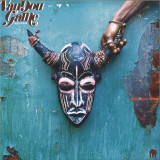
African, funky, sarcastic, bewitching, green, ecstatic: these words collide to describe Vaudou Game and all of them are true. Bella is the first vinyl single derived from the upcoming album called Noussin, due to be relased June 11th 2021.
"Bella" is a smashing summer hit, sang in Mina and french. It's an ode to the nature and love in this hard times. "Be My Wife" on the B side, is a trip into a rock /funk universe with an uptempo twist rythm, sang into the voodoo harmonies.
Composed in Lyon on 100% analog equipment during the lockdown, those two songs might be the funky nuggets of all DJ's and radio playlists .
Steve.Martin - the man with two brains, is the collaboration project of Stevn.aint.leavn and Porter. The two groove maniacs joined forces for dancefloor oriented productions with lots of funk! Besides their own imprint and musical home "Certain Circles" you can find their sound stamp on labels like Beste Modus, Quality Vibe, Rubisco. At the menu, 3 tracks : Deep / Warm / Dub & Rhythm.
We have the honor to welcome the prolific Chris Stussy who give us his deep vision of « Belladova » !
African, funky, sarcastic, bewitching, green, ecstatic: these words collide to describe Vaudou Game and all of them are true.
Noussin is the fourth album of the french Afro Funk band. Forced into lockdown, like much of the planet, Peter Solo and his Vaudou Game had no choice but to retreat into the studio. A reunion to once again invoke the spiritual forces of the Voodoo Deities. A reunion that was Initially imagined for an EP…yet these spiritual forces behind that imagination yearned for something more, and as we all know, these forces are impossible to push away once they have decided to stay.
Under the strain enforced by the current socioeconomic climate, as much as by the environmental peril that faces us all today - they diverted the course of the groove towards daring new vibrations. Without extinguishing or diminishing its highly communicative power, they released Vaudou Game from its origins of pure Afro-Funk to gradually engage into compositions which crystallized themselves into tones resembling more rock than funk.
On this fourth album, with an entirely revisited line-up, Peter Solo separates for the first time in his career from his brassy guard, leaving saxophone, trumpet and trombone outside to invite an arsenal of keyboards to define, with him, this new voodoo sound. A sound, as usual, built on vintage and precise analogical material - grime even on the white side of the tape, a blunt instrument used to blanket anything that strived to shine too much in the mix.
Graced with tapered guitars stringing out rhythmic bumps or withdrawing a few beats to indulge in infectious solos, this album is boisterously alive with vintage 70's Funk, infused with a few digressions into other ethers of the funk timeline, nicking different sounds and frequencies to render the black and white keys of an inspired keyboard to reach new euphoric levels of melodic acidity.
Tearing off the enigmatic mask to reveal his true face: on a few titles, Peter Solo ventures outside of his sacred voodoo range to reconnect with his London years, these titles feature small nods to the time he spent in “The Smoke” where the incantations of British music culture were written within him.
Noussin which means “Stay strong” in Mina, a dialect spoken in the south-west of Togo. Noussin, a message of hope as much as a call to come together to weather the turmoil and to come out better on the other side. Don’t let them grind you down…Noussin!
Lee 'Scratch' Perry's Black Ark Studio opened its doors in 1974. Situated in his backyard at 5 Washington Gardens, Kingston, Jamaica. Using only basic
equipment, a Teac Four-Track Recorder, a Sound craft mixing desk, an Echoplex delay unit and later adding a Phaser effects unit that he used in conjunction with his Roland RE201 Space Echo. He managed mixing down the tracks from Four track to Two track to make his distinctive whirling sound that sets apart the Black Ark Sound from the other Jamaican Studios.
Born Rainford Hugh Perry, 28 March 1936, Hanover, Jamaica. He began his career at the grand age of 16, working for Clement ‘Coxsone’ Dodd’s sound
system, rising quickly to the position of record scout and organising recording sessions during his 3-year period 1963-1966. Restlessness and unsatisfied with credit he felt due to him he moved on to work with Producers J.J. Johnson and Clancy Eccles, the latter of which would help him set up his ‘Upsetter’ label in 1968, which would see his first of many recordings telling the injustices done to him by previous employers. ‘The Upsetter’ track itself pointed at Mr Dodd but reflected to Perry when he inherited it as a nick name alongside many others during the course of his career, including ‘Scratch’, again taken from one of his recordings ‘Chicken Scratch’ recorded in 1965/1966. Perrys work in 1968 with producer Joe Gibbs was fruitful and resulted in many successful releases, but again feeling a lack of credit and itchy feet, it was time to move on. Still not having a studio of his own, Perry recorded at the various Kingston establishments at the time, Randy’s Studio 17 on North Parade, Dynamics on Bell Road and Harry J’s on Roosevelt Avenue where the bulk of the aforementioned recordings with The Wailers were carried out. His dream was always to build his own studio and not to have to work to the constraints of the other studios and producers.
On opening the Black Ark studios, the hits seemed to come immediately. Firstly with Junior Byles' 'Curly Locks' and in 1975 the massive crossover hit Susan Cadogans' 'Hurt So Good' that reached No 4 in the UK charts.1976 saw Island Records releasing Perrys vast output, timeless material like the Heptones 'Party Time', Max Romeo's 'War Inna Babylon' Bob Marley and the Wailers 'Jah Live', 'Punky Reggae Party' and Junior Murvins 'Police and Thieves' to name but a few.But sometimes missing out on a few classics like Perrys own 'Roast Fish, Collie Weed & Corn Bread' and possibly one of the best reggae albums of all time The Congos 'Heart of the Congos'. Dub releases like 'Revolution Dub' (1975) showed a way forward for his production skills in this formidable arena. Having his own studio allowed him to build up a vast catalogue of tracks to work on. We have culled together some lost productions that Lee Perry carried out with singer Mike Brookes, a fine singer, arranger from that special time in the Black Arks history. Sounding like Junior Marvin in parts and Max Romeo in others but still carrying a distinctive Falsetto voice. Some classic tracks as you can see recorded with the cream of musicians at Lee Perrys disposal. Mr Perry works his magic that gives these songs that distinctive feel that his output.
carried around the mid 1970's.
So we hope you enjoy some more lost treasures from the Black Ark that we feel should be added to that mighty cannon of material that still sound so fresh and strong today.
Melbourne-via-Tasmanian four-piece Quivers first released
their 2018 debut We’ll Go Riding On The Hearses as hand-made
cassettes. The album dealt with singer Sam Nicholson’s loss
of his brother in a freediving accident, and “trying to not think
about that, and often coming back to ghosts, benders, water,
and pissing in the snow.” When demand for the album grew,
it received a vinyl release and led Quivers to tour the US, film
a KEXP session, and be selected by NPR Music for both the
Austin 100 SXSW preview and as a “Slingshot” artist to watch.
Their life-damaged but hopeful jangle pop has only sharpened
since then, and while 2021 follow-up Golden Doubt conjures
up REM or The Clean, there is a lyrical directness that sets this
record apart as always its own.
Golden Doubt is carried by shimmering guitars and the
harmonizing vocals of members Holly Thomas and Bella
Quinlan. Elevated by the production of Matthew Redlich
(Holy Holy, Husky, Ainslie Wills), the record explores what
comes after grief, and how one throws oneself back into love. As
Nicholson explains, the album tries to bottle “the rush of feelings
and fears when you give in to falling for someone. It’s also an
album in love with other albums, and the other bands around
us.” Before each take at Woodstock and The Aviary studios in
Melbourne, Australia, the band would imagine a scene together
(a waterhole for “Laughing Waters”, an overgrown carpark for
“Videostores”) and then dive in to capture live group takes.
Quivers need to get words on the page and sounds out to keep
moving on. Both Nicholson and Thomas lost their brothers in the
same year, and through that shared vulnerability they all have
together that runs deep. Golden Doubt is also a love letter to
playing music as a band and processing it all together rather than
just carrying it as a weight. The cancellation of a 21-date US
tour they had slated for 2020 has left them undeterred; Quivers
plans to continue being a band and get back out into the world
as soon as it’s possible.
The Goalie’s Anxiety at the Penalty Kick hail from the City of Brotherly Love, better known as Philadelphia. They boast six members (sometimes seven, if you believe their Facebook page), decorated with strings, keys, guitars, and drums. Dual vocalists weave enchanting lines over a lush landscape of sound that feels like a score of a movie. For a band of such large size it’s not a surprise they know how to fill space, but most impressive is they also know when to leave the space empty.
The debut release from Philadelphia’s The Goalie’s Anxiety at the Penalty Kick. 10 songs that make use of every instrument in their repertoire- strings, keys, drums, guitars, and bells. Dual vocals pepper throughout, playing off each other and weaving through the music to create a beautiful tapestry
This very special reissue celebrates the 21st anniversary of the release of Argentinian Juana Molina’s breakthrough album ‘Segundo’ in 2000.
It has been remastered from the original tapes, and augmented with a rich 32-page booklet recounting the eventful start of Juana’s musical career, and containing numerous notes, anecdotes, original drawings and previously unreleased pictures.
Contributors to the booklet include Bruce Springsteen’s producer Ron Aniello, Domino Recording’s Laurence Bell and David Byrne who, when he discovered the album, immediately invited Juana to open for him on his 2003 US tour.
‘Segundo’ started Juana Molina’s international trajectory as a musician. After dropping a highly-successful career as a TV comedian, she turned to music making. Regretting signing with a major company, who got her to record an over-produced debut album, she resolved to find her own direction in music.
The result was ‘Segundo’ that took 4 years to make involving sessions in Argentina and the USA.
Segundo’ finally came out on a small label in Argentina in 2000, found its way to Japan where it spectacularly took off, and was eventually picked up by the Domino label in 2003. Its reception set Juana Molina on course for performing around the globe, garnering a large, devoted fan base, and going on to record five more extraordinary studio albums.
« The pioneer of Dusselcore is back! »
Maddie Chavez
« Once upon a time Tera Octe’s debut album »
Eduardo Nash
« New Big Room »
Zach Tippit
« On loop at the office »
Chad Ferguson
Mastering by legendary Arjan Rietvink (Qlimax, Armin Van Buuren, Headhunterz…)
Design by Coquelin & Cloarec
Will Hofbauer & Sangre Voss team up for ‘Steppe EP’ this June on Control Freak Recordings, featuring a remix from Discwoman’s Ciel.
London-based Will Hofbauer and Sangre Voss, who’s individual work has seen them appear on labels such as Rhythm Section and Will’s own Third Place imprint, team up for the first time on Control Freak Recordings for the wonky ‘Steppe EP’, picking up early support from Ben UFO, Bradley Zero, and more.
Leading the release, ‘Pumice’ tumbles through rolling low end, crunchy percussion and an eerie breakdown for a high energy start to the A-side. ‘Flundra (Flundra Mix)’ follows with bubbling pads and speaker-rattling subs around a kick-less drop, leading into a shimmering breakdown.
On the flip, ‘June-O’ sees the duo craft a low tempo slugger, peppered with tablas, bells and eagle samples around warped, loopy synthesis. Ciel’s remix of ‘June-O’ takes the B2 spot, adding stuttering percussion, vocal chops, and additional wildlife samples to the mixture to round out the release.
Will Hofbauer & Sangre Voss ‘Steppe EP’ drops on Control Freak Recordings on 18th June.

![Rico - Jama Rico [40th Anniversary]](https://www.deejay.de/images/l/4/0/977140.jpg)
![Rico - That Man Is Forward [40th Anniversary]](https://www.deejay.de/images/l/4/1/977141.jpg)