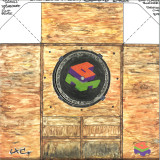
On June 29th 2023, Jeremiah Chiu walked into the Vintage Synthesizer Museum (VSM) in Highland Park, Los Angeles, with no plan more specific than "let"s fire this stuff up and see what happens." Exploring the VSM"s vast collection of classic, rare and staple synthesizers, he would sequence, trigger, and layer the machines together with help from VSM founder/curator Lance Hill. The resulting album - In Electric Time - was recorded in just two days, and edited to completion in the two days following. It was captured fully analog by engineer Ben Lumsdaine, who contributes performances on a few tracks himself. Cooper Crain (of Bitchin Bajas) makes an appearance as well; but ultimately the collection is an intuitive expression of organic electronic conceptualized and created in-context by Chiu alone, as he calls on a lifetime of work in sound synthesis to pain a fulgent, refreshingly undercut sequence of cinematic sketches and in-process themes. In some ways, In Electric Time reflects the directness of Raymond Scott"s electronic studio recordings - with sharp cuts and room chatter - and, in others, it conjures the in-the moment- magic of Harmonia.
quête:bell
This freakbeat jelly belly delight showcases the Bandits’ vaudeville humor, garage rock & catchy psychedelic pop! Considered a cult classic, this mixed bag of candy-coated fuzz is sure to satisfy your sweet tooth! Our favored stereo mix, pressed on yellow vinyl! Newburgh, New York psych-punks the Jelly Bean Bandits formed in 1966. Originally known as “The Mirror,” the band regularly packed area nightspots like the local Trade Winds, Poughkeepsie's Buccaneer Nightclub, and Burlington, Vermont's Red Dog.
In due time, they recorded a three-song demo reel that resulted in a three-album recording contract with Mainstream Records – however, unknown to Mainstream, these three songs represented the sum total of the Jelly Bean Bandits' repertoire, forcing the band to write enough additional material to flesh out a full-length LP in the course of a week. Amazingly, their eponymous 1967 debut is excellent, a freakbeat cult classic distinguished by emotive guitar and some innovative production techniques – all the more impressive, the album was recorded in a single 12-hour stretch. Mainstream hated the end result, however, and dropped the Jelly Bean Bandits just as they were commencing work on the follow-up – only one song was completed before the sessions were aborted, leaving just one ‘60s studio album from these confectionary con-artists. – Jason Ankeny
"The Jelly Bean Bandits" includes the following tracks: "Poor Precious Dreams", "Going Nowhere", "Goodtime Feeling", "Neon River" and more.
This version of the album comes as a 1xLP pressed on yellow vinyl.
White vinyl, limited to 500 copies. Liam Cromby, known for his work as the lead singer and songwriter of We Are The Ocean until 2017, has today announced his forthcoming debut solo album What Can I Trust, If I Can't Trust True Love, due for release on December 1st 2023, also sharing the title track, available to stream/download worldwide now. "Drawing from my own experiences, this song is a testament to those early, fragile moments of a relationship_where every misstep feels like a fall and every kind gesture feels like flying," he explains. "Choosing to name the album after this song was instinctive, given that it was among the final tracks to be crafted. Even though it came later in the creative journey, it perfectly embodies the central theme of the album." Since revealing the first taste of new music in March, with the release of `Here I Am' - accompanied only by a contemplative, artful film featuring an elaborate dance between two performers - followed by `Breakdown', and last month, `At This Table', this new phase of his career is already off to an impressive start. With early airplay from BBC Introducing and Absolute Radio Country among others, an appearance at The Great Escape festival and sold-out headline shows across the country, Cromby was invited to play at the prestigious Black Deer Festival of Americana, and along with a full-band set, joined Brandy Clark, Drake White, Elles Bailey and Bella White for a Songwriter Session. Although recorded in a matter of days, the project was at least five years in the making.
- A1: Passage Through The Spheres
- A2: All Life Long (For Organ)
- A3: No Sun To Burn (For Brass)
- B1: Prisoned On Watery Shore
- B2: Retrograde Canon
- B3: Slow Of Faith
- C1: Fastened Maze
- C2: No Sun To Burn (For Organ)
- D1: All Life Long (For Voice)
- D2: Moving Forward
- D3: Formation Flight
- D4: The Unification Of Inner & Outer Life
Kali Malone's anticipated new album "All Life Long" is a collection of music for pipe organ, choir, and brass quintet composed by Kali Malone, 2020 - 2023. Choral music performed by Macadam Ensemble and conducted by Etienne Ferschaud at Chapelle Notre-Dame-de-L'Immaculée-Conception in Nantes. Brass quintet music performed by Anima Brass at The Bunker Studio in New York City. Organ music performed by Kali Malone and Stephen O'Malley on the historical meantone tempered pipe organs at Église Saint-François in Lausanne, Orgelpark in Amsterdam, and Malmö Konstmuseum in Sweden. Kali Malone composes with a rare clarity of vision. Her music is patient and focused, built on a foundation of evolving harmonic cycles that draw out latent emotional resonances. Time is a crucial factor: letting go of expectations of duration and breadth offers a chance to find a space of reflection and contemplation. In her hands, experimental reinterpretations of centuries-old polyphonic compositional methods become portals to new ways of perceiving sound, structure, and introspection. Though awe-inspiring in scope, the most remarkable thing about Malone's music is the intimacy stirred by the close listening it encourages. Malone's new album All Life Long, created between 2020 - 2023, presents her first compositions for organ since 2019's breakthrough album The Sacrificial Code alongside interrelated pieces for voice and brass performed by Macadam Ensemble and Anima Brass. Over the course of twelve pieces, harmonic themes and patterns recur, presented in altered forms and for varied instrumentation. They emerge and reemerge like echoes of their former selves, making the familiar uncanny. Propelled by lungs and breath rather than bellows and oscillators, Malone's compositions for choir and brass take on expressive qualities that complicate the austerity that has defined her work, introducing lyricism and the beauty of human fallibility into music that has been driven by mechanical processes. At the same time, the works for organ, performed by Malone with additional accompaniment by Stephen O'Malley on four different organs dating from the 15th to 17th centuries, underscore the mighty, spectral power that those rigorous operations can achieve. All Life Long simmers in an ever-shifting tension between repetition and variation. The pieces for brass, organ, and voice are alternated asymmetrically, providing nearly continuous timbral fluctuation across its 78-minute runtime even as thematic material reiterates. Each composition's internal framework of fractal pattern permutations has the paradoxical effect of creating anticipated keystone moments of dramatic reverie and lulling the listener into believing in an illusory endlessness. On an even more granular level, the historical meantone tuning systems of each organ used, and the variable intonation of brass and voice, provide further points of emotional excavation within the harmony. The titular composition "All Life Long" appears twice on the album, first as an extended canon for organ and again in the final quarter, compactly arranged for voice In the latter, Malone pairs the music with "The Crying Water" by Arthur Symons, a poem steeped in language of mourning and eternity. For organ, "All Life Long" moves with a patient stateliness, the drama concentrated in moments when shifting tonalities generate and release dissonance and ecstasy. For voice, each word is saturated with feeling, the singers swooping gracefully downward to capture the melancholy of the narrator's relationship to the timeless tears of the sea. "Passage Through The Spheres," the album's opening piece, contains lyrics in Italian pulled from Giorgio Agamban's essay In Praise of Profanation. In it, Agamban defines profanation as, in part, the act of bringing back to communal, secular use that which has been segregated to the realm of the sacred, a process Malone enacts each time she performs on church organs. This is not music of praise, or of spiritual revelation, but it is an artistic enactment of translating the indescribable. It carries the gravity of liturgical chant, and its fixation on the infinite, but draws its weight from the earthly realm of human experience. A music that draws the listener into the present moment where they can discover themselves within the interwoven musical patterns that can come to resemble the passage of days, weeks, years, a lifetime.
High Roller Records, slipcase Es ist durchaus eine kleine Sensation, dass dieser Tage ein weiteres MORBID SAINT-Album erscheint, also mehr als 30 Jahre, nachdem ihre zweite LP „Destruction System“ aufgenommen, aber bis zu ihrer offiziellen Veröffentlichung vor kurzem nicht fertiggestellt worden war. Allerdings war die Aussicht, neue Musik in ihrem einzigartigen Death/Thrash-Metal-Stil zu schreiben, einer der Hauptgründe dafür, dass sich die Kernmitglieder 2010 überhaupt wieder vereinten. Während ihrer ersten aktiven Phase von 1984 bis ’94 konnte die Band ihr Potenzial längst nicht ausschöpfen, insbesondere im Hinblick auf ihre bahnbrechende erste Platte „Spectrum of Death“ (1990). Das neue Werk entstand im kreativen Fernaustausch, wobei sich alle Mitglieder gegenseitig Ideen zuspielten, um ein Breitseite aus zehn Extrem-Metal-Tracks abzufeuern, wie man sie heute kaum mehr hört – absolut verheerend und doch musikalisch anspruchsvoll, Grenzen überschreitend, aber nicht auf Teufel komm raus, und abgerundet von einem Artwork des legendären Ed Repka (Death, Megadeth). „Swallowed By Hell“ wurde von Chris Djuricic (Num Skull, Disinter) im The Belle City Sound Company aufgenommen und erhielt den letzten Schliff von Scott Elliott in den Chernobyl Studios. Es riecht nach alter Schule, steht aber mit beiden Beinen im Hier und Jetzt. „Eine bessere Besetzung könnte man sich nicht wünschen“, sagt Gitarrist und Mitbegründer Jim Fergades. „Wir freuen uns jetzt über alle Möglichkeiten, und je nachdem, welche sich uns bieten, kann eine Menge passieren.“
CLEAR/BLACK MARBLE VINYL[66,60 €]
Black Vinyl[61,98 €]
Bassmæssage is the heaviest and most consistent bass music night out of Leipzig, operating way over 30 low frequency terrapeutic events since 2007.
Hosting ventral vibrations by the likes of Mungo's Hifi, Moonshine, Rupture, Hardwax and the homies of Jahtari, maintaining strong relations within the local soundsystem culture like Zoumo and Plug Dub and pushing a ton of grass-roots DJs and visual artists, out of doubt it is a sure shot for all who like it low and want it vibrant.
2015 saw the release of the "Volume One" vinyl, blending all kinds of styles and tempi by artists who had played at a Bassmæssage. Dub met Dubstep, Footwork went along some Snailfunk Drum'n'Bass and even Skweee had a cameo. And all this happened on one plate with a warm vibe from start to finish.
It is about time to revive the label with a new vinyl compilation named "Second Drop", following the tradition of a nice roundup across various bass music tearitorries. One side pumps at uplifting 160 BPM, while the flipside is shifting down to relaxing 135 and even 120 speeds.
Nuphlo and Bukkha team up for the energetic modern halftime piece "Drip". Nuphlo might ring a bell as part of The Nasha Experience from London and Leeds, connecting asian roots with nowadays UK bass sounds. Bukkha is state-side born and has recently emigrated to Spain, from where this worldwide touring DJ machine is firing a plethora of bass music styles on renowned labels like Moonshine, System and Innamind.
DjBadshape passes the breakbeat driven torch with handsome melodies and subby kickbass on "Drift" to reflect Leipzig's well various scenes. While checking her tracks on Defrostatica and Human, one may also find artworks for Bassmæssage and more.
Sun People is closing the 160 side with the deep but dirty retro 90s jungle bit "Rise Up". Combining Techno, Footwork and UK Hardcore Breakbeats, the Graz based bass buab made it to releases on Exit, Rua and Alphacut.
Flipping sides, Dub Across Borders redefines steppers dub into the dreamy yet rolling "Bass Tree Dream". The project was found by a Copenhagen dubber when living in Colombia, fusing the rural folklore with soundsystem energy into a world-bass music. This can be heard on labels like Basscomesaveme, Translation and 45Seven and is best to be experienced in its live dubbing appearance which premiered at a Bassmæssage in 2015.
Paranoid One grabs these feelings and drops them a bit more sinister, "Glimp" manages to hide a playful 4 to the floor kick as well beyond its smooth soundscapes and percussions. As Paranoid Society these split personalities from Tallinn were delivering to Modern Urban Jazz and Alphacut already since a decade at least.
bhed finishes with the slow far-away dubsteppish "Minerva". Make sure to not only check the releases on Row and Trusik but also the freshly baked Neuburg based live act in between cosy ambient and lush bass music at the next Bassmæssage on 18th November in LeipZig!
- A1: The War
- A2: The Council Of The Kings
- A3: Vertigo Of Love
- B1: The River’s Queen
- B2: The Margarina Hotel
- B3: All Aboard
- B4: In The Claws Of Cremazilla
- C1: The Cursed Ballerina
- C2: With A Little Help From Ess-95
- C3: Guess Who’s Back
- D1: The Team And The Beast
- D2: The Fight
- D3: We Are Victorious
- D4: Tell The Bells To Ring
If the genesis of The Big Idea was written both in the corridors of their high school and the surroundings of La Rochelle, the first chapter truly takes place in a big house in outskirts of Paris, where the six boys settled once they got their baccalaureate in 2015. Throughout these five years, The Big Idea hosted every European band playing in Paris with no landing place. The house of Champigny-sur-Marne, almost invisible in the monstrous metropolis, became a central location of the capital’s underground scene.
That creative cyclone within which the band is placed quickly shows results and the band hit it hard with their debut LP “La Passion du crime 3” (2017). This quadruple album, written as the movie score of a police investigation story, affirms something fundamental: The Big Idea is determined not to do things like everybody else. The influences of the great psychedelic rock’n’roll tribes naturally appear, the band release several record, start touring all around Europe allowing them to develop a furious alchemy on stage. But then covid brought everything to a halt. However, the band returned to La Rochelle and plotted a new, mad project.
The Big Idea becomes the first band to record an album on a sailing boat while crossing the Atlantic. Once again, the idea is fabulous, and “The Fabulous Expedition of Le Grand Vésigue” represents both the thirst of adventure of the sextet from La Rochelle, and their yearning for calm, psychedelic horizons. After the release of the documentary film and the big tour that followed this extraordinary adventure, the band decides to reaffirm the most essential part of its identity and announces for February 2024 the releasing of a new record more electric and radical, in the image of their live performance with more and more intensity. “Tales of Crematie” is a story built on a fantasy medieval backdrop, but could have however taken place in our modern era. If the elegant, psychedelics parts have not disappeared, the record’s tone is clearly more rock than what the band has ever created before, and as The Big Idea always likes to go overboard, the album will be released as a double LP in which you’ll hear trumpets as well as pianos, violins, tropical influences, post-punk, and above all, loads, loads of fuzz. Just like a toy chest whose key would’ve been thrown away on purpose, hidden arrangement treasures abound inside of “Tales of Crematie” , along with a violent revolt against the modern archetypes of “too normal music.”
"The organ dates back to 1790 and was made by Venanzo Fedeli, who came from a prestigious family of organ builders. This particular organ is tuned in the ancient way at 430 Hz. Tuning relies on pure thirds that aim to create dissonances within the instrument itself.
Since the organ is an instrument modeled according to the principles of nature, the intonation of the pipes was performed according to an incompletely equal system that reflects the natural intonation based on mathematical ratios.
This produces a purer sound for the thirds but slightly harsher and more difficult to listen to. The hardness of the intervals of the organ is a metaphor for the hostile climate that prevails in the Potenza valley during winter and autumn.
The sound of the organ with the register of the flute returns a particularly sweet and penetrating sound but, at the same time, a very complex timbre with intricate harmonic texture, given the numerous fluctuations and beats. The warm tones of the organ reflect the good and welcoming sould of the people who inhabit these lands. The absence of dynamics inside the instrument allows the listener to focus and understand the harmonic texture and timbral differences between the various notes more clearly.
Trombone and trumpet played by Matteo Paggi on track 2 and 3 were recorded during a hot summer day at Elefante Bianco Studio in Rome by Matteo Scarchilli. Sax, effects and noises in track 6 played by Giulio De Asmundis and Pietro Rianna were recorded in Fauna53 studio.
Many thanks goes to Marco and Giuseppe for making this happen. Thanks Federico, Sami, Marisa, Romeo and everyone involved in this project. You know who you are."
Mastered by Alessandro Caldarola.
Photos and color grading by Filippo Corsi.
Graphic project and design by Flavio Mancini.
Vinyl pressed by AFG Record Manufacturing.
FOLLOWING THEIR RECENT REUNION, THE DELGADOS REISSUE THEIR FOURTH STUDIO ALBUM HATE ON COLOURED VINYL AND CD TO MARK ITS 21st ANNIVERSARY
Ushering in a new era of emotionally vulnerable and cinematic songwriting for celebrated Glasgow group The Delgados, 2002’s Hate is the group’s most ambitious recorded statement to date. Recorded amidst a backdrop of personal change and international crisis, Hate’s internal alchemy transmogrifies darkness into light. It’s an enclosed universe full of tragedy and magic, a swirling galaxy of lush orchestration, misanthropy dealt with kindness and black humour. Above all it showed a band coming to terms with their fragility with a new power and grace.
In Hate, the band’s ambition saw them striving to reflect the breadth of human experience, both the joy and tragedy of living in tumultuous times. Initially commissioned by The Barbican in London to compose music for a film about artist Joe Coleman, the instrumental music that instigated Hate was laden with darkness from the outset. The Delgados’ worldview has always been informed by nuance, an oblique but incisive lyrical perspective but on Hate a new rawness is woven throughout the songs. Coleman’s original subject matter - portraits of troubled historical figures like Ed Gein, Mary Bell and Jayne Mansfield - influenced the tonality of the music but the songs were written against a backdrop of international tumult and personal life changes for the band members. Beginning writing sessions following a family bereavement in drummer Paul Savage’s family, Hate was then recorded while both Alun Woodward and co-singer/guitarist Emma Pollock were expecting new additions to their young families, the latter with drummer Paul Savage. In the background to the recording process were the attacks on the World Trade Center of September 2001 and their aftermath. In this context, it’s remarkable that an album was made at all, let alone one so grand and compassionate. It’s a masterclass in restraint and imagination.
Hate sounds like the world in all its ugly glory. Recorded in Glasgow and New York with Tony Doogan, Dave Fridmann and the band as producers and using over 20 additional musicians, Hate grabs the baton from the group’s breakthrough critical and commercial success The Great Eastern. Bolder, broader and more all-encompassing than anything the band had previously attempted, the album’s palette is furnished by a string section, brass and reed instrumentation, a choir and electronic elements augmenting the core group of Emma Pollock, Alun Woodward, Paul Savage and Stewart Henderson. Far from being over the top, the group’s skill is in attention to detail, in honing and refining each arrangement, allowing each element its space.
It’s a fine balancing act that pays massive dividends. Woodward’s new lyrical vulnerability is spotlighted on tracks like The Drowning Years, which throws elegiac string arrangements against the narrative of characters living in darkness, punctuated by couplets that bring a real-life documentary feel to the narrative. All Rise brings a black comedy to the idea of a confessional before a transcendent, choir-led refrain brings ecstatic resolution to Woodward’s vocal in its highest register. On the single All You Need Is Hate, Woodward’s trick of subverting the Beatles standard showcases the dark humour at the centre of Hate. Here The Delgados’ perversity is in full flow, nurturing a glowing light from darkness, the resolving melody and Fridmann production recalling contemporaries The Flaming Lips (whose Michael Ivins assisted in mixing) or Mercury Rev. The perversity is the surging serotonin induced by the group while singing the lines “Hate is everywhere, inside your mother’s heart and you will find it there. You ask me what you need? Hate is all you need.”
It’s a dark magic that pervades Hate, indeed it’s almost the driving force throughout the album. Flipping minor to major and back again, Favours is fuelled by fear and violence before blasting into the heavens with the gauche line “and you’re feeling fine,” operating in stark contrast to the verses’ tone. Album opener The Light Before We Land finds Emma Pollock in the aftermath of recent family trauma. Her vocal is effortless; a study in steady restraint against the massive, Fridmann-patented drum sound powering Savage’s playing and Henderson’s instantly recognisable melodic basslines. Coming In from the Cold is Pollock in full flight, lifted to the heavens by wide-screen, instrumental texture. Her presence on Hate highlights her knack for lyrical impressionism, the timbre of her voice lending itself to drama while always retaining a mystique. Never Look At The Sun, inspired by the Coleman painting The Big Bang Theory (itself an explosives-themed study), revels in paranoia, her performance ringing out in the eye of the storm conjured by the swirling arrangements. It reaches the peak of a redemptive arc while seemingly parodying the very idea of redemption.
Hate was the sound of The Delgados completely fulfilling their potential, a fully realised vision buoyed by the weight of coming through a darkness into light. For its 21st anniversary, the album is being reissued on the band’s own Chemikal Underground on coloured vinyl and CD. Hate is all you need
Ty Segall follows 2022"s acoustic introspection opus "Hello, Hi" with a deeper, wilder journey to the center of the self. With Three Bells, he"s created a set of his most ambitious, elastic songs, using his musical vocabulary with ever-increasing sophistication. It"s an obsessive quest for an expression that answers back to the riptide always pulling him subconsciously into the depths. Questions we all ask in our own private mirrors are faced down here - and regardless of what the mysterious "Three Bells" mean in the context of the album"s libretto, you can be assured that Ty"s ringing them for himself, and for the rest of us in turn.
Released in 2001, I Giorni paved way for the rise of Ludovico Einaudi to mainstream success. This beautifully melodic record features only solo piano, but captivates throughout with it’s gorgeous shapes and phrasing taking the listener on a journey with Ludovico himself. Quite aptly, the album contains the title track I Giorni, which has now been certified as a gold record in the UK. This is the first time this album has appeared on highly collectable coloured vinyl.
- A1: Intro (Joe 90)
- A3: Hey Now (Think I Got A Feeling)
- A2: Chorus (Live)
- A4: Fill Us With Fire (Live)
- B1: Sacred (Live)
- B2: The Circus (Live)
- B3: Who Needs Love Like That (Live)
- B4: Nerves Of Steel (Live)
- C1: Blue Savannah (Live)
- C2: Chains Of Love (Live)
- C3: Turns The Love To Anger (Live)
- C4: Careful What I Try To Do (Live)
- D1: Sometimes (Live)
- D2: Save Me Darling (Live)
- D3: Shot A Satellite (Live)
- D4: Love To Hate You (Live)
- E1: Love Is A Stranger (Live)
- E2: Drama! (Live)
- E3: Always (Live)
- E4: Stop! (Live)
- F2: Victim Of Love (Live)
- F3: Oh L'amour (Live)
- F4: A Little Respect (Live)
- F1: Push Me Shove Me (Live)
'The Neon Live' ist ein 24-Track-Erasure-Live-Album, aufgenommen bei zwei Shows im O2 Apollo in Manchester während der ausverkauften Tournee des achtzehnten Studioalbums des Synthpop-Erfolgsduos aus Vince Clarke und Andy Bell: 'The Neon', ein Album, das es in Deutschland auf Platz 11 in die Charts, in UK sogar bis auf Platz 4 gebracht hat.
a A1. Intro (Joe 90) Live
c A3. Hey Now (Think I Got A Feeling) [Live]
[a] A1. Intro (Joe 90) [Live]
[c] A3. Hey Now (Think I Got A Feeling) [Live]
The concert at Sonic Morgue (Berlin), opened by the song Nerissimo, was part of a series of European dates, culminating in the Berlin gig. A sort of homecoming for the duo that has made the Rome/Berlin axis a membrane continuously crossed by sounds and words in Italian, German and English. The reception given everywhere to songs like Mi Scusi, despite being sung in Italian, continues to excite. A Quiet Life, originally written for the film "A Quiet Life" directed by Claudio Cupellini, has severed some of the connection it had with the film because many now associate it with the final episode of Dark, the highly successful Netflix series. For many years Teho and Blixa have been playing live with Laura Bisceglia on cello and bells, Gabriele Coen on bass clarinet and, for the Berlin concert, the Oriel Quartett string quartet with Anna Eichholz and Kundri Schafer on violin, Robin Hong, viola, Alice Dixon, cello. The album cover image is a mixed media piece by Blixa Bargeld entitled "Aldebaran". Currently, Teho Teardo is busy on a long theatrical tour with famous Italian actor Elio Germano with two live performances of words and music: "Il Sogno di una cosa", freely inspired by Pier Paolo Pasolini"s novel of the same name, and "Il Paradiso di Dante", an original performance of acting, music and multimedia installations inspired by the XXXIII canto of the "Divine Comedy".
VIL Records with their next reissue!
Some Female:Pressure right here with the latest NVST release; Silence Itself Is Noise! This is her debut for SSPB delivering a 6 track ep which are a reflection of her adventurous club sets, a well-balanced mix of powerful beats and expansive atmospheres haunted by skittering echoes of the dancefloor. Each track feels like fleeting memories of the club filtered through the human experience - flickering moments illuminated by strobes and shrouded in smoke, laced with the tang of sweat and psychedelics. Opener "Tiny Mistakes Feeling HOT (Hellisnotamyth version)" coalesces from curling vapors into infernal acid lines and rhythmic fragments that evaporate almost as soon as they appear. "The Devil Loves The Detail (Lucifer's Fire Version)" builds into an inescapable pulse amidst frayed synthesizers, pressure building to fever pitch before "The Danger Zone Of GFY (Freedom Version)" opens out into icy, astral synths. "Monster of Business (Style Edition)" shifts closer to the dancefloor with a slinking, syncopated groove, conversations from the smoking area or studio creeping in at the edges, before erupting into the frazzled bounce of "The Goat and the Night." "The Silence Itself is Noise (Nonstop Bass Version)" loops back once again to more cavernous atmospheres, warped bells and strafing melodic flourishes ringing out amidst fizzing distortion and skeletal percussion. Silence Itself is Noise doesn't clamour for attention, it necessitates it. Once again, NVST proves herself unafraid to challenge club orthodoxy, and unwilling to patronize listeners, instead making deft use of tension and release to create genuine moments of surprise and transcendence.