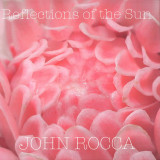
Reflections of the Sun is a collection of new music that see JOHN ROCCA experiment with a more laid back side to his musical personality. John is best know in Jazz Funk circles for his 1980s self funded, self produced and self released Brit Funk classic 'Southern Freeez', and as the band Freeez's founder.
"The melancholic suburban soul of ‘Southern Freeez’ never gets tired for me....an album that has remained at the top of my Brit Funk pile!" - GILLES PETERSON
Much of the album is also somewhat reflective. A personal and emotional reflection on John's life - the tracks a nod to John's varied musical pasts. Sounds, a pondering upon his collection of global influences and his life experiences over the years; Genre, the pulse of today, societal, musical or otherwise - but not easy to place as is John's character; Lyrics, the present dilemmas we face as humanity, whilst reflecting on our own private and deepest human feelings, of life and, of love in all its wonderous forms.
Musically, the 'Reflections of the Sun' album casts a glimpse back to Rocca's Brit Funk roots growing up amongst 1970s classic Jazz Funk and Soul, while also blending inspiration from his 1980-90s electronic influences topped off with everything else he has seen and heard on his life travels since then.
Giving a nod to John's own past while bringing Reflections of the Sun up to date was completed by adding elements of London's re-surgent and vibrant jazz scene. Not so different from John’s own early days jamming with Freeez, he is accompanied on all the album's tracks by his two young nephews and highly respected jazz musicians, Benjamin Rocca on keyboards and Joel Rocca on Saxophone. The two youngsters are known on the current London Jazz scene as the "Rocca Brothers".
The album's title track, "Reflections of the Sun" refers to how humanity, gorging on the sunshine that brings life to everything, also has a tendency to reflect the hellishness of the sun itself. Comparing our self-destructive nature with our planet's volumes of un-ending beauty.
Initial support for various tracks has come via radio plays on UK stations such as JazzFM, Jazz Funk & Soul Radio (JFSR), Soul Groove Radio and Solar (amongst others).
Buscar:ben jammin
- 1
Mononoke is a Berlin band founded by Fabian Rösch and Benjamin Geyer. Their musical passion is improvisation with a sound that moves between experimental electronic music, jazz, beat music and ambient.
This LP combines their two recent EPs which have been released on the Munich based label tunnel.visions,
each on one side.
APARt
APARt was created in the field of tension between spontaneous improvisation and careful studio work, marked
by the lockdowns during covid and social isolation. It was precisely this physical separation that gave rise to a
new experimental approach.
Each track is a puzzle, whose individual pieces were put together, moved around, and placed in new contexts.
Instead of jamming and rehearsing together, musical ideas were exchanged online so that they could be freely
interpreted, altered and redesigned.
modular
Newly found vivid playfulness, fresh approaches and a tilt towards the unexpected marks these songs. Capturing moments in our lives full of challenges, developments and salvation.
The same new and unusual process of working separately, shaped the subsequent second EP modular which
followed the same working structure but with a new component: the modular synthesizer, which decisively reshapes the sound: a collection of analog textures, broken structures and a touch of raw intimacy.
Each song is an episode, each sound a reminder of how music connects us.?
Even when circumstances, such as a pandemic, can threaten to pull us apart.
Chris Ryan Williams (trumpet & electronics) and Lester St. Louis (cello & electronics) work together as HxH (H by H). Their skills have seen them move smoothly across various situations, constantly carving out new terrain and working in new configurations of musicians at a rapid pace. While worth reading, their biographies capture only a part of their complex rhizome.
HxH started about three years ago. The project is a direct response to all their activity with others and more importantly all their future leaning sonic desires. Their debut album STARK PHENOMENA is both their first studio recording and their first physical release. The album is appropriately set to be released by KMRU on his growing label OFNOT. It’s an ideal introduction to their sound world and their approach.
HxH describe their music as “electroacoustic,” but until recently the presence of Black musicians in this field has been greatly overlooked and largely ignored, making this phrase only partially appropriate. What HxH do really is to always be unpredictable. Every gig is a new soundscape. Sometimes you might hear echoes of Autechre or Robert Hood but then the sound-field will open up into a new terrain all their own. Chris and Lester bring together techniques from across the sound spectrum of electronic music and also draw on their deep backgrounds in Jazz, Improvisation, Classical and Noise scenes to create a sound that is true to them. After all, these two have worked with the likes of Bennie Maupin and the music of Black Fluxus artist Ben Patterson. Their rhizome is deep.
One of the ways that their unique approach manifests is in their merging of both acoustic instruments and electronic instruments in real time. This is something few have managed to do – but their spontaneous leanings work in both complex and accessible ways because of their deep understanding of landscape crafting. You can hear this clearly on the track “Pyrex Vision.” Their approach makes it tempting to compare their music to Sun Ra jamming with Laurel Halo – a comparison that would be only partly accurate.
Chris and Lester note that the sounds on STARK PHENOMENA are “imbued with such hopeful, gracious care; one that is far flung from obsessive carefulness or fuck the world carelessness, but more a caring embrace without the fuzziness of nostalgia.”
They note that when they began working together, they would “always come back to speaking on our concepts of an architecture of the expanse,” noting that their live sets often take on the joyfully noisy task of “dreaming big.” For HxH it was essential that STARK PHENOMENA have a quality that is “almost sculptural.” They consider the album “an object to be viewed from all sides.” This kind of thinking has resulted in them directly engaging with numerous sculptors and artists including Torkwase Dyson. Shape wise HxH’s sound fields work in a parallel to Dyson’s black architectural works.
They also note that the opening cut “BEACH” (the opening and longest track from the album) was “written weeks after our first gig in a studio session donated to us by our dear friend jaimie branch.” And that Pyrex Vision “was continually being edited months after sending our ‘final mixes’ to KMRU.” Their sound sources and samples come from studio sessions, live gigs, durational installations, 3am improvised downloads and more.
KMRU notes: "I think there is an in-between layer on this record. I was first caught by the Pyrex Vision track which organically flows between monologue, subtle field recording, and instrumentation. It's such a beautiful track, evoking deep emotion through simplicity. STARK PHENOMENA effortlessly glides in between imaginative mosaics of sounds — free yet complex — unlocking memories within its layers."
Red Vinyl. Brothers Dana and Alden McWayne, along with a troupe of multi-instrumental artists, come together to create jazzy melodies with indie sounds inspired by their unconventional upbringing in Eugene, Oregon. Dana (saxophone) is an organic farm inspector while Alden (drums) is a recent grad of Berklee College of Music. Their debut full-length album, Quiet Music for Young People, is a lush album that melds vintage sounds with the aesthetic and experience of existing in Gen Z and the digital age. Quiet Music For Young People also reminisces of the brother's childhood, summer days spent working at an apple orchard and jamming at jazz clubs on rainy Oregon nights. The experimental smooth jazz-infused album closer "Dragonfly" has been gaining traction on streaming due to trends across Instagram and TikTok. The band has recently toured across the US supporting Benny Sings and will be making their headline debut at NYC's Baby's All Right this winter.
War Head Constriction, a trio that defined an uncompromising afro psych-rock sound, began by playing shows that combined dark proto-metal influences from Black Sabbath and Deep Purple with afro-rhythmic elements. Their raw energy caught the attention of Afrodisia, a progressive record label, which signed them to release a single in 1973: "Graceful Bird" b/w "Shower of Stone." Unfortunately, the record was too experimental for mainstream audiences and quickly faded, leading to the band's breakup. Despite this, they played their biggest show opening for Fela & the Afrika 70 at the National Stadium in Lagos before disbanding. However, the members quickly moved on, continuing to form new groups.
Amenechi recalls jamming with Soga Benson, his cousin Skid, and Ben Bruce at St. Gregory’s, where they wrote and performed together. Benson, who had previously been in rival groups, became close with Amenechi once he joined Greg’s. Benson, a talented guitarist, joined Ofege for their second and third albums in 1975 and 1977. Despite this, his main group, Grotto, had yet to record. That changed when EMI Records, the leading afro-rock label, took interest in Grotto in 1977.
Odion Iruoje, A&R manager at EMI Nigeria, recalls his first encounter with Grotto, noting their cocky attitude and raw material. He sought to help them find an authentic sound, avoiding the typical influences of British rock or groups like Ofege. Iruoje was passionate about youth bands, seeing them as a fresh opportunity to experiment and create something unique. Despite skepticism from EMI Nigeria about the youth market, Iruoje felt confident that Grotto’s originality would shine through.
NAKID presents the first album in years from Max Loderbauer (Sun Electric) and Tobias Freund’s cult Non Standard Institute. Delving deep into the aether with a double LP - almost an hour and a half in length - featuring ruined, vaporous and engrossing ambient variations on a theme.
Planing axes between iridescent new age ambient, sublime folk and avant-classical, to miasmic drone and plangent shoegaze; ‘A Day or Two’ charts the Non Standard Institute’s first actions in 6 years and serves as a compelling reminder of their intuitive work in abundance. Expanding and contracting their sound across 18 parts, they arc from heaving, oddly-tuned drones to smoggy, surreal soundscapes, bringing a wealth of fine-tuned instincts to the table. With Max Loderbauer’s 35+ years as Berlin ambient pioneer with Sun Electric, jams with Villalobos, and roles in Vladislav Delay Quintet and the Moritz von Oswald Trio, he’s matched by Freund’s 40 years of deep engineering expertise embedded in the experimental industrial and techno trenches.
The melancholy, Satie-laced piano meditations that grounded 2018's '5863' are gone, and the human touch that's been present since their very first collaborations is placed under the microscope, enhanced by their use of the Haken Continuum Fingerboard, a gestural synth that was developed to open up new modes of playing. Loderbauer's experience with the piano helps him make the most of the instrument's touch-sensitive 3D surface, while Freund uses two multi-channel loopers, piping the sounds through his arsenal of pedals.
The 18 tracks are billed as "unplanned atmospheres" that arc from sombre, drone-heavy material to humid, tape-saturated imaginary-island jams such as 'Listening To Cells' and 'Are You One Of Them'. On the latter, the duo work patiently, letting dusted string plucks tumble across each other while warbling pads hum below, bending like flutes. On 'Unlikely Events', anxious didgeridoo-like wails are ruptured by environmental rattles, before ominous voices lead us into a pocket of industrialised resonance. In time, the skies open up and the sounds morph into pastoral song, the drone blurring into hopeful pads almost as lucid and eloquent as AFX's 'SAW Vol. II', with sonorous synths that float over formless strings. Reflective, cinematic arrangements for flute and silvery ambient give way to diffusions of denser, resonant polychromatics and pucker up in outernational, alien ambient impulses recalling Connor Camburn jamming with dirashe folk pipes.
2024 Repress
Imagine a held-up-in-traffic Wayne Shorter arriving late to a Weather Report studio session and Joe Zawinul, Victor Bailey, and Omar Hakim filling in the time by jamming on a grooving house cut. Had that happened, it might have sounded a little bit like “It Never Stops,” one of two ultra-fresh tracks on Kaidi Tatham's Yore debut. Jazz and house are obviously distinct genres, yet as this irresistible cut makes clear swing is common to both. The other track, the cerebrally titled “One for the Brain,” locates itself closer to house music proper but is no less appealing for doing so.
Given the jazzy vibe of “It Never Stops,” it's fitting that Benji B once deemed Tatham the "Herbie Hancock of the United Kingdom.” Regarded as one of the originators of the Broken Beat sound, the UK-based multi-instrumentalist has worked with many an artist, from Bugz In The Attic and The Herbaliser to DJ Jazzy Jeff, and his session work credits list Slum Village, Amy Winehouse, Soul II Soul, and others. His own discography includes EPs and releases for labels such as 2000 Black, First World Records, Theo Parrish's Sound Signature, Eglo Records, and now, of course, Yore.
“It Never Stops” rolls in on a wave of silky synthesizer textures and percolating precision with a tight, funky groove that instantly pulls you into its velvety world. Triangles, electric bass, and clavinet add collective radiance to the material as the tune struts its way into your psyche. As if to make the jazz connection even more explicit, Tatham works an acoustic piano solo into the cut's second half before shifting focus back to the groove for the coda. “One for the Brain,” by comparison, digs into its chugging house pulse with fervour whilst also sweetening the arrangement with painterly synth flourishes. This one charges with breathless determination and like “It Never Stops” nods in jazz's direction with the inclusion of a freewheeling piano solo. Every minute and second on this strictly limited 12“ release seem's meaningful. No Represses / Limited 200 Copies.
Epic, grooving, dazzlingly creative, perfectly attuned blends of complex mbalax drumming, field recordings, thumping kick-drum, and cosmic, bubbling, jamming synths and electronics.
The opening is suitably liminal, haunted by a diachronic sense of times past, present, and to come: ancestral ghosts, scratched playback, scraps of old recordings, voices strangulated or just out of range; puttering drums; futuristic, kosmische keys. Part II picks up the pace; III gives the drummers some, and heightens the atmosphere of enchantment. Jon Hassell’s Fourth World music courses through a kind of Dream Theory In Dakar.
Toco SOS, the second side, is a thumping, throbbing, mesmeric future-classic; perfect for fahr’n fahr’n fahr’n on the Autobahn… in a spacecraft. Expert hand percussion, call-and-response singing, bin-trembling foot-drum, spaceways keys. Sleekly funky as prime Popol Vuh.
Both sides range expansively by way of Berlin, where Lamin resided for a few years: you can hear something of T++’s brilliant, landmark HJ record on the A, and elements of Mark Ernestus’ crucial Ndagga project, on the B.
Half an hour of stunning music; in a beautiful sleeve, with mirror lettering, and an intricate spot-gloss rendition of salt crystals, laid over a photograph of the salt mines at Lac Rose, outside Dakar.
- City Gate
- Rumble
- Side Walk
- Cool Weasel Boogie
- Got A Match?
- Elektric City
- No Zone
- King Cockroach
- India Town
- All Love
- Silver Temple
- Light Years
- Second Sight
- Flamingo
- Prism
- Time Track
- Starlight
- Your Eyes
- The Dragon
- View From The Outside
- Smokescreen
- Hymn Of The Heart
- Kaleidoscope
- Home Universe
- Passage
- Beauty
- Cascade Part 1
- Cascade Part 2
- Trance Dance
- Eye Of The Beholder
- Ezinda
- Amnesia
- Inside Out
- Make A Wish Part 1
- Make A Wish Part 2
- Stretch It Part 1
- Streeth It Part 2P
- Kicker
- Child's Play
- Tale Of Daring Chapter 1
- Chapter 2
- Chapter 3
- Chapter 4
- Beneath The Mask
- Little Things That Count
- One Of Us Is Over 40
- A Wave Goodbye
- Lifescape
- Jammin E. Cricket
- Charged Particles
- Eternal Child
- Free Step
- 99: Flavors
- Illusions
- Forgotten Past
Led by the legendary pianist and composer Chick Corea - the venerated 27-time Grammy winner and National Endowment for the Arts Jazz Master - The Elektric Band stormed onto the jazz scene in the mid-1980s, making an immediate and lasting impact on the genre. With their electrifying performances and innovative blend of jazz fusion, the group produced a series of albums that set the bar for excellence in contemporary jazz. Featuring a core lineup of virtuosic musicians - John Patitucci on bass, Dave Weckl on drums, Eric Marienthal on saxophone and Frank Gambale on guitar - the group created a dynamic and electrifying sound that came to define the jazz fusion style. Their collective musicianship was on full display on each album, as they seamlessly blended complex compositions with captivating improvisations. With each outing, the band explored new sonic territories, incorporating elements of funk, Latin and Afro music, and pop sensibilities. Their 5-album studio discography is a masterful tapestry of multi-layered music, showcasing their creativity, innovation, and musicianship. A restlessly creative, eternally youthful and uncommonly generous spirit, Armando Anthony “Chick” Corea left behind an incredibly rich legacy of recorded music when he passed away on February 9, 2021. The music of the Elektric Band continues to inspire and influence musicians to this day, cementing their legacy as one of the most important and iconic jazz fusion bands of all time
Woods are in bloom again, inviting you to disappear into a new spectrum of colors and sounds and dreams on Perennial. Formed in Brooklyn in 2004, Woods have matured into a true independent institution, above and below the root, reliably emerging every few years with new music that grows towards the latest sky. Operating the Woodsist label since 2006 and curating the beloved homespun Woodsist Festival for the musical universe they’ve built, Perennial is the sound of a band on the edge of their 20th anniversary and still finding bold new ways to sound like (and challenge) themselves. Perennial grew from a bed of guitar/keyboard/drum loops by Woods head-in-chief Jeremy Earl, a form of winter night meditation that evolved into an unexplored mode of collaborative songwriting. With Earl’s starting points, he and bandmates Jarvis Taveniere and John Andrews convened, first at Earl’s house in New York, then at Panoramic House studio in Stinson Beach, California, site of sessions for 2020’s Strange To Explain. With a view of the sparkling Pacific and tape rolling, they began to build, jamming over the loops, switching instruments, and developing a few dozen building blocks. The album’s resulting 11 songs, 4 of them instrumental, are in the classic Woods mode--shimmering, familiar, fractionally unsettling--but with the half-invisible infinity boxes of Earl’s loops burbling beneath each like a mysterious underground source. From source to seed to bloom, each loop unfolds into something unpredictable, from the jeweled pop of the aching “Little Black Flowers” to the ecstatic starlit freak-beat of “Another Side.” They are blossomings both far-out and comforting, like the Mellotronic cloud-hopping of “Between the Past,” or sometimes just plain comforting, like the widescreen snowglobe fantasia of the instrumental “White Winter Melody,” touched by Connor Gallaher’s pedal steel. Woods have long used the studio as a place of songwriting, naming 2007’s At Rear House after their shared dwelling and recording space. But Perennial also carries with it an even longer view of Woods. Emerging from the process alongside the music was Earl’s reflection that “perennial plants and flowers are nature’s loops,” an idea rolling under the album’s lyrics like the loops themselves. It certainly applies to the band, too, who have quietly tended to a long, committed project of being a band in the weird-ass 21st century, both individually and communally. Though separated by coasts, the communal sprit carries through Earl, Taveniere, and Andrews’ collaboration, a living embodiment of the freedoms rediscovered every time a new collectively created piece of music emerges. For nearly two decades, Woods have survived subgenres, anchored in the fertile soil below hashtags like lo-fi and freak-folk and psychedelic and indie, and built a shared history that’s something to marvel at. As the flagship band for Woodsist, they’ve accumulated a striking extended family of collaborators (and Woods alum) that have made the label one of the most dependable imprints in the kaleidoscopic low-key underground. It’s a glow that’s transferred whole to the blissed-out Woodsist Fests held in Accord, New York in recent years, which have folded in a wide range of diverse sounds, from the the jazz cosmoverse of the Sun Ra Arkestra and adventurous legends Yo La Tengo, to a hard-to-even-count family tree of contemporaries, like Kevin Morby (who served a few tours of duty as Woods bassist) and Kurt Vile (who released his 2009 debut on Woodsist), a living community in sound. Perennial carries all of this, shaped by decades, but made in the moment, and here right now. The smell of the flowers doesn’t remain, but sometimes the flowers do. Jesse Jarnow Recorded and mixed by Jarvis Taveniere at Panoramic House in Stinson Beach, CA with additional recording at The Ship in Los Angeles, CA and Cottekill Bird Sanctuary in Stone Ridge, NY. Produced by Jarvis Taveniere and Jeremy Earl. Mastered by Timothy Stollenwerk at Stereophonic Mastering in Portland, OR. Jeremy Earl - vocals, guitars, drums, percussion, sk-5, mellotron, vibraphone, autoharp, loops Jarvis Taveniere - guitar, bass, upright bass, hammond, vocals John Andrews - piano, organs, mellotron, drums, vocals Connor Gallaher - Pedal Steel Kyle Forester - sax, wurlitzer
Balearic believers rejoice! Japanese tropical-fusioneers Coastlines are back with the worldwide vinyl release of Coastlines 2. The follow-up to their classic debut, this is the sound of Coastlines's global influences. If the dedication to intricate sonic details is particularly Japanese, the overarching feel captures the sprawling grandeur of the international balearic community. As they put it, Coastlines 2 presents "a more precise and beautifully polished magic hour." If that isn't Balearic, we don't know what is.
Takumi Kaneko and Masanori Ikeda don’t radically alter their sumptuous template with this second LP; and we wouldn't want them to. Yet with a more focused flow from first track to last, both Coastlines and Be With feel this is an even stronger album than their first. One thing that hasn't changed is the use of instrumentals instead of words to express their themes; namely, "the emotional expression of being soaked."
Opener "Tenderly" is appropriately titled, a gentle Latin shuffle easing you back into the Coastlines sound. An organ-heavy synthy exotica that's in step with Lovelock's contemporaneous "Washington Park". Their über-horizontal take on Hawkshaw & Bennett's "Mile High Swinger" (from Synthesiser And Percussion, reissued by Be With!) evokes cocktails-by-the-pool as the sun slowly sets. The blunted deep jazz-funk swing of "Alicia" is a rearranged reimagining of the Gabor Szabo song from his classic Jazz Raga LP. This here sounds like an outtake from The Chronic.
As the sun goes down, "Combustione Lenta" soundtracks the relaxing slow burn of an idyllic bonfire on an isolated beach. Displaying a beautiful new side of Coastlines, we're treated to Moments In Love vibes and melancholic guitar arcs. The piano-laden early morning wonder of "Night Cruise" started life as a completely different song, but the duo found a particularly good loop from the initial sketch and reconstructed it into this sophisticated 80s instrumental soul groove. "Waves And Rays" is all undulating acid waves and lighthouse light. A chopped and screwed steel drum G-Funk with soaring synths and nods toward the squelchy machine soul of Mtume and Jam & Lewis. Yes, *that* good.
The bouncy futureboogie cosmic chug of "Sky Island" represents the beginning of the sunrise, casting images of 80s Japanese fusion and definitely one to play out early doors to get the crowd stepping. "Area Code 868" is the strutting staccato sound of Joe Sample waking up in the Caribbean to craft his piano funk drenched in sunshine. Accordingly, the tentative, naive melodies of "Sand Steps" represent that vivid feeling first thing in the morning, as you step on to the sandy beach in the sunshine and take a deep breath. The world is yours.
The emotional, organ-piano-steel drum-driven "Song For My Mother" is a slo-mo show of sincere gratitude to all the great mothers. "Yasmin's Theme" is Coastlines's Brazilian homage, recalling for them that early summer feeling. It's propelled laconically by the carnival beat of batucada`s big bass surdo drum and complimented by sweeps of warm keys and radiant vocal harmonies. Blissful beatless closer "Asafuji" conjures a scene from a wonderful morning spent with the people of Shizuoka, the symbolic mountain of Japan, Mt Fuji and its inhabitants. It sounds like Dâm-FunK jamming with Sabres Of Paradise.
Coastlines 2 was painstakingly crafted, across the pandemic, at Masanori's rented place in Tokyo and then brought back to his home studio and worked on slowly and repeatedly. With limited time to see each other, the duo became more united in their "consciousness with natural progress."
Mastered by Simon Francis and cut by Cicely Balston at Air Studios, this magnificent double LP has been pressed by the good people at Record Industry.
What is this?
This delight of flicker and bent landing so delicately upon the ear?
It’s “peeled”, JJ+JS’ first outing on Daisart. It’s their second album, following their 2020 debut release as a duo, “1”, which saw JJ – John Jones (AV Moves, Geo Rip, among others) – and JS – Jesse Sappell (of Motion Ward) – flex their collaborative energies across an album of deep, textured meanderings in rhythm and sound on the perennial Lillerne Tapes. “peeled” sees the two pick up where they left off and veer into a ~ place ~ of sound, of sorts.
This place is likely familiar to those following the duo's output and goings-on, as one together and as themselves apart, but with a tweak to the framing of projects past, naturally. Where we find ourselves with “peeled” is reflective of the two’s interest in jamming without a specific destination in mind, a distillation of the two’s interests in a range of sounds and styles.
And though there is some arcane resemblance to all manner of ethereal music of the past, on this vaporous dream of a record, the haze shimmers somehow; the shake’s shudder is dissimilar.
There’s a pair of key interventions on this collection: one a wistful vocal guesting from Izella on the not-quite-folk mood ‘Lily Pad’, the other on ‘Syntropy’, where Daisart’s J pitches layers of texture and chord in polyrhythmic impression. Both bring something refined to the table on which JJ+JS work air into mirage, color into scene, folding the mundane into the magical.
For those of you versed in the catalogs of picnic, Motion Ward, West Mineral, and Experiences Ltd, a wander akin awaits on “peeled” – but this is not a much of a muchness likeness; more so a refreshing, important addition to the expanding catalog these two artists are crafting.
– Nico Callaghan
“I’ve been playing since I was 11 years old,” says Charlie Gabriel, the most
senior member of the legendary Preservation Hall Band. “I never did anything in
my life but play music. I’ve been blessed with that gift that God gave me, and I’ve
tried to nurse it the best way I knew how.”
While he’s faced plenty of challenges nursing that gift for more than 78 years,
none likely rank with last winter’s passing of his brother and last living sibling,
Leonard, lost to COVID-19. For the first time ever, Gabriel put down his horn,
filling his days and weeks instead with dark reflection, a stubborn despondency
broken now and then by regular chess matches in the studio kitchen of Hall
leader Ben Jaffe, working overtime to bring his friend some light.
One such afternoon also included Joshua Starkman, sitting off in a corner
playing his guitar and half-watching the chess from a distance. When Charlie
returned the next day, he brought his saxophone. “I was just inspired to try it, to
play again. It had been a long time, and a guitar makes me feel free. I do love the
sound of a piano, but it takes up a lot of a space, keeps me kind of boxed in.”
That day was to be the first session for ‘Eighty Nine’, almost entirely the work of
Gabriel, Jaffe and Starkman, recorded mostly right there, in the kitchen, by Matt
Aguiluz.
Charlie Gabriel’s first professional gig dates to 1943, sitting in for his father in
New Orleans’ Eureka Brass Band. As a teenager living in Detroit, Charlie played
with Lionel Hampton, whose band then included a young Charles Mingus, later
spending nine years with a group led by Cab Calloway drummer J.C. Heard.
While he’s also fronted a bebop quintet, played and/or toured with Ella
Fitzgerald, Tony Bennet, Aretha Franklin and many more, this is the first time his
name appears on the front of a record, as a bandleader.
Since 2006, Gabriel has been a member of the Preservation Hall Jazz Band,
featuring prominently on ‘That’s It, So It Is’, and ‘Tuba to Cuba’. ‘Eighty Nine’ was
different, and not simply due to a smaller ensemble. “We had no particular plan,
or any particular insight on what we were gonna do. But we were enjoying what
we were doing, jamming, having a musical conversation,” Charlie says, further
musing, “Musical conversations cancel out complications.”
The album includes six standards and three newer pieces on which Gabriel is a
writer: ‘Yellow Moon’, ‘The Darker It Gets’ and ‘I Get Jealous’. The record also
marks Charlie’s return to his first instrument, clarinet, on many of the tracks. “The
clarinet is the mother of the saxophone,” he says. “I started playing clarinet early
in life, and this taught me the saxophone.”
Finally, ‘Eighty Nine’ includes three tracks of Charlie singing. “I always sung, but
it wasn’t my forte to become a singer,” he says. “The truth is, people often
develop a real relationship with a song once they hear the words. Sometimes I
enjoy singing them.”
First pressing on translucent gold Loser Edition coloured vinyl
The Portuguese say that ‘saudade’, the emotional state of nostalgia and the emotional thrills it can trigger, is an extremely powerful thing. It’s certainly hit Tom Trago hard in recent times, with the Dutch producer naming his new self- released single – his first since 2017 – after this distinctively warm and fuzzy heightened emotional state.
Trago’s nostalgia pangs were a direct response to his new life on the Netherlands’ North Sea-facing West Coast, a move that provided the musical inspiration for his 2018 album “Bergen”. While happy in his new home studio, Trago found his mind wandering back to countless happy days and nights spent jamming with friends and contemporaries in his basement studio beneath Volkshotel in Amsterdam.
“Saudade”, Trago’s latest single, was made during one of those all-night Amsterdam studio sessions alongside JP Enfant, a DJ/producer best known for his residency at De School and releases on his LET Recordings. The A- side “Main Mix” fizzes with excitement and the possibilities of the night ahead. Sentimental, emotion-stirring chords, lilting lead lines, chiming melodies and ecstatic electronics rise above a chunky, hot-stepping drum machine rhythm. It’s nostalgic but immediate: a musical marriage of two giddy producers living for the moment.
On the flip you’ll find the “Ambient Mix” set to soundtrack slow-burn sunrises the world over. All immersive synthesizer chords, yearning musical motifs and seductive melodies, it sees Trago delivering a suitably tactile and loved-up soundtrack with which to usher in the dawn of a new day.
Having recently signed to Brownswood Recordings, announced via new track 'I'll Be On Your Mind', Skinny Pelembe lines up his first single proper for the London imprint. 'Spit / Swallow' spans pastoral pop, psychedelic textures and hip-hop-tipped, chopped and spliced guitar, interlacings samples with rolling drum breaks and echoed falsettos. B-side 'Toy Shooter' follows in similar fashion, bridging psych-rock exaltation with beat-head, synth-jamming production.
Born in Johannesburg and raised in Doncaster, Skinny Pelembe is based in London. 'I'll Be On Your Mind' has been receiving radio support from Lauren Laverne on 6 Music, Huw Stevens on Radio 1, Jamz Supernova on 1xtra and Tom Ravenscroft on 6 Music, with previous single 'Seven Year Curse' picking up airplay on Benji B on Radio 1 and Gilles Peterson on 6 Music.
Peterson has shepherded his rise, first through his Future Bubblers programme for new artists, followed by his inclusion on legendary compilation series Brownswood Bubblers. He's been profiled by Pigeons & Planes and Clash, and 'Seven Year Curse' was supported in record shops like Rough Trade, Sounds of the Universe, Phonica and Sister Ray.
- 1