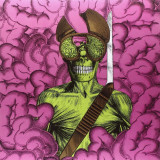
Serious Trouble label presents a mind bending record that brings together forward thinking jams from the early 80’s into present time with reworks of Tiffy L’Amours’ „Follow Me“ and „Film Musik“ from Die Gesunden. Both received an editorial treatment by Benedikt Frey, Menqui & Philipp Otterbach. With kind allowance by the original composers this 12“ marks the editorial spirit of Serious Trouble and waves tribute to moist cellar jams.
The A-Side „Follow Me“ Rework by Frey & Menqui is a wild extension of the original which gently adds a weird drummy cowbell intro before it introduces the chanting eccentric original. That got enhanced with an extra electronic bass recording and relooped cut & phrases emphasing you to hit the bell just one more time.
On the flip side „Film Musik“ Frey & Otterbach dived into the artists main motive and layerd it with a lyra, sh101 and external drums in an 8 hour session. It respectfully keeps the spirit of the playful original. In comparison to that though they managed to built a seamless endless „escheresque" staircase to mad mountain. An Immortal Acid exploration.
12“ 180 gr. heavy Vinyl, Limited to 300 copies. Artwork by Cid Hohner.
Buscar:ben men
KiNK's first release on Sofia Records this year lives up to its title and its creator's reputation. The relentless energy, love of musical adventure and undamped enthusiasm of a KiNK live set can be found here in all its glory.
Wake Up is not only an instruction and a hidden compliment to Laurent Garnier, it's also evidence of the Bulgarians uncanny ability to deliver steamrollers with various twists and turns, while hitting the peak effortlessly.
Beep Beep adds a certain element of mania to the menu. For the lack of a better description, please imagine Mr. Oizo and Steve Poindexter making a record together. Not for the faint at heart.
That can be said for the rest of the EP as well. Featuring Redeye, Room To Jack is on the same level of Beep Beep. Traditional topics of Chicago House get a bench test on a speed farm.
Dancing to Scrambler one would probably need the same room to jack. Swapping the Windy City with British raving fields, KiNK and Raredub deliver a take on the early sound of UK that might miss breakbeats, but manage to re-use all the other ingredients to a hair: fine-tuned and updated. Quotation without modern misinterpretation. Hyper and epic at the same time. And always remember the future!
Estupendo is an alternative electronic band from Buenos Aires, Argentina, formed in 1993. San Antón presents newly remastered versions and bonus tracks from the pioneering album Bistró Málaga-originally released only on CD in 1994.
“San Antón” is a two-disc mind-bending collection of dystopian sci-fi electronica from the spaciest Buenos Aires-based legends Estupendo, reawakened and curated for the first time on vinyl by “The Pressure Company“. The record features a surreal tapestry of illuminated synthesizer layers, processed guitars, ample use of echo, blended watery pianos, and hypnotic soundscapes.
A perfect storm of catchy melodies along with a whole cosmos of ideas and dance-culture references packaged in a bundle of underground hits.
Estupendo is an alternative electronic band from Buenos Aires, Argentina, formed in 1993. San Antón presents newly remastered versions and bonus tracks from the pioneering album Bistró Málaga-originally released only on CD in 1994.
“San Antón” is a two-disc mind-bending collection of dystopian sci-fi electronica from the spaciest Buenos Aires-based legends Estupendo, reawakened and curated for the first time on vinyl by “The Pressure Company“. The record features a surreal tapestry of illuminated synthesizer layers, processed guitars, ample use of echo, blended watery pianos, and hypnotic soundscapes.
A perfect storm of catchy melodies along with a whole cosmos of ideas and dance-culture references packaged in a bundle of underground hits.
Following the release of a number of EPs on Swiss, German, British and Australian labels, Trinidad will release their debut album ‘Palm Trees & Thirty Degrees’ on October 16th 2020.
The album draws on the Swiss-based trio’s experience of sustaining the energy of festival and club shows, while also providing the perfect background to a relaxed summer evening with friends.
The project provides an opportunity for the trio to indulge in a range of musical influences, blending together a mix of synthesizers with the haunting tones of a church organ, the warmth of a string quartet and regality of an opera singer. The album grew organically, with inspiration taking hold beyond the confines of the studio: the bonus track recorded with a Jamaican reggae singer in the back of a VW bus in Greece. Soundscapes from Colombia to India were captured and embedded.
With "Palm Trees & Thirty Degrees" Trinidad guide listeners on a journey to a tropical paradise; to a wonderful, perhaps peculiar place of confidence, created and shaped by the mental theatre of the moment.
The soft kiss of a warm breeze hits you as you adjust to your new surroundings ("Desembarco"); leaving the static chatter of your thoughts behind in the "Lobby" (feat. MonoAbe) of your mind; you allow yourself to imagine what the evening holds in store (“Kopfkino”); But first, there’s a drink in the “Sunset Bar”, a refreshing cocktail "Luciola" that serves as a gateway for you to plunge into the night. A night of unlimited possibilities, the first instances a blur ("Sagrada"), as time starts to lose its meaning ("Tempus Fugit"); everything spins, everything is possible, everything is ("Elevate"). Suddenly, hours (or is it days?) have passed – it doesn’t matter; what matters is the first sign of dawn, the unmistakable warmth dissolving the darkness (“Alma”); the beat slows, and you feel the "Libération" of the new day; looking around you see the moments you’ve shared etched on the faces of your friends ("Fleeting" feat. Julia Portmann); It is not goodbye, it is only "Au Revoir".
The album was produced by Trinidad in their own studios in Bern and Zurich. It features collaborations with a number of artists: Cornelia Aeschbacher Firmin (Hang), MonoAbe (Mallets & Percussion), Jack Williams (text of "Fleeting"), Julia Portmann (vocals), Zenyth (vocals) and Michael Meier (electric bass). The songs were mixed by Marcel Schneider, mastered by Benjamin Fay. Raïssa Lara Lütolf was responsible for the graphic design.
- A1: Les Masques - Il Faut Tenir (1969)
- A2: Isabelle Aubret - Casa Forte (1971)
- A3: Christianne Legrand - Hlm Et Ciné Roman (1972)
- A4: Jean Constantin - Pas Tant D'chichi Ponpon (1972)
- A5: Billy Nencioli & Baden Powell - Si Rien Ne Va (1969)
- B1-: Marpessa Dawn - Le Petit Cuica (1963)
- B2: Jean-Pierre Sabar - Vai Vai (1974)
- B3: Sophia Loren - De Jour En Jour (1963)
- B4: Isabelle - Jusqu’à La Tombée Du Jour (1969)
- B5: Sylvia Fels - Corto Maltesse (1974)
- C1: Frank Gérard - Comme Une Samba (1972)
- C2: Ann Sorel - La Poupée Des Favellas (1971)
- C3: Charles Level - Un Enfant Café Au Lait (1971)
- C4: Andrea Parisy - Les Mains Qui Font Du Bien (1970)
- C5: Audrey Arno - Quand Jean-Paul Rentrera (1969)
- C6: Aldo Frank - T’as Vu Ce Printemps (1970)
- D1: Christianne Legrand - Cent Mille Poissons Dans Ton Filet (1972)
- D2: Clarinha - Lemenja (1970)
- D3: Hit Parade Des Enfants - Aquarela (1976)
- D4: Jean-Pierre Lang - Tendresse (1965)
- D5: Magalie Noël - Une Énorme Samba (1970)
- D6: Françoise Legrand - La Lune
Ever since the late 1950s bossa-nova revolution, Brazil’s influence on French music has been undeniable. Pierre Barouh, Georges Moustaki and a vast array of lesser known artists, all made the Musica Popular Brasileira (MPB) an axis of promotion at the service of a cool and metaphysical, modern and mixed Brazilian lifestyle. Some were seduced by the poetic languors of the bossa, some were looking for fun, and others just loved the American hybridization of jazz-bossa, jazz-samba.
What is bossa nova? One of its creators, Joao Gilberto said: "Its style, cadence, everything is samba. At the very start, we didn't call it bossa nova, we sang a little samba made up of a single note - Samba de uma nota so .... The discussion around the origins of bossa nova is therefore useless”. It is nevertheless useful to remember that these magnificent Brazilian songs, which the guitarist describes as samba, were shifted and balanced around improbable chords. "I like things that lean, the in-betweens that limp with grace," said Pierre Barrouh, quoting Jean Cocteau.
With emotion, arrangements for violin and supple guitar licks, bossa nova rapidly changed. A transformation that can be heard in the Tchic, tchic, French Bossa Nova 1963-1974 compilation, the result of a cultural reappropriation, which traveled through the United States and supplemented itself in France.
A musical revolution that has remained significant, bossa nova was born in Rio. From 1956 to 1961, Brazil lived through its golden years. In five years, the country had invented its modernist style. Elected president in 1956, Juscelino Kubitschek de Oliveira, an elegant man with a broad forehead, brandished a promising slogan: "Fifty years of progress in five years". He quickly got to work. Not worried about increasing debt, he launched the project for a new federal capital, Brasilia, designed by the communist architect Oscar Niemeyer. Volkswagen opened state-of-the-art factories and created the “fusquinha”, the Beetle. In Rio, the Vespa made its first appearance. The Arpoador Surf Club crew run into the “girl” from Ipanema, Helô Pinheiro - the tanned garota ("chick"), between a flower and mermaid, who at 17 walked by the Veloso bar, where the fiery author and composer, Tom Jobim and Vinicius de Moraes, were getting drunk on whiskey. From then on, bossa symbolized cool.
In 1958, Joao Gilberto recorded Chega de Saudade, which the directors of Philips denied, calling it "music for fagots". The marketing director, who believed in it, secretly pressed 3000 78-inch vinyls and distributed them at schools around Rio, creating a tidal wave.
American jazzmen then took over. In particular, trumpeter Dizzy Gillespie and guitarist Charlie Byrd. In November 1962, the Brazilian Ministry of Foreign Affairs funded a "Bossa-Nova" concert at Carnegie Hall in New York, inviting the genre’s pioneers. Unprepared, the show soon turned to disaster. But the troupe was invited to the White House by Jackie Kennedy. The first lady loved "the new beat" and in particular Maria Ninguem, a song by Carlos Lyra, later covered by Brigitte Bardot.
In Brazil, the 1964 military coup quickly ended this euphoria. The destructive atmosphere that ensued pushed many Brazilian musicians to leave, if not to exile. Thus, Tom Jobim, Sergio Mendes and Joao Gilberto arrived to the United States. In New York, Joao Gilberto met saxophonist Stan Getz. At the time, he was married to the Bahianese Astrud Weinert Gilberto, who had a German father. She had never sung before, but she knew how to speak English. Getz therefore asked her to replace her husband on The Girl From Ipanema. The Getz/Gilberto record with Tom Jobim on piano, was released in March 1964. Phil Ramone, the "pope of pop" was in charge of sound.
Bossa nova arrived in Paris through the classic “guitar-voice” channel (Pierre Barouh, Baden Powell, Moustaki…) But France loved jazz and Paris had already welcomed its American contributors. All these good people were to pass through Saint-Germain-des-Prés. The cabaret l'Escale became the Mecca of Latin American sound where one could find Pierre Barrouh and his friends, such as the Camara Trio, samba-jazz aces, whose only record was published by the Saravah label. With a band strangely called Les Masques (a band that included Nicole Croisille and Pierre Vassiliu, among others), the Camara Trio recorded an interesting Brazilian Sound, including the track Il faut tenir which is present on this tasty compilation of rarities.
Other enlightened musicians can also be found on the compilation, such as Jean-Pierre Sabar (songwriter for Hardy, Auffray, Leforestier ...) and the French pop rock organist Balthazar. In 1975, Sabar recorded Aurinkoinen Musiikkimatka on a Finnish label, which featured the crazy Vai, Vai, included on this record. We are now following the footsteps of Brazilian electronic musicians such as Sergio Mendes, Eumir Deodato or Marcos Valle who created funk and disco sounds on their keyboards and synthesizers. A style that influenced Véronique Sanson when she wrote Jusqu’à la Tombée de la nuit in 1969 for Isabelle de Funès, the niece of Louis and a great friend of Michel Berger - Sanson did end up singing this track on her 1992 Sans Regret record.
The pinnacle of exoticism and travel, Sylvia Fels’ Corto Maltese includes bongos, sea mist and ocean sounds. The title was taken from Jacky Chalard’s concept album written in 1974, Je suis vivant, mais j’ai peur (I am alive, but I am scared), based on Gilbert Deflez’s science fiction novel.
However, bossa nova extended the scope of popularity. "In the 1970s, I was a fan of Sergio Mendes, Getz / Gilberto. I fell in love with this music that I knew because I had been an orchestral singer, " explained Isabelle Aubret, who in 1971 delivered a composite record of covers by the very funky Jorge Ben, Orfeu Negro, Tom Jobim, Vinicius de Morais and Jean Ferrat. "I recorded this album for Meys Records in Paris, far from Brazil, with wonderful musicians, François Raubert, Roland Vincent, Alain Goraguer...". The latter wrote the arrangements for Casa Forte, a very percussive title borrowed from Edu Lobo, one of the initiators of the bossa who spent time in California. "Jazz and bossa came together and produced very rhythmic music. I love singing, it allows me to dream, to have fun, to feel a high on stage, and these songs brought me joy, made me swing, my singing felt like a dance.”
The world tours of French singers and their desire for the tropics, often brought them to Rio with its hills, forests, caipirinhas and tanned bodies. There are surprises though, like this Iemenja (Iemenja is the goddess of the sea in the Afro-Brazilian candomblé religion). Not unlike the composer and musician Jean-Pierre Lang, based in Sao Paulo, Claire Chevalier taught Brazil to Brazil. In 1970, the singer and painter published a 45-inch vinyl, Mon mari et mes amants (My husband and my lovers), under the improbable pseudonym of Clarinha (little Claire). She was then living in Rio, with her husband, Joël Leibovitz, who founded a band called Azimuth, and who owned a record label specialized in "sambas enredos" songs for samba school parades.
For its B side, she asked Pierre Perret to come up with lyrics for a song composed by Carlos Imperial: "Oh goddess of the sea, o goddess Iemenja, I bring a white rose to adorn your long hair ..." . "Perret came to see us, and we had fun, remembers Joël Leibovitz. We wrote Lemenja for fun, we recorded it at the Havaí studio, behind the Central do Brasil the central station. Erlon Chaves, the arranger who worked with Elis Regina, joined us" adding his share of Afro-Brazilian percussions and funky brass to the mix.
There is a common misunderstanding in Franco-Brazilian history: that bossa, admittedly hedonistic, is perceived as funny, even though the poets who wrote the texts are often philosophizing on the human condition. Its French interpreters pull it towards a carnival inspired universe, far removed from its fundamental essence. Thus, Jean Constantin covered the famous Samba da minha terra, an ode to the art of samba written by the classic Bahian composer Dorival Caymmi, renaming it with the enticing title of Pas tant de tchi tchi pompon: "On your pier there is no tchi tchi / when you arch your back, you know everything is alright ”(lyrics by Gérard Calvi). This expedited bossa aims for the absurd, but retains a certain elegance.
Indeed, Jean Constantin was not an idiot, the rather large man had a huge mustache and liked fantasy, (Les pantoufles à papa, Le pacha, inspired by cha-cha-cha-cha, salsa and jazz) but he was also the lyricist of Mon manège à moi interpreted by Edith Piaf, the composer of Mon Truc en plume by Zizi Jeanmaire and the soundtrack of François Truffaut’s 400 Blows. Le Poulpe, published in 1970, from which this bossa is extract, was arranged by Jean-Claude Vannier, an accomplice of Serge Gainsbourg’s Melody Nelson. In short: "There is enough of samba / By looking at the parasol / Because my poor cabeza / Is going to die in the sun".
Even the American actress Marpessa Down, who was at the heart of the bossa nova revolution with her role as Euridyce in Marcel Camus’ film Orfeu Negro, winner of the 1959 Cannes Palme d'or, fed the clichée with Je voudrais parler au petit cuica - "Tell me how you manage to always make people want to dance / It's true, I must admit that I cannot resist your magic" - in consequence, once can hear the cuica, a little drum inherited from the Bantu.
But bossa nova had many angles. Societal, of course, pushing actresses who were symbols of women's liberation like Brigitte Bardot, Jeanne Moreau, or Sophia Loren to engage in the exercise of accelerated bossa. In February of 1963, Sophia Loren made a record in French in Rome, Je ne t'aime plus, featuring the song De jour en jour, a bossa written by two Italians, Armando Trovajoli and Tino Fornai, which was released a little later by Barclay. Bossa accompanied the 1960s, a decade of moral liberation. Ann Sorel, who interpreted La Poupée des favellas, caused a sensation with L’amour à plusieurs, a provocative song written by Frédéric Bottom and Jean-Claude Vannier. As for the actress Andrea Parisy, she displayed her bourgeois cheekiness in Marcel Carné's Les Tricheurs before interpreting Les mains qui font du bien. And Magalie Noël, the friend of Boris Vian, who sung Johnny fais-moi mal, was hired to sing Une énorme Samba, composed by Alain Goraguer (arranger to Gainsbourg, Bobby Lapointe and Jean Ferrat) with lyrics by Frédéric Botton.
But in the end, of what wood is bossa nova made of? The answer is given by Christianne Legrand, daughter of Raymond the conductor, and sister to Michel the composer: "With me, with jà" - jà means "immediately" in Portuguese. In 1972, the singer, an expert in vocal jazz and a member of the Double Six, published Le Brésil de Christianne Legrand. Two songs included on the Tchic Tchic compilation that demonstrate how bossa, jazz, funk, rock, etc. work like a swiss army knife: the music is used to denounce broken systems, or miracles, HLM et ciné roman, Cent mille poissons dans ton filet, two songs from the O Cafona soundtrack, a successful telenovela broadcast, at the time in black and white, on TV Globo. The first was adapted in French by the fighter and friend of the Legrand tribe, Agnès Varda. The second is content with a play on words, jostling them into a summer fun.
Véronique Mortaigne
- 1: Im Jenseits Gibt Es Kein Bier
- 2: Amerikanisches Intro
- 3: Frau Bayersdorf
- 4: Mein Vater War Ein Hurenbock
- 5: So Leb Dein Leben
- 6: Älterer Herr
- 7: Ich Bin Jesus Und Kann Alles
- 8: Außerirdischer, Wo Befindet Sich Dein After?
- 9: Mit 'Nem Zeppelin Durchs Jenseits
- 10: Frauenarzt
- 11: Wenn Das Wasser Der Ruhr
- 12: Deutsche Polizisten
- 13: Ich Töte Meinen Nachbarn Und Verprügel Seine Leiche
- 14: Menschenkatapult
- 15: Überall Blühen Rosen
- 16: Mach Die Titten Frei, Ich Will Wichsen
- 17: Kein Geld Für Bier
- 18: Kommandant Ashtar's Grußworte
- 19: Proletentechno
- 20: Habe Brille
Das dritte Album der Kassierer von 1996 ist wieder auf Vinyl erhältlich, Nachpressung von 500 Stück! "Habe Brille" ist benannt nach einem Stück aus einer Operette von Jacques Offenbach und der Titel deutet schon an, wohin die musikalische Reise geht: Es wird ein weiter Bogen geschlagen von der Klassik (hier brilliert Wölfi mit einem a capella Solo über acht Oktaven), Big Band-Einspielungen bis zu düsteren technoiden Maschinenklängen, wobei das Hauptgewicht selbstverständlich auf solidem Punkrock liegt. Die Kassierer überraschen mit ihren virtuos eingespielten Liedern auch verwöhnte Ohren und strafen all die Lügen, die ihnen musikalische Kompetenz absprechen wollen. Was wie ein Streifzug durch die Musikhistorie wirkt, bringt kurz vor der Jahrtausendwende die Vielfalt und Beliebigkeit aller Stile auf den Punkt und liefert nicht mehr und weniger ein Stück Zeitgeschichte. Dabei bleiben die vielen Ohrwürmer sofort im Gedächtnis und laden zum spontanen mitsingen ein. Das große Plus der Band liegt in ihrer konsequenten Konzentration auf die deutsche Sprache, deren Vielfalt sie tiefer ausschöpfen als jede andere Gruppe der Gegenwart. Die Musik der Kassierer läßt den Hörer niemals kalt, sie packt ihn, entwickelt ihre dämonische Kraft und läßt den Hörer als einen anderen zurück. Hier werden Grenzen der Wirklichkeit verzerrt und verschoben, hier wird die realität neu zusammengezimmert. "Habe Brille" bildet die Größe und die Ungeheuerlichkeit der Welt auf musikalische Weise ab. Die Kassierer sind Visionäre und Propheten des dritten Jahrtausends, sie sind Menschen von übermorgen, die mitten unter uns leben. "Nennt es infantil, nennt es genial, scheißegal, die KASSIERER kümmern sich einen Dreck drum - Hauptsache, es wird reagiert. (...) Musikalisch sind die KASSIERER hier unbestritten in Höchstform: von Swing über Volksmusik bis hin zu ihrem altgewohnten Primitiv-Punk ist alles dabei." - Ox-Fanzine / Ausgabe #24
FELICIA ATKINSON & CHRISTINA VANTZOU
REFLECTIONS VOL. 3: WATER POEMS
Auf ,Reflections Vol. 3: Water Poems" bringen Félicia Atkinson und Christina Vantzou ihre Freundschaft und ihre atmosphärische Kunstfertigkeit in einem feierlichen Fokus zusammen. Gesprochene Worte und orchestrale Fantasie fließen wie Nebenflüsse in einen einheitlichen Strom und ergeben eine Sammlung traumhafter Lieder und Klanglandschaften, die im Meer, im Himmel und in den Steinen verankert sind. Mit elektroakustischen Instrumenten, Gesang und Umgebungsgeräuschen lädt Water Poems die Zuhörer in einen unbewussten Raum ein, irgendwo zwischen alltäglicher Intimität und dem Geheimnis des Ozeans, aus dem alles Leben entsteht. Atkinson und Vantzou haben sich 2009 kennengelernt und seitdem immer mal wieder zusammengearbeitet, aber ein Konzert 2019 in der Philharmonie in Paris hat dieses Projekt richtig in Gang gebracht. Da beide jetzt an der Küste leben (Félicia am Ärmelkanal, Christina am Mittelmeer), wurde das Meer natürlich zu ihrer Muse. ,Das Meer wurde nicht als monolithische Postkarte betrachtet", erklärt Atkinson, ,sondern eher als eine Person an sich; eine Energie, ein Geheimnis, ein komplexer Charakter, dem wir als Menschen, die am Meer leben, jeden Tag begegnen." Im Dialog mit dem Land und der Küste nahmen ihre Sprache und ihre Klänge einen sakramentalen Charakter an. ,Ein feierliches Gefühl, ein Gefühl des Dienens, zieht sich tief durch dieses Album", bemerkt Vantzou, ,ich habe das schon einmal gespürt, aber hier, in der Zusammenarbeit mit Félicia, ist es stärker." Stimme, Atem und wässrige Texturen prägen den Ton des maritimen Mysteriums von Water Poems. Neu in Vantzous Praxis und seit langem ein prägendes Merkmal von Atkinsons Werk, gewinnen ihre gesprochenen Worte hier an relationaler Intimität, indem sie sich gegenseitig und die Uferpromenade ansprechen. Die Texte wurden über zwei Jahre hinweg gemeinsam zusammengestellt. Mit radikaler Unschuld lenken sie das Bewusstsein auf die verborgene Auftriebskraft und die unbewussten Strömungen, die durch das Leben fließen: ,Wie kann ein Boot schwimmen? Wie kann ein Flugzeug fliegen? Wie kann ein Körper schwimmen? Wie kann ein Mensch träumen?" Was mit nah aufgenommenen Stimmen und Feldaufnahmen begann, wurde um Synthesizer, Gongs und Metallophone, Klavier, Vibraphon, Rhodes, Gitarren und Mellotron erweitert. Das Gezeitenklavier des Eröffnungstracks ,Film Still / The Sea" zieht uns in die unbewussten Gewässer des Albums. Enthalten sind Feldaufnahmen, die Vantzou in Delphi in der Nähe des legendären Orakels von Pythia aufgenommen hat - ihr griechisches Erbe verleiht diesem Ort der Vorfahren eine zusätzliche Dimension. Dieser Track und ,Water Poems" als Ganzes sind Ausdruck unseres geologischen Erbes und rufen zum Schutz der Küsten und zu einer Vertiefung unserer Beziehung zu unseren Küsten auf. Ein Teil der Einnahmen aus dem Album geht an Arion, ein gemeinnütziges Naturschutzprogramm für das griechische Mittelmeer. Der langjährige Freund und Mitstreiter John Also Bennett hat bei ,Scorpio Purple Skies", dem kosmischen Finale des Albums, mit E-Gitarre, Lap-Steel-Gitarre und Gesang mitgewirkt. Diese üppige Instrumentierung passt super zu den Science-Fiction-Visionen und der feierlichen Atmosphäre des Albums. Water Poems wurde in The Old Carpet Factory, einem Herrenhaus aus dem 18. Jahrhundert auf der griechischen Insel Hydra, in der Villa Medici aus dem 16. Jahrhundert in Rom und in Les Dunes, Atkinsons Heimstudio in der Normandie, aufgenommen. Mehr als das historische Prestige dieser Orte war es die spürbare Geschichte ihrer Landschaft, die die Musik geprägt hat. Atkinson sagt, dass sie sich zu ,Orten mit seltsamer Anziehungskraft" hingezogen fühlten. In der Villa Medici ,haben Steine und Mineralien das gesprochene Wort beeinflusst", bemerkt sie. ,Wir beide legen Wert auf Gefühl, Atmosphäre und Klang", fügt Vantzou hinzu, ,was er hervorruft und was er bewirkt. In unserem Fall konzentrieren wir uns auf die grundlegenden Elemente: Wasser, Luft, Fels, Kosmos - allesamt lebenswichtig.» Von der Insel Kreta aus arbeitete Vantzou den finalen Mix fertig und tauschte dabei Dateien mit Atkinson aus. Immer noch mit der Küste verbunden, verlief der Mixing-Prozess geduldig und wurde von wichtigen Pausen geprägt. Water Poems spiegelt wider, was die Meeresbiologin Rachel Carson uns in Erinnerung ruft: ,Am Rande des Meeres zu stehen bedeutet, Wissen über Dinge zu haben, die so nahezu ewig sind, wie es das irdische Leben nur sein kann." Es zelebriert rituell dieses ozeanische Gefühl als wichtige Quelle der Gelassenheit und Intelligenz. In einer Welt, die von hitzigen Meinungen und ökologischer Vernachlässigung geprägt ist, lenkt Water Poems unsere Aufmerksamkeit auf ,die Quellen der Quellen". Damit schafft es Raum, um uns wieder mit unseren elementaren, animalischen Instinkten zu verbinden und uns auf tiefere Strömungen einzustimmen. Water Poems von Félicia Atkinson und Christina Vantzou ist der dritte Band von Reflections, einer Reihe zeitgenössischer Kollaborationen von RVNG Intl..
Yeun Elez opens a breach: that of a forgotten threshold, a gateway to Hell concealed beneath the peat and legends of the Breton marshes, from which Hoel Moce borrows the name for this project.
Born from Celtic tales passed down in hushed tones, it summons wandering souls, suspended spirits, and those who have already reached the end of their journey. Having escaped from Techno Thriller, Hoel founded Yeun Elez in 2022, as an autonomous and haunting sonic territory.
Surrounded by talented collaborators (Maria: NaturaMorta, Lou Savary de Reymour), he weaves a ritualistic and visceral music, traversed by dreamlike landscapes, misty battlefields, and a fantastical medieval Brittany.
Between pagan symbolism and spectral visions, the project explores the murky depths of the human condition. Thus, birth, love, decline, death: the themes emerge as archaic truths. Betrayal and revenge exist alongside devotion and the quest for an ideal that transcends us.
Mixed by Luc Bersier (Reymour) and then mastered by Tioma Tchoulanov (UVB76, Nze Nze), this album by Yeun Elez doesn't reconstruct the past: it invents it to better haunt it.
Music like a rite of passage, both rooted and timeless, like an inner journey, dark and necessary, to a place where myths refuse to die.
A label long synonymous with raw, off-centre electronics and uncompromising club tools, Bjarki’s bbbbbb recors welcomes a producer whose approach feels cut from the same cloth, London’s Henry Greenleaf. In an era where functionality often outweighs feeling, ‘Brawn’ is a record that doesn’t court approval; it insists on impact. Built for high-pressure systems and low ceilings, it channels force not as spectacle, but as design.
Greenleaf’s catalogue to date, spanning labels such as Par Avion, YUKU, and ARTS, sketches a restless trajectory between precision and collapse. His productions operate where rhythm becomes architecture: kicks land like poured concrete, subs buckle and flex beneath shifting percussive grids, and textures are stretched until they fray at the edges. Sound is treated as a physical material, layered and stress-tested, reshaped until the familiar mutates into something tactile and strange.
Across the EP, that philosophy takes full form. A1 ‘Brawn’ sets the tone with dense, piston-like drums and tightly coiled low-end pressure, balancing brute force with meticulous spatial control. ‘Jump Up To Be’ follows with a more fractured swing, percussive shards ricocheting across a framework that feels perpetually on the verge of rupture. On the flip, ‘Gawk’ strips things back to skeletal components, carving negative space between distorted pulses and menacing, warped rhythmic figures, before ‘UNTUNTUNT’ closes the record in driving fashion, delivering a raw, functional workout that reduces the groove to its bluntest, most hypnotic form.
True to the label’s ethos, ‘Brawn’ doesn’t chase trends or smooth its edges. It folds air and pressure into motion, pares club music down to its working parts, and leaves room for spontaneous chaos to erupt within the grid; moments where structure splinters, energy misbehaves, and control gives way just enough to keep things volatile. Engineered yet unpredictable, utilitarian yet unruly, the EP embodies the tension, unpredictability, and uniqueness that have long defined bbbbbb recors.
- 1: Carrion Crawler
- 2: Contraption / Soul Desert
- 3: Robber Barons
- 4: Chem-Farmer
- 5: Opposition
- 6: The Dream
- 7: Wrong Idea
- 8: Crushed Grass
- 9: Crack In Your Eye
- 10: Heavy Doctor
What's the first thing you think of when someone mentions Thee Oh Sees? Probably their riot-sparking live show, right? Visions of a guitar-chewing, melody-maiming John Dwyer careening across your cranium, rounded out by a wild-eyed wrecking crew that drives every last hook home like it's a nail in the coffin of what you thought it meant to make 21st-century rock 'n' roll? Yeah, that sounds about right. But it misses a more important point-how impossible Thee Oh Sees have been to pin down since Dwyer launched the project in the late '90s as a solo break from such sorely missed underground bands as Pink and Brown and Coachwhips. (While Dwyer still records songs on his own, Thee Oh Sees is now a five-piece featuring keyboardist / singer Brigid Dawson, guitarist Petey Dammit, drummer Mike Shoun and multi-instrumentalist / singer Lars Finberg.) That restlessness extends to everything from the towering, thirteen-minute title track of 2010's Warm Smile LP to the mercurial moods of 2008's The Master's Bedroom Is Worth Spending a Night In. Now, Thee Oh Sees chase the home-brewed symphonies of Castlemania with the scrappy, high-wire hooks of Carrion Crawler / The Dream. Originally envisioned as two EPs, it was cut live to tape in less than a week at Chris Woodhouse's Sacramento studio in June, reflecting the battering-ram bent of the band's live show better than any bootleg ever could. "As I'm sure most would agree," explains Dwyer, "Castlemania was more of a vocal tirade. This one's meant to pummel and throb." That it does, whether one blasts the slow, speaker-bruising build of "The Dream," the sunburnt organs and dovetailing guitars of "Crack in Your Eye" or the interstellar instrumental "Chem-Farmer," a perfect example of what happens when one takes a well-oiled machine-a gang of rabid road warriors, really-and adds a second, groove-locked drum set to the mix. To listen is to realize that Dwyer's music is as manic as the underground comic inclinations of his artwork; colorful and confusing in a way that's more than welcome. It's downright refreshing, like a slap in the face at 5:00 in the morning. Or, as Dwyer puts it, "You have to leave a mark somehow."
- A1: Ernesto Vs Bastian Feat. Susana Dark Side Of The Moon
- A2: Wildstylez & Niels Geusebroek Year Of Summer
- A3: Orlando Voorn In Da Jungle
- A4: Lulleaux Feat Kid Princess Empty Love
- B1: Bakermat Baiana
- B2: Wippenberg Pong
- B3: Headhunterz & Sub Zero Project Our Church
- C1: Brennan Heart & Whildstylez Lose My Mind
- C2: Lazy Jay Float My Boat
- C3: Marco V False Light
- D1: Tinlicker & Helsloot Feat Hero Baldwin Tell Me
- D2: Marcel Woods Advanced
- D3: Toneshifterz & Firelite Paradise
- E1: Nic Chagall Feat Jonathan Mendelsohn This Moment
- E2: Melsen Ain't Real
- E3: Benjamin Bates The Manimal
- F1: Rank 1 L E.d. There Be Light
- F2: Brennan Heart & Jonathan Mendelsohn Imaginary
- F3: Rudenko Everybody
- F4: Sefa & D-Block & S-Te-Fan Infinity
- A1: The Call
- A2: Marty's Dream
- A3: Endo's Game
- A4: The Apple
- A5: Pure Joy
- A6: Holocaust Honey
- B1: The Humbling
- B2: Motherstone
- B3: The Scape
- B4: Tub Falls
- B5: Fucking Mensch
- B6: Rockwell Ink
- C1: Hoff's
- C2: Seward Park
- C3: The Necklace
- C4: Vampire's Castle
- C5: Back To Hoff's
- C6: Shootout
- D1: I Love You, Tokyo
- D2: The Real Game
- D3: Endo's Game (Reprise)
- D4: Force Of Life
- D5: End Credits (I Still Love You, Tokyo)
Daniel Lopatins (Oneohtrix Point Never) Soundtrack für Marty Supreme, gepresst auf schwarzem und transparentem Vinyl. Kommt mit japanischem Obi-Band und doppelseitigem "Koto Endo / Marty Supreme Offizieller Ball"-Poster. Der Film Marty Supreme ist eine Abenteuerkomödie von Josh Safdie aus dem Jahr 2025 und ist lose vom Leben Marty Reismans inspiriert, die in den 1950er-Jahren spielende Geschichte ist jedoch fiktiv. Die Hauptrolle des titelgebenden Tischtennisspielers übernahm Timothée Chalamet. Gwyneth Paltrow, Odessa A'zion, Kevin O'Leary, Tyler Okonma, Abel Ferrara und Fran Drescher ergänzten das Schauspielensemble. Marty Supreme ist der erste Film von Josh Safdie nach Beendigung der kreativen Zusammenarbeit mit seinem Bruder Benny. Das Werk wurde Anfang Oktober 2025 im Rahmen des New York Film Festivals uraufgeführt. Der US-Kinostart war an Weihnachten 2025. Ende Februar 2026 soll der Film in die deutschen Kinos kommen. Die Filmmusik von Daniel Lopatin wurde im Jahr 2025 für einen Hollywood Music In Media Award (HMMA) nominiert. Im Rahmen der Critics' Choice Movie Awards 2026 wurde Marty Supreme in die Shortlists für die Kategorien Casting & Ensemble", Szenenbild", Kamera", Kostüme", Filmschnitt" und Filmmusik" aufgenommen. Im Dezember 2025 gelangte der Film auf die Oscar-Shortlists für das beste Casting, die beste Kamera, das beste Makeup & Hairstyling und die beste Filmmusik. (Quelle: Wikipedia)
- A1: Orchestral Manoeuvres In The Dark– Telegraph
- A2: Blancmange– That's Love, That It Is
- A3: China Crisis– Tragedy And Mystery
- A4: Adam Ant– Strip
- A5: Divine– Love Reaction
- A6: Yello – I Love You
- A7: Talk Talk– My Foolish Friend
- A8: Japan– Canton (Live)
- B1: Fun Boy Three– The More I See (The Less I Believe)
- B2: Tracie*– Give It Some Emotion
- B3: The Teardrop Explodes– You Disappear From View
- B4: Xtc– Love On A Farmboy's Wages
- B5: The Stranglers– Midnight Summer Dream
- B6: The Kinks– Don't Forget To Dance
- B7: Mari Wilson– Cry Me A River
- C1: Bauhaus– Lagartija Nick
- C2: Marc And The Mambas– Black Heart
- C3: The Glove– Like An Animal
- C4: Freur– Doot Doot
- C5: The B-52'S– Song For A Future Generation
- C6: Wall Of Voodoo– Mexican Radio
- C7: Joe Jackson– Breaking Us In Two
- D1: Oliver Cheatham– Get Down Saturday Night
- D2: Rockers Revenge– The Harder They Come
- D3: Freeez– Pop Goes My Love
- D4: Malcolm Mclaren– Soweto
- D5: Culture Club– I'll Tumble 4 Ya
- D6: The Belle Stars– Indian Summer
- D7: Level 42– Out Of Sight Out Of Mind
- D8: Daryl Hall & John Oates– One On One
- E1: Sparks & Jane Wiedlin– Cool Places
- E2: The Romantics– Talking In Your Sleep
- E3: The Fixx– Saved By Zero
- E4: The Motels– Suddenly Last Summer
- E5: Modern English– I Melt With You
- E6: Missing Persons– Walking In L A
- E7: Naked Eyes– Always Something There To Remind Me
- E8: Taco– Puttin' On The Ritz
- F1: Electric Light Orchestra– Secret Messages
- F2: Men At Work– Overkill
- F3: Pat Benatar– Little Too Late
- F4: Journey– Separate Ways (Worlds Apart)
- F5: Styx– Mr Roboto
- F6: Giorgio Moroder & Joe Esposito– Lady, Lady
- F7: Stephen Bishop– It Might Be You
Celebrating the first year of ‘NOW That’s What I Call Music’ – 1983. ‘Now Yearbook’ presents a stellar selection of 1983’s biggest and best hits… 80 huge chart hits from the year, alongside enduring and well-loved classics on 4 CDs. 1983 saw British artists achieving unprecedented success across the world with ‘Every Breath You Take’ from The Police being the year’s biggest seller in the U.S., and ‘Karma Chameleon’ from Culture Club being the top seller in the U.K. Breakthrough acts, achieving their first big hits – all here – include a staggering line-up of future superstars: U2, Eurythmics, Wham!, Paul Young, The Style Council, Marillion and Thompson Twins, to name a few..' Released on a LTD 4CD SET: This will be a limited run of 5000 4CD units housed in ‘hard-back book’ packaging and featuring a 28-page booklet that includes an overview of the chart music of 1983, a track by track guide including chart stats and fun facts, a selection of original picture sleeves and a quiz. 2CD Standard set and also a limited edition of 3000 units, pressed on 3LP translucent red vinyl...
- The Beginning And The End
- Seventh Degraded Hymn
- Memorial Environment #4
- Eighth Degraded Hymn
- Memorial Environment #5
- Ninth Degraded Hymn
- Memorial Environment #6
- Tenth Degraded Hymn
- The End Of Life In Sound
Der postklassische Komponist, Klangkünstler und Kurator Matthew Patton ist mit seinem zweiten Album als Those Who Walk Away zurück. "Afterlife Requiem" ist eine Elegie für seinen Freund und Kollegen Jóhann Jóhannsson. Drones, Elektroakustik und fast vollständige Stille, extrahiert aus unvollendeten Aufnahmen auf Jóhannssons Festplatten, bilden die Grundlage für zwei Streichquintette - Ghost Orchestra (Reykjavík) und Possible Orchestra (Winnipeg) -, die in einem traurigen, langatmigen Werk verarbeitet und ausgelöscht werden. Patton hat auch wieder mit Andy Rudolph (Guy Maddin) und Paul Corley (Sigur Rós, Ben Frost) an der Koproduktion und dem Sounddesign gearbeitet, um eine brodelnde Körperlichkeit zu schaffen, die brodelnde Tiefen mit eindringlichen Bewegungen gespenstischer Streicher kontrastiert. ,Alles, was ich je geschrieben habe, ist ein Requiem. Alles ist ein Ende. Der Tod ist überall in dieser Musik präsent. In meinen Werken geht es um das Verschwinden - der Gegenwart, der Vergangenheit, von allem. Afterlife Requiem wird im Laufe seiner Dauer immer langsamer, es ist ein einziges großes Ritardando, die Zeit verlangsamt sich nicht nur, sie verschwindet. Ohne dass ich darüber nachgedacht hätte, ereigneten sich zwei miteinander verbundene Tragödien, die während des Schreibens, Aufnehmens und Arbeitens organisch an die Oberfläche kamen: der Tod meiner Mutter und der Tod des Komponisten und Freundes Jóhann Jóhannsson. Wenn ich mit dem Schreiben anfange, denke ich an nichts Bestimmtes, ich schreibe einfach, komponiere, nehme auf und höre zu ... aber irgendwas macht sich immer auf unvorhergesehene Weise bemerkbar oder drängt sich in den Vordergrund. Nach dem medizinisch assistierten Tod meiner Mutter wurde mir beim Ausräumen ihrer Wohnung klar, dass ich auch die physische Manifestation ihrer Welt auslöschte - und dass ich genau dasselbe mit der Musik tat, die ich schrieb und aufnahm. Während dieser Zeit wurde mir auch Jóhanns Tod immer wieder bewusst. Für Afterlife Requiem habe ich kurze, verlassene Fragmente aus Jóhann Jóhannssons Festplatten genommen und diese körperlosen Audio-Geister abwechselnd in meine eigene Musik eingebaut, wobei ich sie unrein gelassen habe - und dabei die Grenze zwischen Schaffen und Zerstören verwischt habe. Nach seinem Tod hatte ich diese Festplatten aus Jóhannssons Berliner Studio zum Anhören bekommen. Diese Musik war aufgegeben worden, in verschiedenen Stadien der Entstehung und Auflösung: ein Verzeichnis zerfallener und toter Erinnerungen, vergessen und jetzt nur noch in einer Reihe ineinandergreifender mechanischer Teile vorhanden, die mit der Zeit selbst versagen und verschwinden werden, wie alles andere auch. Monatelang hörte ich mir diese Überreste von Jóhanns Musik obsessiv an und versuchte, Hinweise auf Jóhann vor seinem Tod zu finden. Oft stellte ich fest, dass er das Aufnahmegerät noch lange nach Ende der aufgenommenen Musik laufen gelassen hatte. Er schien nicht zu bemerken, dass die Musik aufgehört hatte, oder registrierte nicht, dass dies das Ende der Musik war, oder vielleicht war er durch etwas anderes abgelenkt. Aber ich fand diese langen Stillephasen zutiefst emotional und berührend. Die verschwindenden Elegien von Afterlife Requiem sind weniger Musik als vielmehr Überreste von Musik. Auf diese Weise arbeite ich immer auf die Subtraktion von Bedeutung hin. Die Musik ist fern und verschwommen, beschädigt, geisterhaft und gespenstisch und deutet nur wie eine halb vergessene Erinnerung an das, was einmal existierte, eine verdichtete Darstellung von Verfall und Auslöschung. Ich habe dieses neue Stück von Anfang bis Ende mit diesen körperlosen Stillephasen aus Jóhanns eigenem Werk, Raum und Zeit unterlegt. Jetzt für immer verschwunden, bleibt seine aufgezeichnete Stille zurück; eine monumentale Leere, die der Welt verloren gegangen ist. Im gesamten Stück, insbesondere in den Abschnitten ,Memorial Environment", habe ich auch unzählige Geräusche aus der Natur integriert, von vulkanischer Lava über Lastenaufzüge bis hin zum menschlichen Blutfluss, dem Zischen von Turbinen und Selbstmordinjektionen. Der Künstler Robert Smithson sagte vor Jahrzehnten: ,Es ist die Dimension der Abwesenheit, die es noch zu finden gilt." Für mich misst diese Musik auch, wie die Zeit abläuft. Tatsächlich ist die Zeit bereits abgelaufen. Die Ewigkeit hat bereits begonnen." - Matthew Patton (Those Who Walk Away)
- Punkrock Lebensberatungstermin
- Der Demagogische Wandel
- Kiezblock (Feat. Chris Kotze)
- Wenn Ich Mal Groß Bin
- Auf Der Suche
- Weißt Du Noch
- Plattensammlung
- Swipe Leben
- Streit Mit Dings Gpt
- Wassereis
White Vinyl[22,48 €]
ULI SAILOR -> File under: Punkrock am KlavierNach über 30 Jahren auf Bühnen zwischen Punkkeller und Festivalhauptbühne bringt Uli Sailor nun sein erstes Piano Solo-Album heraus. ,Besser Anders" ist das Ergebnis von zwei Jahren intensiver Arbeit - zehn Songs voller Energie, Melancholie und Haltung. Produziert wurde das Album halb in Berlin von Thies Neu, halb in Köln von Tobias Röger (Wohlstandskinder, Udo Lindenberg, Slime).Musikalisch schlägt Uli eine Brücke zwischen Indie-Rock und Punk, bleibt dabei aber weit entfernt von weichgespültem Pop. Klavier, Cello und Gesang treffen auf kantige Arrangements und Texte, die irgendwo zwischen Tagtraum und Knochenfabrik liegen - poetisch, wütend, reflektiert. Themen wie Gentrifizierung, digitale Entfremdung und die unerschütterliche Liebe zum Punk ziehen sich durchs ganze Werk.,Besser Anders" ist ein Album gegen die Austauschbarkeit. Kein KI-Produkt, keine Routine - sondern Handarbeit, Schweiß und Herzblut. Uli zeigt, dass Punkrock auch mit Klaviertasten funktionieren kann, solange man das richtige Maß an Wut, Humor und Zärtlichkeit mitbringt.Patrick Reerink (GUTS PIE EARSHOT) sorgt auf dem Album für die Cello-Parts. ,Kiezblock" entsteht gemeinsam mit Chris Kotze (KOTZREIZ), unterstützt von Totze Trippi (BEATSTEAKS) am Bass und einem Chor von Freund*innen - unter anderem Dead End Kids, Berlin Blackouts, Von.Orten und Töff Malstroem. In ,Der demagogische Wandel" greift Guido Donot (DONOTS) zur Gitarre und setzt ein Solo, das hängen bleibt. Das macht ,Besser Anders" zu mehr als einem einsamen Solo-Projekt, sondern ein kollektives Statement mit Haltung.Mittel-Version (2600 Zeichen)Sommer 2025: In einem Berliner Proberaum sitzt ein Mensch und macht das, was er am liebsten tut - Musik. Dieser Mensch heißt Uli Breitbach, besser bekannt als Uli Sailor. Seit über 30 Jahren ist er kreativer Arbeiter, mal euphorisch, mal verzweifelt, und nach zwei Jahren intensiver Arbeit erscheint nun sein erstes Solo-Album: ,Besser Anders".Was wie eine klassische Musikerbiografie klingt, steht im Kontrast zur Gegenwart. Während Künstliche Intelligenz längst komplette Bands ersetzt, bleibt Uli Sailors Musik das Gegenteil davon: handgemacht, ehrlich, mit hörbarem Herzblut. Uli geht auf die 50 zu und bringt sein Debüt erst jetzt heraus - nach Jahrzehnten als Teil verschiedenster Bands wie den Skatepunks D-SAILORS, den Indierockern TUSQ und der legendären Deutschpunkband TERRORGRUPPE.Nach deren Ende wagte Uli ein ungewöhnliches Experiment: Punksongs seiner Jugend auf dem Klavier - unterstützt von Cello. Was zunächst abwegig klang, traf einen Nerv. Seine Konzerte führten ihn in kleine Clubs ebenso wie auf große Bühnen - vom Sisyphos über Rock am Ring bis zur Volksbühne. Egal ob Punkkneipe oder Festival: Uli Sailor funktioniert überall.2024 folgte die EP ,Für immer jung", fünf eigene Songs zwischen Wut und Sentimentalität, die von Kritikern durchweg gelobt wurden. Jetzt also das Album. ,Besser Anders", das am 27. Februar 2026 erscheint - zehn Songs, produziert zur Hälfte von Thies Neu (SHIRLEY HOLMES, DYSE, DEAD END KIDS) in Berlin und von Tobias Röger (WOHLSTANDSKINDER, SLIME, UDO LINDENBERG) in Köln.Musikalisch wagt Uli den Schritt vom Piano-Punkrock hin zu einem Mix aus Indie und Punk, ohne dabei seine Haltung zu verlieren. ,Sellout?", mögen manche rufen. ,Hört doch erst einmal rein", wäre die passende Antwort. Denn ,Besser Anders" ist weit entfernt von weichgespültem Befindlichkeits-Pop. Die Texte bewegen sich zwischen Tagtraum und Knochenfabrik, kraftvoll, poetisch und differenziert. Uli Sailor benennt Missstände, bleibt aber empathisch, reflektiert und wirkt nie platt. Es ist ein vielseitiges, eigenständiges Album mit Songs über Gentrifizierung, digitale Abhängigkeit, verblühende Liebe und die unerschütterliche Kraft des Punk.Patrick Reerink von GUTS PIE EARSHOT steuerte die Cello-Parts bei. Mit Chris Kotze (KOTZREIZ) entstand eine gemeinsam geschriebene Anti-Gentrifizierungshymne, unterstützt von Totze Trippi (BEATSTEAKS) am Bass und einem Backgroundchor, der sich gewaschen hat: Mitglieder von Berlin Blackouts, Dead End Kids, Von.Orten und Töff Malstroem. Bei ,Der demagogische Wandel" wiederum griff Guido Donot (DONOTS) zur Gitarre und setzte ein Solo, das man so schnell nicht vergisst. ,Besser Anders" ist damit weit mehr als ein Solo-Album - es ist ein Gemeinschaftswerk mit Haltung.Vielleicht wird Uli Sailor keine Millionen Klicks erzielen. Aber das ist gut so. Dieses Album ist kein Algorithmusprodukt, sondern das Ergebnis ehrlicher Handarbeit, Leidenschaft und einer großen Liebe zur Musik. Punkrock bleibt hier der rote Faden - anders, besser, echt.
- The Wires: Part 1
- Hall's Creek
- Emu Creek
- The Crater
- Alien F100
- Abysmal Horizon
- Talimnavi
- Liz
- The Shed: Part 1
- Arcane Menace
- Escape
- The Shed: Part 2
- The Cliff
- Mick
- The Return
- Trophy Room
- Head On A Stick
- Kristy
- Statesman Deville
- Ben
- Monumental Isolation
- Epilogue
- The Wires: Part 2
- Wolf Creek: Main Title
Erleben Sie den packenden Soundtrack des australischen Horrorklassikers "Wolf Creek" (2005) wie nie zuvor – neu remastert und auf Red+Black Splatter-Vinyl gepresst, mit exklusivem Artwork und Liner Notes. Der Komponist Francois Tétaz erschuf mit Klavier, Alan Lambs einzigartigen Telefonleitungsaufnahmen aus dem Outback Westaustraliens und einem Streichquartett einen Soundtrack, der als philosophischer Kontrast zum Horror von "Wolf Creek" fungiert. Eine eindringliche Mischung aus atmosphärischen Klanglandschaften, sparsamer Instrumentierung und unterschwelliger Bedrohung – die Musik fängt die Einsamkeit und Bedrohlichkeit des Outbacks in jeder Rille ein. Exklusive Collector's Edition für alle Horrorfans, Soundtrack-Sammler und Vinyl-Liebhaber gleichermaßen.
ince its opening in spring 2021, JUBG, a still young Cologne gallery for contemporary art, has specialized in the broad field of artists and collaborations working along artistic interfaces, especially those between visual art and experimental and/or electronic music. For example, JUBG has already hosted exhibitions by Markus Oehlen, Kim Gordon, Wolfgang Voigt, Matthias and Aksel "Superpitcher" Schaufler, Sven-Åke Johansson, and Emil Schult. Albert Oehlen, who is a kind of mentor and supporter of the gallery, was also a guest at Albertusstraße this summer, where he presented the exhibition D-I-E ORPHEUSMASCHINE together with Michael Wertmüller, Thomas Stammer and the poet Rainald Goetz.
It is only logical that the gallery now expands its sphere of activity to include its own label, on which music appears that comes from similar contexts as the artists listed above already suggest.
As catalog number 1, JUBG is now releasing the official soundtrack to "The Painter" from 2021. The film, German title "Der Maler", is a mixture of feature film and documentary and a collaboration between German director Oliver Hirschbiegel, best known for his Oscar-nominated film "Downfall", and Albert Oehlen, with whom Hirschbiegel has a long friendship, as they both once studied together at the Hochschule der Bildenden Künste in Hamburg.
The docu-fiction shows Oehlen struggling with a painting and pondering the meaning of his work. Oehlen is played by German actor and musician Ben Becker, accompanied by the off-screen voice of Charlotte Rampling. In the film, Becker makes a painting that Oehlen himself creates step by step behind the camera, while the actor improvises the process in front of the camera.
The wonderful music for this film comes from no less than two outstanding personalities whose individual biographies and musical signatures could hardly be better suited to this project. On the A-side it is Gudrun Gut, icon not only of the German electronic music scene since at least the 90's, singer, composer, DJ, label owner (Monika Enterprise) and of course founding member of the legendary 80's New Wave band Malaria. On the B-side it’s the world famous and award winning US avant-garde trumpeter and improvisational musician Nathan "Nate" Wooley, who has played with Fred Frith and John Zorn among others.
Gudrun Gut's tracks bear such beautiful titles as "Bewegung", "Küste" or "Weinen" and she once again pulls out all the stops of her great skills and decades of experience as a producer of the most diverse electronic music genres. These are unusual and much more experimental musical paintings that she creates here than on her recent solo works. Edgy, angular, raw and unpolished, yet always elegant and clever, she subverts the male artist madness depicted extensively in the film in her own unique way.
Nathan Wooley answers with the instrument he has been familiar with since childhood, the trumpet, with which he is able to create a ravishingly virtuosic noise. His pieces are more like sketches, often only 90 seconds or a few minutes long, but in all their abstractness underpin the narrative of the film almost perfectly.
A limited edition of 20 copies in total, painted and signed by Ben Becker, can be purchased directly through JUBG.
JUBG, eine noch junge Kölner Galerie für zeitgenössische Kunst, hat sich seit ihrer Eröffnung im Frühjahr 2021 auf das weite Feld von Künstler:innen und Kollaborationen spezialisiert, die entlang künstlerischer Schnittstellen tätig sind, insbesondere an denen zwischen bildender Kunst und experimenteller und/oder elektronischer Musik. So hat JUBG bereits Ausstellungen von Markus Oehlen, Kim Gordon, Wolfgang Voigt, Matthias und Aksel "Superpitcher" Schaufler, Sven-Åke Johansson und Emil Schult gezeigt. Auch Albert Oehlen, der eine Art Mentor und stiller Unterstützer der Galerie ist, war im Sommer dieses Jahres zu Gast in der Albertusstraße, wo er zusammen mit Michael Wertmüller, Thomas Stammer und dem Dichter Rainald Goetz die Ausstellung D•I•E ORPHEUSMASCHINE präsentierte.
Es ist nur logisch und folgerichtig, dass die Galerie ihren Wirkungskreis nun um ein eigenes Label erweitert, auf dem Musik erscheint, die aus ähnlichen Zusammenhängen und Sphären stammt, wie es die oben aufgezählten Künstler:innen bereits vermuten lassen.
Als Katalog-Nummer 1 veröffentlicht JUBG nun den offiziellen Soundtrack zu "The Painter" aus dem Jahr 2021. Der Film, deutscher Titel “Der Maler”, ist eine Mischung aus Spiel- und Dokumentarfilm und eine Zusammenarbeit zwischen dem deutschen Regisseur Oliver Hirschbiegel, vor allem bekannt für seinen Oscar-nominierten Film "Der Untergang", und Albert Oehlen, mit dem Hirschbiegel eine lange Freundschaft verbindet, studierten sie doch beide zusammen einst an der Hochschule der Bildenden Künste in Hamburg.
Die Doku-Fiktion zeigt Oehlen, wie er mit einem Gemälde kämpft und über die Bedeutung seines Werks nachdenkt. Oehlen wird vom deutschen Schauspieler und Musiker Ben Becker gespielt und von der Stimme von Charlotte Rampling aus dem Off begleitet. Im Film erstellt Becker ein Gemälde, das Oehlen selbst hinter der Kamera Schritt für Schritt anfertigt, während der Schauspieler den Prozess wiederum vor der Kamera improvisiert.
Die wunderbare Musik zu diesem Film kommt von gleich zwei herausragenden Persönlichkeiten, die mit ihren individuellen Biographien und musikalischen Handschriften kaum besser zu diesem Projekt passen könnten. Auf der A-Seite ist dies Gudrun Gut, Ikone nicht nur der deutschen elektronischen Musikszene seit mindestens den 90er Jahren, Sängerin, Komponistin, DJ, Label-Betreiberin (Monika Enterprise) und natürlich Gründungsmitglied der legendären 80er Jahre New Wave-Band Malaria, auf der B-Seite der weltberühmte und Preisgekrönte US-amerikanische Avantgarde-Trompeter und Improvisationsmusiker Nathan “Nate” Wooley, der u.a. mit Fred Frith und John Zorn zusammengespielt hat.
Gudrun Gut’s Tracks tragen so schöne Titeln wie “Bewegung”, “Küste” oder “Weinen” und sie zieht hier einmal alle Register ihres großen Könnens und ihrer jahrzehntelangen Erfahrung als Produzentin der verschiedensten elektronischen Musikspielarten. Es sind ungewöhnliche und sehr viel experimentellere musikalische Gemälde, die sie hier entwirft als auf ihren jüngsten Solo-Werken. Kantig, eckig, roh und ungeschliffen und dabei immer elegant und schlau, unterläuft sie den im Film ausgiebig dargestellten männlichen Künstlerwahnsinn auf ihre ganz eigene Art und Weise.
Nathan Wooley antwortet mit dem ihm seit Kindesbeinen vertrauten Instrument, der Trompete, mit der er in der Lage ist, einen hinreißend virtuosen Lärm zu erzeugen. Seine Stücke sind eher Skizzen, oft nur 90 Sekunden oder ein paar wenige Minuten lang, die in all ihrer Abstraktheit das Narrativ des Films nahezu perfekt untermalen.
Eine auf insgesamt 20 Exemplare limitierte Edition, bemalt und signiert von Ben Becker, ist direkt über die JUBG zu erwerben.