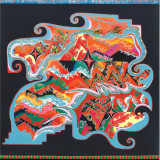
Dröhnender norwegischer Prog-Rock als Soundtrack der Hingabe an ein queeres Schwarzes Selbstbewusstsein, das keine Schonung mit sich selbst kennt! 2021 wurde Ring van Möbius vom Performer und Choreografen Harald Beharie gebeten, die Musik für seinen nächsten Soloauftritt zu schreiben.
Das Projekt wurde bald für den Preis der norwegischen Kritikervereinigung 2022 nominiert. Es entstanden aus einem gemeinsamen musikalischen Ausgangsmaterial drei ähnliche, aber unterschiedliche Werke. Erstens die Demoaufnahmen, zweitens das musikalische Ergebnis dieser Auftragsarbeit und drittens genau dieses Album. Dies ist die vollständig entwickelte Ring van Möbius-Version 'Commissioned Works Pt. II: Six Drops Of Poison'. Das norwegische Trio liefert dabei wieder eine progressive Perle, die auch 1971 hätte erscheinen können, natürlich mit Mitteln wie der rohen Kraft der Hammond-Orgel, Fender Rhodes, Schlagzeug und E-Bass-Gitarre. Ein sehr unterhaltsames, nostalgisches Vergnügen für Fans von Van der Graaf Generator, King Crimson oder Camel. Neben der CD gibt es eine Black Vinyl-Version sowie die streng limitierten Farben White und Tranparent Magenta.
Weitere Formate
Cerca:black ham
Cathalepsy ist ein Metal-Projekt aus Valparaiso, Chile, gegründet von Luigi Ansaldi, das 2006 sein Debütalbum "Fight in the sky" veröffentlichte, das in Ländern wie Brasilien und Japan großen Erfolg hatte. Leider war das Abenteuer nur von kurzer Dauer und die Band löste sich 2010 auf. Im Jahr 2019 beschloss Luigi, die Band wiederzubeleben, diesmal jedoch als Projekt, und begann, kraftvolle und energiegeladene Songs mit Texten mit starken Botschaften zu komponieren. Heavy Metal mit Herz und Wut, dies ist ein kraftvolles und wütendes Album, es ist für alle Metalheads, ohne Scheuklappen. Im Jahr 2019 schließt sich Fabián Valdés diesem Abenteuer an, ein prominenter chilenischer Gitarrist. Cathalepsy sind dabei, den Heavy Metal Fans die ganze Kraft ihrer Musik näher zu bringen! "Blood and Steel" ist der Inbegriff erstklassiger Metal-Musiker in nur einem Album mit Gästen, die von Sängern wie Tim "Ripper" Owens (KK Priest, ex-Judas Priest), Ralf Scheepers (Primal Fear), Harry Conklin (Jag Panzer, ex-Riot), Herbie Langhans (Avantasia, Firewind), Frank Beck (Gamma Ray), Giacomo Voli (Rhapsody of Fire), Ivan Giannini (Vision Divine), Thiago Bianchi (Shaman, Noturnall), David Readman (PinkCream 69, Voodoo Circle), Sologitarristen: Joel Hoekstra (Whitesnake), Roland Grapow (Masterplan, ex-Helloween), Ross The Boss (ex-Manowar), Glen Drover (ex-Megadeath, King Diamond, Testament), Pontus Norgren (Hammerfall), Thobbe Englund (ex-Sabaton), Jens Ludwig (Edguy), Danilo Bar (WhiteSkull), Sigurd Fylling (Legend Of Valley Doom), Keyboarder: Scott Warren (Dio, Heaven and Hell, Black Sabbath), Oliver Palotai (Kamelot). Das ist Heavy Fuckin Metal.
This new album compiles several songs made in the years following Black To Comm's classic "Alphabet 1968" album. Originally released on the seminal Type label in 2009 (and to be reissued on Cellule 75 this year) "Alphabet 1968" combined the sound of vintage shellac and vinyl loops with broken electronics and field recordings, the press release mentioning disparate influences "ranging from Moondog to Basic Channel by way of Bernard Herrmann". In a beautiful one-page review in The Wire magazine (later reprinted in his book Ghosts Of My Life) Mark Fisher compared Richter's music to JF Sebastian’s miniature automata in Blade Runner ("with their bizarre mixture of the clockwork and the computerised, the antique and the ultramodern, the playful and the sinister"), ETA Hoffmann's inventor-magicians and Auguste Villiers de l'Isle-Adam's 1886 tale of Thomas Edison's (fictitious) construction of an artificial human.
Now titled "Coh Bâle" (inspired by a strange dream) these recordings were supposed to become a follow-up to said album but for reasons unknown it never materialized and the album seemed forever lost. At the time Richter started to dive deeper into several strains of (so-called) world music aka the folk music of Southeast Asia and Eastern Europe as well as liturgical and medieval music, the Kraut-Electronica of Harmonia and several certain Mediterranean experimentalists from the 1980's who started to merge their mostly electronic and field recording based compositions with traditional musics from all over the world by way of new sampling technology.
Many of the songs for the album were recorded while travelling and at various residencies around Europe: a detuned piano in a Thessaloniki basement (Richter played at a children's birthday party there), vintage synthesizers in the GRM studios in Paris, decaying acoustic instruments found in an old Black Forest mansion, childrens' voices at a workshop in Karlsruhe's ZKM Institute; then mixed on headphones in the ICE trains running between these places and his hometown Hamburg.
"Coh Bâle" is taking inspirations from old Nonesuch Explorer and Ocora LP's, Crammed Records, 80s Mediterranean Ambient (Nuno Canavarro, Roberto Musci) combined with the DIY spirit of Deux Filles and Flaming Tunes and the playfulness of Asa Chang & Junray. The songs are both mysterious and transparent, intricate and frugal, vibrant and patient. One of the album's unexpected climaxes is a gorgeous (artificial) berimbau version of the Welsh traditional "Iechyd o Gylch".
No two songs feature the same instrumentation and many acoustic sources (pianos, flutes, wood percussion, viola, tablas, autoharp) were disassembled and later coalesced into new configurations or used as virtual instruments; later combined with samples, field recordings, electronics and (on a few tracks) autotuned vocals reminding of recent works by the likes of Claire Rousay or More Eaze.
We had to wait for a worldwide pandemic for Richter to dig deep into the vaults and finally bring these recordings to light. This is the 2nd release from his archives after the "Diode, Triode" LP which presented Musique Concrète/Acousmatic recordings made at INA/GRM and ZKM. Another massive Double-CD (MM∞XX Vol. 1 & 2) was released last year featuring collaborations with 33 artists such as Andrew Pekler, Richard Youngs, Eric Chenaux, Maja Ratkje, Radwan Ghazi Moumneh of Jerusalem In my Heart, GRM boss François Bonnet (Kassel Jaeger), Felix Kubin, Timo van Luijk (In Camera, Af Ursin), Luke Fowler and many others, showing Richter's versatility and his willingness to reinvent himself for every new release.
Marc Richter is widely known under his Black To Comm moniker, having released (at least) 12 albums under this alias in the last 20 years. He is currently signed to the Thrill Jockey label. Richter composes soundtracks for film and has worked with visual artists such as Mike Kelley and Ho Tzu Nyen. He also records as Jemh Circs and Mouchoir Étanche for his own Cellule 75 label (named in tribute to the late Luc Ferrari).
- 1: On The Wings Of A Dove
- 2: To Fabled Lands
- 3: Son Of Perdition
- 4: Ars Moriendi
- 5: Once We Were Kings
- 6: Of Splendid Worlds
- 7: Dying Embers
- 8: Misterium Babel
Ein exzellentes Album, das jedem Black, Death oder Symphonic Metal Fan gefallen sollte! Zum ersten Mal auf Vinyl! Hollenthon ist eine Symphonic Death Metal-Band, die von Martin Schirenc von Pungent Stench gegründet wurde. Hollenthon debütierten 1999 mit "Domus Mundi" und erlangten mit ihrem zweiten Album "With Vilest of Worms" Kultstatus.mit ihrem zweiten Album "With Vilest of Worms to Dwell" im Jahr 2001. Nach diesem Album wurde es ruhig an der Hollenthon-Front, da Schirenc sich darauf konzentrierte, Pungent Stench wieder zusammenzubringen. Nach zwei Pungent Stench-Alben kehrte Schirenc jedoch zu Hollenthon zurück und "Opus Magnum" war das Ergebnis."Opus Magnum" zeigt eine neue Entwicklung des Bandsounds, da die symphonisch-orchestralen Elemente nahtlos mit dem gebotenen Death Metal verschmelzen. Das Album zeichnet sich durch großzügige Chöre, Synthesizer, Streicherarrangements und weiblichen Soprangesang aus, die sich perfekt mit Schirencs
klassischen und ethnischen europäischen Folk-Elementen verbinden. Das Gitarrenspiel hat ein neues Niveau erreicht, mit unglaublichen Soli auf dem gesamten Album. Das Album ist ein perfektes Ganzes, bei dem jeder Song anders ist, aber dennoch einwandfrei zusammenarbeitet. Hollenthon experimentiert auf diesem Album furchtlos mit verschiedenen Sounds, und das funktioniert unglaublich gut. Das Album ist ein durchgehendes, hochenergetisches Erlebnis, und jeder Song ist einzigartig und doch zusammenhängend. Fans von Therion und Symphonic Extreme Metal werden "Opus Magnum" lieben, das unserer Meinung nach sogar besser ist als alles, was Therion seit langem veröffentlicht hat. Insgesamt,"Opus Magnum"
ist eines der besten Extreme-Metal-Alben des Jahres 2008! Sehr empfehlenswert!
Domenico Crisci has been releasing music for more than ten years, starting with famous labels such as L.I.E.S. and its sub-label Russian Torrent in the US, or Opal Tapes and its sub-label Black Opal in the UK, which really established his career, followed by vinyls on Semantica and Jealous God, but since 2016 he has started his own label Summa Cum Laude, where he has released Collin Stange, Sour and Lowfreq77 records next to his own music.
Born Under Another Sun is a four-song EP that has turned out to be a very unpolished, pulsating, tight and raw material, with a more stripped down sound compared to Domenico's well-known early sound. He continues to not overly overdone, operating with few sounds and eschewing all the nowadays boringly mindless, fashionable overly noisy industrial hammering. As he has done throughout his respectable full career run, on this vinyl he has managed to remain self-identical throughout and has delivered another proper techno record from his hands!
- A1: Stompin' At The Savoy
- A2: Flying Home
- A3: Practising, Practising, Just Great
- A4: Relaxing At Camarillo
- B1: Blackbird - White Chicks
- B2: Cool Blues
- B3: You Go To My Head
- B4: If I Should Lose You
- B5: My Ship
- A1: Long Ago (And Far Away)
- A2: Good Morning Heartache
- A3: Never Let Me Go
- A4: Roy Haynes (Reprise)
- A5: Airto
- B1: Roll 'Em Charlie
- B2: What's New
- B3: Take The "A" Train
Charlie Watts “Anthology” is an affectionate retrospective and a reflection of just how frequently Watts was able to exercise his jazz muscles between Rolling Stones commitments to create a bespoke discography of his own. Including 3 unreleased tracks.
The names of Charlie's jazz heroes fell from his lips like a superfan turning the pages of a personal scrapbook. Charlie Parker, Gerry Mulligan, Chico Hamilton, Dave Green, Stan Tracey, Peter King, Courtney Pine, Gail Thompson, Brian Lemon, Gerard Presencer, the Red Rodney group and collaborator Jim Keltner. He knew every player, every session, every album, every outfit they wore on the cover, and he spoke about them with a deep and genuine reverence. He may have been a globally loved hero in the biggest band in the word, but he swatted away any compliment or comparison with his musical favourites. He counted himself their admirer, never their equal.
The Anthology includes an extended essay by Paul Sexton which documents Charlie Watt’s jazz career and the essential albums covered in the collection.
First time on vinyl! Formed from the ashes of the psych/sludge band Cruevo, and preceding guitar player Paul Kott’s work in Matt Pike-fronted Bay Area metal "supergroup" Kalas, High Tone Son Of A Bitch is an innovative, psychedellic stoner/doom band that pulls together a number of influential musicians from bands like Noothgrush, Kalas, Hammers of Misfortune, Men of Porn, Melvins, Hawkwind, Neurosis, High on Fire, Sleep, Witch Mountain, Saviours, Necrot, The Skull, Worshipper and more. This limited release is a vinyl version of the compilation that collects the group’s four EPs from 2003-2020 together.
Green Vinyl
For its fifth release, french label The Bass Academy goes back into time!!! Originally written by legendary Man Parrish, "Boogie Down Bronx", a cult classic from 1984, sees a mighty resurrection with a "fresh mix" rework from UK Electro veteran Bass Junkie. Not the first time Phil Klein (Battle Trax, Breakin' Records) remixes Man Parrish as he committed in 2002 the heavy “Bass Junkie's Boogie Down Bass Mix” of “Hip Hop Re Bop”. Today, he serves up an uncompromising electro funk mayhem made of old schoolish samples, vintage synth melodies, retro congas, relentless scratches and pounding 808 beats. This brand new Sci-Fi anthem, enhanced with the legitimate legacy from the past, will invite you for some irresistible B-Boy breakdancing movements on the linoleum!!! Tuuuuuunnne! On the flipside, Phil teams up once again with long time partner in crime Simon “The Dexorcist” Brown. Together, as Gods Of Technology, (Battle Trax), they revisit another untouchable song, “Future Computer”, an exclusive to TBA track written by Jamie Jupitor and published in 2017 (TBA02). Metallic sororities melt with nasty vocoder sequences and imparable whispers turn the cut into an ode to the dancefloor thanks to harsh and hammering beats. What a timeless monster in pure West Coast tradition! With abrasive outings to appear on the forthcoming months including an incredible album with Matt Whitehead on Dominance Electricity, Phil Klein definitively returns to studios stronger than ever, putting a end to a short blackout. Rush in this hypnotizing collector 12”, limited as usual to 150 copies as it marks one of Phil Klein’s best releases to date!
Sammath begann als Black Metal Band, die Ende 1993 von Jan Kruitwagen gegründet wurde, nachdem er von Australien zurück in die Niederlande gezogen war. Jan war sehr stark inspiriert80er Jahre Thrash und australischer Metal. Das erste Demo "Zwaardbroeders bij de Bergengte" (Brothers of the Sword at the Mountain Pass) wurde 96 veröffentlicht und führte dazu, dass das deutsche FolterRecords Label Sammath unter Vertrag nahmen.
Das erste Album "Strijd" (Schlacht) wurde 1999 veröffentlicht.2001 entwickelte sich Sammath zu einer Live-Band, Bassist Ruud Nillesen stieß zu diesem Zeitpunkt dazu. Seitdem wurden fünf weitere Alben veröffentlicht und viele Live-Shows gespielt.2013 unterschrieb Sammath bei Hammerheart Records und veröffentlichte das furiose Album "Godless Arrogance". Kurz darauf, im Jahr 2016, stieß Wim van der Valk (Inquisitor, Centurian) zur Band am Schlagzeug und Sammath wurde zu der mächtigen dreiköpfigen Kriegsmaschine, die sie heute ist. Alle in der Band begannen, eine größere Rolle bei den Arrangements der Musik zu spielen. Nach der Veröffentlichung des zweiten Albums auf Hammerheart "Across the Rhine is only Death" fanden gut aufgenommene Live-Shows in Deutschland, Serbien, Rumänien und Russland statt.
Tief im glühenden Kessel von Texas haben die Alchemisten von Necrofier (mit Mitgliedern von Night Cobra, Oceans of Slumber, Venomous Maximus, etc.) mit ihrem zweiten Album "Burning Shadows in the Southern Night" eine weitere starke Dosis amerikanischen Black Metals gebraut. Das Vierergespann aus Houston besinnt sich auf die bewährten Tugenden des traditionellen Black und Heavy Metal und wählt einen organischen Klangansatz, indem es den siebenfach Grammy-nominierten Produzenten und Tontechniker Joel Hamilton (Unsane, Tom Waits, Tyler Bryant & The Shakedown, etc.) engagiert, um einen natürlichen Sound zu erzeugen. "Burning Shadows in the Southern Night" wird bei all jenen, die es wagen, dieses bösartige neue Werk zu hören, mit Sicherheit ein Gefühl der Nostalgie hervorrufen.
FFV: Immortal, Rotting Christ, Blackbraid, Uada, Cloak
Tief im glühenden Kessel von Texas haben die Alchemisten von Necrofier (mit Mitgliedern von Night Cobra, Oceans of Slumber, Venomous Maximus, etc.) mit ihrem zweiten Album "Burning Shadows in the Southern Night" eine weitere starke Dosis amerikanischen Black Metals gebraut. Das Vierergespann aus Houston besinnt sich auf die bewährten Tugenden des traditionellen Black und Heavy Metal und wählt einen organischen Klangansatz, indem es den siebenfach Grammy-nominierten Produzenten und Tontechniker Joel Hamilton (Unsane, Tom Waits, Tyler Bryant & The Shakedown, etc.) engagiert, um einen natürlichen Sound zu erzeugen. "Burning Shadows in the Southern Night" wird bei all jenen, die es wagen, dieses bösartige neue Werk zu hören, mit Sicherheit ein Gefühl der Nostalgie hervorrufen.
FFV: Immortal, Rotting Christ, Blackbraid, Uada, Cloak
The next chapter of the Natural Information Society is here. Since Time Is Gravity, credited to Natural Information Society Community Ensemble with Ari Brown, presents a newly expanded manifestation of acclaimed composer & multi-instrumentalist Joshua Abrams nearly 15 year, 7 albums &-counting flagship ensemble. Joining the core NIS of Abrams (guimbri & bass), Lisa Alvarado (harmonium) Mikel Patrick Avery (drums) & Jason Stein (bass clarinet) are Hamid Drake (percussion), Josh Berman & Ben Lamar Gay (cornets), Nick Mazzarella & Mai Sugimoto (alto saxophones & flute), Kara Bershad (harp) & Chicago living legend of the tenor saxophone Ari Brown. Recorded live to tape at Electrical Audio & The Graham Foundation, cover painting Vibratory Cartography: Nepantla, by Lisa Alvarado. 2xLP on Eremite USA, 2xLP & CD on Aguirre/Eremite Europe. Out 14-04.
Since first developing Natural Information Society in 2010, Joshua Abrams has been gradually expanding the group’s conceptual underpinnings, its musical references & the sheer number of the group’s members. Its music is, in a sense, an expansive form of minimalism, based in repeated & overlaid rhythmic patterns, ostinatos & modality. Its roots, its scale & its meaning become clearer in time. If time is gravity, it also allows us to carry more. Having begun as fundamentally a rhythm section with Abrams’ guimbri at its core, the version here can stretch to a tentet, including six horns.
Abrams has been expanding his minimalism gradually, but he has long understood a key to minimalism’s potential: the breadth of its roots in the late 1950s & early 1960s, ranging from the dissatisfaction of young European-stream composers with the limitations of serialism to the simultaneous dissatisfaction of jazz musicians with the dense harmonic vocabulary of bop & hard bop. The former began exploring rhythmic complexity & narrow tonal palates in place of harmonic abstraction (Steve Reich’s Drumming, Philip Glass’ Music with Changing Parts; perhaps above all Terry Riley’s In C & his late ‘60s all-night organ & loop concerts); the later reduced dense chord changes to scales (signally with Miles Davis' Kind of Blue, but rapidly expanding with John Coltrane’s vast project). In the 1950s the LP record opened the world with documentation of Asian & African musics, key influences on both minimalists & jazz musicians. If John Coltrane’s soprano saxophone suggested the keening shehnai of Bismillah Khan, the instrument was rapidly taken up by two key minimalists, LaMonte Young & Riley, similarly appreciative of its flexible intonation, the same thing that kept it out of big bands.
If the guimbri, the North African hide-covered lute that Abrams plays with NIS, involves a rich tradition of hypnotic healing music associated with the Gnawa people, Abrams’ music also touches on other musics as well — other depths, memories & healings, different drones, rhythms & modes. As the group expands on Since Time Is Gravity, he has made certain jazz traditions in the same stream more explicit as well. If there is a mystical & elastic quality involved in the experience of time, both in direction & duration, you will catch it here. The parts for the choir of winds expand on the roles of Abrams’ guimbri, Mikel Patrick Avery & Hamid Drake’s percussion & Lisa Alvarado’s harmonium: at times, the winds are almost looping in the tentet version, each hitting a repeating note in turn, at once drone & distinct inflection on temporal sequence. The brilliance of the work resides in Abrams’ compositions, the NIS’ intuitive execution & in Ari Brown’s singular embodiment of the great tenor saxophone tradition, including the oracular genius of Eddie “Lockjaw” Davis, & Yusef Lateef. The three pieces by the expanded NIS featuring Brown —the opening “Moontide Chorus” & “Is” & the ultimate “Gravity”— have an immediate impact, & togther might be considered a kind of concerto for tenor saxophone. Here Brown presses almost indistinguishably from composed melody to improvised speech, getting so close to language that he might have a text. Everything here is a sign. Note the tap of the Rhythm Ace that links “Moontide Chorus” to “Is”, the attentive heart always present, even when signed by a machine. There’s a link here to the methodologies & meanings of dub music & the linear & vertical collage of beats, textures & tongues: treated with reverence, a sample of a beat-box can be as soulful, as hypnotic, as a mbira or a tamboura. If those pieces with Brown are heard as a suspended concerto, the three embrace & enfold the other works, like the sepals of a flower. That placement will also touch on the mysteries of our perception of time.
Particularly in “Is”, but elsewhere as well, a phenomenon of transcendence arises in which time appears to be tripartite, at once moving backwards & forwards & standing still. This is an act of technical brilliance certainly, but also an illumination of music’s ability to represent temporal consciousness through polymetrics. This particular listener has only heard it before in a few places, including the horn shouts & bowed basses of Coltrane’s Africa, in moments of Charles Mingus’ The Black Saint & the Sinner Lady, in certain pieces where tapes were literally running backwards, & earlier still in Dizzy Gillespie’s Cubana Be, Cubana Bop, in which the composer George Russell & conguero Chano Pozo found a music that spoke at once in the voices of Stravinsky’s Rite of Spring & the vestigial rites, rhythms & songs of the Yoruba language & Santeria religion of inland Cuba.
In Joshua Abrams’ compositions & the realization of them by the NIS, in the time of one’s close listening & memory thereof, distinctions between the “natural” & the “social”, the “quotidian” & the “transcendent” are erased, suspended or perhaps irrelevant. Consider two of the ensemble pieces, one named for nature, the other social science. In “Murmuration” the repeated wind figures of flute & alto saxophone combine with the interlocking patterns of harp, guimbri & frame drum (tar) to create a perfect moving stillness, not an imitation but a witness to the miracle of the starlings’ astonishing collective art, a surfeit of beauty that might be the ultimate defense tactic.
“Stigmergy” takes its name & concept from the Occupy movement’s Heather Marsh, who proposes a social system based on a cooperative rather than competitive models, one in which ideas are freely contributed & developed as ideas rather than an individual’s property. In its form, Abrams’ “Stigmergy” is the closes thing to traditional jazz, a series of accompanied solos by each of the wind players. However, the composed accompaniment is a radically collectivist notion: a repeated rhythmic figure, call it ostinato or riff, in which the different winds each play only a note or two of the figure, a concept both more collectivist & individualistic in its conception than any typical unison figure. It suggests another of the underlying recognitions that propel the Natural Information Society, the group as social organism, the teleology of hypnotic anarchy, all parts in place, functioning systematically, evolving & expressing itself, its nature & society, as a transformative organism.
George Lewis has described music as “a space for reflection on the human condition”. This suggests that, rather than a “distraction”, at least some music might serve as a distraction from distraction. It’s a focus, a clarity, a awareness, an external invitation to interiority, as if music itself is a model for form & contemplation, an organism contemplating for us or as us. If that is a possibility, & I am sure I have heard such musics, than this music is among them. How many of our rhythms, melodies & harmonies (cultural, historical, biological, psychic) might such music carry, translate & transform in the particulate ecstasy of our own murmuration? (Stuart Broomer, April 2022)
Following on from the Bergisch-Brandenburgisches Quartett’s anarchic Live ’82 (BT095), Black Truffle continues its deep dive into the archives of legendary drummer/accordionist/photographer/composer/conceptual prankster Sven-Åke Johansson with Scheisse ’71. Recorded in November 1971 during the Berliner Jazztage at a heavy-hitting concert that also included the Spontaneous Music Ensemble and groups led by Peter Brötzmann, Manfred Schoof, and Masahiko Sato, Scheisse ’71 is the only document of a wild, otherwise unrecorded quintet featuring Johansson on drums, accordion and oboe d’amore, legendary free jazz vocalist Jeanne Lee, her husband Gunter Hampel on vibes, flute and bass clarinet, live electronics pioneer Michael Waisvisz on modified Putney (VCS 3) synthesizer, and the unknown Freddy Gosseye on electric bass. Part of a festival centred on giants of jazz like Duke Ellignton and Dizzy Gillespie, the radical performance shocked its audience, who can be heard heckling and yelling abuse at points, including the titular exclamation of ‘Scheiße!’ Clocking at just over half an hour and recorded in raw but detailed stereo by Johansson himself, the music burns with intensity while also making room for spacious passages and frequent dynamic movement. Beginning with Lee’s voice, Hampel on flute and Johansson on oboe d’amore in a bird-like game of call and response, the unexpected entry of Waisvisz’s tortured, squelching synth bursts prompts the first of many changes in energy and instrumentation, as Gosseye’s busy, roving bass enters and Johansson moves to the kit, his swinging cymbal work and juddering toms extending the approach of Sunny Murray or early Milford Graves. The presence of synthesizer, electric bass, and Lee’s highly amplified voice moves the quintet away from conventional free jazz textures, at times pushing into zones of abstract free sound reminiscent of what groups like MEV, AMM or Johansson’s MND were exploring in the same years. But the energy and joyful melodicism of the music keep it rooted in the tradition of American fire music and its European inheritors. Capable of changing gears in an instant from ferocious blow outs to fragile tapestries of chiming vibes and fizzing synth, the music finds space for Lee’s post-bop free scat (which integrates shrieks and howls just as a post-Ayler saxophonist might), Gosseye’s virtuosic bass runs (a rare attempt to apply the classic free jazz style of players like Alan Silva or Henry Grimes to the electric instrument), Johansson’s folkish accordion interjections, and even a sustained passage of unison bass clarinet and electric bass riffing in its second half. Special mention should be made of Waisvisz’s Putney performance, one of the earliest documents of this under-recorded instrument inventor and player, here playing a major role in giving the music its wildly exploratory, primordial air, his buzzing glissandi and bubbling filter sweeps at times howling like a distressed monkey. Arriving in an austerely stylish sleeve with beautiful black and white photographs by Johansson, Scheisse ’71 is an essential recording that adds yet another layer to our appreciation of this golden era of radical free music.
Fredfades is finally ready with his second album as a solo artist. The producer and DJ and has remained active as a musician ever since his debut single in 2008. Since he released his debut solo album 'Warmth' six years ago he's ben diving into a bunch of different genres and cross-ing musical landscapes such as ambient, hip-hop and house, which has led to releases and productions across labels like his own Mutual Inten-tions imprint, as well as bigger labels like Stones Throw, Fresh Selects and Jakarta Records. This sonic voyage has resulted in ‘Caviar’ - an album that tells the story of a producer who's ready to let go of his youthful love and indulge himself to electronic music.
Fredfades name is more often seen on foreign club posters than back home in Norway. This has colored the musical expression of the Oslo-born multi-artist, and on ‘Caviar’ he is gathering inspiration from every corner of the world where he has traveled. You can clearly hear the inspi-rations from the sounds of Rome, Manchester, South-Africa, Detroit, New York, Berlin, Paris and the Balearic ocean, which are all well repre-sented throughout the album's eight tracks. If you close your eyes and put your ears close to the speakers you will hear loons, running water, African percussion instruments, roaring saxophones, bit-crushed samples, moaning women, TB 303’s, bottom-heavy basslines and recordings of whales communicating at the bottom of the ocean. Everything seamlessly put together for Fredfades’ own sonic world view. The album features a bunch of talented friends of Fred, such as Telephones or the vocalists MoRuf and Kristian Hamilton.
Despite being known as more of a progressive and edgy DJ that haunts down a lot of indie and private press electronic music, Fredfades has cultivated a more elegant and controversial output in his own music. His progressions often consist of dwelling jazz chords from electric pianos or mellow sub-filtered synth patches that creates space where he can unleash rowdy basslines, rhythm sections and leads just as confident and captivating as the man himself. On the jazzy ‘Tenerife 1994’ you can hear a tribute to one of Fred’s greatest heroes in music: Pharoah Sanders, while on ‘My Heart Is On The Edge’ and ‘Summer of Love’ the energy and euphoria is boiling over and directs your mind towards the summer raves which Fredfades is known to throw down in Oslo.
On the LP covers backside Fredfades is posing with a Korg Wavestation in front of the block where he grew up in the suburbs outside Oslo, while the front cover is showing an airbrushed illustration of Caviar from sturgeon - ‘From block to Beluga’. The black vinyl contains magic grooves created by an electronic musical convertite, with the power to transport the listener from a perpetual winter to the 90s warm dance floors and the 'Second Summer of Love’.
- Intro
- Deliver Us From Evil
- Winter Tears
- Child Of The Damned
- Penny For A Poor Man
- Black Mass
- Mrs. Victoria
- Lost And Lonely Days
- Aliens
- City Walls Of Troy
- Kill Zone
- War In Heaven
- Winds Of Thor
- Lucifer's Hammer
- Achilles Revenge
- Lost And Lonely Days (Live 'Keep It True' 2013)
- Aliens (Live 'Keep It True' 2013)
- Soliloquy (Live 'Keep It True' 2013)
- Night Of The Fury Giles Lavery Vocal Demo 2012)
- Father (Tour Rehearsal)
- Glory (Tour Rehearsal)
- Soliloquy (Tour Rehearsal)
- Kill Zone (Instrumental Demo)
- Night O The Fury (Instrumental Demo)
- Glory (1995 Instrumental Demo)
- 70,000 Sorrows (1997 Instrumental Demo)
- The Holy Empire (1997 Instrumental Demo)
splattered vinyl[24,83 €]
High Roller Records, reissue 2023, black vinyl, ltd 250, 425gsm heavy cardboard cover with 5mm spine, poster, insert, mastered and partially restored by Patrick W. Engel at Temple of Disharmony
- 1: Saints In Torment
- 2: Contamination
- 3: Progressive Destructor
- 4: Skulls Adorn The Traitor’s Gate
- 5: Behold The Beyond
- 6: Retaliation
- 7: Savage Intent
- 8: Chimes Of Flagellation
- 9: Beheading Of The Godhead
- 10: The Poison Chalice
- 1: Werewolf Corpse
- 2: Pray And Suffer
- 3: Diabolist
- 4: Bleed For Me
- 5: Legion Of The Damned
- 6: Intro/Slaughtering The Pigs
- 7: Doom Priest
- 8: Place Of Sin
- 9: Undead Stillborn
- 10: Intermezzo
- 11: Taste Of The Whip
- 12: Slaves Of The Southern Cross
- 13: The Window's Breed
- 14: Legion Of The Damned
- 15: Dark Coronation/Outro
Blackened thrash veterans LEGION OF THE DAMNED slay on new studio album The Poison Chalice The LEGION slays again! Dutch thrash veterans LEGION OF THE DAMNED have once again entered into an alliance with the devouring depths of black and death metal and unleash another angry beast, The Poison Chalice, on May 26, 2023 via Napalm Records. The shredding monster delivers the most delicious pitch-black brew and tortures dark souls into demonic underworlds. Founded in 1990 as Occult, the thrash machine around founding members Maurice Swinkels and Erik Fleuren was reborn as LEGION OF THE DAMNED in 2005. On The Poison Chalice, the band unites with Fabian Verweij as second guitarist besides Twan van Geel and hails together with bassist Harold Gielen performing as a five piece for the first time ever on a studio album. Conquering the European charts for decades, the LEGION crowned itself at #17 in the Official German Album Charts with predecessor Slaves Of The Shadow Realms (2019). For almost 35 years, they have formed their aggressive signature sound from the most horrific ingredients of thrash and death metal, combined with brutal blackened influences, resulting in one of the most defined and unique sounds in the scene. The Poison Chalice comes to life by spreading its eerily beautiful wings within the first few seconds, then dives headfirst into a hellishly furious storm before the second song ""Contamination"" absolutely kills. In classic LEGION OF THE DAMNED manner, there is no escape as the track relentlessly drives into the abyss. The album spreads brutal and ice cold thrash soundscapes through relentless attacking drums and incredible guitar harmonies from both lead guitarists, underlined by angry bass lines. Infectious thrash treasures such as “Progressive Destructor”, and the almost seven-minute berserk “Behold The Beyond” break necks with hammering guitar riffs and bloody double bass infernos. “Beheading of The Godhead” delivers what the song title promises, before the past 48 minutes of hate closes with a final deep gulp from “The Poison Chalice” - leaving no one behind. Together with producer Erwin Hermsen, the band has closed the gates of the underworld in Toneshed Studio and demonstrates that they remain the unchallenged masters of brute and unrelenting death-thrash metal in 2023
- Intro
- Deliver Us From Evil
- Winter Tears
- Child Of The Damned
- Penny For A Poor Man
- Black Mass
- Mrs. Victoria
- Lost And Lonely Days
- Aliens
- City Walls Of Troy
- Kill Zone
- War In Heaven
- Winds Of Thor
- Lucifer's Hammer
- Achilles Revenge
- Lost And Lonely Days (Live 'Keep It True' 2013)
- Aliens (Live 'Keep It True' 2013)
- Soliloquy (Live 'Keep It True' 2013)
- Night Of The Fury Giles Lavery Vocal Demo 2012)
- Father (Tour Rehearsal)
- Glory (Tour Rehearsal)
- Soliloquy (Tour Rehearsal)
- Kill Zone (Instrumental Demo)
- Night O The Fury (Instrumental Demo)
- Glory (1995 Instrumental Demo)
- 70,000 Sorrows (1997 Instrumental Demo)
- The Holy Empire (1997 Instrumental Demo)
black vinyl[22,90 €]
High Roller Records, reissue 2023, blue jay/ white splatter vinyl, ltd 250, 425gsm heavy cardboard cover with 5mm spine, poster, insert, mastered and partially restored by Patrick W. Engel at Temple of Disharmony
Tidal Waves Music proudly presents ‘Fly By Night’ for the FIRST TIME on vinyl (the album was only released as a limited compact disc back in the early nineties).
This unique record comes as a deluxe 180g vinyl edition (strictly limited to 500 copies) with obi strip.NonReturnable.
This vinyl edition also features the original painted front cover artwork by Virgil Grady (known for his work with Tribe records) and back photography by acclaimed Detroit scene photographer & author Barbara Barefield, whose work has appeared in many renowned publications such as The New York Times, LA Times, People magazine and countless others.
Released exclusively for Record Store Day 2023 (UK/Europe) and available in participating stores on April 22, 2023.
Wendell Harrison was born in Detroit in 1942 where he began formal jazz studies for piano, clarinet and tenor saxophone. At 14, while still in high school, Harrison started performing & recording professionally with artists such as Marvin Gaye, Grant Green, Sun Ra, Hank Crawford … and many others.
In 1971, Harrison began teaching music at Metro Arts (a multi-arts complex for youth) where he also connected with Marcus Belgrave, Harold McKinney and Phil Ranelin…soon after they formed the (now
legendary) Afro-centric TRIBE record label and artist collective. TRIBE used the Metro Arts complex as a vehicle to convey a growing black political consciousness. Wendell Harrison also published the very popular TRIBE magazine, a publication dedicated to local and national social and political issues, as well as featuring artistic contributions such as poetry and visual pieces.
In 1978 Harrison and McKinney co-founded REBIRTH, a non-profit jazz performance and education organization, in which many notable jazz artists have participated. Around the same time Wendell Harrison
also created the WENHA record label and publishing company, which released many of his (now classic) recordings as well as those of other artists, such as Phil Ranelin, Doug Hammond and Reggie Fields (The Real ShooBeeDoo).
In the early 1990s, Wendell Harrison was awarded the title of “Jazz Master” by Arts Midwest. This distinction led Harrison to collaborate with fellow honorees and gave him the chance to tour throughout the UnitedStates, Middle East and Africa. Even to this day Wendell Harrison's recordings for the TRIBE, WENHA and REBIRTH labels have a large worldwide fanbase.
It is on WEHHA in 1990 that Harrison released (and self-produced) the opus: ‘Fly By Night’ which we are proudly presenting you today. ‘Fly By Night’ is a monster of an album featuring an all-star line-up that
includes Doug Hammond (Mingus, Lonnie Liston Smith) on drums, Kirk Lightsey (Chet Baker, Calvin Keys) on piano, Cecil McBee (John Hicks, Pharoah Sanders, Alice Coltrane) on bass, Jaribu Shahid (Sun Ra) on contrabass and Pamela Wise (Tribe) on Piano. Harrison is killing it here with this selected ensemble (guys he grew up with in Detroit in the late 50’s, when hard bop was the thing and Miles and Coltrane were the heroes of the day). This group of talented veterans are taking this classic album to unseen heights.
On ‘Fly By Night’ the gloves come off…no more jazzy-funk or poppy-jazz. Wendell picks up his tenor for one tune but the remainder of the sessions he performs on clarinet. Wendell’s mastery coaxes the sweet piquant sound of the instrument and as it re-emerges in the contemporary jazz scene. The eight handpicked tunes demonstrate the fertile new directions Wendell Harrison has been working on, combing standards with a fresh new approach.
On these amazing recordings (recorded at the Rebirth Studios in Detroit) the listener is invited to experience a synthesis of what has been and what is now. The record shows Wendell’s trademark proficiency. All of the above makes this incredible record both timeless and as relevant today as it was back when it was initially
released.
- The Watchtower ( Cromlech 'Demo' 1989 ) ( 05:12 )
- Accumulation Of Generalization ( Cromlech 'Demo' 1989 ) ( 03:09 )
- Sempiternal Past
- Presence View Sepulchrality ( Cromlech 'Demo' 1989 ) ( 03:22 )
- Iconoclasm Sweeps
- Cappadocia ( Cromlech 'Demo' 1989 ) ( 03:57 )
- Soria Moria ( Bootleg Tv , Oslo, Norway 01-11-89 ) ( 03:43 )
- Eon / Thulcandra ( Bootleg Tv , Oslo, Norway 01-11-89 ) ( 04:52 )
- Visual Aggression ( Bootleg Tv , Oslo, Norway 01-11-89 ) ( 03:18 )
- Cromlech ( Rehearsal Tape Tracks For Hammy, March 1990 ) ( 04:02 )
- Neptune Towers ( Rehearsal Tape Tracks For Hammy, March 1990 ) ( 03:04 )
- Soulside Journey ( Rehearsal Tape Tracks For Hammy, March 1990 ) ( 04:18 )
DARKTHRONE'S LEGENDARY 1989 DEMO, INCLUDING ADDITIONAL
TRACKS FROM BOOTLEG TV 1989, PLUS ADDITIONAL RARE REHEARSAL
TRACKS FROM 1990 - PRESENTED ON BLACK VINYL.
Longstanding Norwegian band Darkthrone started in 1986, originally
under the name of 'Black Death', before their final infamous moniker was introduced Although becoming known the world over as a black metal band crucial to the legacy of the genre, Darkthrone began more as an extreme metal band utilising element of thrash, death & doom metal into their early compositions.
'Cromlech' was Darkthrone's final demo release before a deal was inked with Peaceville Records. The demo was recorded in 1989 with the line- up of Gylve Nagell (Drums), Ted Skjellum (Guitars/vocals), Ivar Enger (Guitars) & Dag Nilsen (Bass); a line-up which would remain in place for the revered 'Soulside Journey' & 'A Blaze
In The Northern Sky' albums.As well as the iconic 'Cromlech' demo itself containing tracks which would go on to form part of the 'Soulside Journey' debut - this release also contains additional tracks from the Bootleg TV Oslo recordings in 1989, including a cover of Celtic Frost's 'Visual Aggression'.
Finally, this edition of 'Cromlech' also includes a trio of instrumental tracks from a rehearsal tape originally made for Peaceville founder Paul "Hammy" Halmshaw, sent to him in 1990.
This edition of 'Cromlech' is presented on vinyl format with printed inner sleeve & includes the original 'Cromlech' art/logo
Ultramarine are an English electronic music duo, formed in 1989 by Ian Cooper and Paul Hammond.
Cooper and Hammond first worked together in the band A Primary Industry during the mid-1980s. Following the split of that band, they formed Ultramarine and released their debut album 'Folk' in April 1990 on seminal Belgian label Les Disques du Crépuscule. The duo found critical acclaim with their second long player, 'Every Man And Woman Is A Star', initially released in 1991. Over the next decade or so, they recorded two John Peel sessions, collaborated with Robert Wyatt, toured the States with Orbital, then Europe with Björk. After a hiatus, they began recording again in Ian's home studio, overlooking the Blackwater Estuary in Essex.
The moods and movements of this English estuary can be heard running through the duo's stunning and deeply intriguing new album 'Send and Return'.
Flowing and mutating as it transitions from an Essex river into the open sea, the Blackwater Estuary, north of London, inspired this beguiling collection of hypnotic jazz, itching electronica and softly dazzling ambient shapes.
For the 6-track album, Paul and Ian hired a Thames sailing barge moored on the estuary for one day and recorded below deck in the ship's downstairs wooden saloon; the idea was originally inspired by seeing Robin Williamson of The Incredible String Band perform on a similar barge.
The duo were joined by jazz musician Greg Heath and accomplished percussionist Ric Elsworth for the day, who added stunning saxophones, alto flute, percussion and vibraphone to the mix. It's a contemplative, ambient record with gentle jazz inflections and softly pulsing electronica.