History has proven that when the world is in flames, it ignites the empathetic artists to siren their words, music, and rhythm, to blanket our society"s fury and nurse scorched souls. The seemingly endless years of pandemic lockdown and social distancing, coupled with the turbulent plague of civil unrest and racial injustice, called on Vintage Trouble to step into their battle wear. Like so often before, they have spun records to drop onto the fighting grounds, with the intent to freeze the frame long enough to momentarily halt the warring world. And while at ease, we can freely choose to think before we strike or decide to retreat, rather than thoughtlessly charge into repeating history. This collection of heavy hymns is from the heart, and it provides a necessary rise to our ever reckoning.
quête:black one
*BLACK VINYL* Eight years in the making, Santa Cruz, California’s reclusive sons of tectonic riffage Mammatus return with Expanding Majesty, a sixty-nine minute magnum opus of kaleidoscopic guitars, soaring analog synths, wall-ofamps fuzz bass and one hundred feet drums. Four sidelong pieces unfold across a double album in unstoppable riffs that span the meditative and joyful un-earthed flight of ’70s kosmische godfathers like Popol Vuh and Tangerine Dream to the kinds of sub-surface thunder pioneered by Melvins and Sleep.
Label boss Carlo rallies the troops again. This time for his own new collaborative EP, ‘VERSUS’.
Aterral regular, firm family favourite and one of the labels founding artists, Black Loops, steps up on the gorgeously groovy ‘Hungover’. No cloudy heads or slow steps on this collab. Woozy keys yes, but these are kept true by the spritely xylophone melody and warm rolling bass. A perfect opener from this pairing.
Following his popular DOS despatch, ‘Be Pe Em’, much was expected of Emanuele Barilli’s new adventure alongside Carlo. ‘Lelazo’ doesn’t disappoint. Sharp shuffle, filtered keys and popping bassline, all make for a perfect beach-bound soundtrack. Close your eyes, feel the sun on your skin.
From Hungover to another victim of the session, as Carlo teams up with German producer Hauke Freer on ‘Maison.’ Deep, low slung vibes on this ode to the sound we all love. Beautifully constructed, from its patient creamy bassline to its bright rimshots and tender vocal. This is our house. Our home. Come on in.
The most personal of Carlo’s new tracks brings things to a close as he teams up with his young son on ‘Einhorn Poops’. The sun’s warmth is felt again on this beautifully crafted slice of balearic house that matches O's vocals to the equally innocent chimes and bird song to create a fitting and sublime finale.
A native of Los Angeles, Henry Franklin came of age while the city was producing a crop of exciting jazz talent. Frankin’s lasting impact on jazz can be evidenced by the long list of legends who sought him out for tours and recording sessions, Stevie Wonder, Bobby Humphrey, Freddy Hubbard, & Pharaoh Sanders to name a few. Franklin’s solo output is best remembered for his two solo outings with the Black Jazz label- “The Skipper” & “The Skipper At Home”. Together, they form one of the most compelling diptychs in the entire post-bop canon. Recognised by his peers and contemporaries, Franklin’s entry for Jazz Is Dead gives the living legend his flowers and recognises the contributions The Skipper has made as one of jazz’s most influential heartbeats.
Green Vinyl
For its fifth release, french label The Bass Academy goes back into time!!! Originally written by legendary Man Parrish, "Boogie Down Bronx", a cult classic from 1984, sees a mighty resurrection with a "fresh mix" rework from UK Electro veteran Bass Junkie. Not the first time Phil Klein (Battle Trax, Breakin' Records) remixes Man Parrish as he committed in 2002 the heavy “Bass Junkie's Boogie Down Bass Mix” of “Hip Hop Re Bop”. Today, he serves up an uncompromising electro funk mayhem made of old schoolish samples, vintage synth melodies, retro congas, relentless scratches and pounding 808 beats. This brand new Sci-Fi anthem, enhanced with the legitimate legacy from the past, will invite you for some irresistible B-Boy breakdancing movements on the linoleum!!! Tuuuuuunnne! On the flipside, Phil teams up once again with long time partner in crime Simon “The Dexorcist” Brown. Together, as Gods Of Technology, (Battle Trax), they revisit another untouchable song, “Future Computer”, an exclusive to TBA track written by Jamie Jupitor and published in 2017 (TBA02). Metallic sororities melt with nasty vocoder sequences and imparable whispers turn the cut into an ode to the dancefloor thanks to harsh and hammering beats. What a timeless monster in pure West Coast tradition! With abrasive outings to appear on the forthcoming months including an incredible album with Matt Whitehead on Dominance Electricity, Phil Klein definitively returns to studios stronger than ever, putting a end to a short blackout. Rush in this hypnotizing collector 12”, limited as usual to 150 copies as it marks one of Phil Klein’s best releases to date!
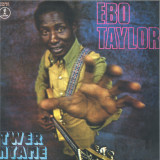
Ebo Taylor “Twer Nyame” is being reissued on vinyl by Comet Records, pressed on high quality vinyl, with label designs and artwork as per the original release.
Originally released in 1978 on Philips-West African-Records. Classic highlife sounds; uptempo grooves, vocals, tons of percussion, guitar, horns and organ lines. Featuring
the stand-out ‘Atwer Abroba’.
Ebo Taylor is one of Ghana's finest producer/arrangers.
Taylor was heavily influential in the unique sound that emerged from the country in the 70's; a combination of traditional Ghanaian with Afro-beat, jazz, and funk rhythms.
He worked with bands including Stargazers Band, Broadway Dance Band, Black Star Highlife Band (with Teddy Osei and Sol Amarfio who later joined Osibisa), Apagya Show Band and fellow musicians C.K.Mann, Gyedu-Blay Ambolley and the legendary Pat Thomas.
Repress! Essential garage Zamrock/soul/funk: the first official reissue of the celebrated band’s one and only album.
The musical style that became known as Zamrock came to embody the economic despair that
followed the 1973-1974 oil crisis, which flung Zambia into recession and exacerbated a wide
range of social tensions. Much of Zamrock also captured the controversy of wider politics in
Africa and the world. Perhaps the finest example of this is Black Power by The Peace.
The Boyfriends, from Kitwe’s Chamboli Mine Township, supplied the founding members for Zamrock’s most
famous band, WITCH, and kick started one of Zamrock’s best bands, Peace. Their sole Zamrock entry, Black
Power, recorded at Malachite Film Studio circa 1973/4 and issued circa 1975, sounds like nothing else in the
Zamrock canon: a lost message drifiting from the flower power era, imbued with a fiery Zambian voice.
June 16th 2023 sees the long overdue vinyl re-issue of Coldplay’s Prospekt’s March EP, the 2008 companion piece to their fourth number one album, Viva La Vida Or Death And All His Friends.
Featuring a selection of new (at the time) tracks, a re-work of Lost: Lost+ with Jay-Z and a remix of album track Lovers In Japan.
Pressed on 140gm, black recycled vinyl, housed in a 4-colour outer sleeve and printed inner sleeve, featuring a matt dispersion varnish.
The next chapter of the Natural Information Society is here. Since Time Is Gravity, credited to Natural Information Society Community Ensemble with Ari Brown, presents a newly expanded manifestation of acclaimed composer & multi-instrumentalist Joshua Abrams nearly 15 year, 7 albums &-counting flagship ensemble. Joining the core NIS of Abrams (guimbri & bass), Lisa Alvarado (harmonium) Mikel Patrick Avery (drums) & Jason Stein (bass clarinet) are Hamid Drake (percussion), Josh Berman & Ben Lamar Gay (cornets), Nick Mazzarella & Mai Sugimoto (alto saxophones & flute), Kara Bershad (harp) & Chicago living legend of the tenor saxophone Ari Brown. Recorded live to tape at Electrical Audio & The Graham Foundation, cover painting Vibratory Cartography: Nepantla, by Lisa Alvarado. 2xLP on Eremite USA, 2xLP & CD on Aguirre/Eremite Europe. Out 14-04.
Since first developing Natural Information Society in 2010, Joshua Abrams has been gradually expanding the group’s conceptual underpinnings, its musical references & the sheer number of the group’s members. Its music is, in a sense, an expansive form of minimalism, based in repeated & overlaid rhythmic patterns, ostinatos & modality. Its roots, its scale & its meaning become clearer in time. If time is gravity, it also allows us to carry more. Having begun as fundamentally a rhythm section with Abrams’ guimbri at its core, the version here can stretch to a tentet, including six horns.
Abrams has been expanding his minimalism gradually, but he has long understood a key to minimalism’s potential: the breadth of its roots in the late 1950s & early 1960s, ranging from the dissatisfaction of young European-stream composers with the limitations of serialism to the simultaneous dissatisfaction of jazz musicians with the dense harmonic vocabulary of bop & hard bop. The former began exploring rhythmic complexity & narrow tonal palates in place of harmonic abstraction (Steve Reich’s Drumming, Philip Glass’ Music with Changing Parts; perhaps above all Terry Riley’s In C & his late ‘60s all-night organ & loop concerts); the later reduced dense chord changes to scales (signally with Miles Davis' Kind of Blue, but rapidly expanding with John Coltrane’s vast project). In the 1950s the LP record opened the world with documentation of Asian & African musics, key influences on both minimalists & jazz musicians. If John Coltrane’s soprano saxophone suggested the keening shehnai of Bismillah Khan, the instrument was rapidly taken up by two key minimalists, LaMonte Young & Riley, similarly appreciative of its flexible intonation, the same thing that kept it out of big bands.
If the guimbri, the North African hide-covered lute that Abrams plays with NIS, involves a rich tradition of hypnotic healing music associated with the Gnawa people, Abrams’ music also touches on other musics as well — other depths, memories & healings, different drones, rhythms & modes. As the group expands on Since Time Is Gravity, he has made certain jazz traditions in the same stream more explicit as well. If there is a mystical & elastic quality involved in the experience of time, both in direction & duration, you will catch it here. The parts for the choir of winds expand on the roles of Abrams’ guimbri, Mikel Patrick Avery & Hamid Drake’s percussion & Lisa Alvarado’s harmonium: at times, the winds are almost looping in the tentet version, each hitting a repeating note in turn, at once drone & distinct inflection on temporal sequence. The brilliance of the work resides in Abrams’ compositions, the NIS’ intuitive execution & in Ari Brown’s singular embodiment of the great tenor saxophone tradition, including the oracular genius of Eddie “Lockjaw” Davis, & Yusef Lateef. The three pieces by the expanded NIS featuring Brown —the opening “Moontide Chorus” & “Is” & the ultimate “Gravity”— have an immediate impact, & togther might be considered a kind of concerto for tenor saxophone. Here Brown presses almost indistinguishably from composed melody to improvised speech, getting so close to language that he might have a text. Everything here is a sign. Note the tap of the Rhythm Ace that links “Moontide Chorus” to “Is”, the attentive heart always present, even when signed by a machine. There’s a link here to the methodologies & meanings of dub music & the linear & vertical collage of beats, textures & tongues: treated with reverence, a sample of a beat-box can be as soulful, as hypnotic, as a mbira or a tamboura. If those pieces with Brown are heard as a suspended concerto, the three embrace & enfold the other works, like the sepals of a flower. That placement will also touch on the mysteries of our perception of time.
Particularly in “Is”, but elsewhere as well, a phenomenon of transcendence arises in which time appears to be tripartite, at once moving backwards & forwards & standing still. This is an act of technical brilliance certainly, but also an illumination of music’s ability to represent temporal consciousness through polymetrics. This particular listener has only heard it before in a few places, including the horn shouts & bowed basses of Coltrane’s Africa, in moments of Charles Mingus’ The Black Saint & the Sinner Lady, in certain pieces where tapes were literally running backwards, & earlier still in Dizzy Gillespie’s Cubana Be, Cubana Bop, in which the composer George Russell & conguero Chano Pozo found a music that spoke at once in the voices of Stravinsky’s Rite of Spring & the vestigial rites, rhythms & songs of the Yoruba language & Santeria religion of inland Cuba.
In Joshua Abrams’ compositions & the realization of them by the NIS, in the time of one’s close listening & memory thereof, distinctions between the “natural” & the “social”, the “quotidian” & the “transcendent” are erased, suspended or perhaps irrelevant. Consider two of the ensemble pieces, one named for nature, the other social science. In “Murmuration” the repeated wind figures of flute & alto saxophone combine with the interlocking patterns of harp, guimbri & frame drum (tar) to create a perfect moving stillness, not an imitation but a witness to the miracle of the starlings’ astonishing collective art, a surfeit of beauty that might be the ultimate defense tactic.
“Stigmergy” takes its name & concept from the Occupy movement’s Heather Marsh, who proposes a social system based on a cooperative rather than competitive models, one in which ideas are freely contributed & developed as ideas rather than an individual’s property. In its form, Abrams’ “Stigmergy” is the closes thing to traditional jazz, a series of accompanied solos by each of the wind players. However, the composed accompaniment is a radically collectivist notion: a repeated rhythmic figure, call it ostinato or riff, in which the different winds each play only a note or two of the figure, a concept both more collectivist & individualistic in its conception than any typical unison figure. It suggests another of the underlying recognitions that propel the Natural Information Society, the group as social organism, the teleology of hypnotic anarchy, all parts in place, functioning systematically, evolving & expressing itself, its nature & society, as a transformative organism.
George Lewis has described music as “a space for reflection on the human condition”. This suggests that, rather than a “distraction”, at least some music might serve as a distraction from distraction. It’s a focus, a clarity, a awareness, an external invitation to interiority, as if music itself is a model for form & contemplation, an organism contemplating for us or as us. If that is a possibility, & I am sure I have heard such musics, than this music is among them. How many of our rhythms, melodies & harmonies (cultural, historical, biological, psychic) might such music carry, translate & transform in the particulate ecstasy of our own murmuration? (Stuart Broomer, April 2022)
Since we've known him, Robert Lloyd has made quite clear his enormous affection for the songs and sounds of Freakwater, the duo of Janet Beveridge-Bean and Catherine Irwin who've been wrongly denied their place as rightful and willful progenitors of alt-country's 'movement', which (frankly) is to their credit. Their genius in offering absolute authentic to the sound old-time Appalachian folk music with a modern façade that in no way negates tradition (one of their albums is titled Feels Like The Third Time) is unparalleled within the genre, and Freakwater remain under-appreciated. After the start of Covid, Robert dared approach Janet with the idea of recording together. Over the course of the long pandemic, songs were bandied about for months, and when recording was finally practical, a band was assembled with dates set up for a recording session in Valencia, Spain. Robert and Janet were joined by Robert's long-time ally, Pete Byrchmore, the musical foil for Robert's solo album on Virgin and a former Nightingale, Mark Bedford, the bassist for Madness and Terry Edwards' Near Jazz Experience, and Pablo Roda, Spanish mystery drummer, couldn't have worked out more perfectly. Tracks were selected without regard for collective presentation, just the goal of walking out of the studio with an album of perfect gems. Forget Lee & Nancy or George & Tammy, Rob and Janet have an immediate chemistry that only sounds long-lived - and too uniquely them to merit any comparison. The title track, Black Cat, Dark Horse is the sole Lloyd / Bean / Byrchmore composition and one of the record 's highlights. Jim Elkington, collaborator with Jeff Tweedy and Richard Thompson, contributes Heavy Reckonings and a song written with Janet, The True Lovers' Knot And The Lie, while Robert adds reworkings from past releases - Sweet Georgia Black and Black Country (with Pete) - not to mention the unreleased Eggs And Bacon. Janet brought One Shot and the unheard Freakwater song Arc Of A Smile. Covers of tunes from Dion and The Monkees and a magnificent Jon Langford song, "Tears Like Stars" round out the album. We daresay the album is among the finest you'll hear in 2023. That it doesn't fit perfectly into any preconceived genre is a testament to its quality. "Songcraft" is a word used infrequently today, yet Black Cat, Dark Horse will show that good songs endure. We're proud that Robert and Janet will find some new admirers through this album's release. The Michael Cumming / Stewart Lee film King Rocker made a case for Robert Lloyd-as-losthero; this album furthers that idea and shows a compelling side of Janet's talent and abilities which will be a surprise to her fans and serve as an entry point to exploring her many other compelling projects.
Pitch language - Modular synth wizard Blawan brings his brand of distorted, syncopated electronic productions. Toast introduces the EP with a playful head bopper with ethereal sounds and menacing overtones. One of the biggest acts in dance music playing international festivals such as Pitchfork 2022, ADE, Nuit Sonores.
Plays from Mary Anne Hobbs on BBC 6 music and coverage from Resident Advisor, Pitchfork, Dekmantel, CRACK, The Face “losing himself in modular synthesis without ever sacrificing soul for science”
Hardcover collection of five 12" LPs on multi-color specialty vinyl w/ 40-page graphic novel. Book is foil embossed with a faux-leather cover printed in a limited edition of 1,000 hand numbered copies.
Omnibus includes Magic Sword's first four releases: “Volume 1” 2LP on Clear + Black Smoke Vinyl, “Legend” on Red + Bone Galaxy Vinyl, “Awakening” on White + Violet Galaxy Vinyl, “Endless” on Blue + Aqua Galaxy Vinyl. RIYL: Oneohtrix Point Never, M83, Stranger Things, Kraftwerk, D & D, Daft Punk. Magic Sword Omnibus is a hardcover collection of Magic Sword's first four releases (Volume 1, Legend, Awakening, and Endless) across five 12" LPs and a 40-page graphic novel written and illustrated by Shay Plummer. Magic Sword Omnibus is foil embossed with a faux-leather cover printed in a limited edition of 1,000 hand-numbered copies. Ages ago, the immortal Dark One was freed from his prison. Since that time, the forces of good have been searching for the Light; the Chosen One; to force him back into his cell. The key to this prison is the Magic Sword. When wielded by the Chosen One, it has the power to return balance to the Universe. Magic Sword is an ageless tale of good and evil, told through an ever-expanding graphic novel and accompanying synth-heavy soundtrack albums; together they create an epic experience for those bold enough to bear witness and come away with a deeper understanding of the ultimate hero's journey
- 1: Blood On The Whitehouse Lawn (Featuring Ali Baker, Jfk, Everybody Knows, Donavin Trip)
- 2: This Timeline Is War Torn (Featuring Bishop I)
- 3: Stawmen (Featuring Iame & Claud Six)
- 4: William Shatner
- 5: It Only Hurts If You Let It (Featuring Thndrthf)
- 6: Black Holes That Automate
- 7: We Will Know Them By Their Fruits (Featuring Nora Smokovitch)
- 8: Eat My Neighbors
Smoke M2D6's boundary-pushing musical production and Jedi-like audio engineering have earned him wide and enthusiastic artistic acclaim, as well as a host of awards. As an MC, Smoke M2D6 has toured the country, performing in all of the lower 48 states, and was one of the original founding members of Northwest super-crew OLDOMINION. Though Smoke M2D6 has not released an album since the 2006 opus Bleed, he has been super-busy creating beats and producing other artists including many of his Oldominion crew mates Onry Ozzborn, Nyqwil, IAME and JFK. The global pandemic finally cleared the deck, allowing Smoke M2D6 to get back to doin' his thing: "When the quarantine started I found an old JFK verse from 2013 where he was talking about a pandemic - 'I've got to build on this,' started cutting it up." We start with an overwhelming feeling of being at the beginning of societal collapse: Quarantine Heart Throb, a mass pak of apocalyptic art. Featured are several NW hip hop legends and mainstays, artists Smoke M2D6 has either "mixed for them, produced for them or is a fan of them." If you are a fan of Smoke M2D6 and have been waiting since 2006 for this album, "You will not be disappointed - - - Quarantine Heart Throb shows my growth as a person, a producer, an engineer and as a rapper." Far out. Smoke M2D6 also appears on (and produced) the K Northwest hip hop compilation All Your friends Friends KLP255.
Death Is Not The End's 333 sub-label drops a much needed reissue of Rupie Dan's My Black Race 12" from 1982. A huge Shaka selection featuring one of the heaviest dubs available from this era of UK roots production. Originally written and produced by Rupie for his Flag Records label, with engineering from Tony Addis (later of Addis Posse and the Warriors Dance label).
"The lyrical idea for My Black Race came about during the 1980/81 social/racial revolution that took place in several cities all over England, including London, Liverpool, Birmingham, Leeds etc. I was living in Bradford, West Yorkshire at the time and was a DJ/Sound System operator on Jah Scorcher International Sound. I also co-hosted a Reggae show on an independent radio station Called Pennine Radio 235. In my regular job I was a youth and community leader with the Bradford education council. I was fully connected and in touch the community.
Seeing how the media used the events of the social uprising as a weapon to further discriminate against the African & Caribbean community committed me to say and do something to elevate the minds of especially young people who were already demoralised by the rhetoric that brought about the so called "riots" of the time. It was during this time that the lyrical foundation of "My Black Race" was laid. The rhythm came later after hearing Barry Brown's "No Wicked Shall Enter the Kingdom of Zion". In the summer of 1982 I entered into the Addis Ababa recording studio on Harrow Road, Paddington and recorded the song having moved to London the previous year. Musicians featured included Victor Cross on bass and Mark Wright on drums (both from the Ariwa band), Rizzo on guitar, Tan Tan and Bami on Horns (all 3 from Aswad band), Bubblers on Piano/Organ (Undivided Roots/Ruff Cutt Band). Lead vocals were provided by myself, with backing vocals Jenifah Gad and Niomi who was working with David Bowie at the time. The engineers were Bubblers and Tony Addis (later of Addis Posse & the Warriors Dance label).
Jah Shaka was in the studio during the entire recording session. I was aquatinted with him as I was previously involved in a 3 way soundclash with Shaka, Quaker City and my sound at the time Jah Scorcher. Some years later I was in Terry's Dub studio in North Acton cutting some dubs when King Jammys and Bunny Lee walked in and heard the song. Bunny was responsible for the production of Barry Brown's "No Wicked Shall Enter the Kingdom of Zion". Thankfully they were both impressed by the track which delighted me as a young up-and-coming artist/producer. The rest is history as we know it. Jah Shaka was mystically constant hence his attachment and love for the song. Jah bless and guide him."
Super limited edition. 2LP comes with an alternative artwork and three bonus tracks! Gatefold, neon pink / black / blue striped vinyl. Limited to 250 copies.
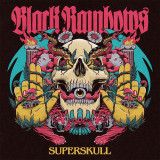
Alright! 2023, Black Rainbows are back with 12 fresh, brand new tunes! The new album sounds huge, with of a great deal of attention paid to the guitars in the recording, and it seems that the band has finally found the perfect balance and tone for their heavy super stoner sound!
This album gives you not only incredible heavy rock-stoner gems, but also: one space acoustic song, one super psychedelic suite and one melodic trippy ballad that adds a perfect mixture of what is sure to be the best album released by the band so far! "Superskull" has been recorded by Fabio Sforza (the same producer of the last two recordings), in May 2022, and after much work and effort by the band in mixing and mastering, the album will see the light of day one year later. The incredible artwork has been delivered by the brazilian artist Pedro Correa.
LP version[20,04 €]
2x12" colored vinyl version[34,66 €]
magenta vinyl version[24,16 €]
Super limited edition. 2LP comes with an alternative artwork and three bonus tracks! Gatefold, neon pink / black / blue striped vinyl. Limited to 250 copies.
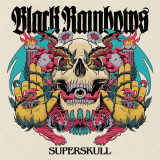
Alright! 2023, Black Rainbows are back with 12 fresh, brand new tunes! The new album sounds huge, with of a great deal of attention paid to the guitars in the recording, and it seems that the band has finally found the perfect balance and tone for their heavy super stoner sound!
This album gives you not only incredible heavy rock-stoner gems, but also: one space acoustic song, one super psychedelic suite and one melodic trippy ballad that adds a perfect mixture of what is sure to be the best album released by the band so far! "Superskull" has been recorded by Fabio Sforza (the same producer of the last two recordings), in May 2022, and after much work and effort by the band in mixing and mastering, the album will see the light of day one year later. The incredible artwork has been delivered by the brazilian artist Pedro Correa.
LP version[20,04 €]
2x12" colored vinyl version[34,66 €]
cyan vinyl version[26,26 €]
Super limited edition. 2LP comes with an alternative artwork and three bonus tracks! Gatefold, neon pink / black / blue striped vinyl. Limited to 250 copies.
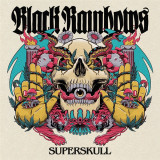
Alright! 2023, Black Rainbows are back with 12 fresh, brand new tunes! The new album sounds huge, with of a great deal of attention paid to the guitars in the recording, and it seems that the band has finally found the perfect balance and tone for their heavy super stoner sound!
This album gives you not only incredible heavy rock-stoner gems, but also: one space acoustic song, one super psychedelic suite and one melodic trippy ballad that adds a perfect mixture of what is sure to be the best album released by the band so far! "Superskull" has been recorded by Fabio Sforza (the same producer of the last two recordings), in May 2022, and after much work and effort by the band in mixing and mastering, the album will see the light of day one year later. The incredible artwork has been delivered by the brazilian artist Pedro Correa.
Following on from the Bergisch-Brandenburgisches Quartett’s anarchic Live ’82 (BT095), Black Truffle continues its deep dive into the archives of legendary drummer/accordionist/photographer/composer/conceptual prankster Sven-Åke Johansson with Scheisse ’71. Recorded in November 1971 during the Berliner Jazztage at a heavy-hitting concert that also included the Spontaneous Music Ensemble and groups led by Peter Brötzmann, Manfred Schoof, and Masahiko Sato, Scheisse ’71 is the only document of a wild, otherwise unrecorded quintet featuring Johansson on drums, accordion and oboe d’amore, legendary free jazz vocalist Jeanne Lee, her husband Gunter Hampel on vibes, flute and bass clarinet, live electronics pioneer Michael Waisvisz on modified Putney (VCS 3) synthesizer, and the unknown Freddy Gosseye on electric bass. Part of a festival centred on giants of jazz like Duke Ellignton and Dizzy Gillespie, the radical performance shocked its audience, who can be heard heckling and yelling abuse at points, including the titular exclamation of ‘Scheiße!’ Clocking at just over half an hour and recorded in raw but detailed stereo by Johansson himself, the music burns with intensity while also making room for spacious passages and frequent dynamic movement. Beginning with Lee’s voice, Hampel on flute and Johansson on oboe d’amore in a bird-like game of call and response, the unexpected entry of Waisvisz’s tortured, squelching synth bursts prompts the first of many changes in energy and instrumentation, as Gosseye’s busy, roving bass enters and Johansson moves to the kit, his swinging cymbal work and juddering toms extending the approach of Sunny Murray or early Milford Graves. The presence of synthesizer, electric bass, and Lee’s highly amplified voice moves the quintet away from conventional free jazz textures, at times pushing into zones of abstract free sound reminiscent of what groups like MEV, AMM or Johansson’s MND were exploring in the same years. But the energy and joyful melodicism of the music keep it rooted in the tradition of American fire music and its European inheritors. Capable of changing gears in an instant from ferocious blow outs to fragile tapestries of chiming vibes and fizzing synth, the music finds space for Lee’s post-bop free scat (which integrates shrieks and howls just as a post-Ayler saxophonist might), Gosseye’s virtuosic bass runs (a rare attempt to apply the classic free jazz style of players like Alan Silva or Henry Grimes to the electric instrument), Johansson’s folkish accordion interjections, and even a sustained passage of unison bass clarinet and electric bass riffing in its second half. Special mention should be made of Waisvisz’s Putney performance, one of the earliest documents of this under-recorded instrument inventor and player, here playing a major role in giving the music its wildly exploratory, primordial air, his buzzing glissandi and bubbling filter sweeps at times howling like a distressed monkey. Arriving in an austerely stylish sleeve with beautiful black and white photographs by Johansson, Scheisse ’71 is an essential recording that adds yet another layer to our appreciation of this golden era of radical free music.
- 1: Saints In Torment
- 2: Contamination
- 3: Progressive Destructor
- 4: Skulls Adorn The Traitor’s Gate
- 5: Behold The Beyond
- 6: Retaliation
- 7: Savage Intent
- 8: Chimes Of Flagellation
- 9: Beheading Of The Godhead
- 10: The Poison Chalice
- 1: Werewolf Corpse
- 2: Pray And Suffer
- 3: Diabolist
- 4: Bleed For Me
- 5: Legion Of The Damned
- 6: Intro/Slaughtering The Pigs
- 7: Doom Priest
- 8: Place Of Sin
- 9: Undead Stillborn
- 10: Intermezzo
- 11: Taste Of The Whip
- 12: Slaves Of The Southern Cross
- 13: The Window's Breed
- 14: Legion Of The Damned
- 15: Dark Coronation/Outro
Blackened thrash veterans LEGION OF THE DAMNED slay on new studio album The Poison Chalice The LEGION slays again! Dutch thrash veterans LEGION OF THE DAMNED have once again entered into an alliance with the devouring depths of black and death metal and unleash another angry beast, The Poison Chalice, on May 26, 2023 via Napalm Records. The shredding monster delivers the most delicious pitch-black brew and tortures dark souls into demonic underworlds. Founded in 1990 as Occult, the thrash machine around founding members Maurice Swinkels and Erik Fleuren was reborn as LEGION OF THE DAMNED in 2005. On The Poison Chalice, the band unites with Fabian Verweij as second guitarist besides Twan van Geel and hails together with bassist Harold Gielen performing as a five piece for the first time ever on a studio album. Conquering the European charts for decades, the LEGION crowned itself at #17 in the Official German Album Charts with predecessor Slaves Of The Shadow Realms (2019). For almost 35 years, they have formed their aggressive signature sound from the most horrific ingredients of thrash and death metal, combined with brutal blackened influences, resulting in one of the most defined and unique sounds in the scene. The Poison Chalice comes to life by spreading its eerily beautiful wings within the first few seconds, then dives headfirst into a hellishly furious storm before the second song ""Contamination"" absolutely kills. In classic LEGION OF THE DAMNED manner, there is no escape as the track relentlessly drives into the abyss. The album spreads brutal and ice cold thrash soundscapes through relentless attacking drums and incredible guitar harmonies from both lead guitarists, underlined by angry bass lines. Infectious thrash treasures such as “Progressive Destructor”, and the almost seven-minute berserk “Behold The Beyond” break necks with hammering guitar riffs and bloody double bass infernos. “Beheading of The Godhead” delivers what the song title promises, before the past 48 minutes of hate closes with a final deep gulp from “The Poison Chalice” - leaving no one behind. Together with producer Erwin Hermsen, the band has closed the gates of the underworld in Toneshed Studio and demonstrates that they remain the unchallenged masters of brute and unrelenting death-thrash metal in 2023