The latest offering from Astral Black comes in the form of the 'Metropolis N' LP, courtesy of Queens, New York's number premier importer/exporter of Jungle & D&B, NIGELTHREETIMES. Having initially garnered a name for themselves as one of New York City's most versatile club DJ's, with the release of their 'Call Of The Void; project in 2020 Nigel also began to build a reputation as a producer in their own right. Resulting in residencies on Rinse FM & The Lot Radio, radio support from the likes of Tom Ravenscroft & Uniiqu3 and press support from Resident Advisor, OkayPLAYER & Mixmag – amplifying their talents throughout New York City and beyond.
With 'Metropolis N' NIGELTHREETIMES distills their eclectic influences through the lens of rolling 160bpm breaks – taking in Jazz, 8-bit game soundtrakcs, science fiction & jump up D&B. Starting off the LP with the rhodes tinged double header of 'TSQ MELTDOWN' & 'EARLY MORNING FROM 103RD STREET', the latter featuring some of the best double bass work heard on a jungle track since 'Brown Paper Bag'. Elsewhere, on 'ROAD2RAILS' and 'PHANTOM SHORES', the producer ditches the instrumentation in favour of oscillated square waves, dubbed out vocal FX & 8-bit melodies, without ever losing site of the projects underlying sense of optimism. On the album closer 'INTERNATIONAL SPACE STATION', 3X manages to bring together the influences heard throughout the project, tying together a muted rhodes chords, squarewave basslines, flutters of alien melodies and finely tuned, slices breakbeats into a 5 minute symphony.
The consistency and exacting production skills heard throughout the offering elevate this project from another drop in the digital ocean to a landmark opus, from a producer carrying the torch for this timeless sound and making the project worthy of a spot alongside some of the classics this genre has produced.
'Metropolis N' is available Oct 13th on digital and limited edition vinyl via Astral Black.
Search:black out
This is the second time out for the Wormholes on AllChival following on from their You Never See the Stars When it Rains anthology release. This one is a previously unreleased album recorded in a concise burst of seven nights in Dublin’s Sun Studios in the spring of 1996. It was originally envisaged as being The Wormholes’ second album, the follow up to their 1994 debut Chicks Dig Scars. Unfortunately the end result of the sessions - Parijuana - would not only be ignored by their label of the time (Roadrunner Records) - but would also just as quickly be dismissed by the band themselves.
Eamonn Crudden, the manager of the band, had manged to extract some money from Roadrunner to record demos of new tracks as soon as the release cycle for their debut was over. The budget was so tight that it covered studio time but was not even enough to buy the master tapes. With things going south with the label – a classic 90’s tale of the A&R man who championed their cause heading off elsewhere the minute they signed - the intention was to go in and aim to record an album rather than demos - with the intention of releasing it on another independent label to keep the momentum around the band going.
However by this stage the Wormholes were totally wrapped up in listening to Can, Faust and generally exploring music based on casual recording, improvisations and extemporization. For them the album was too ‘rock’ and – having been dropped by Roadrunner - they no longer felt under any obligation to release it. To them it was time for a fresh start. Their next recordings would not be ‘for’ anyone but themselves. Today bassist Anto Carroll admits that “at times we were our own worst enemies” and with the benefit of hindsight both he and guitarist Graham Blackmore wish they had gone ahead and released this album at the time. However, back then, they thought they could do better and they did go on to make inventive and unique sounding versions of some of these songs with Stan Erraught producing just a short time later. These recordings were eventually released by Dead Elvis in 1999 - along with a couple of ‘adjusted’ tracks from the Sun Studios sessions - on Parijuana: 4 Years in Captivity.
It’s highly unlikely that listeners today will share the band’s view that the abum was too ‘clean’. This version of Parijuana is dirty, raw, messy with plenty of experimentation and extemporisation. The songwriting is as strong as that on their Chicks Dig Scars debut. The music is played with a new confidence and swagger, very much the sound of a band rooted in a wave of US ‘lo-fi’ finding their own sound. It’s the missing link between their conventional Pavement/Sebadoh influenced debut to the more drawn out, free roaming and extemporised second album proper Scorpio The Album.
Cocoon Recordings' next 12” vinyl comes from a well-known face. No introduction needed as nobody less than Gregor Tresher once again delivers a superb and surprising pair of tracks.
“Black Halo” is down-the-line and perhaps one of the catchiest tracks by Gregor Tresher.
The wobbling driving bassline builds up a rising tension that increases through the vast, detuned, and powerful string parts appearing to extend out to light years, reaching far beyond. Zaps drive the rhythm forward while rushing cymbals push the groove and weld everything together to absolute unity. For Gregor, techno and club culture have certain transcendental qualities, “Black Halo” is concerned with these sentiments and tells an ambivalent story. The onset of bliss oscillates between melancholy and hope, making it an exuberant roller coaster of emotions. A classic Gregor Tresher track, which perfectly represents Gregor’s signature sound!
“Phantom Dancer” literally pulls you onto the dance floor. Discharging beats, which hit you heavily but pleasant. The atmosphere violently evolves with a twisted noise-like signal sound and gets even more brute through the low-pitched filter vocals. An exceptionally deep techno production by Gregor Tresher, which will definitely come to full fruition in the clubs at peak time.
- A1: Flug 8 - Puerto Rico (The Velvet Circle Mix)
- A2: The Black Frame - Sacrosanct (Mount Obsidian Remix)
- A3: The Novotones - Liberty Bell
- A4: Sascha Funke - Mathias Rust
- A5: La Finca - What Clouds Say
- B1: Paulor - The Last Coke In The Desert
- B2: Mount Obsidian - Fade Feat Charlotte Jestaedt
- B3: The Velvet Circle - Our Tribe
- B4: Seb Martel Feat Las Ondas Marteles - Dark Mambo (Joerg Burger Mix)
- B5: Mount Obsidian - Marole Feat Charlotte Jestaedt
Kompakt unveils the third volume of Jörg Burger’s Velvet Desert Music compilation series, dedicated to music that hits the sweet spot between the cinematic, the (pop) ambient, and the psychedelic. With Velvet Desert Music Vol. 3, Burger and his friends wander afar, taking trips away from, or adjacent to, the dancefloor that’s acted so long as the crucible for the Kompakt aesthetic. Like its predecessors, it’s a gorgeous, lambent collection of late-night mood music.
Because it’s such a broad church, Velvet Desert Music admits all kinds of new experiences, as well, with Burger looking for music that "leads out of the desert into the velvet universe". Indeed, of all the volumes in the series, this third instalment feels closest to an album made by a true collective. The roster has changed, with new contributors Flug 8 and Seb Martel, both with his trio Las Ondas Marteles and with Chocolate Genius and Zsela as La Finca, joining regulars The Novotones, Mount Obsidian, The Golden Bug, Paulor and Sascha Funke.
Burger himself reappears, too, alongside Fritz Ackermann (of The Novotones), Max Würden and Thore Pfeiffer, in The Velvet Circle. Their contributions are pure lush life electronica: “Our Tribe” hitches a ride with a low-slung groove, flickering psychedelic reels of acoustic guitar traipsing across moody bass and taffeta layers of drone; their opening remix of Flug 8’s “Puerto Rico” gently introduces the album with softly tangling electronic tones, while guitars, drenched in reverb, pirouette in the background. A Mount Obsidian remix of “Sacrosanct” by Burger’s The Black Frame -project is a swirling treat for the ears.
La Finca’s electronics and voice miniature, “What Clouds Say”, is a masterclass in poetic restraint; Martel’s “Dark Mambo”, remixed by Burger, is one of the collection’s big surprises, for it indeed does what the title says, a drifting, surrealist take on the mambo form, full of pensive chords, rich with unrequited longing, a breathy saxophone whispering under the song’s sly rhythmic carriage.
Elsewhere, The Novotones chime in with a slyly propulsive, Krautrock-esque charmer, “Liberty Bell”, and the guitar-led tone-drift of “Valley of Oblivion”; Paulor’s “The Last Coke in the Desert” is a chiming, lilting dreamscape; Mount Obsidian are joined by vocalist Charlotte Jestaedt for two modern takes on early-hours art song, “Marole” and “Fade”; Sascha Funke’s “Mathias Rust” is a lavish dancefloor dream, vocal samples drifting through the song as it slowly envelops the listener in its opulent radiance.
This is just a taste of the rich pleasures of Velvet Desert Music Vol. 3, a triumph of a compilation that takes the psychedelic visions of its predecessors and looks for the desert within, a dusty kiss, a road-movie hallucination flickering on the listener’s eyelids, a cinematic projection from deep inside the mind.
'After a first album as a duo released on Okraina Records: "Le Corps Défendant", Delphine Dora and Mocke invite us to join them again in listening to a new album. We slip into it as if in a dream, the music carries us away with its floating images.
Heard before on a handful of disturbingly beautiful solo albums and in collaborations such as Midget!, Arlt, Chevalrex, Mohamed Lamouri, Mocke (Dominique Dépret's nom de plume) is a subtle and inventive guitarist, who draws melancholic arpeggios, with a beautiful languor, that walk the line between tensions and tears. Delphine Dora has been heard with Roxane Métayer, Sophie Cooper, Andrew Chalk, Jackie McDowell, Helena Espvall, Valentina Magaletti ... meeting in a moment of improvisation, a solitary sincopated voice blooming between the black and white keys of her piano, tuning betwist these keys, or at other times in the gap of the right note. Here improvisation feeds on melody, or is it the other way round?
Recorded in an old church in the village of Mauzun in the Puy-de-Dôme, by Cyril Harrison, "L'invisible est multiforme" is an invitation to join them, to let these abstract songs erase our obsessive thoughts of the day, to open ourselves to the vibrant poetry of the air and the evening, to finally forget ourselves. Each note played by these four intertwined hands is like a slight break in the fabric of time, sliding one over the other, reminding us of mortality and its beauty. Ritornellas flow out of mechanical clocks, fragile, taking care not to hurt the silence. Both seek to dig and open up new paths to enrich their duet, to open up imaginary landscapes. Sometimes the guitar cuts through the fabric of an organ, fractures the song, just as the rain erases a landscape, redrawing it. But very quickly, both of them continue to follow this new path, improvising what will serve as a framework, a perspective, a language. There is a kind of praise for slowness in this "invisible", a desire to hold back the song, not to let it slip away, to let the listener's ear enter its course, to share the last note, its illumination. Each of these thirteen short sound pieces merge into a common colour, a vibration close to the different tonalities, which inter-penetrate, like a cubist painting. Words cannot take away the mystery of this record, words can only fail to describe the music, you must hear it.'
- Michel Henritzi
'This is an unusual album in the catalogue of Ornette Coleman, and one that passes by most critics. It is however a unique insight into the ‘free jazz’ pioneer’s way of working in the early 70s. Recorded at his large loft space in downtown New York which inspired a whole scene of experimental musicians who were locked out of playing established venues.
The music is a romp showing Ornette playing trumpet as well as saxophone. His quartet which featured second saxophonist Dewey Redman alongside long term cohorts Ed Blackwell and Charlie Haden prove to be the perfect foil for this short set.
This is the first vinyl reissue in nearly 20 years and utilises a fresh 24/96 transfer from the original production master.'
The latest by New York-based producer Lamin Fofana further refines his cinematic dialect of fractured soundscapes, displaced rhythms, and tectonic unease. Unsettling scores aptly describes itself: grainy, bristling, and bruised, rippling with dread disguised as grandeur. The collection emerged from an extended reworking of his 2016 composition, “A Symbol of the Withdrawn God,” mining deeper into the piece’s “unvoiced fragments, shards, and utterances.” Other tracks were inspired by recent readings on climate emergency and its “specific implications for Black life, from hurricanes in the Caribbean to mudslides in West Africa.”
Fofana has spoken of his music as part of a “legacy of resistance,” spanning the roots of Detroit techno to the outer reaches of contemporary sound art as championed by his labels, Sci-Fi & Fantasy and Black Studies. His work here vividly embodies that spirit, seven hyper-textural transmissions of rumbling lament, shifting sands, and restless innovation, tracing jagged silhouettes of indeterminate futures: “The instability is worldwide.”
- A1: Mind Against & Sideral - Criseide
- A2: Remcord - Entourage Effect
- B1: Dyzen - Talk To Me
- B2: Read The News - A Space
- B3: Losless - Ground Echoes
- C1: Ivory - There Would Come A Day
- C2: Beswerda - Out Of The Blue
- D1: Ae Ther - Disco Biscuit
- D2: Vaert - High Hopes
- D3: Momery - Ophelia Ft. Running Pine
- E1: Marino Canal - Ample
- E2: Nandu - Ygi
- F1: Enos - Supernova
- F2: Sam Shure - Plus Ultra
- F3: Laroz - Don't Touch Ft. Sheera
Mind Against launch their eagerly awaited imprint Habitat with a 15-track compilation titled “METAFLORA”, available as a deluxe transparent vinyl 3LP box set including a 24x12” fold-out poster.
Suitably, the compilation features new and emerging artists with whom Mind against have relationships, and recurrent motifs of subtly unsettling melodic house/techno building alternate worlds in soundscapes.
Mind Against & Sideral – ‘Criseide’ heralds this new world with portentous pounding beat/bass, the melodic synth singing beneath like beauty surviving under threat, the vocal/lyrics with an edge of alarm: ‘if you think it couldn’t happen to you…’
‘Talk To Me’ by Dyzen (who also collab’ed with Mind Against on their fabric presents compilation) has stately chords riding a prancing beat while sombre piano and sweet high vocal create a heraldic, post-apocalyptic nu-medieval world, whereas Sam Shure’s ‘Plus Ultra’ has rattling percussion, with melody like a coded message from an abandoned spaceship to which something replies in stark tones…
Marino Canal, whose debut album was released by Nicole Moudaber’s MOOD, and who has support from many big names including fabric’s founder Keith Reilly, features plangent notes veering up, down and off the scale for a disturbing effect in ‘Ample’, while Swiss duo Read The News in ‘A Place’ set a fast, kicking beat against a female voice yearning for ‘a space where I can just be’.
Remcord, often played by Black Coffee, Tale of Us and more besides MA, show us why in ‘Entourage Effect’ while Laroz gives a lively melody and raucous chords in ‘Don’t Touch’ feat. Sheera as her cool, raunchy, layered vocals come to the fore.
- A1: David Holmes & Raven Violet - It’s Over If We Run Out Of Love (Hardway Bros Live At The Ssl Dub)
- A2: Unloved - Mother’s Been A Bad Girl (Horse Meat Disco Remix)
- A3: Pip Blom - Keep It Together (Ludwig A F. Under Pressure Mix)
- B1: Confidence Man - Holiday (Erol Alkan Ooo Remix)
- B2: Toy - You Won’t Be The Same (Dan Carey Dub)
- C1: Audiobooks - The Doll (Bruise Remix)
- C2: The Orielles - The Room (Shy One Remix)
- C3: Eyes Of Others - Once Twice Thrice (The Orielles Remix)
- D1: Fever The Ghost - Source (Leo Zero Dub)
- D2: Working Men’s Club - The Last One (Forgemasters Remix)
Heavenly Recordings release the next two volumes in their series of remixed classics and unreleased versions. ‘Heavenly Remixes 7 & 8’ sees the label going back into the archive, as well as picking off some more recent remixes, and both albums primarily feature either previously unreleased versions or re-workings available for the first time on vinyl and CD.
Heavenly have always seen immense value in the remix, a value way beyond what it might bring commercially. Since their first release in 1990 (where Andrew Weatherall overhauled a one-off single by club kids Sly and Lovechild) Heavenly remixes have been carefully curated and treated as a key part of the A&R process. It’s an opportunity to view an artist through a different prism, to play out a musical ‘what if’ scenario. It’s the kind of exploration that’s happened consistently through the thirty plus years the label has released music.
The ‘Heavenly remixes’ series continues to showcase the very best remixes, versions, meditations, re-rubs and dubs from all around the world of artists right across the roster of the country’s most exciting record label. In most cases, the albums offer the first physical release for a remix, elevating them from streaming playlists to their rightful, spiritual home on super heavy vinyl (or shiny, super-packed compact disc).
‘Heavenly remixes 7’ heads to Belfast, where David Holmes - a producer who first appeared on Heavenly in 1994 amping up the acid on Saint Etienne’s ‘Like A Motorway’ - appears as solo artist and as one third of Unloved, who get a lift right to the heart of a Vauxhall sweatbox by Horse Meat Disco. It draws a line between Amsterdam and Frankfurt as Ludwig A.F. amps up the electronics on Pip Blom’s ‘Keep It Together’. It stops off in a south London studio where super producer Dan Carey plays the desk with Toy, then relocates LA psych rock band Fever The Ghost to an Ibizan shoreline as the sun sets on the horizon. It cements Sheffield’s reputation as the home of modern British techno with the return of true originators Forgemasters. And it pitches up in front of a renegade soundsystem late night at Glastonbury as Erol Alkan’s mighty rework of Con Man gets its third rewind of the night.
‘Heavenly remixes 8’ opens with Space Afrika’s lush, ambient reimagining of the Orielles’ ‘BEAM/S’ before Justin Robertson stretches Amber Arcades’ ‘Turning Light’ into eight minutes of electronic dub. Elsewhere, Baxter Dury’s peerless ‘Miami’ becomes a string-laden electro skank in the hands of French producer Pilooski; Edinburgh’s bedroom techno genius Eyes of Others’ ‘Safehouse’ turns into an East End bathhouse courtesy of disco deviants Decius; Ashley Beedle’s Black Science Orchestra turns Unloved’s heartworn torch song into seven minutes of glimmering dreamlike percussive house and Katy J. Pearson’s freak flag is flown high thanks to The Umlauts’ throbbing filtered electro mix. It ends similarly to how it began as TONE takes
Fran Lobo’s ‘All I Want’ on a gorgeous slow motion spacewalk.
Detroit artist Julion De’Angelo steps forward into his own with a new musical offering:the inaugural EP from his new imprint, Maybee Hill Music. Named after the street that he grew up on, the label celebrates ancestral guidance and reflecting on the past, so you can move FORWARD!
Can’t Go Askin is an exuberant testament to Black joy, building and shining triumphantly throughout its mesmerising 12-minute runtime.The track centers on a riff that immediately locks you in, as it stretches and expands with a seductive, propulsive groove, with percussion and keys all floating below a soaring and shimmering Juno. This bold and idiosyncratic interplay results in a jam which takes you HIGHER, transcendent in the spirited tradition of Chicago and Detroit.
De’Angelo completely switches gears for the flip side of this musical offering. Reflecting Cancer Moon is an immersive descent into deep dubby waters inspired by a night walk in the woods. A hypnotic, bare-bones meditation with crazy swing, that explodes into a rhythmic swirl of percussion. Dub delay echoes in and out as we journey deeper into the forest with the moon illuminating our way forward. This EP embodies De’Angelo’s restless urge to constantly seek out new sounds and open up new sonic areas for experience and transformation, with two tracks reflecting two sides of the musical spectrum.
Crucial Toronto rapper / producer / DJ myst milano. returns with thrilling new album Beyond the Uncanny Valley, an exhilarating ride through hedonistic experimental hip-hop and house music that reinterprets the breadth of Black electronic music with addictive singular energy.
“I offer Beyond the Uncanny Valley as a working anthology of Black electronic music across generational, geographical and genre lines,” myst milano. writes. “I thought a lot about staples of Black art across the world that can be traced back to Africa, and that link the diaspora regardless of where our people end up and throughout all eras.”
A mighty example of this omnivorous and multifaceted awareness of Black creativity, Beyond the Uncanny Valley is a tidal wave, swallowing up Canadian House, Detroit Electro, Chicago Footwork, UK Jungle and Dubstep, Jersey / Baltimore / Philly Club, Southern Hip-Hop and West Coast Funk into the trail of euphoric destruction left by myst milano.’s trademark grimy, sweaty, lusty neo-R&B take on contemporary hip-hop.
Opening with “Thirteen”, the album hits with punch and immediacy. The track’s thumping kick and swirling, haunted synthesis represent myst milano.’s keen ability to nurture perfect symbiosis between production, arrangement and lyrical theme. It is equal parts dreamy, provocative, sexy and powerful, and, together, entirely unique to myst’s creative voice. As with Beyond the Uncanny Valley as a whole, it is evocatively storytelling, mixing vivid imagery with slick wordplay. We are introduced to myst’s groupie (formerly “a hater”), as their crew “causes damage you can’t afford”, while witty threats and erudite posturing flow out over a steadily expanding instrumentation that mimics myst’s breathless, sweatbox DJ sets.
“Ring Ring” is another key track. Glitching nuclear alarms give way to a bulldozing kick drum and in-the-red distortion on myst’s voice. The vocals hit at breakneck speed while the production retains a dirty, dirging stomp. It is formidable, intense, fun, and intimidating in all the right ways.
Underpinning the album is a mechanised female voice that has possessed the record like a replicant ghost. “When we go beyond the uncanny valley, we reach a state of perfect harmony where the robot has mimicked the human to the point of being indistinguishable,” myst says. “Who are we when we become perfect imitations of what the world wants instead of who we really are, which is imperfect and flawed and a little uncanny, anyway?” While the music of Beyond the Uncanny Valley is human, with real emotion and expression, it occasionally flirts with the beyond, reaching into a near future where reality and technology bleed into one.
Beyond the Uncanny Valley is myst milano.’s second full length, following 2021’s rapturously received debut Shapeshyfter, and a monstrously successful accompanying house remix on the UK’s legendary Defected Records.
1 december 1944, Thiaroye military camp, right outside of Dakar, Senegal.
1600 French soldiers of West African origin (Benin, Mali, Ivory Coast, Tchad, Senegal , Gabon, Togo etc.) have been quickly evacuated by the French Army during what was subsequentially called the ‘whitening of the colonial troops’ that happened before the armistice signature. The soldiers are awaiting to be paid for their war effort. Things go sideways, protests erupt, and the French military staff decides to open fire. The official number of casualties is 35, although various sources claim several hundred people died on that fatal day.
Since then, several artists have grasped that difficult topic, screaming for recognition and reparation.
Such is the case with a young Senegalese musician and singer named Maxidilick Adioa, with his very first single ever released, ‘Toubab Bile’, in 1987.
At that time, Adioa had been living in France for a few years. He was considered a master percussionist, playing, recording and touring alongside the great Ivorian artist Alpha Blondy. He had just written a beautiful tune, ‘Nao’, for Aminata Fall, one of the biggest actress and singers in Senegal. It seemed like a good time to launch his solo career.
Toubab Bilé remains Adioa’s biggest hit to this day, and one of the best African reggae tune ever recorded.
Adioa ended up signing an album deal with Chris Blackwell’s Island records and toured the world endlessly during the following years.
In 2012, François Hollande was the first French President to officially mention and pay tribute to the Thiaroye massacre in a speech.
- A1: Dushume - Chakria
- A2: Dhangsha - Germinate
- B1: Bantu - Dark Energy Live Stream Track 2
- B2: Nikki Sheth - Pemberton Gardens
- C1: Dhangsha - Mahapralay
- C2: Niknak - Combative Embers
- C3: Nikki Sheth - Sandwell Valley
- D1: Poulomi Desai - Electromagnetic Signals From Our Raging Black Earth All Our Flora & Fauna Are Burning
- D2: Niknak - Swirls
Sound artist and researcher Amit Dinesh Patel aka Dushume began working in the field of music technology in 2000. In 2021, he began a research project addressing the distinctive lack of visibility for Black and Brown artists within the field of experimental music and sound: "Exploring Cultural Diversity in Experimental Sound", hosted at the Sound/Image Research Centre, University of Greenwich.
Disruptive Frequencies is one output of this research. Patel, together with five other Black and South Asian experimental and electronic artists recorded new music to release as part of this compilation:
Crossing noise, high-energy electronic music, deep bass, ambient and experimental soundscapes, this compilation is a statement challenging institutional Whiteness, racist biases, lack of visibility and access to experimental practices. Each contribution pushes the boundaries of sound manipulation, turntablism, field recording, audio fragmentations and sound collage techniques.
More than a decade after the release of ´Land Lines', the mythical Humboldt County, California based duo of Brian Pyle and Merrick McKinlay reappears seemingly out of nowhere with 'Atheistsaregods'. With past releases on such cult-like labels as Root Strata, Weird Forest, Blackest Rainbow or Digitalis, Starving Weirdos were an indelible part of a sprawling and loose network of artists in Northern America whose DIY work ethic and extreme activity revolved around shoestring-budget constant touring, numerous limited editions on CDR, tape and vinyl and a relentless drive to push the boundaries of genre.
Out of that cauldron, Starving Weirdos stood out as one of the most persistent and visionary acts, developing a mind altering body of work that went from warm soundscapes through droney digressions, freeform improvisation and raucous noise summoned from a myriad of instrumentation and low budget processing - vocals, keyboards, violin, flute, percussion and an assortment of less identifiable sound sources. 10 years on their legacy remains a timeless and wildly under-appreciated one, but hopefully this new album will shine a light on their idiosyncratic approach. As time itself was never a constraint. This is music suspended outside of it.
Right from the start with the echoing percussion, dissonant keys and processed vocals of 'Haiku Nagasaki', 'Atheistsaregods' draws a continuous flux of psychedelic elevation that goes from the gloomy electronic motifs not unlike the early Cluster vibes of 'Invocation' into the dank percussive maze of the appropriately titled 'Barulho do Samba'. The self titled track induces a sense of post-apocalyptic vertigo via hallucinatory scraps of voice, suspended synth tones and reverberating field recordings, connecting into the droney mystics of 'Dudukahar (Reed Prayer)'. Coming full circle, 'For Vinny' brings back the echoing percussion amidst hypnotic cello lines until it drifts off into the unknown. With the same palpable sense of urgency, Starving Weirdos feel as vital as ever. And even if we didn't realize it we were in need of them. Welcome back.
- A1: Extrapolate 01 (Live)
- A2: Meep
- A3: Horn Please (Module)
- A4: Quango
- B1: E S.n
- B2: No Lines (Bodz Mix)
- B3: D R.m 32
- B4: Boot (Live)
- C1: Soaked
- C2: Skint / Soaked / Audio Forensic (Confused Machines Mix)
- C3: D R.m. 32 (Duff Mix)
- C4: Horn Again
- C5: Deep Water
- D1: Soaked (Black Lung Takes A Walk In The Peaceful Valley Mix)
- D2: Skint
- D3: Wasteman
- D4: Extrapolate 02 (Live)
Nice Coordinated Outfit is a journey through history to a time before the internet and social media and before inner city gentrification, when Fitzroy was the beating heart of Australia's avant-garde music and culture. Musically, it showcases the band's incredible range from deep minimal dub to bizarre electronica with elements of shoegaze and experimental noise.
Back then, High Pass Filter were the kings of the Fitzroy underground. Dark, weird improvisers who aimed for something new each performance. Whilst electric guitars and rock n roll dominated Australian airwaves and stages, High Pass Filter were pioneering a sonic revolution in the shadows. The band's indefinable sound saw them sharing lineups with artists from hardcore and punk luminaries like Fugazi and The Boredoms and to dub heavyweights such as Lee Scratch Perry and The Mad Professor.
Black Magic Woman, birthed out of the production outfit of Ron Trent featuring Harry Dennis most known for his previous work with Larry Heard. Harry Dennis one of the leading poets to come out of house and contemporary music in the 80's and 90's.
Being on the forefront of songs by storefront groups powered by both Larry Heard and Marshall Jeffereson The IT and Jungle Wonz critically acclaimed dance classics "Donnie" and "Time Marches on" helped revolutionize dance inteligenca world wide . Together with Trent's production they weave a spell with this ode to the power of the feminine form " Black Magic Woman".
Previously released and powering dance floors globally, Sacred Medicine brings you a set of revisions by production and DJ master Joe Jouquin Claussell who's edit and revision has been highly sought after for the past 4 years along with our young and upcoming talent producer and DJ Coflo. By the introduction of Casmena from Ocha records Coflo first approached us with his remix 4 years ago and now under our direction we are putting it to work. These magical forms are now ready for you to explore and generate power into your world.
Melts In Your Mind is the mercurial new LP by Healing Force Project, aka Italian producer Antonio Marini.
An amorphous, shapeshifting, intangible proposition, Melts In Your Mind represents Healing Force Project at it’s most fluid and alchemical yet, a melon-twisting amalgam of jazz, dub and acid house tropes mulched and rearranged in inimitable style. Seemingly live and erratic polyrhythms, liquid basslines and expressive roving keys combine with kitchen sink sample hits and rogue licks for a thrilling, constantly shifting, alive sound. It’s music that’s difficult to grasp on first or even fourth listen, and as such continues to reward on repeat. Rather than going somewhere, tracks just go, rarely repeating motifs but riffing on, digging into and working out.
Behavior Of Waves sets the scene discretely enough, a simple bass refrain that is eventually overcome with an urgent rhythm that stumbles over itself into a post-dub cavern. The title track resembles a scramble of disparate earthly sounds - lurking synthesizer, restless popping drums, West African balafon and a muted vocal sample - sucked into the same swirling black hole and dropped into another dimension, completely cohesive. Equator acts as loose-limbed palette cleanser, an unmoored drift gently driven forward by an insistent snare roll and improv piano stabs. Inharmonious Layer stands out on the record for being less reliant on samples and by it’s relatively predictable unfolding, a queasy acid lope from the darkest corner of a deviant dancefloor, while on Diaphonization Marini flexes his aptitude with drum sampling, a bouncing excursion in sampled loops interrupted by unironic jazz cliches, the product of an omnivorous lover of the genre’s high and low. Melts In Your Mind closes on the droning tambura, ethereal pads and scattered rhythm of Two Waves In The Dark, a suitably metaphysical and ultimately peaceful resting place for a record that challenges perceptions from the outset.
Marini has released records as Healing Force Project on Firecracker, Berceuse Heroique, Bedouin and most recently Beat Machine Records. He’s based in Treviso, Italy.
Melts In Your Mind was written, produced and mixed by Antonio Marini. It was mastered by Chris Wang. Art and design by Ginji Kimura.
12" + 7" !
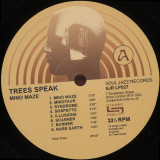
Mind Maze is, amazingly, Trees Speak’s fifth album to be released on Soul Jazz Records in the space of little over two years– an output matched only by the intensity of their music created during this short time.
The first pressing only of the album comes with a bonus seven-inch single containing two tracks that are not available on vinyl anywhere else.
As with all their previous releases, ‘Mind Maze’ is a mind-boggling tightrope walk across an array of musical influences that seamlessly create the unique present-day world of Trees Speak.
The band’s sound is characterized by a combination of German krautrock motoric-beat rhythms, angular New York post-punk attitude, 60s spy soundtracks, psych, rock, jazz, and 70s synthesizers and vocoders. There is also a cosmic spatial awareness to their sound; both personal inner space and galactic outer space, as well as a wilful pushing of sonic boundaries.
Trees Speak are a musical duo based in Tucson, Arizona, composed of Daniel Martin Diaz and Damian Diaz. Their music is heavily influenced by the cosmic magic of the natural desert landscapes of Arizona, creating a unique and captivating sound that is both experimental and innovative.
Here you will find the myriad sounds of 1970s German electronic music (everything from Can to Cluster, Popul Vuh to Tangerine Dream); 1980s New York post-punk and synthcore (from No Wave to Suicide); John Barry’s 1960s movies, John Carpenter’s 1970s horror. You will also hear the influences of French and Italian progressive rock (Magma, Goblin) as well as cosmic, new age and experimental space soundscapes …. an almost endless list of diverse influences that ebb and flow like an ocean of sound, in the process creating a truly unique soundscape that Trees Speak have made wholly their own.
The name Trees Speak reflects their interest in the concept of using future technologies to store information and data in trees and plants, with the idea that trees communicate collectively. This interest in nature and technology, combined with their passion for experimentation, has led Trees Speak to create a truly one-of-a-kind listening experience that is both unique and engaging.
If you ever wanted to hear Can, Neu!, Destroy All Monsters, Pere Ubu, electric eels, John Cage, Liquid Liquid, Tangerine Dream, Suicide, Laurie Spiegel, Art Ensemble of Chicago, John Barry, Mother Mallard’s Portable Masterpiece Company, Sun Ra, Stockhausen, John Carpenter, Electro-Acoustic and Musique Concrete and Mars in one band - then this is it! Trees Speak are a band that defies categorization and offer an eclectic listening experience, both exciting and memorable.
The two bonus tracks (‘Seraphim’ and ‘Orpheus’) included with the album give us a further window into the complex mind maze of the group - two stunning acoustic tracks that explore a distinct early 70s sound of Yes, Argent and other progressive rock accolytes.
These recordings weren't intended for release, they aren't even demos, but rather exercises – process tracks in an attempt to mirror the influences of an aspiring artist as they oriented their emerging work. Most of the tracks were constructed in single sittings and recorded to cassette at home in Glasgow through a Philips AW-7694 boombox. That they feel finished, even iconic amid the shortlived confluence between Detroit techno and intelligent dance music, is a testament to what was materialising, but also to our collective nostalgia, revisionism, and thirst to understand how we've arrived here and why. Übungen has that youthful and pre-internet utopian aura, without being tethered to the phony maxed-out optimism ricocheting across the Atlantic in a 4G pollution. That I first came to Dave Clark's earliest work in the anxiety-ripening stage of the pandemic while I was becoming chronically sick – a time when it was all too easy to glide through dystopian nightmares and realities alike – only speaks to the work's presence and its allowance to dream, ahistoricism or splice into the affect of histories, and to dismantle the contemporary, not in an arsy or nihilistic way, but to appreciate (questioningly) the passage of time.
Sitting somewhere between an EP and a full-length, these six pieces predate Dave's other archival release – Sparky's 94Archive2/8 Rubadub, 2015, which also features cassette transfers originally recorded in stereo without overdubs. As a sound archivist myself, it was a welcome experience first listening to Dave's transfers on headphones while walking around the canals of Maryhill rather than handling the digital captures in a studio. I've been enamored with the music ever since and despite the original utilitarian intention, shifting contexts and the chance to listen afresh decades on allows for clearance (dare I say recuperation). It is, for this reason, and the sardonic re-opening of archival material perverted into something on the ground, that's not merely dog shit, that I am very pleased to finally share this collection.
Each of the titles provides the recording year and is initialed by the respective influence: Carl Craig, Aphex Twin (you'll recognise the shimmering hi-hats), Yellow Magic Orchestra, Black Dog, Polygon Window, and Drexycia.
All music was produced by Dave Clark, except "1993CC" produced by Dave Clark & Graeme Slater, and "1992PW" produced by Dave Clark & Roger Elliott.
The Normandy duo MAMAN KÜSTERS delivers one of the best electro-ebm sound we could find in planet earth, their fully analog sequences create an immediate kind of state of trance that only very few artists reach to delivery.
This EP, that comes out at the same time as their new albumb ” Le Petit Chaos De” released via our partners of UNKNOWN PLEASURES RECORDS, arrives with 2 mind-blowing remixes by GARETH JONES (renowned as Depeche Mode producer, among many other gigantic acts) and the techno producer INSIDER. If you like to make dance, buy this plastic immediately.
Comes presented in a one-off truly limited edition of 300 copies lacquered pressed on 180gr. high quality solid black vinyl.
All tracks have been specially remastered for long cut vinyl by Daniel Hallhuber at Young and Cold Studios.