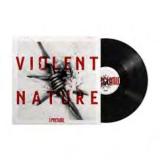
Written during a period of geographic and artistic transition, Country Music traces Severin Black’s movement from London to Berlin, unfolding through cycles of isolation and adaptation. Composed on the city’s periphery, the album’s material was continually dismantled and reassembled, reflecting a process of both artistic and personal reconstruction. The album marks a shift in production methodology, moving away from the immediacy of summed live takes toward a more deliberate, stratified multitrack approach. Sparse yet hypnotic, the record distills layers of sound formed by constant relocation, recurrent solitude, and a recalibration of instinct. In many ways, it echoes the experience of exile, not in a political sense but in the quieter, more insidious form of displacement that alters one’s perception of time and self. The music drifts between structure and dissolution, a reflection of existing at the threshold of different spaces—both physically and sonically.
The shedding of the previously used Nape moniker signaled a decisive sonic transformation, informed by extended time spent in the Pyrenees and a renewed engagement with folkloric material. Severin began playing the clarinet while making this record, and though its presence is minimal, it reveals itself as an interest in acoustic simulation, particularly the digital approximations of classical instruments that emerged within 1990s synthesizer technology. This interrogation of authenticity and mediation parallels the album’s thematic engagement with memory, where recollection functions not as a retrieval of fixed experience but as an iterative process of distortion and reconstruction. The relocation to Berlin reignited an affinity for grime music, evident in the syncopated brass of Pilgrim Wine and the fractured vocal layers of March, while memories of childhood in rural Wales permeate the record’s atmospheric spaces. The album includes contributions from longtime collaborator Vanessa Bedoret and Berlin-based artist Pavel Milyakov (Buttechno).
Country Music situates itself within an unresolved dialogue—between past and speculative futures, between folk lineage and digital fragmentation, between place and its embodied and sonic traces. What emerges is not a fixed statement but a process, an ongoing negotiation between what is left behind and what is brought forward. Words by Chantal Michelle
Mastered by Owen Pratt / Design by Severin Black / Center label image by Nicky Kidd / Back cover text by Alya Kanıbelli
Suche:black van
C.L.A.W.S. comes to Dark Entries with a new ripping LP, Splat City II. C.L.A.W.S. is the solo project of musical luminary Brian Hock, who has been a key figure in the Bay Area underground for over two decades via his involvement in projects like Bronze and The Vanishing, as well as helming the record labels Squirrels on Film and Immortal Sin. With C.L.A.W.S., Hock takes on the dancefloor, picking up cues from the Hague’s Giallo-dipped electro, the skewed minimalism of Chicago acid, and the mind-rending forays of San Francisco post-punk icons like Chrome and Tuxedomoon. Following 2019’s inaugural Splat City EP, Splat City II continues to map the psychogeography of a metropolis both alien and immediately recognizable, one where life is cheap, but so are the thrills. Previously released on Squirrels on Film in digital-only format, this expanded vinyl edition of Splat City II features two new cuts. Things kick off with “Route 505” and “One Tear,” a duo of rompers that vibe like Tom Ellard and Chip E locked in a room with a vial of liquid. Next up, Bay Area deckmaster Tyrel lends his editing chops to “Vigilant Slimy Monsters,” sculpting a moody space disco beast. Squirrels on Film co-founder Solar teams up with Hock for “Black Magic Carpet Ride III,” a cavernous downtempo banger. The slow-mo pace continues with “Wild Slugs United,” which features the no wave-esque clarinet work of Paul Costuros. Closer “Don’t Flip the Crystal Ship” pays homage to Bayview venue Bay Area 51 with melancholic strings and a quartz-solid electrofunk bassline. Splat City II comes in a sleeve with artwork by Bert Bergen, which features a vampiric cat and sci-fi cityscapes.
- C2: Bad (Remix)
- A1: The Curse Of The Gifted
- A2: Lovehate Thing Feat Sam Dew
- A3: Sunshine
- A4: Heaven's Afternoon Feat Meek Mill
- B1: Golden Salvation (Jesus Piece)
- B2: Vanity
- B3: Gullible Feat Ceelo Green
- B4: Bricks Feat Yo Gotti & Lyfe Jennings
- C1: Clappers Feat Nicki Minaj & Juicy J
- C3: Tired Of Dreaming Feat Ne-Yo & Rick Ross
- C4: Rotation Feat Wiz Khalifa & 2 Chainz
- D1: Simple Man
- D2 88:
- D3: Black Heroes / Outro About Nothing Feat Jerry Seinfeld
- D4: Bad Feat Tiara Thomas
- Al Infitar
- Pour Un Tombeau De
- Anatole
- No. 4
- La Llorona
- Cohn's Dance
- Kirillow Und Die Berge
- Liquid Cancer
- Aderfluss
- Noctem
Rotes Vinyl[23,11 €]
NA ZAROT opens a portal into a universe of darkness, chaos and spiritual upheaval. The sound is raw, jagged like cold iron and radically unpolished-an antithesis to any romanticized or völkisch fantasy, firmly rooted in an anti-fascist stance. NA ZAROT shapes lo-fi black metal infused with traces of punk as a counter-space: a place where archaic directness meets a dense, spiritually charged atmosphere that unfolds a hypnotic pull even within the noise. The production remains deliberately fragmented and unrefined-a kind of emotional excavation protocol that exposes the core of the genre without glorifying it. Lyrically, the tracks revolve around death, decay, isolation, spiritual disintegration and those threshold moments in which the abyss releases a strangely unsettling calm. Musically, sawing guitars, brutal screams, driving drums, sickly strings, ghostly voices and a distorted piano collide. Above it all lies a weight of leaden sorrow, until sudden ruptures drag the pieces without warning into even deeper darkness. Side A presents the tracks from the On Death and Dying tape, where literary spaces intersect with personal experiences. The lyrics brush against literary references such as Mallarmé's death poems, the legend of La Llorona or motifs from Romain Gary's The Dance of Genghis Cohn.Side B offers new, previously unreleased material titled "Alpensterben." The four songs preserve those unheard screams that would otherwise vanish into nothingness. Alpensterben becomes a blood-marked journey through the final hours of an existence scraping against its own ending-an intense, haunting echo of lived despair. Comes with printed 28page 10" magazine!
- D2: Herbert - I Hadn't Known
- A1: Nickodemus Featuring Cole Williams - Obeah Woman (Kiko Navarro Afroterraneo Remix) (8 22)
- A2: Art Of Tones - Elephants (5 36)
- B1: Sinm - Alley-Oop (6 18)
- B2: Motor City Drum Ensemble - Get Slapped Up (8 09)
- C1: Maestro & Vezzola - Irma (5 52)
- C2: Manabu Nagayama - Light & Shadow (Masalo Version) (8 24)
- D1: Trinidadian Deep - Be Near Me (6 47)
- E1: Webster Wraight Ensemble - Unexpected News (James Duncan Mix) (7 03)
- E2: 100Hz - Funkin' (7 59)
- F1: Anchorsong - Kajo (5 25)
- F2: Sutekh - Rhapsody On A Theme By Paganini, Variation 17 (4 44)
- F3: Flytronix - Backatcha (7 36)
DJ Maestro, geboren als Martijn Barkhuis in Nederland, is een gerenommeerde Nederlandse DJ, producer en componist, vooral bekend om zijn werk aan de fameuze Blue Note Trip-compilatieserie. Met een diepgewortelde passie voor jazz en een scherp oor voor eigentijdse grooves, verwierf Maestro naam door klassieke jazzopnames te combineren met moderne beats, wat resulteerde in een verfijnde fusie die zowel traditionele jazzliefhebbers als een nieuwe generatie luisteraars aanspreekt. Zijn vermogen om naadloze, atmosferische en muzikale verhalen te creëren leverde hem erkenning op van het prestigieuze Blue Note Records-label, dat hem het vertrouwen gaf om hun klassieke catalogus te gebruiken voor moderne, genre-overstijgende mixes. Met de lancering van de Blue Note Trip-serie in de vroege jaren 2000 hielp DJ Maestro de interesse in klassieke jazz nieuw leven in te blazen door tijdloze tracks te koppelen aan subtiele elektronische elementen en soulvolle interpretaties. De serie werd een vaste waarde in lounges en hi-fi luisterruimtes over de hele wereld. Elke release weerspiegelt Maestro’s respect voor muzikaal erfgoed en zijn talent om verhalen te vertellen via geluid, waarbij hij luisteraars meeneemt op een muzikale reis die zowel nostalgisch als vooruitstrevend is. In 2015 begon DJ Maestro aan een opmerkelijk project: Little Girl Blue Remixed, een eigentijdse herinterpretatie van Nina Simone's iconische debuutalbum uit 1958. Het album werd geprezen om zijn respectvolle, maar inventieve remixes. Dit project onderstreepte Maestro's vermogen om de brug te slaan tussen klassieke jazz en hedendaagse muziek, en verstevigt zijn status als visionair binnen de jazz fusion scene. Naast deze albums heeft DJ Maestro samengewerkt met een breed scala aan artiesten, bigbands en jazzmuzikanten. Hij heeft zijn repertoire ook uitgebreid naar filmmuziek, liveoptredens en remixes – allemaal met behoud van zijn kenmerkende stijl geworteld in jazz, soul en downtempo. DJ Maestro blijft een culturele brug slaan tussen tijdperken, waarbij hij de rijkdom van jazz viert en tegelijkertijd innovatie, dansmuziek en moderniteit in zijn mixen verwelkomt. Na zijn geprezen reeks genre-overstijgende compilaties keert Maestro nu terug met Deep Trip – een gloednieuwe mixcompilatie die zal verschijnen op Black Hole Recordings. Deze keer kiest hij voor een meer house-georiënteerde richting, met warmere grooves, diepere ritmes en een weelderige sfeer, maar altijd met Maestro’s onmiskenbare signatuur. Deep Trip verschijnt zowel als een mixed CD als in een triple vinyl set met alle tracks in ongemixte versie. Het is een reis door hedendaagse deep house-texturen, met soulvolle percussie en een hypnotische opbouw. De compilatie laat Maestro’s muzikale evolutie horen: trouw aan zijn jazzwortels, maar volledig omarmend wat de moderne house te bieden heeft.
h 4. I Hadn't Known I Only Heard
[h] 4. I Hadn't Known [I Only Heard]
[h] D2 | Herbert - I Hadn't Known [I Only Heard] (7 15)
Heavyweight psychedelic improvisers EarthBall are back with their third and most monstrous record to date: ‘Outside Over There’, released on Upset The Rhythm (Nov 7th). Born from the haunted basements of Nanaimo, Canada, the quintet thrives on spontaneity, shaping improvisation into jagged hallucinations and ecstatic eruptions.
Recorded live-off-the-floor in 2024 in Jeremy, Izzy, and Kellen’s basement, and mixed by drummer John Brennan, ‘Outside Over There’ is an album that feels both summoned and inevitable. Each track lands with uncanny purpose, as if uncovered rather than written.
The opener, 100%, features a cameo from comedian and English icon Stewart Lee, who lent his blessing for the band to use a fragment of his stand-up. The album was mastered by John Dieterich (Deerhoof), with liner text contributed by longtime comrade John Olson (Wolf Eyes). Olson describes the album in his unmistakable style:
“This eight-track odyssey unfolds like a dreamscape, where whispered incantations brush against the shadowy fringes of the cosmos, and wild, Cézanne-inspired rock anthems erupt like geysers of color in the midst of a western warm and wet rain storm… culminating in the sprawling eleven minute masterpiece, ‘And The Music Shall Untune The Sky,’ aptly dubbed the Earth Crusher. A creation so utterly deconstructed and intertwined with the pulse of nature itself that if AI was called upon to conceive ‘Outside Over There’ anew, it would just spit back, “F.U. in Tree Font”. An enchanting invitation for even the flat-earthers to join the circle, if only just a little.”
EarthBall’s trajectory has been relentless. Their 2024 album ‘It’s Yours’ was praised by The Quietus as “fully aggressive and fully life-affirming,” and by The Wire as "a boisterous mind-melting album”. The band’s live double set LP ‘Actual Earth Music Vol. 1 & 2’ (2025) captured blistering performances: a performance opening for Wolf Eyes at the Fox Cabaret, and a Café OTO improvised throw-down featuring Chris Corsano and Steve Beresford. These releases on their own confirm them as one of Canada’s most vital experimental exports, not to mention the impressive self-released discography on their Bandcamp. The band’s reach has stretched far beyond their west coast roots with a UK tour May 2024, plus this past June, EarthBall closed Montreal’s Suoni Per Il Popolo Festival alongside Pulitzer Prize-winning composer Raven Chacon. This November they will perform at Le Guess Who? Festival in Utrecht, with a European tour to follow (tour dates below). Outside of EarthBall, each member carries their own torch. Jeremy Van Wyck, founding member of the legendary Shearing Pinx, has toured extensively, released over 100 records, and has been a vital force in the Vancouver and West Coast underground for the past 25 years. He and Isabel Ford (Izzy) play together not only in EarthBall, but also in Psychedelic Dirt, Shearing Pinx, Behaviours, and Crotch.
John Brennan collaborates widely, including recently with Endlings (Raven Chacon and John Dieterich), Evichen (Victoria Shen), Francesco Fonassi, Plan Your Future (with Greg Saunier of Deerhoof), Brennan/Corsano duo and Physics with John Dieterich. Kellen Maclaughlin performs with KVMP and Ora Corgan, while saxophonist Liam Murphy is a west coast staple, playing with the best across Vancouver Island and the mainland. On three of the tracks of ‘Outside Over There’, the band is joined by their comrade Justin Patterson, who also plays with Brennan in the duo Modale. This cross-pollination fuels EarthBall’s sound - a collective improvisation, psychically overdriven, and grinding into bloom.
Outside Over There’ is more than an album though, it is a ritual, a gathering of sound at the forest’s edge; where feedback, saxophone screams, and ecstatic vocals dissolve the boundary between chaos and clarity. EarthBall invite you into their circle, to share in the joyful terror of spontaneous creation. ‘Outside Over There’ will be released on November 7th through Upset The Rhythm digitally and as a limited blue-in-black vinyl LP.
- 1: Heatsick (Feat. Hilary Jeffery)
- 2: Plastic Fascist
- 3: Praya (Feat. Bendik Giske, Maria W.horn)
- 4: Past Blast
- 5: Mancini Sighs
- 6: Black Metal Rewind (Night Drive Astra, 200)
- 7: Death By Nostalgia, 1688
- 8: Passengers (Feat. Bendik Giske, Maria W Horn, Adam Betts)
Loaded with tension and anchored by bold textural and stylistic contrasts, Sam Slater’s third solo full-length finds the British sound artist, composer, and engineer grappling with his creative contradictions head-on.
Having spent a life time in bands and producing records, Sam transitioned somewhat by accident through his work with Johan Johansson into working as a composer on high profile projects such as his collaboration with Hildur Guðnadóttir on the Grammy Award-winning Joker and Chernobyl, and with Pulitzer Prize-winning journalist Mstyslav Chernov on the soundtrack to the lauded 2000 Meters to Andriivka. Having a vast set of interests and influences is an asset when helping realise a directors vision for a soundtrack, but one's own musical voice can end up being constrained. In Lunng, Slater has gone back to his wildly divergent range of influences and rather than shy away from the extremes, he's used them to create a singular vision.
Take the opening track “Heatsick”: Slater imagines an extravagant fusion of 2000s drone metal and vintage British brass, welding ear-splitting overdriven drones and blown-out choral vocals to stirring trombone swells from veteran player Hilary Jeffery. On paper, it’s hard to imagine—but Slater’s intentionality conducts these polarizing elements into a surreal blur of sonic extremes, with the guitars’ relative harshness softened by Jeffery’s eerily nostalgic colliery echoes.
His last solo album, I do not wish to be known as a Vandal (Bedroom Community, 2022), showcased this breadth by assembling a team of collaborators including Sam Dunscombe and Yair Elazar Glotman. On this record he’s linking up with acclaimed multi-instrumentalist Maria W. Horn, idiosyncratic sax virtuoso Bendik Giske, versatile percussionist Adam Betts, and the aforementioned Jeffery, Slater ushers these players toward a lattice of calculated confutations.
Working to explore the tension between the divergent practices of his collaborators—Lunng was meant to be challenging. On “Praya”, Giske’s familiar overblown horn phrases are almost vaporized, vanishing among Slater’s weightless synths and Horn’s chillingly hoarse vocals. There are traces of Horn’s Funeral Folk project, but Slater shifts the emphasis, letting her voice brush past the other elements like a hallucination.
Slater’s use of extremes isn’t just in the micro; dynamics drive the album’s overall flow. “Praya” sets the stage for the record’s heaviest, most prickly moment: “Passengers”. Here, Horn’s voice cracks, rasps, and gurgles over serrated synths and Betts’ ritualistic drums. Slater turns an industrial symphony into a folk opera—dark, dramatic, and strangely beautiful—etched with Giske’s fluttering phrases.
But the mood soon shifts. Slater careens toward chaos, unleashing double-time rhythms and piercing textures familiar to anyone with a soft spot for classic black metal. These grotesque incongruities are deliberate; Slater surveys years of musical conflict and leans in, using dissent as fuel to build kinetic energy.
The weight of sentimentality bears down on “Black Metal Rewind (Night Drive Astra, 2006)”, melting teenage memories into hypnagogic ambience—shoegaze dreams whirled with angelic choral delusions. On “Death by Nostalgia, 1688”, he ventures further into polarizing territory, distorting AutoTuned voices with cryptic strings and medieval tonalities, unsettling any stable sense of past or present.
In this record Slater focuses on pure energy, color, and mood. Lunng distills years of listening into a bracing brew—boiling each sound down to its essence, then serving it with unflinching intent.
John Twells, 2025
- 1: Dirty Water
- 2: Destroyer
- 3: Scream Out Loud For Love
- 4: Police Bastard
- 5: More!
- 6: Hole In The Ground
- 7: We Take All
- 8: Eazy
- 9: Spring That Never Ends
- 10: Sad Song Man
- 11: Chevy Van
- 12: Tail Down
- 13: Leather
- 14: All Right, All Night
Sweatmaster releases a new full-length album after a 15-year hiatus via Svart Records Sweatmaster, one of the aristocrats of Finnish garage rock, is making a big comeback with the release of their fifth album More! in January 2026. After the release of their 2010 album Dig Up the Knife, the band took a long break, which ended a few years ago with live performances both domestic and abroad. At the same time, new material began to emerge in the rehearsal room, and the band quickly found a common strategy for working on it. "We were unanimous about the strengths of our band and decided to get to the heart of the matter. The main idea was to make straightforward songs carried by the vocals. The kind that would work well live with our aggressive playing style," says the band's drummer Matti Kallio. Svart Records will release Sweatmaster's fifth album early next year. More! is a sharp package of fourteen songs that has not been polished to death. "We wanted a raw and electric sound for the new album, built tightly around the three of us playing. The aim was to stick to Sweatmaster's original energy and not spread ourselves too thin. However, despite our efforts, the intervening years brought some new tones with them," guitarist Mikko Luukko explains the background of the new album. The album's first single will be released on Friday, September 19th, and according to singer-bassist Sasu Mykkänen, Destroyer is the essence of Sweatmaster. "The drum fill draws you into the pull of the electric triangle. The guitar taps at the ballads and wants nothing more than to drive the rhythm until the passionate vocals take over. The song doesn't lead anywhere, it's already there. 2 minutes, 37 seconds. Wham bam. Here you go." More! is available for pre-order now at Svart’s webstore on Svart exclusive vinyl, limited coloured vinyl, classic black vinyl, and CD. Release date January 30th, 2026.
Grupo um celebrate 50 years with release of lost dictatorship-era album nineteen seventy seven!
First time release - vinyl comes with printed innersleeves
Brazilian avant-jazz vanguardists Grupo Um celebrate their 50th anniversary, sharing a second previously lost 1970s album from the vaults. Nineteen Seventy Seven (titled after the year it was recorded) is another rip-roaring instrumental fusion treasure from the band which spawned from within Hermeto Pascoal’s famed mid-1970s São Paulo collective.
Like their debut album Starting Point, Grupo Um’s Nineteen Seventy Seven was recorded when Brazil's military dictatorship was at its most repressive. “There were no open doors to those who dreamt to be protagonists in creative instrumental music”, remembers drummer Zé Eduardo Nazario, “even popular composers and singers had to submit their songs to censors and many records were banned and confiscated from the stores.”
Just like Hermeto Pascoal's Viajando Com O Som (1977) and Grupo Um's previous album Starting Point (1975), both of which remained unreleased until the 21st century, Zé Eduardo asserts that the 1977 album was flatly 'without any chance to be released at that time."
Recorded at Rogério Duprat’s Vice-Versa Studios in São Paulo, the group were under both time and space restraints, “we chose the small Studio B,” Lelo Nazario recalls, “which had a Tascam (TE AC) 12x8 console and a 4-channel AMPEX AG 440 machine. Therefore, we had to record without overdubs, everything straight to tape.”
Expanding from a trio to a quintet, original Grupo Um members Lelo Nazario (keys), Zé Eduardo Nazario (drums), and Zeca Assumpção (bass) were joined by saxophonist Roberto Sion and percussionist Carlinhos Gonçalves. Carlinhos, Zé and Zeca had already played together in the group Mandala, while brothers Lelo and Zé had just finished a stint backing Hermeto Pascoal during his years in São Paulo.
Lelo was deeply immersed in modular synthesizer experimentation during this period, working extensively with the ARP2600 and EMS Synthi AKS. These electroacoustic explorations formed the sonic foundation for "Mobile/Stabile," one of his first compositions to merge modular synthesis with Brazilian music, a fusion that would ripple throughout the Brazilian jazz scene. The piece premiered at the first São Paulo International Jazz Festival in 1978, performed by Grupo Um with guest trumpeter Márcio Montarroyos. In a shocking moment, festival organizers interrupted the show mid-performance, sparking fierce backlash from both audience members and journalists who denounced the incident as artistic censorship during Brazil's era of political and cultural repression. The version on Nineteen Seventy Seven is the first recording of the composition.
Nineteen Seventy Seven combines Afro-Brazilian rhythm, modular synthesis and a plethora of whistles, percussion and effects pedals. Album opener “Absurdo Mudo” - so titled for the absurd difficulty it poses to the musicians performing it - starts out in a cloud of mysterious dissonance, before the haze breaks for a glorious keyboard and saxophone interplay atop an uptempo samba groove. “Cortejo dos Reis Negros (Version 2)” (Procession of the Black Kings), based on the maracatu rhythm, inverts the traditional jazz song structure by beginning with improvisations, which are followed by the theme and a final coda. “The studio also had two Parasound electronic reverb units,” Lelo notes, “and the timbre is very audible on the soprano sax and percussion.”
Grupo Um’s daring music represents a manifesto of resistance during the dictatorship years, but it’s one which remains just as relevant today. As Lelo puts it: “For me, the aesthetic issue has always been about combining contemporary avant-garde languages with Brazilian music, independent of categories and commercial interests. The result of this fusion takes music to a new level.”
Recording credits (1977)
Recorded at Vice-Versa B Studio, São Paulo, November 9, 1977
Produced by Lelo Nazario and Zé Eduardo Nazario
Engineered by Ricardo “Franja” Carvalheira
Lelo Nazario – Wurlitzer electric piano, acoustic piano, signal generator, percussion
Zé Eduardo Nazario – drums, percussion
Zeca Assumpção – electric bass
Carlinhos Gonçalves – percussion
Roberto Sion – soprano sax, clarinet
Release credits (2025)
Produced by UTOPIA Studio, São Paulo
Project Coordination in Brazil by Irati Antonio (Utopia Studio)
Tape Restoration and Digital Mastering by Lelo Nazario at Utopia Studio, July 2025
Liner Notes by Lelo Nazario and Zé Eduardo Nazario
Photography by Jorge Las Heras, Lelo Nazario, and artists' personal archives
Photo Restoration by Lelo Nazario
Artwork and Design by Alessandro Renaldin
Sweatmaster releases a new full-length album after a 15-year hiatus via Svart Records Sweatmaster, one of the aristocrats of Finnish garage rock, is making a big comeback with the release of their fifth album More! in January 2026. After the release of their 2010 album Dig Up the Knife, the band took a long break, which ended a few years ago with live performances both domestic and abroad. At the same time, new material began to emerge in the rehearsal room, and the band quickly found a common strategy for working on it. "We were unanimous about the strengths of our band and decided to get to the heart of the matter. The main idea was to make straightforward songs carried by the vocals. The kind that would work well live with our aggressive playing style," says the band's drummer Matti Kallio. Svart Records will release Sweatmaster's fifth album early next year. More! is a sharp package of fourteen songs that has not been polished to death. "We wanted a raw and electric sound for the new album, built tightly around the three of us playing. The aim was to stick to Sweatmaster's original energy and not spread ourselves too thin. However, despite our efforts, the intervening years brought some new tones with them," guitarist Mikko Luukko explains the background of the new album. The album's first single will be released on Friday, September 19th, and according to singer-bassist Sasu Mykkänen, Destroyer is the essence of Sweatmaster. "The drum fill draws you into the pull of the electric triangle. The guitar taps at the ballads and wants nothing more than to drive the rhythm until the passionate vocals take over. The song doesn't lead anywhere, it's already there. 2 minutes, 37 seconds. Wham bam. Here you go." More! is available for pre-order now at Svart’s webstore on Svart exclusive vinyl, limited coloured vinyl, classic black vinyl, and CD. Release date January 30th, 2026.
- A1: Robert Pico - Le Chien Fidèle
- A2: Annie Girardot - La Femme Faux Cils
- A3: Spauv Georges - Je Suis L'état
- A4: Zoé - Zoé
- A5: Jacques Da Sylva - Fou
- A6: Valentin - Je Suis Un Vagabond
- A7: Jacques Malia - Histoire De Gitan
- A8: Bernard Jamet - Raison Legale
- B1: Jean-Pierre Lebort - Barbara Au Chapeau Rose
- B2: Les Concentrés - Fils De Dégénérés
- B3: Les Missiles - Publicité
- B4: Hegessipe - Le Credi D'hegessipe
- B5: Marechalement Votre - Ethero Disco
- B6: Mamlouk - Decollez Les
- B7: Mozaique - L'amour Nu
- B8: Jean-Marc Garrigues - Je Dis Non
- B9: Penuel - Astronef 328
The journey through French-speaking pop archives continues with this fifth volume, packed with fuzz, gimmicks, and dissent. Far from the charts, the selected tracks display a great creative freedom, often backed by corrosive humor. Welcome to the surprising, kaleidoscopic, and colorful world of the late sixties and early seventies, Wizzz!
Born in Montauban, Robert Pico stumbled into music by chance when he met René Vaneste, then artistic director at Pathé-Marconi. René brought him to Paris to record his first 45 RPM EP in 1964. A year later, Pierre Perret introduced him to Vogue, where he recorded his second album with Claude Nougaro’s orchestra. Sylvie Vartan then introduced him to RCA, where he recorded four singles, including the astonishing "Chien Fidèle," a track backed by a hair-rising fuzz guitar. Alongside his solo career, he also composed for other artists like Alain Delon (the song was recorded but remains unreleased), Magali Noël, Bourvil, and Georges Guétary. In the Paris of the sixties, he mingled with Mireille Darc, Elsa Martinelli, Marie Laforêt, France Gall, Françoise Hardy, Petula Clark, Régine, Dani, Serge Gainsbourg, Joe Dassin, Franck Fernandel, Charles Level, and Roland Vincent. Despite his efforts and winning a Grand Prix Sacem for his final record, Robert Pico didn’t achieve the expected success in show business and decided to leave Paris and return to the Southwest, where he devoted himself to writing. He is the author of 23 books (including Delon et Compagnie, Jean-Marc Savary Editions 2025, a memoir about his youth and his many encounters). Today, he is relieved to never have become a celebrity and devotes himself to his work with passion.
In 1969, the Franco-Italian movie Erotissimo was released, directed by Gérard Pirès (who later directed Taxi in 1998, written and produced by Luc Besson). This pop comedy features Annie Girardot, Jean Yanne, Francis Blanche, Serge Gainsbourg, Nicole Croisille, Jacques Martin, and Patrick Topaloff. The soundtrack was written by Michel Polnareff and William Sheller, with lyrics by Jean-Lou Dabadie. "La Femme Faux-cils," performed by Annie Girardot. It recounts the feelings of a rich CEO's wife who seeks to develop her sex appeal under the influence of advertisement and magazines. Groovy, sparkling and light, this track, with ITS lush arrangements humorously critiques consumer society and feminine beauty standards.
“Je suis l’Etat” (1967) is the flagship track of the first EP by singer-songwriter Spauv Georges, aka Georges Larriaga, better known as Jim Larriaga (1941-2022). Born into a family of bakers, the young man was initially planning to become a hairdresser when he discovered English-speaking music through Elvis Presley and the Beatles. After this revelation, he decided he would become a songwriter and gave himself five years to succeed. He recorded his first two EP’s independently for RCA under the pseudonym Spauv Georges; meaning “that poor George”, a nickname given to him by the mother of her friend Jean-Pierre Prévotat (future drummer of the Players, Triangle, or Johnny Hallyday). Portraying a depressed and eccentric young man, Spauv Georges created corrosive and amusing songs that didn’t reach a wide audience, despite a TV appearance with Jean-Christophe Averty.
Supported by his loyal friend and fellow songwriter Jean-Max Rivière, Georges Larriaga met the future singer Carlos in the early '70s, then Sylvie Vartan’s assistant. He wrote songs for Carlos, including the popular "La vie est belle," "Y’a des indiens partout," and "La cantine", which went onto become a huge hit in 1972. He also composed for Claude François (“Anne-Marie”, 1971), Charlotte Julian (“Fleur de province”, 1972), helped launch child singer Roméo (who sold 4 million records), and later wrote the hit "Pas besoin d’éducation sexuelle" (1975) for the young Julie Bataille. In 1971, Jim recorded an album for Disc'Az: “L’univers étrange et fou de Jim Larriaga”, which featured pop gems like “La maison de mon père”.
The story of the song "Zoé" began when Pierre Dorsay, artistic director at Vogue Records, asked Swiss singer and musician Pierre Alain to write a song for a new female singer. The inspiration came when he realized that Zoé (the artist's name) was also the name of France's first atomic battery, created in 1948, which consisted of uranium oxide immersed in heavy water! The lyrics reflect a bubbling energy that must be handled with caution, while the instrumentation echoes this atomic theme, notably with the use of a theremin.
Zoé’s career lasted only as long as a single 45 RPM, but it seems Christine Fontane was the vocalist behind this pseudonym, who is known for several EPs, a good "popcorn" album in 1964, and a handful of children’s singles in the '70s. Regardless, the photograph on the cover is of a different girl entirely.
Later, Pierre Alain continued his career, writing songs for himself, Marie Laforêt, Danièle Licari, Alice Dona, Arlette Zola (3rd place in Eurovision 1982), and achieving multiple gold and platinum records in Canada. Also an inventor with several patents, president of the Romande Academy, and head of the French Alliance in Geneva, he now composes atonal music, books, and poetry. Moreover, he is also the host of "Les Mardis de Pierre Alain" at "Le P'tit Music'Hohl" in Geneva.
Filled with oriental choruses and fuzz guitar, "Fou" is from Jacques Da Sylva's only EP released by Vogue in 1967. Despite the quality of this recording, all traces of this singer disappear after this first effort.
Valentin is a baroque pop singer born in Belgium. He is the songwriter and composer of most of the tracks on his three singles released in the late 60s in Canada. A legend says that he reincarnated himself as Jacky Valentin during the 1970s for a rock'n'roll revival career in Belgium, but his older brother sadly debunked this story. Valentin's first two singles were arranged by Claude Rogen, a Parisian session pianist who had come to Canada to promote the song “Mister A Gogo”, a cover of David Bowie’s “Laughing Gnome”, adapted by singer Delphine, his wife at the time. Far from his usual network, Claude Rogen arranged music for Polydor, including the arrangements for “Je suis un vagabond” in 1969, a jerk tune with string arrangements and a furious optimism.
Jacques Malia wrote, composed, and recorded his only 45 EP for Festival in 1966. “Histoire de gitan” is an incredible beat track with bohemian scat that tells the story of a gypsy musician who came to Paris to make it in the Music-Hall, to no avail. The hero of the song and its author probably shared a similar fate, as Jacques Malia faded into anonymity after this remarkable attempt.
Bernard Jamet recorded two EPs for Barclay in the late sixties and co-wrote several songs with Christine Pilzer, Pascal Danel, and prolific songwriters Michel Delancray and Mya Simile. The track “Raison Légale” (1968), his masterpiece, immerses the listener in a courtroom right when a murderer is being judged, with jerk rhythm and free arrangements. A unique, paranoid, judicial, and psychedelic oddity.
Jean-Pierre Lebrot-Millers started his career in show business in 1967 as a singer and songwriter for the Philips label. After three singles, he wrote several songs of a new kind with his friend Pierre Halioche, in the midst of the sexual liberation movement and the democratization of drugs. With provocative lyrics, “Les filles du hasard” and “Barbara au Chapeau Rose” were released on a Philips singles in 1968. The character of Barbara was inspired by a queen of Parisian nightlife during the psychedelic years: model Charlotte Martin, who dated Eric Clapton from 1965 to 1968, then Jimmy Page from 1970 to 1983. Jean-Claude Petit’s arrangements, with a table-filled intro, soul brass, and Hendrixian guitar, emphasize the flamboyance of a hedonistic and sexy character, whose dog is named Junkie because “Junkie est un nom exquis”! The track was recorded live in three takes with a full orchestra.
Upon its release, the record was censored by Europe 1 and RTL due to its references to drug use. Jean-Pierre Lebrot was then banned from the airwaves and later dismissed by his record label. He changed his artist name to Jean-Pierre Millers, while his companion Pierre Halioche became D. Dolby for a new dreamy composition, “Chilla”, which Jean-Pierre produced himself with arrangements by Jean Musy. Once again, the song was immediately censored everywhere. After this setback, he decided to stop singing and started taking on odd jobs to support his Swedish wife and their son until the day he met Jean-Pierre Martin, then production manager at Decca, who had worked with Manu Dibango. Martin offered Jean-Pierre Lebrot-Millers, then employed at Rank Xerox, the position of artistic director at Decca. He accepted and became, a year later, promotion director (radio, press, TV). He worked on Julio Iglesias’s first album for Decca, which became a massive hit and allowed him to meet Claude Carrère. The latter asked him to write new songs and find their performers, much like a “talent scout.” It’s through him that Jean-Pierre discovered Julie Pietri and Corinne Hermès. He composed “Ma Pompadour” for Ringo, Sheila’s husband, and took the microphone again for the syncope hit “Rendez-Vous” in 1982.
That same year, Jean-Pierre Lebrot-Millers tried to release a track for which he had heavily gone into debt: “Si la vie est un cadeau”. Having recorded it in London, he presented it to numerous professionals, all of whom refused to get involved. The same thing happened with Antenne 2 and the Sacem when he proposed the song as France’s entry for Eurovision. He then met Haïm Saban, who was producing cartoon soundtracks and had just launched the Goldorak theme song. Saban, having listened to the song, declared it had the potential to become a hit. He sent Jean-Pierre and Corinne Hermès to meet the CEO of the Luxembourg radio and television network. The latter received them, asked to hear a verse and chorus a cappella in his office, and immediately hired them to represent Luxembourg at Eurovision 1983. They reworked the arrangements and recorded a new version with Haïm Saban as co-producer. The song ended up winning Eurovision 1983, a great comeback for our hero. He continued producing and hung out with the band Nacash in Belgium when a couple came to introduce their daughter for an impromptu audition in a hotel room. The girl sang “Les démons de minuit” while dancing to a radio cassette. Impressed, he had her take singing lessons for a year and composed a song for her (for which he had the melody and title, but no lyrics). This required him to go on the hunt for a lyricist, who ended up being Guy Carlier. They recorded the song, which was initially a ballad, at Bernard Estardy’s CBE studio, and gave the singer a new name: Melody. They showed the song around their industry network without success. Later, Estardy called Jean-Pierre to suggest changing the rhythm and making it pop-rock. Orlando, Dalida’s brother, liked the result and decided to co-produce the track. “Y’a pas que les grands qui rêvent » became a classic hit. The song has since been covered by Juliette Armanet (as a ballad, like the original) and Valentina.
Born into an aristocratic Breton family, Hervé Mettais-Cartier worked as a DJ at Queen Kiss, a nightclub in Poitiers, where he formed the band Les Concentrés with Michel (an actor) and Christian (a radio technician). Together, they created a repertoire of whimsical songs (“Ma bique est morte”, “J’suis un salaud”, “Fils de dégénéré”...) that they performed on stage dressed in white (in homage to “concentrated milk”). They performed at Bliboquet and Olympia in 1968 for the 10th edition of the “Relais de la chanson Française” organized by L’Humanité-Dimanche and Nous les Garçons et les Filles, sponsored by Pepsi Cola. Winners in the author-composer category, alongside Danish singer Dorte, their visibility allowed them to record a 45, and appear on television in Jean-Christophe Averty’s show. The A-side of the disc features Bruno le ravageur, a casatchok dedicated to Bruno Caquatrix, the director of Olympia, nicknamed in the song “Coq Atroce” or “croque-actrices”. The B-side is dedicated to “Fils de dégénéré”, a quirky tribute to Hervé's aristocratic roots, mixing absurdity with sophisticated vocal harmonies.
After Les Concentrés, Hervé Mettais-Cartier formed the duo La Paire et sa Bêtise with his friend Olivier Robert. They performed in Parisian cabarets and toured with Pierre Vassiliu. In the late 1970s, Hervé began a solo career. He recorded two albums for the Motors label in 1978 and 1979, which did not achieve their anticipated success due to lack of promotion. In 1980, he met Bernadette, with whom he started a family and created a “Chansons à voir” (songs to see) show that he performed until his death at the end of 2024.
Publicité comes from the final EP by the Missiles (Ducretet Thomson, 1966), a disc that also includes “La (nouvelle) guerre de cent ans”, featured on Volume 4 of our Wizzz! series. Please refer to the booklet for the story of the band.
“He’s 1.82 meters tall, 28 years old, weighs 135 kg, is black and Belgian”: this is the description of singer Hegesippe on the back of his sole single (Decca, 1967). He appears on the album cover wearing a Greek toga, like a hippie gag – we are at the end of the year 1967. In “Le crédo d’Hegesippe”, this former bodyguard of Antoine and the Charlots plays the delightful card of the thick brute converted to Flower-Power and non-violence, with arrangements by Jean-Daniel Mercier, aka Paul Mille.
“Ethéro-disco” was released on a promotional record for clients of the Maréchal company (Liège, Belgium) for the New Year 1979. Over a funky rhythm, celebrity impersonations (Brigitte Bardot, Jacques Dutronc, Fernandel…) deliver an enigmatic text about pharmaceutical products like ether, bismuth, and aspartate. The track was composed by Dan Sarravah (responsible for Joanna's “Hold-up inusité” featured on Wizzz! Volume 3) and Tony Talado, who was also a singer (one 45 in 1967), songwriter (with over a dozen credits between 1964 and 1985 in various styles from surf music to disco), author (Devenez Végétarien, Dricot Editions, 1985), ad designer, and psychologist.
Décollez-les is on the A-side of Mamlouk's only single, a pseudonym for Marsel Hurten, who is known for his work on several EPs in the late sixties, as well as composing music for Hervé Vilard’s “Capri, c’est fini”, Claude Channes' “La Haine”, Annie Philippe’s “On m’a toujours dit”, and Nancy Holloway’s “Panne de Cœur”.
This strange song, with Afrobeat horns and absurd dialogues between a chef and his kitchen staff, is the result of a collaboration between Marsel Hurten and one of his neighbors, a photographer from Pavillon-sous-Bois (93), where the musician settled after returning from the Algerian War. A music video was shot to promote the record.
Marsel Hurten was born in Tourcoing (59) into a musical family. At a young age, he joined the brass band founded by his grandfather, playing the piston before studying trumpet at the conservatory, as well as teaching himself how to play the guitar. As an orchestra musician, he toured in France, Belgium, Germany, and England. He released a series of solo 45’s between 1965 and 1968 for the DMF and Az labels before stopping recording to focus on working for other artists (Gilles Olivier, Noëlle Cordier…).
“L’amour nu” (Vogue, 1971) is the work of the short-lived Belgian band Mozaïque. The track, written by singer Jacques Albin, closely resembles another of his compositions, “Carré Blanc”, which he recorded in 1969 for Disc’AZ.
Represented by the Lumi Son micro-label based in Marignane (Côte d'Azur), Jean-Marc Garrigues released two 45 RPMs in the late sixties, defending the French jerk sound. The song “Je dis Non” is a short, joyful ode to youth, pop music, and rebellion.
Songwriter and performer Jacques Penuel released three singles. The first one, “Astronef 328” (Fontana, 1969), features a dizzying series of chords punctuated by sound effects, a sci-fi story, and arrangements by Jean-Claude Vannier.
We would like to sincerely thank Pierre Alain, Moon Blaha, Marsel Hurten, Bastien Larriaga, Jean-Pierre Lebrot-Millers, Bernadette Mettais-Cartier, Robert Pico, Olivier Robert, Claude Rogen, Micky Segura.
- 1: Opening
- 2: Intro
- 3: Eleanor
- 4: Fear The Sea
- 5: Leaves
- 6: In Motion #2
- 7: Adrenaline
With their bold blend of doom metal roots, atmospheric rock, and ethereal vocals, THE GATHERING were already reshaping heavy music in the mid-90s. But few recordings capture that electric live energy better than their iconic set at Dynamo Open Air , and now, for the very first time, this legendary moment finally arrives and it's everything fans could hope for. Expertly released by 7 Mater / Sevan Mater, this deluxe edition is limited to 500 copies each on Black and Purple vinyl, with a custom cover artwork designed by Sevan Mater that honors the spirit of the era while bringing new visual depth. It's not just a reissue - it's a resurrection. Recorded during a time when the band was ascending into cult status, the Dynamo performance showcases the perfect fusion of Anneke van Giersbergen's soaring vocals with the band's dynamic instrumental interplay. Songs like "Eleanor", and "Leaves" ring out with clarity and emotion, capturing both the power and subtlety that defined their live presence
Clear Vinyl Edition[21,43 €]
Black vinyl repress. Wie in het voorjaar van 2025 het voorrecht had om de theatertour van Het Zesde Metaal bij te wonen, kon daar op de koop toe genieten van een handvol gloednieuwe songs. Het resultaat is de EP Randgevallen: vijf songs, vijf vertellingen uit het persoonlijke en wereldse leven die andermaal bewijzen dat Het Zesde Metaal als geen ander kan beschrijven, beklijven en betoveren.
Wie in het voorjaar van 2025 het voorrecht had om de theatertour van Het Zesde Metaal bij te wonen, kon daar op de koop toe genieten van een handvol gloednieuwe songs. En daarna vaststellen dat die helaas nergens te (her)beluisteren waren. Tot nu, want de goesting om de songs vast te leggen voor de eeuwigheid werd op den duur wel heel groot. En dus kampeerden Wannes Cappelle en co afgelopen zomer enkele dagen in Waimes (DAFT Music Studios), voor het eerst in de nieuwe bezetting met Kasper Cornelus op gitaar/toetsen en Sander Verstraete op bas.
Het resultaat is de EP Randgevallen: vijf songs, vijf vertellingen uit het persoonlijke en wereldse leven die andermaal bewijzen dat Het Zesde Metaal als geen ander kan beschrijven, beklijven en betoveren. Een staalkaart bovendien van de muzikale en tekstuele veelzijdigheid die de band al jaren kenmerkt. Opener Service is een opgewekte popsong waarin Cappelle sappig de drang naar reviews en hartjes in het dagelijkse en economische leven fileert: 'wa' vind je van onze service? / zou j'ons geen tiene willen geven? / asteblieft, want anders is den directeur vies.' In Traagskes Groeien verstilt het tempo en keert de blik naar binnen, het persoonlijke leven in, mijmerend over kinderen die stilaan het nest ontgroeien. 'ge moet u zo nie' spoeien / ge moet traagskes groeien / ge moe' laagske per laagske groeien', probeert Cappelle het loslaten nog even uit te stellen.
Wie dacht dat Oud En Nieuw daarna gaat over feestvieren in de donkerste dagen van december, is op het verkeerde feestje beland. Wiegend op hypnotiserende bas, drum en pedal steel passeert opnieuw de vergankelijkheid van het leven, dit keer met een bredere maatschappelijke blik. 'alles da' oud is, was ooit nieuw / en groot is ooit kleine begonnen / veel komt van weinig / glad was eerst ruw / zelfs de waarheid wierd ooit verzonnen'. Wanneer naar het einde toe pulserende synths het tempo opheffen en de song licht euforisch uitwaaiert in een instrumentale coda, kun je alleen maar de ogen sluiten en stilstaan bij wat was en nog komen zal.
Label is het enige nummer dat speciaal voor de EP werd geschreven en baadt net als Service in meer dartele klanken, terwijl Cappelle met trefzekere oneliners een beeld van zichzelf schetst. 'de meeste middens mijd ik, ik hore bie de randgevallen thuis / misschien verdiene 'kik ook een label'. Moeten we altijd proberen de ander in een vakje te duwen? Kan iedereen niet 'gewoon' anders zijn? En ironisch draait Cappelle de rollen om: 'atypisch is de norm / ge moogt buiten de lijntjes kleuren / gewoon is niet verboden / normaal zijn doet geen zeer / as ze mor hunder plekke kennen / de rare zijn met meer.'
Het slotakkoord is voor het beklijvende Duizend Soldaten van Willem Vermandere, dat Cappelle en Filip Wauters begin dit jaar brachten voor het tv-programma Ik Vraag Het Aan. Nu zet het een pakkend punt achter een EP die nogmaals de tijdloze klasse van de band onderstreept. Meeslepend, verhalend, herkenbaar, grappig, ontroerend, scherp. Het Zesde Metaal is het allemaal en heeft daar slechts vijf songs voor nodig.
Randgevallen werd opgenomen met Frederik Segers (productie) en Jasper Maekelberg (mix) aan de knoppen, en komt uit op 4 oktober. Met de plaat onder de arm én aan de merchandisetafel herneemt de band zijn theatertour, maar dan in het groot, langs fantastische zalen in onder meer Brugge (Concertgebouw), Gent (Capitole) en Nederland.
- Mean Street
- Dirty Movies
- Sinners Swing!
- Hear About It Later
- Unchained
- Push Comes To Shove
- So This Is Love?
- Sunday Afternoon In The Park
- One Foot Out The Door
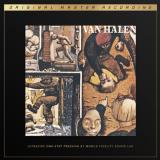
The song titles on Van Halen's aptly titled Fair Warning don't lie. The likes of "Unchained," "Mean Street," "Push Comes to Shove," "One Foot Out the Door," and more indicate the mood the band channels on its double-platinum 1981 record — the nastiest, darkest, and fiercest album of the group's storied career. For the fourth time in four years, Van Halen throws down the gauntlet to all challengers and emerges victorious.
Sourced from the original analog tapes, pressed on MoFi SuperVinyl at Fidelity Record Pressing, and strictly limited to 5,000 numbered copies, Mobile Fidelity's UltraDisc One-Step 180g 45RPM 2LP set plays with unfettered clarity, dynamics, and immediacy. Benefitting from superb groove definition, an ultra-low noise floor, and dead-quiet surfaces, this vinyl edition captures what went down in the studio with tremendous realism and involving presence.
Taking a more controlled approach in the studio and still completing everything in less than two weeks, Van Halen and producer Ted Templeman relied on studio amplifiers to direct the sound. Further diverging from the live-on-the-floor approach of its earlier albums, the ensemble also employed overdubs to great effect. The result: Dense, stacked architecture that underlines the hard-hitting tenor of the songs — and which comes alive like never before on this reference edition that looks as good as it sounds.
The premium packaging and gorgeous presentation befit the reissue's select status. Housed in a deluxe slipcase, it features special foil-stamped jackets and faithful-to-the-original graphics that illuminate the splendor of the recording. Aurally and visually, it is made for listeners who want to immerse themselves in everything involved with the album, including the iconic cover art adopted from William Kurelek's haunting painting, "The Maze."
Isolated frames from Kurelek's childhood-inspired work — including a man bashing his head into a brick wall, a guy pinning down an adversary as he delivers bare-fist blows to his face and others watch with apparent glee, a boy tied down on a conveyer belt and being sent through the equivalent of a meat saw — adorn the front and back covers. The sunnier visual disposition of Van Halen's prior efforts gives way to something sinister and tortured, traits reflective of the music within. The band members, too, are visually depicted not in glamorous shots but in a serious black-and-white portrait in which the quartet is clad in black leather jackets.
Tough, aggressive, stark: Fair Warning comes on like a series of bare-knuckled punches to the solar plexus and boasts lyrical narratives to match. Though not a concept record, the concise album revolves around themes of roughing it on the streets and struggling to survive amid dim prospects. Singer David Lee Roth reportedly penned many of the initial lyrics after traveling to Haiti and observing extreme poverty. The characters and situations populating Fair Warning reflect hardscrabble existence, last-chance desperation, and underlying danger.
Witness the crazies, poor folks, and hunters of “Mean Street”; the former prom queen turned pornographic actress on “Dirty Movies”; the menace and vice of “Sinners Swing!”; the streetwise hustle of “Unchained”; the isolation and alienation of “Push Comes to Shove”; the desire for escape on “One Foot Out the Door”: A carefree California beach party Fair Warning is not.
Having said he felt angry and frustrated during the sessions, guitarist Eddie Van Halen uses the forceful arrangements as a playground for his seemingly unlimited arsenal. Supported by a crack rhythm section and a hyped-up Roth, he performs with an almost impossible combination of punk-like intensity, technical finesse, lyrical fluidity, and unbridled emotion. The virtuoso was increasingly butting heads with Templeton and seeking a freedom in the studio he believed denied him.
No wonder he plays like a bat out of hell. Listen to the rapid-fire manner in which he slaps the high and low E strings on the 12th fret of his instrument on “Mean Street,” instilling the tune with funk flair and metal-spiked sharpness. For the pouty strut of “Dirty Movies,” Eddie Van Halen contributes slide guitar magic made possible after he sawed off the lower portion of a Gibson SG so he could reach further down the fretboard.
Related intensity, urgency, and daredevil momentum punctuate the surging “Sinner’s Swing!” A heavily flanged, delicately melodic introduction frames the attitudinal “Hear About It Later,” among the most creative arrangements of Van Halen’s career. And do riffs come any bigger or magnetic than those on the high-wire kick of “Unchained”? As for the out-of-left-field “Sunday in the Park,” an instrumental composed on an Electro-Harmonix micro-synthesizer: Who but Eddie Van Halen to supply creep factor in such an ingenious way?
Despite selling fewer quantities than Van Halen’s prior efforts, Fair Warning remains for many diehards the record that epitomizes all of the band’s immense strengths —Roth’s manic energy and tongue-wagging humor, Alex Van Halen’s rhythmic heartbeat-in-your-chest bombast, and Michael Anthony’s lucid bass lines included. Arriving when the New Wave of British Heavy Metal and new-wave movements were taking flight, it signaled a shot across the bow from a band determined to stay a step ahead and provide proof nobody could touch what it delivered.
More than four decades later, Fair Warning still sounds that alarm.
The duality of "man" is a subject that has been explored in art for centuries, from writings of the Bible to Descartes, all the way up to filmmakers like Lynch, Cronenberg, & Carpenter. Who is your "true self" & what do they want? With their sixth studio album "Wish Defense" (again for longtime home Trouble In Mind Records), Chicago trio FACS take a good, long look in the mirror to face themselves. The return of original member Jonathan Van Herik - who stepped away from the group just before their debut album "Negative Houses" was released in 2018 - replacing longtime bassist Alianna Kalaba brings renewed vigor & a marked angularity from the band's more recent output. The songs still hit hard, but the approach is sideways - the roles have changed since Van Herik's original tenure & his previous time with Case & powerhouse drummer Noah Leger in Disappears; now on bass, Van Herik was originally the group's guitar player and features on the debut, while current guitarist Brian Case played bass. This role reversal has helped the band's dynamic, offering up a different musical perspective than before, now revisiting the trio's long-going collaboration with some distance and time. Case notes that the lyrics on "Wish Defense" revolve around doppelgängers or "doubles", tackling the idea of facing yourself and observing your ideas and motivations. Look no further than the album's title track; "Enter the mirror / Double walker / An intimate / Wish defense / Is it real? / You beside me / The detail / Terrifying / Abject self / Your grief / A public / Performance". Case lays out the entire album's theme in one stanza; Are your actions & emotions your true self? Or are they a performative aspect of that "other" person you put forward? Case says that ultimately the sentiment is "_don't let the bastards get you down, there's something beyond this moment, like hope - but not in the naive belief that ultimately people are good". "Wish Defense"s artwork is also a subtle reference to "Negative Houses"' art, returning to that album's black & white starkness & minimalism. The album's checkerboards everywhere are offset reflections of themselves, mirrored with the album's lyrics printed front & center on the cover. Everything is out in the open. A final note; "Wish Defense" is the last album engineered by Steve Albini. Two days were recorded at Electrical Audio in early May of 2024 before Steve's untimely passing, with renowned engineer & friend Sanford Parker stepping in to finish the session 24 hours later, tracking the last bits of vocals and overdubs. Longtime collaborator John Congleton mixed the album as Albini would have; in Electrical Audio's A room, off the tape, using Albini's notes about the session.
- 1: Nothing Is Sacred ( 05:42 )
- 2: Wailing ( 04:3 )
- 3: At Dusk ( 05:40 )
- 4: When All Hope Is Gone ( 05:01 )
- 5: Wisdom ( 04:0 )
- 6: Dust To Dust ( 0:02 )
- 7: For My Days Are Vanity ( 06:25 )
- 8: I Am A Stranger In The Earth ( 06:52 )
- 9: Deliverance ( 05:50 )
Formed in 1993 & hailing from Monaco, Godkiller was the vision of multiinstrumentalist & sole founding member, Duke Satanael, who between 1996 & 2000 released an EP & 2 studio albums under the Godkiller name, commencing with the black metal cult classic debut 'The Rebirth Of The Middle Ages'. Though initially more a death metal inspired act in the formative years, Godkiller quickly developed into a project fully engulfed in the spirit of 1990s black metal, bringing to mind acts like Emperor & Satyricon for the implementation of such strong atmospherics, though on later releases Godkiller incorporated more industrial & electronic elements into the compositions as part of its creative evolution. 'Deliverance' was Godkiller's second studio album & final release before the project was laid to rest & ventured into a more electronic & industrially metallic direction for what could be considered a more contemporary & expressive take on Godkiller's established brand of darkness.
- A1: No Escape
- A2: Protocol
- A3: Front Enemy
- A4: Blacksmith Of Damnation
- A5: Killing Season
- B1: Vantage Point
- B2: Return To Agony
- B3: Fever Dreaming
- B4: Smoking Mirrors
- B5: The Coldest Death
Cold Steel's patented brand of aggressive, hardcore thrash metal takes no prisoners on 'Discipline & Punish'. To bring the album to life, the group decamped to Philadelphia and teamed with producer Arthur Rizk (Blood Incantation, Power Trip, Cavalera). In the studio, they drew on influences like Metallica, Machine Head, and Slipknot while sharpening and solidifying their own signature sound.
- A1: Who Is This?
- A2: Felix
- A3: Cal
- A4: Following The Ring
- A5: You Shouldn't Be Here
- A6: Spike
- A7: Scrapes And Static
- A8: Cabin Attack
- A9: It's Cold Here
- A10: Gwen Follows Cal
- A11: The Ghost Grabber
- A12: Bleeding Snowman
- A13: Mando And Finn And The Moonlit Sky
- A14: The Lake Search Pt. 1
- A15: Ruinous Dream
- A16: Van Ride
- A17: Time To Find Out
- A18: Ice Incursion
- A19: Alpine Lake Hue
- A20: The Lake Search Pt. 2
- A21: Out Of Light
- A22: Ice Lake Showdown
- A23: At Rest
- A24: Hope
»La Traversée« (»The Crossing«) is Matthias Puech’s second album for Hallow Ground and follows up on 2023’s »Mt. Hadamard National Park.« Profoundly inspired by re-reading »The Odyssey,« the French composer, instrument designer, and scholar used a Eurorack modular synthesizer to create four pieces that are by far the most intuitive and emotionally charged in his ever-expanding catalogue. Puech’s masterful command of sound comes to the forefront with even more urgency on this record. A wandering meditation on the human condition, »La Traversée« is an album that is constantly in motion—complex electronic music at its most gripping and evocative.
The foundation for »La Traversée« was laid when Puech prepared a live set for a tour organised in collaboration with Hallow Ground in support of »Mt. Hadamard National Park.« Before writing the first three pieces—»Ennosigaios,« »Polyphármakos,« »Nekuia«—the 18½-minute-long »Ithâké« was composed in near-total isolation in the South of France at the end of 2023. Puech performed the material live several times before taking a step black from it for a while. He revisited the pieces when preparingthem for a release. »I was struck by how the technical process and the intention behind the music had completely vanished from my memory,« he says.
What remained intact, however, was Puech’s association of the material with one of the most influential texts of Western literature. Reading a graphic novel adaptation of »The Odyssey« with his two four-year-olds, he noticed the effect that it had on them and himself. »Its themes of longing, fear of and attraction to the unknown, unresolved quests, and the struggle for control felt topical,« he says. »I was completely taken. Every story ever told seemed contained in this ancient tale; every story I have ever tried to tell as a composer seemed inscribed in this framework.« This also extended to formal motifs such as the repetition of incidents, narrative developments, or dramatic effects that also mark »La Traversée.«
Puech says that he perceived Homer’s writing as musical, »like an old Delta blues or a Renaissance counterpoint,« which inspired his writing process. »With a couple of knobs on my Eurorack system, I could control the unfolding of a story,« he notes. »This made me pass through different emotional statesand led to moments in which everything made sudden sense—when you as an artist get a glimpse atsomething essential, can touch upon something universal.« This shines through »La Traversée,« a wildly imaginative album that is deeply personal while also telling a story far more wide-reaching than that of its creator.
- 1: Ogyatanaa Show Band - You Monopolise Me
- 2: Honny And The Bees Band - Psychedelic Woman
- 3: Wellis Band - Bindiga
- 4: The Uhuru Dance Band - Yahia Mu
- 5: Sawaaba Soundz - Owuo
- 6: St. Peter And The Holy Men - Bofoo Beye Abowa Den
- 7: Asaase Ase, Ebo Taylor - Ohiani Sua Efir
- 8: Hedzoleh Soundz - Edinya Benya
- 9: Honny And The Bees Band - Sisi Mbon
- 10: The Black Star Sound - Nite Safari
Seminal sounds from the golden age of Ghanaian music. Highlife, rock, and soul collide and merge with tradition and culture. New styles meet old styles. A new generation renews old musical customs. New fashions meet old fashions, creating new fusions. Features rare tracks from Hedzoleh Soundz, Ogyatanaa Show Band, Honny & the Bees and early Ebo Taylor (Asaasa Sa). These tracks were originally available on vanishingly rare 70s pressings, then a highly collectible 5LP box set released in 2009. This special vinyl edition is produced in conjunction with the James Barnor archive, featuring a previously unpublished 1976 photo from the archive of Ghana’s most famous photographer. Comes with Obi-strip.
- A1: 100%
- A2: Helsinki
- A3: Outside Over There
- A4: Seeing Docks Unlock
- A5: Hellfire Relations
- B1: Where I Come From
- B2: Behind The Mall
- B3: And Music Shall Untune The Sky
Heavyweight psychedelic improvisers EarthBall are back with their third and most monstrous record to date: ‘Outside Over There’, released on Upset The Rhythm (Nov 7th). Born from the haunted basements of Nanaimo, Canada, the quintet thrives on spontaneity, shaping improvisation into jagged hallucinations and ecstatic eruptions.
Recorded live-off-the-floor in 2024 in Jeremy, Izzy, and Kellen’s basement, and mixed by drummer John Brennan, ‘Outside Over There’ is an album that feels both summoned and inevitable. Each track lands with uncanny purpose, as if uncovered rather than written.
The opener, 100%, features a cameo from comedian and English icon Stewart Lee, who lent his blessing for the band to use a fragment of his stand-up. The album was mastered by John Dieterich (Deerhoof), with liner text contributed by longtime comrade John Olson (Wolf Eyes). Olson describes the album in his unmistakable style:
“This eight-track odyssey unfolds like a dreamscape, where whispered incantations brush against the shadowy fringes of the cosmos, and wild, Cézanne-inspired rock anthems erupt like geysers of color in the midst of a western warm and wet rain storm… culminating in the sprawling eleven minute masterpiece, ‘And The Music Shall Untune The Sky,’ aptly dubbed the Earth Crusher. A creation so utterly deconstructed and intertwined with the pulse of nature itself that if AI was called upon to conceive ‘Outside Over There’ anew, it would just spit back, “F.U. in Tree Font”. An enchanting invitation for even the flat-earthers to join the circle, if only just a little.”
EarthBall’s trajectory has been relentless. Their 2024 album ‘It’s Yours’ was praised by The Quietus as “fully aggressive and fully life-affirming,” and by The Wire as "a boisterous mind-melting album”. The band’s live double set LP ‘Actual Earth Music Vol. 1 & 2’ (2025) captured blistering performances: a performance opening for Wolf Eyes at the Fox Cabaret, and a Café OTO improvised throw-down featuring Chris Corsano and Steve Beresford. These releases on their own confirm them as one of Canada’s most vital experimental exports, not to mention the impressive self-released discography on their Bandcamp. The band’s reach has stretched far beyond their west coast roots with a UK tour May 2024, plus this past June, EarthBall closed Montreal’s Suoni Per Il Popolo Festival alongside Pulitzer Prize-winning composer Raven Chacon. This November they will perform at Le Guess Who? Festival in Utrecht, with a European tour to follow (tour dates below). Outside of EarthBall, each member carries their own torch. Jeremy Van Wyck, founding member of the legendary Shearing Pinx, has toured extensively, released over 100 records, and has been a vital force in the Vancouver and West Coast underground for the past 25 years. He and Isabel Ford (Izzy) play together not only in EarthBall, but also in Psychedelic Dirt, Shearing Pinx, Behaviours, and Crotch.
John Brennan collaborates widely, including recently with Endlings (Raven Chacon and John Dieterich), Evichen (Victoria Shen), Francesco Fonassi, Plan Your Future (with Greg Saunier of Deerhoof), Brennan/Corsano duo and Physics with John Dieterich. Kellen Maclaughlin performs with KVMP and Ora Corgan, while saxophonist Liam Murphy is a west coast staple, playing with the best across Vancouver Island and the mainland. On three of the tracks of ‘Outside Over There’, the band is joined by their comrade Justin Patterson, who also plays with Brennan in the duo Modale. This cross-pollination fuels EarthBall’s sound - a collective improvisation, psychically overdriven, and grinding into bloom.
Outside Over There’ is more than an album though, it is a ritual, a gathering of sound at the forest’s edge; where feedback, saxophone screams, and ecstatic vocals dissolve the boundary between chaos and clarity. EarthBall invite you into their circle, to share in the joyful terror of spontaneous creation. ‘Outside Over There’ will be released on November 7th through Upset The Rhythm digitally and as a limited blue-in-black vinyl LP.
- A1: The Sermon
- A2: You Are Blessed
- A3: The Van
- A4: The Whisper
- A5: Areverend At The Bus Stop
- A6: Friends (Alternative)
- A7: Michigan Basement
- A8: The Nightmare (Extended)
- A9: Goodbye Autumn (Extended)
- A10: The Photo (Alternate)
- A11: The Beggar
- B1: Blackmail
- B2: And So Fades The Light
- B3: Reverends Theme (Extended)
- B4: Regression (Extended)
- B5: A Collected History
- B6: Reverend Walk With Me
- B7: The Cuckhold (Alternate)
- B8: The Fan
- B9: Imposter Syndrome
- B10: Gift Of God Child
Gold Vinyl[28,36 €]
So Fades the Light is an eerie horror thriller that makes for unsettling watching. That is no small part thanks to the equally haunting score from composers Blair French (an ambient and Balearic producer from the Detroit area) and Dave Graw (a fellow Motor City musician and visual artist), who forgo melody in place of atmosphere. It means their soundtrack is a living, breathing presence that's less about music a more of a sort of ghost that refuses to leave. Graw and French sculpt a world of distortion, static and whispered tones that feel dug out of crumbling ruins. It’s bleak, patient and unrelenting, always pulling you deeper into the lead character Sun’s fractured memories and the menace of her past. As a standalone release, it’s equally gripping: a record that blurs ambient, horror and noise into one oppressive atmosphere.
- A1: The Sermon
- A2: You Are Blessed
- A3: The Van
- A4: The Whisper
- A5: Areverend At The Bus Stop
- A6: Friends (Alternative)
- A7: Michigan Basement
- A8: The Nightmare (Extended)
- A9: Goodbye Autumn (Extended)
- A10: The Photo (Alternate)
- A11: The Beggar
- B1: Blackmail
- B2: And So Fades The Light
- B3: Reverends Theme (Extended)
- B4: Regression (Extended)
- B5: A Collected History
- B6: Reverend Walk With Me
- B7: The Cuckhold (Alternate)
- B8: The Fan
- B9: Imposter Syndrome
- B10: Gift Of God Child
Black Vinyl[26,85 €]
So Fades the Light is an eerie horror thriller that makes for unsettling watching. That is no small part thanks to the equally haunting score from composers Blair French (an ambient and Balearic producer from the Detroit area) and Dave Graw (a fellow Motor City musician and visual artist), who forgo melody in place of atmosphere. It means their soundtrack is a living, breathing presence that's less about music a more of a sort of ghost that refuses to leave. Graw and French sculpt a world of distortion, static and whispered tones that feel dug out of crumbling ruins. It’s bleak, patient and unrelenting, always pulling you deeper into the lead character Sun’s fractured memories and the menace of her past. As a standalone release, it’s equally gripping: a record that blurs ambient, horror and noise into one oppressive atmosphere.
- Soldiers Requiem
- When The Walls Come Down
- Walk In Cold
- Jettison
- Live Wire
- The Mule
- Coldbringer
- Blight
- Free Nation
- Hammer Head
- Ghetto Mechanic
- Suspect Device
- Vanilla Blue - Bonus Track
- The Strip (Live) - Bonus Track
- Roller Queen (Live) - Bonus Track
- Backlash Jack (Live) - Bonus Track
Limited edition GRAPE CRUSH vinyl 1000 copies worldwide. Remastered by Bob Weston at Chicago Mastering Service. Originally released in 1988 vinyl reissue includes 4 bonus tracks. "Plenty of bands can claim Naked Raygun as an influence, from post-punkers to hardcore acts. All of them could learn a thing or two or three by studying the whoas. With Jettison... Naked Raygun achieved creative bliss. Here is an album that successfully combines dissonant instrumentation with supremely catchy vocals." - Punknews.org - // Naked Raygun were an extraordinary staple in the Chicago music scene - beginning in the early 80's and continuing until their quiet demise in the early 90's. Their music showed the world that punk rockers could play and be really good at it. Founded in Chicago in 1980, by Marco Pezzati, Jeff Pezzati and Santiago Durango, Naked Raygun released six albums during their eleven year career that would change the sound of punk rock indefinitely. The band is widely recognized as being one of the most influential punk bands of the 80's. Their anthemic style incorporated politics in a uniquely accessible way, melding pop and hardcore into one cohesive sound, that would later be dubbed, "The Chicago Sound". Shortly after their first release, Basement Screams, Durango left to join Big Black permanently, and was replaced by John Haggerty, whose unique style of buzzsaw guitar would define Raygun's sound for their next four albums. Additionally, Pierre Kezdy replaced Camilo Gonzalez and Eric Spicer took over drums for Jim Colao. In 1990, Haggerty left the band to start Pegboy. Bill Stephens joined the band for their final studio release entitled, Raygun...Naked Raygun.
- A1: Taking The Veil
- A2: Laughter And Forgetting
- A3: Before The Bullfight
- A4: Gone To Earth
- B1: Wave
- B2: River Man
- B3: Silver Moon
- C1: The Healing Place
- C2: Answered Prayers
- C3: Where The Railroad Meets The Sea
- C4: The Wooden Cross
- C5: Silver Moon Over Sleeping Steeples
- D1: Camp Fire Coyote Country
- D2: A Bird Of Prey Vanishes Into A Bright Blue Cloudless Sky
- D3: Home
- D4: Sunlight Seen Through Towering Trees
- D5: Upon This Earth
Gone to Earth ist das dritte Soloalbum von David Sylvian, ursprünglich erschienen am 1. September 1986. Das Doppelalbum folgte auf Brilliant Trees und erreichte Platz 24 der UK Album Charts.
Die zwei LPs bieten einen besonderen Kontrast: Eine Seite mit experimentellen Rock-Songs und Gesang, die andere rein instrumental und ambient. Gastmusiker sind u. a. Robert Fripp (Co-Autor von drei Songs) und Bill Nelson (Co-Autor von einem Song).

Diese Neuauflage erscheint als Corona White, Brown Opaque Black Vinyl und basiert auf dem neuesten Remaster.
Swedish trio Death And Vanilla follow their much-praised re-imagined soundtracks to `Vampyr' (2017) and `The Tenant' (2018) with their interpretation of the soundtrack to cult 1968 TV show `Whistle And I'll Come To You'. Ltd White Vinyl LP, Soundtrack / Electronic / Indie At a time when post-ambient electronica and bedevilled folk music are co-habiting, and the public's interest in Pagan rites and rituals has been sparked by a new generation of fans. The bizarre storyline of Whistle And I'll Come To You seems even more pertinent_ and strangely haunting. The Jonathan Miller-adapted 1968 ghost story was originally part of BBC's Omnibus series and featured Michael Horden as a fussy professor who discovers an ancient whistle which summons up the spirits. A black and white folkloric tale in the style of The Wicker Man, the original TV programme received rave reviews. The esoteric live score was recorded at the Hypnos Theatre in Malmö. The 42-minute soundtrack utilises stuttering tape loops on `Intro' before breathing new life into the primitive John Carpenter-like drum machine on `Supernatural Breakfast', while `Walk On The Beach 2' sounds like a hauntological rendition of a Broadcast classic. Indeed, that effect is amplified on `Nightmares', with its swirling wind and other-worldly choral effect, before the feeling of some supernatural presence is suggested on the penultimate cut `Evidence Of Spiritualism'.
Ostinato as resistance: Rafael Anton Irisarri’s landmark work reimagined. Marking the tenth anniversary of the American composer’s critically acclaimed album 'A Fragile Geography', this new edition arrives renewed, both sonically and visually.
First released in 2015 (Room40) during a period of personal upheaval and creative reinvention, it endures as a testament to resilience, transformation, and the connection we hold with the places that shape us.
Written in the aftermath of a devastating theft, A Fragile Geography was born out of loss. Just days before a cross-country move to New York, Irisarri’s entire Seattle-based studio was wiped out. Instruments. Recordings. Archives. Gone without a trace. He arrived on the East Coast to an empty room and the daunting task of starting over.
“This album wasn’t just a record; it was a lifeline,” Irisarri reflects. “It became a way to process the emotional chaos that followed: uprooting, instability, and ultimately, the slow, intuitive rebuilding of a life.”
Composed and recorded in the rural woods of the Hudson Valley, the album took shape in seclusion, surrounded by nature, and through a process guided by improvisation. Embracing limitations, Irisarri wove textural layers of field recordings with half-remembered melodies from his Seattle years, piecing them together like fragments of memory. Tracks like “Displacement,” “Hiatus,” and “Persistence” juxtaposed haunting stillness with restless momentum, mapping an inner terrain of grief, catharsis, and rebirth.
Among its defining sounds is “Empire Systems,” a monumental centerpiece built around a simple four-chord progression, organ textures, and guitar drones. Gradually, the track expands into layers of immersive loops and thick, enveloping distortion that wash over the listener like a rolling wave. Often cited as the album’s most majestic passage, it captures Irisarri at his most sonically ambitious. With a harmonically saturated structure crafted from restraint and repetition, it remains one of his most recognizable compositions: an exercise in the art of maximal minimalism.
From the outset, “Reprisal” received praise from BBC’s Mary Anne Hobbs, who championed the track on her radio show. Her support played a key role in introducing Irisarri’s work to wider audiences and solidifying his place within the lineage of electronic, drone, and experimental sound artists. A slow-burning elegy, the piece emerges from a haze of distortion and sub-bass, with dense, unrelenting drones carrying a sense of mounting tension. Just as it seems to collapse under its own weight, flickers of guitar emerge like distant light through fog. It’s a meditation on dissonance, resolve, and the elusive possibility of release.
The closing track, “Secretly Wishing for Rain,” is steeped in saudade: a longing for Seattle’s dour grey skies, lush green landscapes, and desaturated sunsets. Through it, Irisarri mourns a vanished chapter of life bound to the city, a time documented in scattered mementos and cherished collections, now permanently gone. A reflection on what could never be recovered: an era lost to time. Julia Kent’s looped cello motifs added a melancholic warmth to the track, marking the first collaboration between the two artists and sparking a musical dialogue that would keep growing in the years that followed.
More than a career highlight, A Fragile Geography has laid the foundation for Black Knoll studio, which Irisarri rebuilt from the ground up. The studio has since grown into a creative hub for countless projects, with Irisarri engineering records for iconic music figures like Terry Riley, Ryuichi Sakamoto, William Basinski, MONO, Devendra Banhart, Grouper, Emeralds, Steve Hauschildt, Julianna Barwick, and many others. Carried by its lasting influence, the album has quietly captured the ear of a younger generation, its sound and emotional arc finding new listeners in unexpected corners.
The album’s new visual language was reimagined in collaboration with Mexico City–based designer Daniel Castrejón. Irisarri captured ghostly images at Gaztelugatxeko Doniene, a historic coastal site in Bermeo, Euskal Herria. Castrejón then treated the photographs with distressed textures and spectral overlays. The final artwork channels the rugged, elemental forces that shaped both the music and Irisarri’s aesthetic, renewing his ties to ancestral ground inspired by the Basque homeland of his bloodline.
Mastered by Stephan Mathieu with exceptional attention to detail, this anniversary edition uncovers every nuance in the sound design, enhancing clarity and presence. With each listen, new elements emerge, inviting discovery and reconnection.
“I don’t experience this album as a document of grief anymore,” says Irisarri. “I hear adaptation and I'm reminded that when everything falls apart, something meaningful, maybe even beautiful, can emerge.”
Ostinato as resistance: Rafael Anton Irisarri’s landmark work reimagined. Marking the tenth anniversary of the American composer’s critically acclaimed album 'A Fragile Geography', this new edition arrives renewed, both sonically and visually.
First released in 2015 (Room40) during a period of personal upheaval and creative reinvention, it endures as a testament to resilience, transformation, and the connection we hold with the places that shape us.
Written in the aftermath of a devastating theft, A Fragile Geography was born out of loss. Just days before a cross-country move to New York, Irisarri’s entire Seattle-based studio was wiped out. Instruments. Recordings. Archives. Gone without a trace. He arrived on the East Coast to an empty room and the daunting task of starting over.
“This album wasn’t just a record; it was a lifeline,” Irisarri reflects. “It became a way to process the emotional chaos that followed: uprooting, instability, and ultimately, the slow, intuitive rebuilding of a life.”
Composed and recorded in the rural woods of the Hudson Valley, the album took shape in seclusion, surrounded by nature, and through a process guided by improvisation. Embracing limitations, Irisarri wove textural layers of field recordings with half-remembered melodies from his Seattle years, piecing them together like fragments of memory. Tracks like “Displacement,” “Hiatus,” and “Persistence” juxtaposed haunting stillness with restless momentum, mapping an inner terrain of grief, catharsis, and rebirth.
Among its defining sounds is “Empire Systems,” a monumental centerpiece built around a simple four-chord progression, organ textures, and guitar drones. Gradually, the track expands into layers of immersive loops and thick, enveloping distortion that wash over the listener like a rolling wave. Often cited as the album’s most majestic passage, it captures Irisarri at his most sonically ambitious. With a harmonically saturated structure crafted from restraint and repetition, it remains one of his most recognizable compositions: an exercise in the art of maximal minimalism.
From the outset, “Reprisal” received praise from BBC’s Mary Anne Hobbs, who championed the track on her radio show. Her support played a key role in introducing Irisarri’s work to wider audiences and solidifying his place within the lineage of electronic, drone, and experimental sound artists. A slow-burning elegy, the piece emerges from a haze of distortion and sub-bass, with dense, unrelenting drones carrying a sense of mounting tension. Just as it seems to collapse under its own weight, flickers of guitar emerge like distant light through fog. It’s a meditation on dissonance, resolve, and the elusive possibility of release.
The closing track, “Secretly Wishing for Rain,” is steeped in saudade: a longing for Seattle’s dour grey skies, lush green landscapes, and desaturated sunsets. Through it, Irisarri mourns a vanished chapter of life bound to the city, a time documented in scattered mementos and cherished collections, now permanently gone. A reflection on what could never be recovered: an era lost to time. Julia Kent’s looped cello motifs added a melancholic warmth to the track, marking the first collaboration between the two artists and sparking a musical dialogue that would keep growing in the years that followed.
More than a career highlight, A Fragile Geography has laid the foundation for Black Knoll studio, which Irisarri rebuilt from the ground up. The studio has since grown into a creative hub for countless projects, with Irisarri engineering records for iconic music figures like Terry Riley, Ryuichi Sakamoto, William Basinski, MONO, Devendra Banhart, Grouper, Emeralds, Steve Hauschildt, Julianna Barwick, and many others. Carried by its lasting influence, the album has quietly captured the ear of a younger generation, its sound and emotional arc finding new listeners in unexpected corners.
The album’s new visual language was reimagined in collaboration with Mexico City–based designer Daniel Castrejón. Irisarri captured ghostly images at Gaztelugatxeko Doniene, a historic coastal site in Bermeo, Euskal Herria. Castrejón then treated the photographs with distressed textures and spectral overlays. The final artwork channels the rugged, elemental forces that shaped both the music and Irisarri’s aesthetic, renewing his ties to ancestral ground inspired by the Basque homeland of his bloodline.
Mastered by Stephan Mathieu with exceptional attention to detail, this anniversary edition uncovers every nuance in the sound design, enhancing clarity and presence. With each listen, new elements emerge, inviting discovery and reconnection.
“I don’t experience this album as a document of grief anymore,” says Irisarri. “I hear adaptation and I'm reminded that when everything falls apart, something meaningful, maybe even beautiful, can emerge.”
2025 Repress
We here at TSTD are longtime fans of Mexican producer/musician MONSIEUR VAN PRATT. So it’s a great pleasure to finally work with the man. For this 7 inch he delivers two tracks:
Side A is a slow disco edit of a super rare Mexican late 70s cover version of Bobby Caldwell’s classic love song “What You Won’t Do for Love”.
Side B takes us into the church of Black Soul, a slow Gospel Soul track for your sunset disco beach bar dj sets.
Monsieur Van Pratt, founder of Super Spicy Records, is a prominent producer and DJ originally from Mexico City, whose influence on electronic music is widely recognized both nationally and internationally. With an impressive career that includes more than 100 releases in digital format.
Ostinato as resistance: Rafael Anton Irisarri’s landmark work reimagined. Marking the tenth anniversary of the American composer’s critically acclaimed album 'A Fragile Geography', this new edition arrives renewed, both sonically and visually.
First released in 2015 (Room40) during a period of personal upheaval and creative reinvention, it endures as a testament to resilience, transformation, and the connection we hold with the places that shape us.
Written in the aftermath of a devastating theft, A Fragile Geography was born out of loss. Just days before a cross-country move to New York, Irisarri’s entire Seattle-based studio was wiped out. Instruments. Recordings. Archives. Gone without a trace. He arrived on the East Coast to an empty room and the daunting task of starting over.
“This album wasn’t just a record; it was a lifeline,” Irisarri reflects. “It became a way to process the emotional chaos that followed: uprooting, instability, and ultimately, the slow, intuitive rebuilding of a life.”
Composed and recorded in the rural woods of the Hudson Valley, the album took shape in seclusion, surrounded by nature, and through a process guided by improvisation. Embracing limitations, Irisarri wove textural layers of field recordings with half-remembered melodies from his Seattle years, piecing them together like fragments of memory. Tracks like “Displacement,” “Hiatus,” and “Persistence” juxtaposed haunting stillness with restless momentum, mapping an inner terrain of grief, catharsis, and rebirth.
Among its defining sounds is “Empire Systems,” a monumental centerpiece built around a simple four-chord progression, organ textures, and guitar drones. Gradually, the track expands into layers of immersive loops and thick, enveloping distortion that wash over the listener like a rolling wave. Often cited as the album’s most majestic passage, it captures Irisarri at his most sonically ambitious. With a harmonically saturated structure crafted from restraint and repetition, it remains one of his most recognizable compositions: an exercise in the art of maximal minimalism.
From the outset, “Reprisal” received praise from BBC’s Mary Anne Hobbs, who championed the track on her radio show. Her support played a key role in introducing Irisarri’s work to wider audiences and solidifying his place within the lineage of electronic, drone, and experimental sound artists. A slow-burning elegy, the piece emerges from a haze of distortion and sub-bass, with dense, unrelenting drones carrying a sense of mounting tension. Just as it seems to collapse under its own weight, flickers of guitar emerge like distant light through fog. It’s a meditation on dissonance, resolve, and the elusive possibility of release.
The closing track, “Secretly Wishing for Rain,” is steeped in saudade: a longing for Seattle’s dour grey skies, lush green landscapes, and desaturated sunsets. Through it, Irisarri mourns a vanished chapter of life bound to the city, a time documented in scattered mementos and cherished collections, now permanently gone. A reflection on what could never be recovered: an era lost to time. Julia Kent’s looped cello motifs added a melancholic warmth to the track, marking the first collaboration between the two artists and sparking a musical dialogue that would keep growing in the years that followed.
More than a career highlight, A Fragile Geography has laid the foundation for Black Knoll studio, which Irisarri rebuilt from the ground up. The studio has since grown into a creative hub for countless projects, with Irisarri engineering records for iconic music figures like Terry Riley, Ryuichi Sakamoto, William Basinski, MONO, Devendra Banhart, Grouper, Emeralds, Steve Hauschildt, Julianna Barwick, and many others. Carried by its lasting influence, the album has quietly captured the ear of a younger generation, its sound and emotional arc finding new listeners in unexpected corners.
The album’s new visual language was reimagined in collaboration with Mexico City–based designer Daniel Castrejón. Irisarri captured ghostly images at Gaztelugatxeko Doniene, a historic coastal site in Bermeo, Euskal Herria. Castrejón then treated the photographs with distressed textures and spectral overlays. The final artwork channels the rugged, elemental forces that shaped both the music and Irisarri’s aesthetic, renewing his ties to ancestral ground inspired by the Basque homeland of his bloodline.
Mastered by Stephan Mathieu with exceptional attention to detail, this anniversary edition uncovers every nuance in the sound design, enhancing clarity and presence. With each listen, new elements emerge, inviting discovery and reconnection.
“I don’t experience this album as a document of grief anymore,” says Irisarri. “I hear adaptation and I'm reminded that when everything falls apart, something meaningful, maybe even beautiful, can emerge.”
Seit ihrer Gründung im Jahr 2013 in Metro Detroit, Michigan, hat die Metalcore/Post-Hardcore-Band I
Prevail eine Menge kritischer und kommerzieller Erfolge erzielt. Ihr erstes Album, „Lifelines“ von 2016,
erreichte sowohl in den USA als auch in Kanada Goldstatus, während „TRAUMA“ von 2019 diese Leistung
in Kanada wiederholte. Letzteres wurde bei den Grammys in dem Jahr für das beste Rockalbum nominiert,
die Single „Bow Down“ war zudem Anwärter für die beste Metal-Performance. Mit „TRUE POWER“ aus
dem Jahr 2022 ging die Band weiterhin ihren eigenen musikalischen Weg und weigerte sich, den Erwartungen des Genres zu entsprechen.
Jetzt, mit ihrem vierten Album „Violent Nature“, geht die Band eine Stufe weiter. Das Album wurde
in zwei Etappen in den Blackbird Studios in Nashville aufgenommen und unter der Leitung von Bassist
und Keyboarder Jon Eberhard selbst produziert. Außerdem handelt es sich um das erste Material, in dem
Vocalist Eric Vanlerberghe als einziger Sänger der Band sowohl cleanen als auch nicht cleanen Gesang
übernimmt. Es geht hart zur Sache. Die erste Single des Albums, der Titeltrack, ist möglicherweise der
brutalste, extremste und wildeste Song, den die Band je veröffentlicht hat. Doch nicht alles ist so brutal
und intensiv. Obwohl die Single „Rain“ alles andere als sanft ist, fühlt sich der kraftvolle, hymnische Refrain
des Songs im Vergleich dazu wie ein Schlaflied an, obwohl der Text Andeutungen derselben Wut und Pein
enthält. Nichtsdestotrotz veranschaulich
Belgian drummer and composer Jelle Van Giel presents All I Hear, the first full-length album of his new band, Close Distance.
All I Hear unfolds in ten chapters - nine on vinyl, with an additional track on CD. Each track depicts its own world. Some burst to life, driven by energy that draws you in and melodies that linger. Others take their time, emerging like landscapes through morning mist, shaped by shifting textures and quiet detail.
Subtle soundscapes and cinematic colors blend with improvisation and groove, creating an immersive listening experience that speaks to both head and heart. This is music that paints with sound, drawing the listener deep into the world of Close Distance: a quartet in which Jelle invites his fellow musicians Roeland Celis (guitar), Ewout Pierreux (piano/rhodes) and Yannick Peeters (double bass) to join him on his journey and sometimes lead the way.
- A1: Commando
- A2: The Wolfpack
- A3: Black Crow On A Tombstone
- A4: Die By My Hand
- B1: My Skin Is Cold
- B2: The Sign Of The Trident
- B3: Last Man Standing
- B4: Den Siste
Gatefold sleeve Insert Seventh studio album by black metal band Satyricon Includes the single "Black Crow n A Tombstone" and “My Skin Is Cold” Originally released in November 2008 through Roadrunner Records, The Age of Nero is the seventh studio album by black metal band Satyricon. Most of the album was written in a forest cabin, with the collaboration of Snorre Ruch (Thorns).
It was recorded in part at Sound City Studios in Van Nuys, California. In this studio bands like Metallica and Nirvana had also recorded. In support of the release The Age of Nero the band did a full European headlining tour in November /December 2008. The album includes the single "Black Crow on a Tombstone" and “My Skin Is Cold” (also released as 5 track EP prior to album release). Available on black vinyl housed in a gatefold sleeve and it includes an insert.
- Victim Or Vixen
- Glutton For Love
- Cyber Crimes
- Live (In A Dream)
- The Walk Of Shame
- Crisis Stage
- Taste Of Hate
- Snake Water
- End Vision
The latest by Andrew Clinco's acid punk alias VR SEX takes its title from an architectural phrase but more importantly refers to the warped, wicked underworld the songs both chronicle and condemn. Donning the moniker Noel Skum - an acerbic anagram of Elon Musk - Clinco vents his scorn for and fascination with the seedy, surreal margins of low-life Los Angeles, doomed to dead ends of vanity, lust, and technology. Although initially launched as an outlet for "heavier sounds" beyond Clinco's duties in new wave fantasists Drab Majesty, the project has ripened into a compelling exercise in world building, weaving themes of gritty city neofuturist sleaze within a framework of driving, distorted guitars and cathode-blasted synths. Echoes of Chrome, Wire, Minimal Man, and Sisters Of Mercy ripple through the collection but ultimately Rough Dimension charts its own twisted vision of "our unforgiving reality." Written and demoed across two weeks alone in a Marseille flat using his prized 1980's Gibson "Invader" and a laptop, Clinco then took the tracks to Strange Weather studios in Brooklyn to record with Ben Greenberg (Uniform, The Men) who helmed 2019's debut, Human Traffic Jam. The results are notably ripping, refined, and riveting. Riffs in alternate tunings chug and churn over mid-tempo drums punctuated by spikes of sci-fi electronics while the vocals swagger and spit venom ("where we walk is also where we shit / but if we bark at our reflections are we hypocrites? / impulses bleed right into our seed / where hate culminates the apple rotted on the tree"). It's a bristling mix of the melodic and the macabre, absurdist observations of fast living and desperate measures, the clock of youth ticking towards midnight as dreams unravel in Babylon. VR SEX's specialty is making these cautionary tales of psychic decay and tainted love a thrill rather than a drag. There's a sunglasses at night glamor to Clinco's choruses and solos, a wit to his black leather judgements ("what is the answer / to cancerous people / walking in my line of sight?"). The music's milieu tends towards parasites and predators but its mood skews refreshingly accelerated and amused, cruising the strip with a cigarette, watching goths and limousines crawl in gridlock beneath digital billboards. The Rough Dimension may be a cesspool, but it's home.
- Anchorage
- Into The Night
- Eleanor, You
- Waiting
- Anchorage (Danny Blackburn/Adultdvd Remix)
Die Gang aus Stockton-on-Tees ist zurück, denn es gibt noch so viel zu erledigen. Mit "Anchorage" veröffentlichen YOUNG REBEL SET ihren ersten neuen Song seit 2013, und veröffentlichen im September 2025 die "Sun" EP an - die erste Veröffentlichung der britischen Indie-Pub-Rocker seit dem Tod ihres Sänger Matty Chipchase im Dezember 2019. Doch "Anchorage" ist mehr als nur ein Comeback-Song, er ist ein Stück Geschichte. Geschrieben wurde der Song bereits 2012, während der Arbeiten am zweiten Album "Crocodile". Live gespielt wurde er damals in Originalbesetzung bereits, doch nun, über zehn Jahre später, wurde er auch aufgenommen. Und zwar in den legendären Abbey Road Studios in London - erstmals steht Sänger Tom Blackwell am Mikrofon. Seine Stimme bringt eine raue Wärme in den Sound der Band, der Matty Chipchase Respekt entgegnet, ohne zu versuchen, ihn zu imitieren.
Brenda (Hudson Whitlock of Surprise Chef / Karate Boogaloo / The Pro-Teens) presents new album 'Bath Time', a suite of heartbreaking, cinematic indie-soul ballads from the hotbed of Melbourne, Australia.
Brenda encompasses the left-field soul sensibilities for which Whitlock has come to be recognised in cult instrumental groups Surprise Chef, Karate Boogaloo and The Pro-Teens, alongside heartfelt, introspective lyricism delivered in a sincere, delicate falsetto. Stylistically, lines can be drawn to the 1960s sweet soul ballads of The Delfonics, Jean-Claude Vannier's vivid arrangements for Serge Gainsbourg, and, of course, the unmistakable flavour of Melbourne's cinematic soul movement à la other Whitlock exploits Surprise Chef and Karate Boogaloo.
'Bath Time' contains ten entrancingly melancholic ballads that earnestly express Whitlock's dramatic indie-soul sensibilities; encompassing the classically introspective nature of the poetic lyricist and the idiosyncratic use of soulful instrumental arrangements. The songs encompass themes of old romantic habits dying hard, familial rifts and unrequited love.
True to his modest vagabond nature, Whitlock has 'released' six Brenda albums to date, each uploaded exclusively to bandcamp, gladly resigning the music to the underground. Whilst he created theses albums in solitude, playing each instrument himself, 'Bath Time' sees Whitlock relinquishes the isolationism of previous works in favour of including his trusted inner circle of friends and collaborators: Surprise Chef's Lachlan Stuckey and Jethro Curtin on guitar and keyboard respectively, Karate Boogaloo's Darvid Thor on bass, and production from Henry Jenkins (Surprise Chef, Karate Boogaloo, Frollen Music Library).
AVAILABLE IN BLACK ICE WITH ORANGE AND BLUE SPLATTER (COK015WW)
Brenda (Hudson Whitlock of Surprise Chef / Karate Boogaloo / The Pro-Teens) presents new album 'Bath Time', a suite of heartbreaking, cinematic indie-soul ballads from the hotbed of Melbourne, Australia.
Brenda encompasses the left-field soul sensibilities for which Whitlock has come to be recognised in cult instrumental groups Surprise Chef, Karate Boogaloo and The Pro-Teens, alongside heartfelt, introspective lyricism delivered in a sincere, delicate falsetto. Stylistically, lines can be drawn to the 1960s sweet soul ballads of The Delfonics, Jean-Claude Vannier's vivid arrangements for Serge Gainsbourg, and, of course, the unmistakable flavour of Melbourne's cinematic soul movement à la other Whitlock exploits Surprise Chef and Karate Boogaloo.
'Bath Time' contains ten entrancingly melancholic ballads that earnestly express Whitlock's dramatic indie-soul sensibilities; encompassing the classically introspective nature of the poetic lyricist and the idiosyncratic use of soulful instrumental arrangements. The songs encompass themes of old romantic habits dying hard, familial rifts and unrequited love.
True to his modest vagabond nature, Whitlock has 'released' six Brenda albums to date, each uploaded exclusively to bandcamp, gladly resigning the music to the underground. Whilst he created theses albums in solitude, playing each instrument himself, 'Bath Time' sees Whitlock relinquishes the isolationism of previous works in favour of including his trusted inner circle of friends and collaborators: Surprise Chef's Lachlan Stuckey and Jethro Curtin on guitar and keyboard respectively, Karate Boogaloo's Darvid Thor on bass, and production from Henry Jenkins (Surprise Chef, Karate Boogaloo, Frollen Music Library).
AVAILABLE IN BLACK ICE WITH ORANGE AND BLUE SPLATTER (COK015WW)
They say the best thing for a new band to really find out who they are is to go out and play as much as possible. They see what works and what doesn’t with the crowd as well as watch their peers perform and can learn from the best. For the past 2 years, WORMWITCH, has done just that. Having toured North America with The Black Dahlia Murder, Numenorean and appeared at last year’s prestigious Psycho Las Vegas Festival with Danzig, Dimmu Borgir and many more, the Vancouver 3-piece took it all in and regrouped in the Fall of 2018 to start writing their new album. Heaven That Dwells Within is the follow up to 2016’s Decibel Magazine Year End charting, Strike Mortal Soil. The riffs are stronger, the overall feel the album darker and their love of black metal dimly shines through much more on their past release. The album was mixed and mastered by V. Santura (Triptykon, Schammasch), giving it that much of a gloomier touch. With a tour right out of the gate with Cloak and Uada followed by a European run, the future, though dark in music, can only be bright.
Feedasoul Records is proud to welcome South African deep house craftsman KaySoul with his debut full-length LP, Black Rose. A ten-track body of work, with six cuts specially selected for a limited vinyl release, Black Rose is as personal as it is profound - a record that reflects KaySoul’s journey into fatherhood, love, responsibility, and self-transformation.