On behalf of re:discovery records, it is with great excitement that we announce the joint compilation from Facil and Prototype 909 called 'Excerpts from 1993-1995.
As most know, Prototype 909 was a legendary acid techno act from New York that toured the circuit as one of the premier rave acts from America during the 1990s.
Facil was a side small duo project that only made one album and a few appearances on a handful of compilations. The A-side features two Facil tracks. 'Tree Frog' has an amazingly robotic ambient dub electro sound. A killer track that will have dancefloor patrons staring at each other with blank wtf faces. '700x7' completes the A-side with ambient dub gem. Floaty and airy melodics balance out a devastating 808 drum beat.
This is ambient dub in the truest example. The b-side then offers two spacey trance beauties with 'Transit' & 'Planet S' from Prototype 909. The EP finishes with more space junk ambient dub with 'Same Place' by Facil.
Overall, a great look into the window of early to mid-1990s New York ambient dub.
Buscar:blank out
Lim. Collector’s item. Comes in black vinyl with transparent PVC sleeve, limited edition/500 units world wide.
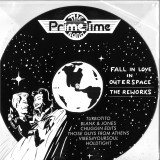
DJ Supermarkt came across this rare private press 7 Inch a long time ago, and since tried to locate the band to include the track on his Too Slow To Disco compilation series. After years he found bandleader Jeff Wollman, who gave TSTD permission to finally rerelease this funky space beauty for the first time on the new compilation TSTD 4.
The story could have ended here, but Jeff and DJ Supermarkt went one step further, and came up with the plan to give the track to a few selected producers for new versions/reworks. We contacted our favorite smooth space approved producers of today, and they all said “Yes” and we are super proud to now give you: The Reworks!
About PRIME TIME BAND:
Some bands excel at turning up, turning it on and getting the job done. Prime Time Band have spent an unlikely 38 years in the business as we write, throwing down a smooth, funky-yet-jazzy set for discerning listeners in the USA, Japan and beyond. “Fall in love in outer space”, their 1986 almost-hit, hits that sweet spot between 80s funk-pop and the disco era’s love of anything galaxy-tinged. Guy Maxwell (bass), Larry Vann (drums), Jeff Wollman (keys), Kenn Peterson (guitar) and Tom Marken (vocals) gifted us a rather delicious spacey groover that feels as ready for
AN INCREDIBLE LOOKING PICTURE DISC WHICH SOUNDS AS GOOD AS IT LOOKS!
Following up on the runaway success of his recent vinyl album ‘Return of The Hitman’, Marvellous Cain is back again with an eye-catching slice of vinyl adorned with perhaps the most iconic
illustration of Marv that’s ever been created!
The ‘Jungle Funk EP’ comes hot off the press, kickin off with maybe the funkiest drum and bass track of the year? ‘Love Train’ has had so much support since its promo this summer, perfect vibes
on a huge outdoor sound system. Razor sharp drumbeats underpin the soulful melodies which in turn compliment the funky bass guitar riff that are guaranteed to get you in the mood to party!
On hearing ‘Love Train’ for the first time, the insanely talented Brazilian turntable wizard DJ Marky was instantly smitten and offered to add to the release on remix duties!! So of course, we let him!!
DJ Marky seasons the track with favela flavours and adds a speaker shaking bass which will get you bumping, grinding & calling for the reload until the very last bars.
On the flip side of this gorgeous picture disc, Marvellous Cain offers up two more Drum & Bass / Jungle cuts. ‘Buss Ah Blank’ fuses modern dancefloor bass sounds with 70’s soul, a track that has been a favourite with the likes of Nicky Blackmarket, Charlotte Devaney & did serious damage when Marvellous Cain played it at Notting Hill Carnival on the mighty Rampage Soundsystem.
Finally ‘Funky To Night’ comes with a load more bass guitar licks… There’s a reason this is called the ‘Jungle Funk EP’!
All the tracks on this picture disc have receive support in clubs, and on the airwaves from the likes of Rampage & Heartless Crew. Also if you’ve seen Marvellous Cain’s social media pages then you will understand the lengths this man goes to in order to get his music heard… This will be one of the most entertaining promotional campaigns you’ve ever witnessed!!
Super deep n’ rolling ambient junglist mutations from hyped cloakroom attendent Florian T M Zeisig and mysterious XPQ? operator PVAS, uniting under the NUG moniker for a highly atmospheric session beamed directly from that short-lived, elusive sweetspot in the mid 90’s when Omni Trio and DJ Crystl collided with Mo Wax’s Some Scientific Abstract Type Shit! and Gescom’s Disengage, all red lights dappling thru a dense fog of smoke.
Rinsed out under the timeless influence of “bong & sterni” - who sound like a legendary Berlin ambient duo, but are just weed and beer - Zeisig and PVAS collide in midair for a stereo-swirled recollection taking us back to 1995 - that Autechre radio show on Kiss FM, peak Mo Wax, Kodwo Eshun’s ‘club trax’ column, just before everything went fully tasteful. Throwing links to more contemporary refractions found on various J. Albert workouts as much as Skee Mask’s most vapourised breaks, the NUG sound keeps toes and heads off the ‘floor with a rugged but lush suite of rave suspension systems making critical use of negative space and recoiling dub dynamics.
One for the early hours of the club, ‘Not Many People Here yet’ gives acres of room to bounce off the walls, while the ruder ‘Filthy Club’ sounds like the backroom heard from ceramic tiled bogs, and you’re already healthily zonked for the zombie float of ‘Is Under The Blanket.’ The radiant pads and swingeing breaks of ‘Morpheus’ dial up Skee Mask’s most pendulous rave visions, and ‘Napping Under God’ rolls out on 9 minutes of webbed breakbeat for the locked-in steppers, with Florian’s ambient texturing fully coming into effect on the blurry-eyed flex of ‘Lite.’
Available from Blank Forms for the first time since its original 1980 release on ALM-Uranoia, New Sense of Hearing documents a collaboration between Takehisa Kosugi and Akio Suzuki, two luminaries of Japanese experimental music in the lineage of Fluxus. Blank Forms's high-quality reissue of the sought-after, long out of print LP, is produced by musician-artist Aki Onda and mastered from the original tapes recorded on April 2, 1979, at Tokyo's Aeolian Hall. Described by Suzuki as the "culmination" of their sound,New Sense of Hearing features the two musicians improvising together in that empty Tokyo theater, Kosugi on vocals, violin, and radio transmitter and Suzuki on the Analapos, his namesake glass harmonica, spring cong, and kikkokikiriki, all apparatuses of his own invention. Suzuki and Kosugi first met at the city's Minami Gallery in 1976 on the occasion of "Sound Objects and Sound Tools," an exhibition of Suzuki's homemade instruments. Two years later, at the Festival d'Automne in Paris, Suzuki invited Kosugi to join him for a suite of performances as part of the exhibition "MA: Espace - Temps au Japon," organized by architect Arata Isozaki and composer-writer Toru Takemitsu. Suzuki and Kosugi performed together at the Musée des Arts Décoratifs, Paris, nearly fifty times, honing their approach to mutual improvisation, before traveling with the exhibition to Stockholm and New York_critic Tom Johnson wrote in the Village Voice that he had "seldom seen two performers so completely tuned in on the same types of sounds, the same performance attitude, the same philosophy, the same sense of what music ought to be."For New Sense of Hearing, the duo reunited in Japan and produced an extraordinary dispatch from their collaboration of arioso violin, echoing vocals and bangs, and metallic twangs. As Johnson observed in 1979, Kosugi and Suzuki are "in a very subtle artistic world where there can be no direct relationships. . . . Only coincidence." Takehisa Kosugi (1938-2018) was a composer, artist, and violinist from Tokyo. In 1960, Kosugi founded Group Ongaku, the country's first improvisational performance collective dedicated to Happenings, with Mieko Shiomi and Yasunao Tone. Four years later, Fluxus leader George Maciunas published Events, an eighteen-piece set of his text compositions. Between 1971 and '74, his band the Taj Mahal Travelers produced four live albums. In 1977, the Merce Cunningham Dance Company invited Kosugi to be their resident musician; from 1995 to 2011 he served as the company's musical director. The Whitney Museum of American Art presented "Takehisa Kosugi: Music Expanded," a two-day retrospective of Kosugi's work, in 2015. Akio Suzuki (b. 1941) was born in Pyongyang, North Korea, to Japanese parents. For the artist-musician's first Fluxus-style work Kaidan ni Mono wo Nageru (Throwing Things at the Stairs), 1963, Suzuki tossed a bucket of miscellaneous objects down a flight of stairs in Nagoya Station and listened to the sounds it produced. During the next decade, he would create original instruments including the Suzuki-type glass harmonica and the echo instrument Analapos. In 1976, Tokyo's Minami gallery hosted his first exhibition, "Akio Suzuki's World: Sound Objects and Sound Tools." For his 1988 performance piece Space in the Sun, Suzuki spent twenty-four hours listening to his surroundings on the meridian line which runs through Amino, Kyoto. Suzuki has performed and exhibited at many venues and music festivals, including Documenta 8 (Germany, 1987), the British Museum (2003), Musée Zadkine (France, 2004), Kunstmuseum Bonn (Germany, 2018), and the Museum of Contemporary Art Tokyo (2019).
Clear Vinyl
New Nordic jazz duo Svaneborg Kardyb sign to Gondwana Records and announce NPR Tiny Desk session and captivating third album Over Tage
Svaneborg Kardyb are Nikolaj Svaneborg - Wurlitzer, Juno, piano and Jonas Kardyb - drums, percussion a multi award winning duo from Denmark, where they won two "grammys" at the Danish Music Awards Jazz 2019: New artist of the year and Composer of the year. ?Drawing on Danish folk music and Scandinavian jazz influences, including Nils Frahm, Esbjörn Svennson and Jan Johansson's landmark recording Jazz På Svenska, their music is an exquisite and joyful melding of beautiful melodies, delicate minimalism, catchy grooves, subtle electronica vibes, Nordic atmospheres and organic interplay, all underwritten by the sheer joy of playing together. "We started in the earliest of mornings over the blackest of coffee, sometimes even without talking, just music.
Immediately we felt a connection between our personal style of playing and the compositions emerged like out of nowhere. The vibe from these early sessions is still the backbone of our little band".
Svaneborg Kardyb hail from Aalborg, in Jutland, in the north of Denmark where they first met in 2013 and discussed the possibility of creating a duo over late night talks. Six years went by as they both explored other projects before they eventually realised the idea of making music together. Like their new label mates, Vega Trails, Svaneborg Kardyb are a duo, a format that gives them a lot of space to occupy - or leave blank. "We enjoy the simplicity and focus it gives to the interplay. We come from very different musical backgrounds; Nikolaj from Scandinavian jazz, and Jonas from Roots, blues and folk, so the music is a sum of our personal contributions and doesn't thrive to be anything else than that. It's quite unique for us to have this shared musical tongue and friendship".
Their music is intentionally simple at first glance, but evolves and unfolds through listening over time, with plenty of room for exploration, reflection and improvisation. Their aim is to create music that is as honest and intimate as possible "with melodies and rhythms so strong that we are left as only the messengers". And their fast-developing music chemistry allowed them to give little thought to what their musical influences were. Giving their music a captivating charm. "We explored whatever sounds and musical structures our duality gave birth to and through long jam-sessions we found small seeds of ideas that turned into tunes. Danish traditional songs, community singing and hymns are a big inspiration too. Both the tonal language, the lyrical melodies and the way generations can gather around the music, is something that is close to our hearts".
Over Tage (over roofs) is their third album, following Knob (2019) and Haven (2020) and marks their debut for Gondwana Records a label noted for working with artists such as Mammal Hands, Portico Quartet and GoGo Penguin whose music, like that of Svaneborg Kardyb delights in exploring the fertile spaces between genres. For the duo it is their most serious and thoughtful record to date. "It may be our strongest and most honest record so far. Doubts and uncertainty were kind of the foundation for the sounds of the album but there is also hope and lots of uplifting moments and we're very pleased with how it came out." And it is that mixture of elevation and thoughtfulness, honesty and intimacy that makes the music of Svaneborg Kardyb so special and Over Tage such a joy to listen to. The world awaits.
Welcome to the world of Edward Blankman, a retired dentist who wrote elegant, minimalist jazz in obscurity circa 1970. At least that's the story. In truth, Edward Blankman's Cape Cod Cottage is the 2021 concept album from Echo Park composer Brendan Eder. A tender, wistful follow up to 2020's To Mix With Time, the Cape Cod Cottage sound evokes the spirit of Erik Satie, Miles Davis with Gil Evans, and Stevie Wonder, balanced with the accessibility of 1960s lounge-exotica. Eder created Blankman's story to channel his own grief, with bittersweet tenderness. Read the liner notes (or watch the mini-doc), and you'll be transported to the quiet shores of Cape Cod in the early 70s, where a lonely retiree mourns his late wife, Natalie, with walks in nature and evenings at his Wurlitzer. The story is brought to life with a meticulously crafted package sporting classic liner notes, faux 1970s photographs documenting Edward with the musicians (taken during the actual session), a make-believe jazz label, and a commissioned oil painting of Edward's cottage. Eder brought together a dream line up with a ton of chemistry for the project; drummer Christian Euman (Jacob Collier), saxophonist Josh Johnson (Jeff Parker, Leon Bridges), and bassist Alex Boneham (Billy Childs), who all studied together at the Hancock Institute of Jazz. Rounding out the group is flutist Sarah Robinson, a recurring player in Eder's ensemble, and Edward Blankman (Brendan) on the Wurlitzer. The cast was booked for a single date with coveted engineer Michael Harris (Kamasi Washington, Angel Olsen) at famed Electro-Vox Recording Studios. To create realism for Edward's story, the charts were purposefully withheld from the musicians until they arrived at the studio. The result is an authentic and natural performance delivered by players at the top of their game, captured on lauded vintage equipment including the legendary Neve-8028 console. This was, hands down, one of the very best records of last year so don't miss out on this extremely limited pressing for UK and Europe. Under license from Jazz Dad Records.
- A1: Plays Albert Ayler 1 10 01
- A2: Plays Albert Ayler 2 09 45
- B1: Plays John Cassavetes 1 09 58
- B2: Plays John Cassavetes 2 09 57
- C1: Plays Hubert Fichte 1 10 01
- C2: Plays Hubert Fichte 2 09 59
- C3: Plays Cornelius Cardew 1 04 01
- D1: Plays Cornelius Cardew 2 04 03
- D2: Plays Robert Johnson 1 04 04
- D3: Plays Robert Johnson 2 04 00
Ekkehard Ehlers' seminal plays series was originally released on three 12inches (Staubgold) and two 7inches (Bottrop-Boy) in very limited runs. The entire series was previously only available as a CD compilation or digitally. Keplar finally presents it on double vinyl for the first time, featuring a new cover artwork.
Domestic ethnology: Ekkehard Ehlers plays.
‘Play’ is a word in English with many meanings attached. Each one sends you down a different cognitive pathway. When I think of ‘playing’, in the sense of a game, I think of an activity involving more than one person. When Ekkehard Ehlers plays, he is very much on his own. Or, at least, alone but at the same time keeping intimate company with the artistic innovators named in his titles. Robert Johnson. John Cassavetes. Albert Ayler. Cornelius Cardew. Hubert Fichte. Is he playing with them, against them, about them, for them, to them? This can never be known.
It is certainly a mistake to try to hear the ‘work’ of these originals in the sounds played by Ekkehard. They’re not cover versions. They’re hardly tributes in the conventional sense. Cassavetes and Fichte are not even musicians, although music played an important part in both their careers. Sure, there are little nods and flashes of recognition – tiny guitar licks among the minimal beats of ‘Robert Johnson 2’; rich bowed instruments in ‘Albert Ayler’, recalling the violin, cello and double bass arrangements on Ayler’s 1967 Live in Greenwich Village LP; the elongated organ lines of ‘Cornelius Cardew 1’ gesturing towards passages in Paragraph 1 of the British composer’s 1971 Marxist monolith, The Great Learning. Ekkehard is not so much playing these figures as allowing himself to be played by them.
Playing as an activity also suggests freedom. Maybe the only thing all five named persons have in common is that they were all quiet radicals. In music, literature and cinema, they all stepped, without self-promotion or fanfare, into unmapped territories. Once there they found it necessary to invent new languages in order to survive. Necessity was the mother of their inventiveness. They were also uncomfortable avant gardists. Lonely types, fighting their corners out on the margins, with little reward, often misunderstood, ridiculed or ignored.
All died unfairly young. Fichte a victim of HIV/AIDS, Cassavetes of cirrhosis of the liver. (‘Cassavetes 2’ sounds like a tender farewell played across the 59 year old alcoholic director’s death bed.) The deaths of Johnson, Ayler and Cardew have never been satisfactorily explained, and remain shrouded in myths and conspiracy theories. The pioneering expeditions of all five began in that spirit of playful freedom, but inexorably drew them towards the heart of darkness.
So these ‘plays’ are micro-dramas, sonic soliloquies, monolog-ins to the private accounts of various geniuses in Ekkehard’s ‘follow’ list. Hacked sensibilities. Artistic manifestos boiled down and distilled, skinned and dried in the digital smokehouse. (Ekkehard Ehlers Flays.) Each of these plays was originally floated out into the world alone on its own disc. The collected works play well as a team – a tranquil, introspective experience where each artist has his own identifiably unique sound character. As an album, Plays is a ‘Plattenragout’ – a ‘record stew’ – which was the title of Hubert Fichte’s LP review column in the leftist culture magazine konkret in the 1960s. The novelist’s work investigating the cultures of South America and the Caribbean islands has been called ‘domestic ethnology’. The writer himself referred to his ‘ethnopoesie’. Ekkehard Ehlers’s intuitive electronic portraits are a form of domestic ethnology in themselves. Invoking another of Ekkehard’s musical aliases, they are portraits of cultural ‘autopoiesies’ – creators whose works were strong enough to have their own self-regenerating life force. (by Rob Young)
All tracks written and produced by Ekkehard Ehlers.
Featuring Stephan Mathieu, Joseph Suchy, Anka Hirsch.
Tracks A1 to C2 originally released on three 12inches via Staubgold.
Tracks D1 to D4 originally released on two 7inches via Bottrop-Boy.
Plays originally released as CD compilation in 2002 by Staubgold.
Mastered by Rashad Becker.
Cut to vinyl by Lupo, Berlin, 2022.
Redesigned by Sandra Kastl, 2022.
Photos by Ludger Blanke
In a time where electronic music gets harder and faster each day, Berlin-based duo Brigade‘s debut album „Hard Times, Soft Music“ reclaims easy listening as a badge of honour. Being released on 14.10.2022, the record is a meticulously calibrated work of room temperature, a home cooked meal between friends or a warm sonic blanket that tugs you in after a rainy day. Pushing their club roots to the side, Brigade‘s debut album con- dently sits between ambient, house and hip hop. „We took the pandemic as a cue to take a break from dance floor productions and play around with different genres and production styles.“ The rst single „International CommunicationTM“ showcases that breadth and introduces an album pretty much anyone in the post-Shrek cultural landscape could agree on. Basically, if you appreciate a good hug, chances are you‘ll enjoy this LP. Also, there's a pretty cute dog on the cover.
Italian legend Daniele Baldelli & DJ Rocca team up for ‘Cielarko’ on Gottwax this May.
Often mentioned in the same breath as DJing pioneers Francis Grasso, David Mancuso and Nicky Siano, Baldelli’s storied history includes his various long-running residencies, the most well-known being the legendary Cosmic club in Italy, and establishing the now world-renowned ‘cosmic sound’. Teaming up here with his regular production partner DJ Rocca, the duo reunite for four immaculately produced and colourful tracks for Gottwax Records, the record label from the UK’s Gottwood Festival.
Leading the release, ‘Blanka’ brings rolling low end and psychedelic synth work together with floaty yet punchy percussion for a mid-tempo trip. ‘Flava’ follows with sharp staccato drum hits and Italo disco inspired leads, making for a light and playful closer to the A-side. On the flip, ‘Verdeta’ brings twisted basslines, FX-laden licks and wonky drums for a fun and enjoyable track before ‘Helblua’ rounds out the release with light keys, chugging percussion, and catchy riffs.
Jerry Hunt, Philip Krumm, Jerry Willingham, James Fulkerson, Larry Austin, Dary John Mizelle, BL Lacerta, Gene DeLisa, Robert Michael Keefe, Rodney Waschka II Irida Records: Hybrid Musics from Texas and Beyond, 1979-1986 Irida Associates U.S.A., an obscure and short-lived record label formed by composer-performer Jerry Hunt, offers a glimpse into the revelatory world of new music and composition in the artist's native Third Coast. Based first in Dallas and later in Hunt's home outside the rural town of Canton, Texas, Irida presented the innovative and daring experiments_into aleatoric methods, environmental acoustics, improvisation, homemade technologies, and more_pursued by Hunt and his select collaborators, primarily working in or near Texas between 1979 and 1986. Irida's brief and compact output_seven non-sequentially numbered LPs released in unknown quantities_shared work by artists whose practices often challenged the limitations of vinyl recording. Hunt called the label a "vanity project" and frequently talked of a tax loophole he could claim if it all went belly up, but in its short lifespan Irida captured a tremendous period of creative experimentation by the artist and his friends and collaborators. This boxed set gathers Irida's complete discography for the first time. These records include early attempts by Hunt to record his generative and highly permutable scores and performances on vinyl in Cantegral Segment(s) 16.17.18.19. / Transform (Stream) / Transphalba / Volta (Kernel), as well as his only composition for piano, "Lattice," on Texas Music (both records 1979). The label distributed solo and group recordings by those in Hunt's circle as well, including Larry Austin's electroacoustic, syncretic compositions in Hybrid Musics; James Fulkerson's unique, extended techniques for the trombone on Works; a fusion of three overlaid compositions in Dary John Mizelle's Music of Dary John Mizelle; spontaneous pieces and riff-based "character improvisations" in Music of BL Lacerta by the four piece "orchestra in miniature" BL Lacerta Improvisation Quartet; and experiments in compositional "mapping" by external structures in Cartography, featuring Austin, Gene De Lisa, Robert Michael Keefe, and Rodney Waschka II. Accompanying the boxed set is a richly-illustrated reader with a detailed essay on on the label by Lawrence Kumpf and Tyler Maxin; never-before-published archival materials; newly commissioned reflections by Fulkerson and the composer Jerry Willingham; as well as an interview with Hunt and ephemera including album and concert reviews, artworks, posters and flyers, and correspondences from the musicians and composers involved.
repress
"The haunting ambience of Beat fit somewhat with the then-popular Massive Attack and Portishead, but the album's subsonic drone made it more of a minimal mood piece than a collection of songs." MAGNET
The second in a trio of albums released by the core duo of Lawrence Chandler and Martha Schwendener, Beat is without doubt their definitive artistic statement.
Coming 20 years to the day of its original release, this is the first time this album has been available on vinyl in almost two decades, and the first ever U.S. vinyl release. (Was released here on Beggars Banquet, original copies very hard to find..)
The second album from New York City's Bowery Electric was released in late 1996, less than 15 months after their self-titled debut, but it found them having traveled light years musically in the interim, the group having seemingly decided to see how far they could take the guitar/ bass/ drums/ vocal setup into the atmosphere.
Every aspect of their approach had been refined and focused: squalling, distorted guitars had been transformed into hazy, sensual sheets; the live drums transmuted to sampled rhythms more in debt to the blossoming downtempo sound of the day; bass lines reduced to their most basic diagrams; vocals submerged to become one with the narcotized fog of the instruments; even the lyrics were reduced to a few minimal lines used sparingly so as not to overshadow the dynamic.
Beat is a lush and dense mantra of shadowy percussion, barely-there vocals and immersive drones that envelops the listener in an opiated blanket of sound.
quotes:
"Bowery Electric have made something utterly astonishing here. So deep, so wide, and somehow as intimate as a train crash. The first six tracks are just the most crushingly beautiful thing I've heard in 1997; the last five are even better. Good god, THIS IS IT." Melody Maker
"While cymbals shower down over the songs like a torrent of shattered glass, their austere beauty is never static. Ambience has rarely sounded so messy." Exclaim
A near-perfect mix of shifting dance beats, menacing electronic drones, analogue bleeps,
syncopated rhythms and ethereal vocals." Now UK
A legendary indie audio artist blurring his lifelong attachments, from spontaneous composition (in the late 70's with John Zorn) to experimental rock (with Bongwater and other bands in the 80's) alongside his recent inquiries into the intricacies of ambient-folk songcraft (with his most recent solo LP, "And The Wind Blew It All Away"), Kramer continues to explore the possibilities of shaping naturally occuring aural landscapes into intoxicatingly affecting music. Sound and language - not just melody and ambient textures - has been his raw material for decades. He nowjuggles them more deftly than ever on his newest ambient opus. In the ten compositions that comprise this new LP, mournful at times yet mysteriouslylife-affirming and generous in their scope, Kramer sees films where there arenone, and composes his accompanying ambient soundtracks in a state of interrupted grace. Words, text, complete screenplays, character arcs, shooting scripts and storyboards swirl through his head as he puts his imagery to sound, and the results evoke a world in which moths, drawn to the bright flickering lightsof Cinema and the low humming lights of Dreams, in Kramer's own words, "...might never die". The LP's nature reveals an interior dialogue between musician and choice. Each piece represents Kramer's encounter with the blank canvas of silence that greets him as a composer. Embracing sounds as objects and instruments of Truth, the end result of his process is as much about what is absent and what has been removed or edited away than what is left in its wake as artifacts of emotion. These pieces are the Spring frost of lost imaginings, vanitas to broken connections, visions nearly unrecordable by the human eye. Kramer envisions a music that functions to stoptime, as an event that always plays in the present and never needs a past to give it a reference point. It is music that communicates in the most intimate way possible, as intricately and as deeply as the way it blossoms and shifts and evades categorizationwhen exposed to thin air. Drawn toward the light of a multitude of influences, we hear echoes of the feverishly frozen dreams of composers Morton Feldman, Terry Riley, Brian Eno and Arvo Part, melting alongside the surreal cinemas of David Lynch and The Brothers Quay, all parts converging to evoke a time and place that does not exist outside of the mind's eye of the listener. These ten works are fluid adventures in fathomless landscapes, emotions distilled and offered as a paintless painting without a physical home. Each individual composition is an offering to a future memory, a chalice to be filled with the listener's own reactions to them. As a whole, the ten pieces form an image of ten circling planets in an expanding galaxy that colors itself anew with each subsequent listen. Movement, grace, and Peace.
Note price increase and cat number change from last time around. In the late 1960s, the American trumpet player and free jazz pioneer Don Cherry (1936-1995) and the Swedish visual artist and designer Moki Cherry (1943-2009) began a collaboration that imagined an alternative space for creative music, most succinctly expressed in Moki's aphorism "the stage is home and home is a stage." By 1972, they had given name to a concept that united Don's music, Moki's art, and their family life in rural Tagårp, Sweden into one holistic entity: Organic Music Theatre. Captured here is the historic first Organic Music Theatre performance from the 1972 Festival de jazz de Chateauvallon in the South of France, mastered from tapes recorded during its original live broadcast on public TV. A life-affirming, multicultural patchwork of borrowed tunes suffused with the hallowed aura of Don's extensive global travels, the performance documents the moment he publicly jettisoned his identity as a jazz musician, and represents the start of his communal "mystical" period, later crystallized in recordings such as Organic Music Society, Relativity Suite, Brown Rice, and the soundtrack for Alejandro Jodorowsky's The Holy Mountain. The musicians in Don Cherry's New Researches, hailing from Brazil, Sweden, France, and the US, converged on Chateauvallon from all over Europe. The five-person band Don and Moki Cherry, Christer Bothén, Gérard "Doudou" Gouirand, and Naná Vasconcelos performed in an outdoor amphitheater and were joined onstage by a dozen adults and children, including Swedish friends who tagged along for the trip and Det Lilla Circus (The Little Circus), a Danish puppet troupe based in Christiania, Copenhagen. The platform was lined with Moki's carpets and her handmade, brightly colored tapestries, depicting Indian scales and bearing the words Organic Music Theatre, dressed the stage. As the musicians played, members of Det Lilla, led by Annie Hedvard, danced, sang, and mounted an improvised puppet show on poles high up in the air. The music in the Chateauvallon concert aspired to a universal language that would bring people together through song. In a fairly unprecedented move, Don abandoned his signature pocket trumpet for the piano and harmonium, thereby liberating his voice as an instrument for shamanic guidance. The show opens with him beckoning the audience to clap their hands and sing the Indian theta "Dha Dhin Na, Dha Tin Na," and the set cycles through uplifting and sacred tunes of Malian, South African, Brazilian, and Native American provenance including pieces that would later appear on Don's albums Organic Music Society and Home Boy (Sister Out) all punctuated by outbursts of possessed glossolalia from the puppeteers. "Relativity Suite, Part 1" notably spotlights Bothén on donso ngoni, a Malian hunter's guitar, prior to Vasconcelos taking an extended solo on berimbau. A vortex of wah-like microtonal rattling, Vasconcelos's masterful demonstration of this single-stringed Brazilian instrument is a harbinger of his work to come as a member, with Don, of the acclaimed group Codona. The sounds of children playing on the ensemble's achingly tender rendition of Jim Pepper's oft-covered beacon of spiritual optimism, "Witchi Tai To," lends the proceedings an especially intimate, domestic glow. Given the context of the star-studded international jazz festival, the concert's laid back, communal vibe feels like an attempt by the Cherrys to show Don's jazz audience that he was moving on. At the same time, however, Don was extending a warmhearted invitation for them to come along for the ride. With liner notes by Magnus Nygren. Track list: 1. Intro: Dha Dhin Na, Dha Tin Na 2. Butterfly Friend 3. Elixir 4. Amazwe 5. Interlude with Puppets 6. Ganesh 7. Elixir Reprise / Witchi Tai To 8. Resa 9. Relativity Suite, Part 1 10. Berimbau Solo 11. Interlude / North Brazilian Ceremonial Hymn 12. Elixir Reprise / Ganesh 13. Ntsikana's Bell / Traditional Melody
Note price increase and cat number change from last time around. In 1968, Don Cherry had already established himself as one of the leading voices of the avant-garde. Having pioneered free jazz as a member of Ornette Coleman's classic quartet, and with a high profile collaboration with John Coltrane under his belt, the globetrotting jazz trumpeter settled in Sweden with his partner Moki and her daughter Neneh. There, he assembled a group of Swedish musicians and led a series of weekly workshops at the ABF, or Workers' Educational Association, from February to April of 1968, with lessons on extended forms of improvisation including breathing, drones, Turkish rhythms, overtones, silence, natural voices, and Indian scales. That summer, saxophonist and recording engineer Göran Freese who later recorded Don's classic Organic Music Society and Eternal Now LPs invited Don, members of his two working bands, and a Turkish drummer to his summer house in Kummelnäs, just outside of Stockholm, for a series of rehearsals and jam sessions that put the prior months' workshops into practice. Long relegated to the status of a mysterious footnote in Don's sessionography, tapes from this session, as well as one professionally mixed tape intended for release, were recently found in the vaults of the Swedish Jazz Archive, and the lost Summer House Sessions are finally available over fifty years after they were recorded. On July 20, the musicians gathered at Freese's summer house included Bernt Rosengren (tenor saxophone, flutes, clarinet), Tommy Koverhult (tenor saxophone, flutes), Leif Wennerström (drums), and Torbjörn Hultcrantz (bass) from Don's Swedish group; Jacques Thollot (drums) and Kent Carter (bass) from his newly formed international band New York Total Music Company; Bülent Ates (hand drum, drums), who was visiting from Turkey; and Don (pocket trumpet, flutes, percussion) himself. Lacking a common language, the players used music as their common means of communication. In this way, these frenetic and freewheeling sessions anticipate Don's turn to more explicitly pan-ethnic expression, preceding his epochal Eternal Rhythm dates by four months. The octet, comprising musicians from America, France, Sweden, and Turkey, was a perfect vehicle for Don's budding pursuit of "collage music," a concept inspired in part by the shortwave radio on which Don listened to sounds from around the world. Using the collage metaphor, Don eliminated solos and the introduction of tunes, transforming a wealth of melodies, sounds, and rhythms into poetic suites of different moods and changing forms. The Summer House Sessions ensemble joyously layers manifold cultural idioms, traversing the airy peaks and serene valleys of Cherry's earthly vision. In the Swedish Jazz Archive quite a few other recordings from the same day were to be found. Some of the highlights are heard as bonus material on the CD edition of this album. The octet is augmented by producer and saxophone player Gunnar Lindqvist, who led the Swedish free jazz orchestra G.L. Unit on the album Orangutang, and drummer Sune Spångberg, who recorded with Albert Ayler in 1962. The bonus CD also includes a track without Cherry featuring Jacques Thollot joined by five Swedes including Lindqvist, Tommy Koverhult, Sune Spångberg, and others. With liner notes by Magnus Nygren and album art featuring a cover painting by Moki Cherry: Untitled, ca. 1967-68. Track list: 1. Summer House Sessions 2. Summer House Sessions.
The legendary BORIS celebrate a 30 year career as one of experimental music's most forward-thinking, heavy, and innovative bands with the new album Heavy Rocks (2022). Continuing their series of Heavy Rocks records, BORIS once again channels the classic proto-metal sounds of the 70s into something all new. The album, 10 pulse-pounding tracks, highlight the very trajectory of BORIS and their storied career - from the driving, fuzzed out Rock N' Roll opener "She is Burning", to the punk, raucous "My Name is Blank", BORIS are heavier than ever before. "Question 1" is just kickass - D-beats give way to a doomed, spaced out and heavier-than-anything guitar wailing and feedback, before diving back into their Metal, sending the listener into a complete frenzy. This is unmistakably BORIS, and this is the band at the height of their powers. Elsewhere on the record, a more daring, "out there" side of the band begins to shine on tracks such as the aptly titled "Blah Blah Blah", the industrial "Ghostly Imagination" and the truly wild "Nosferatou". Noisy passages (not unlike prior collaborations with legendary artists like Merzbow,) collide with visceral vocal howls while a relentless, almost Zornian-saxophone shreds harder than any guitar solo ever could. In 2022, BORIS cement what Heavy Rock means to them, and release one of their most captivating records to date.
Following the success of Land of Nothing EP, Baby Strange are set to
release their second full length album – WORLD BELOW
WORLD BELOW picks up where LAND OF NOTHING left off, with the uniquely
Baby Strange sound encased within haunting melodies, syncopated guitar riffs,
four to the floor drums, huge bass lines and all blanketed under a cover of
melancholy that pulls and tears on the listeners emotions.
Written as a reaction to how the pandemic has played havoc with mental health,
the increasingly visible class divide and the meteoric rise of food banks across
the country – World Below is an album that plays to the paradox of the topics set
out within. Equally dark & beautiful with pop melodies that sync with pure grit.
The result is an album in the truest sense of the word - 10 songs that pull the
listener through a myriad of textures, sounds & emotions, completed with an
array of artwork that generates a visual accompaniment for the topics set out
ithi
Following the success of Land of Nothing EP, Baby Strange are set to
release their second full length album – WORLD BELOW
WORLD BELOW picks up where LAND OF NOTHING left off, with the uniquely
Baby Strange sound encased within haunting melodies, syncopated guitar riffs,
four to the floor drums, huge bass lines and all blanketed under a cover of
melancholy that pulls and tears on the listeners emotions.
Written as a reaction to how the pandemic has played havoc with mental health,
the increasingly visible class divide and the meteoric rise of food banks across
the country – World Below is an album that plays to the paradox of the topics set
out within. Equally dark & beautiful with pop melodies that sync with pure grit.
The result is an album in the truest sense of the word - 10 songs that pull the
listener through a myriad of textures, sounds & emotions, completed with an
array of artwork that generates a visual accompaniment for the topics set out
ithi
Following the success of Land of Nothing EP, Baby Strange are set to
release their second full length album – WORLD BELOW
WORLD BELOW picks up where LAND OF NOTHING left off, with the uniquely
Baby Strange sound encased within haunting melodies, syncopated guitar riffs,
four to the floor drums, huge bass lines and all blanketed under a cover of
melancholy that pulls and tears on the listeners emotions.
Written as a reaction to how the pandemic has played havoc with mental health,
the increasingly visible class divide and the meteoric rise of food banks across
the country – World Below is an album that plays to the paradox of the topics set
out within. Equally dark & beautiful with pop melodies that sync with pure grit.
The result is an album in the truest sense of the word - 10 songs that pull the
listener through a myriad of textures, sounds & emotions, completed with an
array of artwork that generates a visual accompaniment for the topics set out
ithi
TRANSMISSION EDITION OF PORCUPINE TREE'S 2008 MINI ALBUM 'NIL
RECURRING'.Following on from the announced reissue series from
Porcupine Tree, issued through their own Snapper Music imprint
Transmission, 2008's mini album 'Nil Recurring' will be made available on
classic black vinyl edition
Originally released on CD in 2008, the mini- album (29 minutes of music) was
written during the 'Fear Of A Blank Planet' sessions, completed over the Summer
of 2007 & is presented as a cohesive, self-contained Porcupine Tree work in its
own right. The title track features Robert Fripp on lead guitar, & the album moves
through the full Porcupine Tree spectrum of atmospheric ambience, melodic
hooks & crushing riffs.
Porcupine Tree are gearing up for the release of their new album in June, marking
another step forward in the incredible journey of the band that began as a solo
studio project created by Steven Wilson in the late eighties to a multi grammy
nominated act & one of the world's most revered live bands, selling out arenas
across the globe & wowing fans with their incredible performances.
This new Transmission reissue of 'Nil Recurring' remains faithful to the original
artwork & has never sounded better.
"post- prog pearls of modern intelligent, rock- propelled pop....very tasty indeed"
Classic Rock