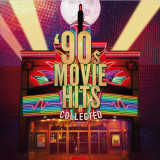
90's Movie Hits Collected is a throwback to the glory days of movies like Batman Forever, Man On The Moon, GoldenEye, Young Guns II, Pretty Woman, Godzilla, The Bodyguard, Trainspotting and many more blockbusters. The 2LP 90's Movie Hits Collected includes classics from U2, R.E.M., Tina Turner, Jon Bon Jovi, Roxette, UB40, Jamiroquai, Whitney Houston. Seal, and Lenny Kravitz amongst others.
This film music compilation album is part of the Collected compilation series, which is a collaboration between Universal Music and Music On Vinyl. The compilations bring together the biggest and best names of its genre, combined with forgotten hits and less discovered gems, giving the listener an experience of both nostalgia and uncovering new musical grounds at the same time.
90's Movie Hits Collected is available on black vinyl and includes an insert with photos.
Suche:block univers
- 1: Home
- 2: Prana 10:9
- 3: Holy 0:58
- 4: Amok
- 5: Open
- 6: Game Over
When I first heard Natalie Rose LeBrecht's time-suspending, air-ionizing music, more than twenty years ago, I thought "this kid is on to something." She's been proving that thought right ever since. Her recordings, from the teenage 4-track tapes she made as Greenpot Bluepot to the recent albums under her own name, have been fascinating dispatches from her progressively deeper dives into her gorgeous, weird, wildly idiomatic aesthetic. Holy Prana Open Game is a jewel of intensely personal cosmic music, created through a remarkable process of openness, craftiness, addition and subtraction. It belongs to a tradition of albums that document a rich, meditative sound as it rises up to join the world outside its creators' minds: Alice Coltrane's Universal Consciousness, Harmonia's Musik von Harmonia, Philip Glass's North Star, Talk Talk's Laughing Stock.
"Meditative" is specifically the idea here: Holy Prana Open Game had its origins in the fourteen days LeBrecht spent silently meditating in her home's small music room in the summer of 2019. "I came out of that bursting with the will to create new music," she says, and she created it sound-first. LeBrecht taught herself to program an analog synthesizer's timbres from scratch, and built a new set of glacial, heady compositions out of them, eventually singing to accompany the keyboard parts she was playing.
Then she closed her eyes at her computer, "let my mind be clear and open, imagined light pouring down through me, and began auto-writing to my memory of the music playing through my mind. Most of the lyrics emerged this way, and then I used my conscious mind to refine them a bit at the end." One other song came along with LeBrecht's new pieces, a cover that seems wildly unlikely from the outside and makes total sense in its context: it's a version of Atoms for Peace's "Amok" (which had been created by improvisation and editing, too), mutated into her own idiolect.
In early March of 2020, LeBrecht recorded Holy Prana Open Game's analog synth parts with Martin Bisi at his studio in Brooklyn--and then the world shut down. As you may have gathered, LeBrecht is very much a spiritual, head-in-the-stars type. She is also extremely hardcore, and if making the art she wants to make means doing things the hard way, she cracks her knuckles and gets down to it. Within weeks, she had taught herself how to record, mix and edit with a digital audio workstation. She recorded her vocal parts (sometimes multi-tracked into a radiant choir) at home, assembled a rough mix of the album, and sent it off to her collaborators.
LeBrecht spent some years studying with and assisting La Monte Young and Marian Zazeela at their legendary sound-and-light installation, the Dream House. As with their work, her singular, precisely focused vision is shored up by its openness to artistic voices beyond her own. For Holy Prana Open Game, she worked with the Australian guitarist Mick Turner and drummer Jim White (both of Dirty Three, the Tren Brothers and innumerable other projects), as well as woodwind player David Lackner, a longtime presence on her recordings.
Turner and White have been playing together in one context or another since 1985; in the summer of 2020, they were only blocks from each other in Melbourne, Australia, whose strict lockdown meant they couldn't meet up to record together. So both of them, as well as Lackner, recorded their improvisational additions to LeBrecht's rough mixes individually, often without hearing each other's contributions. "I had asked them to play as much as they could on each track," she says, "and told them that I would edit it all down in post, so I had a lot of source material of theirs to work with."
LeBrecht arranged and edited the recordings from all four of their homes to flow together like breath across the duration of her suite. Prana, one of the album's central conceits, is in fact the Sanskrit word for breath, with the connotation of the breath of life. Like LeBrecht's music, prana flows at its own pace, and demands stillness to take in fully--but it's also subtly playful and surprising, a force that can be as light as air or as immersive as the atmosphere itself.
Counting from one to ten is one of the first things we learn when we try to speak a new language. It's also a universal language we use in our beats. Numbers are the inspiration source of this album, and its roots are in the inherent rhythmical existence of numbers in music. There is a numerical theme in all the tracks. Every number matches with different grooves and rhythms, and it all comes together around a single "groove pallet".
- Granul
After the ambitious A Distant (Dark) Source (2018) and the subsequent artistic triumph of its live recording in 2021, French avant-garde metal outfit HYPNO5E return with their sixth studio album. Once more, these four visionary musicians and cinematographers take us back to the lost shores of the palaeolithic Lake Tauca, where we dive deeper into its dark source to fnd vibrant visions of a memory both distant and hazy as well as warm and evocative. Sheol shows HYPNO5E at the top of their game, revealing the epitome of their idiosyncratic sound while also exploring new and exciting aspects of their artistic identity. Since 2006 HYPNO5E have been taking grand strides in honing their brand of cinematographic metal, with each of their albums developing elements that would become essential building blocks to their sound. Their 2007 debut album Des Deux l'Une Est l'Autre harnessed a raw, chaotic energy, while the following Acid Mist Tomorrow (2012) saw them apply a hazy filter to their ferocious sound. On Shores of the Abstract Line (2015) HYPNO5E already transformed into the true modern metal grandmasters they are today, while the special soundtrack album Alba - Les Ombres Errantes explored a more subdued acoustic side of the band. Sheol sees the band sounding warmer and brighter than anywhere else in their storied discography, and the arrival of new drummer Pierre Rettien and bass player Charles Villanueva adds a fresh touch the classic HYPNO5E sound. The sweeping finales of «Lands of Haze» and «The Dreamer and His Dream» as well as the pastoral qualities of the quiet finger-picked parts on «Bone Dust» and «Lava From The Sky» hearken back to the old prog rock records of the seventies, albeit with an updated sonic palette and modern production parameters. Besides, these eight tracks also see the band carefully exploring new patterns, shapes, and forms within their own musical universe: from the alternating use of ritardando and accelerando on the aforementioned rim-clicks to the increased employment of string sections and vocal harmonies. With the addition of a whole new palette of warmer and brighter tones, HYPNO5E superbly bridge the sounds of the modern progressive metal and retro prog-movements creating an evocative sonic experience. FOR FANS OF Gojira, Opeth, Periphery, Uneven Structure, Steven Wilson Limited (100 copies ww) Single Colour (Gold Vinyl) Edition!
James Curd presents the fourth instalment from his already essential PRONTO label, delivering a hyper-infectious original alongside a bumper pack of top-drawer remixes on ‘I Am One, I Am Many’.
First up, Curd’s original version of ‘I Am One, I Am Many’ bursts from the blocks with its lively tempo and feel-good groove. Built around an empowering spoken word vocal and pitched somewhere in the fertile soil between disco and house, the funk-laden jam rolls over thick bass, dramatic strings and jaunty guitar licks, with irresistible horn motifs lifting spirits as the dance-ready arrangement unfolds.
Next, renegade UK collective Adelphi Music Factory maintain the uncompromising approach that has seen them garner universal tastemaker heat thanks to impactful releases on Shall Not Fade, Nervous, and their own Beat Factory label. Adding weight to the drums, they stay true to the intention of the original, retaining the track’s key parts while tastefully reforming them as an unfettered main room banger.
The UK remix flavour extends into the third iteration, with notorious party-starters Make A Dance continuing their club-focused manifesto with their brilliantly atmospheric revision. Here, M.A.D. carry on the fine work they’ve been manifesting on their eponymous label, constructing an almost entirely new track around the iconic vocal. A contagious organ hook drives the energy as saucer-eyed sweeps and off-kilter synths meander across the panorama, the sturdy house rhythm expertly powering the kinetically charged groove.
Tel Aviv’s Nenor rounds off the remixes, the esteemed producer and DJ showing the kind of sparkling form that has seen his work appear on benchmark labels including Mahogani, Strictly Rhythm, Heist, and Razor N Tape among many others. Transposing the track into deeper territory, Nenor strips back the instrumentation to serve a mesmerising heads-down roller. The vocal soars over brooding bass and syncopated chords, with loose rhythms and subtle textures combining to hypnotic effect.
After living a number of years in the United States, GRAMMY® and ICMA Nominated Finnish violinist Petteri Iivonen returned to Europe where he became concertmaster of the Finnish Opera orchestra in Helsinki before moving to Paris to serve as concertmaster for the Paris Opera. Petteri's ability to play in many styles with sincerity and his natural lyrical facility with his instrument made him the ideal candidate to work with luminary conductors such as Esa-Pekka Salonen in Helsinki and now Gustavo Dudamel at Paris Opera.
Petteri commands his instrument with ease. While much of his playing is exceptionally beautiful, it is not beautiful for the sake of being pretty. I have heard few violinists with Petteri's ability to control color and timbre, and even fewer who use this ability for such musical and appropriate ends. Petteri plays a Ferdinandus Gagliano violin in this recording, built in 1767. We recorded this performance during a live concert in Alfred Newman Hall at the University of Southern California. We chose a legendary Austrian AKG C-24 stereo microphone with the original brass surround CK12 tube, Midwood vacuum tube preamplifiers and no mixer recording to Agfa-formula 468 tape. The signal path was as short as we could make it, with as few electronics between performer and final product as we could manage. We hope you enjoy the results.
The chaconne most likely originated as a dance in the New World which returned to Spain (along with much gold melted into blocks from irreplaceable Pre-Columbian art and jewelry) after the conquest of the Americas. This original chaconne offered a fast, sexy, syncopated rhythm. Composers treated this dance with increasing invention and gravity during the Baroque era. Henry Purcell wrote complex and chromatic chaconnes for violin. Bach's Chaconne, from his Partita No. 2, may represent the culmination of this genre. Petteri plays with authority and freshness in any environment, and this recording reminds me handsomely why Johann Sebastian Bach remains among my favorite composers of all time.
- A1: Rock This Mother
- A2: Talk To Me Girl
- A3: You Can Find Me
- A4: Check This Out
- A5: Jesus Going To Clean House
- A6: Hope You Understood
- A7: Is It What You Want
- A8: Love Is Everlasting
- A9: This Is Hip-Hop Art
- A10: Opposite Of Love
- A11: Do You Know What I Mean
- B1: Saving All My Love For You
- B2: Look Out Here I Come
- B3: Girl You Always Talking
- B4: Have A Great Day
- B5: Take My Hand
- B6: I Need Your Love
- B7: Your Town
- B8: Talk Around Town
- B9: Booty Head/Take A Little Walk
- B10: I Love My Mama
- B11: I Never Found Anyone Like You
Vinyl LP[23,49 €]
As the sun sets on a quaint East Nashville house, a young man bares a piece of his soul. Facing the camera, sporting a silky suit jacket/shirt/slacks/fingerless gloves ensemble that announces "singer" before he's even opened his mouth, Lee Tracy Johnson settles onto his stage, the front yard. He sways to the dirge-like drum machine pulse of a synth-soaked slow jam, extends his arms as if gaining his balance, and croons in affecting, fragile earnest, "I need your love… oh baby…"
Dogs in the yard next door begin barking. A mysterious cardboard robot figure, beamed in from galaxies unknown and affixed to a tree, is less vocal. Lee doesn't acknowledge either's presence. He's busy feeling it, arms and hands gesticulating. His voice rises in falsetto over the now-quiet dogs, over the ambient noise from the street that seeps into the handheld camcorder's microphone, over the recording of his own voice played back from a boombox off-camera. After six minutes the single, continuous shot ends. In this intimate creative universe there are no re-takes. There are many more music videos to shoot, and as Lee later puts it, "The first time you do it is actually the best. Because you can never get that again. You expressing yourself from within."
"I Need Your Love" dates from a lost heyday. From some time in the '80s or early '90s, when Lee Tracy (as he was known in performance) and his music partner/producer/manager Isaac Manning committed hours upon hours of their sonic and visual ideas to tape. Embracing drum machines and synthesizers – electronics that made their personal futurism palpable – they recorded exclusively at home, live in a room into a simple cassette deck. Soul, funk, electro and new wave informed their songs, yet Lee and Isaac eschewed the confinement of conventional categories and genres, preferring to let experimentation guide them.
"Anytime somebody put out a new record they had the same instruments or the same sound," explains Isaac. "So I basically wanted to find something that's really gonna stand out away from all of the rest of 'em." Their ethos meant that every idea they came up with was at least worth trying: echoed out half-rapped exhortations over frantic techno-style beats, gospel synth soul, modal electro-funk, oddball pop reinterpretations, emo AOR balladry, nods to Prince and the Fat Boys, or arrangements that might collapse mid-song into a mess of arcade game-ish blips before rallying to reach the finish line. All of it conjoined by consistent tape hiss, and most vitally, Lee's chameleonic voice, which managed to wildly shape shift and still evoke something sincere – whether toggling between falsetto and tenor exalting Jesus's return, or punctuating a melismatic romantic adlib with a succinct, "We all know how it feels to be alone."
"People think we went to a studio," says Isaac derisively. "We never went to no studio. We didn't have the money to go to no studio! We did this stuff at home. I shot videos in my front yard with whatever we could to get things together." Sometimes Isaac would just put on an instrumental record, be it "Planet Rock" or "Don't Cry For Me Argentina" (from Evita), press "record," and let Lee improvise over it, yielding peculiar love songs, would-be patriotic anthems, or Elvis Presley or Marilyn Monroe tributes. Technical limitations and a lack of professional polish never dissuaded them. They believed they were onto something.
"That struggle," Isaac says, "made that sound sound good to me."
In the parlance of modern music criticism Lee and Isaac's dizzying DIY efforts would inevitably be described as "outsider." But "outsider" carries the burden of untold additional layers of meaning if you're Black and from the South, creating on a budget, and trying to get someone, anyone within the country music capital of the world to take your vision seriously. "What category should we put it in?" Isaac asks rhetorically. "I don't know. All I know is feeling. I ain't gonna name it nothing. It's music. If it grabs your soul and touch your heart that's what it basically is supposed to do."
=
Born in 1963, the baby boy of nine siblings, Lee Tracy spent his earliest years living amidst the shotgun houses on Nashville's south side. "We was poor, man!" he says, recalling the outhouse his family used for a bathroom and the blocks of ice they kept in the kitchen to chill perishables. "But I actually don't think I really realized I was in poverty until I got grown and started thinking about it." Lee's mom worked at the Holiday Inn; his dad did whatever he had to do, from selling fruit from a horse drawn cart to bootlegging. "We didn't have much," Lee continues, "but my mother and my father got us the things we needed, the clothes on our back." By the end of the decade with the city's urban renewal programs razing entire neighborhoods to accommodate construction of the Interstate, the family moved to Edgehill Projects. Lee remembers music and art as a constant source of inspiration for he and his brothers and sisters – especially after seeing the Jackson 5 perform on Ed Sullivan. "As a small child I just knew that was what I wanted to do."
His older brother Don began musically mentoring him, introducing Lee to a variety of instruments and sounds. "He would never play one particular type of music, like R&B," says Lee. "I was surrounded by jazz, hard rock and roll, easy listening, gospel, reggae, country music; I mean I was a sponge absorbing all of that." Lee taught himself to play drums by beating on cardboard boxes, gaining a rep around the way for his timekeeping, and his singing voice. Emulating his favorites, Earth Wind & Fire and Cameo, he formed groups with other kids with era-evocative band names like Concept and TNT Connection, and emerged as the leader of disciplined rehearsals. "I made them practice," says Lee. "We practiced and practiced and practiced. Because I wanted that perfection." By high school the most accomplished of these bands would take top prize in a prominent local talent show. It was a big moment for Lee, and he felt ready to take things to the next level. But his band-mates had other ideas.
"I don't know what happened," he says, still miffed at the memory. "It must have blew they mind after we won and people started showing notice, because it's like everybody quit! I was like, where the hell did everybody go?" Lee had always made a point of interrogating prospective musicians about their intentions before joining his groups: were they really serious or just looking for a way to pick up girls? Now he understood even more the importance of finding a collaborator just as committed to the music as he was.
=
Isaac Manning had spent much of his life immersed in music and the arts – singing in the church choir with his family on Nashville's north side, writing, painting, dancing, and working various gigs within the entertainment industry. After serving in the armed forces, in the early '70s he ran The Teenage Place, a music and performance venue that catered to the local youth. But he was forced out of town when word of one of his recreational routines created a stir beyond the safe haven of his bohemian circles.
"I was growing marijuana," Isaac explains. "It wasn't no business, I was smoking it myself… I would put marijuana in scrambled eggs, cornbread and stuff." His weed use originated as a form of self-medication to combat severe tooth pain. But when he began sharing it with some of the other young people he hung out with, some of who just so happened to be the kids of Nashville politicians, the cops came calling. "When I got busted," he remembers, "they were talking about how they were gonna get rid of me because they didn't want me saying nothing about they children because of the politics and stuff. So I got my family, took two raggedy cars, and left Nashville and went to Vegas."
Out in the desert, Isaac happened to meet Chubby Checker of "The Twist" fame while the singer was gigging at The Flamingo. Impressed by Isaac's zeal, Checker invited him to go on the road with him as his tour manager/roadie/valet. The experience gave Isaac a window into a part of the entertainment world he'd never encountered – a glimpse of what a true pop act's audience looked like. "Chubby Checker, none of his shows were played for Black folks," he remembers. "All his gigs were done at high-class white people areas." Returning home after a few years with Chubby, Isaac was properly motivated to make it in Music City. He began writing songs and scouting around Nashville for local talent anywhere he could find it with an expressed goal: "Find someone who can deliver your songs the way you want 'em delivered and make people feel what you want them to feel."
One day while walking through Edgehill Projects Isaac heard someone playing the drums in a way that made him stop and take notice. "The music was so tight, just the drums made me feel like, oh I'm-a find this person," he recalls. "So I circled through the projects until I found who it was.
"That's how I met him – Lee Tracy. When I found him and he started singing and stuff, I said, ohhh, this is somebody different."
=
Theirs was a true complementary partnership: young Lee possessed the raw talent, the older Isaac the belief. "He's really the only one besides my brother and my family that really seen the potential in me," says Lee. "He made me see that I could do it."
Isaac long being a night owl, his house also made for a fertile collaborative environment – a space where there always seemed to be a new piece of his visual art on display: paintings, illustrations, and dolls and figures (including an enigmatic cardboard robot). Lee and Issac would hang out together and talk, listen to music, conjure ideas, and smoke the herb Isaac had resumed growing in his yard. "It got to where I could trust him, he could trust me," Isaac says of their bond. They also worked together for hours on drawings, spreading larges rolls of paper on the walls and sketching faces with abstract patterns and imagery: alien-like beings, tri-horned horse heads, inverted Janus-like characters where one visage blurred into the other.
Soon it became apparent that they didn't need other collaborators; self-sufficiency was the natural way forward. At Isaac's behest Lee, already fed up with dealing with band musicians, began playing around with a poly-sonic Yamaha keyboard at the local music store. "It had everything on it – trumpet, bass, drums, organ," remembers Lee. "And that's when I started recording my own stuff."
The technology afforded Lee the flexibility and independence he craved, setting him on a path other bedroom musicians and producers around the world were simultaneously following through the '80s into the early '90s. Saving up money from day jobs, he eventually supplemented the Yamaha Isaac had gotten him with Roland and Casio drum machines and a Moog. Lee was living in an apartment in Hillside at that point caring for his dad, who'd been partially paralyzed since early in life. In the evenings up in his second floor room, the music put him in a zone where he could tune out everything and lose himself in his ideas.
"Oh I loved it," he recalls. "I would really experiment with the instruments and use a lot of different sound effects. I was looking for something nobody else had. I wanted something totally different. And once I found the sound I was looking for, I would just smoke me a good joint and just let it go, hit the record button." More potent a creative stimulant than even Isaac's weed was the holistic flow and spontaneity of recording. Between sessions at Isaac's place and Lee's apartment, their volume of output quickly ballooned.
"We was always recording," says Lee. "That's why we have so much music. Even when I went to Isaac's and we start creating, I get home, my mind is racing, I gotta start creating, creating, creating. I remember there were times when I took a 90-minute tape from front to back and just filled it up."
"We never practiced," says Isaac. "See, that was just so odd about the whole thing. I could relate to him, and tell him about the songs I had ideas for and everything and stuff. And then he would bring it back or whatever, and we'd get together and put it down." Once the taskmaster hell bent on rehearsing, Lee had flipped a full 180. Perfection was no longer an aspiration, but the enemy of inspiration.
"I seen where practicing and practicing got me," says Lee. "A lot of musicians you get to playing and they gotta stop, they have to analyze the music. But while you analyzing you losing a lot of the greatness of what you creating. Stop analyzing what you play, just play! And it'll all take shape."
=
"I hope you understood the beginning of the record because this was invented from a dream I had today… (You tell me, I'll tell you, we'll figure it out together)" – Lee Tracy and Isaac Manning, "Hope You Understand"
Lee lets loose a maniacal cackle when he acknowledges that the material that he and Isaac recorded was by anyone's estimation pretty out there. It's the same laugh that commences "Hope You Understand" – a chaotic transmission that encapsulates the duality at the heart of their music: a stated desire to reach people and a compulsion to go as leftfield as they saw fit.
"We just did it," says Lee. "We cut the music on and cut loose. I don't sit around and write. I do it by listening, get a feeling, play the music, and the lyrics and stuff just come out of me."
The approach proved adaptable to interpreting other artists' material. While recording a cover of Whitney Houston's pop ballad "Saving All My Love For You," Lee played Whitney's version in his headphones as he laid down his own vocals – partially following the lyrics, partially using them as a departure point. The end result is barely recognizable compared with the original, Lee and Isaac having switched up the time signature and reinvented the melody along the way towards morphing a slick mainstream radio standard into something that sounds solely their own.
"I really used that song to get me started," says Lee. "Then I said, well I need something else, something is missing. Something just came over me. That's when I came up with 'Is It What You Want.'"
The song would become the centerpiece of Lee and Isaac's repertoire. Pushed along by a percolating metronomic Rhythm King style beat somewhere between a military march and a samba, "Is It What You Want" finds Lee pleading the sincerity of his commitment to a potential love interest embellished by vocal tics and hiccups subtlely reminiscent of his childhood hero MJ. Absent chord changes, only synth riffs gliding in and out like apparitions, the song achieves a lingering lo-fi power that leaves you feeling like it's still playing, somewhere, even after the fade out.
"I don't know, it's like a real spiritual song," Lee reflects. "But it's not just spiritual. To me the more I listen to it it's like about everything that you do in your everyday life, period. Is it what you want? Do you want a car or you don't want a car? Do you want Jesus or do you want the Devil? It's basically asking you the question. Can't nobody answer the question but you yourself."
In 1989 Lee won a lawsuit stemming from injuries sustained from a fight he'd gotten into. He took part of the settlement money and with Isaac pressed up "Saving All My Love For You" b/w "Is It What You Want" as a 45 single. Isaac christened the label One Chance Records. "Because that's all we wanted," he says with a laugh, "one chance."
Isaac sent the record out to radio stations and major labels, hoping for it to make enough noise to get picked up nationally. But the response he and Lee were hoping for never materialized. According to Isaac the closest the single got to getting played on the radio is when a disk jock from a local station made a highly unusual announcement on air: "The dude said on the radio, 107.5 – 'We are not gonna play 'Is It What You Want.' We cracked up! Wow, that's deep.
"It was a whole racist thing that was going on," he reflects. "So we just looked over and kept on going. That was it. That was about the way it goes… If you were Black and you were living in Nashville and stuff, that's the way you got treated." Isaac already knew as much from all the times he'd brought he and Lee's tapes (even their cache of country music tunes) over to Music Row to try to drum up interest to no avail.
"Isaac, he really worked his ass off," says Lee. "He probably been to every record place down on Music Row." Nashville's famed recording and music business corridor wasn't but a few blocks from where Lee grew up. Close enough, he remembers, for him to ride his bike along its back alleys and stumble upon the occasional random treasure, like a discarded box of harmonicas. Getting in through the front door, however, still felt a world away.
"I just don't think at the time our music fell into a category for them," he concedes. "It was before its time."
=
Lee stopped making music some time in the latter part of the '90s, around the time his mom passed away and life became increasingly tough to manage. "When my mother died I had a nervous breakdown," he says, "So I shut down for a long time. I was in such a sadness frame of mind. That's why nobody seen me. I had just disappeared off the map." He fell out of touch with Isaac, and in an indication of just how bad things had gotten for him, lost track of all the recordings they'd made together. Music became a distant memory.
Fortunately, Isaac kept the faith. In a self-published collection of his poetry – paeans to some of his favorite entertainment and public figures entitled Friends and Dick Clark – he'd written that he believed "music has a life of its own." But his prescience and presence of mind were truly manifested in the fact that he kept an archive of he and Lee's work. As perfectly imperfect as "Is It What You Want" now sounds in a post-Personal Space world, Lee and Isaac's lone official release was in fact just a taste. The bulk of the Is It What You Want album is culled from the pair's essentially unheard home recordings – complete songs, half-realized experiments, Isaac's blue monologues and pronouncements et al – compiled, mixed and programmed in the loose and impulsive creative spirit of their regular get-togethers from decades ago. The rest of us, it seems, may have finally caught up to them.
On the prospect of at long last reaching a wider audience, Isaac says simply, "I been trying for a long time, it feels good." Ever the survivor, he adds, "The only way I know how to make it to the top is to keep climbing. If one leg break on the ladder, hey, you gotta fix it and keep on going… That's where I be at. I'll kill death to make it out there."
For Lee it all feels akin to a personal resurrection: "It's like I was in a tomb and the tomb was opened and I'm back… Man, it feels so great. I feel like I'm gonna jump out of my skin." Success at this stage of his life, he realizes, probably means something different than what it did back when he was singing and dancing in Isaac's front yard. "What I really mean by 'making it,'" he explains isn't just the music being heard but, "the story being told."
Occasionally Lee will pull up "Is It What You Want" on YouTube on his phone, put on his headphones, and listen. He remembers the first time he heard his recorded voice. How surreal it was, how he thought to himself, "Is that really me?" What would he say to that younger version of himself now?
"I would probably tell myself, hang in there, don't give up. Keep striving for the goal. And everything will work out."
Despite what's printed on the record label, sometimes you do get more than one chance.
- A1: Rock This Mother
- A2: Talk To Me Girl
- A3: You Can Find Me
- A4: Check This Out
- A5: Jesus Going To Clean House
- A6: Hope You Understood
- A7: Is It What You Want
- A8: Love Is Everlasting
- A9: This Is Hip-Hop Art
- A10: Opposite Of Love
- A11: Do You Know What I Mean
- B1: Saving All My Love For You
- B2: Look Out Here I Come
- B3: Girl You Always Talking
- B4: Have A Great Day
- B5: Take My Hand
- B6: I Need Your Love
- B7: Your Town
- B8: Talk Around Town
- B9: Booty Head/Take A Little Walk
- B10: I Love My Mama
- B11: I Never Found Anyone Like You
Cassette[11,72 €]
As the sun sets on a quaint East Nashville house, a young man bares a piece of his soul. Facing the camera, sporting a silky suit jacket/shirt/slacks/fingerless gloves ensemble that announces "singer" before he's even opened his mouth, Lee Tracy Johnson settles onto his stage, the front yard. He sways to the dirge-like drum machine pulse of a synth-soaked slow jam, extends his arms as if gaining his balance, and croons in affecting, fragile earnest, "I need your love… oh baby…"
Dogs in the yard next door begin barking. A mysterious cardboard robot figure, beamed in from galaxies unknown and affixed to a tree, is less vocal. Lee doesn't acknowledge either's presence. He's busy feeling it, arms and hands gesticulating. His voice rises in falsetto over the now-quiet dogs, over the ambient noise from the street that seeps into the handheld camcorder's microphone, over the recording of his own voice played back from a boombox off-camera. After six minutes the single, continuous shot ends. In this intimate creative universe there are no re-takes. There are many more music videos to shoot, and as Lee later puts it, "The first time you do it is actually the best. Because you can never get that again. You expressing yourself from within."
"I Need Your Love" dates from a lost heyday. From some time in the '80s or early '90s, when Lee Tracy (as he was known in performance) and his music partner/producer/manager Isaac Manning committed hours upon hours of their sonic and visual ideas to tape. Embracing drum machines and synthesizers – electronics that made their personal futurism palpable – they recorded exclusively at home, live in a room into a simple cassette deck. Soul, funk, electro and new wave informed their songs, yet Lee and Isaac eschewed the confinement of conventional categories and genres, preferring to let experimentation guide them.
"Anytime somebody put out a new record they had the same instruments or the same sound," explains Isaac. "So I basically wanted to find something that's really gonna stand out away from all of the rest of 'em." Their ethos meant that every idea they came up with was at least worth trying: echoed out half-rapped exhortations over frantic techno-style beats, gospel synth soul, modal electro-funk, oddball pop reinterpretations, emo AOR balladry, nods to Prince and the Fat Boys, or arrangements that might collapse mid-song into a mess of arcade game-ish blips before rallying to reach the finish line. All of it conjoined by consistent tape hiss, and most vitally, Lee's chameleonic voice, which managed to wildly shape shift and still evoke something sincere – whether toggling between falsetto and tenor exalting Jesus's return, or punctuating a melismatic romantic adlib with a succinct, "We all know how it feels to be alone."
"People think we went to a studio," says Isaac derisively. "We never went to no studio. We didn't have the money to go to no studio! We did this stuff at home. I shot videos in my front yard with whatever we could to get things together." Sometimes Isaac would just put on an instrumental record, be it "Planet Rock" or "Don't Cry For Me Argentina" (from Evita), press "record," and let Lee improvise over it, yielding peculiar love songs, would-be patriotic anthems, or Elvis Presley or Marilyn Monroe tributes. Technical limitations and a lack of professional polish never dissuaded them. They believed they were onto something.
"That struggle," Isaac says, "made that sound sound good to me."
In the parlance of modern music criticism Lee and Isaac's dizzying DIY efforts would inevitably be described as "outsider." But "outsider" carries the burden of untold additional layers of meaning if you're Black and from the South, creating on a budget, and trying to get someone, anyone within the country music capital of the world to take your vision seriously. "What category should we put it in?" Isaac asks rhetorically. "I don't know. All I know is feeling. I ain't gonna name it nothing. It's music. If it grabs your soul and touch your heart that's what it basically is supposed to do."
=
Born in 1963, the baby boy of nine siblings, Lee Tracy spent his earliest years living amidst the shotgun houses on Nashville's south side. "We was poor, man!" he says, recalling the outhouse his family used for a bathroom and the blocks of ice they kept in the kitchen to chill perishables. "But I actually don't think I really realized I was in poverty until I got grown and started thinking about it." Lee's mom worked at the Holiday Inn; his dad did whatever he had to do, from selling fruit from a horse drawn cart to bootlegging. "We didn't have much," Lee continues, "but my mother and my father got us the things we needed, the clothes on our back." By the end of the decade with the city's urban renewal programs razing entire neighborhoods to accommodate construction of the Interstate, the family moved to Edgehill Projects. Lee remembers music and art as a constant source of inspiration for he and his brothers and sisters – especially after seeing the Jackson 5 perform on Ed Sullivan. "As a small child I just knew that was what I wanted to do."
His older brother Don began musically mentoring him, introducing Lee to a variety of instruments and sounds. "He would never play one particular type of music, like R&B," says Lee. "I was surrounded by jazz, hard rock and roll, easy listening, gospel, reggae, country music; I mean I was a sponge absorbing all of that." Lee taught himself to play drums by beating on cardboard boxes, gaining a rep around the way for his timekeeping, and his singing voice. Emulating his favorites, Earth Wind & Fire and Cameo, he formed groups with other kids with era-evocative band names like Concept and TNT Connection, and emerged as the leader of disciplined rehearsals. "I made them practice," says Lee. "We practiced and practiced and practiced. Because I wanted that perfection." By high school the most accomplished of these bands would take top prize in a prominent local talent show. It was a big moment for Lee, and he felt ready to take things to the next level. But his band-mates had other ideas.
"I don't know what happened," he says, still miffed at the memory. "It must have blew they mind after we won and people started showing notice, because it's like everybody quit! I was like, where the hell did everybody go?" Lee had always made a point of interrogating prospective musicians about their intentions before joining his groups: were they really serious or just looking for a way to pick up girls? Now he understood even more the importance of finding a collaborator just as committed to the music as he was.
=
Isaac Manning had spent much of his life immersed in music and the arts – singing in the church choir with his family on Nashville's north side, writing, painting, dancing, and working various gigs within the entertainment industry. After serving in the armed forces, in the early '70s he ran The Teenage Place, a music and performance venue that catered to the local youth. But he was forced out of town when word of one of his recreational routines created a stir beyond the safe haven of his bohemian circles.
"I was growing marijuana," Isaac explains. "It wasn't no business, I was smoking it myself… I would put marijuana in scrambled eggs, cornbread and stuff." His weed use originated as a form of self-medication to combat severe tooth pain. But when he began sharing it with some of the other young people he hung out with, some of who just so happened to be the kids of Nashville politicians, the cops came calling. "When I got busted," he remembers, "they were talking about how they were gonna get rid of me because they didn't want me saying nothing about they children because of the politics and stuff. So I got my family, took two raggedy cars, and left Nashville and went to Vegas."
Out in the desert, Isaac happened to meet Chubby Checker of "The Twist" fame while the singer was gigging at The Flamingo. Impressed by Isaac's zeal, Checker invited him to go on the road with him as his tour manager/roadie/valet. The experience gave Isaac a window into a part of the entertainment world he'd never encountered – a glimpse of what a true pop act's audience looked like. "Chubby Checker, none of his shows were played for Black folks," he remembers. "All his gigs were done at high-class white people areas." Returning home after a few years with Chubby, Isaac was properly motivated to make it in Music City. He began writing songs and scouting around Nashville for local talent anywhere he could find it with an expressed goal: "Find someone who can deliver your songs the way you want 'em delivered and make people feel what you want them to feel."
One day while walking through Edgehill Projects Isaac heard someone playing the drums in a way that made him stop and take notice. "The music was so tight, just the drums made me feel like, oh I'm-a find this person," he recalls. "So I circled through the projects until I found who it was.
"That's how I met him – Lee Tracy. When I found him and he started singing and stuff, I said, ohhh, this is somebody different."
=
Theirs was a true complementary partnership: young Lee possessed the raw talent, the older Isaac the belief. "He's really the only one besides my brother and my family that really seen the potential in me," says Lee. "He made me see that I could do it."
Isaac long being a night owl, his house also made for a fertile collaborative environment – a space where there always seemed to be a new piece of his visual art on display: paintings, illustrations, and dolls and figures (including an enigmatic cardboard robot). Lee and Issac would hang out together and talk, listen to music, conjure ideas, and smoke the herb Isaac had resumed growing in his yard. "It got to where I could trust him, he could trust me," Isaac says of their bond. They also worked together for hours on drawings, spreading larges rolls of paper on the walls and sketching faces with abstract patterns and imagery: alien-like beings, tri-horned horse heads, inverted Janus-like characters where one visage blurred into the other.
Soon it became apparent that they didn't need other collaborators; self-sufficiency was the natural way forward. At Isaac's behest Lee, already fed up with dealing with band musicians, began playing around with a poly-sonic Yamaha keyboard at the local music store. "It had everything on it – trumpet, bass, drums, organ," remembers Lee. "And that's when I started recording my own stuff."
The technology afforded Lee the flexibility and independence he craved, setting him on a path other bedroom musicians and producers around the world were simultaneously following through the '80s into the early '90s. Saving up money from day jobs, he eventually supplemented the Yamaha Isaac had gotten him with Roland and Casio drum machines and a Moog. Lee was living in an apartment in Hillside at that point caring for his dad, who'd been partially paralyzed since early in life. In the evenings up in his second floor room, the music put him in a zone where he could tune out everything and lose himself in his ideas.
"Oh I loved it," he recalls. "I would really experiment with the instruments and use a lot of different sound effects. I was looking for something nobody else had. I wanted something totally different. And once I found the sound I was looking for, I would just smoke me a good joint and just let it go, hit the record button." More potent a creative stimulant than even Isaac's weed was the holistic flow and spontaneity of recording. Between sessions at Isaac's place and Lee's apartment, their volume of output quickly ballooned.
"We was always recording," says Lee. "That's why we have so much music. Even when I went to Isaac's and we start creating, I get home, my mind is racing, I gotta start creating, creating, creating. I remember there were times when I took a 90-minute tape from front to back and just filled it up."
"We never practiced," says Isaac. "See, that was just so odd about the whole thing. I could relate to him, and tell him about the songs I had ideas for and everything and stuff. And then he would bring it back or whatever, and we'd get together and put it down." Once the taskmaster hell bent on rehearsing, Lee had flipped a full 180. Perfection was no longer an aspiration, but the enemy of inspiration.
"I seen where practicing and practicing got me," says Lee. "A lot of musicians you get to playing and they gotta stop, they have to analyze the music. But while you analyzing you losing a lot of the greatness of what you creating. Stop analyzing what you play, just play! And it'll all take shape."
=
"I hope you understood the beginning of the record because this was invented from a dream I had today… (You tell me, I'll tell you, we'll figure it out together)" – Lee Tracy and Isaac Manning, "Hope You Understand"
Lee lets loose a maniacal cackle when he acknowledges that the material that he and Isaac recorded was by anyone's estimation pretty out there. It's the same laugh that commences "Hope You Understand" – a chaotic transmission that encapsulates the duality at the heart of their music: a stated desire to reach people and a compulsion to go as leftfield as they saw fit.
"We just did it," says Lee. "We cut the music on and cut loose. I don't sit around and write. I do it by listening, get a feeling, play the music, and the lyrics and stuff just come out of me."
The approach proved adaptable to interpreting other artists' material. While recording a cover of Whitney Houston's pop ballad "Saving All My Love For You," Lee played Whitney's version in his headphones as he laid down his own vocals – partially following the lyrics, partially using them as a departure point. The end result is barely recognizable compared with the original, Lee and Isaac having switched up the time signature and reinvented the melody along the way towards morphing a slick mainstream radio standard into something that sounds solely their own.
"I really used that song to get me started," says Lee. "Then I said, well I need something else, something is missing. Something just came over me. That's when I came up with 'Is It What You Want.'"
The song would become the centerpiece of Lee and Isaac's repertoire. Pushed along by a percolating metronomic Rhythm King style beat somewhere between a military march and a samba, "Is It What You Want" finds Lee pleading the sincerity of his commitment to a potential love interest embellished by vocal tics and hiccups subtlely reminiscent of his childhood hero MJ. Absent chord changes, only synth riffs gliding in and out like apparitions, the song achieves a lingering lo-fi power that leaves you feeling like it's still playing, somewhere, even after the fade out.
"I don't know, it's like a real spiritual song," Lee reflects. "But it's not just spiritual. To me the more I listen to it it's like about everything that you do in your everyday life, period. Is it what you want? Do you want a car or you don't want a car? Do you want Jesus or do you want the Devil? It's basically asking you the question. Can't nobody answer the question but you yourself."
In 1989 Lee won a lawsuit stemming from injuries sustained from a fight he'd gotten into. He took part of the settlement money and with Isaac pressed up "Saving All My Love For You" b/w "Is It What You Want" as a 45 single. Isaac christened the label One Chance Records. "Because that's all we wanted," he says with a laugh, "one chance."
Isaac sent the record out to radio stations and major labels, hoping for it to make enough noise to get picked up nationally. But the response he and Lee were hoping for never materialized. According to Isaac the closest the single got to getting played on the radio is when a disk jock from a local station made a highly unusual announcement on air: "The dude said on the radio, 107.5 – 'We are not gonna play 'Is It What You Want.' We cracked up! Wow, that's deep.
"It was a whole racist thing that was going on," he reflects. "So we just looked over and kept on going. That was it. That was about the way it goes… If you were Black and you were living in Nashville and stuff, that's the way you got treated." Isaac already knew as much from all the times he'd brought he and Lee's tapes (even their cache of country music tunes) over to Music Row to try to drum up interest to no avail.
"Isaac, he really worked his ass off," says Lee. "He probably been to every record place down on Music Row." Nashville's famed recording and music business corridor wasn't but a few blocks from where Lee grew up. Close enough, he remembers, for him to ride his bike along its back alleys and stumble upon the occasional random treasure, like a discarded box of harmonicas. Getting in through the front door, however, still felt a world away.
"I just don't think at the time our music fell into a category for them," he concedes. "It was before its time."
=
Lee stopped making music some time in the latter part of the '90s, around the time his mom passed away and life became increasingly tough to manage. "When my mother died I had a nervous breakdown," he says, "So I shut down for a long time. I was in such a sadness frame of mind. That's why nobody seen me. I had just disappeared off the map." He fell out of touch with Isaac, and in an indication of just how bad things had gotten for him, lost track of all the recordings they'd made together. Music became a distant memory.
Fortunately, Isaac kept the faith. In a self-published collection of his poetry – paeans to some of his favorite entertainment and public figures entitled Friends and Dick Clark – he'd written that he believed "music has a life of its own." But his prescience and presence of mind were truly manifested in the fact that he kept an archive of he and Lee's work. As perfectly imperfect as "Is It What You Want" now sounds in a post-Personal Space world, Lee and Isaac's lone official release was in fact just a taste. The bulk of the Is It What You Want album is culled from the pair's essentially unheard home recordings – complete songs, half-realized experiments, Isaac's blue monologues and pronouncements et al – compiled, mixed and programmed in the loose and impulsive creative spirit of their regular get-togethers from decades ago. The rest of us, it seems, may have finally caught up to them.
On the prospect of at long last reaching a wider audience, Isaac says simply, "I been trying for a long time, it feels good." Ever the survivor, he adds, "The only way I know how to make it to the top is to keep climbing. If one leg break on the ladder, hey, you gotta fix it and keep on going… That's where I be at. I'll kill death to make it out there."
For Lee it all feels akin to a personal resurrection: "It's like I was in a tomb and the tomb was opened and I'm back… Man, it feels so great. I feel like I'm gonna jump out of my skin." Success at this stage of his life, he realizes, probably means something different than what it did back when he was singing and dancing in Isaac's front yard. "What I really mean by 'making it,'" he explains isn't just the music being heard but, "the story being told."
Occasionally Lee will pull up "Is It What You Want" on YouTube on his phone, put on his headphones, and listen. He remembers the first time he heard his recorded voice. How surreal it was, how he thought to himself, "Is that really me?" What would he say to that younger version of himself now?
"I would probably tell myself, hang in there, don't give up. Keep striving for the goal. And everything will work out."
Despite what's printed on the record label, sometimes you do get more than one chance.
- A1: Just Can't Wait (Feat Lumi Hd)
- A2: One More Time (Feat Sanity)
- A3: Nagu
- A4: Music Is… (Feat Mr Auden Allen)
- A5: Alegre (Feat Ellie Coleman)
- B1: Party (Feat Lumi Hd)
- B2: On The One (Feat Mr Auden Allen &Amp; Renegade Brass Band)
- B3: Only Because You&Apos;Re Around (Feat Andrea Brown)
- B4: Blockbuster
- B5: Tears
- B6: So Real (Feat Lumi Hd)
LP with Digital Download Card
"Honestly, this album from Sam Redmore is having it" - Craig Charles
"Very clever. Very Nice." – Fatboy Slim
"Totally loving this. It's been on repeat since I heard it." – Nemone
"Amazing. Where can I get all your stuff?" - Jazzy Jeff
Having established himself first as a DJ and then as a remixer, Sam Redmore is now very much making himself known as an original producer of quality global grooves that can light up any dancefloor, carnival or party.
After garnering early support for his remixes from the likes of Gilles Peterson, Quantic, Nightmares On Wax, The Nextmen, Lauren Laverne, Danny Krivit and Craig Charles, Sam has built a name for crafting soul-drenched remixes of the classics, with his army of fans eagerly awaiting every new re-work.
Signing to Jalapeno Records for his debut album of original material, Sam has kept the eclectic tastes of all his fans satisfied with a series of very different singles showcasing the wide range of styles he is known for - all picking up rave reviews and a very wide spread of radio support including Radio 1 / 6 Music / Radio 2 / Jazz FM / Worldwide FM in the UK as well as hitting Number 1 most added on US college radio charts (world).
The single Nagu in particular has become a mainstay on daytime 6 Music but each successive release has been finding new fans. From his killer cumbia covers (Tears / Just Be Good To Me) through to the afro-house exuberance of One More Time and leading neatly up to Just Can't Wait, an extremely soulful disco house floorfiller, this is an album with broad appeal both in the UK and overseas.
In the meantime, Sam has been honing his live shows throughout 2022, with festival bookers keen for a piece of the action. Boomtown, Wilderness, Green Man, Kendal Calling and a whole host of others have seen what the punters at Mostly Jazz, Funk & Soul Festival saw last summer, when Sam debuted his live show on the main stage of a key festival on the Saturday afternoon. Anyone who was there and saw the audacious 12-piece live ensemble playing their first show knew they were seeing something special.
. One of the first Grunge Records ever released. Sourced from the original 1985 Master Tapes. Includes Unreleased Bonus Track. Mark Arm & Steve Turner of Mudhoney, Jeff Ament & Stone Gossard of Pearl Jam. Features Studio Master Tape Box image w/ lyrics. Released in 1985, Green River “Come On Down" was a record existing in its sonic universe out of step with its own time. Was it glam? Was it punk? Was it metal? Was it cool? We now know it was one of the building blocks of what Mark Arm would coin as "grunge" but in 1985 this record was a silent groundbreaker. It was not only the raw, sludgy, slower guitar sound that makes this band important in its place in rock history, but the members of Green River would go on to lead some of the biggest names in the genre: Mudhoney and Mother Love Bone, the latter of which also contained the roots of Pearl Jam. The record includes the iconic original cover artwork, now pressed on black vinyl, and includes a printed inner sleeve with lyrics and photo of the original master tape box, plus an unreleased rare bonus track!
He might be vocalist in bands such as Brighton-based progressive act Diagonal and psychedelic outfit Baron, but when it comes to his solo work Alex Crispin has typically worked in more wordless fields. Last year the songwriter, vocalist and producer released a triptych of ambient albums, consisting of two older albums in 'Idle Worship' and 'Open Submission', as well as new meditative work in 'Resubmergency'. On his new self-titled album, however, Crispin re-emerges from the cavernous soundscapes to – for the first time – put his vocal and song writing stamp on a record under his own name. “I personally find it easier to create more guarded, moody music, but I was at a point where I wanted to embrace a more universal, intimate and open side to what I might say” Crispin says. “Over time I’d got over certain blocks or preoccupations and so wanted to create something accessible and open hearted, which became a big driver for this record.” Pointedly self-titled to reflect the newfound confidence in his song writing away from the collective of a band, the album’s nine tracks are a warm embrace amidst troubled times. Musically there’s nods to everything from tropicalia and Brazilian MPB, to 80’s dusk pop balladeers The Blue Nile and Paul Simon’s explorations into African music. Lyrically aware of the snowballing turbulence that surrounds us, Crispin in reaction tries to see hope and looks around at the relationships and connections in his life that provide him strength. He opens 'Invisible (To Us)' with the words “Before the world did end, there was just one moment when, everybody thought there might be time, to look around again, to laugh to cry to sing.” Elsewhere, 'Listen & Learn' strikes at the heart of other underlying themes of the record, of the rarity of people opening up, taking on new ideas and allowing change. It’s accompanied with a rich, maximal sound palette of flute and sax that play around each other as Crispin’s vocal chips in with gentle encouragement. “One of the main markers on the album that I was aware of from the start, was to let myself express joy and positivity in the music” he says. “I have come to greatly prize the power of accessibility and universality over artistic 'coolness or trend', much in the same way that so often for me, the greatest pieces of art humans make nowadays are things like Pixar movies, with their combination of undeniable human talent and craft, alongside genuinely moving and accessible themes.” Indeed, there is a cinematic feel to much of Crispin’s own music, something brought over from his ambient creations – although his self-titled album possesses a panorama all of its own. Something like 'When I Reach The Ocean' has a hazy, pastoral feel to it like something out of the Canterbury Folk scene; there’s space between the notes though, which in turn pushes the track out to a greater expanse than the comparatively soft-edged and modest sound palette used to create it. Similarly, the likes of 'Effert' revel in the space afforded to them - in the case of the aforementioned in particular, Crispin lets his voice take a back seat and creates an open wash of sound that he allows the guitar to probe and explore within. “In making any music I am definitely conscious of trying to put in only what is effective” Crispin says. “It is so easy to clutter tracks without realising it, just having the ability to add stuff can just become addictive as it’s so easy to do with recording setups now.” The album started coming together at the end of 2020, with Crispin getting most of the songs to a concrete state, before starting recording in May 2021 with Diagonal bandmates Luke Foster (drums) and Daniel Pomlett (Bass), who put down rhythm tracks. Jazz saxophonist Rob Milne then added parts which would become the glue that held the whole organic aesthetic of the album together. There’s no doubt that lockdown played a part in proceedings, with a kind of forced focus resulting in a need for joyful expression. However, Crispin and his partner also suffered a bereavement which led to her travelling for large periods of time. “It was a very intense and difficult time and I think some of the intensity of emotion of that situation coupled with being alone must have inevitably contributed to the work itself” he says. It's perhaps why when even in moments of sheer happiness, such as the 'Sabu’s' breezily euphoric opener, Crispin ponders: “No-one really cares beyond this moment, and even when it's here, it's never here”. It’s the first of several bittersweet moments on the record that give the album its weight. On this new LP, Crispin recognises that sadness doesn’t mean throwing out hope, and that even in moments of joy there’s still a path ahead of you to take.
Clear Vinyl
I met Thomas Roussel in 2017 at a Pigalle fashion show in Paris. As always with Stéphane Ashpool, the designer of Pigalle, casting is perfect and the clothes are modern and groundbreaking. But my eyes and ears were intrigued by this retro-futuristic instrument next to me, the Cristal Baschet. French composer and conductor Thomas Roussel wrote the soundtrack of the show.
He add this magnificent instrument in his "not very classical" orchestra, this is what I immediately loved with him!
He invited us into his world of classical music with a fresh twist, simplicity and audacity.
At the same time I was scratching my head to find something different to celebrate the 15th anniversary of Ed Banger records.
For a long time I had this idea of mixing both electronic and classical music together. Exactly like my heroes Metallica did in 1999 with the Symphonic orchestra of San Francisco! Thomas Roussel seems the perfect man for this crazy idea. We did Ed Banger 15 together and we became friends.
Thomas Roussel grew up in Dijon, spent his days at the conservatory and his nights at L’An-Fer, one of the most respected Techno club in France. Probably the reason why he ended up working with Jeff Mills, on two projects mixing Jeff’s 909 and a classical orchestra.
By experimenting new ways of using an orchestra, by creating state-of-the-art scenography and producing more ambitious music he quickly became the man in charge of everything "classica". The list of his collaborations is too long and will ruin this little introduction.
It could sounds like this : Chanel, Apple, Cartier, Kenzo, Nike, Dior…
Performing from Paris to Macau, from Monte Carlo to Dubai and from New York to Beijing!
In 2017 Thomas Roussel released his first album as Prequell with Universal Music.
A successful collaboration that really allows Thomas Roussel to become an artist.
In 2022 Ed Banger records is proud to release Thomas Roussel "LATE METAL" a 3 tracks EP.
Where uplifting orchestration and electronic music composing collide. The perfect soundtrack of a block buster movie mixing George Lucas & Christopher Nolan generations. It’s also a marker of our time, music boundaries are explosing. It’s time to hear the London Symphony Orchestra’s strings battling with a Drum’n’Bass beat, a way to DEIFIED classical music.
It’s also a record for your eyes. Art director Andy Picci created an algorthym and gave life to a mercury abstract form. This collaboration
marks the need for Thomas Roussel to always push the boundaries and take his project to another LEVEL.
- A1: Signe" (Eric Clapton) - 3:13
- A2: Before You Accuse Me" (Ellas Mcdaniel) - 3:36
- A3: Hey Hey" (Big Bill Broonzy) - 3:24
- A4: Tears In Heaven" (Clapton, Will Jennings) - 4:34
- B1: Lonely Stranger" (Clapton) - 5:28
- B2: Nobody Knows You When You're Down And Out" (Jimmy Cox)
- B3: Layla" (Clapton, Jim Gordon) - 4:46
- B4: Running On Faith" (Jerry Lynn Williams) - 6:35
- C1: Walkin' Blues" (Robert Johnson) - 3:37
- C2: Alberta" (Traditional) - 3:42
- C3: San Francisco Bay Blues" (Jesse Fuller) - 3:23
- D1: Malted Milk" (Robert Johnson) - 3:36
- D2: Old Love" (Clapton, Robert Cray) - 7:53
- D3: Rollin' & Tumblin'" (Muddy Waters) - 4:10
Strictly limited to 10,000 numbered copies, pressed on MoFi SuperVinyl at RTI, and mastered from the original master tapes, Mobile Fidelity's ultra-hi-fi UltraDisc One-Step 180g 45RPM 2LP collector's edition enhances the blockbuster work for today – and the ages to come. Surpassing the sonics of any prior version, it peels away any remaining limitations to provide a transparent, lively, ultra-nuanced presentation of a record that won six Grammy Awards – including prizes for Album of the Year, Best Male Rock Vocal Performance, and Best Rock Song. The expanse and depth of the soundstage, fullness of tones, natural snap and extension of the guitar strings, realistic rise and decay of individual notes, and roll of Clapton's vocals all attain demonstration-grade levels.
Housed in a deluxe box, the UD1S Unplugged pressing features special foil-stamped jackets and faithful-to-the-original graphics that illuminate the splendor of the recording and the reissue's premium quality. No expense has been spared. Aurally and visually, this UD1S reissue exists as a curatorial artifact meant to be preserved, touched, and examined. It is made for discerning listeners that prize sound quality and production, and who desire to fully immerse themselves in the art – and everything involved with the album, from the images to the finishes.
Truly, everything about Unplugged matters. Having sold more than 10 million copies in the U.S. and more than 26 million copies worldwide, the 1992 work resonates with listeners of all generations and speaks a universal language. Recorded for MTV before a very small audience on January 16, 1992, the 14-track set became the signpost for future acoustic-based endeavours that witnessed artists of all stripes re-examining their catalogues and, in many instances, as Clapton does here, placing familiar originals in fresh contexts and unveiling spirited versions of cover material. Needless to say, Clapton's session turned MTV's series into can't-miss programming for which the likes of Rod Stewart, Tony Bennett, Nirvana, Pearl Jam, and more would soon participate.
Kicking off his performance with a spirited instrumental to establish the mood, Clapton immediately wades into the style that originally caught his attention as a British teenager in the early 1960s: American blues. Backed by a superb band that includes guitarist Andy Fairweather Low, pianist Chuck Leavell, bassist Nathan East, and drummer Steve Ferrone, Slowhand delivers a rhythmic, toe-tapping rendition of Bo Diddley's "Before You Accuse Me" that announces he's come to reconnect with his muse. What follows over the course of nearly the next hour stirs the heart, shakes the soul, moves the mind, and invigorates the senses.
Of course, there's no talking about Unplugged without keying in on "Tears in Heaven," the striking ballad Clapton penned about the death of his four-year-old son. More emotional, direct, spare, and healing than the studio version released a year prior, it crackles with an intimacy, maturity, poignancy, honesty, sweetness, and integrity that inform the entire concert. Indeed, how Clapton frames other favorites here – transforming "Layla" into a relaxed, comfortable stroll and ruminating on the seasoned ripples flowing throughout "Old Love," for example – indicate both a creative rebirth and gleeful acceptance of the next phase of his career.
And that very direction (two of Clapton's next three albums would be all-blues projects) is what really makes Unplugged so indispensable. Equivalent in mastery if not in volume to the output that earned him his "God" nickname, interpretations of Jesse Fuller's "San Francisco Bay Blues" (complete with kazoo!), Big Bill Broonzy's "Hey Hey," Robert Johnson's "Walkin' Blues" and "Malted Milk," and Muddy Waters' "Rollin' & Tumblin'" showcase a learned professor in his element and all the wheels turning.
In every regard, Clapton's Unplugged session was appointment listening when it came out in August 1992. With the arrival of MoFi's UD1S pressing, that sensation is more urgent than before.
More About Mobile Fidelity UltraDisc One-Step and Why It Is Superior
Instead of utilizing the industry-standard three-step lacquer process, Mobile Fidelity Sound Lab's new UltraDisc One-Step (UD1S) uses only one step, bypassing two processes of generational loss. While three-step processing is designed for optimum yield and efficiency, UD1S is created for the ultimate in sound quality. Just as Mobile Fidelity pioneered the UHQR (Ultra High-Quality Record) with JVC in the 1980s, UD1S again represents another state-of-the-art advance in the record-manufacturing process. MFSL engineers begin with the original master tapes and meticulously cut a set of lacquers. These lacquers are used to create a very fragile, pristine UD1S stamper called a "convert." Delicate "converts" are then formed into the actual record stampers, producing a final product that literally and figuratively brings you closer to the music. By skipping the additional steps of pulling another positive and an additional negative, as done in the three-step process used in standard pressings, UD1S produces a final LP with the lowest noise floor possible today. The removal of the additional two steps of generational loss in the plating process reveals tremendous amounts of extra musical detail and dynamics, which are otherwise lost due to the standard copying process. The exclusive nature of these very limited pressings guarantees that every UD1S pressing serves as an immaculate replica of the lacquer sourced directly from the original master tape. Every conceivable aspect of vinyl production is optimized to produce the most perfect record album available today.
MoFi SuperVinyl
Developed by NEOTECH and RTI, MoFi SuperVinyl is the most exacting-to-specification vinyl compound ever devised. Analog lovers have never seen (or heard) anything like it. Extraordinarily expensive and extremely painstaking to produce, the special proprietary compound addresses two specific areas of improvement: noise floor reduction and enhanced groove definition. The vinyl composition features a new carbonless dye (hold the disc up to the light and see) and produces the world's quietest surfaces. This high-definition formula also allows for the creation of cleaner grooves that are indistinguishable from the original lacquer. MoFi SuperVinyl provides the closest approximation of what the label's engineers hear in the mastering lab.
SACD
Mastered from the original master tapes, Mobile Fidelity's numbered hybrid SACD enhances the blockbuster work for today – and the ages to come. Peeling away remaining sonic limitations to provide a transparent, lively, ultra-nuanced presentation of a record that won six Grammy Awards (including prizes for Album of the Year, Best Male Rock Vocal Performance, and Best Rock Song), it places Clapton and company in your room. The expanse and depth of the soundstage, fullness of tones, natural snap and extension of the guitar strings, realistic rise and decay of individual notes, and roll of Clapton's vocals all attain demonstration-grade levels. A perennial audiophile favourite, Unplugged now tosses its hat into the ring as a demonstration disc.
Bump 'n Grind Wax's latest limited edition, hand-stamped 7" record is fresh-squeezed lemonade on a hot day. "Back Together Again," the underrated classic from Howard University alums Roberta Flack and Donny Hathaway gets the Reggae Roast treatment. UK vibes conductor, Adam Prescott and vocalist, Rachel Wallace make silky smooth waves with this Studio One inspired late 70's disco tune. A beefed-up bassline couples with an array of echoes and reverbs to guide both the A-side and B-side, "Dub Together Again." Ready for the return of reunions, dances, and block parties, this one is played best with overproof rum, over-sized speakers, Clarks, and hot coals in the jerk pan.
On 19th August at 2PM BST, Ed Sheeran will announce his brand new album ‘=’ alongside an album pre-order. 14 tracks in length, the album will be released on 29th October 2021.
Ed Sheeran is an era-defining artist. Through his fusion of thought-provoking songwriting, universal pop and multi-genre influence, his rich tapestry is not only perfectly suited to his audience but it’s something that transcends generations.
Since surfacing on the UK circuit in 2010 with his ‘No.5 Collaborations Project’ – an eight-track EP featuring his favourite grime artists of the time – the Suffolk-raised recording artist has resonated with fans across the world through his peerless songcraft and versatility. And now, with four UK No.1 albums to his name – ‘+’ (2011), ‘x’ (2014), ‘÷’ (2017) and ‘No.6 Collaborations Project’ (2019) – he has sold over 55 million albums and 160 million singles across the world.
Most notably, Ed’s 2017 blockbuster release, ‘÷’ (Divide), saw Ed reign supreme as one of the most in-demand pop stars on the planet – a feat he has continued to sustain ever since. Crowned as the fastest-selling album, ever, by a male artist in the UK, the chart-shattering album housed a swarm of singles including ‘Castle on the Hill’, ‘Perfect’ and ‘Shape of You’, with the latter becoming Spotify’s most-streamed song of the last decade.
But it’s not just his recorded music that’s seen the former Glastonbury headliner become one of the sought-after artists of the 21st century either. Possessing a mystical ability to turn 90,000 capacity venues into the pub back-rooms that he first started playing in, Ed made history in 2015 after becoming the first-ever artist to play Wembley Stadium solo - without a band and with just his guitar and loop pedal - over three, consecutive sold out nights. Move forward to the summer of 2019 and Ed would re-enter history books after the completion of his mammoth two-year Divide tour, which would officially become the most-attended tour of all time after it culminated with special homecoming shows in Ipswich, Suffolk.
Ed Sheeran - who was awarded an MBE for his services to music and charity in 2017 - is the proud recipient of 1 x IFPI Award (best-selling global artist of 2017); 4 x Grammys; 4 x Ivor Novello’s; 6 x BRIT Awards (including two consecutive wins for ‘Global Success’ in 2018 and 2019); 7 x Billboard Awards + more.
At the end of 2019, Sheeran was presented with the Official Chart Company’s first-ever ‘No.1 Artist of the Decade’ award following a host of accomplishments in his native UK including the most No.1’s across the UK’s Official Singles and Albums chart from the years 2010-2019.
LP pressed exclusively for National Album Day 2021 on gold vinyl in
single-pocket jacket with custom dust sleeve and digital download
coupon.
Through ‘Titanic Rising’, Weyes Blood, aka Natalie Mering, has
designed her own universe to soulfully navigate life’s mysteries.
Manoeuvring through a space time continuum, she plays the role of
melodic, sometimes melancholic, anthropologist.
Tellingly, Mering classifies ‘Titanic Rising’ - written and recorded during
the first half of 2018, after three albums and years of touring - as The
Kinks meeting WWII or Bob Seger meets Enya. The latter captures the
album’s wilful expansiveness (“You can tell there’s not a guy pulling the
strings in Enya’s studio,” she notes, admiringly). The former relays her
imperative to connect with listeners. “The clarity of Bob Seger is
unmistakable. I’m a big fan of conversational songwriting,” she adds. “I
just try to do that in a way that uses abstract imagery as well.”
The Weyes Blood frontwoman grew up singing in gospel and madrigal
choirs. (Listen closely to ‘Titanic Rising’ and you’ll also hear the jazz of
Hoagy Carmichael mingle with the artful mysticism of Alejandro
Jodorowsky and the monomyth of scholar Joseph Campbell.)
‘Something To Believe’, a confessional that makes judicious use of the
slide guitar, touches on that cosmological upbringing. “Belief is
something all humans need. Shared myths are part of our psychology
and survival,” she says. “Now we have a weird mishmash of capitalism
and movies and science. There have been moments where I felt very
existential and lost.”
As a kid, she filled that void with ‘Titanic’. (Yes, the movie.) “It was
engineered for little girls and had its own mythology,” she explains.
Mering also noticed that the blockbuster romance actually offered a story
about loss born of man’s hubris. “It’s so symbolic that The Titanic would
crash into an iceberg, and now that iceberg is melting, sinking
civilization.” Today, this hubris also extends to the relentless adoption of
technology, at the expense of both happiness and attention spans.
But Weyes Blood isn’t one to stew. Her observations play out in an
ethereal saunter: far more meditative than cynical. To Mering, listening
and thinking are concurrent experiences. “There are complicated
influences mixed in with more relatable nostalgic melodies,” she says.
“In my mind my music feels so big, a true production. I’m not a huge,
popular artist, but I feel like one when I’m in the studio. But it’s never
taking away from the music. I’m just making a bigger space for myself.”
The sensation was perfect – Helloween, who have sold more than 10 million records worldwide, being one of the most respected German metal bands since 1984, announced their PUMPKINS UNITED WORLD TOUR in 2016. The media was raving about the TOUR OF THE YEAR, playing 69 shows in 32 countries all over the world. More than one million fans on three continents were ecstatic because it was not only a reunion of the original band, it was the summit of seven ultimate HELLOWEEN heroes: Andi Deris, Michael Kiske, Michael Weikath, Kai Hansen, Markus Grosskopf, Sascha Gerstner & Dani Löble. Or to put it simple: it was a dream come true for fans around the world, the band received five times more spectators and all of them had only one wish: »Please stay together!«
Following the excitement, one of the biggest magazines in this genre ‘BURRN!’ (Japan) honored the band with four unbelievable cover stories, this was followed by the thunderstorm of the century within the social media universe, a celebrated PUMPKINS UNITED single and the quenchless hunger for more – much more! And yes, the musicians tasted blood and it was clear: there is no way back – the future of HELLOWEEN will be written in unity. It marked the beginning of a new era and the re-birth of a metal legend with exceptional artists.
Their first new album will be released in summer 2021. Flatten the runway with a loud drumbeat: in April 2021 the spectacular single SKYFALL will be released. The 12 minute epic, written by Kai Hansen has the long yearned ‘Keeper-Vibe’ but it isn’t telling the story of the whole album. SKYFALL has a musical arch which will be loved by fans of every era: from unforgettable times to glorious adventures all the way to the upcoming first album of the HELLOWEEN new age. The epic track tells about an alien landing on earth and a dramatic chase while Hansen, Kiske and Deris duel with each other in a breathtaking manner and create a broadband adventure - with a lyric sheet with colored blocks identifying the singers as well as a video that is formidable. Produced by Martin Häusler, it will be the most elaborate clip in the history of the band, the story to be shown with 3-D animation and looking cinematic – in these times almost a dinosaur in implementation.
The base of the upcoming milestone album was already erected in the studio: using the original Ingo Schwichtenberg drum kit, the recording was done with the same modulators at the Hamburg HOME studios where back then ‘Master of The Rings’, ‘Time of the Oath’ and ‘Better than Raw’ was recorded. Back to the roots and completely analog is the UNITED impact - another great work by well-known producer Charlie Bauerfeind and Co-producer Dennis Ward before the album traveled to New York and got the final mastering polish in the Valhalla Studios of Ronald Prent (Iron Maiden, Depeche Mode, Rammstein).
With all this brand new material an album has been created, an album that is set apart from the digital mainstream and showing that the essence of the band was never more solid.
The artwork of Eliran Kantor (Berlin) is clear: SKYFALL is the beginning of something big – here comes HELLOWEEN.
It took Sibille Attar five years and a lot of soul searching to produce Paloma’s Hand, the 2018 EP that served as the long-awaited follow-up to her debut album, Sleepyhead. Both that record and her first EP, 2012’s The Flower’s Bed, seemingly left her with the world at her feet, with widespread critical acclaim, television appearances and a Swedish Grammy nomination for Best Newcomer. The years that followed, though, involved both creative and personal turmoil, and left her feeling increasingly adrift musically as the uglier side of the industry reared its head.
“For a long time in my life, I tried to sit in certain constellations to please other people,” she says. “And it didn’t work, because I could only do it for a little while before I’d get frustrated and want to do things my own way. There was a time when I felt like I couldn’t trust the business, and it was draining me of my love for the music. Eventually, I realised you can’t live your life trying to fit into somebody else’s mould all the time.”
Paloma’s Hand, a six-track pop odyssey that slalomed through genres, brought years of struggle to a long-overdue end. Just as importantly, though, it served as a much-needed palate cleanser for Attar, breaking through the barrier of writer’s block. Just two years later, she’s back with her second full-length, the aptly-titled A History of Silence, a reference to that long period of searching for her voice. “I thought about calling it A History of Violence, because in many ways, the album is like a violent attempt to tell my own story when I’ve been silenced,” she explains.
Key to the pace at which she was able to work this time around was a realisation that she functions best on her own - “I just felt like, “fuck it - I can’t be bothered dealing with other people and their opinions.” Accordingly, A History of Silence was written, recorded and mixed entirely by Attar herself, and where she needed a little bit of outside help - sweeping strings on the epic "Dream State", for instance - she penned the arrangements herself and had friends record them exactly as directed. “It seems like that’s the way I have to work to get things done, and it helped things come together really quickly - the first song was done at the start of 2019, and the last one was finished around the time the pandemic was taking hold. It was frantically fast, but I work one song at a time, so it was never too chaotic."
The album never sounds too chaotic, either; like Paloma's Hand, it takes a broad approach to pop, but one that’s anchored by the key through-lines of sharp melodies and atmospheric soundscapes. Largely recorded in Attar’s Stockholm apartment, A History of Silence finds room for everything from sparse alt-rock ("Go Hard or Go Home") to spacey, electropop (the Madonna cover "Oh Father"), via the more up-tempo likes of "Somebody’s Watching". “On some tracks, I had really specific influences in mind,” says Attar. “There’s a lot of eighties stuff going on, and I was deliberately tracking down those kinds of synthesizers to try to capture that sound.”
Attar shies away from talking in too much detail about the themes that run through A History of Silence - she wants the record to be received as universally as possible - but it’s clear that the album marks the beginning of a hugely exciting new chapter after the rebirth that Paloma’s Hand represented. “If anything, it’s like a preacher’s album,” she says. “I’m preaching to myself, teaching myself, telling myself off in the lyrics. It’s about accepting loss of power, changing expectations, and getting rid of some heavy baggage. That’s the way I made the album, and it meant I had no limits - every single idea I had, I tried. When I said I was falling out of love with music, that feels like a very long time ago now.”
Hawkwind have always been associated with music festivals, most notably the free festivals, where Dave Brock has said that, at
those events, the band is not shackled to appease an audience by giving them what they expect and have paid to see. With that obligation removed, the band can relax and experiment more than usual and gigs become even more fun. Their sessions, where they played for free, sometimes with the Pink Fairies, at Canvas City, outside the official site of the Isle Of White Festival in 1970, are a matter of legend and Nik Turner gained much attention when he painted his face silver and was much photographed as a result. During his set, Jimi Hendrix referred to him as 'the cat with the silver face'. However, when we think of Hawkwind and festivals, the word Stonehenge leaps to the fore.
The band always loved being there, enjoying the whole event as well as the freedom of how and when they played. This was not a time of business, but a time of fun. The most important one of these was Stonehenge 1984, which proved to be the last festival before the authorities moved in the following year to block the festival from being set up and Hawkwind ended up playing a few miles away instead. It was the sad end to an era. It had taken place twelve times and, had it been allowed one more time, it would have become a public event and the powers that be were determined to prevent that from happening. Happily, the 1984 festival was recorded and filmed and the Hawkwind Solstice Eve and Solstice Morning were both preserved...and we should be grateful for that.
The fact that Hawkwind were playing for free didn't mean it was a basic show. As well as the line-up of Dave Brock, Harvey Bainbridge, Huw Lloyd Langton (who played the evening session, but not the following morning), Nik Turner, Alan Davey and Danny Thompson, there were half a dozen dancers, a mime artist and fire spitting. A free event, it was the ideal time to introduce the new rhythm section to the band in the form of Danny Thompson on drums and Alan Davey on bass, with Harvey moved to keyboards. A move which was to have a long term affect in the way he made music, leading to his solo career, as well as years playing synths for Hawklords, in years to come, after his stint as the Hawkwind keyboards player came to an end.. Danny fitted the bill comfortably and drummed for the band until he left in 1988, to be replaced by Richard Chadwick. Danny went on to play for other bands including Bedouin and Pre Med. He also recorded a cassette album called Skinwalker. Alan made a good team alongside Dave Brock and it can be seen on the video just how pleased he was to be playing alongside Dave Brock, a man whom he had only met for the first time in November 1982, backstage at the Ipswich Gaumont. He went on to be the longest serving Hawkwind bass player, before moving on to pursue solo projects and form a nmber of bands. So in terms of the line-up, Stonehenge 1984 had a notable impact on the formation of the band for a number of years and, indeed, the destinies of Harvey, Danny and Alan. As if that were not enough to make the event special in the annals of Hawkwind, they played an interesting and varied main set in the evening, featuring a blend of old and new Hawkwind songs, along with numbers from Inner City Unit and
Bob Calvert's Lucky Leif And The Starfighters album. In keeping with the relaxed atmosphere, there was a considerably extended
version of Ghost Dance, lasting around ten minutes. The sunrise set was special too, with a long, laid-back, jam at dawn, in fitting with the occasion.
A lovely and relaxing start to the day and the kind of jam they couldn't really play to a paying audience. It's good to have the
memories of this significant festival gathered together in three formats.
Enjoy this special set, which commemorates a special event, not only in the history of Hawkwind, but of the saga of Stonehenge festivals.
Let’s go out! A suggestion that might sound like an absurdity in current times, but feels like the true promise of Bella Boo’s debut EP on Running Back. The Studio Barnhus affiliate refines and elevates her bright, genial and dissenting take on deep house into something greater than its parts.
What was supposed to be an album with features and collaborations was turned into an introspective solo-practice by Covid-19 and subsequently into this rich 8-track-EP. A writer’s block and the pitfalls of the aforementioned deep house genre were overcome with the help of Axel Boman’s knowledge of football philosophy and a 140bpm tempo advice. So, everything fell in its right place.
„Let’s Go Out“ is like the gateway into a wonderful coherent musical universe and an entertaining listening experience. Imaginative and sparkling, tender-hearted as well as bouncing when it needs to be. Bella’s EP is as much of a tribute to the UK scene that inspired her over the years as it’s entirely her own and distinctive thing. Like a perfect mixtape, it ebbs and flows, and once you reached its finish, it makes you want to start again – or to go out.
Short version: Bella Boo’s bright and genial debut EP on Running Back. Eight tender-hearted, imaginative and bouncing tracks that are as much of a tribute to the UK Scene that inspired her over the years, as they are the gateway into a wonderful coherent musical universe that is Bella’s own entirely.
Unbegrenzt is the third in an ongoing series of archival records of the unheard music of Swedish composer Catherine Christer Hennix, co-released by Blank Forms Editions and Empty Editions. It follows Selected Early Keyboard Works and Selections from 100 Models of Hegikan Roku (named the #1 archival release of 2019 by The Wire), in addition to a two-volume collection of Hennix’s writing titled Poësy Matters and Other Matters.
Recorded in February of 1974 and featuring Catherine Christer Hennix (recitation, percussion, and electronics) and Hans Isgren (bowed gong), Hennix’s realization of Karlheinz Stockhausen’s “Unbegrenzt” (German for “unlimited”) from Aus den Sieben Tagen is an elaboration both rigorous and radically different from the canonical 1969 recording issued by Shandar. The collection of 15 text pieces written in Paris during May of 1968, Aus den Sieben Tagen, denies its performers notated direction and instead provides poetic cues that hinge upon Stockhausen’s conception of “intuitive music,” a Eurocentric perspective on improvisation antithetical to the vernacular forms Hennix had engaged with as a young drummer performing in Stockholm jazz clubs with musicians like Bill Barron, Cam Brown, Hans Isgren, Lalle Svenson, Allan Vajda, Bo Wärmell, and many others. While both Hennix and Isgren saw the formal prospect of Aus den Sieben Tagen as a productive development of and beyond La Monte Young’s event scores, she here steadfastly counters his rationalization of intuition with the Principle of Sufficient Reason. (Cf. Brouwer’s Lattice.) Eschewing the busy, conservatory-addled lapses into idiomatic citation of Stockhausen’s 1969 recording, Hennix’s alternative realization of the “Unbegrenzt” score’s instructions to “play a sound with the certainty that you have an infinite amount of time and space” is based on her concept of Infinitary Compositions, the trademark of her ensemble The Deontic Miracle which, at one time, considered adding Stockhausen, La Monte Young and Terry Jennings scores to its repertoire. Taking a mature, minimal iteration of Stockhausen’s compositional method of “moment-forming” to heart, her version’s dark, controlled feedback and amplified bowed gong subtly shift through an immanent sequence of formative moments, step by step. Its bubbling computer noise, percussion, and repeated ominous transient sounds of temple blocks over the bowed gong terminate with the integrated recitation of exotic text fragments from Hevajra Tantra which faithfully take Stockhausen’s score into deeper vistas of the unconscious and a more devastating opening to the unlimited time and space of a dreaming mind.
Audio restoration and mastering by Stephan Mathieu, with an essay by Bill Dietz.
Catherine Christer Hennix (b. 1948) started her creative life playing drums with her older brother Peter, growing up in Sweden where she heard jazz luminaries, such as John Coltrane, Eric Dolphy, Dexter Gordon, Archie Shepp, and Cecil Taylor perform from 1960 to 1967. Directly after high school, Hennix went to work at Stockholm’s pioneering Elektronmusikstudion (EMS), where she developed early tape music, incorporating computer generated speech done at the Royal Technological University (KTH), where she was an undergraduate student. After traveling to New York In 1968, she met artists Dick Higgins and Alison Knowles who invited her to stay at the Something Else Press Town House where she had the opportunity to meet, among others, composers John Cage, James Tenney, and Phil Corner. During the following years she developed fruitful collaborative relationships with many composers in the burgeoning American avant-garde, including, most significantly, Henry Flynt and La Monte Young. Young introduced Hennix to Hindustani raga master Pandit Pran Nath and she would later study intensively under him as his first European disciple. While Hennix continued to make music performing alongside Arthur Russell, Marc Johnson, Henry Flynt, and Arthur Rhames, she also served as a professor of Mathematics and Computer Science at SUNY New Paltz and as a visiting Professor of Logic (at Marvin Minsky’s invitation) at MIT’s Artificial Intelligence Laboratory. In recent years Hennix has led the just-intonation ensemble the Chora(s)san Time-Court Mirage, which has featured musicians Amelia Cuni, Amirtha Kidambi, Chiyoku Szlavnics, Hilary Jeffrey, Amir El-Saffar, Benjamin Duboc and Rozemarie Heggen. She currently resides in Istanbul, Turkey pursuing studies in classical Arabic and Turkish makam.
It's been three years since the last vinyl by Ntogn was unveiled and now we're glad to share with you the result of his venture through the recent winter.
'Smedjan' is inspired by the dwarven craftsmanship of Norse mythology. It is made completely with organic sounds gathered from, and recorded in, the forests of Bålsta which is rich with northern heritage. Everything you hear is either processed textures of birch wood blocks, layers of a custom made Ukrainian artisan mouth harp or the artist's own voice.
There is no synthesis in this record. The kick drums are made by hitting these pieces of wood against each other with contact microphones. Bass layers are extracted from bark scraping against bark. Hi hats are crafted by recorded fire of the same wood logs burning and ambiance is built from the forests where the trees grew and from the woodshed where the artist chopped the wood during winter to keep his cabin warm. The rhythms and sounds in this shed is what inspired the making of this record.
By shaping these sounds of wood and metal Ntogn strives to create a sonic experience that connects the listener to the old Norse stories of the dwarven craftsmanship of Svartalfheim. It is they who made the famous trinkets and weapons that empower the gods of Asgård through stories of trickery and despair which has later inspired tales and literature for over a thousand years.
The record has been distilled from material that was meant to become a two-hour live set specifically made for Mo:dem festival which was unfortunately cancelled due to the corona pandemic. It was also the foundation of the artist's thesis at the university of sound design where he made a study of the effects of organic sound on an electronic expression such as techno music.
It will be released digitally and as a 200 copy limited edition black vinyl adorned with an artwork drawn by the artist's partner Gabriella Holmström using the ashes of the same birch wood blocks that was used to make the sonic content.
The record has received early support from Francois X, Takaaki Itoh, Abstract Division, BLNDR and Rambadu to name a few.
*:・゚✧*:・゚✧
Ntogn en'togg-n is a conceptual electro-acoustic project developed by Hypnus Records' founder and sound design graduate Michel Iseneld (b. 1988, Sweden). It aims to breath life into a fascination for magic with the use of contemporary and classic sound design techniques. This has resulted in what Resident Advisor's William Lynch describes as 'fierce, artistic techno that sounds like little else out there' and a discography ranging from earth-shattering techno to dark, throbbing ambient excursions.
After spending nearly three years in isolation, deeply lost in literature on history, philosophy, occultism and epic fairy-tales; Michel developed an inner world which eventually found an outlet through the means of music in 2013. By the use of field recordings and various samplings of his voice and surroundings, something peculiar sprouted as his inner images started to manifest and mature into an organic sound inspired by the emerging hypnotic deep techno scene.
Today, all music is released on his own imprint Tome in order to preserve the projects' artistic freedom and originality. After two years of sound design studies at the university and a new-found passion for modular synthesis; there's plenty of music in store aimed to satiate the curious minds.
The next release in the Phonica Special Edition series comes from Ukrainian duo Asyncronous who first came to our attention after hearing their critically acclaimed debut on Berlin label Slow Life, 'The Art of Fighting In A Dream'.
A Phonica favourite, it provided the soundtrack to many days in the shop throughout the year, culminating in its inclusion in our top ten Best Singles of 2019!
The Phonica Special Edition series is focused on one-off projects, special remixes or collaborations, highlighting music that is slightly left of the dance floor and pairing it with unique artwork.
This time featuring a beautiful piece by celebrated Ukrainian artist, Mykyta Storozhkov.
The pair initially joined forces in an effort to explore human imagination and life experiences through music, focussing on creating feelings and atmosphere rather than be constrained by genre limitations. The result on this EP is a hazy cosmic trip through their universe of synth swells, deep sub bass and meticulous percussion.
The journey begins on 'Padma Kirtanam' with a constant drone providing the backbone to a building tension scattered with drums. The tension releases and makes way for A2 'Shinkansen', a beautiful track with minimal drums and dubbed out synths which echo around the listener's ear. Closing the A side 'Volta' continues this aesthetic but adds a 4x4 kick drum upping the groove to a cosmic deep house jam.
'Avalanche' kicks off the B side of the record with a syncopated bass line and skitterish hi hats. The energy is at its highest level here and only stops to make way for the next track 'Blocks of Despair'. The tempo drops and drum hits reverberate above stretched out bass notes creating arguably the most heartfelt tune of the release.
The EP ends with 'Midnight Sun' an ambient excursion that invites you to drift off with Asyncronous into outer space.
Today we have many opportunities to discover the world and travel through it without leaving your own room. In the age of globalisation, with the help of knowledge, technology and imagination, you can instantly teleport yourself to mystical temples of India or see the sun above the polar desert at midnight. No more borders - we are connected like never before, as if we are not at different ends of the globe, but on a single and indivisible continent that is not mapped but exists in a plexus of global events, information flows and digital environment.
This is our common home. Our new Pangaea.
Max Duke's first LP “My Sins” is a journey between house and Techno via electronica, with a unique french house touch that forms an unusual and cohesive debut album. It’s the sound of the musical universe and the influences that have taken hold of the french artist. The album unfolds over the course of 11 tracks, each piece serving as a building block and the result of many months of Max’s work. It is the product of experimenting in the studio, seizing the mood of the moment and reflecting on life experiences. Each song has its own story and helps to complete and close the circle of this captivating musical journey. Guitar, piano and synths are his words in the story; the channel that perfectly transmits all the emotions and feelings bottled up in the album. The range of moods, tempos, impressions, sounds and rhythms oscillates between
downtempo and techno with hints of breaks and house.
Straight up dancefloor cuts like “Almost Done”, “Echoes” and title track “My Sins” rub shoulders with the closed-eye mind wandering soundtrack of “Covered”. “A New Reality” emerges as a tribute to 90s trance. The two sections of “Characters” explore an instrumental middle ground between almost orchestral and minimalism. “My Sins” is the work of an artist in constant movement and evolution who opens the door to his unique world in full. The album will be released 30th September on Redlight Music.
From the artist:
"pootek" - Paul (Solpara) and I laid down the majority of this track one November night in Berlin. We lived in the same dorm in university nearly 10 years ago and bonded over weird electronic music. We hadn't seen each other in a while and had never made music together. We got so rowdy making this my neighbour who I had never seen before came up to complain we were being too loud.
"whendialupbecomeform" - I was thinking a lot about dial-up modems, especially after I heard a Lana Del Rey song that featured that sort of sound in the background, whether intentionally or not. I woke up in the middle of the night and laid down the main arrangement in a couple of hours. I later added some vocals, random sounds from freesound.org, and what might be described as "dreamy pads."
"dosheepdreamofandroidelectrics" - I don't think the song has much to do with Philip K. Dick. I wanted to make something that someone could introspectively zone out to, maybe under the influence of a plant, either at home or at the club.
This publication from Blind Allies is comprised of 6 tracks. This is the first release from series where records are made on modular synthesizers. It includes a part from live jam by Philet, journey to the world of obscure feeling from Igors Vorobjovs & Void Cells and cosmic adventure by redstripedown. Dancefloor killer by Tunnel, a tale from HHNOI and a flashback to soviet electronic music from Marta SmiLga. This release will take you away to a parallel universe.
Vinyl only.