Cerca:bone


Moon Diagrams is the solo recording project of Deerhunter co-founder and drummer Moses John Archuleta. Two years after his acclaimed debut album Lifetime Of Love, Archuleta returns with Trappy Bats, a mini-LP that interweaves three brilliant new Moon Diagrams tracks with radiant reworks from Shigeto, Angel Deradoorian and Jefre Cantu-Ledesma. Trappy Bats was largely recorded in a single night as a means to process the intense intersection of Archuleta’s social, political and personal hysteria. Having been arrested for an unremembered missed court date, Archuleta spent 24 hours in a holding cell, offering ample time to reflect on his life, the current state of the nation (the jail televisions were showing a constant feed of the then-active Unite the Right rally in Charlottesville) and the other inmates. Upon being released the next day, Archuleta found himself suffering from a bout of insomnia and feeling the need to process everything through music. Here, Archuleta is in his freest and most grateful state, channelling the turmoil and confusion he was experiencing into an unencumbered fit of creativity. It’s pure, unadulterated escapism with an even more callous palette of sounds than before, clearly split between two moods. On what you might call the ‘up’ side, the title track could be the sonic spawn of Not Waving and Terrence Dixon: a snarling mix of percussive clatter and washes of orchestral tones coalesce into a pulsating groove across its almost 12-minute runtime, the underlying ’80s aesthetic making it feel like a turbo-charged Shep Pettibone remix of New Order, looped to infinity. Detroit electronica don Shigeto goes even further and implodes the track into a kaleidoscope of bone-jarring, viscerally giddy dance music. Over on the ‘down’ side, ‘Wipeout’ is a slow-motion waltz of dusty piano and clattering percussion loops that coolly stumble along with the woozy, nocturnal flare of The Caretaker or Philip Jeck. The haunted reverie ventures even deeper with a beatifically electrified ambient re-imagination by Jefre Cantu-Ledesma. Daisychain’ goes almost completely off the grid, offering up a sweetly submerged slab of constantly evolving murkiness in the vein of Demdike Stare or a dosed Andy Stott. The sweet shuffle levitates even higher with a celestial re-interpretation by sonic visionary Angel Deradoorian, formerly of the Dirty Projectors. The end result is an extended traipse through Saturday evening fever-dream techno, Sunday morning cigarette jazz-pop and every blank thought in between.

- Nothing Is Safe
- He Dead (Feat. Ed Balloon)
- La Mala Ordina (With The Rita) (Feat. Elcamino & Benny The Butcher)
- Club Down (With Sarah Bernat)
- Run For Your Life (Feat. La Chat)
- The Show
- All In Your Head (Feat. Counterfeit Madison & Robyn Hood)
- Blood Of The Fang
- Story 7
- Attunement (With Pedestrian Deposit)
- Piano Burning
There Existed An Addiction To Blood" ist das insgesamt vierte Album von Clipping und ihr drittes für Sub Pop. Es ist der Nachfolger des von Kritikern und Publikum gleichermaßen gefeiertes Album ,Splendor And Misery" aus dem Jahr 2016. ,There Existed An Addiction To Blood" enthält die Singles ,Nothing Is Safe", ,Blood Of The Fang" und ,La Mala Ordina" (Feat. Benny The Butcher, Elcamino, The Rita), die von Clipping produziert, von Steve Kaplan gemischt und von Dave Cooley bei Elysium Masters in Los Angeles gemastert wurden. Das Album enthält auch Gastbeiträge von Ed Balloon, La Chat, Counterfeit Madison und Pedestrian Deposit. ,There Existed An Addiction To Blood" ist Clippings Interpretation eines neuen Rap-Splitter-Genres unter Zuhilfenahme ihrer einzigartigen Lupe. Clipping wenden sich auf dem neuen Werk intensiv dem Horrorcore zu, eines bewusst absurden und kreativ bedeutsamen Subgenres, das Mitte der 90er Jahre blühte. Einige der bemerkenswertesten Pioniere hießen Brotha Lynch Hung und Gravediggaz, aber es umfasst auch bahnbrechende Werke der Geto Boys, Bone Thugs-N-Harmony und die nahezu vollständigen Veröffentlichungen des klassischen ,Memphis cassette tape rap". Der wahrscheinlich subversivste und experimentellste Rap hat sich oft als ,Alternative" zu konventionellen Sounds präsentiert, aber Clipping verzerren das Ganze respektvoll in neue Konstellationen. ,There Existed An Addiction To Blood" absorbiert die hyper-gewaltigen Horror-Symboliken der Murder Dog-Ära, stellt sie aber in einem neuen Licht dar: immer noch dunkel getönt und düster, aber in einem seltsameren und lebendigeren Farbton. Wenn der traditionelle Horrorcore mit ,Blacula", dem populären Blaxploitationsfilm-Klassiker aus den frühen 70er Jahren, verwandt war, so ist das neue Output von Clipping analog zu ,Ganja & Hess", dem blutrünstigen Kultklassiker von 1973, der als unbesungenes Wahrzeichen des schwarzen Independent-Kinos gilt, dessen Score von Sam Waymon, Clipping als Inspiration zum Titel des Albums diente und auch Samples auf dem Track ,Blood Of The Fang" lieferte.ENG The science-fiction visionary Octavia Butler once declared that "there is nothing new under the sun, but there are new suns." The aphorism could apply to any art form where the basic contours are fixed, but the appetite for innovation remains infinite. Enter Clipping, flash fiction genre masters in a hip-hop world firmly rooted in memoir. If first person confessionals historically reign, the mid-city Los Angeles trio of rapper Daveed Diggs and producers William Hutson and Jonathan Snipes have spent the last half-decade terraforming their own patch of soil, replete with conceptual labyrinths and industrial chaos. They have conjured a mutant emanation of the future, built at odd angles atop the hallowed foundation of the past. Their third album for Sub Pop, There Existed an Addiction to Blood, finds them interpreting another rap splinter sect through their singular lens. This is Clipping's transmutation of horrorcore, a purposefully absurdist sub-genre that flourished in the mid-90s. If some of its most notable pioneers included Brotha Lynch Hung and Gravediggaz, it also encompasses seminal works from the Geto Boys, Bone Thugs-N-Harmony, and the near-entirety of classic Memphis cassette tape rap. The most subversive and experimental rap has often presented itself as an "alternative" to conventional sounds, but Clipping respectfully warp them into new constellations. There Existed an Addiction to Blood absorbs the hyper-violent horror tropes of the Murder Dog era, but re-imagines them in a new light: still darkly-tinted and somber, but in a weirder and more vivid hue. The album contains interludes with hissing recordings of demonic invasions, and guest appearances from Griselda Gang's Benny the Butcher and Hypnotize Minds horror queen La Chat. Other tracks feature contributions from noise music legends The Rita and Pedestrian Deposit. It all ends with "Piano Burning," a performance of a piece written by the avant-garde composer Annea Lockwood. Yes, it is the sound of a piano burning. There Existed an Addiction to Blood fits neatly into the broader scope of the band's career, which has seen them expand from insular experimentalists into globally recognized artists. Since the release of their first album in 2013, Diggs has won a Tony and a Grammy (both for his acting/rapping work as Thomas Jefferson and Marquis de Lafayette in Hamilton), as well as co-written and starred in 2018's critically hailed Blindspotting, while Snipes and Hutson have scored numerous films and television shows. Clipping's last album, the 2016 afro-futurist dystopian space opus Splendor & Misery was recently named one of Pitchfork's Best Industrial Albums of All-Time. Commissioned for an episode of This American Life, their 2017 single "The Deep" became the inspiration for a novel of the same name, written by Rivers Solomon and published by Saga Press. But their latest masterwork embodies what the band had been building towards - a work that finds them without peer. This is experimental hip-hop built to bang in a post-apocalyptic club bursting with radiation. It's horrorcore that soaks up past blood and replants it into a different organism, undead but dangerously alive. It is a new sun, blindingly bright and built to burn your retinas.

Two dope Island Boogie tracks by Experience, an Afro Reggae group hailing from Germany. - Very nice steeldrumming in these tunes..
Experience’s “Share It With You” and “Happiness” can both be found on the private LP release “Oh! What A Feeling” from 1982. The group consisted of Anthony Flaverney from Trinidad, Curvin Murchant from Jamaica, Daniel Kofi Jefferson from Ghana and John Innies from Trinidad and was founded in Hamburg.
Anythony Flaverney, the lead singer on both songs, was active as songwriter and musician in Germany since the mid-1970s, most notably appearing on the Peter Herbolzheimer arranged “Caribbean Rock“ album by Malcolm's Locks (be sure to check their funk version of Bob Marley’s “Get Up Stand Up”!). Curvin Merchant, a highly respected drummer from Jamaica, settled in Germany around the same time. Before forming Experience, he was a member in several groups, including highly successful pop acts like Boney M. Later he became known as "Germany’s Grandfather of Roots Rock Reggae", among other things buildung up the "Reggae Center" in Hamburg. Flaverney and Merchant are joined by Daniel Jefferson on bass and John Innies on steel pan. The band existed for about 2 years, touring in Germany and Europe, unfortunately recording only one album which features a unique mix of Reggae and Funk.
The first track “Share It With You”, should give any serious music lover goose bumps. It was written by Flaverney and features a deep groove, steel drum solos and fantastic soulful vocals. It’s that type of tune you will play in a DJ set and people will come up to you and ask what it is. The single version is slightly edited.
Side B continues with Happiness, an equally great track with positive vibe and attitude, written by Flaverney and Jefferson. Again, the steel pan sounds give it that special compelling “Island” vibe from Trinidad.
The single is limited to 300 copies and comes in a beautiful picture sleeve showing part of the original artwork from the “Oh! What A Feeling” album.

Alexander Pletnev started an entirely new journey under his own name two years ago. Release after release on forward thinking and respected labels like Media Fury, KUMP, Fleeting Wax, SZE and Hard Fist, he has built a solid discography of incredible diversity - from percussive DJ tools to viscous synthetic EBM to dreamy weirdness.
His latest EP titled Voranto Bros is a long awaited return to Le Temps Perdu and the prime example of refined musical storytelling. Title track is a cinematic tale, a sound novel about two migrant brothers hitting the shores of USA in the dawn of XXth century to became vicious gangsters, broken souls ruling the night of NYC. Dusty tape hiss, off kilter percussions and melodies all alternate to later sink under the weight of heavy drums. While Hope They Wont Come Back is a severe instrumental ballad with low drums, talking bass lines and noisy guitar riffs - five minutes inside confused man's mind.
On a remix front, Cocktail D'Amore's head honchos Discodromo strip Voranto Bros down to bear bones to deliver EBM style dance floor burner. And Harold Boué aka Abstraxion aka Lion's Drums of Biologic Records fame delivers menacing remix for Hope They Won't Come Back, a dark & mystic journey, which unwinds slowly and builds up to unexpected climax.
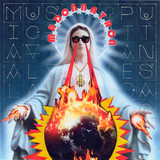
“Having moved forwards emotionally from the wilds of dystopian stalking and associated hobbies, Madonnatron have instead been found frolicking through the green pastures of gangsta pimps, Hindu God wars, Cyber Men invasion, loveless nightclub hook-ups, modern Italian Nabokov, and revered screen goddess Elizabeth Taylor. Think of them as post-punk lab rats in the Secrets Of Nimh, feasting dubiously on back-dated episodes of Top Of The Pops. With notorious roaring guitars, chanting vocals and rabid drums they audibly glow in the dark, are strong-armed, and will probably bite you.”
Like their debut, which was released to much acclaim in July 2017, Musica Alla Puttanesca was produced by Liam D. May at Trashmouth Studios.
Their atmospheric, raw, and confrontational live shows carry a sonic force that by turns will make you weep, cross yourselves, and weep again. In the last couple of years, Madonnatron delivered a successful UK headline tour; supported The Moonlandingz,

lack Truffle present In Real Life, the latest in a flurry of releases from Berlin-based guitarist and composer Julia Reidy. Having drawn acclaim for solo performances on 12-string acoustic guitar that bridge microtonality, ‘American primitive’ stylings and classic minimalism, Reidy’s recent releases have utilised an increasingly broad sonic palette, fleshing out guitar-based composition with electronics, field recordings, and – most strikingly – heavily auto-tuned vocals. On In Real Life, Reidy pushes one step further, crafting an epic LP-length suite that moves from abstracted song to lush electronics and explorations in contemporary musique concrète. Beginning with a passage of eerie electronics and creaking percussive interjections, Reidy’s heavily auto-tuned voice quickly takes centre stage. Surrounded by explosions of electric guitar and synthesised arpeggios, the auto-tuned voice delivers a melancholic ode, bringing together poetic images to reflect on the instability of experience and mutability of identity in a contemporary world saturated by digital technology. This concern with the unsettled relationship between the physical and digital is reflected musically by the constantly shifts in emphasis between Reidy’s physically demanding guitar-picking and the various forms of synthesis deployed. Similarly, the dynamic imagery of cutting, shattering, and ‘racing streams’ present in Reidy’s lyrics also serves to characterise the structure of In Real Life, which ceaselessly shifts between distinct episodes. The song-based opening, long sequences of frenetic 12-string guitar shadowed and eventually overtaken by synth tones, passages of delicate chiming harmonics, electro-acoustic cut-ups – each flows seamlessly into the next, often recurring throughout the record’s duration, which lingers over interstitial moments between these episodes.
Mixed and mastered by Joe Talia at Good Mixture, Tokyo. Vinyl cut at 45rpm for maximum fidelity by Rashad Becker at D&M, Berlin. Artwork by Suze Whaites. LP desgn by Lasse Marhaug.

Glenn Astro conquers new territories with Naturals, fusing elements of Balearic and leftfield house with tribal and acid sounds on Tartelet Records.
In an impressively short amount of time, Glenn Astro has created a musical universe that’s entirely his. With full-length releases making waves on Ninja Tune and Apollo Rec, the sister label of R&SRecordings, the Berlin-based musician assembles a perfect pastiche of influences on his forthcoming EP Naturals, coming out on Copenhagen’s Tartelet Records this September.
Exploring the outer fringes of the Balearic sonic spectrum, Naturals delves into unexpected sound territories without losing touch with planet home. Sub-heavy drums mix with private oceanic field recordings, futuristic synth, and effect pedal workouts, delivering a four-track EP that is novel but honest to the bone.
“I tried not to take any direct influence from any particular music I was listening to,” Glenn Astro says. “Instead, I tried concentrating on where the instruments and effects were taking me, experimenting with different ways of using the gear that I know so well.”
Inspired by Sicily’s natural beauty, the juxtaposition of its rough landscapes and clear blue waters, Naturals takes listeners on a journey into unfamiliar sound; a conscious diversion from his usual style and yet an instant dance floor cracker infused with the artist’s signature panache.
“I made most of the record while being in Sicily,” he says. “In retrospect, it is easy to hear that the volcanic landscapes contrasting the idyllic beaches were a major influence.”
The EP opener “Naturals (Unsweetened Mix)” is a beautiful freak – a peak-time cut – starting out with tranquil ambient melodies and water drop percussion followed by a beasty acid line and slick drum programming. Next, “Naturals (Dance Mix)” slows it down to 116 BPM, taking a completely different route with a hypnotic dance between tribal and dub – a wonderfully weird closer.
On the flip side, “Slarutan (Pristine Mix)” emerges au natural with Sicilian field recordings, layered pads, playful melodies, and crisp drum programming. Saving the best for last, “Slarutan (Water Mix)” dips its toes into the early days of dance music, shifting into futuristic, ambient dub territory with divine melodies and filtered percussion.
“This one is for the plants and the trees. Return to planet Tartelet,” Glenn Astro says.

In early 2018, Jas Shaw, one half of Simian Mobile Disco was diagnosed with a rare health condition – AL amyloidosis – a disorder of bone marrow cells. Having just completed SMD’s 7th studio album Murmurations and with a special show at the Barbican scheduled for April, things were thrown into confusion. At the time, no one, including Shaw, knew how the prognosis would pan out. Jas had to start chemotherapy almost immediately, which meant cancelling the tour. The duo decided to go ahead with the Barbican show in spite of Shaw’s illness, which was especially poignant as all involved knew it could potentially be SMD’s last ever live performance – in the end it turned out to be a tour-de-force. If this was SMD’s swansong, so be it.
In the year that followed, Jas spent months receiving weekly chemotherapy, learning to live with his condition, and when he felt well enough, spending hours in his studio making music.
The result of this was twofold, firstly a collaborative album with Derwin Dicker (Gold Panda), released as Selling – On Reflection, on City Slang Records Secondly, a growing archive of solo work, which is now ready for release. Entitled “The Exquisite Cops”, this 20+ track growing body of work will see the light of day via SMD’s Delicacies label – with a 2-track single released every fortnight /month and a limited
edition double LP scheduled for 27th September.
At the end of 2018 a difficult year was capped with hopeful news. With his condition in remission, able to stop chemotherapy Jas is able to start DJing and playing live again.
Jas: “The Exquisite Cops tracks seem to have made their own system for creation. Normally I record electronic music like a band would, as a take. So, it’s kind of surprising to me that that this batch of tracks wasn’t made this way. Instead of a single take that gets edited and developed these tracks were all made in bits, usually months apart. Some days I’d make a drum track, often editing it down so that it’s some sort of semblance of a structure; on other days I’d end up just making a synth sound or texture. This wasn’t something that I gave into reluctantly, it’s nice to be able to give a feedback based pad your whole attention rather than just set it up and only attend to it if it gets really out of hand.
The process of matching these misfits together was originally born out of laziness, rather than break open the synths to make something to develop an idea, what if I could just use something that I already had; slack. The interesting thing was that in pulling two takes together that were done months apart, they cast each other in a different light and though sometimes making them fit together was a hatchet job, sometimes they locked up together in an improbable way, making the rough structures that I’d improvised make a different sort of sense; often a more interesting sort of sense.
The more I did this the more it felt like this was not just a slacker’s way to use up offcuts, this resulted in combinations that I’d probably not have chosen if I’d done the tracks in one go. Also, and I know this isn’t something that’s important to everyone, there was a level of fastidious detail that I’d never have got if I’d had the textural and rhythmic elements playing together. It’s a longwinded process but it’s changed how I record and how I think about recordings I’ve made; plus I enjoy all parts of it so why cut it short?”

Free Love, the artists formerly known as Happy Meals return to Optimo Music with ‘Extreme Dance Anthems’ a phantasmic mini album from their hearts to yours.
They say – “We recorded EXTREME DANCE ANTHEMS in our recently moved studio, ‘Full Ashram Celestial Garden’ which is now situated in a building that holds both a church below us and a sex club next door. Most of the tracks were formed from late-night sessions that we started to kind of ritualistically hold inspired from a particular thought or idea that we later cut down and did a live mixdown of. The music is about physicality and the metaphysical – it is about a recontextualisation of the ineffable as a centre point of existence which in turn influences how we engage with everything around us. A celebration of the unquantifiable, unspeakable, indivisible EXPERIENCE as the throne from which all ideas are derived. Even though the world is fucked- we are here.
On the face of it – I realise that this description might just seem like apolitical hippy bullshit but fuck that – as a deliberate result of the modern political landscape, our societies’ individual and collective disengagement with the metaphysical has led us to treat other humans, animals and our environment like resourceful statistics rather than something that actually holds any inherent value. An Inner Revolution of the foundations of our reality in a way that reintroduces the essence of existence, and not merely its describable derivatives, into the conversation of how we should live our lives INFORMS our perception of the world in a way that demands us to ACT. The record is about a kind of gradual awakening between the two of us – a reconnection with the magic around us.
The ineffable is not without moments of illumination- mostly in the form of immediate absurdity: ONE DAY WE WILL ALL BE DEAD BUT HERE WE ARE ALIVE INSTEAD.
The record is called EXTREME DANCE ANTHEMS because it made us both laugh”.
Keiji Haino,Jim O'rourke,Oren Ambarchi
In the past only geniuses were capable of staging the perfect...
- A1: In The Past Only Geniuses Were Capable Of Staging The Perfect Crime (Also Known As A Revolution) Today Anybody Can Accomplish Their Aims With The Push Of The Button Part 1
- B1: Decorously Decorously Decorously Decorously Decorously Decorously Decorously Decorously Decorously Decorously To Make Something Beautiful And Then To Smash It Decorously
- C1: Head-On Collision If It Still Has Bones It Shall Move Forward (Which Is Different To Progress)
- D1: In The Past Only Geniuses Were Capable Of Staging The Perfect Crime (Also Known As A Revolution) Today Anybody Can Accomplish Their Aims With The Push Of The Button Part 2
For its 50th release, Black Truffle presents the 9th album from one of the label’s core ensembles, the power trio of Keiji Haino, Jim O’Rourke and Oren Ambarchi. Drawn from a November 2015 performance at Tokyo’s now-defunct SuperDeluxe, the record’s opening piece drops us immediately into the maelstrom, abruptly cutting into an extended episode of Ambarchi’s pummelling drums, O’Rourke’s fuzzed-out 6 string bass and Haino’s roaring guitar and electronics. Eventually settling into a hypnotic bass and drum groove over which Haino unleashes some almost Ray Russell-eque skittering atonal screech, these opening 13 minutes act as a potent reminder of the trio’s power. Alongside showcasing the steady development of a unique language for the guitar-bass-drums power trio, the group’s succession of releases over the last decade has demonstrated a constant experimentation with new instruments, which continues here with O’Rourke use of Hammond organ (played at the same time as his roaming, sometimes knotty basslines). On the album’s second piece, the organ plays a key role, furnishing a harmonically rich shimmer over O’Rourke’s angular 6 string bass chords, Haino’s distant, chirping electronics and Ambarchi’s crisp cymbal work; arriving somewhere halfway between Albert Marcoeur and Terje Rypdal, this piece is undoubtedly a highlight in the trio’s catalogue so far. Sides two and three are given over to slow-burning, multi-part epics that range from spacious reflection to furious tumult. Where the trio’s previous 2LP set (This Dazzling, Genuine “Difference” Now Where Shall It Go?, 2017) was primarily instrumental in focus, here we find Haino’s voice taking the spotlight on the expansive third side, intoning, wailing and exhorting in Japanese and English over a backdrop that moves from hushed bass and organ atmospherics to rolling toms and cymbal crashes before arriving at an ecstatic finale of searing guitar, tumbling drums and reverb-saturated bass. The fourth side returns to the hypnotic grooves of the opening piece, fixing on an relentless riff and riding it into oblivion under Haino’s roaming psychedelic soloing and jagged chordal slashes.

The second full-length LP from Jungle Brown, ‘Full Circle’, drops on Mr Bongo in September 2019. Featuring collaborations with Sampa The Great, Fliptrix (High Focus) and Terri Walker amongst other super-talents.
The trio – Ric Flo, MAEAR & Tony Bones – have spent the last two years redefining soulful hip-hop – the sound is bigger, more thought-provoking, and it has matured with a rich soulful underpinning. They have also entered territories fans are yet to hear from them as they glide effortlessly over Tony Bones’ productions that introduce trap and house into their repertoire. The
project is an eclectic array of their influences, twisted and blended together to create a ground-breaking release for UK music.
Jungle Brown’s debut album ‘Flight 314’ has achieved more than a million streams without any budget for marketing or promotion. They spent much of 2016 in Apple Music’s ‘Best of 2016 category, featuring on Spotify and SB.TV, were requested to curate an exclusive playlist for Tidal and attracted attention from New York with Beats 1’s very own, Ebro.
They’ve shared the stage with the likes of De La Soul, Ghostface Killah, Lowkey, Akala and Donaeo, played major festivals including Glastonbury, Boomtown and Lovebox as well as a huge number of clubs shows across the UK.

The infamous Kiwi returns to Needwant with his second EP on the London label (home to the likes of The Revenge, Ejeca, Maxxi Soundsystem and many more) On this cut Kiwi does what he does best by incorporating emotion and grit into dance music. The EP features 3 mixes of ‘Kiya’ as well as a remix from underground hero Brian Ring.
The record opens with the original version of ‘Kiya' which features warm bass tones, spaced out synth lines, shuffling percussion and a tribal-esq vocal. The Rave mix gives ‘Kiya’ dance floor authority, introducing driving acid synth lines and a weightier low end. On the B side Kiwi delivers a deconstructed ‘Dreamscape’ mix stripping ‘Kiya' back to it’s beautiful bare bones.
‘Kiya’ will be another addition to Kiwi’s already impressive physical discography which includes releases on imprints such as Disco Halal, Future Boogie & 17 Steps. His unique approach to remixing and producing over the years has meant that he has seen a wealth of support from names such as Andrew Weatherall, DJ Harvey, Gerd Janson, Daniel Avery, Erol Alkan, Optimo, Annie Mac and Skream.

The Ryote EP is the aptly titled debut from Ryote, featuring 5 tracks of raw, leftfield house and techno inspired by grimy basements and late
night mischeif. Ryote also has releases with Minneapolis labels Always Human Tapes and Abstrakt Xpressions. The co-founder of Kajunga and co-owner of Detroit-based Clave House stays active in the Midwest circuit, performing regularly at a varity of events and festivals such as: Even Furthur, Sacred Earth, SYSTEM, Communion and Elixir.

Curve Records returns for their second outing with a powerful, grooved-out, broken beat EP: ‘Planned Cities’ from Bristol’s veteran forward thinking producer Lrusse.
“I like the optimism behind planned cities because they often don't turn out as expected - humans are random and there are unintended consequences everywhere. I never set out to write a broken beat EP, so that's quite been kind of a surprise too, ha.” Fellow Bristol legend Lord Leopard (F.K.A. Lukas) remixes the A1, ‘Crep Check’, delivering a club tool that will heat to any dancefloor.
A1: Crep Check - Crunchy, half-step drums broken beat hot with searing pads and bone-rattling sub.
A2: Crep Check (Lord Leopard Remix) - A huge straight up 4/4 club tool, tried and tested on the dancefloor.
B1: Scaff - An instant classic with a distinct Bristol bass bin sound, lazy broken drums and chopped piano hook.
B2: Those Letters - A soaring broken beat journey, perfect for switching up a 5am techno set.
Lrusse is the solo project of Ed Bayling, also known for slow-mo dancefloor heaters as one-half of Bristol’s Behling and Simpson, and has found regular support from the likes of Midland and Danny Krivit to Claude von Stroke and Todd Edwards, with tracks released on iconic labels such as K7, Tsuba and Dirt Crew, as well as underground fixtures like Nite Owl Diner and Apple Pips.

In this post-industrial, post-enlightenment religion of ourselves, we have manifested a serpent of consumerism which now coils back upon us. It seduces us with our own bait as we betray the better instincts of our nature and the future of our own world. We throw ourselves out of our own garden. We poison ourselves to the edges of an endless sleep.
Animated Violence Mild was written throughout 2018, at Blanck Mass’ studio outside of Edinburgh. These eight tracks are the diary of a year of work steeped in honing craft, self-discovery, and grief - the latter of which reared its head at the final hurdle of producing this record and created a whole separate narrative: grief, both for what I have lost personally, but also in a global sense, for what we as a species have lost and handed over to our blood-sucking counterpart, consumerism, only to be ravaged by it.
I believe that many of us have willfully allowed our survival instinct to become engulfed by the snake we birthed. Animated — brought to life by humankind. Violent — insurmountable and wild beyond our control. Mild — delicious.

Black Truffle is pleased to announce the release of this genuine head-scratcher, the first collaboration between DJ/mixtape-compiler Kayo Makino and underground legend Tori Kudo. Originally created to be played between acts at the launch of Eiko Ishibashi’s acclaimed The Dreams My Bones Dream and then reworked and refined for LP release, the two side-long pieces are sonic environments constructed by Makino for Kudo’s piano to inhabit, or, as the LP’s credits suggest, a cinéma pour l’oreille in which Kudo’s piano plays the starring role. Beginning with a soothing field recording of crickets dramatically punctuated by smashing glass, the first side finds Kudo playing his way repeatedly through one of Satie’s 1897 Pièces froides. Best known to many listeners for his role as leader of the ecstatically shambolic rock unit Maher Shalal Hash Baz, Kudo’s performance of Satie’s whimsical yet haunting melody is alternately halting and fluid, delighting in the hesitations of unstudied technique and the subtle variations between repeated attempts. While the combination of Kudo’s piano and the background of crickets initially suggests a documentary approach to recording – as if the we are simply hearing incidental sounds creeping through an open window – things take an unexpected turn a few minutes in when Kudo’s piano is suddenly doubled. Layering two separate attempts at the same piece of top of each other, Makino’s unorthodox mixing blurs Satie’s original into a fog of stumbling echoes that becomes increasingly dreamlike as the chirping crickets are overtaken by pattering rain, German dialogue and traffic sounds. The second side begins in a similarly inscrutable vein, with snatches of birds and film music providing a gentle backdrop for Kudo’s improvisational variations on a chord progression that, as his performance builds over its twenty-minute duration, somehow begins to suggest the sadly swaggering grandeur of Mick Taylor-era Rolling Stones. Makino accompanies and eventually overwhelms Kudo’s piano with a bizarre layer of digitally processed voice and drums, stretched out into a disorienting haze before suddenly retreating to leave Kudo’s piano accompanied only by a barking dog. Seemingly unrelated to anything else being produced in the world of contemporary music, this is a striking collaboration between two unique musical personalities that bridges the mundane and the surreal, opening up a dream-space both haunted and hospitable.

Colombian Techno powerhouse Gotshell unleashes a barrage of his signature, twisted, bone-shaking, analogue techno bombs for 'The Draft EP' on Suara with remixes from label head Coyu and Argentinian producer Flug.
Firstly, the A side houses ‘Pears Cosmic’, a swell of glitches, thunderous kicks and rave stabs at a fever pitch pace and secondly '19 Caracteres’ a sci-fi blitz, comprised of killer drum programming, modular bleeps, zaps and urgent surges.
Flip it over to find Coyu’s reinterpretation of ‘The Draft’, reworking the drums, adding rapid-fire claps into the mix and leaving the trance stabs out for a more heads down approach. Finally, Flug takes on ’19 Caracteres’ focusing his remix around an atmospheric echoing synth line, punctuated and interspersed by the original’s glitchy sounds.

Having broken a decade's silence with 2016's 'System', LA-based electronic musician Joseph Fraioli, a.k.a. Datach’i, returns this summer with his eighth album 'Bones'.
Released on Venetian Snares' Timesig imprint, 'Bones' features 12 tracks of mind expanding electronica, once again recorded on his custom-built Eurorack modular system. Much like its predecessor, 'Bones' manages to make the most of the possibilities modular systems offer, whilst avoiding their many pitfalls that can often turn such music into little more than a dry academic exercise. Indeed 'Bones' is a remarkably intimate album, written and recorded in the time following his father's death, and reflects this intense period of personal change in Joseph's life.
"Creating this music was a therapy of sorts," Joseph recalls. "It was almost like a close friend being there for me, and it's something that I hope others can perhaps utilize in the same way."
The connection to his father is something that is reflected not just in the emotional intensity of 'Bones', but in the actual production itself. "My father and I were very close," he explains. "Whilst he was sick with cancer I bought him a guitar as he wanted to learn how to play, just to have something to do while he was getting treated. After he passed away my mother gave me the guitar to have as a sort of memory of him. I had the idea to record some sounds and music on the guitar and load it onto granular sample players on the modular synth so I could make new music from those sounds as a sort of tribute to my dad. You can hear some of those sounds on a few of the tracks here like 'Arrivals', 'Motion in the Living Room' and 'Undimension'."
The resulting album grapples with the intensity of these emotions. But for all their weight, tracks like 'Saugerties Road', ‘Rockledge 3A’ and ‘Antumalal’ transform that heaviness into something warm and comforting whilst the aforementioned 'Arrivals' or ‘Wand’ ultimately achieve some kind of escape velocity and soar. Even though 'Bones' is about endings and finding closure, it also looks forward to new beginnings.
"It was something very much on my mind throughout recording this album," he relates, "ends being beginnings and beginnings being the end. Cycles of time and how time works, it's all reflected throughout the album right down to how the tracks are ordered."
Ranging from blissful ambience and guileless, starry eyed melodies, to intricate claustrophobic rhythms that forever sound close to collapsing in on themselves before expanding into bold new patterns, 'Bones' is the work of a producer who, twenty years on from his debut, continues to push the boundaries of electronic music.

* Metallic percussion contorts and splinters throughout the maximalised Second Freeze', whilst Simple As' courses with a transcendental bare bone rhythmic intensity.
* Randomer follows up releases on Dekmantel, Clone and L.I.E.S, by teaming up with Livity Sound regular Hodge for a collaborative 12" on the reverse Livity Sound label.
