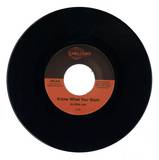
Melodies International proudly moves forward with an elusive piece of mid-tempo Chicago soul originally performed by Gloria J. Jennings in 1977.
Gloria was signed to Stage Productions as a gospel singer with pure and raw talent she had developed in the choir of her father's Southern Baptist Church. She was 16 years old at the time. To tutor her for R&B vocals, Willie C. Nance of Stage Productions spent 3 months taking the artist back and forth for vocal training 25 miles each way, 3 days per week.
At the time, Mr. Nance had made plans to work with singer and songwriter Theresa Eagins to record Know What You Want'. However, two days before the recording was set to begin, Ms. Eagins refused to move forward with the recording as she chose to take her religious faith more seriously and forgo the singing of secular music. Hence, Stage Productions turned to Gloria Jay to perform a song that would go on to move people thousands of miles away, many years later.
One of them was Patrick Forge: Back around 1990 I had a residency upstairs at the Wag Club on a Friday night alongside Paul Martin (he was Gilles P's A&R right hand man at Talkin Loud), the night was called Respect and we played mainly Soul, Boogie and Jazz-Funk. Many years later I bumped into Paul at a record shop and he quizzed me about a tune I used to play at the end of the night at Respect. Hhe described it as being an independent Soul seven inch on a red label, slow to mid tempo... and more to the point a bullet of a record. It piqued my curiosity so much I burrowed through my seven inches and even made Paul a compilation of likely contenders, his response was lovely selection, but it's not on there!'. Damn, a mystery! Many moons later whilst I was living in Japan, my tenant in my London flat said she'd found an old mixtape I'd done for her way back when and was desperate to know the identity of something she was calling the choo choo song'. Eventually when I was back in London she played the mixtape and I quickly identified her tune as Fabrica' by Cesar Mariano, however letting the tape play some time later a familiar descending chord sequence catapulted me back to those Friday nights at The Wag, and Gloria Jay's plaintive vocals reminded me of a record that had been absent from my life for far too long. I've no idea what happened to my original copy, I hunted another one down straight away, and I've kept it close ever since. Know What You Want' is a song that goes deep in such a simple, unaffected, almost naive way, Gloria's voice is both sweet and raw, it's built on simple chords and obvious instrumentation, but it's so much greater than the sum of its parts.
Know What You Want' is soul music, pure and unadulterated, there's nothing getting in the way of the feeling, it's straight from the heart.' Carefully re-mastered from the tapes, MEL008 comes forth in its original 7' format with a 14'x14' poster.
Buscar:boogie man
First official reissue of Nigerian Boogie Disco Grail LP produced by Grotto for EMI Nigeria and originally released in 1978. Contains dance classic'Bad city Girl'. Liner notes by Nigerian Music expert Uchenna Ikkone, include previously unpublished photos and extensive interviews by Temitope Kogbe.
.
Odion Iruoje was the A&R manager at EMI at the time,' Benson says, and he auditioned us, liked he material and signed us.' Odion Iruoje of course had groomed and produced Ofege. Now he was looking to repeat the formula with other high school groups such as Tirogo, Apples and Question Mark. Grotto's deep rock would be a welcome addition to this schoolboy rock' series.
Work on their album started immediately, with Iruoje in the producer's chair. Adapting to the tastes of the times—as well as their own maturing musical sensibilities—Grotto started transitioning from acid rock towards sleeker, more dance floor-friendly grooves. As I grew older I think I got a bit jazzier,' Benson says. I also listened to Curtis Mayfield, James Brown, Isley Brothers, Prince and a lot of funk groups from that era.'
Hard rock was the content of the first album,' Amenechi agrees, and funk/jazz/R&B the focus of album number two. Especially with the late Toma Mason Jr. joining as bassist.' The group's second album, Grotto II: Wait... No Hurry (released in 1979) reflected the growing sophistication of its members' musical outlook. Fat, funky bass grooves rubbed shoulders with jazzy flute lines, space-age synthesizer tones punctuated good, old-fashioned crunchy rock riffs.
- A1: History-Los Charlys Orchestra Feat. Omar
- A2: Love On Hold (Extended Mix)-Aeroplane Feat. Tawatha Agee
- A3: 2Nd Time Around-Tuxedo
- A4: Love X Love-Thames River Soul Feat. Kenny Thomas
- B1: There 4 U-Leela James
- B2: When I Luv -Mike City Feat. Faith Evans
- B3: Lost Without You-Will Sessions And Amp Fiddler
- B4: T's All Divine (Extended Boogie Back Mix)- James Day Songs Feat. Trina Broussard, Tim Owens & Joe Cunningham
- C1: Good Kinda Lovin-Jay King
- C2: Doublin' Down-The Jack Moves
- C3: Keepin' Love New (Club Mix)-Wez
- C4: Flowered Tears (Dj Spen Soul Flower Remix)-S.e.l
- D1: One For The Money (Gold Digger Mix)-The Groove Association Feat. Georgie B, Wez & Everis
- D2: Back To You-Paul Craver
- D3: Kissing You (Original Mix)-Wipe The Needle Feat. Lifford
Expansion's most successful and longest running compilation series returns with a 2017 edition. The concept remains the same, fifteen must-have modern soul room gems taken from the year's biggest dance floor spins on the soul scene. While tracks here have topped UK soul charts, many have not been available in all formats. Once again, attention is paid to the 'flow' of the 15 gems chosen here from shuffling beats to boogie to more soulful house as played at modern soul events. Participants this year include Omar with Los Charly's Orchestra, Tawatha Agree (voice of Mtume's Juicy Fruit') with Aeroplane, Kenny Thomas with Thames River Soul produced by and featuring Incognito, and both Wez and The Groove Association formerly members of Brit Funk group Second Image. Leela James is here after her stint in a US realty TV show R&B Divas: Los Angeles', other guests including Amp Fiddler, Faith Evans, Trina Broussard and Lifford.
Brazilian mid tempo boogie double header. We've been playing these two out for the last couple of years and they are firm favourites.
'E Novamente Mas Que Nada' is the opening track from Reseda's 1979 album on Som Livre. An ultra catchy vocal hook, boogie guitars and synths lead into a piano and cuica breakdown and horns to finish. One of the finest in the genre in our
opinion.
'Ginga' is taken from Robson Jorge & Lincoln Olivetti's self-titled
masterpiece, reissued on Mr Bongo. Arguably the most immediate and club friendly track from the album, it always turns heads. Another premium example of Brazilian boogie from the masters of the sound and producers for the likes of Rita Lee, Erasmo Carlos, Don Beto, Marcos Valle, Tim Maia, Gilberto Gil, Gal Costa, Sandra Sa, Painel de Controle and many more.
You could be forgiven for thinking Basso's been hitting the plant food of late. Last time out we took a trip with Trance, and now our esoteric expert nods his head, rolls his shoulders and drops a h-h-h-house record on our unexpecting asses. That's right folks, roll up the rug, push the sofa back and enjoy some ‚Personal Growth' from James Booth.
.
Operating a million miles away from the kick and hiss of the trendy lo-fi folks, the Berlin based producer favours subtle rhythms, delicate textures and tender melodies - turning out a string of sophisticated dance floor winners for 100% Silk, Church and No Bad Days. Now he brings his organic house stylings to the Growing Bin with a fresh five-tracker packed with all the warmth of a Tempelhof picnic on a balmy July afternoon.
Emerging from the watery depths of the Drexciyan ocean, opener ‚Mood' strides calmly through the morning dew, stretching those loose limbs and seeking out Hardcastle's rainforest. Drifting freely
through immersive, aquatic pads and soft focus melodies, the track takes in a little R&R before snapping electro percussion, cascading synthlines and a rolling rhythm up the intensity. The deepness continues on the A2 as ‚Dream Precipitation' offers a medicated vision of Debussy doing P-Bar while Lynch rolls the cameras. Syncopated hi-hats, jazzy keys and star-gazing sine waves wrap themselves around your cerebellum, expanding your mind as a steady kick moves your body into the pleasure zone. Booth takes a Derren Brown tip on the flip, imbuing ‚You' with the kind of mesmeric rhythm that can make the staunchest wallflower pull a Pink Panther on a packed dance floor. The exotic tumble of woody percussion and hissing castanets keep up a fascinating rhythm, driving the titular mantra and snaking synth melody through bursts of slapped bass and subtle 4/4. ‚Dhoop Stick' stays on board with the boogie hypnotism, weaving its way through celestial melodies, squelching bass and toasty Rhodes before ‚The Chorus' brings down the curtain with wailing FM vox, military snares and the dreamy synth pop charm of a lost Sheffield classic. Warm, woody and entirely organic, this is the birth of Green House...you heard it here first!
(words by Patrick Ryder)
Too many people sleep on Tougher Than Leather, Run-DMC's fourth album. But hear us out as we plead the case for this amazing LP. By 1988 there was a lot more competition in the rap game - Public Enemy, Boogie Down Productions, Eric B. & Rakim, Ice-T and many more had given Hollis, Queens' prodigal sons lots of competition. But Joe, Darryl and Jay were still at the top of their game, and hip-hop fans should never let this classic - chiefly produced by their Queens neighbor, DJ and multi-instrumentalist Davy D(MX) - get lost in their crates. For starters, the album's first single, Run's House' b/w Beats To The Rhyme' is arguably the most powerful one-two punch of the trio's career, showing contenders to the rap throne that they could still destroy a beat, tag-teaming with power at any speed. Not to be lost in the shuffle, fans were also reminded on both sides that Jam-Master Jay remained one of the world's best DJs, flexing the pinnacle of what would be called turntablism' a decade later. Both songs show a musical telepathy between all three that has rarely been equaled. The second single, Mary, Mary,' driven by an infectious Monkees sample, took a different approach, shrewdly ensuring that pop fans who jumped on the Raising Hell bandwagon had something to chew on. But, like Walk This Way,' the song wasn't just bubblegum - there was an edge to it, and the lyrical gymnastics were very real. It wasn't selling out, it was allowing fans to buy in. Papa Crazy,' driven in concept and by a sample from the Temptations' Papa Was A Rolling Stone,' followed a similar pop-leaning path. Overall, the lyrical content on the album was a step up from the group's first three LPs. It's easy to infer, looking back, that they were feeling the heat from their younger competitors in the rap game. The genre was changing fast, and they were up to the challenge. On cuts like Radio Station' they bring substance to the grooves, by attacking Black Radio for its continual denigration of rap. Tougher Than Leather' reminds the world that they were still the Kings of Rock, with hard guitars to drive the point home. And They Call Us Run-DMC' and Soul To Rock And Roll' both bring things back to their early days, with sure-fire park jam rhymes and killer cuts. Tougher Than Leather, which went platinum up against a lot of competition, perfectly bookends the '80s output of one of the decade's most important groups. It encompasses the full range of the trio's capabilities, and reminds us that Run-DMC should never be forgotten as both pioneers and party-rockers. And so, we say, long live Joe, Darryl and Jay!
Quartet Series is back with the Bodybuilder Series after Scott Franka's popped the new offshoot's cherry in the spring. For this sophomore release, Nachtbraker sourced some serious production talent from Eindhoven, The Netherlands. While it's the Portamento Boys' first ever release, they have the chutzpah to go full-frontal Italo and pull it off with great panache with a moody and energetic EP. The record is characterized by catchy melodies, quirky vibes and warm analog grooves. Connoisseurs will instantly recognize the TR-606 and 707, SH-101, Ensoniq Esq1 and a Casio CZ-3000. The Italo express jets off and takes no prisoners with 'Been There Come Back", a banging workout paying homage to the glorious 80's. Shoulder-pad boogie anyone 'Portamento 101 feels like you're playing the 1986 version of Outrun on your Sega. On the flip 'Final Dinner' serves up some fine Asian-Italian fusion Cuisine, and finally the P Boys drop 'Eighty Ain't", acknowledging that even though the tracks are clearly inspired by the 80s, they didn't just emulate, but innovate instead. Now let's introduce the Portamento Boys. Some say it al began when the first episode of 'Jacques, zo is het wel weer genoeg geweest' was aired on the Dutch box back in the second half of 1988. Others say it was the respect he got for robbing the local Albert Heijn with the famous saying, 'Hallo, Jumbo' that made him end up in solitary confinement. His colleagues say he never let go of Piet, his last undercover assignment. But the only one to help him in these times of mental distress, identity crises and general psychosomatic turmoil was Koos. After all these years there is a mantra to find in Piet's life that keeps him going.
Having made her mark on Brazil's rich musical legacy with three best-selling albums to date, Rio's original nu-bossa queen returns with a tour de force of golden-era Brazilian soul music. From the spiritual swing of the early pioneers of modern Samba, to the dizzying hedonism of Brazil's eighties disco/boogie craze, Clareia is a life-affirming journey through the rich and varied sounds Sabrina Malheiros has been immersed in since she can remember. For her most up-lifting and danceable album to date, Sabrina has (as always) enlisted her father Alex Malheiros - bassist of samba jazz-funk legends Azymuth - and visionary London based producer Daniel Maunick (aka Dokta Venom), son of Incognito's Bluey.
Sabrina Malheiros' career has often been characterised by her place in the succession of those special Brazilian women who, with unmistakable talent and effortless grace, have encapsulated the magical energy of Brazil with their voices. Elis Regina, Astrud Gilberto, and Joyce all had it, and Sabrina Malheiros has it in spades.'(MOJO) With her debut album Equilibria in 2005, Sabrina arrived on a wave of instant acclaim, carving out her place as the pioneering voice of a new brand of Brazilian soul music, rooted in the traditions of samba and bossa, but with an edge of contemporary electronic sophistication. Sabrina's innovative nu-bossa sound would continue with the 2006 remix album 'Vibrasons' followed by sophomore 'New Morning' - declared the best album of summer 2008'(Evening Standard), before 2011's best-seller Dreaming.
Six years on, Sabrina returns with Clareia. Itmeans to clear, light, brighten or illuminate, which, after seeing Brazil and the rest of the world go through some very difficult times, is exactly what the writing of this album brought to my life.' All tracks are written by either Sabrina, or in collaboration with her father Alex Malheiros and producer Daniel Maunick. Written and recorded in Niteroi, Brazil, overlooking Gunabara Bay and Rio's beaches, mountains and forests, the music basks in its surroundings and sings of ecological beauty, peace and sanctuary. Echoing Sabrina's emphasis on clarity, Alex notes that the album's title represents an appeal to the minds of our civilization today, to clear our thoughts for good and for peace.'
This pursuit of clarity continued into the studio: It took a little longer than usual' notes Sabrina, which was good in way, as all my previous albums were recorded in rush and we usually had a week for pre-production and another week in the studio, which always gave me the feeling that I could do better. With this album it was different... we took our time.'
Sabrina's unmistakable voice has never sounded better. Packed out with high-octane swinging samba-soul, like the title-track and 'Salve O Mar', the album also features some bottom-heavy Brazilian boogie cuts, like rejoicing album opener 'Celebrar' which harks back to some of Marcos Valle's cult '80s disco output, and 'Sol Ceu E Mar' is a Tania Maria-esque future classic of scorching latin-funk. Mellower moments are found in 'Em Paz', on which Sabrina's beguiling harmonies find an anchor in the rhythmic acoustic guitar of Ze Carlos', who Sabrina heralds as being the best guitarist I have ever worked with'. Azymuth's keyboardist Kiko Continentino's deft Rhodes, piano, organ and synth playing, add ever more textures of distinctly Brazilian brilliance throughout, while tropical brass and flute arrangements on cool bossa-jazz movers 'Vai Maria' and 'Sandore', come from Brazilian saxophone legend Leo Gandleman, a man who has worked with everyone from Gal Costa to Gilberto Gil. The rhythm section combines Daniel Maunick's seamless drum programming and the organic polyrhythms of Brazilian percussion legend Jakare, all punctuated by Alex Malheiros' inimitable (occasionally slapped) jazz-funk bass, giving the album its irresistibly danceable pulse.
Set for release at the height of summer this year, Clareia is an intergenerational masterclass of Brazil's soulful spectrum, led by a pioneering voice of today's scene on the very top of her game. The up-lifting compositions, which take inspiration from the stunning natural beauty amongst which the album was made, and the call for the clarity of mind needed to preserve it, are enriched by this special team of some of Brazil's most established musicians. Like the sun breaking through tropical storm-clouds, Clareia is a vessel of joy, as Sabrina puts it simply, I hope Clareia brightens the soul of whoever listens to it. That's the spirit of this album.'
3 overlooked jams on one 12" single, excavated from the deepest realms of the TK Disco vaults. Remastered, represented and brought back into focus for 2017's DJ bags and dance-floors. Side A sees Wizzdom's 1980 boogie jam 'Free bass' kicking off proceedings. A P-funk-ish, low slung jam indeed, it has everything you'd want including some Furious Five esque shouts of 'Free-Bass!' weaving in and out of the mix. This one is a true heads cut, one for the diggers! Over on side B we get Jimmy 'Bo' Horne's slamming 'Is it in' - a stomping piece of Disco-funk that in the right hands will cause maximum damage. Also, Jimmy's mildly double-entendre lyrics are hugely entertaining! Following up we have a cut from Herman Kelly & Life, 'A refreshing love' was an LP only release and is some serious downtempo Latin tinged soul super soaked in Miami sunshine! All in all, 3 majorly overlooked gems nestled away in the TK archive now brought back into the light. As usual, these TK represses are always done in the proper manner. 100% legit re-edits, from the archive, remastered and released in conjunction with Henry Stone Music / TK Disco - Miami FL.
- A1: Smith & Mudd - Mhor (Lexx Mix)
- A2: Freshro! - Pacifc State (Phil Mison Mix)
- B1: Okinawa Delays Feat. Satoko Ishimine - Nariyama Ayagu (Max Essa Dub)
- B2: Mudd & Pollard - Far Away (Ron Trent Mix)
- C1: Paraíso -Teu Sorriso (Jex Opolis Remix)
- C2: Bison - Familiar Stranger (Baldelli & Dionigi Remix)
- D1: Jack Cutter (Feat. David Harks) - Serpent Strut (Fingers Deep Mix)
- E1: Paqua - Ruby Running Faker (Emperor Machine Extended Vocal)
- F1: Smith & Mudd - The Surveyor (40 Thieves Remix)
- F2: Bison - Salmon Spungcake
- G1: Smith & Mudd - Nether (Bjørn Torske Extended Mix)
- H1: Paqua - Late Train (Mushrooms Project Remix)
- H2: Zee Erf - Southern Freeez (Sean P's India Navigation Mix)
- I1: Holger Czukay - Music To Be Murdered By
- I2: Leo 'Almunia' Ceccanti - Andromeda Bound
- J1: U-She - Blue Sky (Mudd Mix)
- J2: Statues - River Darkness
10 Years Boxset
In the spring of 2007, musician and producer Paul 'Mudd'
Murphy decided to launch his own label. Named after the house
he grew up in, Claremont 56 would release beautiful music by
friends, associates, collaborators and like-minded musicians.
In the 10 years that have passed since, Claremont 56 has more
than surpassed Murphy's modest expectations. It has built up
a cult following around the world, with listeners responding
positively to the label's combination of magical music, beautiful
artwork, and impeccable packaging.
To mark the label's frst decade, Murphy has put together
a sumptuous vinyl box set of previously unheard material,
produced and presented with the same attention to detail that
listeners have come to expect.
Each copy of Claremont 56: 10 Years contains fve weighty slabs
of wax and a bespoke info sheet, housed in a specially designed,
hand-numbered box with debossed logos on the front and rear.
However impressive the packaging, it's the music that makes
Claremont 56: 10 Years stand out. Featuring a mixture of
unreleased tracks and brand new remixes of vintage label
releases, the highlights come thick and fast.
As you'd expect, some of the most impressive contributions
come from those artists you could describe as legendary',
including Chicago deep house originators Larry Heard and Ron
Trent. Can legend Holger Czukay kindly contributes one of the
standout moments, the eccentric 'Music To Be Murdered By',
from his own unreleased catalogue, while Afro-cosmic pioneer
Daniele Baldelli joins forces with Marco Dionigi to deliver a
typically spacey remix of Bison's 'Familiar Stranger'. There's also
an epic, Afro-tinged dub disco remix of Smith & Mudd's 'Nether'
by Norwegian scene founder Bjorn Torske.
Elsewhere, Good Timin' man Jex Opolis turns an overlooked
track by Paraiso into a samba-boogie killer, Sean P dubs out
Zee Erf's beautiful cover of 'Southern Freeez', and Phil Mison
turns FreshRo's laidback electrofunk cut 'Pacifc State' into a
breezy, Balearic gem. Look out too, for the emotion-rich beauty
of Statues' 'River Darkness' - a track arguably worth the cost
of the box set on its own - and the deep space explorations of
Almunia's Leo Ceccanti.
We could go on, but we're running out of space. Sufce to say,
Claremont 56: 10 Years is a lovingly compiled, curated and
presented celebration of the label's frst decade.
Amsterdam's cult producer and DJ Steven van Hulle a.k.a. Awanto 3 likes his samples vibrant, his drums wobbly and his synths sweaty as a Detroit summer breeze. The MPC wizard returns to Dekmantel delivering his second, full-length album. Gargamel is arguably his most compelling piece of work. Spread over the course of nine tracks, van Hulle shows he's capable of serving up many different styles and genres in his ever-expanding arsenal.
.
The Rednose Distrikt affiliate kicks things off with his friend and co-producer Darling. 'Azrael' builds over shuffling, infectious rhythms, a cluster of vocal stabs and heartfelt keys.
'This Is When We Met', 'Why Don't You' and 'Gargamelancholia' on the other hand, are aggressive, batty-jackin peak-time tracks embracing classic acid aesthetics, while 'Positive Negative' is a stretched-out house jam incorporating the tussle of wonky boogie and tribal bumps.
Van Hulle drops the tempo on 'Hooli Goose', taking slow release hypnosis turns while making a marching band sound cool. The dry drum machines, melted bass and schizo sounds of 'Ride The Dragon' will appeal to the freaks, and the dreamy 'Happy Bird' is a tripped-out set of ambient and lo-fi themes. Last but not least, Dexter enters the stage to do what he does best with 'Thick': showing who's boss of the 808 with a straight-up electro essential.
Peter Hunnigale aka Mr Honeyvibes was born in South London on December 12th, 1960. Peter Hunnigale was to develop into one of Britain's most formidable reggae 'Lovers Rock' artist of our time. It was clear at a tender age Peter's main interest was in music and being born of Jamaican parentage, he was exposed and influenced by music of West Indian culture.
Untamed Love is an UFO in Peter Hunnigale's career, recorded at Omega studio (London) and originally released on the Cosmic label in 1986. Some people have no words to describe it. You can call it brit-boogie, rare funk, sick jam, musical bomb, or god jam, whatever it's a typical mid 80's tune with a rhythmic background sound that is captivating and memorable, thanks to heavyweight synth and awesome vocals. The original 12'' vinyl record is still very hard to find and expensive nowadays. If you are about to discover this song, make sure you are sit down when you listen to it because this song will blow you down hey girl I like the way you smile'.
Growing up in Britain meant that Peter Hunnigale was also open to other genres of music and with seeing the popular acts of the day perform on television and hearing the songs on the radio Peter knew what he wanted to be. Peter is also a great musician and did live work with reggae legends such as The Chosen Few, The Pioneers, B.B. Seaton and many others, while earning the respect of their peers as a competent bassist and qualified engineer. He won a Best Newcomer award at the Celebrity Awards in 1987, and won Best British Reggae Album at the British Reggae Industry Awards the same year.
For the past four decades, a growing cult of soul music collectors have sought two obscure LPs and a handful of extremely rare 45s released on the vanity record label LAD Productions, Inc. between the late seventies and the mid eighties by the mysterious South Side Chicago singer/song writer Larry Dixon.
Larry's raw songs capture the transition from R&B to boogie-down as disco was rapidly becoming extinct.
They also perfectly illustrate Larry's ability to overcome his environment and discrimination, transcended by his determination to write and produce music. With the support of his faithful musicians, Larry's success was only hindered by lack of airplay and promotion, but his talent shines through.
This is the story of Larry Dixon, his label LAD Productions, Inc., and his friends and family throughout four decades of music in Chicago's toughest neighborhoods.
Jerome Derradji is proud to reactivate Past Due Records - the boogie funk division of Still Music to release this fantastic archive - what many consider to be the Holy Grail - of Chicago Funk, Boogie and Soul.
The album was produced by John Congleton (Blondie, Sigur Ros), Greg Saunier of Deerhoof and Xiu Xiu's own Angela Seo.
It features guest appearances by fabled minimalist composer Charlemagne Palestine, L.A. Banjee Ball superstar commentator Enyce Smith, Swans guitar virtuoso Kristof Hahn and legendary drag artist and personal hero of Xiu Xiu, Vaginal Davis.
FORGET was recorded during a period of epic productivity for Xiu Xiu. While writing FORGET, they released the lauded Plays the Music of Twin Peaks, collaborated with Mitski on a song for an upcoming John Cameron Mitchell film, composed music for art installations by Danh Vo, recorded an album with Merzbow and scored an experimental reworking of the Mozart opera, The Magic Flute. All of this frantic, external activity lead to a softly damaged dreaminess and broadened intent that has not been heard before in other Xiu Xiu works.
Standout track, Wondering' is one of the catchiest boogie pop gems in the Xiu Xiu catalog, but like much of FORGET, it still bears an underlying tension that manifests differently in each piece. From the haunted guitar duet of "Petite", the hilariously fraught lyrics of "Get Up," the advanced industrial boxing match of "Jenny GoGo," or the experimental goth explosion of "Faith, Torn Apart", all the songs, in their own ways, build to a roiling boil of a fate in vanishing.
The calligraphy on the cover translates literally to "we forget." It bows to the universality of everything and everyone's inevitable decline and foggy disappearance. Regarding the album title, Xiu Xiu singer Jamie Stewart said, To forget uncontrollably embraces the duality of human frailty. It is a rebirth in blanked out renewal but it also drowns and mutilates our attempt to hold on to what is dear.' FORGET is both the palliative fade out of a traumatic's past but also the trampling pain of a beautiful one's decay.
Xiu Xiu is Shayna Dunkelman, Angela Seo and Jamie "Butch Jenny" Stewart.
Rune Lindbaek joins Bastedos on this new edition featuring two tracks from polar oposites of the BPM spectrum. Side A from Bastedos features a pacey electronic number with flavours of both rock and disco and a singer making the asertion that ' I Just Wanna Dance, I Just Wanna Boogie', surely any listener will be left with a similar desire when they hear this at their favourite discotetheque. Rune slows it down a gear or two for the flip with his version of Supermann, this is a perfect end of the night track that would melt the hips of even the man of steel.
Stirred up from deep within, from an abstract spiral of sound and movement, from a sensation of time and space absolving and converging at once, the Black Flower musicians have molded a tangible matter: the album Artifacts. Their second full album sounds international and ageless. Eastern influences, Ethiodub and jazz effortlessly merge. Fantasy and reality seem to fuse. In a word: nourishment for body and soul.
"Psyche-delicious and accessible 20th century Ethiodubjazz. As if John Zorn put on Fela Kuti's shoes and imbibed Mulatu Astatke's whirls."
Piloted by saxophonist /flutist /composer Nathan Daems (Ragini Trio, Dijf Sanders, Antwerp Gipsy-Ska Orkestra), this instrumental band aims for originality. Fellow musicians and 'brothers down the road' are Jon Birdsong (dEUS, Beck, Calexico) on cornet, Simon Segers (Absynthe Minded, De Beren Gieren, Stadt) at the drums, Filip Vandebril (Lady Linn, The Valerie Solanas, Antwerp Gipsy-Ska Orkestra) at the bass and Wouter Haest (Los Callejeros, Voodoo Boogie) playing keys.
For many of us, the Ethiopian aspect once made known to the world by Mulatu Astatke will stand out. Still, Black Flower further adds oriental scales, Afrobeat à la Fela Kuti, jazz in a John Zorn way and varied western music traditions such as rock and dub. The resulting melting pot is undoubtedly inspired by Nathan's distant travels and the multifariously colorful city of Brussels.
...Pretty legit if you ask me - LeFto, Studio Brussel
After their well-received debut album Abyssinia Afterlife (2014, W.E.R.F. / Zephyrus Records) that created an atmosphere of mythical figures and psychedelia, Black Flower now reflects on ancient and modern cultures. The album title Artifacts refers to centuries-old fragile objects or tools that empowered the development of human culture. The world today would look entirely different without those artifacts. The seemingly brittle suddenly becomes a powerful welding cornerstone. Add the musicians' personal musical backgrounds and the result is an album with an ageless mystique. Artifacts is the synthesis of different cultures, of the past and present, and personal and collective memories. It is the soundtrack to modern reality, based on the elements that connect us.
Brilliant - Gilles Peterson, BBC Radio 6
One of Belgium's Best Bands of these past years (...) Black Flower does not simply play a tune, they always groove! - Kurt Overbergh, Ancienne Belgique
Uncomplicated originality, plenty of space for fantasy and an organic tone: those are the ingredients for Black Flower to lay claim to an age-old human ritual: dancing! Still, Black Flower also stands out in various other settings. Their audience at a jazz club will have felt exalted, their audience at a late-night show will not have resisted dancing. The band wields influence over their surroundings in a way only heart-and-soul musicians can. This mastery has repeatedly taken them to United Kingdom, France, the Netherlands and Germany.
Ekambi Brillant was born in the village of Dibombari in Cameroon in 1948. In 1962 he attended school in Yaounde and learned his musical craft. In 1971 he heads off to the big city lights of Douala. Here he finds himself in a French TV, music competition hosted at "Le Domino" nightclub. It is here where he brushes shoulders with other Cameroonian music legends such Manu Dibango and Francis Bebey.
The music contest win gives him the break he needs and in 1972 and with the support of fellow troubadour JK Mandengue he finds himself with a record deal with Phonogram and his first hits in France.
Its in 1975 where we pick up this merry tale. Because it is in 1975 when things start to get a bit funky. Which is just how we like it here at Africa Seven. In partnership with French producer, guitarist and all around hero, Slim Pezin he creates the "Africa Oumba" album. He goes on in the two subsequent years to record the Soul Castle and Djambo's Djambo's albums also with Slim.
Our compilation focuses on the funkier end of Ekambi's music drawn mainly from the 1975 to 1978 period. Things open up with our theme tune "Africa Africa" (of course). It's tribal twisted psych funk is the perfect start to any album. We then move to "Aboki" possibly Ekambi's finest dance floor filler. Next it's the choppy disco strings and slap bass of "Nyambe" and the swirling African swing of "N'Kondo" and the pulsing chop-funk "Ekila".
The flip side starts off with "Soul Castle" an ordinary day tale for our hero. "Massoma" and its funk boogie get things bopping next up before "Machine Ma Bwindea" gives us some punchy brass and low slung funk grooves. "Mother Africa" shows us the songwriting power of Ekambi while also managing to have one of the funkiest flange basslines we have heard in a good while. Things close off with swing-time of "Lambo Lena".
Ekambi Brillant would go on to become one of the big name legends of Cameroonian music with nearly 20 albums to his name. He has contributed to the emergence of several Cameroonian artists such as Marthe Zambo, Valery Lobe, Aladji Toure and Africans. He now spends his time in Cameroon and Washington DC. Ekambi, we salute you sir.
Japan's Sauce81 follows up on his modern boogie/funk gem 'Natural Thing', with the equally infectious 'Dance Tonight'. It may sound like it's been hiding in a dusty crate of unheard records all these years, but it was actually recorded last year in Tokyo, all vocals, instruments and production handled by the man himself. Forthcoming on 7inch in Feb 2017. Includes Dub version on the B-Side. Put some weight on it!
'I take my guitar and strum and sing some tings and blow people's mind. But I ain't trying to do anybody's music. I'm doing what I feel' - Shadow
When it came out in 1984 the far-out album Sweet Sweet Dreams by Trinidad & Tobago's Shadow (aka Winston Bailey) was described as 'way ahead of its time'. Undeservedly it was panned by critics and, unable to reach markets, disappeared into the dusty record collections of a few music aficionados. Now, more than three decades later that cosmic dance-floor UFO is about to take off again, change all that and set the record straight. Remastered and cut by Frank Meritt at The Carvery the album is truly a masterpiece.
But who is this Shadow behind Sweet Sweet Dreams Shadow is a man of understated magnitude. A truly enigmatic artist, he first emerged in Trinidad and Tobago during the 1970s, becoming a part of the tapestry of Caribbean music and reinvigorating calypso at the time. Calypso, the indigenous folk music of Trinidad and Tobago, has roots in West African kaiso rhythms, French Creole influences, and the hardships endured by the African slaves brought to Trinbago, whose descendants still use it as a tool for satire, self-expression, and social commentary. Calypso has also given birth to several other music genres, including soca, with its uptempo beats and festival context. Shadow effortlessly moves between both.
Shadow came from a humble but musical family and started writing songs as a youth while tending cattle in the fields. To his family's initial chagrin he chose calypso over church music but his talent and drive were undeniable. In the early days of his career Shadow's style was cramped when working with some of the more conservative music arrangers who felt that calypso and soca should fit a mould. But after a while Shadow teamed up with more innovative arrangers, including Arthur 'Art'de Coteau, who followed their and Shadow's intuitions resulting in a long line of hits.
'The first time we met for me to arrange his music we had a heated argument on the arrangement for one of his songs, I was theoretically correct but Shadow was musically right. Shadow broke all the traditional musical rules and made his own and that made him a musical giant. He changed the face of Calypso music in 1974 with the release of "Bassman" a tune in which Bass and magnificent horn line took central stage changing Soca music for ever. What Shadow did with his music was to put calypso on the International Dance circuit, giving it a totally different groove. You could take his music and swing it in any direction, Disco, Pop, Calypso, you name it. His music was different from anything that existed before'. - Carl "Beaver" Henderson, one of Trinidad's veteran producers.
This inert creativeness culminated in Sweet Sweet Dreams which was arranged by Shadow and deals with burning and ever-relevant themes like love and the ups and downs of relationships. a surprising fact for someone mainly known for his satirical and political lyrics. It prompted his manager to wonder if Shadow had written the lyrics while in a state of 'tabanca' (a word used in Trinidad and Tobago to describe lovesickness).
Sweet Sweet Dreams was recorded at the legendary SHARC studios, located on a hill in Chaguaramas (near Port of Spain) and despite a fantastic sound and monster Soca-boogie tunes like 'Lets get it together', 'Lets Make it Up' and 'Way, Way Out' the album was a commercial flop, probably due to the fact that it didn't sound like anything else coming out of Trinidad & Tobago at the time: It fused a range of different rhythms and new sounds, primarily heavy synth riffs.
Shadow took the album's lack of success in his stride with usual aplomb:
'When I did Sweet Dreams I expect something could happen. But nothing big happen because I have no big market and no distribution and all this thing now. So I just cool myself and move on to another song. I wasn't doing just one song. I used to always have plenty songs at the one time. And be writing music'.
What Shadow didn't realise back then was that the proto-electronic cocktail he had mixed in 1984 would only find the recognition it deserved three decades later. Life has swung full circle: Sweet Sweet Dreams has come true and been elevated to holy grail status becoming one of the most sought-after Caribbean disco records in existence.
For this re-release we carried out extensive interviews with Shadow and the musicians and have included as bonuses exclusive photos from Shadow's personal collection and the dancefloor filler tune 'D'Hardest' was added as a bonus track.
Meet Thorsteinssøn. The Iceland-born-Denmark-bred Gunnar Thor Viggosson better known as one half of 76-79 with Tommy Vicari Jnr and bossman at Comfortable Records and Vanity. Right now, though, we're calling him the man behind the first Pets artist album this year... Deliciously cosmic and cheerily schizophrenic, 'Academy Of Heroes' is inspired by a brilliant creative project Thorsteinssøn practiced during his years living in Amsterdam: Solar Industry Radio. A project that would begin with a made up artist or band name in styles ranging from cosmic funk,scandinavien disco to noise collages of the galaxies. A joyously backwards project that inspired a rich rainbow of styles, the content was then represented 24/7 online, collaged with strange jingles and sifi snippets. Genius. Returning to those creations, Thorsteinssøn and Pets have weaved together a full album that cherry picks from his thunderous proliferation: from the strutting west coast deep house of '1976' to the introverted electro boogie of 'N M T F R' by way of the poignant chords of 'Untitled Disco Six', the wry acid wriggles of 'Channel DISQ' and the Trans Am twinkles of 'Beneath A Steel Sky', the 14 collection acts as an immersive, timeless collage. A smorgasbord of synthetic exploration, rich in sci-fi, space and robotic sympathy, pieced together with the same spirit of his cult radio transmissions, it works just as well on the cans as it does in the dance... And it's en route with an equally alluring package of remixes. An album, a radio show for freaks or simply a journey into Thorsteinssøns world.. Whatever... He really is a creative maverick. !


