WRWTFWW Records is beaucoup happy to announce the official reissue of Pierre Barouh's hard-to-describe-but-easy-to-enjoy French flair meets Japanese avant-garde lost treasure of experimental-electronic-chanson-pop with a new-wave-minimal-bossa touch, Le Pollen. Originally recorded July 1982 at Nippon Columbia Studio in Tokyo and composed, arranged, and played by a who's who of Japan's most groundbreaking musicians of the 80s, the album comes as a LP with bonus 7inch, housed in a heavy sleeve displaying two immaculate photos of Barouh and holding a printed lyrics insert.
A free-spirited world traveler with an incredible ear for music, Paris-born singer and activist Pierre Barouh introduced the sounds of Brazil (and more) to Europe and pushed the envelope with his pio-neering label Saravah, home of adventurous innovators Brigitte Fontaine, Areski, Jacques Higelin, Naná Vasconcelos, and Roland Bocquet's Catharsis among many others. His bohemian border-free vision of modern chanson, blending musical tradition from various parts of the globe with forward-looking artistry, resonated particularly well in Japan, where the scene spearheaded by Yellow Magic Orchestra fell in love with everything Barouh.
And so one day in 1981, Pierre Barouh received an invitation from a Japanese label to come record an album in Tokyo. Not one to turn down an escapade around the world, the French visionary jumped on a plane and landed in a studio surrounded with a dream line-up of musicians: Yukihiro Takahashi (who had named his solo debut Saravah! after Barouh's imprint) and Ryuichi Sakamoto of YMO, Yasuaki Shimizu and his Mariah bandmates Masanori Sasaji and Hideo Yamaki, members of the Moonriders, Motohiko Hamase, Mitsuru Sawamura of Interior, Kazuhiko Katoh and the list goes on. Also participating in the making of the album were longtime collaborator Francis Laï and the mys-terious and beautiful David Sylvian.
The result is Le Pollen, a sincere and affectionate mix of nouveau chanson, techno-pop, post-punk, jazz, bossa, ambient, and minimalism. And probably something else entirely. Honestly impossible to classify in a particular genre, Pierre Barouh's fascinating cosmopolitan music melting pot is, above all, a reassuring ode to humanity, where friendship, exchange, and collaborative creativity breeze freely. Making music together. It's all love.
Pierre Barouh sadly passed away in December 2016, leaving behind a monumental legacy of music and art for us to cherish, and a life philosophy that's well worth considering:
La vie, qu'elle soit longue ou brève
Moi, tous mes rêves
Je les prends toujours au sérieux
Quand l'utopie brise les chaînes
C'est l'oxygène,
De ceux qui sont restés curieux
Life, be it long or brief
Me, all my dreams
I always take them seriously
When utopia breaks the chains
It's the oxygen,
Of those who've remained curious
From the song "L'Autre Rive" on Le Pollen.
Buscar:boul
Previously unreleased recordings by various lineups drawn from Derek Bailey, Tristan Honsinger, Christine Jeffrey, Toshinori Kondo, Charlie Morrow, David Toop, Maarten Altena, Georgie Born, Lindsay Cooper, Steve Lacy, Radu Malfatti and Jamie Muir.
Journalists often make the brief history of Free Improvisation conform to the idea that the history of music is a nice straight line from past to present: Beethoven… Brahms… Boulez. Thus Derek Bailey, Evan Parker and John Stevens — together with Brötzmann and co across the Channel — were the trailblazing ‘first generation’, forging a wholly new language alongside contemporary avant-garde and free jazz. Figures like Toshinori Kondo and David Toop, willing as they were to incorporate snippets of all kinds of music, were the pesky ‘second generation’, happily cocking a snook at the ‘ideological purity’ of Bailey’s non-idiomatic improvisation.
‘Company 1981’ shows up the foolishness — the wrongness — of such storylines. Check the eclectic collection of guests Bailey invited to Company Weeks over the years. He had clear ideas about the music, but he was no ideological purist.
One of the founders of Fluxus, Charlie Morrow injects blasts of Cageian fun into half the recordings here, whether blurting military fanfares from his trumpet, or intoning far-flung scraps of speech. Cellist Tristan Honsinger and vocalist Christine Jeffrey join in the joyful glossolalia, while Bailey, Toop and Kondo contribute delicious, delicate, hooligan arabesques, by turns.
The remainder are performed by a different ensemble: Bailey, bassist Maarten Altena, former Henry Cow members Georgie Born and Lindsay Cooper on cello and bassoon, the insanely inventive Jamie Muir on percussion, and trombonist Radu Malfatti, showing his mastery of extended technique. Were that not enough, there’s the inimitable purity of Steve Lacy’s soprano ringing high and clear above the melee. Glorious!
There’s always been this idea that Free Improvisation is somehow Difficult Listening, but when the doors of perception are thrown open and prejudice cast aside, you realise that it’s not difficult at all. “Is it that easy?” chirps Morrow, at one point. Indeed it is.
Enjoy yourself.
Sometimes a record comes along that is a wonderful anomaly that really is all about the music. Silver Leaf recently appeared on the radar via obscuro diggers on both sides of the Atlantic and landed with a Hey!
What is known about Silver Leaf, beyond that it was a short-lived mid-80s project out of Cincinnati, Ohio, is that it features ex-Zephyr keyboardist John Faris, working alongside the mysterious vocalist Silvia Leaf.
The difference between the blues and occasional psychedelic rock of early 70s Boulder, Colorado's Zephyr and the lo-fi recordings of Silver Leaf are striking, but in Hey! and Can We Rebuild Our City?, the power of the ballad and strong playing of John, is wrapped in mid-80s, mid-States lo fi heaven.
Whether a non-de-plume, Ms Leaf's searing, innocent vocals fly above John's keys and programming. Hey!'s repetitive exhalations act like a mantra to a party, while tom's chime in accompaniment. Here it comes!
Can We Rebuild Our City? starts with Faris' forlorn intro before crashing percussion heads to some kind of wonderful, as Leaf questions a calls to hearts.
Releasing just 3 singles, Silver Leaf's music is unique and essential, an experience and a delight to present.
La Maison Venturi and Goldmann Sax teamed up to produce this French Modern Boogie & Ambient album by Boulevard Mélodie.
Recorded under the ligurian moon, facing the Mediterranean sea, during the summer of 2016, with musicians and non-musicians, humans and animals, this album relates the friendly, odd and contemplative time they shared together: Odes to a wavy happiness, contemporary art incantations to the sea, rapped stories of loveless holidays and Gainsbourg like stories of truck accident.
Also included, a balearic edit of Basket Molle' by the upcoming edit wizard Unouzbeck.
Alexis Cabrera debuts on FUSE sister imprint Infuse as he releases his four-track ‘Acidity’ EP.
Argentinian born, Berlin-based producer and live act Alexis Cabrera has emerged as one of South America’s finest electronic music exports with a string of stand-out releases via the likes of Raum…Musik, Moscow, Yaji and Salty Nuts over the past few years alone. A co-founder of Fun Records alongside fellow Argentian Barem, Cabrera’s sophisticated, groove-heavy sound combined with his impressive live performances have seen him take to world renowned venues such as Watergate, Tresor and Hoppetosse in his adopted hometown, and September now welcomes another ‘feather in his cap’ as he makes his debut on FUSE sister imprint Infuse to deliver his four-track ‘Acidity’ EP.
Taking cues from its title, lead cut ‘Acidity’ unveils a bubbling acid-driven production guided by sweeping synths and slick drum licks, whilst ‘Bulevardò’ journeys through warping electronics, shuffling percussion and off-kilter vocal murmurs to offer up a twisting, hypnotic ride. Next up, ‘Tocado’ introduces an infectious medley of organic drums, resonant bass melodies and icy hats, before closing proceedings via the jazzy chords and funk-heavy bass licks of the infectious ‘Esa Vaina’.
“After a banner year that witnessed Lafawndah release her first album Ancestor Boy, the debut of her soundsystem Fara Fara, and further incursions into film, contemporary art and fashion, the ceaseless artist returns with another plot twist: The Fifth Season.
Inspired by her encounter with author NK Jemisin’s Broken Earth trilogy, Lafawndah both pays homage to and extends further the elemental, emotionally charged myths of Jemisin’s books. These are stories where a broken heart can tear apart a continent. In contrast to the precision- tuned industrial productions of Ancestor Boy, The Fifth Season breathes a different kind of volatility. Inviting a new degree of spontaneity and freedom into her process, Lafawndah’s collaborators - Theon Cross (tuba), Nathaniel Cross (trombone), Valentina Magaletti (percussions), and Nick Weiss (keyboards) - encircle her confrontational character studies with iridescent, cinematic chamber-bass moves.
These are torch songs for when it rains ash, creation ballads for when the earth turns inside out. Ghosts of Art Ensemble of Chicago and Rahsaan Roland Kirk color the air, yet Lafawndah’s mastery of pop songcraft, vocal production and razor-honed clarity of purpose cut through. In addition to the Lafawndah originals, The Fifth Season features interpretations of hybrid-folk godfather Beverly Glenn Copeland’s “Don’t Despair” and acid-impressionist prodigy Lili Boulanger’s “Old Buddhist Prayer.” Album highlight “You, at the End” deploys a poem by poet-performer Kae Tempest to aching, rift-tearing ends, and french dream-trap wraith Lala &ce features on “Le Malentendu”.
The Fifth Season anchors Lafawndah as a descendent of forebearers Brigitte Fontaine and Scott Walker - a born theatric whose acid humor warps the sub-continental undertow of her emotive storytelling. Lafawndah’s elementalism on The Fifth Season finds her imagination more agile than ever, and recent live shows have evinced a drive to push these compositions further out, deeper, and more aflame.”
- A1: Boulevards (Feat Denitia)
- A2: Consequence
- A3: What It Is (Feat Scienze & Lex-Us)
- B1: C-Side (Feat Denitia)
- B2: Daddy Warbucks (Feat Sene)
- C1: Interlude A
- C2: Expatria (Feat Thalma De Freitas)
- C3: The Night (Feat Melissa Mcmillan)
- C4: Expatria Interlude
- D1: Right Here (Feat Denitia)
- D2: More Or Less (Feat Marlon Craft)
- D3: Interlude B
- D4: With You (Feat Denitia)
Ltd. Purple Edition
Out 18th September, ‘What It Is’ is the second LP from Brooklyn- based multi-instrumentalist, composer, arranger and producer Sly5thAve; his first new music since the critically acclaimed project ‘The Invisible Man: An Orchestral Tribute to Dr. Dre’. The recording had been first devised as a benefit concert in LA which was attended by Dr. Dre who took to the stage to express thanks for Sly5thAve’s arrangements. Having spent the past three years performing the project with orchestras around the world, ‘What It Is’ sees Sly5thAve retain the high-quality that fans and critics alike have come to expect from him while stepping out with something considerably different, delving deeper into the worlds of hip hop, jazz and soul. Celebrating not only his own versatile musicianship but that of his collaborators and friends, ‘What It Is’ is a collection of tracks showcasing the best of the multi-faceted musician. A sought-after collaborator himself, Sly5thAve has attained much respect from his work with a host of highly fêted musicians including; Prince (as a member of the New Power Generation Band), Stevie Wonder, Gladys Knight, The Dave Brubeck Quartet, Taylor Swift, Janelle Monáe, Freddie Gibbs and Quantic.
“Don´t go out there, you might get shot” was the warning from Donna Maya relatives when she visited Detroit two years ago. That makes her even more curious to explore the city. Disturbed by, as well as fascinated from the dystopian state of Detroit she recorded many places that made (industrial) history, including the Ford factory, the world’s tallest, now abandoned central station and the once magnificent Michigan Theater, that was brutally converted into a parking garage. Donna Maya transformed the sound recordings into artificial sound sculptures combined with electronic beats. Every track is dedicated to one of those places and makes it musically alive. With her theremin Donna Maya guides the listener deeply inside. The result of Donna Mayas 6 weeksstay in Detroit is her album “Lost Spaces -> Detroit". “Lost Spaces ? Detroit” is about how to handle crises, how individuals get along with it and the relationship of society to its culture. Donna Maya understands Detroit as a perfect example for what capitalism does when people give up cultural values. With “Lost Spaces ? Detroit” Donna Maya draws a musical picture of how she experienced Detroit that shows that not only a city got lost, but a living space for everyone: Pure urban experimental electronics with theremin.
- A1: Walkin' My Baby Back Home (Nat King Cole With Orchestra)
- A2: What Does It Take
- A3: Walkin
- A4: I'm Hurtin
- A5: Where Were You
- A6: Angel Eyes
- A7: Nature Boy
- B1: I'd Rather Have The Blues (Nat King Cole In The Charts)
- B2: Unforgettable
- B3: Autumn Leaves
- B4: Pretend
- B5: Mona Lisa
- B6: Too Young
- B7: Smile
- C1: Hit That Jive Jack (The Nat King Cole Trio)
- C2: (Get Your Kicks On) Route 66 (Get Your Kicks On)
- C3: Sweet Georgia Brown
- C4: Straighten Up & Fly Right
- C5: Laura
- C6: Embraceable You
- C7: Dream A Little Dream Of Me
- D1: Besame Mucho (Nat King Cole Goes Latin)
- D2: Rex Rhumba
- D3: Rhumba Azul
- D4: Calypso Blues
- D5: Boulevard Of Broken Dreams
- D6: Rhumba Blues
- D7: Papa Loves Mambo
With the sole exception of Louis Armstrong, Nat "King" Cole was one of therare black artists to enjoy such celebrity in the Forties and Fifties. He began his career as a pianist, forming a trio in 1937 with guitarist Oscar Moore and bassist Wesley Prince, but he was so successful as a singer that he went on to make many recordings as a vocalist.
Capitol, his record label, was quick to capitalize on Nat Cole's velvet tones. The hits came one after another: Straighten Up and Fly Right (1943) sold a million copies, and Nature Boy (1948) and Mona Lisa (1950) sold over three 3 million each. Some of his other (numerous) popular hits can be found on Side B.
Nat Cole's popular songs, however — some were so sentimental they were even slushy — should never conceal his talents as a pianist and musician, which he displayed with the best jazz orchestras around (Side A), his own trio (Side C) or in outings with Latin rhythms (Side D).
His fame earned him his own NBC television show in 1956, while Presidents Truman andKennedy would consult Nat on complex racial issues. He also appeared in some fifty films, and continued to record profusely (at least a hundred of his titles entered the sales charts). Nat "King" Cole deserved his title: not only did he sell over fifty million albums, but he also belongs to those artists who wrote jazz history.
Compositions and lyrics by Conny Fornbäck. Eurorack, LYRA-8, speech synthesis and vocals by Conny Fornbäck. Additional drums on Geosmin by Zeke. Produced, recorded and mixed at Grappling Hook Studios, Stockholm, Sweden. Mastered by Rude 66. Curation and executive production by Mika Hallbäck Vuorenpää. Artwork by Titta Kallio and Fredrik Möller. Photograph: “Attentive gaze - Painful attention” (detail) by Guillaume-Benjamin-Amand Duchenne de Boulogne.
Any botanist will extol the virtues of cross-pollination, and musical hybrids are a Growing Bin speciality. For the latest release Parisian outfit Maât splice jazz with Balearic, dub, house and Afro to create a free thinking LP dedicated to world fusion fore-runners Codona.
If Singu found calm amongst the chaos of Tokyo for ’Siku’ (GBR017), then Maât map out a Sunday stroll through the sun dappled streets of the Parisian banlieue on ’Solar Mantra’. Humming reeds converge into a pre-dawn chorus before dewy sequences and drifting syncopation signal sunrise over La Vilette, a perfect place to start ‘The Walk’. Skirting the Périphérique, the Parisian ensemble pick out a street percussionist by Boulevard d’Algérie then detour to Pré-Satint-Gervais to draw a bassline out of the Metro Area, adding an Environ cool to the uptempo ‘Jaki & Bryn’. With icy bells, brooding guitars and melancholic vocals, ‘Feuglace’ transports Miko’s garten to the 20th arrondissement while the polyrhythmic patter and micro-tuned guitars of ‘Solar Mantra’ see out the A-side with a fourth world hymn.
Chakras cleansed and ready for a B-side rebirth, Maât take us dancing through Père Lachaise via organic house bomb ‘Quetzal Pacino’, an emotive exploration of rhythmic mallets, dreamy pads and propulsive bass, which moves like the Innerzone Orchestra re-arranged by Jon Hassell. Rest comes with the soothing pianos and swelling sine waves of the pastoral ‘Clarière’, a hazy homage to the noon sun on a clearing. Circular motifs, limber grooves and dubby bass mean we’re on the move again, slipping into Montreuil with the echo-drenched scat and firm back beats of ‘Mount Beuvray’, before ‘Llomé Dub’ takes us home in time for a cool beer and much needed smoke on the balcony. Acoustic guitar, lilting piano and a gorgeous female vocal ride the punchy bass and clattering drums to perfection, keeping us company until the day fades into a contented haze.
Patrick Ryder
- 01: Lord Beginner - Sons And Daughters Of Africa
- 02: The Lion - Royal Wedding
- 03: The Mighty Terror - The Hydrogen Bomb
- 04: Dai Dai Simba - Modern Telephone
- 05: Willie Payne & The Starlite Tempos - Wa Sise
- 06: The Mighty Terror - The Emperor Of Africa
- 07: Louise Bennett - Bongo Man
- 08: Marie Bryant - My Handy Man
- 09: Nigerian Union Rhythm Group - Tortoise Mambo
- 10: Calypso Rhythm Kings - Boul Ve Se
- 11: The Mighty Terror - Life Is Like A Puzzle
- 12: The Mighty Terror - Chinese Children
- 13: Bill Rogers - Hungry Man From Clapham
- 14: Lili Verona - Underground Train
- 15: The Lion - Highway Code
- 16: Billy Sholanke - Kana Kana
- 17: Calypso Rhythm Kings - L’année Passée
- 18: Lord & Lady Beginner - One Morning
- 19: West African Rhythm Brothers - Ema Foju Ana Woku
- 20: Trinidad Steel Band - Caroline
part 8[26,01 €]
Still deeper forays into the musical landscape of the Windrush generation. A dazzling range of calypso, mento, joropo, steelband, palm-wine and r’n'b. Expert revivals of stringband music, from way back, alongside proto-Afro-funk. An uproarious selection of songs about the H-Bomb and modern phones, prostitution and Haile Selassie, mid-life crisis and the London Underground, racism and solidarity, the Highway Code and a 100% West Indian Royal Wedding.
For example some frantic British-Guianan joropo music-hall about Eatwell Brown from Clapham, who starts out biting off a piece of his mother-in-law’s face at a party, then devours everything in his path… a chunk of Brixton Prison, a Union Jack, a policeman’s uniform. Or Marie Bryant — collaborator of Lester Young and Duke Ellington — taking time off from skewering the South African PM Daniel Malan at her West End revue, to contribute some arch, swinging filth about uber-genitalia. Superior sound, courtesy of Abbey Road, D&M and Pallas; lovely gatefold sleeve; full-size booklet, with full notes, and fabulous previously-unseen photographs, including a set from the family archive of Russ Henderson (who led the first, impromptu Notting Hill Carnival march, in 1966).
As winter strikes, the summery SFV Acid reappears fully-fledged with some sluggish San Fernando Valley funk and his signature acidic aesthetics. Mostly slow-burning tracks that meander the boulevards, twitchy due the right dose of acid and vocal jabs scattered across. It's always summer in the valley.
Both noted for their powerful and inventive electro tunes (recently released on Return To Disorder or Nocta Numerica), L.F.T. and Raymond D. Barre are two of the most interesting producers of the moment. On that new split EP, the punk sensitivity from Hamburg meets the braindance influence of the parisian : here are five fucked-up acid bombs for all the 303 trainspotters !
- non-gatefold sleeve without 7"
Rush Hour announces their second artist compilation Patchwork, curated by one of the label’s most loved family members, Sassy J. The Swiss DJ is the very embodiment of passion and long-standing dedication to the craft of the DJing, but also to the community surrounding the music that she lives and breathes. For the past fourteen years Sassy J has run the Patchwork night in her native Bern and in London, with guests ranging from Theo Parrish and Little Dragon to Floating Points and MF Doom invited to share their respective musical visions. Her collaborative approach stands out in a DJ world that is too often weighted in favour of promoting the individual. This compilation grows out that unique sensitivity, foregrounding a theory of curation that centres on long-term bonds, articulated through Sassy J’s personal relationships with the contributing artists.
Patchwork speaks to the grass roots values that Sassy J espouses, showcasing music by many of the artists that have joined her throughout the years in clubs, on the radio, and at home. It is an expression of Sassy J’s individual musical path that casts its gaze firmly in the future: Patchwork is made up almost entirely of new and unreleased songs that are exclusive to this collection. Patchwork captures a sound that has continued to evolve in its restless search for new musical directions. Across thirteen tracks we find forward thinking electronic music rubbing elbows with cosmic jazz and deep percussion workouts from Brazil and beyond.
There are irresistible calls to the dancefloor: 2000 Black’s UK boogie and the syncopated rhythms of WaH-chU-kU nod to the West London sound, whilst the early rave of Nu Era and Aardvarck’s sub-rattling techno channel the grittier edges of the club experience. We find machine music imbued with humanity in Larry Heard’s deep house classic “Survivor” and in Ron Trent’s WARM project, whose gentle breeze points to a different side of the legendary producer. Patchwork also opens a more immersive listening space in which the radical indie soul of Georgia Anne Muldrow, the ambient spiritual jazz of bandleader Carlos Niño & Friends, and the lament for the Amazon rainforest by Azymuth’s drummer Ivan Conti can channel the overall spirit of group interplay and solidarity. Patchwork also includes Sassy J’s collaboration with veteran producer Alex Attias, marking her own place in a universe that is held together by her singular thread.
"This is the compilation of the year!" - DJ Spinna
Luciano Berio/Pierre Boulez/Olivier Messiaen/Karlheinz Stockhausen
Serenata I / Sonatine / Cantéyodjayâ / Zeitmasze
The avant-garde composer and conductor Pierre Boulez was a titan of post-War experimental classical music. Born in the small cheesemaking town of Montrbrison in central France in 1925, Boulez studied at the Paris Conservatoire with the composer and organist Charles Messiaen and received private tuition from pianist Andrée Vaurabourg; after moving to the Marais district in 1945, he briefly studied with Schoenberg disciple, René Leibowitz, and further influence came from immersion in Balinese gamelan, Japanese classical music and African drumming, among other sources. Earning money by playing an early electronic keyboard called the ondes Martenot on theatre productions, Boulez soon became music director of the Renaud-Barrault theatre company (led by actor/direction Jean-Louis Barrault and his actor wife, Madeleine Renaud), leading to tours of Belgium, Switzerland, Britain and both North and South America. American composer John Cage became an ally, though they subsequently clashed over Cage’s commitment to the role of chance in his compositions, paving the way for an intense and lasting friendship with the German composer, Karlheinz Stockhausen, who arrived in Paris in 1952 to study with Messiaen. In July of that year, the pair attended the International Summer Course for New Music in Darmstadt, leading to contact with Italian composer Luciano Berio and other noteworthy figures. Then, in 1954, with backing from Barrault and Renaud, Boulez began staging a series of concerts of experimental music at the Petit Marigny theatre, titled Le Domaine musical. The pieces collected on this album are all taken from performances staged for the 1957 Domaine musical season, beginning with Berio’s “Serenata I,” conducted by Boulez, which debuted in Paris in March of that year; arranged for flute and fourteen instruments, Berio said that the idea behind the piece was for the solo flute to be confronted by continuously interchanging elements, rather than mere accompaniments or oppositions. Boulez’s own “Sonatine,” composed in 1946 for flute and piano, is a 12-tone piece that evidences Messiaen’s influence, with shades of Asian classical music in places; then, Stockhausen’s monumental “Zeitmasze” or “Time Measures,” a serial composition for five woodwinds, played in different combinations of tempos and speed, was partly inspired by Webern’s principles of homogenous and harmonic textures. Finally, Messiaen’s 1949 work “Cantéyodjayâ,” delivered by pianist Yvonne Loriod, takes it shape from the classical Hindu rhythms of ancient India, as with much of the composer’s oeuvre.
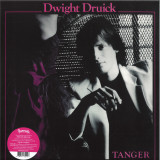
Dwight Druick’s born in Montreal to a professional gambler and an ex-Radio City Rockette. One of five children, he grew up in a family buoyed by music and beleaguered by the vagaries of miscalculated risk. After attaining a McGill University bachelor’s degree in Art
History, Dwight fully embraced both music and risk by traveling to London, where he signed a contract with Pye Records and Joe Cocker’s management company. The ensuing record,
Druick & Lorange was released to critical acclaim and relative success. After returning to Canada, Dwight recorded two albums with Phil Vyvial: Midnight and Minuit. Recorded with the Muscle Shoals Rhythm Section in Alabama, the duo’s work achieved airplay success in Quebec and across Canada. Dwight subsequently released his first French language solo album, Tanger, released in 1980 by the Canadian label, Bobinason.
Today quite hard to find in its original version, Tanger is first of all an incredibly solid album, clearly underrated and deserving more credit. Mostly known by collectors and DJs for the
stunning cover of Toto’s classic hit, “Georgy Porgy”, which was produced and arranged with the help of George Thurston (Boule Noire), it includes many other tasty titles, with amongst
them another fine rendition of “Open Your Eyes” by The Doobie Brothers. In fact, with its brilliant mix of Modern-Soul, Disco and AOR styles, the whole album is already considered
by many connoisseurs as a classic, and clearly a must have for anyone enjoying this musical blend. Never reissued on vinyl until now, there was not much more needed at Favorite Recordings
to make it happened. Officially licensed to Dwight Druick, who was unfortunately not able to provide the original tapes, Tanger has been perfectly restored and remastered by Frank Merritt, at The Carvery, London. CD and digital edition will also come with “Georgy Porgy (Version Disco)” as a bonus track.