Formed by LA-based drummer Tommaso Cappellato in conjunction with pianist Alberto Lincetto and bassist Nicolò Masetto, the group is known for their experimental blend of eclectic jazz, funk, downtempo beats, and vintage Italian library music. On this release, they are showcasing their foray into Italian vocals. The A-side "Luce" is a vibrant track that combines 80s jazz funk elements with a touch of boogie in an extended multi-rhythmic version that keeps the energy grooving. Flipping to the B-side, "Luna Gioia" offers a modern interpretation of downtempo Brazilian-funk and slow disco, accompanied by an instrumental version that allows the music to shine on its own.
Suche:brazilian
We are proud to bring you part II of the CEP VA series, featuring six tracks that span a wide range of genres. Each track brings its own signature to this release, making it truly one of a kind.
Beta.V opens the A-side, fusing self-sung vocals with multiple synths that harmonize beautifully together to create a timeless track. This is followed by SWART's 'Eternal Raver', much akin to old-school trance thanks to hypnotic synths and dreamy textures creating a meditative state. A3 introduces ETERA’s 'Classic Shit', a dancefloor weapon with stomping beats and crisp, background drums signaling the signature sound of ETERA himself. On the B-side, SZG stands out with its gated synthline, pounding bass, and catchy vocals from Brazilian MC DDSV adding that unique energetic spin to this release. DJ HENNE’s 'Roboter' on B2 is a hard house slayer featuring a deep mid-track breakdown and self-sung vocals - a DJ HENNE classic. Wrapping up the release, Pōnky combines groovy, funky plucks with a smooth finish, closing the EP out on a playful note.
'Pursuit Of Change' drops via CEP Records on 29th November 2024.
Here at Mr Bongo we have been inundated with people asking us to reissue this release. Ana Frango Elétrico's petit cult classic masterpiece 'Little Electric Chicken Heart' from 2019, which was only ever released on vinyl and CD in Brazil and Japan, has fast become a collector's item.
Well received by fans, DJs, and reviewers on release, The Needle Drop expressed "Ana Frango Elétrico's authentically vintage fusion of chamber pop, rock, samba and jazz is a real blast!" listing it as one of its Top 50 Albums of 2019. The album's reputation has been slowly building ever since, gaining a Latin Grammy nomination in 2020, and now solidly cementing itself as a gem of contemporary Brazilian music.
Across the albums nine tracks, Ana blends elements and influences from MPB, Tropicália, indie rock, punk and pop, forging them together with a sumptuous dose of her signature style. The finesse of 'Saudade' kicks off the LP, one of Ana's most known tracks to a non-Brazilian audience. A sublime opener, beginning with a spellbinding piano solo before transcending into a beautiful dream-laden slice of warmth, complete with luscious jazzy horns and deft vocal delivery. ‘Promessa e previsões’ follows, the only track on the album not to be written by Ana, instead being penned by Chico França. It’s a swelling and sweeping twilight groover, building and breaking across absorbing peaks.
Other highlights on the album include the anthemic 'Chocolate', which was a firm favourite with a packed sing-along crowd when we heard Ana perform it live. Elsewhere, 'Se No Cinema' hits with its quirky allure, charm and catchy melodies before transforming into a carnival spirit.
Tapping into the richness of Brazil’s new wave of musical energy, the album also includes a heavyweight lineup of collaborations with artists such as Dora Morelenbaum (Bala Desejo), Tim Bernardes, Antonio Neves and Guilherme Lirio to name but a few.
A short, sweet and refreshing record, that leaves nothing to waste, marrying playful ideas with poignant themes. 'Little Electric Chicken Heart' is a future classic and will beguile fans of ‘70s Brazilian recordings, Gal Costa, Mac DeMarco, Stereolab, Superorganism, Caetano Veloso and more.
Proudly presenting, ‘Калі ты запытаеш (If You Ask)’, a brand new, blissed-out pop production with a ‘70s AOR touch, by the ever-on-point SOYUZ (СОЮЗ). Coming at a period between albums, the single features guest appearances from the sensational musicians, Biel Basile (O Terno, Sessa) and Anthony Ferraro (Toro Y Moi, Astronauts, Etc.). Friends of the band, they add their signature touch on the drums and synth respectively. To complete the package, SOYUZ back the title track with a short but sweet, Wurlitzer-laden, MPB-tinged number, ‘Tenório’.
‘Калі ты запытаеш (If You Ask)’ tells the story of lost dreams. A track that can be interpreted either as a bittersweet longing for childhood times, or for a native place you can’t return to. For the writer Alex Chumak he suggests, "In my case, as in the case of many Belarusians, it’s both".
For this song, Alex chose to sing in his native Belarusian tongue. As he explains this language "to me feels underrepresented in pop music, also it’s a beautiful legacy and sonority that I wanted to share with the listeners of our project around the world". One of the key inspirations was a Belarusian band “Песняры” (“Pesniary”), who produced a host of great progressive folk, jazz fusion and AOR, from the ‘70s to the ‘90s, predominantly sung in Belarusian.
Another key influence was the music coming out of the Brazilian state of Minas Gerais in the ‘70s, drawing inspiration from the sentimental and harmonious music of Beto Guedes, Lô Borges, Fernando Oly and Wagner Tiso.
Having parted ways with their drummer Anton, SOYUZ needed to find a new way to produce songs. The answer was to go remotely. Alex contacted the brilliant Biel Basile, who had recorded Sessa's contemporary classic ‘Estrela Acesa’, in which Alex also participated. Utilising Biel and Sessa’s newly built studio in São Paulo, SOYUZ had Biel record the drums directly to tape to get the rich sound they were after. Adding the final magic into the mix, California’s Anthony Ferraro provided a beautiful Solina String Ensemble synth arrangement, with drummer/recording engineer Albert Karch expertly assisting with the production.
To capture the essence of the single visually, Alex and the Brazilian one-man-industry visual artist Gabriel Rolim, spent a blazing sunny May day in Berlin shooting film and stills – one of which became the perfect cover image. We hope you enjoy this little nugget of SOYUZ mastery, a sweet taster to savour while the new album is recorded.
"Back in stock due to popular demand, the 11th release in our signature Brazil 45’s series came in the form of João Bosco - O Ronco Da Cuica and Antonio Adolfo E A Brazuca – Transamazônica. Two jewels from Brazil’s rich musical heritage.
On the A side, prolific guitarist João Bosco’s MPB masterpiece ‘O Ronco Da Cuica’. Originally appearing on his 1976 ‘Galos de Briga’ LP released on RCA Brazil, it had yet to have had an official 7” release. It’s an intoxicating blend of passionate vocals, feverish cuica and deftly picked acoustic guitar.
On the flip, Antonio Adolfo E A Brazuca’s track ‘Transamazonica’ is an all-time classic Brazilian jazz fusion gem. Taken from the hard-to-find 1971 self-titled LP on Odeon Brazil, it again had never been released on 7”. Adolfo was the founder of Trio 3-D and later played with Elis Regina."
Following her breakout debut on the label with the mega-hit Heavyweight Sound, which brought a spark of light to lockdown when it dropped, Nina Girassóis now unveils her first album, Superfluido.
Great music isn’t about having the latest gear—it’s about the vision and creativity behind it. Superfluido is the result of over a decade of lo-fi experimentation at São Paulo’s Rocky Studio, where Nina teamed up with producer Paulera. Their journey is infused with mid-2000s underground sound system sessions, carnival rhythms, and the vibrant energy of the city that never sleeps.
The duo’s creative process flows with the spirit of ‘vida boa’—embracing spontaneity and seizing inspiration wherever it strikes: in the supermarket queue, at the bar, or while wandering the streets. This free-flowing approach defines Nina and Paulera’s work, embodying a distinctly Brazilian way of living in the moment, grounded amidst life’s challenges.
With its minimalist soulful sound, Superfluido radiates an effortless, unpolished beauty. It’s a collection of tracks meant to be shared with those closest to you—a soundtrack for life’s special moments.
Repress!
For number 93 in the Brazil45 series, we present two favourites from the Harmony Cats. A female vocal quintet (who later became a trio) from São Paulo. They formed in 1976 and were most prolific in the disco period.
'Harmony Cats' Theme' from 1976 is probably the group best known track outside of Brazil. Owing a lot to Rhythm Heritage's version of 'Barretta's Theme (Keep Your Eye On The Sparrow)’ it's wonderfully spacey breakbeat and percussive production with lush, floaty vocals makes it a real crossover classic record.
'Seja Como Nos (De Pe No Chao)' is instantly recognisable. Tucked away on the b-side of their 1979 single 'Tem Dinheiro Nisso' on Young Records, it is a beast of a cover version of The Jacksons' classic ' Shake Your Body (Down To The Ground)'. Nothing subtle or sophisticated here. Just a song of pure disco joy, enhanced with awesome Brazilian production and the Cats' trademark vocal arrangements. A get-of-jail-free card for any DJ that finds themselves stuck with an empty dance-floor, but also one that will put smiles on the faces of the more discerning leftfield club crowds.
- Next installment in BRAZIL45 Series.
- Features cover of The Jacksons ‘Shake Your Body (Down To The Ground)’.
- 2 tracks of pure disco joy.
- A1: Erik Tagg / Got To Be Lovin' You
- A2: Lui / Oh, Oh(I Think I'm Fallin' In Love
- A3: Chocolateclay / The Cream Is Rising To The Top
- A4: Ted Coleman Band / If We Took The Time (Where Do We Go From Here)
- A5: Babadu! / All I've Got To Give
- A6: Danny Dee / My Girl Friday
- B1: Positive Force / Everything You Do
- B2: Jim Schmidt / Love Has Taken It All Away
- B3: Matthew Larkin Cassell / Fly Away
- B4: Moonpie / Sunshine Of My Life
- B5: Cantaro Ihara / Twiny
Soul, funk, jazz, Brazilian, Latin music... P-VINE's Groove-Diggers series has unearthed quality records that transcend genres, nationalities and ages since the series was launched in 2006. Now, we have decided to release a compilation album containing a selection of great sound sources from our vast collection. It is no exaggeration to say that this compilation, which includes a wide selection of previously overlooked finds and popular tracks that everyone has probably heard at least once, would not have been possible without the Groove Diggers team.
Adam Beyer shares his first collaboration with Brazilian superstar Vintage Culture, ‘Lift Me Up’ feat. Kyozo.The track has been brewing ever since the two artists crossed paths while touring and discussions soon turned to a potential collaboration. Passing ideas back and forward, ‘Lift Me Up’ took shape, before Kyozo’s signature vocals were added, with the British vocalist on their radar after link ups with Prof & Fitch, Aiken and Made by Pete. The final work is a pristine slice of dance music built for the summer festival season and reinforces Beyer’s continuing expansion and maturation of his sound palette, following the runaway success of his remix of Sharam’s PATT (Party All The Time) with Green Velvet and Layton Giordani and recent EP on Drumcode ‘Ghost Kiss’.‘Lift Me Up’ has soldered the relationship between Beyer and Vintage Culture, with the Drumcode boss playing the Brazilian’s So Track Boaevent earlier this year, with an anticipated B2B coming before the end of 2024.
An obscure bit of Brazilian folk rock from the early 70s - recorded with an easygoing, laidback style that's really wonderful! The group's working mostly here in a blend of acoustic guitar and percussion and some of the guitar work is done by Jorge Amiden of O Terco, using a strange three-necked guitar that looks mighty weird in the picture! This instrument seems to be played using a bow at times - creating a "guitar strings" sort of feel that gives the record a bit more class than you might expect from its relatively rootsy setting and there's also some great subtle production on the vocals that compresses them slightly, in a way that links the record to some of the other South American rock of the time. Titles include "O Jogo", "Tributo Ao Sorriso", "Blusa Le Linho", "Voce Pole Ir Alem", "Do Zepo Adiante", "Transe Uma", "Cara Ou Coroa", and "Venha Pisar Na Grama".
Bogotá-based Colombian composer Eblis Álvarez, known as Meridian Brothers, has been concocting a unique blend of psychedelic sounds since 1998. With his latest project, "Mi Latinoamérica Sufre," Álvarez explores the untapped potential of the electric guitar in a tropical Latin context. Drawing inspiration from African highlife and soukous traditions, Álvarez crafts a fearless sonic experiment infused with invention, playfulness, and emotion. Unlike typical tropical guitar records, this album eschews distortion and clichés, opting for a pure, clean approach. Through intricate compositions blending cumbia, champeta, soukous, Brazilian tropicalia, and underground psychedelic rock, Álvarez pays homage to the golden era of Congolese rumba, Ghanaian highlife, and Nigerian afrobeat.
"Mi Latinoamérica Sufre" delves into the ego trip, presenting a humorous yet introspective journey of self-discovery and identity. The central character, Junior Maximiliano the Third, navigates through the complexities of self-discovery using psychedelic substances, political philosophy, and folklore. As he grapples with nostalgia, paranoia, and shared suffering, Álvarez showcases his vocal prowess, creating a sonic theater of the mind. Accompanied by visual narratives from Colombian artist Mateo Rivano, the album portrays various psychological states of disorientation, self-pity, enlightenment, and optimism. "Mi Latinoamérica Sufre" emerges as a worthy and innovative addition to the concept album tradition, offering a distinctive blend of bitter-sweet flavors inspired by Latinoamérica.
- A1: Machine Messiah
- A2: I Am The Enemy
- A3: Phantom Self
- B1: Alethea
- B2: Iceberg Dances
- C1: Sworn Oath
- C2: Resistant Parasites
- C3: Silent Violence
- C4: Vandals Nest
- D1: Cyber God
- D2: Chosen Skin (Bonus Track)
- D3: Ultraseven No Uta (Bonus Track)
- D4: Machine Messiah
- D5: I Am The Enemy
- D6: Phantom Self
- E1: Alethea
- E2: Iceberg Dances
- F1: Sworn Oath
- F2: Parasites
- F3: Silent Violence
- F4: Vandals Nest
- G1: Cyber God
- G2: Chosen Skin (Bonus Track)
- G3: Ultraseven No Uta (Bonus Track)
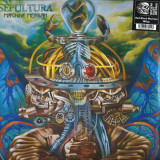
"Reprint of ""Machine Messiah"". The 40th Anniversary Edition will be available as 2LP - 180g Ruby Red Marble in gatefold. Sepultura are a Brazilian heavy metal band formed in Belo Horizonte in 1984 by brothers Max and Igor Cavalera.
"
"A Seamless Symphony of Harmonious Electronica" - Jazziz
Emerging from over a year of creative hibernation following their debut album, Stavroz's upcoming EP "Kick Up the Dust" jolts them back into action. The EP flows gently, yet the overall mood of the journey isn’t always easy to pinpoint. There’s a certain vagueness to Stavroz’ sound which allows for bizarre experiments to seep through without interrupting the course. “We like to keep it lightly twisted, like a wink with a frown,” says the band.
In the title track however, Stavroz boldly steers towards the heart of the dance floor: efficient, remorseless, powerful, intense and most of all... elegant. Guiding you harmoniously through the club is a delightful duet of trumpet and saxophone, timed perfectly to heal you where it hurts most.
"Her Eyes Were Red" does what it says on the cover. There's melancholy - without sadness. Power - without force. Love - without lust. Stavroz's music possesses a distinct power that feels both natural and organic, never resorting to brute force or aggression. In their own way, the Belgian quartet offers an astonishing journey of saxophone & duduk, supported by broken beats and chopped vocals.
In Dae-El, a track featuring the Brussels-based producer and sound designer Poltrock, ethereal-sounding synths and duduk are combined with ghostly high-pitch distortions. Despite a backbone of muffled beats, the tune has vaporous qualities, reverberations that wobble and tinkle into space – it’s an easy listening experience but in a trippy, spaced-out way. “We’re trying to go for the sweet spot between the couch and the club”.
Adding further depth to their EP, Stavroz collaborates with Brazilian singer and composer Castello Branco in "Valente." Here, intimate Sade-like vocals harmonize with rubbery scratches, acoustic guitar, and horn segments, crafting a lush lounge piece that seamlessly balances both relaxation and empowerment, transparency and provocation. It's a testament to Stavroz's versatility and their knack for creating music that defies easy definition, leaving listeners eagerly anticipating the next twist and turn in their captivating musical journey.
Time to Play is pleased to introduce the fifth chapter of its catalog, titled
Midnight Love, created by the young Japanese talent DJ Dreamboy. The main
track, which shares its name with the EP, serves as a true manifesto of
Japanese deep house: minimal, intense, balanced, and dreamy. It’s no
coincidence that this track was chosen by Brazilian producer Zopelar for a
tough and driving remix.
The B-side opens with “Vibe,” which starts with a minute of suspended
ambience before unleashing a burst of kicks and acid arpeggios that ignite a
contagious euphoria. “Dream Town” follows in a similar vein, maintaining a
softer profile akin to Midnight Love. The EP closes with “My House Style,” a
high-speed journey through nocturnal Tokyo, featuring deep basslines, dreamy
atmospheres, a relentless rhythm, and an irresistible desire for the experience
to never end.
Following on from his previous debut album Tape 1/Tape 2 on Soundway, Felbm delivers Tape 3/Tape 4 : an intimate, emotional, lilting and melodic solo project. These 14 lo-fi, instrumental, jazz-infused sketches were written on guitar, with cascading keyboards, vibraphone and drum machine. Possessing a restorative and soothing quality, it goes some way to balancing out a chaotic year for the world
at large.
With echoes of the dreamier end of 1980s English indie-pop, minimal ambient music and Brazilian bossa-nova, Topper’s musical storybook includes touches of The Durutti Column, hints of Antônio Carlos Jobim and Baden Powell, whilst all set firmly in the summer fields of Germany and the Netherlands. The recording method used for the creation and recording of Tape 3 and Tape 4 follows the same as his previous release: all sketches were initially recorded onto cassette on a 4-track tape machine. Most notably a vibraphone finds its way onto
almost every track fitting Topper’s sound-palette perfectly: warm yet distinctive, a percussive as well as sustaining sound that evokes some melancholy and a certain timeless nostalgia. Features that most certainly also apply to the other ‘new’ instrument on the tapes: mellotron flutes.
Tape 3/Tape 4 navigates the space between quiet, open, meditative tunes and more solid instrumental works, reflecting his constant search for an optimal balance between stillness and movement.
- A1: S–O S–O Paulo 3 29
- A2: Curso Intensivo De Boas Maneiras 2 58
- A3: Glória 3 20
- A4: Namorinho De Port–O 2 35
- A5: Catecismo, Creme Dental E Eu 2 44
- A6: Camelô 2 15
- B1: N–O Buzine Que Eu Estou Paquerando
- B2: Profiss–O De Ladr–O 2 35
- B3: Sem Entrada E Sem Mais Nada 2 40
- B4: Parque Industrial 3 16
- B5: Quero Sambar Meu Bem 3 50
- B6: Sabor De Burrice
In 1968 Tom Zé; moved from Salvador Bahia to Sao Paulo where he hung out and wrote with his friends Gilberto Gil and Caetano Veloso. Although initially part of theTropicalia movement, Zé was so independent he was determined to forge his own musical path. He started by recording Grande Liquidacao, a hyperactive pop album backed up by two incredible psychedelic rockbands: Os Brazoes and Os Versateis. Tom Zé's material on this album includes traditional Brazilian Tropicalia laced with crazy vocal melodies and samples a multitude of genres from funk to psychedelic rock and bossa nova creating in the process a sort of unheard pop exotica. This is especially apparent on the track šGloria› with its changing tempos, bubbling instrumentation and off-the-wall harmonies. The pace of the album, considering it was the 60™s, is brutal so Zé takes a break between songs to address the listener before resuming his zigzag trajectory. The album also includes the fantastic šParque Industrial› which was later recorded by Gal Costa, Gilberto Gil and Caetano Veloso on the Tropicalia: Panis et Circenses album. Tom Zé was also arguably the creator of the first sampler. In the mid 1980's David Byrne pulled one of his albums out of the samba section of a Rio de Janeiro record store which led him to bringing Zé to worldwide attention by releasing numerous albums on the Luaka Bop label.
In Mr Bongo’s opinion, 'Imprevisto' is one of the most unmistakable Brazilian jazz records ever made. Dramatic intro and hypnotic piano line, decorated with panned percussion before the hats come in. Then the upright bass. A true classic.
Bossa Três formed in 1961 in Rio. They spent most of their early years touring jazz clubs in the USA, before the original line up and their pianist (and perhaps most well-known band member) Luis Carlos Vinhas, returned to Brazil. This is the final track on their Em Forma! LP from 1965, released on Forma. The original pressing of this Brazil 45 was the first time ‘Imprevisto’ had been released on a 7”.
We know very little about Ana Rosely. She released four 7” 2-track records between 1975 and 1984, the latter featuring the brilliant ‘Skim Dum Dum Dum’. The original version was released by RGE Discos in 1984, which came as a surprise to us given the sound. It is very difficult to find an original copy in good condition and they are, as ever, increasing in price.
- A1: Cabo Verde Band - Bo Terra Cabo Verde
- A2: Americo Brito & Djarama - Rapaz Novo E Malandro
- A3: Cabo Verde Show - Terra Longe
- B1: Elisio Vieira - Tchon Di Somada
- B2: Vlu - Rua D'lisboa
- B3: Galaxia 2000 - Coracao Dum Criola
- C1: Mendes & Mendes - Mitamiyo
- C2: Danny Carvalho - Roncanbai
- C3: Mendes & Mendes - Walkman
- D1: Jose Casimiro - La Mamai Ta Bem
- D2: Elisio Vieira - Bem Di Fora
- D3: Zeca & Zeze Di Nha Reinalda - Mocinhos
Arp Frique returns with a brand new release on his imprint Colorful World Records in collaboration with Rush Hour. A compilation of 12 Cape Verdean gems assembled with the help and knowledge of Americo Brito, there is a very special story behind it. Americo Brito, who features on Arp Frique’s original Nos Magia, is a proud and important member of the Cape Verdean community in Rotterdam. His story reveals the historical connections between radio, vinyl, Cabo Verde and Rotterdam’s international music scene in the 70s and 80s. Cape Verdean insiders say “we export all they have to other countries, only to import it back again”. Cape Verdeans have migrated all over the world, mainly to cities with big harbours, like New York, Boston and Rotterdam (Holland). Rotterdam became one of the main destinations (next to Portugal) on the European mainland. When Americo, like many of his friends and relatives moved to Rotterdam, he quickly became infected with the music virus. Surrounded on a daily basis by Cape Verdean music in Portuguese pensions and small hotels, this was where sailors ingested a dose of “sodade” through the interpretations of their beloved music by the local Cape Verdean artists. Americo took to the stage with his band Djarama in the 70s and 80s. The live music scene was buzzing and the Cape Verdean community had their own infrastructure for arranging shows, often in nightclubs where the band had to bring their own soundsystem. Interestingly, Americo didn’t stick to performing and recording music. He found another way to help spread the Cape Verdean magical secret of music across Rotterdam, Holland and beyond: “There was this spot in Rotterdam where all foreign radio stations were housed, all these different nationalities together, Surinam, Cape Verdean, Hindustani…Guy Ramos and some of my other friends made radio in the 80s there. I got involved in their radio activities. Later on I started to work as a technician and eventually as producer and radio DJ for “Radio Voz De Cabo Verde”. Radio became bigger and there were around 4 different Cape Verdean stations active at one point in Rotterdam. instrumental in the development of this was the attic of a Dutch friend, where “Radio Babalu” came to life. Radio has always held a special place in my heart.” Americo’s music collection stems from this era, also aided by his many travels across Europe to cities with Cape Verdean communities. Alongside Rotterdam local, Arp Frique, Americo unveils some of these songs: dancefloor hits and beloved radio gems known in the Cape Verdean scene by younger and older generations alike, and so far undiscovered by a “bigger” audience. The compilation showcases the worldly view of Cape Verdean music, incorporating knowledge from their travels in their compositions. It ranges from the obvious funana and coladeira, to the more unexpected influences of deep disco, new wave, uptempo reggae, jazz-funk and Brazilian pop music; demonstrating just the tip of the iceberg, but what an amazing t(r)ip it is!
Tooflie is back with a new exploration of regional sound from all over theglobe by the anonymous crew of edits lovers. The five different, but equallyimpressive, cuts on the fourth installment are deep dives into the soniccarnival of Brazilian favelas through the skillful reinterpretations by hiddentalents. The A2 track 'CBACA' bolsters the signature baile funk raw energywith hard house rhythms and acidic melodic patterns. Stepping between thefunkier side of electro and polyrhythmic panache, MWR - 'man withrefrigerator' is tailored to take the dancefloor to a new level. The openingtrack starts with a minimalistic yet paunchy breakbeat groove on 'PDNCA' and continues the deepness through the heavy and raw low-endextravaganza on 'RTK'. Bringing the vinyl to a close, 'LAPA' goes full-throttleon haunting arpeggios and leaves things on a blissful note.