"In 1910, the illustrator George Herriman created the Krazy Kat comic strip. Ignatz, a vicious mouse, was Krazy Kat’s arch enemy, and his favourite pastime was to throw bricks at Krazy Kat’s head (who misinterpreted the mouse’s actions as declarations of love)
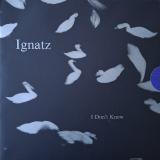
"Ignatz is the alter-ego of Belgian musician Bram Devens. Since 2005, he has released around 20 albums accompanied by guitar, in LP, CD or cassette formats, on labels such as (K-RAA-K)³, Ultra Eczema, Fonal, Mortaux vaches, Okraïna, among others. Ignatz has toured all over the world: Belgium, Germany, the Netherlands, France, Great Britain, Italy, Finland, Greece, Switzerland, Portugal, Lithuania, the United States, Japan, etc.
"Since the beginning of his journey as a singer-songwriter, Ignatz has played wonderfully and mysteriously with the combination of the similar and the unfamiliar, between the repetition and permanent reinvention with slight shift in accents... Now For two decades, when discovering his new songs, whether on record or in concert, his expressive and sonic universe can be recognized in seconds, and at the same time, he surprises every time. This is clearly also the case with ‘I Don't Know’, an album for which (after the cassette ‘Coffee, No Cigarettes’, Taping Policies 2017) he trades his guitar for the piano.
"In the mid-2010s, Ignatz inherited the family piano. As a self-taught musician, he explored the instrument and gave a piano concert in the small Flemish town of Geel, which was filmed by Jef Mertens (who also released the aforementioned cassette) and attended by Beata Szparagowska and Philippe Delvosalle from the label By the Bluest of Seas. After some years, it was in his home in Landen that Bram Devens recorded this haunted piano album, which is unlike any other piano record."
Cerca:bt express
- 1
After the last release ‘Innocence’ with Nathan Cable gaining support from John Digweed on his renowned Apple Music Compiled & Mix Series, we bring forth one of the remixers for his own single release ‘Snake Altar’.
Richie Blacker Northern Ireland’s progressive house & breaks prodigy who’s seen releases on Sasha’s Last Night On Earth, Scream’s Of Unsound Mind, Franky Wah’s Shen, Armada, Anjuna Deep and so many more including his own imprint Mess Express. We were super excited to sign the original breaks mix of ‘Snake Altar’, an amazing ethereal & euphoric progressive breaks track with its haunting ethnic vocals we just knew who could step up as the originator (this time) to remix the third Break-The-Future project.
Ray Keith delivered his signature sound system Jungle / Drum & Bass sound to which we think you’ll absolutely love, just oozing in class. The way it flows from euphoric to his heavy hitting signature darkness to deep jungle roots and back is exactly what we wanted from the big man himself and absolutely buzzing to have Ray on the label for our third release.
To finalise the package Richie Blacker delivered a 4x4 mix, now the lead track and to close off the release a beatless mix & acapella giving you some serious tools to work with… THIS IS ESSENTIAL!
Black vinyl[13,03 €]
By the time of their second album, 1989’s ‘Unfinished Business’, EPMD were firmly cemented in the rap stratosphere. With one certified classic album under their belts, they proved they were no one-hit wonders, with the sequel possibly even better. A concise 12 tracker once again produced by the artists themselves, it saw them adhering to the ‘if it ain’t broke, don’t fix it’ maxim, while going somewhat ‘bigger’.
In other words, guests started to appear – not just on the records, but in the videos – and marketing budgets were higher. None of which watered down their sound. In fact, this is the ultimate EPMD record: a beat that’s simple but perfect, and two top-of-their-game MC’s going back and forth. But the appearance of NWA in the video for ‘The Big Payback’ hints at their reputation at the time – and at the cordial relations between coasts before the deadly beef that was to come.
‘Payback’ takes both its title and core sample from James Brown’s ‘The Payback’ from 1973, and then weaves two more JB elements with it, including the addictive stabs from ‘Baby, Here I Come’. It’s a golden track from the golden age.
The B-side is another gem from the same album, and only released before on 7” in a very rare, limited pressing. ‘So Wat Cha Sayin’ was the album’s lead single, and shows EPMD’s wide sampling palette. There’s bits of BT Express, a whole lot of Funkadelic and, brilliantly, some drums lifted from Soul II Soul’s gem from just the year before, ‘Fairplay’. Lyrically, it’s just all about threats to sucker’s MC’s – what else do you want from EPMD?
• A certified Hip Hop classic.
• Samples James Brown’s ‘The Payback’ from 1973.
1st press sold out
LTD repress soon
Following Chicago’s tradition in special edits and dj personal reworks to extend crucial parts and surprise the dancers, Theo Parrish has always sparkled his legendary sets with his own versions of classic and obscure disco, funk and soul cuts to maximum effect! Some of those were available to fans in mid 2000s via the Ugly Edits series, now it’s finally time for the LOVELY EDITS.
Officially licensed and using the original parts from the master tapes, here we have Theo’s takes on two absolute staples: BT EXPRESS ‘Peace Pipe’ and GEORGE DUKE ‘I Want You For Myself’.
Two decades since they formed in New York City and over ten years since their last album, Tel Aviv based quartet Shotnez are back with Dose a Nova, an album of 10 exhilarating jazz filtered jams, with vibrations indebted to tuareg desert blues, Ethiopian-jazz, 1950's Afro Cuban recordings, surf- rock and folk from across the East Mediterranean basin.
Featuring the original Balkan Beat Box producers Ori Kaplan and Tamir Muskat alongside Uri Kinrot from Boom Pam and Itamar Ziegler from The Backyard, four musicians who are all producers and share love and deep connection to hip hop and jazz, Shotnez reunited in 2020 meeting up for improvised sessions and jams, once a week over a period of about four months at a carpentry turned music studio in suburban Tel Aviv.
Downing midi cards, triggers and synths, the day to day tools for these four producers and picking up and playing their respective traditional instruments - saxophone, clarinet, guitar, bass, percussion and drums – the group was immediately liberated by the moment. In the middle of a strict lockdown, they had no preconceptions, no deadlines, no labels or managers knocking on the door. This was an opportunity to rebuild the camaraderie that developed on the other side of the world two decades back, to reconnect as brothers and seek a higher spiritual plane, all the whilst fully encouraging each other to express their diverse musical backgrounds channelled within, during their time apart.
"Electro Baghdad" expands on the ideas explored on the duo"s self-released 2023 debut EP "Electro Hafla, and builds upon SHIRAN"s solo work, which earned her a Songlines "Top of the World" award and widespread praise for her expressive voice and dynamic reinterpretation of traditional Yemeni music - an influence drawn from her maternal heritage. Both born to half-Yemeni, half-Iraqi parents in Israel, SHIRAN and Bakal"s music reflect their diverse heritage. Singing previously in Yemenite Arabic, she bridged generations by blending traditional melodies with contemporary sounds. Now with "Electro Baghdad", SHIRAN and Bakal pay tribute to their Iraqi roots, recontextualising traditional songs passed down through generations, using analog synths, heavy basslines, and pulsing electronic grooves.
Carrying on from recent archival releases from masters of Indian classical tradition such as Kamalesh Maitra and the Dagar Brothers, Black Truffle is pleased to present a previously unheard recording of a concert by Pakistani vocalist Salamat Ali Khan. Born to a musician family in Hoshiarpur in the northwestern state of Punjab, Khan moved with his family to Lahore in Pakistan after the 1947 partition of India, becoming a child musical prodigy. Khan was a master of the kyhal form of Hindustani classical vocal music, a style integrating influences from Middle Eastern musical traditions that gives the singer a great deal of improvisational freedom. Travelling widely across the globe from the 1960s until his death in 2001, Khan approached ragas performed in the kyhal style as expressive forums for risk-taking improvisation, enlivened by ceaseless ornamental invention.
This remarkable recording was captured by Michael Hönig (of krautrock legends Agitation Free) in concert at Berlin’s Neue Nationalgalerie as part of the MetaMusik festival in 1974 (which also featured Nico, Tangerine Dream, and Roberto Laneri’s Prima Materia, among many others). Khan, who is also heard accompanying himself on a specially tuned alpine zither (in place of the traditional swarmandal, an Indian style of zither), is joined by Shaukat Hussein Khan on tabla and Hussein Bux Khan on harmonium. The lack of a familiar underlying tanpura drone gives this performance a weightless, floating quality, with all three of the musicians playing masterfully with the interaction between silence and the pulse propelling each section of the raag.
As Khan explains in his opening remarks, this performance of the rainy season Raag Megh is divided into three parts, each with its own tempo and rhythmic scheme (tala). The opening vilambit, in a twelve-beat tala, stretches out for over twenty minutes, lingering for a long time in a space of meditative calm, Khan lightly strumming the zither while exploring the lower end of his range in languorously extended notes. Virtuoso tabla interjections at first barely state the tempo, and the interplay between musicians is so spacious that we hear scraps of audience noise and the squeak of the harmonium’s mechanism in between the notes. Gradually picking up rhythmic definition and melodic complexity, after around fifteen minutes the music builds dramatically, with Khan letting out emotive yelps and swooping scalar shapes ranging across his full vocal range. This flows seamlessly into the following jhaptal, at a faster tempo in ten beats, which then makes way for the concluding teental, very fast in sixteen beats, which becomes a frantic improvisational exchange of daring rhythmic disruptions from the tabla, flowing harmonium melodies, and a stunning variety of vocal approaches from Khan, ranging from rapid-fire staccato consonants to guttural growls.
Accompanied by stunning black and white concert photographs, the LP also contains a moving and entertaining recollection from acclaimed German musicologist Peter Pannke, looking back on his experience assisting Khan and his musicians in Berlin at the Metamusik festival (including a mouth-watering description of a feast cooked by the maestro himself). As Pannke describes in his account of attending the concert, the beauty and spiritual intensity of this music leaves the listener speechless.
Black Truffle is thrilled to present the first vinyl reissue of David Rosenboom’s unique Future Travel, originally released on the short-lived Detroit label Street Records in 1981 and here presented in an expanded edition with an additional LP of wild, previously unheard live and studio material from the same period.
Future Travel emerged from the confluence of two important streams in Rosenboom’s work at this time. First, his exploration of ‘propositional music’, defined as ‘complete cognitive models of music’ that start from the radical question, ‘What is music?’ In this case, the music belongs to the universe of Rosenboom’s In the Beginning (1978-1981), in which proportional relationships determine the material available to the composer in all musical parameters (harmonic relationships, melodic shapes, rhythmic subdivisions, dynamics, and so on). Second, the work documents a key moment in Rosenboom’s long collaboration with synthesizer pioneer Don Buchla. Having played a role in developing concepts for some of the modules of the Buchla 300 Series Electric Music Box (an innovative analogue modular system controlled by micro-processors), Rosenboom went on to write the software for Buchla’s hybrid analogue-digital keyboard synthesiser, the Touché, the instrument heard most prominently here.
In a way that no purely analogue synthesizer could, the 300 Series and Touché allowed Rosenboom to work with the In the Beginning algorithms in real time, the synthesizers becoming ‘intelligent instruments’ that actively collaborate with the performer. Developing the open structures of the electronic pieces from In the Beginning, Future Travel explored the possibilities of simply ‘playing the system’, recording live at Francis Ford Coppola’s Zoetrope studio in San Francisco. Working from loose sketches, Rosenboom added acoustic instruments to the electronic sounds and, on some pieces, the processed voice of Jacqueline Humbert. Like Rosenboom’s collaboration with Humbert on the abstracted synth-chanson of Daytime Viewing, this music set out deliberately to challenge the ‘stratified and illusorily coagulated identities in the musical culture of the time,’ refusing distinctions between ‘serious’ and popular music. But where Daytime Viewing achieves this in part through genre references, Future Travel is bracingly sui generis, existing in a unique universe where radical formalisation à la Xenakis spontaneously gives rise to expressive jazz harmonies and old-timey folk melodies.
The crystalline quality of many of the Touché sounds gives Future Travel a sparkling, immediately enticing surface, its layers of shifting ostinato patterns pulsating outside conventional meter, rippling like waves on the surface of water. On opener ‘Station Oaxaca’, ping-ponging synth arpeggios and hand percussion accompany a sentimental violin melody, abruptly overtaken by layered keyboard runs, before the entry of tinkling marimba-like sounds reframe the scene as sci-fi Martin Denny exotica. ‘Time Arroyo’ begins as an austere study in staccato synth sounds in multiple overlapping tempi, reminiscent of Ligeti’s famous ‘clock’ rhythmic effects. Before long, it opens up into a melodic passage with the gentle heroism of classic Roedelius, which proves to be only a brief interlude before the layers of rhythmically distinct synthesiser patterns begin to build and accelerate into an increasingly dense cacophony. The wildest twists and turns are saved for the epic closer ‘Nova Wind’, where the arrangement focuses on Rosenboom’s virtuoso piano playing, perfectly embodying the project’s radical disregard of stylistic orthodoxies as he moves from hyperactive pointillistic flurries to a kind of space-age gospel.
At several points throughout the record, the distinctive voice of Jacqueline Humbert is heard reading passages from the text component of In the Beginning, a dialogue between The Double (an embodiment of humanity’s timeless desire to replicate itself in spiritual and technological copies) and two Spirit Characters. Fittingly, as all are conceived as embodiments of a future form of techno-human collective consciousness, distinctions between the three characters are not immediately evident in Humbert’s delivery, just as the music blurs the boundaries between intelligent computing and human spontaneity. Adorned with a striking retro-futurist cover (and here accompanied by extensive new liner notes and archival images), Future Travel is a time capsule of radical imaginings at the birth of our digital age, reminding us of utopian possibilities of which our own present seems so often to fall short.
Keiji Haino/Jim O'rourke/Oren Ambarchi
With pats on the head, just one too few is evil one too many...
- My “Watashi Dake?” Is Definitely Not Included In This Unequal Treaty, Is It?
- Right Brain, Left Brain; Right, Left; Right Wing, Left Wing. Just How Many Combinations Can Be Made From These?
- “Critical Consciousness?” That’s Been Abandoned In Corner Of A Shower Room In A 53-Storey Apartment Building Inhabited By Extra-Terrestrial Lifeforms…
- I Thought I Had Pulverized It Summarily But There Are Just Too Many Who Lack Reality Or Who Are Cowards So I Cannot Change A Thing
- E1: Still Divided Into Pieces? Let’s Reconnect Them Recognise That You Are A Point And The Longest Line Let It Become Light
- I Can No Longer Sense That Sacred Feeling Of Expression Just The Loitering Of Vulgar Vibrations That Can Only Be Described As A Half-Hearted Class Reunion Will You Consent To This?
- There Are Always Things I Wish To Say But I Can Only Convey Them In This Language August 6 August 9
The heavyweight trio of Keiji Haino, Jim O’Rourke and Oren Ambarchi return with their 12th and most epic release to date, the triple LP With pats on the head, just one too few is evil one too many is good that's all it is. Documenting the entirety of their final performance at the dearly departed Roppongi home of Tokyo underground institution SuperDeluxe in November 2018, the music spread across these six sides splits the difference between the guitar-bass-drums power trio moves and experiments with novel instrumentation that have defined the trio’s decade of working together. Containing some of the most delicate music the three have committed to wax since the gorgeous 12-string acoustic guitar and dulcimer tones of Only wanting to melt beautifully away is it a lack of contentment that stirs affection for those things said to be as of yet unseen (BT011), this wide-ranging release also offers up some of their most blistering free rock performances yet.
The side-long opening piece finds Haino on a single snare drum in duet with O’Rourke on unamplified electric guitar, playing in the lovely post-Bailey vein heard on his classic 90s recordings with Henry Kaiser and Mats Gustafsson. Spiky dissonance and ringing harmonics interweave with flowing melodic fragments as Haino single-mindedly explores the resonance of the snare like an untutored Han Bennink. On ‘Right brain, left brain; right, left; right wing, left wing. Just how many combinations can be made from these?’, O’Rourke moves to synth and electronics, joined by Ambarchi on drums, who at first focuses on sizzle cymbals before hypnotic cycles of gentle tom rhythms combine with electronic burbles and flutters to suggest a dream collaboration between Masahiko Togashi and Jean Schwarz. Ambarchi’s percussion is then joined by Haino on wandering, overblown flute, before the man in black switches back to the snare for a bizarre, stuttering drum duet.
For the first trio performance, Haino makes another new addition to his seemingly infinite catalogue of instruments, this time a homemade contraption he refers to as ‘Strings of Dubious Reputation’. Joined by O’Rourke on increasingly spaced-out electric guitar and Ambarchi on skittering percussion, Haino’s wonky, slack strings adds a definite ‘musique brut’ edge to this side-long performance, certainly one of the most enchantingly odd in the trio’s discography. When the group reconvene for the second set, spread out across the final three sides, they seem ready to breathe fire from the first instant. O’Rourke slashes distorted chords on the six-string bass, Ambarchi breaks into his signature irregular caveman thump, and Haino squeals and squawks on heavily delayed oboe before unleashing an overpowering electrical storm when he first picks up the guitar. For over half an hour, the trio pound out one of their most relentless performances, a constantly rearranging kaleidoscope of tortured fuzz guitar, insanely busy bass riffing and propulsive, tumbling drums. A hushed atmosphere initially reigns on the final long piece, given the mournful title ‘There are always things I wish to say but I can only convey them in this language August 6 August 9’. Haino’s clean guitar strumming calls up the shimmering tones of his PSF classic Affection, gradually building to a surging wall of sound, bass and drums lumbering through a roar of jet-engine guitar. Arriving in a deluxe trifold package with photos by Lasse Marhaug alongside inner sleeves with extensive live images, this epic release is perhaps the most remarkable document yet of this unique trio’s stamina and continuing inventiveness.
Having toured the world with Mczo and been at the helm of his own studio Pamoja Records since he was just 18, influential Singeli producer Duke, now 25, is one of Tanzania's busiest club alchemists. On his acclaimed solo debut "Uingizaji Hewa" we were introduced to his idiosyncratic "hip-hop Singeli" sound, a slower cousin to the Dar Es Salaam-rooted hard 'n fast club template that takes as much special sauce from Busta Rhymes and Eminem as it does the 200BPM clatter of genre veterans Jay Mitta and Sisso. On September's "Sounds Of Pamoja," we were treated to a closer look into Duke's studio, and specifically at his work with the city's best young MCs like Dogo Kibo, Pirato MC and MC Kuke. "Early Instrumentals" allows us to witness the depth of Duke's evolution with a selection of unearthed genre melting Singeli mutations laid completely bare without vocals. This 11-track set features some of his most arresting hybrid dance music yet, expressing his visionary fusion of contemporary rave sounds, US rap attitude, and Tanzanian dance history. While the roots of Singeli are in taraab, a popular fusion of East African and Middle Eastern traditional dance rhythms and melodies, Duke steers the sound into a synth-led, syncopated firework display that sounds spry and futuristic. Centered arounda bumping staccato melody and urgent synth strings 'Dukelo Fl Sing' echoes the lo-swung swagger of early Dr. Dre productions, but kicks the tempo into overdrive, decorating any gaps with flickering late-nite synths. 'Beat Kali Duke' meanwhile drives carnival trance leads through hard and fast rolls of kick drums, whistles and woodblock cracks. It's not all completely high speed either: 'Duke Selecta' is almost afro-house, with slow, sexy bass and woozy vocal melodies, and 'KKKKKKKKKKKKKKK' absorbs the propulsive spirit of South African gqom. "Early Instrumentals" is the most varied picture we've been presented yet of Duke's rousing dance cocktail. IT's a physical call to action that assures listeners the genre is for movement, not headphone listening
Black Truffle is pleased to announce its first release from celebrated London-based Canadian composer Cassandra Miller. Though her body of mature work stretches back almost twenty years, many listeners were introduced to Miller through the success of her astonishing 2015 Duet for Cello and Orchestra, which sets an imperturbable two-note cello part against a series of increasingly dense orchestrations of an Italian folk melody; in 2019, it was selected by The Guardian as one of the ‘best classical music works of the 21st century’. Traveller Song / Thanksong, the first release of her music on vinyl, presents a pair of compositions for voice and ensemble that exemplify Miller’s gently absurd, strikingly beautiful, and utterly unique work.
Like many of Miller’s compositions, these pieces originate in existing music. Traveller Song (2016/2018) begins from a 1950s song of an anonymous Sicilian cart driver recorded by Alan Lomax and Diego Carpitella, which Miller recorded herself singing along to, going on to then record herself singing to her own layered voices. Miller’s untutored voice is an unsteady, wavering wail that has, in her words, ‘more in common with a quasi-shamanistic keening than anything Sicilian’. Heard sometimes alone, sometimes layered, her pre-recorded voice is accompanied by a chamber sextet drawn from London’s Plus-Minus Ensemble. In the first section, Miller’s exposed warble is set to a spare piano accompaniment, somehow both faintly preposterous and magisterial. Following the voice note for note, the piano part often makes use of almost mechanical sequences of parallel chords, reminiscent both of Satie’s Rosicrucian period and the abrupt harmonic movements of a chord organ. The orchestration then opens up to guitar, clarinet, and sliding strings, a delicate environment for Miller’s voice, which, especially when it begins to be layered, generates a powerful sense of intimacy. In its concluding minutes, the folk roots of the original melody return in the form of a glorious full ensemble setting dominated by accordion, clarinet, and strummed guitar. Thanksong begins from recordings of Miller singing along to the third movement of Beethoven’s late quartet in A minor (Op. 132), the ‘holy song of thanks’ the composer wrote to express his gratitude for (temporarily) recovering from illness. Recording herself singing along repeatedly to each of the individual parts of the quartet, Miller created an aural score where each member of the string quartet listens to their own part on headphones, playing by ear. Performed on this recording by Montreal's Quatuor Bozzini, with whom Miller has a decades-long relationship, they are joined by the British soprano Juliet Fraser, who sings material from the Beethoven quartet ‘as slowly and quietly as possible’. The atmosphere of the opening of Beethoven’s Dankgesang, of hushed reawakening and thoughtful reflection, is sustained throughout the fourteen minutes of Miller’s piece, building at points almost to sentimentality before the five individual parts again fall back into a gentle burble of unsynchronised melodic gestures. Like Traveller Song, here the use of the voice is a long way from the mannered performance of much contemporary music, reaching for a human and bodily presence more connected to the reality of the everyday, albeit suffused with wonder. Presented in a stylish sleeve adorned with photography by Lasse Marhaug and liner notes by Cassandra Miller, this is a key release from a major contemporary composer whose work challenges and dazzles in equal measure. .
Celebrating its one hundredth release, Black Truffle is honoured to present a major archival discovery: a stunning document of the only performance by the trio of Tony Conrad, Arnold Dreyblatt and Jim O’Rourke. Across a two-night programme organised by David Weinstein at legendary New York experimental venue Tonic in January 2001, Conrad, Dreyblatt and O’Rourke presented individual projects before performing a collaborative set each night, the first with members of Dreyblatt’s ensemble and the second the trio heard here. As Dreyblatt points out in the wonderfully informative and reflective liner notes written for this release, this was a collaboration across generations, reflecting the profound impact of Conrad’s pioneering minimalism on Dreyblatt and O’Rourke. Both Dreyblatt and O’Rourke came to this collaboration armed with a deep appreciation of Conrad’s music and the just intonation principles at its core, Dreyblatt having first encountered the incredible power of Conrad’s precisely tuned violin chords during his tenure as an archivist for La Monte Young in 1975, while O’Rourke had performed with Conrad in various settings since the mid-1990s (as well as admiring, reissuing, and performing Dreyblatt's music). The flyer for the concert promised ‘massive, ecstatic, pulsating overtones’, and the trio certainly delivered. From the moment this keening stream of bowed strings begins, it is clear, as Dreyblatt writes, that we are in ‘Tony’s sonic universe’, as massively amplified, slowly shifting combinations of precisely chosen pitches fill the room with complex beating patterns and ghostly difference tones. For more than twenty-five minutes, the music operates at a level of intensity comparable to classic recordings such as Conrad’s Four Violins, until the texture thins out slightly in the performance’s final quarter, allowing for the listener’s first recognition of the individual voices that make up this enormous, overwhelming harmonic edifice. The constant stream of bowed tones is broken by a beautifully rich pizzicato from Conrad on monochord, the sliding low tones and metallic shimmer of the other strings taking the set's final moments on an unexpected detour into spacious pastoral psychedelia.
Though produced by three individuals known for their own distinctive bodies of the work, this is egoless music, the perfect expression of Conrad's desire 'to move away from composing to listening', to 'working "on" the sound from "inside" the sound'. Historically important and overwhelming in sonic impact, this release also serves as a moving tribute to Tony Conrad from two musicians profoundly marked by the example set by his art and life.
NAPPYNAPPA is a prolific artist from Washington DC with a highly creative and free approach. ONDAMICUNDERDACOZMIKLYTZ coalesces his expressive hip hop soundscapes with layers of eclectic influences. The album features production from long-time collaborator Black Moses, as well as Pat Cain, Zac Clare, Tooth Choir, Jelani Kwesi and RICTHESUPERSONIC.
NAPPYNAPPA is one half of the group MODEL HOME alongside Pat Cain. He has featured on over twenty albums in the last two years alone, including the celebrated Disciples compilation ‘One Year’, the acclaimed ‘SE’ on Max D’s Future Times label and ‘both feet en th infinite’, released by Don Giovanni Records.
South London-based 8-piece band Don't Problem is proud to present their their new album ' Liminality' planned for October 2021.
Their first three singles 'King Kong' 'Whale' and 'CD's Lament' gathered very strong media support with coverage from the likes of Mary Anne Hobbs, Jamz Supernova, Tom Robinson, WorldWide FM, BBC London, Jazz FM, Soho Radio, Amazing Radio, Radio Nova, Fip and more.
With their new album, the combo challenges the common perception of a "covers" brass band, exclusively writing original material and adding electronics, synths & strings, a reflection of their wide encompassing interests. They introduce us to a very personal journey; the moment in time where a brass band affirms their love for club culture and delivers an album that travels from heavy funk to psychedelic jazz and UK dance music.
"As 8 people writing music together, sometimes it can take a while for a tune to fully take shape. This tune came into itself in the studio which gave us the space to explore the production, sonic possibilities and instrumentation. The opening section leads to a beautiful first-take flugelhorn solo driven by lush strings, pulsing horns and electronics before reaching its soaring conclusion. The title ‘Whale’ is in reference to the Whale emoji which we use as a way to express a greatness or joy for which words can't be found."
Don't Problem's debut 'DP EP' combined the heavy funk and raw psychedelic sound of brass and drums with ferocious grime-inspired improvisation to deliver original and fresh music, aimed squarely at the dance floor. The band is comprised of 8 musicians who've played with everyone from Tenderlonius, Emma Jean Thackray, Alfa Mist, Tom Misch and Ruby Rushton to Riot Jazz.
By the time of their second album, 1989’s ‘Unfinished Business’, EPMD were firmly cemented in the rap stratosphere. With one certified classic album under their belts, they proved they were no one-hit wonders, with the sequel possibly even better. A concise 12 tracker once again produced by the artists themselves, it saw them adhering to the ‘if it ain’t broke, don’t fix it’ maxim, while going somewhat ‘bigger’.
In other words, guests started to appear – not just on the records, but in the videos – and marketing budgets were higher. None of which watered down their sound. In fact, this is the ultimate EPMD record: a beat that’s simple but perfect, and two top-of-their-game MC’s going back and forth. But the appearance of NWA in the video for ‘The Big Payback’ hints at their reputation at the time – and at the cordial relations between coasts before the deadly beef that was to come.
‘Payback’ takes both its title and core sample from James Brown’s ‘The Payback’ from 1973, and then weaves two more JB elements with it, including the addictive stabs from ‘Baby, Here I Come’. It’s a golden track from the golden age.
The B-side is another gem from the same album, and only released before on 7” in a very rare, limited pressing. ‘So Wat Cha Sayin’ was the album’s lead single, and shows EPMD’s wide sampling palette. There’s bits of BT Express, a whole lot of Funkadelic and, brilliantly, some drums lifted from Soul II Soul’s gem from just the year before, ‘Fairplay’. Lyrically, it’s just all about threats to sucker’s MC’s – what else do you want from EPMD?
• A certified Hip Hop classic.
• Samples James Brown’s ‘The Payback’ from 1973.
- A1: Father Bird, Mother Bird (Sunbirds)
- A2: Connaissais De Face (Tiger?)
- A4: Dearest Alfred (Myjoy)
- A4: First Class (Soul In The Horn Remix)
- B1: If There Is No Question (Soul Clap's Wild, But Not Crazy Mix)
- B2: Pelota (Cut A Rug Mix)
- C1: Time (You And I) (Put A Smile On Dj's Face Mix)
- C2: Shida (Bella's Suite)
- D1: So We Won't Forget (Mang Dynasty Version)
- D2: One To Remember (Forget Me Nots Dub)
"The art of the remix has been around for several decades, from the fervid imaginations of JA pioneers like Coxsone Dodd, Duke Reid or King Tubby to the disco enthusiasts of New York, such as Tom Moulton, who bequeathed us the modern iteration of the remix and provided a template from which most remixers still work. Moulton's first commercial remix, a reworking of BT Express' appropriately-named `Do It 'Till You're Satisfied', which stretched it from three minutes to a luxurious five, assisted the band in securing its first Billboard R&B Number One, as well as providing a pathway for remixers like Walter Gibbons, Larry Levan, Richie Rivera and Tee Sott, to completely reinvent the concept of a remix (and in some instances, deconstructing the idea of what comprised a song). It has subsequently been used as a marketing tool, a dancefloor-devastator, a gimmick (both cheap and expensive) or even as a way of reaching a different audience (think Tori Amos' `Professional Widow'). Khruangbin are no slouches when it comes to the remix themselves. They've been reworked before, in 2016, with the highly collectible EP on Boogiefuturo. But this time, they're taking it a step further with an album dedicated to the art. Entering the tight-knit world of a Khruangbin song can be a little daunting. They have created this entire universe in which the trio seem to function telepathically in the way the music is composed, arranged and played. To mess with their delicate eco-system can invoke feelings similar to that of an unwanted guest crashing a good-time party. "We write our music to be interpreted; this is another wonderful interpretation of the music," reassure Khruangbin. "There is something very vulnerable about letting others work on your music. But through the correspondence with the different artists, we gained a bigger connection to the songs themselves." The choice of remixers for this album is neither arbitrary nor accidental. They're not names picked randomly out of a hat or chosen via a throw of the dice. All have some connection to the band, sometimes personal friendships, musical connections, or simply mutual musical appreciation. Harvey Sutherland and Ginger Roots have both toured with the band, Kadhja Bonet and Ron Trent had their own mutual fan club going on, Knxwledge sampled `White Gloves' on a recent mixtape, Natasha Diggs and Soul Clap's Eli's are recent buddy-ups, Quantic is a mutual friend of Bonobo (crucial in the KB origin story), while I've known Laura for number of years; plus she is also godmother to one of Felix Dickinson's kids. Doesn't get much more intimate than that, right? Some of these remixes were specifically made so you can dance your ass off while getting down to the Khruangbin sound, while some might better be appreciated horizontally with headphones on, wearing fashionably loose clothes. The choice is yours. But all were made with love and respect for Khruangbin. "A good remix deconstructs, recontextualizes, or simply extends a good time," say the band. Amen and out." - Bill Brewster
- A1: Bt Express - Do It ('Til You're Satisfied) ('Til You're Satisfied)
- A2: Uncle Louie - I Like Funky Music (Feat Walter Murphy)
- A3: Thomas Stewart - Bump & Hustle Music
- A4: Brenda George - What You See Is What You're Gonna Get
- A5: All The People - Cramp Your Style (Feat Robert Moore)
- B1: The Soul Searchers - Think
- B2: Clarence Reid - If It Was Good Enough For Daddy
- B3: George & Gwen Mccrae - The Rub
- B4: Lee Dorsey - Give It Up
- B5: Robert Parker - Get Ta Steppin
- B6: Aaron Neville - Hercules
This is a collab between Tenebreuse Musique and BrainBending (Color Your Brain Subdivision).
Each invited one Mentlcore Acid artists artist to express...
Waanzine went into his Industrial acidcore, creaking noises from the concrete jungle.
Wanorde brings 2 tunes focusing on the dancefloor side : efficient structures. Nowhere is a masterpiece.
birthportal presents its third release featuring tracks from Pete Zapatrón.
Drawing from bright synth stabs, racing arpeggios and housey re-percussions, the adventure makes way through Pete's sonic visions, painting intense firey landscapes, strolling through laid back disco groove, expressions of sincere gratitude, and a quenched drought thanks to the spiritual waters of life.
Here's one for all the hardcore Disco and Soul lovers out there, one of the finest and rarest manifestations of the legendary writing, arranging and production team of Randy Muller and Jeff Lane (Skyy, BT Express, Brass Construction, Aquarian Dream, Spiders Webb and many more!). First appearing as a 'Columbia Records Disco Series' promo 12" in 1976 this is a wondrous example of that mid to late 70's uptempo Soul sound morphing into Disco, and boy are we glad it did! Drenched in pure Philly vibes 'I'm Ready To Give Up My Life' is a real beauty, clocking in at over 9 mins of pure dance-floor joy with soaring strings and a driving rhythm. Pure class all the way and one for the aficionados for sure. Beautiful Soul music that will certainly deliver the goods in the club indeed. As per the original 1976 promo release this 12" features the same program on both sides.
This underground Disco classic has been legally reissued by Above Board distribution in conjunction with the legal rights holders - Sony Music Entertainment. This high quality repress features original Columbia white label Disco 12" artwork and has been remastered from Sony's original sources by Optimum Mastering, Bristol UK.
Dublin based disco imprint Fatty Fatty Phonographics return with the 4th instalment of their 'Downtownsounds Classics' series, this time throwing three stone-cold classics onto one 12, all given the re-edit treatment by in house producers Pablo and Shoey.
Voiced by Leroy Burgess, with drums by hip hop legend Marley Marl and production by The Aleem Brothers, 'Release Yourself' was a huge across-the-board anthem in the clubs of NYC on its release in 1984.
The lads have superglued elements of both the vocal and dub sides together for an epic end of night take on this beloved classic.The B side features two under appreciated classics from the pen of one Billy Nichols, a man known for his work with West End Records (the Levan mixed 'Give Your Body Up To The Music') and the funky band of brothers that was BT Express.
On 'Take Me...' Nichols' hooked up with disco master Patrick Adams for an emotional, string drenched disco belter that has found favour with the likes of Dimitri from Paris, Floating Points and Hunee.While 'Dance If Off' is a wonky proto Acid-Disco trip beloved of Rahaan and Eric Duncan of Rub 'n' Tug. With copies going for over 300 euros, you can do your bank account and your dancefloor a favour here...
James K is a stranger to obviousness. Over the past few years the New York native has quietly honed her sound and peculiar aesthetic. Equally organic and electronic, her sound is a combination of odd dreams, industrial beats and vocals, both incomprehensible and appealing, with a thick layer of glitter on top of it. James K is a concentrated dose of emotion mixed with sorrowful iciness, which in turn ties together ripped, broken, morphed and enchanted samples. James K stands for a fusion of visual and sonic elements, deeply rooted in conscious art practice and downright freak-out. James K creates a mythology of her own.
'PET,' her first LP due out in early 2016, will be a co-release with Dial and her own label, She Rocks! A special edition of the album with added bonus tracks and interludes with be released on cassette through Canadian label 1080p.
In James K's words: 'The underlying desire of 'PET' divides into two parts: an escape into ethereality and a mischievous denial of my own experience. It narrates my search for honest expression by means of the premature denial- a childish excursion into a world of monstrosity and innocence.
PET reflects my mental state during its production - as a person, I was owned, objectified and hurt by other, and that wound I then unwillingly internalized. I turned to my music as a way to dissect these thoughts. The product became my possession, or 'pet.' In retrospective, this process gives me strength over myself; love—knowledge and wisdom enacted. The arrangement of the music and the PET itself relates to my endless struggle, namely, my attempts to reclaim myself.'
Her 'Sokit' 7' is a double track single for her album, which she released last Spring. James K is featured on the recent compilation released by Dial Records for their 15-year anniversary, and a mini LP of her noise pop project SETH (along with producer Gobby), was also recently released by label 1080p in June, in cassette and digital form. She rocks.
- 1


