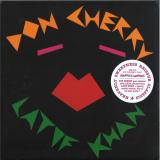
Don Cherry, armed with a voracious musical appetite and boundless imagination, first made a name for himself - though not always fully understood - alongside Ornette Coleman, playing trumpet or cornet. In Los Angeles and then New York, he stood at the heart of a revolutionary approach to improvisation based on melody rather than harmony, later baptized "Free Jazz," the final structural development of American jazz. Over time, he became a champion of improbable fusions - gradually integrating into his style a whole array of "exotic" instruments, and more importantly, the cultures from which they originated. Among them: India, Brazil, Africa, Indonesia, and even China. The time had come for the emergence of "world music": in hindsight, a patchwork rich in imagination and seduction, but once the novelty wore off, often lacking in substance.
In Don Cherry's case, however, the commitment ran deep - tied to his personal engagement with a global vision of art and the human condition. Ustad Ahmed Latif Khan, from the Delhi gharana (a musical lineage), was part of a new generation of accompanists - percussionists, sarangi players, flutists, etc. - who had extended both the technical and conceptual possibilities of their predecessors to gain recognition as soloists and soon to venture onto the international scene. Among them, Latif stood out for his taste for irregular, highly syncopated rhythmic patterns - rich in variety and originality. Don and Latif had never met before the recording session, but the two quickly recognised one another as kindred spirits - calm, focused... and full of laughter. Don clearly knew what he wanted to create, and nothing seemed to pose a challenge for Latif, who grasped the American's intentions immediately, warmed up his fingers at astonishing speed, and with his perfect pitch, naturally took on the role of tuning Don's diverse instrument collection to match whatever was found in the studio - from concert piano and Hammond B3 organ to chromatic orchestral timpani.
Search:c sar
- Anti-Manifesto
- Head? Chest? Or Foot?
- Hate, Myth, Muscle, Etiquette
- Showdown (G.e. / P.)
- Ska Sucks
- Middle Finger Response
- Stick The Fucking Flag Up Your Goddam Ass, You Son Of A Bitch
- Haillie Sellasse, Up Your Ass
- Fück Machine
- This Might Be Satire
- Who Will Help Me Bake This Bread
- Pigs Will Pay
- Homophobes Are Just Pissed Because They Can' T Get Laid
- Leg-Hold Trap
- I Want Ü 2 Vant Me
- Seemed Funny The First Time
- Not To Be Gender Specific, Of Course
YELLOW VINYL[24,33 €]
Re-issued! 1993 nahmen PROPAGANDHI ihr erstes Album "How to Clean Everything" auf und veröffentlichten es über das damals noch junge Label Fat Wreck Chords. Es versteht sich von selbst, dass das Album nicht nur das Label bekannt machte, sondern vor allem PROPAGANDHI als eine der großen Kräfte in der Punkszene etablierte. "How To Clean Everything" war ein Start nach Maß und lehnte sich noch eher an die Skate-Punk-Tradition an als die folgenden Werke der Band. Trotzdem voller aggressiver Metal/HC-Riffs und jungenhafter, bissiger Texte über Menschenrechte, Gleichberechtigung und radikale linke Politik. Sänger/Gitarrist Chris Hannah erklärt seine Gründefür die Neuauflage (mit einem Hauch seines geliebten sarkastischen Humors): ,Vielleicht liegt es an den Badesalzen, aber ich bin zu der Überzeugung gelangt, dass es wertvoll ist, etwas zu haben, das einen bis zum Tod verfolgt. Ich präsentiere euch "How To Clean Everything". Die 2026 Neuauflage enthält wie die 20th Anniversary Edition das komplette Originalalbum plus die drei Outtakes, die Fat Mike für Fat Wreck seinerzeit für die Vinylveröffentlichung rausgenommen hatte. Natürlich wurde das Album auch von den originalen Analogbändern remastert. Schwarzes und farbiges Vinyl wieder erhältlich.
[p] SEEMED FUNNY THE FIRST TIME [BONUS TRACK]
[q] NOT TO BE GENDER SPECIFIC, OF COURSE [BONUS TRACK]
Peter Rehberg is known for his pioneering electronic work with computer software which over time evolved into a modular set up alongside running MEGO and then Editions Mego labels.
Rehberg was a prolific collaborator, with other musicians and with contemporary dance and theatre productions, most notably with French artist and choreographer, Gisèle Vienne with whom he created a series of soundtracks from Showroomdummies, released under the name DACM in 2002 (Showroomdummies MEGO 056), to Crowd in 2017. A collection of Rehberg’s solo works for Vienne was released in 2008 (Work for GV 2004-2008 EMEGO 092). The outfit KTL, with Stephen O’Malley, was initiated by Gisèle Vienne for her work Kindertotenlieder and subsequently made a series of soundtracks for Vienne’s works branching off into a prolific series of live shows. The work Rehberg did for theatre and performance teased out aspects of his practice one may not have encountered in his own solo work as PITA or that of collaborations with other musicians.
Editions Mego is proud to present a previously unreleased theatre soundtrack made for Icelandic choreographer Margrét Sara Guðjónsdóttir, whom Rehberg had a decade long collaboration with until his untimely passing in 2021. The original composition for Liminal States was created by Rehberg for the performance Pervasive Magnetic Stimuli in 2018 and then revisited as a catalyst for the concepts behind Liminal States. This work is based on an ongoing artistic research conducted by the choreographer into altered states of perception through phenomenological embodiment. It is the last in a trilogy dealing with the notion of larger forces that act on us beyond our conscious mind. The trilogy consists of Pervasive Magnetic Stimuli (2018), Boundless Ominous Fields (2024) and now Liminal States (2024).
Rehberg's score for Liminal States is a vast canvas of spectral ambience at once tangible and unfathomable in its constantly shapeshifting lysergic dread. The results are a psychological journey through the mental effects of sound on space and subsequently the mind. The first part presents cascading waves of shimmering electronics laying the groundwork for the second part where the psychological illusion splinters into all manner of sonic effects taking the listener on a deep mental voyage. If references are witnessed the late period long form hallucinatory works of Coil, such as Time Machines and Constant shallowness leads to evil, are amongst a similar mind message delivered here. Unlike any other release in Rehberg’s output Liminal States is a single long form work which, despite the form, retains Rehberg’s idiosyncratic sound vision.
Guðjónsdóttir and Rehberg’s collaboration blurs that relationship into a greater force which truly enables the theme of liminal states to unfold in a brave new fashion. Rich in timbre and sonic invention this is powerful work easily holding its own outside of the intended performance whilst still complimenting the missions statement entirely. This profound collaboration has the cumulative effect where the concept and soundtrack are one and may be one of the strongest works in the entire Rehberg canon.
Es ist alles überlebensgroß, düsterer als der Tod und das beste Album, das die Horror-Punks von Creeper je aufgenommen haben.
Das Album "SANGUIVORE" hat Creepers ohnehin schon überlebensgroße Ambitionen auf neue Höhen geführt, was zu den positivsten Kritiken ihrer Karriere führte und in ihrem ersten Headliner-Konzert in der OVO Wembley Arena in London gipfelte. Historisch gesehen schließt die Band am Ende einer Creeper-Ära den Sargdeckel, um sich erneut neu zu erfinden. Doch dieses Mal trotzt die fünfköpfige Band den Erwartungen, indem sie das kreative Universum des Vorgängeralbums erweitert und am 31. Oktober mit "Sanguivore II: Mistress Of Death" aufs Neue ins Vampir-Universum eintaucht.
"Sanguivore II: Misstress Of Death" ist eher eine thematische Fortsetzung als eine direkte Weiterführung der ursprünglichen Geschichte. Wie eine klassische Horror-Anthologie spinnt es eine neue Geschichte aus derselben Blutlinie wie das Original, diesmal mit dem blutigen Vampirherz als roter Faden, um eine brandneue Erzählung einzuführen.
Die Geschichte führt uns zurück in die moralische Hysterie der Satanic Panic und ihre Auswirkungen auf die Welt des Hardrock und Heavy Metal der 80er Jahre. Es war eine Zeit, in der der verstorbene Prince of Darkness, Ozzy Osbourne und Judas Priest von Gerichtsverfahren verfolgt wurden. Iron Maiden spielte tief im Herzen Amerikas, während W.A.S.P. und Mötley Crüe mit ihrer skandalösen Theatralik und Dekadenz die Gemüter der Konservativen erhitzten.
Wie schon das Original wurde auch "Sanguivore II" von Tom Dalgety (Ghost, Rammstein, Royal Blood) produziert.
Saint Etienne kündigen mit 'International' ihr 13. und zugleich letztes Studioalbum an, das am 5. September 2025 bei Heavenly Recordings erscheint. Nach 35 Jahren Bandgeschichte, unzähligen Stilwechseln und Projekten jenseits der Musik ziehen Sarah Cracknell, Bob Stanley und Pete Wiggs damit einen Schlussstrich unter ihr gemeinsames Schaffen im Studio. International ist ein stilistisch vielseitiges Album, das von langjährigen Weggefährten, Heldinnen und Freundinnen mitgestaltet wurde – darunter Confidence Man, Vince Clarke, Erol Alkan, Paul Hartnoll (Orbital) und Nick Heyward. Die Songs spiegeln sowohl den nostalgischen Rückblick als auch die ungebrochene kreative Neugier der Band wider. Mit dem bewegenden Abschlusstrack Last Time verabschiedet sich das Trio endgültig von seinen Fans – aufrichtig, wehmütig und voller Wärme.
- Brown Is The Color
- Tame
- No Yawn
- All Odds No Chants Feat. Sara Persico & Elvin Brandhi
- Im Bann Der Wehenden Fahnen
- No Place Like
- Home
- Spellbound To Ancestral Curse
- Though The Trees Feat. Iceboy Violet
- Nowhere Everywhere Feat. Elvin Brandhi & Sara Persico
- Who, Me?
The notion of home isn’t precise, even a dictionary will offer multiple definitions. A home can be a place where you live, a place where you belong, where you originate from or a place where you’re given care; it can be a physical space, a land, a people or even a person. The concept isn’t completely universal, but everyone possesses a unique idea of what home means to them. On her fifth album, Ziúr considers not just what home symbolizes from her perspective, but the word’s resonance to the diverse community that surrounds her, and how their stories have impacted her over the years. Indeed, it’s the first time she’s felt it necessary to examine her own nationality. In the past, she’s deliberately avoided labelling herself as German, feeling disconnected from her country’s politics, culture and even the German language itself. In 2025, the idea of Germanness is in flux and progressives are under attack from all sides. The country’s politics aren’t only being turned inward by the growing throng of far-right voices, but by scared moderates, opportunists and those blinded by comfort, willing to ignore hatred to maintain their privilege. Stepping up to provide a different narrative, Ziúr scours her soul, writing and singing in German for the first time and proposing growth and evolution, not fear and regression. “I never considered being part of Germany,” she explains. “But I am.”
A solemn mood permeates the album’s opening track ‘Brown is the Color’, and Ziúr sings in measured, slow-motion breaths over noisy synth oscillations and doomed piano flourishes. Already, it’s a significant departure from her last run of releases, veering away from the frenetic, satirical chaos of 2023’s Hakuna Kulala-released ‘Eyeroll’ or its fantastical, dubby predecessor ‘Antifate’. Ziúr pulls on real world insights here, tracing her oldest, dearest musical inspirations to present her origins to anybody who might be listening. “Cold world is holding up,” she laments with a metallic crunch. “To let go of your heart, let me go.” And her voice emerges from the shadows completely on ‘Tame’; unprocessed, Ziúr sounds naked and vulnerable on ‘Tame’, curving her precise words around broken, lopsided rhythms and jangling new wave guitars. It’s pop music in its own way, inverted and reconstructed to fit snugly into her well-established sonic landscape. On ‘No Yawn’, brittle, downsampled hi-hats and industrial scrapes ping-pong around distorted riffs, provided by James Ó Ceallaigh aka WIFE; “You fail to sugarcoat your half-ass attempt,” she deadpans, “to build your promised wonderland on quicksand.” Even the beatless ‘All Odds No Chants’, a collaboration with Elvin Brandhi and Sara Persico, reveals another room in Ziúr’s autobiographical suite, mirroring György Ligeti’s enduringly influential choral works with its gnarled, dissonant vocal harmonies.
Electric Satie is a one-off conceptual project by Japanese composer Mitsuto Suzuki, who is mostly known for his work on Final Fantasy soundtracks. Released on CD-only in 1998, “Gymnopédie ’99” reimagines Erik Satie’s beloved piano compositions in electronic form ranging sonically from downtempo bossa-nova (featuring Brazilian percussionist Marco Bosco and vocalist Silvio Anastacio) to freestyle ambience and chillout room IDM, not far from the music featured on Music from Memory’s “Virtual Dreams II” or Warp Record’s “Artificial Intelligence.” A deeply imaginative composer and arranger, Suzuki harnesses a unique mix of drum machines, synthesizers, live percussion, soprano saxophone, piano, and spoken word to craft a lush and vividly futuristic sound world that video game soundtrack enthusiasts will easily fall into.
- A1: Overture
- A2: Main Title - The Cowboys
- A3: The Hands Quit
- A4: The Boys
- A5: Wil And Ann
- A6: The Kids And Crazy Alice
- A7: Graveyard
- A8: Anybody That Tall
- A9: Training Montage
- A10: Long Hair And The Roundup
- A11: Nightlinger's Tale
- B1: To Belle Fourche
- B2: The First Night
- B3: Burning Daylight
- B4: Learning The Ropes (Vivaldi - Concerto In D)
- B5: Sour Mash
- B6: Long Hair's Threat
- B7: Mrs. Collingwood's Girls
- B8: Entr'acte
- B9: Afraid Of The Dark
- B10: Charlie's Demise
- B11: Charlie's Burial
- C1: Long Hair Trails
- C2: Long Hair And Dan
- C5: Into The Trap
- C6: The Battle
- C7: End Title And End Cast
- D1: Entr'acte (Segment)
- D2: Nightlinger's Tale (Alternate)
- D4: Long Hair's Threat (Alternate)
- D4: The Execution (Alternate)
- D5: Into The Trap (Alternate)
- D6: End Title And End Cast (Alternate)
- D7: Exit Music
- C3: Summer's Over
- C4: Drums Of Manhood And The Execution
- Meta Y Guaguancó
- Si Los Rumberos Me Llaman
- Cuando Suenan Los Tambores
- Galletana (Aka Calletana And Cayetana)
- Dulce Con Dulce
- El Sabio
- Caramelo A Kilo
- Mulence
- Yiri-Y Ri-Bom
- Sancocho E'güesito
- Invitación Guaguancó
- Tumba Tumbador
- Macho Cimarrón
- Rompe Saragüey
Classic Latin Tunes Became Sals Hits! Pablo Yglesias -aka DJ Bongohead- compiles Grosso Recordings an amazing serie with classics tunes from Caribbean music that became great successes of "Salsa". Some tracks have been remastered and restored, others are presented on vinyl again after many many years. "This is the four volume in our series on the Roots of Salsa...The main criterion was to pick tracks that sounded adequate for today's DJs to play at a gig or were sufficiently interesting (or enough of a surprise to fans of the later version) to merit inclusion. The other measuring stick was that they needed to come from the old-school, before the more modern era (from 1962 on) and all of its recording innovations and marketing strategies...for now, listen to these dozen gems and then go back to their more familiar cousins from recent times and compare and contrast, and we're sure you'll be enlightened and entertained." Liner notes by Pablo "Bongohead" Yglesias. Format and selection designed for DJs, collectors and general public.
Alvorada is Montanha’s first long play: an ambient-leaning work, nocturnal in mood yet touched by electricity, tracing a journey from waking activity into dream logic. Recorded mostly in the late hours of the evening with windows open to the city, letting its air and sounds influence the music, it sometimes reached the early moments of sunrise. The title, meaning “dawn,” reflects both the liminal hours of its making and the band’s own renewal. These tracks are closer to drawings than songs: narratives written between instruments, moments of tension and release, fragments of memory and dream. The tracklist follows this nocturnal voyage with the patience of Eno, the disquiet of Uematsu, and the madness of Miles Davis’ Decoy, oscillating between streets and sleep, routine and reverie.
Montanha was formed in 2010 by André Azevedo, Nuno Oliveira, João Sarnadas, and Tito Silva, bonding over architecture school all-nighters on videogame soundtracks (Age of Empires, Super Mario). They began as a psychedelic rock combo and in 2013 released their self-titled EP which introduced a raw, improvised energy. But the album that was meant to follow was abandoned as the band entered hiatus. The four members turned their creative drive towards co-founding Favela Discos, where experimentation with media and form reshaped their ideas of music, and developed their taste, their way of playing, and a more personal sound that was more open and disconnected from a defined genre.
By 2017, Montanha had returned to the studio with new experience, no longer a rock band in the traditional sense but a project devoted to improvisation and electronic soundscapes. An ever gentrifying city forced them to abandon acoustic drums, and they embraced electronic beats instead, and became mobile; one guitar dissolved into full synths, leaving the other to converse with bass. Improvisation remained their compass. In improvisation there are no mistakes, only missed opportunities. Montanha found their opportunity in the routine of the studio to break routines of pop and experimental. The result is a body of nearly fifty hours of recordings, sculpted into an album.
Alvorada is not only Montanha’s first LP but also the dawn of their new phase. Improvised yet carefully sculpted, the record expands the territory of the song into nonlinear narratives, letting the language of night, dream, and city seep into its form.
- 01: Black Power (Feat. Donna Summer)
- 02: Mao (Feat. Joe Ki Und Die P.t.s.g.)
- 03: Lesbische Nummer
- 04: Tabarin Soul Shake
- 05: I Have No Friends (Feat. Joe Quick)
- 06: The World Has Gone (Feat. Joe Quick)
- 07: Haschkeller
- 08: Jazz-Kater
- 09: Soul Food (Feat. Joe Quick)
- 10: Night Trip
- 11: Moonflower Q 70
- 12: Karthago Ist Grün (Feat. Joe Ki Und Die P.t.s.g)
- 13: Beat-Schuppen Suite (Feat. Joe Quick)
- 14: Pozzolico
- 15: Midnight Love
- 16: Otran Limited Respettivo (Ii)
- 17: Snake Dance
- 18: Foreign Music Limited Alpha 80
- 19: Sphinx
- 20: Bal-Tha-Sar
Vol.1[28,99 €]
The second installment of The Tape Masters series by German film music maestro Peter Thomas. Audiophile pressing in deluxe 2x10" vinyl set, limited to 500 copies.
While volume one of the series compiled Thomas' dopest library music cuts, this album dives deep into the soulful side of the Peter Thomas Sound Orchester, featuring the mystique house band of Afro-American Munich GI club Tabarin Bar, Donna Summer's first solo recordings, stunning cinematic funk instrumentals and a healthy amount of breaks and beats.
Out of the 20 scorching tunes on this compilation, only three were released at the time of their recording and are nearly impossible to find on the 2ndhand market, ten have never been released anywhere before, others celebrate their first outing on vinyl or in stereo.
Peter Thomas is widely acknowledged as Germany's most inventive film music composer of the 1960s and 1970s, best known for his iconic soundtracks. Today, his work is cherished not least for its incredible groove factor. The story of this compilation traces the origins of the Peter Thomas Sound Orchester's rhythm section and its soul music background, shines a light on unsung heroes like singer Joe Quick and unearthes nuggets that have been lying dormant on tape for decades.
All music was carefully transferred from Peter Thomas' private master tapes and cut in full dynamics, housed in a beautiful fold-out cover with liner notes and private pictures. The compilation is released in cooperation with Peter Thomas' son Philip who represents the Peter Thomas Sound Orchester catalogue since his father's passing in 2020.
- Intro
- Sarah (Frau, Auch In Ner Band) Feat. Alex Pascow
- Gestern Emergenza
- What Afd Thinks We Do
- Unser Lehrer Dr. Specht
- Pizza Napoletana
- Steppenwolf
- Unsere Kneipe
- Dagmar Wöhrl
- Was Ist Eigentlich Dein Scheiß Problem?!
- Das Schöne Leben
- Ich Vs. Mich Vs. Euch
- Nachbarn
- Schäm Dich!
- Zwischen Thermomix & Webergrill Feat. Hc Baxxter
"Die große Palmöllüge". Alles steht hier im Zeichen der Verschwörungstheorie. Geht Palmöl nun klar oder ist die Abholzung des Regenwaldes am Ende etwa eine Riesensauerei - die Welt teilt sich in zwei Lager. Fridays for Future, regionale Kleinbauern und Orang Utans scheinen sich einig: geht eher nicht so klar. Hier halten wiederum ausgewiesene Klima-Experten dagegen, z.B. Jan Leyk (bekannt aus "Berlin Tag & Nacht"). Der sagt nämlich, dass die "bekackte Tofuwurst dafür sorgt, dass verschissen nochmal die Regenwälder abgeholzt werden". Palmöl, Facepalm - whatever_ Was hat das jetzt alles mit dem neuen Album des linksgrünversifften Punk-Quartetts Akne Kid Joe am Hut? Die sind Team Orang Utan und FFF, soviel erstmal dazu. Aber steht denn wirklich alles im Zeichen der Verschwörungstheorie? Wer aufgrund des Album-Titels nun eine Konzept-LP gegen nutella und co. vermutet, muss leider enttäuscht werden. Wie schon auf Karate Kid Joe wird sich hier auch wild echauffiert, die Palette ist nun aber deutlich breiter. Zentrale Themen sind - klar, Verschwörungstheorie - aber auch linke Klassiker wie Vaterlandsverrat, Saufen und Beamtenbeleidigung. Mitunter wird es auf der neuen Scheibe aber auch richtig deep, z.B. mit einer 1,5 minütigen Nacherzählung eines Beziehungsendes im Italien Urlaub. Oder der Frage was nun besser ist - "Free Hugs" oder "Love Yourself" T-Shirts.
- 01: Parixan Nissan
- 02: Genesis
- 03: Tarian Sari (Funky Remix)
- 04: Karpet Ajaib
- 05: Sunda Megathrust
- 06: Prau Layar (Kapal Selam Version)
IS THE BEST is the manifestation of Prontaxan's collective mindset as a music group formed by visual artists, musicians, producers, and filmmakers.
IS THE BEST tells a story about release — how the constraints of routine can break free through celebration, and how Funkot becomes a universal language to speak about resistance, pressure, and acceptance of reality within the context of today's working class.
IS THE BEST is an expression of this phenomenon — where a masterpiece is one that breaks out of its shell to shine, be admired, discussed, and criticized by its audience.
IS THE BEST is born as Prontaxan's remedy for electronic music lovers across the globe.
On her fourth full-length album as Shedir, Sardinian sound artist Martina Betti offers a profound meditation on what it means to be human on the threshold of uncertainty.
We Are All Strangers is a series of ambient tapes-tries shaped by duality and introspection, where sound becomes a space to explore the tension between identity and ambiguity, presence and disappearance, connection and solitude. Inspired by the idea that we are all strangers, however, first and foremost to ourselves, Betti crafts seven fluid, slow-burn compositions that inhabit a sociological liminal zone—what she comments as an “inner elsewhere.”
These aren’t songs in the traditional sense, but evolving sonic environments that feel like emotional states made audible. Environmental textures, submerged electronics, and deep low-end pulses coalesce into a dreamlike architecture of sound: immersive, fragile, and quietly transformative.
Rather than offering answers or closure, the album invites us to live in radical openness—to stop trying to define everything we see and feel, and instead bathe in what remains unnamed. In this sense, We Are All Strangers is an invitation: to sit with uncertainty, to embrace the unfinished, and to find resonance even in our collective disconnection.
For listeners drawn to the introspective frequencies of Rafael Anton Irisarri, Félicia Atkinson, or Lawrence English, Betti’s music offers a similarly haunting and immersive experience—one where strangeness is not a flaw, but a starting point. In her hands, ambient music becomes a kind of reflective shelter: a place to brush against each other in the dark and begin to learn, as she puts it, “the difficult art of closeness.”
- A1: Rikard From - Saw It On The Radio (2 50)
- A2: Robert Gromotka - No Jive (2 27)
- A3: Becky Ainge - Cut The Jazz (2 01)
- A4: Rainer Oleak - Dummes Spiel (3 49)
- A5: Dennis Korn - Kartoji Man (2 32)
- A6: Sarah Watson - The Mambo Craze (2 11)
- A7: Isaac Alstad - North West (2 27)
- A8: Leonard Lehmann - You Stayed (2 27)
- A9: Eckes Malz - Time Slips (2 38)
- B1: Bugge Wesseltoft - Jeunesse Doree (4 01)
- B2: Jonas Hain - When No Words Come (2 20)
- B3: Ulf Kleiner - Anchorless (2 46)
- B4: Ana Rebekah - My Society (2 55)
- B5: Stein Austrud - Lettre Au Pere Noel (3 16)
- B6: Cristian Vivaldi - Jazz Music (2 15)
- B7: Martin Bohmer - Our Relationship (3 38)
- B8: Lera Palyarush - Back From Where I Started (2 45)
We’re happy to announce the “Planetary Shift” EP by our friend O-Wells with an additional remix by Bangkok’s finest Sarayu from More Rice. An EP that combines friendship and a long overdue Ozelot-cosmos release. After we heard “Planetary Shift” a while ago for the first time, we kept insisting on releasing it- Now we’re happily presenting it to you in the form of a 4 track EP.
The record orbits around O-Wells’ signature style: dub-inflected drums, slithering synth lines, and percussive patterns that never sit still. There’s a sleek futurism to these tracks, but they feel worn-in, like spacecraft that have already charted the edges of known space. Across the EP, O-Wells embraces tension and release—rolling low-end pressure that swells, only to dissolve into weightless melodic fragments.
The result is music that feels in constant flux, forever shifting through sonic terrain without losing its pulse. Anchoring the EP is a remix from Sarayu, a key voice from Southeast Asia’s flourishing electronic music scene. Known for threading traditional rhythmic sensibilities into contemporary club frameworks, Sarayu flips O-Wells’ abstract groove into something tactile and urgent. His version turns the track inside out—primal percussion and humid atmospheres pushing the original’s spacious minimalism toward a more grounded, earthy palette. It’s a vital rework that expands the release’s global reach, bridging Frankfurt and Bangkok through the shared language of rhythm and friendship – Overall, the reason why we do what we do.




