After 6 years, label boss Ewan Jansen circles back to Red Ember’s main with a new EP.
A concept journey equally for the mind and the dancefloor that strays from his house roots with themes of mysticism pushing wider rhythm palettes and creative synthesis.
The opener ‘Solanoid’ marches over the horizon; a solid progression of sun-scorched chords, goaded by some distinctive chanting synths and driving bass.
‘Caravania’ answers as a stomping IDM-esque fable, joined by bubbling rhythms on the ground and a central writhing serpentine synth guided from high above by voices unknown.
The flip side quickly de-camps from the physical, with the organic ‘Mistik’ seeing elements of rave and tribal electronica driven by tuned kicks, sub-bass and resonant rhythms.
Lastly, a stoic tome of stone and water is left with ‘Gecko’ – a skittish chunky groove, with isolated melancholic tones that find harmony in the end.
Buscar:ca ra j
12" + 7" !
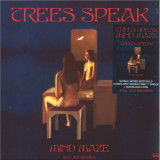
Mind Maze is, amazingly, Trees Speak’s fifth album to be released on Soul Jazz Records in the space of little over two years– an output matched only by the intensity of their music created during this short time.
The first pressing only of the album comes with a bonus seven-inch single containing two tracks that are not available on vinyl anywhere else.
As with all their previous releases, ‘Mind Maze’ is a mind-boggling tightrope walk across an array of musical influences that seamlessly create the unique present-day world of Trees Speak.
The band’s sound is characterized by a combination of German krautrock motoric-beat rhythms, angular New York post-punk attitude, 60s spy soundtracks, psych, rock, jazz, and 70s synthesizers and vocoders. There is also a cosmic spatial awareness to their sound; both personal inner space and galactic outer space, as well as a wilful pushing of sonic boundaries.
Trees Speak are a musical duo based in Tucson, Arizona, composed of Daniel Martin Diaz and Damian Diaz. Their music is heavily influenced by the cosmic magic of the natural desert landscapes of Arizona, creating a unique and captivating sound that is both experimental and innovative.
Here you will find the myriad sounds of 1970s German electronic music (everything from Can to Cluster, Popul Vuh to Tangerine Dream); 1980s New York post-punk and synthcore (from No Wave to Suicide); John Barry’s 1960s movies, John Carpenter’s 1970s horror. You will also hear the influences of French and Italian progressive rock (Magma, Goblin) as well as cosmic, new age and experimental space soundscapes …. an almost endless list of diverse influences that ebb and flow like an ocean of sound, in the process creating a truly unique soundscape that Trees Speak have made wholly their own.
The name Trees Speak reflects their interest in the concept of using future technologies to store information and data in trees and plants, with the idea that trees communicate collectively. This interest in nature and technology, combined with their passion for experimentation, has led Trees Speak to create a truly one-of-a-kind listening experience that is both unique and engaging.
If you ever wanted to hear Can, Neu!, Destroy All Monsters, Pere Ubu, electric eels, John Cage, Liquid Liquid, Tangerine Dream, Suicide, Laurie Spiegel, Art Ensemble of Chicago, John Barry, Mother Mallard’s Portable Masterpiece Company, Sun Ra, Stockhausen, John Carpenter, Electro-Acoustic and Musique Concrete and Mars in one band - then this is it! Trees Speak are a band that defies categorization and offer an eclectic listening experience, both exciting and memorable.
The two bonus tracks (‘Seraphim’ and ‘Orpheus’) included with the album give us a further window into the complex mind maze of the group - two stunning acoustic tracks that explore a distinct early 70s sound of Yes, Argent and other progressive rock accolytes.
To many crowds the world over PBR Streetgang are known and loved for their talents behind the turntables, selecting at most major festivals and clubs of note but to others they are producers and remixers whose eclectic taste and evolving style has seen them enjoy longevity and critical acclaim. This album is a rare selection of originals and remixes that shows the breadth of their work.
Featuring early original hits that propelled them into the limelight, like ‘Downstroke’ and ‘J2Thab’, and more recently their stand out disco tinged nugget from their debut album ‘Late Night Party Line’.
Previously un-pressed remixes like the cult classic rework of Romathony’s – 'Bring You Up' and the slow chuggy sleaze of Bryan Ferry – One Night Stand and the teary eyed euphoria of their remix Hot Chip’s - 'Melody Of Love'.
This compilation represents an honest retrospective of the production and remix talents of PBR - always keeping true to their sound and themselves.
Limited Vinyl Press.
DJ Support from a very broad base.. from Paul Woolford and Bicep to Jennifer Cardini and Daniel Baldelli.
Dune Castle Records Presents… For Private Use Only by Cantrips, two heaving psychedelic funk pieces composed by Cantrips' Patrick Ryan and recorded over one day by a studio band including members of Surprise Chef and Karate Boogaloo.
Cantrips is a Melbourne psychedelic funk and cinematic soul group led by multi instrumentalist and studio producer Patrick Ryan. With heavy groove sensibilities, Ryan composes head nodding psychedelic funk music from the Dune Castle Throne Room, a DIY studio in Thornbury, Melbourne, from where he operates the label Dune Castle Records. Ryan composed two tracks in homage to David Axelrod's work with Psychedelic Pop band The Electric Prunes in the late 1960s. Ryan performed these pieces with members of Surprise Chef, with Henry Jenkins (Karate Boogaloo, Surprise Chef, Emma Donovan and The Putbacks) producing the two pieces.
This release follows a psychedelic funk LP composed by Ryan under Dune Castle named Dark Age Martial Arts. A self released record; it was nominated for the Australian Music Prize 2022. It received airplay and support from Radio DJs around Australia on stations such as PBS, RRR and FBI, as well as featuring on radio shows across England, Scotland and France. It also received considerable support from record stores in Australia and the UK.
Angelo is an LP, named after a car, featuring nine songs Brijean have crafted and carried with them through a period of profound change, loss, and relocation. It finds percussionist/singer Brijean Murphy and multi-instrumentalist/producer Doug Stuart processing the impossible the only way they know how: through rhythm and movement. The months surrounding the acclaimed release of Feelings, their full-length Ghostly International debut in 2021 which celebrated tender self-reflection and new possibilities, rang bittersweet with the absence of touring and the sudden passing of Murphy’s father and both of Stuart’s parents. In a haze of heartache, the duo left the
Bay Area to be near family, resetting in four cities in under two years. Their to-go rig became their traveling studio and these tracks, along with Angelo, became their few constants. Whereas Feelings formed over collaborative jams with friends, Angelo’s sessions presented Murphy and Stuart a chance to record at their most intimate, “to get us out of our grief and into our bodies,” says Murphy. They explored new moods and styles, reaching for effervescent dance tempos and technicolor backdrops, vibrant hues in contrast to their more somber human experiences. Angelo beams with positivity and creative renewal — a resourceful, collective answer to “what happens now?”
Angelo the car is a 1981 Toyota Celica they got off Craigslist during their first stint in Los Angeles, where Murphy and Stuart have since settled. “Such a bro-y, ‘80s dude car, it’s been super fun to drive around in a new town,” Murphy says. “He’s older than us, he’s a classic, he’s got a story.” It is a spiritual vehicle with a cinematic appeal, first dropping them off in an alleyway for the scene-setting intro, “Which Way To The Club.” The question is quickly resolved by “Take A Trip” as a cruising bassline mingles with crowd sounds, hand-claps, cuíca hiccups, whip-cracks, even a horse neigh. Brijean have found some club on this cross-dimensional trip — the kind of
imagined space or chamber within one’s self capable of “shifting a fraction of who you are,” says Murphy. They wrote the track with the simple intention to be “as free as we could be,” adds Stuart, likening the flip on the B section to a realm unlocked: ”What if the world changed completely? You open the door to a new room.”
Next is “Shy Guy,” a motivational anthem for the wallflowers among us. Murphy sets up the daydream: “We are in junior high, we’re on the dance floor, what’s going down, who is dancing, who is not, how are we gonna make them dance?” The narrator, the MC, hypes up the room as conga-driven rhythms bounce between languid synth and guitar lines. “Show me how to move...I feel something...I know you feel it too,” Murphy sings sweetly, calling back to the opening lines of Feelings, and this time the audience chants it back. It is easy to picture Brijean performing this one — something they only got to do a handful of times until more recently, opening shows for Khruangbin and Washed Out, an experience they found informative. Murphy explains, “It was inspiring to be out there and let loose more. To see how people can expand their expression on stage gave me more liberty with how I viewed my musicianship. My role for so long was to be a backup percussionist, so why would I ever leave the drums, you know? But then after playing all these runs, you see these artists and realize you can, you have permission.”
“Angelo” and “Ooo La La” deliver the danciest stretch in Brijean’s catalog to date. The title track adopts a deep house pulse replete with strings, hi-hats, and kicks. The latter opts for a funkier groove that foregoes verses in favor of warbled hums and extended breakdowns. What follows is perhaps the duo’s dreamiest run, a comedown initiated with the honey-hued interlude “Colors” drifting into “Where Do We Go?”, a tropicália reverie where Murphy contemplates the passage of time and space.
It all culminates in “Caldwell’s Way,” a fond farewell to their Bay Area community — “a part of my life that I knew couldn’t come back,” says Murphy. Above shimmering organ sounds, lush strings, and the birdcall of their former neighborhood, she wistfully articulates the uncertainty of moving on by remembering the characters dear to them. There’s the wisdom of their neighbor, Santos, who refused payment when helping them move out: “I’d rather have 100 friends than 100 dollars.” And the song’s namesake, Benjamin Caldwell Brown, a friend and club night cohort for many years. “I’m only miles away, maybe I’m just feeling lonely,” the line resigns to warm nostalgia, and “Nostalgia” runs the closing credits to this healing and transportive collection.
"A Place For Love" is a captivating electronic house music endeavor, expertly crafted by the synergistic partnership of San Proper and Figi, hailing from the vibrant city of Amsterdam. The project boasts an impressive roster of guest contributors, including Tom Trago, Seth Troxler, and the esteemed label heads of Guti & David Gtronic, each imbuing the compositions with their signature style. The project exudes a funky, charming, and inviting energy, inviting listeners to fully embrace their individuality and lose themselves in the hypnotic beats. Whether it be the electrifying dubby techno, the shimmering and ethereal twists, or the razor-sharp edges injected into the club-ready tracks, "A Place For Love" offers a diverse array of auditory delights. It is truly a sanctuary for those seeking to indulge in the boundless beauty of electronic music and the euphoria of self-expression.
One of Drumcode's solid MVP's Wehbba comes strong with a sci-fi themed trio of tracks to kick off 2023.
The Brazilian enjoyed another stellar year in 2022, with highlights include the excellent 'Dynamo' EP on Drumcode in April, a contribution to A-Sides ‘The Next Step' and collaborating with Adam Beyer to remix the classic Planetary Assault Systems cut ‘In From The Night’.
He likewise played Drumcode's WHP, our NYC event at Avant Gardner and Drumcode São Paolo to round out the year.
His latest EP on Drumcode ‘Premonition’ is an atmosphere-rich, intergalactic-themed trip that plays out deliciously over three cuts. The title track is imagined as a kind of travel through space and time, propelled by sci-fi synths, Wehbba’s trademark full bodied basslines and a cleverly placed sample from a David Bowie interview.
‘The Message’ is a dynamic beast of a track driven by robotic synth stabs, a catchy melodic riff and memorable vocal refrain ‘Mars Needs Women’ sampled from a 1950s sci-fi film. It has all the ingredients to be another classic addition to Wehbba’s discography. ‘Inertia’ is led by a hypnotising riff that builds over six minutes.
“I love to play this track after a series of rave bangers to keep the energy levels up while taking people on a trip,” shares Wehbba.
On April 7th electronic luminary Nathan Fake presents the new longplayer ‘Crystal Vision’ on his own Cambria Instruments imprint, which features collaborations with Clark and Wizard Apprentice.
This is music for music’s sake – recorded without angles, agendas and themes – so Fake was free to simply continue honing his craft and express himself non-literally. Aptly titled, there’s a clarity of execution and ambition, and a peak effectiveness to the record that just sounds right.
Continuing to set a personal bar higher and topping his own best, the mark of master craftsperson is everywhere, but that doesn’t mean it’s polished; There’s plenty of rawness evident, with spiky sonics keeping ears on high alert – full of endorphin-flooded rave energy.
Following a short, scene-setting ‘Arrival’ – a simple major chord arpeggio played on a Jupiter 6 which sounds like curtains opening at dawn, things begin apace with ‘The Grass’, which hurtles like a precision-tuned bullet train through Arctic tundra. The undulating effect of compression is emphasised by the classic techno trope where 2 rhythms jar yet interlock, creating an exquisitely disorientating strobe-like flutter. On the track’s guest, Fake comments, “I fell in love with Wizard Apprentice's ‘I Am Invisible’ and felt our musical styles were similar. Their vocals are smooth and clear and sharp at the same time. They’re like a calm within the storm.”
Inspired by Italo disco but sounding wholly alien and futuristic, ‘Vimana’’s fizzing buzzsaw arpeggiated bassline, popping snares and bright whirling melody are equally an electro trance melange, with an effervescent major chord Arp that kicks in midway.
Reminiscent of what used to be called ‘funky techno’ but with sparklier sounds, ‘Boss Core’ blinds like sunshine bouncing off ice. Using his trusty Boss DR550 drum machine, and inspired by Autechre's ‘Vose In’, the track peaks by reaching that melancholic/euphoric axis for which he is loved.
With chugging slow breakbeats not a million miles from Board Of Canada or trip hop, ‘Crystal Vision’ rolls along, with the melody opening up, revealing more hidden notes as it progresses, building into a fractal, kaleidoscopic mosaic.
An emotional outpouring with serotonin surging through the circuitry, classic breakbeats and layers of lazers, ‘Bibled’ has all the hallmarks of a classic. This is a bonafide festival-set closing, hugging-your-mates, moment – or, with its guitar solo, “a power ballad” – as Nathan calls it.
A minimalistic moment of calm midway through the album, ‘CMD’’s gently comforting dreamscape is conjured with FM stacked and detuned sine waves which are left to breathe, whilst the chunky Chicagoan house jack of ‘Hawk’ brings to mind classic Relief records, but even more detuned and wibbly, and laden with synths.
As the title suggests, ‘Amen 96’ is in Fake’s own words, “me having a go at jungle. I grew up listening to it, and I remember as a teenager it sounded like the most intense and otherworldly music ever. It still does. This track is an experiment to see how my melodic style works against amen breaks”. Closer to the braindance end of the spectrum than ‘proper’ jungle (and all the more interesting for it), Fake channels the spirit of Squarepusher but makes it his own, brimming with melodious twinkle.
A collaboration with Nathan’s close friend and genuine musical hero Clark. ‘Outsider’ finds this dream team alchemising pure gold that’s bigger than the sum of their parts. Skittering, intense, far-reaching end epic, the pair close proceedings on a grandly dramatic note. In 2020 Nathan released the album ‘Blizzards’, which was described by The Quietus as “his best work”, and “his best LP yet” yet by Resident Advisor. The equally well received ‘Blizzards Remixes’ EP which featured Afrodeutsche and Irene Dresel followed in 2021, as did a nationwide UK tour.
An in-demand remixer, Fake has added his magic to tracks by Radiohead, Clark, Perc, Jon Hopkins, GoGo Penguin, Dominik Eulberg, Christian Löffler and Damian Lazarus, working for labels including Ninja Tune, Domino, Warp, Blue Note and Kompakt.
A lost MPB gem from rural Finland! We Jazz presents the first ever reissue of this rare 1990 local release by Brazilian duo Rosanna & Zelia. 7" EP with inside out 3mm spine sleeve. RIYL: Gilberto Gil, Joyce, Musica Popular Brasileira, bossa nova, bossa jazz
Liner notes by Mikko Mattlar:
"Rosanna & Zélia were a Brazilian duo of singers and musicians Rosanna Guimarães Tavares and Zélia Nogueira da Fonseca. They moved from Minas Gerais, Brazil to Europe in 1988, released five albums in Germany between 1993–2004 and featured vocals on an Ian Pooley house track Coração Tambor before Rosanna died of cancer in 2006. Zélia still continues her career in Germany, touring actively and releasing new music.
The duo's journey from Brazil to Germany also included two brief visits to Finland. In the years 1989–1990, they spent time in the small town of Seinäjoki in Ostrobothnia. Rosanna & Zélia performed Brazilian music in Finnish clubs and festivals and recorded a 7" EP for local label Maumau Music. The record was distributed mostly in the Seinäjoki area, but the three songs are well-performed and authentic Brazilian MPB, so the largely unknown record now gets its first reissue for a wider audience on We Jazz Records.
But how did two Brazilian women find their way to a small Finnish town to record an EP? The main reason for this was music journalist and promoter Risto Vuorinen, who was on a holiday in Albufeira, Portugal, where a friend of his lived. The streets were almost empty that evening, but Vuorinen and his friend heard fine guitar playing and singing from a bar. There were Rosanna and Zélia performing on a small stage, and the two Finnish men happened to be the only customers. When the artists ended their performance, Vuorinen's friend, who spoke Portuguese, went to talk to them. Rosanna and Zélia told him they had recently come from Brazil and are trying to gain ground in Europe with their music.
Because Rosanna and Zélia didn't know where they would head next, and because Vuorinen liked their music, he thought of bringing the duo to his hometown, Seinäjoki. They immediately liked the idea, and in the autumn of 1989 they arrived in Finland. The national Finnish jazz festival was held in Seinäjoki, and Vuorinen thought Rosanna & Zélia's Brazilian music would fit right in. They performed at the festival and in November 1989, also made recordings in a local studio with backing musicians from Seinäjoki.
Music enthusiast Pertti Hakala had a record shop and label Maumau Music in Seinäjoki releasing music from local artists. He released a three-track EP from the sessions. with two tracks written by Rosanna & Zelia themselves and their cover version of Extra (Brazilian Reggae), written and originally performed by Gilberto Gil in 1983. A small pressing was made for the Finnish market, and Hakala also sent a box of records to Brazil, but for some reason it was sent back.
After their first visit to Finland, Rosanna & Zélia headed back to central Europe, but Vuorinen decided to organize more performances for them for the next summer. Maybe he also wanted to show them the beautiful Finnish summer, as Rosanna and Zélia had so far seen the country only during the darkest autumn. The duo came back to Finland for the summer of 1990 and performed at the Womad world music festival organized as a part of local Provinssirock. They also played in Nummirock and Puistoblues, both respected music festivals, and performed on TV in Helsinki.
Rosanna and Zélia lived in a small apartment in Seinäjoki and played two to three gigs per week all summer. Because there were only two of them, even small pubs could afford to book them, and in 1990 the economic situation in Finland was good. It was before a major economic depression hit the country. The duo travelled by bus or train, and because they were an acoustic duo, they could easily carry their instruments in public transport. Vuorinen got excellent feedback from organizers. Rosanna and Zélia were good performers, but also really nice people.
With the income from their summer gigs, Rosanna and Zélia could buy a PA mixer and other musical equipment. When the summer 1990 turned to autumn, they continued their journey from Seinäjoki to Germany where they settled down."
One of techno's most joyous experimentators delivers two intriguing uptempo tracks. Instead of hitting hard and heavy 'In Aggregate' and 'Carob' float delicately, with explosive detail blooming freely and high above what feels rather like a bass-ladden undercurrent than a persistent kick drum foundation.
Both tracks expand on Stefan Goldmann's extensive polyrhythmic research and integrate tonal and metric functions within the same units of sound. Somewhat radically, the central sound of 'Carob' is all
in one: beat, bassline and single-note melody. By contrast, 'In Aggregate' unfolds lush layers of exuberant percussion, countered by rounded drops of bass and an occasional vocal snippet ricocheting off of claustrophobia-inducing walls of glass.
As future-forward as they are organic, these offerings come with appropriately idiosyncratic artwork by Jorinde Voigt.
Staran Wake is a collaborative project by Andrew Bunsell and Tom Relleen. After several years creating music in various groups together, followed by countless hazy late night recording sessions at each other’s studios and crisper afternoons producing the results, the British duo’s musical vision materialised with this self-titled instrumental album, taking nearly 4 years to complete.
This collection of pieces is composed with a wide range of instruments and combines multiple dark, experimental genres to form a rather lavish and unique proposition. It is imprinted with intense turgid textures, interweaving the hyper-tactile characteristics of analogue sound with field recording elements and sound effects.
Although the project’s name suggests a rather celestial concept (‘an’ means moon in one of the early protolanguages), the music actually explores the intimate feelings of transient space and otherness. It uses subtle build-ups of tension and repetitive progressions to shape an impression of distended time and space. More than a mere treat for the ears, it’s a multi-layered album that invites reflection.
All tracks composed, performed and recorded by Andrew Bunsell and Tom Relleen at Dalston Studios, Space Studios and The Bunker, London, UK
Arranged, produced and mixed by Andrew Bunsell and Tom Relleen at The Bunker, London, UK
Mixed and mastered by Marta Salogni at Studio Zona, London, UK
Artwork and design by Jonas Meier
Inner Zone’s latest project marks the launch of their brand new eponymous label - the first EP in what’s set to be a run of self-released work. Kicking things off in style, Neurolink arrives with supercharged energy thanks to sizzling breaks, wonky rave chords and blissed-out vocal samples. Next up, My Mind is a winding journey through signal-firing, synapse-stimulating percussion - this time the breaks are faster, more vortex-like. Fragmented vocals and a nostalgia-tinged melody combine to create the gloomy euphoria of the third track, Dark Night. The Final track, Crystal Cut, is spell-casting - a heady potion of ethereal chimes, paired with a delicate melody, guides us into a state of hypnosis. Inner Zone’s latest release offers a contemporary re-imagining of the much-loved sound of breaksy, rave-hued, 90s dance floors.
Very few electronic music artists can boast of spanning a wide musical spectrum as the UK producer Calum Lee aka Paleman / Fresnel Lens.Always emphasizing the percussive side (advantage of being a jazz drummer), and always with an innovative spirit, the releases of this authenticsound designer oscillate between the most abstract / experimental electronica and minimalist club focused techno, from atmospheric andintrospective works to the sickest dubstep / bass music.
As at 30D we declare ourselves absolute fans of Calum's music, we had a clear obligation to ask him to join our catalogue, specifically for the EyesHave It sub-label (we had especial interest in his interpretation of broken, dark and industrial techno). His answer was direct and unmistakable:"I've sent you a lot of pieces that fit with your label vision and the imagery that we love.. I've been studying existentialism a lot recently, so thesetunes are a reflection of my headspace at the moment!".
A true declaration of intent!And here it is, five perfect examples of obsessive tribal madness, overexciting synthetic broken beats and a lot of rawness. A pure musical gem.
- A1: Garbage Day #3
- A2: Get-U-Now
- A3: What A N*Gga Know?
- B1: Sweet Premium Wine
- B2: Plumskinzz (Loose Hoe, God & Cupid)
- B3: Smokin’ That S*#%
- C1: Contact Blitt
- C2: Gimme
- C3: Black Bastards!
- D1: It Sounded Like A Roc
- D2: Plumskinzz (Oh No I Don’t Believe It!)
- D3: Constipated Monkey
- D4: F*#@ Wit’ Ya Head
- D5: Suspended Animation
Black Vinyl[30,67 €]
Before MF DOOM donned his mask and became one of the most prolific MC-producers of modern Hip-Hop, he was a member of KMD, an early ‘90s rap group whose work still goes criminally under-appreciated to this day.
Following their 1991 debut album, Mr. Hood, the former trio shed one member leaving only two remaining – Subroc and his brother, Zev Love X (better known today as MF DOOM). Originally scheduled for release in 1994, their sophomore album Black Bastards showed clear progression from their debut. It was a truly amazing record, both sonically and lyrically, full of youthful creativity and tinged with the stresses of growing up as Black men in urban America. Songs like the lead single “What A N*gga Know”, the slippery, bass-driven “Get U Now”, and the album’s title track explore Black consciousness viewed through young-but-experienced eyes. Musically alternating between bouncy and raw – many times both, concurrently – the tracks gave the MC’s the springboard they needed to express themselves clearly.
Sadly, Subroc would face a sudden and untimely death in 1993, just as the duo were finishing the album. Grief-stricken, his brother Zev Love X – now the sole remaining member of the group – was determined to carry the legacy of KMD onward, but Elektra Records unceremoniously shelved the project in the eleventh hour, due to controversy surrounding the album’s provocative cover art. Following the fallout with Elektra, Zev tried for years to release the album on other labels, but he was continually met with dead ends. Struggling through the pain of losing his brother, coupled with the inability to release their final project together, a discouraged Zev Love X quietly withdrew from the scene and began quietly plotting his revenge on an industry that had broken him spiritually. Thus, in order to understand the true origin story of the super-villain, MF DOOM, one must recognize and appreciate the evolution of his former group, KMD, and the backstory of their pivotal album, Black Bastards.
Through a musical collaboration between Italian musician Samuele Strufaldi and the villagers of Gohouo-Zagna in the Ivory Coast, a new album called Davorio released on Música Macondo Records, will raise money for a new community library and space in the village.
Davorio is the joint efforts of Samuele Strufaldi, and the Guéré musicians of Gohouo-Zagna, located in the Ivory Coast’s Guemon region. The record is a cross-cultural-conversation that tells the villagers’ stories through a modern musical language; one that blends together Guéré music, jazz, and electronica. More than just a record, Davorio is a story about the villagers of Gohouo-Zagna, with their lives, traditions, and cultures animated across the album’s 16-tracks. The profits from the vinyl and digital music streams of the project and the money raised from a Go Fund Me fundraising page, will be used to help construct a library for the villagers, that will provide them with the infrastructure to help further their culture and storytelling for years to come.
Igziabeher Yi mas gan (Let Jah be Praised!) - as we follow up with the next release forwarding from Ashanti Selah Music; we are proud to present a fresh combination to the label with Iqulah Rastafari who is a true ambassador and master of his faith as well as being a high-caliber artist in his own right; this release delivers the whole roots and nothing but the roots in its full entirety. Hailing from Jamaica and toured the 4 corners of the world with his band 'Giddeon Family' as well as performing many shows in Africa with the 'Azania Band' - Iqulah always brings the spiritual power and most honourable Rasta energy in connection with the music; making it a such an engaging experience when being among the vibration.
The Maxi-single offers two original vocals and two dub mixes per side with strong lyrics and heavy riddims to accompany!
- A1: Evol - The Dark Dreamquest (Intro)
- A2: Corvus Neblus - Forever I Shalt Dwell In Ravenloft
- A3: Asmorod - Fiat Abyssus (Second Chapter)
- A4: Vindalv - Swærþ Stimma (Excerpt)
- B1: Apeiron - Pan's Journey To The Cosmic Void
- B2: Secret Stairways - Lammas Tide
- C1: Dolch - Tumulus
- C2: Endoki Forest - Ii
- C3: Lunar Womb - Night Towers
- C4: Maelifell - La Dame Du Lac
- D1: Kadotus 609 - The Summoning Through Crimson
- D2: Neptune Towers - To Cold Void Desolation
In the early 1990s, a handful of black metal artists were enticed by the possibility of conjuring new fantastical worlds from the deep isolation of their home setups. Rather than the dense metal sound of their existing projects, this new direction would be centred around intimate synth soundscapes: forlorn organs and otherworldly MIDI theatrics.
The music on ASCEND is predominantly from self-produced, self-distributed releases, typically manufactured in small numbers. Though some artists producing this style of music, most notably Mortiis and Burzum, gained wider recognition outside underground circles, it is only in recent years that the sound and its influence has really been appreciated. This is particularly the case with the late Matthew Davis and his recently reappraised Secret Stairways project, whose song ‘Lammas Tide’ (from the 1997 Enchantment of the Ring album) appears on ASCEND. A simple home recording on a Yamaha KX-W392 manages to be both elegant and tortured, ambiguously devotional and recalling latter years Popol Vuh.
This battle between dark and light is a constant thread through ASCEND, with simple minimal synth lines that can be both delicate and menacing. Compilation opener ‘The Dark Dreamquest’ from Italian black metal group Evol is loaded with occult warning, and Finnish act Kadotus 609’s ‘The Summoning Through Crimson’ is languid, twisted and dark. In spite of the darkness, several pieces of the music on ASCEND have formal similarities with the sometimes saccharine new age music that rose to prominence in that era: but to a rougher, darker ends. The closing song from Darkthrone icon (and past NTS radio host) Fenriz, under his Neptune Towers pseudonym, pulls us further out, with ‘To Cold Void Desolation’ — an astral synth project, akin to ’70s kosmische muzik masters Harmonia.
The gentler side can often amplify an uncannily sinister edge, heard in German act Dolch’s ‘Tumulus’, where orc marching horns contrast against delicate rompler harps and softly whispered chanting. It hammers home a deep loneliness and detachment constant throughout ASCEND, made possible by these unusual contrasts, both unsettling and otherworldly.
Grey Vinyl
Lobster Theremin continue a string of euphoric, rave ready techno and trance cuts with a release from Germany’s Rove Ranger that’s hard, fast and effective. Straight off the back of his latest release on ravey UK imprint 10 Pills Mate, and his incredible track ‘Stutenlove’ on Lobster’s PLUR Compilation Volume 1. Rove Ranger is the dancefloor gift that keeps on giving. ‘
Opener ‘1998’ conjures up earlier release Rave Memories, with loopy, psychedelic, thundering 140+ techno, hurtling us from acid car ride into full flight across a sunset-burnt sky. Hefty percussive techno with an old skool sound, waves or rave drift over pacey heat and compelling kicks. Then we arrive at ‘101010’. 100% warehouse body music on this driving title track. Organic, clinking, clattering shell percussion clops over a dark, endless beat. True Berlin warehouse spirit channelled into the machine.
The uplifting ‘In My Mind’ is a proper chunky club pumper, blending lush vocals, squelchy bass lines and housier elements. The peak of euphoria and a nostalgic trip back to 90’s fusion dance music. Rounding out the EP on a eurorave tip, ‘Schaltkreis’ launches down a swirling, mesmerising wormhole. Pulling together urgent trance-synth stabs, racing pulse drumwork and crushed production taking us headlong into the abyss