is it the best jazz record from japan, as the french-born english disc jockey, record label owner and music collector gilles peterson once assumed or is it maybe the best jazz record of all jazz records
well, everybody needs to decide by himself and has to listen to 'watabase', the second solo piano album of the japanese jazz pianist fumio itabashi, that was originally released in 1982.
tokyo based mule music unearth it, remastered the original recordings and brings it back to the global stores in order to seduce all music lovers that embrace notes who come straight from the heart and soul.
while diving deep into the seven compositions on 'watarese', any sensible listener finds out, that the instrumental piano pieces are somehow soulfully connected to what keith jarret plays on his legendary 'the köln concert' live album for the munich based ecm record company.
like jarret, itabashi does not play his notes academic. he let them fly, gives them some kind a life of their own, hits the piano keys deeply emotional and injects his compositions and interpretations some kind of nervous human soul.
in terms of style some call his 'watarase' recordings post-bop, others contemporary jazz. none of such definitions fit really, as all is just that kind of agitating jazz that melts spirituality with humanity. three tunes, the epic 'someday my prince will come' as well as 'msunduza' and 'i can't get started', are interpretations of compositions by the us-american movie score pioneer frank churchill, south african pianist dollar brand and russian-american composer and songwriter vernon duke.
all other four compositions been written and recorded by the 1949 born itabashi who started to play the piano when he was eight years old. while studying at the tokyo based kunitachi college of music, he fell in love with jazz.
his love was so deep, that he starts to work in the 1970's with such legendary japanese jazz musicians like trumpet player terumasa hino, drummer takeo moriyama and saxophonist sadao watanabe.
till today fumio itabashi is a vital part of the japanese jazz culture as a live performer and film score composer. those who want to see how he makes love with his piano should check the world wide web for the french documentary 'jazzed out', that captured his unique way of playing in one episode.
but as music is always firstly for the ears, and not for the eyes, this little letter in-front of you would rather like to recommend to play the 'watarase' recordings loud to get hooked by the highly infectious piano gems that have been recorded at nippon columbia 1st studio in tokyo on 12th and 13th of octo-ber 1981.
they will haunt you. they will come for good. and they will force you to be a good friend with the repeat button - whatever medium you chose to surrender to the piano jazz music of fumio itabashi.
Cerca:capt p
A new chapter of the very well received MINIMAL SIGNALS V.A. compilation series is here. Again, MINIMAL SIGNALS aims to capture what's hot on the international minimal dark and post-pyunk scene. On this occasion, the american solo project DANCING PLAGUE, the Berlin based MARTA RAYA, the german HOLYGRAM remixed by the french chevalier of synths COLD COLORS and the french SYDNEY VALETTE remixed by his compatriots THEREMYNTH makes of MINIMAL SIGNALS VOLUME 4 a must have for the autumn 2018. It the It arrives on 12 Maxi-Single EP format and produced in a ONE-OFF truly limited edition of 300 copies lacquered pressed on 180 gr. high quality solid WHITE vinyl. All tracks have been specially remastered for LONG CUT vinyl by Eric Van Wonterghem
"Birds" ist Captain O'Haras erstes gemeinsames Release auf dem Leipziger Label Haptik. Die beiden Artists verstehen die gemeinsame Produktion als Prozess der Kommunikation, ihre Talente vereinen sich dabei im eleganten Spiel. Sein technisches Know-how und ihr Talent für Klangästhetik ergänzen und potenzieren sich und erzeugen eine einzigartige Musikerfahrung. Dieser Mix gelingt über eine experimentell-stilistische Fusion zwischen pulsierenden Rhythmen und flächigen Synth-Patterns: Neon-Nostalgia mal Deep-House hoch zwei! Drinnen und Draussen, zwischen Bühne, Club und Festival konzipiert.
Birds ist durch und durch luftiger Wald-und-Wiesen-Deep-House
von puristischer Qualität, ein aufziehender Sturm der die Vögel vom Himmel fallen lässt, She dagegen ein ganz fluider Club-Track, wobei Nannas betörende Vocals einen selbstreflexiven Moment, ein Momentim Tanz mit sich selbst vermitteln, fliessende Töne auf der dem Weg zu totaler Balance. Rondo, die rein instrumentale Collaboration von Ookami &
Mizo, gibt einen erdgebundenen und ekstatischen Deep-House-Pulsmit, erzeugt den nötigen Drive zum Eskalieren. Mizos Birds Remix rundetdie EP ab, indem er der ätherischen Qualität des Single Tracks das gewisse Quäntchen Elektrizität verleiht sowie eine treibende und düstere Atmo added.
Beim Projekt Haptik geht es vordergründig darum, die Vielfalt des Underground der elektonischen Tanzmusik zu feiern und dabei Inspiration auf allen Ebenen zu schaffen. Durch die Experimentierfreude des Labels, mit der gesamten
Bandbreite musikalischer Möglichkeiten zu spielen, ist Haptik das richtige Dach für den virtuosen Sound des Duos.
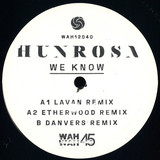
As bottom end provider for Cinematic Orchestra and Paper Tiger, Hunrosa (AKA Sam Vicary) already has something of a pedigree for a man of such tender years. His music glides effortlessly between Bonobo at his most sonorous, Jon Hopkins at his most ethereal and Flying Lotus at his most freaky. Currently based in Manchester, his music captures the wild organic senses of his Cornish childhood, anchoring it with a darker 2am undercurrent. Following the success of 'Ransom' (a firm favourite of BBC 6 Music's Tom Ravenscroft) Hunrosa returns with his newest offering 'We Know'. An eerie, ethereal track full of haunting atmospheres, Vicary enlists Austrian percussion maestro Manu
Delago, who lends his hang drum expertise to the proceedings weaving it amongst the twisting, intricate beats and Anna McLuckie's delicate vocals. the original is accompanied by a white label 12' containing three reworkings from burgeoning producers Lavan, Etherwood and Danvers. Newcomer Lavan is up first, moulding the organic melodies and earthy percussion into a dubbed out, soulful and bouncy 4/4 number. Hospital Records golden boy Etherwood (whose band Hunrosa is also a member of) brings a late-night liquid DnB atmosphere into play, harnessing the raw emotional power of the lyrics, as reverberating piano chords strike out into the darkness. Having turned the
heads of Bradley Zero and Gilles Peterson with his recent releases, CoOp and WotNot Music's Danvers resets the atmosphere with a zen like extended intro, before launching headfirst into a hypnotic and enthralling looped rhythm section. The groove locked in place, it rises and falls with precision, joined by spaced-out synths throughout the nine-minute duration, allowing the majestic instrumentation to gather pace as the spine chilling vocals drift overhead.
A captivating collection of early singles by the renowned Zimbabwean Mbira master and a true African music icon. The songs were mostly recorded in the 1970's, during the buildup to the Chimurenga revolution,
and were only ever released in Stella's home country. Deep resistance & culture. 'I am a rebel', smiles the 70-year-old Stella Chiweshe. Her album 'Kasahwa: Early Singles' offers a fascinating introduction to the world
of Mbira, with the term not only referring to the instrument, consisting of 22 to 28 metal keys mounted on a wooden healing tree body, but also to a musical genre - and on a much wider level, to an entire culture and deeply spiritual
lifestyle, very much at the core of the young Zimbabwean nation. 'Kasahwa' is a collection of impossible-to-find early seven inches, eight cuts spanning the period from 1974 to 1983 and representing Mbira in its purest
form. None of these songs has been released outside of Africa so far.
RLydmor is Copenhagen based Jenny Rossander, an electronic producer, composer, singer, songwriter and general troublemaker. Now she's about to release her third solo album "I Told You I'd Tell Them Our Story", a multi-layered piece of modern electronic pop music.
In her sounds and with her words, Rossander captures a reflective description of her surroundings and invites the listener to follow her on a very personal journey.
After her first steps with her two solo albums, that have been released in Denmark only, to much applause, the first international coming out was the 'Seven Dreams Of Fire" album as Lydmor & Bon Homme (with Tomas Høffding from WhoMadeWho). In 2016 Lydmor suddenly disappeared to Shanghai for several months. Her life in the Chinese metropolis inspired her to write a piece of modern electronic pop music which will be released as her new solo album "I Told You I'd Tell Them Our Story" in September. "There is a fearless madness in her that might have waited for too long to finally break out." (Nothing But Hope And Passion). With lots of initiative, Lydmor has made her dream come true to tour most of the world with her music. No matter if she plays an acclaimed festival, a famous club or the tiny living room of her greatest fans, every single one of Lydmor's shows means a highly intense experience. With her irresistible voice and unabashed honesty Lydmor places the little hooks of her melodies and lyrics into the electronic soundscape and she will flirt, dance, cry, scream and hug her way into your heart.
After her first two albums - A Pile of Empty Tapes (2012) and Y (2015) - which were only released in Denmark, Lydmor's new record will be released internationally for the first time by hfn music. "I Told You I'd Tell Them Our Story" is a rite of passage captured in intense moments experienced on the edge of the world and on the edge of one self. Lydmor lived in Shanghai for several months in 2016 and the Chinese metropolis inspired her to completely redefine her artistic expression and to write this new album.
Firmly established Industrial Detroit crew cranks out an EP that could have been a solid early 90's Wax Trax! side project with solid beats and cyberpunk grittiness. - ACIID HOUSE
by Fluxion A/D
Born in the warehouses of Detroit long time instigators of the Eastern Market broken beat underground Fluxion A/D captures the Detroit Industrial deep current like no other possibly could. Fluxion A/D is the next manifestation of this cyberpunk network core collective 'DeLIENMetria, Di_sect" improvised precision.
Svengalisghost captured here in his most true form, the live setting. This recording comes direct from the board during his performance on French television in 2015 and harnesses the maniacal energy of his live set in perfect form. What may be the Chicago born artist's darkest and most plodding recording to date, this is the definintion of deconstructed death-industrial, foward thinking and freeform yet totally focused and razor sharp, plodding drums over open wire electronics and zodiac killer vocals hitting you from all angles. This is sound of evil personified. Limited copies available worldwide.
- A1: Setaoc Mass - Far Away From Yesterday
- A2: Juxta Position - Hexagon
- B1: Roman Poncet - Turn Down
- B2: Viers - Moomin Trash
- B3: Nocow - Metha
- C1: Kirilik - Batut
- C2: Lady Starlight - D5-12
- D1: Ubx127 - Vectors
- D2: Len Faki - Robot Evolution
- E1: Pablo Mateo - Anfang Ende Immer
- E2: Shlomi Aber - 3000 Reasons Why
- F1: Nocow - Run Far
- F2: Truncate - Bassline
- G1: Lewis Fautzi - Modern Humans
- G2: Jeroen Search - Rubidium
- H1: Amotik - Neela
- H2: Setaoc Mass - Silence
4x12" Set , Special 15th Anniversary Edition, with Special Deluxe 4 Gatefold, shrink wrapped incl Download Card
Celebrating its 15th anniversary as well as the monolithic catalogue 100, Figure releases a gem-packed compilation featuring 15 artists who are shaping the current sound of the label. Ranging from machine-driven stompers courtesy of Juxta Position, Kirilik or Lady Starlight, to punchy electro by Viers and UBX127, to Nocow's signature style wavey melancho-electronics, or the straight-up high-voltage-techno of Shlomi Aber, Lewis Fautzi and captain Len Faki himself, all adequately framed by Setaoc Mass' beautiful ambient pieces - this 4 LP-set encompasses everything Figure both past, present and future. Arriving in a unique gatefolded sleeve that carries the exclusive handmade visual art by Munich artist Julia Schewalie. Whether long time fan or newly recruited follower, this one is a must-have entry in every techno-lover's collection.
You may know of 'Rude Movements', an early dance music classic produced by SunPalace (Mike Collins and Keith O'Connell) back in 1983 that brought together protohouse, balearic beats and funky vibes. In 1984, the tune quickly became an anthem that could regularly be heard at David Mancuso's 'The Loft' or at Larry Levan's 'Paradise Garage' for example.
Thanks to Mike Collins, the studio veteran still in the business after more than 35 years and currently busy perpetuating the legacy of SunPalace, more material from the archives
has been 'surfacing' over the past few years on UK-based record labels. After a very productive meeting earlier this year, Parisian label Chuwanaga is really proud to present four unreleased songs produced between 1982 and 1984! Co-written by Mike Collins from SunPalace and Breeze McKrieth, a founder member of Britfunk bands Light Of The World and Beggar & Co, these Lost Songs are the almost forgotten result of this seminal collaboration, an exclusive musical rendez-vous between experienced studio music makers and funksters at the top of their game, including some of the finest Britfunk musicians. Bringing together eighties influences and futuristic sounds, the result covers a wide range of genres, from jazz-funk to new wave: it captured a unique
moment in British musical history, a smooth transition to a more electronic sound. Definitely not one to be missed!
Here at Death & Leisure we are on a continuing mission to surprise and experiment, and so with our new release we present something very special, Blackmoon1348 and The Tibetan Monks of The Tashi Lhunpo Monastary. This project sounds like nothing else, it fuses heavy drone guitar sounds with traditional tibetan throat singing and live instrumentation.
BlackMoon1348 in collaboration with the Tibetan Monks of the Tashi Lhunpo Monastery (Tibet/ India). 2017 BlackMoon1348 embarked on a cultural experimentation of cultural diversity in the arts, forming a collaboration of ancient Tibetan ceremonial practises and instrumentation with sub-harmonic drones and industrial soundscapes. The music amalgamates sacred mantras that date back to the early teachings of Tibetan Buddhism practised in the Tashi Lhunpo Monastery, with heavy detuned western instruments, synths, and electronic music for the first time in recorded history. The Tashi Lhunpo monastery was once home to the Panchen Lama who subsequently 'disappeared' under the oppressive Chinese rule of Tibet. A handful of the Tashi Lhunpo monks were fortunate to escape into exile and have since re-built the monastery in Mysore, South India - now flourishing with over 400 monks practising within the monastery. Tibetan Buddhism is an outlawed ancient tradition within Tibet - monks, nuns, and Tibetans cannot openly practise their heritage and traditions, forcing Tibetans to inhabitable plateaus, with such areas are now under 'Chinese Re-development', the land being stripped of natural resources for China's ever growing economy and totalitarian rule. Tibetans face persecution for as little as owning a Tibetan flag, or picture of the Dali Lama, with such actions landing you in jail, tortured, poised, and/or being released just before the point of death. It is important for us to remember and celebrate the traditions of the Himalayas and its sacred, peaceful practises.
The music was recorded live in one take at Flesh and Bone studio in Hackney for NTS Radio's Black Impulse show. Engineered, mixed, and mastered by Oliver and Owen at Flesh and Bone, capturing the raw, ethereal essence of the collaboration and ceremonial sounds buried deep within the Himalayas. This was the first time in history for such collaboration of tradition, ideology from Adeline Rozario and orchestrated by David Kerry of BlackMoon1348 who created this music to diversify and bring together ceremonial instruments, diversifying the metaphysics of transcendence through ceremonial Tibetan practises.
It is important to understand that BlackMoon1348 are not attempting to change the fundamental meaning or belief of the Tashi Lhunpo Monks, or assume to have a deep-rooted understanding of the ancient traditions of Tibetan Buddhism, This is our understanding of Tibetan culture and practices as truly and honestly as we see and feel it, and our attempt to spread this beautiful, sacred, culture, and keep it alive within today's society.
Liberation through hearing.
- 1: The Room
- 2: Hbw
- 3: Rythm A
- 4: Groovin' With The Eternal Now
- 5: Don't Move!
- 6: Feel Better
- 7: Like A River
- 8: Just The Rain
- 9: Haha Lol
- 10: Two Doors
"The Room", Fenster's fourth album and their first release on Altin Village & Mine marks the beginning of a new chapter for the band. After releasing three albums, a feature length film, and touring extensively throughout Europe and North America since 2012, "The Room" serves as an entry point into their sonic evolution. The essential characteristic of the band is transformation - within and between genres, albums, and songs. Their sound is a window framing psychedelic, groovy, hypnogogic, playful pop.
Fenster is Elias Hock (Germany), Jonathan Jarzyna (Germany), Lucas Ufo (France) and JJ Weihl (USA). Their mission in creating this album was to compose and arrange every song together in a room. It is an experiment in collective creativity that pushed all of them to transcend their individuality and create something together which is greater than the sum of its parts.
The songs were tracked live in a house where the band ate, slept, and played together. Often the songs were recorded without implementing a click track. They were intent on finding and locking into a human groove—one open to imperfection—while still maintaining a tightness between them. They wanted to make the songs feel alive—as if the listener were present in the room with them in the moment of creation.
The album's title track "The Room" opens the record like a rollercoaster ride. There is a tension in the first bars that ties us to earth, a minimal riff that guides us to the first chorus where we feel we are slowly lifting into the air—and by the time we reach the second chorus it has exploded into a space far away from the planet's gravitational pull.
The band's use of juxtaposition is not just a way of channeling a vast library of musical genres and concepts, it is a means of expression. Combining tender pop melodies with kraut-beats, disco grooves and psychedelia frees the band from any one sound and creates a genre all its own.
This playfulness is especially vibrant in songs like "Rhythm A" and "HAHA lol" which deconstruct and fuse together disparate moments of explosive rock, tender harmonies, percussion made of splashing water, voices from a radio, and electric piano. Even "Feel Better", a sparkly pop ballad is cracked wide open by a long trippy interlude that appears unexpectedly within an otherwise classic structure.
The cover art, created by the band's own Lucas Ufo, invites us into a room in the shape of a human skull. If one looks "out" the window in the picture, one finds oneself looking in to an infinite portal of rooms within rooms. The record plays a lot with this idea of perception. In "HBW", the relationship between the bass and the drums creates the feeling of an infinity loop. The lyrics lend an enigmatic tint to the landscape of so called objective reality v. perceived reality: "I was a phase — you were going through — said I was the one but there is no one — there's only the sun — that gives shape to the moon"
The record starts with "The Room" and ends with "Two Doors". Maybe one door is an exit, and one leads to another room... who knows The song has something mysterious and expansive, like a digital ocean flooding the room, carrying everything away. The whole process of making a record is about capturing a moment in time. This is the record they made - in this point in time, all together, in a room. The last words of the record roll out with the waves: "What you leave behind for someone else to find — Two doors inside — neither one is right"
Tracklisting
'Garage bands suddenly obtain cult status and become the antithesis of their initial appeal'
Garage Class were a group of reluctant outliers who produced one of the finest contributions to the wave of UK DIY music that emerged during the late 70s and early to mid-80s.
Hailing from Alsager in North West England and comprised of Tim Shutt (vocals) Phil Murphy (lead guitar) Clive Williams (guitar) Lynne Sanders (bass) and Phil Bourne (drums / bass on studio recordings) Garage Class originally went by the name of The Pits before their then manager Steve Hurt imposed an alias which, though unpopular within their ranks, would nevertheless reflect the shambolic art they would eventually capture on their first and only single.
As The Pits the group offered a loutish inflection on glam-punk flamboyance, evoking Johnny Thunder hitting the north and remaining disowned yet undeterred in a dreary old boozer. But as Garage Class the group distilled a roughcast and homespun primitivism that felt quintessentially their own. In this they proved too unruly to be assimilated into any wider scene. Early gigs descended into acrimony and recognition proved elusive. Yet what they managed to make back then now sounds like an extraordinary article of underdog ambition.
Released in 1984, four years after it was originally recorded, the Terminal Tokyo single is an unlikely triumph of exceptional messthetic punk. Though raw and unpolished the songs here are precariously pop-minded and indisputably anthemic. The titular A-side reveals the dry and detached drawl of Shutt aka The Subliminal Kid, a sharp, jaded and poetic voice that has some of the most iconic lines never heard in punk. Accompanied by second-hand guitars, on-the-fly handclaps and a chorus like a terrace chant this is the cult hit that never was, a heroically artless masterpiece that has all the ragged character and misfit euphoria of Swell Maps and The Buzzcocks if they were more impulsive and boisterous, and left to their own devices in the remote margins of a Cheshire town. The original B-side is here substituted for I Got Standards, a track that, until now, has somehow remained unreleased. An ideal twin to Terminal Tokyo there's the same brusque and dog-eared quality to the band's delivery, as well as the same upfront emphasis on strong hooks and insistent momentum. Yet again, Shutt is on impeccable form, perfecting an inflated, adolescent antagonism that has all the sardonic, malcontented charm of similarly 'shirty' buggers like Dan Treacy (Television Personalities), Patrik Fitzgerald and Mark Perry (Alternative TV).
Although never accepted in their own time both tracks represent a brief but inspired moment of fervent imperfection, one that epitomized the best of a diffuse and autonomous underground movement spearheaded by The Desperate Bicycles and built upon by the likes of Amos & Sara, The Homosexuals, The Cleaners From Venus and Family Fodder. Like them Garage Class were situated at a point where punk, art, humour and a sense of stubborn independence all intersected.
In the years since Terminal Tokyo has accumulated a retrospective appeal among certain trusted circles, with Jon Dale celebrating the single in his exhaustive and essential Story of UK DIY for Fact Magazine, and original copies regularly changing hands for a foolish forty quid or so. With this inaugural release on the Outer Reaches label Terminal Tokyo is not only restored for the very first time but given a worthy expansion courtesy of JD Twitch (Optimo).
Continuing his own fascination with the fringe history of UK DIY - documented on his own outstanding compilation Cease & Desist: DIY! (Cult Classics From The Post Punk Era 1978-1982) and in his re-edits of Crass Records classics for an early release on RVNG INTL - Twitch reinterprets I Got Standards as an incisive, dubwise outing that pictures Jaki Liebezeit and Muslimgauze on a bender in England's provinces, tasked with remixing the raw product of local punks. A new slant on Garage Class' crude magnificence, built to play loud on contemporary soundsystems.
Although the latter part of 1980 spelled the end for Garage Class with members moving on to other projects (Bourne fell in with The Colours Out of Time, Murphy went on to front The Regular Guys and Shutt eventually left to form Happy Refugees) this reissue attempts to give their fleeting time together and the unique single statement they made the treatment it deserves. If this means Garage Class have obtained cult status, their initial appeal remains. Just listen for yourself.
- A1: Double Exposure - Ten Percent (Walter Gibbons Disco Madness Mix)
- A2: Luv U Madly Orchestra - Rocket Rock (Walter Gibbons 12" Mix)
- B1: Loleatta Holloway - Catch Me On The Rebound (Walter Gibbons Disco Madness Mix)
- B2: Loleatta Holloway - Hit And Run (Walter Gibbons 12 Mix)
- C1: Love Comittee - Where Will It End (Walter Gibbons 12" Mix)
- C2: Love Comittee - Just As Long As I Got You (Walter Gibbons 12" Mix)
- D1: Cellophane - (Dance With Me) Let's Believe (Walter Gibbons Disco 12" Mix)
- D2: First Choice - Let No Man Put Asunder (Walter Gibbons Disco Madness Mix)
Walter Gibbons, a true master of the mix, a disco legend, a pioneer of dance music. There's literally very few who can lay claim to progressing the artform of studio mixing and technique than the late Gibbons. His contribution to contemporary music cannot be understated, first as a DJ where his drum laced experimentation captured the ears and minds of his peers and the dancers, then later as a mixer and studio genius where he continued on his quest. Often fixated on the percussion and breaks within records his versions would often dive into spaced out, dubby and stripped back territory that very few of his peers were even contemplating at that time, fervently reconstructing the tracks themselves and often the time, space and dancefloor within which the record was being played. A true original, Gibbons was behind many of the 'definitive' versions of the classics, his unique style often catapulting records that were just fine in their original form into brand new colourful, cosmic interpretations that flourished sonically and rhythmically with brand new sounds that bristled with vision.
Salsoul Records thought a well programmed and thought out retrospective of this legends output was in order and this incredible collection of tracks is where we find ourselves. A stellar compilation across 2 heavyweight slabs of wax featuring of some of Gibbons' finest works. Included you'll find genre defining cuts like his mixes of Double Exposure, Loleatta Holloway, Love Committee, First Choice and many more.
A truly essential package for the die-hard Disco aficionado or for those who are exploring this most important movement in dance music for the first time. Curated with the full input and backing of Salsoul Records and carefully selected to reflect the truly timeless nature of the music contained within. For listening, for dancing, for turning on a party!
Remastered by Optimum Mastering. Artwork & design by Million Dollar Disco. Fully authorised.
- A1: Off To See The Hangman, Part I
- A2: Sometimes There's Blood
- A3: Idumea
- A4: Off To See The Hangman, Part Ii
- A5: Face Down Strut
- A6: Laika's Song
- A7: Oh, Command Me Lord!
- B1: Sweep It Up
- B2: Requiem For John Fahey
- B3: Dance Of The Everlasting Faint
- B4: Bleeding Finger Blues
- B5: Sack 'Em Up, Parts I And Ii
- B6: It Was All Sackcloth And Ashes
Tompkins Square present the debut full-length by Welsh multi-instrumentalist, Gwenifer Raymond. Hailing from Cardiff and now residing in Brighton in the South of England, Raymond began playing guitar at the age of eight. Tompkins Square released her debut 7" on Record Store Day.
In Gwenifer's own words :
When I was about eight years old a pretty formative thing happened to me ... my mum bought me a cassette tape of Nirvana's Nevermind. Being so young I'd had no real interest in music prior to that, but I did have a 'My First Sony' cassette player that I used to listen to audiobooks. Anyway, I put the tape in, pressed play, and what I heard blew my little 8 year old mind. I don't know what it was about that wall of sound that so captured me, but I spent many hours hyperactively running around the house with headphones on, volume at full blast, and Nevermind on repeat. It was either for Christmas or my birthday that year, that I asked for a guitar.
I spent all my teenage years playing either guitar or drums in various punk and rock outfits around the Welsh valleys, but around that time I was also getting seriously into older stuff, Dylan, The Velvet Underground and the like. Through those cheap compilation CDs you could get then, I found that a common influence amongst these guys was pre-war delta and country blues, as well as Appalachian music. Eventually I stumbled upon Mississippi John Hurt, Skip James and Roscoe Holcomb, and they became the holy trinity of musicians I so wanted to able to play like. Eventually, I tracked down a blues man in Cardiff who could teach me and it was in studying these guys that I was introduced to John Fahey and the whole American Primitive thing.
I've always loved being in bands and the sonic chemistry it produces, but at the same time it's always a bit of a compromise that those sounds in my head have to pass through and be translated by someone else's. Sometimes it can be for the better, but sometimes not so much. American Primitive was the first time it had occurred to me that you didn't really need anything more than one solo instrument to fully express yourself, especially when those feelings and moods refuse to be articulated in words, sometimes it's a mystery to yourself what it is you're expressing. I still play in hard rock and punk bands and love to wail and hit my guitar with a complete lack of any subtlety or nuance, but in the end I think that all these things are really part of a circle, feeding back into itself. It's all just a lineup of strange mutations.
- A1: Emad Youssef - Al Bareedo Ana (The One I Love)
- A2: Abdel El Aziz Al Mubarak - Ma Kunta Aarif Yarait (I Wish I Had Known)
- B1: Kamal Tarbas - Min Ozzalna Seebak Seeb (Forget Those That Divide Us)
- B2: Madjzoub Ounsa - Arraid Arraid Ya Ahal (Love, Love Family)
- B3: Khojali Osman - Malo Law Safeetna Inta (What If You Resolve What's Between Us)
- C1: Zaidan Ibrahim - Ma Hammak Azabna (You Don't Care About My Suffering) (Live)
- C2: Saied Khalifa - Igd Allooli (The Pearl Necklace)
- C3: Taj Makki - Ma Aarfeen Nagool Shino! (We Don't Know What To Say!)
- D1: Hanan Bulu Bulu - Alamy Wa Shagiya (My Pain And Suffering) (Live)
- D2: Abdelmoniem Ekhaldi - Droob A Shoag (Paths To Love)
- D3: Samira Dunia - Galbi La Tahwa Tani (My Heart, Don't Fall In Love Again)
- E1: Mohammed Wardi - Al Sourah (The Photo)
- E2: Abdullah Abdelkader - Al Zaman Zamanak (It's Your Time)
- F1: Mustafa Modawi & Ibrahim El Hassan - Al Wilaid Al Daif (The Youth Who Came As A Guest)
- F2: Ibrahim El Kashif - Elhabeeb Wain (Where Is My Sweetheart)
- F3: Mohammed Wardi - Al Mursal (The Messenger)
In Sudan, the political and cultural are inseparable. In 1989, a coup brought a hardline religious government to power. Music was violently condemned. Many musicians and artists were persecuted, tortured, forced to flee into exile — and even murdered, ending one of the most beloved music eras in all of Africa and largely denying Sudan's gifted instrumentalists, singers, and poets, from strutting their creative heritage on the global stage.
What came before in a special era that protected and promoted the arts was one of the richest music scenes anywhere in the world. Although Sudanese styles are endlessly diverse, this compilation celebrates the golden sound of the capital, Khartoum. Each chapter of the cosmopolitan city's tumultuous musical story is covered through 16 tracks: from the hypnotic violin and accordion-driven orchestral music of the 1970s that captured the ears and hearts of Africa and the Arabic-speaking world, to the synthesizer and drum machine music of the 1980s, and the music produced in exile in the 1990s. The deep kicks of tum tum and Nubian rhythms keep the sound infectious.
Sudan of old had music everywhere: roving sound systems and ubiquitous bands and orchestras kept Khartoum's sharply dressed youth on their feet. Live music was integral to cultural life, producing a catalog of concert recordings. In small arenas and large outdoor venues, musical royalty of the day built Khartoum's reputation as ground zero for innovation and technique that inspired a continent.
Musicians in Ethiopia and Somalia frequently point to Sudan's biggest golden era stars as idols. Mention Mohammed Wardi — a legendary Sudanese singer and activist akin to Fela Kuti in stature and impact in his music and politics — and they often look to the heavens. A popular story is of one man from Mali who walked for three months across the Sahel to Sudan because the father of the woman he wanted to marry would only allow it if he got him a signed cassette from Wardi himself. Saied Khalifa is said to be the one of the few singers to make Ethiopian emperor Haile Selassie smile.
Such is the stature of Sudanese singers and the reputation of Sudanese music, particularly in the "Sudanic Belt," a cultural zone that stretches from Djibouti all the way west to Mauritania, covering much of the Sahara and the Sahel, lands where Sudanese artists are household names and Sudanese poems are regularly used as lyrics until today to produce the latest hits. Sudanese cassettes often sold more in Cameroon and Nigeria than at home.
But years of anti-music sentiment have made recordings in Sudan difficult to source. Ostinato's team traveled to Ethiopia, Somalia, Djibouti, and Egypt in search of the timeless cultural artifacts that hold the story of one of Africa's most mesmerizing cultures. That these cassette tape and vinyl recordings were mainly found in Sudan's neighbors is a testament to Sudanese music's widespread appeal.
With our Sudanese partner and co-compiler Tamador Sheikh Eldin Gibreel, a once famous poet and actress in '70s Khartoum, Ostinato's fifth album, following our Grammy-nominated "Sweet As Broken Dates," revives the enchanting harmonies, haunting melodies, and relentless rhythms of Sudan's brightest years, fully restored, remastered and packaged luxuriously in a triple LP gatefold and double CD bookcase to match the regal repute of Sudanese music.
A 20,000-word liner note booklet gives voice to the singers silenced by an oppressive regime.
Take a sail down the Blue and White Nile as they pass through Khartoum, carrying with them an ancient history and a never-ending stream of poems and songs. It takes two Niles to sing a melody.
Mac DeMarco's breakthrough sophomore album, Salad Days - released on April Fools', 2014 - garnered widespread critical acclaim, landing on over 30 Year End lists. It was the album that catapulted DeMarco from 'loveable slacker' to 'mature songwriter with a gaptoothed grin,' all at the tender age of 23. DeMarco's demos for Salad Days, originally included in an expanded edition of the album only available on Captured Tracks Mail Order site, peel back the curtain of said artist, who, up until then, may have been more known for his raucous live shows than his genuine talent as a songwriter and craftsman. This collection of demos and sketches as well as previously unreleased instrumental demos offer a rare insight into Mac's world and process.
Mac DeMarco's second album, 2, cleaned up the songwriter's warped take on soft rock and brought it to a broader audience. Given DeMarco's affinity for keeping things lo-fi—2 was the first time he'd bothered to record demos—it's revealing to hear these songs in their most embryonic form. The performances here are a little looser and the sound a little hazier than on the actual LP, lending an atmosphere of dreamy vulnerability, especially to ballads like 'Annie' and the Lennon-esque 'Sherrill.'
Thomas Fehlmann steps away as co-member of The Orb following two acclaimed full lengths on Kompakt (COW - 2016, Moonbuilding 2703 AD - 2015) and embarks back on his solo career with a career defining album 'Los Lagos' - from Detroit to Schaffel techno he conducts a broad spectrum of electronic music into a seamless flow.
Thomas Fehlmann has been active since the late 1970's from Palais Schaumburg, the Tresor defnining trio 3MB (with Moritz von Oswald and Juan Atkins), Ocean Club (together with Gudrun Gut) and of course The Orb.
Artwork direction and design by DESIGNERS REPUBLIC.
'Los Lagos' is Thomas Fehlmann's seventh solo full-length, his 4th for Kompakt following his Berlin inspired 2010 full length 'Gute Luft'. in the musician's own words it's about "checking the juice".
Establishing a picture of his current artistic condition, as suggested by the title - los lagos / die lage / the situation (literally translating to 'the lakes' but taking the meaning of 'wassup' in the context of a relaxed discussion between friends), the album refers to Fehlmann's "musical motivation, dreams and wishes" through the language of music exclusively: a way to "allow myself to techno" he says, "to techno as a means to deconstruct and rebuild again. Set up an area of tension, loose it in the flow of the grooves. Magnifying some detail out of proportion, regroup around that and slowly knit a texture. Expand."
"It was time to take a bend and head where the sun rises or sets, wherever my heart drives me." This is pretty much the kind of decision Thomas Fehlmann has made. 61 and shining, longstanding member of The Orb, multi-talented composer and boundless experimentalist, had to make in the twilight of his collaboration with Alex Paterson, eager to taste the flavours of the unknown on his own again. "It was the moment when felxibility would have become compromise'. Far from being the demise of their joint dream, this was bound to split it in two distinct, parallel fantasies - rich of their own singularity.
As goes with that essential love of his for the free-flowing nature of electronic music, a fascination born out of its "lack of borders", capable of "inventing, changing the emphasis, experimenting with an unpredictable outcome", 'Los Lagos' "freely connects disparate extremes. Art, disco, minimalism, schmalz, jazz and funk". As he likes to say, Fehlmann's head functions as a sampler, capturing elements and re-assembling them under his own embracing perspective ; not afraid to leap from a deep, dubbed-out hypnotism ('Window', 'Morrislouis', 'Freiluft') to the playfulness of '90s-style bleepy schaffel ('Tempelhof' featuring Max Loderbauer), through out-there, muscle-flexing dancefloor cuts ('Triggerism') onto the calmness of ambient ('Geworden').
In need to keep his inner balance in check, Fehlmann committed himself to "switch off the control" and follow his intuition, which isn't so much of an easy process as he also wanted to incorporate the side disturbances experienced: "it's a complex process of search and destroy to bring out a new beauty trying to expand my vocabulary". With 'Los Lagos', Fehlmann looked at finding "the structure that's surprising, disturbing and rewarding". The artwork for the record, courtesy of contemporary artist and friend Albert Oehlen whom he shares lots of artistic ambitions with, echoes the producer's "funky use of shape and space, sludge and clarity" like a second skin. A search for light and harmony that Fehlmann sums up eloquently: "Does your inner musical voice respond", that is the question. Then "doors open up in unexpected corners, rays of light appear; you follow through and you're in - in your oasis."
Released on Leeds Jazz & Soul labelATA Records, the debut LP fromThe Lewis Express takes the rich legacy of the soul-jazz outfits of the 1960s as the initial blueprint of their sound. Taking inspiration from the likes of Ramsey Lewis, Young-Holt, Eddie Cano, Ray Bryant and Cannonball Adderley, they present a collection of tracks that range from introspective spy film themes to burning Brazilian jazz.
Primarily based in Leeds, The Lewis Express is comprised of many of the musicians that have graced previous ATA releases: George Cooper, Piano (Abstract Orchestra) Neil Innes, Bass (The Sorcerers, The Magnificent Tape Band, Tony Burkill), Sam Hobbs, Drums (Dread Supreme, Tony Burkill, Matthew Bourne) and Pete Williams, Percussion (The Sorcerers, The Magnificent Tape Band, Tony Burkill). Recorded over an intense two-day session by the band of the same name, "The Lewis Express" is a nod to the classic soul jazz recordings of The Young Holt Trio / Young-Holt Unlimited and Ramsey Lewis, from who this group take their name. But, delivered with a distinctly European feel. As with many of the classic Ramsey Lewis cuts, this album was recorded live, capturing the rich inter-relationship between the players.
Kicking off the album isLove Can't Turn A Man, a slow burner that introduces the piano of George Cooper as he works over a rock solid backbeat.Cancao De Momentois an up-tempo Brazilian Workout in the style of Milton Banana with rhythmic piano punctuated by percussion.Brother Move Onis probably the most recognizable as being in the soul jazz vein, with nods to such classics as Ramsey Lewis'The 'In' CrowdandSoulful Strutby Young Holt Unlimited, particularly the latter. Moving intoHawkshaw Philly(their nod to session music legend and leader of The Mohawks, Alan Hawkshaw) the band create what sounds like a rare library cut.Theme From The Watcheris a nod to the cinematic soul-jazz of the 60s, conjuring up the sort of imagery that coincides with the black and white spy thrillers, espionage and intrigue.Last Man In The Chain Ganghas a very strong Ramsey Lewis feel and offers some of the most powerful piano playing of the whole album. The final track,Straight Seven Strut, is the only vocal track of the album. The staccato swing and French vocals lend it some of the qualities of 60s yé-yé music but with a far jazzier backbone, spiced with percussive handclaps.