Athens-based percussionist and sound artist Yorgos Stavridis makes a stark, physical debut for Heat Crimes with »Solo Percussion«, a set of one-take improvisations that approach percussion as a field of friction between body, objects, space, and sound. Working with membranes, metals, found objects, and feedback systems, Stavridis foregrounds timbre, texture, and spatial presence, collapsing distinctions between instrument, environment, and recording apparatus.
Microphones and speakers are treated as unstable instruments in their own right, introducing opaqueness, resistance, and feedback into the performative chain. Scrapes, low-end pressure, brittle metallic chatter, and sudden bursts of resonance emerge through close bodily engagement with surfaces and materials, each piece documenting a specific configuration of objects, gestures, and acoustic conditions. Performed and recorded live, »Solo Percussion« captures sound in its most contingent state; situational, physical, and irreducibly present. Eschewing narrative, pulse, or formal development, the record sits squarely in Heat Crimes’ lineage of process-led, uncompromising sonic research, where listening becomes an active, tactile act and sound itself is the primary event.
Cerca:capture
Kyoto-based Stones Taro is a producer and DJ who has established a unique standing within the global dance music scene. After operating the NC4K label since 2017, he embarks on a new challenge by launching his own self-release series.
The inaugural release, titled "Foglore," is characterized by its foggy sound design and timeless arrangements reminiscent of folk tales.
In this four-track release, Stones Taro explores a fresh interpretation of the fusion between Dub, Techno, and Deep House. These tracks capture the essence of contemporary music in intriguing ways, yet feel as familiar as if they have existed since ancient times.
Finlay Shakespeare is an electronic musician working from the UK and across Europe. A childhood obsession with his parents’ record collection led him to both create his own music and build his own synthesizer equipment throughout his teenage years. After studying audio engineering, he was invited to become in-house engineer for the Moog Sound Lab UK, leading to collaborations with acts as diverse as Suicide, Charlemagne Palestine, The Grid and Mica Levi & Eliza McCarthy, both in live and studio environments. In 2017, Finlay began recording a series of monthly “Housediet'' releases - all improvised and captured at home utilising drum machines, modular synthesis and processed vocals. After several encounters with Peter Rehberg of Editions Mego, a compilation of the Housediet tracks was drawn up by Rehberg and Shakespeare, culminating in the release of “Domestic Economy” in early 2019. “Solemnities' ', a second album for Editions Mego appeared the following year. In the period since Rehberg’s untimely passing, Finlay has recorded for Superpang, Modulisme and his own GOTO Records imprint. “Illusion + Memory”, meanwhile, continues on from where “Solemnities” left off, with Finlay once again aiming to work at the fringes of electronic pop. Alter is proud to present “Illusion + Memory”, the third full length physical LP of Shakespeare’s utterly unique and sophisticated output. Shakespeare’s obsession and knowledge of late 70’s and early 80’s electronic pop music is once again at the forefront of this intense and dynamic release. Alas, this is not some retro throwback. Shakespeare’s deep understanding of his machines breathes new life into a genre of music once defunct. Supporting the likes of Blancmange bolstered his reputation for sublime synth hooks and dark lyrical content. Building on his previous work in the field “Illusion + Memory” is an unabashed pop record, as joyous as it is intense, moving from the brooding opening ballad “Your Side of the River” through the punchy “Theresa” which could be read as a love song to Throbbing Gristle’s United. Elsewhere “Climb” unleashes the opportunity to the dancefloor as wild electronics snake into all manner of schizophrenic shapes. There is a romantic side to this music. In its homage to electronic pop of the late 70’s and early 80’s but also in the emotional punch Shakespeare injects into every second of every track. Shakespeare’s reboot of these musical forms is technically impressive, one rich in feeling and deep in emotion, atmospherically and vocally. The two come together to create a unique visceral sonic experience… today!
Following the widely acclaimed release of Body Shell in Spring 2025, Carré returns to Tempa, for a new EP, ‘Hibiscus’, featuring a collaborative track with LA-artist Bbyafricka, highlighting the synergy of West Coast Rap & London Soundsystem culture.
Connected by warmth and groove that define where Carré is musically right now, each of the four tracks on ‘Hibiscus’ stands on its own, yet together they continue to showcase Carré’s flair for producing sleek dubstep with melodic verve. From the shimmering ‘Warm Light’, the razor-sharp edge of ‘X Effect’, the deep stepper ‘Ride It Out’ to the stripped back ‘Hibiscus’ which glows with the addition of Bbyafricka’s sultry vocals, the EP is a concise statement of Carré’s evolving sound.
Speaking about the collaboration, Carré says, “I’d been a fan of Bbyafricka’s sound, style, and tone — tracks like ‘Baton Rouge’ and ‘Dumbo’ really stood out to me — and I could already imagine how her voice would fit with my production. The fact that she’s from LA made the connection feel even more natural. When I reached out, she was down straight away and came back with something I genuinely loved. She captured the energy of the track perfectly, and together I think we created something that feels authentic and even better than I’d imagined.”
For Bbyafricka, working on ‘Hibiscus’ was a moment of overcoming writer's block, “this song was me coming out of it on a weekend spent in Joshua tree, sitting outside looking at the view and the solar panels. I think you can envision what my view was when you play the song,” she explains.
Carré’s next outing on Tempa is a welcome return, signifying the home run she’s on as a producer and marking another impressive instalment in the producer's growing catalogue. In the last three years, Carré has quickly become a leading figure in the contemporary wave of artists pushing the true school Dubstep sound to new places and new audiences, expanding on the roots laid down by the likes of Skream, Benga, and Loefah.
Originally dropped in 1980 as part of Taking Care of Business, The Ted Coleman Band's only album, this 7" captures that sweet spot where jazz-funk meets rare groove perfection. 'If We Took the Time' is pure sunshine - think Roy Ayers on a slow afternoon, Billy Wooten in full cosmic flow, with shimmering vibraphones, velvet basslines and vocals that radiate soul from the Garden State to the cosmos. On the flip is the liquid and lively smooth and sexy delight 'Can You Feel It ' with buttery vocals and more cosmic bliss. Two glorious sounds.
A chance meeting in Mexico City set Points of Inaccessibility into motion. When Ibero-American composer Rafael Anton Irisarri crossed paths with Dutch media artist Jaco Schilp at MUTEK in 2024, a conversation about how technology shapes perception revealed an unexpected common ground. Schilp invited Irisarri to a spring 2025 residency at Uncloud, the Utrecht-based collective he co-founded, where Irisarri's sound began to take form amid an environment shaped by Schilp’s visual research.
The Uncloud studio was located inside the former Pieter Baan Centre, a forensic psychiatric prison where suspects of violent crimes were once confined. Its long history of silence and containment shaped the atmosphere in which the project developed. Within this setting, Irisarri coaxed long bowed-guitar tones through a network of pedals and looping systems. The raw gestures thickened into a vaporous and architectural field of sound. Schilp processed the material through a custom point-cloud software patch that produced images in continuous flux. The visuals flickered, dissolved and reformed like memories that resist coherence, functioning as a digital Rorschach that reflected the observer’s own perception.
Amid these spectral echoes, the project evolved into an examination of how the past persists within present signals. Memory endures as residue and interference, continually shaping perception even when its source has faded.
Schilp’s visual process required a continuous stream of sound in real time. Irisarri improvised throughout the residency, generating material that allowed the visuals to develop in parallel. Once back in his New York studio, he began shaping the recordings by carving pathways through the improvisations and mapping selected passages into MIDI. This process allowed him to build outward from the bowed-guitar material with minimal overdubs, adding Prophet 5 textures, Moog bass and strings that expanded the harmonic field while keeping the original performances at the center. To refine the structure, Abul Mogard provided editorial input, working with Irisarri’s stems to guide transitions and strengthen the overall pacing. The material, originally created under conditions of immediacy and constraint, evolved into a fully realized work through careful revision, patience and sustained reworking.
The title engages the geographic concept of the Poles of Inaccessibility, locations defined solely by their distance from all surrounding points. Irisarri adapts this idea to the conditions of digital life, where new forms of inaccessibility arise through the informational enclosures that structure perception. What appears to be a fully connected network often produces a deeper kind of separation, one shaped by the filtering logic of the systems that mediate experience. In this sense, the digital sphere mirrors its geographic counterpart. We inhabit spaces saturated with signals, yet the possibility of genuine contact becomes increasingly remote.
At its core, Points of Inaccessibility considers what can be understood as the new rituals of capitalist realism. Irisarri uses the term digital shamanism to describe the forms of simulated connection that organize contemporary life. These systems promise comfort through algorithms, influencers and AI interlocutors, yet they often reproduce the same conditions that generate loneliness in the first place. What appears as connection becomes the echo of connection, a sequence of gestures that imitate solidarity while withholding it. Like the geographic poles, these rituals are defined by distance. They pull us into environments where everything is illuminated, yet meaningful proximity becomes increasingly rare. In this sense, the work approaches a hauntology of the present, a reflection on futures that have stalled and intimacies that have been thinned by the algorithmic infrastructures that surround us.
This thematic tension unfolds across the album’s four movements. Faded Ghosts of Clouds introduces the work with textures that rise and dissipate in slow cycles, creating an atmosphere that resists clear definition. Breaking the Unison occupies a pivotal position in the sequence and focuses on the moment when the individual and the system fall out of alignment. Its shifting patterns trace the scattering of signals that once suggested connection, revealing the instability at the heart of contemporary perception. Signals from a Distant Afterglow forms the center of the album and features vocals by Karen Vogt, whose presence enters the sound field like a fragile transmission shaped by distance and delay. The closing piece, Memory Strands, follows motifs that appear, recede and briefly intersect before returning to quiet. Across these movements, the album outlines a landscape in which emergence and disappearance continually inform one another.
Listening to Points of Inaccessibility is an encounter with a sound field that is constantly in flux. Elements surface briefly, shift position and recede, creating a sense of motion that resists stable interpretation. The music moves between closeness and vastness, carrying traces of memory while withholding a clear point of resolution.
The album’s visual identity completes the project’s conceptual arc. In Mexico City, where Irisarri and Schilp first met, Daniel Castrejón transformed stills from Schilp’s point-cloud visuals into the cover image. The final artwork captures a single suspended frame of the digital material, a moment extracted from a field that is normally in constant motion. Its surface recalls the texture and abstraction found in the work of Catalan artist Antoni Tàpies, where material presence and erasure coexist within the same plane.
What emerges is a work that examines the tension between technological systems and human presence. Points of Inaccessibility asks whether connection is still possible within environments shaped by mediation and delay, or whether we have become isolated points within the very networks that promise proximity. What possibilities for relation persist within environments organized by algorithms and interruption? And how are we meant to understand presence when so much of it is constructed at a distance?
Points of Inaccessibility will be released on BioVinyl on February 6, 2026, with audiovisual performances planned throughout 2026.
Mastered by Stephan Mathieu
Artwork by Jaco Schilp
Design and layout by Daniel Castrejón
Artist photo by Iulia Alexandra Magheru.
Explicit isolation is the third album by the international collective E/I, led by composer and percussionist Szymon Pimpon Gąsiorek. The group’s seven core members came together while studying at Copenhagen’s Rhythmic Music Conservatory and the Royal Danish Academy of Music. For this latest release, they are joined by Slovenian musicians Samo Kutin (hurdy-gurdy) and Kaja Draksler (organ), alongside Danish tuba player Rasmus Svale.
The three compositions distill sound down to its essential elements, drifting freely through space. The material is minimal, moving in the geological rhythm of endless cycles of tension and release, formation and dissolution, density and lightness. Pimpon acts here more as a guide than a creator with a master plan. He is a navigator, leading us to the most crucial moments where sonic emissions merge into vibrating drones, building to an inevitable leap—an explosion after which the particles rearrange themselves once again. It feels like futuristic temple music infused with intergalactic spiritual jazz, the extensions of drone music, and acoustic ambient textures, all highlighted by the jolly grin of the navigator.
“I wrote the scores and asked each of the musicians to record their parts individually. What’s interesting for me about doing it this way is that it removes the element of immediate interaction and introduces a factor of randomness. I then edited and mixed it myself, also adding my own parts. Previously, it was strictly acoustic music, and the recordings were ‘live,’ meaning they were captured in one room at the same time, with no subsequent edits.” Pimpon has also incorporated electronics, which make the album even more airy and organically complement the sounds of the hurdy-gurdy and organ, recorded in Trboje, the small Slovenian village.
- A1: Rock Around The Clock - Bill Haley And His Comets
- A2: Sixteen Candles - The Crests
- A3: Runaway - Del Shannon
- A4: Why Do Fools Fall In Love - Frankie Lymon & The Teenagers
- A5: That'll Be The Day - Buddy Holly & The Crickets
- A6: At The Hop - Danny & The Juniors
- A7: He's So Fine - The Chiffons
- A8: See You In September - The Tempos
- A9: I Only Have Eyes For You - The Flamingos
- B1: Surfin' Safari - The Beach Boys
- B2: Little Darlin' - The Diamonds
- B3: Almost Grown - Chuck Berry
- B4: (He's) The Great Imposter - The Fleetwoods
- B5: Smoke Gets In Your Eyes - The Platters
- B6: Peppermint Twist (Part 1) - Joey Dee & The Starliters
- B7: Barbara-Ann - The Regents
- B8: Book Of Love - The Monotones
- B9: A Thousand Miles Away - The Heartbeats
- C1: Do You Wanna Dance - Bobby Freeman
- C2: Party Doll - Buddy Knox
- C3: Come Go With Me - The Del-Vikings
- C4: You're Sixteen - Johnny Burnette
- C5: Love Potion #9 - The Clovers
- C6: Since I Don't Have You - The Skyliners
- C9: Get A Job - The Silhouettes
- D1: Come Back My Love - The Wrens
- D2: Crying In The Chapel - The Orioles
- D3: Cupid - Sam Cooke
- D4: Earth Angel - The Penguins
- D5: Freight Train - Rusty Draper
- D6: Gee - The Crows
- D7: I'm Sorry - Brenda Lee
- D8: Johnny B. Goode - Chuck Berry
- D9: The Locomotion - Little Eva
- E1: Mr. Lonely - Bobby Vinton
- E2: Reet Petite - Jackie Wilson
- E3: Runaround Sue - Dion
- E4: Searchin' - The Coasters
- E5: A Teenager In Love - Dion & The Belmonts
- E6: To The Aisle - The Five Satins
- E7: Whispering Bells - The Del-Vikings
- E8: Will You Love Me Tomorrow - The Shirelles
- E9: Hey Little One - Dorsey Burnette
- F1: Diana - Paul Anka
- F2: The Girl Can't Help It - Little Richard
- F3: It's All In The Game - Tommy Edwards
- F4: A Kiss From Your Lips - The Flamingos
- F5: Oh What A Night - The Dells
- F6: Rock And Roll Music - Chuck Berry
- F7: Sh-Boom - The Crew Cuts
- C7: Chantilly Lace - Big Bopper
- F8: The Stroll - The Diamonds
- F9: Walking Along - The Solitaires
- C8: Tutti Frutti - Little Richard
Inspired by the soundtrack from the motion picture American Graffiti, this 3LP collection captures the sound of late night cruising, jukebox romance and early rock ’n’ roll rebellion. Spanning doo wop, rockabilly and classic pop, the set brings together era defining hits from the mid 1950s to early 1960s, featuring timeless favourites by Chuck Berry, The Beach Boys, Dion, Little Richard, Sam Cooke, The Platters and many more. Pressed across three vividly coloured vinyl records, red, blue and yellow, this set is both a nostalgic listening experience and a striking collector’s piece, celebrating the golden age of American rock and pop in authentic style.
- A1: Svitanie - Jonáš Gruska
- A2: Yamaha Birds Pt 1 - Dialect
- A3: La Guardiana De Las Ondas Radiales 1 - Makakinho Do Amor
- A4: Sonderbare Ereignisse Am Lake Hillier - Baldruin
- A5: Kirkas Laulu, Haalea Valo - Olli Aarni
- A6: Wind Up Paradise Birds -Øyvind Torvund, Bit20 Ensemble, Trond Madsen, Jørgen Træen, Kjetil Møster
- A7: Whizz -Vic Bang
- A8: A Glitch In The Jungle - Grykë Pyje
- A9: Harpusta / Tarjous -Tomutonttu
- B1: Vögel Unserer Heimat - Native Instrument
- B2: Irekle Qoştar - Hmot
- B3: Ptakodisk - Artificial Memory Trace
- B4: Mijn Papegaai Fluit Pure Tonen - Floris Vanhoof
- B5: Aviary - John Also Bennett
- B6: Susurrus - Cheryl E Leonard
- B7: The Wild Birds Of Bluesealand - Mike Cooper
- C1: Un Signe Sylvestre - Matthias Puech
- C2: Barrockstadt Feathered Symphony - Enchanted Lands
- C3: Kolibřík - Ursula Sereghy
- C4: Pigeon Tones For Eggflute - Ecka Mordecai, Malvern Brume
- C5: Bird To Bottle - Banana, Alexandra Spence, Mp Hopkins
- C6: Whistle & Bag - Rie Nakajima
- C7: The Listener - Martina Lussi
- D1: Clivis - James Rushford
- D4: Synthetic Birdsong - Andrew Pekler
- D5: 030652_0125ꜱ12 ᴡᴀᴠ - Atte Elias Kantonen
- D6: Dive Woodz - Kensho Nakamura
- D7: Time Flys - Felicity Mangan
- D8: While They Gathered My Ears Grew - Maria Komarova
- D9: Birds In Gutter - Misha Kurilov
- D2: Three Calls - Kate Carr
- D3: Starlings Gulls Doves - Infant
When you listen to birds, they usually talk about food, sex/family, or anxiety. If they knew about the true nature of humanity's cruel and exploitative relationship with birds, they would be discussing rebellion. Humanity's current trajectory about birds is to cause the extinction of one-third of all bird species by the end of this century.
This record crystallises the borders between memory, beauty, and anxiety. At the core is an amalgam of all the birds we have met and heard, their sounds synthesised from a blend of memories. Esthetically it simulates the qualities of bird sounds, hitting similar frequential sweet spots. There is a great variety of birds captured here, from high to low frequencies, from solo voices to groups, from birds standing on their own to complex world-building, where the bird voices are part of an ecosystem, becoming one of the instruments.
You could stop there, enjoying this record on a musical level, but it invites us to do one step further, to consider reconfiguring our relationship with the Earth and its inhabitants. To question our impact, and to ask why we need synthetic bird music. Is it just a visionary endeavour or is it because we are failing at fostering a world in which organic birds and other creatures can thrive?
32 artists from the whole world, including our favourite artists from Eastern Europe, have contributed to this compilation both with new and previously released music. Their music is ordered from dawn to dusk and into the night. For many of the artists it's their first time on mappa, but some have previously released an album with us.
Repress!
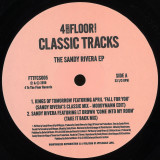
4 To The Floor is committed to delivering seminal house music to wax, making sought after heritage tracks readily available on vinyl for crate diggers to add to their collections. The fourth edition of the series pays homage to one of the most loved names in house music – Sandy Rivera. Known for his soulful dancefloor cuts he has produced timeless classics, with his long-lasting career and multitude of aliases captured by this 12” release. Opening the A-side is the Moodymann Edit of Kings of Tomorrow’s ‘Fall For You’, featuring the stunning vocals of long-time collaborator April Morgan, followed by Sandy’s grooving ‘Come Into My Room’ which features LT Brown. On the flip is Soul Vision’s ‘Don’t Stop’ with its atmospheric strings and gospel vocal. The release is closed with Kings Of Tomorrow featuring Elzi Hall ‘Show Me’, an atmospheric club cut that shows the versatility of this house legend.
If there is a year zero for the introduction of reggae music to Japan, you’d be forgiven for thinking it was 1979 when Bob Marley and the Wailers toured the country, trailed by an entourage of journalists, photographers and fans ready to spread the message of the music into all corners of Japanese society.
But the story of Japanese reggae is not a linear one, and the music that is collected on Tokyo Riddim 1976-1985 captures the moment J-reggae entered the broader public consciousness, merging commercial city pop style with an infectious backbeat, that has drawn comparisons with the emergence of Lovers Rock in the UK.
Rather than look directly to Jamaica, many producers and artists in Japan were inspired instead by the more approachable sounds of The Police and UB40, their reggae fix arriving pre-filtered through the lens of new wave pop from the UK. Playful and groovy, these album deep cuts have been overlooked for too long.
Among them are Miki Hirayama, the idol singer who borrowed the bassline from Bob Marley’s Natural Mystic on ‘Denshi Lenzi’, Chu Kosaka, who headed to Hawaii to cut the Jimmy Cliff-inspired ‘Music’ and Marlene, the Philippine songstress whose cover of Roberta Flack’s ‘Hittin’ Me Wear It Hurts’ owed much to her producer’s obsession with Sly & Robbie’s Compass Point sound.
Then there was Izumi “Mimi” Kobayashi, who enlisted the Babylon Warriors to perform on a dubbed-out version of her own track ‘Lazy Love’, the city pop-meets-new wave reggae sound of Miharu Koshi’s ‘Coffee Break’, Junko Yagami’s anti-apartheid deep cut ‘Johannesburg’ and Lily, whose ‘Tenkini Naare’ was produced by Ryuichi Sakamoto and closes out the compilation with a flourish.
While these stories may not always conform to neat narratives, they do provide a more accurate reflection of the indirect ways in which styles infiltrate one another and, in their naivety, have the potential to create something beautifully strange and entirely new. Previously only available in Japan, the tracks on this compilation are a testament to that curious alchemy.
Tokyo Riddim 1976-1985 is released on vinyl and as a full album download (no streaming), featuring original artwork by Japanese Fukuoka-based artist Noncheleee, whose cover pays homage to the iconic dancehall album art of Wilfred Limonious.
Released on 1st September, Tokyo Riddim 1976-1985 is part of Time Capsule's Nippon Series, a loose series of compilations exploring different musical scenes from Japan between the 1960s and 2010s.
- A1: Blues For Gon-San
- A2: Samba De Negrito
- B1: La Esmeralda
- B2: Reaching To The Sun
- B3: Cantalope Island
Bass: Takashi Mizuhashi, Teruo Nakamura
Drums: Bruno Carr
Piano, Electric Piano: Herbie Hancock
Recorded on February 22, 1977, in New York, this rare session captures Japan’s proud bassist Takashi Mizuhashi performing alongside Herbie Hancock.
Throughout the album, Mizuhashi’s deeply resonant bass tone and melodious phrasing shine, making this a quintessential “international” Japanese jazz classic.
- A1: Ghetto Chronicle Daily
- A2: Use To Fear Death
- A3: Drug War Rages
- A4: Saturday Night, Sunday Morning
- A5: What U Saying
- B1: Nighty Night
- B2: Stick N Step
- B3: Death Of A Salesman
- B4: White Chalk Pt. (Feat. Biggie Smalls)
- B5: Same Shit
A long-overdue vinyl reissue for this underground gem from the Bronx! Originally released in the late ’90s, Ghetto Chronicle Daily stands as a timeless snapshot of New York street rap in its rawest form — a true reflection of the city’s golden era grit and lyrical craftsmanship.
The Money Boss Players — made up of Big Ah (RIP), Lord Tariq, Tre Bag, Eddie Cheeba, C-Dubb, and legendary producer Minnesota — were key figures in shaping that unmistakable Bronx sound. Their chemistry was electric: sharp lyricism, vivid street storytelling, and cinematic beats that carried the DNA of hip-hop’s golden age.
This first-ever vinyl reissue brings this underground classic back to the masses in its full glory and goes a step further with bonus tracks previously unreleased on vinyl, including “Drug War Rages” and “Same Shit” — raw, unfiltered cuts that capture the crew at their most authentic. Also included is “White Chalk Pt. 2”, featuring none other than The Notorious B.I.G., a rare collaboration that cements the group’s deep roots in the East Coast rap lineage.
Since the original release, members of Money Boss Players have continued to carve their own lanes — with Eddie Cheeba and Tray Bag evolving into Boss Money, and Lord Tariq making his mark as a solo artist. In recent years, Bronx rapper Yung JB has joined the fold, carrying the Boss legacy into a new generation.
Now, more than two decades later, Ghetto Chronicle Daily returns to turntables worldwide — remastered and pressed with care for true heads and collectors alike. A must-have piece of hip-hop history, finally on wax where it belongs.
- Sit Yourself Down
- Moonshine
- Beneath The Planet Apes
- 88:
- Easy Work
- Get In Line
- Higher Learning
- O.p.m. (Feat. The Real Shakar)
- Searching
After decades deep in the game, few names carry the same weight as D.I.T.C. veteran O.C. and East New York’s own PF Cuttin, the DJ and producer behind countless underground classics. Long respected for their consistency and craftsmanship, the two finally joined forces for Opium — a nine-track masterclass that channels the essence of true-school hip-hop.
Originally released to remind heads of what the real sound of the streets was, Opium plays like a time capsule from the era of block parties, 40s, and cipher sessions on the corner — where bars mattered and the beats hit hard. PF Cuttin’s rugged, sample-driven production perfectly complements O.C.’s sharp lyricism and timeless flow, delivering a record that bridges nostalgia with enduring relevance.
Reissued in 2025 with the same iconic artwork by Scarful, this edition celebrates a collaboration that captures the raw soul of New York hip-hop — pure, uncut, and eternal.
Crystal Tides’ long-awaited debut album Toothpaste is the sound of a band truly coming into their own. Written and recorded completely independently, the record embodies the spirit of resilience, creativity, and raw honesty that has carried the Portsmouth outfit through their journey so far. “We wanted the focus of this album to showcase our independence as a band. We felt it important, given our journey thus far, that it come from us in as raw form as possible.” The seeds of Toothpaste were planted back in 2022 with rough voice notes on lead singer Billy’s phone, evolving into a collection of songs that capture both the band’s infectious energy and their most personal reflections to date. From collaborative writing sessions in the practice room to late-night home demos, every track carries the DNA of Crystal Tides’ unity and determination. Working with long-time collaborator and producer David Evans, the result is a bold, heartfelt body of work that celebrates their independence while delivering polished, stadium-ready anthems. The album takes its name from one of its most intimate tracks. Toothpaste was born out of Billy’s battle with Ulcerative Colitis, which led to life-changing surgery. A passing joke about naming the album after the song became a moment of clarity. It's unusual, striking title felt like the only choice, a symbol of the band’s authenticity and ability to find meaning even in the unexpected.
Stoop Kid is the jangly indie rock project of Diest-born Jens Rubens. After Camp Careful (2021) and Mount Cope (2023), Stoop Kid returns with his third full-length album Office Overdue, a ten-song collection that captures the quiet fatigue, flickering humor, and
fragile hope of keeping it together in a world that won't slow down.
'Office Overdue' is a collection of songs Jens made at home in his modest home studio. For this album, he wanted to let go of pressure and expectations more than ever, and only work on music when he genuinely felt like it.No fancy studio, no producer, just walking upstairs and messing around. The result doesn't always sound perfectly polished: the drums are sometimes clumsily programmed and more than a few wrong notes made it onto the record. The guitars were allowed to hit a bit harder this time, with the '90s slacker vibes coming through more prominently. The result is a record that feels raw and honest, and above all, was made purely out of enthusiasm.
Office Overdue explores the attempt to keep functioning in everyday life while the world around us feels on the verge of collapse. The songs move between mental exhaustion and self-reflection, carried by a dry, sometimes bitter humour that helps lighten the weight. The album focuses on repetition and routine, and on the tension between wanting to care for others and being trapped inside one's own head. Themes of anxiety, guilt and dissociation recur throughout, but are always accompanied by small moments of connection, gentle resistance and acceptance. Office Overdue embraces the mess, the doubt and the false notes, without drawing grand conclusions. Not everything is resolved, but the persistence remains.
- 1: Fire The Choir 0:5
- 2: Twin Scissors 0:0
- 3: Plainclothes Man 02:29
- 4: Career Blonde 02:12
- 5: Pontaria 01:39
- 6: The Gold Standard In Dumpster Diving 01:28
- 7: Caught Again 04:02
- 8: That's Not My Skin You're Eating 01:13
- 9: Husband And Bribe 02:24
- 10: Wire Lashes 02:07
- 11: Buckteeth 01:48
- 12: Community Gun 02:13
- 13: Triple Tracy 04:33
Conjuring a faithful following, quite rare in these days of ADHD, by sheer force of their celebratory and fiery live shows, Montijo's most celebrated outfit reflects these past couple years of camaraderie and life on the road on their debut album, after a self-released EP and a 4 way split on Zegema Beach Records. Sublimating all the inherent potential of post-hardcore at its most sweeping into a forceful and focused delivery, 'Acetate' captures all their urgency through 13 memorable and sharpened tracks. Recorded patiently and mastered by the gifted know how of Jack Shirley - Deafheaven, Joyce Manor or Gouge Away -, the songs on 'Acetate' open sprawling vistas upon the band's recognizable sound between chaos and order, cutting back on everything that might be redundant or overly technical. Alex Domingos' vocals reach new means of expressiveness through harrowing screams and hints of melody, João Pires' sinewy guitar pulling out riffs and skewed lines that echo for posterity and the rhythmic section of Simão Simões - bass - and João Portalegre - drums - driving all this turmoil with kinetic precision and flexibility. Never before did Hetta sound as relentless, chill and melodic, tracking down life at its own pulse.
- Beauty Of The Brain
- In The Woods
- Heavy Cloud
- Encore
- Manything Goes
Somewhere between jazz, progressive rock and cinematic soundscapes, Kabasse unfolds a world of intricate arrangements, bold sonic textures and heartfelt improvisation. The brainchild of Munich-based musician Sigmund Perner (also member of Carpet), this sextet blends composed structure with free exploration, layering lush harmonies, unexpected rhythms and a rich palette of wind, mallet and keyboard instruments. What began as decades of musical ideas-gathered quietly, never written down-found its shape through a group of close-knit musicians from Munich and Augsburg, including Perner's own son on drums. Together, they recorded in a live studio session, embracing risk and spontaneity. The result: a deeply personal debut album that feels both mature and raw, contemplative and gripping. Rather than demanding attention, the pieces invite it: About Sitting on Fences captures the art of waiting-for ideas to grow, evolve and resonate. Just like the name Kabasse, inspired by the calabash: a vessel, a resonator, a home for sound.
- Mama Ku Dile - Mama Nao Chores
- As Cinco Sociedades - O Isangela Itanu
- Tambi Mua Ngola - Obito Em Angola
- Ngongo Mua Ngola - Sofrimento Em Angola
- Tribalismo - Katungu
- Ufolo - Liberdade
- Katete Ngila - Catete É Um Passaro
- A Luta Continua - O Nvunda Ki Ia Bue Lua
- Mona Ku Jimbe Manhenu - Filho Nao Esqueca A Sua Mae
- Undenge Uami - A Minha Infância
- Nguma - Inimigo
- Kamba Diami - O Meu Amigo
David Zé - Mutudi Ua Ufolo / Viúva da Liberdade is a major milestone in Angolan music, intensely blendingsemba, rumba, and bolero, recordedat the height of the country"s liberation struggle. Both soulful and political, the album resonates far beyond Luanda, carrying a universal spirit akin to that of Bob Marley. Originally released on CDA with Conjunto Merengue, it captures David Zé at his creative peak. Sung in Portuguese and local dialects, it combines rhythmic elegance with deep commitment, weaving links between Afro-Brazilian and Latin American traditions. After his assassination in 1977, the album was banned for several years, before being reborn as an essential work of resistance and beauty. In 2008, his legacy found a new echo when Damian Marley and Nas sampled "Undenge Uami" on Distant Relatives.
- A1: Qpr Shuffle (2.34)
- B1: Version (2.39)
All football teams for some reason or other adopt a song and make it their own. In many ways to sing along to or chant over, as their team roll out onto the football pitch. Mal-one a big fan of the instrumental track, likes the way they can set and capture the mood. He has adapted one of his tunes ‘Rude Boy Shuffle’ to help push up West London’s finest team ‘Queens Park Rangers’. In true reggae style he has added the version dub excursion to its B-Side, for further
enhancement. We hope this reggae inspired ditty hits the mark and hopefully the back of the net.