Cuernavaca / Stateville / Frankincense And Myrrh / Apsara / Ancestral / Spin / Zincali
Approaching his eighty-fifth birthday, sharp and lean, Phil Cohran lives a couple of blocks from the lake on the north side of Chicago. His modest apartment is filled with a palpable richness. His cornet and trumpets, zithers, French horn, harp and frankiphones (an electric kalimba of his own invention); his beloved telescope; African art; a mural of the Chinese monastery where Muslim monks bestowed on him the name Kelan ('holy scripture'); hand-printed posters from the culture wars of 1960s Chicago; all reflect a life dedicated not just to music, but also to science and astronomy, to history and activism. In its range of subject matter the track-list of Kelan Philip Cohran & The Hypnotic Brass Ensemble embodies this invigorating and all-embracing curiosity: a Mexican hill-town filled with perfume and flowers... an Illinois state prison where Cohran taught inmates in the 1960s... heavenly dancers in the temples of Cambodia... a tribute to a sixteenth-century Venetian musicologist. Welcome to the musical world of Kelan Philip Cohran.
Cohran was born in Mississippi and grew up in St Louis. In the immediate post-war years St Louis was a jazz heartland, home of stalwarts like Clark Terry and Oliver Nelson (both of whom he played with), not to mention a genius called Miles Davis. In 1950 Cohran moved to another heartland, Kansas City, where he played trumpet in one of the hardest swinging swing-groups, led by Jay McShann (who famously had given Charlie Parker his first job). With McShann he spent 'the best year of my life', touring as far as Mexico and playing proto-rock'n'roll in Texas with the likes of Big Mama Thornton on vocals. Back in St Louis Cohran led his own group, the Rajas Of Swing, whose show involved wearing red jackets, grey slacks, blue suede shoes and turbans.
Then in the mid-50s he moved to Chicago. He had a small group with a friend, the legendary tenor saxophonist John Gilmore, whose regular gig was to play at Sarah Vaughan's weekly 'birthday' parties, an excuse for the Sassy One to splash the cash and have some fun. ('What, Sarah Vaughan would sing with you and John Gilmore' 'No way, Sarah didn't sing, she was too busy partying.') And in 1959, through Gilmore, he was invited to join Sun Ra's Arkestra, at a crucial period in the evolution of that extraordinary group. Effortlessly wrapping traditions as divergent as boogie-woogie and electronica in an Afro-centric, intergalactic mythology of his own making, Sun Ra casts a huge shadow across conventional narratives of jazz history. 'With Sunny', Cohran simply says, 'I found my own voice'.
You can hear the emergence of this voice on the LP Angels And Demons At Play, recorded in 1960 - Sun Ra's masterpiece from the period. On the track Music From The World Tomorrow, against the urgent whipped and chopped percussion of the Arkestra, it is Cohran's zither, initially bowed and then plucked and strummed, which is the track's magic ingredient. More profoundly it was Sun Ra's example - his defiant self-confidence and sense of purpose - that set Cohran on his own (to quote another Ra composition) 'pathway to unknown worlds'. Indeed this spirit of self-belief led Cohran to turn down the invitation to accompany the Arkestra when Sun Ra moved east in 1961.
Staying in Chicago, Cohran founded the Affro-Arts Theater and performed with the Artistic Heritage Ensemble, recording the group for his own Zulu Records imprint. (Co-members went on to become Earth Wind & Fire; Cohran taught the group's leader Maurice White the mysteries of the frankiphone). The AACM, a musicians' collective of immense influence and importance, had its first meeting in Cohran's front room. With Oscar Brown Jr and Gene Page he wrote and performed in a show celebrating the nineteenth-century Afro-American poet Paul Lawrence Dunbar. He taught music tirelessly in schools and prisons. His studies into music theory and history led him to the discovery of a key book in his life, Gioseffo Zarlino's treatise on harmony, published in Venice in1558. Astronomy is another passion and another area of expertise. One of the gems of the Cohran discography is African Skies, with its lovely harp playing, commissioned by the Chicago Planetarium in 1993.
In Chicago he also raised a large family. Many of his children have gone on to become professional musicians; eight of them are the Hypnotic Brass Ensemble. For each of them, their first teacher was their father, who famously insisted on giving them music lessons not just for several hours after school, but for several hours before school as well. Their father's music was all around them as children; they all vividly remember lying in bed at night not being able to sleep because their father was rehearsing with the Jazz Workshop downstairs.
For the Hypnotic Brass Ensemble, the voyage to where they are now - whether tearing up festivals from Glastonbury to Melbourne, or touring with Gorillaz, or recording their first album on Honest Jon's - has involved a necessary stepping away from their father's shadow. Phil Cohran is the first to recognise this, happily allowing their sound - heavy on the funk, with the urgency of hip hop never far away - to blossom.
But likewise this album is for all of them a natural step. Recorded in Chicago in June 2011, the idea was beautifully simple - 'my music and their band' as Phil puts it, 'we don't have to rattle on more than that'. Only to point out perhaps that here - in the majestic surge of Zincali, for instance, or in the sheer verve and bounce of Cuernevaca - is music not just filled with the warmth of home. This is music that plumbs the depths and rings with joy.
'Cuernevaca is a town in the mountains south of Mexico City. I was there in 1950 when I was on the road with Jay McShann's band. It's a place close to paradise, a city filled with the fragrance of flowers. I always wanted to go back... In 1974 I taught workshops at the prison in Stateville, the Big House where Al Capone spent time. There's a huge wall around the prison, and once I took Hypnotic there - ha - to see what the future holds for them... Makeda, the Queen of Sheba, sent a caravan of gifts to King Solomon - a caravan that took more than a day to pass one point - and the main gifts were Frankincense And Myrrh... I wrote Apsara in 1967, when Jackie Kennedy was in the news with her visit to the temple of Angkor Wat in Cambodia. Apsara were celestial beings, dancers who brought forth the civilization of ancient Cambodia, by dancing in the holy nectar called Amrita... Ancestral is a meditation drone written for my Friday-night residence at the Ethiopian Diamond Restaurant in Chicago's Rogers Park... Spin is the latest of these compositions. Everything in the cosmos spins, from the smallest objects we can see in a microscope to the largest galaxies. Spin is the motion of all things whether it looks like it or not... Zincali is a name Spanish gypsies call themselves. 'Zin', East Africa; 'cali', the people. One of the offshoots in my research into Moorish Spain has led me to Gioseffo Zarlino, the sixteenth-century master of music at St Mark's in Venice. It's said that Bach lost his sight reading Zarlino's treatise on counterpoint. His greatest composition is his setting of the Song of Songs - 'Nigra Sum', 'I am black'. This is my tribute to Zarlino and to the zincali.'
Buscar:cara
Virtuosic ‘70s rock guitar ruminations encounter an irrefutable mixture of astonishing modern elements and classic psychedelic / progressive rock trademarks: Icelandic frontrunners THE VINTAGE CARAVAN return with their fifth studio album, Monuments, out April 16, 2021 via Napalm Records. After countless high-voltage live performances at festivals such as Roadburn, Wacken and Hellfest, and touring with Opeth, the Icelandic band’s new full-length impressively demonstrates that they have matured both musically and lyrically – presenting their very own potent mixture accented by bold, nostalgic nuance. On 11 diverse tracks, these youngbloods from Reykjavik truly cast a spell on fans of bewitching, guitar-driven classic and blues rock influences. The album opener, “Whispers”, clearly showcases the band’s musical progression without sacrificing their tried-and-true, retro-inspired sonic trademark. “Crystalized '' convinces with light blues influences, encircling the listener in enchanting guitar lines and quickly rising to the full extent of its power while evoking anecdotes of retro nostalgia. “Can’t get you out of my mind” takes its listener on a blistering ride through pounding drums, intense guitar solos and an undeniably catchy chorus, while tracks like “This one’s for you” represent a stunning blueprint in THE VINTAGE CARAVAN’s musical universe with unconventional, surprisingly calm melodies and Óskar’s gripping, tranquil vocal power. In contrast, bold drumming merges with fast-paced riffs, enveloping an impressive galloping vortex and pronouncing tracks like “Dark Times” and “Said and Done” as top notch rock pieces. The soft plugging, atmospheric sound of album closer “Clarity” symbolizes the crowning culmination of a 60-minute journey through the eternal landscapes of Iceland and the poetic lyricism of the trio.
Following a series of records with Thrill Jockey (including
the sensational Seasonal Hire with Steve Gunn), the Black
Twig Pickers return to the VHF mothership to continue their
charming and original take on old time and Appalachianinspired
string band sounds. Together since 2001, and a
continuous presence in the music’s true home of Southwest
Virginia, the Twigs represent the actively working evolution
of the traditions—learning songs from other locals, playing
dances at the Floyd Country Store, etc—without retroartifice
or nostalgia. The ragged-but-right performances and
recording (and Sally Ann Morgan’s perfect cover design)
sit at the ideal intersection of DIY / “underground” and local
string-sound values. On Friend’s Peace, the band travels a
range of styles, from the lovely harmony on the trad-classic
“Moonshiner” to the racing fiddle / guitar / banjo on the
“Money Musk” medley. Mixed in with the traditional songs
are several perfectly-placed original tunes, including Mike
Gangloff’s keening “Cara’s Waltz” and Isak Howell’s solo
guitar spotlight on “Barnswallow.”
Nada Surf are an American alternative rock band formed in the 1990s in New York. High/Low is their debut studio album, released in 1996 to positive reviews. All tracks were written by frontman Matthew Caws and bassist Daniel Lorca. Combining indie punk with grunge, emo and even pop, High/Low is a record full of high quality riffs and catchy melodies. It contains the smash hit single “Popular”, which reached the top 10 in several countries and remains a classic song among fans of alternative music.
High/Low is available on gold coloured vinyl as a limited edition of
1000 individually numbered copies.
Richard Youngs' e work can traverse everywhere from avant-folk or otherworldly pop to minimalist electronics or some of the most fervent 'outer sounds' one can dredge from the deepest crevices of their doubtlessly life battle-scarred imagination. On Metal River, Youngs offers four songs of deep space beamed curdled electronics not far removed from being akin to the contorted death caterwauls of a cyborg species reaching out in uttermost anguish. It's like prime Edgar Froese getting snagged on Incapacitants before tumbling headlong into a dingy cellar that then has its door slammed shut and locked before one notices the only company is accorded by body parts in dusty and mouldy demijohns. Features three songs on the first side, 'Days of Gravity Indoors', 'Metal River' and 'Rainy Days Static Caravan', plus the side long 'Dual Monody of Accumulated Detritus'. The perfect follow up to the 2dicks 7" lathe-cut also featuring Richard Youngs and released by FD in June. White vinyl, too. What more could you possibly ask for? "
Los ingenieros oníricos se sirven de los artefactos para poder manipular su conciencia y diseñar mundos oníricos por los que viajar. De origen incierto, los artefactos se encuentran dispersos entre planos y han intentado ser rediseñados en nuestro mundo mediante el uso de frecuencias, convirtiéndose en elementos de estudio plenamente funcionales para el ingeniero onírico del plano físico. La correcta correlación de uso entre artefactos permite al onironauta saltar entre los diferentes estados de la experiencia para la formación de universos.
El artefacto Onirógeno es capaz de inducir al sueño. Sirve de puerta de enlace al mundo onírico y está presente en un estado de semi-consciencia. Dicho artefacto esférico, de naturaleza cromada, reproduce de manera cíclica el proceso de encendido de la máquina de sueños por un operador en un espacio ilusorio. El ingeniero sucumbe a un estado aletargado que permite el vínculo con otros artefactos al ser testigo de una de estas reproducciones.
El artefacto Hipnagogia es capaz de provocar alucinaciones visuales de intensidad creciente. Permite formar protomundos inconexos. Es un artefacto propio del plano semi-consciente. Debido a lo efímero de los protomundos formados, el ingeniero es incapaz de controlarlos y dotarlos de sentido.
El artefacto Efialtes es uno de los más inestables y volátiles. Este ente del plano semiconsciente provoca la incapacidad transitoria para realizar movimientos voluntarios durante la transición entre el sueño y la vigilia. Permite al ingeniero crear un canal al plano transitorio. Su presencia o interacción puede darse en los primeros o últimos estadíos. Está muy presente en el mundo semi-consciente y puede ser atraído por el uso de otros artefactos. Emite un zumbido muy característico cuando interacciona.
El artefacto Proyector, toroide derivado de Efialtes, solo presente en el plano transitorio. Crea un canal y permite al ingeniero ingresar, precediendo a la separación física, y materializar la consciencia en el nuevo plano.
Extracorpóreo es un derivado del artefacto Proyector, presente en el plano transitorio y con influencia en el plano físico. Permite a la conciencia materializada del ingeniero comunicarse con los impulsos básicos motrices y órdenes cerebrales del plano físico, traduciendo los diferentes protocolos implicados.
El artefacto Vacío es un espacio unidimensional que interconecta el plano transitorio con el plano onírico.
El artefacto Arquitecto, presente en el plano onírico, forma y diseña espacios acorde con las órdenes del ingeniero onírico en el caso de que el canal de comunicación sea lo suficientemente consciente. Es una pequeña recreación esférica del universo elevado a infinito en forma de fractal.
El artefacto Escultor, de hormigón y presente en el plano onírico, crea las diferentes imágenes e inteligencias que habitan el mundo onírico en construcción. Aunque puede ser controlado, a menudo actúa con un mayor libre albedrío, creando imágenes recurrentes.
El artefacto Programador, de código en cascada y presente en el plano onírico, es la inteligencia encargada de dotar a los mundos oníricos de acontecimientos.
El artefacto Devoramundos es el artefacto más inestable conocido y con mayor rango de influencia entre planos. Destruye el mundo creado como un agujero negro engulle todo a su paso.
El artefacto Cordón, de plata y presente en todos los planos, sirve como nexo entre el cuerpo físico y la consciencia materializada. A menudo, debido al influjo de otro artefacto, o a la inestabilidad en el canal creado por correlación, es capaz de obligar a la regresión, clausurando el canal de comunicación. Existe un artefacto Cordón que une cada una de las conciencias proyectadas con sus correspondientes cuerpos así como del cuerpo físico. Se desconoce que ocurre en caso de fisión.
El artefacto Regreso, presente en el plano transitorio-semiconsciente permite al ingeniero recuperar la consciencia y restablecer sus signos vitales.
Caravela's debut full length LP 'Orla' is an intoxicating mix of Afro-Brazillian rhythms and contemporary London jazz drenched in modern psychedelic and progressive textures. The band's deep and infectious grooves form the basis from which they can showcase their beautiful and mature songwriting craft. Lyrics touching on social and environmental issues in both Brazil and Cape Verde, as well as reflections on modern life, weave between the songs in Loubet's native Portuguese.
Lead single 'A Macieira' garnered airplay on NTS, Worldwide FM and Soho Radio, with Music Is My Sanctuary describing it as an "uplifting and graceful lead single" in their premiere of the track.
"… an album as hummably lovely as it is knowingly referencing of a certain tradition of neo-psychedelic English whimsy." - The Observer
“… sets the pair into new experimental territory” - NME
Mute / BMG announce the long-awaited vinyl reissue of Goldfrapp’s fourth album, Seventh Tree. Out on 5 March 2021, this is one of a series of Goldfrapp vinyl releases on special edition coloured vinyl.
Originally released in February 2008, Seventh Tree has been out of print for many years and will be reissued here as a yellow vinyl pressing in a gatefold sleeve, with an exclusive art print of the original artwork.
Featuring the singles ‘A&E’, ’Happiness’, ‘Caravan Girl’ and ‘Clowns’, the album was written by Alison Goldfrapp and Will Gregory and recorded at their own studio deep in the English countryside.
Seventh Tree followed the glitterball glamour of platinum-selling album, Supernature (2005), and is very much its sensual counterpoint. Where its predecessor came cocooned in style and sex, Seventh Tree emerges gilded in the butterfly colours of an English surrealism. It shimmers and shines with the warmth of a hazy summer, an electric whirlpool of sound over which Alison’s glistening voice soars.
Alison Goldfrapp described the album as “English romanticism with a hint of California sunshine.” while Will Gregory called it “heartache dressed in ten louche outfit”’.
"The Queen", they called her and Dinah Washington's regality
was nowhere more apparent than in the recording studio,
where she was uncompromising in her demands for the best in
material and in backing. She is marvelous in this recording,
which dates from 1957, for not only did she have some great
standards to sing in arrangements by Quincy Jones and Ernie
Wilkins, two of the best around at that time, but she also had
behind her a star-spangled band (the trumpet section alone is
sufficient indication of its quality) that gave her every
opportunity to be at her best.
- A1: Rockin’ In Rhythm
- A2: Drop Me Off In Harlem
- A3: Day Dream
- A4: Caravan
- A5: Take The ‘A’ Train
- B1: I Ain’t Got Nothing But The Blues
- B2: Clementine
- B3: I Didn’t Know About You
- B4: I’m Beginning To See The Light
- B5: Lost In Meditation
- B6: Perdido
- C1: Cotton Tail
- C2: Do Nothin’ Till You Hear From Me
- C3: Just A Sittin’ And A Rockin’
- C4: Solitude
- C5: Rocks In My Bed
- D1: Satin Doll
- D2: Sophisticated Lady
- D3: Just Squeeze Me (But Don’t Tease Me)
- D4: It Don’t Mean A Thing (If It Ain’t Got That Swing)
- D5: Azure
Ella Fitzgerald was, by any yardstick, a remarkable singer. She
had achieved much by the time she signed to the newly created
Verve Records in 1956, but it was the genius of Norman Granz,
her personal manager and Verve founder, in suggesting she
tackle the material of great contemporary composers in themed
albums that sent her career into orbit. As the New York Times
wrote on her passing in 1996, "These albums were among the
first pop records to devote such serious attention to individual
songwriters, and they were instrumental in establishing the pop
album as a vehicle for serious musical exploration." The song
selections ranged from standards to rarities, and the eight-title
series represented an attempt by Fitzgerald to cross over to a
non-jazz audience that may have been unaware of the talents
she first committed to vinyl in 1935.
- A1: Somebody Else Feat. Boy Matthews
- A2: Automatic Feat. Fiora
- A3: Latching Onto You Feat. Nazarene
- A4: Antibodies Feat. Cara Melín
- B1: World Beneath Feat. Swedish Red Elephant
- B2: Overnight Feat. Fiora
- B3: Rules Feat. Chenai
- B4: Make You Mine
- C1: Simpansi
- C2: Nightshift Feat. Fiora
- C3: Strange Without You Feat. Daramola
- D1: Call Me Feat. Hexe
- D2: Wait It Out
- D3: Adams Hill
Das zweite Tensnake-Studioalbum "L.A." erscheint nun endlich auf Vinyl. Benannt nach der Metropole an der US-Westküste, in der der Hamburger DJ und Produzent sechs Jahre lang eine Liebesbeziehung erlebte, huldigt Tensnake mit den 14 Tracks seine Liebe zum Pop, was sich besonders in dem Pointer Sisters-Cover "Automatic" widerspiegelt, das allein auf Spotify bereits über 5 Mio. Streams zählt und damit - nach seinem Klassiker "Coma Cat" (2010) - sein zweitmeistgestreamter Hit ist. Tensnakes Zeit in L.A. brachte ein exzellentes House-Pop-Album mit zahlreichen Vocal-Ohrwürmern und entspannten Instrumentals hervor.
When a synth master like Steve Moore joins forces with the legendary KPM, magic must materialise. And so it does with Analog Sensitivity: cinematic, enigmatic synthscapes to both haunt and heal.
New York-based multi-instrumentalist/producer/film composer Steve Moore is probably best known for his synthesizer and bass guitar work as Zombi, together with Anthony Paterra. But he is also part of Miracle and Titan as well as being a prolific solo artist releasing music as Gianni Rossi, Lovelock and under his own name. Steve’s music has found a home across labels like Future Times, Mexican Summer, LIES, Static Caravan, Relapse, Kompakt, Spectrum Spools, Death Waltz and Ghost Box, and much of his recent work has been scoring films like The Guest and Cub. Prolific indeed.
The story of Analog Sensitivity starts with those soundtracks, or more specifically the time in between them. Rather than being commissioned by KPM, this LP comes from music Steve was recording sporadically and tinkering with for over three years during the downtime between his film projects. There were no ideas about what it was nor a plan for how it would be released, or even if it was going to be released at all.
However, after Jon Tye invited him to play on the Ocean Moon project for KPM Steve realised that the hallowed library label might be the perfect home for what he had been working on. The people at KPM agreed. Finishing production in late 2019 in Albany, NY, he came up with the track sequencing and suddenly, he had an album: Analog Sensitivity.
The LP opens with the dystopian electronic minimalism of “Eldborg”, its dark synth bass unfolding to ominous synth pads, shadowy sustains and glistening arpeggios. “At The Edge Of Perception” brings an unsettling retro-future of edgy analogue leads and desolate FX. The sound of a robotic core tears through the sparse textures of the enigmatic “Rose Of Charon”. A chilling breeze blows through a persistent, hypnotic synth sequence on “Time Freeze”. Title track “Analog Sensitivity” is a sparkling transcendental synthscape of melody, drones and celestial synth. The brooding “Behind The Waterfall” winds down the first side, building subtle strings and a desolate sound beneath its haunting organ.
“Mirror Mountain” ushers in side two, its woozy bass and arpeggio unfolding to envelop the muffled, muted echos of its organic leads. "Syzygy" emerges you in bubbling sequences, airiness and ambient electric guitar tones. It’s followed by the cinematic minimalism of “Pentagram Of Venus” and its trickling FX. The wind swirls through the otherworldly “Of Dust Thou Art” kicking up clouds of unsettling, plodding synth sequences leading to the uneasy atmosphere of “Message From The Beast” which builds to the echo of the last refrain of some choral incantation. Closing track “Urge Surfing” is as cool a climax as you’d hope from something so brilliantly titled, riding along hushed waves of brooding electronics.
With the clue right there in the title, Analog Sensitivity is built up from the quieter aspects of the sound Steve has been exploring and evolving for over 20 years. It’s a layering of ambivalently dense and airy, muffled and echoing sounds from his collection of synthesizers and other electronic music hardware. And whilst some of Steve’s other work uses this vintage equipment to conjure the past, that wasn’t his intention here. Steve explains “I wanted Analog Sensitivity to feel atemporal, as though it could have been released any time over the past 30 or 40 years. While not specifically in the spirit of any particular album, I’m really into old KPM artists like Alan Hawkshaw and Brian Bennett”.
From Shrine to Stax, Isaac Hayes to Gloria Ann Taylor, The Mad Lads to The Staples Singers, Detroit to Atlanta, Kendrick to Pusha-T, Dale Warren’s singular voice is the lone constant. Beneath the ethereal beauty of his productions was a genius crippled by his unbridled id. His everevolving 24-Carat Black project spanned the ’70s, producing a masterpiece and an unfinished follow up. Discovered in a storage space were Warren’s 1980s demos cut with grown n’ sexy divas Princess Hearn, Vicki Gray, and LaRhonda LeGette right before his untimely death at the age of 50. III is an unfinished symphony that peels away the final layer of Dale Warren’s mysterious oeuvre.
Der Hamburger Musiker und DJ RVDS schließt sich mit dem meditativen, ohrenschmeichelnden Klangkunstwerk "Moods and Dances 2021", einem musikalischen Geschenk aus einer Zeit, in der die Zukunft Vergangenheit sein wird, dem Label Bureau B an. Inspiriert von der sphärischen Exotik und den fantasievollen Elektroniksounds der Library Music, beschwört Richard von der Schulenburg Palmen, Pyramiden, Promenaden und Portale herauf, die vom Zentrum eines Holodecks aus beobachtet werden. Die Stücke nehmen uns mit auf eine Reise durch den wilden Geräte-Dschungel in Richards Privatstudio und lassen sich als Hommage an die Klang-Schattierungen in seiner Sammlung verstehen. Ob mit geschmolzener 303 auf dem Gipfel des Mount Acid, ob improvisierter Jazz auf den Fendertasten oder live mit Bühnen-Pathos, Richards Musik ist in jedem Fall eine eindringliche, allumfassende Erfahrung. Gut möglich jedoch, dass diese Erfahrung noch nie unmittelbarer war als auf seinem neuesten Werk.
- A1: Samba Negra - Eberebijara
- A2: King Somalie - Monkey 'S Dance
- A3: El Grupo Folclórico - Tamba
- A4: Los Viajeros Siderales - El Campanero
- A5: Rio Latino - Ayu
- B1: Aníbal Velásquez - La Mazamorra Del Diablo
- B2: La Francachela - Mosquita Muerta
- B3: El Grupo Folclórico - Juipiti
- B4: King Somalie - Le Mongui
- C1: El Grupo Folclórico - El Tornillito
- C2: Samba Negra - Long Life Africa
- C3: La Banda Africana - Te Clavo La... Mano
- C4: Myrian Makenwa - El Platano
- D1: El Grupo Folclórico - Tucutru
- D2: Grupo Bola Roja - Caracol
- D3: El Grupo D'abelard - Otro Perro Con Ese Hueso
- D4: Conjunto Barbacoa - Wabali
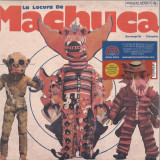
La Locura de Machuca is the story of one man’s bizarre odyssey into Colombia’s coastal music underground, and the wild, hypnotic sounds he helped bring up to the surface.
One night in 1975, a successful tax lawyer named Rafael Machuca had his mind blown in Barranquilla’s ‘Plaza de los Musicos’. Overnight he went from a high ranking position in the Columbian revenue authority to visionary production guru of the newly formed record label that bore his name, Discos Machuca, and for the next six years he devoted his life to releasing some of the strangest, most experimental Afro Psychedelia Cumbias ever produced. La Locura de Machuca is the story of one man’s bizarre odyssey into Colombia’s coastal music underground, and the wild, hypnotic sounds he helped bring up to the surface.
The Colombian music industry was thriving in the mid-seventies, but while homegrown bolero and vallenato tunes were doing well on the charts, it was imported African records that were setting crowds on fire at the picos – the sound-systems that fuelled neighbourhood parties – and wherever those records were played there were always a handful of groups who were inspired to plug traditional Cumbia directly into the electric currents coming from across the Atlantic.
It was these obscure bands, who fused Colombian and African rhythms with the swirling organs and psychedelic guitars of underground rock, that fired Machuca’s imagination. While the label made its money releasing popular hits by legends such as Alejandro Durán and Aníbal Velásquez, that money was poured back into a unique run of experimental releases by fringe artists such as La Banda Africana, King Somalie, Conjunto Barbacoa, and Abelardo Carbono, one of the godfathers of Champeta Criolla.
When Machuca couldn’t find groups to realise his particular vision, he simply created them himself. Drawing on a fearsome roster of musicians associated with the label, he assembled bands that lasted only as long as it took to record an album ,and unleashed the results – complete with arrestingly unusual album covers – under a series of different names such as Samba Negra or El Grupo Folclórico. This unorthodox approach led his longtime recording engineer, Eduardo Dávila, to describes Machuca’s productions as the “B-Movies of Colombian music.”
The story of Doctor Machuca and his eccentric exploits tells of one of Colombia’s most atypical and peculiar record companies; a defining pillar of Afro-Caribbean psychedelia. His productions have come to represent the roots of Champeta and set the pedigree standards for Afro and Costeño avant-garde. The seventeen tracks on La Locura de Machuca, harvested from the darkest, strangest corners of the Discos Machuca catalogue, sound like little else recorded before or since.
Alfredo "El Inca" Linares is one of the best and most beloved musicians in the history of salsa. Fans love his piano playing because of his authentic Cuban feel and 'swing' combined with progressive arrangements and uncompromising phrasing. "Lo Que Tengo" is full of rock solid dance floor killers and no filler, recorded in 1980 with some of the cream of the crop of contemporary Venezuelan salsa musicians (members of Mango, Madera, El Trabuco Venezolano, Los Dementes, Los Melódicos, Dimensión Latina, Guaco, and La Salsa Mayor) and launched there on the indie label A.L.G. Records as ¡Con Todo!, and then a year later on the much larger Velvet Records with a different cover. This a classic Alfredo Linares album, but with the updated studio sound of 1980s Caracas. With five perfectly paced salsas, one funky cha cha chá, a steamy bolero and a dance-friendly Latin jazz number to top it off, there is something for everybody on this record. Thankfully today's generation can now enjoy this rarity at a fraction of the cost of an original copy. Presented in its original artwork and pressed on 180g vinyl. Good to know: Alfredo "El Inca" Linares is one of the best and most beloved musicians in the history of salsa. Fans love his piano playing because of his authentic Cuban feel and 'swing' combined with progressive arrangements and uncompromising phrasing that puts one in mind of Eddie Palmieri. As a composer, arranger and band-leader Linares is highly respected as well. Ever since the 1960s in Lima Peru when his career began, his records have always been on point, being super tight, sharp, and hard as hell, what salseros call salsa brava con afinque. It's no surprise that Lo Que Tengo is exactly that: full of rock solid dance floor killers and no filler, played with verve and flair. Unlike some of his other records that were patched together from various sessions made in different studios (sometimes even in several countries!), this album has the advantage of being produced, recorded and mixed by Alfredo Linares all in one studio and block of time, and backed by hand-picked seasoned professionals who Linares had already played with, both in the studio and on stage, lending it a consistency and sonic integrity that is excitingly manifest in every groove. The album was recorded in 1980 in Caracas with some of the cream of the crop of contemporary Venezuelan salsa musicians (members of Mango, Madera, El Trabuco Venezolano, Los Dementes, Los Melódicos, Dimensión Latina, Guaco, and La Salsa Mayor) and launched there on the indie label A.L.G. Records as ¡Con Todo!, and then a year later on the much larger Velvet Records with a different cover. The LP was also released in Colombia (INS, 1982) and the US (Gallo, 1984), both editions utilizing the Velvet Records cover. During this time Linares had been in Venezuela for some five years and was under contract with a nightclub in Caracas. Through being on the salsa scene there he became friends with the band Mango and even guested on an album with them in 1976. After the contract was up Linares was a free agent again and he was able to draw on his friendship with Mango and assemble a band to back him, first for the Colombian/Venezuelan production Salsa de Verdad (Fonodisco, 1976) and then again with ¡Con Todo! / Lo Que Tengo. One of the distinctive aspects of Alfredo Linares tunes is the 'break' (la cierre)-there are always plenty of dramatic hand-clapping breakdowns followed by an infectious tumbao (sustained vamp) section that sends shivers up the spine and makes the dancers go crazy. In addition, Linares always lets his musicians stretch out, especially in the percussion section. Again, Lo Que Tengo is no exception: there are so many examples of typical arrangements here that one could call this a classic Alfredo Linares album, but with the updated studio sound of 1980s Caracas, which was awash in petro-dollars at the time and so had the latest equipment and a strong consumer base for the salsa market. The album's title tune (originally credited on the Venezuelan edition as 'Lo que tengo que crear'-'What I Have To Create') is by Mango's timbalero José "Cheo" Navarro and sums up Linares' central career philosophy: the musician lives every day to create music, to spread joy and create a party, without complications, wherever he goes. With five perfectly paced salsas, one funky cha cha chá, a steamy bolero and a dance-friendly Latin jazz number to top it off (note the bluesy piano solo from Linares and the sublime vibes of Mango's Freddy Roldán), there is something for everybody on this record. Thankfully today's generation can now enjoy this rarity at a fraction of the cost of an original copy.
Fabrizio Maurizi makes his debut on Infuse this October as he delivers his latest EP ‘Jumping’, backed by a remix from Pierre Codarin.
A staple within the Italian house and techno scene for over a decade, Bologna’s Fabrizio Maurizi is a producer and DJ now known across the globe for his seamless blend of the two styles across his productions and DJ sets. One half of the duo Bassa Clan, with material via their self-titled imprint, and a member of the Bolo Represent collective, Maurizi’s recent releases include EPs via labels such Bodyparts, Memoria, Want?, Re.face, whilst playing sets worldwide for renowned institutions such as fabric, Robert Johnson, Womb and Cocoricò. Next up, October signals the arrival of a new name to his catalogue as he heads to FUSE sister imprint Infuse to deliver three fresh productions in the form of his ‘Jumping’ EP – accompanied by bubbling UK talent Pierre Codarin on remix duties.
The slick and paired back title track ‘Jumping’ opens proceedings as Maurizi fuses minimal soundscapes with more jazz-influenced notes and tones, whilst Pierre Codarin’s remix ups the energy levels as he introduces metallic drum licks, spiralling electronics and a snaking bassline to the mix. On the flip, ‘Night and Day’ harnesses a classy blend of dubby chords, slinking hats and echoed vocals, before closing the package via the off-kilter rhythms and loose, glitch-driven drums of hypnotic after-hours cut ‘Caravel’.
ANRMAL ist Juana Molinas erstes Livealbum auf ihrem langen Karriereweg. Es wurde beim NRMAL Festival in Mexiko aufgenommen, kurz bevor die Welt im März zum Stillstand kam, und ist ein Zeitzeugnis, wie die Welt "vorher" einmal war. Durch das kraftvolle Set zieht sich ein so mitreißender Punkrock-Vibe, dass er uns auf bessere Zeiten hoffen lässt. Als Juana Molina vor mehr als zwei Dekaden als Musikerin startete, waren ihre Kompositionen eher reflektiert und auf das Wesentliche reduziert. Zumeist spielte sie Solokonzerte mit ihrer Gitarre, einem Keyboard und Effektgeräten. Über die Jahre wurden ihre Konzerte immer wilder und ihre Platten immer intensiver und extrovertierter, was bei den Tourneen zu ihren letzten Alben zu erleben war. Auf dem am 23.10.2020 erscheinenden ANRML wird Juana Molina von ihren Bandkollegen Odin Schwartz am Bass und Pablo González am Schlagzeug begleitet, die eine Extraportion Energie zum Auftritt beitragen. Das Set enthält Stücke aus Juanas letzten Alben Halo, Wed 21 sowie der Wiederveröffentlichung Un día und der EP "Forfun", alle erschienen bei Crammed Discs. Gemischt wurde das Album von Juana Molinas Toningenieur Marcelo Coca Monte.