Only those who read all the credits on record liner notes will know the full details: Areski is of course Brigitte Fontaine's partner in life, but also her creative alter ego, and the composer of the music of most of her songs. Even though it was his wife Brigitte and not him who wrote the lyrics, Areski is a poet in his own right. Furthermore, he is polyvalent: composing, arranging, singing, improvising, playing every possible instrument and even acting! Areski, to sum up, is the perfect mix of the tradition of Munir Bashir with the European sophistication' of someone like Jean-Claude Vannier, one foot permanently in Versailles (where he was born) and the maghreb. Areski, is left bank French songs without the stylistic effects, revised and updated through contact with arab-andalusian music. He is a Living Theatre style happening with a dose of cosmic free jazz, surrealist poetry viewed through the prism of Kabyle culture... All that and a lot more!
Areski honed his talent observing the stars of traditional chaâbi, testing it out in bars and dives before meeting, during military service, the singer Jacques Higelin with whom he would record his first cult album, and who would present him to his wife-to-be, Brigitte Fontaine. Between 1969 and 1980, with her, Areski would contribute an essential chapter to French underground music including classics such as Comme à la radio (with the Art Ensemble of Chicago), Je ne connais pas cet homme, L'Incendie, Le Bonheur and Vous et nous. For all that, Areski has never really tried to have a career under his own name, in spite of the wonderful Un Beau matin first published in 1970, and which it is high time to de (re)discover (better late than never). Those already in the know will not be surprised to see, especially, Jean-Charles Capon, author of the inspired L'Univers-solitude, Brigitte Fontaine of course, or Daniel Vallancien, author of a no-less inspired duo with saxophonist Philippe Maté. All contributing to an acerbic poetic universe, concerned but never militant, and open to worldwide influences long before they became a fashion.
Inspired, poetic, in a word essential: Un Beau Matin is one of the best albums of the French underground produced by Pierre Barouh on his label Saravah, alongside those by Maurice Lemaître, Catharsis, Claude Yvans, Mahjun, Barney Wilen, Cohelmec Ensemble et Michel Roques.
Cerca:catharsis
Techno Album of the month March 2018 in Mixmag UK!
Central to the Israeli club scene, Deep'a & Biri have long been defying expectations even within a community they helped construct. Serving as resident DJs, activists and bookers for Tel Aviv's legendary Barzilay Club, the pair helped build a transcendent club scene. Hugely influential artists such as Robert Hood, Derrick May, Rødhad, Ben Klock and Moritz Von Oswald passed through the club, enjoying legendary crowds and what they could surely sense was a genuine air of anarchy, rebellion and unadulterated rave pleasure.
As the duo held down dozens of parties with dozens of DJs, there was no 'eureka' moment for their emerging sound; just a steady stream of brilliant, inspiring electronic music, much of which left an indelible imprint on the pair. Now based in Berlin, for Deep'a & Biri, things are much the same, even if the landscape and the city is different. Always rooted in the fertile ground between machines and emotion, on their second full-length LP, 'Dominance', the duo demonstrate their unique grasp of the sensitive, unfolding relationship between man and machine. Steadfast in their insistence never to remain in one lane in terms of their sound, 'Dominance' flawlessly segues between forcefulness and weightlessness. From beginning to end, this is not a record afraid to show its teeth with an uncompromising, instantly recognisable techno palette that kicks the foundations of any sound system with menace, anger and determination, particularly on tracks such as the dense 'Voltage' and pulsing throughout the more industrial flourishes of 'Ecole De Nancy' and 'Seeking Solace'.
Beyond these grittier, although never mindless, moments of authority, a sense of escapism and curiosity imbues the album. 'Alpha Cephei' offers the first hint of Deep'a & Biri's more wistful concepts, producing a smoke trail of twinkling electronics out of a smudged but distinctive bassline. That understated sense of emotional catharsis carries throughout, to be found between the complex-yet-familiar bells that drive 'Flow Diverter's' rhythm to a Detroit-indebted landscape that will surely instantly elasticate any keen dancers, while 'False Memories' offers big-room techno fulfillment with none of the character or sincerity removed for cheap thrills. Saving the most remarkable moments for last, the pair sign off 'Dominance' with the poignant and purifying 'Astral Trails', fusing an ethereal, ambient landscape with the more pronounced rhythms of their hardware.
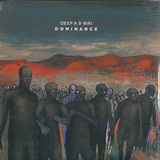
The album's distinctive artwork comes from the studio of Jewish orthodox artist Avraham Guy Barchil, who forged a powerful connection with Deep'a, both was immediately drawn to 'weird atmosphere, amazing technique and emotions involved with his work'. Perhaps one of the most interesting painters from Israel, Avraham is known for his unique perspective, taking his inspiration from the Zohar - the foundational work in the literature of Jewish mystical thought known as Kabbalah. The ambiguous figures represent mystical aspects of the Torah (the five books of Moses), as well as material on mysticism and mythical cosmogony.
Ensuring their natural, conscious touch always remains at the forefront of this unapologetically machine-driven music, Deep'a & Biri have produced an album in the lineage of their heroes and greatest influences. Cerebral yet satisfying, deep yet always engaging, 'Dominance' both reasserts and evolves Deep'a & Biri's forward facing and singular sound.
For fiends of: Cursed, HIs Hero is Gone, Tragedy.
Formed in 2008 in South Florida, Centuries current lineup now includes members based in Pittsburgh, Pennsylvania and Nashville, Tennessee, and in the UK from Manchester.
Since their 2013 debut Taedium Vitae (Southern Lord), the group have refined their sound into something more focused, and intense, and The Lights Of This Earth Are Blinding surges with ten new tracks of the band's harrowing, metallic, punk/crust-influenced hardcore, delivered with a calculated, very deliberate approach.
The album was recorded in February 2017 by Kris Hilbert at Legitimate Business (Catharsis, Torch Runner, The Body), mastered by Brad Boatright at Audiosiege (Integrity, Black Breath, Halshug), and completed with artwork by Phil Trona.
About the new album the band remark..."The Lights Of This Earth Are Blinding is a dark album that carries a theme of constant self-doubt. It follows how we choose to accept our loses and the reaction to life, as well as the journey we take to make peace with the demons we've made.' The new track 'Bygones' is streaming below.
Cryosleep is the debut album from Null + Void, the alias of prolific New York producer Kurt Uenala. It's an album of contrasts and tension, where darkness is pierced by blinding light, and where moody new wave bleeds into stark electronics. In one moment, joyful memories give way to isolation and regret, and in the next, Cryosleep explores the catharsis of crowded dancefloors. Throughout the record, Uenala matches his dynamic production with incredible vocalists-from Depeche Mode's Dave Gahan and the inimitable Shannon Funchess, to Black Rebel Motorcycle Club and The Big Pink. Null + Void's take on dark pop meshes with his love for Detroit electro, poignant synth melodies, and cold atmospheres. With the cinematic opener 'Falling Down' and brooding instrumentals like 'Come To Me", Cryosleep can feel like the soundtrack to a lost space epic. No doubt, the album evokes Blade Runner, dystopian landscapes, and the splendor of far-off galaxies. As Uenala puts it, Cryosleep is inspired by 'classic sci-fi stuff,' images of futuristic machines sustaining humans frozen in a dreamstate. The melancholy 'Foreverness' explores what they might be thinking: 'A collection of fragments, memories of a life lived-preserved, but incomplete and jumbled.' Meanwhile, 'Into The Void' paints a peaceful, otherworldly picture, 'like soaring towards a white light.'
'Exit Entrance' is the DFA debut for Kohei Matsunaga aka NHK yx Koyxen.
Kohei has been making / releasing music since 1997 and has recorded for such iconic labels as Mille Plateaux, Important, Pan & Diagonal.
His latest recordings explore intricate drum programming, lush melodies & sparkling arrangements. Touchstones include the legendary 'Clicks & Cuts' compilations from the 1990's as well as Aphex Twin & Autechre. RA called his music bombastic techno funk....unpredictable but rarely disappointing'.
'Exit Entrance' is a collection of new songs that snap and flicker unlike anything Kohei has done in the past. There is a clarity and beauty to these tracks that bursts out of the speakers in a three dimensional way, matching the 3D glasses that the artist wears during all his live performances. The elegant arrangements and crisp drum breaks match the concise song titles - Kohei foregoes the typical impenetrable track names made up of numbers and shorthand, and opts for a more direct emotional sincerity through the sonic themes of the record. Not all the music here falls into the same exact formula.
As the album heads towards a close, after several tracks of harmonious beauty, we get 'Outset (for Mika Vainio)', a sombre hushed techno tune, dedicated to his late friend and musical collaborator, who unexpectedly passed away earlier this year as the record was being completed. What follows after this track is perhaps the real catharsis, as 'Dented' ominously kicks off with acidic stabs and rolls into a tumultuous dirge of gritty techno.
In this regard, 'Exit Entrance' can play out like a life cycle, a mini opera of birth and beauty, of sorrow and mourning.
It is one of the most direct and honest records Kohei has ever made, and DFA is beyond proud to present this work from such an esteemed creative force in the electronic avant-garde world of music.
For fans of Aphex Twin, Actress, Zomby, Kraftwerk, Four Tet.
Originally released via Ascetic House in 2015, Vereker's Grace tape owes much to the canon of vintage anti-music, exploring catharsis via a transgression of traditional compositional & technical values. Working with the same thematic concerns of much of the more leftfield additions to the Avian catalogue - in it's more subdued moments, anxiety & dissafection; in it's more high energy - pure hysteria - the recording pairs basic synthesis with warped vocals in the same manner as Industrial progenitors Throbbing Gristle and Steven Stapleton (Nurse With Wound).
The reduced palette & crushed production aesthetic creates a powerful immediacy, with a twisted musicality being drawn - at times, kicking and screaming, out of the depths of the mix. Like much of Vereker's best work on labels like LIES & Berceuse Heroique, elements warp & twist uncomfortably within the tight confines of a reduced dynamic spectrum - creating a dark, heady energy.
scetic House, the predominantly cassette only label, has seen appearances from LA's Silent Servant, Northern Electronics' Varg & Avian's own Shifted - under his Covered In Sand alias
- A1: Less Of Me
- B14: The Closet
- A2: My Eyes
- A3: Popularity Is So Boring
- A4: Orphans
- A5: Eliminate By Night
- A6: Freud In Flop
- A7: Burning Rubber
- A8: I Woke Up Dreaming
- A9: Crown Of Thorns
- A10: Baby Doll
- A11: Race Mixing
- A12: Don't Talk About Love
- A13: No Morality
- B1: Instrumental
- B2: Baby Doll
- B3: Freud In Flop
- B4: Race Mixing
- B5: Crown Of Thorns
- B6: Red Alert
- B7: The Closet
- B8: Instrumental
- B9: Freud In Flop
- B10: Burning Rubber
- B11: Red Alert
- B12: Orphans
- B13: Eliminate By Night
Teenage Jesus and the Jerks began to formulate their visionary brand of aural catharsis sometime during the first half of 1977, amidst the sordid ruins of a then fully down-and-out Lower Manhattan. The mastermind behind this juggernaut of sonic libertinage was a barely pubescent but world-weary runaway who called herself Lydia Lunch. Influenced strongly by the Marquis de Sade and Henry Miller, Lunch shrewdly decided to graft the existential horror of her own writing onto harsh, atonal music after being exposed to the room-clearing live output of other contemporary rock-music deconstructionists like Suicide and Mars. With an agenda of conjuring nightmarish intensity in lieu of technical instrumental ability, Teenage Jesus instantly made the supposedly nihilistic' and raw' current wave of so-called Punk acts sound like slick, good-timey pop music by comparison. Teenage Jesus and the Jerks were The Texas Chainsaw Massacre, lisa, She Wolf of the SS, and Salò, or the 120 Days of Sodom, transliterated into a blatant mockery of the increasingly tired, basic rock-band format. Posthumously, there have been numerous reissues of the primary Teenage Jesus corpus, namely the first side of the Lydia Lunch double compilation album Hysterie (CD Presents, 1986), a very incomplete anthology titled Everything (Atavistic, 1995) and Shut Up and Bleed (Cherry Red/Atavistic, 2008), which also featured Beirut Slump tracks. These less-than-fastidious documents contained reverb-laden transcriptions of the studio cuts directly from vinyl copies, as well as random live tracks of mediocre fidelity. This particular collection about to be released on Other-People is meticulously edited and mastered from rare bootlegs taped during the initial 1977-1979 period of classic band, and only one title (Crown of Thorns from January 17,1979) has been legitimately released to date, albeit in a completely different sound quality.